

You built a beautiful direct mail campaign. You pulled the list from your CRM by hand, exported it to a CSV, cleaned the addresses, sent the file to a printer, waited two weeks, and then had no idea which of those 2,000 postcards actually moved a deal. Sound familiar? That gap between sending physical mail and knowing whether it worked is exactly why automation became non-negotiable.
The shift is already happening at scale. According to Postalytics' 2026 direct mail statistics, 56% of businesses now use a direct mail automation software platform to run campaigns, up from 40% in 2023. Marketers are no longer treating mail like a one-off print project. They want it to behave like the rest of the stack: triggered from CRM events, personalized by segment, tracked to a response, and tied to pipeline.
That matters because the channel still performs. The same research reports direct mail open rates in the 80% to 90% range, against 20% to 30% for email, with most marketers seeing response rates above 3%. The problem was never the mailbox. It was the manual workflow standing between your customer data and the physical send. The tools below close that gap.
What's inside
This guide is for growth marketers, demand gen managers, and marketing ops leaders evaluating direct mail automation software for B2B and service businesses. We focused on platforms that connect physical mail to your CRM and martech stack, not standalone print shops. If you're building out a broader stack, our roundups of the best marketing automation software and best account-based marketing software pair naturally with this guide.
We selected and ranked the 12 tools below on four criteria that decide real-world fit:
- CRM and martech integration depth, including native connectors and API access
- Personalization and segmentation driven by customer or account data
- Tracking and attribution, including delivery tracking, QR codes, pURLs, and response measurement
- Ease of use and pricing transparency for both small teams and scaled revenue orgs
No tool made the list on brand recognition alone. Each one earns its place by solving a specific direct mail automation job.
TL;DR
Short on time? Here is the quick decision map by buyer type.
- Best for CRM-driven campaign speed: Postalytics. Strong tracking, free tier, and fast triggered campaigns make it the default starting point for most marketing teams.
- Best for developer-led, programmatic mail: Lob. An API-first platform for teams that want to send and track mail directly from their own systems.
- Best for revenue and account-based gifting plus mail: Sendoso, Postal, and Reachdesk. These blend direct mail into broader sending and gifting motions for sales and ABM.
- Best for performance-style direct mail with digital targeting: Postie. Built for marketers who want lookalike audiences, retargeting, and ROAS measurement on physical mail.
- Best for address verification and scaled print automation: PostGrid and Stannp. Both pair clean address data with print-and-mail APIs.
- Best for simple self-serve campaigns: Mailjoy, Click2Mail, and Printfection serve smaller teams and merch-adjacent sends without heavy setup.
Background
What direct mail automation software is
Direct mail automation software is a platform that lets marketing teams create, personalize, send, and measure physical mail campaigns from a single connected system, using customer data and automated triggers instead of manual print workflows.
In plain terms, it turns direct mail into a programmatic channel. Instead of exporting lists and emailing a printer, you connect your CRM or marketing automation platform, define who gets mailed and when, and let the software handle printing, fulfillment, and tracking. The result is automated direct mail that behaves like email or paid media, with delivery tracking and attribution built in. The same logic that powers an interactive demo applies here: connected data drives a personalized, measurable experience.
Most direct mail marketing software includes some combination of these capabilities:
- Template and design tools for postcards, letters, and self-mailers
- CRM and martech connectors for list sync and triggers
- Personalization fields driven by contact or account data
- USPS address verification and deduplication
- Automated printing and fulfillment
- Delivery tracking and response tracking via QR codes and pURLs
- Attribution reporting tied to conversions or pipeline
How the workflow works
A typical automated direct mail workflow runs like this:
- Trigger. A CRM event, lifecycle stage change, or intent signal fires. Examples: a lead hits a high score, a deal stalls, or a customer lapses.
- Audience and data. The platform pulls the matching contacts, runs USPS address verification, and removes bad records to protect cost and deliverability.
- Personalization. Merge fields pull names, company data, account details, or offers into the design. Segments can receive different creative.
- Print and fulfillment. The software sends the job to a print and mail network automatically, with no manual handoff.
- Delivery tracking. You see mailstream status and estimated in-home dates, so sales or email follow-up can be timed around arrival.
- Response tracking and attribution. QR codes, pURLs, unique URLs with UTMs, or promo codes capture responses and tie them back to conversions and revenue.
The whole point is that each step runs from connected data, not a spreadsheet.
Why marketers use it
Direct mail marketing automation earns its place in the stack because it adds a physical touch to motions that are otherwise all-digital, while staying measurable. Teams use it to:
- Generate and influence pipeline with triggered, high-intent outreach
- Support account-based marketing by mailing target accounts on cue
- Run lifecycle plays like onboarding, reactivation, and renewal
- Stand out in omnichannel campaigns where inboxes are saturated
The performance backdrop helps. Postalytics' 2026 data found 85% of marketers agree direct mail delivers the best conversion rate of the channels they use, and 84% read direct mail the same day they receive it. Automation is what makes that performance repeatable and attributable rather than a manual gamble.
When to use direct mail automation software
Direct mail automation is not for every campaign. It earns its budget in a few specific motions where physical mail moves the needle and digital alone stalls.
Trigger high-value outreach from CRM events
The strongest use case is event-driven mail. When a lead crosses a high-intent threshold or a deal goes quiet, a triggered postcard or dimensional mailer can reopen the conversation.
Example trigger logic: a marketing-qualified lead views the pricing page twice in 72 hours, so the platform automatically queues a personalized letter, then notifies the rep to follow up the day it lands. Best-practice playbooks recommend leading with email and digital retargeting in the first 0 to 72 hours, then triggering automated direct mail for high-intent segments within 48 to 96 hours to cut waste and add lift. Pairing this with lead scoring software helps define which segments qualify for a physical touch.
Personalize outreach by segment or account
Direct mail works far better when it is mapped to data rather than blasted to a generic list. Tie the creative to account, persona, or lifecycle stage. Mature teams treat this the same way they treat personalization software across other channels.
Example personalization variables:
- Contact name, title, and company
- Account industry, region, or tier
- Lifecycle stage or renewal date
- Product or plan currently in use
- Offer or incentive specific to the segment
Use cases include account-based marketing mailers, VIP customer gifts, win-back offers for lapsed buyers, and event invitations for a target list.
Measure physical campaigns alongside digital channels
The reason to automate, rather than outsource to a printer, is measurement. Good direct mail software treats mail as a trackable channel.
You can monitor metrics like:
- Pieces produced, mailed, and delivered
- Estimated in-home dates
- QR code and pURL scans or visits
- Response rate by segment
- Conversions, meetings booked, or pipeline influenced
When that data flows back into your CRM, direct mail stops being a black box and starts showing up in the same attribution reporting as everything else.
Comparison table
Here is the full list at a glance. Pricing and ratings reflect verified, first-party and G2 data at publish time. Tools are sorted by relevance to the direct mail automation software keyword, starting with the most CRM-and-tracking-focused platforms.
| # | Product | Intent | Key differentiation | Pricing | G2 rating |
|---|---|---|---|---|---|
| 1 | Postalytics | CRM-driven direct mail automation | Triggered campaigns with strong tracking and a free tier | Free; Marketer $199/mo; Pro & Agency $399/mo | 4.4/5 |
| 2 | Lob | Programmatic, API-first mail | Postal IQ routing and print delivery network | Developer free; Startup $260/mo; Growth $550/mo | 4.4/5 |
| 3 | Sendoso | Gifting plus direct mail for revenue teams | AI gifting recommendations and global fulfillment | Custom (Starter, Core, Advanced, Enterprise) | 4.6/5 |
| 4 | Postal | Gifting, swag, and direct mail | Marketplace and ROI reporting in one hub | Custom | 4.5/5 |
| 5 | Reachdesk | Global gifting and direct mail for B2B | Global vendor marketplace and AI personalization | From $20,000/year | 4.5/5 |
| 6 | PostGrid | Print, mail, and address verification | Address verification across 245+ countries | Custom | 4.9/5 |
| 7 | Postie | Performance direct mail for digital marketers | Lookalike audiences and real-time ROAS tracking | Custom | 3.9/5 |
| 8 | PFL | Tactile marketing automation | CRM-triggered mail with in-house fulfillment | Custom | 4.2/5 |
| 9 | Printfection | Swag and branded merch fulfillment | Inventory storage and kit fulfillment | Custom | 4.4/5 |
| 10 | Mailjoy | Self-serve postcards and letters | Drag-and-drop designer with pay-as-you-go pricing | Free; from $0.90/postcard; Pro 150 $128/mo | 4.5/5 |
| 11 | Click2Mail | Outsourced postal mail | Email-to-Mail and pay-only-for-what-you-mail | No subscription; pay per piece | 4.1/5 |
| 12 | Stannp | Trackable direct mail at scale | Address verification, live tracking, and webhooks | Free; Starter $12/mo; Growth $48/mo; Premium $315/mo | 4.8/5 |
1. Postalytics
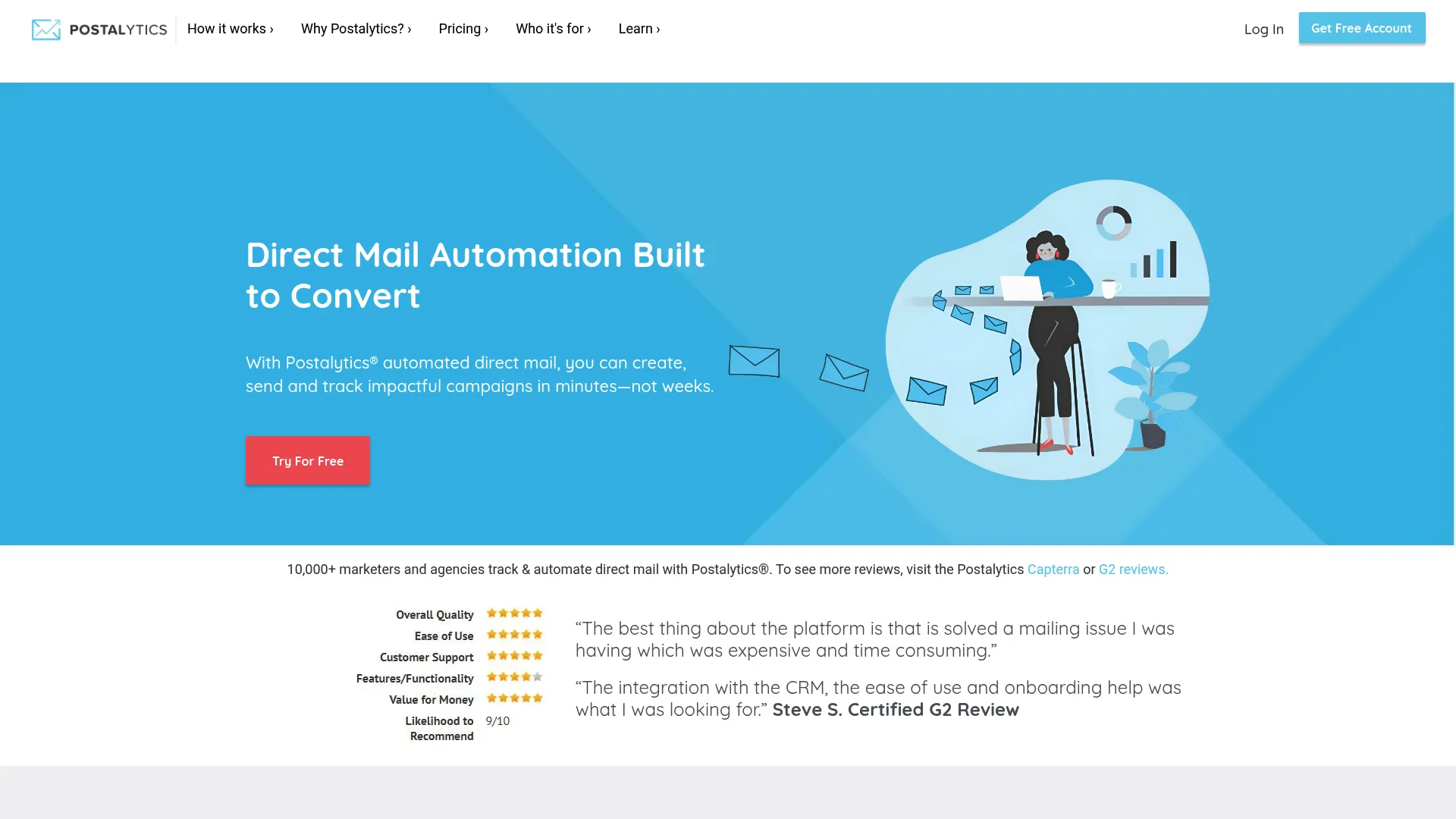
Postalytics is direct mail automation software built for creating, sending, and tracking postcard and letter campaigns from a connected workflow. It positions itself around speed and measurement, letting teams launch automated direct mail without the manual print cycle. For most marketing teams evaluating this category, it is the natural first stop because it pairs triggered campaigns with strong response visibility and a genuinely usable free tier.
The platform leans hard into tracking. Campaign analytics, delivery status, QR codes, and pURLs give you response visibility that turns mail into a measurable channel rather than a guess. It connects to CRM and marketing automation tools so sends can fire from lifecycle stages or intent signals, and it handles USPS address verification to keep your list clean and your costs down.
Best for: Marketing teams that want CRM-triggered direct mail with tracking and attribution baked in.
Key strengths
- Direct mail editor: Build postcards and letters with personalization fields, no design team required.
- Tracking and analytics: Monitor delivery, scans, and responses through QR codes and pURLs for clear attribution.
- Triggered campaigns: Fire automated sends from CRM events and lifecycle stages without manual exports.
Why choose Postalytics: It hits the sweet spot for digital marketers who treat direct mail as part of an omnichannel system. The free plan lets you validate the workflow before committing budget, and the tracking depth means you can defend the channel in a pipeline review. If your priority is connecting mail to CRM data and proving response, this is the most direct fit.
Postalytics pricing: The U.S. pricing page lists a Free plan at $0 per month, a Marketer plan at $199 per month, and Pro and Agency plans at $399 per month, all with all-in per-piece pricing. Annual and higher-volume pricing are available by contacting sales. The free tier makes it easy to test triggered campaigns before scaling.
2. Lob
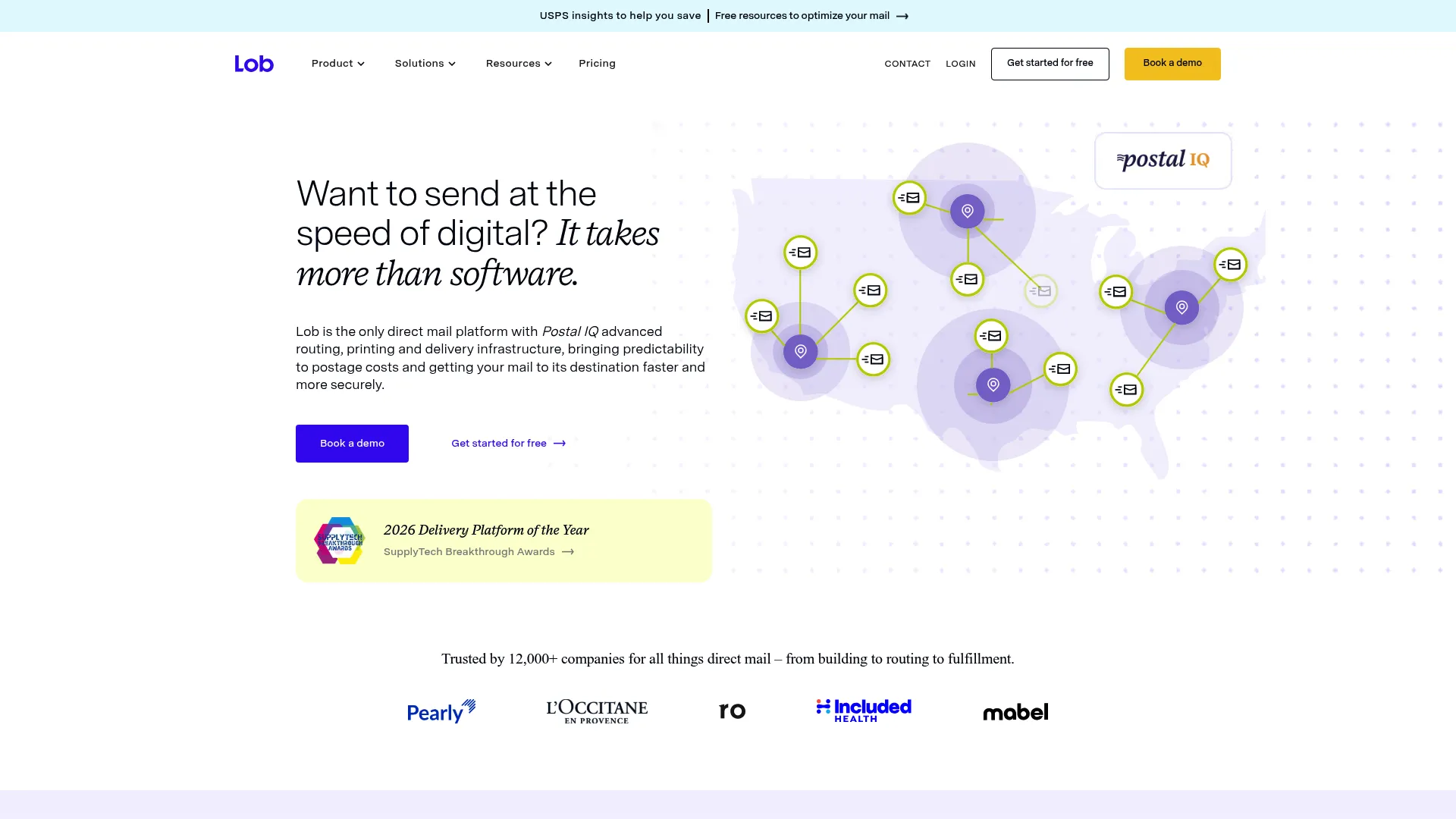
Lob is a direct mail automation platform built for sending, printing, routing, and tracking mail programmatically. It is the API-first option on this list, designed for teams that want to trigger and manage mail directly from their own product, app, or data pipeline. If you have engineering bandwidth and want direct mail to behave like any other API-driven workflow, Lob fits cleanly into a stack-heavy operation.
Where Lob stands out is operational infrastructure. Its Postal IQ routing intelligence and nationwide print delivery network are built to move volume reliably, and its campaign tools, APIs, personalization, and tracking give marketing and engineering a shared surface to work from. That makes it a strong fit for product-led motions where mail is part of a lifecycle automation rather than a one-off campaign.
Best for: Operations and engineering-supported marketing teams that want scalable, programmatic direct mail.
Key strengths
- Postal IQ routing intelligence: Optimize how and where mail is routed for reliable, efficient delivery.
- Print delivery network: Lean on a nationwide network built to handle volume without manual coordination.
- APIs and tracking: Trigger, personalize, and track mail directly from your own systems.
Why choose Lob: Choose Lob when your team wants direct mail to live inside existing automation rather than a separate campaign tool. The trade-off is that you get the most value with developer involvement, so it suits teams with stack-heavy workflows over those wanting a pure point-and-click builder.
Lob pricing: Lob combines a platform subscription with per-piece pricing. The Developer edition is free to start, with 4x6 First Class pieces shown around $0.872. The Startup edition runs a $260 monthly subscription with lower unit pricing, and the Growth edition is $550 per month with the lowest published unit rate near $0.582. Enterprise pricing is available by talking to sales.
3. Sendoso
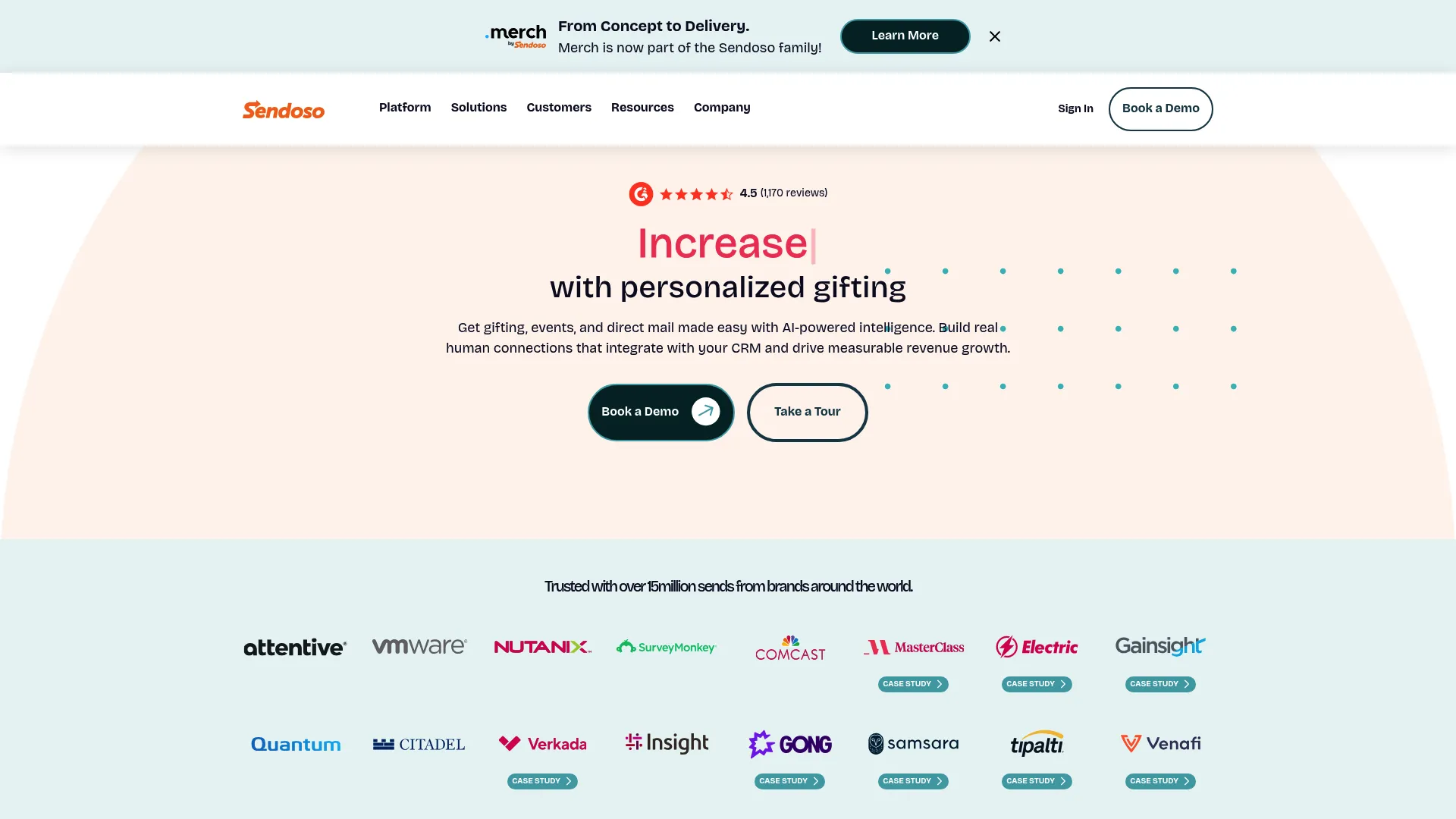
Sendoso is a sending management platform that combines personalized gifting, direct mail, and campaign fulfillment for B2B revenue teams. Direct mail sits inside a broader sending motion here, which makes Sendoso a strong fit when physical outreach is part of an account-based or sales-driven play rather than a standalone mail program.
The platform uses AI-powered gifting recommendations to help reps and marketers pick the right send for each recipient, then handles fulfillment and tracking. Integrations and analytics connect sends to CRM data, so you can tie a mailed gift or postcard to a meeting booked or a deal advanced. For revenue teams running ABM, that closed loop is the appeal. Teams that want even tighter alignment often pair this with broader sales engagement tools.
Best for: B2B sales and marketing teams that want to automate personalized gifting and direct mail at scale.
Key strengths
- AI-powered gifting recommendations: Match the right send to each recipient automatically.
- Direct mail and eGift sending: Run physical and digital sends from one platform.
- Integrations and analytics: Connect sends to CRM workflows and measure impact on pipeline.
Why choose Sendoso: Pick Sendoso when direct mail is one tactic inside a larger account engagement motion. A common use case is sending a personalized dimensional mailer to a stalled enterprise account, then triggering rep follow-up when it lands. It is built for revenue workflow, so it shines for sales-led teams more than for high-volume batch mail.
Sendoso pricing: Sendoso does not publish pricing. Its compare-plans page lists Starter, Core, Advanced, and Enterprise tiers and routes buyers to talk to sales, describing flexible pricing based on company size, goals, and global presence.
4. Postal
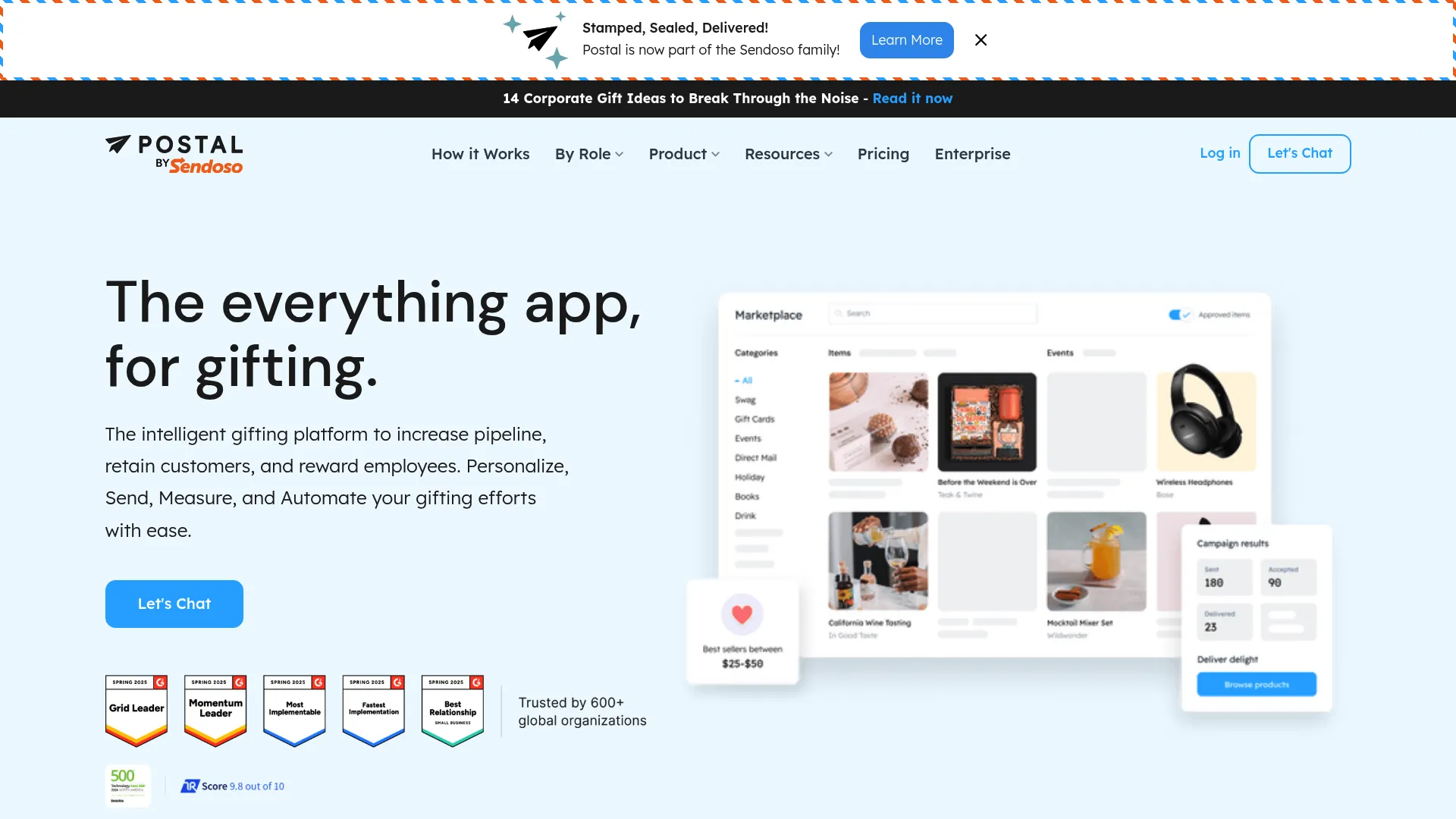
Postal is an intelligent gifting platform for sending, tracking, and automating corporate gifts, swag, and direct mail. Like Sendoso, it treats mail as part of a wider sending motion, with a marketplace of gifts and swag plus the orchestration to deliver and measure them. It suits teams that want operational simplicity and clear campaign control across both gifting and mail.
The platform pairs a gifting marketplace and swag store with reporting and ROI tools, so the send-to-track loop stays intact. You choose the item, personalize it, automate the send from a trigger or list, and watch the outcome flow into your reporting. That makes it a practical option for marketing and revenue teams that want one hub for physical touches.
Best for: B2B teams that want to automate personalized gifting, swag, and direct mail from one platform.
Key strengths
- Gifting marketplace: Choose from a curated set of gifts to match recipient and campaign.
- Swag store: Manage and send branded merchandise alongside mail.
- Reporting and ROI: Track sends through to outcomes for clear attribution.
Why choose Postal: Choose Postal when you want personalization and automation across gifting and direct mail without standing up separate tools. It emphasizes send-to-track workflow, so you can connect a physical touch to a measurable result. Compared with API-first platforms, it favors marketers who want a managed hub over a developer-driven pipeline.
Postal pricing: Postal does not display public pricing. Its pricing page presents an Engage plan with a contact-sales CTA and a feature list, so figures are available through a sales conversation.
5. Reachdesk
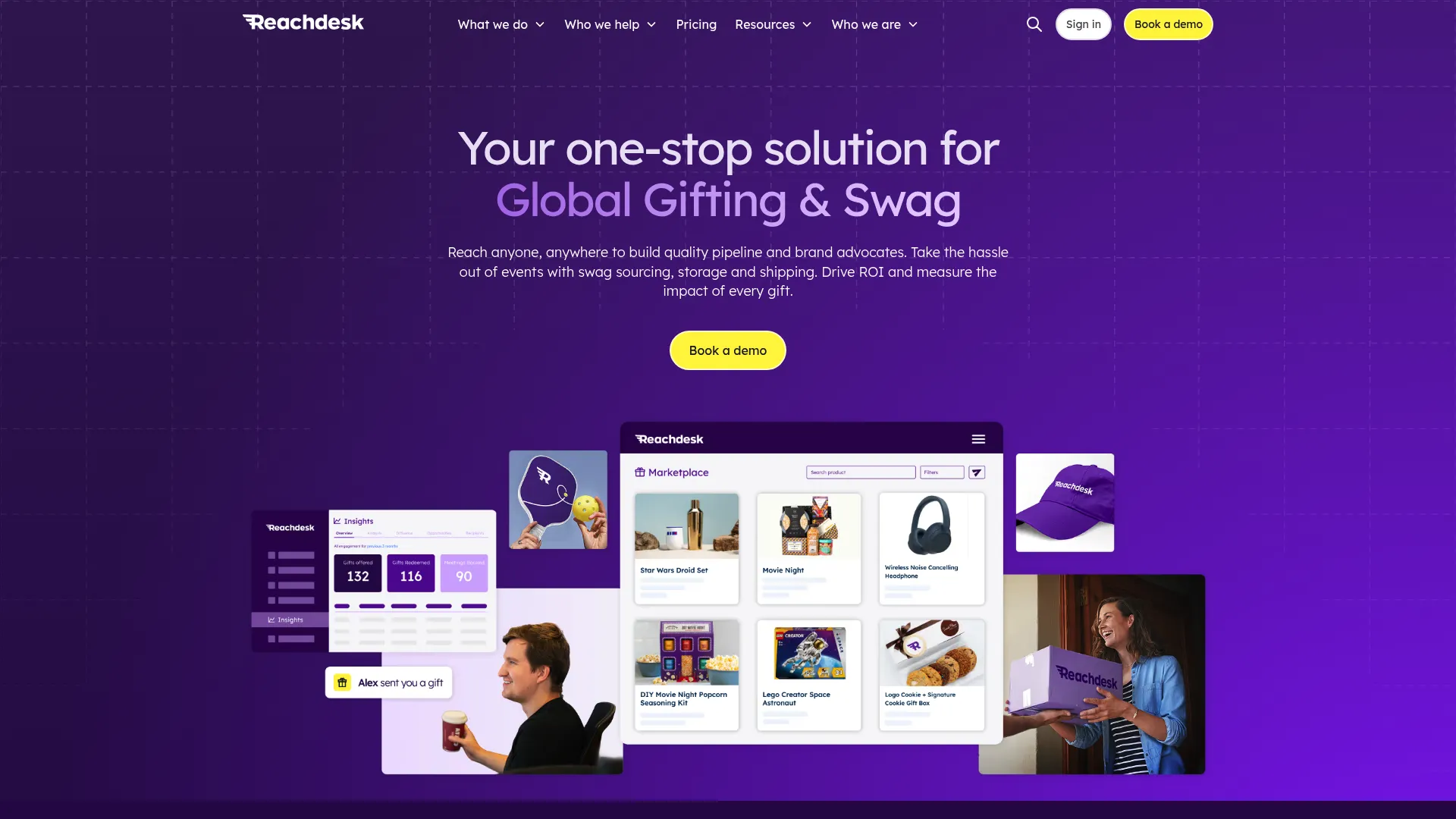
Reachdesk is a global gifting and direct mail platform that helps B2B teams source, store, ship, track, and measure corporate gifts and swag. It blends direct mail with gifting and account engagement, with particular strength in global reach. Reachdesk reports fulfillment in 150+ countries, which makes it a fit for teams running account-based motions across regions.
The platform combines a global vendor marketplace with AI-powered personalization and full swag sourcing, storage, shipping, and fulfillment. For revenue teams, the value is consistency: you can run the same personalized mail or gift play across markets and measure it in one place. That account-based fit is where Reachdesk complements a direct mail motion rather than replacing a batch-mail tool.
Best for: B2B sales, marketing, and people teams that need global gifting and direct mail fulfillment.
Key strengths
- Global vendor marketplace: Source gifts and mail across regions from one catalog.
- AI-powered personalization: Tailor sends to recipient and account context.
- End-to-end fulfillment: Handle sourcing, storage, shipping, and tracking in one workflow.
Why choose Reachdesk: Reachdesk earns its place when account-based campaigns span multiple countries and need consistent execution. A typical ABM use case is mailing a coordinated, personalized package to a buying committee spread across regions, then tracking engagement centrally. It complements direct mail programs that have outgrown single-country tools.
Reachdesk pricing: Reachdesk plans start at $20,000 per year for the Core tier. Published plan names include Core, Plus, and Premium, with pricing details for the higher tiers available through sales. There is no free tier.
6. PostGrid
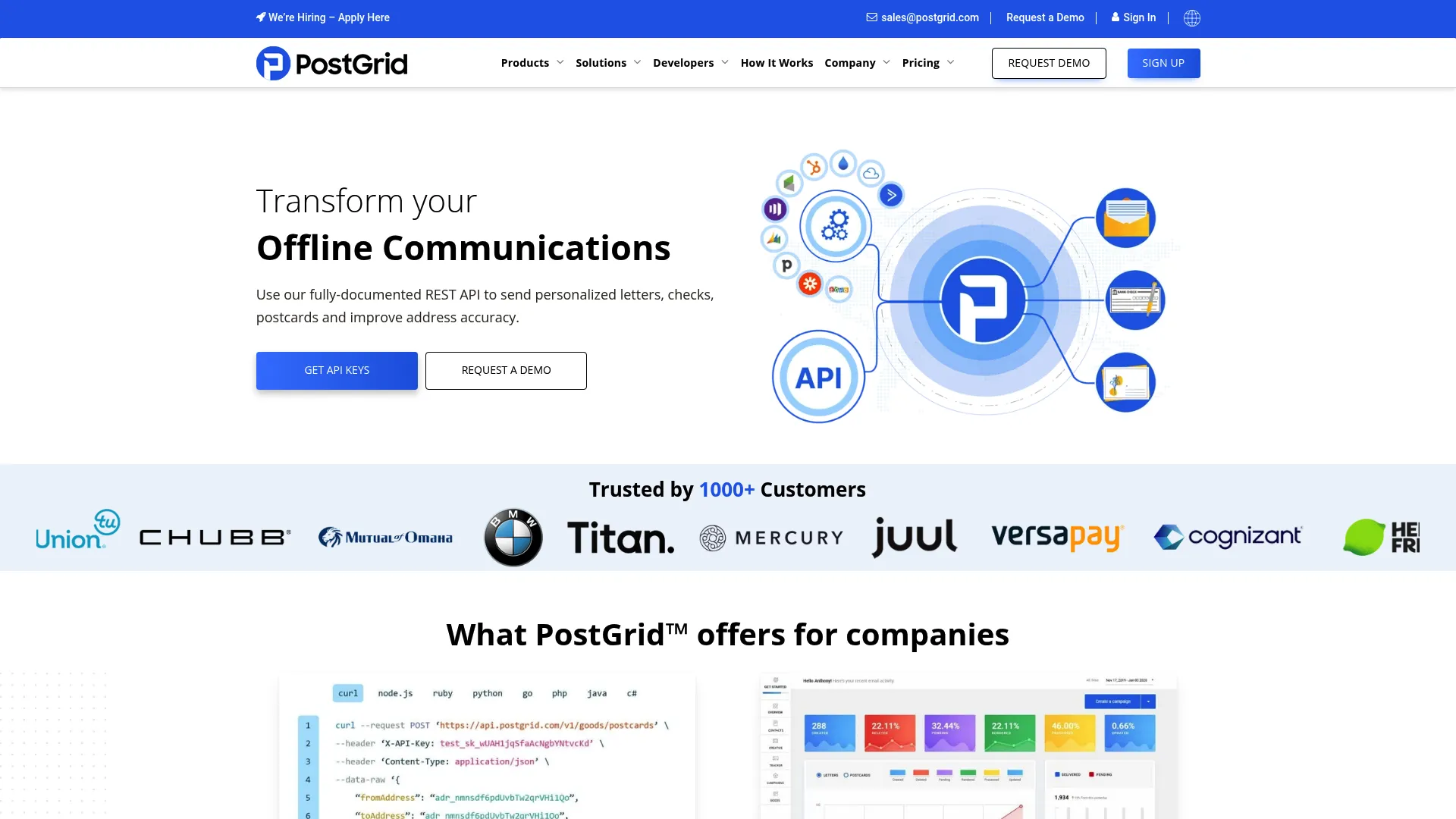
PostGrid is an offline communication platform for automated print-and-mail and address verification. It is the strongest pick on this list when data quality is the priority, pairing a print and mail API with verification that keeps lists clean before anything hits the press. For teams that need direct mail CRM integration and scalable, accurate sends, it is a serious option.
The platform offers a Print and Mail API for letters, postcards, and checks, plus US and Canada address verification and autocomplete and international verification across 245+ countries. That combination matters because clean addresses control cost and protect deliverability. PostGrid also supports automation and templating, so high-volume mailing workflows can run programmatically from your data.
Best for: Businesses automating direct mail and address verification at scale.
Key strengths
- Print and mail API: Send letters, postcards, and checks programmatically.
- Address verification: Verify and autocomplete US and Canada addresses to cut waste.
- International coverage: Validate addresses across 245+ countries for global sends.
Why choose PostGrid: Choose PostGrid when data accuracy and integration are non-negotiable. It fits teams that want direct mail connected to CRM data and triggered through an API, with verification doing the quiet work of protecting spend. The category-leading G2 rating reflects how well it serves automation-focused operators.
PostGrid pricing: PostGrid does not publish prices on its pricing page. The site lists its Print and Mail API and address verification APIs, and first-party support content directs buyers to contact sales for pricing.
7. Postie
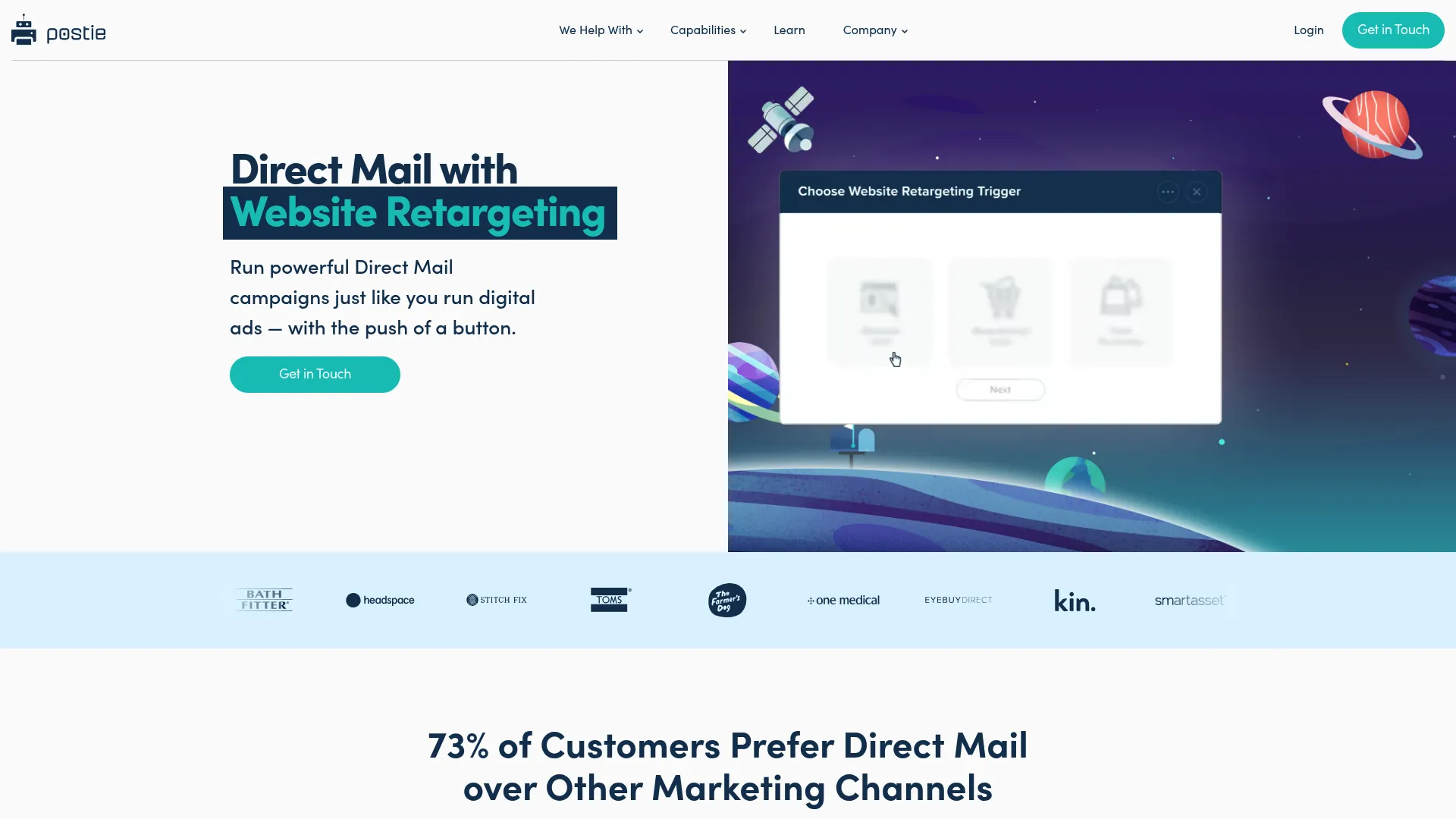
Postie is a direct mail marketing platform built for digital marketers, focused on targeting, execution, and measurement. It brings a performance-marketing mindset to physical mail, with audience modeling and real-time measurement that will feel familiar to anyone running paid digital. That makes it a fit for marketers who want triggered, segmented, and measurable campaigns rather than batch sends.
The platform supports lookalike audiences and custom audience targeting, website retargeting to postal addresses, and real-time campaign measurement with ROAS tracking. The retargeting angle is the standout: you can reach site visitors through their mailbox and measure the return like a digital channel. For attribution-minded teams, that closes the loop between web behavior and physical mail.
Best for: Brands running measurable direct mail campaigns with CRM, website, and retargeting data.
Key strengths
- Lookalike and custom audiences: Build targeted audiences from your first-party data.
- Website retargeting to mail: Reach site visitors through direct mail, not just ads.
- Real-time ROAS tracking: Measure return as the campaign runs, like a digital channel.
Why choose Postie: Pick Postie when you think about direct mail the way you think about paid media. It is built for trigger-based and segmented campaigns with attribution front and center, which suits performance marketers more than teams wanting a simple postcard tool.
Postie pricing: Postie does not publish pricing on its site. Buyers connect with the team for a quote based on their campaign needs.
8. PFL
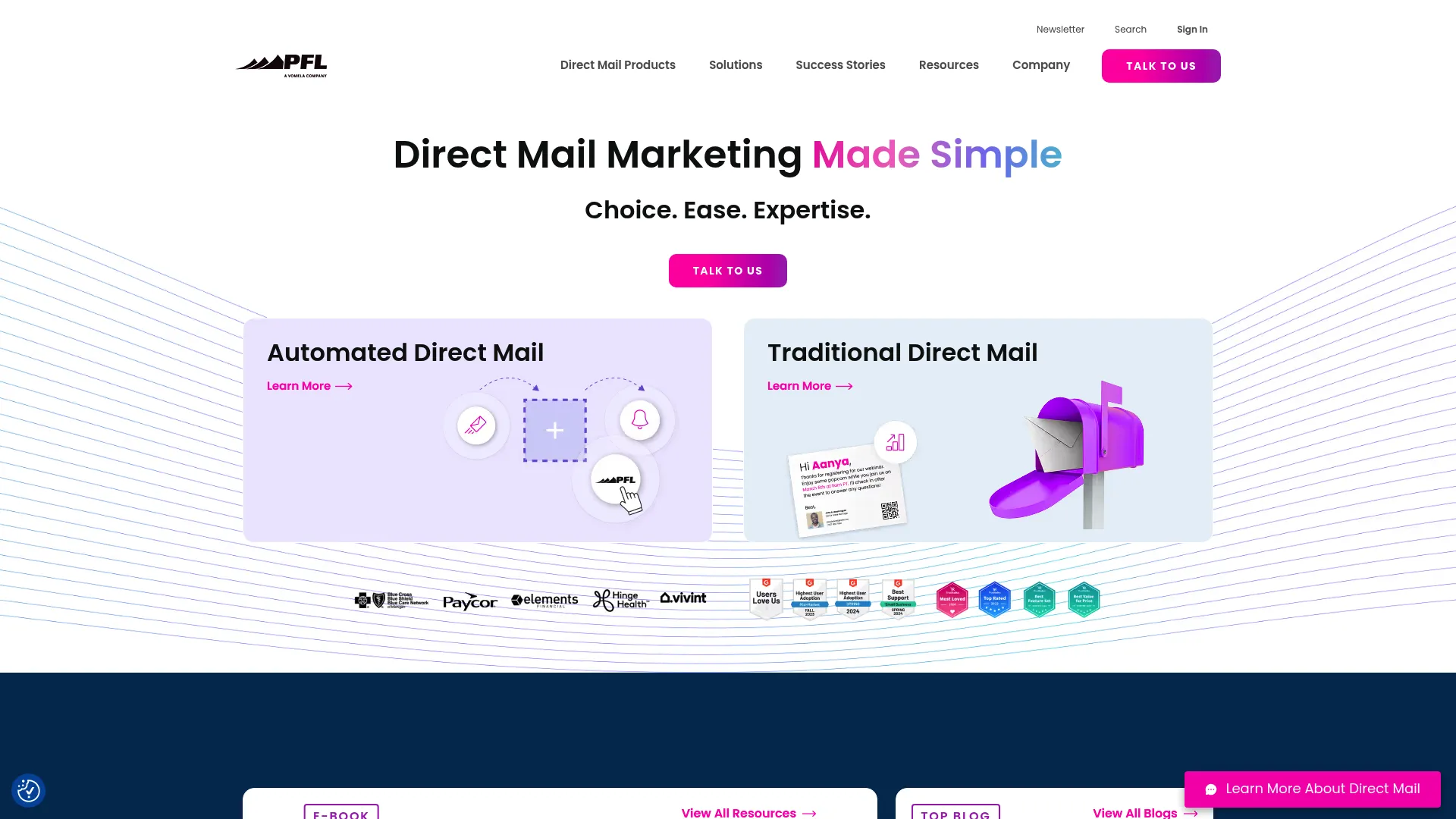
PFL is a direct mail automation platform that combines software, printing, fulfillment, and measurement into what it calls tactile marketing automation. It is built for personalized physical outreach at scale, with campaign orchestration that ties mail to CRM and marketing automation workflows. For larger teams running complex, account-based campaigns, PFL brings the automation and fulfillment under one roof.
The platform triggers automated direct mail from CRM and MAP workflows, supports personalization at scale through template fields and recipient data, and handles in-house printing, storage, and fulfillment with delivery tracking. That vertical integration is the appeal: you are not stitching together a mail tool, a printer, and a tracking layer. PFL runs the orchestration end to end.
Best for: B2B teams that want automated, personalized direct mail tied to CRM and MAP workflows.
Key strengths
- CRM and MAP triggers: Fire automated mail from your existing marketing workflows.
- Personalization at scale: Populate template fields with recipient data for tailored sends.
- In-house fulfillment: Print, store, and ship with delivery tracking from one provider.
Why choose PFL: PFL fits larger teams and more complex campaigns where personalization, automation, and fulfillment all need to work together. It positions the direct mail use case at the center while handling the operational weight, which suits enterprise marketing orgs over lean self-serve teams.
PFL pricing: PFL uses contact-based selling and does not publish pricing or plan names on its site. Buyers work with the team to scope a plan for their volume and workflow.
9. Printfection
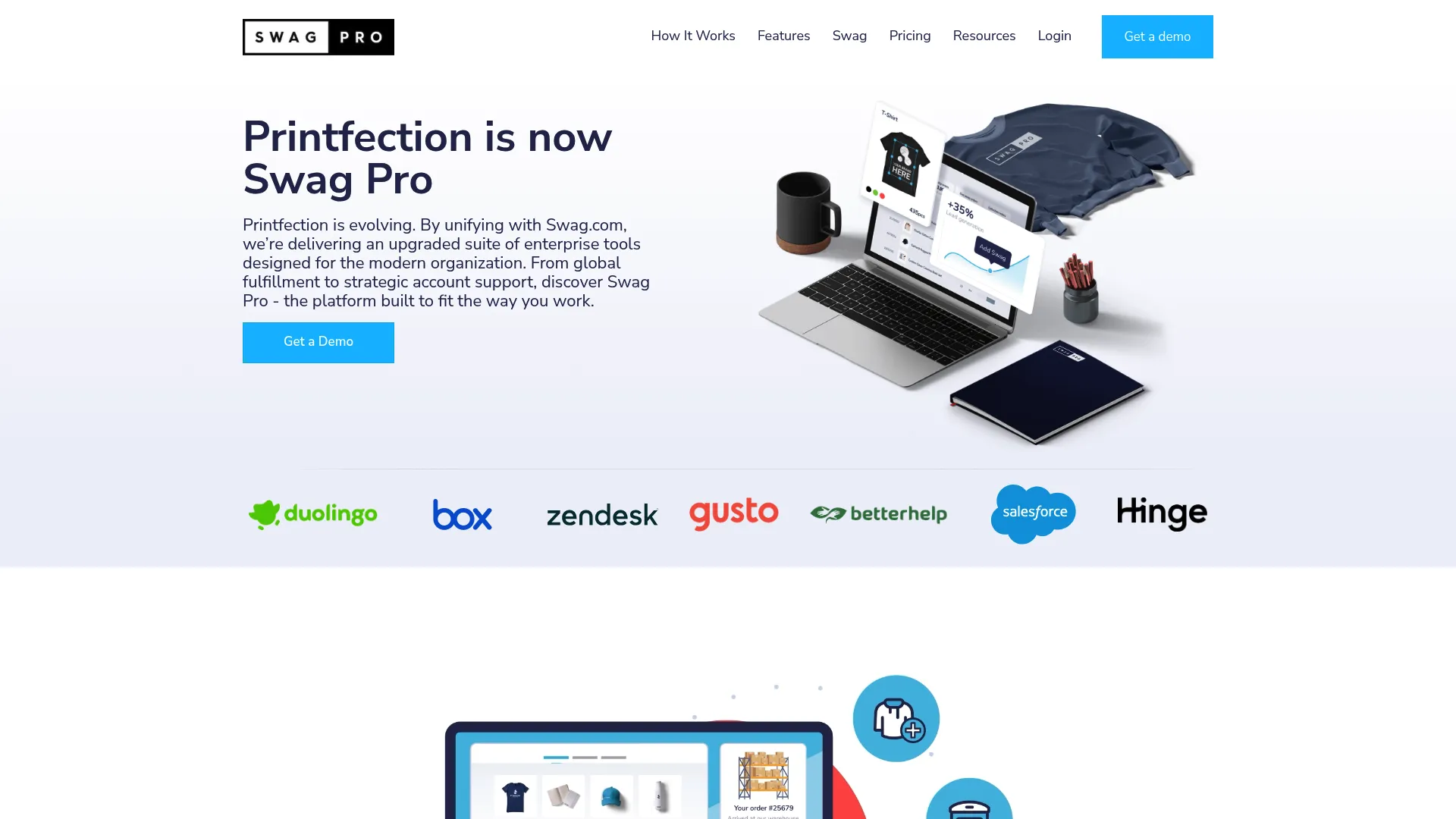
Printfection is a swag management platform for ordering, storing, and distributing branded merchandise. It belongs on this list where merch and fulfillment are part of the physical marketing motion, not as a core postcard-and-letter tool. If your direct mail-adjacent campaigns lean on branded items, kits, and swag, Printfection handles that fulfillment cleanly.
The platform centralizes inventory storage and management, swag kits and fulfillment, and user budgets, reporting, and integrations. That makes it useful for campaigns where the physical send is a branded package rather than a mailer. It is strongest when merch is the medium, so frame it as a complement to a direct mail program rather than a replacement for one.
Best for: Teams needing centralized swag storage, ordering, and fulfillment for physical campaigns.
Key strengths
- Inventory storage: Warehouse and manage branded merchandise centrally.
- Swag kits and fulfillment: Assemble and ship branded packages on demand.
- Budgets and reporting: Control spend and track distribution across teams.
Why choose Printfection: Choose Printfection when branded merch and kit fulfillment are part of your campaign mix. It is built around physical marketing fulfillment, so it pairs well with a direct mail tool when you want both mailers and swag in the same motion.
Printfection pricing: Printfection lists Standard, Enterprise, and Custom plans on its pricing page but does not publish numeric prices. Plans require a sales conversation.
10. Mailjoy
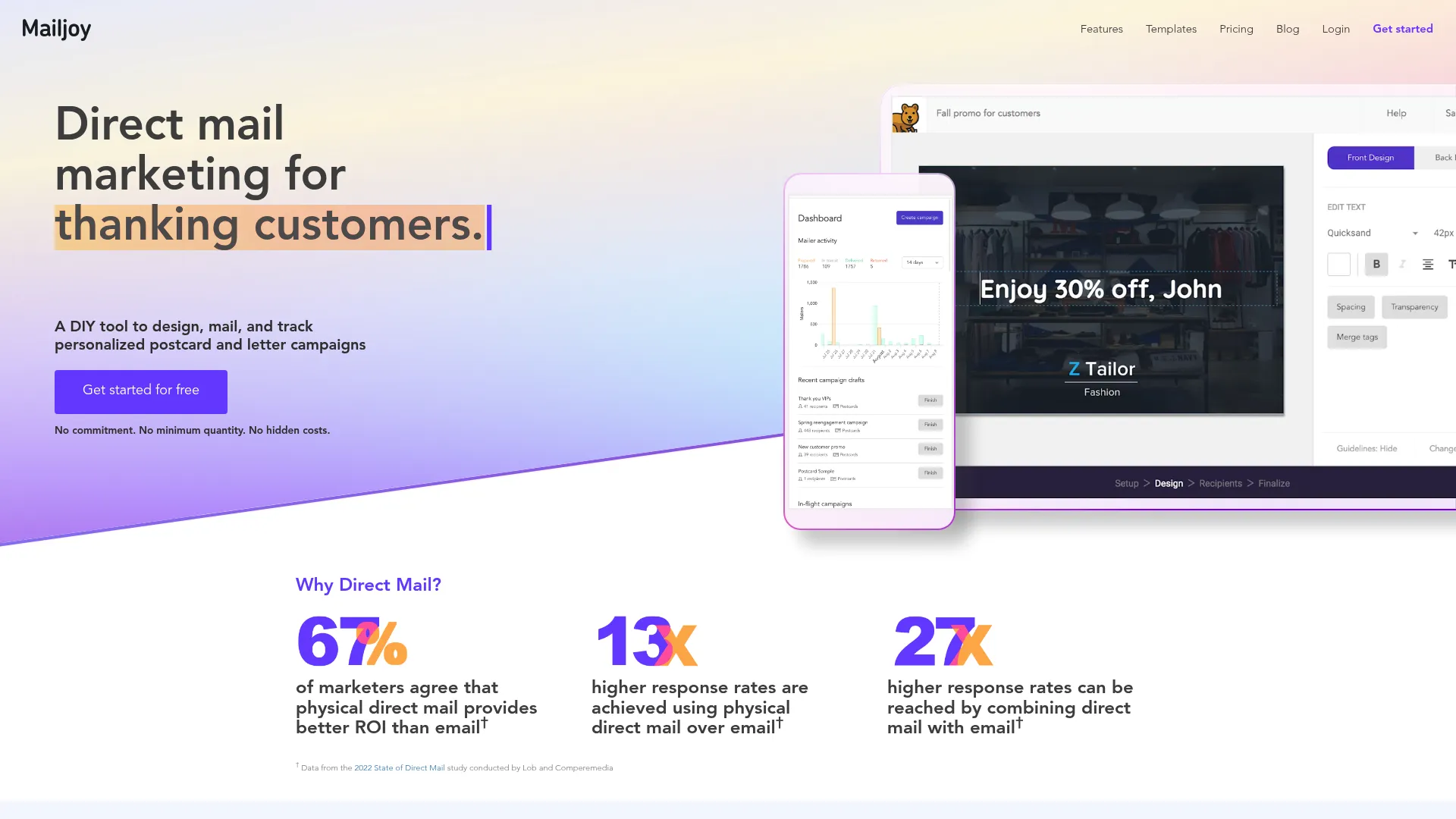
Mailjoy is direct mail software for designing, sending, and tracking personalized postcards and letters. It is built for simplicity, with a drag-and-drop designer and pay-as-you-go pricing that lets smaller teams launch campaigns fast. For marketers who want practical execution without enterprise overhead, Mailjoy keeps the workflow accessible.
The platform combines a drag-and-drop postcard and letter designer, mailing list management and segmentation, personalization with merge tags, and live preview, PDF proofs, and delivery and conversion tracking. That gives smaller teams the core of direct mail marketing automation without a steep setup. You can design, segment, personalize, send, and track from one place.
Best for: Teams that want self-serve direct mail campaigns with personalization and tracking.
Key strengths
- Drag-and-drop designer: Build postcards and letters without design resources.
- List management and segmentation: Organize and target your audience inside the tool.
- Personalization and tracking: Use merge tags and track delivery and conversions.
Why choose Mailjoy: Mailjoy suits small teams and lean marketing functions that value speed and usability over deep enterprise features. Its pay-as-you-go model and free starting point make it a low-risk way to run direct mail automation software for small business needs.
Mailjoy pricing: Mailjoy is free to use with pay-as-you-go pricing. Postcards start at $0.90, with larger sizes at $1.20 and $1.50, and letters at $1.50. Discounted monthly credit plans for postcards include Pro 150 at $128 per month, Pro 500 at $415 per month, Pro 1,000 at $800 per month, and Pro 2,500 at $1,925 per month.
11. Click2Mail
Click2Mail is an online direct-mail platform for creating, automating, and sending postal mail pieces. It is a practical, established option for teams that need straightforward output and mailing without managing postage and fulfillment by hand. Where other tools lean into orchestration, Click2Mail focuses on getting mail produced and sent efficiently.
The platform offers Email-to-Mail for turning email attachments into postal mail, Mailing Online products spanning postcards, letters, flyers, brochures, and certified mail, and CRM and integration tools including Click2Mail Connect and Zapier. That mix fits operational marketing workflows where you need to send a variety of mail types reliably. It is functional and direct rather than feature-heavy.
Best for: Businesses that need to automate or outsource direct mail without managing fulfillment manually.
Key strengths
- Email-to-Mail: Turn email attachments into physical mail pieces.
- Broad mailing products: Send postcards, letters, flyers, brochures, and certified mail.
- CRM and Zapier integration: Connect mailing to your tools through Click2Mail Connect and Zapier.
Why choose Click2Mail: Choose Click2Mail when you want a dependable way to produce and send a range of mail types without standing up a heavy platform. It fits operational marketing teams that value execution and variety over campaign orchestration.
Click2Mail pricing: Click2Mail states there are no monthly or subscription fees and that customers only pay for what they mail. Public per-piece pricing is not displayed on the main page, and the Email-to-Mail flow routes users to a cost estimate.
12. Stannp
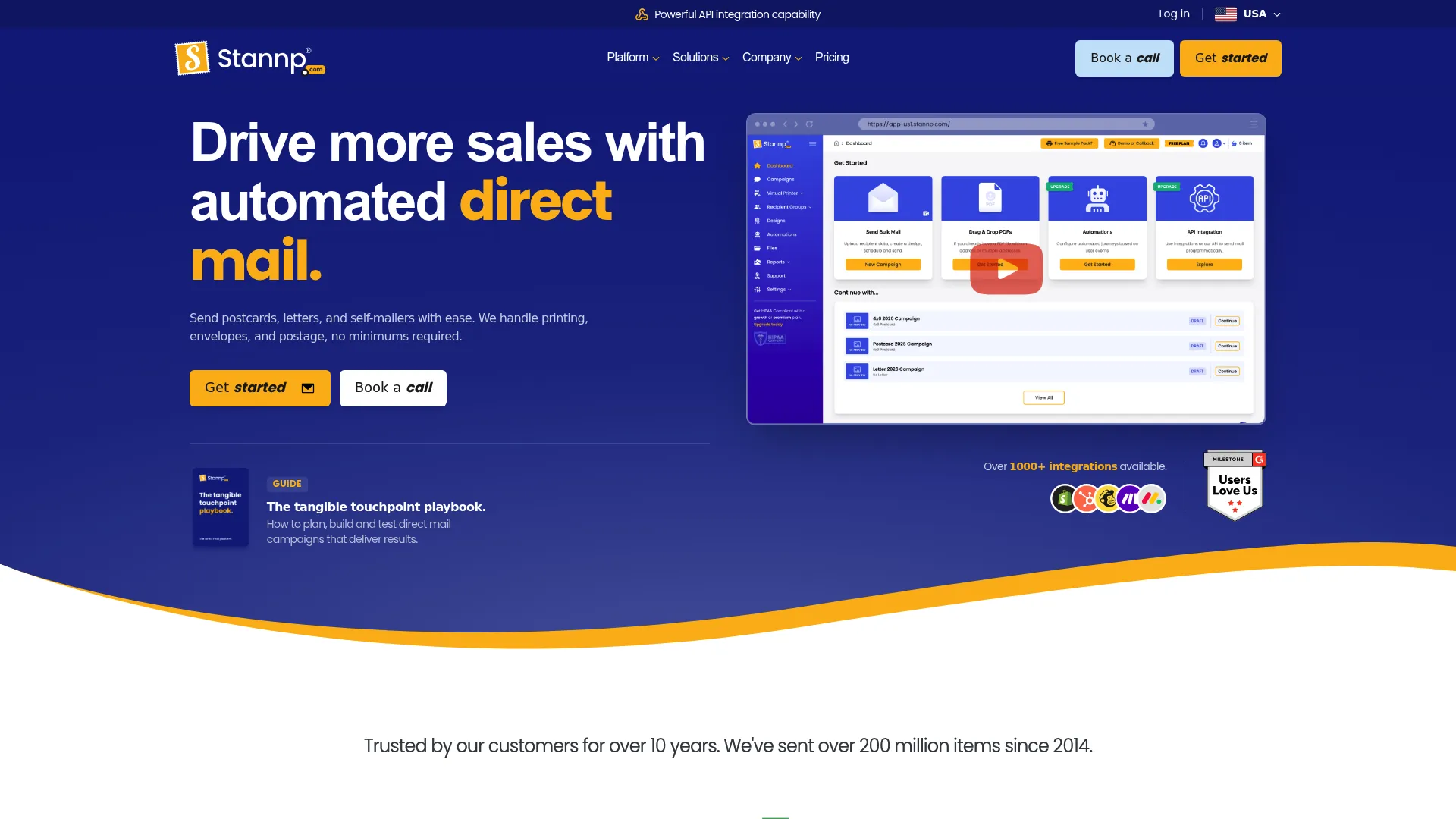
Stannp is a direct mail marketing platform for sending postcards, letters, self-mailers, and SMS, with automation and tracking built in. It is a flexible, data-driven option for teams that want mail triggered from systems and measured closely. With transparent self-serve pricing and a free tier, it is approachable for smaller teams while scaling to higher volume.
The platform includes address verification, live mail tracking, and API integrations and webhooks. The webhook and API support is the standout for automation: you can trigger mail from events in your own systems and branch sequences based on response. Combined with address verification and live tracking, that gives data-driven marketers the control they expect from a digital channel.
Best for: Businesses needing automated, trackable direct mail at scale.
Key strengths
- Address verification: Clean and validate addresses to protect deliverability and cost.
- Live mail tracking: Follow mail status in real time for timed follow-up.
- API and webhooks: Trigger and branch campaigns from your own systems.
Why choose Stannp: Stannp appeals to data-driven marketers who want automation and integration without enterprise pricing. Its API and webhook support tie mail to your stack, and the tiered self-serve plans make it easy to start small and scale.
Stannp pricing: Stannp's U.S. pricing shows a Free plan at $0 per month, a Starter plan at $12 per month, a Growth plan at $48 per month, and a Premium plan at $315 per month, plus a custom Enterprise plan. Per-item pricing is also listed by volume.
Considerations
Before you commit, run any shortlist through this buyer's checklist. The right direct mail management software depends less on feature counts and more on how cleanly it fits your stack and proves its return.
CRM and martech integration quality
Check both native connectors and API depth. A tool that lists Salesforce, HubSpot, or Marketo on a logo wall is not the same as one with a deep, two-way sync. Confirm whether triggers, list syncs, and response data flow back into your CRM automatically. Direct mail integration that only works one direction will leave gaps in your reporting. If your CRM itself is still in flux, our guide to the best CRM software can help you settle the foundation first.
Personalization and segmentation options
Look at how the platform uses customer data to drive targeted mail. Can you segment by account, lifecycle stage, or behavior? Can you populate creative with merge fields and run different versions per segment? Personalization and segmentation are what move direct mail from a generic blast to a relevant touch.
Tracking and attribution
Ask exactly what the tool measures after a piece is sent. Strong platforms cover delivery tracking, QR code and pURL scans, response tracking, and downstream conversion. Confirm that attribution reporting ties mail to pipeline or revenue, not just to a vanity scan count. If you cannot prove impact, the channel will lose its budget.
Address verification and deliverability
Clean data controls cost. USPS address verification, deduplication, and international validation prevent you from paying to print and mail pieces that never arrive. Check whether verification runs automatically before each send and which countries are supported if you mail globally.
Pricing and scaling
Understand how pricing changes with volume, automation complexity, and team size. Some tools combine a subscription with per-piece costs, others are pay-as-you-go, and several reserve pricing for sales calls. Map the model to your expected send volume so you are not surprised when a campaign scales.
Conclusion
The best direct mail automation software depends on your motion, not on a single winner. For most marketing teams that want CRM-driven campaigns, tracking, and a free way to start, Postalytics is the cleanest entry point. Teams with engineering support and programmatic needs should look at Lob, while PostGrid and Stannp lead on address verification and scaled, API-driven mail.
If direct mail is part of a broader revenue or account-based motion, Sendoso, Postal, and Reachdesk fold mail into gifting and sending workflows built for sales teams. Postie wins for performance marketers who want lookalike targeting and ROAS measurement, and PFL suits enterprise teams that need orchestration and fulfillment under one roof. For lean teams, Mailjoy, Click2Mail, and Printfection keep things simple and accessible.
Your next step is to match the tool to your stack and your measurement goals. Shortlist two or three, run a small triggered campaign, and watch whether the response data flows back into your CRM the way you need. That single test will tell you more than any feature list.
FAQs
Direct mail automation is the practice of creating, sending, and tracking physical mail campaigns automatically through software, using customer data and triggers instead of manual list exports and print orders. It connects your CRM or marketing platform to printing and fulfillment, so mail can fire from events like a lead score change or a stalled deal. The goal is to run mail as a measurable, repeatable channel.
Automated direct mail starts with a trigger, such as a CRM event or intent signal, that selects the right contacts. The software verifies addresses, personalizes the creative with merge fields, and sends the job to a print and mail network automatically. Delivery tracking shows estimated in-home dates, and QR codes or pURLs capture responses that flow back into your reporting for attribution.
Yes. Most direct mail automation tools integrate with CRM and marketing automation platforms like Salesforce, HubSpot, and Marketo, either through native connectors or an API. These integrations let you trigger sends from lifecycle stages, sync lists automatically, and push response data back into the CRM. Strong direct mail CRM integration is what keeps mail measurable alongside your digital channels.
Marketers track direct mail ROI through delivery tracking, response tracking, and attribution reporting. Common methods include QR codes, personalized URLs with UTM parameters, unique phone numbers, and promo codes that tie a response back to a specific campaign. When that data syncs to the CRM, you can connect mailed pieces to conversions, meetings booked, or pipeline influenced. A solid QR code generator makes those response links easy to set up and track.
Often, yes. Direct mail automation software for small business needs has become accessible through free tiers and pay-as-you-go pricing, so a lean team can run a campaign without a large commitment. Smaller teams benefit most when they use mail for targeted, high-intent moments like reactivation or VIP outreach rather than mass batch sends. The automation removes the manual print work that usually makes mail impractical at small scale.
The features that matter most are CRM and martech integration, personalization and segmentation, address verification, and tracking and analytics. Integration keeps mail tied to your data, personalization makes each piece relevant, USPS address verification protects deliverability and cost, and tracking proves response and ROI. Prioritize these over surface-level template counts.
Direct mail software focuses on producing and sending physical mail like postcards and letters at scale, with strong list management, address verification, and tracking. Gifting platforms center on personalized gifts and swag, often as part of a sales or account-based motion, with marketplaces and fulfillment for physical items. Many gifting tools also send direct mail, so the line blurs, but the core difference is whether the platform is built primarily for mail volume or for curated, personalized sends.