A single unvetted vendor can stall a launch for weeks. A security questionnaire sits in someone's inbox, a SOC 2 report expires mid-review, procurement flags a data-processing clause, and the feature you promised slips another sprint. The friction is rarely one big failure. It is dozens of small ones, spread across teams that do not share a system.
That coordination cost is why the category is growing so fast. The global vendor risk management market is worth USD 15.08 billion in 2026 and is projected to reach USD 26.44 billion by 2031, an 11.89% CAGR, according to Mordor Intelligence. Cloud delivery already accounts for 65% of vendor risk management deployments, which tells you where the buying is heading: SaaS-first, automation-heavy, integrated into the rest of the stack.
Good third party risk management software does not just satisfy an auditor. It centralizes your vendor inventory, automates the repetitive parts of assessments, and gives cross-functional teams visibility they can act on. For product managers who own security, privacy, and compliance constraints, that visibility is the difference between a launch that ships on time and one that waits on a review nobody scheduled. The right third party risk management tools turn a manual bottleneck into a repeatable process.
If your team is also evaluating adjacent governance tooling, it helps to see how these platforms overlap with audit management software, AI security posture management tools, and contract lifecycle management software, since the same vendors often appear across all four categories.
What's inside
This guide covers eight vendor risk management platforms selected for lifecycle coverage, assessment automation, continuous monitoring, integration depth, compliance support, and ability to scale with a growing vendor base. We looked at how each tool handles onboarding, questionnaires, evidence collection, and offboarding, not just how it scores an assessment.
It is written for the operators who live with this workflow day to day: security and risk teams, procurement, RevOps, and the product and program managers who sit next to compliance decisions. Every pricing figure and rating should be confirmed on the vendor's live pages at the time you evaluate, since packaging in this category changes often.
TL;DR
- Best overall for enterprise risk workflows: Riskonnect, for teams that want TPRM connected to broader enterprise risk and resilience.
- Best for privacy and governance-heavy programs: OneTrust, for organizations running third-party management alongside privacy and AI governance.
- Best for assessment automation and evidence handling: ProcessUnity, a specialized third-party risk management platform with AI-assisted workflows.
- Best for continuous monitoring and fast-moving SaaS teams: Vanta, for compliance-native companies that want security posture tracked continuously.
- Best for integrated workflow environments: ServiceNow, when vendor risk lives inside a broader operations platform.
- Best for configurable GRC and audit-first programs: Archer, AuditBoard, and Diligent, depending on whether governance, audit, or board oversight leads your program.
These third party risk management solutions map to different maturity levels, so match the tool to your current workflow, not just the longest feature list.
What is third party risk management software?
Third party risk management software is a platform that helps organizations identify, assess, monitor, and remediate the risks introduced by vendors, suppliers, and other external partners across the full relationship lifecycle. TPRM tooling centralizes what used to live in spreadsheets, shared drives, and email threads.
The lifecycle it supports usually runs in this order:
- Inventory: build a single register of every third party you work with.
- Onboarding: capture vendor details, contracts, and data-processing context at intake.
- Inherent risk tiering: apply inherent risk scoring to prioritize which vendors need deep review.
- Assessments and questionnaires: send standardized security, privacy, and compliance questionnaires.
- Evidence collection: gather SOC 2 reports, certifications, and control documentation.
- Continuous monitoring: track external signals, breach data, and posture changes over time.
- Remediation: assign, track, and close findings with owners and due dates.
- Offboarding: revoke access and document the end of the relationship.
Most third-party risk management platform products share a common feature set that is worth knowing before you compare:
- Centralized vendor register
- Automated questionnaires and evidence collection
- Inherent and residual risk scoring
- Continuous monitoring and alerting
- Compliance mapping to named frameworks
- Integrations with procurement, GRC, SIEM, and open APIs
The strongest platforms cover business continuity, security, and supply-chain risk in one place, so a change in any of them surfaces to the same team on the same dashboard.
What to look for in third party risk management software
Feature lists blur together fast in this category. These four criteria separate a platform you will still use in two years from one you abandon after the first audit.
Lifecycle coverage
Check whether the platform handles the full relationship, from onboarding through offboarding, or only the assessment step. Assessment-only tools score a vendor once and go quiet. Lifecycle platforms keep the vendor record live, so renewals, contract changes, and offboarding all stay tracked. If your vendor base is growing, lifecycle coverage is what prevents process debt from piling up.
Automation and evidence handling
The manual work in TPRM is questionnaire routing, chasing evidence, and reviewing responses. Look for automated questionnaire distribution, reminder cadences, evidence request workflows, and structured review queues. Strong vendor risk assessment software reduces the number of emails a human has to send by a large margin, which is where most of the time savings actually come from.
Risk intelligence and monitoring
A point-in-time assessment ages the moment it is filed. Continuous monitoring pulls external signals, breach data, financial health indicators, and posture changes, then prioritizes them so your team acts on what matters. Evaluate how the platform scores and ranks alerts, not just whether it collects them.
Integration and reporting depth
TPRM does not live alone. Confirm the platform connects to your GRC system, procurement stack, SIEM, and identity tooling, and that it exposes an API. On the reporting side, check dashboard quality, export options, and whether board-ready reporting is native or bolted on. Deep GRC integration is often what makes a platform defensible internally.
When to use third party risk management software
Not every team needs a dedicated platform on day one. These three situations are when the switch pays for itself.
Scale vendor reviews without burying the team
A handful of vendors fits in a spreadsheet. A hundred does not. As the vendor base grows, manual reviews create process debt fast: missed renewals, stale assessments, and no single source of truth. Software absorbs that scale so headcount does not have to.
Prepare for audits and regulatory scrutiny
When evidence, controls, and reporting need to be repeatable rather than reconstructed from scratch each cycle, a platform earns its cost. Auditors want a trail. TPRM software produces one automatically, with timestamps, owners, and versioned evidence.
Detect issues before they become incidents
Vendor risk is not static. A partner suffers a breach, changes ownership, or lets a certification lapse, and your exposure shifts without warning. Continuous monitoring surfaces those changes early, turning a potential incident into a routine remediation task.
Comparison table
Sort this table by relevance to your workflow, not by row order. Pricing in this category is almost always quote-based, and G2 ratings move as review volume changes, so confirm every figure on the vendor's live pricing page and current G2 listing before you make a decision.
| # | Product | Intent | Key differentiation | Pricing | G2 rating |
|---|---|---|---|---|---|
| 1 | Riskonnect | Enterprise risk orchestration | TPRM connected to broader ERM, RMIS, and resilience | Custom pricing | 4.3/5 |
| 2 | OneTrust | Governance and privacy programs | Third-party management inside a unified privacy and AI governance platform | Custom pricing | 4.4/5 |
| 3 | ProcessUnity | TPRM specialization | Configurable, AI-assisted third-party risk workflows | From $25,000 | 4.5/5 |
| 4 | Vanta | Continuous compliance | Automated monitoring and evidence for fast-moving teams | Custom pricing | 4.6/5 |
| 5 | ServiceNow | Workflow-integrated risk | Vendor risk inside a broader operations platform | Custom pricing | 4.4/5 |
| 6 | Archer | Configurable GRC | Highly configurable risk and compliance workflows | Custom pricing | 3.6/5 |
| 7 | AuditBoard | Audit-first programs | TPRM linked to audit, SOX, and controls work | Custom pricing | Not listed |
| 8 | Diligent | Board-level governance | Third-party oversight inside board and GRC reporting | Custom pricing | Not listed |
1. Riskonnect
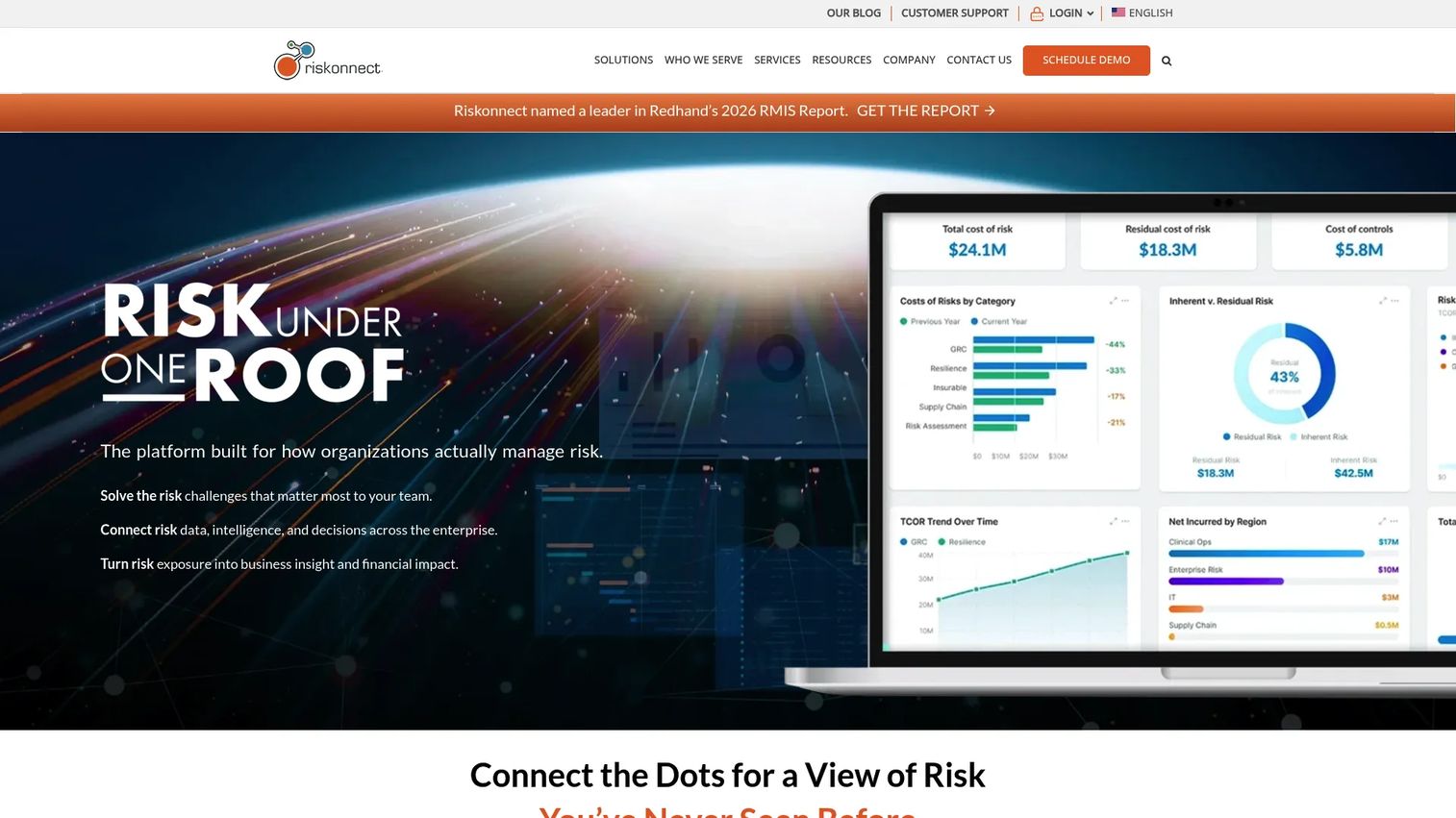
Riskonnect is a cloud-based risk management platform that treats third-party risk as one thread inside a larger fabric of governance, insurable risk, and business continuity. It combines GRC software, a risk management information system, resilience tooling, and AI-powered risk intelligence, so vendor risk connects directly to enterprise risk management rather than sitting off to the side.
Best for: mid-market and enterprise teams that want TPRM, compliance, claims, and resilience managed in one platform.
Key strengths
- Unified risk fabric: connects third-party risk to enterprise risk, audit, and internal controls in one system.
- Business continuity and resilience: models how a vendor disruption cascades into operational exposure.
- AI-powered risk intelligence: surfaces and prioritizes emerging risks across the register.
Why choose Riskonnect: If your organization already thinks in enterprise risk terms and wants third-party oversight to roll up into board-level reporting, Riskonnect fits the way the program is structured. It suits teams that see vendor risk as inseparable from operational resilience rather than a standalone checklist.
Riskonnect pricing: Riskonnect does not publish a public starting price. The company states that pricing depends on project size, complexity, and customization, so you will work through a scoped quote. On G2, Riskonnect holds a 4.3/5 rating. Confirm both the quote and the current rating during your evaluation.
2. OneTrust
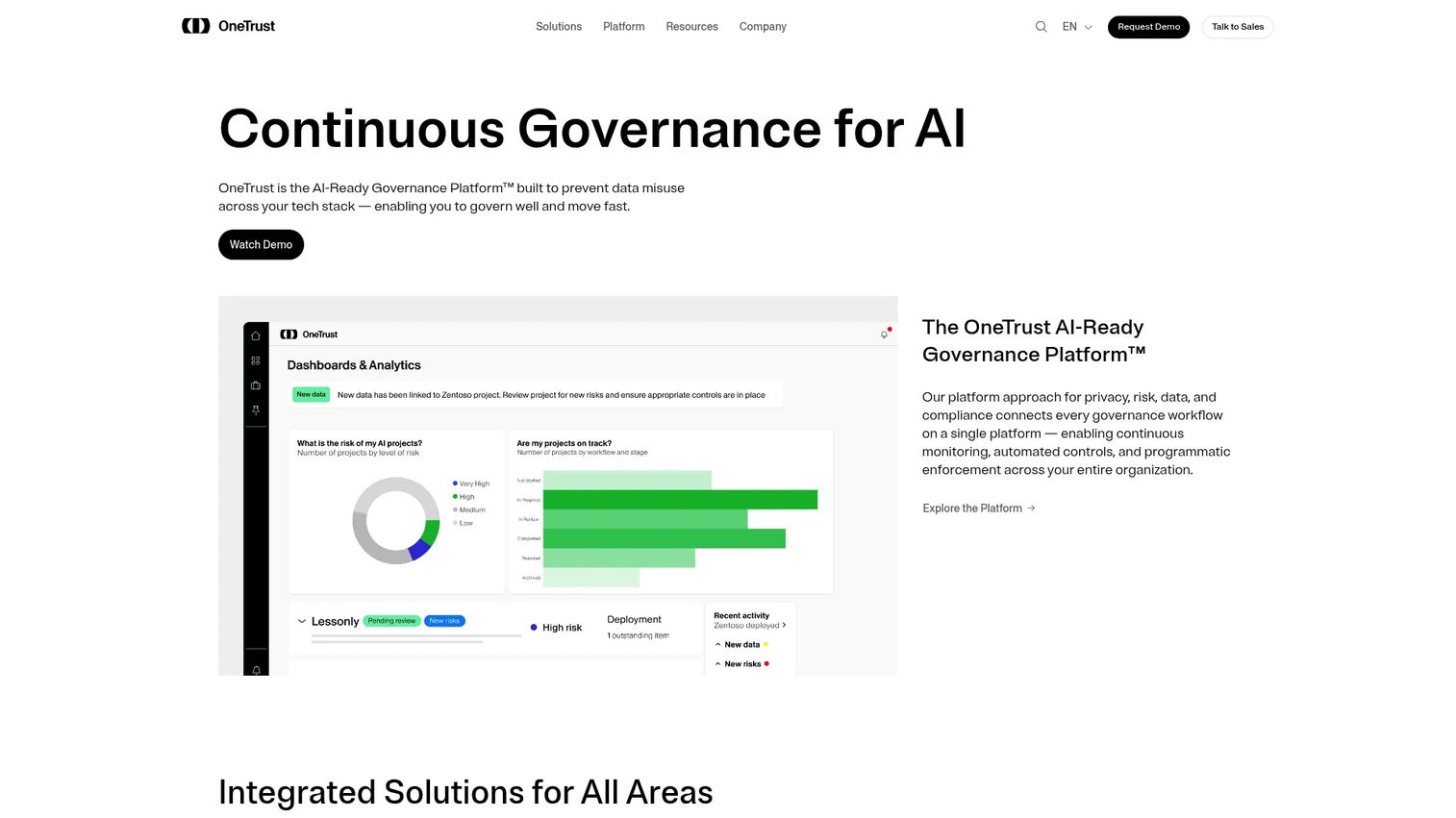
OneTrust is an AI-ready governance platform spanning privacy, risk, data, and compliance, with third-party management packaged as a dedicated motion inside the broader suite. For teams that already run privacy automation or consent management on OneTrust, adding third party vendor risk management software from the same vendor keeps assessments, inventory, and governance workflows under one roof.
Best for: enterprises that need a unified privacy, AI governance, risk, and compliance platform where third-party risk is one module among several.
Key strengths
- Unified governance: third-party management sits alongside privacy automation and GRC workflows.
- AI governance coverage: extends oversight across models, agents, datasets, and vendors.
- Assessment workflows: standardized questionnaires and evidence collection built into the platform.
Why choose OneTrust: Compliance-heavy organizations choose OneTrust when third-party risk is one piece of a wider privacy and governance mandate. If your program already tracks data subjects, consent, and AI risk, running vendor assessments in the same platform reduces the number of systems your team has to reconcile.
OneTrust pricing: OneTrust does not display public numeric pricing. It uses customized, usage-based quotes tied to meters such as admin users, inventory size, visitors, profiles, or data volume, and it packages a Third-Party Risk Management Base and a Third-Party Management Suite among its plans. OneTrust holds a 4.4/5 rating on G2. Verify current plan packaging directly, since the metering model shifts by module.
3. ProcessUnity
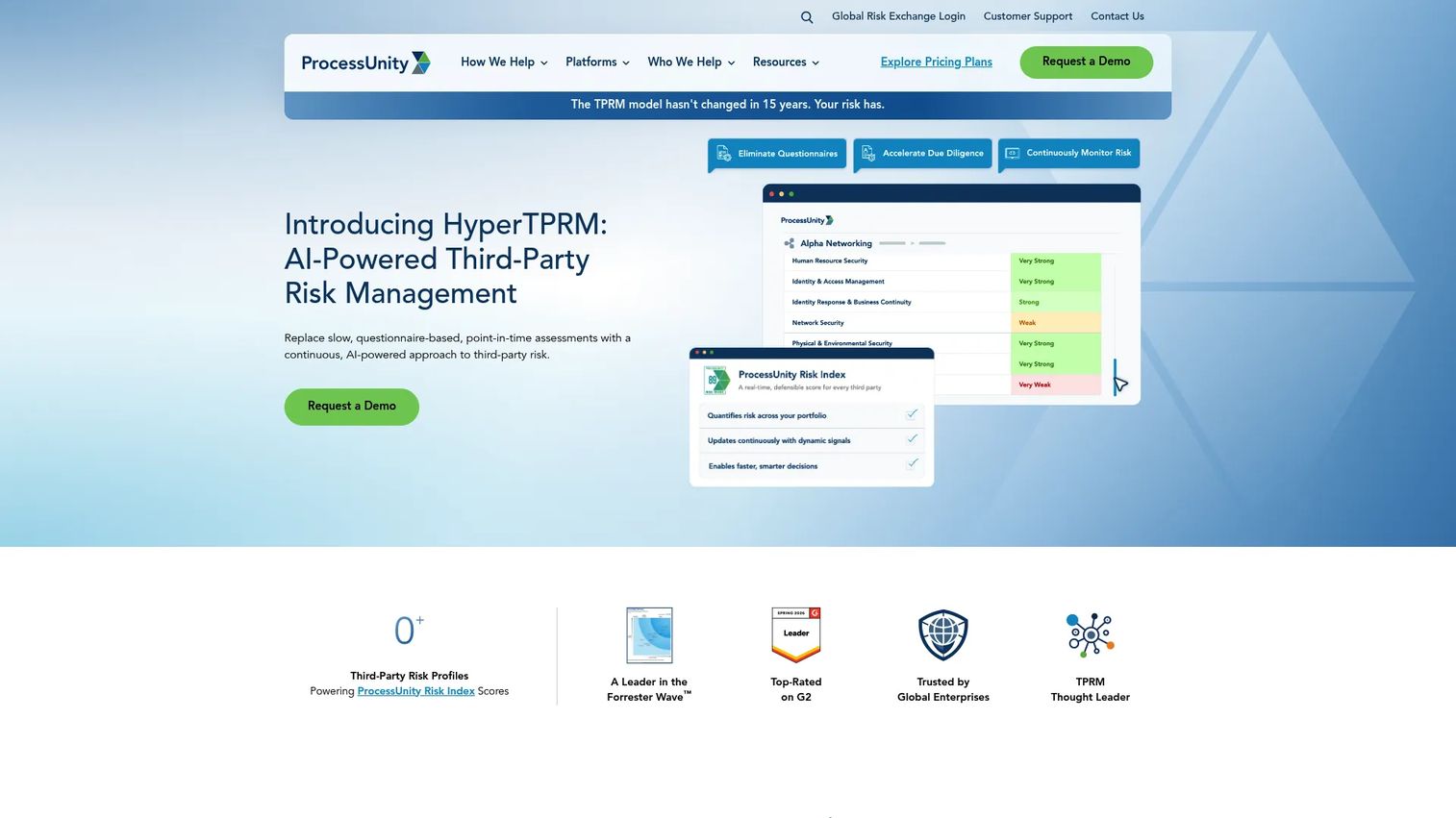
ProcessUnity is a third-party risk management software and data platform built to automate vendor assessments and risk workflows end to end. It pairs a no-code configurable platform with AI-powered workflows and reporting-as-a-service, so teams can shape assessment logic, questionnaires, and evidence evaluation without engineering support.
Best for: organizations that want a configurable, TPRM-specialized platform with AI-assisted questionnaires and evidence collection.
Key strengths
- AI-powered TPRM workflows: accelerate questionnaire review and evidence evaluation.
- No-code configuration: shape assessments and risk logic without developer time.
- Reporting-as-a-service: automated assessments and reporting keep programs moving between cycles.
Why choose ProcessUnity: ProcessUnity is the pick when third-party risk is the main event, not a side module. Teams that run high volumes of third-party risk assessments and want deep specialization over broad governance breadth tend to land here. The configurability rewards teams willing to invest in tailoring the workflow to their exact tiering model.
ProcessUnity pricing: ProcessUnity publishes a starting price for small and medium businesses at $25,000, with full plans gated behind a form submission. It does not list named tiers or a billing cadence publicly. On G2, ProcessUnity holds a 4.5/5 rating. Confirm the current entry price and packaging before you commit.
4. Vanta
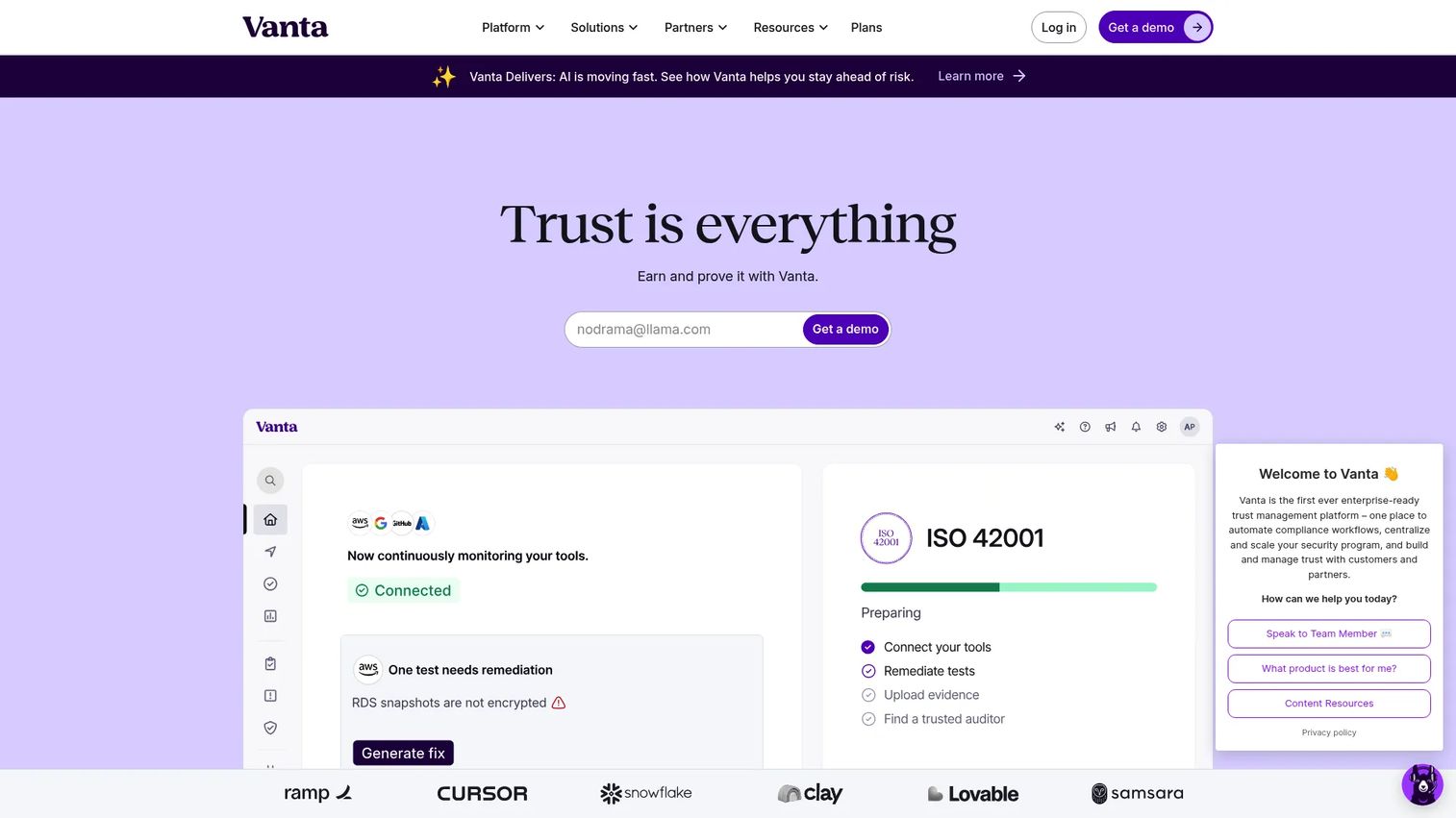
Vanta is a compliance automation and trust management platform built around continuous security posture monitoring. Its vendor risk capabilities sit inside a broader workflow that includes continuous compliance monitoring, AI-assisted policy and evidence automation, and a Trust Center with questionnaire automation, which makes it a natural fit for teams that treat security and vendor risk as one continuous program.
Best for: growing SaaS companies that want automated compliance and continuous security posture management alongside vendor risk.
Key strengths
- Continuous compliance monitoring: tracks posture and controls in real time rather than at audit intervals.
- AI-assisted evidence automation: reduces the manual work of collecting and mapping evidence.
- Trust Center and questionnaire automation: streamlines both inbound and outbound security reviews.
Why choose Vanta: Fast-moving teams already using compliance tooling choose Vanta when they want vendor risk folded into the same continuous monitoring workflow that runs their SOC 2 or ISO program. It appeals to companies that value automation and speed over the heavier configuration of enterprise GRC suites.
Vanta pricing: Vanta uses personalized, demo-based pricing rather than public dollar amounts, and lists Essentials, Plus, Professional, and Enterprise plans on its pricing page. Vanta holds a 4.6/5 rating on G2. Because vendor risk may be packaged within a broader plan, confirm what is included at each tier during your demo.
5. ServiceNow
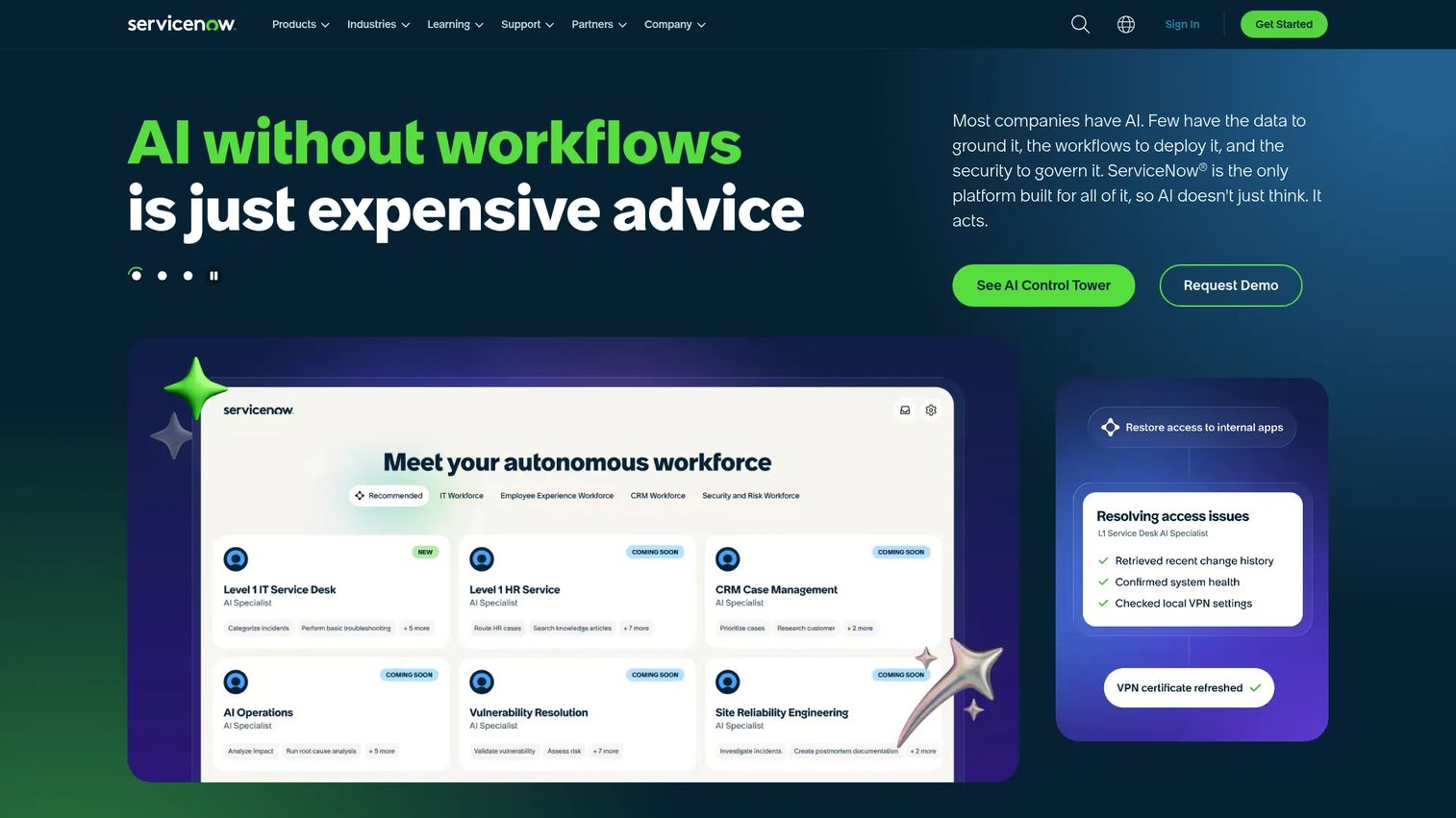
ServiceNow is an enterprise AI workflow platform spanning IT, HR, customer service, security, and finance, with vendor risk management delivered as part of its broader governance and operations capabilities. It brings AI agents, self-service portals, and low-code app development onto a single PaaS platform, so vendor risk workflows connect to the same automation that runs the rest of the enterprise.
Best for: large enterprises already standardized on ServiceNow that want vendor risk inside their existing workflow platform.
Key strengths
- AI agents and skills: automate risk workflows alongside IT and operations processes.
- Low-code app development: tailor vendor risk workflows on the same PaaS the enterprise already runs.
- Self-service portals: route vendor and internal requests through familiar interfaces.
Why choose ServiceNow: ServiceNow fits organizations that have standardized operations on the platform and want vendor risk to reuse the same automation, data model, and reporting. Adopting it as a dedicated point tool is a bigger workflow decision; adopting it because you already run ITSM and security operations there is a natural extension.
ServiceNow pricing: ServiceNow uses custom, quote-based pricing and does not display public dollar amounts. Its ITSM pricing page lists Foundation, Advanced, and Prime plan tiers, with vendor risk capabilities priced separately through sales. ServiceNow holds a 4.4/5 rating on G2. Scope the modules you actually need before requesting a quote.
6. Archer
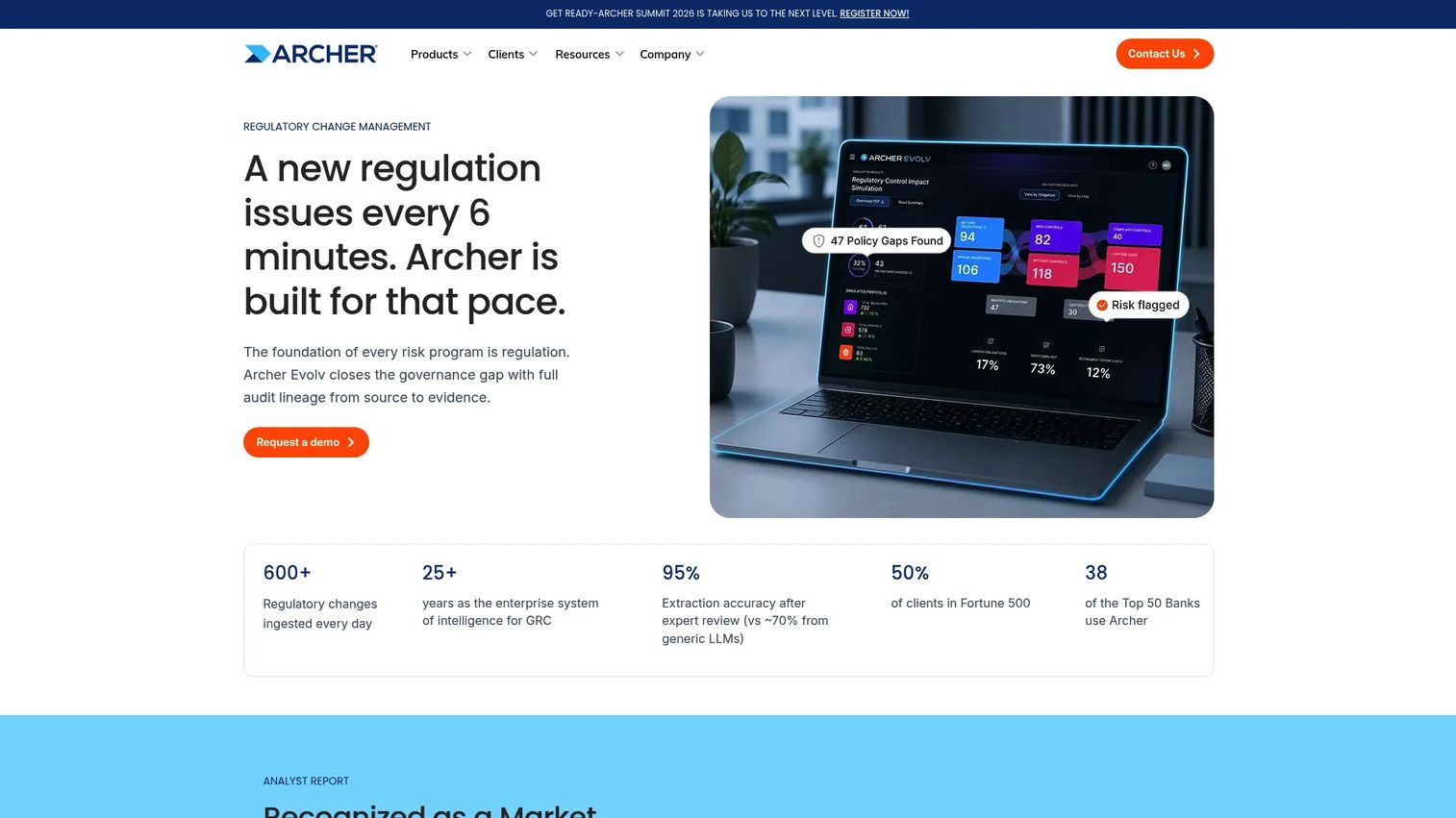
Archer is enterprise governance, risk, and compliance software for managing risk, compliance, audit, and related workflows, including third-party risk. It offers enterprise-wide data visibility across risk, compliance, and audit, AI-powered analytics with automated compliance monitoring, and dedicated coverage for third-party risk, ESG, business resilience, and IT and security risk.
Best for: large organizations that need configurable GRC and risk management workflows with third-party risk as one integrated domain.
Key strengths
- Configurable GRC workflows: adapt risk, compliance, and audit processes to your program.
- AI-powered analytics: automate compliance monitoring across the risk landscape.
- Broad domain coverage: third-party risk, ESG, IT risk, and resilience in one platform.
Why choose Archer: Archer suits large, process-heavy organizations that want to configure their own risk workflows rather than adopt a fixed template. Teams that already run mature GRC programs and treat third-party risk as one domain among many tend to value its depth and configurability.
Archer pricing: Archer does not publish public pricing; its site routes to contact and request-demo flows. On G2, Archer holds a 3.6/5 rating based on a smaller review pool, so read recent reviews alongside the score. Request a scoped quote and validate the third-party risk module against your requirements.
7. AuditBoard
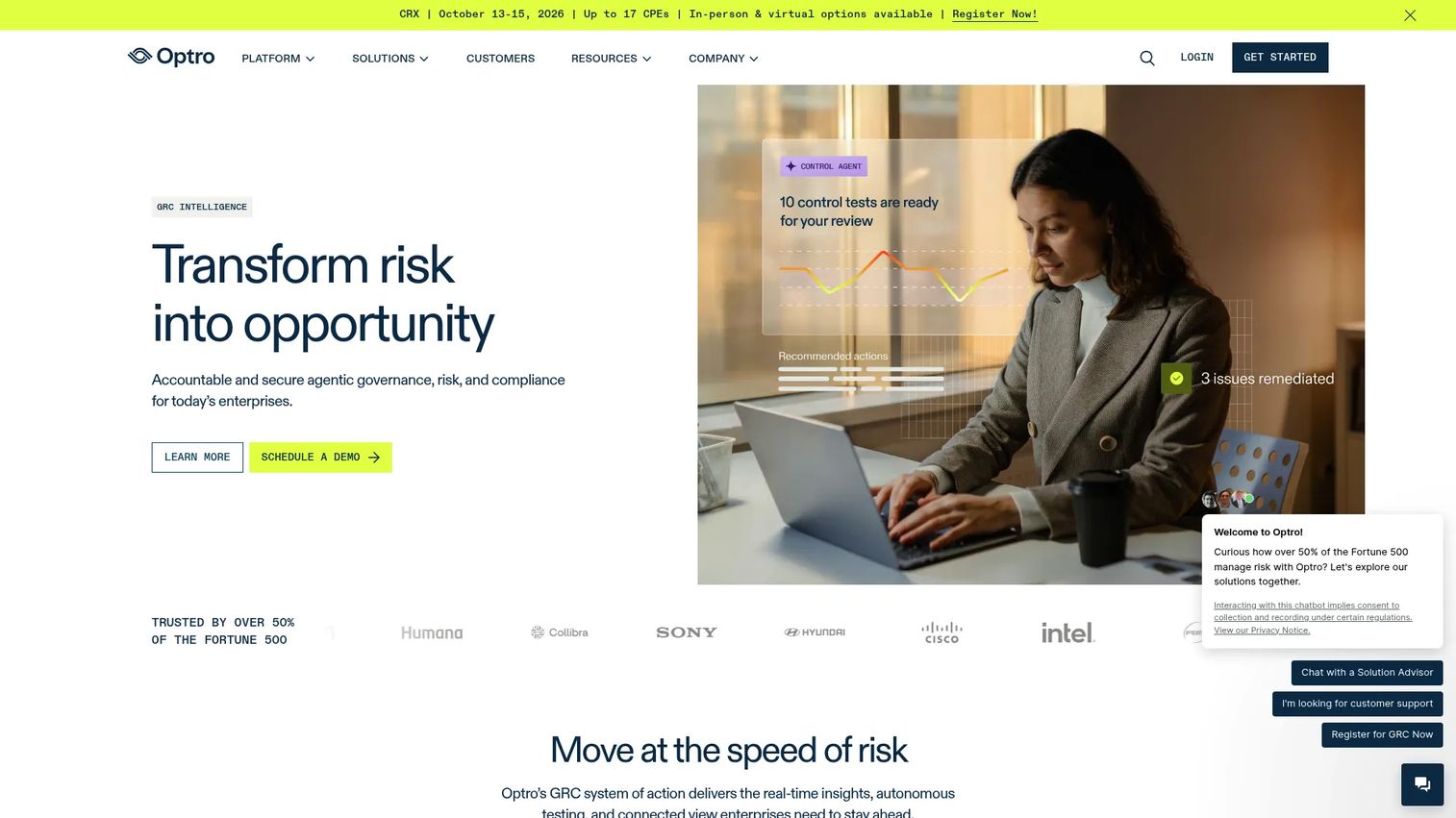
AuditBoard is cloud-based GRC software built for audit, risk, compliance, ESG, and IT risk teams, with third-party risk offered as one of its integrated modules. It combines AI and automation across audit and risk workflows, no-code analytics and reporting dashboards, and connected modules for audit, controls, risk, compliance, and third-party risk, so evidence gathered in one area feeds the others.
Best for: large enterprises running internal audit, SOX, compliance, and enterprise risk programs that want third-party risk linked to that work.
Key strengths
- Audit-first architecture: third-party risk connects to internal audit and SOX programs.
- Connected modules: evidence and controls flow across audit, risk, and compliance.
- No-code analytics: build dashboards and reporting without engineering support.
Why choose AuditBoard: AuditBoard is the fit when audit and controls lead your program and third-party risk needs to plug into that existing motion. Because the platform is audit-first, buyers evaluating it primarily for TPRM should confirm the depth of the third-party module against their specific assessment and monitoring needs.
AuditBoard pricing: AuditBoard does not expose a public subscription price; the site routes to demo and sales flows. Request a quote and, during evaluation, verify the current rating on a live review source since a G2 score was not readily confirmable. Scope the third-party risk module explicitly rather than assuming parity with the audit modules.
8. Diligent
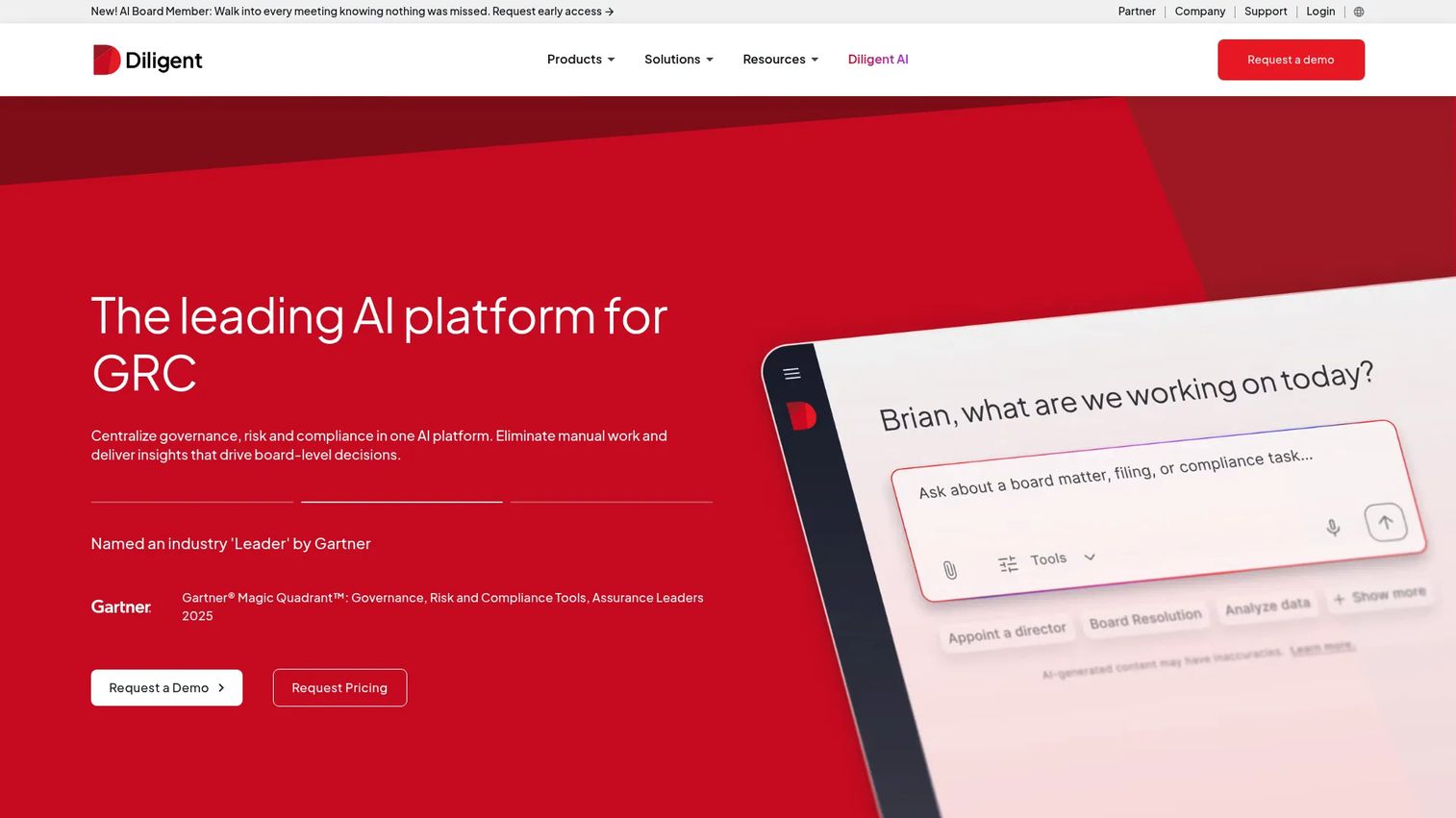
Diligent is AI-powered governance, risk, and compliance software oriented toward boards and leadership teams, with third-party oversight framed inside broader GRC and governance reporting. Its strengths include a secure board portal for agendas, documents, and minutes, AI-powered meeting minutes workflows, and secure collaboration with role-based access and encryption, which places third-party risk in the context of board-level visibility.
Best for: boards and governance teams that need secure, enterprise-grade oversight where third-party risk rolls up into governance reporting.
Key strengths
- Board-level governance: third-party oversight surfaces in board and leadership reporting.
- Secure collaboration: role-based access and encryption protect sensitive governance data.
- AI-powered workflows: streamline minutes, reviews, and governance documentation.
Why choose Diligent: Diligent fits when governance and board reporting are the organizing principle and third-party risk needs to appear in that context. If your program is driven by TPRM specialists who need deep questionnaire automation and continuous monitoring as the primary job, pair Diligent with, or compare it against, a more TPRM-specialized platform.
Diligent pricing: Diligent does not display numeric pricing publicly and directs visitors to request pricing. A G2 rating was not readily confirmable for the relevant product, though Diligent Boards carries a 4.7/5 rating on Capterra. Confirm current pricing and the specific product rating before deciding.
How to choose the right platform
Every platform on this list clears a basic bar. The differences show up in fit, so run your shortlist against these criteria before you sign anything.
Lifecycle coverage versus assessment scope
Decide whether you need full lifecycle coverage from onboarding to offboarding or primarily strong assessments. A growing vendor base almost always needs the former. Map your actual workflow stages and check each tool against them.
Automation and evidence workflows
Look closely at questionnaire routing, reminder cadences, evidence request handling, and review queues. This is where day-to-day time is spent, so a small difference in automation compounds across hundreds of vendors and third-party risk assessments.
Integration and GRC fit
Confirm the platform connects to your GRC system, procurement integrations, SIEM, and identity stack, and that it offers a usable API. A platform that reports cleanly into your existing governance layer is easier to defend internally and easier to keep current.
Compliance and regulatory alignment
Check that the tool maps to the frameworks you actually answer to, and that its inherent risk scoring model matches how you already tier vendors. Strong compliance and regulatory alignment saves rework every audit cycle.
Verify pricing and ratings live
Pricing in this category is quote-based and packaging changes often. Confirm every price and G2 or Capterra rating on the vendor's current pages during evaluation rather than trusting any static comparison.
Conclusion
The best third party risk management software for your team depends on where your program sits today, not on which vendor has the longest feature list. Riskonnect leads for enterprise risk orchestration and resilience. OneTrust wins when third-party management belongs inside a privacy and governance mandate. ProcessUnity is the specialist for assessment automation and evidence handling. Vanta suits fast-moving SaaS teams that live in continuous monitoring. ServiceNow, Archer, AuditBoard, and Diligent each fit teams organized around workflow, configurable GRC, audit, or board governance.
A practical next step: shortlist two or three tools that match your current workflow maturity, compare their lifecycle coverage side by side, verify the integrations you actually depend on, and validate pricing and G2 data on live pages before you commit. Then start with the platform that matches how your team already works, since adoption beats capability every time. If governance tooling is part of a wider evaluation, the same discipline applies to contract management software and component content management systems in your stack.
FAQs
It centralizes your vendor inventory, automates assessments and evidence collection, monitors external risk signals continuously, and tracks remediation across the full vendor relationship. In practice, it replaces the spreadsheets, email chains, and shared drives that most teams outgrow once their vendor base passes a few dozen partners.
GRC software governs risk, compliance, and controls across the whole organization, while TPRM focuses specifically on the risks introduced by external vendors and partners. Many platforms in this list offer both, with TPRM as a module inside a broader GRC suite. Choose a dedicated TPRM tool when vendor risk is the primary job, and a GRC platform when it is one domain among many.
Lifecycle coverage, automation of questionnaires and evidence collection, continuous monitoring with prioritized alerts, and integration depth with your GRC, procurement, and SIEM stack. Inherent risk scoring that matches how you already tier vendors is the feature that most affects daily workload.
Modern platforms distribute standardized questionnaires automatically, send reminder cadences, and request evidence such as SOC 2 reports through structured workflows. Responses flow into a review queue where AI-assisted tools flag gaps, so reviewers spend time on judgment rather than chasing documents. This is where most of the time savings in TPRM actually come from.
At minimum, connections to your GRC system, procurement tooling, SIEM, and identity provider, plus an open API for anything custom. Procurement integrations matter most for intake, since capturing vendors at the point of purchase prevents shadow vendors from ever escaping the register.
Continuous monitoring pulls external signals like breach data, financial health, and posture changes, then prioritizes them so your team acts before a change becomes an incident. Instead of relying on a point-in-time assessment that ages the moment it is filed, you get an ongoing view that flags when a vendor's risk profile shifts.
Look for mapping to the frameworks your organization actually answers to, which commonly include SOC 2, ISO 27001, GDPR, and industry-specific rules for finance, healthcare, or the public sector. The platform should let you map controls to multiple frameworks at once, so a single piece of evidence satisfies several requirements and you avoid duplicating assessment work.
Measure the reduction in manual review time, the shortening of vendor onboarding and procurement cycles, and the drop in launch delays caused by unfinished security reviews. For a product manager, the clearest signal is how often a vendor dependency stalls a release before versus after the platform is in place. Faster, repeatable reviews translate directly into shipped features and cleaner audits.