The sponsorship recap deck looked great. Your logo appeared in broadcasts, in-venue signage, social clips, and creator content. Then your CMO asked the question you were dreading: "What did this actually drive?"
That question is the gap sports marketing intelligence software exists to close. According to Marketing Dive (2025), 76% of marketers say they struggle to calculate sports sponsorship ROI. The measurement problem is not niche. The global sports and events marketing technology market was valued at $85.2 million in 2025 and is projected to reach $378.8 million by 2033, according to Grand View Research (2025), reflecting how urgently teams are investing in better data.
Most content on this topic either sells you one platform or lists hundreds of companies with no buying guidance. Neither helps you answer your CFO's question. This guide does something different: It separates the measurement jobs, matches each platform to the job it actually does well, and gives you the data you need to shortlist faster.
What's inside
This guide is for brands, agencies, rights holders, teams, leagues, and growth marketers who need to compare sports marketing intelligence platforms before buying.
- Tools evaluated: 12 platforms covering sponsorship valuation, exposure measurement, fan intelligence, sports data, and content analytics
- Selection criteria: Relevance to sponsorship analytics, data coverage and depth, reporting for ROI conversations, and use-case fit
- Pricing and G2 ratings were verified against live sources at drafting time
- The guide helps you route by job: Planning, measurement, fan research, content, or renewal reporting
- Buyer checklist in the considerations section covers what to verify before you sign
TL;DR
- Best overall for sponsorship market intelligence: SponsorUnited maps brand deals, properties, and partner activity across the market, so you know who sponsors what before you pitch or buy
- Best for sponsorship ROI measurement: Relo Metrics tracks exposure across broadcast, streaming, social, and venue channels and ties it to outcomes
- Best for social sponsorship analytics: Zoomph measures audience demographics and sponsor performance across social media
- Best for fan research and brand tracking: Marketcast provides audience segmentation and brand perception data before and after campaigns
- Best for sports media intelligence: MediaRadar gives agencies and publishers visibility into competitor ad spend across 30-plus channels
- Best for athlete and creator campaigns: OpenSponsorship connects brands with 40,000-plus athletes and creators, with managed activation from $2,000 per month
- Best for football-focused campaigns: PFF gives analysts, media teams, and fantasy-adjacent marketers detailed NFL and college football data starting at $9.99 per month
What is sports marketing intelligence software?
Sports marketing intelligence software helps brands, teams, leagues, agencies, and rights holders collect, analyze, and act on data about sponsorships, audiences, media exposure, fan behavior, and sports content performance.
The category sits at the intersection of several adjacent disciplines: social media analytics, audience intelligence platforms, competitive intelligence tools, and brand intelligence software. What makes sports marketing intelligence distinct is its focus on sports-specific data: Broadcast rights, athlete performance, fan loyalty, sports event audiences, and sponsorship deal structures.
Key capability groups within this category include:
- Sponsorship intelligence: Tracks deals, rights holders, brands, assets, categories, and competitive partner activity across properties
- Exposure measurement: Measures logo visibility, placement value, broadcast time, social engagement, and digital reach using computer vision and media monitoring
- Fan and audience intelligence: Profiles fan segments, affinities, viewing behavior, purchase intent, and engagement patterns by sport and property
- ROI and attribution reporting: Connects exposure or engagement to downstream outcomes such as brand lift, sales lift, search lift, web traffic, or renewal value
- Sports content and media analytics: Measures video highlights, editorial coverage, social performance, and content distribution
- Partner reporting: Packages performance data for renewals, upsell conversations, internal budget reviews, and sponsor recaps
Not all 12 platforms on this list do the same job. Some are sponsorship databases for pre-deal research. Others measure post-campaign exposure. Some focus on fan research; others automate sports video content. The routing that matters is matching the tool to the measurement decision you face.
For broader marketing analytics software needs beyond sports, see the linked comparison.
When to use sports marketing intelligence software
Prove sponsorship ROI beyond impressions
A CFO, CMO, or procurement lead wants more than a screenshot of your logo on a jersey. They want to know whether the sponsorship drove brand lift, search volume, sales, or qualified traffic. Platforms focused on outcome attribution connect media exposure data to business metrics through panel research, search data, or matched-market analysis. Use these when the renewal conversation is approaching and you need defensible numbers.
Price and renew sponsorship packages
Rights holders and sales teams building renewal decks need category benchmarks, asset performance data, and competitive context. If you are pricing a stadium naming deal or a jersey patch, you need to know what comparable properties sold for and how similar assets have performed for other brands. Sponsorship intelligence databases are the right tool for this job.
Find sports audiences that match your campaign
Before spending on a sponsorship, digital marketers need to validate that the audience fits. Fan intelligence platforms provide demographic profiles, affinities, and behavioral data for sports audiences. This helps you calculate whether the CAC is defensible before you commit budget. Audience research here feeds the same planning conversation as audience intelligence platforms in adjacent categories.
Sports marketing intelligence software comparison
The table below covers all 12 tools in this guide. Pricing and G2 ratings reflect verified data from vendor pricing pages and live G2 listings. Where no price or rating is available, that is noted plainly.
| # | Product | Best for | Key differentiator | Pricing | G2 rating |
|---|---|---|---|---|---|
| 1 | SponsorUnited | Sponsorship market intelligence | Large sponsorship and partnership dataset with AI-powered analyst | Quote-based | N/A |
| 2 | Relo Metrics | Sponsorship ROI measurement | Cross-channel exposure and outcome measurement | Quote-based | 4.6/5 |
| 3 | Zoomph | Social sponsorship analytics | AI-powered social audience and sponsor performance reporting | Quote-based | 4.5/5 |
| 4 | Genius Sports | Sports data and fan activation | Official sports data plus fan engagement and media products | Quote-based | 4.5/5 |
| 5 | Marketcast | Fan and audience research | Custom research combining survey data with behavioral signals | Quote-based | N/A |
| 6 | MediaRadar | Sports media and ad intelligence | Cross-channel ad spend and competitive media tracking | Quote-based | 4.5/5 |
| 7 | Blinkfire Analytics | Visual sponsorship tracking | Computer vision for social and digital brand exposure | From $4,166/month (annual) | 5.0/5 |
| 8 | OpenSponsorship | Athlete and creator partnerships | Marketplace of 40,000+ athletes with managed campaign activation | From $2,000/month | 4.0/5 |
| 9 | Hookit | Social sponsorship valuation | Social media sponsorship analytics with Promotional Effectiveness scoring | Quote-based | 4.0/5 |
| 10 | Sports Info Solutions | Sports data analysis | Live feeds and deep sports performance data across major leagues | From $9.99/week | N/A |
| 11 | PFF | Football analytics | Player grades, advanced stats, and NFL/college football data tools | Free; paid from $9.99/month | N/A |
| 12 | WSC Sports | Sports content intelligence | Automated video highlight creation and personalized distribution | Quote-based | N/A |
Best 12 sports marketing intelligence software tools
1. SponsorUnited
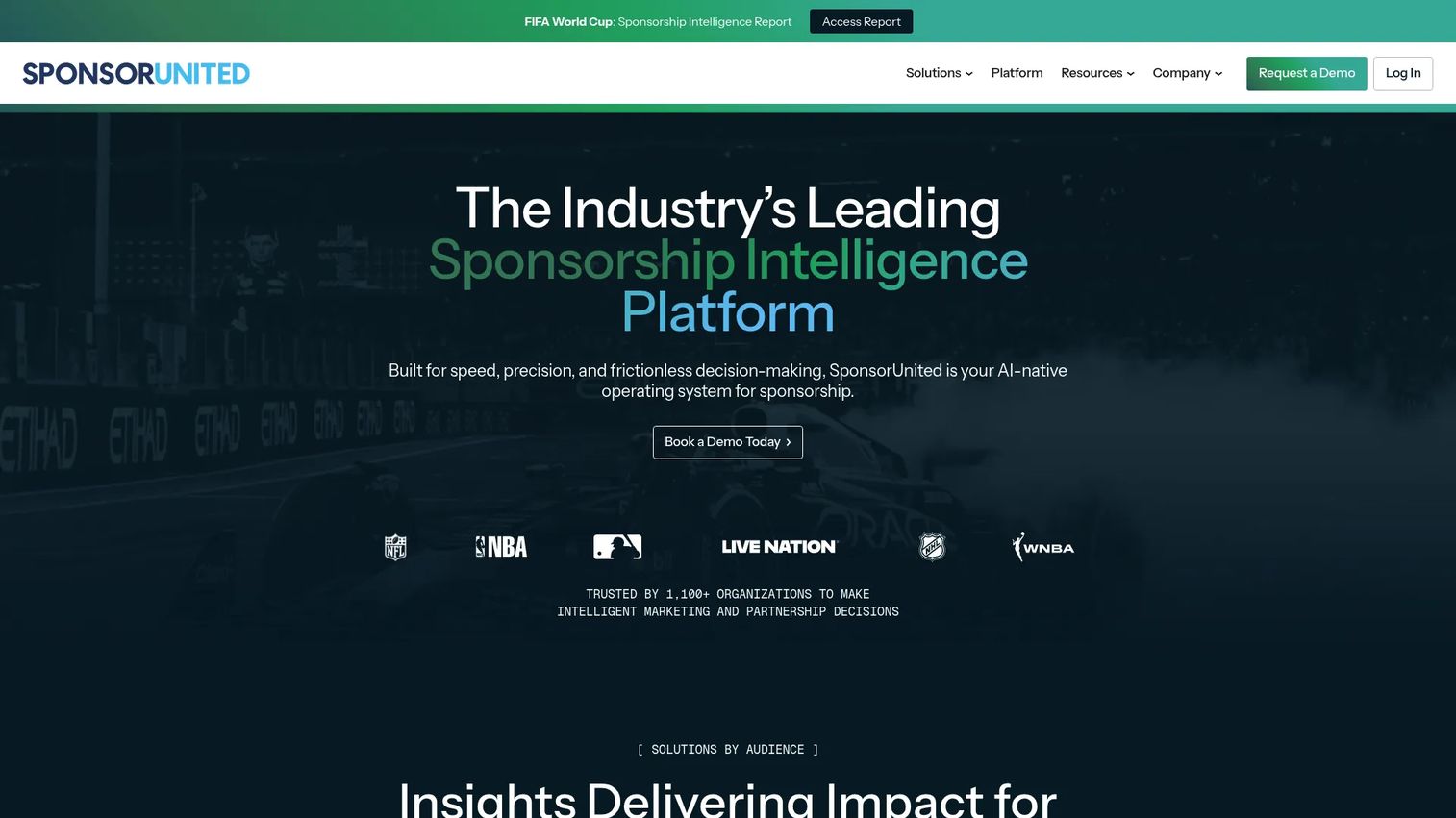
SponsorUnited is an AI-native sponsorship intelligence platform for brands, rights holders, agencies, and media companies. It aggregates sponsorship deal data across sports and entertainment, letting users research brand partnerships, evaluate assets, benchmark categories, and identify prospecting opportunities. The platform's core value is market mapping: Understanding who sponsors what, where deals are priced, and which properties fit a brand's strategy.
Best for: Teams that need broad sponsorship market intelligence before pitching, buying, or benchmarking partnerships.
Key features
- AI-powered SUrface analyst for surfacing sponsorship insights
- Proposal Evaluator covering audience, market, competitive, and pricing dimensions
- SPND pricing insights across deals, categories, markets, and assets
- Brand, rights holder, and agency profile database
- Competitive research and sponsor activation creative library
Why choose SponsorUnited: Choose it when the question is not "did my sponsorship work?" but "what should I sponsor next, and what should I pay?" It is built for pre-deal research and competitive landscape mapping, not post-campaign exposure measurement.
SponsorUnited pricing: SponsorUnited does not post pricing on its website. Plans are sales-led; request a demo to get package details based on your data access and user needs.
2. Relo Metrics
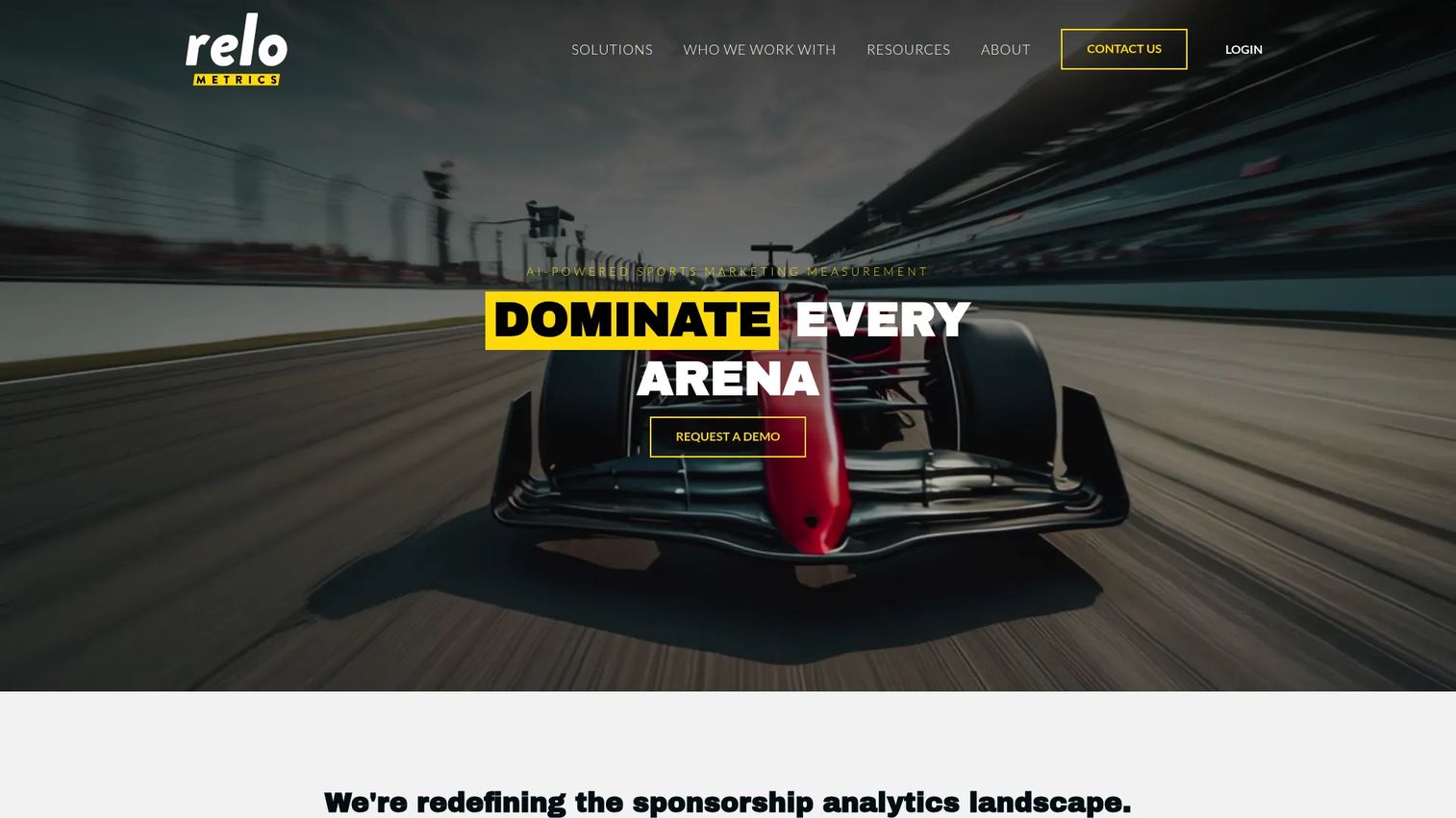
Relo Metrics is an AI-powered sponsorship analytics platform built to measure and optimize sports sponsorship performance. It tracks brand exposure across broadcast, streaming, social, owned digital, and in-venue channels using computer vision technology. Teams use it to generate partner recap reports, benchmark exposure against category norms, and build renewal decks with performance data.
Best for: Brands, agencies, sports teams, leagues, and rights holders measuring sponsorship exposure, media value, and ROI.
Key features
- Computer-vision sponsorship exposure measurement
- Broadcast, streaming, social, and in-venue tracking
- Relo Census benchmarking and competitive intelligence
- Automated performance insights and reporting
- Athlete social account performance tracking
Why choose Relo Metrics: This is the right tool when leadership wants proof of what the sponsorship delivered, not just impressions. It fits the renewal conversation and CFO-ready reporting that many sponsorship teams struggle to produce from raw media data.
Relo Metrics pricing: Enterprise packages are structured around channel coverage, data depth, and reporting scope. Contact sales for a quote.
G2 rating: 4.6/5
3. Zoomph
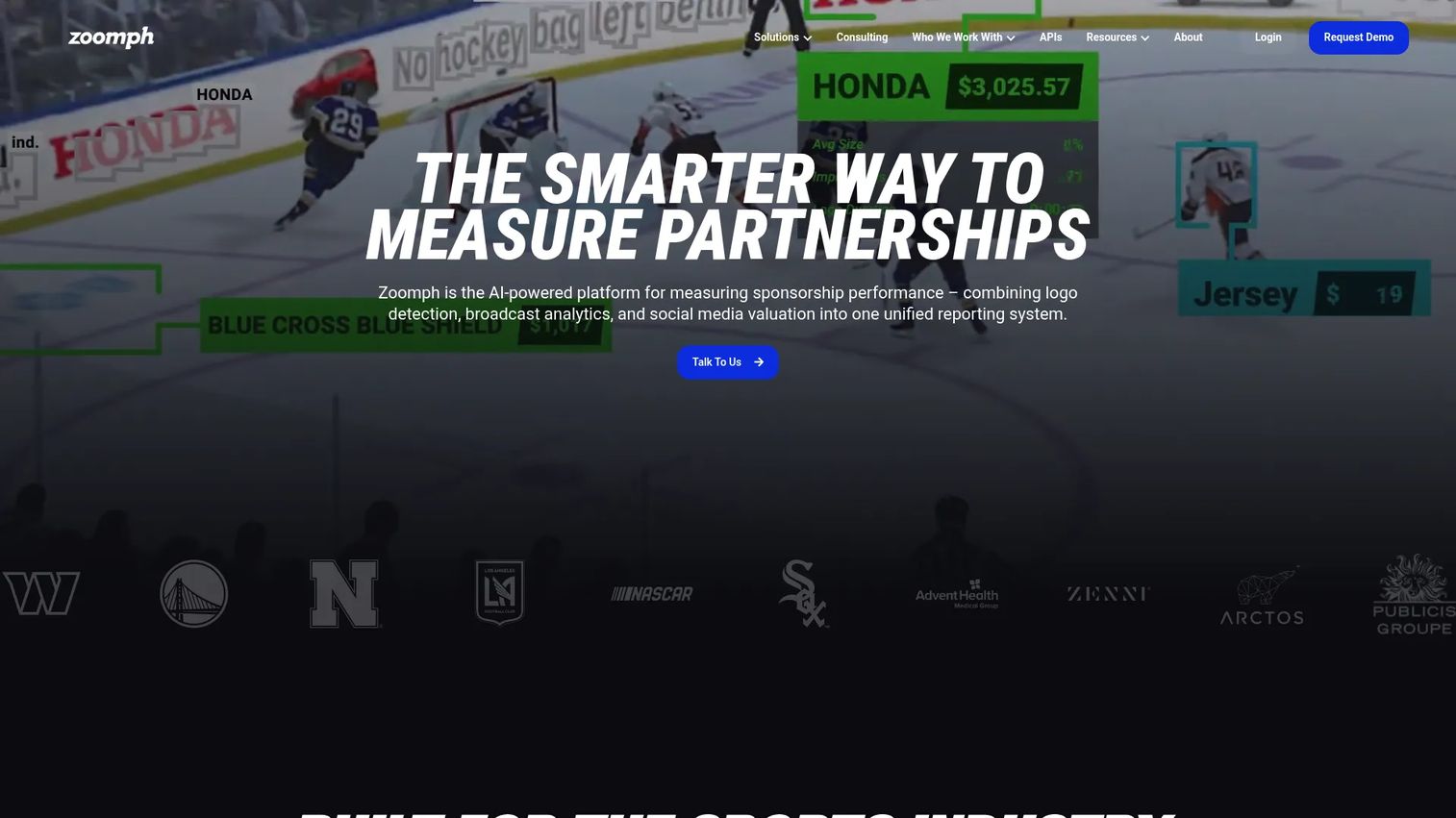
Zoomph measures sports sponsorship performance across social media and broadcast channels using AI logo detection, text recognition, and asset tracking. Its audience intelligence layer provides demographic profiles and behavioral data on the fans engaging with partner content. Digital marketers use Zoomph to build sponsor performance reports, justify partnership spend, and validate audience fit before renewal.
Best for: Sports teams, leagues, brands, and agencies measuring sponsorship performance across social channels and fan engagement.
Key features
- AI logo, text, and asset detection across channels
- Social media and broadcast sponsorship measurement
- Audience demographics and behavioral profiling
- Benchmarking against competitors and league norms
- Custom dashboards and report exports
Why choose Zoomph: Choose it when social media performance is central to your sponsorship story and you need audience data alongside exposure metrics. It fits growth marketers who must defend partner spend to leadership with channel-specific evidence. For broader social media marketing context, see the linked guide.
Zoomph pricing: Zoomph offers Marketing and Enterprise tiers, both priced through a sales conversation. Contact sales for package details.
G2 rating: 4.5/5
4. Genius Sports
Genius Sports is a sports data, technology, and fan engagement company serving leagues, brands, media companies, and sportsbooks. It provides official sports data feeds, AI-powered performance analytics, fan activation tools, broadcast augmentation, and advertising optimization products. The breadth of its offering means it sits differently from pure sponsorship measurement platforms: It supports organizations that want sports data to power content, campaigns, and fan experiences.
Best for: Organizations that need official sports data, fan engagement activation, and campaign optimization in a single sports technology environment.
Key features
- Official sports data and odds APIs
- AI-powered video capture and performance analytics
- Fan engagement and broadcast augmentation tools
- Dynamic creative optimization for sports advertising
- Sports media activation and campaign management
Why choose Genius Sports: Choose it when fan engagement and sports data activation matter more than pure sponsorship database research. It is well suited to leagues, media companies, and brands that want data infrastructure underneath their campaign layer.
Genius Sports pricing: Genius Sports directs prospective customers to contact their team for pricing. Package structure varies by product and use case.
G2 rating: 4.5/5
5. Marketcast
Marketcast is a marketing effectiveness and research partner focused on audience intelligence, brand tracking, and campaign measurement. For sports marketers, it provides fan research, audience segmentation, brand perception data, and pre-to-post campaign analysis. Its AI-powered research platform integrates survey data with behavioral, search, social, and purchase signals to give a richer picture of fan attitudes.
Best for: Marketers who need audience research and brand perception data before or after sports campaigns.
Key features
- Advertising effectiveness measurement across campaign lifecycle
- Brand tracking integrating behavioral, search, and purchase data
- AI-powered survey creation, sample management, and dashboards
- Fan research and audience segmentation
- Consumer insights for entertainment and sports verticals
Why choose Marketcast: Choose it when you need to understand why fans respond to a sponsorship, not just where the logo appeared. It fits strategy and pre-campaign planning work where the question is audience quality, not exposure volume.
Marketcast pricing: Marketcast offerings are consultative and custom. Contact their team to discuss research scope and pricing.
6. MediaRadar
MediaRadar is a marketing intelligence platform tracking advertising spend, creative assets, and media buying behavior across 30-plus channels. For sports marketers, it provides visibility into how competitors are spending across sports media, which advertisers are active in specific categories, and how media buying patterns are shifting. Publishers and agencies use it to identify sponsorship prospects and validate pricing against category benchmarks.
Best for: Agencies, publishers, and advertising teams needing competitive media intelligence across sports and entertainment channels.
Key features
- Cross-channel advertising intelligence across 30-plus media channels
- Competitive and category ad spend monitoring
- Creative asset tracking and media-spend analysis
- Brand and channel benchmarking
- API and Data Cloud integrations
Why choose MediaRadar: Choose it when your planning depends on knowing what competitors are spending and where. It is a natural fit for sales teams at publishers selling sports media inventory, and for agencies building campaign plans against competitive landscape data. This complements competitive intelligence tools in your broader stack.
MediaRadar pricing: MediaRadar does not publish pricing. Plans are structured around data access and channel coverage; request a demo for package details.
G2 rating: 4.5/5
7. Blinkfire Analytics
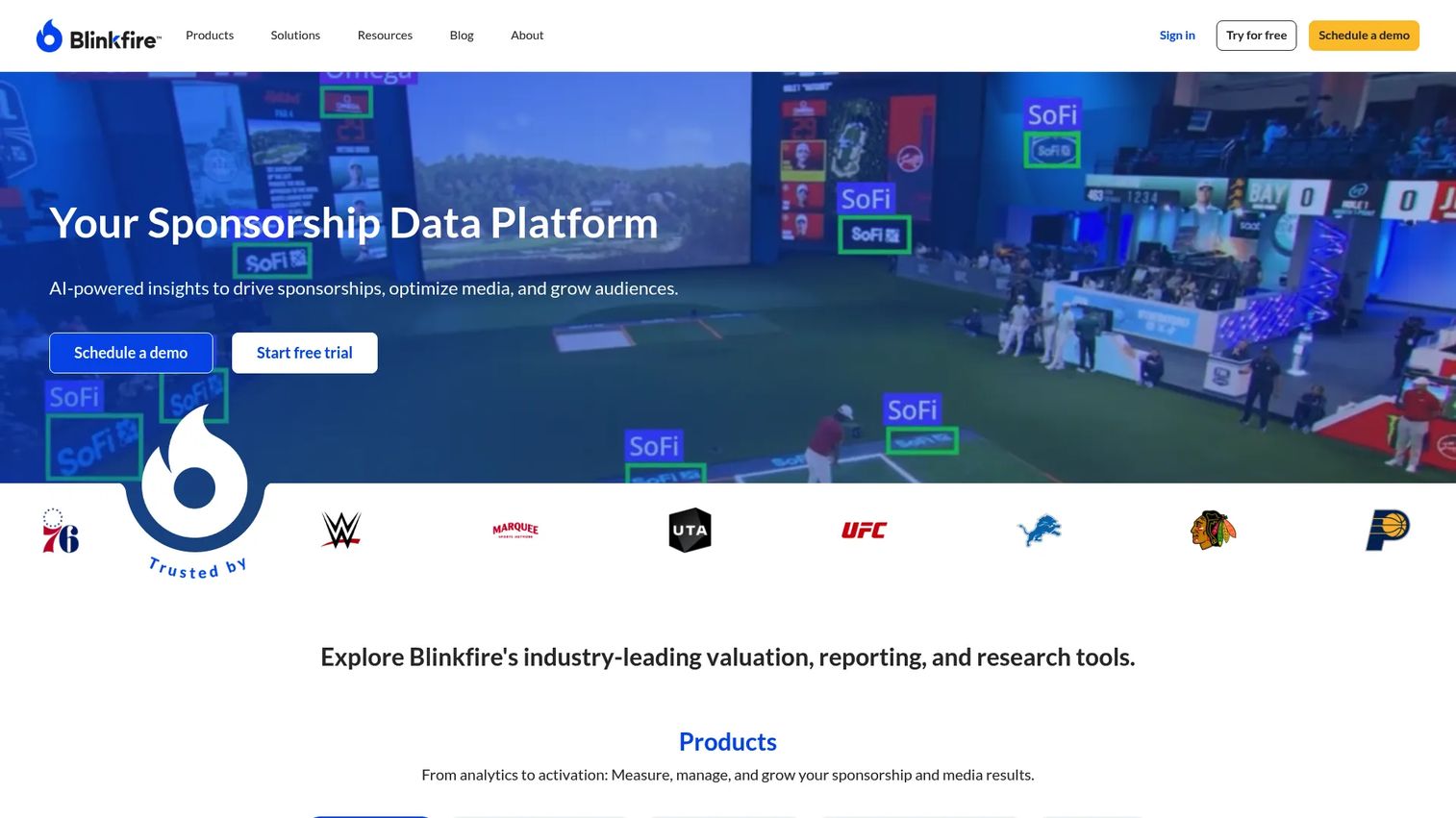
Blinkfire Analytics is an AI-powered sponsorship intelligence platform that measures brand exposure in photos, videos, social posts, and digital content using computer vision. Rights holders use it to show sponsors exactly where their marks appeared and how fans engaged. The platform covers social media, digital, broadcast, streaming, and in-venue media with post-level detail and competitive benchmarking.
Best for: Sports rights holders and sponsors measuring visual brand exposure across social and digital content.
Key features
- AI and computer vision for brand, logo, and asset detection
- Real-time social media analytics and sponsorship measurement
- Custom reporting with post-level detail and competitive benchmarking
- Sponsorship valuation and media value calculation
- Content performance tracking across channels
Why choose Blinkfire Analytics: Choose it when visual brand exposure is the primary metric and you need to show sponsors where their marks appeared with post-level granularity. It is particularly useful for teams building sponsor recaps from social and digital content.
Blinkfire Analytics pricing: Agency Benchmarking plans start at $4,166 per month billed annually (Bronze), $6,250 per month (Silver), and $10,000 per month (Gold), with an Enterprise tier from $12,500 per month. Analytics plan pricing requires a sales conversation.
G2 rating: 5.0/5
8. OpenSponsorship
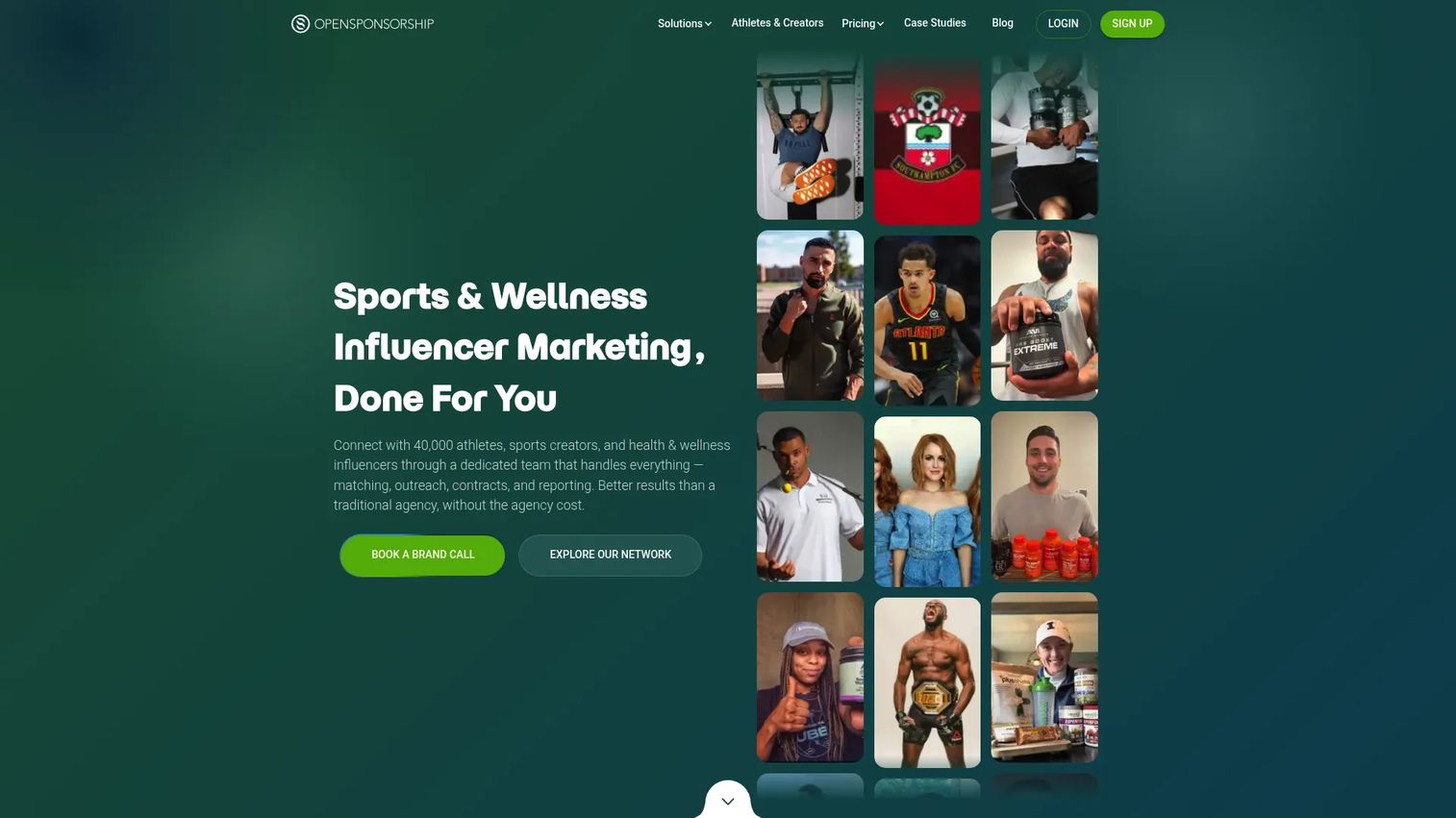
OpenSponsorship is a sports and wellness influencer marketing platform connecting brands with athletes, sports creators, and health influencers through managed campaigns. It is not a passive measurement tool; it is a marketplace and activation platform. Brands search a network of 40,000-plus athletes and creators, manage outreach, run campaigns, and track performance from one dashboard.
Best for: Brands that want to find, activate, and manage athlete or sports creator sponsorships without a large internal partnerships team.
Key features
- Access to 40,000-plus athletes and creators
- Athlete search, AI recommendations, and campaign management
- Fully managed campaign option with dedicated account management
- Deal workflow, messaging, and contract management
- Performance reporting and ROI tracking
Why choose OpenSponsorship: Choose it when the job is sourcing talent and running creator-led activations, not just analyzing existing assets. For digital marketers testing athlete influencer marketing for the first time, the managed model reduces execution dependency. A free brand account lets you search the network before committing to a paid plan.
OpenSponsorship pricing: Full-Service plan starts at $2,000 per month. The Elite plan starts at $5,000 per month for larger campaign volumes. A free brand account is available for network search.
G2 rating: 4.0/5
9. Hookit
Hookit is a sponsorship analytics and valuation platform built around social media performance measurement. It tracks athletes, teams, events, and brands using mentions, hashtags, keywords, and logo detection to calculate earned media value and sponsorship ROI from social content. Its Hookit Score and Promotional Effectiveness Score give brands a standardized way to rank and compare athletes and properties.
Best for: Brands, teams, athletes, and sports organizations measuring and comparing sponsorship performance through social media valuation.
Key features
- Sponsorship analytics and valuation via social media measurement
- Athlete, team, event, and brand tracking and ranking
- Logo, mention, hashtag, and keyword-based promotion measurement
- Promotional Effectiveness Score and Hookit Score
- Custom dashboards and partner performance reporting
Why choose Hookit: Choose it when social sponsorship value is the core reporting requirement and you need a standardized scoring system to compare athletes or properties. It suits brands managing multiple athlete relationships who need a consistent measurement framework.
Hookit pricing: Contact their team for plan details based on your portfolio size and tracking needs.
G2 rating: 4.0/5
10. Sports Info Solutions
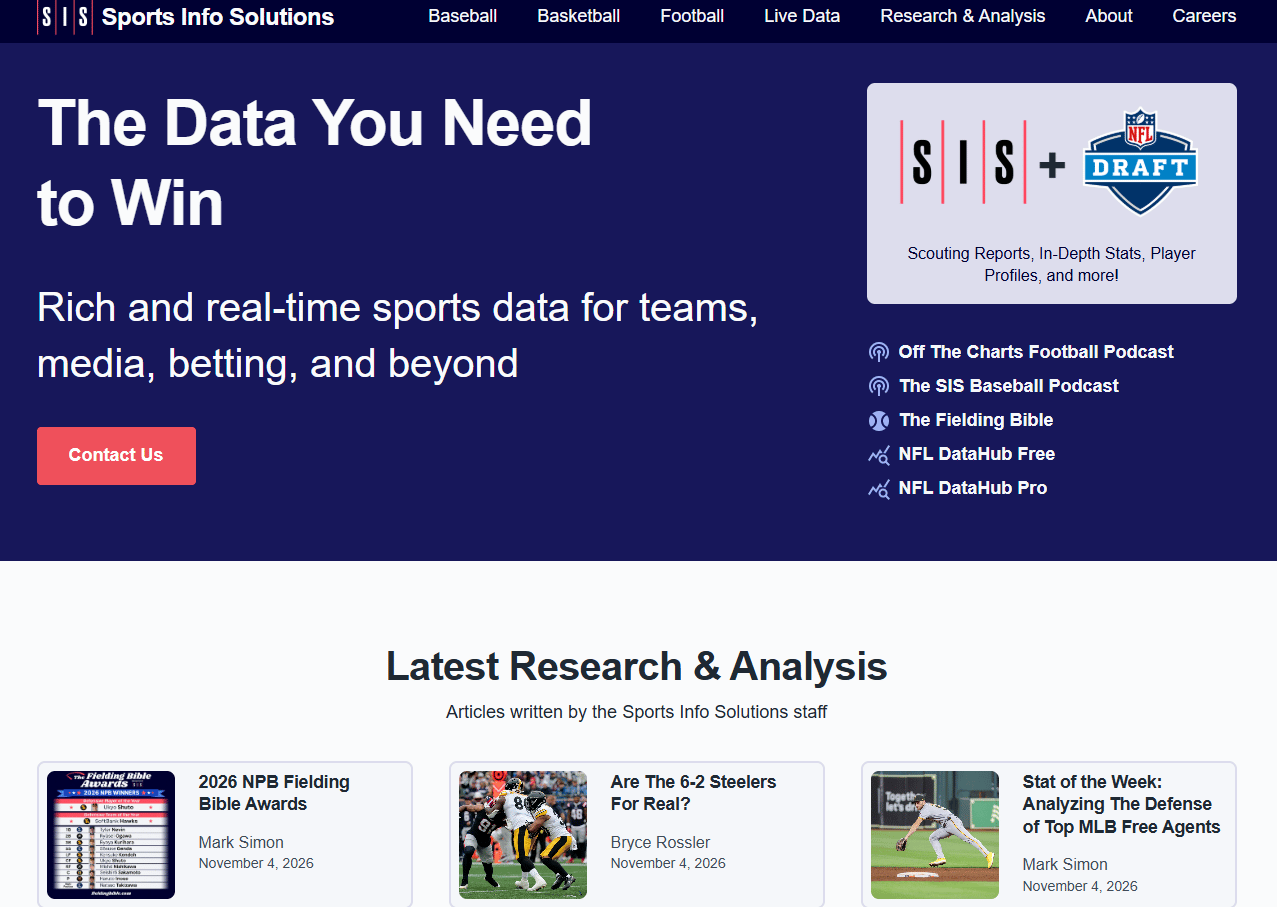
Sports Info Solutions is a sports data and analytics provider covering baseball, basketball, football, and other major leagues with live feeds, play-level data, and advanced analytics. It is not a sponsorship measurement platform in the traditional sense. It is valuable for sports marketing teams that need credible performance data to power content, editorial campaigns, fantasy-adjacent engagement, or audience intelligence built on player and team statistics.
Best for: Media companies, teams, analysts, and marketers that need deep sports performance data for content, analysis, and campaign storytelling.
Key features
- Live, low-latency sports data feeds with play-level detail
- Advanced analytics across baseball, basketball, and football
- Film Room, injury data, and Total Points metrics
- Scouting reports and customizable analytics tools
- Custom data products for enterprise and research use cases
Why choose Sports Info Solutions: Choose it when your marketing work depends on credible sports data to support editorial, content differentiation, or audience engagement. It is not a logo-tracking or sponsorship valuation tool; it is data infrastructure for teams building sports-data-driven narratives. This connects to broader big data analytics software needs in the marketing stack.
Sports Info Solutions pricing: Consumer subscription plans are available for specific leagues. NFL plans start at $9.99 per week or $99.99 per year. NFL plus NCAA plans run $199.99 per month or $1,399.99 per year. The NFL plus NCAA annual plan includes a 7-day free trial. Enterprise and research licensing is available through a sales conversation.
11. PFF
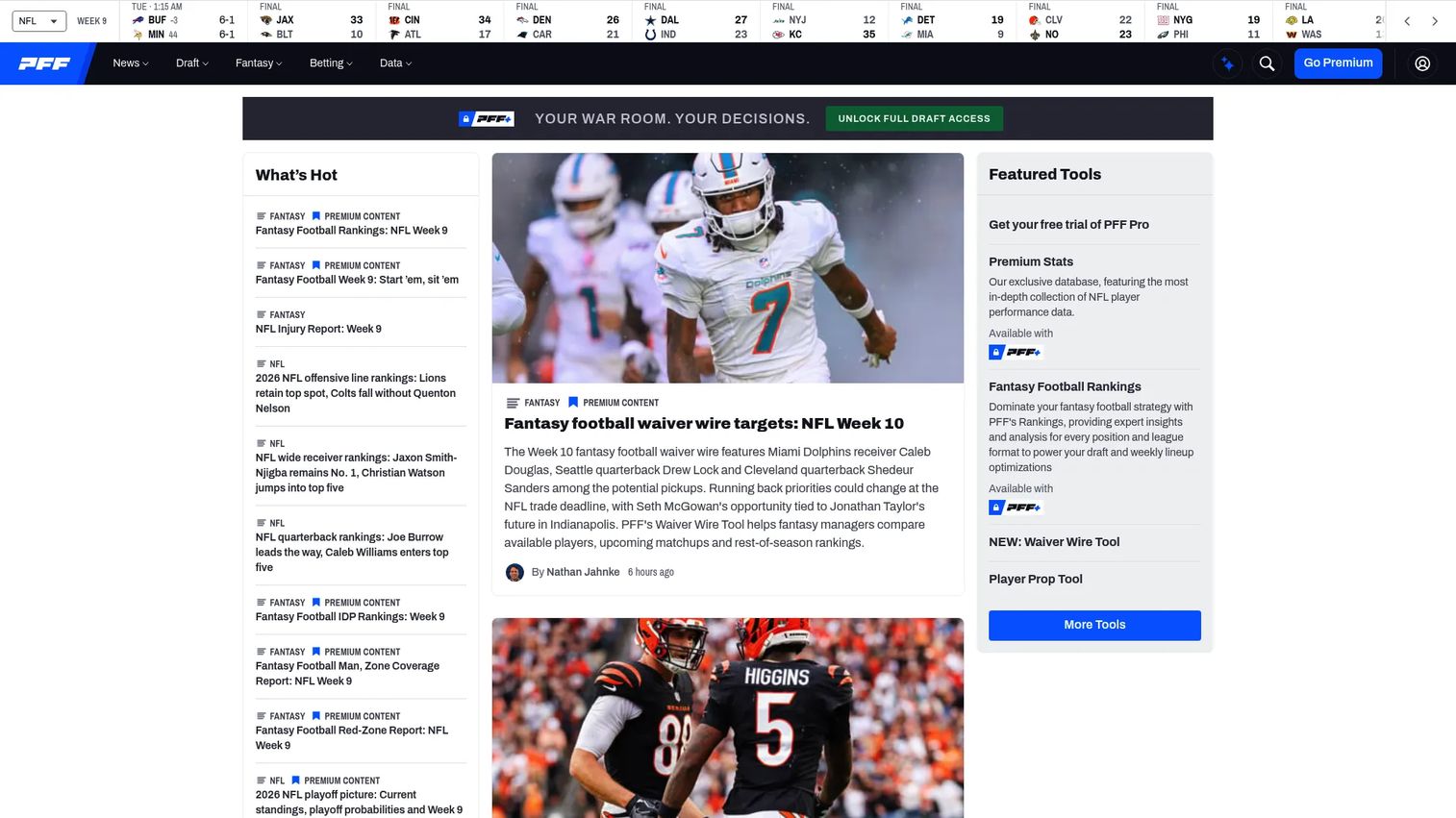
PFF is a football analytics company known for player grades, advanced statistics, fantasy projections, draft intelligence, and NFL and college football data tools. For sports marketers, PFF is most useful when campaign relevance depends on football expertise: Fantasy-adjacent campaigns, sports media partnerships, betting-adjacent content, or audience engagement built around credible player performance data.
Best for: Football-focused marketers, media teams, fantasy platforms, and analysts building campaigns or content around NFL and college football insights.
Key features
- NFL and college football player grades and advanced statistics
- Fantasy football projections, rankings, and draft tools
- PFF Guru AI chatbot for data queries
- Premium Stats Pro with reports, visualizations, and CSV exports
- API and programmatic data access via PFF Pro
Why choose PFF: Choose it when campaign credibility or audience engagement depends on detailed football data. Do not reach for it as a general sponsorship measurement tool; its strength is football-specific analytics and the audiences built around them.
PFF pricing: A free tier covers articles and limited tools. Monthly plan at $9.99 per month. Annual plan at $99.99 per year (includes Premium Stats). PFF Pro at $199.99 per year adds Premium Stats Pro, enhanced visualizations, and API access.
12. WSC Sports

WSC Sports is an AI-powered sports content technology platform that automates the creation, management, personalization, and distribution of sports video. Leagues, teams, broadcasters, and media companies use it to generate highlights, short-form clips, and personalized video formats at scale across apps, websites, social platforms, and connected TV. According to IBM survey data cited by Fortune Business Insights (2025), 90% of sports fans engage with sports content beyond live matches, which is the audience WSC Sports is built to serve.
Best for: Sports leagues, teams, broadcasters, and media organizations automating personalized video content at scale for fan engagement.
Key features
- AI-based analysis, indexing, tagging, and rating of sports content
- Automated highlight and video format creation
- Personalized delivery across apps, social, websites, and CTV
- Content editing and asset management tools
- Distribution analytics and performance tracking
Why choose WSC Sports: Choose it when the marketing problem is content velocity and fan engagement across digital surfaces, not sponsorship measurement. It fits organizations that need to turn live moments into campaign-ready clips without manual editing. For content marketing tools in adjacent categories, see the linked guide.
WSC Sports pricing: Enterprise packages are structured around content volume and distribution channels; contact sales for details.
Considerations when choosing sports marketing intelligence software
Match the tool to the measurement job
Sponsorship intelligence, exposure measurement, fan research, and sports data are four distinct jobs. Before evaluating vendors, write down the decision the tool needs to support: Pre-deal research, post-campaign ROI reporting, audience validation, or renewal pricing. A tool optimized for market mapping will not replace one built for outcome attribution, and vice versa.
Check data coverage before dashboard design
Verify which leagues, sports, media channels, social platforms, and geographies the tool covers for your specific portfolio. Many platforms have strong coverage in US professional sports and limited depth in international leagues, niche sports, or emerging platforms. A polished dashboard does not fix missing coverage for the properties you actually manage.
Ask how ROI connects to business outcomes
Media value and impressions are inputs, not outcomes. Ask each vendor how they connect exposure to brand lift, sales lift, search volume, ticketing, app installs, or renewal value. Request a methodology brief and a sample report using data from a comparable sponsorship. Finance and leadership will not accept media value screenshots as proof of business impact. For more on connecting analytics to revenue, see analytics platforms that drive ROI.
Verify integrations and data export workflows
Growth marketers need data to flow into the systems where decisions happen: CRM, BI tools, data warehouses, ad platforms, and reporting dashboards. Ask specifically about native integrations, API access, clean room compatibility, and export formats. A tool that generates insights in a walled-off portal adds work rather than reducing it.
Review pricing against portfolio size and campaign frequency
Quote-based tools can deliver strong value for large sponsorship portfolios. Smaller teams should check minimum contract size, seat limits, data volume caps, and what support is included. Ask for a sample report before signing. Pricing across this category varies significantly by data depth, channel coverage, and service model.
Conclusion
Sports marketing intelligence is a category with genuinely different tools for genuinely different jobs. Using the wrong one means you are either measuring the wrong thing or missing the measurement entirely.
For sponsorship market intelligence before you buy or pitch, SponsorUnited gives you the broadest dataset. For measuring what your sponsorship delivered, Relo Metrics handles cross-channel exposure and outcome reporting. Zoomph and Blinkfire Analytics cover social and visual exposure with strong reporting for rights holders. Genius Sports and WSC Sports serve teams that need data to power content and fan engagement. Marketcast and MediaRadar answer the audience research and competitive media intelligence questions. PFF and Sports Info Solutions are the right choice when campaign credibility depends on credible sports performance data. For brands activating athlete partnerships directly, OpenSponsorship is purpose-built for that job.
The practical next step: Identify your primary measurement job, shortlist three platforms whose core capability matches it, and ask each vendor for a sample report built from one real sponsorship, campaign, or audience segment you manage.
Start your journey with Guideflow today!
FAQs
Sports marketing intelligence software is a category of tools that helps brands, teams, leagues, agencies, and rights holders collect and analyze data about sponsorships, fans, media exposure, sports content, and campaign performance. It spans sponsorship databases, exposure measurement platforms, fan research tools, sports data feeds, and content analytics, depending on the measurement job. The goal is to connect sports investment to business outcomes rather than stopping at impressions or media value.
For post-campaign ROI and exposure measurement, Relo Metrics and Zoomph are strong options with cross-channel tracking and reporting tools. For pre-deal market research and competitive benchmarking, SponsorUnited serves a different but equally important part of the ROI conversation. The right tool depends on whether you need to plan smarter or prove performance after the fact.
Sports analytics typically focuses on player performance, game outcomes, injury data, and betting markets. Sports marketing intelligence focuses on sponsorships, fan audiences, media exposure, campaign ROI, and content performance. PFF and Sports Info Solutions sit closer to the sports analytics side. SponsorUnited, Relo Metrics, and Zoomph sit firmly in the marketing intelligence category. Some platforms, including Genius Sports, span both.
Relo Metrics, Zoomph, and Blinkfire Analytics all measure media value by tracking logo visibility, social engagement, and broadcast exposure. SponsorUnited provides pricing benchmarks and deal comparisons for pre-valuation research. Hookit calculates social-specific sponsorship value using its Promotional Effectiveness Score. The right choice depends on whether you need valuation for planning or for post-campaign proof.
Start with data coverage: Which leagues, channels, platforms, and geographies the tool tracks for your actual portfolio. Then evaluate attribution methodology, asking how the platform connects exposure to business outcomes beyond media value. Check reporting formats for whether outputs fit your CFO's questions. Finally, review integration options with your CRM, BI tools, and data warehouse.
Some platforms go beyond media value to connect sponsorship exposure with outcomes like brand lift, search volume growth, sales lift, foot traffic, or ticketing. Platforms positioned around outcome measurement typically use panel research, matched-market analysis, or behavioral data signals. Ask every vendor for the methodology behind their outcome claims and request a sample report before you buy.
Rights holders typically need inventory valuation, sponsor recaps, asset performance data, and renewal-ready reporting to defend their pricing and retain partners. Brands typically need audience fit validation, campaign ROI proof, and competitive benchmarking. Some platforms serve both sides; others are built primarily for one. For example, Blinkfire Analytics is used heavily by rights holders building partner recaps, while Marketcast is more commonly used by brand-side teams validating audience quality.
Most enterprise-grade platforms in this category, including SponsorUnited, Relo Metrics, Zoomph, Genius Sports, MediaRadar, Hookit, and WSC Sports, use quote-based pricing. Pricing reflects data coverage, channels tracked, number of properties, user seats, and service level. Blinkfire Analytics publishes starting prices for Agency Benchmarking from $4,166 per month annually. OpenSponsorship starts at $2,000 per month for managed campaigns. PFF has the most accessible consumer pricing, starting at $9.99 per month, though its use case is narrowly focused on football data.