

Your RAG prototype worked great in a notebook. Then you shipped it, and retrieval quality fell apart under real traffic.
Latency spiked. Filtered queries returned the wrong chunks. The bill from your managed provider grew faster than usage. Now you are stuck comparing options while your AI roadmap waits on infrastructure nobody agreed on.
This is the actual problem with picking vector search software. It is not a feature checklist. It is a workload decision that touches latency, filtering, governance, and cost all at once, and the wrong call surfaces in production, not in the demo.
The stakes are rising fast. The global vector search market was valued at $3.1 billion in 2025 and is forecast to reach $32.8 billion by 2034 at a 28.5% compound annual growth rate, according to MarketIntelo (2025). Vector search software alone accounted for 48.3% of that revenue in 2025, roughly $1.5 billion.
That growth means more tools, more marketing claims, and more ways to choose wrong. This guide cuts through it with a technical, presales-friendly comparison you can take into a security review or a proof of concept.
What's inside
This guide is written for engineers, sales engineers, and technical evaluators choosing vector search software for RAG, semantic search, or AI agent workloads. We picked tools that show up repeatedly in production stacks and enterprise evaluations.
We compared each option on four criteria that matter when you move past the prototype:
- Retrieval quality and hybrid search: how well it combines vector similarity with keyword and metadata signals
- Latency and scale: performance under real query volume and growing datasets
- Deployment flexibility: managed, open source, self-hosted, or embedded in existing infrastructure
- Governance and cost: security controls, access management, and predictable pricing
TL;DR
- Best for managed production scale: Pinecone. Fully managed serverless vector database with strong developer experience and enterprise governance.
- Best for controlled retrieval and hybrid search: Qdrant. Deep filtering, multivector support, and open-source roots.
- Best for lightweight AI search stacks: Chroma. Open-source infrastructure with usage-based cloud economics.
- Best for RAG and product search apps: Weaviate. Native hybrid search, schema-based filtering, and managed cloud.
- Best for high-volume open source: Milvus. Distributed architecture built for massive similarity search.
- Best for managed Milvus: Zilliz Cloud. Milvus power without running the cluster yourself.
- Best if you already run Redis: Redis Stack. Low-latency vector search alongside existing data structures.
- Best incremental path: PostgreSQL with pgvector. Vector search where your relational data already lives.
What is vector search software?
Vector search software stores data as high-dimensional numerical embeddings and retrieves the most similar items using distance calculations rather than exact keyword matches. It powers semantic search, recommendations, and AI retrieval by finding meaning, not just matching strings.
Here is how it works in practice. You convert text, images, or audio into embeddings using a model. The software indexes those vectors, then answers a query by finding the nearest neighbors in that vector space. That nearest-neighbor result is what feeds a large language model in a RAG pipeline, or what surfaces the "related items" on a product page.
The core capabilities buyers evaluate:
- Similarity search: approximate nearest-neighbor retrieval across millions or billions of vectors
- Hybrid search: combining dense vector similarity with sparse keyword signals for better relevance
- Metadata filtering: narrowing results by attributes like date, category, tenant, or permissions
- Indexing algorithms: HNSW, IVF, and quantization options that trade recall against speed and memory
- Deployment models: managed cloud, self-hosted open source, or embedded libraries
A quick clarification on terms. A vector database is a full system that stores, indexes, and manages vectors alongside metadata, with persistence, scaling, and access control. A vector search engine emphasizes the retrieval layer itself, the fast matching of query vectors to stored ones. Most tools on this list do both, and the market uses the labels loosely.
For teams building RAG, the vector database becomes the knowledge layer. Your documents get chunked, embedded, and stored, then retrieved at query time to ground the model's answers in your own data. Semantic search works the same way, minus the generation step.
When to use vector search software
Powering RAG and AI agents
RAG pipelines need fast, accurate retrieval to feed context into a language model. Vector search software is the retrieval half of that equation. When an agent needs to pull relevant documents, past conversations, or tool outputs, a vector database for RAG returns the right chunks at low latency. This is the most common reason teams adopt these tools in 2026.
Improving enterprise search
Traditional keyword search fails when users phrase queries differently than your documents. Semantic search understands intent. Enterprise search across support tickets, internal wikis, contracts, and knowledge bases becomes far more useful when it matches meaning. Metadata filtering also lets you enforce permissions, so users only retrieve what they are allowed to see.
Adding semantic matching to product experiences
Recommendations, duplicate detection, image search, and personalization all rely on similarity. If your product needs to answer "find things like this," vector search software handles it at scale. E-commerce, media, and marketplace platforms use it to surface relevant items without hand-tuned rules.
Comparison table
These six columns reflect what technical evaluators actually weigh: fit for your workload, the one thing that sets each tool apart, verified pricing, and current user sentiment. Pricing and ratings below are pulled from each vendor's live pricing page and G2 listing.
| # | Product | Best for | Key differentiator | Pricing | G2 rating |
|---|---|---|---|---|---|
| 1 | Pinecone | Managed production RAG and search | Fully managed serverless with dense, sparse, and full-text indexes | Free; Builder $20/mo | 4.6/5 |
| 2 | Qdrant | Controlled hybrid retrieval | Deep payload filtering and hybrid search | Free tier; usage-based | 4.5/5 |
| 3 | Chroma | Lightweight AI search stacks | Open-source with usage-based cloud | Starter $0/mo; Team $250/mo | 4.2/5 |
| 4 | Weaviate | RAG and product search apps | Native hybrid search and multi-tenancy | Free; Flex from $45/mo | 4.6/5 |
| 5 | Milvus | High-volume open source | Distributed architecture for scale | Free (open source) | N/A |
| 6 | Zilliz Cloud | Managed Milvus operations | Serverless and dedicated managed Milvus | Free Starter; pay as you go | 4.7/5 |
| 7 | Redis Stack | Teams already on Redis | Vector search plus JSON, search, time series | Contact for Redis Cloud | 4.5/5 |
| 8 | PostgreSQL with pgvector | Incremental adoption | Vector search inside PostgreSQL | Free (open source) | 3.8/5 |
The pattern is clear. Managed platforms trade some control for operational simplicity, open-source options give you full control of your stack, and pgvector lets you start where your data already lives. Match the tool to your workload, not to the loudest marketing.
Best vector search software for 2026
1. Pinecone
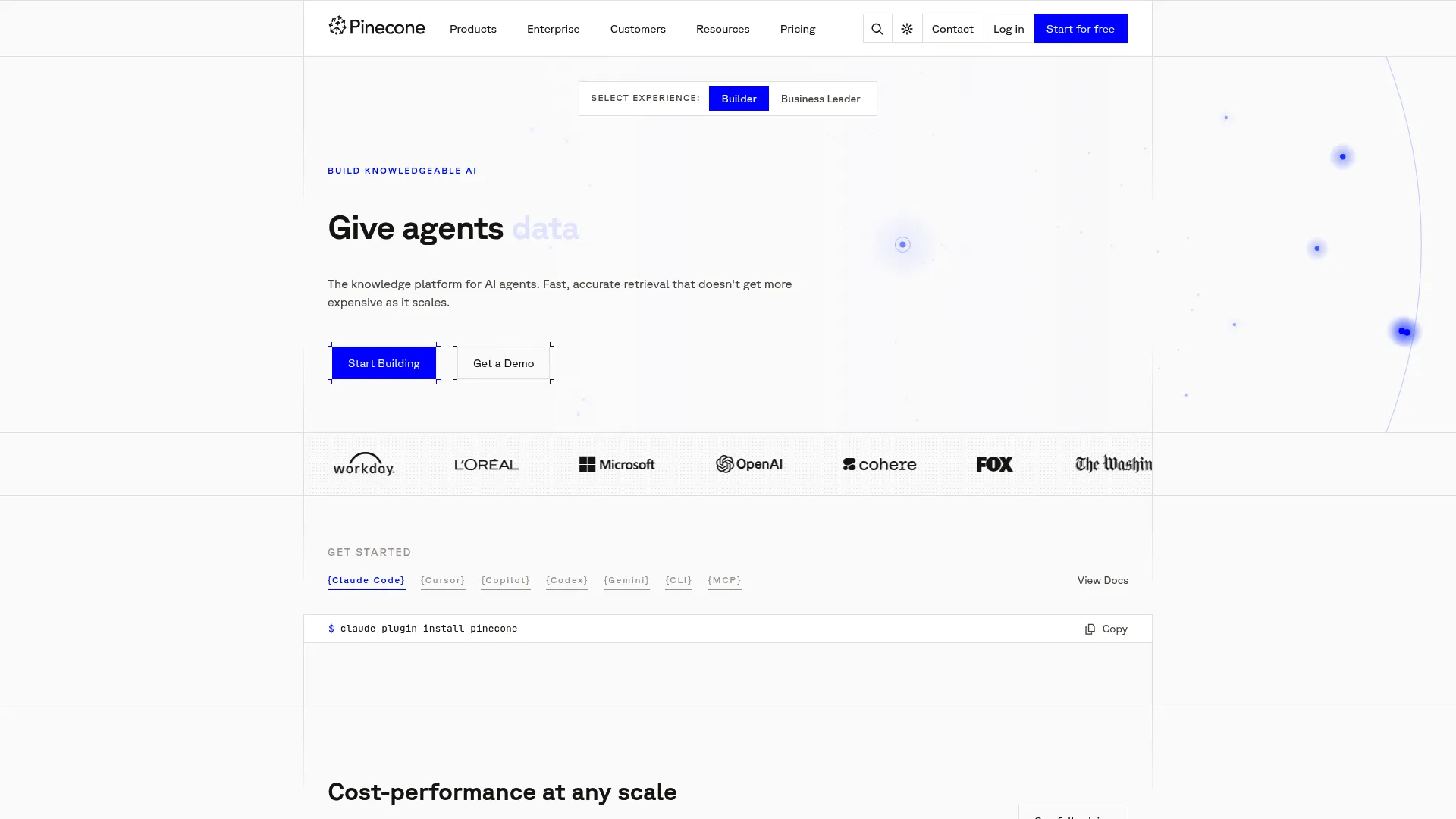
Pinecone is a fully managed vector database built for production semantic search, RAG, and agent applications. It removes cluster management entirely, so your team ships retrieval features instead of running infrastructure. The serverless architecture scales with usage, and dense, sparse, and full-text indexes support hybrid search out of the box.
Best for: Teams that want managed scale without operating a vector database themselves.
Key strengths
- Serverless vector database with automatic scaling
- Dedicated Read Nodes for high-throughput retrieval
- Pinecone Inference and Assistant for RAG workflows
- Dense, sparse, and full-text indexes for hybrid search
- Bring Your Own Cloud (BYOC) deployment option
Pinecone fits teams that value time-to-production over infrastructure control. The developer experience is clean, observability is built in, and the knowledge-layer positioning maps directly to RAG and agent use cases. For enterprise buyers, the BYOC option and managed governance help clear security review faster than a self-hosted alternative would.
Pinecone pricing: Starter is free. Builder is $20 per month flat. Standard carries a $50 per month minimum usage, and Enterprise starts at a $500 per month minimum usage. BYOC pricing is available through sales.
2. Qdrant
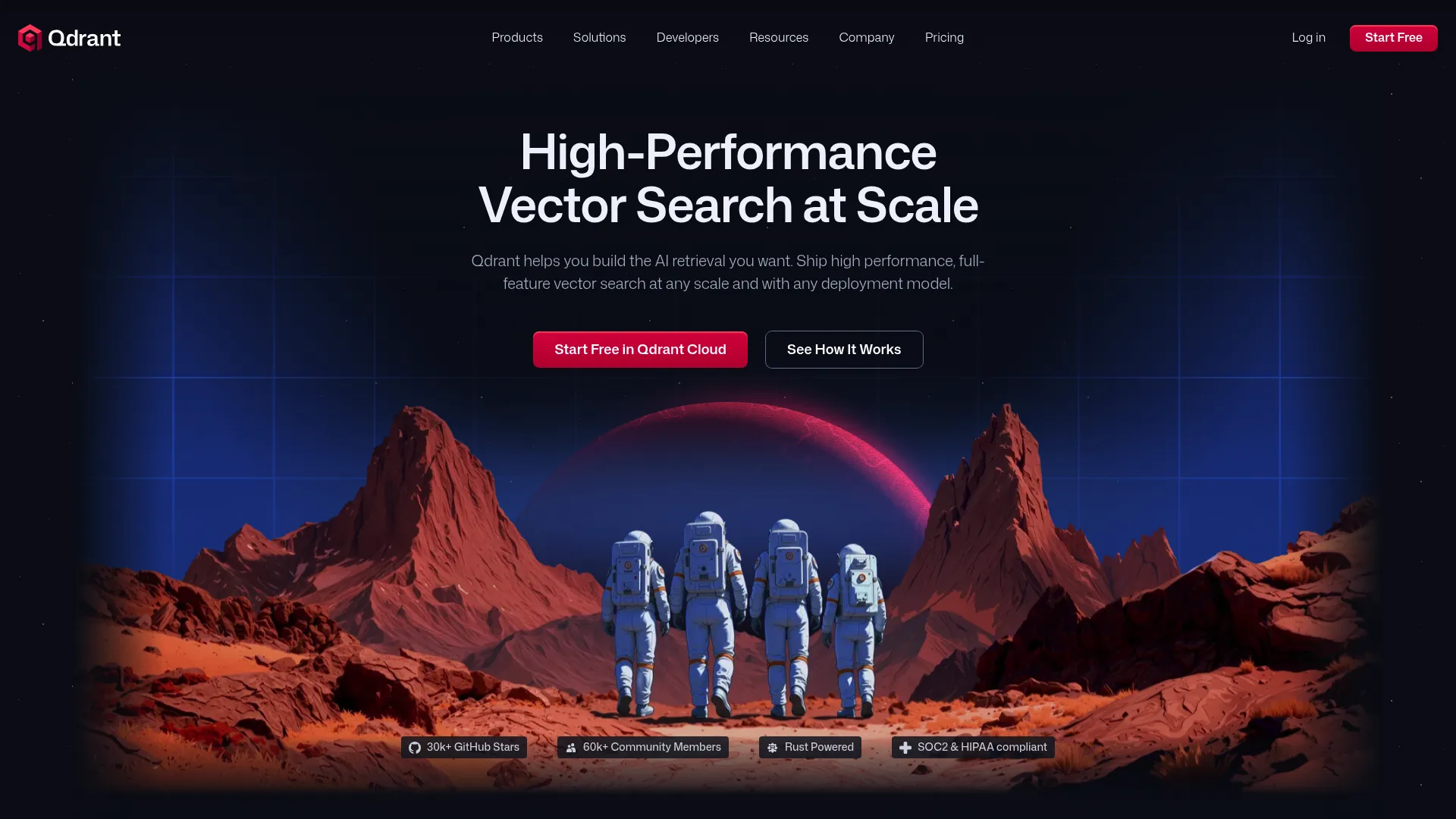
Qdrant is a vector search engine and database built for AI applications that need precise control over relevance. Its payload filtering is a standout, letting you attach rich metadata to vectors and filter without wrecking recall. Teams that care about controlled retrieval, where the right filter must return the right result, tend to shortlist it.
Best for: Teams building semantic or hybrid search systems that demand fine-grained filtering.
Key strengths
- Vector similarity search with high recall
- Hybrid search combining dense and sparse vectors
- Payload filtering and metadata storage
- Multivector retrieval for advanced ranking
- Flexible deployment from open source to managed cloud
Qdrant appeals to engineers who want to tune retrieval behavior rather than accept defaults. The open-source core means you can self-host for full control, then move to managed cloud when operational load grows. Its filtering performance is the reason it lands on so many technical evaluation shortlists in 2026.
Qdrant pricing: The Free Tier is free forever. The Standard Tier uses usage-based pricing. Premium and Private Cloud plans are quote-based, available on request.
3. Chroma
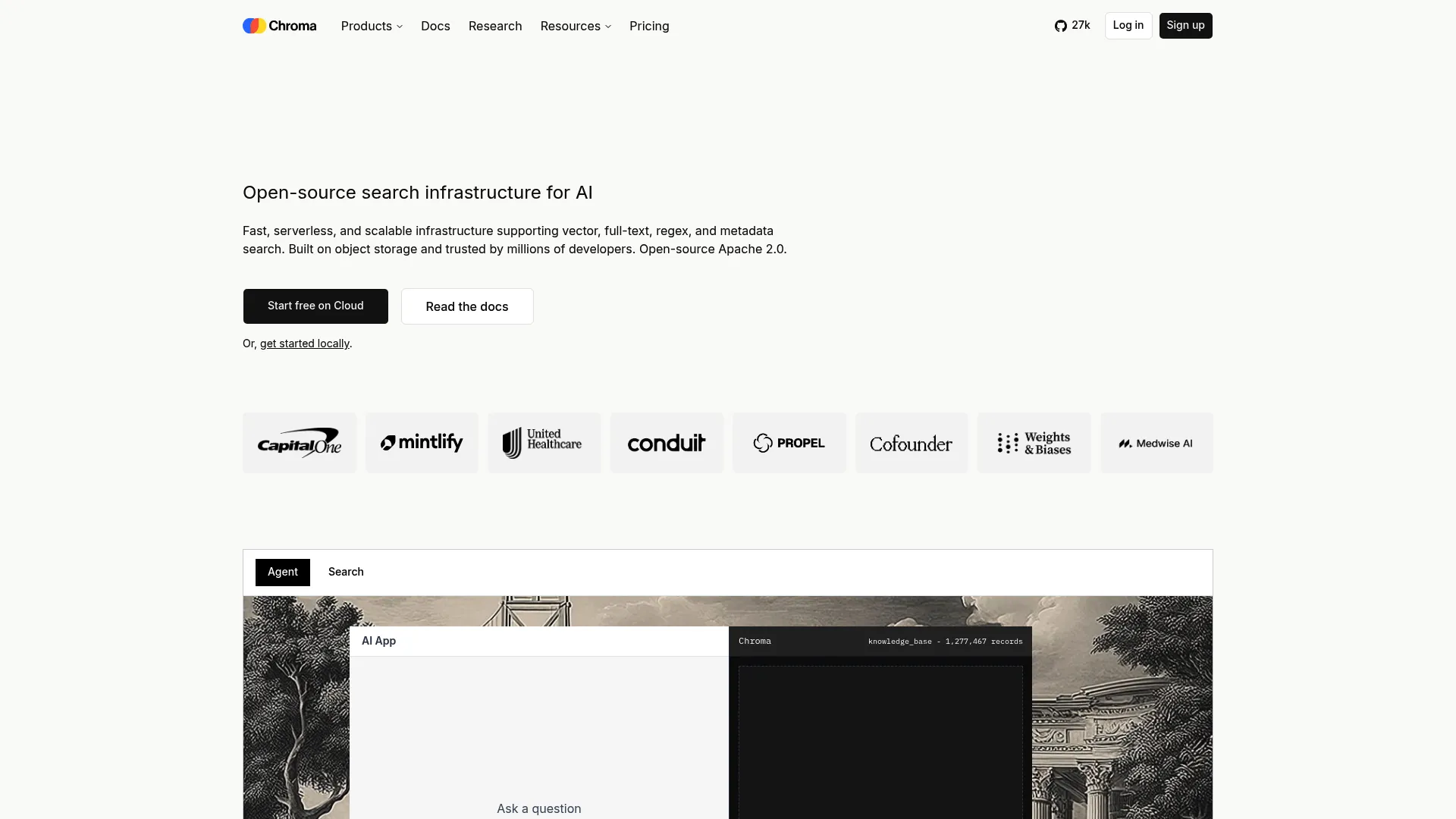
Chroma is open-source search infrastructure for AI, combining vector, full-text, and metadata search in one system. It became popular for its developer-friendly local workflow, then extended to a cloud offering with usage-based billing. If you want a lightweight way to add retrieval to an AI stack, Chroma keeps the barrier low.
Best for: Teams that want lightweight, open-source retrieval infrastructure with a simple path to cloud.
Key strengths
- Vector search with a simple developer API
- Full-text and metadata search in one system
- Open-source core with self-host option
- Usage-based cloud billing
- Fast local iteration for prototyping
Chroma suits teams that prototype fast and want retrieval that scales without a heavy operational footprint. The cloud pricing charges separately for writes, storage, queries, and network returned, so cost tracks actual usage rather than reserved capacity. That model rewards workloads that are spiky or still finding their scale.
Chroma pricing: Starter is $0 per month with $5 in free credits. Team is $250 per month with $100 in credits. Enterprise is custom. Usage for writes, storage, queries, and returned data is billed on top.
4. Weaviate
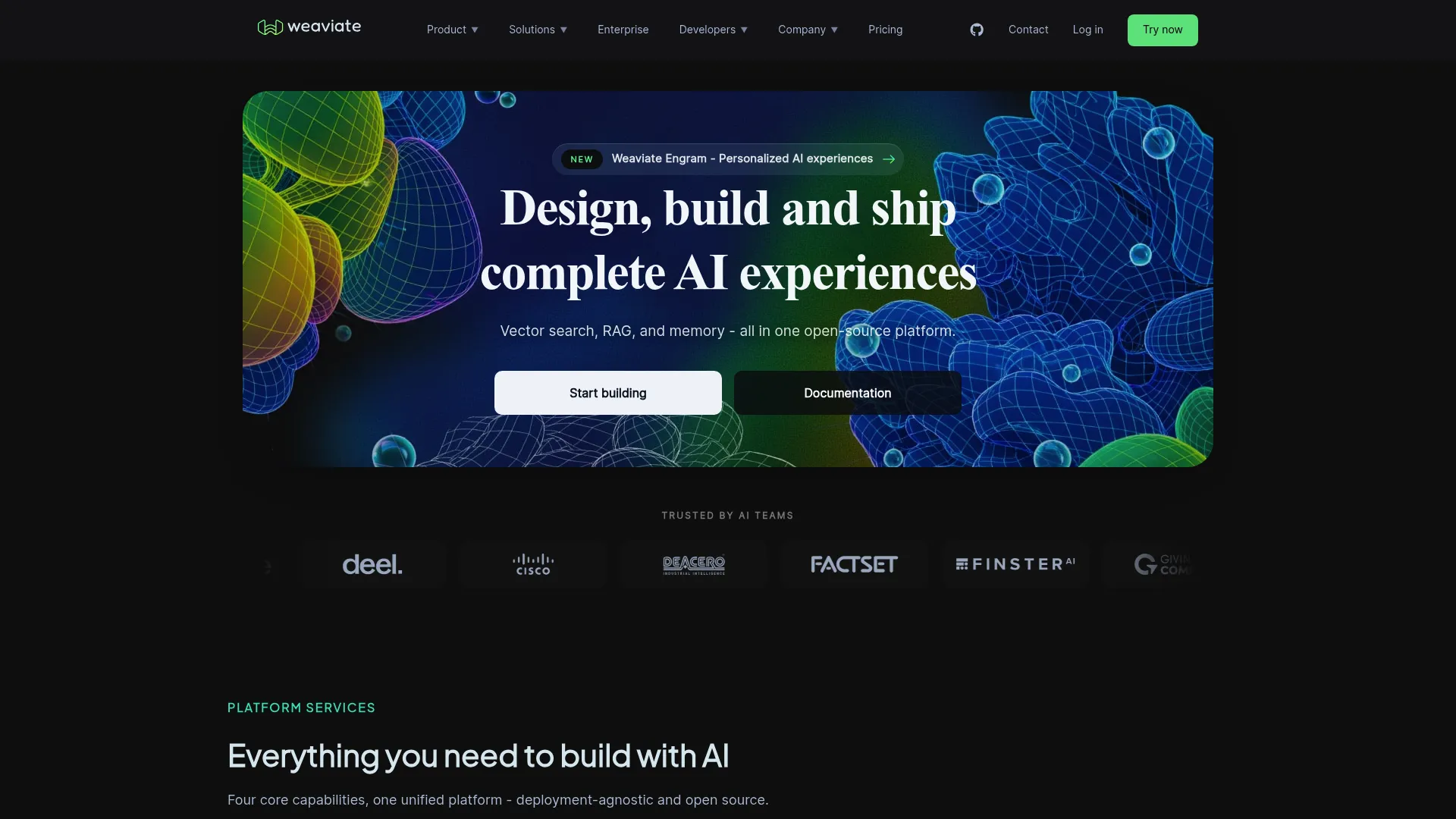
Weaviate is an open-source AI database and vector search platform for building search, RAG, and agentic applications. It leans into native hybrid search, combining vector and keyword retrieval without a separate system. Schema and filtering support make it a strong fit for structured product search and knowledge-heavy RAG apps.
Best for: Teams building semantic search, RAG, or AI-native applications on managed vector infrastructure.
Key strengths
- Hybrid search combining vector and keyword
- Advanced filtering and multi-tenancy
- Schema-based data modeling
- Managed cloud with embeddings and Query Agent
- Open-source deployment option
Weaviate works well when your data has structure and your queries need both semantic and exact matching. Multi-tenancy makes it practical for SaaS products serving many customers from one deployment. The managed cloud handles embeddings and retrieval together, which shortens the path from raw documents to a working RAG app.
Weaviate pricing: The Free plan is $0 per month, always free. Flex is pay-as-you-go starting at $45 per month. Premium is a prepaid contract starting at $400 per month.
5. Milvus
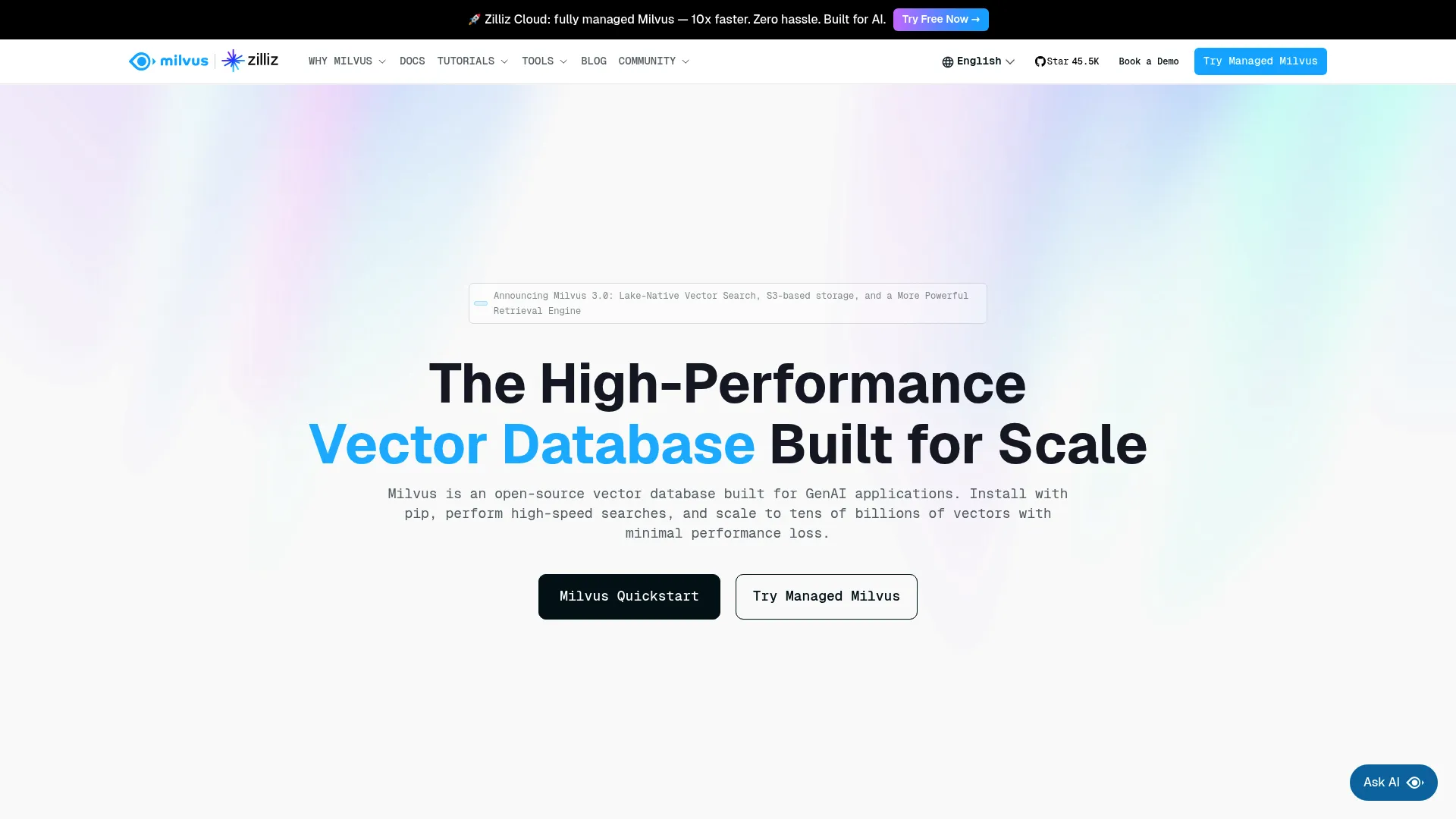
Milvus is a high-performance open-source vector database built for similarity search at scale. Its distributed architecture handles billions of vectors, which is why large retrieval systems adopt it. Multiple deployment modes, from an embedded Lite version to a full distributed cluster, let you start small and grow into serious volume.
Best for: Teams building scalable vector search and RAG systems that want an open-source database.
Key strengths
- Vector similarity search and filtering
- Hybrid search and full-text search with BM25
- Milvus Lite, Standalone, and Distributed deployment modes
- Distributed architecture for billion-scale datasets
- Large open-source community and ecosystem
Milvus is the choice when scale is the primary constraint and you have the engineering capacity to run distributed infrastructure. The Lite mode is handy for prototyping, and the same codebase carries you to production distributed clusters. For teams that want the open-source power without running the cluster, the managed option below solves that directly.
Milvus pricing: Milvus is 100% free and open source. A managed cloud version is available through Zilliz.
6. Zilliz Cloud
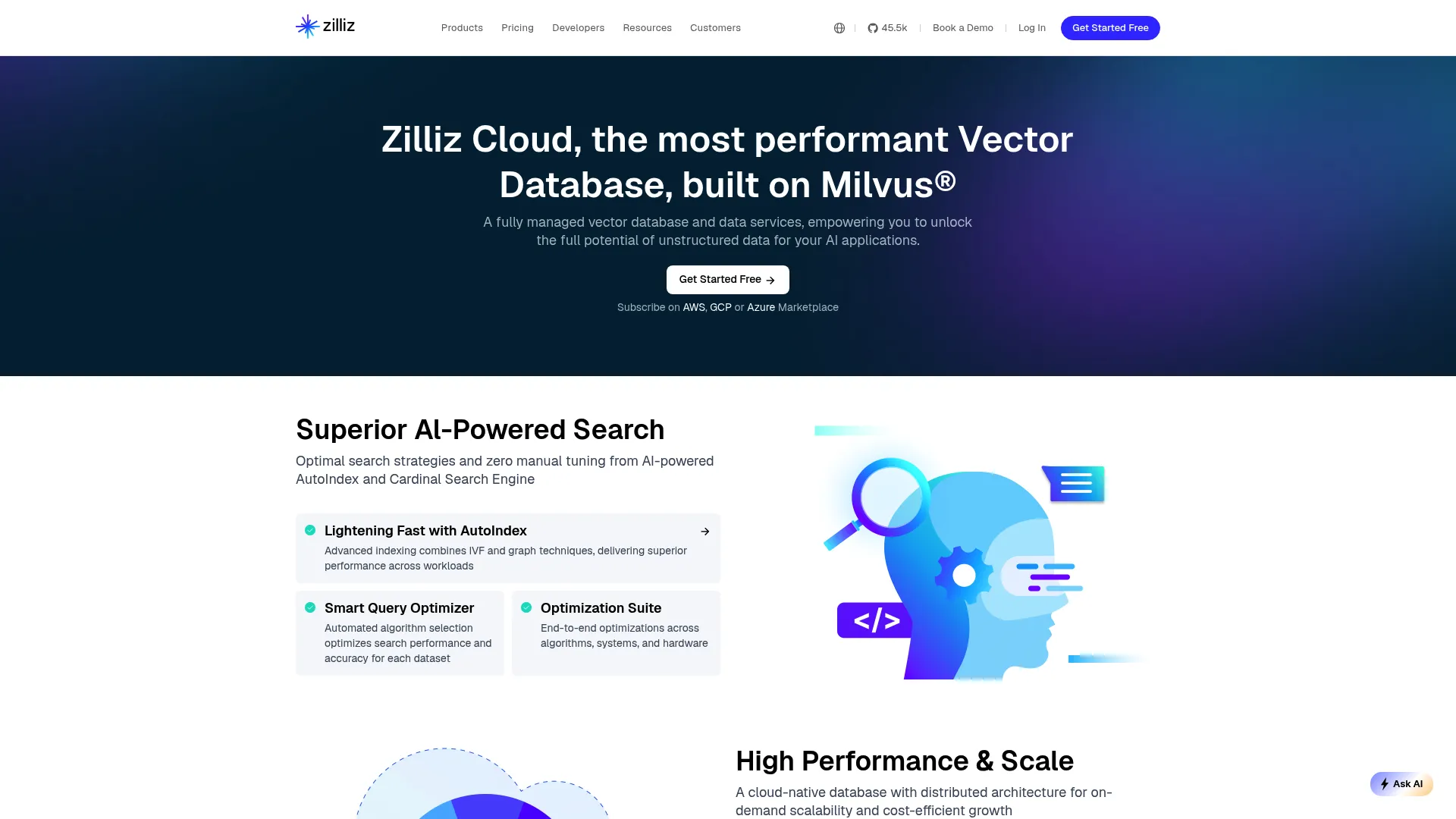
Zilliz Cloud is the managed cloud version of Milvus, built by the team behind the open-source project. It delivers Milvus scale and performance without asking you to operate the cluster. Serverless and dedicated deployment options, plus auto-scaling and backup, make it the practical path for teams that want Milvus in production without the operational overhead.
Best for: Teams that want Milvus power on a managed vector database with enterprise operations.
Key strengths
- Free cluster with limited capacity to start
- Serverless and dedicated deployment options
- Hybrid and vector search with auto-scaling
- Backup, RBAC, and observability features
- Built and maintained by the Milvus creators
Zilliz Cloud is the answer when you like Milvus but do not want to staff cluster operations. RBAC and observability address the governance questions that come up in enterprise review, and the free Starter cluster lets you validate before committing spend. For AI search, RAG, recommendation, and anomaly-detection apps, it covers the range without a self-managed footprint.
Zilliz Cloud pricing: A free Starter cluster is available. The Standard plan is pay as you go, with Enterprise and Business Critical tiers available through sales.
7. Redis Stack
Redis Stack bundles Redis with search, JSON, time series, and probabilistic data structures, adding vector search to a data platform many teams already run. If Redis is already in your stack for caching or real-time data, adding vector retrieval means one fewer system to operate. Its in-memory design targets low-latency use cases.
Best for: Teams already running Redis that want low-latency vector search without a new database.
Key strengths
- Vector search alongside existing Redis data
- Queryable JSON documents
- Querying across hashes and JSON documents
- Probabilistic data structures for real-time analytics
- In-memory performance for low-latency retrieval
Redis Stack makes sense when latency matters and you value consolidation. Running vector search on infrastructure your team already knows removes a learning curve and a separate operational surface. It fits real-time recommendation and session-based retrieval especially well, where the in-memory model shines.
Redis Stack pricing: Redis Stack is available as part of Redis offerings, with Redis Cloud plans available through Redis. Check the Redis Cloud page for current plan details.
8. PostgreSQL with pgvector
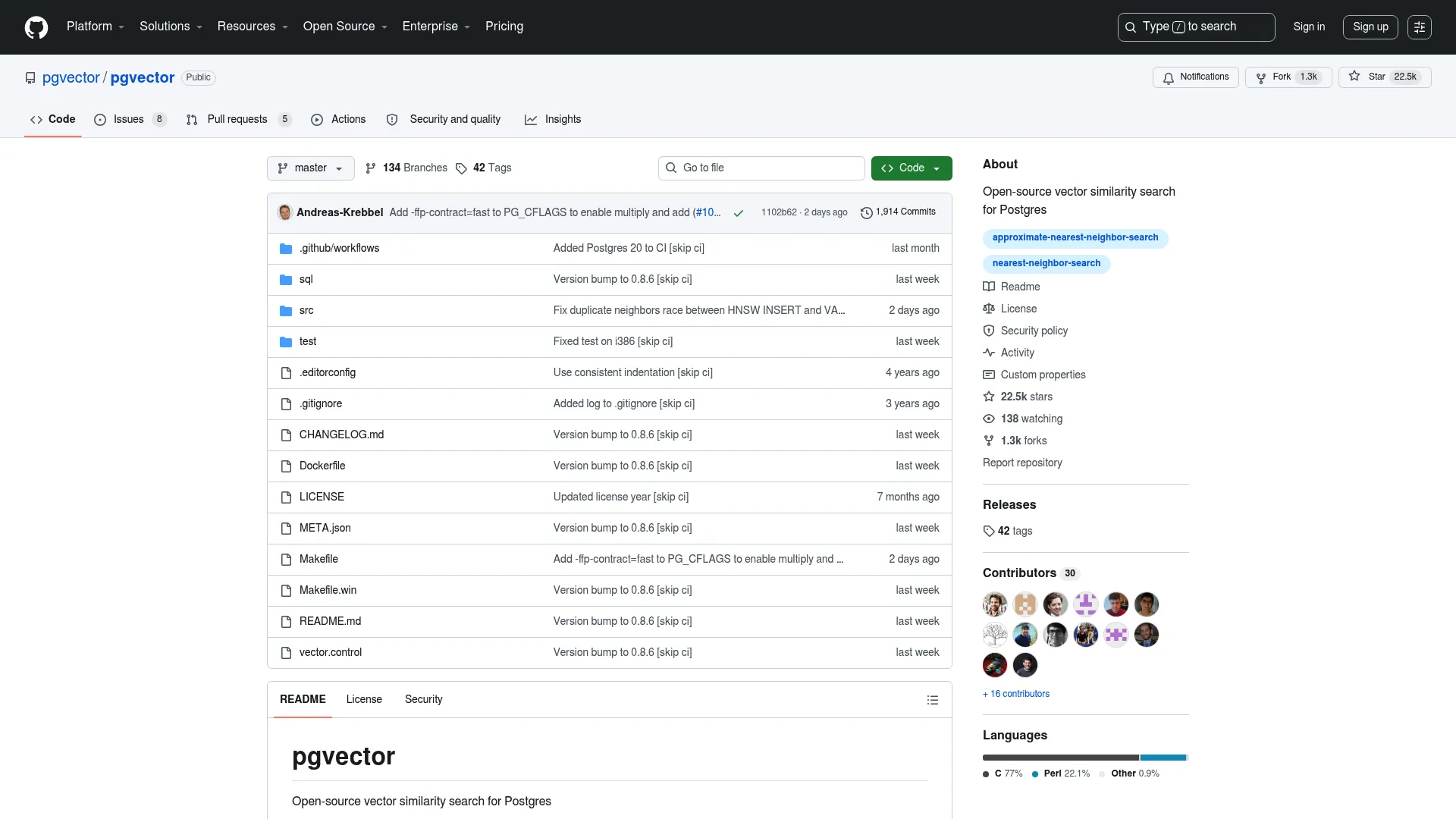
PostgreSQL with pgvector adds vector similarity search directly to PostgreSQL through an open-source extension. For teams that already run Postgres, this is the "start where your data already lives" path. You get vector search with SQL, relational joins, and the transactional guarantees you already depend on.
Best for: Teams that want vector search inside PostgreSQL with SQL and relational joins.
Key strengths
- Exact and approximate nearest-neighbor search
- Single-precision, half-precision, binary, and sparse vectors
- L2, inner product, cosine, L1, Hamming, and Jaccard distances
- Runs inside your existing PostgreSQL database
- Full SQL and relational join support
pgvector is the incremental choice. If you already run PostgreSQL and your vector workload is moderate, you avoid adding a new system entirely. You keep one database, one backup strategy, and one set of access controls. As retrieval volume and query complexity grow, teams often evaluate a dedicated vector database, but pgvector gets you into production with what you already operate.
pgvector pricing: pgvector is a free, open-source PostgreSQL extension. Your cost is whatever your PostgreSQL hosting already runs.
Considerations
Before you commit, run every shortlisted tool against these five criteria with your own workload.
Retrieval quality and hybrid search
Test recall on your actual data, not a benchmark dataset. Check whether the tool supports hybrid search combining dense vectors with sparse keyword signals, since pure vector search misses exact-match terms like product codes or names. Relevance is the whole point, so measure it before anything else.
Metadata filtering performance
Filtering should narrow results without collapsing recall or spiking latency. Some engines apply filters before the vector search, others after, and the difference matters at scale. Test filtered queries at your expected data volume, especially if you enforce per-user or per-tenant permissions through metadata.
Latency and scalability
Measure query latency at your target dataset size and concurrency, not at prototype scale. Ask how the tool handles growth: does it scale horizontally, and what happens to latency as vectors reach the hundreds of millions? Low-latency vector search under real load is where prototypes and production diverge.
Deployment and governance
Decide between managed, open source, and self-hosted based on your team's capacity and security posture. Managed options clear operational load; open source gives control and data residency. For enterprise buyers, check RBAC, SSO, audit logging, and compliance certifications early, since security review is where deals stall.
Total cost of ownership
Look past the entry price. Usage-based pricing rewards spiky workloads but can surprise you at steady high volume. Self-hosted open source is free in license but costs engineering time. Model your real query and storage volume against each pricing structure before you sign.
Conclusion
The right vector search software depends on your workload, not on a leaderboard.
If you want managed production scale with strong developer experience, Pinecone is the safe pick. For controlled hybrid retrieval with deep filtering, Qdrant leads. Chroma fits lightweight open-source stacks, Weaviate suits structured RAG and product search, and Milvus with its managed sibling Zilliz Cloud covers high-volume scale. If you already run Redis, Redis Stack adds vector search with minimal new surface, and PostgreSQL with pgvector is the cleanest incremental path when your data already lives in Postgres.
Your next step: shortlist two tools that match your deployment model and run a proof of concept on your own data. Measure recall, filtered-query latency, and cost at realistic scale before you commit. That single POC will tell you more than any comparison table, including this one.
If part of your evaluation involves showing technical stakeholders how a product works before they commit, teams often build interactive demos and sandboxes with Guideflow to walk buyers through the experience, support hands-on validation, and organize everything in a shared hub. Start your journey with Guideflow today!
FAQs
Vector search software stores data as high-dimensional embeddings and retrieves the most similar items using distance calculations instead of exact keyword matching. It powers semantic search, recommendations, and AI retrieval by matching meaning rather than strings. In RAG systems, it serves as the knowledge layer that feeds relevant context to a language model.
A vector database is a full system that stores, indexes, and manages vectors alongside metadata, with persistence, scaling, and access control. A vector search engine emphasizes the retrieval layer, the fast matching of query vectors to stored ones. In practice most tools do both, and the market uses the terms loosely, so evaluate capabilities rather than labels.
For managed RAG at production scale, Pinecone and Weaviate are strong picks because they combine hybrid search with low operational overhead. For open source, Qdrant and Milvus offer deep control and scale. The best vector database for RAG is the one whose retrieval quality holds up on your actual documents at your real query volume.
Yes, open-source options like Qdrant, Milvus, Chroma, and pgvector run in production at serious scale. The trade-off is operational: you handle deployment, scaling, and monitoring yourself, which costs engineering time. If your team has that capacity, open source gives full control and data residency; if not, a managed option converts that work into a subscription.
Hybrid search combines dense vector similarity with sparse keyword signals, which catches exact-match terms that pure vector search misses. Metadata filtering narrows results by attributes like date, tenant, or permissions. The key question is whether filtering degrades recall or latency at your data volume, since some engines filter before the vector search and others after.
Use PostgreSQL with pgvector when you already run Postgres and your vector workload is moderate. You keep one database, one backup strategy, and one set of access controls, which simplifies governance and cost. As query complexity and volume grow into the hundreds of millions of vectors, teams often move to a dedicated vector database for better filtering and latency.
Enterprise teams weigh retrieval quality, latency at scale, and total cost, then run security review on RBAC, SSO, audit logging, and compliance certifications. Deployment flexibility matters too, since data residency and BYOC options often decide whether a tool clears procurement. A proof of concept on real data usually settles the technical questions before contract negotiation.
Redis Stack is a strong low-latency choice because its in-memory design targets real-time retrieval, especially for teams already running Redis. Managed platforms like Pinecone and Zilliz Cloud also deliver low latency through optimized serving layers and dedicated read capacity. Measure latency at your target concurrency and dataset size, since real-world numbers diverge from prototype benchmarks.