
A driver clears the terminal at 2:14 PM. Your billing team invoices for that move four days later. In between, someone pinged the driver twice, updated a spreadsheet, chased a proof of delivery, and answered three customer calls asking "where's my container?" None of that work moved a single box. It just kept the paper trail from falling apart.
That gap between the physical move and the money is where drayage operations quietly bleed margin. Free-time windows expire while a container sits unflagged. Detention accrues that nobody bills. Dispatch runs on text messages and memory. And every customer status update routes back through a human who could be doing higher-value work.
The market has noticed. The global drayage management software segment was valued at $2.1 billion in 2025 and is projected to reach $5.8 billion by 2034, growing at an 11.4% CAGR, according to Marketintelo (2025). Software made up 62.3% of that market value. Operators are not buying software because it is trendy. They are buying it because manual coordination stops scaling around the time volume gets interesting.
This guide is for the operator making that call: the fleet owner, the operations lead, the dispatch manager weighing whether a purpose-built container drayage TMS earns its place in the stack. We look at seven tools through an operator lens, not a feature-sheet lens, because what matters is how fast a move becomes an invoice and how few humans it takes to get there.
What's inside
This guide compares seven container drayage software platforms built for carriers, brokers, and intermodal operators. We evaluated each tool on the workflows that actually govern drayage margin: dispatch workflow automation, real-time container tracking, billing and accessorial recovery, document and proof of delivery automation, driver mobile app execution, integration depth, and how realistically a team can adopt it. We skipped generic freight platforms that treat drayage as an afterthought and focused on tools that either specialize in container work or handle it credibly inside a broader TMS. Pricing and ratings reflect verified, public sources where available.
TL;DR
- Best for enterprise intermodal operations: CargoWise Landside Trinium TMS, for operators who need deep terminal connectivity and customizable dispatch at scale.
- Best for low-cost cloud drayage teams: TMSEZ, at $15 per truck/month with a free trial and no contract.
- Best for workflow automation and AI-assisted billing: PortPro TMS, which runs order-to-payment inside one system.
- Best all-in-one intermodal drayage software: DrayMate LogiNet, for carriers wanting dispatch, track and trace, and a customer portal in one platform.
- Best broader TMS with drayage fit: Rose Rocket, for brokers and 3PLs running mixed-mode freight.
- Best for smaller intermodal fleets comparing options: Trucker Zoom and Trimble TruckMate.
What is container drayage software?
Container drayage software is a transportation management system built specifically to plan, execute, track, and bill the short-haul movement of ocean and rail containers between ports, rail ramps, warehouses, and customer locations.
Unlike a general freight TMS, a drayage TMS handles the container-specific realities that make this niche hard: chassis assignment and tracking, terminal appointments, per-diem and demurrage clocks, empty returns, and the tight free-time windows that decide whether a move is profitable. The category clusters around a consistent set of core functions.
- Dispatch and load planning: Assign moves to drivers, sequence work, and manage schedules without a whiteboard.
- Real-time container tracking: Follow containers across marine terminal and rail systems, with status visibility for internal teams and customers.
- Customer communication and portal: Give shippers self-serve status and document access instead of routing every question to a human.
- Document capture and proof of delivery automation: Collect PODs, interchange receipts, and scale tickets from the driver's phone.
- Invoicing and accessorial recovery: Turn a completed move into an invoice fast, and flag detention, demurrage, and per-diem before they leak.
- Terminal and rail coordination: Sync appointments, availability, and holds with marine terminal integration and EDI feeds.
- Driver mobile app: Push assignments and pull status updates, signatures, and documents from the field.
The through-line is compression: fewer manual touches between the physical move and the money, and fewer humans standing between the container and the customer who wants to know where it is.
When to use container drayage software
Not every operation needs a purpose-built drayage TMS on day one. Here is where the payback shows up fastest.
Automate dispatch and reduce manual load planning
When a dispatcher is assigning moves by memory and text message, every added truck multiplies the coordination load. Dispatch workflow automation lets you assign work, sequence pickups and returns, and manage driver schedules from one screen. Higher-volume operations benefit most, because that is where the manual method breaks down and where a few saved minutes per move compounds across the day.
Improve container visibility and customer communication
The "where's my container?" call is pure overhead. It produces no move and no margin. Software with real-time container tracking, a customer portal, and automated status alerts cuts those calls off before they start. Customers self-serve, internal teams stop firefighting, and exceptions surface early instead of at the terminal gate. Fewer surprises means better service and fewer costly misses.
Speed up billing and recover accessorials
The longer the gap between delivery and invoice, the more cash sits frozen and the more accessorials slip away. Proof of delivery automation and billing tools shorten that path: capture the POD in the field, generate the invoice the same day, and flag detention, demurrage, and per-diem while the clock still matters. Accessorial recovery is often the single clearest ROI line in a drayage software decision, because that revenue is already earned. It just needs to be caught and billed.
Comparison table
We ranked these seven tools by how directly they serve container drayage work, then by operator fit across dispatch, visibility, billing, and adoption. Enterprise-grade platforms lead where breadth and terminal connectivity matter; lean cloud tools lead where price and speed to value matter. Pricing and ratings below reflect verified public sources; where a vendor gates pricing behind sales, we note that plainly.
| # | Product | Best for | Key differentiation | Pricing | G2 rating |
|---|---|---|---|---|---|
| 1 | CargoWise Landside Trinium TMS | Enterprise intermodal operators | Deep terminal connectivity, customizable dispatch, AI order automation | Request a demo (no public price) | 4.3/5 |
| 2 | PortPro TMS | Carriers and brokers wanting one system | Order-to-payment automation, embedded customer comms | Contact sales | 4.7/5 |
| 3 | TMSEZ | Price-sensitive cloud drayage teams | Low-cost, chassis auditing, per-diem tracking | $15 per truck/month, $75/month min | Not listed |
| 4 | DrayMate LogiNet | All-in-one intermodal carriers | Dispatch, track and trace, ePORTAL customer portal | Based on active trucks | Not listed |
| 5 | Rose Rocket | Brokers and 3PLs on mixed-mode freight | Configurable TMS with unlimited AI agents | From $2,080/month | 4.8/5 |
| 6 | Trucker Zoom | Intermodal drayage fleets | AI dispatch assist, quoting, bookkeeping | From $70/driver/month | Not listed |
| 7 | Trimble TruckMate | LTL and larger transportation orgs | Order-to-settlement operations and accounting | Contact sales | 4.4/5 |
1. CargoWise Landside Trinium TMS
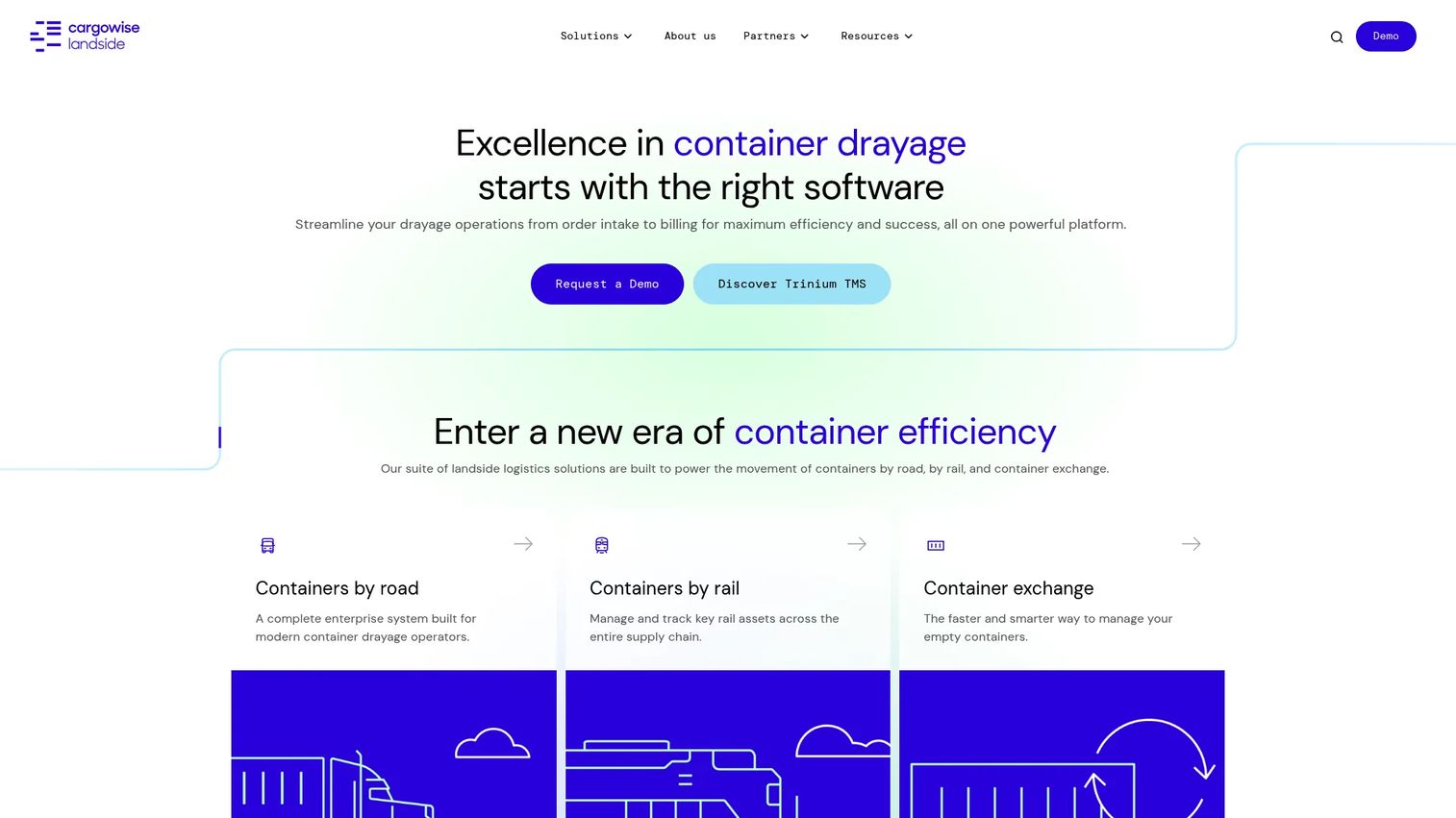
CargoWise Landside Trinium TMS is the enterprise end of the container drayage TMS market, built for North American intermodal trucking operators who need to run high volume with deep customization. It handles the full landside flow from order intake through billing, and its strength is connectivity: the kind of terminal and customer integration depth that larger operations require to keep boxes moving without manual reconciliation.
Best for: North American drayage and intermodal trucking operators that need an enterprise landside TMS with heavy integration requirements.
Key strengths
- EDI/API customer integrations: Connect directly to customer systems so orders, updates, and billing flow without re-keying.
- AI-powered order automation: Reduce manual order entry and let the system create and route work automatically.
- Dispatch workflow customization: Shape dispatch screens and rules around how your operation actually runs, not a generic template.
Why choose CargoWise Landside Trinium TMS: This is the pick when scale and integration depth outweigh simplicity. Larger operators with existing enterprise systems, high daily move counts, and demanding customer EDI requirements get the most value. Smaller fleets may find the breadth more than they need, but for operations that have outgrown lighter tools, the terminal connectivity and dashboards justify the weight.
CargoWise Landside Trinium TMS pricing: CargoWise does not publish pricing on its site. The product pages route visitors to request a demo and speak with sales, which is typical for enterprise TMS platforms where scope drives cost. Expect a scoping conversation rather than a self-serve signup. On G2, the broader CargoWise product carries a 4.3/5 rating.
2. PortPro TMS
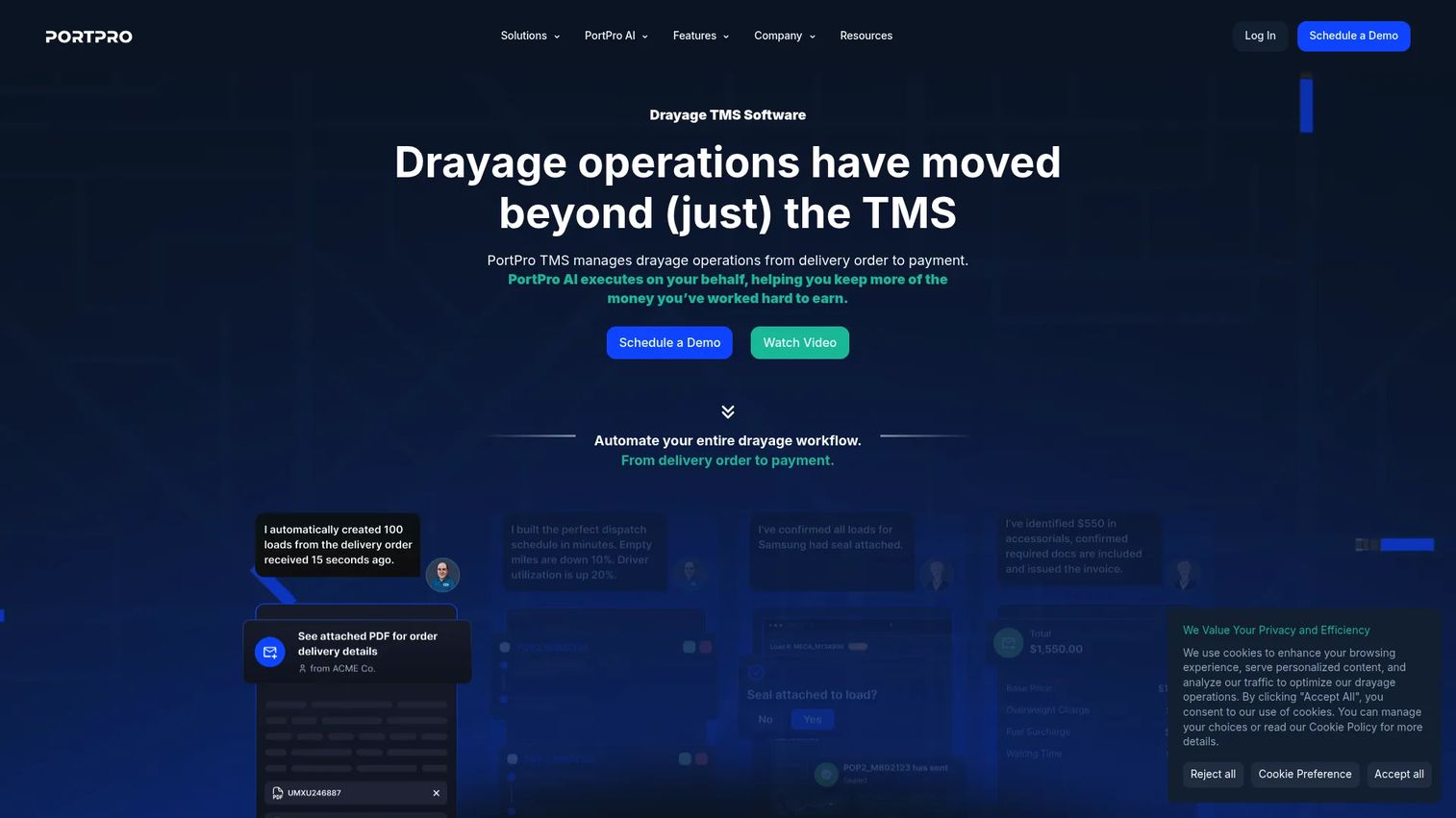
PortPro TMS is a drayage-native TMS that runs the whole cycle from delivery order to payment inside one system. Its pitch is consolidation: instead of stitching dispatch, customer communication, and billing across separate tools, PortPro keeps order entry, driver planning, customer messaging, and invoicing in one place. The embedded email inbox is a small detail that tells the story, because customer comms live where the work lives.
Best for: Drayage carriers and brokers that want dispatch workflow automation, customer communication, and billing in a single platform.
Key strengths
- Order entry and automatic load creation: Turn incoming delivery orders into dispatchable loads without manual setup.
- Dispatching and driver planning: Plan and assign driver work from a unified operations view.
- Accounts receivable and invoicing automation: Move from completed load to invoice faster, tightening the cash cycle and supporting accessorial recovery.
Why choose PortPro TMS: Choose PortPro when the core problem is fragmentation, when your team is losing time bouncing between a dispatch tool, an inbox, and an accounting system. The consolidated model shortens the path from move to money and keeps customer communication attached to the load record. Carriers and brokers running meaningful volume feel this the most.
PortPro TMS pricing: PortPro does not publish plan pricing on its site, using demo and sales-contact CTAs instead. You will need a conversation to scope cost to your fleet size and workflow. On G2, PortPro holds a strong 4.7/5 rating, one of the higher marks among drayage-specific platforms.
3. TMSEZ
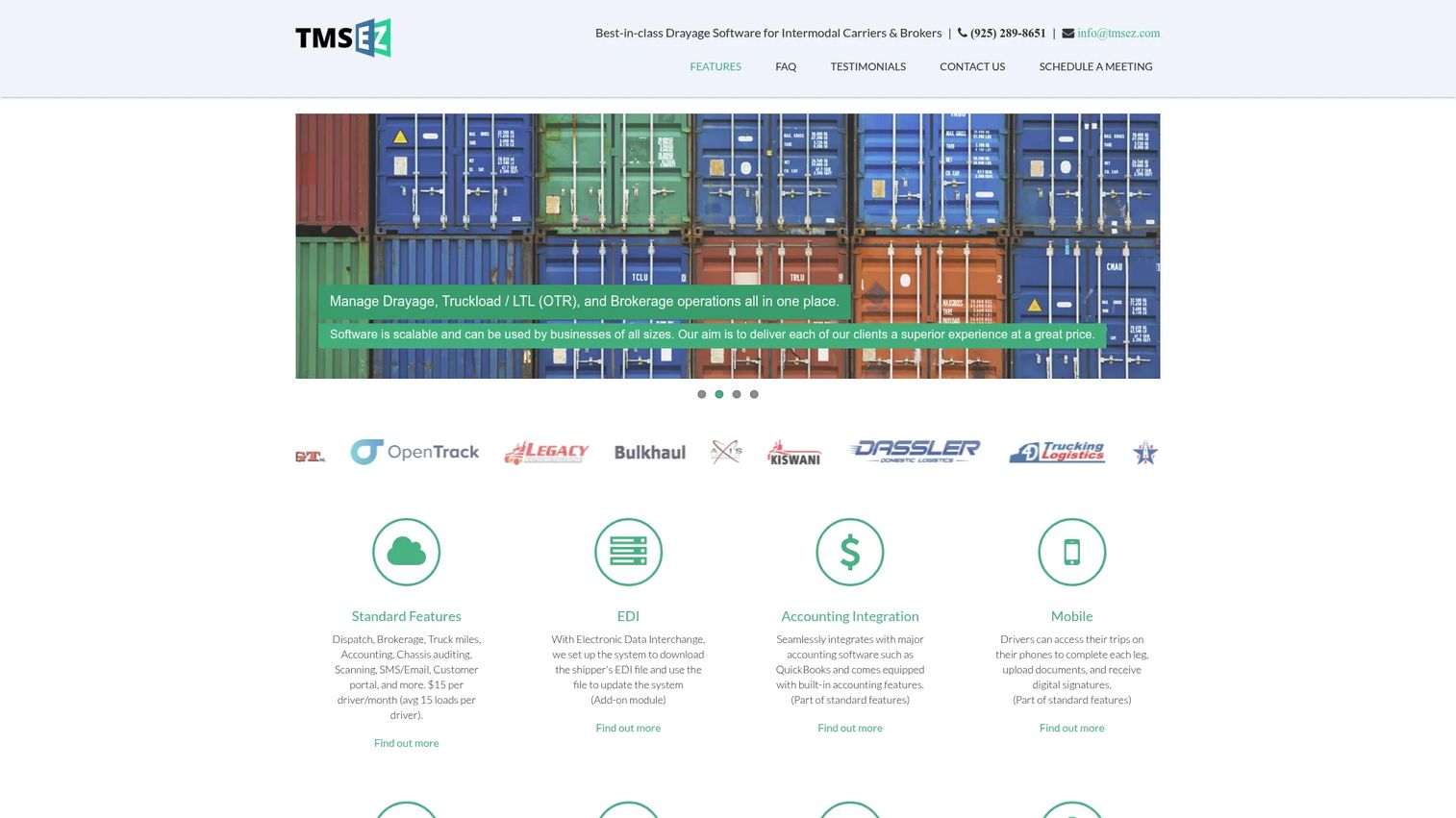
TMSEZ is the value pick: cloud-based drayage, intermodal, and brokerage software priced for teams that will not tolerate a heavy enterprise contract. At $15 per truck per month with a free trial and no contract, it removes the biggest objection smaller fleets have to adopting software at all. And it covers the practical ground drayage operations actually need day to day.
Best for: Intermodal carriers and brokers that need drayage-focused transportation management software without enterprise pricing.
Key strengths
- LoadBoard, billing, and invoicing: Manage loads and turn them into invoices inside one workflow.
- Chassis auditing and per-diem tracking: Catch chassis and per-diem charges before they become unrecovered leakage.
- Driver mobile app and document scanning: Let drivers pull assignments and scan documents from the field, supporting proof of delivery automation.
Why choose TMSEZ: Choose TMSEZ when price and speed to value matter more than deep customization. The chassis auditing and per-diem tracking directly target accessorial recovery, which is exactly where small fleets lose money silently. For a price-sensitive operation, the math is easy to run and the entry cost is low enough to test without a committee.
TMSEZ pricing: TMSEZ publishes clear pricing: $15 per truck per month, with a $75 monthly minimum, no contracts, and a free trial. That transparency is rare in this category and makes it one of the easiest tools to evaluate before committing. A verified G2 rating was not available at the time of writing.
4. DrayMate LogiNet
DrayMate LogiNet is a cloud-based drayage TMS built specifically for ocean and rail drayage carriers who want dispatch, tracking, invoicing, and fleet management in one platform. Its ePORTAL customer portal and container track and trace with rail and port visibility make it a strong all-in-one option for carriers who want to stop juggling separate systems for operations and customer communication.
Best for: Drayage carriers that want an all-in-one intermodal operations platform covering dispatch through invoicing.
Key strengths
- Real-time dispatch with track and trace: Assign moves and follow containers across rail and port systems in one view.
- Automatic invoicing based on your rates: Generate invoices from completed moves against your configured rates, speeding the cash cycle.
- ePORTAL customer portal and driver mobile apps: Give customers self-serve status while drivers update status and capture documents on the road.
Why choose DrayMate LogiNet: Choose DrayMate when you want breadth in a single platform without the enterprise footprint. The combination of rail and port visibility, automatic invoicing, and a built-in customer portal covers the workflows that generate the most manual overhead for growing carriers. It fits operators comparing modern intermodal drayage software who want one system rather than a patchwork.
DrayMate LogiNet pricing: DrayMate does not publish fixed numeric pricing. Its license terms indicate pricing depends on active trucks, with a one-time license fee, optional paid integrations, and a monthly fee revised periodically. Expect a scoping conversation tied to fleet size. A verified public G2 rating was not available at the time of writing.
5. Rose Rocket

Rose Rocket is a broader transportation management platform for trucking, brokers, carriers, and 3PLs rather than a drayage-only tool. That is precisely why it belongs on this list: operators running mixed-mode freight, where drayage is one lane among several, often want one configurable TMS instead of a specialist tool per mode. Rose Rocket handles order management, real-time tracking, and invoicing, and every plan includes unlimited AI agents.
Best for: Freight brokers, carriers, and 3PLs that want a configurable TMS with built-in automation across mixed-mode freight.
Key strengths
- Order management: Centralize orders across freight types in one system of record.
- Real-time tracking and track and trace: Give internal teams and customers live status without manual check-ins.
- Invoicing and billing: Move from completed work to invoice inside the same platform.
Why choose Rose Rocket: Be honest about fit here. If your operation is pure container drayage, a drayage-native tool will match your terminal and chassis workflows more tightly out of the box. But if drayage sits alongside truckload, LTL, or brokerage in your business, Rose Rocket's configurability and mixed-mode coverage can consolidate several tools into one. Growing operations that expect their freight mix to broaden get real value from that flexibility.
Rose Rocket pricing: Rose Rocket publishes pricing openly. The Full Service Platform starts at $2,080/month, and Enterprise runs on custom pricing. Every plan includes unlimited AI agents. On G2, Rose Rocket carries a 4.8/5 rating, the highest on this list, though from a smaller review count.
6. Trucker Zoom
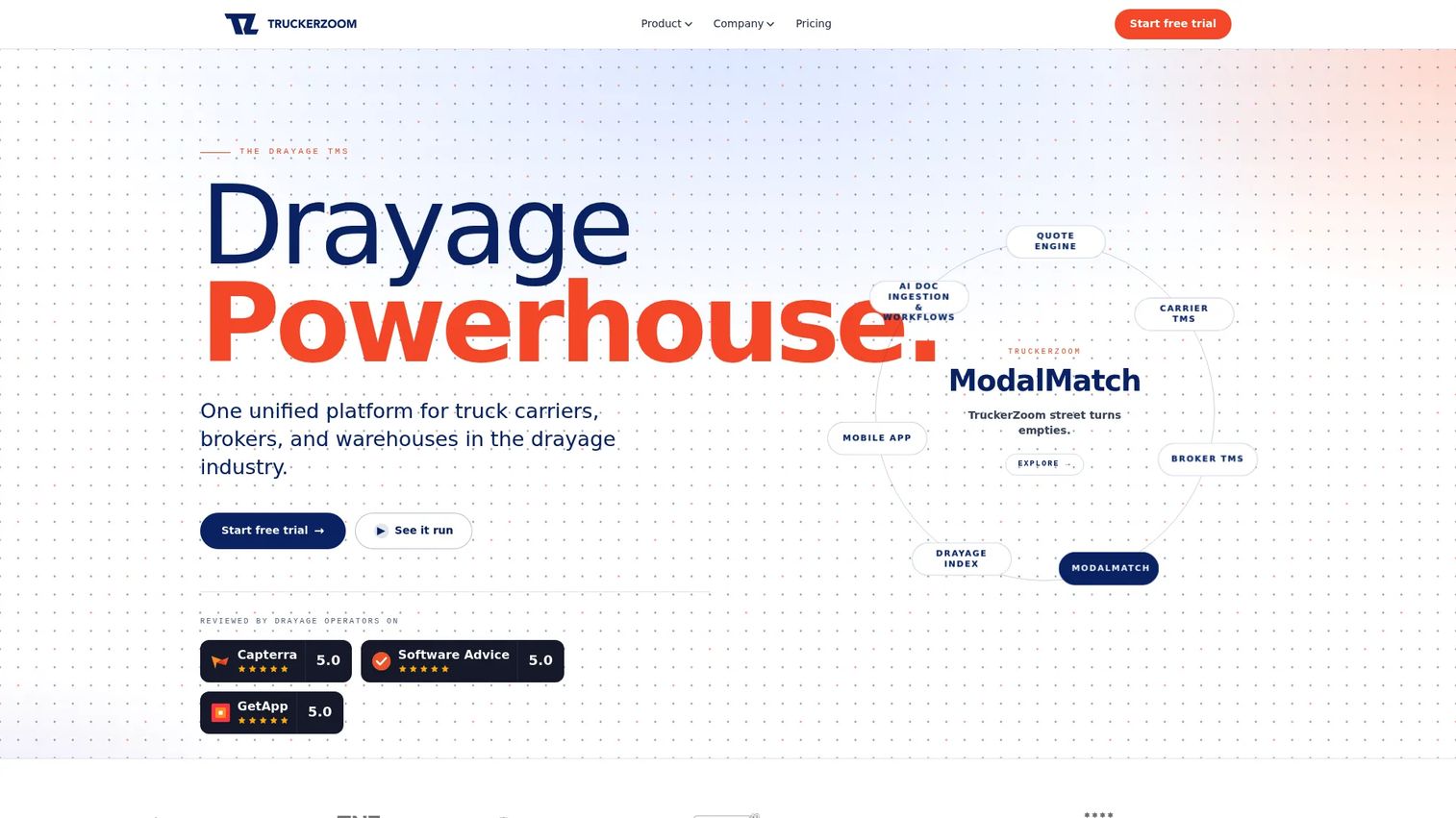
Trucker Zoom is intermodal drayage TMS software aimed at trucking and container drayage fleets that want dispatch, loadboard, quoting, and bookkeeping in one place, with AI dispatch assist layered in. It sits between the lean value tools and the enterprise platforms, offering a practical feature set for fleets that have outgrown spreadsheets but do not need heavy enterprise customization.
Best for: Intermodal drayage fleets needing a TMS with dispatch, loadboard, quoting, and bookkeeping.
Key strengths
- Automated workflows: Reduce repetitive manual steps across dispatch and back office.
- AI dispatch assist: Get help assigning and sequencing moves so dispatchers spend less time planning.
- Driver mobile app: Push assignments and pull field updates and documents from drivers.
Why choose Trucker Zoom: Choose Trucker Zoom when you want intermodal dispatch software with modern automation but predictable per-driver pricing. The quoting and bookkeeping tools mean it covers more of the back office than a pure dispatch tool, which suits fleets that want fewer separate systems. It differs from the most specialized drayage-first products by leaning toward a broader trucking workflow while still targeting intermodal work.
Trucker Zoom pricing: Trucker Zoom publishes tiered pricing. The TZ Core Plan is $70 per active driver per month, TZ Premium is $120 per active driver per month, and TZ Enterprise is $140 per active driver per month, with a stated $250 monthly minimum regardless of driver count and a 30-day free trial. A verified G2 rating was not available at the time of writing.
7. Trimble TruckMate
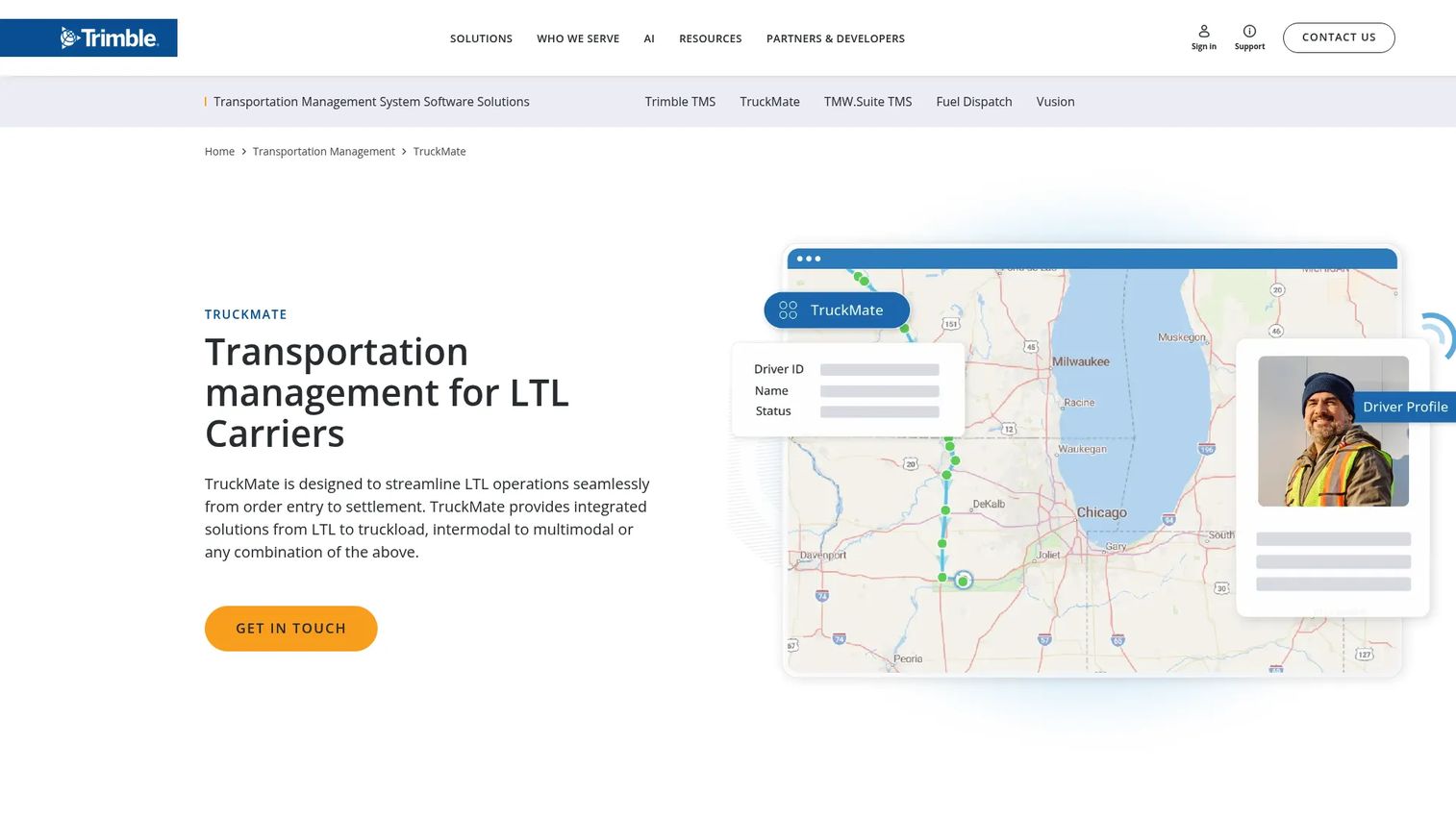
Trimble TruckMate is an established transportation management platform for LTL carriers that also supports intermodal management, covering operations from order entry to settlement with dispatch, auto-rating, billing, and accounting tools. It is the operational-maturity option: a broad, configurable system backed by a large transportation software vendor, suited to organizations that value stability and depth over a lightweight footprint.
Best for: LTL carriers and larger transportation organizations needing a configurable TMS for dispatch, billing, and accounting with intermodal support.
Key strengths
- Order-to-settlement operations: Run the full operational flow from order entry through settlement in one system.
- Intermodal management support: Handle intermodal work alongside LTL and other freight types.
- Dispatch, auto-rating, billing, and accounting: Cover front-office and back-office functions inside a single platform.
Why choose Trimble TruckMate: Choose Trimble TruckMate when your organization is larger or more established and values a mature, integrated TMS over a drayage-first specialist. Its accounting and settlement depth make it a fit for operations that want front office and back office in one place. Pure container drayage teams may prefer a more focused tool, but for mixed and larger fleets, the breadth and vendor backing carry weight.
Trimble TruckMate pricing: Trimble does not publish pricing for TruckMate; the product page describes capabilities and routes to sales. Cost is scoped through a conversation. On G2, Trimble as a seller carries a 4.4/5 rating, though this reflects the broader Trimble TMS family rather than TruckMate alone.
Considerations before you buy
The right container drayage software depends less on feature counts and more on how a tool fits your daily reality. Run every option through this checklist.
Dispatch fit
Does the tool match your dispatch complexity and daily load volume? A high-volume operation needs dispatch workflow automation that sequences and assigns without manual overhead. A smaller fleet may value simplicity over deep customization. Match the tool to how your dispatchers actually work, not to a feature list.
Visibility
Can customers and internal teams see container status without manual follow-up? Real-time container tracking and a customer portal cut the "where's my box?" calls that produce no margin. Check whether visibility extends across marine terminal integration and rail coordination, not just internal moves.
Billing and proof of delivery
Does it shorten the path from delivery to invoice? Proof of delivery automation and same-day invoicing free up cash and reduce disputes. Confirm the tool flags demurrage, detention, and per-diem so accessorial recovery does not depend on someone remembering.
Integration depth
Does it connect cleanly to EDI, accounting, terminal systems, and driver tools? EDI integration and accounting sync determine how much re-keying your team does. A tool that does not integrate becomes another silo, which is the opposite of the goal.
Mobile execution and implementation
Can drivers update status and capture documents from the road via a driver mobile app? And can your team realistically adopt the tool without a long, expensive rollout? Weigh implementation burden against payback. A tool that takes six months to deploy needs to justify that runway.
Conclusion
The container drayage TMS market splits along clear lines. Enterprise breadth lives with CargoWise Landside Trinium TMS and Trimble TruckMate, built for larger operations with deep integration and accounting needs. Workflow automation and drayage-native design belong to PortPro TMS and DrayMate LogiNet, which run order-to-payment inside one system. Low-cost practicality is TMSEZ's lane, at $15 per truck per month. And Rose Rocket covers operators whose freight mix runs broader than drayage alone, with Trucker Zoom fitting intermodal fleets that want modern automation at per-driver pricing.
Start your shortlist by size and workflow. Smaller or price-sensitive fleets should test TMSEZ or Trucker Zoom first, where free trials make evaluation low-risk. Growing drayage carriers wanting one all-in-one platform should look hard at PortPro or DrayMate. Larger or mixed-mode operations should evaluate CargoWise, Trimble, or Rose Rocket. Whichever direction you lean, request a demo or start a trial and test it against your real dispatch and billing workflow before you commit. The tool that shortens the gap between a completed move and a paid invoice is the one that earns its place in your stack.
FAQs
Container drayage software plans, executes, tracks, and bills the short-haul movement of ocean and rail containers between ports, rail ramps, warehouses, and customer sites. In plain terms, it handles dispatch, real-time container tracking, invoicing, and driver workflow support in one system, so fewer manual touches sit between a completed move and a paid invoice.
A drayage TMS is tuned for container-specific realities: chassis tracking, terminal appointments, per-diem and demurrage clocks, empty returns, and tight free-time windows. A full TMS manages broader freight across truckload, LTL, and other modes. They overlap on dispatch, tracking, and billing, but a drayage-native tool matches container workflows more tightly, while a broader TMS wins when drayage is one lane among several.
The core set is dispatch workflow automation, real-time container tracking, a customer portal, proof of delivery automation, billing with accessorial recovery, EDI integration, and a driver mobile app. Terminal coordination and rail coordination matter for operators with heavy port and ramp activity. Prioritize the features that touch your biggest manual bottleneck first.
It can be, and the decision hinges on volume and manual overhead. If a dispatcher is managing moves by text message and billing lags days behind delivery, even a small fleet recovers time and accessorials quickly. Low-cost tools with free trials, like TMSEZ, make it cheap to test whether the payback is real before committing.
It tracks the clocks. The software flags per-diem, detention, and demurrage as they accrue, so charges get billed instead of quietly absorbed. Paired with fast invoicing and proof of delivery automation, accessorial recovery becomes systematic rather than dependent on someone remembering a free-time window. That recovered revenue is often the clearest ROI in a drayage software decision.
A strong customer portal gives shippers self-serve container status, document access, and updates without routing every question through your team. Look for real-time visibility tied to terminal and rail data, document downloads like PODs and invoices, and clean status timelines. The goal is fewer "where's my container?" calls and more time for work that moves margin.
Accounting sync and EDI integration usually top the list, because they cut re-keying between your TMS and your books and your customers' systems. Terminal and rail systems matter for container visibility, and a driver mobile app connects field execution to the office. Alerting tools help exceptions surface before they cost money at the gate.
It depends on data migration and how much workflow customization you need. A lean cloud tool with a free trial can be running in days for a small fleet. An enterprise platform with deep EDI, terminal, and accounting integrations can take weeks to months, since scope drives the timeline. Ask each vendor for a realistic estimate tied to your fleet size and integration list before you sign.