You remember the investor who introduced you to your strongest prospect. Your new VP of Finance does not. The note is buried in Slack, the follow-up sits in a spreadsheet, and the relationship is still trapped in your head.
That is the real problem with founder-led deal sourcing: It does not transfer. When fundraising, strategic partnerships, and acquisition opportunities all run through the same small set of personal relationships, the process stops the moment you step back from it. According to Affinity's 2025 state of private capital report, 50% of investors named new deal sourcing their top focus for 2025, up from 30% in 2024. The pressure to build a repeatable sourcing motion is not unique to funds. It applies to any organization that wants pipeline to survive beyond the founder's inbox.
Deal sourcing software replaces scattered context with a shared system. The right platform gives your team relationship history, target visibility, and clear ownership so deals do not stall because no one knew who to call next.
What's inside
This guide covers seven deal sourcing platforms evaluated for founders, corporate-development teams, and private-capital operators. Tools were selected based on four criteria:
- Relationship intelligence: Does it capture and surface warm-introduction paths?
- Proprietary company discovery: Can it find targets before they enter a broad process?
- Workflow depth: Does it support outreach tracking, stage progression, and reporting?
- Pricing model fit: Is the cost structure appropriate for a lean or growing team?
The guide also includes a buyer checklist and FAQ section to help you avoid buying an enterprise system before your sourcing process is stable.
TL;DR
- Best for relationship-led deal sourcing: Affinity combines relationship intelligence with an investment CRM built for warm-introduction workflows
- Best for complex private-capital workflows: DealCloud suits established investment firms with formal pipeline governance and committee reporting
- Best for lean teams sourcing through networks: 4Degrees converts collective team relationships into trackable outreach without asking the founder for context every week
- Best for proprietary company discovery: SourceScrub and Grata help teams build target lists from structured private-company data before a market process begins
- Best for AI-assisted market mapping: Cyndx supports thesis-led target identification (note: The company is currently winding down)
- Best for M&A transaction workflow: DealRoom connects sourcing directly to diligence and post-close planning
What is deal sourcing?
Deal sourcing is the process of identifying, qualifying, and starting conversations around investment, acquisition, partnership, or financing opportunities before they enter a formal transaction process.
Deal sourcing versus deal origination
The two terms often appear interchangeably, and that is mostly fine. If a distinction matters, use this one: Deal sourcing covers finding and prioritizing potential opportunities, while deal origination refers to the broader work of turning those opportunities into actionable transactions. The practical gap between them is narrow. What matters more is building a repeatable process either way.
What deal sourcing software does
A deal sourcing platform centralizes the context your team needs to find, qualify, and progress opportunities. Core capabilities typically include:
- Centralizing relationship history and warm-introduction paths
- Building target lists by sector, geography, ownership structure, or growth signals
- Tracking outreach, follow-up cadences, and deal stages
- Enriching company and contact data from multiple sources
- Surfacing relationship strength and network overlap across team members
- Connecting sourcing activity to pipeline reporting and investment committee materials
How founders use deal sourcing tools
For a Series B founder, the use cases look different from a traditional fund:
- Preparing investor target lists before a raise without rebuilding context from memory
- Identifying strategic partners or channel targets for a new GTM motion
- Researching acquisition targets when the board starts asking about build-versus-buy
- Handing relationship context to a VP of Finance or Business Development on day one
- Creating a shared view of pipeline that survives a board meeting without the founder narrating it
| Founder-led sourcing without a system | Repeatable sourcing with a system |
|---|---|
| Relationship history in the founder's inbox | Shared activity log accessible to the whole team |
| Target list in a board deck nobody updates | Live pipeline with stage, owner, and next step |
| Introductions depend on the founder knowing who to ask | Relationship mapping shows who on the team can make the ask |
| New hire spends weeks reconstructing context | Inherits a working system on day one |
When to use deal sourcing software
Build a repeatable investor and partner pipeline
The trigger: The founder is still making every warm introduction personally. A lightweight relationship platform creates ownership rules, follow-up discipline, and visibility without adding bureaucracy. When a VP of Finance joins and needs to manage the investor-relations calendar, they should be able to open a tool and see the current state of every relevant relationship, not ask the founder to reconstruct it from memory.
Find proprietary acquisition or partnership targets
The trigger: The team is waiting for banker-led processes or obvious inbound. Company research platforms and market-mapping tools surface targets before they appear in broad auction processes. For a Series B company exploring adjacent verticals or complementary technology, proprietary sourcing starts with building a target universe from structured data rather than waiting for a banker to call.
Give a new finance or strategy leader a working system
The trigger: A new executive inherits a folder of files, a contact list with no context, and informal notes scattered across tools. The first job is capturing clean historical context, not building a perfect database. Even a simple relationship platform with activity history and a defined pipeline structure gives a new leader a foundation rather than a blank page.
Deal sourcing software comparison
The seven tools below fall into distinct categories: Relationship intelligence and investment CRM, private-company research and market mapping, and M&A workflow management. Avoid evaluating every product against the same checklist. A research database will not replace relationship ownership, and a relationship platform will not fix a weak target universe.
| # | Product | Best for | Key differentiator | Pricing | G2 rating |
|---|---|---|---|---|---|
| 1 | Affinity | Relationship-led deal sourcing | Relationship intelligence and investment CRM | From $2,000/user/year | 4.4/5 |
| 2 | DealCloud | Complex private-capital workflows | Configurable CRM and deal lifecycle management | Custom pricing | 4.2/5 |
| 3 | 4Degrees | Warm-introduction sourcing | Relationship mapping and network intelligence | Custom pricing | 4.5/5 |
| 4 | SourceScrub | Proprietary company research | Searchable private-company intelligence | Custom pricing | 4.5/5 |
| 5 | Grata | Sector and market mapping | Private-market discovery and market intelligence | Custom pricing | 4.9/5 |
| 6 | Cyndx | AI-assisted target identification | AI-led company discovery and thematic sourcing | Custom pricing | 4.6/5 |
| 7 | DealRoom | M&A sourcing workflow | Sourcing connected to diligence and transaction execution | Custom pricing | 4.4/5 |
Best 7 deal sourcing tools for 2026
1. Affinity
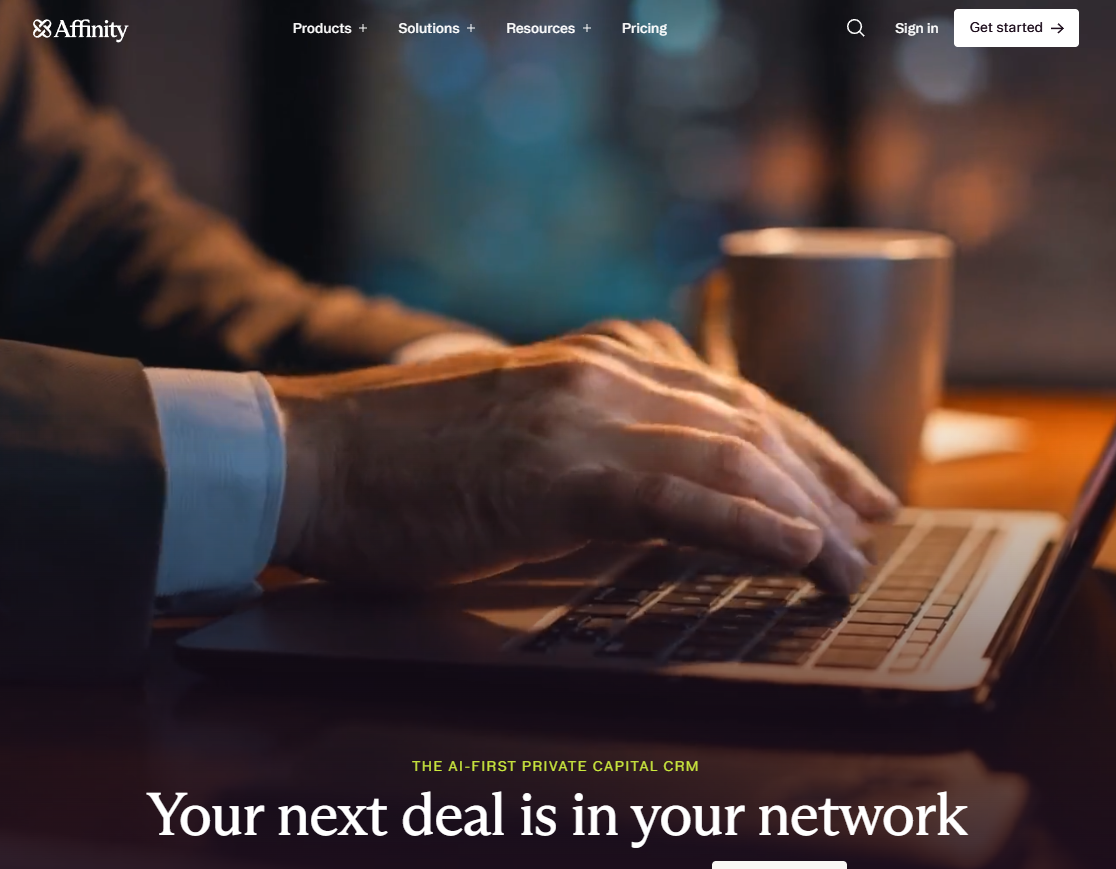
Affinity is a relationship intelligence and investment CRM that captures email and calendar activity automatically, then turns that data into relationship-strength scores, shared pipeline records, and warm-introduction maps. It is built specifically for private-capital workflows, which means the pipeline model fits deal-flow logic rather than requiring significant customization.
Best for: Founders and investment teams that need to convert relationship history into a repeatable sourcing process.
Key features
- Relationship intelligence and strength scoring from communication data
- Automatic email and calendar activity capture
- Deal pipeline management with deal-flow logic
- AI Chat, Notetaker, and workflow automations
- Data enrichment and enterprise-grade permissions
Why choose Affinity: The main constraint for most relationship-led sourcing teams is not a lack of targets. It is knowing who can make the right introduction and whether anyone has already engaged that account. Affinity addresses that directly by surfacing relationship context across the whole team, not just the person who made the initial contact.
For a founder handing investor relationships to a VP of Finance, Affinity preserves years of interaction history in a format the new executive can actually use. The alternative is weeks of founder-narrated context that still ends up incomplete.
Affinity pricing: Plans are billed annually per user. Essential starts at $2,000 per user per year. Scale runs $2,300 per user per year and Advanced $2,700 per user per year, with each tier adding AI features, enrichment depth, and integration options. Enterprise pricing requires a conversation with sales.
G2 rating: 4.4/5
2. DealCloud
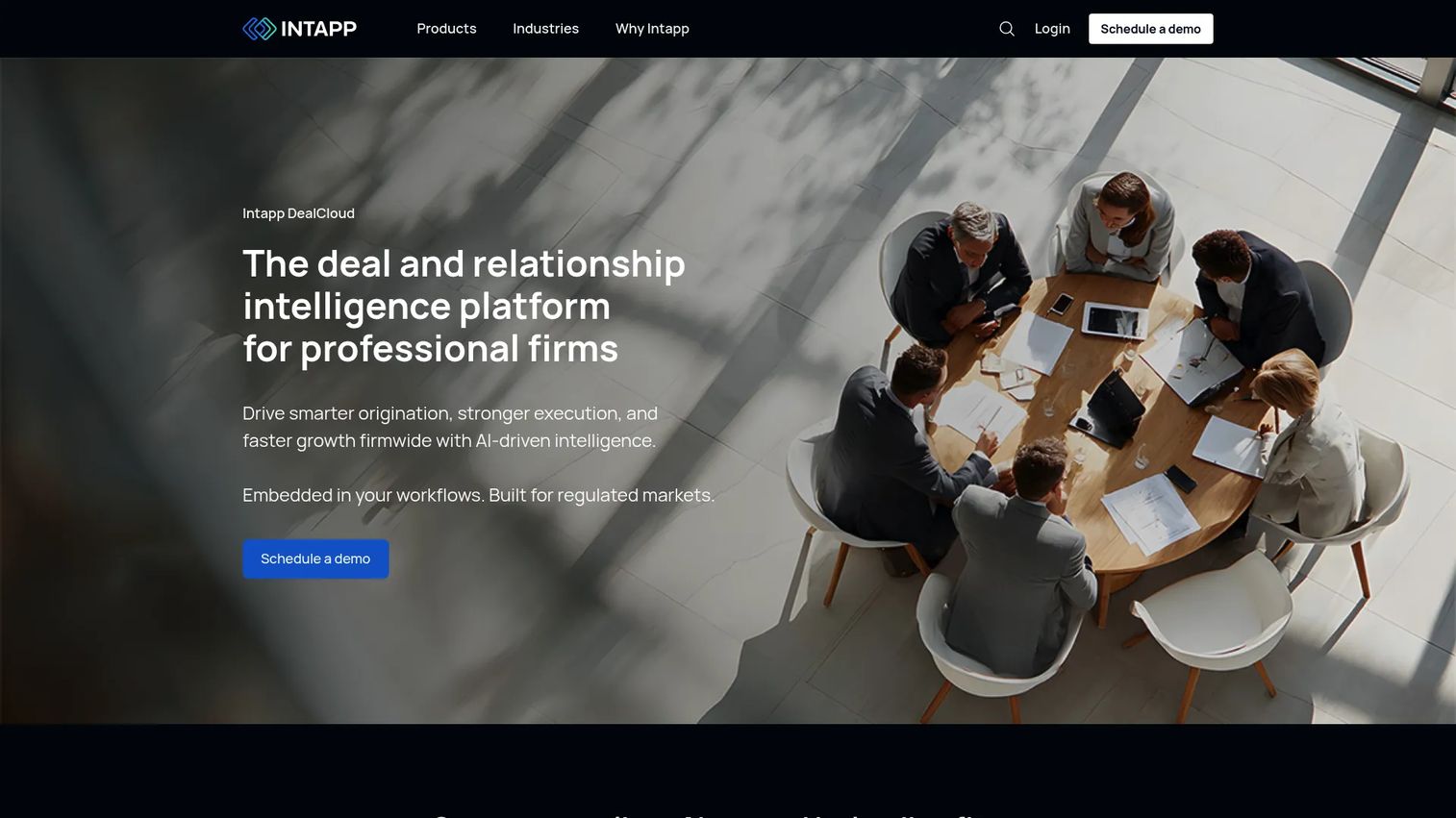
DealCloud is an AI-powered deal and relationship intelligence platform owned by Intapp, built for investment banking, private equity, credit, and legal and advisory firms with formal deal workflows. It supports relationship management, business development, pipeline tracking, fundraising, and investor relations from a single configurable data model.
Best for: Established private-capital and corporate-development teams that need structured workflow governance, committee reporting, and formal pipeline management.
Key features
- Configurable deal pipelines and workflow automation
- Relationship management with a relational intelligence graph
- Investment committee and fundraising reporting
- Business development and origination tracking
- Automated data enrichment and integrations
Why choose DealCloud: DealCloud earns its value when deal sourcing must connect to formal approvals, diligence, and portfolio operations. If your firm runs IC processes with structured stage gates, needs audit-ready reporting, or manages relationships across a multi-product investment platform, DealCloud fits those requirements.
The honest trade-off for a founder: DealCloud may be more system than a lean team needs before the sourcing process is stable. It is more appropriate for a Series B company that has built a formal corporate-development function, not for a team still figuring out who owns the outreach calendar.
DealCloud pricing: Pricing is not shown on the website and requires a sales conversation. Expect the discussion to cover user count, workflow configuration needs, data requirements, and integration scope.
G2 rating: 4.2/5
3. 4Degrees
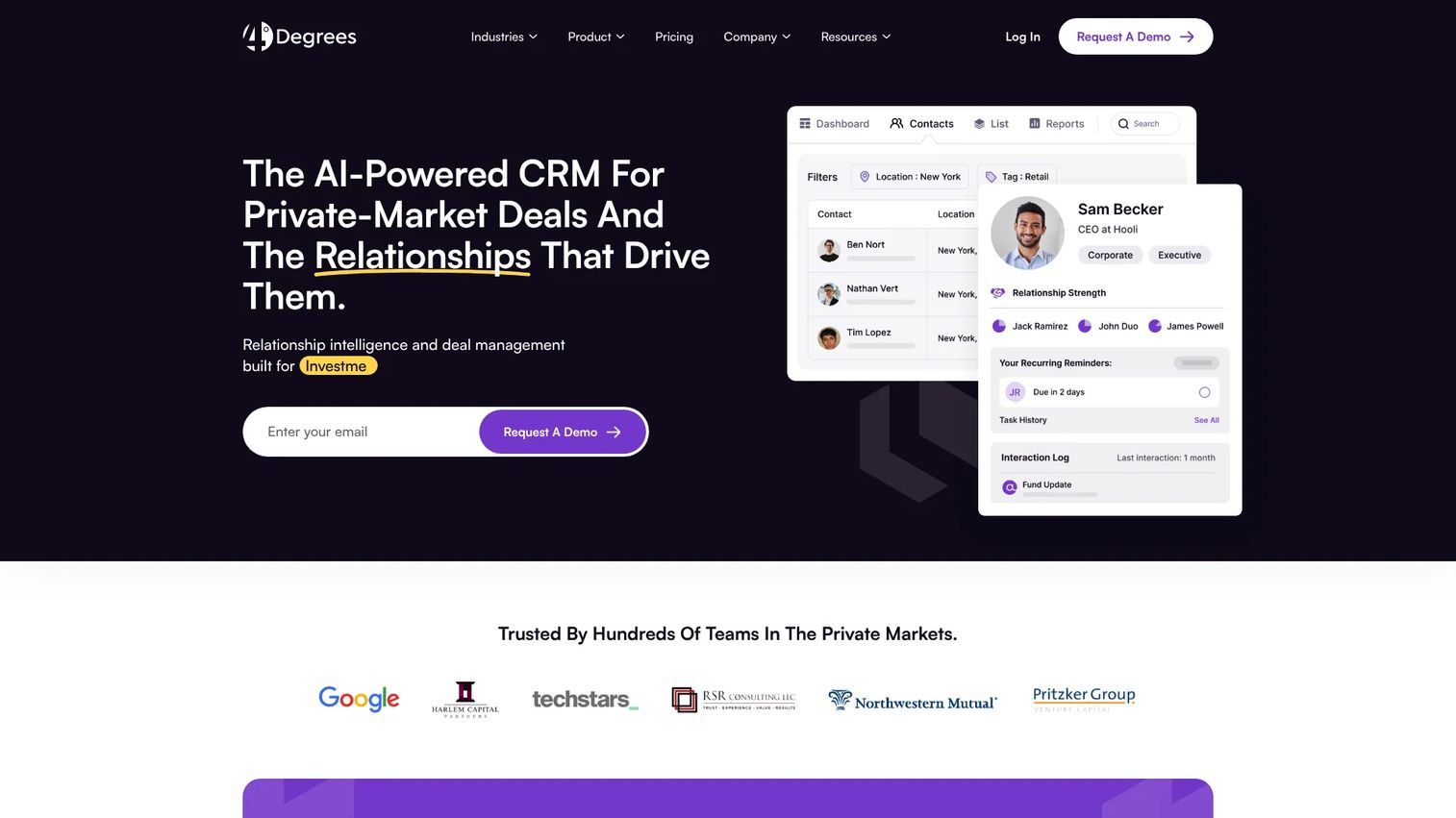
4Degrees is an AI-powered relationship intelligence and CRM platform built for venture capital, private equity, investment banking, and consulting teams. Its core job is helping deal teams discover who on their team knows a target contact, then track the outreach from that point forward without requiring manual data entry.
Best for: Founder-led fundraising, strategic partnership outreach, and lean corporate-development teams that depend on warm introductions.
Key features
- Relationship strength scoring and warm-introduction path discovery
- Automated contact activity capture from Gmail, Outlook, and LinkedIn
- Deal and pipeline management with automated data capture
- AI-powered field suggestions and document intelligence
- Reporting for business development and sourcing KPIs
Why choose 4Degrees: 4Degrees fits best when the sourcing motion starts with networks rather than broad market scans. A new operator can work from collective team relationships instead of asking the founder for context every week.
For a Series B founder approaching an investor outreach campaign, 4Degrees shows which team members already have a warm relationship with the target. That changes the first email from cold outreach to a coordinated warm introduction, which materially changes the response rate.
4Degrees pricing: Plans are priced per user per month, billed annually. The pricing page states that exact amounts vary by organization and require contacting 4Degrees directly.
G2 rating: 4.5/5
4. SourceScrub
SourceScrub is an AI-powered deal-sourcing platform built for private equity, investment banking, and corporate-development teams that need to find and monitor private-company opportunities at scale. Unlike a relationship CRM, it starts with the company universe and works outward: Who exists in this market, how are they performing, and which ones match our criteria?
Best for: Teams building acquisition, investment, or partnership target lists from structured private-company data before those companies become widely known.
Key features
- Private-company discovery with multi-source company profiles
- Advanced filtering by sector, geography, revenue, and ownership
- Custom scoring and target prioritization
- Conference planning and event intelligence
- Company news, signal tracking, and CRM integrations
Why choose SourceScrub: SourceScrub fits when the team's bottleneck is finding relevant companies in a fragmented market. A strategy team mapping vertical SaaS companies that fit an acquisition thesis can build a defensible target universe before the outreach conversation even begins.
The practical limit: SourceScrub is a research platform, not a relationship management system. Teams that also need detailed contact history, introduction path discovery, and internal workflow controls will use it alongside an investment CRM rather than instead of one.
SourceScrub pricing: The pricing page lists five tiers (Essentials, Plus, Professional, Fuel Your CRM, and Data Connect Cloud and API), but does not display amounts. Pricing requires contacting SourceScrub, and the cost will vary by the number of users, data coverage scope, export volume, and contract level.
G2 rating: 4.5/5
5. Grata
Grata is a private-market intelligence platform for investors, bankers, and corporate acquirers who need to find and analyze companies that do not show up in standard databases. Its keyword search, similar-company discovery, and market-mapping capabilities are oriented toward thematic and sector-driven sourcing rather than relationship management.
Best for: Founders and strategy teams evaluating markets, partnership ecosystems, or acquisition targets across fragmented industries.
Key features
- Private company search with keyword and similar-company discovery
- Market maps and sector research
- Company financials, executive contacts, and deal data including multiples
- Conference and event intelligence
- CRM integrations and target list collaboration
Why choose Grata: Grata works best when the question is "Who exists in this market?" before the question becomes "Who do we know?" It helps a strategy team build a target universe with real coverage across a sector, including companies that have never shown up in a banker-sourced process.
For a Series B company exploring a tuck-in acquisition thesis, Grata surfaces the companies worth investigating, complete with financial context and contact information to start outreach. At 4.9/5 on G2, it earns consistently strong reviews from private-market users.
Grata pricing: The pricing page lists Growth, Scale, and Alpha packages, plus optional Data Warehouse and API add-ons, without displaying amounts. Contact Grata to discuss coverage scope, user count, and contract structure.
G2 rating: 4.9/5
6. Cyndx
Cyndx was an AI-driven private-company intelligence and deal-sourcing platform that supported M&A, private equity, and corporate-development research. Its core job was turning a strategic thesis into a prioritized target list through AI-assisted company matching, thematic market research, and strategic-fit analysis.
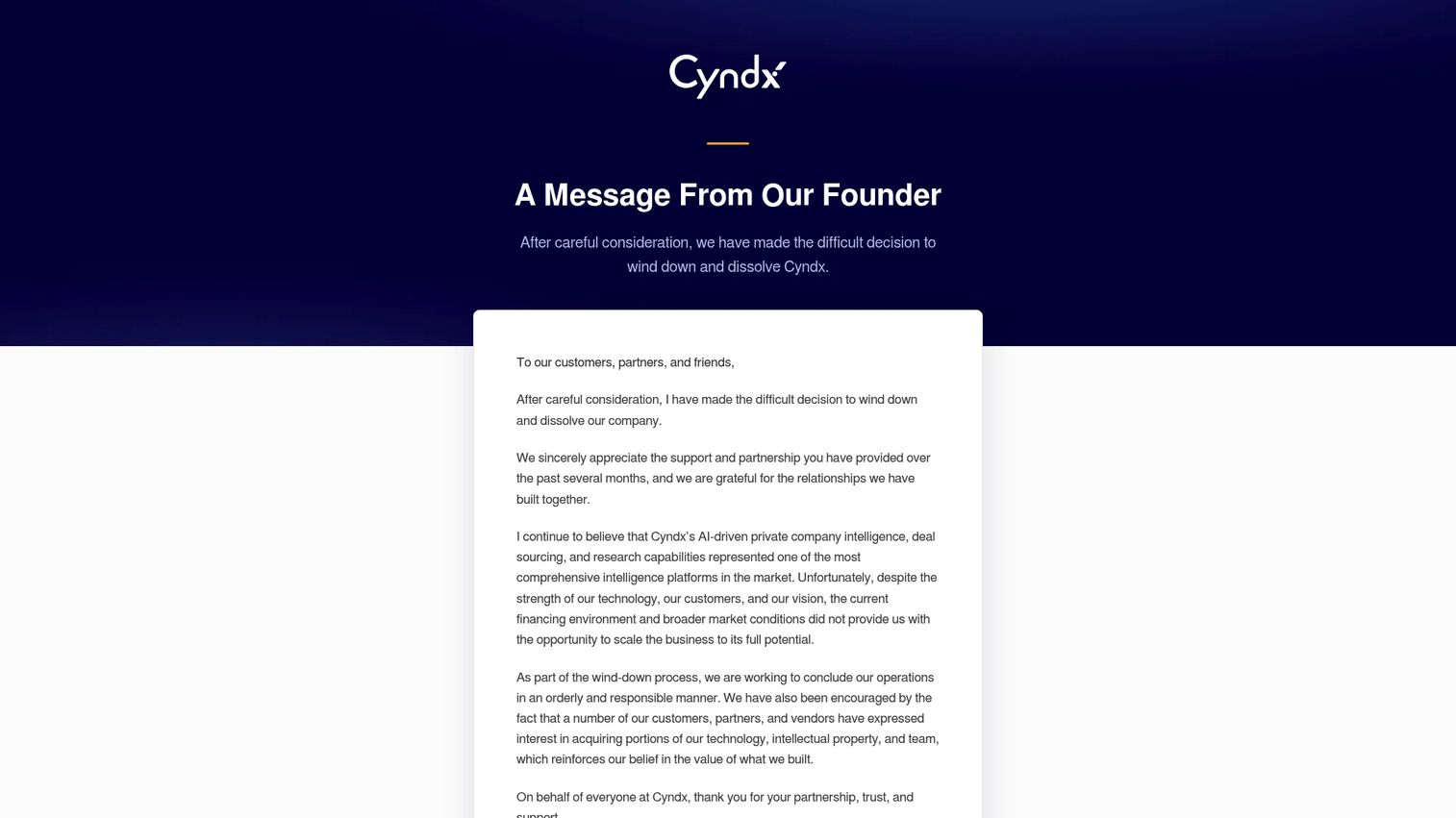
Important note: Cyndx's website currently states that the company is winding down and dissolving. Verify current operational status before including it in any vendor evaluation.
Best for: Historically, teams that need to screen a broad market against a specific acquisition, investment, or partnership thesis and want AI assistance in prioritizing the output.
Key features
- AI-assisted target identification and company matching
- Thematic market research
- Strategic-fit analysis
- M&A and corporate-development workflows
- Private company intelligence
Why choose Cyndx: Cyndx fit best when a team had a defined thesis but needed help converting that thesis into a prioritized company list. For a founder exploring build-versus-buy choices or mapping a structured strategic-partnership program, the thesis-to-target workflow addressed a real research bottleneck.
Given the company's current wind-down status, teams evaluating this space should assess Grata or SourceScrub as alternatives with comparable discovery and market-mapping capabilities.
Cyndx pricing: Pricing information could not be verified from a current first-party source. Contact the company directly to confirm operational status before requesting pricing.
G2 rating: 4.6/5
7. DealRoom
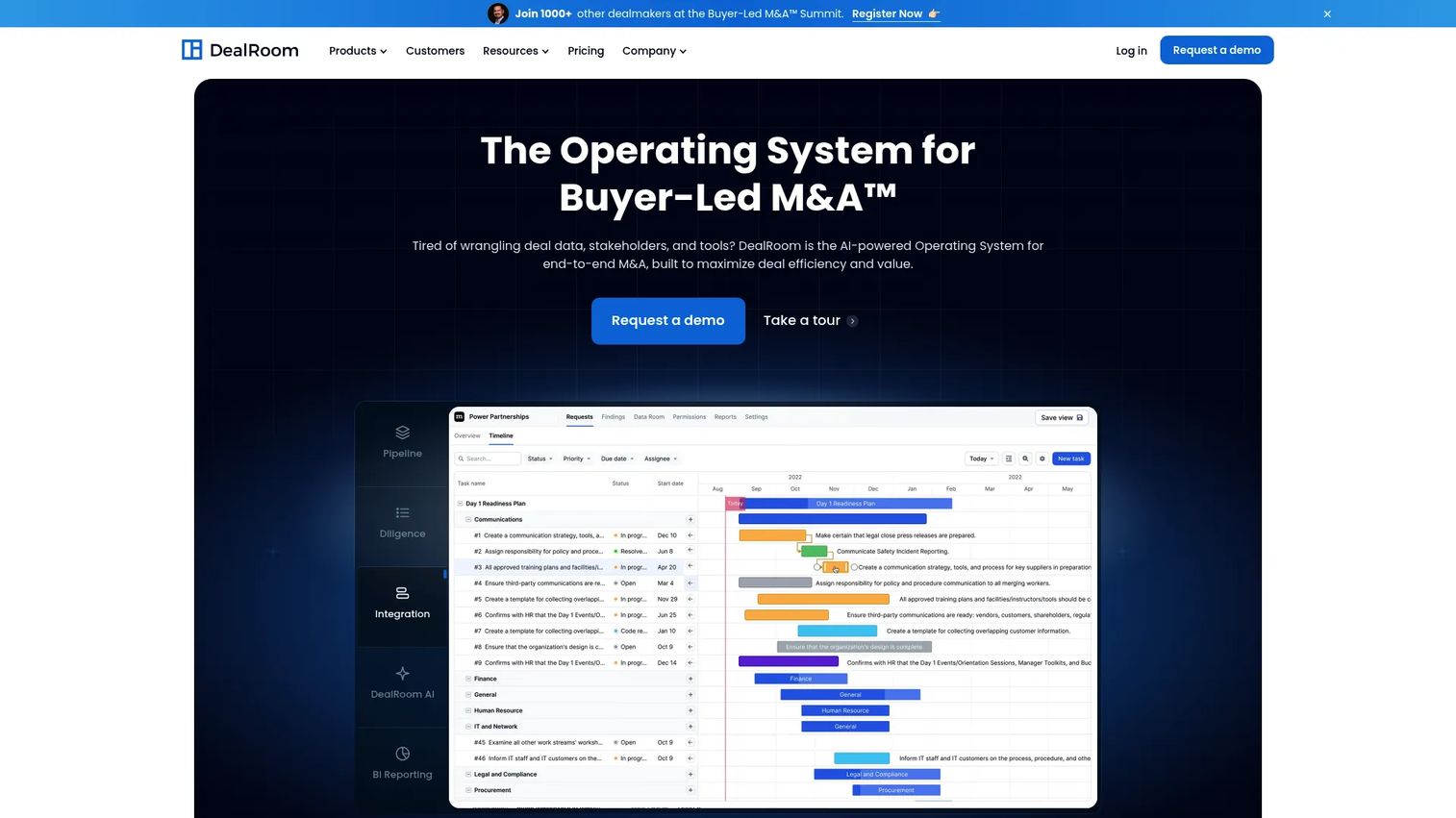
DealRoom is an AI-powered M&A operating system that manages the full buyer-led deal lifecycle: Pipeline tracking, diligence, deal collaboration workspaces, post-merger integration planning, and BI reporting from one platform. It can support sourcing, but its real value shows when a target moves past initial qualification into formal evaluation.
Best for: Corporate-development teams that want sourcing connected to diligence, integration planning, and transaction execution in a single workspace.
Key features
- M&A pipeline tracking and deal collaboration workspaces
- Secure due-diligence data room
- Post-merger integration planning
- AI-powered pipeline and diligence workflows
- BI reporting across the deal lifecycle
Why choose DealRoom: DealRoom makes sense when a company expects to run recurring acquisitions or complex strategic transactions. If you are running a deliberate tuck-in acquisition program, the ability to move a target from sourcing into a structured diligence workspace without switching tools saves meaningful time and reduces context loss at handoff.
For a founder who only needs an investor list or a partner relationship tracker, DealRoom is too much system. It earns its place once the deal volume and transaction complexity justify a formal M&A workflow, which typically means more than one active deal at a time.
DealRoom pricing: Pricing is based on deal volume with unlimited users and an annual commitment. No specific plan amounts are shown on the pricing page. Contact DealRoom to discuss your deal volume and get a quote.
G2 rating: 4.4/5
Considerations when choosing deal sourcing software
Start with the sourcing constraint
Identify the actual bottleneck before selecting a platform. Teams that cannot find relevant companies need research and discovery tools. Teams that have targets but cannot get warm introductions need relationship intelligence. Teams that lose deals because nobody followed up need pipeline management. A relationship platform will not fix a weak target universe, and a research database will not replace relationship ownership.
Match implementation to process maturity
A founder-led sourcing process should not begin with a highly customized enterprise build. Start with the smallest system that captures relationship history, assigns owners, documents next steps, and records why each target is prioritized. You can grow into complexity once the process is stable and the team is using the tool consistently.
Test data coverage before signing
Run a real list of 20 to 30 target companies through any platform you are evaluating. Check industry classification, ownership data, employee counts, geography, and contact relevance against what you already know. Coverage gaps in your core sector matter more than headline database size.
Decide who owns data hygiene before launch
Every active opportunity needs an owner, a next step, a date, and a reason it is prioritized. Without that operating rule in place from day one, any platform becomes a more expensive spreadsheet within 60 days. Name the owner before the contract is signed.
Measure sourcing outcomes, not activity
Track new qualified targets added per month, the percentage of targets with a known relationship path, first-contact-to-meeting conversion, and stage progression rate. Time from identification to diligence and opportunities lost because no owner followed up are also worth capturing. Establish a baseline in the first quarter before judging whether the platform changed pipeline quality.
Conclusion
Deal sourcing software only works when it matches the actual bottleneck.
Affinity fits relationship-led sourcing that needs an investment CRM with history and network visibility. DealCloud suits formal private-capital and corporate-development processes with committee reporting and stage governance. 4Degrees helps lean teams convert warm networks into trackable outreach without founder involvement in every introduction. SourceScrub and Grata both help teams build a stronger target universe from structured private-company data. Cyndx supported thesis-led market mapping, though teams should verify the company's current status before including it in a vendor evaluation. DealRoom makes sense when sourcing connects directly to M&A execution.
Choose the tool category before selecting the product. A founder who needs investor and partner relationship context should start with relationship intelligence. A founder exploring acquisitions should start with target research, then add transaction workflow tools when deals reach diligence.
The goal is a system that earns its place in your stack within the first quarter, not one that requires six months before it produces anything useful. Give your VP of Finance or Strategy something that works on day one.
Start your journey with Guideflow today!
FAQs about deal sourcing tools
Deal sourcing focuses on finding and qualifying potential opportunities. Deal origination covers the broader work of turning those opportunities into transactions, including outreach, internal approvals, negotiation, and closing. Most teams use the terms interchangeably, and the practical difference matters less than having a repeatable process for both.
The best option depends on the team's primary constraint. Relationship-heavy firms doing proprietary sourcing typically prioritize investment CRM and relationship intelligence platforms like Affinity or 4Degrees. Teams pursuing proprietary targets in fragmented markets need company research and discovery platforms like SourceScrub or Grata. Most PE firms eventually need both.
Early-stage investors often need fast founder and network context, making relationship intelligence the priority. Growth-stage investors managing larger portfolios may need more formal pipeline management and market data. Evaluate platforms based on relationship capture quality, referral tracking, sector research depth, and reporting capabilities against your stage and thesis.
Yes, and the value is often highest before the hire. Capturing relationship context and establishing a target list before the hire means the new executive inherits a working system rather than reconstructing it from the founder's memory. It also forces the founder to document ownership rules and decision criteria that would otherwise stay implicit.
Proprietary sourcing combines direct relationships, referrals, market mapping, signal monitoring, and targeted outbound. Proprietary does not mean secret. It means the opportunity was found and developed through original work before a broad auction process started. The practical advantage is earlier access and more negotiating flexibility, not exclusivity.
No. Software organizes research, relationship history, and deal workflow. Advisors provide market access, transaction experience, negotiation support, and process management that software cannot replicate. The tools reduce the time your team spends reconstructing context and managing follow-up, freeing capacity for the work that requires human judgment.
Start with new qualified targets added per period, percentage of targets with a known relationship path, outreach-to-meeting conversion, and stage progression rate. Add time from identification to diligence and opportunities lost due to missed follow-up once the process is running. Establish a baseline in the first quarter before attributing changes to the platform.
Avoid buying for feature volume. A system with 40 capabilities your team ignores adds cost without adding value. Choose a platform that matches your immediate sourcing bottleneck, requires a named owner to operate, and can be running in the first week without a major implementation project. If you cannot name who owns the data by the time you sign the contract, the platform will not work.