Security teams don't have a shortage of threat data. According to SANS, only 36% of organizations measure whether their threat intelligence program is actually effective, even though almost all of them run one. The real problem is turning volume into something analysts can act on before the window closes.
Raw indicators expire fast. A malicious IP flagged last week may already be recycled infrastructure. What separates useful threat intelligence from noise is context: who is attacking, how, why now, and whether it maps to your environment. Without that layer, feeds just add work.
Presales and solutions engineering teams feel this acutely when supporting security evaluations. Buyers want proof that a platform reduces analyst workload, integrates with their SIEM, and changes what the team does next, not just what they see. This guide covers 15 threat intelligence platforms across enterprise, dark web, and open-source categories to help you build a credible shortlist before a POC.
What's inside
This guide is for SOC leaders, threat intelligence analysts, security architects, and presales teams supporting technical security evaluations.
- Who this is for: Anyone building or validating a shortlist of cyber threat intelligence platforms
- How tools were selected: Intelligence depth, integration fit, source quality, and workflow actionability
- What the table covers: Best fit, key differentiator, pricing, and G2 rating for all 15 tools
- Mix: Paid enterprise platforms, digital risk intelligence products, and open-source options
- How to use it: Build a 3-tool shortlist, then run a POC against your actual incidents and workflows
TL;DR
- Best overall enterprise platform: Recorded Future Intelligence Platform, for broad external intelligence across SOC, vulnerability management, and executive reporting
- Best for Google security stack: Google Threat Intelligence, for Mandiant research, VirusTotal data, and Google-scale telemetry in one workflow
- Best for endpoint-first teams: CrowdStrike Falcon Adversary Intelligence, for adversary context tied directly to Falcon detection workflows
- Best for dark web coverage: Flashpoint Ignite, for deep underground source intelligence and finished analyst reports
- Best open-source options: MISP and OpenCTI, for teams with engineering capacity and a need for standards-based sharing
- Best free community source: AlienVault OTX, as a starting point or supplement to an enterprise program
What is a threat intelligence platform?
A threat intelligence platform (TIP) is software that collects, normalizes, enriches, analyzes, and distributes cyber threat data so security teams can make faster, better-prioritized decisions.
TIPs ingest from a broad set of sources: external threat feeds, vulnerability databases, malware repositories, adversary intelligence, dark web sources, internal telemetry, and open-source intelligence. They enrich indicators of compromise with attribution, confidence scores, prevalence data, exploit status, and affected technology context. The result is intelligence that analysts can act on, not just data they have to interpret themselves.
Platforms connect to SOC workflows through SIEM, SOAR, EDR, XDR, firewall, ticketing, and case management integrations. Most support STIX and TAXII for standardized sharing. The better ones push enriched context directly into detection rules, triage queues, and automated playbooks.
Key capabilities to look for:
- Threat feed ingestion and normalization from multiple sources
- Indicator enrichment with confidence, context, and TTPs
- Adversary and campaign mapping, including MITRE ATT&CK alignment
- Vulnerability intelligence with exploit status and CVE context
- Dark web and digital risk monitoring
- SIEM, SOAR, and EDR integrations
- STIX/TAXII sharing and distribution controls
- Analyst workflow support: case management, reporting, and collaboration
- Priority intelligence requirements (PIR) management
The distinction between threat data and threat intelligence matters here. Threat data is raw signal: an IP address, a hash, a domain. Threat intelligence adds context, confidence, relevance to your environment, and a recommended action. A platform that delivers only data without the analytical layer may increase alert volume without improving response quality. That is the buying mistake this guide helps you avoid.
For adjacent coverage, see our guides on attack surface management software and breach and attack simulation software.
When to use threat intelligence platforms
Prioritize alerts with external context
SOC teams use threat intelligence to decide which alerts deserve analyst time. An alert tied to a known threat actor's infrastructure, a recently exploited CVE, or an active ransomware campaign carries a different urgency than a generic anomaly. Platforms that enrich alerts at ingestion allow analysts to triage on relevance rather than volume.
Support incident response and threat hunting
During an active incident or a proactive hunting campaign, analysts need adversary TTPs, infrastructure relationships, and historical campaign data to scope the problem fast. MITRE ATT&CK-mapped intelligence helps teams identify what else the attacker likely did, not just what triggered the alert. According to SANS (2024), 83% of respondents say cyber threat intelligence has improved their prevention, detection, and response capabilities.
Monitor external and dark web risk
Security teams track exposed credentials, leaked data, brand abuse, typosquatting, and underground forum chatter to get ahead of attacks before they hit internal systems. This is where platforms with dedicated dark web and digital risk capabilities earn their place. Executive protection and third-party risk programs also draw heavily on these sources.
Threat intelligence platform comparison
Use this table as a starting shortlist. Pricing figures come from vendor pricing pages and G2 ratings come from G2 product listings, both checked in October 2026. Several G2 listings carry the vendor name rather than the product name, and review counts are noted so you can judge how much weight a score deserves. Run a POC to validate analyst usability and integration depth before committing.
| # | Product | Best for | Key differentiator | Pricing | G2 rating |
|---|---|---|---|---|---|
| 1 | Recorded Future Intelligence Platform (owned by Mastercard) | Enterprise threat intelligence programs | Intelligence Graph correlating technical, open web, dark web, and adversary infrastructure sources | Contact sales | 4.5/5 (256 reviews) |
| 2 | Google Threat Intelligence | Google security stack and Mandiant users | Combines Mandiant research, VirusTotal data, and Google telemetry | Contact sales | 5.0/5 (1 review) |
| 3 | CrowdStrike Falcon Adversary Intelligence | Falcon-first security teams | 290+ adversary profiles tied to endpoint context | Contact sales | Not listed on G2 |
| 4 | Flashpoint Ignite | Dark web and illicit community intelligence | Deep underground source coverage and finished intelligence | Contact sales | 4.5/5 (84 reviews, Flashpoint listing) |
| 5 | Anomali ThreatStream | Intelligence operations teams | Feed ingestion, enrichment, STIX/TAXII, and SIEM integration | Contact sales | 4.5/5 (1 review) |
| 6 | ThreatConnect (Dataminr acquisition announced) | Intelligence operations and orchestration | AI-powered analytics, playbooks, and risk quantification | Contact sales | 4.6/5 (14 reviews) |
| 7 | Cyware | Cyber fusion and intelligence sharing | Collaboration, sharing, and a broad security tool integration library | Contact sales | 4.3/5 (3 reviews, vendor listing) |
| 8 | Cyble Vision | Digital risk and external threat intelligence | Dark web, attack surface, and brand exposure monitoring | Contact sales | 4.8/5 (148 reviews, Cyble listing) |
| 9 | CloudSEK XVigil | External digital risk protection | AI-driven monitoring across surface, deep, and dark web | Contact sales | 4.8/5 (138 reviews, CloudSEK listing) |
| 10 | IBM X-Force Threat Intelligence | IBM security stack and research-driven teams | Research-backed intelligence with malware and adversary analysis | Contact sales | 4.4/5 (14 reviews) |
| 11 | SOCRadar Extended Threat Intelligence Platform | Mid-market to enterprise external visibility | Modular pricing across attack surface, dark web, and brand protection | From $4,550/year | 4.7/5 (122 reviews) |
| 12 | KELA Cyber Intelligence Platform | Criminal underground intelligence | Cybercrime community intelligence and compromised asset tracking | Quote-based | No reviews on G2 |
| 13 | MISP | Open-source threat sharing | Community IoC sharing with STIX/TAXII and granular controls | Free (open source) | Not listed on G2 |
| 14 | OpenCTI | Open-source CTI knowledge management | STIX 2.1 knowledge graph with a large connector library | Free community edition | 4.6/5 (48 reviews) |
| 15 | AlienVault OTX | Free community threat intelligence | Open threat exchange with community pulses and API access | Free | Not listed on G2 |
The 15 platforms reviewed in detail
1. Recorded Future Intelligence Platform
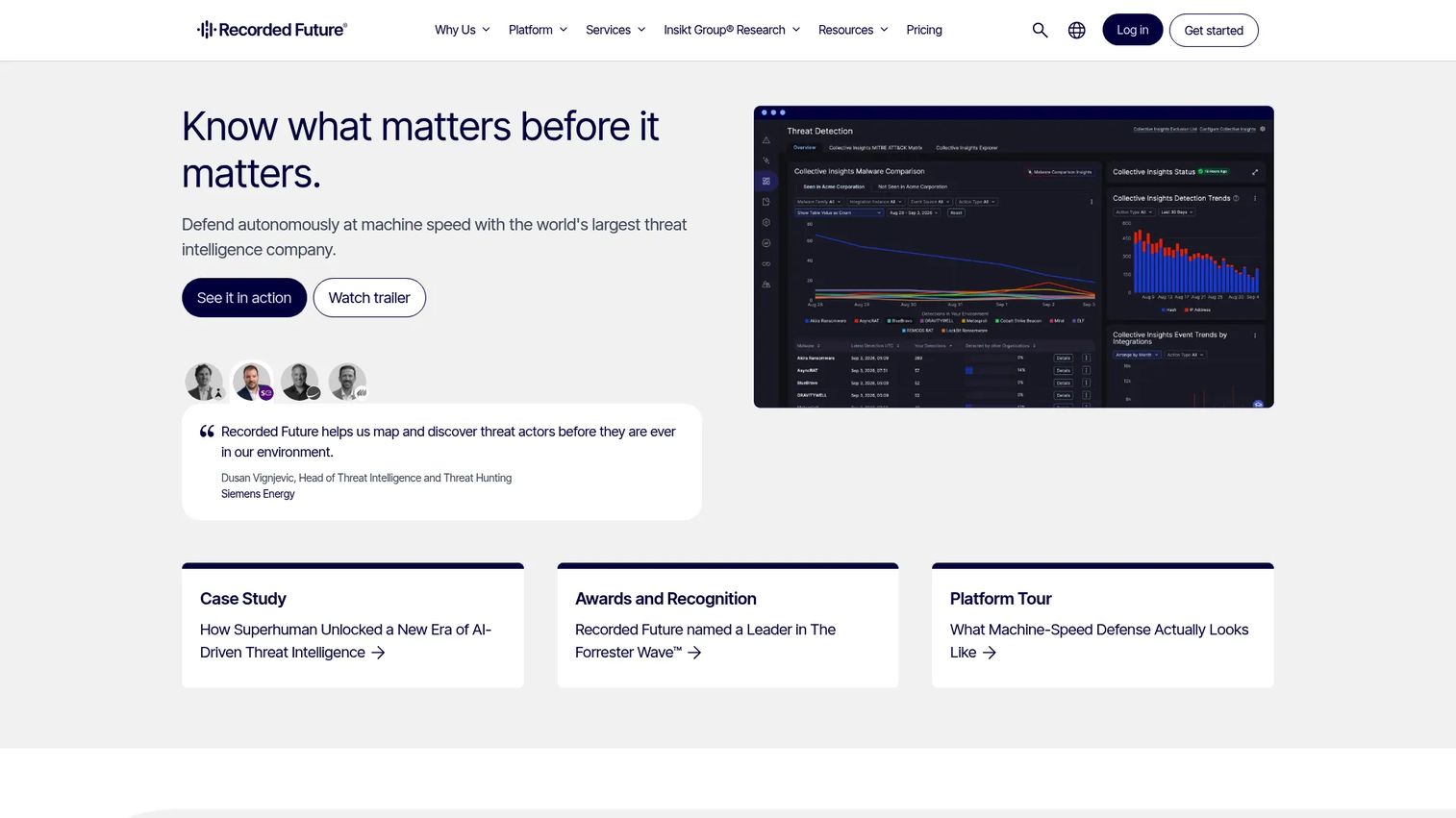
Recorded Future Intelligence Platform is an AI-driven threat intelligence platform that connects internal telemetry and external sources to identify, prioritize, and respond to evolving threats. Its Intelligence Graph correlates signals across technical sources, the open web, the dark web, and adversary infrastructure, giving analysts context across domains, malware families, threat actors, CVEs, and geopolitical risk.
Recorded Future has been a Mastercard company since Mastercard completed its acquisition of the business in December 2024. The platform is still sold and developed as a standalone product, but buyers evaluating it as part of a payments or fraud program should expect that overlap to come up in commercial conversations.
Best for: Large security teams that need broad external intelligence across SOC, vulnerability management, and executive reporting.
Key features
- Intelligence Graph correlating technical, open web, dark web, and adversary infrastructure sources
- Recorded Future AI for intelligence queries and report creation
- Vulnerability intelligence with exploit status and CVE context
- Brand risk and third-party risk monitoring
- Integrations with SIEM, SOAR, EDR, and ticketing platforms
Why choose Recorded Future: Strong fit when the buyer wants broad threat intelligence coverage with business-ready reporting that travels up to the CISO. Presales teams should validate whether analysts will actually use the scoring model inside daily triage workflows, not just during the demo.
Recorded Future pricing: Recorded Future prices by quote across its packaged tiers and does not publish a rate card. Ask sales to tie the package to your specific intelligence modules, user count, and integration requirements.
G2 rating: 4.5/5 (256 reviews)
2. Google Threat Intelligence
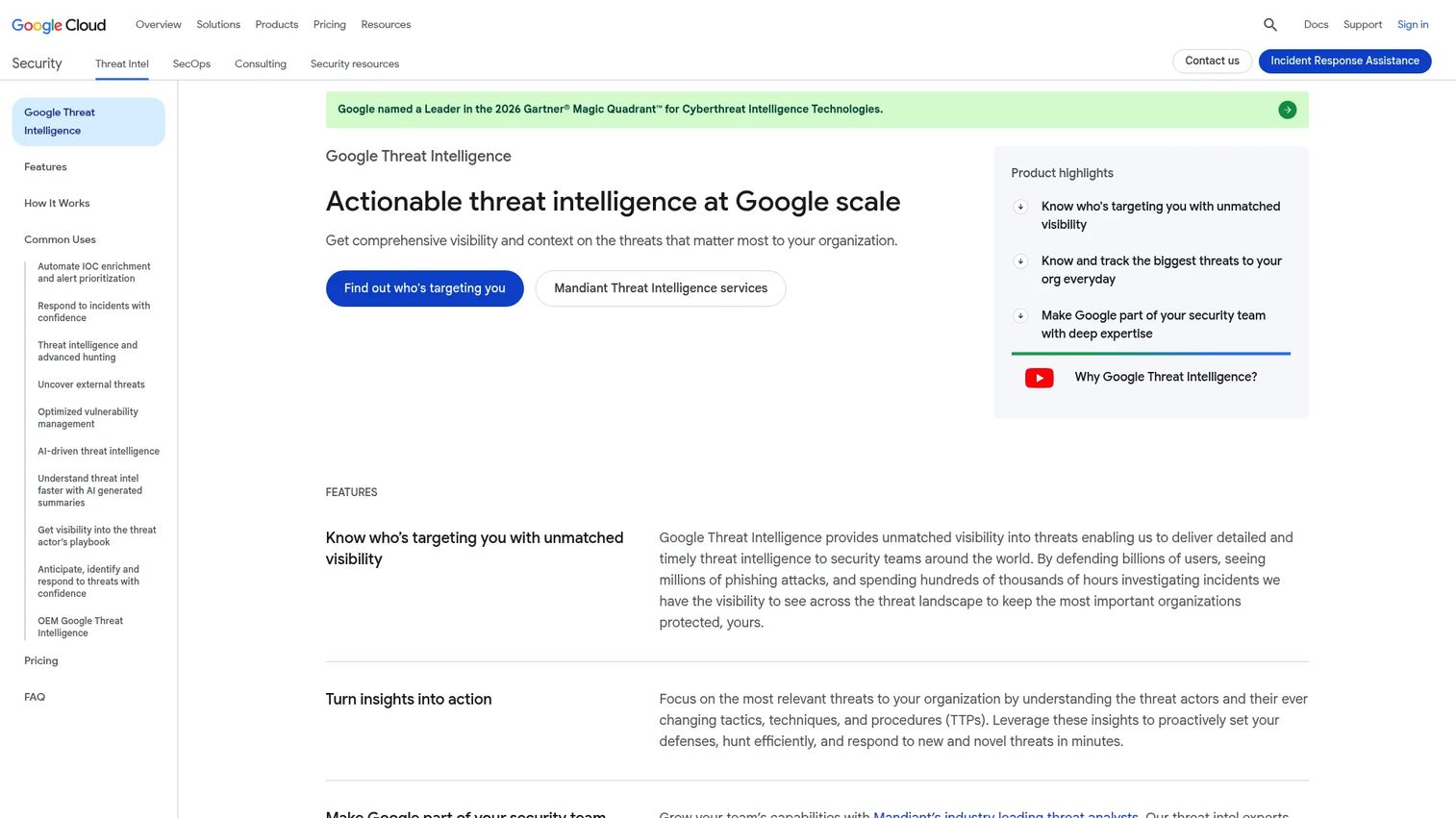
Google Threat Intelligence is a Google Cloud platform that combines Mandiant expertise, VirusTotal data, and Google-scale telemetry into a single intelligence workflow. It provides visibility into threat actors, campaigns, malware families, and vulnerabilities, backed by Gemini-powered summaries and a threat intelligence workbench that supports hunting, rule sharing, and forensic investigation.
Mandiant and VirusTotal are both Google properties, so the three source sets in this product come from one corporate parent rather than from independent providers.
Best for: Security teams already using Google Cloud, Chronicle, or Mandiant services that want finished intelligence and technical evidence in one place.
Key features
- Mandiant threat research and finished intelligence reports
- VirusTotal intelligence for malware and indicator analysis
- Gemini-powered threat summaries and analysis
- IOC enrichment and alert prioritization
- Unified verdict combining Google, Mandiant, and VirusTotal context
Why choose Google Threat Intelligence: The combination of Mandiant research depth and VirusTotal breadth is the real differentiator. Presales teams should validate how it connects to the customer's existing SIEM, cloud environment, and incident response workflow, since value scales with stack integration.
Google Threat Intelligence pricing: Subscriptions run on an annual flat rate with a set API call allocation per tier (Standard, Enterprise, Enterprise+, and OEM). Additional API call packs are available separately. Google does not publish tier prices, so contact sales.
G2 rating: 5.0/5 (1 review)
3. CrowdStrike Falcon Adversary Intelligence
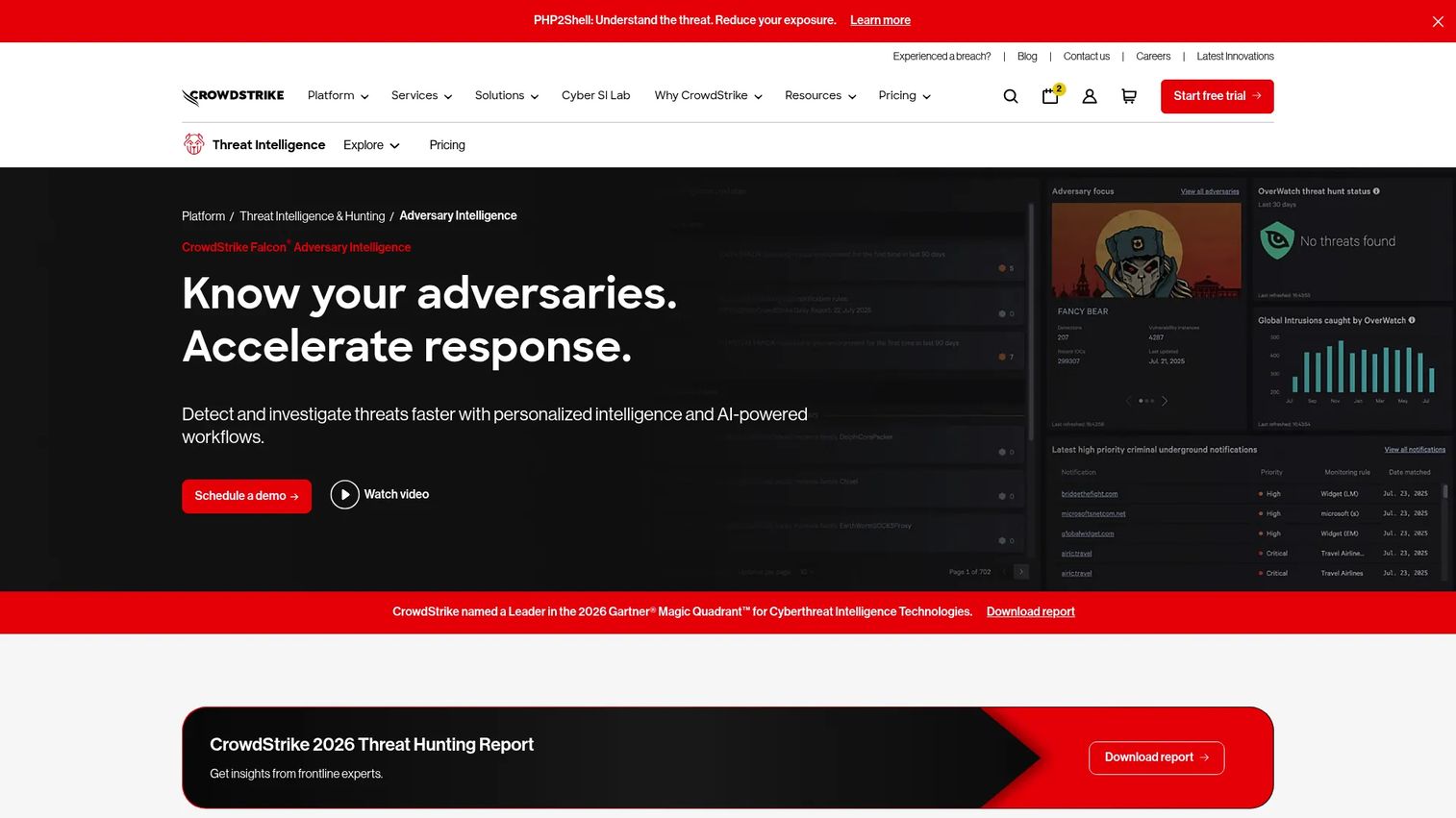
CrowdStrike Falcon Adversary Intelligence delivers personalized, real-time intelligence through 290+ adversary profiles, context-aware indicators, and advanced malware sandbox analysis. It monitors open, deep, and dark web sources for fraud, phishing, impersonation, and data leaks, and provides prebuilt workflows and APIs for automated countermeasures inside the Falcon platform.
Best for: Security operations and threat hunting teams already standardized on Falcon who want intelligence tied directly to endpoint detection context.
Key features
- 290+ named adversary profiles with MITRE ATT&CK mapping
- Open, deep, and dark web monitoring for brand and data leaks
- Intel Explorer and Indicator App for investigation
- Advanced malware sandbox analysis
- Prebuilt workflows, APIs, and integrations for automated response
Why choose CrowdStrike Falcon Adversary Intelligence: The tight coupling between adversary intelligence and endpoint telemetry is the main reason to choose this over a standalone TIP. It performs best when the buyer is already on Falcon and wants intelligence without managing a separate platform. SE-led evaluations should demonstrate how threat context flows into detection rules and hunting queries.
CrowdStrike Falcon Adversary Intelligence pricing: CrowdStrike does not publish prices for this module. Pricing is quote-based and licensed by endpoint, server, or employee count across standard and premium editions. Contact sales with your Falcon deployment details.
G2 rating: Not listed on G2. CrowdStrike's adversary intelligence module has no G2 product profile of its own, so any score you see attached to it elsewhere belongs to a different CrowdStrike listing.
4. Flashpoint Ignite
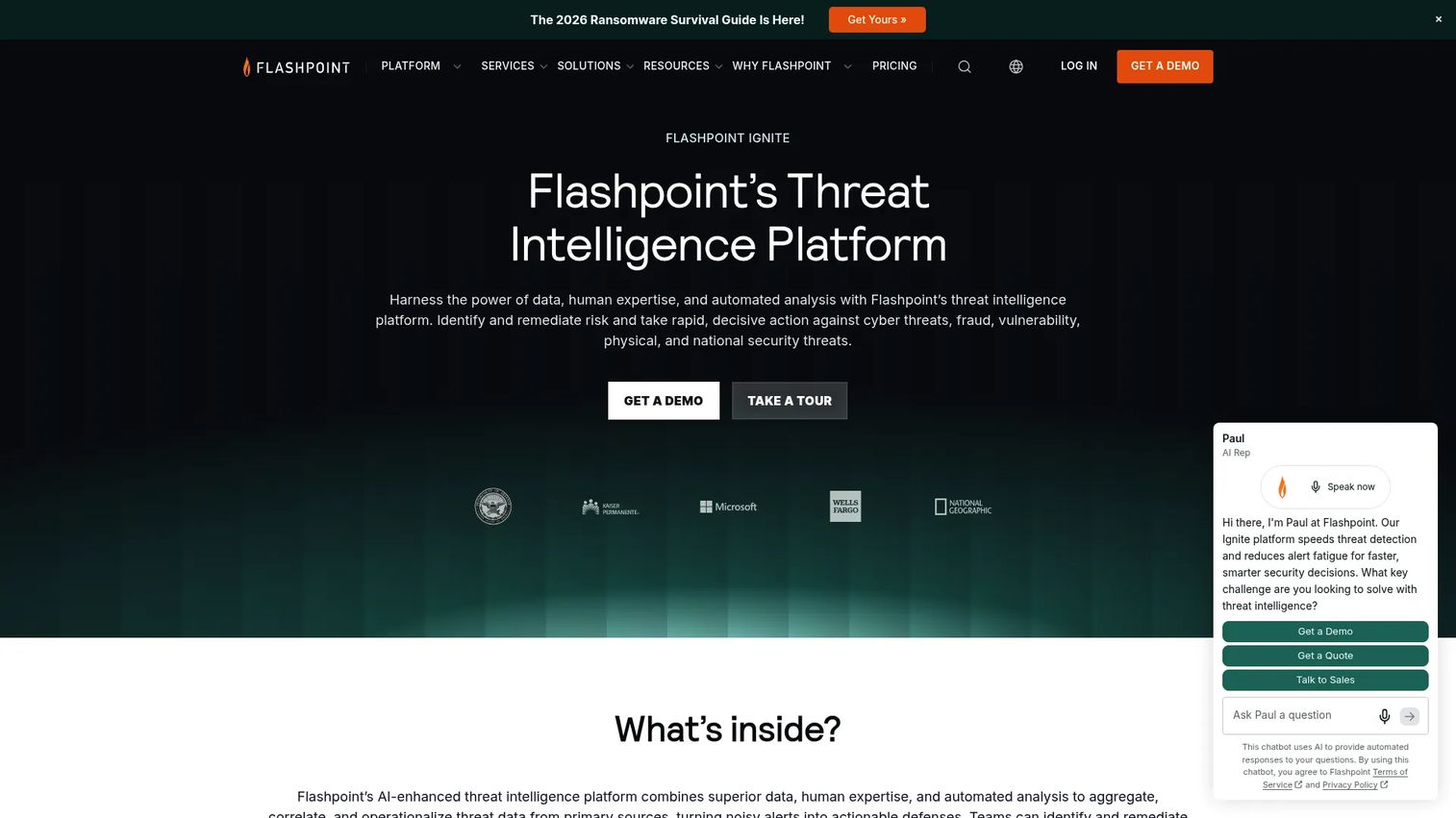
Flashpoint Ignite is an AI-enhanced threat intelligence platform built around deep coverage of illicit communities, dark web forums, ransomware groups, and fraud channels. It combines unified search across text, images, video, and conversations with finished intelligence reports, customizable alerting, and integrations with SIEM, TIP, and SOAR tools.
Best for: Enterprise security and intelligence teams that need dark web, fraud, and illicit community intelligence alongside finished analyst reporting.
Key features
- Unified search across illicit communities, dark web, and open sources
- Dark web and underground forum intelligence
- Fraud and ransomware monitoring
- Finished intelligence reports and interactive dashboards
- Customizable alerting with keywords, filters, and user roles
Why choose Flashpoint Ignite: Strong choice when external risk and source depth matter more than a generic feed aggregator. Source relevance and alert quality are the metrics to test in any POC. Ask the Flashpoint team to show coverage for your specific sector, geography, and threat actor focus areas.
Flashpoint Ignite pricing: Flashpoint offers packages around Cyber Threat Intelligence, Vulnerability Intelligence, and Physical Security Intelligence. All are quote-based with no published rate card. Ask sales to scope by monitored use cases, seats, and included modules.
G2 rating: 4.5/5 (84 reviews). G2 lists the vendor as Flashpoint rather than Flashpoint Ignite, so the score covers the wider product family.
5. Anomali ThreatStream
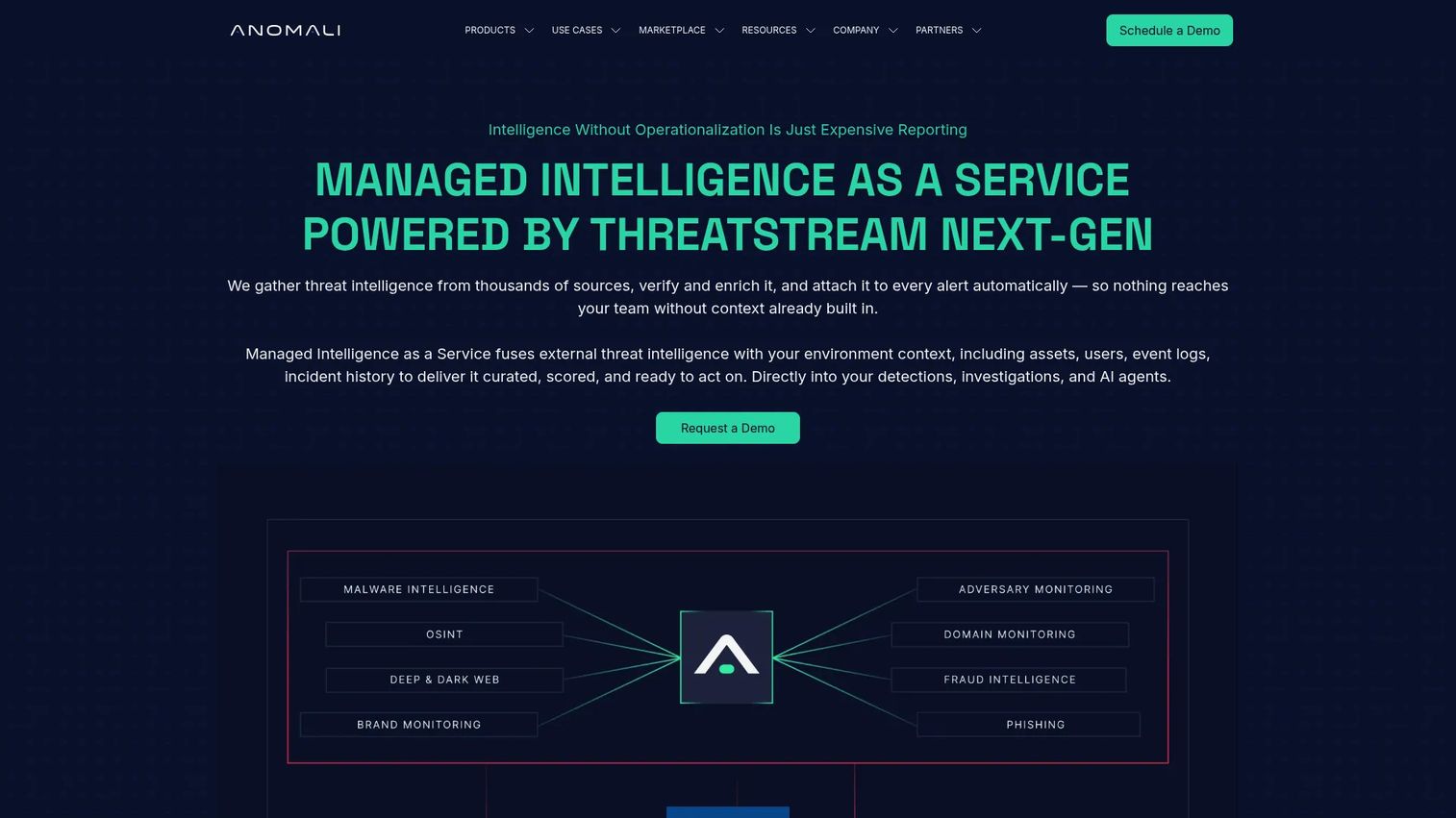
Anomali ThreatStream is a managed threat intelligence platform that collects, verifies, enriches, scores, and operationalizes intelligence across security workflows. It provides real-time enrichment of logs and alerts, campaign-level prediction using TTPs, and intelligence sharing through Trusted Circles and STIX/TAXII. The API-first architecture supports automation across detection, investigation, and AI-assisted SOC workflows.
Best for: Enterprise security operations teams managing large indicator volumes and multiple intelligence feeds that need structured lifecycle management.
Key features
- Curated, confidence-scored threat intelligence from multiple sources
- Real-time enrichment of logs, alerts, and events
- Campaign prediction using indicators and adversary TTPs
- STIX/TAXII sharing and Trusted Circles collaboration
- API-first architecture for automation and SIEM integrations
Why choose Anomali ThreatStream: Good fit when the core challenge is intelligence operations: ingesting many feeds, deduplicating indicators, scoring them, and distributing them to detection tools. Presales teams should verify how feed quality, false-positive rates, and analyst workflows behave in a live POC with the buyer's actual data sources.
Anomali ThreatStream pricing: Anomali publishes no prices. Pricing is handled through sales and requires a demo request. Cost drivers include feed volume, user count, integration requirements, and automation scope.
G2 rating: 4.5/5 (1 review). The score rests on a single review, so treat it as directional only and weigh Gartner Peer Insights or reference calls more heavily.
6. ThreatConnect
ThreatConnect is a security operations platform that combines threat intelligence management, AI-powered analytics, playbook automation, and cyber risk quantification. It visualizes threat relationships through a graph interface, supports agentic AI for intelligence requirements and report generation, and integrates with dashboards, APIs, and case management tools.
Dataminr announced its intent to acquire ThreatConnect for $290 million on 21 October 2025. Dataminr's own newsroom still describes the deal as announced rather than closed, so confirm product roadmap, support, and contract terms directly with the vendor before signing a multi-year agreement.
Best for: Mature security teams that need intelligence management, workflow governance, and automation in the same platform.
Key features
- Threat intelligence aggregation, scoring, and management
- AI-powered threat graph and analytics
- Playbook automation and orchestration
- Workflow and case management
- Agentic AI for threat queries, modeling, and intelligence reports
Why choose ThreatConnect: Strong fit for teams that need process and governance around intelligence, not just a feed repository. The automation and collaboration capabilities help when intelligence needs to move across SOC, incident response, and executive reporting consistently. SE evaluations should test analyst adoption and the depth of integration with the buyer's SIEM and SOAR.
ThreatConnect pricing: Pricing is subscription-based with no published rate card, and depends on user count, modules selected, and integration requirements. Contact sales for a quote.
G2 rating: 4.6/5 (14 reviews)
7. Cyware
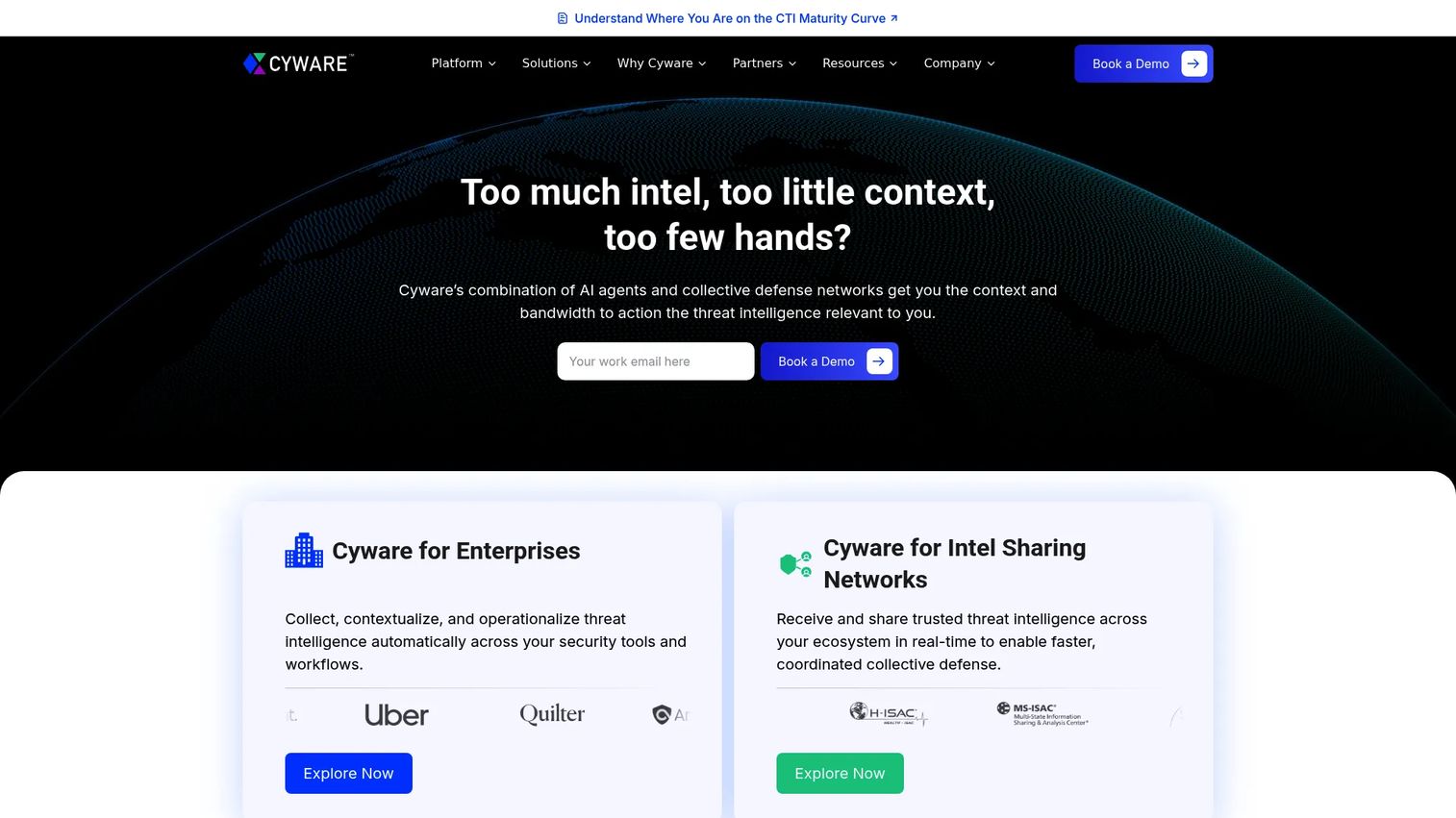
Cyware is an AI-powered threat intelligence platform built around cyber fusion, intelligence sharing, and cross-team automation. It supports threat intelligence ingestion, enrichment, correlation, and actioning, with native multi-engine malware sandboxing, STIX/TAXII sharing, and a large library of security tool integrations through its Intelligence Suite and Collaboration Suite.
Best for: Enterprise SOCs, threat intelligence teams, and trusted sharing communities (ISACs) that need unified intelligence operations and cross-organization collaboration.
Key features
- Threat intelligence ingestion, enrichment, and correlation
- AI-powered automation with playbooks and code generation
- Digital risk protection and exposure management
- Native multi-engine malware sandboxing
- STIX/TAXII sharing and a broad security tool integration library
Why choose Cyware: Useful when the buyer's real problem is moving intelligence across people and systems, not just consuming it. The cyber fusion model works well for organizations that share intelligence with sector peers or operate multiple security teams that need coordinated workflows. SEs should validate governance controls and downstream automation before recommending.
Cyware pricing: Pricing is custom across the Intelligence Suite and Collaboration Suite, with nothing published publicly. Quotes are based on deployment model, analyst seats, feed volume, automation scope, and sandbox capacity. Request a quote from the Cyware sales team.
G2 rating: 4.3/5 (3 reviews). The score sits on Cyware's vendor profile and is spread across several thinly reviewed product listings, so it carries little statistical weight.
8. Cyble Vision
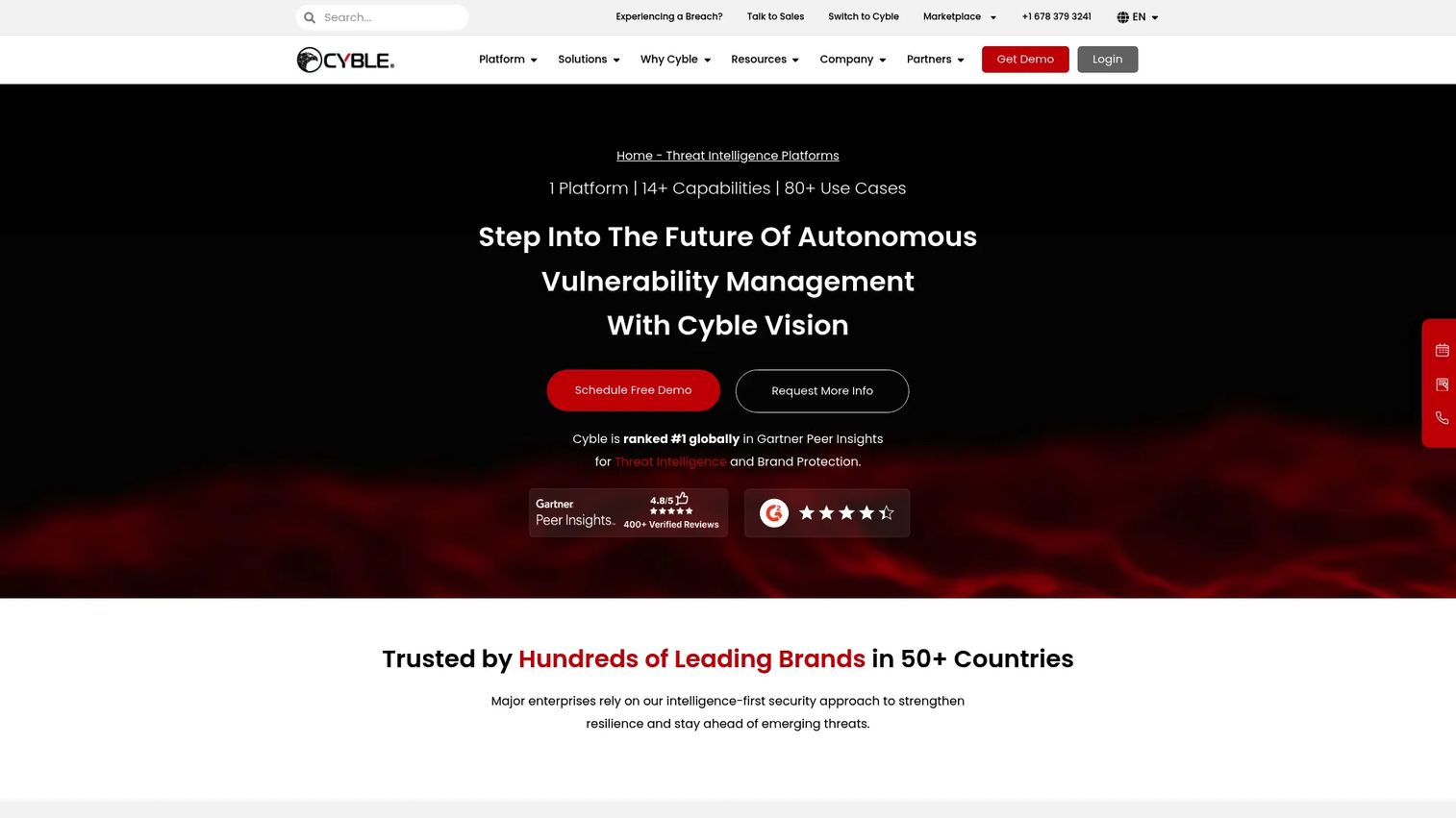
Cyble Vision is an AI-native cyber threat intelligence and digital risk protection platform that monitors surface, deep, and dark web sources for external threats. It covers dark web and cybercrime activity, attack surface management, brand impersonation, leaked credentials, ransomware tracking, and executive monitoring, all in a unified platform.
Best for: Enterprise security and risk teams that need external visibility across cyber, brand, and digital risk in one view.
Key features
- Dark web and cybercrime community monitoring
- Attack surface management and vulnerability monitoring
- Brand intelligence, impersonation detection, and takedown support
- Exposed credential and data-leak detection
- Threat actor, ransomware, and campaign tracking
Why choose Cyble Vision: Strong when security teams need an outside-in view of threats targeting their assets, people, and brand, not just internal signal. Presales teams should test alert relevance and evidence quality using the buyer's own domains and employee data during any evaluation.
Cyble Vision pricing: Cyble publishes no prices. Pricing is handled through a personalized demo and subscription review. Contact Cyble sales for details on modules and coverage scope.
G2 rating: 4.8/5 (148 reviews). G2 lists the vendor as Cyble rather than Cyble Vision, so the score covers the company's full product set.
9. CloudSEK XVigil
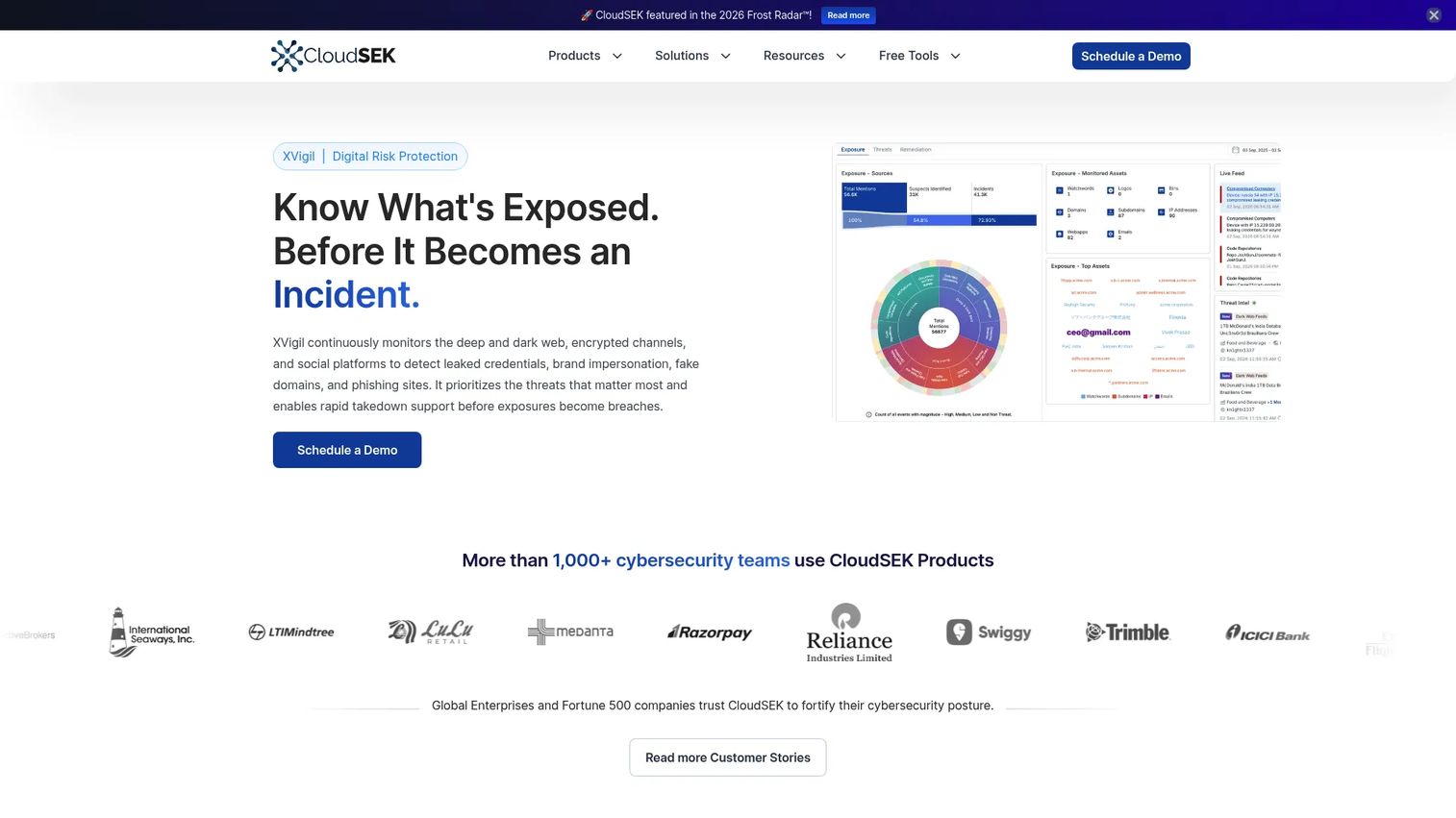
CloudSEK XVigil is a digital risk protection platform that uses AI to monitor surface, deep, and dark web sources for leaked credentials, data leaks, brand impersonation, fake domains, phishing sites, and related external threats. It provides AI-powered threat prioritization, attack-path correlation, takedown support, and API integrations with other security tools.
Best for: Security teams focused on external exposure, leaked data, and brand abuse who need continuous outside-in monitoring with remediation support.
Key features
- Deep and dark web monitoring for data leaks and credentials
- Brand risk monitoring: fake domains, phishing, and impersonation
- AI-powered threat prioritization and attack-path correlation
- Takedown support and workflow tracking
- API integrations with other security and ticketing tools
Why choose CloudSEK XVigil: Useful when the buyer wants continuous external threat monitoring with an emphasis on brand protection and exposure management. Alert volume and false-positive rate are the most important metrics to test in a POC, alongside how well the platform maps external findings to the buyer's specific assets.
CloudSEK XVigil pricing: CloudSEK publishes no prices. Request a quote from the CloudSEK team, who scope by monitored assets, intelligence modules, and user requirements.
G2 rating: 4.8/5 (138 reviews). G2 lists the vendor as CloudSEK rather than XVigil, so the score covers the company's full product set.
10. IBM X-Force Threat Intelligence
IBM X-Force Threat Intelligence provides global security intelligence, threat research, and actionable analysis to help organizations identify and anticipate cyber threats. Capabilities include malware reverse engineering, threat group and campaign reporting, cyber exposure insights across surface and dark web sources, an Adaptive X-Force Threat Score for prioritization, and integration feeds for IBM security products including QRadar.
IBM also distributes its X-Force Premier Threat Intelligence feed into OpenCTI, listed separately at number 14, through a connector built with Filigran. The two entries are independent products, but the intelligence can end up in the same place.
Best for: Enterprise teams using IBM security tools or needing research-backed threat intelligence to contextualize incidents and vulnerability exposure.
Key features
- Malware reverse engineering and analysis
- Threat group, campaign, and early-warning reports
- Cyber exposure insights across surface, deep, and dark web
- Adaptive X-Force Threat Score for threat prioritization
- Integrations with IBM QRadar and security tool feeds
Why choose IBM X-Force Threat Intelligence: Good fit when research depth and enterprise security context matter, particularly for organizations already running IBM security products. SEs should validate how intelligence flows into detection, triage, and response tools within the buyer's specific stack, since value is highest when integration is tight.
IBM X-Force Threat Intelligence pricing: IBM documents plan names but publishes no prices. Contact IBM sales with your product packaging and subscription scope for a quote.
G2 rating: 4.4/5 (14 reviews), under the listing name IBM Security X-Force Threat Intelligence.
11. SOCRadar Extended Threat Intelligence Platform
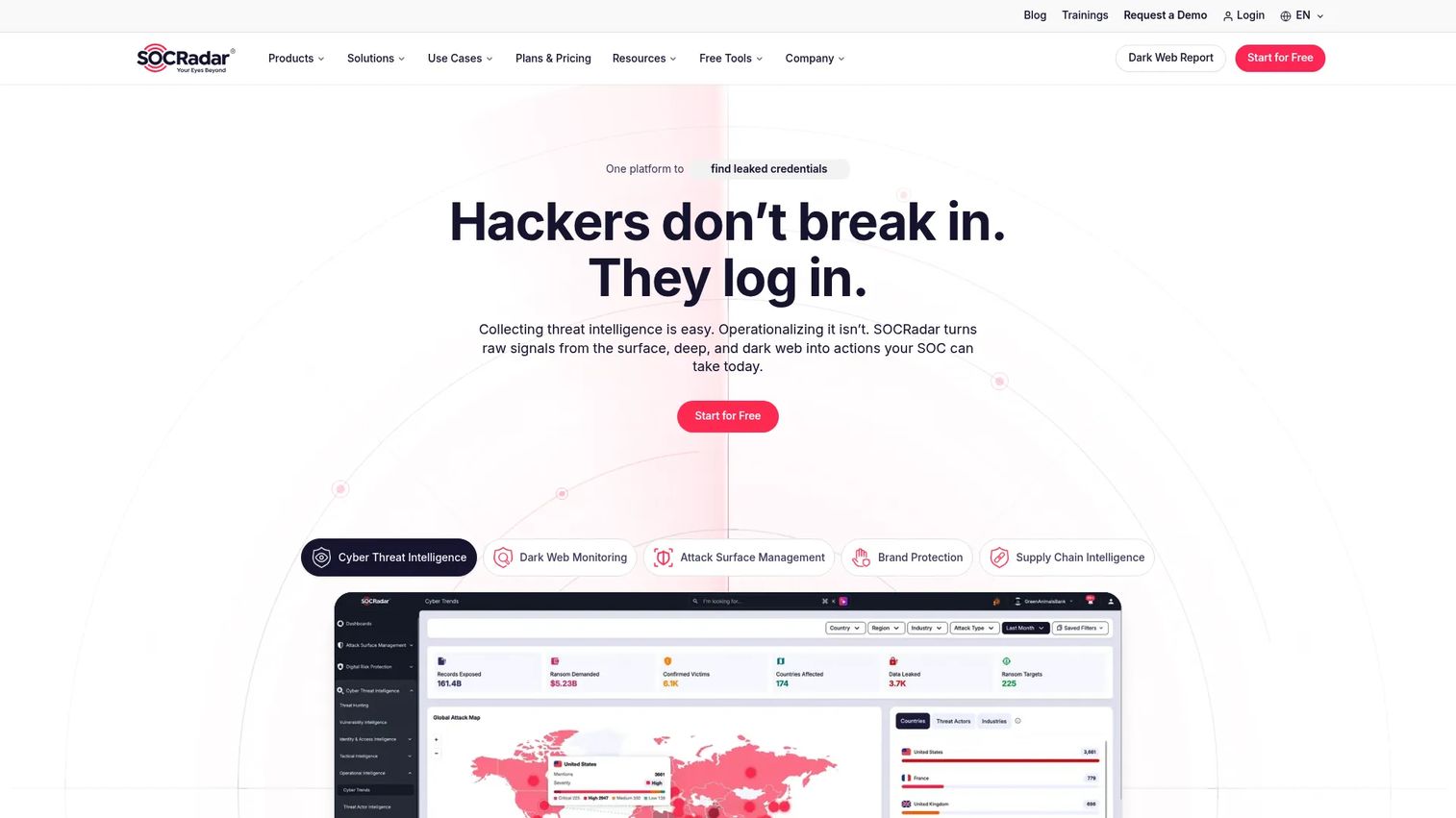
SOCRadar Extended Threat Intelligence Platform combines cyber threat intelligence, dark web monitoring, external attack surface management, brand protection, and supply chain intelligence in a modular platform. It is one of the few vendors in this category that publishes list prices for some modules, which makes it easier to scope during a technical evaluation than quote-only alternatives.
Best for: Mid-market and enterprise teams that want external threat intelligence, attack surface visibility, and brand protection without managing separate point products.
Key features
- Threat hunting and IOC management
- Dark web monitoring: credentials, forums, stealer logs, ransomware
- External attack surface discovery and vulnerability monitoring
- Brand protection with phishing detection and automated takedowns
- Supply chain intelligence and vendor risk assessment
Why choose SOCRadar: The modular structure and visible pricing make evaluation straightforward. Teams can start with a specific module (dark web monitoring or CTI, for example) and expand. Presales teams should validate asset discovery accuracy and alert prioritization quality during a POC.
SOCRadar pricing: SOCRadar publishes prices for its packaged tiers. Advanced Dark Web Monitoring starts at $4,550/year ($600 per month) for the Essential tier and $9,100/year ($1,145 per month) for Business. Cyber Threat Intelligence Essential starts at $14,750/year ($1,625 per month). Attack surface management, brand protection, and supply chain modules, plus all Ultimate tiers, are priced on request. A free Freemium license is also available.
G2 rating: 4.7/5 (122 reviews)
12. KELA Cyber Intelligence Platform
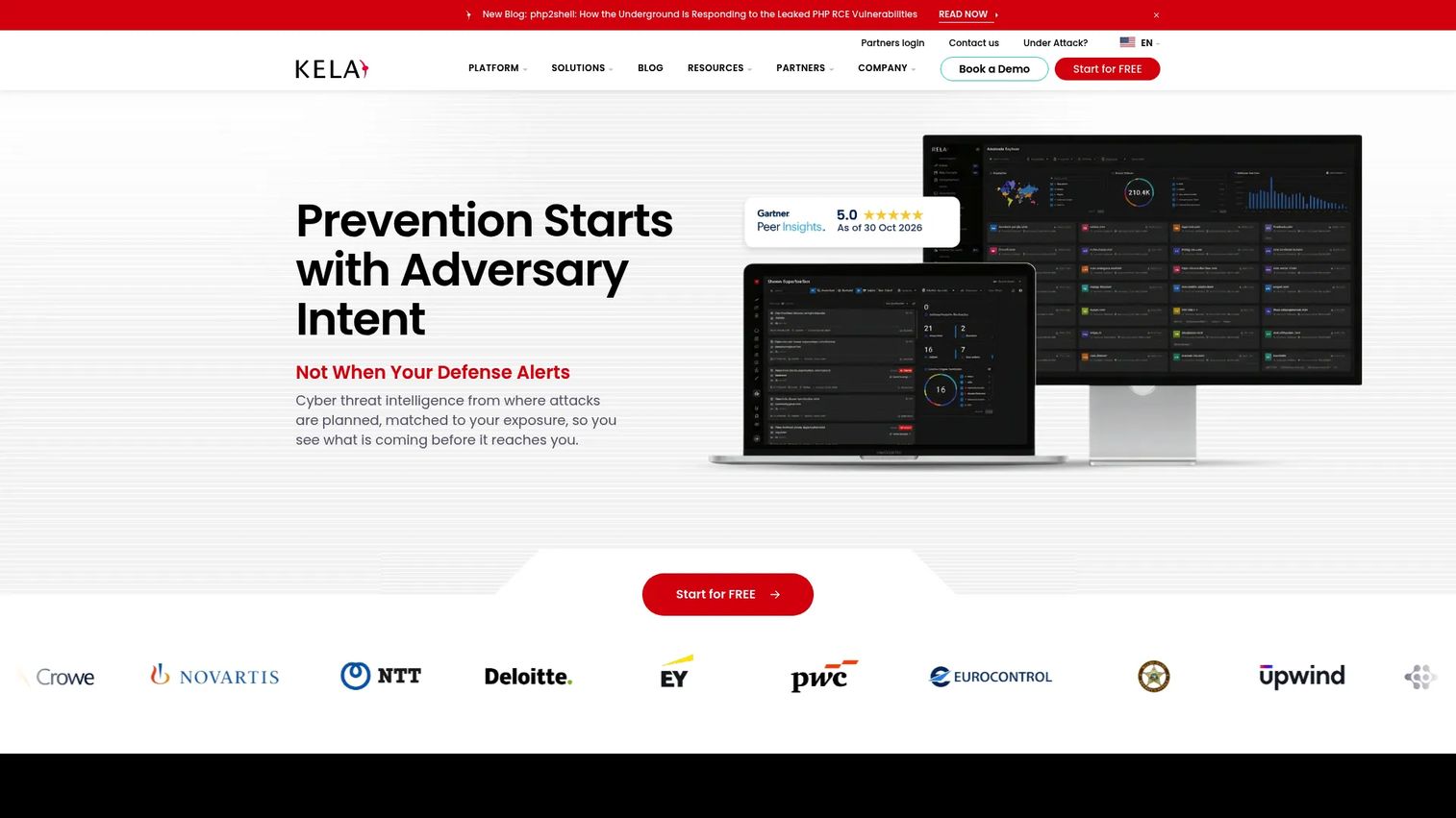
KELA Cyber Intelligence Platform fuses cybercrime-underground intelligence with an organization's external exposure and attack surface. It provides dark web monitoring, threat actor profiling, global NetFlow monitoring, threat infrastructure mapping, and agentic AI digital CTI analysts for pre-emptive hunting. KELA focuses heavily on actor-level intelligence from criminal communities rather than generic indicator feeds.
Best for: Threat intelligence teams and enterprise security programs that prioritize criminal underground source depth and actor-focused intelligence over feed volume.
Key features
- Cybercrime community monitoring and actor profiling
- Ransomware tracking and compromised credential detection
- Global NetFlow monitoring and technical intelligence
- Threat infrastructure mapping and pre-emptive hunting
- Agentic AI digital CTI analysts
Why choose KELA: Strong when a buyer cares more about who is targeting them and what criminal tools are in play than about general indicator feeds. Evaluate how well the platform maps underground findings to the buyer's specific assets and attack surface during any engagement.
KELA pricing: KELA publishes no prices and no public trial terms. The platform is modular and licensed per capability, so ask sales to scope by modules, users, and intelligence requirements, and to confirm whether an evaluation period is available for your use case.
G2 rating: No reviews on G2. KELA has a G2 product profile, but it has not been reviewed yet.
13. MISP
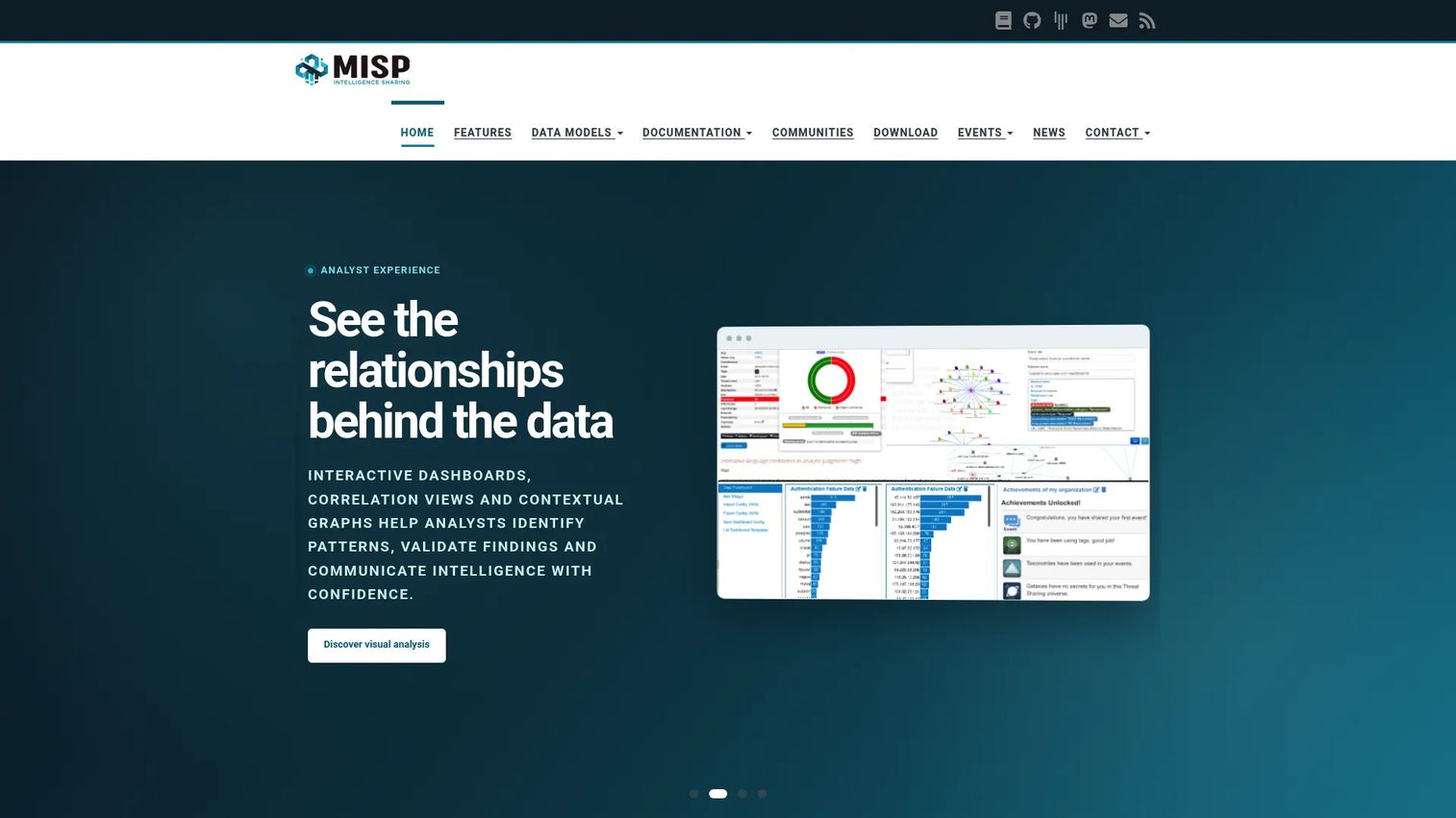
MISP is a free, open-source threat intelligence platform for collecting, analyzing, correlating, automating, and sharing cyber threat information. Used widely by CERTs, ISACs, government organizations, and enterprise security teams, it supports structured intelligence modeling, STIX/TAXII, granular sharing controls, real-time synchronization across instances, and a REST API with automation modules and integrations.
MISP is maintained by the open-source MISP project community rather than by any of the commercial vendors in this guide, though several of them, including Cyware, publish MISP integrations.
Best for: Security teams, CERTs, and intelligence-sharing communities that need a self-hosted, standards-based platform with full control over data governance.
Key features
- Structured intelligence modeling and analysis
- High-performance indicator correlation and visual exploration
- Granular sharing controls and real-time synchronization
- Analyst collaboration: notes, opinions, sightings, and relationships
- STIX/TAXII support, REST API, and automation modules
Why choose MISP: Strong choice for teams that want control, transparency, and community-based sharing without a vendor subscription. The operating cost comes from hosting, administration, tuning, and integration work, not license fees. Teams without dedicated security engineering support should plan for that overhead before committing.
MISP pricing: MISP is free and open-source software. Check the project repository for current license terms, and budget for hosting infrastructure, administration, commercial support contracts if needed, and integration development.
G2 rating: Not listed on G2. MISP has no G2 product profile.
14. OpenCTI
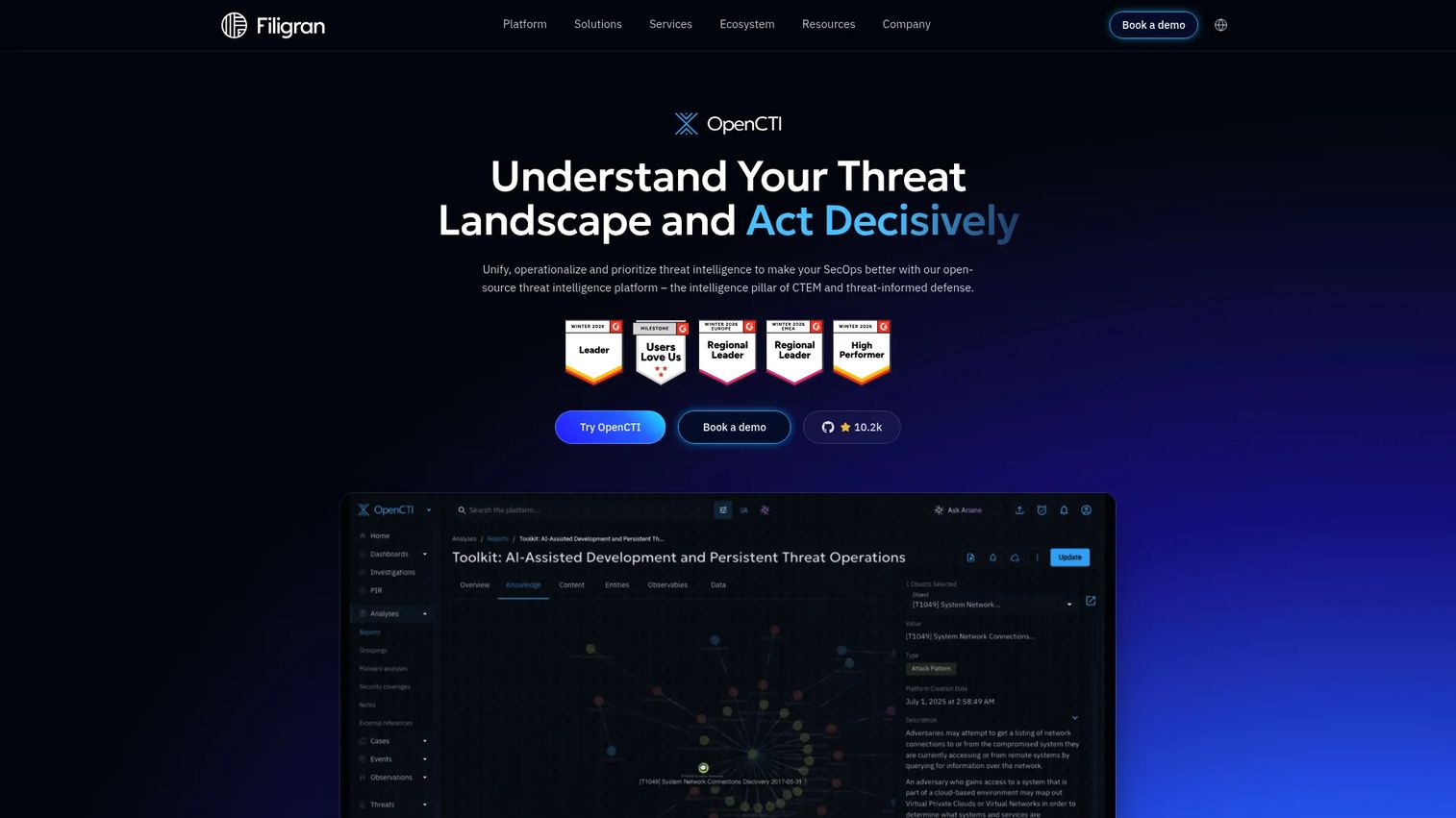
OpenCTI is an open-source cyber threat intelligence platform from Filigran for structuring, storing, correlating, and operationalizing threat intelligence using a STIX 2.1 knowledge graph. It supports a large connector library, threat intelligence visualization, case management for incident response, AI-powered analysis, automated playbooks, and granular RBAC with audit trails. The Community Edition is free and self-hosted.
Filigran, the company behind OpenCTI, is independent of the other vendors in this guide, but it does ship a connector for IBM's X-Force Premier Threat Intelligence feed, listed separately at number 10.
Best for: Security teams that need a structured CTI knowledge base built on open standards and can support their own deployment and connector management.
Key features
- STIX 2.1 knowledge graph for threat intelligence modeling
- A large library of integrations and connectors
- Case management for incident response workflows
- AI-powered analysis and report generation
- Automated playbooks and priority intelligence requirement tracking
Why choose OpenCTI: Strong fit when a buyer needs structured CTI knowledge management, not just feed ingestion. The graph model is particularly valuable for mapping relationships between threat actors, campaigns, malware, and infrastructure. Presales and evaluation teams should confirm who will own connector configuration, data quality, and ongoing administration before recommending the Community Edition.
OpenCTI pricing: The Community Edition is free and self-hosted. The Enterprise Edition, Filigran support packages, and managed cloud hosting add AI, automation, enterprise security, and support capabilities. Filigran publishes no prices for those, so request a quote.
G2 rating: 4.6/5 (48 reviews), under the listing name OpenCTI by Filigran.
15. AlienVault OTX
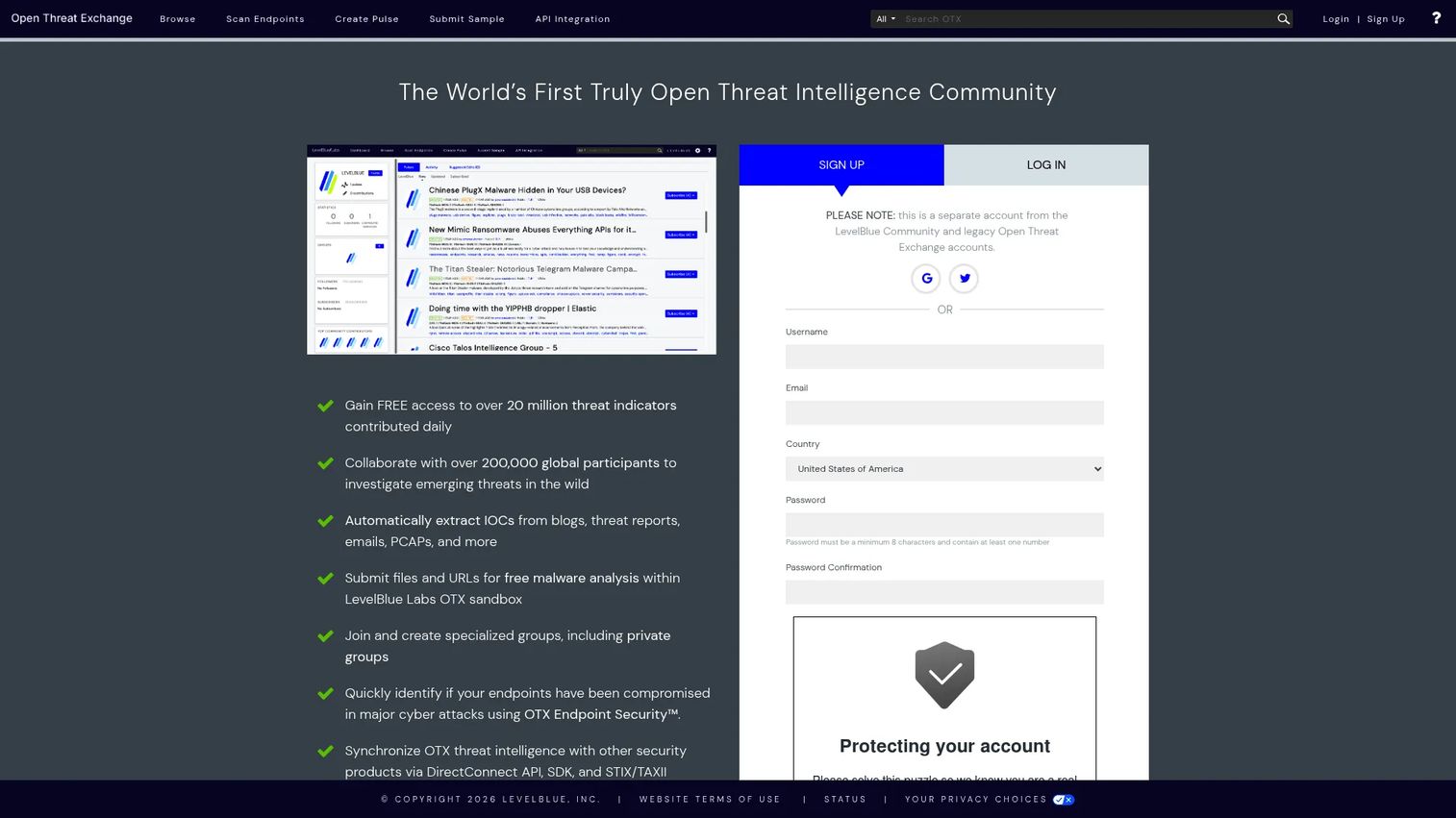
AlienVault OTX is an open information-sharing and analysis community where security practitioners contribute, research, and receive alerts about emerging threats and indicators of compromise. OTX pulses package community-contributed indicators (IPs, file hashes, domains) with context, and the platform provides API access for integration into other security tools.
The service is now operated by LevelBlue, the company formed from AT&T Cybersecurity, and its current documented name is LevelBlue Labs Open Threat Exchange. The AlienVault branding and domain are still in circulation, so expect both names in vendor documentation and integration listings.
Best for: Security practitioners and smaller teams that need a free, community-driven source of threat indicators to supplement or start a threat intelligence program.
Key features
- Community-contributed OTX pulses with indicator context
- Alerts for emerging threats and new indicators
- Open threat exchange and collaborative research
- Basic threat context and malware association data
- API access for integration with security tools
Why choose AlienVault OTX: A practical entry point for teams that want free community threat intelligence and don't yet have a full enterprise CTI program. The limitation is depth: OTX provides community signal, not finished intelligence or analyst-curated reporting. For best competitive intelligence tools in adjacent categories, OTX pairs well with a more structured platform.
AlienVault OTX pricing: OTX is free. Check current API limits and commercial packaging details on the LevelBlue platform pages before building production integrations.
G2 rating: Not listed on G2. There is no OTX-specific G2 product profile, so scores you may see belong to other LevelBlue listings.
Considerations when choosing threat intelligence platforms
Match the platform to your priority intelligence requirements
Before evaluating vendors, define what your team actually needs to know. Ransomware targeting your sector, exploited CVEs affecting your stack, credential exposure, or adversary infrastructure are all valid starting points. A platform that answers your specific questions is more valuable than one that delivers more general volume. Write down your top five priority intelligence requirements before any demo.
Test enrichment quality, not feed volume
More indicators often means more noise. Evaluate confidence scoring, source transparency, deduplication logic, and false-positive handling before committing. Ask the vendor to show how their platform handles conflicting intelligence from multiple sources and what happens to stale or expired indicators.
Check who owns the vendor and the sources
Several platforms in this category sit inside larger companies, and several bundle sources that share one corporate parent. Recorded Future is a Mastercard company, Google Threat Intelligence combines three Google-owned source sets, and ThreatConnect has an announced acquisition by Dataminr. None of that is disqualifying, but it affects roadmap risk, renewal leverage, and whether two shortlisted products are genuinely independent.
Validate integrations with your daily SOC workflow
The platform needs to improve response workflows, not create another tab to check. Test integrations with your SIEM, SOAR, EDR, and ticketing system during the POC. Verify that enriched context appears where analysts already work, and that automation rules fire correctly on real indicator types. For teams already evaluating adjacent tooling, see our guide on best AI cybersecurity solutions for overlapping workflow categories.
Check governance and sharing controls
Review user roles, data markings, sharing group configuration, STIX/TAXII export, audit logs, and access control granularity. For organizations that share intelligence with sector peers or regulatory bodies, confirm the platform supports structured sharing protocols with appropriate classification controls.
Run a POC with real security questions
Test the platform against your own recent incidents, exposed assets, top-priority CVEs, and known adversaries. A good POC shows whether intelligence changes what the team does next. Analyst usability, report quality, and integration depth should all be visible within two weeks of hands-on evaluation.
Conclusion
The best threat intelligence platform is the one your analysts use inside daily workflows, not the one with the most impressive demo. Here is how to segment the shortlist:
- Enterprise all-around: Recorded Future Intelligence Platform, for broad external intelligence, deep integrations, and executive-ready reporting
- Google security context: Google Threat Intelligence, when Mandiant research and VirusTotal breadth both matter
- Endpoint-led adversary intelligence: CrowdStrike Falcon Adversary Intelligence, for Falcon-first teams
- Dark web and underground: Flashpoint Ignite, KELA, and Cyble Vision for different depths of criminal source coverage
- External exposure monitoring: SOCRadar and CloudSEK XVigil, when attack surface and brand risk need to live alongside threat intelligence
- Open-source intelligence operations: MISP and OpenCTI, for teams with engineering capacity and standards-based sharing requirements
- Free community intelligence: AlienVault OTX as a starting point or supplemental source
Pick three candidates that match your priority intelligence requirements, then run a POC. Measure whether intelligence changes your triage decisions, not just how many indicators the platform ingests. For teams evaluating broader intelligence tooling alongside this category, our guides on best audience intelligence platforms, best revenue intelligence platforms, and best brand intelligence software cover adjacent areas worth cross-referencing.
Every platform on this list gets evaluated through a demo before anyone runs a POC, and presales teams in this category spend a lot of time rebuilding the same SOC workflow demo for each new prospect. Guideflow lets presales and product marketing teams capture those workflows once as an interactive demo that buyers can click through at their own pace, before any environment gets provisioned.
Start your journey with Guideflow today!
FAQs
A threat intelligence platform is software that collects, normalizes, enriches, analyzes, and distributes cyber threat data so security teams can make faster, better-prioritized decisions. It ingests from external feeds, dark web sources, vulnerability databases, internal telemetry, and open-source intelligence, then connects to SIEM, SOAR, and response workflows through integrations and APIs.
Threat data is raw signal: an IP address, a domain, a file hash, or a vulnerability identifier. Threat intelligence adds context, confidence, relevance to your specific environment, and a recommended action. Data tells you something happened; intelligence tells you whether it matters and what to do about it.
At a minimum, look for SIEM, SOAR, EDR, and firewall integrations, plus ticketing and case management for analyst workflows. Deeper integrations with XDR, vulnerability management, and identity systems add value at scale. STIX and TAXII support matters if you need to share or receive structured intelligence with partner organizations.
MISP and OpenCTI are strong options for teams with engineering support, governance processes, and time to configure connectors. They can match commercial platforms on structure and sharing capability. Where they fall short is curated source access, finished analyst reports, automated prioritization, and vendor support. Enterprise teams typically need paid platforms for those layers.
Test the platform against your own recent incidents, your highest-priority CVEs, your top vendor domains, and any known adversary activity targeting your sector. Measure analyst usability, false-positive rates, integration depth with your existing tools, and reporting quality. A good POC shows whether intelligence changes the decisions your team makes, not just the alerts they see.
Indicators of compromise (IoCs) are technical artifacts associated with suspicious or malicious activity, such as IP addresses, domains, URLs, file hashes, and registry keys. Context matters because IoCs age quickly. An IP that was serving malware last month may be clean infrastructure today, so confidence scores and timestamps should accompany any indicator before it influences a response decision.
TTPs stands for tactics, techniques, and procedures. They describe how an attacker operates: what they are trying to achieve (tactics), how they achieve it technically (techniques), and the specific implementations they favor (procedures). TTPs are more durable than individual indicators because attackers change infrastructure far more often than they change behavior. MITRE ATT&CK is the most widely used framework for mapping and communicating TTPs.
Update frequency depends on the data type. Fast-changing indicators like malicious IPs or phishing domains may update continuously. Malware families and vulnerability intelligence follow research and discovery cycles. Strategic intelligence on adversary campaigns or geopolitical risk follows publication schedules. Freshness matters, but relevance to your environment matters more.