

You built a welcome sequence six months ago. It still sends the same five emails to every new subscriber, whether they signed up for a free trial or downloaded a pricing guide. Nobody has touched it since.
That is the quiet problem with most lifecycle automation. It gets set up once, then runs on autopilot while your segmentation drifts, your reporting stays fuzzy, and your CFO keeps asking which channel actually drove that revenue. You need a drip campaign software that handles welcome flows, lead nurturing, abandoned cart recovery, and win-back campaigns without becoming another maintenance headache in a stack you already can't fully account for.
The global drip marketing software market is expected to surpass $6 billion by 2027, growing at roughly 15% CAGR, according to Market-Research-Report-List (2025). The category is crowded, and the platforms differ more than their landing pages suggest. Some lead with ecommerce revenue attribution. Some lead with automation depth. Some just want to be simple.
We evaluated seven based on automation depth, segmentation model, integration coverage, deliverability, and pricing value. Here is how they actually differ.
What's inside
This guide is for growth marketers, ecommerce marketers, and lean lifecycle teams choosing a drip email automation platform they can defend on ROI, not just features.
We selected and ranked tools on four criteria:
- Automation depth: trigger logic, branching, and behavior-based routing
- Segmentation: how granular and dynamic the audience model gets
- Integrations and deliverability: CRM, ecommerce, and inbox placement
- Pricing value: what you actually pay as your list scales
No sponsored placements. Pricing and G2 ratings reflect each vendor's public pages as of August 2026.
TL;DR
Short on time? Here are the decision shortcuts:
- Best for advanced automation depth: ActiveCampaign, for branching logic and CRM-connected workflows
- Best for ecommerce lifecycle automation: Klaviyo, for revenue-linked segmentation
- Best for all-in-one ecommerce plus SMS: Omnisend, for fast prebuilt workflows
- Best budget multi-channel option: Brevo, for email plus SMS without enterprise pricing
- Best for lean teams that want simplicity: MailerLite, for clean, intuitive automation
- Best value for ecommerce-first teams: Drip, for behavior-based flows without bloat
- Most familiar all-rounder: Mailchimp, for broad-use drip workflows and easy setup
What is drip campaign software
Drip campaign software is automation that sends a planned sequence of emails or messages to a contact based on time delays or user behavior, without manual follow-up on each send.
Instead of blasting one email to your whole list, you build a flow. A trigger fires (a signup, a cart abandonment, an inactivity window), and the sequence runs on its own logic from there. The best drip email marketing platforms share a common feature set:
- Triggers: start flows from signups, purchases, page views, or inactivity
- Segmentation: group contacts by behavior, attributes, or lifecycle stage
- Personalization: insert dynamic content, product data, and merge fields
- Analytics: track opens, clicks, conversions, and revenue per flow
- Templates: prebuilt welcome, cart, and win-back sequences to launch fast
- Integrations: sync with your CRM, ecommerce platform, and analytics stack
The line between drip email software and full marketing automation is thin. Most modern platforms cover both, layering SMS, push, and CRM logic on top of email drip campaign software basics. What separates them is depth: how far the branching goes, how dynamic the segments are, and how cleanly the reporting ties back to revenue.
If you sell through a storefront, ecommerce-native tools link flows directly to purchase behavior. If you run a longer B2B nurture, CRM-connected automation matters more. The right pick depends on where your revenue comes from, not on which tool has the longest feature list.
When to use drip campaign software
Welcome new subscribers without manual follow-up
A new signup is the highest-intent moment you get. A welcome sequence meets that intent automatically, introducing your product across three to five messages while the interest is still warm. Done well, it lifts activation and early engagement without a rep touching a keyboard. The measurable payoff shows up in trial-to-paid conversion and D7 retention.
Recover abandoned carts and inactive leads
Most abandoned carts never come back on their own. An abandoned cart flow fires within an hour of drop-off, reminds the shopper what they left, and often recovers a meaningful share of otherwise lost revenue. The same logic applies to inactive leads: a re-engagement sequence pulls dormant contacts back before you write them off. Both run on behavior triggers, so they scale without extra work.
Nurture leads and re-engage customers over time
Lead nurturing is where drip marketing software earns its budget. A sequence spaced over weeks keeps your product in front of a buyer through a long evaluation, feeding relevant content based on what they clicked. Post-purchase, win-back campaigns re-engage lapsed customers with targeted offers. The outcome you track is influenced pipeline and repeat purchase rate, not just opens.
Comparison table
The seven platforms below are ordered by relevance to lifecycle and drip use cases. Pricing reflects public starting tiers, and G2 ratings come from each vendor's current listing. Use this as a shortlist, then read the sections for the detail that matters to your funnel.
| # | Product | Best for | Key differentiator | Pricing | G2 rating |
|---|---|---|---|---|---|
| 1 | Mailchimp | Broad-use SMB drip workflows | Familiar all-in-one with predictive segmentation | Free; paid from $13/mo | 4.3/5 |
| 2 | ActiveCampaign | Advanced automation depth | Branching logic plus built-in CRM | From $15/mo (billed annually) | 4.4/5 |
| 3 | Klaviyo | Ecommerce lifecycle automation | Revenue-linked customer profiles | Free; paid from $45/mo | 4.5/5 |
| 4 | Omnisend | All-in-one ecommerce plus SMS | Prebuilt workflows across channels | Free; paid from $16/mo | 4.6/5 |
| 5 | Brevo | Budget multi-channel campaigns | Email plus SMS at low entry price | Free; paid from $9/mo | Not listed |
| 6 | MailerLite | Lean teams wanting simplicity | Clean editor with landing pages | Free; paid from $12/mo | 4.6/5 |
| 7 | Drip | Ecommerce-first behavioral flows | Behavior-based segments, no bloat | From $39/mo | 4.4/5 |
1. Mailchimp
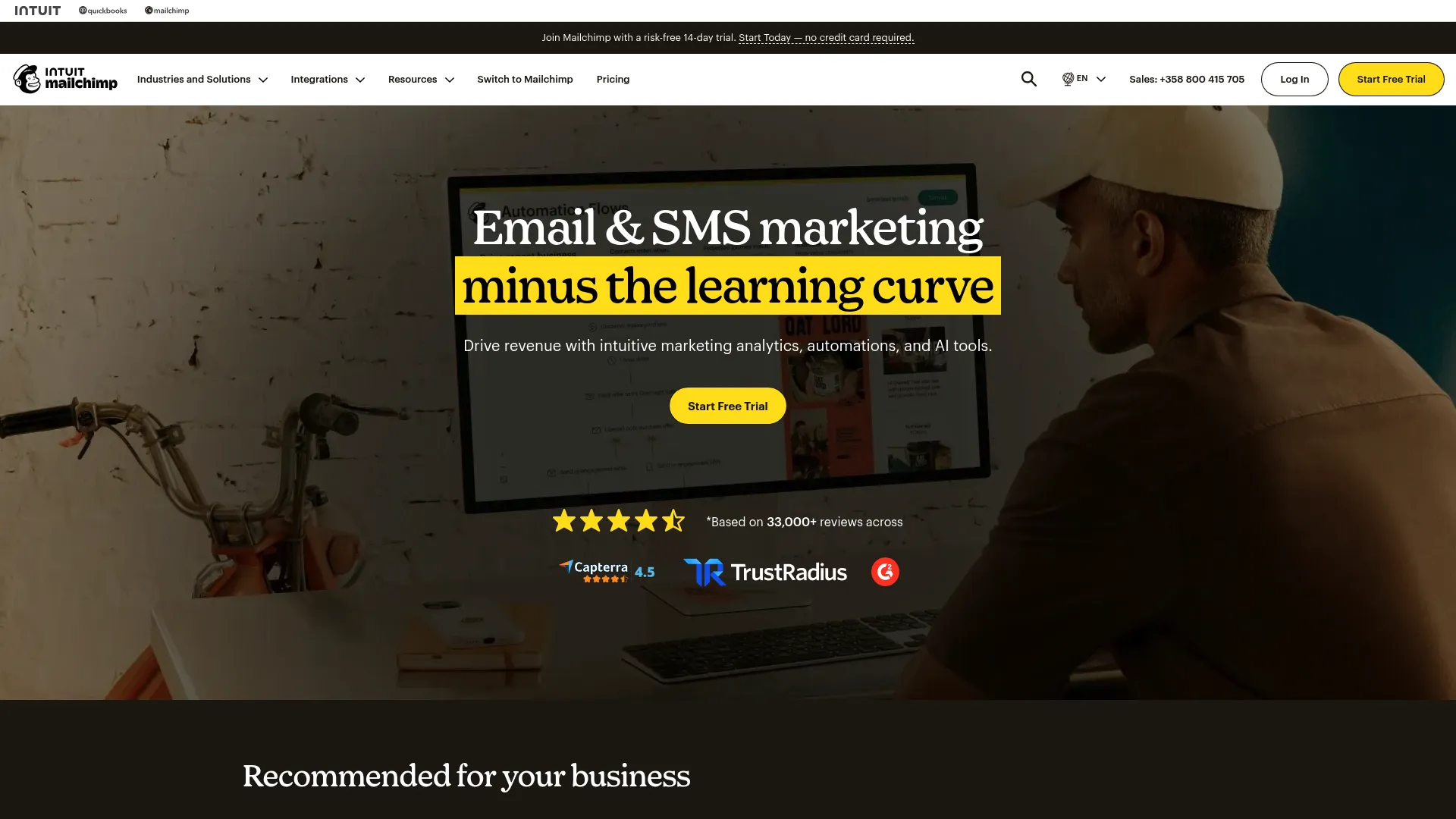
Mailchimp is the platform most marketers meet first. It handles email and SMS marketing, automation flows, landing pages, and audience management in one place, which makes it a low-friction starting point for basic-to-intermediate drip campaigns. If your team already lives in the broader Mailchimp environment, building a welcome sequence or a simple nurture flow takes minutes rather than a migration project.
Its strength is breadth without a steep learning curve. Predictive segmentation and generative AI copy assistance help lean teams launch respectable flows fast, and the template library covers the common lifecycle patterns out of the box.
Best for: small and mid-sized businesses that want email marketing, automation, and audience management in one platform.
Key features
- Marketing automation flows
- Email builder and landing pages
- Generative AI copy assistance
- CRM and segmentation
- Integrations with Salesforce, Shopify, Google Analytics, and Zapier
Why choose Mailchimp: Pick it when you value familiarity and fast setup over deep branching logic. It fits generalist marketers who need a capable drip email software without dedicating a specialist to it.
Mailchimp pricing: Free plan for up to 250 contacts. Essentials starts at $13/month, Standard at $20/month, and Premium at $350/month. Pay-as-you-go and custom high-volume options are also available.
2. ActiveCampaign

ActiveCampaign is the choice when automation depth is the point. It combines email marketing, marketing automation, and a built-in CRM, so your drip sequences can react to sales activity, not just email behavior. Complex triggers, conditional branching, and behavior-based routing are native here rather than bolted on, which is why teams running multi-stage B2B nurtures gravitate to it.
The tradeoff is that depth asks something of you. You get more control over how a contact moves through a flow, which rewards teams willing to design the logic deliberately. Cross-channel messaging via SMS and WhatsApp rounds out the lifecycle picture.
Best for: businesses wanting marketing automation tied to a CRM and cross-channel messaging.
Key features
- Email marketing and newsletters
- Marketing automation with branching logic
- CRM and sales automation
- Landing pages
- SMS and WhatsApp messaging
Why choose ActiveCampaign: Choose it when your funnel has real complexity and you need workflows that respond to CRM signals. It suits mid-market growth marketers who want defensible attribution across the sales and marketing handoff.
ActiveCampaign pricing: The Starter plan begins at $15/month billed annually. Plus, Pro, and Enterprise tiers scale up from there with pricing that varies by contact volume and features. No free tier, though a trial is available.
3. Klaviyo
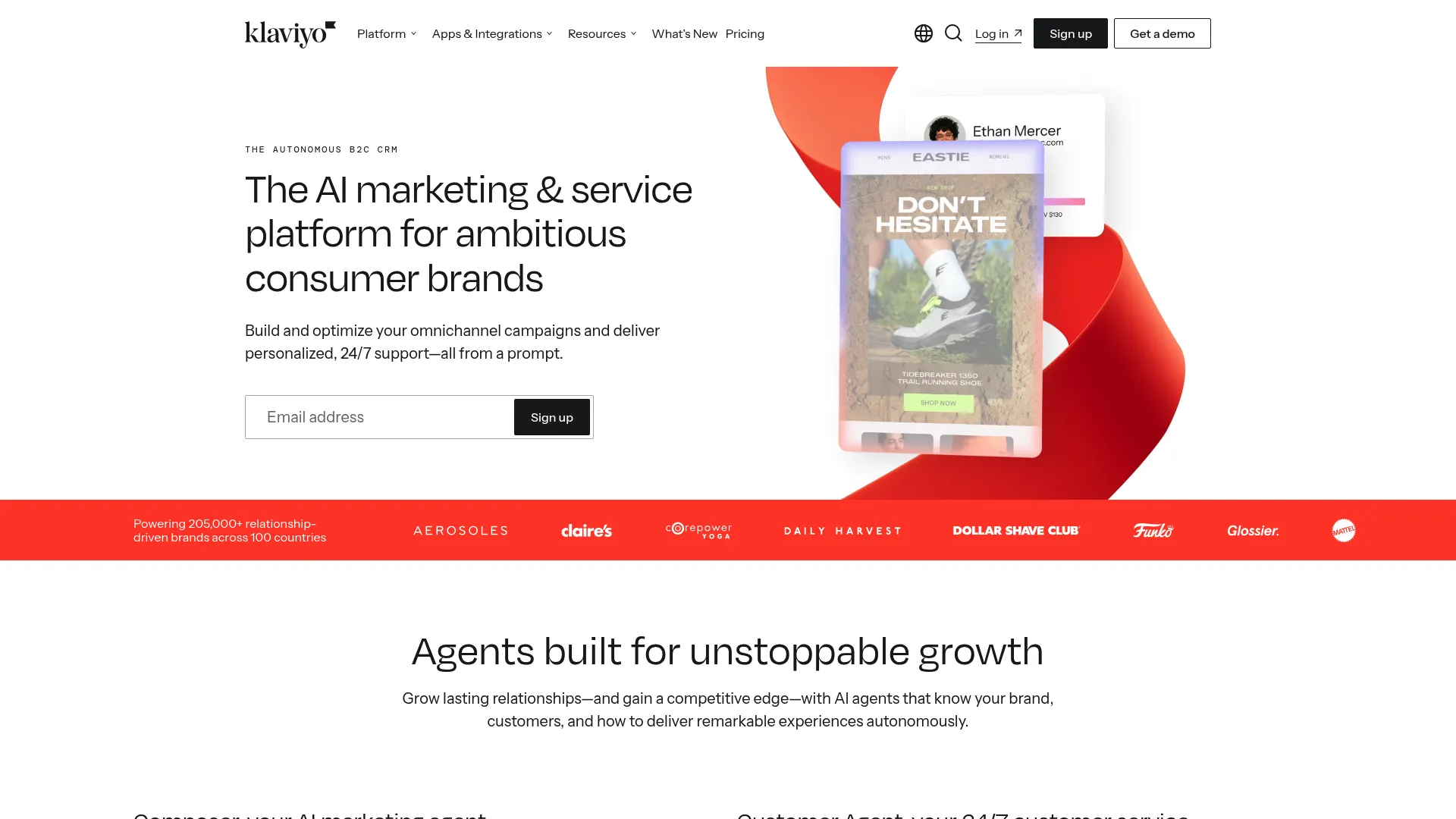
Klaviyo built its reputation on ecommerce, and it shows. It unifies email, SMS, customer data, and analytics into rich profiles, so your flows can target on shopping behavior, purchase history, and predicted lifetime value. For online stores, that means abandoned cart, browse abandonment, and post-purchase sequences that tie directly to revenue rather than to vanity metrics.
With more than 350 pre-built integrations, Klaviyo slots into most ecommerce stacks without custom work. Product recommendations and behavior-based segmentation are first-class here, which is why revenue-focused DTC teams tend to standardize on it.
Best for: ecommerce brands that want unified email and SMS marketing plus customer data and analytics.
Key features
- Customer profiles and segmentation
- Automated flows and omnichannel campaigns
- Revenue-linked reporting
- Product recommendations
- 350-plus pre-built integrations and APIs
Why choose Klaviyo: Pick it when your revenue comes from a storefront and you want segmentation driven by shopping behavior. It fits ecommerce marketers who measure flows in dollars, not opens.
Klaviyo pricing: Free plan covers up to 250 profiles, 500 emails per month, and $5 of mobile messages monthly. Paid plans scale by contact count, with a listed starting point of $45/month on the platform tier.
4. Omnisend
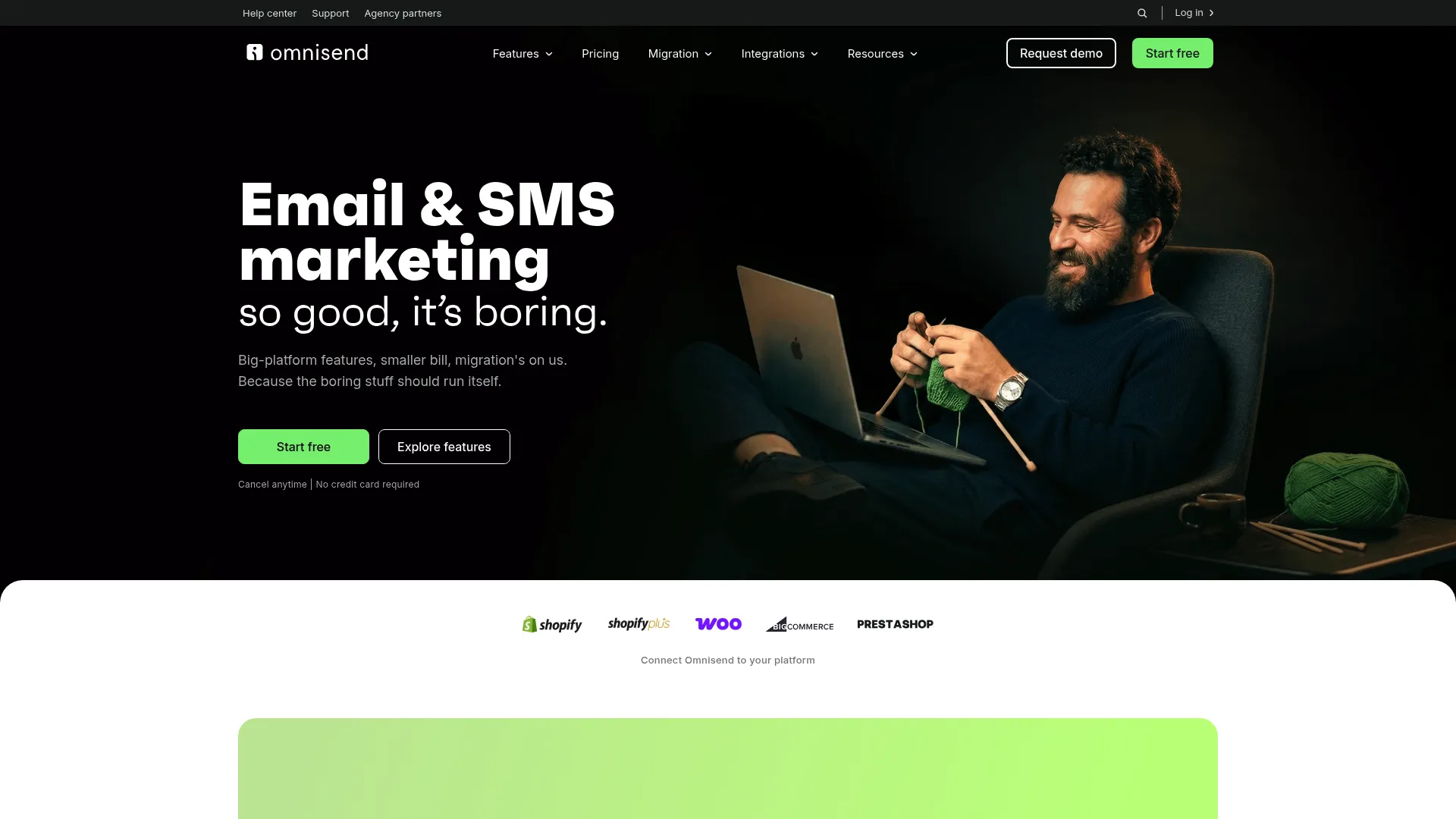
Omnisend is built for ecommerce teams that want to move quickly. It bundles email, SMS, and push into one platform with prebuilt automation workflows, so a smaller team can launch cart recovery and welcome flows without building each one from scratch. The drag-and-drop builder and dynamic segmentation keep the setup fast while still handling multichannel lifecycle campaigns.
Where it stands out is speed to launch paired with practical value. AI product recommendations and ready-made workflows mean you spend less time wiring logic and more time optimizing. That balance suits lean ecommerce operators who need results this quarter, not next.
Best for: ecommerce teams that want one platform for email, SMS, push, and automations.
Key features
- Drag-and-drop email builder
- Dynamic segmentation
- Automation workflows
- AI product recommendations
- Email, SMS, and push campaigns
Why choose Omnisend: Choose it when speed to launch matters and you want multichannel lifecycle flows without heavy configuration. It fits smaller ecommerce teams that value prebuilt workflows over deep custom branching.
Omnisend pricing: Free plan available. Standard starts at $16/month and Pro at $59/month, with pricing that scales by billable contacts.
5. Brevo
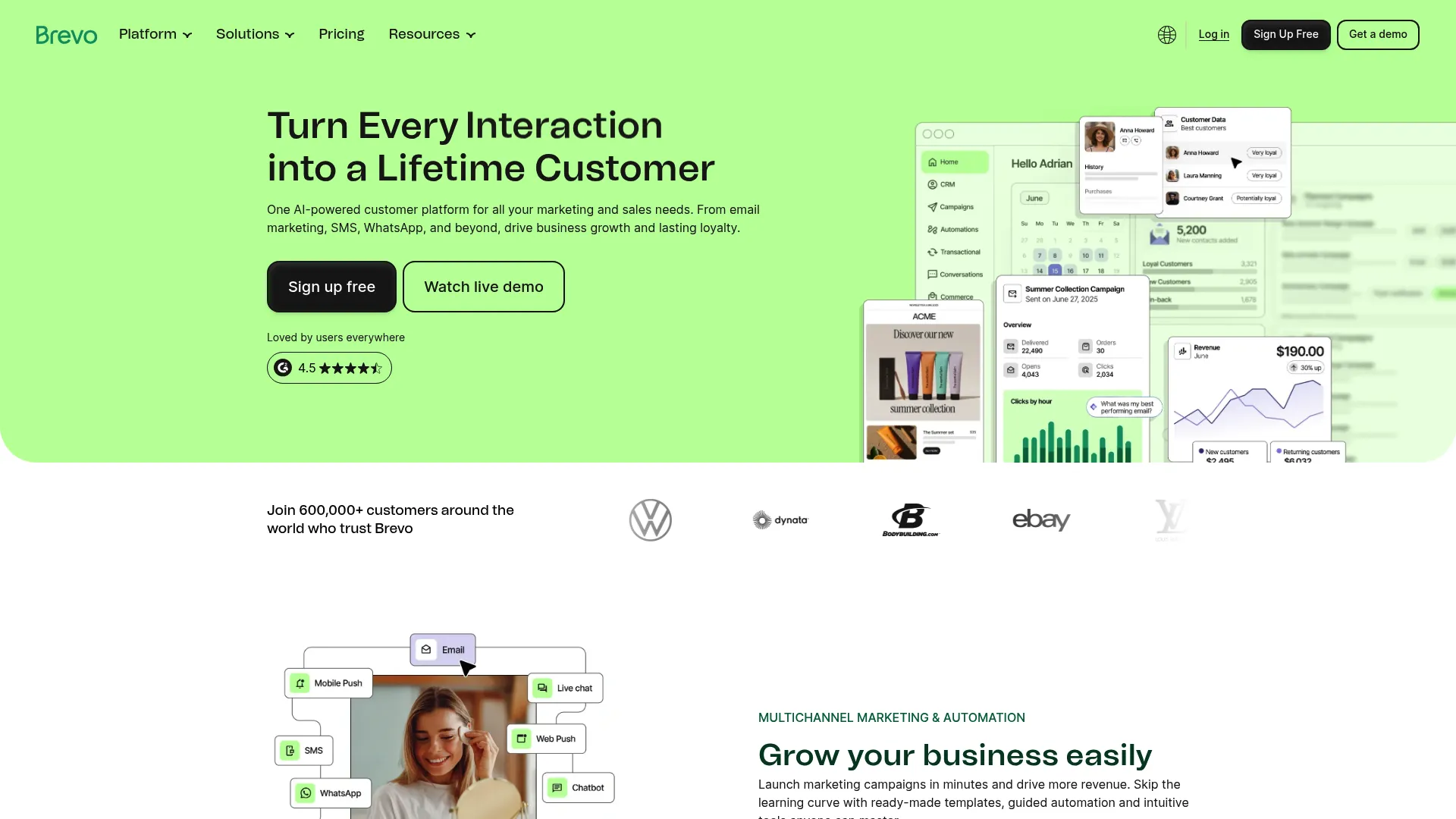
Brevo is the budget-conscious multi-channel pick. It combines email marketing, automation, SMS, and WhatsApp campaigns in one platform, and its entry pricing undercuts most enterprise-oriented competitors. For teams that want to run basic to intermediate lifecycle campaigns across more than one channel without committing to a large monthly spend, it hits a practical sweet spot.
The value story is the headline: you get core automation and CRM functionality at a low entry price. That makes Brevo a strong fit for startups and lean teams testing whether multi-channel drip campaigns move their numbers before scaling investment.
Best for: SMBs wanting multichannel marketing and CRM in one platform.
Key features
- Email marketing
- Marketing automation
- SMS and WhatsApp campaigns
- Built-in CRM
- Transactional email support
Why choose Brevo: Pick it when budget is a real constraint and you still want email plus SMS in one place. It suits early-stage marketers who need core automation without enterprise pricing.
Brevo pricing: Free plan available. Starter begins from $9/month, Standard from $18/month, and Professional from $499/month. Enterprise is custom-priced.
6. MailerLite
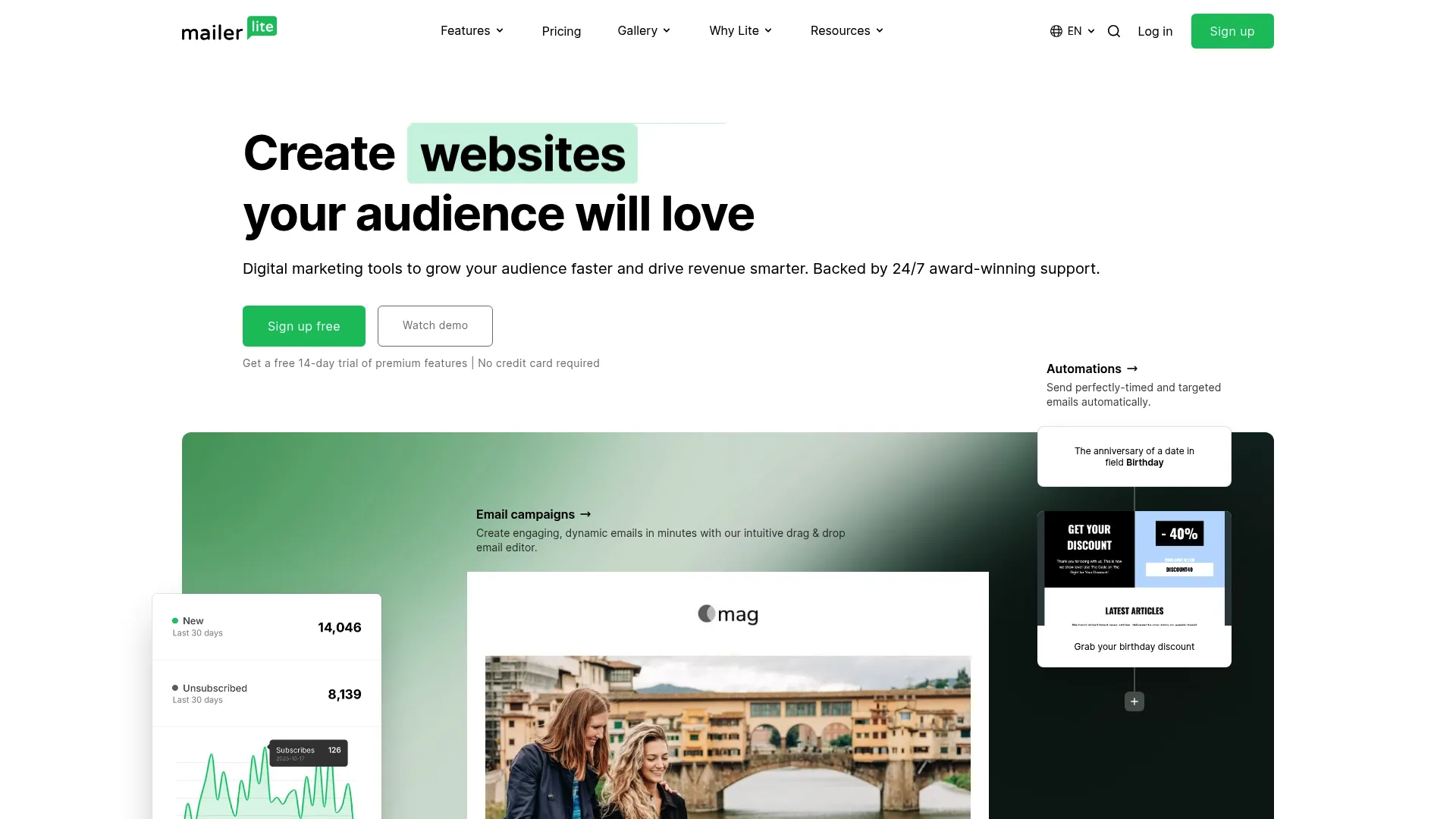
MailerLite is the clean, simple option for teams that value ease of use over depth. It covers email campaigns and automations, landing pages, a website builder, and signup forms in an interface that stays out of your way. For a lean team or a creator, that means you can stand up a welcome sequence and a landing page in an afternoon without a specialist.
Its appeal is intuitive workflows and a low learning curve. You are not paying for complexity you will never use, and the automation is capable enough for most straightforward lifecycle needs.
Best for: small businesses and creators needing simple email marketing with landing pages and automations.
Key features
- Email campaigns and automations
- Landing pages and website builder
- Signup forms, pop-ups, and preference center
- Drag-and-drop editor
- Digital product selling
Why choose MailerLite: Choose it when simplicity and speed matter more than deep branching. It fits creators and lean teams that want straightforward drip email automation they can manage themselves.
MailerLite pricing: Free plan for up to 250 subscribers. Comfort starts at $12/month and Power at $25/month, scaling by subscribers and sending volume. Enterprise is custom-priced, with a 14-day trial of premium features.
7. Drip
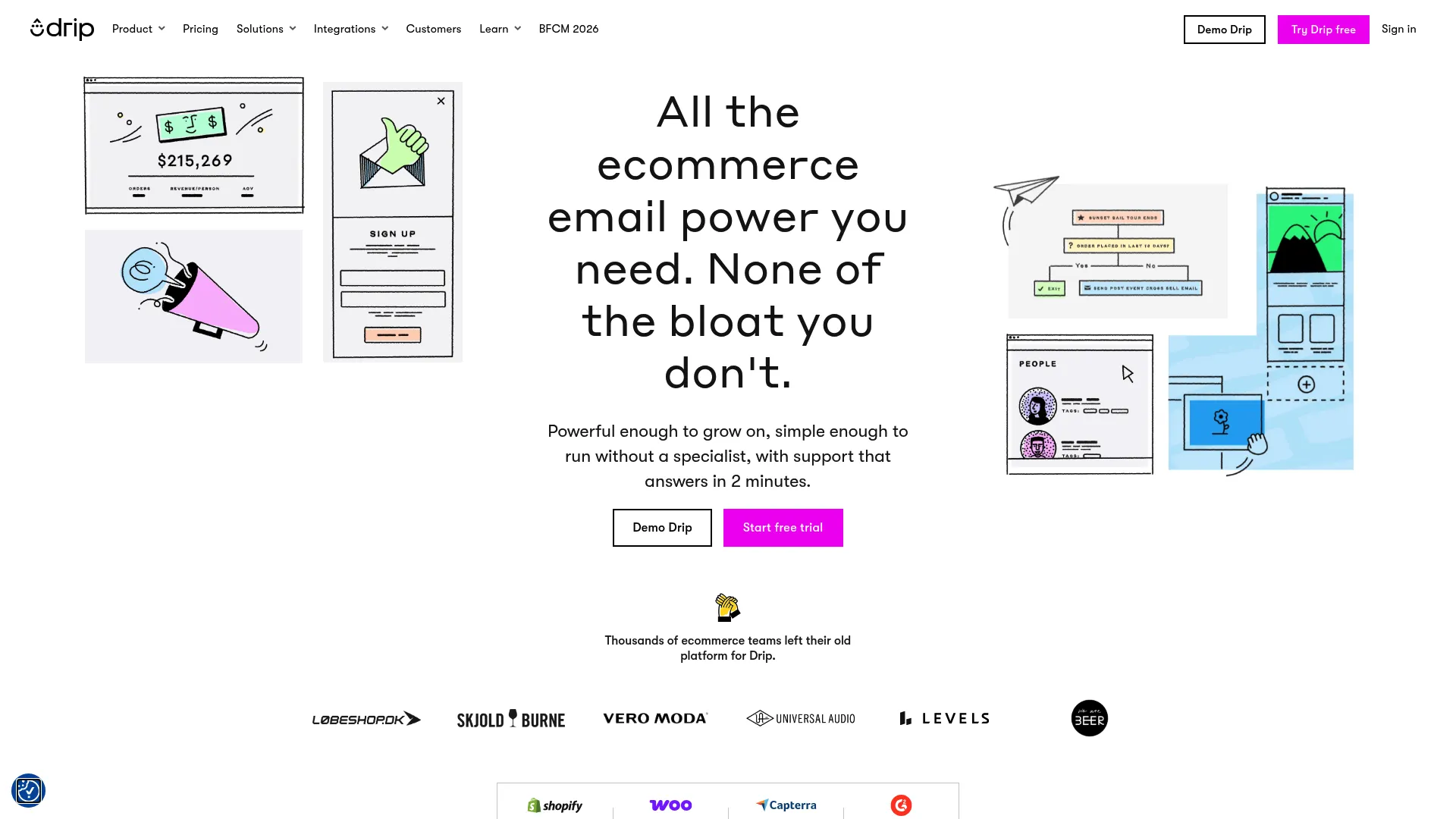
Drip is an ecommerce-focused platform for lean teams that want behavior-based automation without the bloat. It centers on email marketing, automation workflows, and segmentation built around what shoppers actually do, so your flows react to browsing, purchasing, and engagement signals. Setup is quick, and the behavioral segments make it easy to run targeted welcome, cart, and post-purchase sequences.
Its niche is clear: revenue-oriented workflows for B2C brands that do not need a sprawling enterprise toolset. Deliverability and responsive support are recurring reasons teams stick with it.
Best for: ecommerce brands needing behavior-based email and automation.
Key features
- Email marketing
- Marketing automation and workflows
- Segmentation and personalization
- Behavioral targeting
- Ecommerce integrations
Why choose Drip: Pick it when you run an ecommerce store and want focused behavioral automation without paying for features you will not touch. It fits lean B2C teams that prioritize revenue-linked flows.
Drip pricing: Plans start at $39/month, based on the number of active people in your account and monthly email volume. There is a 14-day free trial rather than a free version.
Considerations
Before you commit, run each shortlisted tool through this checklist. The feature lists look similar; the differences show up in how the platform behaves under your actual data.
Evaluate segmentation depth
Ask how dynamic the segments are. Can a contact move in and out of a segment automatically as their behavior changes, or do you rebuild lists manually? Behavior-based, real-time segmentation is what separates a drip that feels personal from one that feels like a batch send. Test it with your own attributes before you buy.
Check integration coverage
Your drip tool is only as useful as the data feeding it. Confirm it connects cleanly to your CRM, ecommerce platform, and analytics stack, and check whether those integrations are native or require middleware. A missing integration turns into an engineering ticket you did not budget for.
Review analytics and attribution
Opens and clicks are table stakes. What you actually need is flow-level revenue attribution your finance team will believe. Verify that the platform reports conversions and revenue per sequence, not just aggregate campaign stats, so you can prove which flows drive pipeline.
Compare pricing against volume
Entry prices are a starting line, not the real cost. Model what each tool charges at your projected contact count in twelve months, since most scale by list size or send volume. A cheap starting tier can become the most expensive option once you grow.
Confirm setup and migration effort
If you are switching platforms, ask about template import, contact migration, and deliverability warm-up. The best tool on paper is worthless if the switch costs you two months of degraded inbox placement. Get the vendor to walk you through the migration path before signing.
Conclusion
The right drip campaign software depends on where your revenue lives and how complex your funnel is. Choose depth if automation complexity matters: ActiveCampaign gives you branching logic and CRM-connected workflows for multi-stage nurtures. Choose ecommerce-native tools if your revenue comes from storefront behavior: Klaviyo leads on revenue-linked segmentation, Omnisend on fast multichannel launch, and Drip on focused behavioral flows without bloat. Choose simplicity if speed matters: MailerLite and Mailchimp let lean teams launch quickly, while Brevo covers multi-channel campaigns on a tight budget.
Start by shortlisting two tools that match your funnel, then run a real welcome or cart sequence through each during a trial. The platform that reports revenue cleanly and segments the way your buyers actually behave is the one worth paying for.
Start your journey with Guideflow today!
If you also need prospects to experience your product before they buy, not just read about it, Guideflow lets you build interactive product demos that convert. Start your journey with Guideflow today!
FAQs
A drip campaign is a specific sequence of pre-written messages sent on a set schedule or trigger, like a five-email welcome series. Email automation is the broader capability that powers drip campaigns and much more, including one-off behavioral triggers, dynamic content, and cross-channel logic. Every drip campaign is automation, but not all automation is a drip.
For ecommerce, Klaviyo, Omnisend, and Drip lead because they tie flows directly to shopping behavior and revenue. Klaviyo suits data-rich DTC brands, Omnisend fits teams that want fast multichannel setup, and Drip works well for lean stores wanting focused behavioral automation. The best pick depends on your stack and how much segmentation depth you need.
Not always. A dedicated email platform handles most lifecycle drips on its own. You benefit from a CRM when your sales and marketing motions overlap, since a tool like ActiveCampaign lets flows react to deal stages and rep activity. For pure ecommerce or newsletter nurture, the built-in contact management is usually enough.
There is no fixed number, but most effective welcome and nurture sequences run three to seven emails. Cart recovery flows often work with two or three. The right count is the fewest messages that move the contact to the next stage without fatiguing them. Watch unsubscribe and drop-off rates to find your ceiling.
Beyond opens and clicks, track conversion rate, revenue per flow, and completion rate through the sequence. For ecommerce, attributed revenue is the metric your finance team cares about. For B2B nurture, watch influenced pipeline and lead-to-opportunity conversion. Deliverability and unsubscribe rate act as guardrails on the whole program.
Yes. Automation is where lean teams get leverage, letting a one-person marketing function run welcome, cart, and win-back flows that would otherwise never get sent. Free and low-cost tiers from MailerLite, Brevo, Mailchimp, and Omnisend make it affordable to start. The payoff shows up in activation and retention without added headcount.
Yes, and these are among the highest-ROI flows in ecommerce. Abandoned cart sequences fire when a shopper leaves items behind, and post-purchase flows drive reviews, cross-sells, and repeat orders. Klaviyo, Omnisend, and Drip build these as native, prebuilt workflows, so you can launch them without designing the logic from scratch.
Compare segmentation depth, integration coverage with your existing stack, flow-level revenue reporting, and real cost at your projected list size. Then check the migration path: template import, contact transfer, and deliverability warm-up. Run a live sequence through a trial before committing, since the tool that segments and reports the way your funnel works is the one that will actually stick.


.avif)