AI tools are already inside your customers' workflows. They're in the sales stack, the support queue, the coding environment, and the finance approvals process. Security teams now have to answer for prompts, agents, models, APIs, and sensitive-data flows they can barely see, let alone control.
According to the 2025 Thales Data Threat Report, 73% of organizations are already investing in AI-specific security tools. Yet the architecture of AI risk keeps shifting: new agent frameworks, MCP server integrations, LLM-powered features, and shadow AI adoption create exposure faster than most security reviews can track.
The hard part is no longer whether teams will use AI. They already are. The question is which security layer gives you enough visibility and control without blocking the work that's moving revenue.
For presales and sales engineering teams, this tension shows up in every technical evaluation. Buyers want proof that your product handles prompt injection, data leakage, agent permissions, and model risk. This guide gives you the shortlist and the framing to answer those questions. For broader context on the AI cybersecurity landscape, see our roundup of the best AI cybersecurity solutions.
What's inside
This guide compares 12 AI security solutions selected for enterprise buyers and technical evaluators in 2026.
- Who it's for: Presales teams, security engineers, and SEs supporting AI product diligence, RFPs, and POC conversations
- Selection criteria: Runtime protection depth, agent and model security coverage, enterprise fit, and integration with existing security stacks
- Pricing: Checked against vendor pricing pages in October 2026; ratings reflect live G2 listings
- Ownership notes: Where one listed product is owned by another vendor on this list, or by a larger parent company, the entry says so
- Use cases covered: LLM application security, AI model protection, agent governance, shadow AI discovery, posture management, and identity-centric AI risk
TL;DR
- Best overall enterprise AI security platform: Cisco AI Defense, for discovery, validation, and runtime governance across large organizations
- Best for LLM application protection: Prompt Security, for prompt injection defense, data leakage controls, and AI app monitoring
- Best for cloud-native AI runtime security: Prisma AIRS, for connecting AI risk to cloud and security operations workflows
- Best for AI governance and posture management: Cranium, for inventory, risk scoring, and compliance evidence across the AI estate
- Best for SaaS AI discovery: Grip AI + SaaS Security Platform, for finding shadow AI and governing employee AI usage
- Best for a free starting tier: NeuralTrust, with a free plan covering 100,000 requests per month
What is AI security software?
AI security software covers tools that help organizations discover, govern, monitor, test, and protect AI systems, including generative AI apps, machine learning models, autonomous agents, APIs, prompts, workloads, and sensitive data.
Traditional security tools still matter, but AI introduces a new attack surface that firewalls and endpoint protection were not built to handle. Prompts can carry injection attacks. Models can be poisoned, stolen, or manipulated. Agents can take privileged actions with excessive permissions. Employees adopt AI tools outside approved channels before procurement reviews them.
Core risks AI security tools address
- Prompt injection and jailbreak attempts
- Sensitive data leakage through prompts and outputs
- Model theft and model poisoning
- Unauthorized agent actions and tool access
- Shadow AI and unmanaged SaaS AI adoption
- Insecure MCP server integrations
- Hallucination and harmful output risk
- AI workload and supply-chain vulnerabilities
Core capabilities to evaluate
- AI asset discovery and inventory
- Runtime monitoring and alert generation
- Prompt and response filtering
- Data loss prevention at the AI layer
- Model scanning and adversarial testing
- Agent permission governance and least-privilege enforcement
- Audit trails and policy enforcement for compliance
- Integrations with SIEM, SOAR, CASB, and cloud security tooling
For presales teams, this list maps directly to what buyers ask in security questionnaires and AI feature reviews. Knowing which layer a product covers, and which it does not, is what makes technical validation credible.
When to use AI security solutions
Secure AI applications before production
Teams building or buying AI applications need to test prompts, model behavior, API calls, and data handling before launch. Runtime guardrails should be in place before a feature reaches users. Buyers often ask for evidence of this layer during proof-of-concept reviews, especially when sensitive data is involved.
Govern employee and business-unit AI adoption
Shadow AI is real. Employees use browser-based AI tools, SaaS AI features, and consumer LLMs in sales, support, and engineering workflows. AI governance tools help security teams see where AI is already operating before formalizing a policy. This is the conversation that often opens up after a data-leak incident or a compliance audit. Our guide to AI governance tools covers the dedicated governance layer in more depth.
Protect AI agents and tool access
Agents that call APIs, access data repositories, use credentials, or trigger business workflows introduce a new class of privilege risk. Security teams need to see which tools agents can call, what permissions they hold, and whether those permissions follow least-privilege principles. MCP server security and agent identity governance are both active evaluation criteria in enterprise deals today.
AI security solutions comparison
Use this table to map vendors to security layers before requesting demos. Pricing and G2 ratings below reflect vendor pricing pages and live G2 listings as of October 2026. Custom pricing means the vendor publishes no public tier structure. The ownership column flags cases where two entries trace back to one parent company, which matters when you are building a genuinely independent shortlist.
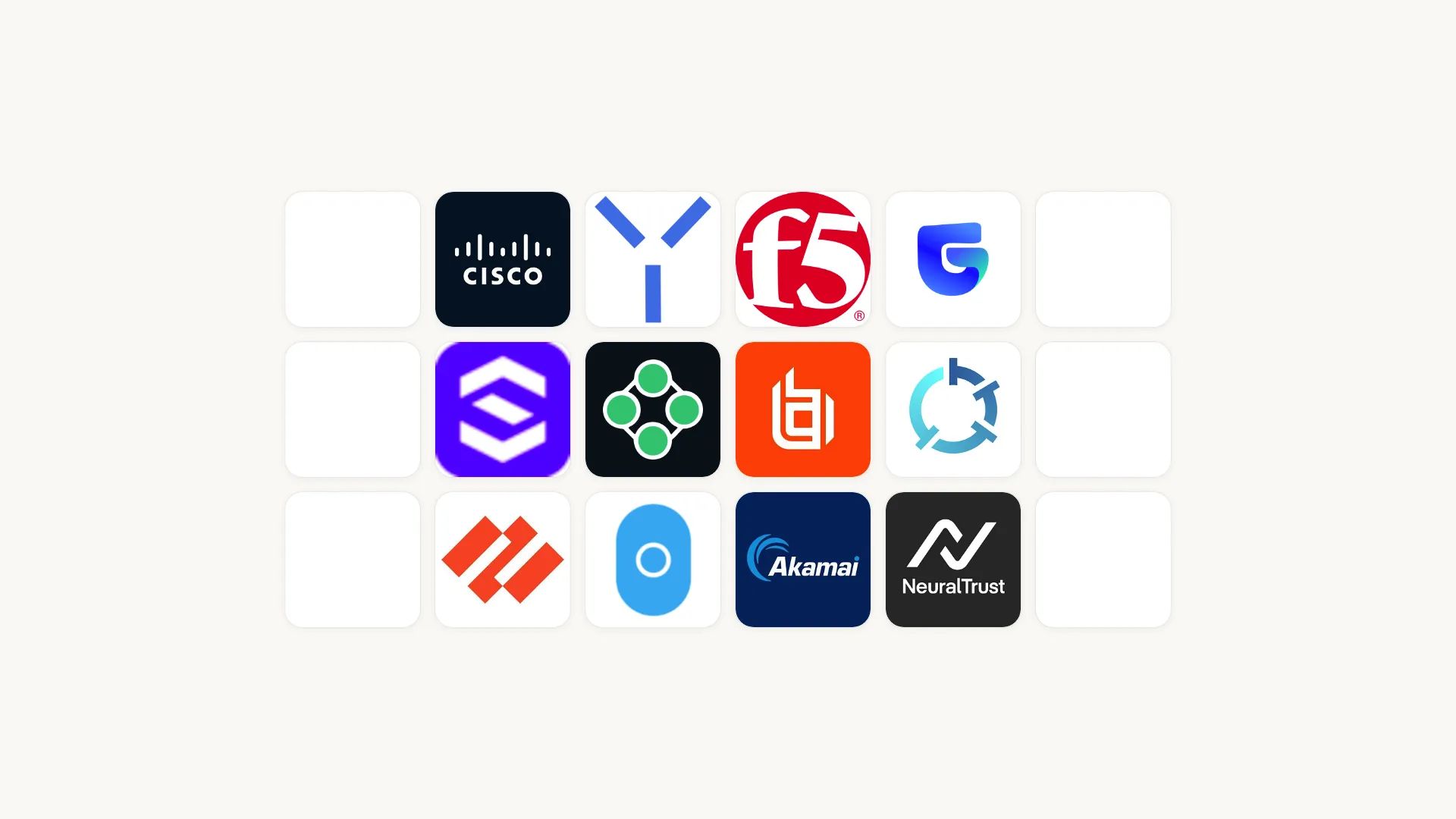
| # | Product | Best for | Key differentiator | Ownership | Pricing | G2 rating |
|---|---|---|---|---|---|---|
| 1 | Cisco AI Defense | Enterprise AI application governance | AI discovery, validation, and runtime protection across enterprise environments | Cisco | Custom pricing | No reviews on G2 |
| 2 | Prompt Security | LLM application protection | Prompt injection defense, data leakage controls, and AI app runtime monitoring | Acquired by SentinelOne, September 2025 | Custom pricing | 5.0/5 (2 reviews) |
| 3 | Prisma AIRS | Cloud-native AI runtime security | AI runtime, posture management, agent identity, and supply-chain security in one platform | Palo Alto Networks | Custom pricing (credit-based) | 5.0/5 (1 review) |
| 4 | CalypsoAI Inference Platform | AI inference control and red teaming | Policy enforcement, guardrails, and observability for enterprise AI inference | Acquired by F5, October 2025; same vendor as entry 7 | Custom pricing | 4.3/5 (6 reviews) |
| 5 | HiddenLayer | AI model threat protection | Detection and response for attacks on machine learning models and AI supply chains | Independent | Custom pricing | No reviews on G2 |
| 6 | Cranium | AI security posture management | AI inventory, risk scoring, governance workflows, and compliance evidence | Independent | Custom pricing | No reviews on G2 |
| 7 | F5 AI Guardrails | AI model and agent runtime protection | Runtime guardrails for prompt injection, data leakage, and unsafe agent actions | F5; built on the CalypsoAI technology in entry 4 | Custom pricing | Not listed on G2 |
| 8 | BeyondTrust Pathfinder Intelligence | Identity-centric AI agent security | Privilege visibility and access risk across human, machine, and AI identities | BeyondTrust | Custom pricing | 4.6/5 (588 reviews, BeyondTrust seller rating) |
| 9 | Akamai Firewall for AI | Edge and application-layer AI defense | Prompt injection and harmful-output protection at the edge and via REST API | Akamai | Custom pricing | No reviews on G2 |
| 10 | Grip AI + SaaS Security Platform | SaaS AI discovery and governance | Identity graph connecting users, agents, apps, permissions, and risk signals | Grip Security | Custom pricing, sold annually per human user | 4.4/5 (5 reviews) |
| 11 | Portal26 AI Adoption Management Platform | Enterprise AI usage governance | Adoption visibility, prompt protection, audit, and policy management across GenAI | Portal26 | Custom pricing | Not listed on G2 |
| 12 | NeuralTrust | AI agent and LLM application security | Real-time agent runtime protection with a free plan and enterprise deployment options | Independent | Free; Standard $49/month | No reviews on G2 |
One ownership note worth reading before you shortlist: entries 4 and 7 are not independent of each other. F5 completed its acquisition of CalypsoAI in October 2025 and the CalypsoAI Inference Platform now ships as F5 AI Guardrails. Treat them as one vendor conversation, not two competing quotes. Entry 2, Prompt Security, is now part of SentinelOne.
AI security solutions reviewed in detail
1. Cisco AI Defense
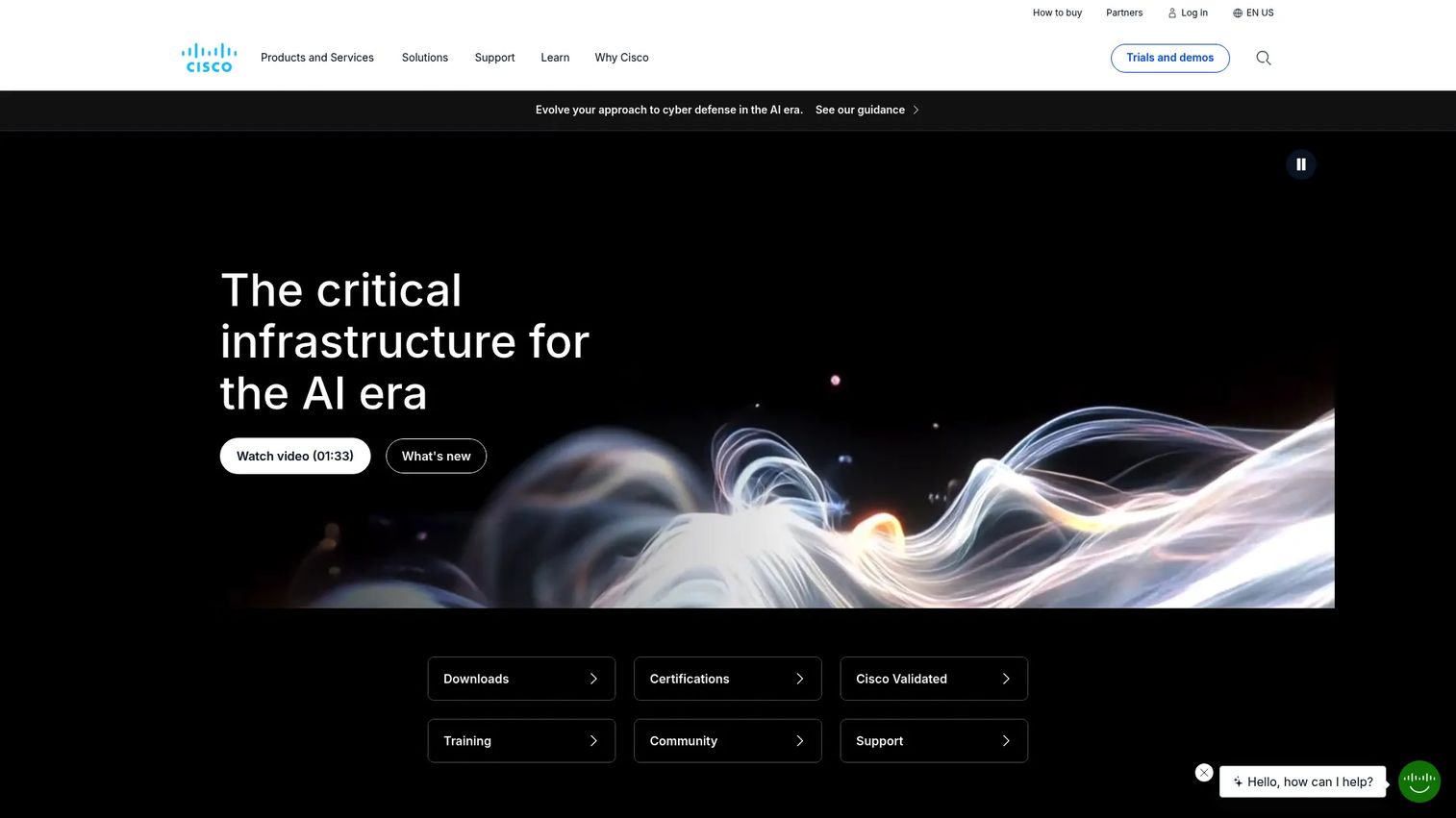
Cisco AI Defense is an enterprise AI security platform that covers the full lifecycle from discovery to runtime protection. It inventories AI assets across cloud environments, scans AI supply chains including models, repositories, MCP servers, and tools, performs algorithmic red teaming against discovered vulnerabilities, and enforces runtime guardrails for privacy, safety, and agentic behavior. For large organizations where multiple business units are adopting AI simultaneously, it connects AI security to existing network, cloud, and SOC workflows.
Best for: Large enterprises needing centralized AI discovery, validation, and runtime governance across complex environments.
Key features
- AI asset inventory and cloud-wide visibility
- AI supply-chain scanning: models, repositories, MCP servers, tools, and skills
- Algorithmic red teaming and vulnerability validation
- Runtime privacy, safety, and agentic guardrails
- Integration with existing Cisco security workflows
Why choose Cisco AI Defense: It belongs near the top of any enterprise shortlist because it covers the AI security stack from discovery through runtime, not just one layer. For presales teams fielding broad security review questions, the cross-functional architecture gives you credible answers across multiple evaluation criteria.
Cisco AI Defense pricing: Cisco sells AI Defense through enterprise agreements and publishes no public tier structure. Contact Cisco sales for pricing; cost drivers include deployment scope, environment count, and enterprise support tier.
2. Prompt Security
Prompt Security is an AI security platform for securing organizational AI use, LLM applications, and agentic systems. It detects shadow AI across the enterprise, prevents sensitive-data leakage with real-time redaction, enforces granular policies across AI usage, and provides red teaming capabilities that test for prompt injection, jailbreaks, data exposure, and unsafe agent behavior. Deployment is available as cloud-hosted or self-hosted.
Ownership disclosure: Prompt Security is no longer an independent vendor. SentinelOne announced the acquisition in August 2025 and closed it in September 2025, folding the technology into its wider security platform. If you already run SentinelOne, or if you are comparing SentinelOne's AI security roadmap against this list, factor that in.
Best for: Security teams governing enterprise LLM adoption and protecting applications that use generative AI.
Key features
- Shadow AI detection and real-time visibility
- Sensitive-data leak prevention and output redaction
- Granular policy enforcement across AI usage
- Red teaming for prompt injection and jailbreak scenarios
- Cloud or self-hosted deployment options
Why choose Prompt Security: Choose it when the evaluation centers on prompt-level controls, sensitive-data exposure, and AI application behavior rather than model-layer attacks. Presales teams will find it a strong fit for buyers who ask specifically about LLM application security and employee AI governance.
Prompt Security pricing: Ask sales about cost drivers: application count, user volume, traffic scale, and deployment model, and ask how licensing now interacts with SentinelOne agreements.
G2 rating: 5.0/5 from 2 reviews.
3. Prisma AIRS
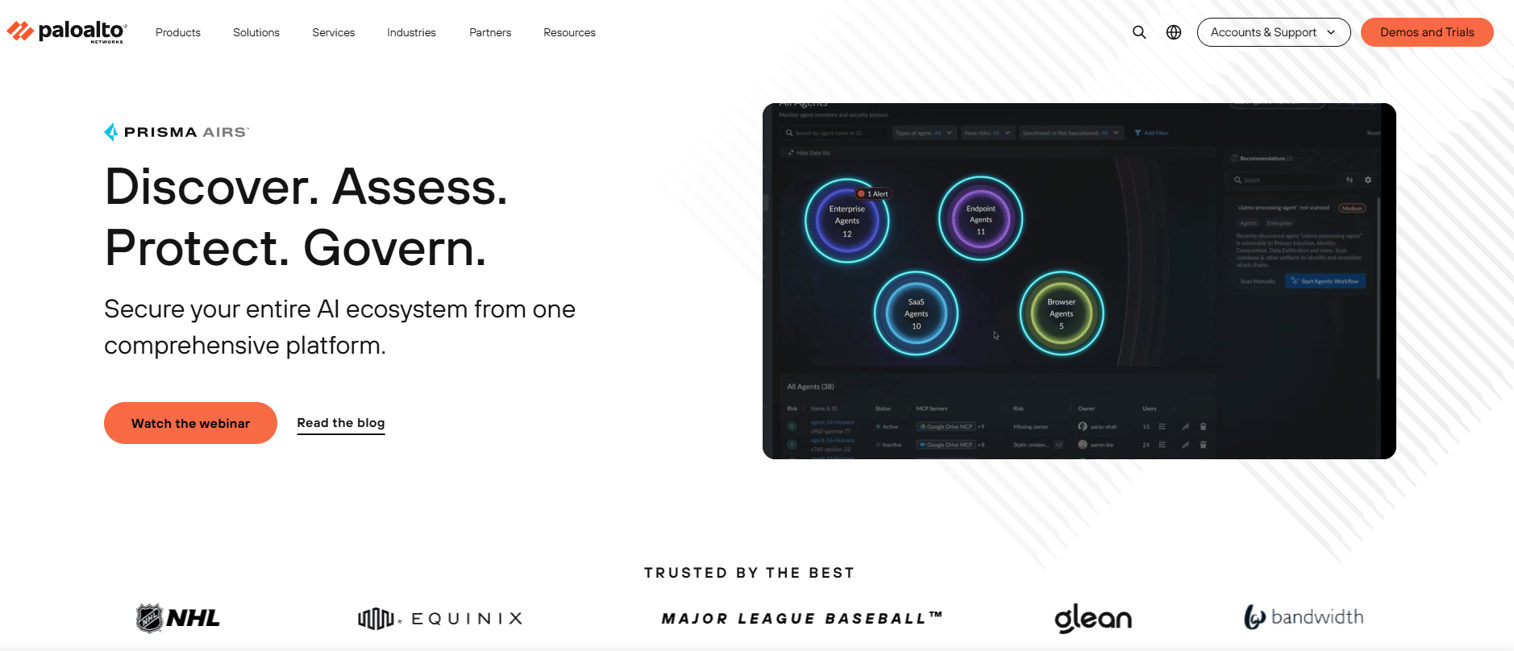
Prisma AIRS is Palo Alto Networks' AI security platform for securing AI applications, models, agents, data, and infrastructure across the full AI lifecycle. It includes an AI Gateway for centralized policy and access control, AI Supply Chain Security for scanning models and AI artifacts, AI Red Teaming for adversarial testing, and AI Runtime Security for real-time protection against prompt injection, data exposure, and unsafe agent actions. It also covers AI Posture Management, AI Inventory, and Agent Identity Security for MCP workflows.
Best for: Cloud-first enterprises that want AI security integrated into their existing cloud and security operations platform.
Key features
- AI Gateway: centralized policy, access control, and observability
- AI Supply Chain Security: model and artifact scanning
- AI Runtime Security: real-time prompt injection and data-exposure detection
- AI Posture Management and Inventory
- Agent Identity Security for AI agents and MCP workflows
Why choose Prisma AIRS: It's the strongest option for teams already running Palo Alto Networks' cloud security stack. The breadth of coverage across posture, supply chain, runtime, and agent identity reduces the number of point tools needed to answer a security review.
Prisma AIRS pricing: Pricing uses Software NGFW credits and consumption models rather than standard subscription tiers, so there is no published per-seat or per-month rate. Contact Palo Alto Networks sales; cost depends on cloud environment scope and usage scale.
G2 rating: 5.0/5
4. CalypsoAI Inference Platform
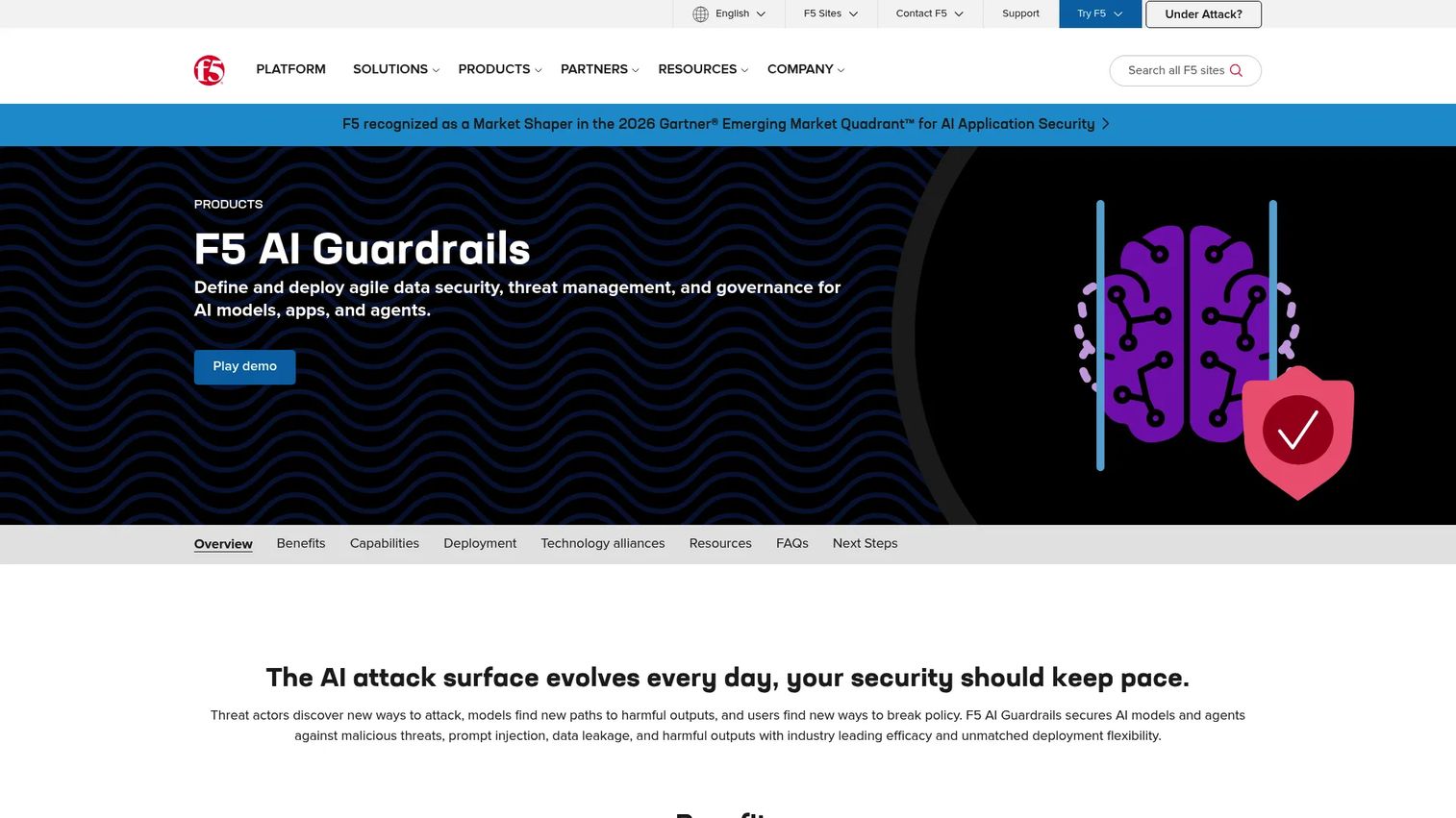
CalypsoAI is an enterprise AI security platform focused on protecting, governing, testing, and observing AI models, applications, and agents at inference time. It defends against prompt injection and jailbreaks, enforces model-agnostic runtime policies, prevents sensitive-data leakage, supports natural-language guardrail creation, moderates harmful or biased outputs, maintains audit-ready logs, and governs agent actions and tool use. Deployment options include on-premises, private cloud, public cloud, and air-gapped environments.
Ownership disclosure: CalypsoAI is now owned by F5, which also appears on this list at entry 7. F5 announced the acquisition in September 2025 for $180 million and completed it the following month. The CalypsoAI Inference Platform now ships as F5 AI Guardrails inside the F5 Application Delivery and Security Platform, and the CalypsoAI homepage redirects to F5. Entries 4 and 7 are therefore one vendor, not two independent options, and you should not run them against each other as separate bids.
Best for: Enterprises that need guardrails and governance for AI inference workflows, especially in regulated or air-gapped environments.
Key features
- Prompt injection and jailbreak defense
- Model-agnostic runtime policy enforcement
- Sensitive-data leakage prevention and compliance controls
- Natural-language guardrail creation
- Audit-ready logging and AI observability
Why choose CalypsoAI Inference Platform: Choose it when the buyer needs more than content filtering, specifically policy enforcement, observability, and agent-action governance at the inference layer. The air-gapped deployment option is a differentiator for regulated industries.
CalypsoAI Inference Platform pricing: No public pricing. Because the product is now sold as part of F5's portfolio, pricing runs through F5 enterprise agreements. Ask about deployment scope, model volume, and required security controls.
G2 rating: 4.3/5
5. HiddenLayer
HiddenLayer provides an AI Security Platform for securing agentic, generative, and predictive AI applications across their lifecycle. Its core modules cover AI Discovery, AI Supply Chain Security, AI Attack Simulation, and AI Runtime Security. The focus is protection at the model layer: detecting threats against machine learning models, monitoring for supply-chain attacks, simulating adversarial scenarios, and responding to runtime incidents. HiddenLayer serves enterprises and government organizations where proprietary ML assets are high-value targets.
Best for: Security teams whose primary risk is attacks against machine learning models and the AI supply chain, not just the application layer above them.
Key features
- AI Discovery across deployed models and assets
- AI Supply Chain Security: scanning for model-layer threats
- AI Attack Simulation: adversarial testing of ML models
- AI Runtime Security: threat detection and incident response
- Coverage for agentic, generative, and predictive AI
Why choose HiddenLayer: When the main risk is the model itself rather than the application built around it, HiddenLayer is purpose-built for that problem. It's especially relevant for organizations with proprietary models, fine-tuned assets, or exposure to adversarial ML attacks. Our roundup of AI model deployment software covers the adjacent model operations layer.
HiddenLayer pricing: No public pricing. Contact HiddenLayer sales; cost drivers include model count, deployment environment, and monitoring scope.
6. Cranium
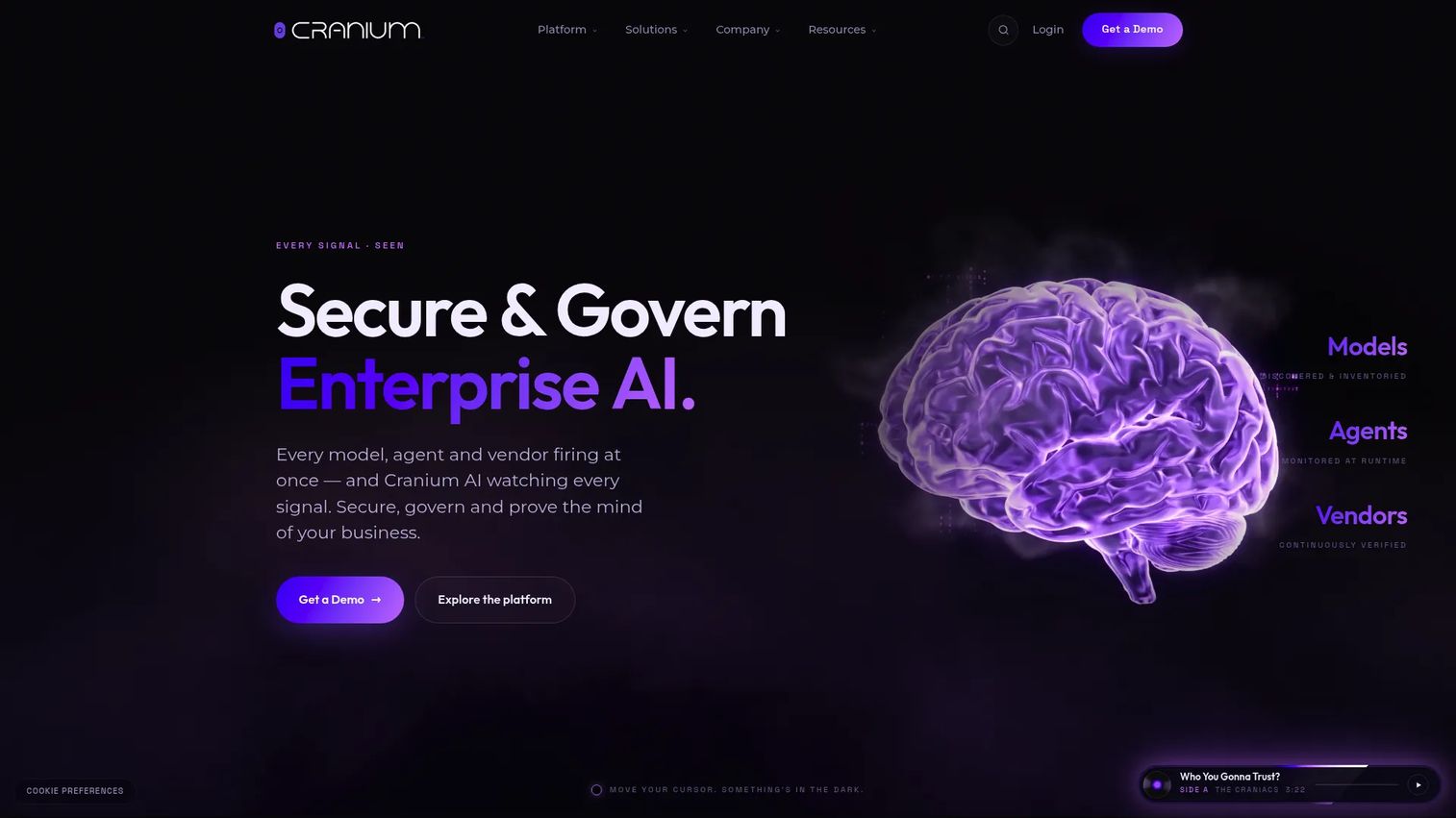
Cranium is an enterprise platform to discover, observe, govern, secure, and prove the safety and compliance of AI models, agents, datasets, and vendors. It automates AI discovery and inventory including an AI Bill of Materials and shadow-AI detection, provides runtime observation with live risk signals and intent classifications, defines and enforces AI policies mapped to NIST AI RMF and the EU AI Act, performs adversarial testing and red teaming, and generates real-time AI Cards and audit-ready compliance evidence.
Best for: Enterprise security, risk, and governance teams building an AI risk management program and needing audit evidence.
Key features
- Automated AI discovery and Bill of Materials generation
- Runtime observation: risk signals, intent classifications, token tracking
- AI policy enforcement mapped to NIST AI RMF and EU AI Act
- Adversarial testing and red teaming capabilities
- Audit-ready compliance evidence and AI Trust Hubs
Why choose Cranium: It fits teams asking "what AI do we have and how do we prove it's safe?" before asking "how do we block every bad prompt?" Governance and inventory programs often need to precede runtime controls, and Cranium is built for that sequence. For more context on AI security posture management, see our dedicated guide.
Cranium pricing: Ask about AI asset volume, number of business units, and governance reporting requirements.
7. F5 AI Guardrails
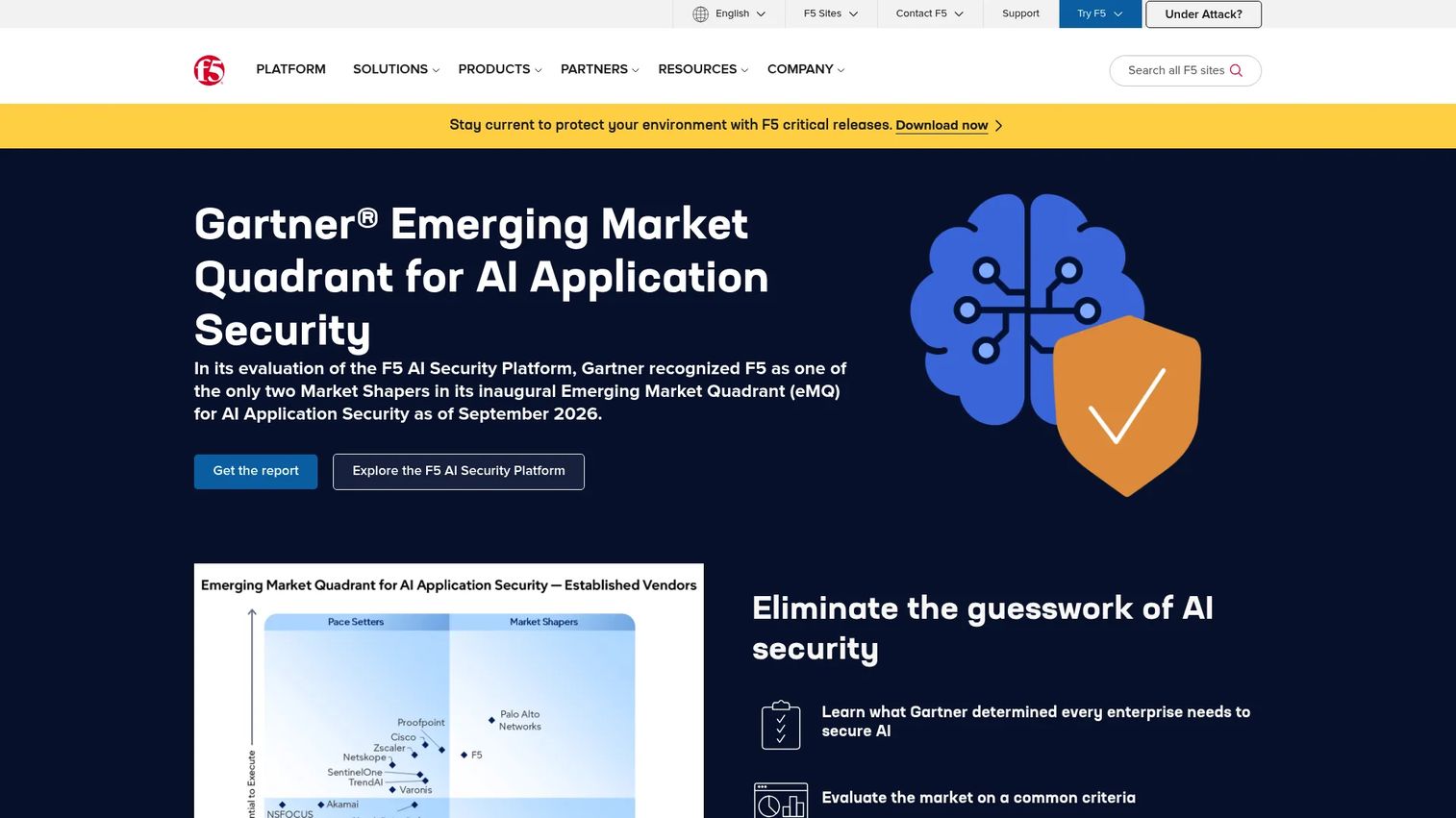
F5 AI Guardrails provides runtime security for AI models, applications, and agents. It defends against prompt injection and jailbreaks, supports custom natural-language guardrail creation, moderates harmful or biased outputs, applies semantic data-security controls to prevent sensitive-data leakage, governs secure agent actions and tool calls, and maintains audit-ready logs with full traceability. Deployment is available across public cloud, private cloud, on-premises, and air-gapped environments.
Ownership disclosure: F5 AI Guardrails is the productized form of the CalypsoAI Inference Platform at entry 4. F5 bought CalypsoAI for $180 million in a deal announced in September 2025 and completed in October 2025, then launched the technology under the F5 brand inside the F5 Application Delivery and Security Platform. If you are shortlisting from this list, count entries 4 and 7 as a single vendor option.
Best for: Enterprises that need runtime AI guardrails across diverse deployment environments, including air-gapped infrastructure.
Key features
- Prompt injection and jailbreak defense
- Custom guardrail creation with natural language
- Semantic data-security controls for leakage prevention
- Secure agent actions and tool-call governance
- Audit-ready logging and traceability
Why choose F5 AI Guardrails: When AI security needs to sit at the application delivery and traffic enforcement layer, F5's existing presence in application security gives this product strong integration paths. It works well for enterprises with hybrid environments and existing F5 deployments.
F5 AI Guardrails pricing: Cost depends on application footprint, traffic scale, and selected platform components. Confirm current terms with F5, since licensing shifted when the CalypsoAI technology moved into the F5 platform.
8. BeyondTrust Pathfinder Intelligence
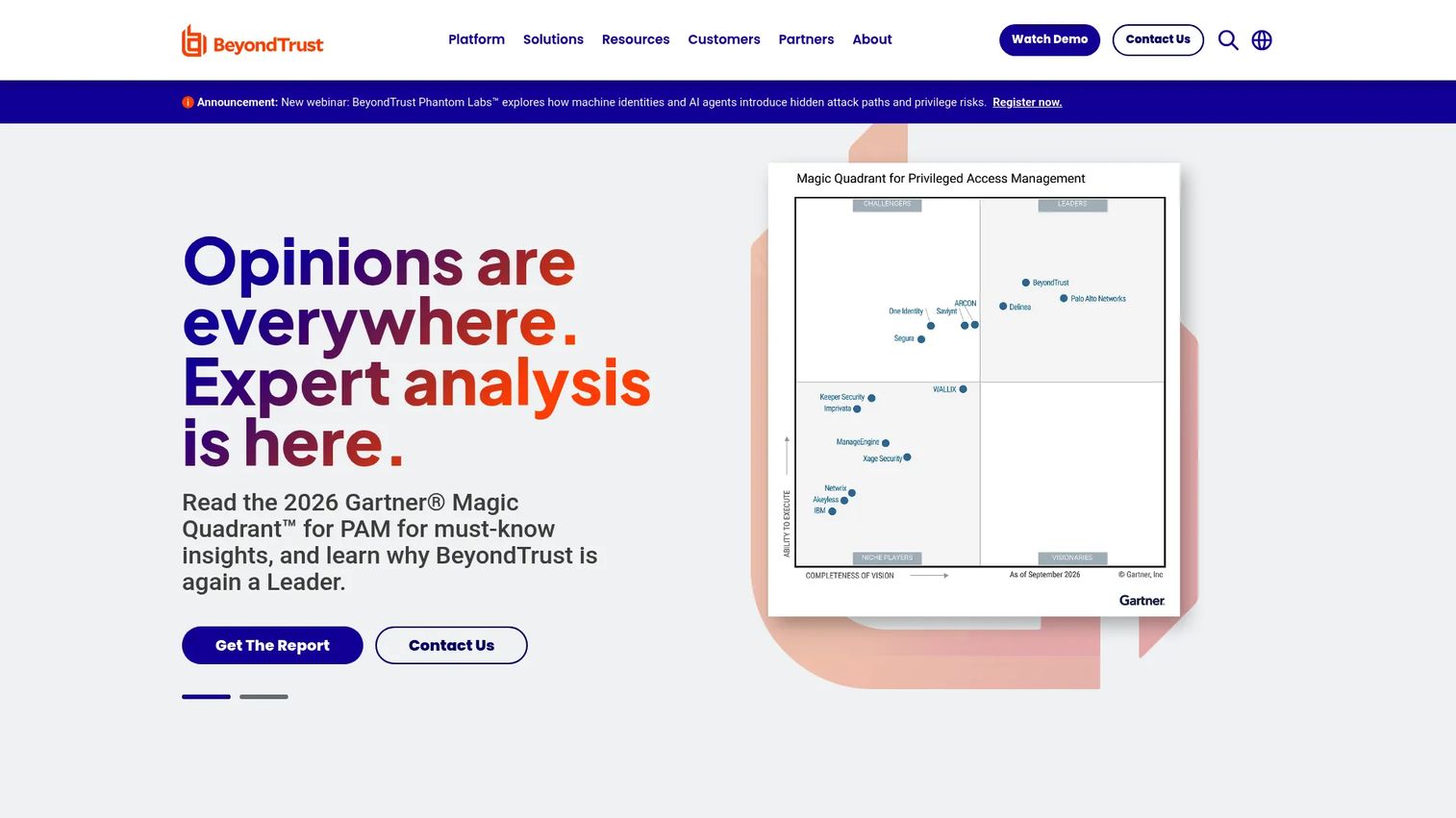
BeyondTrust Pathfinder Intelligence is a unified identity-security platform that provides visibility, intelligence, and control across human, machine, workload, and AI-agent identities. Its PathfinderAI assistant lets security teams query live identity data in natural language. The platform surfaces privilege relationships, escalation paths, and access risk across PAM, ITDR, CIEM, and secrets management. An MCP gateway allows secure querying of connected BeyondTrust products through a single endpoint. PathfinderAI and the MCP gateway are in Early Access in the US region.
Best for: Enterprise security teams that treat AI agent security as an identity and privilege problem rather than a prompt-layer problem.
Key features
- Natural-language PathfinderAI assistant for identity-data queries
- Unified visibility across identities, entitlements, and privilege paths
- Risk-prioritized findings with remediation recommendations
- MCP gateway for secure querying of connected products
- Cross-platform coverage: PAM, ITDR, CIEM, cloud identity management
Why choose BeyondTrust Pathfinder Intelligence: Choose it when the core AI security concern is agents acting with excessive permissions. Presales teams supporting identity-heavy enterprise accounts will find this framing maps directly to what IT and security directors ask during AI agent reviews. See also our guide to best AI agents for the agent landscape context.
BeyondTrust Pathfinder Intelligence pricing: Contact BeyondTrust sales, cost depends on identity footprint, platform modules, and deployment scope.
G2 rating: 4.6/5 from 588 reviews
9. Akamai Firewall for AI
Akamai Firewall for AI protects AI applications, LLMs, and AI-driven APIs from prompt injection, data exposure, harmful output, and other AI-specific threats. It detects and blocks adversarial inputs, filters toxic or noncompliant AI-generated content, detects sensitive-data leaks, and applies policy-based enforcement with monitor, modify, and deny actions. Deployment is available through the Akamai edge network and via REST API, making it accessible across cloud, hybrid, and on-premises environments.
Best for: Teams that want AI security close to their web, API, and edge traffic rather than inside the model or application layer.
Key features
- Prompt injection and jailbreak detection and blocking
- Harmful or noncompliant output filtering
- Sensitive-data leak detection and exfiltration prevention
- Policy-based enforcement: monitor, modify, or deny
- Edge and REST API deployment options
Why choose Akamai Firewall for AI: When the buyer already thinks in web application firewall and API security terms, Akamai's edge presence makes this a natural fit. It protects AI-enabled customer-facing applications without requiring changes deep inside the application stack.
Akamai Firewall for AI pricing: Cost depends on traffic volume, number of protected applications, and Akamai platform configuration.
10. Grip AI + SaaS Security Platform
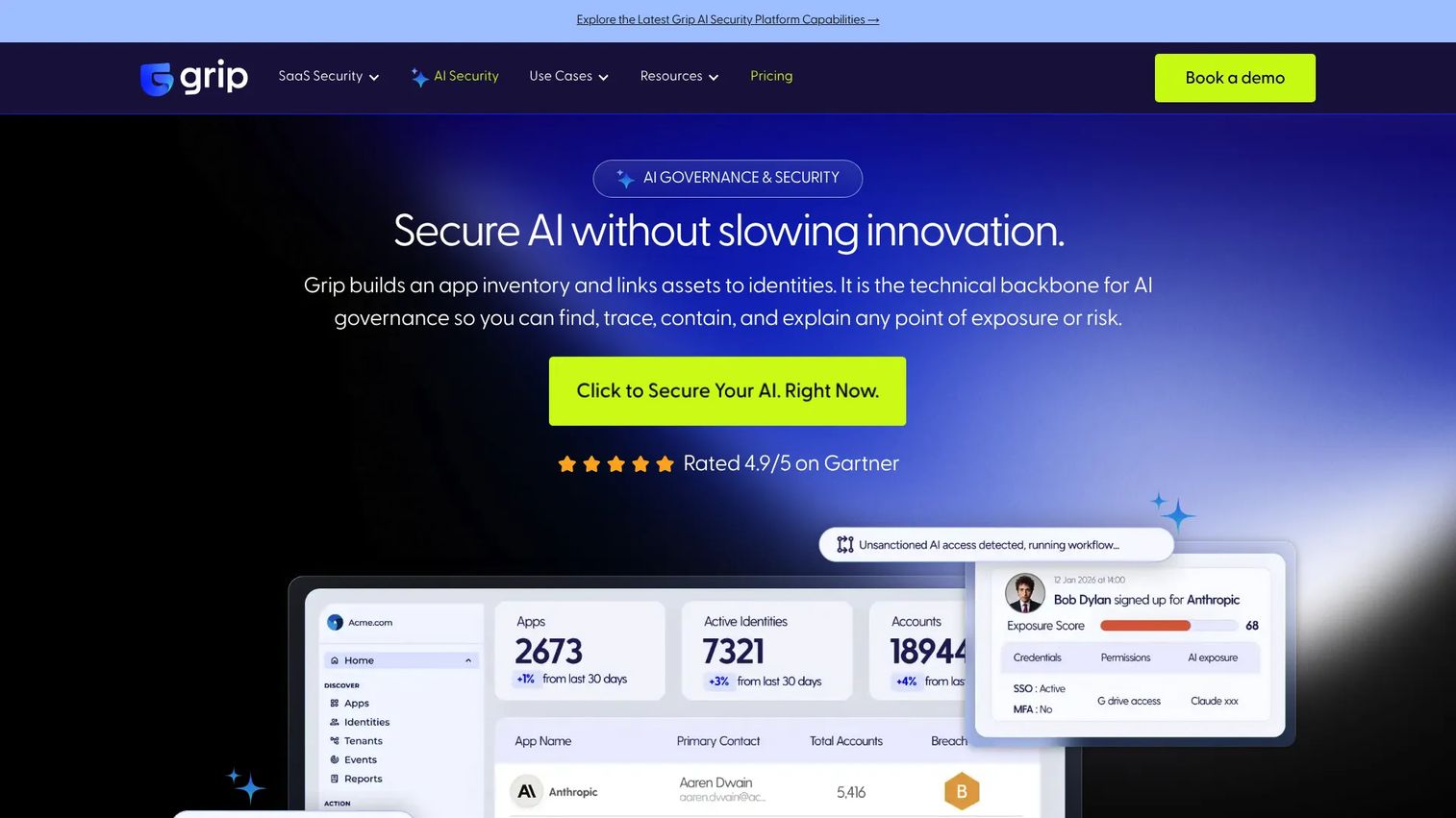
Grip is an AI and SaaS security platform that provides visibility, governance, threat detection, posture management, and automated remediation across applications, identities, agents, and integrations. It discovers shadow AI and unmanaged SaaS, builds an identity graph connecting users, agents, apps, and permissions, manages SaaS and AI security posture with misconfiguration monitoring, detects threats and automates credential rotation, and provides risk scoring and governance workflows.
Best for: Security teams that need to answer "where is our workforce already using AI?" before they can build a runtime protection strategy.
Key features
- AI and SaaS discovery, including shadow and unsanctioned tools
- Identity graph: users, agents, applications, permissions, resources
- SaaS and AI posture management with misconfiguration detection
- Threat detection with automated credential rotation
- Risk scoring and governance workflow automation
Why choose Grip AI + SaaS Security Platform: When the primary question is shadow AI adoption rather than model-layer attacks, Grip gives security teams the visibility to act. It fits organizations at the early stage of formalizing AI governance.
Grip AI + SaaS Security Platform pricing: Grip prices per human user rather than per application, and sells annually. Its pricing page separates an SMB tier, a standalone AI Governance Assessment, and an enterprise tier, but publishes no rate for any of them, and third-party listings disagree on the SMB figure. Request a quote from Grip and ask whether the AI Governance Assessment is included or billed separately.
G2 rating: 4.4/5 from 5 reviews.
11. Portal26 AI Adoption Management Platform
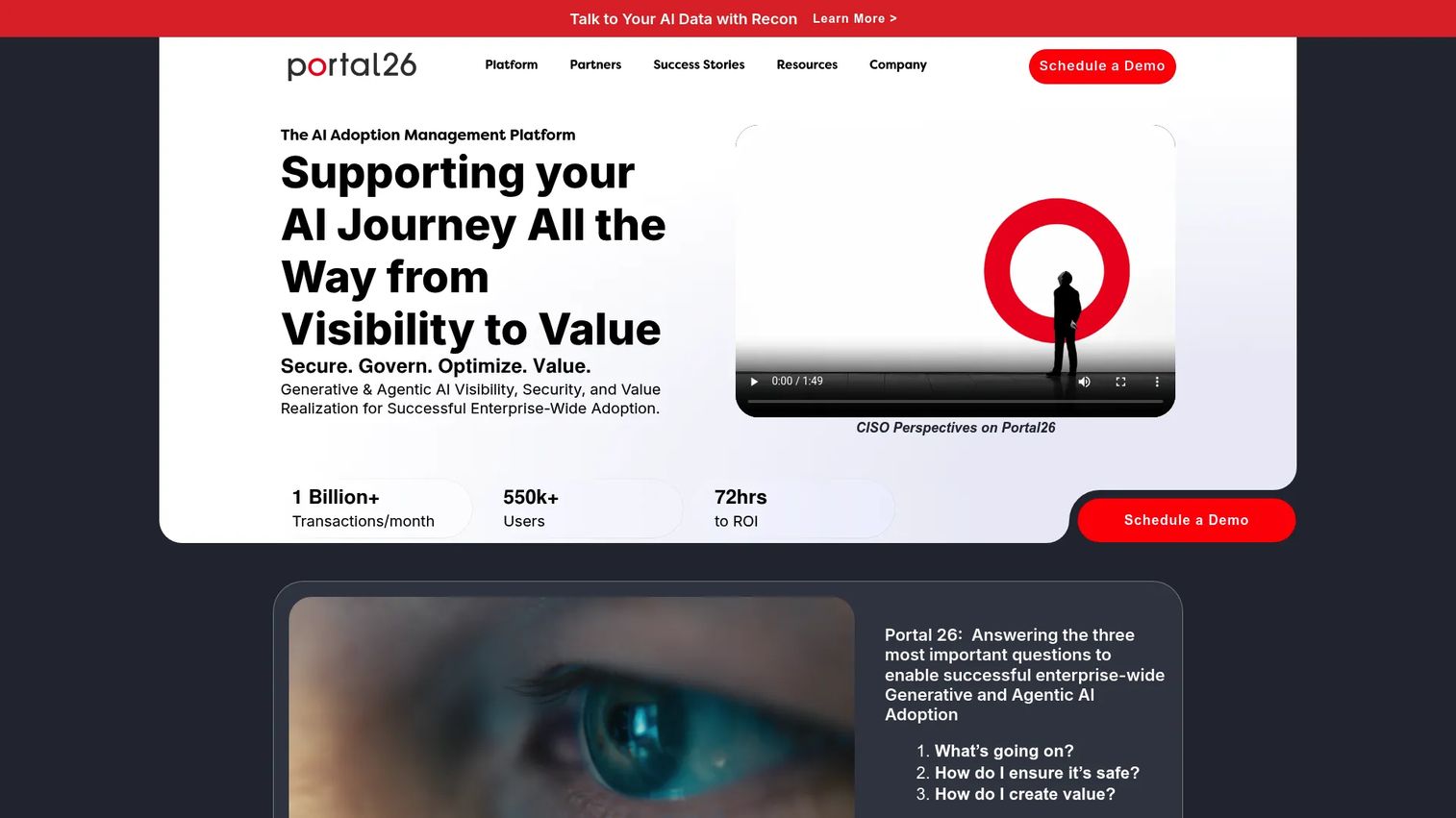
Portal26 is an enterprise AI adoption management platform providing visibility, security, governance, analytics, and value realization for generative and agentic AI usage. It covers shadow AI discovery, AI risk management, prompt protection, audit and forensics, policy management, AI usage analytics, agentic token control, and enterprise search. Portal26 also ships a dedicated management layer for Anthropic's Claude, covering sanctioned and unsanctioned usage, token analytics, and forensic audit.
Best for: Compliance, IT, and security teams that need an operating layer for AI adoption across many employee-facing tools.
Key features
- Shadow AI discovery and usage visibility
- AI prompt protection and sensitive-data controls
- Audit and forensics for AI interactions
- AI policy management and enforcement
- Agentic token control and adoption analytics
Why choose Portal26 AI Adoption Management Platform: It fits teams that want adoption governance, usage analytics, and value realization alongside security controls, not just a runtime blocker. The combination of risk management and ROI tracking is useful for teams reporting AI program health to leadership. For adjacent context on agentic AI platforms more broadly, that guide is worth a look.
Portal26 AI Adoption Management Platform pricing: Portal26's subscription terms list pricing as confidential, so every figure comes through a quote. Contact Portal26 sales.
12. NeuralTrust
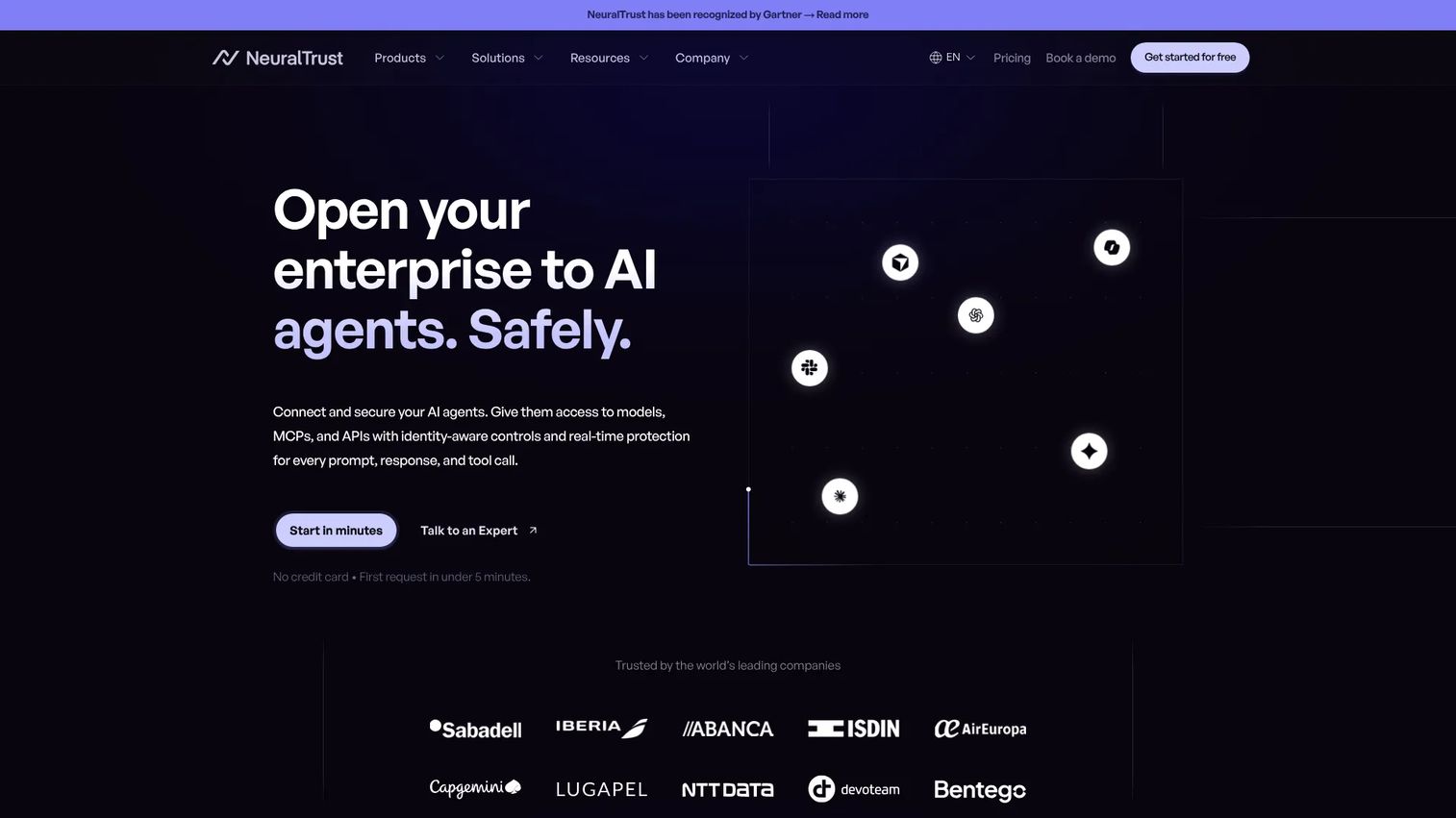
NeuralTrust is an enterprise platform for securing and governing AI agents, models, tools, and agent interactions. It provides real-time AI agent runtime protection, an AI gateway for models, MCP servers, tools, and agents, and detects prompt injection, multi-turn injection, PII, secrets, toxicity, and sensitive data. It includes traffic control policies, tool-use permissions, agent monitoring with trace analytics, and full audit capabilities. Deployment spans SaaS, hybrid cloud, on-premises, and air-gapped environments.
Best for: Security and platform teams governing AI agents and agentic applications, especially in regulated environments that need a free entry point.
Key features
- Real-time AI agent runtime protection
- AI gateway for models, MCP servers, tools, and agents
- Multi-turn injection, PII, secret, and sensitive-data detection
- Traffic control policies and tool-use permissions
- Agent monitoring, trace analytics, and audit capabilities
Why choose NeuralTrust: It's the only tool on this list with a publicly available free tier, making it accessible for teams that want to evaluate agent security before committing to enterprise pricing. The combination of agent governance, MCP server support, and air-gapped deployment is strong for regulated sectors. MCP server security is an emerging concern worth tracking; our guide to best AI security posture management tools covers the broader governance context.
NeuralTrust pricing: The free plan covers 100,000 requests per month with SaaS hosting, 7-day log retention, and five team members. Standard starts at $49 per month, which includes a usage credit, uncapped pay-per-request billing above it, 30-day log retention, and unlimited team members. Enterprise offers private deployment, flexible retention, SSO/SAML/SCIM, and volume commitments, priced on request.
Considerations when choosing AI security solutions
Start with the AI system you need to protect
Classify the risk first: employee AI usage, an LLM application, an ML model, an AI agent, an API layer, or a cloud workload. Buying a model-security tool when the real problem is shadow AI discovery creates tool sprawl before it creates security. Map the risk layer, then evaluate vendors against it.
Check who actually owns each vendor on your shortlist
AI security has consolidated fast. Two products that look like independent options can turn out to belong to the same parent company, as CalypsoAI and F5 AI Guardrails do on this list. Before you run a three-vendor bake-off, confirm that you are talking to three vendors. Acquisitions also change roadmaps, support models, and licensing, so ask what happens to the product you are buying over the next two renewal cycles.
Verify runtime controls, not only dashboards
A good inventory report is useful, but security teams need to know what happens during live AI use. Ask whether the product can detect, block, alert, log, and route incidents at runtime. Vendors that show strong posture dashboards but thin real-time controls create a gap that buyers will find during a POC.
Check how the tool handles sensitive data
Buyers will ask about PII, source code, customer records, credentials, and deal information. For presales teams, this maps directly to the security questionnaire items that stall AI feature approvals. Know whether the product scans inputs, redacts outputs, logs what was sent, and supports DLP policy enforcement.
Map integrations to the existing security stack
Security teams rarely want another isolated console. Ask whether the solution connects to SIEM, SOAR, CASB, CSPM, IAM, and ticketing systems. Vendors with weak integration stories often create alert fatigue rather than reducing it.
Ask what evidence it produces for audits and RFPs
For enterprise deals, audit trails and policy reports are not optional. Ask whether the tool generates artifacts that a compliance reviewer, procurement team, or board can actually use. This is especially relevant for buyers operating under the EU AI Act or sector-specific AI governance requirements.
Conclusion
AI security is not one category. It's a stack of controls across AI apps, prompts, models, agents, APIs, identities, and employee adoption. The right product depends entirely on which layer is creating the deal risk.
To summarize the shortlist by use case:
- Cisco AI Defense for enterprise-wide discovery, validation, and runtime governance
- Prompt Security for LLM application and shadow-AI protection, now within SentinelOne
- Prisma AIRS for cloud-native AI runtime security and agent identity governance
- CalypsoAI / F5 AI Guardrails for inference-layer guardrails in regulated or air-gapped deployments, counted as one vendor
- HiddenLayer for ML model threat detection and supply-chain security
- Cranium for AI security posture management and compliance evidence
- BeyondTrust Pathfinder Intelligence for identity and privilege-centered AI agent risk
- Akamai Firewall for AI for edge and application-layer AI traffic protection
- Grip for shadow AI and SaaS AI discovery
- Portal26 for AI adoption governance and usage analytics
- NeuralTrust for agent runtime protection with a free starting plan
Before requesting demos or pricing, map your highest-risk AI use cases to the security layer they require. That mapping makes vendor evaluations faster and security review conversations more productive.
Security questionnaires on AI features rarely get answered by a slide. When a buyer asks how your product handles prompt logging, agent permissions, or data residency, an interactive demo lets them click through the actual controls and see the answer for themselves. Guideflow helps presales and product marketing teams build those interactive demos and share them inside the deal.
Start your journey with Guideflow today!
FAQs
AI security solutions are tools that help organizations discover, govern, monitor, test, and protect AI systems. The category covers generative AI applications, machine learning models, autonomous agents, APIs, prompts, and sensitive-data flows. Key capabilities include runtime monitoring, prompt filtering, model scanning, agent permission governance, and audit trail generation.
Traditional tools protect networks, endpoints, identities, applications, and data. AI security tools add controls for a new set of risks: prompt injection, model behavior, inference traffic, agent actions, and AI adoption patterns. The two categories are complementary. An organization securing AI needs both layers, not one instead of the other.
Look for tools with runtime prompt inspection, jailbreak detection, policy enforcement, and logging at the inference layer. Prompt Security, F5 AI Guardrails (which includes the former CalypsoAI technology), NeuralTrust, and Akamai Firewall for AI all cover prompt injection specifically. The right choice depends on whether the priority is a cloud-native deployment, an on-premises option, or an edge-based approach.
Strong platforms scan prompt inputs before they reach the model, filter outputs before they reach users, and log what was sent and received. Controls include real-time redaction, DLP-style policy enforcement, access governance, and audit logs. Buyers should validate how the tool handles source code, customer records, credentials, and regulated personal data before approving a deployment.
Some do, and capabilities vary significantly. Comprehensive agent security covers tool access permissions, credential handling, MCP server governance, identity context, and action logging. BeyondTrust Pathfinder Intelligence approaches this from the identity and privilege layer. NeuralTrust, Prisma AIRS, and Cranium address agent governance from the runtime and policy layer. Ask vendors specifically what happens when an agent attempts a privileged action outside its defined scope.
Yes, and it matters for shortlisting. The CalypsoAI Inference Platform is owned by F5 and now ships as F5 AI Guardrails, so those two entries represent one vendor. Prompt Security was acquired by SentinelOne in September 2025. Prisma AIRS is a Palo Alto Networks product. Consolidation in this category is fast, so confirm current ownership before you treat two names as two independent bids.
Buyers want evidence, not general claims. Prepare clear answers about where data goes during inference, which subprocessors have access, how prompts are logged and retained, what runtime controls exist, how incidents are detected and escalated, and what audit artifacts are available. Security reviews for AI features are increasingly detailed, especially in regulated industries. Our guide on best presales software tools covers the broader presales evaluation stack.
Start by mapping your AI systems: what you have, what's sanctioned, what's in production. Identify your highest-risk use cases by data sensitivity and agent access scope. Then test vendors against those scenarios in a proof of concept that includes known prompt injection patterns, data leakage attempts, and agent-permission boundary tests. Score vendors on detection speed, false-positive rate, integration depth, and quality of audit output.
The need scales with AI exposure. A company using AI only for low-risk internal drafting has a different risk profile than one shipping AI agents to customers, running proprietary ML models, or processing regulated data through LLM features. Grand View Research estimates the AI security platforms market at $13.18 billion in 2025, projected to reach $56.54 billion by 2033 at a 20.0% compound annual growth rate, reflecting the acceleration in enterprise exposure. Start with a risk assessment before adding tooling.