A loan funds. Then the real work starts.
Payments have to post. Escrow has to reconcile. Statements have to go out on time, every month, for the life of the loan. Investor reports have to tie out. And when a borrower falls behind, the collections, loss mitigation, bankruptcy, and foreclosure workflows have to run without a compliance slip that turns into a fine.
Most servicing teams inherited a system that was fine at a smaller portfolio and is now the bottleneck. Manual escrow analysis. Payment exceptions worked in spreadsheets. A default team that lives in three tools at once. The North America mortgage servicing software market held a 42.5% revenue share in 2026, according to Market Intelo, and cloud deployment already accounts for 58.3% of it. That shift is not cosmetic. It changes what "modern servicing" means and what you should demand from a platform.
The hard part is not finding a mortgage servicing platform. It is picking one that fits your portfolio complexity, your compliance burden, and how much migration risk your team can absorb. This guide treats that as a stack decision, not a feature checklist.
What's inside
This guide is for servicing operators, technology evaluators, and lending leaders comparing a mortgage servicing platform against a legacy system or a competing vendor.
We chose the seven platforms below on four criteria that actually decide deployments:
- Lifecycle coverage: loan boarding, payments, escrow, reporting, and default in one system
- Compliance and auditability: audit trails, controls, and regulatory change management
- Integration depth: APIs, LOS connectivity, EDI, and partner networks
- Implementation fit: portfolio size, conversion risk, and team bandwidth
Pricing and G2 ratings shift, so verify both on the vendor's live pages before you shortlist.
TL;DR
- Best overall for end-to-end servicing: Sagent, for banks and lenders modernizing the full stack
- Best for enterprise servicing depth: ICE Mortgage Technology MSP, for large first-lien and home equity portfolios
- Best for detailed operational control: FICS Mortgage Servicer, for strong back-office and reporting depth
- Best modern architecture for loan servicing platform buyers: LoanPro, for API-first, configurable lending
- Best for flexibility and automation: Nortridge, for tailored servicing workflows
- Best cloud-native evaluation: Peach Finance, for teams modernizing legacy infrastructure
- Best for smaller or specialized portfolios: Bryt, for simpler operational needs
What is mortgage servicing software
Mortgage servicing software is the system of record that manages a loan after it funds, handling payments, escrow, borrower communication, investor reporting, and default workflows across the full servicing lifecycle.
Origination gets a borrower to the closing table. A mortgage servicing system owns everything after. That is where the relationship, the compliance exposure, and the retention opportunity actually live.
The core functions of any mortgage loan servicing software:
- Loan boarding: onboard funded loans and validate data from the LOS
- Payment processing: post principal, interest, escrow, and fees with exception handling
- Escrow administration: analysis, disbursements, shortage and surplus handling
- Borrower self-service: portals for payments, statements, and requests
- Collections and delinquency: early-stage outreach and payment arrangements
- Default and loss mitigation: bankruptcy, foreclosure, and workout workflows
- Investor and year-end reporting: remittances, reconciliations, and tax reporting
- APIs and integrations: connections to LOS, banking, EDI, and partner systems
A good loan servicing system does not just store the loan. It moves work through payments, escrow, and default with an audit trail behind every action.
When to use mortgage servicing software
Manage the loan after origination
The post-close handoff is where servicing takes over the borrower relationship. Once the loan funds, someone has to board it, set up escrow, and start the payment clock. Servicing software owns that handoff and every touchpoint that follows for years. Get the boarding step wrong and you inherit data problems that surface at the worst possible moment.
Reduce manual work across payments and escrow
Payments and escrow are the highest-volume, most repetitive work in servicing. Manual posting, exception queues, and annual escrow analysis eat operational hours and invite errors. Payment orchestration and automated escrow analysis raise throughput without adding headcount. This is where a modern platform pays for itself first, because the work happens every single day.
Handle delinquency and default workflows
Servicing software matters most when a borrower stops paying. Collections, loss mitigation, bankruptcy, and foreclosure are tightly regulated and heavily gated. A default workflow that misses a required notice or timeline creates real regulatory risk. A platform with built-in default management keeps those steps sequenced, documented, and auditable when it counts.
Comparison table
Here is a plain-English view of how the seven platforms compare. Verify pricing and G2 ratings on each vendor's live pages before you shortlist, since both change often.
| # | Product | Best for | Key differentiator | Pricing | G2 rating |
|---|---|---|---|---|---|
| 1 | Sagent | Banks and servicers modernizing the full stack | End-to-end Dara platform with core, consumer, and default | Sales-led | Not listed |
| 2 | ICE Mortgage Technology MSP | Large first-lien and home equity portfolios | Enterprise servicing system with deep integrations | Sales-led | 4.4/5 |
| 3 | FICS Mortgage Servicer | Detailed operational and reporting control | Back-office automation and investor reporting depth | Sales-led | 4.3/5 |
| 4 | LoanPro | Modern architecture buyers | API-first lending and credit platform | Sales-led | 4.4/5 |
| 5 | Nortridge | Flexible, tailored servicing workflows | Configurable servicing with public pricing | From $1,200/mo | 4.2/5 |
| 6 | Peach Finance | Cloud-native modernization | Adaptive core with compliance automation | Sales-led | 4.7/5 |
| 7 | Bryt | Smaller or specialized portfolios | Lightweight cloud servicing with free trial | Sales-led | Not listed |
Best mortgage servicing software for 2026
1. Sagent

Sagent builds mortgage loan servicing software for banks and lenders, centered on its Dara platform. It covers core servicing, the consumer experience, and default management as connected modules rather than bolted-on tools. The pitch is a root-level system for the full servicing stack, not a point solution stitched to a legacy core.
Best for: Banks and mortgage servicers that want one end-to-end servicing platform instead of a patchwork.
Key strengths
- Core servicing for boarding, payments, and escrow
- Consumer experience layer for borrower self-service
- Default management for delinquency and loss mitigation
- Modular architecture across the servicing lifecycle
Why choose Sagent: If your mandate is to replace a legacy servicing system at the root rather than patch it, Sagent is built for that scope. It fits teams that want servicing, consumer, and default running on shared data instead of reconciled across systems.
Sagent pricing: Sagent's site directs evaluators to contact sales and request a meeting, so pricing is portfolio-specific.
Sagent does not publish a product-specific G2 rating, so validate current sentiment through references during your evaluation.
2. ICE Mortgage Technology MSP
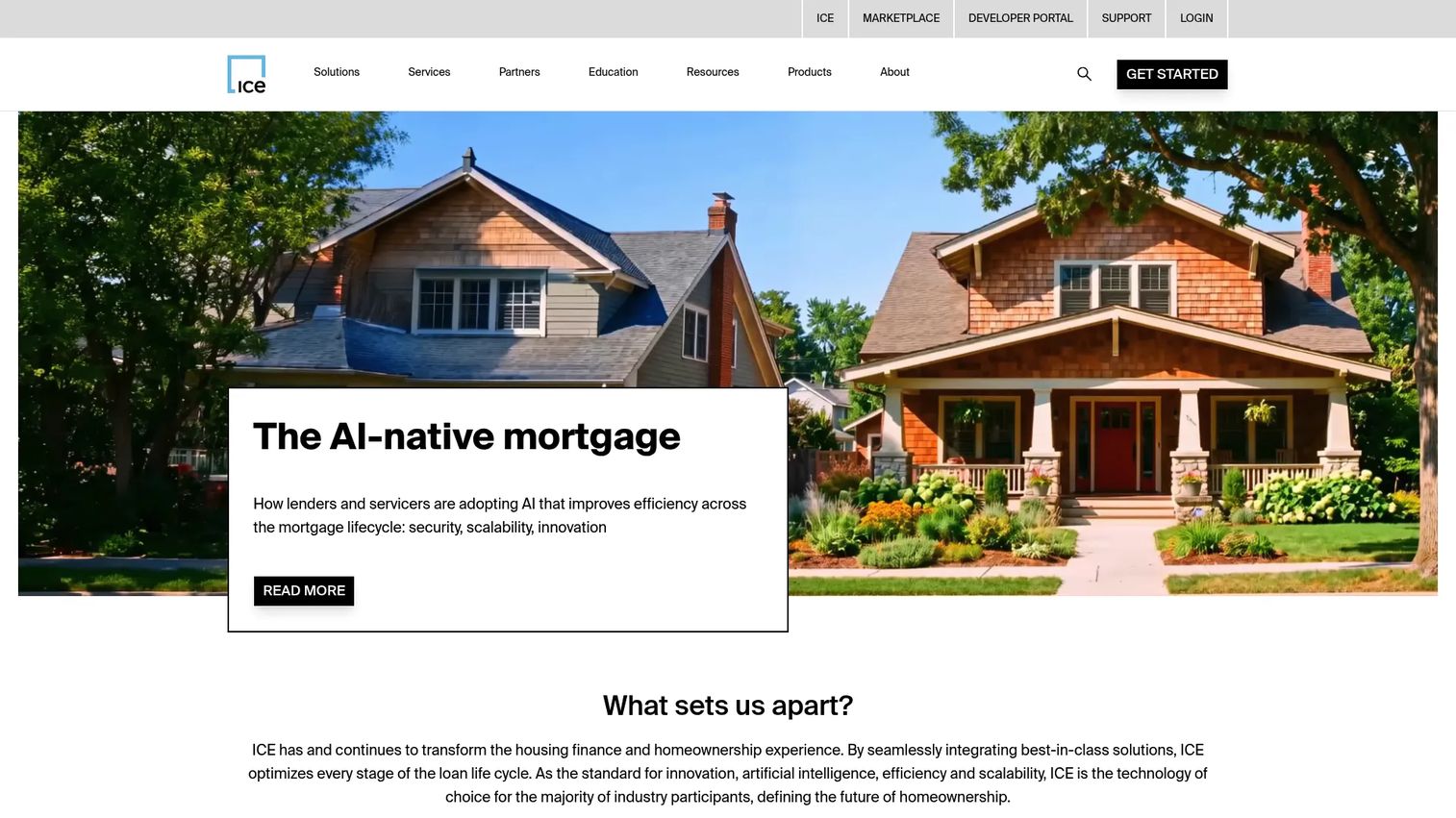
ICE Mortgage Technology MSP is an end-to-end mortgage servicing system that manages first mortgages and home equity loans and lines of credit on one platform. It runs the full lifecycle from loan boarding through default, with API and EDI integrations, workflow automation, and borrower self-service. It is a proven enterprise system built for scale.
Best for: Large servicers and organizations that need a single servicing system for first-lien and home equity portfolios.
Key strengths
- End-to-end servicing from boarding to default
- First mortgages and home equity on one platform
- API and EDI integrations with workflow automation
- Borrower self-service capabilities
Why choose ICE Mortgage Technology MSP: When portfolio scale and compliance maturity are the deciding factors, a proven enterprise system carries weight. MSP fits servicers that need depth, integration breadth, and a platform that has already run at high volume.
ICE Mortgage Technology MSP pricing: ICE states that pricing depends on portfolio size and the solutions you need, so expect a sales-led quote.
MSP carries a 4.4/5 rating on G2 based on the ICE Mortgage Technology platform listing.
3. FICS Mortgage Servicer
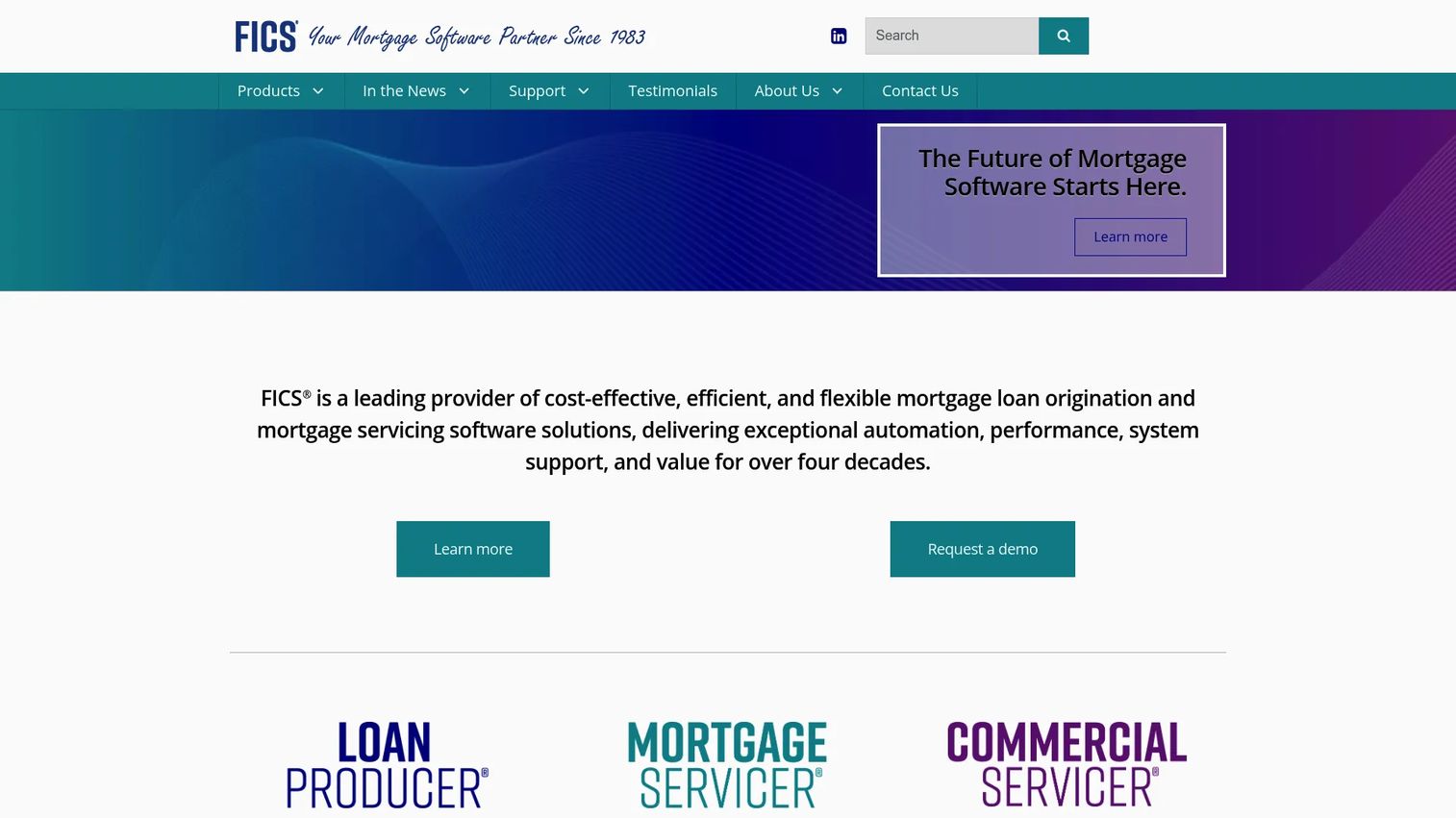
FICS Mortgage Servicer is mortgage servicing software for residential servicing operations. It automates payment processing, investor reporting, and escrow administration, alongside custodial accounting, imaging, and report writing. The strength here is operational depth: detailed back-office control and reporting that servicing teams actually compare line by line.
Best for: Mortgage lenders that want detailed operational control and strong back-office and reporting tooling.
Key strengths
- Payment processing with exception handling
- Investor reporting and remittance
- Escrow administration and custodial accounting
- Imaging, report writing, and borrower self-service
Why choose FICS Mortgage Servicer: If your team lives in the back office and cares about reporting depth, FICS covers the operational detail that thinner platforms gloss over. It fits residential servicers that want servicing automation without sacrificing granular control.
FICS Mortgage Servicer pricing: FICS plan on a direct quote tied to your servicing operation.
FICS Mortgage Servicer holds a 4.3/5 rating on G2, based on a small number of reviews.
4. LoanPro
LoanPro is an API-first lending and credit platform spanning origination, servicing, collections, and payments. Its Modern Lending Core, plus origination, servicing, collections, and payments suites, give teams a configurable foundation to build on. This is a loan servicing platform for buyers who want to customize heavily rather than accept a fixed workflow.
Best for: Financial institutions and lenders that want a configurable, API-friendly lending and credit platform.
Key strengths
- Modern Lending Core as a configurable foundation
- Origination and servicing suites
- Collections suite for delinquency workflows
- Payments suite with API-first architecture
Why choose LoanPro: If your team has the engineering appetite to configure a platform to your exact servicing logic, LoanPro rewards that. Mortgage-specific buyers should validate escrow, investor reporting, and default coverage against their requirements during evaluation.
LoanPro pricing: LoanPro determines packages by account volume and support agreement, and directs prospects to contact sales.
LoanPro holds a 4.4/5 rating on G2.
5. Nortridge

Nortridge is loan servicing and management software for lenders, built around configurable workflows. It handles servicing logic, payment processing and payment options, and reporting with dashboards. The appeal is flexibility: teams that need servicing operations tailored to their portfolio rather than forced into a fixed template.
Best for: Lenders that need a configurable loan servicing platform with reporting and workflow automation.
Key strengths
- Configurable loan servicing workflows
- Payment processing with multiple payment options
- Reporting and dashboards
- Workflow automation across operations
Why choose Nortridge: If tailored servicing operations matter more than out-of-the-box speed, Nortridge gives you the configuration room. It is also one of the few platforms here with transparent public pricing, which helps implementation-conscious teams budget early.
Nortridge pricing: The Loan Management System starts at $1,200 per month for up to three full users. Additional full users are $400 per user per month, and read-only users are $57 per user per month, with add-on pricing for modules, training, and LOS integration.
Nortridge holds a 4.2/5 rating on G2.
6. Peach Finance

Peach Finance is API-first loan management and servicing software built for cloud-native operations. Its Adaptive Core is a configurable lending engine, Compliance Guard encodes regulatory rules, and Loan Replay handles retroactive ledger recalculation. This is a platform for teams that want automation and scalability while moving off legacy infrastructure.
Best for: Lenders that need configurable loan servicing infrastructure with compliance automation.
Key strengths
- Adaptive Core configurable lending engine
- Compliance Guard for regulatory rules
- Loan Replay for retroactive ledger recalculation
- API-first, cloud-native architecture
Why choose Peach Finance: If modernization off a legacy servicing system is the goal, Peach's cloud-native architecture and compliance automation are built for that transition. It fits teams that value configurability and want compliance logic enforced in the platform rather than in process.
Peach Finance pricing: Peach site indicates pricing is based on active loans per month, so expect a usage-based quote.
Peach Finance holds a 4.7/5 rating on G2.
7. Bryt

Bryt is cloud-based loan management and servicing software aimed at simpler, smaller-portfolio needs. It covers loan servicing and tracking, workflow automation, and document management in a lighter package. For niche or smaller portfolios, that focus is the point: fewer moving parts, faster to stand up.
Best for: Lenders that need a customizable, lightweight loan servicing platform for smaller or specialized portfolios.
Key strengths
- Loan servicing and tracking
- Workflow automation
- Document management
- Cloud-based access
Why choose Bryt: Bryt fits teams whose servicing requirements are straightforward and who do not need the heavy default and investor-reporting machinery of an enterprise platform. It performs best for smaller books where speed to launch matters more than deep back-office tooling.
Bryt pricing: Bryt offers a 30-day free trial. Pricing is modular through a calculator on its site, with no fixed public starting price displayed.
Bryt does not surface a G2 product rating, though Capterra reviews are available for reference.
Considerations
End-to-end lifecycle coverage
The strongest reason to consolidate is one system for boarding, payments, escrow, reporting, and default. Every seam between tools is a reconciliation cost and an audit gap. Patchwork stacks can work, but only with a deliberate integration strategy and someone accountable for the data flowing between systems. If you cannot name that owner, favor breadth in one platform.
Compliance, risk, and auditability
Mortgage servicing is regulated at every step, so check the audit trail before the feature list. Can you see who did what, when, and why on any loan? How does the platform handle regulatory change management when rules shift? Look for controls that enforce required notices and default timelines automatically, not workflows that rely on someone remembering.
Payment processing and borrower experience
Payment orchestration, borrower self-service, and communication quality are not soft features. They drive delinquency reduction and retention directly. A borrower who can pay easily, see a clear statement, and get answers without a call stays current more often. Evaluate the payment exception handling and the self-service portal as closely as the accounting engine.
Integrations and ecosystem
APIs, LOS connectivity, EDI, and partner networks decide whether the platform fits your existing infrastructure or fights it. A servicing system that cannot talk cleanly to your LOS, banking rails, and investor reporting channels creates manual work you were trying to eliminate. Map your current integrations first, then test each candidate against that list.
Migration and implementation effort
Conversion risk scales with portfolio size and team bandwidth. Moving loans off a legacy system is where deployments stall or slip. Ask about data conversion support, implementation timelines, and whether a parallel run is possible before cutover. Run a staged evaluation and validate against real references at your portfolio size, not the vendor's largest logo.
Conclusion
There is no universal winner in mortgage servicing software, only the right fit for your portfolio and constraints.
If you are modernizing the full stack at a bank or lender, Sagent is built for that scope. For large first-lien and home equity portfolios, ICE Mortgage Technology MSP brings proven enterprise depth. FICS Mortgage Servicer wins on back-office and reporting control. LoanPro and Peach Finance suit teams that want modern, API-first architecture and heavy configurability, while Nortridge offers tailored workflows with transparent pricing. Bryt fits smaller or specialized portfolios that value simplicity.
Start with the dimension that will actually decide your deployment: portfolio complexity, compliance burden, or migration risk off a legacy system. Shortlist two or three platforms, run a staged evaluation against real references, and pressure-test payments, escrow, and default before you sign. Retention and recapture follow good servicing, so weight borrower experience heavily in the final call.
FAQs
Mortgage servicing software is the system of record that manages a loan after it funds. It handles payments, escrow administration, borrower communication, investor reporting, and default workflows across the servicing lifecycle. In short, it owns the borrower relationship from the first payment through payoff.
Origination software gets a borrower approved and to the closing table, covering application, underwriting, and funding. A mortgage servicing system takes over after the loan funds, managing payments, escrow, reporting, and default. Origination is pre-close; servicing is everything after.
Prioritize end-to-end lifecycle coverage, compliance and auditability, payment handling, investor and year-end reporting, and integration depth with your LOS and banking rails. Then weigh implementation support and migration risk. The best loan servicing platform for you is the one that matches your portfolio complexity and team bandwidth.
Yes. Most modern platforms offer APIs, EDI, and LOS connectivity, and several plug into partner networks for banking, investor reporting, and default services. Integration depth varies widely, so map your existing infrastructure and test each candidate against that list before committing.
Servicing owns every borrower touchpoint after the loan funds, so it shapes retention directly. Clear statements, easy self-service payments, and responsive communication keep borrowers current and satisfied. Strong servicing data also powers recapture, letting you reach borrowers with the right offer before they refinance elsewhere.
Enterprise fit depends on portfolio scale, compliance maturity, and operational complexity, not a single ranking. Proven enterprise systems like ICE Mortgage Technology MSP and full-stack platforms like Sagent are common shortlists for large first-lien and home equity portfolios. Validate against references at your scale.
Focus on data conversion, implementation support, and whether a parallel run is possible before cutover. Ask how the vendor has handled conversions at your portfolio size and request references. Migration off a legacy system is where timelines slip, so stage the evaluation and validate the conversion plan before you sign.