You bought the endpoint tool. You configured the SIEM rules. You wrote the DLP policies. Then someone on the board asks a simple question: how do you know any of it actually works?
Most security teams can't answer that with evidence. They can show configuration screenshots and coverage dashboards, but a dashboard that says a control is "enabled" is not the same as proof the control blocked or detected a real technique. That gap is exactly what breach and attack simulation software exists to close. BAS software safely runs real attacker techniques against your live defenses, then tells you what got blocked, what got detected, and what walked straight through.
The stakes are rising with the market. The global breach and attack simulation market is projected to grow from USD 894.5M in 2025 to USD 6.59B by 2035, a 22.1% CAGR, according to Market Research Future (2024). That growth tracks a shift in how security leaders think: point-in-time testing once a quarter no longer matches an attack surface that changes daily. Continuous validation is becoming the default expectation, and buyers now shortlist BAS tools the way they shortlist any other core control.
This guide walks through the 10 best breach and attack simulation tools for 2026, where each one fits, and how BAS differs from vulnerability scanning, penetration testing, and red teaming. If you evaluate security software for a living, this is meant to shorten the path from "we should test this" to a defensible recommendation. For teams building broader evaluation stacks, it pairs well with related buyer guides like our roundup of AI security posture management tools and our breakdown of application performance monitoring tools.
What's inside
This is a neutral buyer's guide for security evaluators, presales engineers, and the stakeholders who sign off on the purchase. Every tool on the list was assessed against the criteria that actually matter in a technical validation cycle:
- Continuous validation and production-safe simulation across live environments
- MITRE ATT&CK coverage and kill chain mapping depth
- Remediation workflows that turn findings into closure, not just alerts
- Executive reporting and trend visibility for stakeholders
- Integrations with the existing security stack (endpoint, SIEM/SOAR, cloud, email)
- Fit across mid-market and enterprise security programs
We also flag where a platform leans toward the broader adversarial exposure validation (AEV) category rather than classic BAS, since that distinction increasingly shapes vendor selection.
TL;DR
- Best overall for continuous validation: Cymulate, for broad, ongoing control testing with strong remediation guidance.
- Best for control coverage and reporting: Picus Security, for threat and mitigation libraries plus executive-ready output.
- Best for education-forward buyers: Rapid7, for teams that want BAS framed inside a wider exposure management stack.
- Best for adversarial emulation: SCYTHE, for AEV-forward, response-chain validation.
- Best for attack path validation: XM Cyber, for teams focused on the paths an attacker could actually take.
- Best for exploitability proof: Pentera, for hands-on validation of real, reachable risk.
What is breach and attack simulation software?
Breach and attack simulation software is a category of security tools that continuously and safely runs simulated attack techniques against an organization's live defenses to validate whether controls block, detect, and alert as expected. Unlike a scanner that lists theoretical weaknesses, BAS actually exercises the control and reports what happened.
The value sits in what it proves, not what it predicts. Here is what mature BAS platforms do:
- Run real attacker techniques safely. Simulations use production-safe, non-disruptive testing methods that exercise controls without harming systems or data.
- Map to MITRE ATT&CK. Techniques are aligned to the ATT&CK framework and kill chain mapping, so coverage is measurable against a shared language every security team understands.
- Test controls across layers. Endpoint security, network security, email security, web application firewall, cloud security, DLP, and SIEM/SOAR detection all get exercised.
- Prioritize and remediate. Findings feed remediation workflows with guidance, so teams close gaps and re-test rather than collect a backlog of alerts.
- Report over time. Trend data and executive reporting show whether control effectiveness is improving, holding, or slipping after changes.
One distinction worth internalizing: BAS validates whether specific controls work, while the broader AEV and exposure validation category focuses on which attack paths and exploitable exposures matter most. Several vendors below now span both, which is why the lines have blurred.
When to use breach and attack simulation software
Validate real-world defense coverage
Use BAS when you need proof, not assumptions, that layered controls behave as designed. If you want evidence that endpoint agents block a specific ransomware technique, that email filters catch a phishing payload, or that SIEM rules actually fire an alert, simulation answers it directly. This is where control effectiveness stops being a claim and becomes a measured result.
Replace point-in-time confidence with continuous checks
A quarterly penetration test tells you about one moment. Your environment does not stand still for the next three months. New tools ship, rules get tuned, threat actors change tactics. Continuous validation catches regressions the day they appear, so a config change that silently broke detection doesn't stay hidden until the next audit.
Prove remediation and reporting to stakeholders
The hardest part of security is not finding gaps, it is showing you closed them. BAS excels here because it re-tests after remediation and tracks the trend line. When a CISO needs to show the board that detection coverage climbed from 61% to 89% over two quarters, that story comes from repeatable simulation data, not anecdotes.
Comparison table
The table below positions each platform by primary intent so you can pattern-match to your own environment before reading the detail. Pricing for most BAS platforms is quote-based and scoped to deployment, so public numbers are noted where verifiable.
| # | Product | Intent | Key differentiation | Pricing | G2 rating |
|---|---|---|---|---|---|
| 1 | Cymulate | Continuous validation | Broad exposure validation with auto-remediation guidance | Quote-based | 4.9/5 |
| 2 | Picus Security | Continuous validation | Threat and mitigation libraries, strong reporting | Free trial; quote-based | 4.8/5 |
| 3 | Rapid7 | Exposure management | BAS inside a broader security operations stack | InsightVM from $1.62/mo per asset | 4.3/5 |
| 4 | SCYTHE | Adversarial emulation | AEV-forward, full ATT&CK module library | Scoping-based | 4.5/5 |
| 5 | AttackIQ | Continuous validation | ATT&CK-aligned testing, agentless Flex option | Flex from $0; Enterprise quote-based | 4.5/5 |
| 6 | SafeBreach | Enterprise BAS | Continuous simulation plus attack path validation | Quote-based | Limited reviews |
| 7 | XM Cyber | Attack path validation | Attack graph analysis across hybrid environments | Quote-based | 3.5/5 |
| 8 | Pentera | Automated validation | Exploitability proof in live production | Quote-based | 4.5/5 |
| 9 | Mandiant Security Validation | Enterprise BAS | Threat-intel-driven validation methodology | Quote-based | Not listed |
| 10 | IBM Security Randori | Exposure management | External attack surface discovery and validation | Quote-based | 4.3/5 |
1. Cymulate
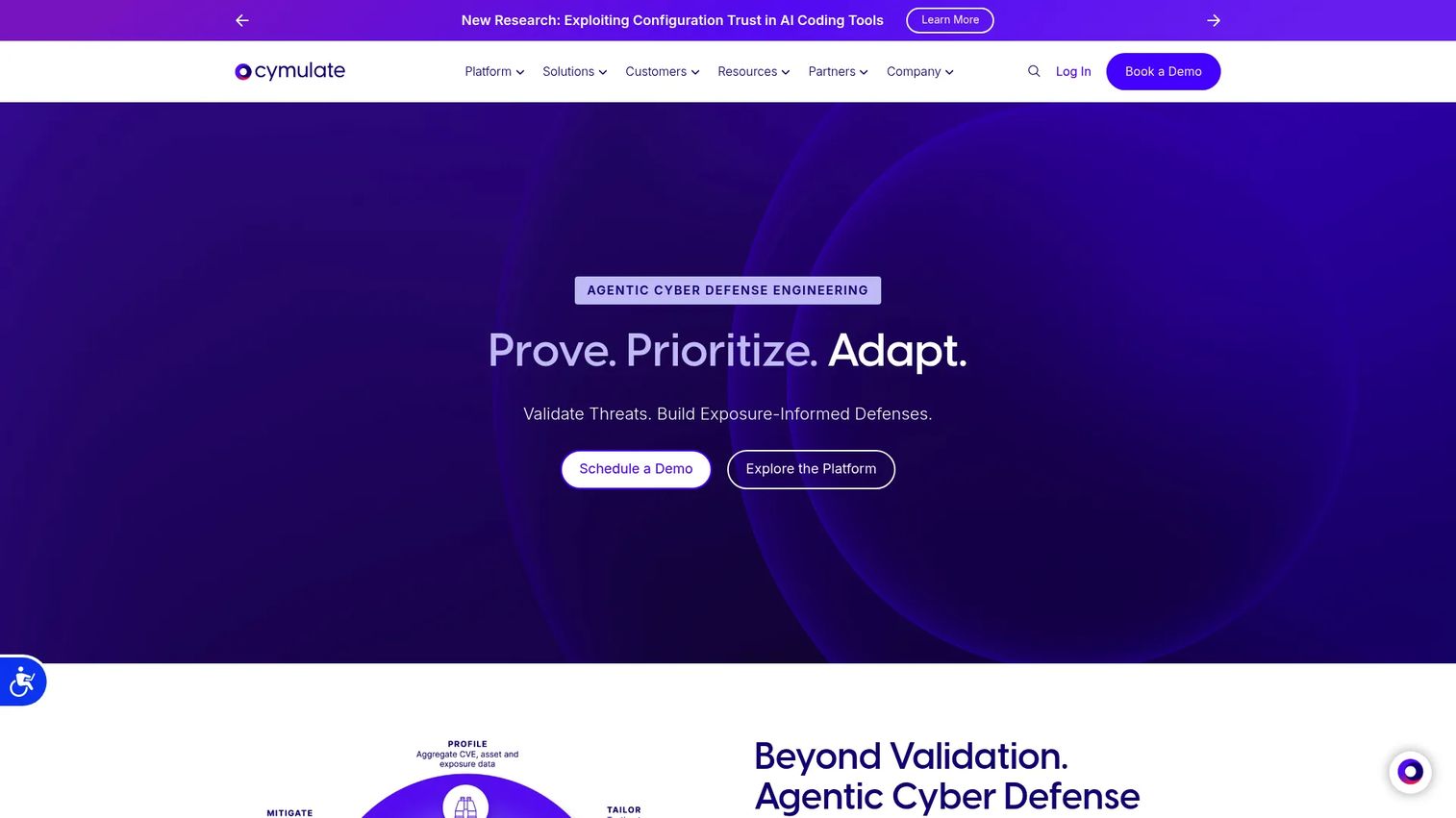
Cymulate is a cyber exposure validation and attack simulation platform built for security teams that want to validate and improve defensive controls continuously. It runs threat validation across the full kill chain, prioritizes exposures, and pairs findings with remediation guidance so teams can close gaps and re-test in the same loop. It sits comfortably as an everyday validation layer rather than a once-a-quarter exercise.
Best for: Security teams that want broad, continuous control validation with clear remediation direction.
Key strengths
- Continuous threat validation: Runs ongoing simulations across controls so regressions surface quickly, not at the next audit.
- Exposure prioritization and remediation guidance: Ranks what matters and tells teams how to fix it, feeding practical remediation workflows.
- Detection engineering and auto mitigation: Helps tune detections and apply mitigations, tightening control effectiveness over time.
Why choose Cymulate: If your priority is continuous validation with a strong bridge from finding to fix, Cymulate earns its place. It suits teams that want breadth across endpoint, email, web, and network controls without stitching together separate point tools, and it carries one of the highest satisfaction scores in the category.
Cymulate pricing: Cymulate does not publish a public price. Pricing is demo and contact-based, scoped to your environment. On G2, it holds a 4.9/5 rating.
2. Picus Security
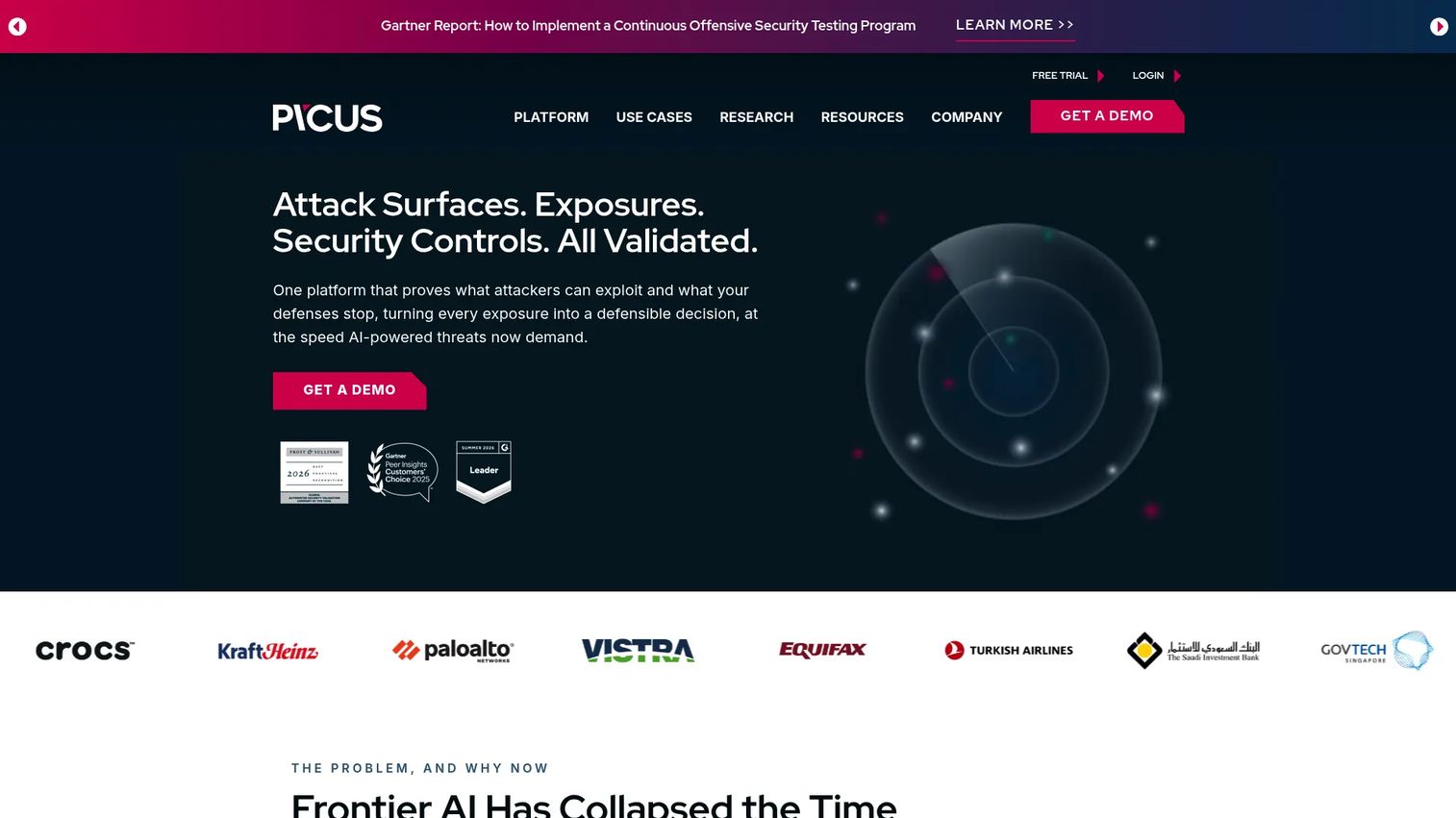
Picus Security is a continuous security validation and adversarial exposure platform known for its threat and mitigation libraries. It validates security controls against real-world attack scenarios, measures exploitability, and translates results into remediation steps and executive-ready reporting. Coverage spans endpoint, network, email, web, cloud, and DLP, which makes it a strong fit for teams standardizing validation across many control layers.
Best for: Security teams that want continuous validation of defenses paired with strong reporting for stakeholders.
Key strengths
- Security control validation: Tests whether controls block and detect known and emerging techniques mapped to MITRE ATT&CK.
- Adversarial exposure validation: Validates exploitability, not just theoretical exposure, so priorities reflect real risk.
- Continuous threat exposure management: Ties validation into an ongoing CTEM motion rather than isolated tests.
Why choose Picus Security: Picus stands out when executive reporting and remediation loops matter as much as raw testing. The mitigation library shortens the path from finding a gap to closing it, and the breadth of control coverage keeps validation consistent across the stack. It's a strong pick for security programs that need to prove continuous improvement to leadership.
Picus Security pricing: Picus offers a 14-day free trial. Paid pricing is not publicly listed and is quote-based. On G2, it holds a 4.8/5 rating.
3. Rapid7
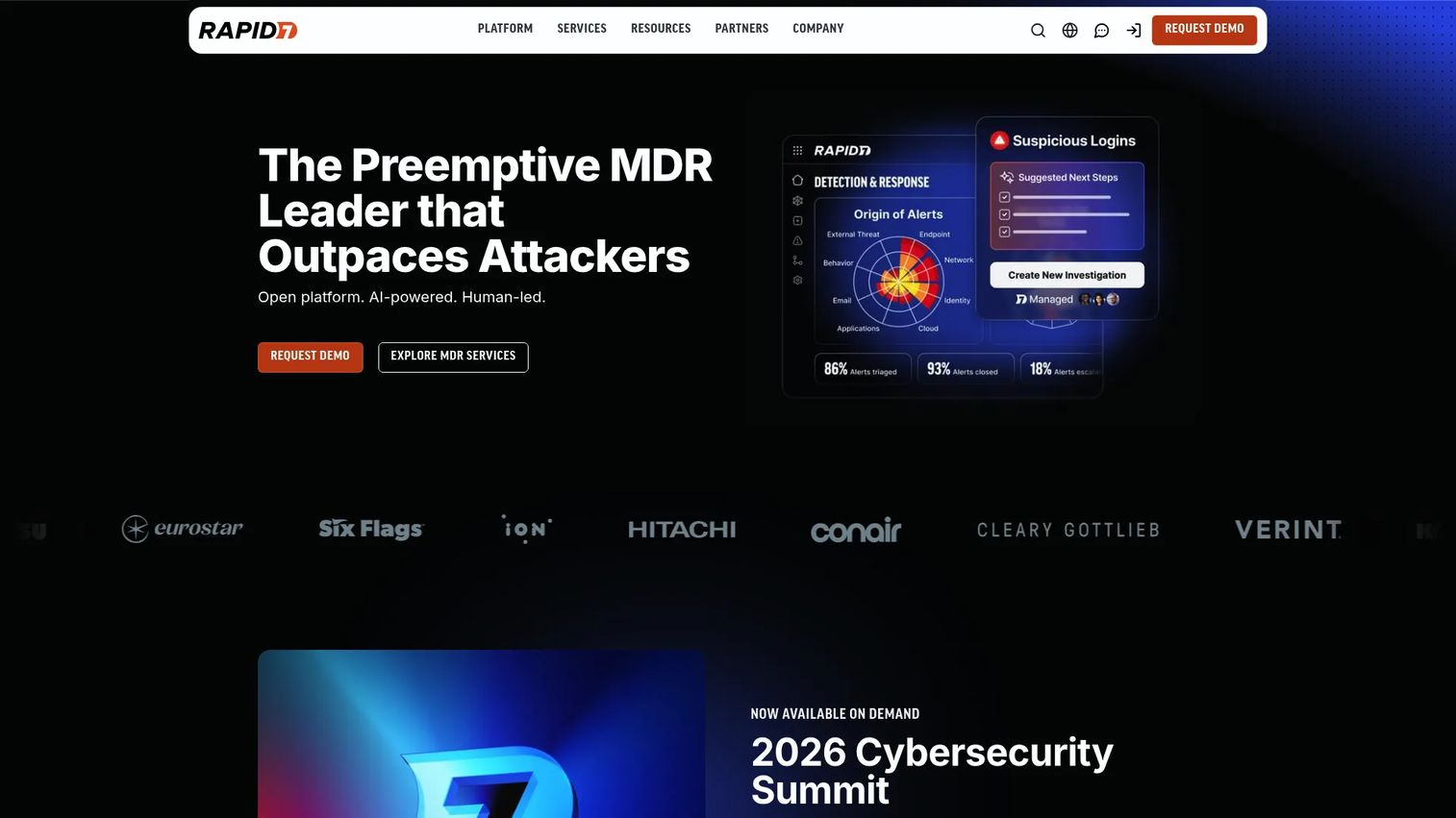
Rapid7 is a broad cybersecurity company offering vulnerability management, cloud security, SIEM, and managed detection and response. For BAS-adjacent buyers, its value is context: Rapid7 frames validation inside a wider exposure management and security operations stack, which helps teams see where simulation fits alongside vulnerability scanning, detection, and response. If you want BAS as one input into a unified operations picture rather than a standalone tool, this is the education-forward option.
Best for: Organizations that want validation woven into a broader exposure management, SIEM, and MDR platform.
Key strengths
- Exposure Command vulnerability management: Consolidates asset and vulnerability context to prioritize what to validate.
- Incident Command next-gen SIEM: Ties detection and response data to the exposures that matter.
- Managed Threat Complete MDR: Adds human-led detection and response for teams that need it.
Why choose Rapid7: Rapid7 fits teams that would rather buy into a platform than assemble point tools. The strength is breadth and clarity on how vulnerability scanning, penetration testing, and red teaming differ from continuous validation. It's the pragmatic choice when consolidation and a single security operations view outweigh best-of-breed BAS depth.
Rapid7 pricing: Rapid7 publishes starting prices for selected products, with InsightVM from $1.62/mo per asset for 500 assets and InsightAppSec from $175/mo per app. Exposure Command and MDR tiers are quote-based. On G2, Rapid7 holds a 4.3/5 rating.
4. SCYTHE
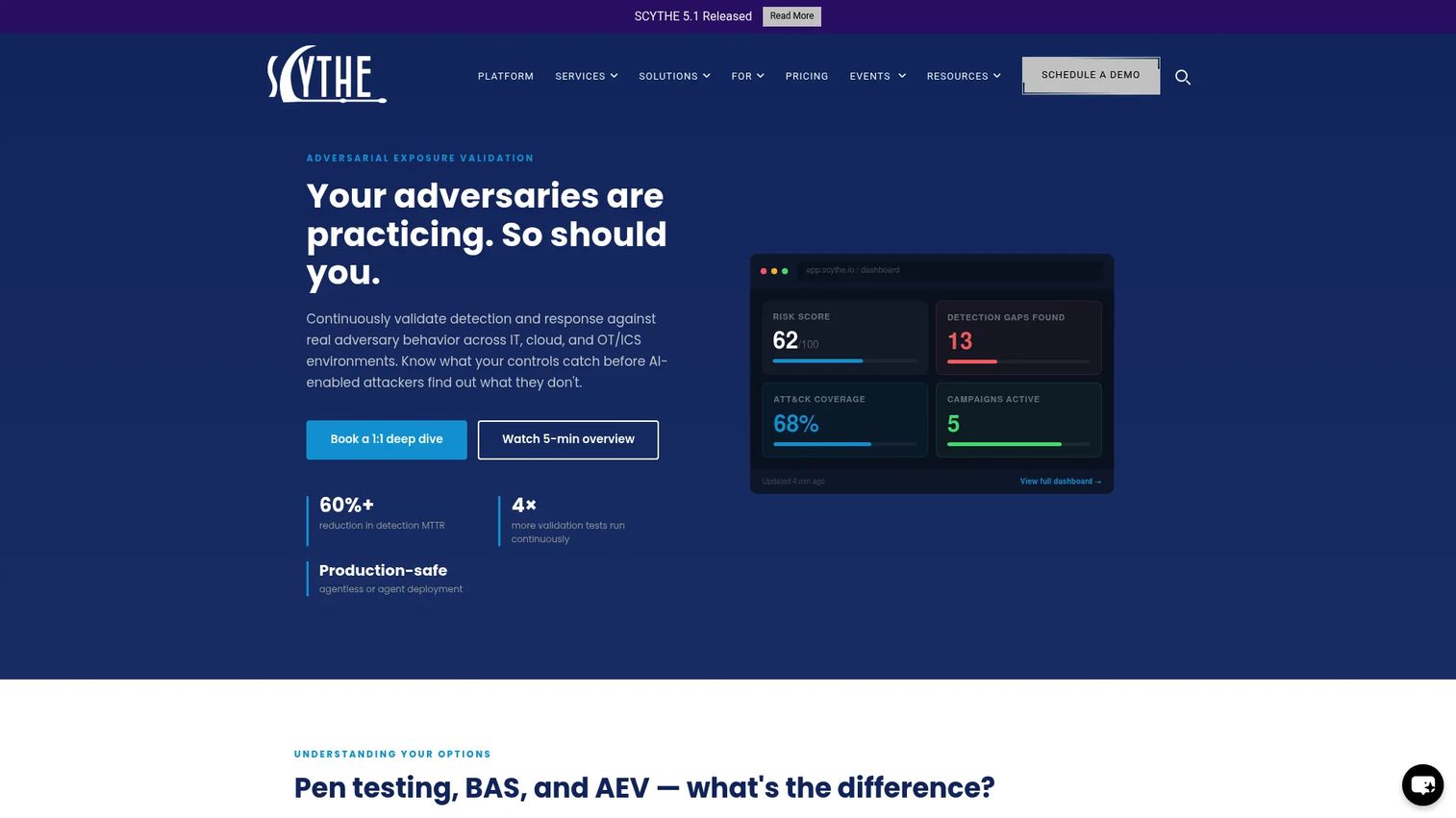
SCYTHE is an AI-enabled adversarial emulation and validation platform aimed at teams that want to go beyond control-by-control testing into full response-chain validation. This is where the AEV distinction matters: rather than only checking whether a control blocked a technique, SCYTHE emulates an adversary's end-to-end behavior so teams can validate detection, response, and the people and processes in between. That makes it a fit for more advanced security programs.
Best for: Security teams and service providers running adversarial emulation and validation programs at depth.
Key strengths
- Unlimited seats and agents: Removes per-seat friction so whole teams can run and review emulations.
- Full ATT&CK module library: Broad technique coverage aligned to MITRE ATT&CK for measurable depth.
- AI-driven dynamic test generation: Generates varied test scenarios so validation keeps pace with evolving tactics.
Why choose SCYTHE: Choose SCYTHE when you want AEV-forward, response-chain validation rather than narrower control checks, and when you value modern category framing that treats emulation as a program, not a task. Its MSP and MSSP models also make it attractive to service providers running validation on behalf of clients.
SCYTHE pricing: SCYTHE uses scoping-based pricing across Foundation, Advanced, and MSP/MSSP models, with no public dollar figure. On G2, it holds a 4.5/5 rating.
5. AttackIQ
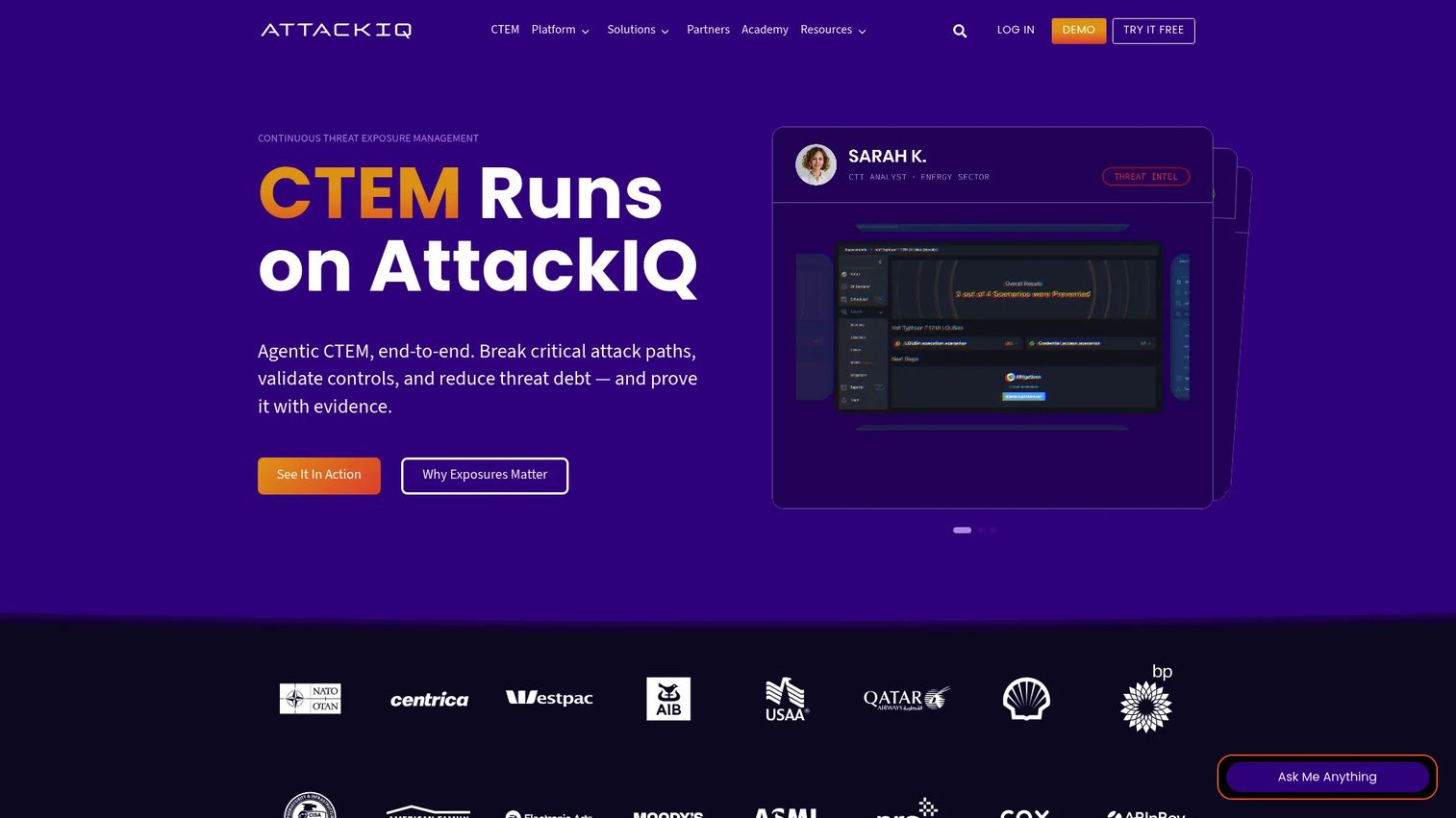
AttackIQ is a mature platform for adversarial exposure validation and continuous control testing, with a strong reputation for ATT&CK-aligned rigor. It's built for teams operationalizing security validation at scale, offering an agentless on-demand option (Flex), a fully managed continuous option (Ready), and a full enterprise deployment. That range lets a program start small and grow into continuous, orchestrated validation.
Best for: Security teams validating defenses and exposure continuously against real adversary behavior.
Key strengths
- AttackIQ Flex: Agentless, on-demand exposure validation for fast, targeted tests.
- AttackIQ Ready: Fully managed continuous validation for teams that want the outcome without the operational load.
- AttackIQ Enterprise: Custom adversary scenarios and enterprise-wide orchestration for large programs.
Why choose AttackIQ: AttackIQ suits teams that want repeatable, ATT&CK-aligned validation and a clear on-ramp. The Flex option lets a team prove value with a single scenario before committing to continuous coverage, which makes it easy to pilot. Its methodology credibility is a strong selling point for security-mature organizations.
AttackIQ pricing: AttackIQ Flex publishes public tiers: Free at $0, Pay-as-you-go at $300 (credit-based), and Monthly at $4,995, with yearly pricing available on request. Enterprise is licensed as a quarterly subscription with no public figure. On G2, it holds a 4.5/5 rating.
6. SafeBreach
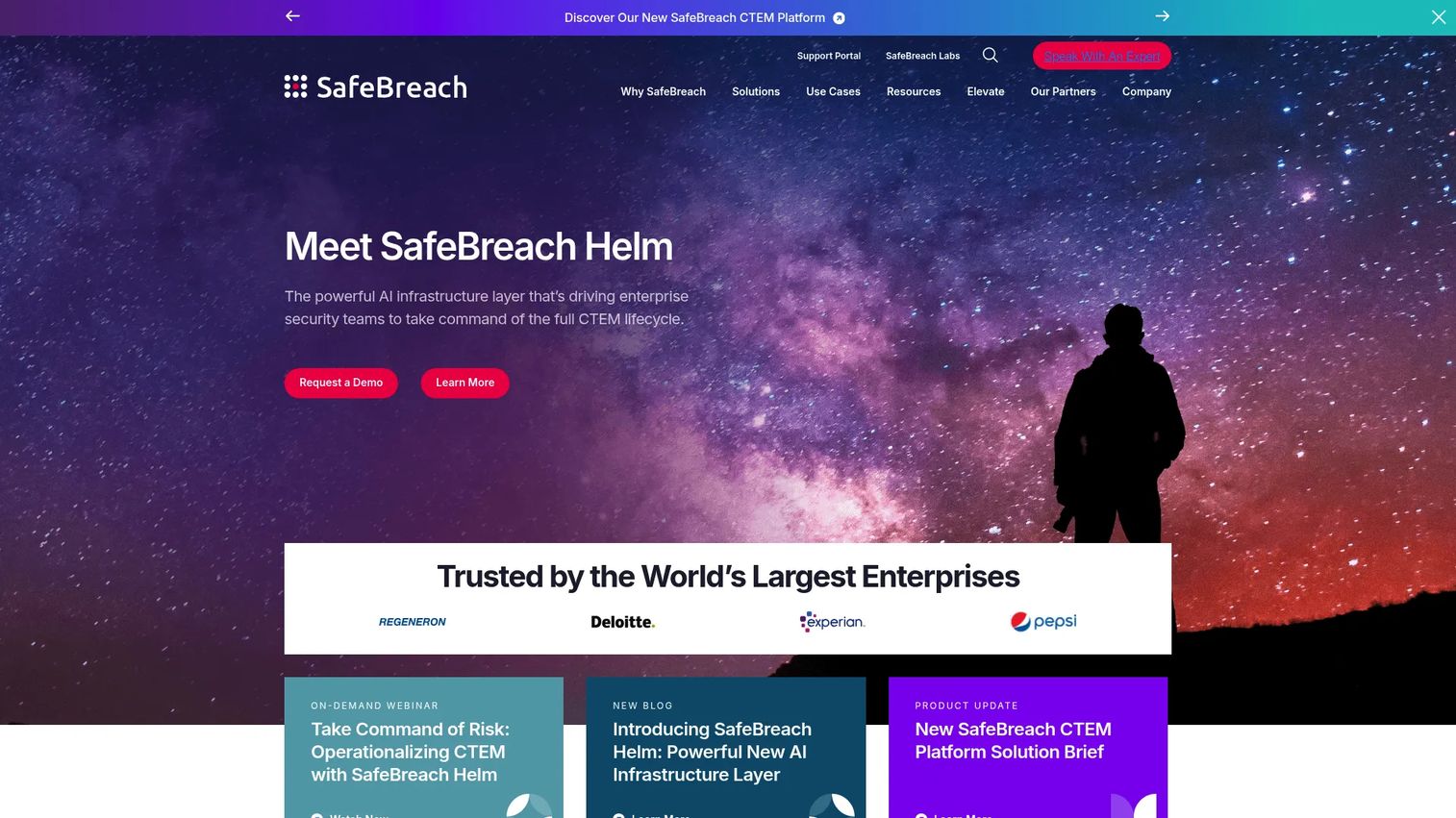
SafeBreach is an enterprise exposure validation platform focused on continuously validating defenses and measuring cyber risk at scale. It combines classic breach and attack simulation with attack path validation and AI-powered CTEM orchestration, so large security teams can translate simulation results into concrete operational actions. The emphasis is on measuring control effectiveness over time and tying it to business risk.
Best for: Large enterprises validating security controls and exposure at scale.
Key strengths
- Continuous breach and attack simulation (Validate): Runs ongoing simulations to measure control effectiveness over time.
- Attack path validation (Propagate): Maps how an attacker could move, not just whether a single control held.
- AI-powered CTEM orchestration with SafeBreach Helm: Coordinates validation across the exposure management lifecycle.
Why choose SafeBreach: SafeBreach fits enterprise programs that need both control validation and attack path context in one platform. The combination helps security teams move from a list of findings to a prioritized, operational remediation plan. It's a strong option when scale and executive reporting are central to the mandate.
SafeBreach pricing: SafeBreach does not publish public pricing; it is quote-based and scoped to the enterprise deployment. Public G2 review volume is currently limited.
7. XM Cyber
XM Cyber is a continuous exposure management platform built around attack path validation. Instead of testing controls one at a time, it maps the routes an attacker could actually take to reach critical assets, then validates exploitability and prioritizes remediation along those paths. For teams that care less about isolated control checks and more about "which path gets someone to the crown jewels," this framing is compelling.
Best for: Enterprises that need continuous exposure management and attack path validation across hybrid environments.
Key strengths
- Full-attack-surface exposure discovery: Finds exposures across on-prem and multi-cloud environments.
- Validated attack path mapping with XM Attack Graph Analysis: Shows the real routes to critical assets, not theoretical ones.
- Exploitability validation and remediation guidance: Prioritizes fixes that break the most dangerous paths first.
Why choose XM Cyber: XM Cyber is the pick when the goal is exposure reduction along attack paths rather than control-by-control validation. Breaking a single choke point can neutralize many downstream risks, which makes remediation efficient. Teams managing sprawling hybrid environments get a clear map of where to focus.
XM Cyber pricing: XM Cyber does not publish public pricing; the site directs buyers to book a demo. On G2, it holds a 3.5/5 rating.
8. Pentera
Pentera is an AI-driven exposure validation platform that leans toward automated security testing, safely validating exploitable risk in live production environments. Where classic BAS confirms whether a control fired, Pentera goes further to prove what an attacker could actually chain together and exploit, then prioritizes the exposures that carry real reachability. That makes it a strong fit for teams that want hands-on proof, not just detection scores.
Best for: Enterprises that want continuous, production-safe validation of exploitable security risk.
Key strengths
- Continuous adversarial validation in live environments: Safely tests production without the wait of a scheduled engagement.
- Coverage across internal, external, and cloud identity: Products span network, external surface, and identity exposure with remediation orchestration.
- AI-powered testing workflows: Automates test generation and exposure validation to keep pace with change.
Why choose Pentera: Pentera fits teams that want automated proof of exploitable paths across live environments, closer to continuous automated penetration testing than to control-only BAS. It suits security programs that need to show not just that a control detected something, but that a real attack path was closed. That evidence resonates in both security reviews and executive updates.
Pentera pricing: Pentera does not publish public pricing; it is demo and contact-sales based. On G2, it holds a 4.5/5 rating.
9. Mandiant Security Validation
Mandiant Security Validation is an enterprise validation platform that uses Mandiant threat intelligence to test and measure the effectiveness of security controls against realistic attacker behaviors. Its differentiation is methodology credibility: validation is driven by intelligence on what threat actors are actually doing, so testing reflects current adversary activity rather than a static library. For serious security programs, that threat-informed approach carries weight.
Best for: Enterprises validating the effectiveness of security controls against realistic, intelligence-driven attacker behaviors.
Key strengths
- Validation Director integration: Connects to SIEM and the broader security stack to measure detection and response.
- Actors for safe control testing: Safely tests network, endpoint, and email controls in a production-safe way.
- Modular coverage: Additional modules span Protected Theater, Email Theater, AEDA, TAAM, and cloud validation.
Why choose Mandiant Security Validation: This is the choice for enterprise buyers who want high-confidence, threat-informed validation backed by well-known intelligence. The methodology credibility and operational reporting suit organizations where the board expects rigor and defensible evidence. It fits programs that treat validation as a serious, ongoing discipline.
Mandiant Security Validation pricing: Mandiant does not publish public pricing; access and licensing are handled through sales. A current public G2 rating was not available at the time of writing.
10. IBM Security Randori
IBM Security Randori is IBM's attack surface management and threat exposure product, focused on continuously discovering and prioritizing externally exposed assets. It complements BAS-style validation by answering a different question: what is exposed to the internet, and which of those exposures are worth acting on first. For teams whose primary concern is external attack surface and continuous exposure reduction, Randori adds visibility that internal control testing alone does not provide.
Best for: Security teams needing external attack surface visibility and exposure prioritization.
Key strengths
- Continuous attack surface discovery: Continuously maps externally exposed assets as they change.
- Passive and active discovery: Combines discovery methods to build a realistic external view.
- Vulnerability validation: Validates exposures against known exploited vulnerabilities to prioritize action.
Why choose IBM Security Randori: Randori fits teams that want to start from the attacker's outside-in perspective and prioritize the external exposures that matter most. Paired with a control-focused BAS tool, it rounds out validation with attack surface awareness. It's a strong complement when exposure visibility is the gap in the program.
IBM Security Randori pricing: IBM does not publish public pricing for Randori; it is quote-based. On G2, IBM Security Randori Recon holds a 4.3/5 rating.
Considerations before you buy
The right BAS tool depends less on feature checklists and more on how well it fits your environment, maturity, and reporting obligations. Use this checklist to pressure-test any shortlist.
Control coverage and integrations
Confirm the platform tests the controls you actually run: endpoint, network, email, web application firewall, cloud, DLP, and SIEM/SOAR detection. Then verify it integrates cleanly with your existing stack. A validation tool that can't read your detection layer produces incomplete answers.
Production-safe simulation
Any serious vendor designs for non-disruptive testing, but you still need to validate that yourself. Ask how simulations are contained, what data they touch, and how they're scoped. Run a controlled pilot before you trust it in production at scale.
Remediation workflows and reporting
Finding gaps is the easy part. Evaluate how the platform turns findings into remediation workflows, whether it re-tests after fixes, and how it presents trends. Strong executive reporting is what turns technical results into stakeholder confidence and budget.
BAS versus AEV fit
Decide whether you need control validation, attack path validation, or both. Some tools focus on control effectiveness, others on exploitable paths and exposure. Matching the platform's center of gravity to your program's goal avoids buying depth you won't use.
Compliance support and scalability
Check whether the tool maps results to the frameworks your auditors care about, and whether it scales from a single business unit to the whole enterprise without a re-platform. Compliance support and clean scaling save painful migrations later.
Conclusion
The 10 tools here sort into a few practical buckets. For continuous validation, Cymulate, Picus Security, and AttackIQ lead with broad control coverage and strong remediation loops. For exposure and attack path visibility, XM Cyber, Pentera, and IBM Security Randori focus on the routes and surfaces attackers actually use. For enterprise remediation programs, SafeBreach and Mandiant Security Validation bring scale and threat-informed rigor. And for buyers weighing BAS against the broader AEV category, SCYTHE and Rapid7 offer the clearest framing of where each approach fits.
Here's a practical next step. Map your current control coverage across endpoint, email, cloud, and detection. Define two or three success criteria you can measure, such as detection coverage percentage or mean time to remediate a validated gap. Then pilot your top two vendors against those criteria in a contained environment. Let the evidence, not the sales deck, drive the decision. That's how security validation earns its place in the stack and how continuous improvement stops being a slogan and becomes a number you can show the board.
FAQs
Breach and attack simulation software safely runs simulated attacks against your live security controls to confirm whether they block, detect, and alert as expected. Instead of listing theoretical weaknesses, it exercises real techniques and reports the actual outcome. The goal is evidence of control effectiveness, not assumptions.
Penetration testing is usually point-in-time and human-led, delivering a snapshot on the day it runs. BAS is continuous and automated, so it validates defenses repeatedly as your environment and threats change. Many teams use both: BAS for ongoing coverage, pentesting and red teaming for deeper, creative human-led probing.
Reputable BAS platforms are built for production-safe, non-disruptive testing that exercises controls without harming systems or data. That said, you should still validate containment and scoping yourself. Run a controlled pilot first, confirm what data simulations touch, and expand coverage once you trust the behavior.
Most platforms test across endpoint security, network security, email security, web application firewall, cloud security, and DLP, plus SIEM and SOAR detection and response. The breadth matters because attackers chain techniques across layers. Confirm the tool covers the specific controls you run before you commit.
Frequency depends on security maturity, environment churn, and change cadence, but the direction of travel is continuous validation. If your stack changes weekly, quarterly testing leaves long blind spots. Continuous or triggered simulation after control changes catches regressions the day they appear rather than months later.
MITRE ATT&CK gives vendors and buyers a shared framework for mapping attacker techniques, so coverage and validation depth can be measured against a common language. Most BAS tools align tests and kill chain mapping to ATT&CK. That alignment makes it possible to compare platforms and communicate coverage clearly to stakeholders.
Focus on control coverage, integrations with your existing stack, remediation workflows, executive reporting, ease of use, and validation fidelity. Confirm production-safe testing and compliance support for your frameworks. Then pilot the top two vendors against measurable success criteria before signing, so the choice rests on evidence rather than a pitch.