
By Series B, legal work stops being a pile of one-off requests. It becomes an operating system problem.
Outside counsel invoices arrive late and without context. Contract reviews stack up in someone's inbox. The general counsel is answering Slack messages from sales, HR, and finance simultaneously. And when the board asks about legal spend, nobody has a clean answer.
According to the CLOC 2025 State of the Industry Report, 84% of surveyed legal departments already use electronic billing, yet matter management, spend visibility, and intake discipline remain inconsistent across organizations. The gap between departments that have a legal operating system and those still running on spreadsheets shows up in diligence, in burn multiple, and in founder time.
This guide covers 21 enterprise legal management software platforms, explains what the category does, and gives you a practical shortlist organized by operating need - whether that's outside counsel spend control, matter tracking, legal AI, or intake automation.
What's inside
This guide is built for founders, general counsel, CFOs, and legal operations leaders evaluating legal management platforms. Tools were selected and evaluated on the following criteria:
- Matter management depth: Taxonomy, workflows, custom fields, document links, and reporting
- Legal spend and e-billing: Invoice review, billing guidelines, accruals, budgets, and outside counsel collaboration
- Intake and workflow automation: Request triage, routing, approvals, and business-user experience
- Reporting, analytics, and AI: Dashboard quality, decision-grade analytics, and specific AI workflows
- Pricing was verified against each vendor's pricing page and reviewed on G2, Capterra, or TrustRadius during drafting
TL;DR
- Best for large enterprise legal departments: Passport or TeamConnect handle complex, global matter portfolios and legal spend at scale
- Best for legal spend management: Brightflag and TyMetrix 360 give legal and finance teams structured control over outside counsel invoices and budgets
- Best for modern in-house legal teams: LawVu Legal Workspace and Xakia provide intake, matters, and collaboration without a heavy deployment
- Best for legal AI: Harvey supports research, drafting, document review, and insourcing rather than traditional ELM system-of-record work
- Best for invoice visibility: Apperio and BusyLamp surface outside counsel spend before the invoice lands
- Best for intake and workflow automation: Checkbox handles legal request volume and routing without requiring full ELM infrastructure
What is enterprise legal management software?
Enterprise legal management software is a system of record for in-house legal departments that centralizes matters, legal spend, e-billing, outside counsel collaboration, intake, workflows, reporting, and operational governance.
Legal operations leaders use it to replace email threads, spreadsheets, and disconnected document folders with a governed, auditable layer across all legal work. According to the CLOC 2025 State of the Industry Report, 66% of surveyed departments rate automating legal processes a high priority, and the median annual spend on legal systems and technology reached $701,900.
Core capabilities in enterprise legal management software
- Matter management: Track every legal matter from open to close, with documents, owners, status, deadlines, and custom fields
- Legal spend management: Set budgets, manage accruals, review invoices, enforce billing guidelines, and report on outside counsel cost
- Electronic legal billing (e-billing): Process law firm invoices digitally, apply billing rules, and approve or reject line items
- Legal intake and triage: Capture requests from across the business, route them to the right attorney, and track service levels
- Outside counsel management: Manage law firm relationships, rate cards, preferred-firm lists, and collaboration portals
- Reporting and analytics: Build dashboards for legal spend by matter, by practice area, by firm, and for board-level visibility
- AI-assisted review: Apply AI to invoice line-item audits, matter summaries, triage, and document analysis
- Security and audit trails: Role-based access, SSO, permissions, and exportable audit logs for diligence readiness
Enterprise legal management versus contract lifecycle management
ELM manages legal department operations: Matter tracking, spend, invoicing, intake, and reporting. Contract lifecycle management handles contracts from request through drafting, negotiation, signing, and renewal. The boundary is meaningful. Many scaling companies need both, and some ELM platforms include CLM modules while others integrate with standalone CLM tools. Evaluate whether you need them bundled or separate before committing to a platform.
Enterprise legal management versus legal AI
Legal AI platforms like Harvey focus on knowledge work: Research, drafting, document review, and analysis. They do not replace ELM as a system of record for matters and spend. Modern in-house teams increasingly run both, using ELM for operational structure and legal AI for work throughput. The two categories complement each other rather than compete directly.
When to use enterprise legal management software
Centralize legal matters before work gets lost
Legal work outgrows inboxes and spreadsheets faster than most founders expect. When attorneys are tracking matters in personal folders, legal context disappears during handoffs and becomes impossible to audit during diligence. ELM creates a shared matter record that survives personnel changes and supports board-level reporting.
Control legal spend before invoices surprise finance
Outside counsel invoices often arrive weeks after work is completed, with limited line-item visibility. ELM platforms enforce billing guidelines, track budgets against accruals, and give finance a real-time view of committed legal spend. For a Series B company, this directly affects burn multiple and runway accuracy.
Build a repeatable legal intake process
When legal supports sales, HR, finance, and procurement simultaneously, ad hoc Slack requests create bottlenecks and inconsistency. An intake layer routes requests by type, assigns ownership, sets service-level expectations, and gives business stakeholders visibility into status. That's the difference between a legal team that scales and one that stays a bottleneck.
Enterprise legal management software comparison
Use this table as a starting point for shortlisting. Pricing and G2 ratings reflect verified data from vendor pricing pages and live G2 listings. Where no price is publicly displayed, that reflects each vendor's sales-led model rather than a missing detail. The column "Key differentiator" names the primary reason a team would choose that platform.
| # | Product | Best for | Key differentiator | Pricing | G2 rating |
|---|---|---|---|---|---|
| 1 | Passport | Large enterprise legal and insurance teams | AI-powered matter and spend management with Microsoft integration | Quote-based | Not enough reviews for aggregate rating |
| 2 | TyMetrix 360 | Corporate legal teams prioritizing e-billing and spend control | E-billing, benchmarking, and Power BI analytics | Quote-based | 3.6/5 |
| 3 | Brightflag | Legal and finance teams needing AI-driven spend visibility | AI invoice review and matter-level financial dashboards | Quote-based (subscription tied to outside counsel spend) | 4.6/5 |
| 4 | Thomson Reuters Legal Tracker | Established legal departments with complex billing workflows | Enterprise e-billing, analytics, and deep integrations | Quote-based | 4.6/5 |
| 5 | LawVu Legal Workspace | Modern in-house legal teams wanting a unified workspace | Intake, matters, contracts, and spend in one platform | Quote-based | 4.5/5 |
| 6 | OnitX Enterprise Legal Management (ELM) | Large legal departments with complex, multi-region workflows | Configurable workflows, AI invoice review, global compliance | Quote-based | 4.6/5 |
| 7 | TeamConnect | Enterprise legal operations managing global matter portfolios | Comprehensive ELM with ARIES AI and flexible deployment | Quote-based | 4.7/5 |
| 8 | HighQ | Legal teams prioritizing secure collaboration and document portals | Client portals, workflow automation, and AI document insights | Quote-based | 4.3/5 |
| 9 | Legal Suite | Corporate and government legal departments needing broad coverage | Modular platform covering contracts, entities, IP, and litigation | Quote-based | 2.0/5 |
| 10 | Apperio | Legal and finance teams tracking outside counsel spend | Real-time spend visibility and budget monitoring | Quote-based | 5.0/5 |
| 11 | Legal Files | Legal departments needing practical matter and document tracking | Full-text search, document assembly, and flexible deployment | Quote-based | 3.3/5 |
| 12 | Matter.Space | Teams needing centralized matter and knowledge management | Matter-centric platform with Microsoft ecosystem integration | Quote-based | Not enough reviews |
| 13 | RazorSign | Legal teams seeking integrated LegalOps and contract management | AI contract review, e-signatures, and e-stamping | Quote-based | 4.7/5 |
| 14 | Xakia | Small to mid-sized in-house legal teams building legal ops | Transparent per-user pricing with a 14-day free trial | From $100/user/month | 4.5/5 |
| 15 | Zelican | Legal departments managing litigation, billing, and compliance | Court case tracking, mobile access, and client portal | Quote-based | Not enough reviews |
| 16 | Acuity ELM Essentials | Smaller legal and claims teams needing ELM basics | Core matter, e-billing, and analytics without overbuilding | Quote-based | 4.0/5 |
| 17 | Ascent ELM | Large organizations managing complex legal operations | Matter management, billing, and document search | Quote-based | Not enough reviews |
| 18 | BusyLamp | European legal departments controlling outside counsel spend | Automated invoice processing and cross-border eBilling | Quote-based | Not enough reviews |
| 19 | Checkbox | Legal teams with high intake volume needing workflow automation | AI-powered intake, triage, and no-code legal workflow builder | Quote-based | 4.3/5 |
| 20 | Claw Legaltech | Law firms and legal professionals managing cases and calendars | Case management, time tracking, and document storage | Quote-based | Not enough reviews |
| 21 | Harvey | In-house teams and law firms using AI for legal knowledge work | Purpose-built legal AI with agents, Vault, and contract intelligence | Custom pricing | 4.3/5 |
Best 21 enterprise legal management software tools for 2026
1. Passport
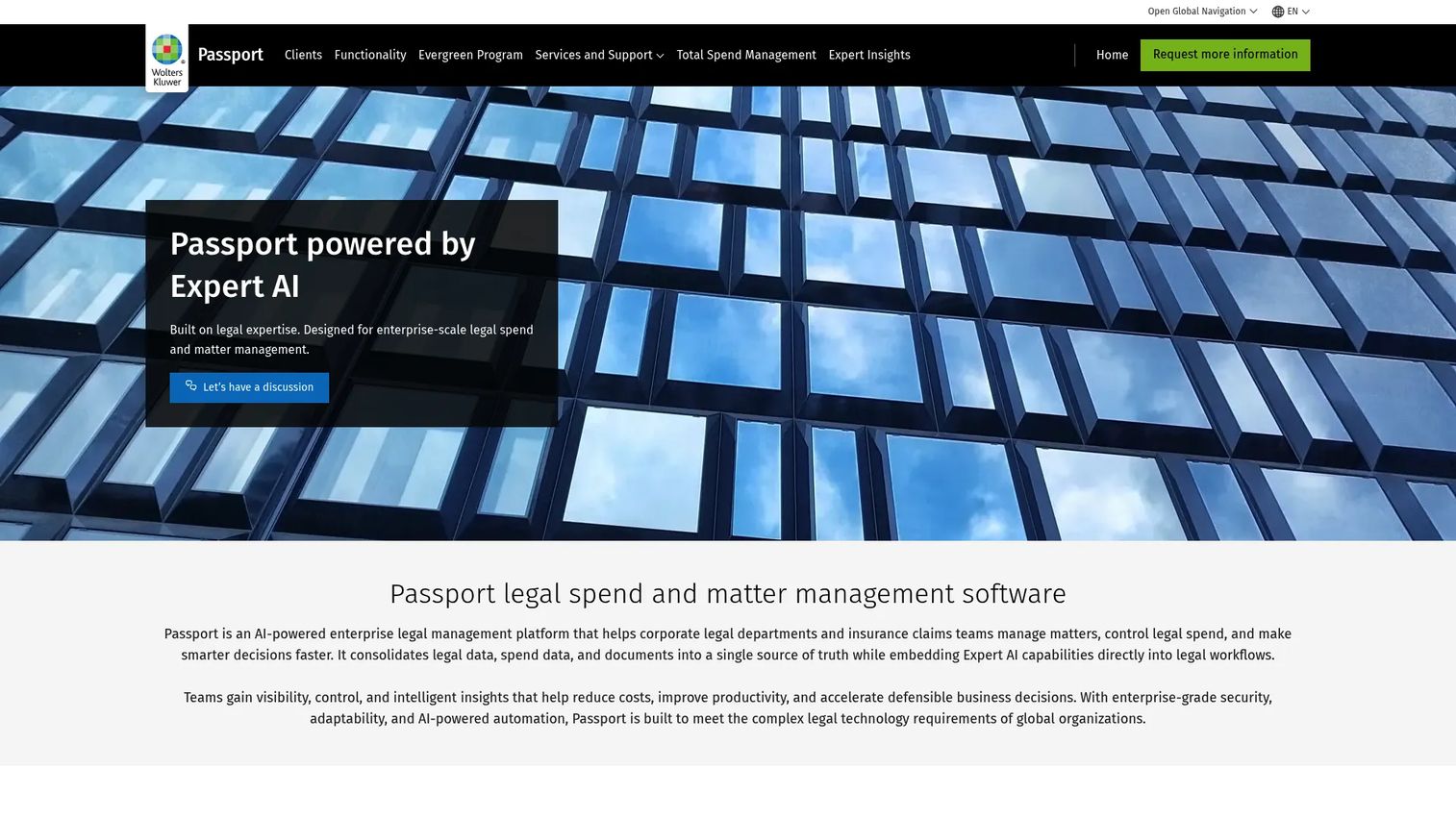
Passport is an AI-powered enterprise legal management platform from Wolters Kluwer designed for large corporate legal departments and insurance claims defense teams. It centralizes matter and spend management, automates billing-rule enforcement, and integrates with Microsoft Office workflows. The platform covers the full legal operations cycle from matter intake through invoice approval and analytics.
Best for: Large in-house legal departments and insurance organizations needing highly configurable enterprise-grade legal spend and matter management.
Key features
- Matter lifecycle management and outside counsel collaboration
- AI-powered matter summarization and invoice analysis
- Automated billing-rule enforcement and compliance workflows
- Reporting, analytics, and benchmarking dashboards
- Configurable integrations and connector library
Why choose Passport: The platform suits large legal departments that need a broad system of record rather than a narrow spend or matter tool. Its AI-assisted invoice review and configurable workflow engine make it a practical fit for teams managing high matter volumes.
Passport pricing: Wolters Kluwer directs prospective buyers to request a demo rather than displaying plan prices. Pricing is handled through a sales conversation, with cost driven by department size, modules selected, and implementation scope.
G2 rating: Not enough reviews for an aggregate rating on G2 at the time of publication.
2. TyMetrix 360
TyMetrix 360 is a SaaS-based e-billing and legal matter management platform from Wolters Kluwer, built for corporate legal departments and insurance claims organizations. It covers legal spend management, electronic billing, matter tracking, law firm collaboration, and Power BI analytics. Teams use it to control outside counsel costs, enforce billing guidelines, and report on legal spend with benchmark comparisons.
Best for: Enterprise legal teams whose primary operating problem is invoice control and outside counsel spend visibility.
Key features
- E-billing workflows with automated invoice review
- Legal matter management and status tracking
- AI-powered matter summarization
- Power BI analytics and legal spend benchmarking
- Budget, rate, and outside counsel spend management
Why choose TyMetrix 360: A strong fit when the business case centers on invoice accuracy, spend reporting, and law firm collaboration. Teams that need benchmarking data alongside billing controls will find the Power BI integration useful for board-level reporting.
TyMetrix 360 pricing: Wolters Kluwer presents TyMetrix 360 through a request-a-demo model. Pricing is not publicly displayed and is determined through a sales process based on usage and module selection.
G2 rating: 3.6/5
3. Brightflag
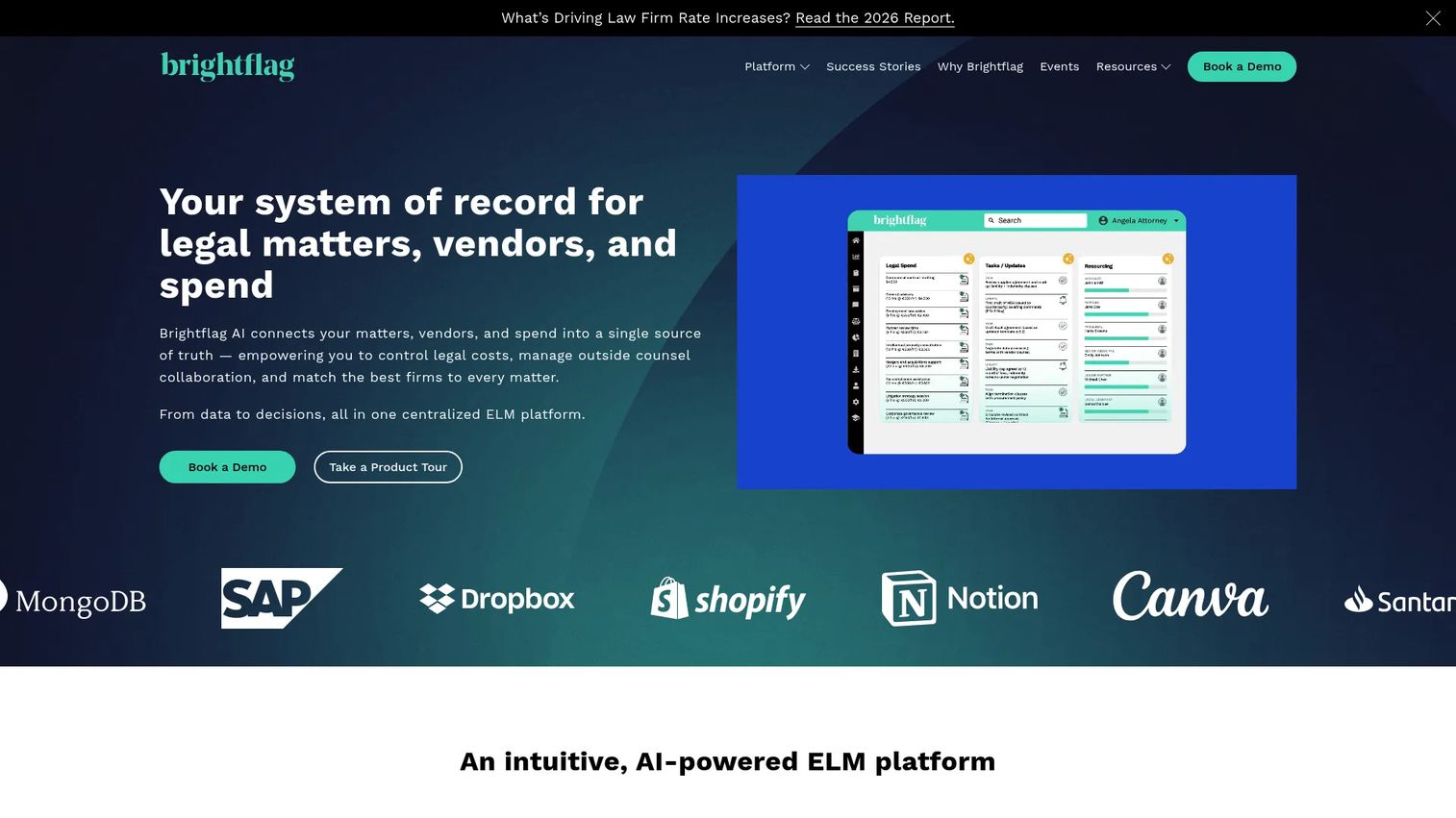
Brightflag is an AI-powered enterprise legal management platform for corporate legal teams, with particular strength in legal spend management and outside counsel cost control. It combines AI-assisted invoice review with matter management, budgeting, accruals, and a generative AI assistant called Ask Brightflag. Legal and finance teams use it to answer spend questions without waiting on monthly invoice reconciliation.
Best for: Corporate legal departments where the primary pain is knowing where outside counsel spend is going before the invoice arrives.
Key features
- AI invoice review and billing-guideline enforcement
- Matter budgets, accruals, and spend forecasting
- Legal spend dashboards and reporting
- Outside counsel collaboration portal
- Generative AI assistant (Ask Brightflag) for spend queries
Why choose Brightflag: Useful when legal and finance need faster answers on matter-level cost. The AI invoice review layer reduces manual line-item scrutiny, and the matter budget tracking helps founders and CFOs avoid surprise spend at quarter close.
Brightflag pricing: Brightflag structures pricing as a fixed one-time implementation fee combined with an annual subscription tied to outside counsel spend volume. Specific amounts require a sales conversation.
G2 rating: 4.6/5
4. Thomson Reuters Legal Tracker
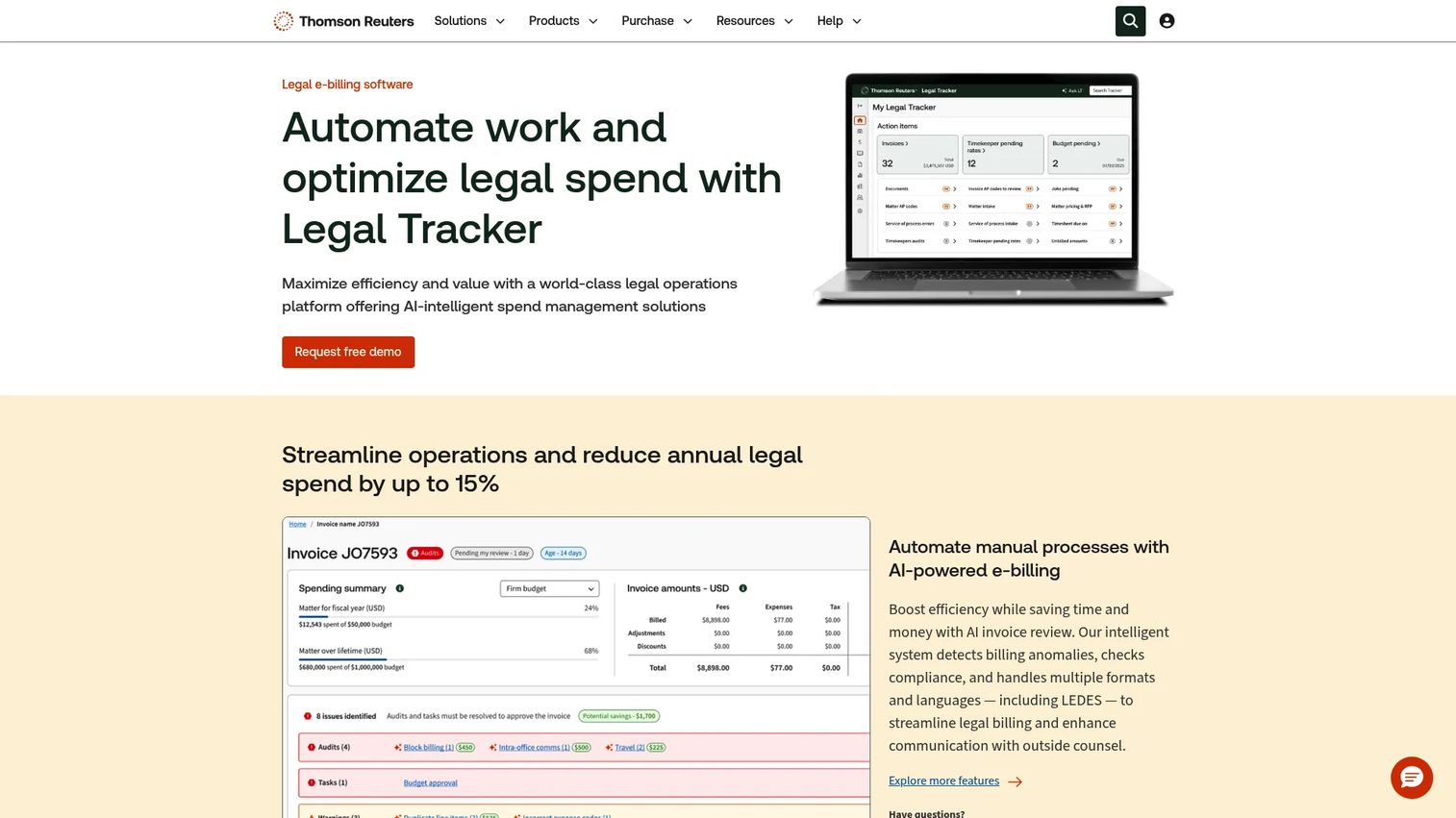
Thomson Reuters Legal Tracker is an AI-powered legal operations platform covering e-billing, matter management, legal spend, analytics, and outside counsel collaboration. It integrates with iManage, NetDocuments, Microsoft Outlook, SharePoint, Power BI, and Tableau. Large legal departments use it as a system of record for managing law firm relationships, invoice compliance, and legal spend benchmarking.
Best for: Corporate legal departments with established legal operations that need mature e-billing, budget controls, and deep analytics integrations.
Key features
- Electronic billing with invoice auditing and billing-guideline enforcement
- Matter management with searchable repositories and collaboration
- Legal analytics, benchmarking, and scheduled reporting
- Integrations with iManage, Outlook, SharePoint, Power BI, and Tableau
- Advanced AI for workflow efficiency and billing compliance
Why choose Thomson Reuters Legal Tracker: A reliable choice for legal teams already invested in the Thomson Reuters ecosystem or those who need enterprise-grade matter and spend infrastructure with broad integration support.
Thomson Reuters Legal Tracker pricing: Pricing is not publicly listed. Thomson Reuters directs prospective customers to request a demo or contact a sales representative.
G2 rating: 4.6/5
5. LawVu Legal Workspace
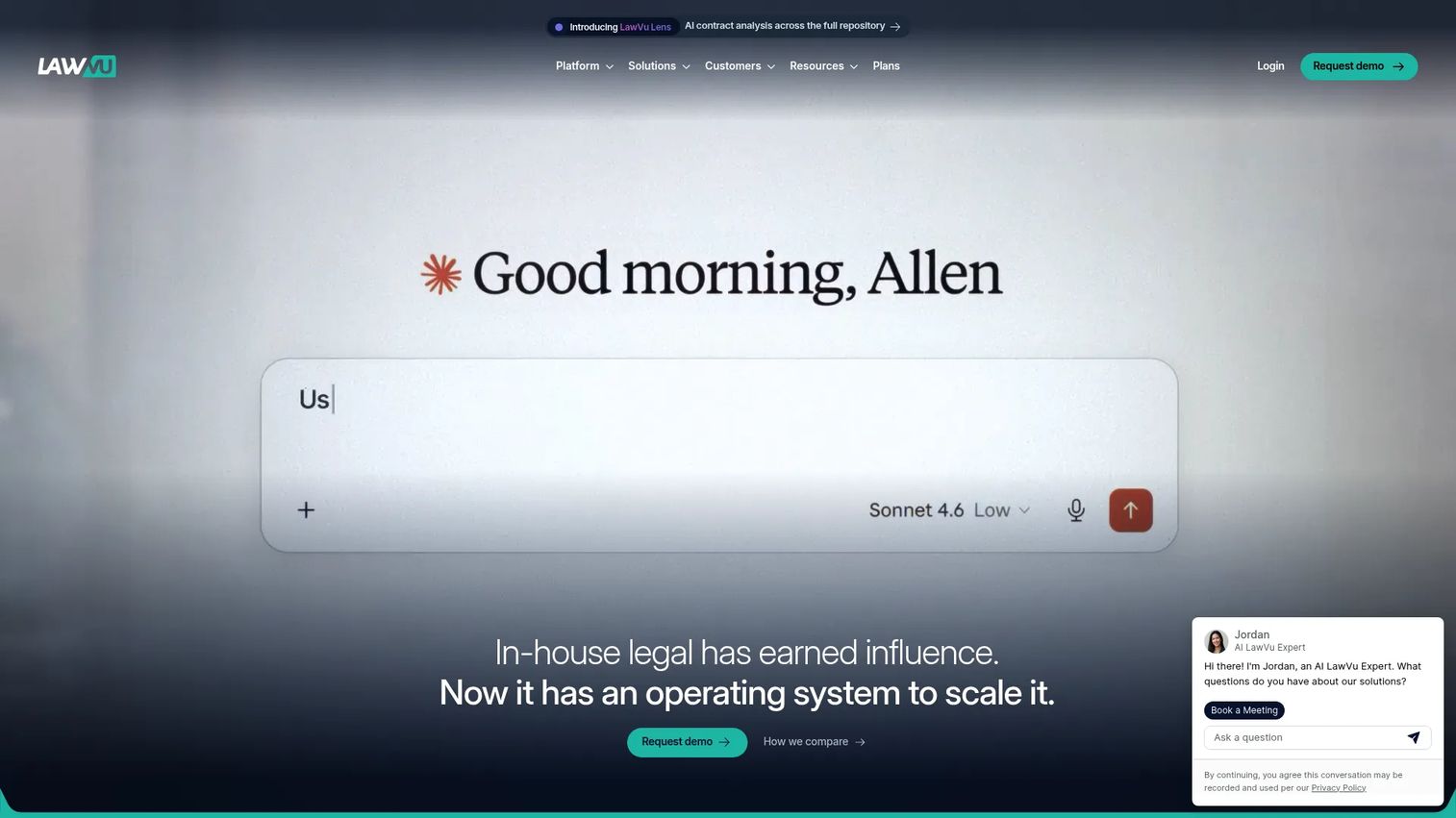
LawVu is a unified legal operating system for in-house teams that combines legal requests, matters, contracts, documents, spend management, and AI-assisted workflows in one platform. It integrates with Microsoft 365, Outlook, Gmail, Box, SharePoint, Salesforce, Slack, and DocuSign. In-house teams use it as a single front door for all legal work across the business.
Best for: Modern in-house legal teams seeking one platform for intake, matter management, contracts, spend, and reporting rather than connecting separate point tools.
Key features
- Legal intake, triage, and request tracking
- Matter workspace with document and knowledge management
- Contract lifecycle management
- Legal spend management and e-billing
- Interactive reporting dashboards and AI-powered document analysis
Why choose LawVu: A strong fit when the legal team wants to give business stakeholders one place to submit requests and track status, while attorneys manage matters and contracts in the same environment. The breadth of integrations reduces friction with existing enterprise tools.
LawVu pricing: Pricing is based on plans and users. LawVu directs prospects to contact sales or request a demo; module and user selection drive the final cost.
G2 rating: 4.5/5
6. OnitX Enterprise Legal Management (ELM)
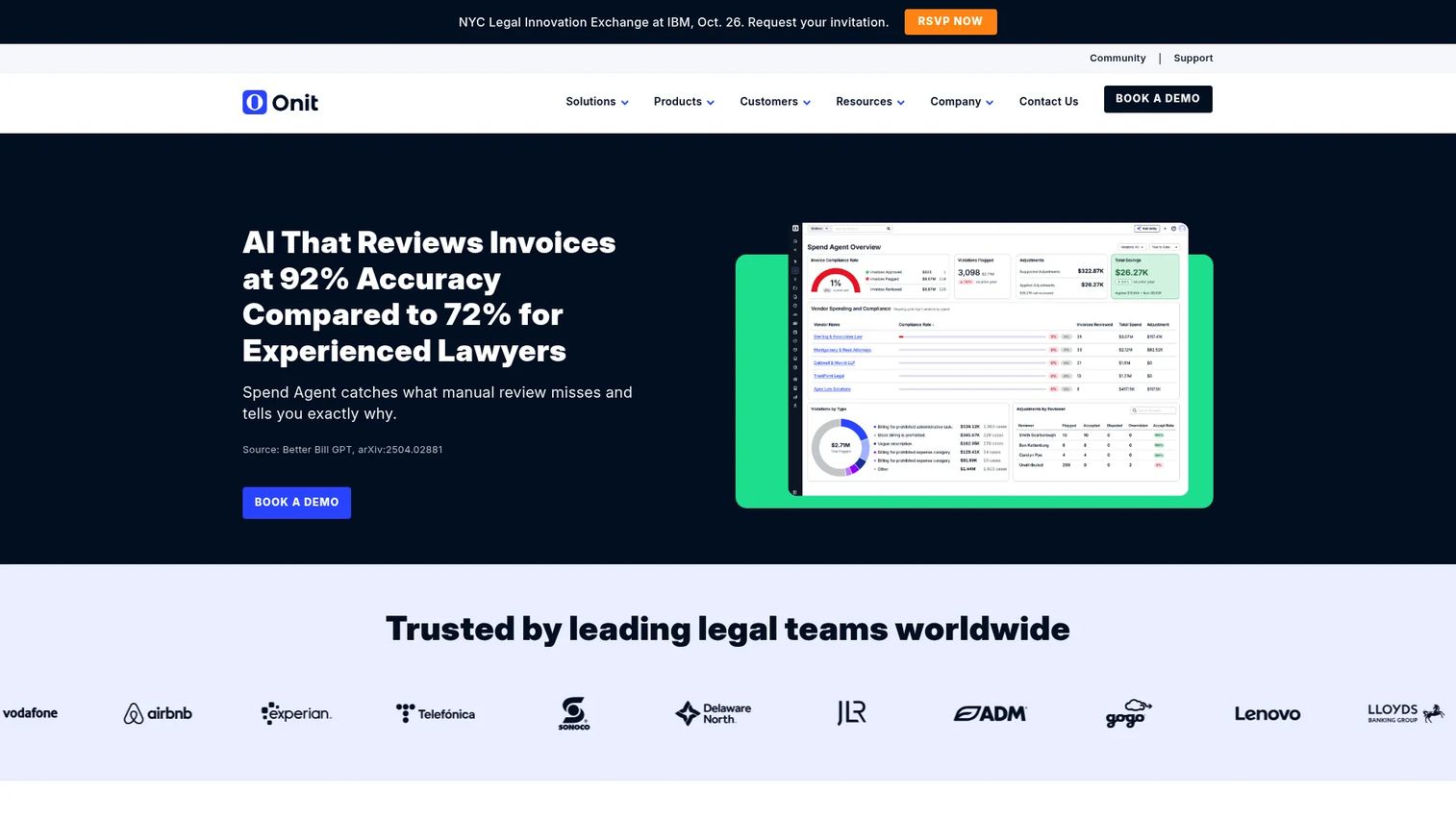
OnitX Enterprise Legal Management is an enterprise legal operations platform from Onit covering matter intake, spend management, invoice processing, configurable billing rules, and multi-currency workflows. It includes an AI-powered invoice review capability called Spend Agent and supports multi-language, VAT-compliant billing across global legal operations.
Best for: Large corporate legal departments with complex, multi-region workflows that require highly configurable legal operations and governed spend management.
Key features
- Structured matter intake with configurable billing rules
- AI-powered invoice review through Spend Agent
- Multi-currency, multi-language, and VAT-compliant workflows
- Centralized legal operations with reporting and auditability
- Configurable alternative fee arrangements and budget tracking
Why choose OnitX: The platform suits legal teams managing diverse matter types across multiple jurisdictions. The configurable workflow engine handles process complexity that simpler tools cannot accommodate.
OnitX ELM pricing: Pricing requires a sales conversation. Cost is driven by modules selected, implementation scope, user count, and integration requirements.
G2 rating: 4.6/5
7. TeamConnect
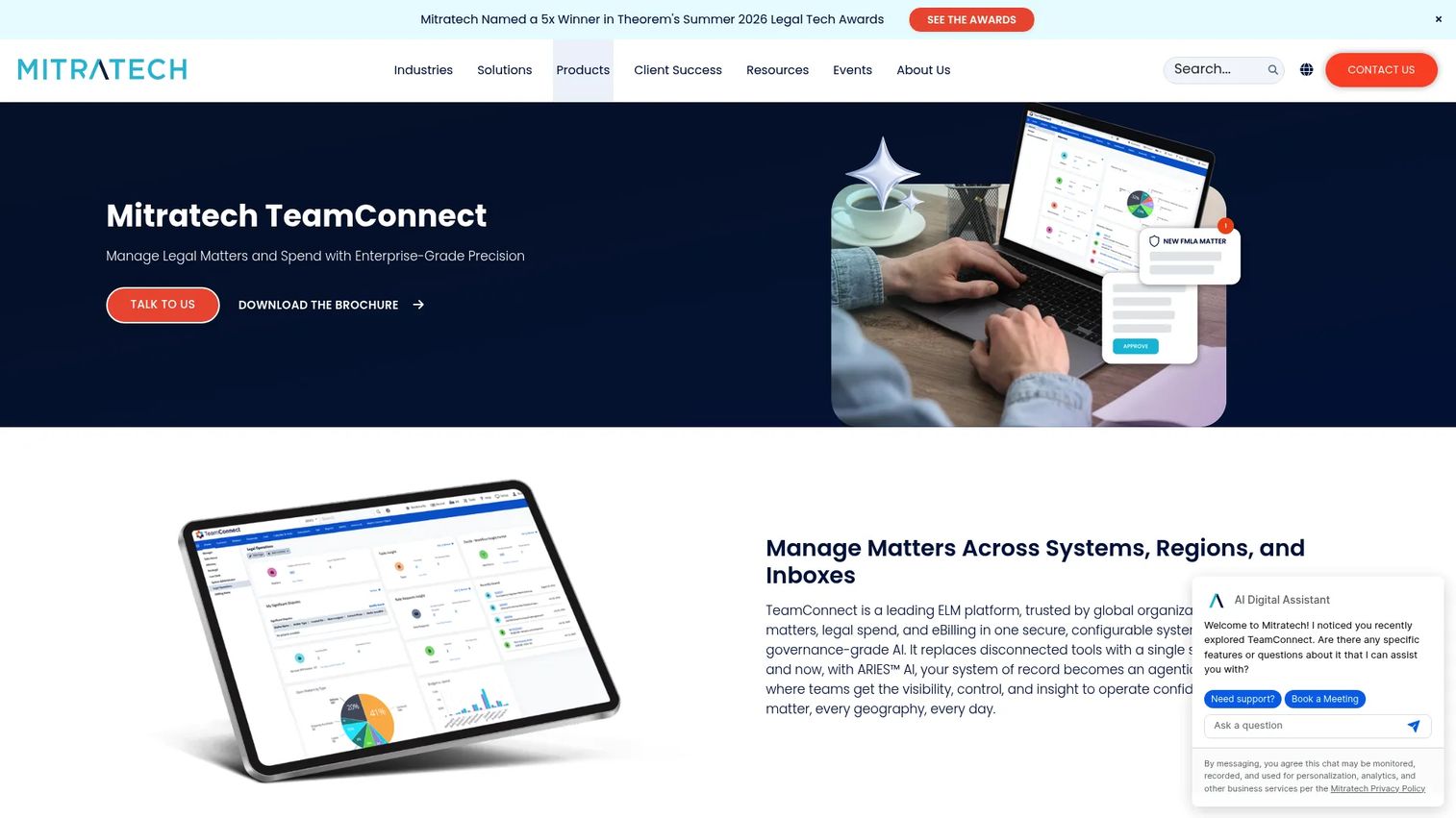
TeamConnect is an enterprise legal management platform from Mitratech for managing legal matters, documents, workflows, compliance, and legal spend across global legal operations. It includes ARIES AI capabilities, intelligent intake and triage, and supports both cloud and on-premises deployment. Enterprise legal departments use it to manage high matter volumes with strong reporting and governance.
Best for: Enterprise legal operations teams managing complex, global matter portfolios where configurable workflows and flexible deployment options matter.
Key features
- Legal matter management and document management
- Legal spend management and eBilling
- Intelligent legal intake and triage
- Workflow automation and ARIES AI capabilities
- Reporting, analytics, and dashboards
- Cloud or on-premises deployment
Why choose TeamConnect: A good fit for mature legal operations teams with dedicated legal ops ownership and complex process requirements. The ARIES AI capabilities and flexible deployment model differentiate it for organizations with specific infrastructure constraints.
TeamConnect pricing: Mitratech presents TeamConnect through a sales-led process. Pricing is not publicly displayed and is determined by deployment model, modules, and user count.
G2 rating: 4.7/5
8. HighQ
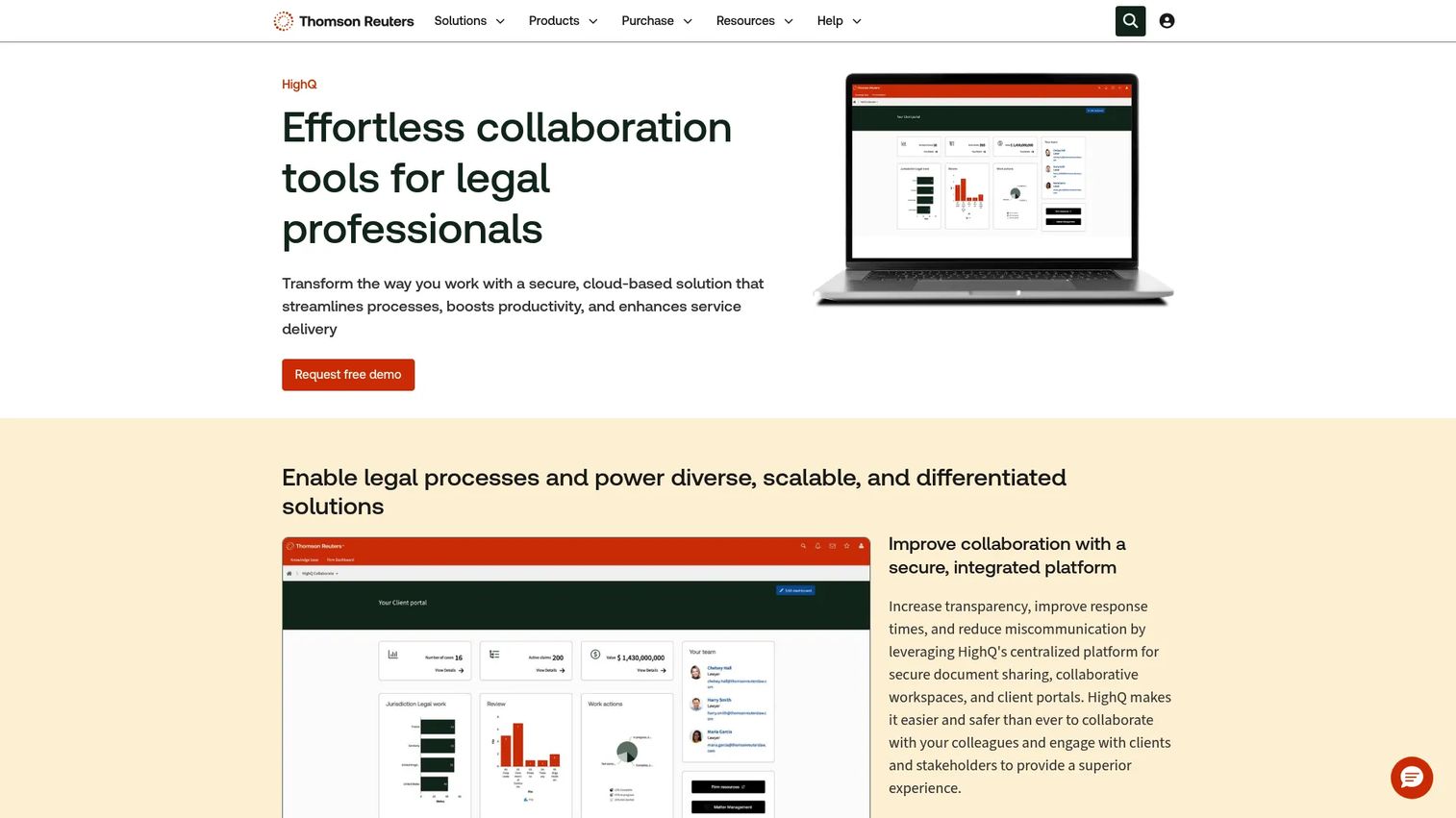
HighQ is a secure, cloud-based collaboration and legal workflow platform from Thomson Reuters for law firms, corporate legal departments, and government organizations. It supports client portals, virtual data rooms, secure file storage, workflow automation, document management, and AI-enabled document insights.
Best for: Legal teams that prioritize secure collaboration around matters and documents, particularly those managing client portals or complex document workflows.
Key features
- Client portals, virtual data rooms, and secure file storage
- Workflow, document, and legal project automation
- AI-enabled document insights and self-service Q&A
- Legal project management and matter workspaces
- Drafting integration and due diligence workflow support
Why choose HighQ: A strong fit when the legal team's primary need is secure collaboration on matters and documents rather than full spend management. It complements broader ELM deployments for teams that need a client-facing or matter-facing collaboration layer.
HighQ pricing: Pricing is not publicly displayed. Thomson Reuters directs buyers to contact sales for plan details and costs.
G2 rating: 4.3/5
9. Legal Suite
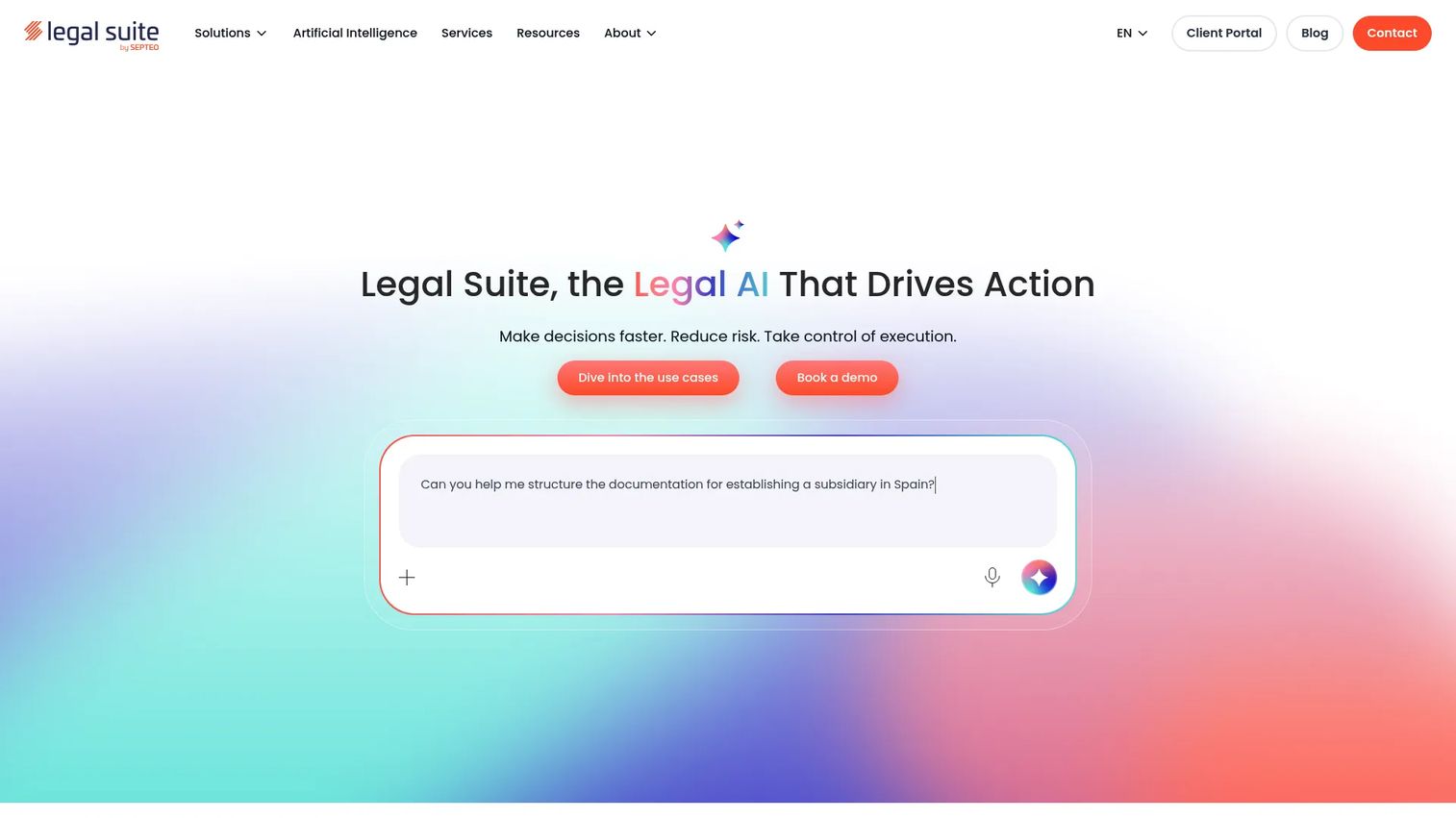
Legal Suite is a modular legal management platform from Septeo for corporate legal departments and government organizations. It covers contracts, matters, legal spend, corporate entities, leasing, intellectual property, litigation, and collaborative intake in a configurable platform. Teams use it when they need broad operational coverage across multiple legal work types.
Best for: Corporate legal and government legal teams seeking a configurable, multi-module platform that covers diverse legal operations beyond matters and spend.
Key features
- Contract lifecycle management and legal matter management
- Legal spend and invoice management
- Corporate entity and IP management
- Litigation management and collaborative intake portal
- AI-assisted legal operations
Why choose Legal Suite: Useful when the legal department manages a wide range of legal work types and needs operational coverage across entities, IP, and litigation alongside matters and spend. The modular structure allows teams to adopt what they need.
Legal Suite pricing: Pricing is not publicly displayed on the vendor site. Interested buyers should contact Legal Suite or its parent company Septeo directly.
G2 rating: 2.0/5
10. Apperio
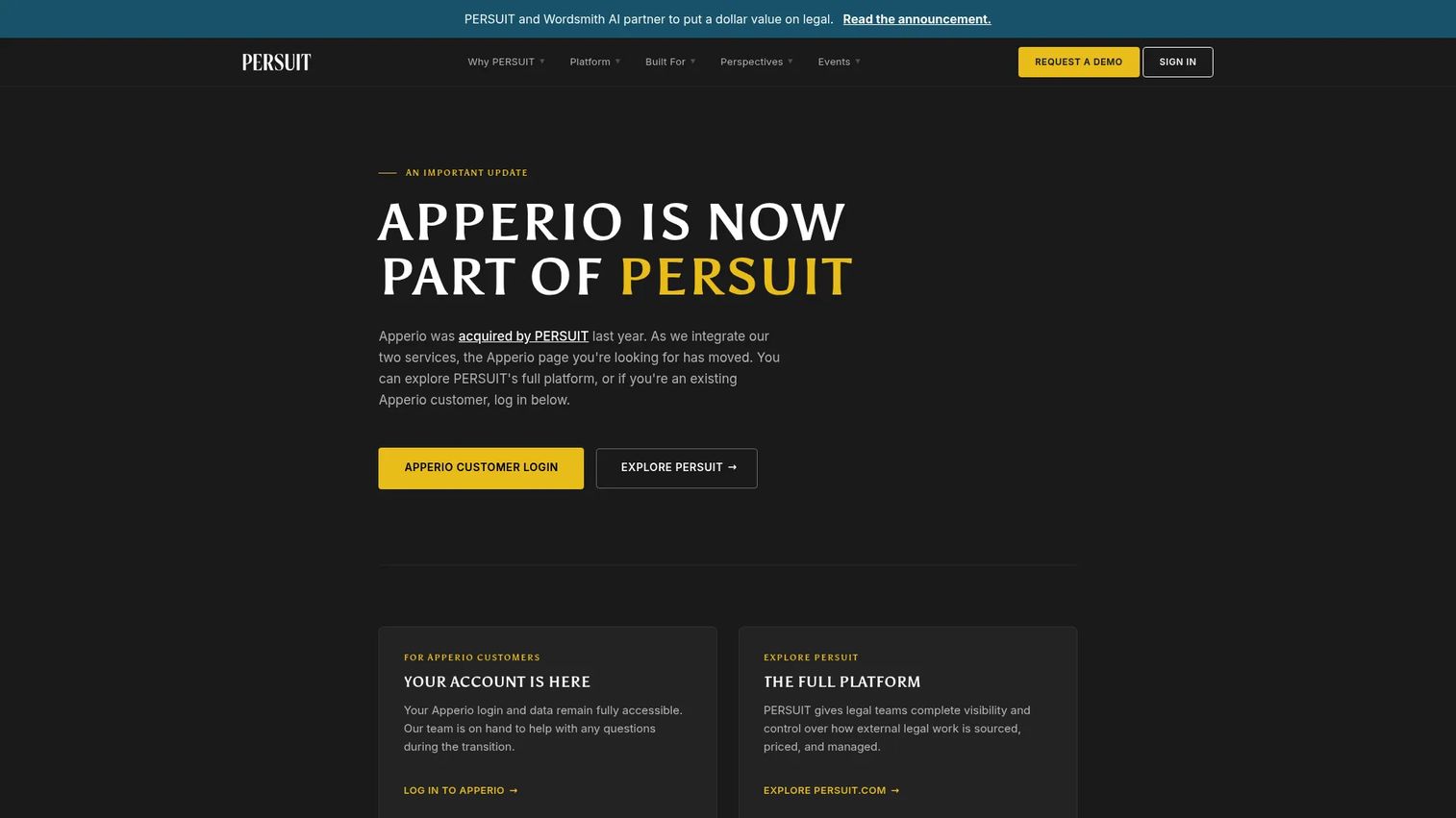
Apperio, now part of PERSUIT, is a legal spend and e-billing platform that provides continuous visibility into outside counsel work, costs, budgets, and billing data. Legal and finance teams use it to see spend as it accumulates rather than waiting for monthly invoice packages.
Best for: Corporate legal departments and law firms where the core problem is knowing what outside counsel spend looks like before the invoice arrives.
Key features
- Real-time legal spend visibility and tracking
- Legal spend analytics and reporting
- Budget and accrued-cost monitoring
- Outside counsel collaboration and billing data capture
- Matter-level financial tracking
Why choose Apperio: A direct fit for teams where invoice surprise is the most immediate pain. Real-time spend tracking against budgets helps legal operations and finance avoid the month-end reconciliation problem that drives forecast inaccuracy.
Apperio pricing: Pricing is not publicly displayed. Apperio is now part of PERSUIT; prospective buyers should contact sales for current plan details.
G2 rating: 5.0/5
11. Legal Files
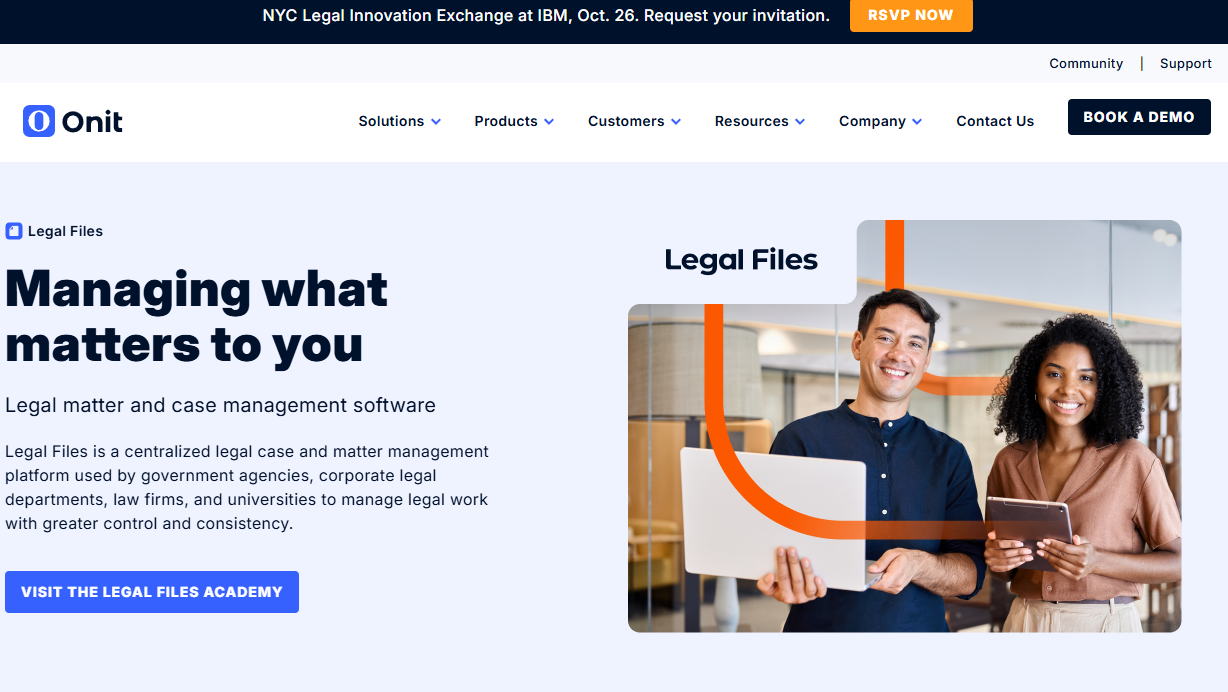
Legal Files is a matter and case-management platform for organizing cases, documents, emails, deadlines, contacts, and workflows across legal departments, law firms, government agencies, universities, and insurers. It supports both cloud and on-premises deployment and includes full-text search across case files.
Best for: Legal departments, government agencies, and insurers that need structured matter and document management without deploying a large enterprise ELM stack.
Key features
- Document management and full-text search across case files
- Document assembly and workflow rules
- Task assignment, deadline tracking, and email automation
- Customized dashboard with reminders and alerts
- Cloud or on-premises deployment options
Why choose Legal Files: A practical fit for teams that need reliable matter tracking and document organization rather than a full spend or e-billing platform. The deployment flexibility makes it suitable for organizations with specific infrastructure requirements.
Legal Files pricing: Pricing requires a sales conversation. Specific figures are not publicly displayed on the vendor's site.
G2 rating: 3.3/5
12. Matter.Space
Matter.Space is a matter-management platform for corporate legal departments and law firms. It covers matter information management, document and email handling, full-text knowledge search, workload tracking, and deadlines. The platform supports cloud, private-cloud, and hybrid deployment, and integrates with the Microsoft ecosystem.
Best for: Corporate legal teams seeking centralized legal matter, document, and workload management with flexible deployment options.
Key features
- Matter information management and knowledge search
- Document and email management
- Workload and deadline management
- Microsoft ecosystem integrations
- Cloud, private-cloud, and hybrid deployment
Why choose Matter.Space: A good starting point for teams that need matter organization and document control without building out full spend and e-billing infrastructure. Its Microsoft integration suits organizations already running on the Microsoft stack.
Matter.Space pricing: Pricing is handled through a sales process. The vendor's site did not resolve to a public pricing page during research.
13. RazorSign
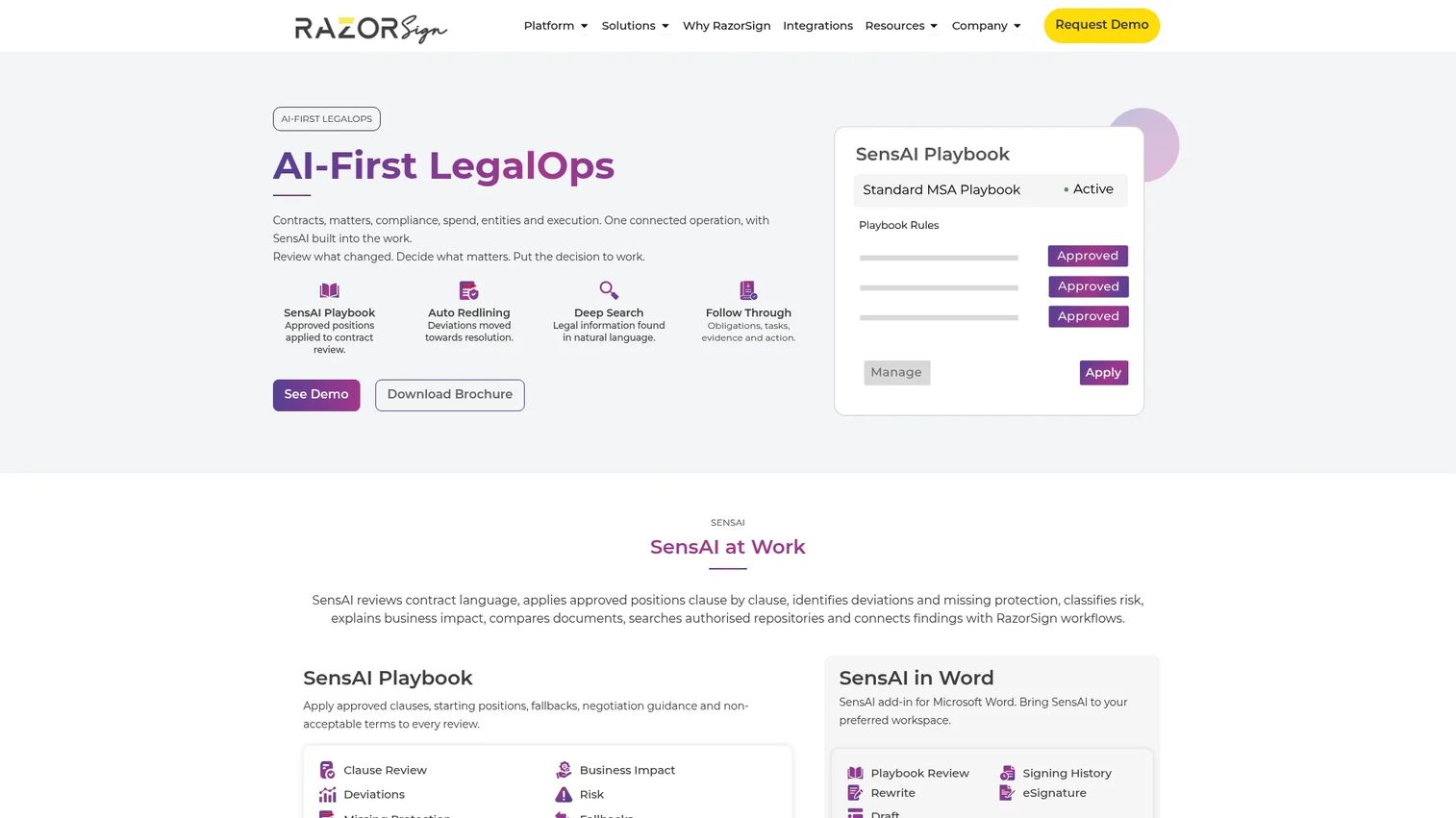
RazorSign is an AI-first legal operations platform covering contracts, matters, compliance, legal spend, corporate entities, and electronic execution. Its AI-assisted contract review applies playbooks, risk classification, deviation detection, and auto-redlining. The platform also covers electronic signatures, e-stamping, clickwrap agreements, bulk signing, and e-KYC.
Best for: Enterprise legal teams seeking an integrated LegalOps and contract management platform with electronic execution built in.
Key features
- AI-assisted contract review with risk classification and auto-redlining
- Contract lifecycle management from authoring through obligations and renewals
- Electronic signatures, e-stamping, and bulk signing
- Legal matter and spend management
- Corporate entity management and compliance workflows
Why choose RazorSign: A strong fit when the legal team needs contract management and electronic execution alongside matter and spend workflows, particularly in markets where e-stamping and regulatory-grade signing requirements apply.
RazorSign pricing: Pricing is not publicly displayed. Prospective buyers need to contact RazorSign's sales team for plan details.
G2 rating: 4.7/5
14. Xakia
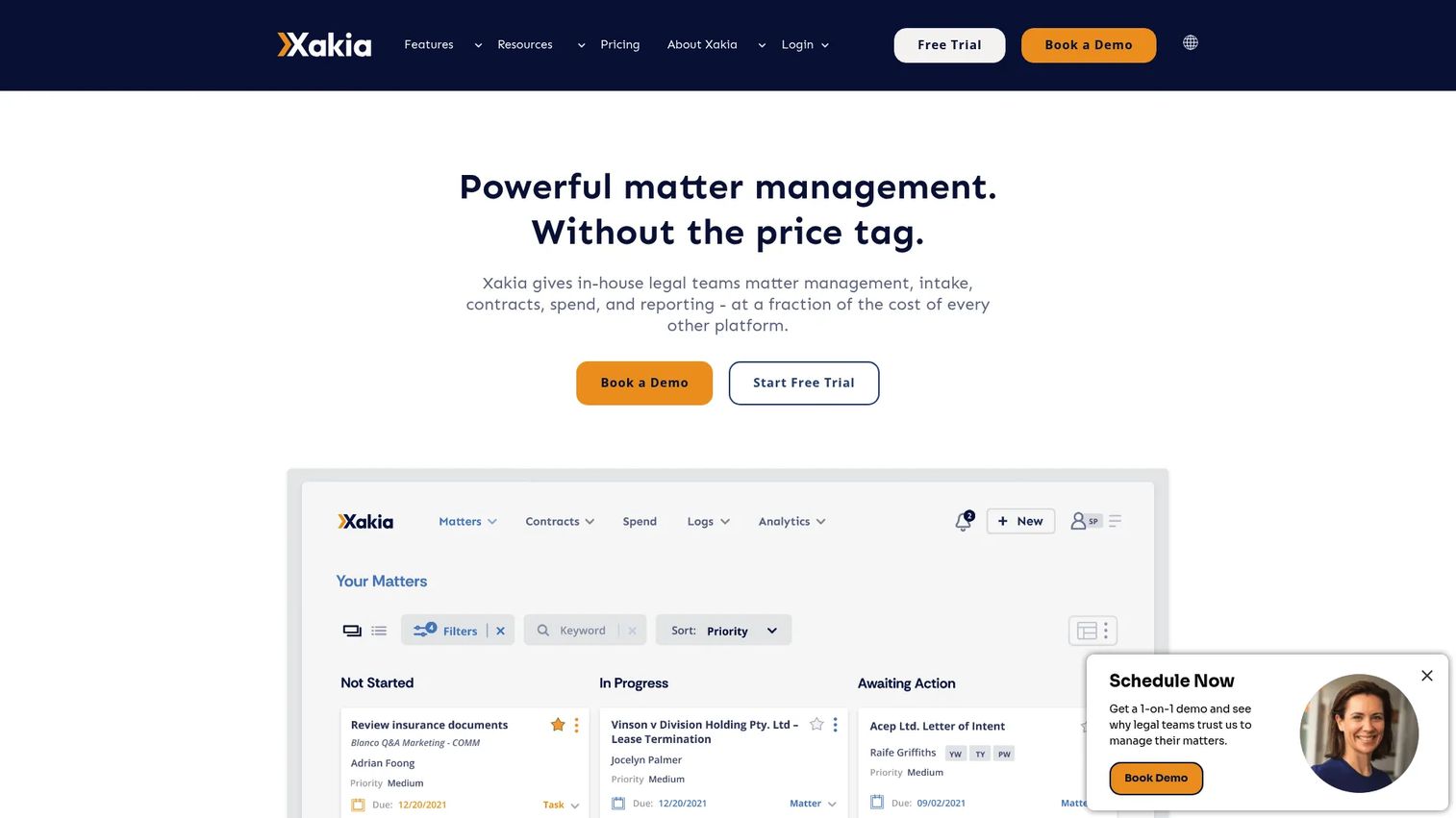
Xakia is an in-house legal operations platform covering matter management, intake, contracts, spend, document management, entity management, and reporting. It is one of the few ELM platforms to publish transparent per-user pricing, making it practical for teams that need to build a business case without going through a sales process first.
Best for: Small to mid-sized in-house legal teams building legal operations discipline who want per-user pricing and a 14-day free trial before committing.
Key features
- Matter and task tracking with legal intake and triage
- Contract lifecycle management and AI contract review
- Spend management and budget tracking
- Document management and entity management
- Dashboards and workload reporting
Why choose Xakia: The combination of transparent pricing, a free trial, and broad feature coverage makes Xakia the easiest platform to evaluate without a lengthy procurement cycle. It suits growing legal teams that want to start with core legal ops and expand.
Xakia pricing: Plans start at $100 per user per month (Advance), with Professional at $125, Enterprise at $155, and All-In at $230. Annual billing offers up to 10% off. A 14-day free trial is available.
G2 rating: 4.5/5
15. Zelican
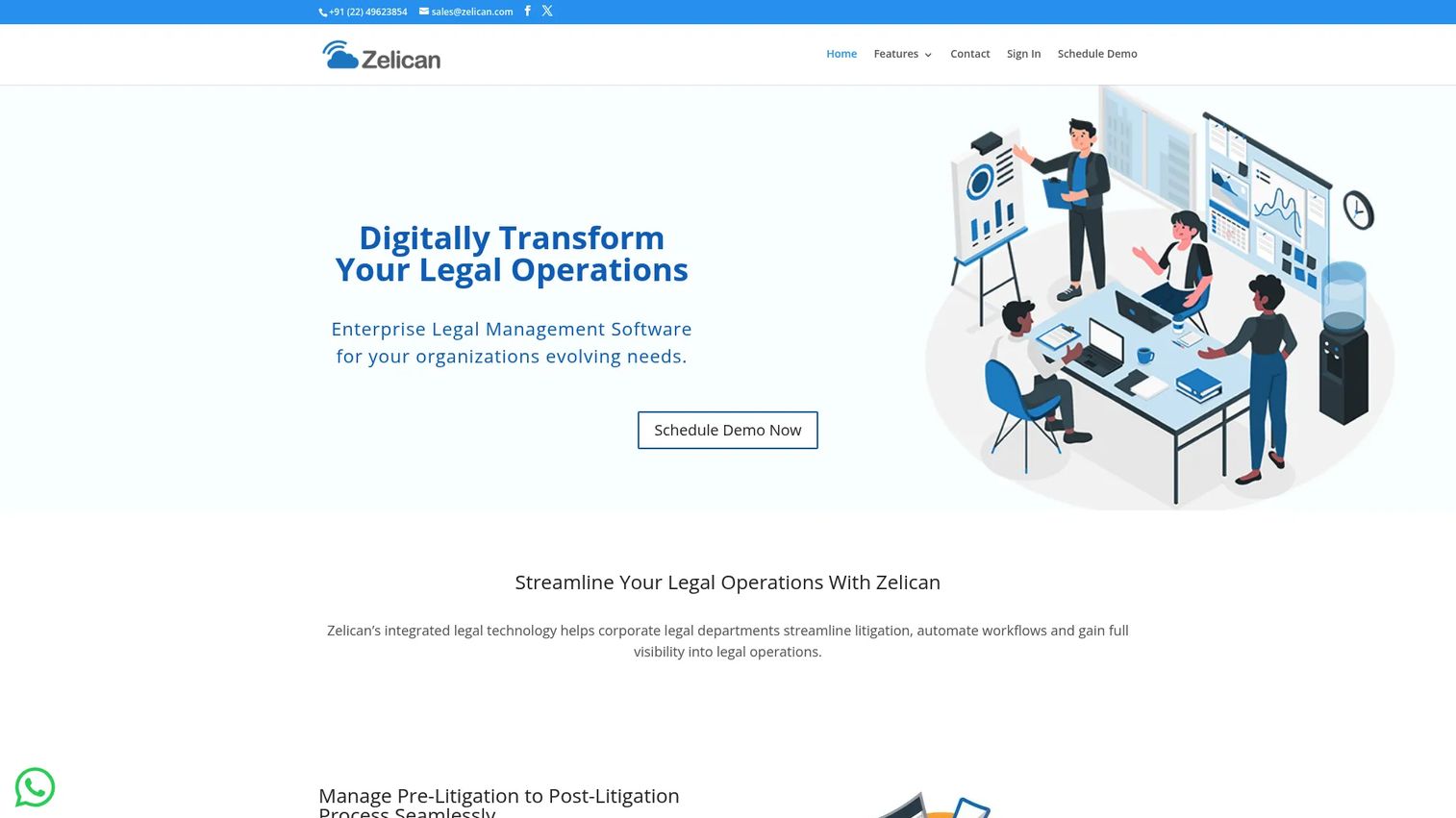
Zelican is an enterprise legal management platform for corporate legal departments and law firms. It covers litigation and matter management, legal billing, document management, court case tracking, hearing-date management, client portal, time tracking, and mobile access for Android and iOS.
Best for: Legal departments with significant litigation volume that need court case tracking, hearing management, and mobile access alongside core matter and billing workflows.
Key features
- Litigation and matter management with court case tracking
- Legal billing, invoicing, and expense management
- Legal document management and automation
- Client portal and secure messaging
- Mobile access for Android and iOS
Why choose Zelican: A practical fit when litigation is a primary work type and the legal team needs hearing-date management and court tracking alongside standard matter and billing functions. Mobile access supports attorneys who work across locations.
Zelican pricing: Annual subscription fees are determined through mutual discussion with the vendor. Pricing is not publicly displayed.
16. Acuity ELM Essentials
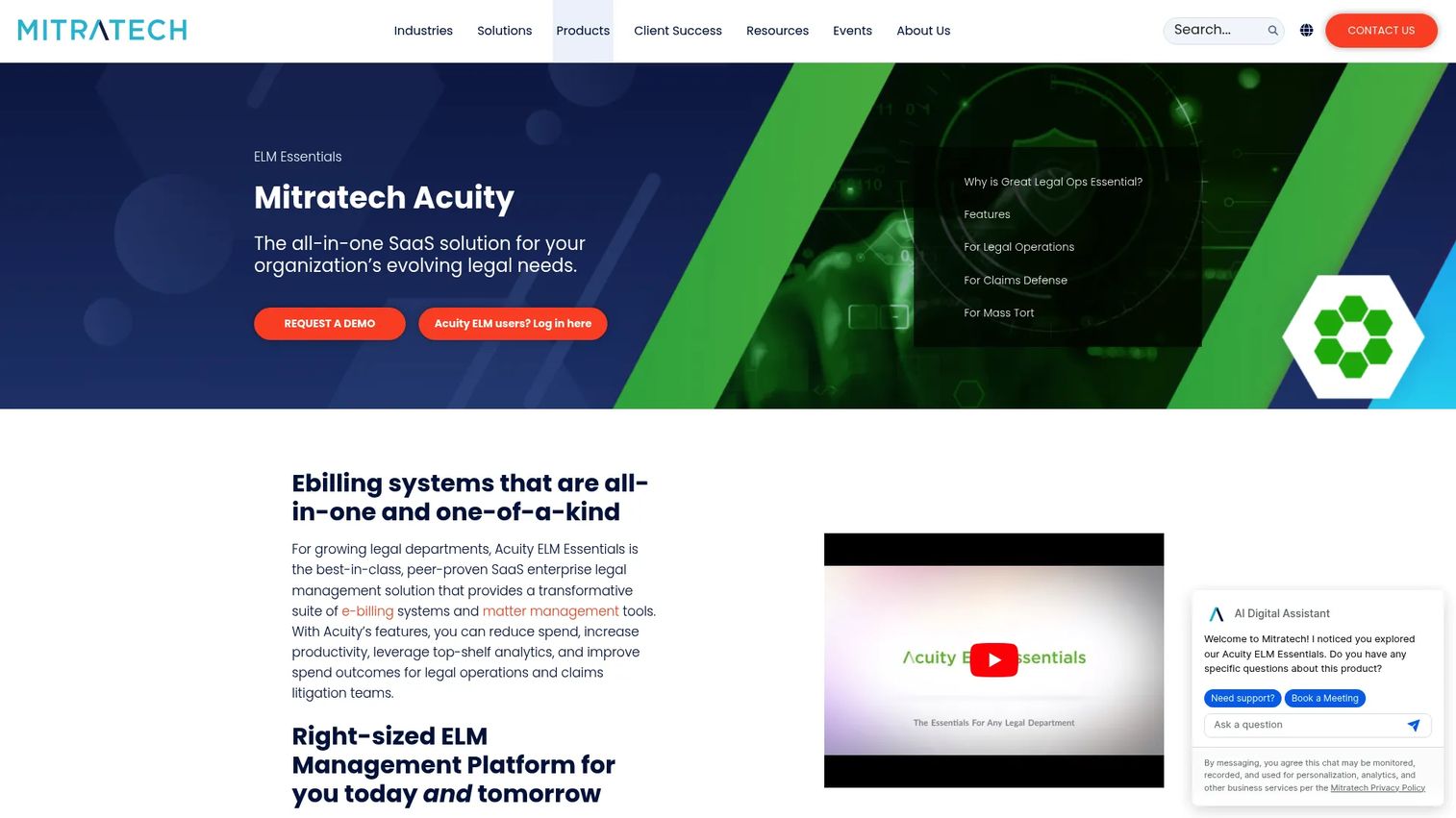
Acuity ELM Essentials is a SaaS enterprise legal management platform from Mitratech positioned as an all-in-one solution for legal operations and claims management. It covers core ELM functions: Matter management, optimized e-billing, and analytics, without the configuration complexity of larger enterprise platforms.
Best for: Small to mid-sized legal departments and claims teams that need core ELM capabilities without overbuilding their legal infrastructure.
Key features
- Matter management and status tracking
- Optimized e-billing workflows
- Legal spend analytics and reporting
- Vendor management
- Claims management support
Why choose Acuity ELM Essentials: A good fit for teams that need foundational legal operations controls before expanding into advanced workflow or AI capabilities. It avoids the implementation overhead of larger enterprise ELM deployments.
Acuity ELM Essentials pricing: Mitratech does not display pricing publicly for this platform. Cost is determined through a sales conversation.
G2 rating: 4.0/5
17. Ascent ELM
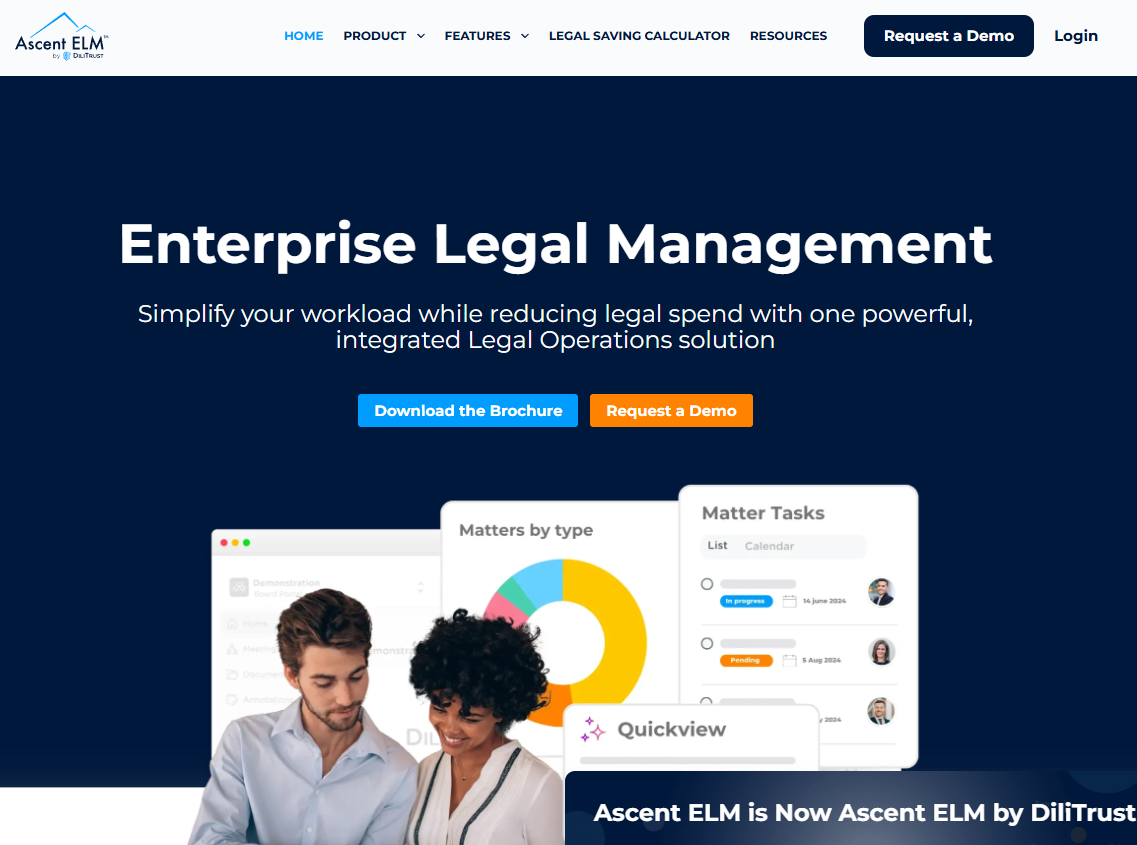
Ascent ELM is enterprise legal management software for managing legal matters, documents, billing, expenses, and workflows. It includes legal case and matter management, document management with full-text search, and billing and invoice tracking for large organizations and in-house legal departments.
Best for: Large organizations needing structured matter tracking, document search, and billing management in a single legal operations system.
Key features
- Legal case and matter management
- Document management and full-text search
- Billing, invoicing, and expense tracking
- Workflow automation
- Reporting dashboards
Why choose Ascent ELM: A fit for organizations where the primary need is matter and document control with billing visibility. The platform offers the foundational ELM layer without the complexity of globally configured multi-module systems.
Ascent ELM pricing: Contact the vendor for a quote.
18. BusyLamp
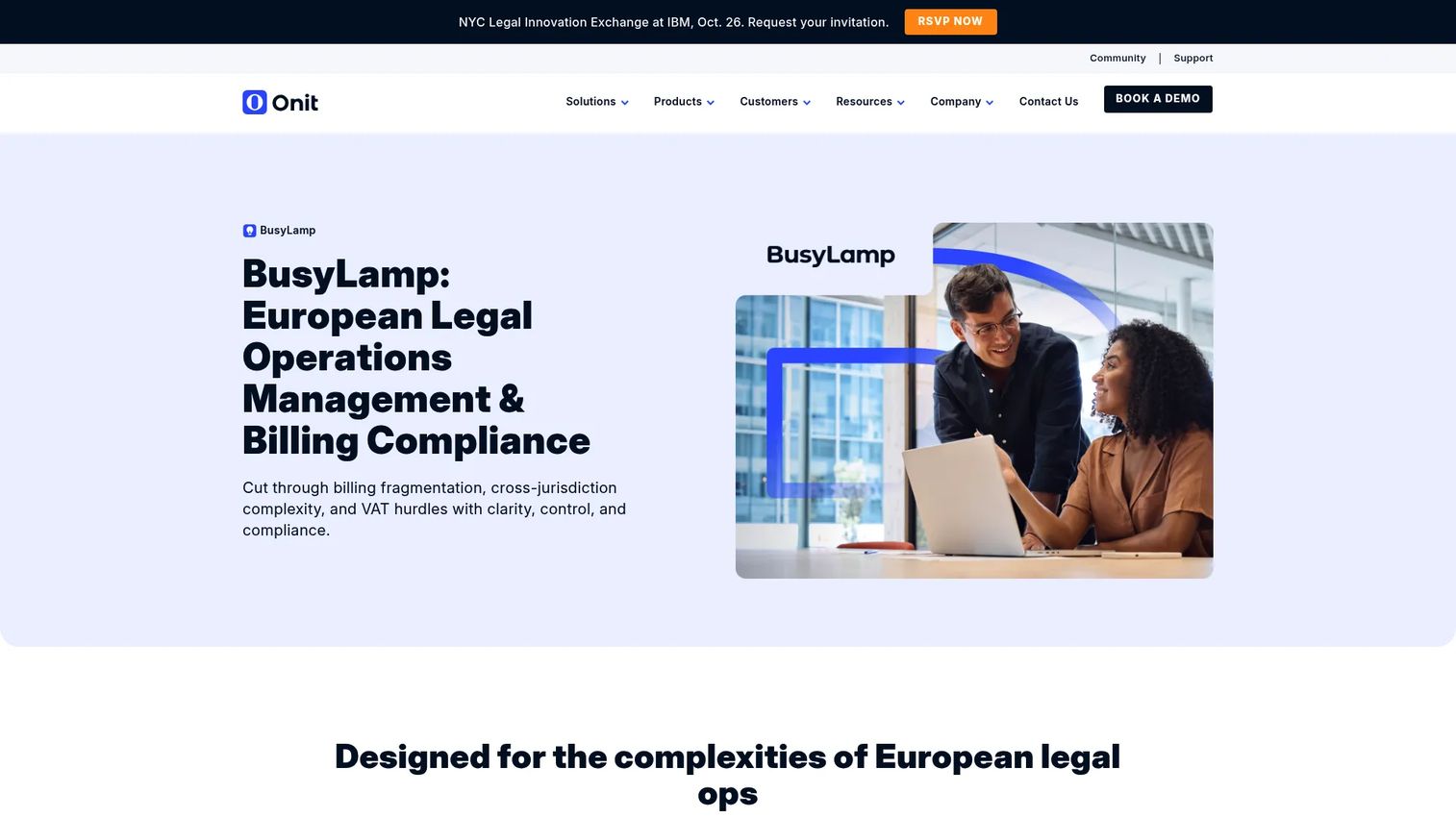
BusyLamp, now part of Onit, is a European legal operations management and billing compliance platform. It automates outside counsel spend and eBilling, with AI-driven invoice validation, LEDES-ready file generation, cross-border eBilling, legal spend analytics, and integrations with AP, ERP, and SSO systems.
Best for: European legal departments managing cross-border outside counsel billing, spend compliance, and legal operations governance.
Key features
- Automated invoice processing and validation
- AI-driven invoice validation and LEDES-ready file generation
- Cross-border eBilling and legal spend analytics
- AP, ERP, and SSO integrations
- Outside counsel billing compliance workflows
Why choose BusyLamp: The platform suits legal teams operating across European jurisdictions where cross-border billing compliance and multi-currency invoice processing are operational requirements. Its Onit integration extends the platform into broader legal operations if needed.
BusyLamp pricing: BusyLamp now routes prospects through Onit for sales conversations.
19. Checkbox
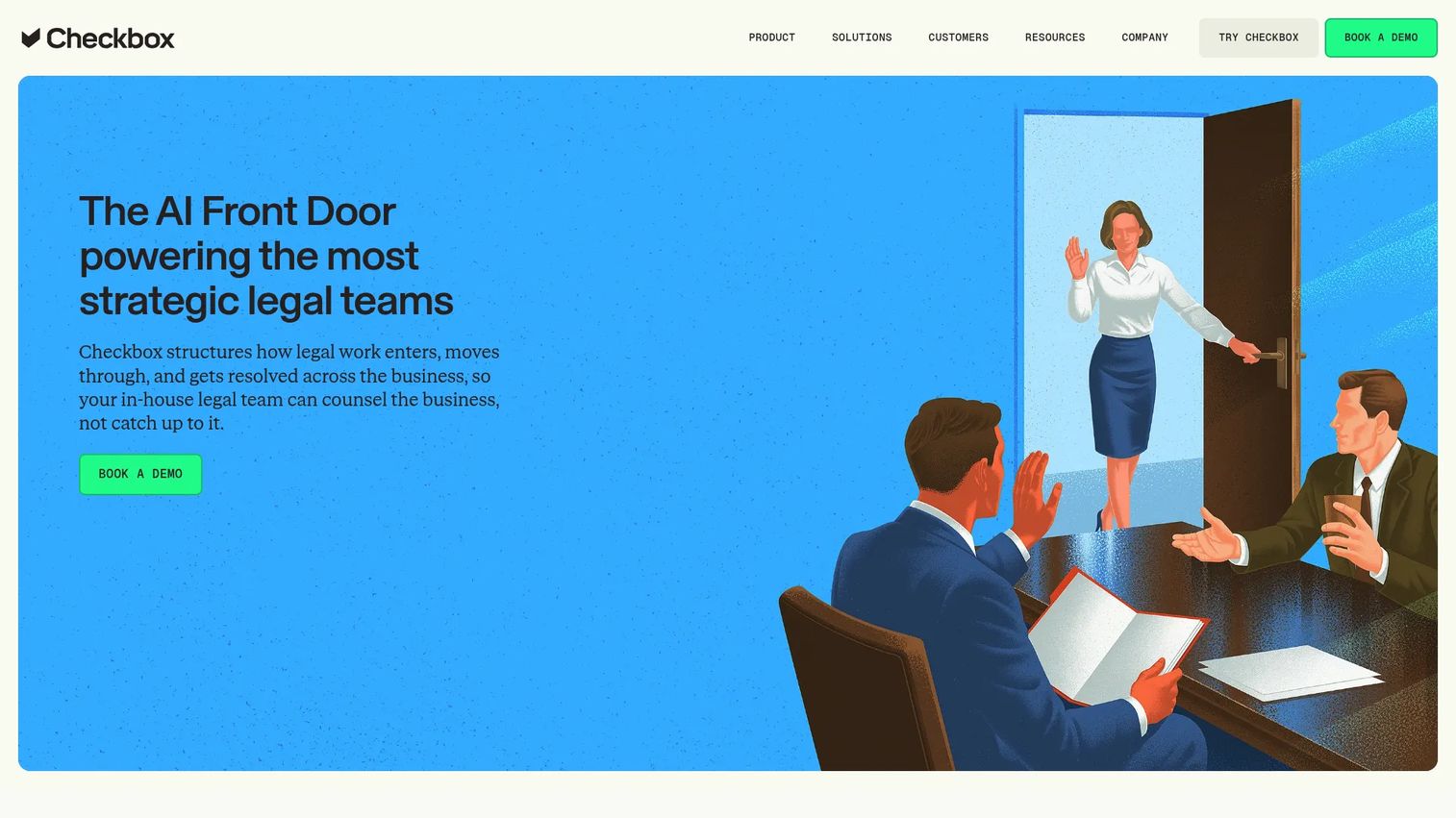
Checkbox is an AI-powered legal operations platform for capturing, routing, automating, and managing in-house legal work. It covers AI-powered intake and question answering, workflow automation, matter tracking, document generation, contract workflows, and dashboards. It integrates with email, Slack, Microsoft Teams, Salesforce, and DocuSign.
Best for: In-house legal teams where the primary problem is request volume and routing rather than full spend management or e-billing infrastructure.
Key features
- AI-powered legal intake and automated triage
- No-code workflow builder and approval routing
- Matter and request tracking
- Document generation and contract workflows
- Integrations with Slack, Teams, Salesforce, and DocuSign
Why choose Checkbox: A strong fit when legal request volume from business partners is the operational bottleneck. It builds the legal front door without requiring a full ELM deployment, making it practical for teams that need intake discipline before building out broader legal operations infrastructure.
Checkbox pricing: Pricing is not publicly displayed. Checkbox routes prospective buyers to a sales conversation for plan details and cost estimates.
G2 rating: 4.3/5
20. Claw Legaltech
Claw Legaltech is a legal practice-management platform for law firms and legal professionals. It covers case management, calendar scheduling, document storage, and time tracking. The platform is positioned for legal professionals who need centralized matter and practice administration.
Best for: Law firms and legal professionals seeking centralized case, document, calendar, and time management in a single practice management tool.
Key features
- Case management and matter tracking
- Calendar scheduling
- Document storage
- Time tracking
- Request management
Why choose Claw Legaltech: A practical fit for law firms or smaller legal operations moving from disconnected tools to a centralized practice management system. It focuses on the fundamentals of case and practice administration rather than enterprise spend or e-billing workflows.
Claw Legaltech pricing: The vendor's site was inaccessible during research. Contact the vendor directly for pricing.
21. Harvey
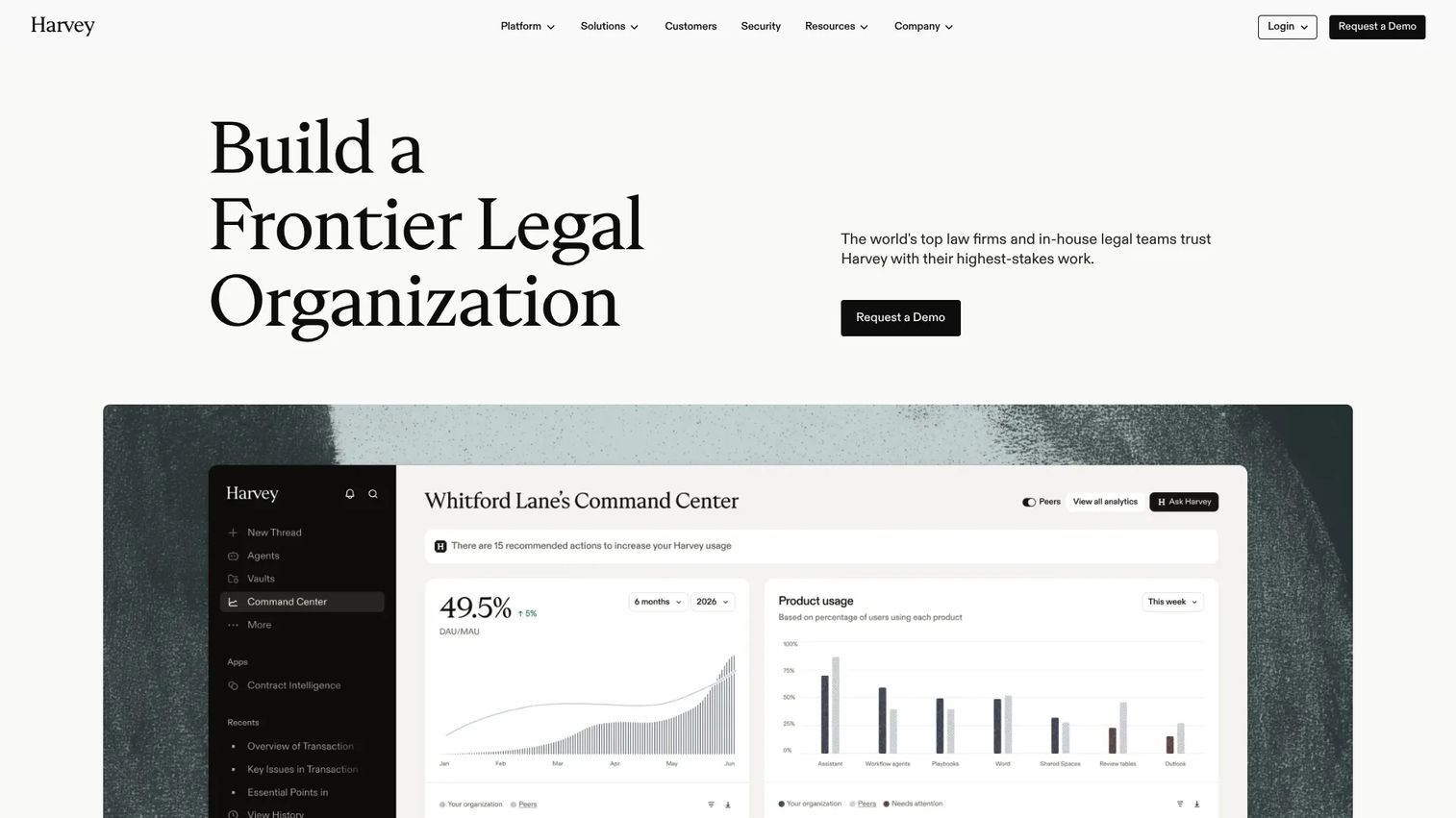
Harvey is an AI software platform for legal and professional-services teams. It supports research, drafting, document review, contract intelligence, and workflow automation through purpose-built legal AI agents. Harvey includes Vault for secure document storage and large-scale review, a Contract Intelligence module, an Agent Builder, and integrations with iManage, SharePoint, and Google Drive.
Best for: In-house legal teams and law firms that want to reduce outside counsel dependency by bringing more legal knowledge work in-house through AI.
Key features
- Purpose-built legal AI agents with parallel execution and custom Agent Builder
- Vault for secure document storage, review tables, and knowledge bases
- Contract Intelligence for contract review, negotiation, and portfolio analysis
- Source-grounded outputs with citations and auditability
- Integrations with iManage, SharePoint, and Google Drive
Why choose Harvey: Harvey addresses the work throughput problem that traditional ELM platforms do not: It helps legal teams do more legal work internally rather than referring it out. Teams that want to reduce outside counsel spend through insourcing, rather than just tracking it, will find Harvey a strong complement to their existing legal operations infrastructure.
Harvey pricing: Harvey uses custom pricing. Prospective buyers engage through a sales or demo conversation for specific plan details.
G2 rating: 4.3/5
Considerations when choosing enterprise legal management software
Matter management depth
Evaluate how the platform structures matter taxonomy, supports custom fields, and connects documents to specific matters. A system that cannot accommodate your matter types without workarounds will create data quality problems over time. Ask whether matter records survive attorney turnover and whether the export format is audit-ready.
Legal spend and e-billing controls
Go beyond invoice processing and evaluate whether the platform enforces billing guidelines automatically, tracks budget against accruals in real time, and gives finance a view without manual exports. The burn multiple impact of uncontrolled outside counsel spend is measurable; the platform you choose should make the spend visible before it's spent, not after.
Intake and workflow fit
Legal intake should match how your business already submits requests. Evaluate whether the intake form can be embedded in Slack, email, or an intranet, and whether non-legal users can track status without logging into the legal system. Approval routing and service-level tracking are table stakes for teams supporting sales, HR, and procurement simultaneously.
Reporting, analytics, and AI
Distinguish between basic dashboards and decision-grade reporting. A chart of open matters is not the same as a spend-by-practice-area trend with year-over-year comparison. AI claims should map to specific jobs: Invoice line-item review, matter summaries, triage routing, or document analysis. Ask for a demonstration of the specific AI workflow rather than accepting a product description.
Implementation, governance, and integrations
Ask who owns the system after rollout. SSO, role-based permissions, and audit trails are non-negotiable for a company preparing for diligence. Verify integrations with your document management system, finance system, and procurement stack before selecting a platform. Implementation timelines vary significantly, and the post-implementation support model should match your legal team's technical capacity.
Conclusion
The right enterprise legal management software depends on where your legal operations break first.
For broad ELM infrastructure, Passport, TeamConnect, Thomson Reuters Legal Tracker, and OnitX handle the full legal operations cycle at scale. For spend control, Brightflag, TyMetrix 360, Apperio, and BusyLamp give legal and finance teams the invoice visibility they need before costs accumulate. For modern in-house legal workspaces, LawVu, Xakia, Checkbox, and HighQ build the intake and collaboration layer without requiring a large enterprise deployment. For legal AI, Harvey addresses the throughput problem by helping teams do more legal work internally.
The most important selection criterion for a founder: Pick the platform that gives legal, finance, and leadership a shared view of legal work. If outside counsel invoices, matter status, and legal requests live in separate systems, the legal operating model cannot scale without the founder filling the gaps. A legal system of record built before diligence forces one is always cheaper than one built under pressure.
If your company sells complex legal software and needs buyers to understand workflows before a call, create an interactive demo that lets prospects experience your product without scheduling a meeting.
Start your journey with Guideflow today!
FAQs
Enterprise legal management software is a system of record for in-house legal departments that centralizes matters, legal spend, e-billing, outside counsel collaboration, legal intake, reporting, and operational governance. It replaces ad hoc email, spreadsheets, and disconnected document folders with a governed platform that tracks all legal work from request through resolution.
Primary users include general counsel, legal operations managers, in-house attorneys, and outside counsel coordinators. Finance partners use it for spend reporting and accruals. Procurement teams interact with it for vendor management. Business stakeholders across sales, HR, and product submit legal requests through intake forms, and leadership uses dashboards for board-level visibility into legal spend and matter status.
ELM manages legal department operations: Matter tracking, spend control, e-billing, intake, and reporting. Contract lifecycle management focuses specifically on contracts from request through drafting, negotiation, approval, signing, and renewal. Companies often need both, and many ELM platforms include a CLM module while others integrate with standalone CLM tools. Evaluate whether bundling makes sense for your legal team's operating model before selecting a platform.
Core features include matter management, legal spend management, electronic legal billing, legal intake and triage, outside counsel management, analytics and reporting, workflow automation, and security controls like SSO and audit trails. AI capabilities for invoice review, matter summaries, and triage routing are increasingly standard. The weight you give each feature should reflect your legal team's primary operating problem.
AI can assist with invoice line-item review and billing-guideline enforcement, matter summarization, triage and routing recommendations, document analysis, legal research, drafting support, and spend forecasting. The most defensible AI claims in this category are tied to specific workflows rather than general productivity language. Ask any vendor to show a working demonstration of the AI capability that matters most to your legal team before relying on feature descriptions.
A small legal team can start with intake and matter tracking, using lightweight platforms like Xakia or Checkbox before building out a full ELM stack. ELM becomes more operationally important when outside counsel spend reaches a level where invoice review and budget tracking require dedicated tooling, when matter volume makes manual tracking unreliable, or when the company faces diligence and needs an auditable legal record. Starting early is cheaper than retrofitting.
Most enterprise legal management platforms use quote-based pricing. Cost drivers include the number of users or attorneys, matter volume, e-billing features, integrations required, implementation services, ongoing support tiers, and AI module access. According to the CLOC 2025 State of the Industry Report, the median legal systems and technology spend across surveyed departments was $701,900 annually. Xakia is the primary exception in this list with transparent per-user pricing starting at $100 per user per month.
Start by identifying the primary operating problem: Matter tracking, outside counsel spend control, legal intake volume, e-billing, or AI-assisted legal work. Shortlist platforms that address that problem directly, then evaluate integrations with your document management system, finance stack, and communication tools. Check whether the implementation model matches your legal team's technical capacity, and confirm that governance features such as SSO, role-based permissions, and audit logs meet your diligence requirements. If the vendor does not publish pricing, use G2, Capterra, or a peer network to get a realistic cost range before entering a sales process. For a closer look at adjacent categories, our guides on contract analytics software and asset lifecycle management cover related evaluation criteria.