
You built a great launch video. Then you dropped it into a public uploader wrapped in ads, mailed the raw file as an attachment, and pasted a link that opened into a cluttered player next to three competitor recommendations. The video was fine. The distribution killed it.
That is the real problem most teams face. Not making the video, but hosting it somewhere that keeps your branding intact, protects private assets, embeds cleanly on a landing page, and tells you who watched what. For a product marketing manager, a video hosting platform is a distribution and conversion layer, not a storage bin. It sits under your launch pages, your sales follow-ups, your onboarding flows, and your campaign assets.
The category is growing fast. The online video platform market is expected to reach USD 1.39 billion in 2026 and grow at a 13.1% CAGR through 2031, according to Mordor Intelligence (2026). More teams are treating video as a core GTM channel, which means the tool you host it on matters more than it used to.
We picked these platforms by weighing the things GTM teams actually care about: upload speed, privacy and access controls, embedding options, video analytics, and custom branding. If you are also mapping out how video fits alongside interactive product experiences, our roundups on content marketing tools and growth marketing tools pair well with this one. Marketing teams building out the full stack will also find our list of interactive demo tools for marketing teams a useful companion.
What's inside
This guide covers seven video hosting services that span free video hosting, secure sharing, branded playback, analytics, and enterprise workflows. It is written for product marketing managers and other GTM teams who use video to support launches, product education, and campaign distribution, not just to park files.
We evaluated each platform on four criteria: fast upload and playback, privacy and access controls, embedding and distribution, and analytics with branding. Every entry includes verified pricing where public, a G2 rating where available, and clear guidance on who each platform fits best. The goal is a shortlist you can act on, not a feature dump.
TL;DR
Short on time? Here are the quick picks for video platform for businesses use cases:
- Best overall for business hosting: Vimeo. Ad-free playback, privacy controls, branded player, and analytics in one place.
- Best for marketing workflows and lead generation: Wistia. Built around branded video, lead capture, and marketing integrations.
- Best simple video uploader for fast sharing: Streamable. Upload, trim, share, embed, done.
- Best for upload and sharing flexibility: ScreenPal. Recording, editing, captions, and hosting bundled together.
- Best for reach and discoverability: YouTube. Free, massive audience, easy embeds.
- Best enterprise video platform: Brightcove. Scale, governance, security, and OTT delivery.
- Best privacy-first, secure video hosting: SproutVideo. Password protection, whitelists, viewer logs, and marketing tools.
What is a video hosting platform?
A video hosting platform is a service that stores, delivers, and manages video files online so you can share, embed, and track them without hosting the files yourself. It handles encoding, streaming, playback across devices, and the controls around who can watch.
The strongest video hosting sites for business use share a common set of capabilities. Look for these before you commit:
- Ad-free video hosting: Playback with no third-party ads or competitor recommendations interrupting your content.
- Secure video hosting: Password protection, domain restrictions, private links, and access controls for sensitive assets.
- Video embedding: Clean, reliable embed code that drops into websites, landing pages, and email.
- Video analytics: Play rate, completion, drop-off points, and engagement data you can act on.
- Custom branding: Player colors, thumbnails, logos, and branded landing pages that match your identity.
- Format support: MP4, MOV, and other common formats, plus 4K video hosting for high-resolution playback.
- Integrations: Connections to your CRM, marketing automation, CMS, and analytics stack, often through API access.
- Fast upload and playback: Quick video upload and adaptive streaming that holds up on any connection.
The best video hosting platform for one team is rarely the best for another. A demand gen team optimizing landing pages needs different things than an enterprise managing thousands of secure assets.
When to use a video hosting platform
Host videos on a website or landing page
When video sits on a conversion-focused page, branded embeds and ad-free playback do real work. A hosted, customized player keeps attention on your product instead of pushing viewers toward unrelated recommendations. Hosted video also loads faster and plays more reliably than a file attachment or a public upload, and it keeps the viewing experience inside your brand. For launch pages and campaign landing pages, that control directly affects how the asset converts. If you also run interactive walkthroughs on those pages, our guide to account based marketing software covers how to layer both.
Share private videos with prospects or customers
Not every video should be public. Sales follow-ups, onboarding walkthroughs, and customer education videos often carry roadmap details, pricing, or account-specific context. Password-protected video hosting, private links, and domain restrictions let you share those assets with the right people and nobody else. This matters most for deal-stage content shared with a buying committee, where you want the champion to forward the video internally without exposing it to the open web.
Track engagement and improve performance
Video analytics turn a passive asset into a signal source. For PMMs, growth marketers, and sales teams, knowing play rate, completion rate, rewatch behavior, and drop-off points tells you what messaging lands and where attention dies. A high drop-off at the 20-second mark is a message problem you can fix. Engagement data also feeds lead scoring when a platform syncs with your CRM. For a deeper look at building that measurement muscle, see our roundup of marketing analytics software and how analytics platforms drive ROI.
Comparison table
Here is a side-by-side view of the seven video hosting services, sorted by relevance to business hosting and commercial usefulness. Use it to find your starting point, then read the full section for the platforms that fit.
| # | Product | Intent | Key use case | Pricing | G2 rating |
|---|---|---|---|---|---|
| 1 | Vimeo | Business hosting | Ad-free branded hosting with privacy and analytics | Free; paid from $96/mo billed annually | 4.3/5 |
| 2 | Wistia | Marketing video | Branded hosting with lead capture and analytics | Free; Business $79/mo | 4.6/5 |
| 3 | Streamable | Simple sharing | Fast upload, trim, and embed | Free plan available | 4.8/5 |
| 4 | ScreenPal | Record and host | Recording, captions, and hosted sharing | Free; Deluxe from $4/mo | 4.4/5 |
| 5 | YouTube | Reach and discovery | Public hosting and embeds at scale | Free | Not listed |
| 6 | Brightcove | Enterprise video | Governance, security, and OTT delivery | Custom pricing | 4.1/5 |
| 7 | SproutVideo | Secure hosting | Private hosting with marketing tools | From $10/mo | 4.6/5 |
1. Vimeo
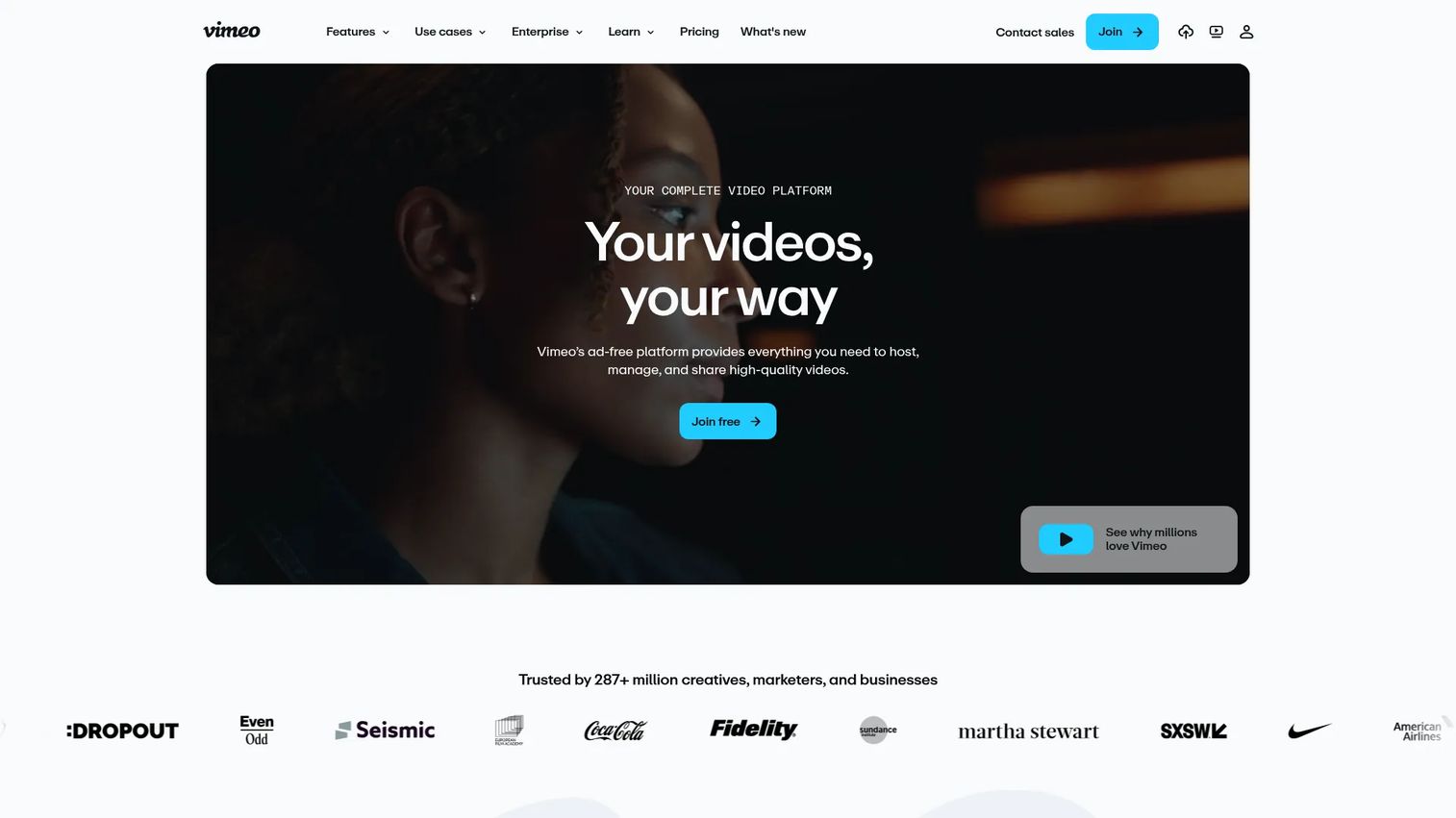
Vimeo is the broadest business-friendly option on this list. It combines ad-free, customizable playback with privacy controls, analytics, collaboration, live streaming, and webinars in one platform. For teams that want a polished, professional video layer without the noise of a public platform, it is a strong default.
The ad-free player is the anchor. Videos play inside a clean, branded frame with no competitor recommendations and no interruptions. Privacy controls let you gate videos with domain restrictions and private links, so a sales leave-behind stays inside the buying committee. Analytics cover engagement and completion, and the platform plays well with the review and collaboration workflows PMMs rely on during launch prep.
Best for: Teams that want branded, ad-free hosting with privacy, analytics, and collaboration in one place.
Key strengths
- Ad-free customizable player: Clean playback with your branding and no third-party ads.
- Privacy and domain controls: Restrict videos to specific domains and private links.
- Analytics and collaboration: Engagement data plus review tools for launch-ready video.
Why choose Vimeo: If you need one reliable platform that handles hosting, branding, privacy, and light live-event work, Vimeo covers the widest surface area. It fits marketing and PMM teams that want general-purpose hosting with a professional playback experience, not a stripped-down uploader.
Vimeo pricing: Vimeo offers a Free plan at $0. Paid self-serve plans, verified from Vimeo's hosting page, are billed annually: Starter at $96/mo, Standard at $192/mo, and Advanced at $600/mo. Enterprise is custom and sales-led. Vimeo holds a G2 rating of 4.3/5.
2. Wistia
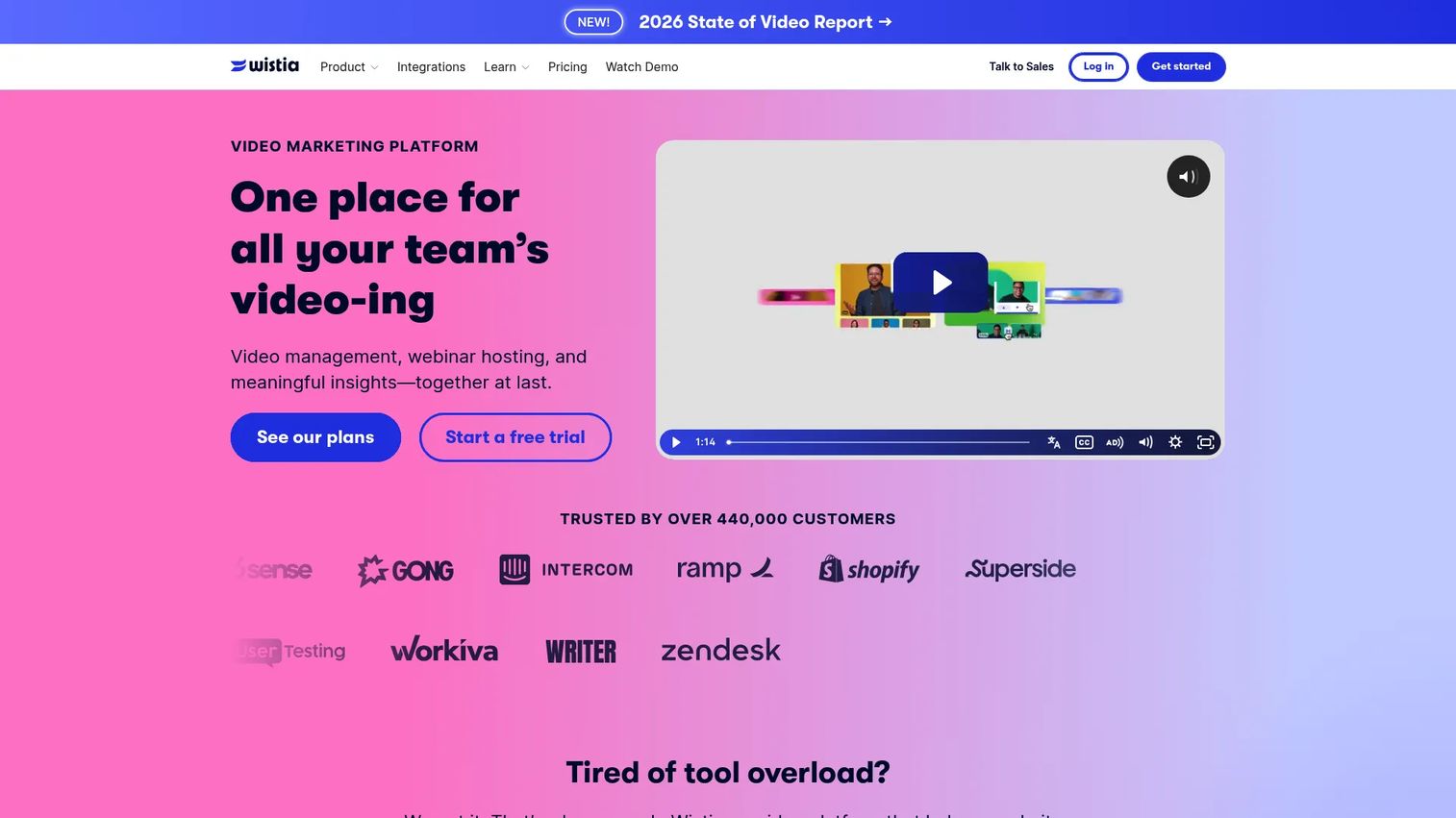
Wistia is built for marketing teams. It pairs branded video hosting and embedding with recording, editing, analytics, and lead capture, so the video and the marketing workflow live together. If your video program is measured in pipeline, Wistia speaks your language.
The branded player is fully customizable, and collections are structured to support SEO and organized viewing. Where Wistia stands out for PMMs is lead generation: you can add email capture and turnstiles inside videos, then push that data into your marketing stack. Analytics go deep on engagement, showing exactly how viewers move through a video, which is useful for message testing on launch and campaign assets. Webinar tools round out the marketing use cases.
Best for: Marketing and demand gen teams that want branded video tied directly to lead capture and analytics.
Key strengths
- Branded, customizable player: Match the player to your identity across every embed.
- Lead capture in-video: Add email gates and turnstiles to turn views into leads.
- Deep video analytics: See engagement patterns and drop-off across every viewer.
Why choose Wistia: Choose Wistia when video is a lead generation engine, not just a content format. It fits PMM and demand gen teams launching product or campaign videos who want capture, analytics, and marketing integrations without stitching tools together.
Wistia pricing: Wistia offers a Free plan at $0 and a Business plan at $79/mo. It also lists a Developer Plan with a $25 monthly platform fee plus usage-based storage and bandwidth, and an Enterprise plan with custom pricing. Wistia holds a G2 rating of 4.6/5.
3. Streamable
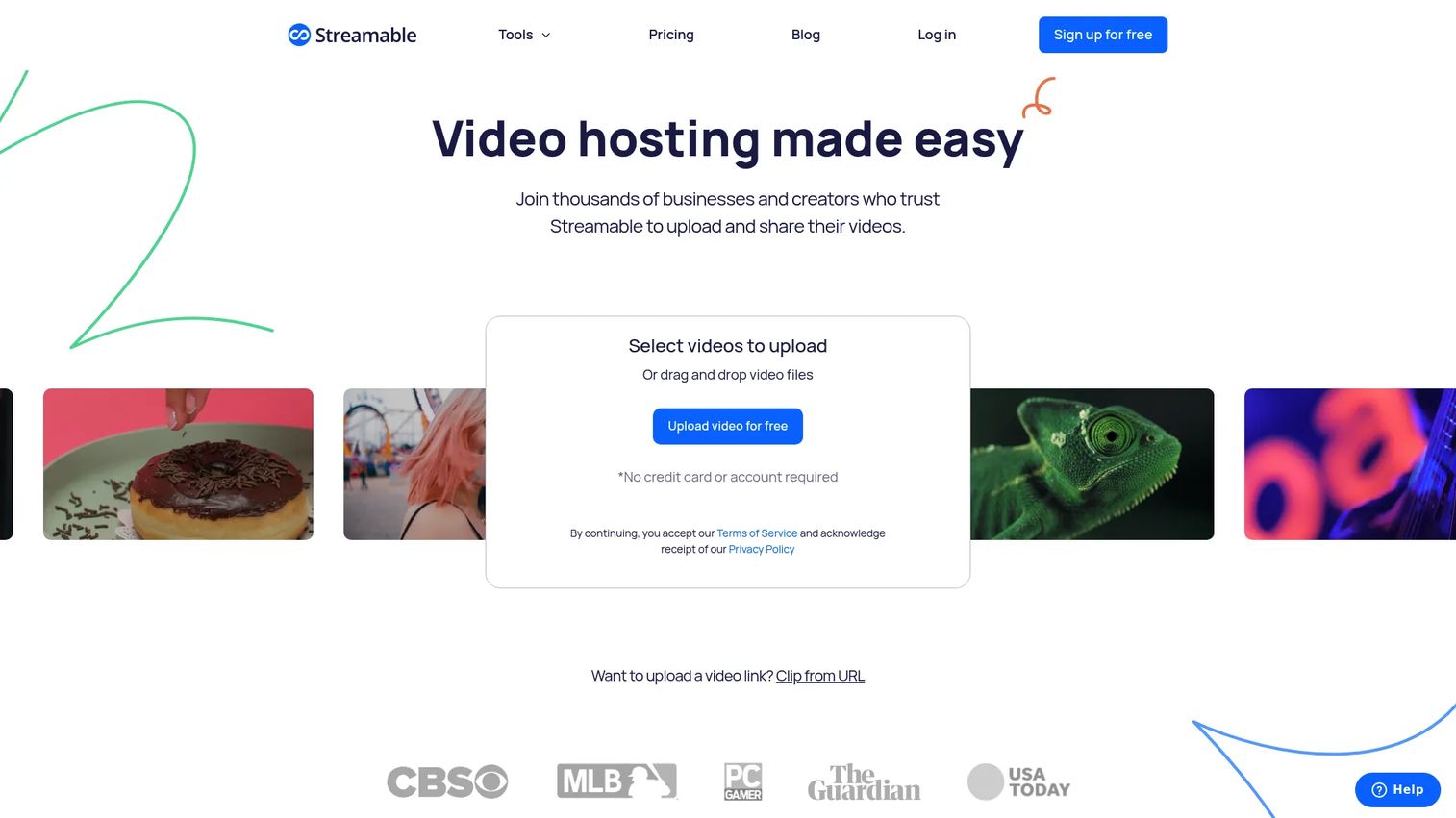
Streamable is the speed-first pick. It strips video hosting down to the essentials: upload a file, trim or clip it, get a shareable link, and embed it. For teams that want quick publishing without heavy setup, it is one of the fastest ways to get a video live.
The appeal is the simple video uploader and the lightweight playback. You are not configuring workflows or navigating a dense dashboard. You drag in a file, and it is ready to share in minutes. It handles clip, trim, and merge editing plus embedding, which covers the common needs of internal updates, quick social clips, and fast turnaround assets. It is a clean fit when speed matters more than deep analytics or governance.
Best for: Teams and individuals who want fast, no-friction video upload and sharing.
Key strengths
- Fast upload and sharing: Get a shareable link in minutes with minimal setup.
- Lightweight editing: Clip, trim, and merge before you publish.
- Simple embedding: Drop videos into pages with quick embed code.
Why choose Streamable: Reach for Streamable when the job is speed and simplicity. It fits teams that publish frequent, low-ceremony videos and want the shortest path from file to shared link, rather than a full marketing or enterprise workflow.
Streamable pricing: Streamable's public pricing page shows a Free plan at $0. It references Pro, Business, and Enterprise plans, with Enterprise on custom pricing. Streamable holds a G2 rating of 4.8/5.
4. ScreenPal

ScreenPal bundles screen and webcam recording, editing, and hosting into one tool. If you create the video and host it in the same place, ScreenPal removes a handoff. It suits teams producing internal, customer, or education content who want more control than a public platform gives them.
The workflow is the draw: record, edit, add AI captions and transcripts, then host and share with a link or embed code. Privacy controls let you keep videos restricted, and captions plus accessibility features make the content usable for a wider audience. Free video hosting is available, which makes it easy to start, and paid plans unlock unlimited recording time. For onboarding walkthroughs, help content, and training videos, the all-in-one flow is efficient.
Best for: Creators, educators, and teams that want to record, edit, and host video in one workflow.
Key strengths
- Record and host together: Capture screen and webcam, then host without switching tools.
- Captions and accessibility: AI captions and transcripts widen your audience.
- Simple embedding and privacy: Share via link or embed with access controls.
Why choose ScreenPal: Pick ScreenPal when your team both creates and distributes video and wants one workflow for it. It fits internal, customer, and education content where recording, captions, and hosting in a single place saves real time.
ScreenPal pricing: ScreenPal offers an always-free plan. Paid plans, verified from its plans page, are Deluxe at $4/mo, Max at $10/mo, and Business at $8/user/mo. Paid plans include unlimited recording time. ScreenPal holds a G2 rating of 4.4/5.
5. YouTube
YouTube is the reach play. Nothing else on this list comes close to its audience scale, discoverability, and familiarity. It handles public hosting, embedding, live streaming, and creator monetization, and viewers already know how to use it. For top-of-funnel awareness content, that reach is hard to beat.
Embedding is straightforward, and the platform's recommendation engine can surface your content to new audiences you did not pay to reach. That same engine, though, is why YouTube is less aligned to private, brand-controlled business hosting. The player can show ads and recommend other videos, including competitors, and the experience lives inside YouTube's environment rather than yours. It is a strong distribution channel and a weaker fit when you need ad-free, branded, or gated playback.
Best for: Teams publishing public awareness content that benefits from massive reach and discoverability.
Key strengths
- Unmatched reach: The largest video audience and built-in discovery.
- Easy embedding: Reliable embed code and universal familiarity.
- Live and creator tools: Live streaming, playlists, and monetization built in.
Why choose YouTube: Use YouTube when reach and discoverability are the goal and the content is meant to be public. For private, brand-controlled distribution, the business-first platforms above give you more control over playback, branding, and access.
YouTube pricing: Core YouTube access is free. Paid consumer services like YouTube Premium exist separately, but there is no public pricing for the base publishing product. YouTube does not have a listed G2 rating for the core product.
6. Brightcove

Brightcove is the enterprise video platform on this list. It is built for large organizations that need scale, security, governance, and advanced distribution, including OTT delivery. When video is a core operation with compliance and workflow requirements, Brightcove is designed for that weight.
The platform covers video hosting and streaming, a full library management layer, analytics, interactivity, an AI suite, live streaming, and OTT. For enterprise teams, the value is in governance and reliability at scale: managing thousands of assets, controlling access, and integrating video into broader systems. It is more platform than tool, which is exactly what large media and enterprise operations need.
Best for: Large organizations that need enterprise-grade hosting, governance, security, and OTT distribution.
Key strengths
- Enterprise scale and governance: Manage large video libraries with access control.
- Advanced distribution: Live streaming and OTT delivery for broad reach.
- Analytics and AI suite: Engagement data and AI tools built for scale.
Why choose Brightcove: Evaluate Brightcove when your organization has governance, security, and scale requirements that lightweight tools cannot meet. It fits enterprise teams treating video as core infrastructure rather than an occasional marketing asset.
Brightcove pricing: Brightcove uses custom, quote-based pricing. Its public site shows studio and package feature matrices with a contact-sales flow, and no public numeric pricing is listed. Brightcove holds a G2 rating of 4.1/5.
7. SproutVideo
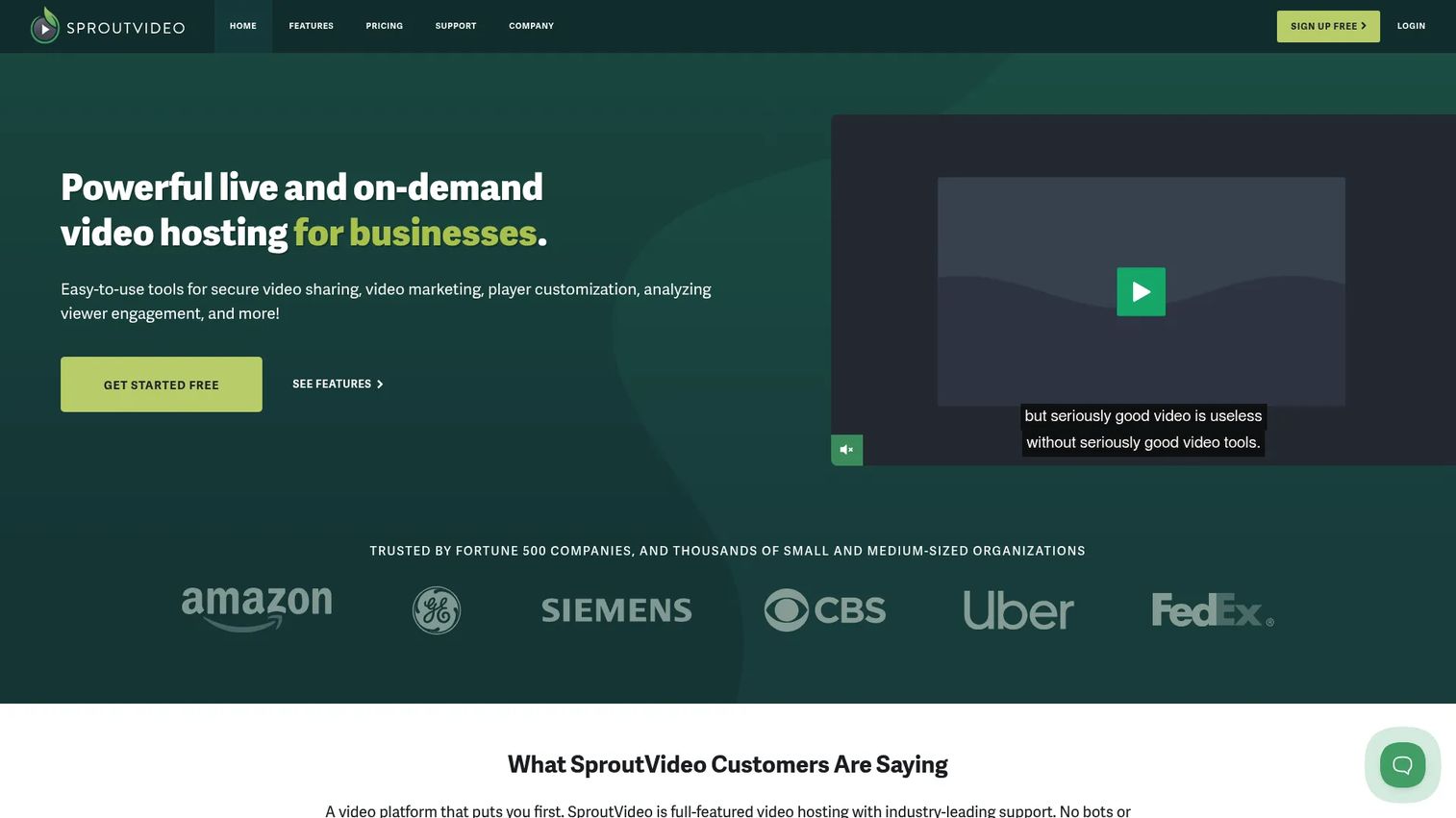
SproutVideo leads with privacy. It is a business video hosting and live streaming platform built around secure video hosting, with strong access controls plus marketing and analytics tools on top. For PMMs managing gated content or controlled distribution, that security-first posture is the differentiator.
Its privacy toolkit is deep: passwords, IP and domain whitelists, two-factor viewer access, and viewer logs that show exactly who watched. Custom branding keeps the player and pages on-brand, and analytics cover engagement so you can see how gated assets perform. Lead generation tools help turn views into contacts, which makes it a fit for gated launch content or private customer distribution where you still want to capture intent.
Best for: Businesses that need secure, branded video hosting with lead generation and detailed access logs.
Key strengths
- Deep privacy controls: Passwords, whitelists, two-factor access, and viewer logs.
- Custom branding: Keep the player and landing pages on-brand.
- Analytics and lead tools: Engagement data plus lead capture for gated content.
Why choose SproutVideo: Choose SproutVideo when privacy and access control are non-negotiable and you still want marketing and analytics on top. It fits teams distributing gated assets, private customer videos, or controlled launch content to a defined audience.
SproutVideo pricing: SproutVideo offers four paid plans, verified from its pricing page: Seed at $10/mo, Sprout at $35/mo, Tree at $75/mo, and Forest at $295/mo, with a 30-day free trial. SproutVideo holds a G2 rating of 4.6/5.
Considerations before you choose
The right video hosting platform depends on how you distribute, protect, and measure video. Run through this checklist before you commit.
Free plan versus paid plan
Free video hosting is a fine starting point, but read the limits. Free plans often cap storage, restrict the number of videos, add platform branding, or hold back analytics and integrations. If the free tier forces someone else's logo onto your player or blocks the engagement data you need, it is only free until it costs you a conversion. Match the plan to what you actually distribute.
Privacy and access controls
For any customer-facing or internal asset, check the access controls before anything else. Look for password-protected video hosting, domain restrictions, private links, and, for sensitive content, viewer logs and two-factor access. The question is simple: can you guarantee only the right people see this video? If the platform cannot answer that cleanly, it is the wrong home for gated content.
Embedding and distribution
Your platform should embed cleanly on websites, landing pages, and in email, and share smoothly to social. Check how the embed code behaves across your CMS and whether the player stays responsive. If you run video across a marketing stack, confirm the platform fits the tools you already use so distribution stays consistent everywhere the asset appears.
Analytics and reporting
Useful video analytics go past view counts. For PMM and growth teams, the metrics that matter are play rate, completion rate, replay behavior, and drop-off points, plus any conversion or lead signal. Look for analytics that map to a real question: is this message landing, and where do people leave? Bonus points if the data syncs to your CRM so engagement feeds lead scoring.
Branding and player customization
Custom branding is trust. Player colors, custom thumbnails, branded landing pages, and control over the viewing experience keep every video consistent with your identity. For launches especially, a consistent branded player signals polish and keeps attention on your product instead of a generic frame. Confirm which branding controls sit behind which tier before you buy.
Conclusion
There is no single best video hosting platform, only the best fit for how your team distributes and measures video. Vimeo is the strongest all-around business pick, with ad-free branded playback, privacy, and analytics in one place. Wistia is the choice when video drives lead generation. Streamable wins on speed and simplicity, and ScreenPal bundles recording with hosting for record-and-share workflows.
For scale and reach, YouTube is unmatched for public content, while Brightcove serves enterprise teams with governance and OTT needs. SproutVideo is the privacy-first pick for gated and controlled distribution. The tradeoff runs along a clear line: simplicity, marketing depth, or enterprise control.
Start with the platform that matches your top priority. If privacy leads, weigh SproutVideo. If lead capture leads, weigh Wistia. If you want one reliable, branded, ad-free home for most of your video, start with Vimeo and expand from there. To round out the surrounding stack, our guide to email marketing software tools and conversational marketing software pair naturally with a video distribution layer.
FAQs
Several platforms offer free video hosting, including Vimeo, Wistia, ScreenPal, Streamable, and YouTube. Free plans usually trade off something: platform branding on the player, storage or video count caps, or reduced analytics and integrations. They work well for early testing or low-stakes internal videos, but check the limits before you host anything customer-facing or conversion-critical.
It depends on the job. For marketing and lead generation, Wistia is built for it. For general branded, ad-free business hosting, Vimeo covers the widest surface. For enterprise governance and scale, Brightcove is the enterprise video platform on this list. For privacy-first, gated distribution, SproutVideo leads. Separate your needs into marketing, enterprise, and simple sharing, then match the tool.
For clean, ad-free embedding with full player customization, Vimeo and Wistia are the strongest picks. Both give you branded players, reliable embed code, and no competitor recommendations interrupting playback. SproutVideo is also strong when you need branded embeds with tight access controls. The key is ad-free playback and a player that matches your brand.
Use a platform with real access controls: password-protected video hosting, domain and IP restrictions, private links, and viewer logs. SproutVideo is built around this with passwords, whitelists, two-factor viewer access, and detailed logs. Vimeo also offers strong privacy and domain restrictions. Avoid relying on public platforms for anything sensitive, since their default is discoverability, not privacy.
Yes, most video hosting services include analytics. Common metrics are play rate, completion rate, average watch time, replay behavior, and drop-off points. For PMM and growth teams, these numbers reveal whether a message lands and where viewers lose interest. The most useful analytics also sync to your CRM so video engagement can feed lead scoring and follow-up.
Streamable and ScreenPal are the speed-first options. Streamable focuses on a simple video uploader: drag in a file, trim it, get a shareable link. ScreenPal adds recording and captions on top of quick hosting. Both prioritize fast upload and playback over deep governance or advanced marketing features, which makes them ideal for frequent, low-friction video sharing.
At minimum, look for MP4 and MOV support, since these cover most recordings and exports. Good platforms also handle other common formats and offer adaptive streaming so playback holds up across connections. If you produce high-resolution content, confirm the platform supports 4K video hosting so your quality survives upload and playback.