

Your wildlife data lives in six places at once. Trail camera SD cards. A field notebook someone left in a truck. Three spreadsheets with slightly different column names. A group chat where someone typed "big buck at north stand" with no timestamp. A shared drive nobody updates. And a map printed in 2023.
When it comes time to report, you rebuild the whole picture by hand. Every season. That is not a tracking problem. It is a visibility and coordination problem.
The global wildlife conservation management software market hit USD 652.4 million in 2024 and is projected to reach USD 1,620.8 million by 2033, a 10.7% CAGR, according to Dataintelo (2024). The tools got serious because the field work did. Cloud-based adoption among large zoological facilities rose over 40%, per Global Growth Insights (2025), and more than 58% of those facilities now run software for animal health and breeding tracking.
The question is no longer whether to use software. It is which one fits your workflow: deer management, parks monitoring, conservation reporting, or AI-assisted tracking.
What's inside
This guide is for anyone choosing software to capture wildlife observations, coordinate field teams, and turn raw sightings into reports that hold up.
We selected tools based on four criteria that actually matter in the field:
- Field data capture: How fast can someone log an observation on a phone, often offline?
- Reporting and analytics: Can raw data become trends and decisions without manual rework?
- Team coordination: Does it support shared records, permissions, and consistent workflows?
- Domain fit: Is it built for deer, parks, conservation, or general wildlife tracking?
We prioritized real, verifiable products over generic category pages.
TL;DR
- Best for deer and game management: Game Management Solutions (GMS), built around herd inventory, lineage, and ranch recordkeeping.
- Best for parks and open-space monitoring: Outway, with offline mapping, observation logging, and automated reports.
- Best for conservation workflows: SMART Conservation Software, a free, open-source standard for patrol and observation data.
- Best for AI-assisted tracking: HuntPro, which auto-tags trail camera images and maps activity heatmaps.
- Rule of thumb: Pick for your dominant workflow, not for the longest feature list. A deer breeder and a parks ecologist need different tools.
What is wildlife management software
Wildlife management software is a category of tools that helps teams capture field observations, track wildlife activity, analyze patterns, and coordinate the people doing the work.
It replaces the scattered mix of notebooks, spreadsheets, camera exports, and group chats with one system of record. Depending on the vendor, the same platform serves deer breeders, parks ecologists, conservation patrols, and research teams.
Core capabilities usually include:
- Wildlife observation logging: Capture sightings, photos, counts, and notes from the field, often on mobile.
- Mapping and geospatial context: Pin observations to locations and see activity across sites.
- Reporting and trend analysis: Turn logged data into surveys, summaries, and season-over-season trends.
- Team collaboration: Share records, set permissions, and keep everyone on the same workflow.
- Integrations and web or mobile access: Connect cameras, export data, and work from a browser or phone, sometimes offline.
The category overlaps with adjacent markets. The animal tracking software market alone was USD 491.23 million in 2023 and is projected to reach USD 1,075.75 million by 2032, a 9.10% CAGR, per Market Research Store (2024). Wildlife tracking software, wildlife monitoring software, and game management software are all variants that share this core, differing mainly by who they serve.
When to use wildlife management software
Not every operation needs a platform. Here is when spreadsheets stop working.
Track wildlife activity across sites
You started with one trail camera and a notebook. Now you have twelve cameras, four properties, and two field techs. The moment you cannot answer "where is deer activity trending this month" without an hour of manual sorting, you have outgrown spreadsheets. Wildlife tracking software keeps camera data, sightings, and site-level trends in one place so the answer takes seconds.
Coordinate teams in the field
When more than one person logs observations, inconsistency creeps in. One writes "buck," another writes "male WTD," a third forgets the date. Shared records, standardized fields, and permissions fix this. Team coordination software matters most when handoffs happen, when a ranger's morning patrol needs to inform an ecologist's afternoon report.
Turn observations into reports and decisions
Raw sightings do not justify a budget or a habitat change. Trends do. Teams use wildlife reporting software to spot patterns, compare seasons, and communicate with stakeholders, boards, or agencies. If you regularly rebuild the same report by hand, the software pays for itself in recovered time.
Comparison table
We ranked these by relevance to the wildlife management keyword and the breadth of their field-to-report workflow. Pricing and ratings reflect what each vendor publishes; where a figure is not public, we note it rather than guess.
| # | Product | Best for | Key differentiator | Pricing | G2 rating |
|---|---|---|---|---|---|
| 1 | Game Management Solutions (GMS) | Deer breeders, ranch managers | Herd inventory, DNA, and lineage tracking | Call for pricing | Not listed |
| 2 | Outway | Parks and land-management teams | Offline mapping plus automated reports | From $416/mo (5 users) | Not listed |
| 3 | SMART Conservation Software | Conservation and patrol teams | Free, open-source, standardized data | Free | Not listed |
| 4 | HuntPro | AI-assisted trail camera workflows | AI image tagging and activity heatmaps | From $29/mo | Not listed |
| 5 | Wildlife Management Solutions | Food plot and habitat managers | Seed blends and planting guidance | Custom quote | Not listed |
| 6 | Wildlife Monitoring & Tracking Software (Outway) | Parks and open-space monitoring | Observation logs plus trend visualization | From $416/mo (5 users) | Not listed |
Best wildlife management software for 2026
Each tool below fits a different job. Read for your dominant workflow, not the whole list.
1. Game Management Solutions (GMS)

Game Management Solutions is deer-breeding and wildlife recordkeeping software built for ranches and deer farmers. If your operation runs on herd data, pedigrees, and pen assignments, this is the most specialized option here. It treats the animal as the record, not the sighting.
Best for: Deer breeders and ranch managers who need structured herd and lineage records.
Key strengths
- Herd inventory and animal tracking
- Ranch management, scheduling, and contact management
- DNA submittal and retrieval, lineage and pedigree, and pen management
- Mobile field use for logging on site
Why choose GMS: Most tools on this list treat wildlife as observations to count. GMS treats each animal as a managed asset with a history. That fits deer management and breeding operations far better than a general monitoring app, where you care about individual lineage, not just population trends.
GMS pricing: Public pricing is not listed on the site. The product pages instruct visitors to call for information, which usually means pricing scales with herd size and operation scope.
2. Outway
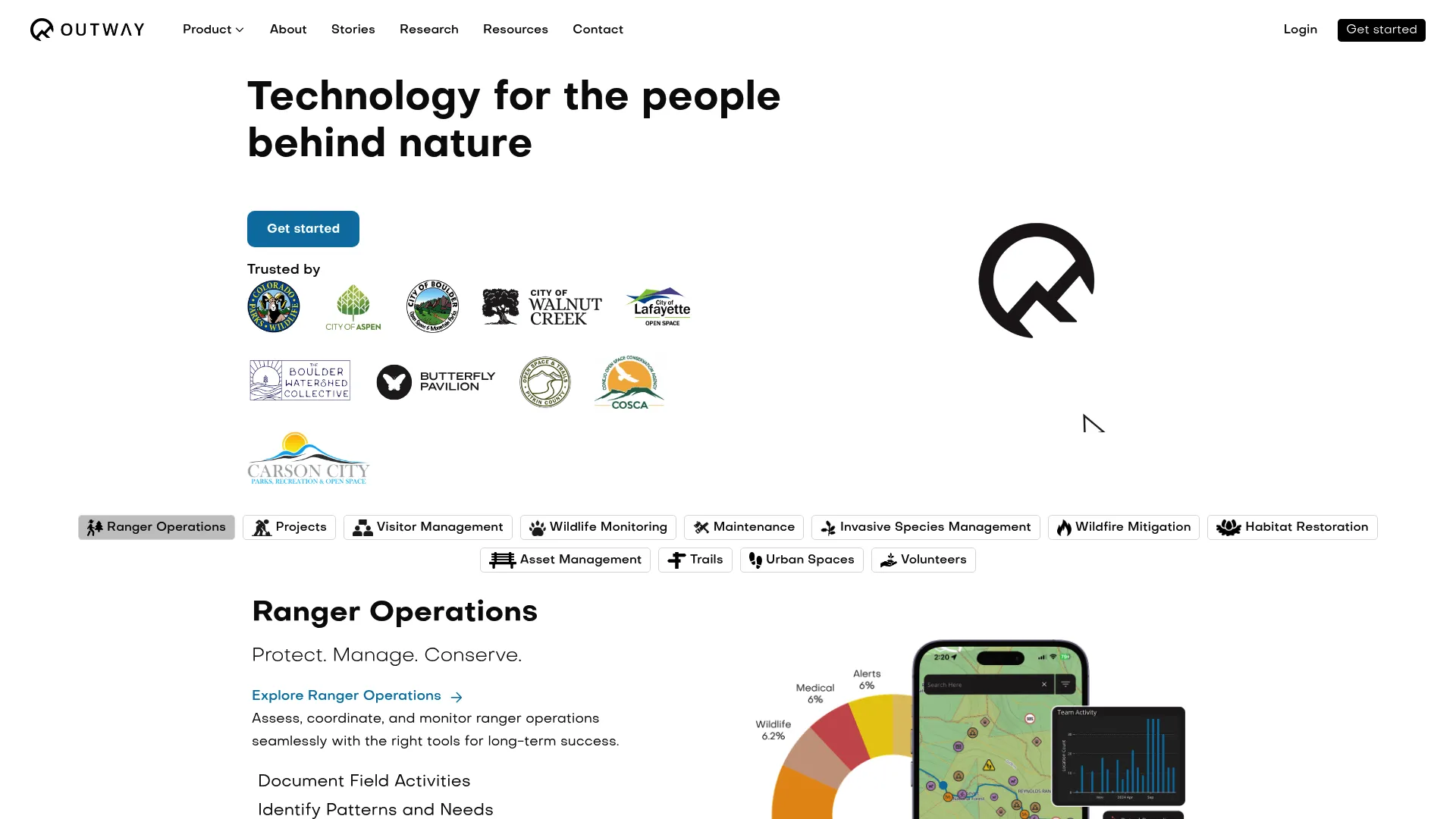
Outway is land management software that combines mapping, tracking, recording, and reporting for field teams. For parks, trails, and conservation crews that work where cell service does not reach, its offline support is the headline feature. You log in the field, sync when you are back online.
Best for: Parks, trails, and land-management teams needing offline fieldwork with centralized reporting.
Key strengths
- Offline support and offline mapping
- Automated reports and data exporting
- Map-based team collaboration and permissions
Why choose Outway: If your team spends days in the backcountry and reconstructs everything at a desk later, offline-first design changes the workflow. Observations get logged when and where they happen, not from memory. The automated reports then remove the manual rebuild that eats a field manager's week.
Outway pricing: The publicly listed Basic Services (Standard) plan is $416 per month for 5 users, plus $90 per month for each additional user, available monthly or annually. Enterprise pricing is handled through a separate custom contract.
3. SMART Conservation Software
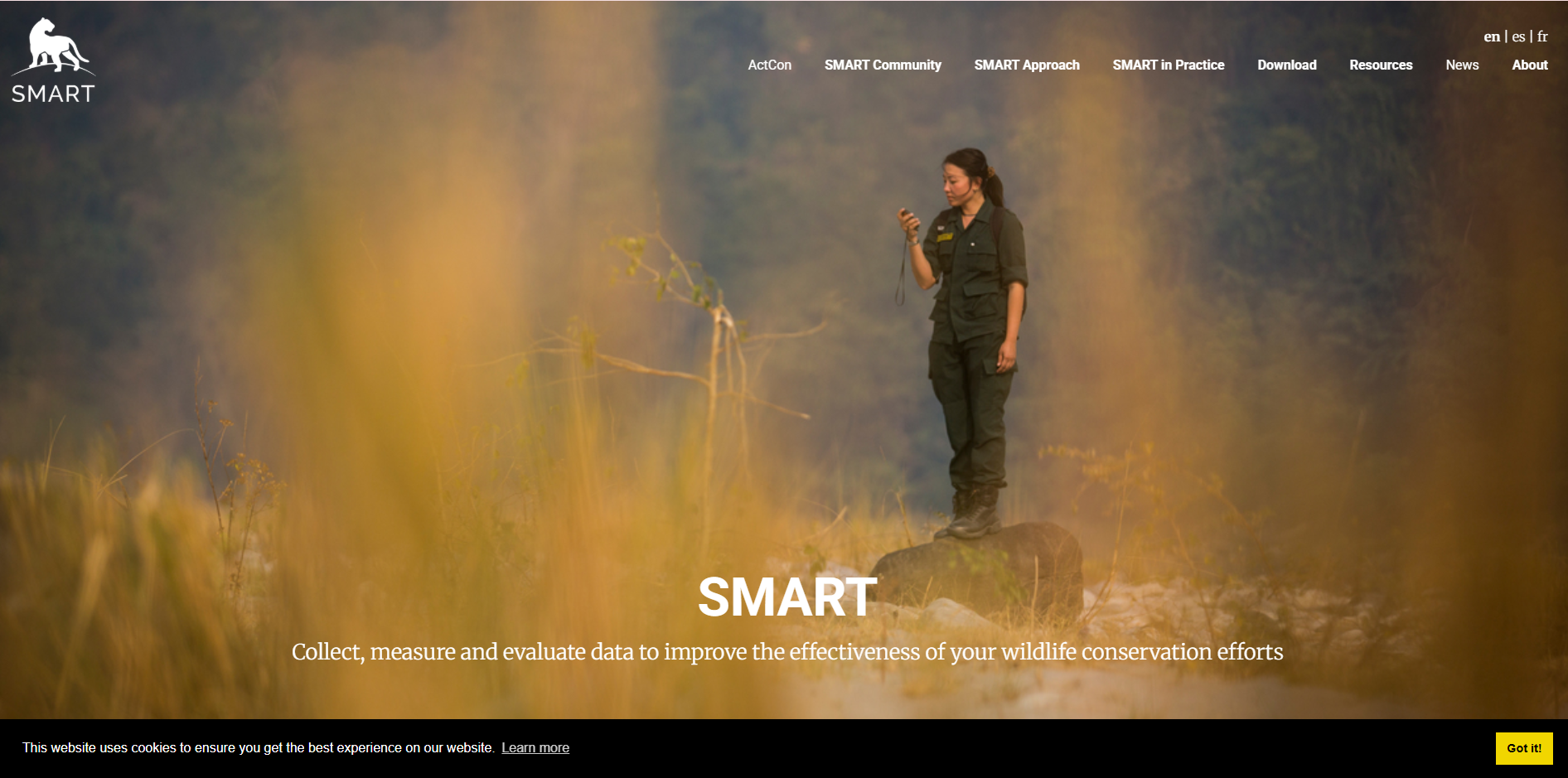
SMART Conservation Software is a free, open-source platform for collecting, analyzing, and reporting wildlife and patrol data. It is the institutional standard for protected-area management, backed by a conservation alliance and used across terrestrial and marine contexts. For agencies and non-profits, the price is hard to beat: zero.
Best for: Conservation teams managing protected areas, patrol data, and standardized field reporting.
Key strengths
- Desktop database with mapping, spatial analysis, and report generation
- Mobile data collection for patrols and observations
- Cloud-based SMART Connect for multi-user access and visualization
Why choose SMART: When your reporting has to meet grant, agency, or alliance standards, SMART's structured data model is built for exactly that. It standardizes how patrols and observations get recorded, so data holds up across teams and years. That consistency is worth more than a slick interface when audits and funding depend on it.
SMART pricing: The SMART platform is free. SMART Connect as a Service is described as free for government agencies, non-profit, and educational organizations. No paid plan amounts are published on the site.
4. HuntPro

HuntPro is an AI-powered platform for trail-camera data, guest coordination, mapping, and harvest tracking. Its differentiator is automation: instead of scrolling thousands of camera images by hand, its AI tags wildlife for you. For anyone drowning in trail camera photos, that alone justifies a look.
Best for: Hunters, land managers, and wildlife teams wanting AI-assisted trail camera and property tools.
Key strengths
- Advanced AI tagging for wildlife images
- Guest management and hunt coordination
- Property mapping with markers, heatmaps, and stand index
Why choose HuntPro: The AI image tagging turns a tedious sorting chore into a searchable database. Combined with mapping and heatmaps, you move from "I have 4,000 photos" to "show me buck activity near the north stand last week" in a few taps. The tiered pricing also spans casual hunters through research operations.
HuntPro pricing: The Hunter / Professional plan starts at $29 per month. The Ranch / Farm / Reserve plan is $208 per month. The Research / Conservation tier is custom, arranged by contacting sales.
5. Wildlife Management Solutions
Wildlife Management Solutions approaches wildlife management from the habitat side. It supplies food plot seed and seed blends for deer, turkey, quail, ducks, and dove, with planting guidance to match. It is not a data platform, and that is the point: managing wildlife starts with managing the land they use.
Best for: Landowners and wildlife managers focused on food plots and habitat blends.
Key strengths
- Food plot seed and seed blends by species
- Planting instructions for seed mixes
- Dealer locator and contact support
Why choose Wildlife Management Solutions: Software tracks what happens on your land. Habitat management shapes what happens in the first place. If your management plan hinges on attracting and holding wildlife through food plots, this covers the input side that a tracking app cannot. Many operations pair habitat work with a separate data tool.
Wildlife Management Solutions pricing: Pricing is not publicly displayed. The site directs visitors to call for a custom seed blend quote and works through dealer sales, so cost depends on acreage and blend selection.
6. Wildlife Monitoring & Tracking Software (Outway)
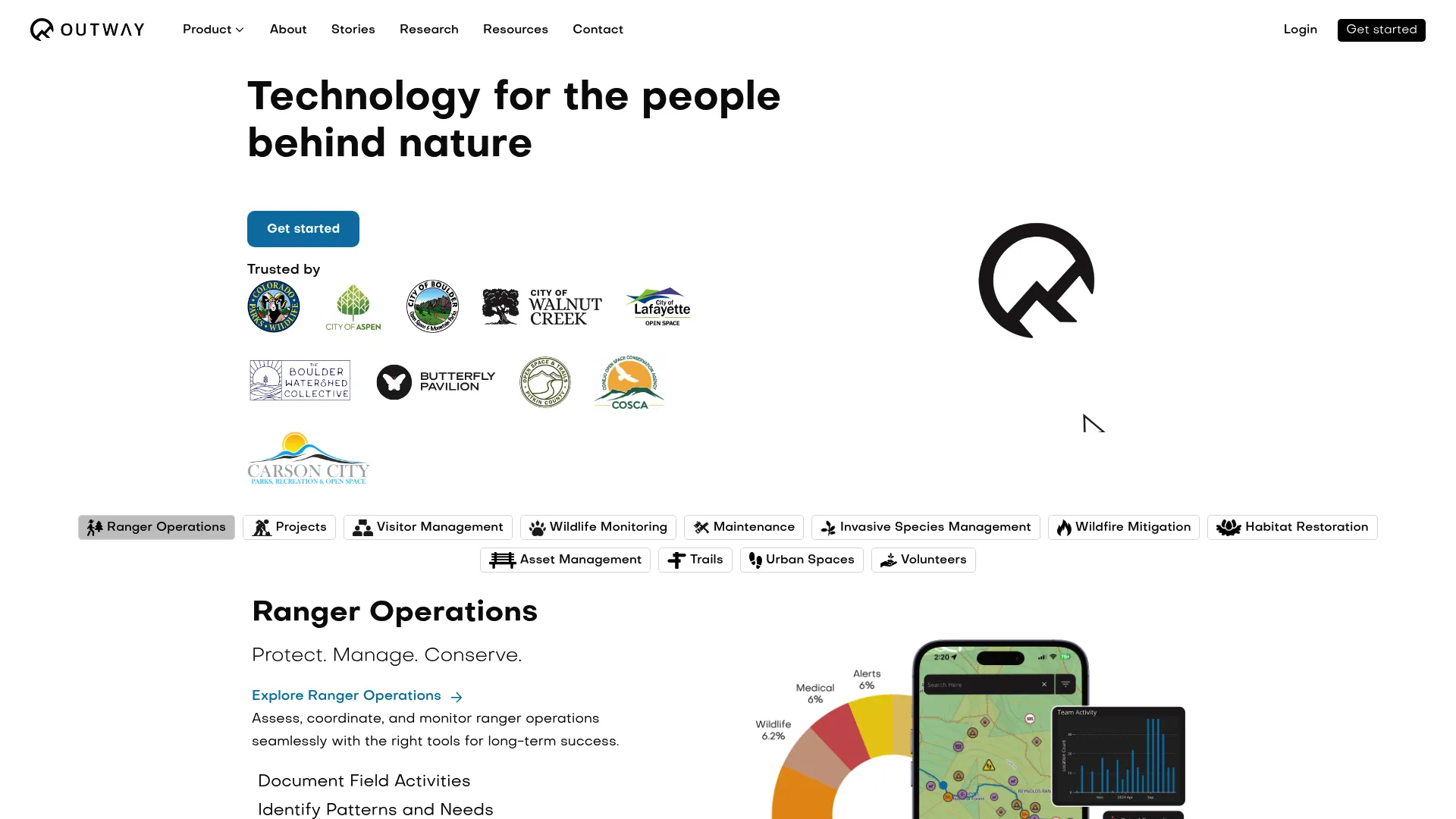
Outway's wildlife monitoring and tracking use case is worth calling out on its own. The same platform that handles general land management doubles as wildlife monitoring software, aimed at capturing observations, mapping trends, and coordinating surveys across parks and open space.
Best for: Parks, land management, and wildlife teams needing offline field tracking and trend reporting.
Key strengths
- Capture wildlife observations, photos, and notes
- Integrated mapping and trend visualization
- Offline support and cross-team collaboration
Why choose this use case: If your primary job is monitoring rather than breeding or hunting, this configuration centers the workflow on sightings and surveys. Trend visualization turns a season of logged observations into a picture you can show stakeholders. The offline capability keeps it usable in remote parks and reserves where connectivity is unreliable.
Pricing: Same as the core Outway plan. Basic Services (Standard) is $416 per month for 5 users, plus $90 per month per additional user, with enterprise pricing available through a custom contract.
Considerations
Before you shortlist, run each tool against the criteria that decide whether it survives a real field season.
Field data capture
The best-designed report is worthless if nobody logs the data. Test how fast a field tech can record an observation on a phone, ideally offline. If logging takes more than a few taps, people revert to the notebook and your database goes stale.
Reporting and insights
Ask whether the tool turns raw sightings into trends without manual export-and-rebuild cycles. Good wildlife reporting software should generate season-over-season comparisons, surveys, and stakeholder-ready summaries on its own. If you still open a spreadsheet to make sense of the output, that is a gap.
Team coordination
Check for shared records, role-based permissions, and standardized fields. When multiple people log data, consistency is everything. A ranger and an ecologist should be writing into the same structured system, not two parallel ones.
Integrations and interoperability
Look at how the tool handles trail cameras, map layers, and data exports. Can you get your data out in a usable format? Lock-in is a real cost. Wildlife mapping software that plays with your existing GIS or camera setup saves duplicate work.
Deployment flexibility
Confirm it works across mobile and browser, and check offline behavior if you work in remote areas. Also weigh hosting: some conservation teams need secure cloud hosting and reliable backups to meet agency requirements.
Domain fit
Match the tool to your job. Deer breeders need lineage and pen management. Parks teams need offline monitoring. Conservation groups need standardized, auditable reporting. A tool built for one rarely excels at another.
Conclusion
There is no single best wildlife management software, only the best fit for your workflow.
For deer and game management, Game Management Solutions gives you herd, lineage, and pen records that a general monitoring app cannot match. For parks and open-space monitoring, Outway's offline-first design and automated reports fit teams that work far from cell towers. For conservation, SMART Conservation Software offers a free, standardized, audit-ready foundation. For anyone buried in trail camera images, HuntPro's AI tagging turns a chore into a searchable map.
Do not buy on feature count. Buy on the job you do most days.
Your next step: shortlist two or three tools that match your dominant workflow, then compare them on three things only, field data capture speed, reporting output, and team coordination. Request a demo or trial for each and run one week of real observations through them before you commit.
FAQs
It captures field observations, tracks wildlife activity, maps it geographically, and turns that data into reports. Depending on the vendor, it also coordinates field teams with shared records and permissions. The goal is one system of record instead of scattered notebooks, spreadsheets, and camera exports.
Game Management Solutions is the most specialized for deer, built around herd inventory, DNA and lineage tracking, and pen management. It treats each animal as a managed record with a history, which suits breeders and ranch operations. HuntPro also fits deer-focused workflows if your priority is trail camera data and property mapping.
Yes. Most modern tools offer mobile logging so field teams record observations on a phone or tablet. Several, like Outway, add offline support so you can capture data with no signal and sync later. Mobile capture is often the difference between a database that stays current and one that goes stale.
It converts raw sightings and camera data into trends, surveys, and summaries automatically. Instead of rebuilding a spreadsheet each season, you generate season-over-season comparisons and stakeholder-ready reports from logged data. That saves field managers hours and makes the data defensible for budgets, grants, or agency review.
Very. SMART Conservation Software is a free, open-source standard used across protected areas for patrol and observation data. Its structured data model is built to meet grant and agency reporting requirements. For conservation groups, standardized, auditable data usually matters more than a polished interface.
Prioritize fast field data capture, offline support if you work remotely, automated reporting, and domain fit for your specific job. Check that you can export your data and that it integrates with your cameras and maps. Match the tool to whether you manage deer, parks, or conservation, because those workflows differ.
Through shared records, standardized fields, and role-based permissions. Instead of each person keeping separate notes, everyone logs into one structured system with consistent categories. That keeps a ranger's morning patrol and an ecologist's afternoon analysis working from the same data.
Wildlife monitoring software centers on observing populations, logging sightings, and tracking trends across sites, common in parks and conservation. Game management software focuses on managing specific animals or herds, including breeding, lineage, and harvest, common in deer ranches and hunting operations. Some platforms cover both, but most lean toward one workflow.