Your product team commits to an EHR integration. The hospital signs the contract. Then the implementation starts, and you discover three incompatible message formats, two site-specific ADT workflows, and a backlog of interface exceptions nobody budgeted for.
This is the real shape of clinical data integration. Moving a message from one system to another is the easy part. Keeping that data accurate, observable, and maintainable as customers add systems and standards evolve is the operating model problem that breaks roadmap timelines.
According to ONC Health IT (2026), 76% of U.S. non-federal acute-care hospitals engaged in all four interoperability domains in 2025. The infrastructure making that possible sits quietly in the middle: Healthcare integration engines and interface engines routing, transforming, validating, and monitoring billions of clinical messages every day.
The engine you choose shapes how fast you can commit to new customer integrations, how many support tickets you handle when a lab feed fails, and how much engineering capacity stays available for differentiated product work. Which engine fits your data standards, deployment model, EHR footprint, and operating capacity?
What's inside
This guide is for product managers, interoperability leads, and health IT architects evaluating healthcare interface software. Tools were selected based on four criteria:
- Standards coverage, including HL7, FHIR, DICOM, and X12
- Deployment flexibility across cloud, on-premises, and managed-service models
- Observability and operational tooling for monitoring, alerting, and error handling
- EHR and clinical system fit across provider, lab, and imaging environments
TL;DR
- Best for enterprise health systems: Infor Cloverleaf for broad HL7, FHIR, CDA, and X12 transformation across large, mixed clinical environments
- Best for teams with existing Mirth skills: NextGen Mirth Connect for channel-based interface workflows with an established installed base
- Best for cloud-first managed integration: InterSystems Health Connect for organizations that want enterprise interoperability without managing the infrastructure
- Best for DICOM and HL7 combined: Qvera Interface Engine for imaging-heavy workflows that need DICOM alongside standard HL7 and FHIR interfaces
- Best for Epic-centered organizations: Epic Bridges for provider teams that need native alignment with Epic interface governance
- Key selection note: Message volume, EHR relationships, deployment constraints, and internal interface engineering capacity each drive the right engine choice more than any single feature comparison
What are healthcare integration engines?
A healthcare integration engine is middleware that receives, validates, transforms, routes, and monitors clinical and administrative data between systems such as EHRs, laboratories, imaging platforms, payer applications, devices, and patient-facing software.
The category is also called a healthcare interface engine or healthcare interface software, and vendors use both terms interchangeably. What matters is the function: These products sit between systems that speak different data languages and make sure messages get where they need to go without corrupting downstream workflows.
Core functions include:
- Routing: Directing HL7 v2 feeds, FHIR API requests, DICOM imaging workflows, X12 transactions, and file-based messages to the right destination systems
- Transformation: Field mapping, code translation, message enrichment, filtering, validation, and conversion between HL7, FHIR, XML, JSON, CSV, and proprietary formats
- Monitoring: Alerting, error queues, retry logic, message replay, audit logs, and root-cause investigation
- EHR and clinical interoperability: Connecting EHRs, laboratory information systems, practice management systems, imaging platforms, revenue cycle applications, and health information exchanges
- Integration debt reduction: Creating reusable routing and transformation patterns rather than building one-off point-to-point connections for every system pair
| Function | Example |
|---|---|
| Routing | Send ADT messages from an EHR to downstream clinical systems |
| Transformation | Convert HL7 v2 fields into a FHIR resource |
| Validation | Reject malformed messages before they corrupt downstream workflows |
| Monitoring | Alert an interface team when a lab feed fails |
| Governance | Maintain logs, access controls, and repeatable interface patterns |
An engine does not remove the need for interface mapping, testing, governance, and long-term ownership. It creates the infrastructure that makes all of those things manageable at scale. For product managers evaluating healthcare middleware, that distinction matters. The opportunity cost of ongoing maintenance is what separates a good engine choice from an expensive one.
You might also find our guide on API monitoring tools useful for thinking through observability requirements alongside your integration engine selection.
When to use a healthcare integration engine
Connect EHRs, labs, imaging, and clinical applications
Hospitals, health systems, multi-site practices, and healthtech vendors use integration engines when data needs to move reliably across clinical applications. The selection depends on the protocols in use, EHR relationships, message throughput, and the interface engineering skills available internally.
Modernize legacy HL7 workflows while adding FHIR APIs
Most healthcare organizations are in a transition state: Legacy HL7 v2 feeds remain central while customers and partners increasingly request FHIR APIs. The right engine handles staged modernization without forcing an all-at-once platform replacement.
Scale integrations without multiplying point-to-point interfaces
A product that builds a new custom integration for every customer accumulates maintenance cost faster than it acquires revenue. Integration engines centralize reusable routing patterns, testing, operational monitoring, and interface ownership. For product managers, that is the difference between a scalable implementation model and a permanent engineering tax.
| Use an integration engine when | Consider a simpler direct integration when |
|---|---|
| Multiple customers need similar interface patterns | One partner, one connection, low ongoing change |
| Standards diversity includes HL7, FHIR, and DICOM | Single well-documented REST API on both sides |
| Interface monitoring and audit logs are required | Error handling is manageable in application code |
| Internal team will maintain interfaces long-term | Vendor manages the connection end-to-end |
Healthcare integration engines comparison
The nine engines below solve the same broad problem but differ in deployment models, EHR fit, DICOM support, standards depth, cloud availability, and operational tooling. Pricing across this category is almost universally quote-based. Qvera is the exception with a published entry price. For all others, request a quote and evaluate the total cost against interface volume, deployment architecture, implementation services, and support model.
| # | Product | Best for | Key differentiator | Pricing | G2 rating |
|---|---|---|---|---|---|
| 1 | Infor Cloverleaf | Enterprise health systems with complex legacy interoperability | Broad HL7, FHIR, CDA, and X12 transformation at clinical scale | Quote based | 3.5/5 |
| 2 | NextGen Mirth Connect | Teams with existing Mirth expertise and channel-based workflows | Established HL7 interface engine with a large installed base | Quote based | 5.0/5 |
| 3 | Rhapsody Corepoint | Hospitals seeking a modular, no-code-friendly interface engine | No-code graphical workflow builder with SaaS and on-premises options | Quote based | 3.8/5 |
| 4 | InterSystems Health Connect | Cloud-first healthcare interoperability programs | Fully managed cloud integration service with enterprise platform depth | Quote based | 4.2/5 |
| 5 | Qvera Interface Engine | Imaging, HL7, FHIR, and DICOM-heavy environments | DICOM networking alongside HL7 and FHIR in one engine | From $9,980/year | 4.9/5 |
| 6 | iNTERFACEWARE Iguana | Developer-led interface teams needing deep control | Scriptable Lua-based development with built-in testing and Git integration | Quote based | 4.5/5 |
| 7 | Epic Bridges | Epic-centered provider organizations | Native alignment with Epic interface workflows and governance | Through Epic agreements | 4.2/5 |
| 8 | Consensus Conductor | Large provider networks managing broad integration portfolios | Enterprise interoperability orchestration across complex exchange workflows | Quote based | 4.7/5 |
| 9 | iatricSystems EasyConnect Jaguar | Provider organizations needing managed interoperability support | EHR-agnostic integration with proactive monitoring and implementation services | Quote based | Not available |
Best healthcare integration engines for 2026
1. Infor Cloverleaf
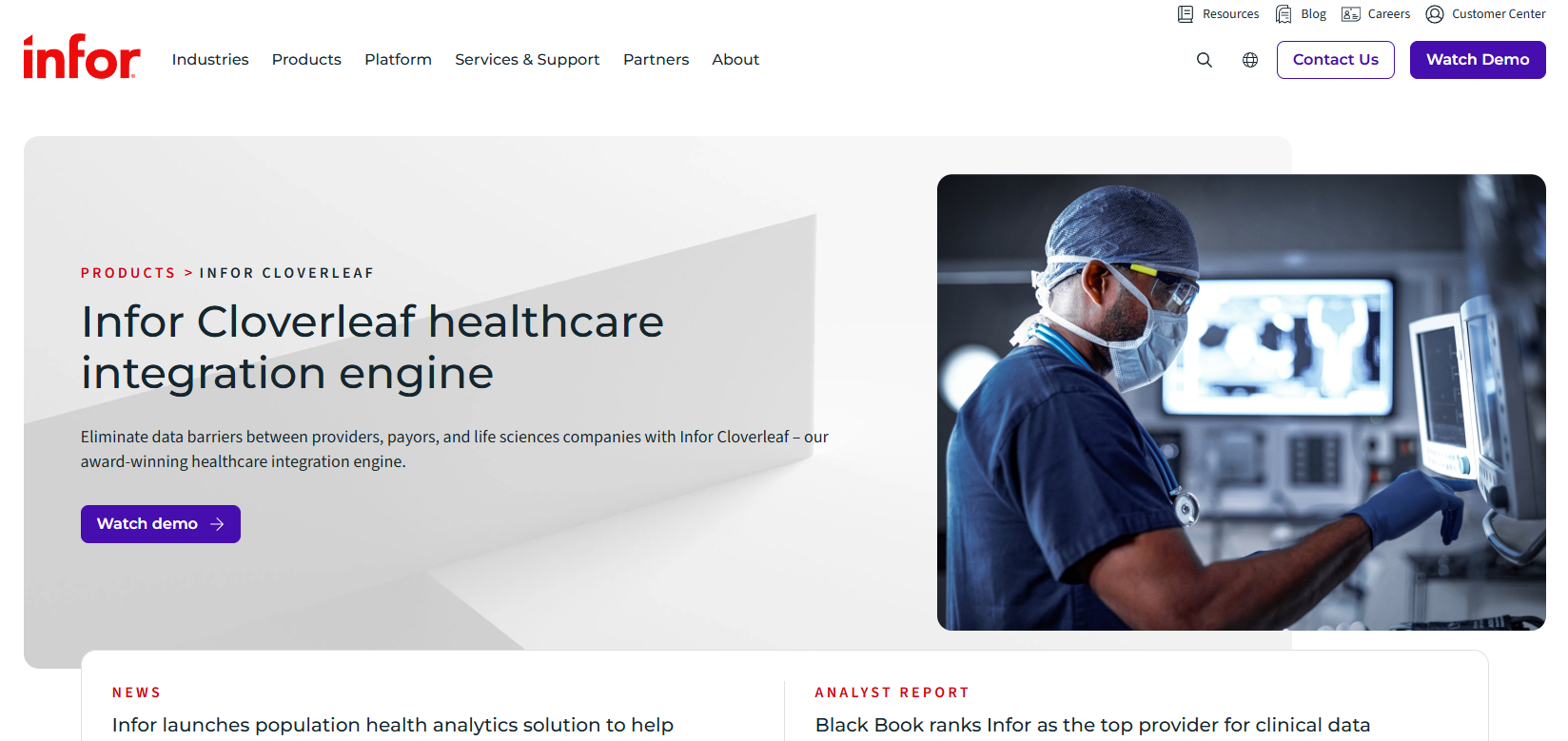
Infor Cloverleaf is a healthcare data integration platform built for organizations managing diverse clinical, operational, device, payer, and legacy data flows. It handles real-time data exchange across hospitals, health systems, payors, laboratories, and life sciences companies, supporting HL7 v2, FHIR, CDA, and X12 within a single integration layer. The platform is positioned as a long-term healthcare data integration platform rather than a lightweight connector.
Best for: Health systems and healthcare product teams that need broad standards support, large-scale data transformation, and a platform they can maintain through multiple EHR generations.
Key features
- HL7 v2, FHIR, CDA, and X12 data transformation
- Real-time message processing and exchange
- API gateway for legacy and modern application integration
- Monitoring and operational visibility
- Support for clinical, life sciences, and payer environments
Why choose Infor Cloverleaf: The strongest case is breadth. Cloverleaf suits organizations that need to connect a large, mixed clinical environment and cannot afford a specialized tool for every protocol. If your product roadmap includes legacy modernization and FHIR API adoption running in parallel, this engine is a candidate worth evaluating.
Infor Cloverleaf pricing: Infor requires a quote for Cloverleaf. Evaluate the total cost against interface volume, deployment architecture, implementation services, and managed support needs.
G2 rating: 3.5/5, based on 2 reviews
2. NextGen Mirth Connect
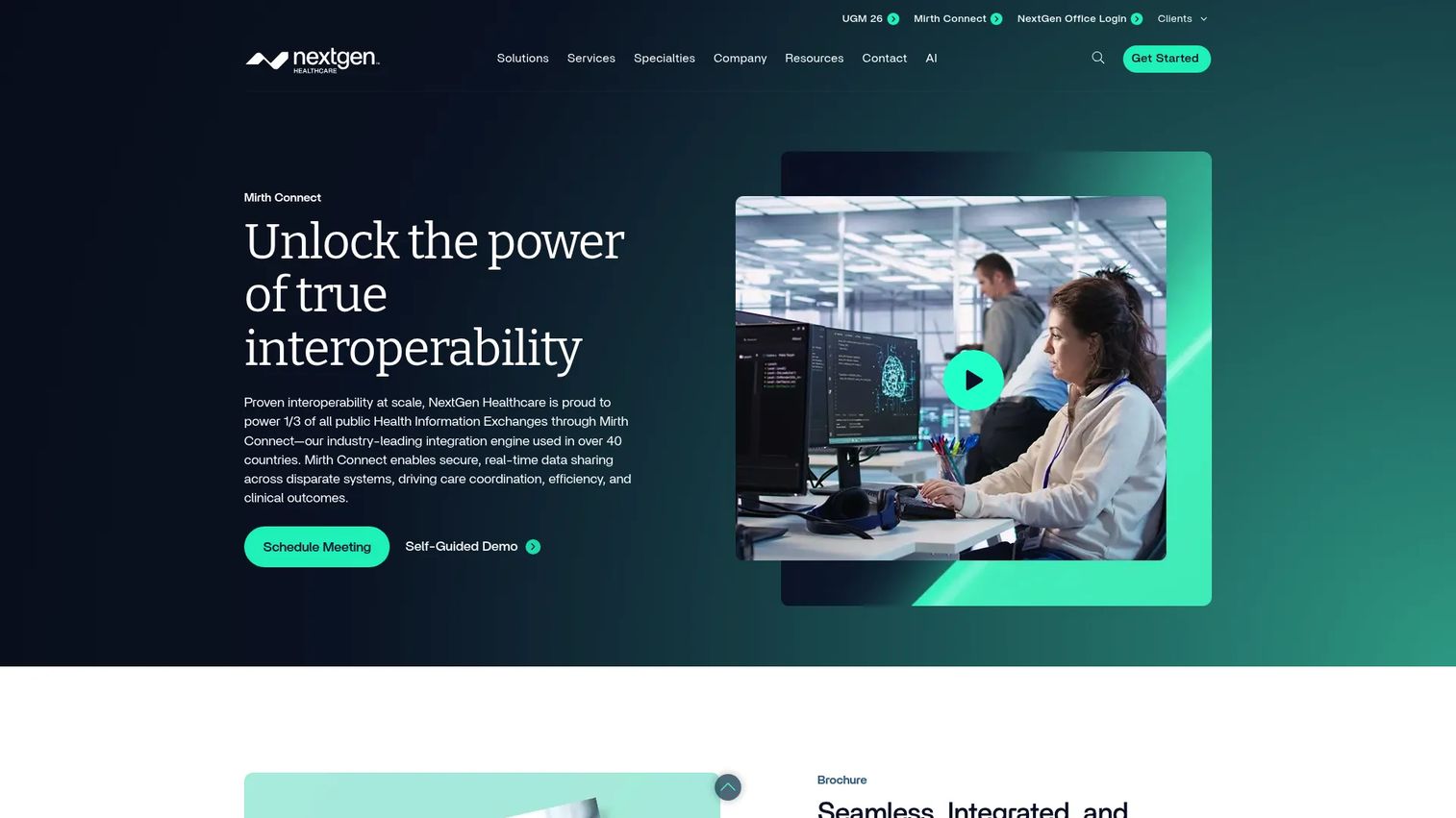
NextGen Mirth Connect is a standards-based healthcare integration engine for secure, real-time data sharing across disparate clinical systems. It uses a channel-based interface model where each connection is configured as a distinct channel with routing, filtering, and transformation logic. The platform supports HL7, FHIR, DICOM, X12, XML, JSON, and other formats, and has a large installed base across hospital and healthtech environments.
Best for: Healthcare organizations and healthtech teams with in-house interface developers who already know Mirth-style channel configuration and want to stay on an established platform.
Key features
- Channel-based interface design and message mapping
- HL7 v2 routing and data transformation scripting
- Support for HL7, FHIR, DICOM, X12, XML, and JSON
- API and FHIR connectivity
- Platform-agnostic interoperability and high-volume scalability
Why choose NextGen Mirth Connect: If your team has engineers with Mirth channel experience, migration cost and retraining time are real factors in any engine comparison. Mirth Connect's existing skill continuity is a concrete operating-model advantage, not just a feature claim.
NextGen Mirth Connect pricing: NextGen offers three commercial license tiers: Enterprise, Gold, and Platinum. Pricing is annual and flat-fee, with no published numeric price. Contact NextGen for a quote. A complimentary research license is available for qualifying nonprofit-affiliated studies.
G2 rating: 5.0/5, based on 2 reviews
3. Rhapsody Corepoint
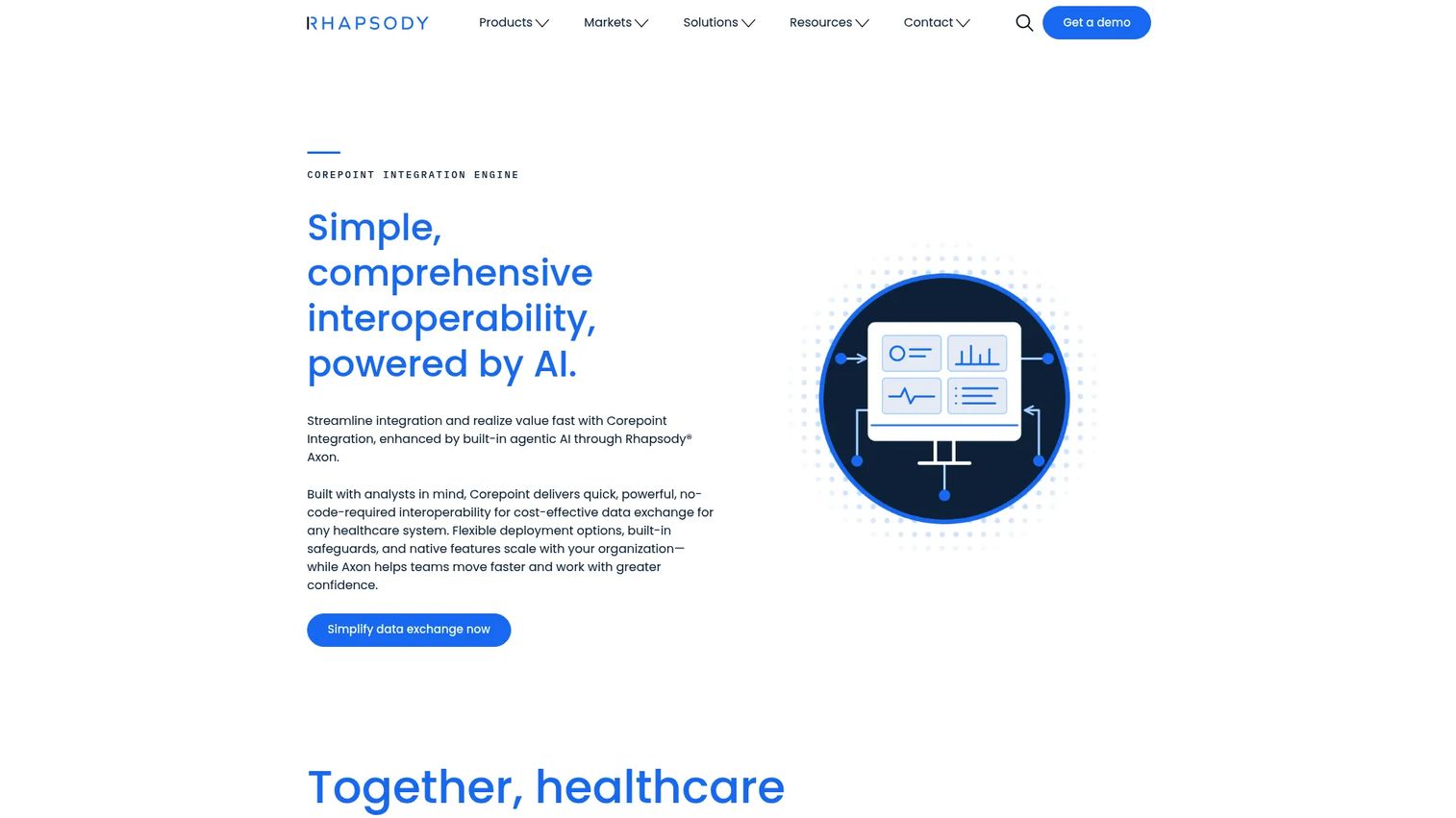
Rhapsody Corepoint is a healthcare integration engine within the Rhapsody portfolio, built for no-code-required interface configuration across EHRs, clinical systems, and APIs. Teams build and manage interfaces through graphical, menu-driven workflows without writing transformation scripts. It supports HL7, FHIR, REST, and web services, and can be deployed as SaaS, on-premises, or through an iPaaS model.
Best for: Provider organizations that want a modular healthcare interface engine with monitoring, troubleshooting, and alerting built in, and prefer a graphical configuration approach over scripting.
Key features
- No-code graphical interface building with menu-driven workflows
- Monitoring, troubleshooting, alerting, and message tracking
- HL7, FHIR, REST, and web services interoperability
- SaaS, on-premises, and iPaaS deployment options
- Agentic AI capabilities through Rhapsody Axon
Why choose Rhapsody Corepoint: The graphical build environment reduces the interface engineering skill floor. Teams without deep integration developers can still configure and maintain interfaces. For product managers concerned about implementation capacity, that matters.
Rhapsody Corepoint pricing: Rhapsody directs prospective customers to request a demo or contact an interoperability specialist. Total cost varies with deployment scope, interface count, and support model.
G2 rating: 3.8/5, based on 3 reviews
4. InterSystems Health Connect
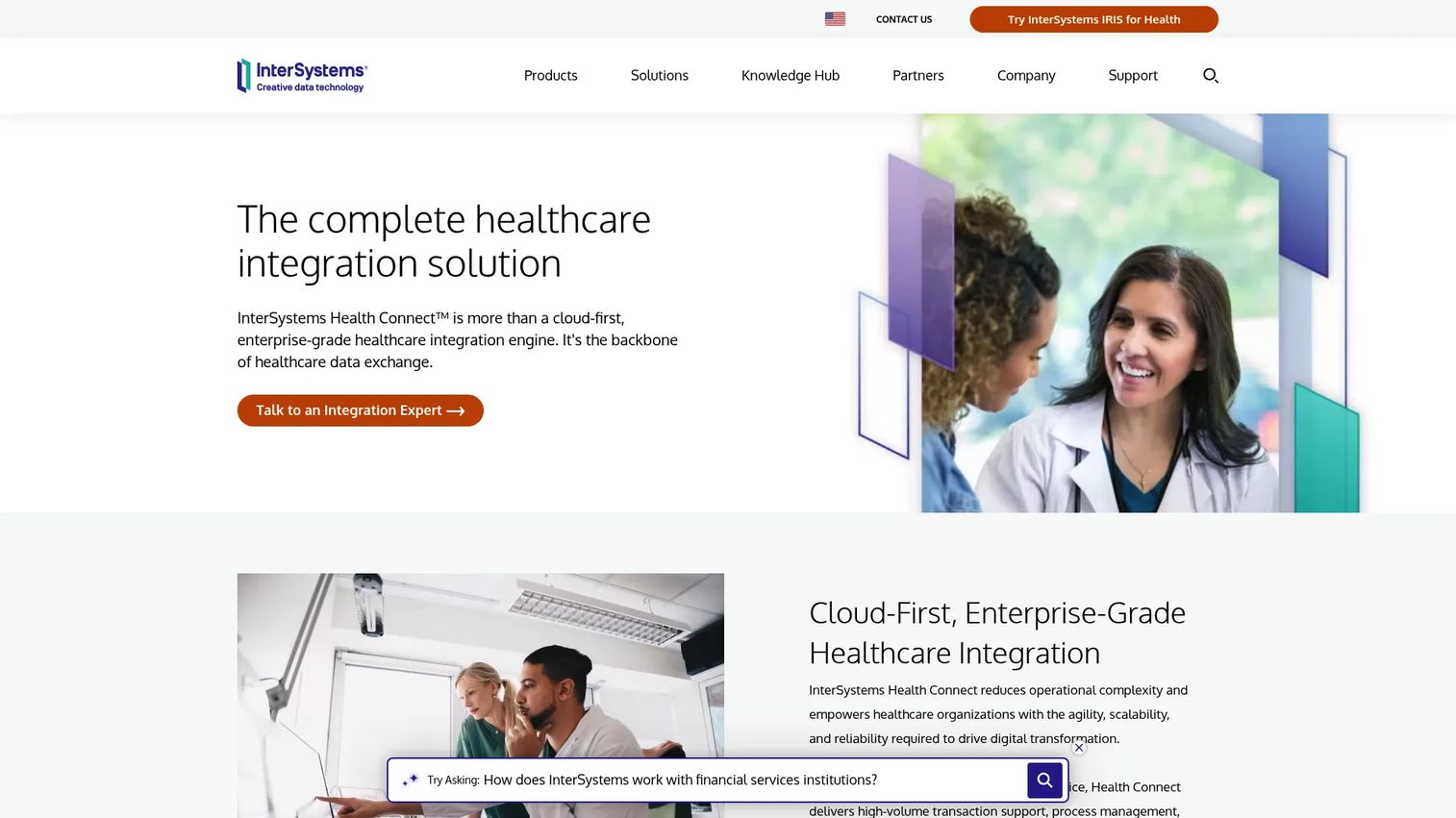
InterSystems Health Connect is a cloud-first, enterprise-grade healthcare integration engine for secure, high-volume data exchange across clinical systems, applications, and devices. It is offered as a fully managed cloud service, handling infrastructure provisioning, encryption, monitoring, access controls, and platform upgrades on the customer's behalf. The platform supports HL7 v2, FHIR, DICOM, IHE profiles, and API-based integration.
Best for: Health systems and healthcare software vendors that want enterprise integration capabilities without managing the underlying infrastructure or platform release cycles.
Key features
- HL7 v2, FHIR, DICOM, IHE profiles, and cloud-based data exchange
- High-volume transaction processing with monitoring and process management
- Fully managed cloud service with encryption and access controls
- Healthcare data transformation and normalization
- Integration with broader InterSystems health data platforms
Why choose InterSystems Health Connect: The operating model argument is stronger than the feature argument. Teams that want interoperability capabilities without the infrastructure maintenance burden will find the managed service model worth evaluating, particularly where internal platform engineering capacity is limited.
InterSystems Health Connect pricing: InterSystems describes a flexible pay-as-you-grow model and requires a direct contact for pricing. No published numeric price is available on official pages.
G2 rating: 4.2/5, based on 20 reviews
5. Qvera Interface Engine
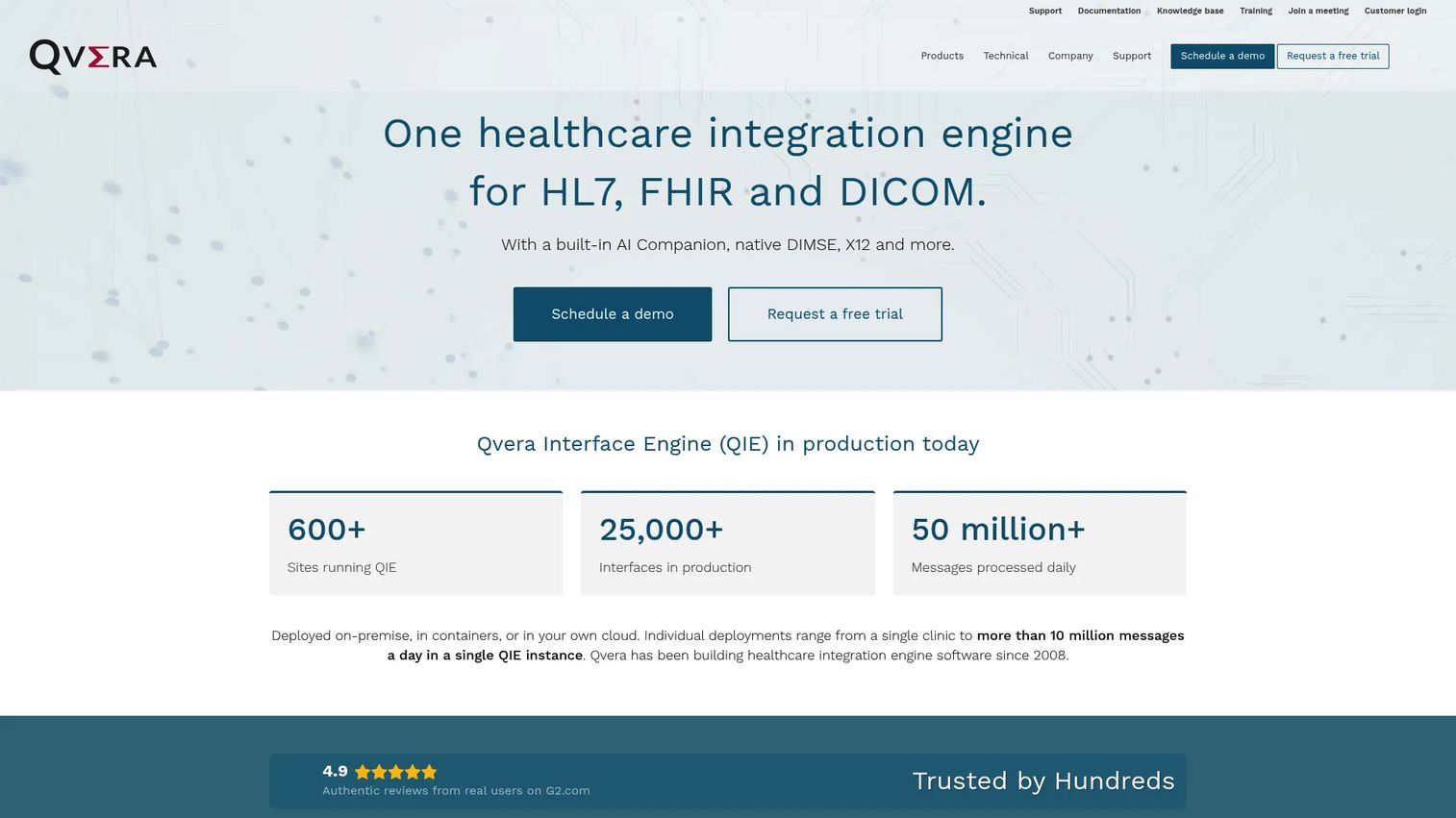
Qvera Interface Engine connects clinical, imaging, and administrative systems using a drag-and-drop Visual Channel Editor alongside scripting and workflow configuration. It supports HL7, FHIR, DICOM, X12, ASTM, EDIFACT, XML, JSON, and CSV in a single engine, which makes it a distinct choice for imaging-heavy environments that need DICOM networking alongside standard clinical messaging. Deployment options include on-premises, cloud, Docker, Kubernetes, AWS ECS, and Microsoft AKS.
Best for: Hospitals, imaging centers, and healthtech vendors that need DICOM header management, imaging archive integration, and HL7 or FHIR interfaces within the same platform.
Key features
- HL7, FHIR, DICOM, X12, ASTM, EDIFACT, XML, JSON, and CSV support
- Drag-and-drop Visual Channel Editor with scripting
- Web-based monitoring dashboards and automated alerts
- DICOM header de-identification and imaging workflow tools
- High-availability and horizontally scalable deployment
Why choose Qvera Interface Engine: If your product needs to manage DICOM imaging data alongside HL7 clinical messages, Qvera avoids the cost of running separate engines for imaging and clinical workflows. It is also the only engine in this list with a published starting price, which gives product teams a concrete budget anchor before engaging sales.
Qvera Interface Engine pricing: Channel-based licensing starts at $9,980 per year for two channels, billed annually. Enterprise and OEM licensing are available by quote. A Remote Management Hub add-on is licensed separately.
G2 rating: 4.9/5
6. iNTERFACEWARE Iguana
iNTERFACEWARE Iguana is a healthcare integration engine built for developer-led interface teams that need precise control over interface logic, testing, troubleshooting, and deployment. It uses a Lua scripting environment with built-in code assistance, source control, and Git integration. The platform covers HL7, FHIR, XML, JSON, X12, and CDA, and pairs interface development with a web-based monitoring dashboard, message activity logs, and user-permission controls.
Best for: Healthtech product teams and healthcare organizations with engineers who need deep control over custom interface behavior, version management, and integration testing workflows.
Key features
- Lua-based scripting with testing and built-in code assistance
- HL7, FHIR, XML, JSON, X12, and CDA format support
- Built-in source control and Git integration
- Monitoring dashboard, message logs, notifications, and public APIs
- User permissions, audit logs, and high-availability architecture
Why choose iNTERFACEWARE Iguana: When integration logic is part of a product's differentiation, and engineering teams need to own complex message behavior end-to-end, Iguana fits that model. The tradeoff is an engineering investment. This is not a graphical configuration tool, and it requires developers who can own the scripting environment.
iNTERFACEWARE Iguana pricing: Pricing is value-driven and tailored by use case. No published numeric price appears on the official pricing page. Contact iNTERFACEWARE for a quote.
G2 rating: 4.5/5, based on 40 reviews
7. Epic Bridges
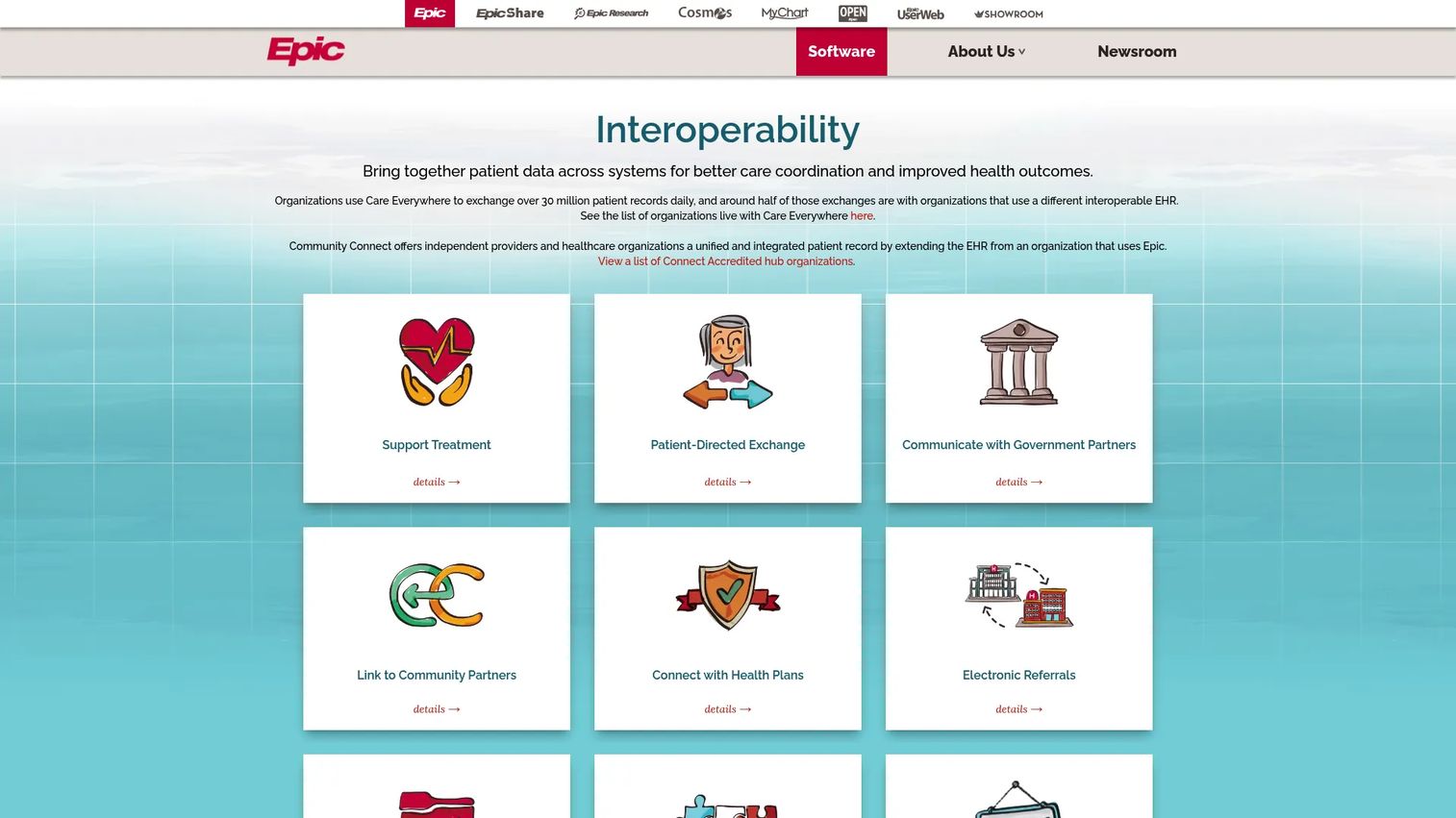
Epic Bridges is Epic's native interoperability capability for connecting healthcare organizations, clinical applications, health plans, and government partners to exchange patient and operational data. For organizations operating Epic as their primary EHR, Bridges provides HL7-based interfaces, FHIR APIs, and the Care Everywhere exchange network within a tightly integrated operational model. Epic Community Link extends access for community providers to patient charts, orders, referrals, and notifications.
Best for: Epic customer organizations that need interfaces closely connected to their Epic environment, using Epic-certified governance and implementation processes.
Key features
- Care Everywhere exchange of patient records across organizations
- FHIR-based APIs and standards-based interface support
- Epic Community Link for community-provider connectivity
- HL7 integration within Epic's native governance model
- EHR-native interface workflows and clinical application connectivity
Why choose Epic Bridges: The fit case is EHR alignment. When Epic is the system of record and the buyer wants operational proximity to Epic workflows rather than a separately managed integration layer, Bridges belongs on the evaluation list. For multi-EHR environments or healthtech vendors serving Epic and non-Epic customers, a separate enterprise engine is usually more appropriate.
Epic Bridges pricing: Pricing is handled through Epic contracting and implementation arrangements. Epic does not display a public price on official interoperability pages. Open developer APIs are available at no cost to developers.
G2 rating: 4.2/5 for Epic overall
8. Consensus Conductor
Consensus Conductor is positioned as an enterprise interoperability orchestration product for organizations coordinating broad portfolios of data exchange workflows. It supports message routing, transformation, and centralized oversight of multi-system clinical data exchange. Buyers evaluating this product should verify current product packaging, naming, and commercial availability directly with the vendor before proceeding, as product ownership and offerings in this space change.
Best for: Large provider networks and interoperability programs that need centralized management of complex exchange workflows across many connected systems.
Key features
- Enterprise integration orchestration and clinical data exchange
- Message routing and transformation
- Centralized integration oversight and governance
- Multi-system interoperability support
- Enterprise-scale exchange workflow management
Why choose Consensus Conductor: The strongest fit is portfolio management at enterprise scale. This is worth exploring when the buyer's primary problem is governance across many interfaces, rather than a contained set of application connections. Confirm current product availability and support status before scheduling an evaluation.
Consensus Conductor pricing: Quote based. Contact the vendor for current commercial terms and packaging.
G2 rating: 4.7/5
9. iatricSystems EasyConnect Jaguar
iatricSystems EasyConnect Jaguar is a healthcare interface engine for secure, real-time data exchange across EHRs, laboratory systems, radiology systems, emergency department systems, and other clinical applications. It is EHR-agnostic, supports HL7, FHIR, X12, REST, JSON, and XML, and includes a drag-and-drop interface builder alongside proactive monitoring through built-in iAlert. The platform is positioned for provider organizations that value implementation support and healthcare domain expertise alongside the software.
Best for: Provider organizations that need healthcare-focused integration support and a managed operational model, particularly teams without a large internal interface engineering staff.
Key features
- HL7, FHIR, X12, REST, JSON, and XML format support
- Drag-and-drop interface building and management
- Proactive monitoring with built-in iAlert
- EHR-agnostic integration across EHRs, LIS, RIS, and ED systems
- Secure real-time data exchange and transformation
Why choose iatricSystems EasyConnect Jaguar: For organizations that prioritize implementation and operational support, EasyConnect Jaguar's healthcare-specific service model is the differentiating factor. It fits best when internal interface engineering capacity is limited and the organization needs a vendor that provides implementation involvement, not just software.
iatricSystems EasyConnect Jaguar pricing: Quote based. No published pricing or entry price appears on the official product page. Contact iatricSystems for current terms.
Considerations when choosing a healthcare integration engine
Standards and message formats
Evaluate what the product needs to support now and what is likely in the next two years. Most implementations still require HL7 v2. Many also require FHIR APIs, DICOM, and X12 for specific workflows. Ask for working demonstrations of the exact message flows you need, not a generic standards-support checklist. A vendor claiming FHIR support may mean read-only access to one endpoint, or it may mean full bidirectional API orchestration. Those are not the same thing.
For teams also managing API infrastructure, our API gateway software and API testing tools guides cover the adjacent layer where integration engines hand off to application APIs.
Deployment and operating model
Decide who will run the engine after go-live. Cloud-hosted, managed-service, customer-managed, and EHR-native models each carry different internal labor requirements. The lowest license cost can become the most expensive option if the team lacks monitoring capacity, release management bandwidth, or interface support expertise. Factor engineering opportunity cost into the total cost calculation, not just the contract value.
Observability and incident response
Ask how your team will identify failed messages, replay data, trace transformations, and audit changes. Require demonstrations of error queues, alerts, log search, retry behavior, environment separation, and incident workflows. A failed interface can result in a delayed lab order, a missing radiology result, or a duplicate patient record. For product managers, those failures become customer escalations and support backlog, not just infrastructure incidents.
Integration development and maintenance
Evaluate the creation model against the technical skills you have today, not the skills you plan to hire. Some engines use graphical configuration. Others require scripting, test automation, version control, and code review cycles. Committing to a developer-centric tool without the developers to run it creates a different maintenance risk than committing to a managed service without the budget to sustain it.
EHR, partner, and customer fit
Confirm the engine supports the systems your customers currently run. Technical capability and implementation speed are different things. An engine may be technically compatible with an EHR, but if it lacks pre-built adapters, existing deployment relationships with that EHR vendor, or experienced implementation resources, the project timeline extends regardless. Check reference customers in your specific EHR environment before committing.
If your product team is also evaluating broader clinical trial management software or customer data platform infrastructure, the observability and governance criteria above apply across all three categories.
Conclusion
Healthcare integration engines solve a specific and consequential infrastructure problem. The nine products above cover the major approaches: Enterprise platforms for large-scale clinical data integration, managed cloud services for organizations reducing infrastructure burden, developer-centric engines for teams that need deep interface control, imaging-aware engines for DICOM alongside HL7 and FHIR, and EHR-native options for tightly aligned Epic environments.
No single engine wins across all dimensions. The right choice depends on message volume, EHR relationships, deployment rules, DICOM requirements, and how much internal interface engineering capacity your team can sustain after go-live.
Before scheduling vendor evaluations, build a requirements matrix. Include the systems in scope, the exact message types required, expected throughput, monitoring and audit requirements, deployment constraints, delivery team capacity, and who owns support after implementation. That matrix will surface the real decision faster than any feature comparison.
Infor Cloverleaf and InterSystems Health Connect suit large enterprise programs. NextGen Mirth Connect and Rhapsody Corepoint fit organizations with existing Mirth skills or graphical configuration preferences. Qvera Interface Engine stands out for imaging-heavy environments. iNTERFACEWARE Iguana fits developer-led teams. Epic Bridges belongs on the list for Epic-centered providers. Consensus Conductor and iatricSystems EasyConnect Jaguar serve organizations prioritizing portfolio governance and implementation support, respectively.
Start your journey with Guideflow today!
FAQs
The terms are used interchangeably across the industry. Both refer to middleware that connects healthcare applications, routes messages, transforms data formats, validates content, and supports monitoring. Product naming differs by vendor, so you will see both terms applied to functionally identical products.
At minimum, evaluate HL7 v2, FHIR APIs, message routing, transformation, validation, monitoring, alerting, audit logs, and security controls. Add DICOM for imaging workflows, and X12 for payer or claims use cases. The specific formats required depend on the systems your customers run, not a generic checklist.
Yes. Orders, results, patient demographics, and status updates can move between an EHR and a laboratory information system through a properly configured engine. The exact messages, field mappings, and validation requirements vary by site, EHR version, and lab system, so implementation scope should be defined before selecting an engine.
No. Engines typically manage APIs alongside HL7 feeds, files, web services, and message queues. An engine orchestrates data across multiple protocols, but an API strategy still requires clear ownership, versioning, authentication, and governance. The engine is the routing and transformation layer; the API is one of the transports it manages.
FHIR adoption is expanding, but HL7 v2 remains deeply embedded in hospital operations. Most healthcare organizations need both for the foreseeable future. Evaluating transformation and coexistence capabilities is more useful than asking which standard will win. For teams building new healthtech products, FHIR-first design is increasingly the right default, with HL7 v2 translation handled by the integration engine for legacy system connections.
There is no single answer that holds across hospital environments. Evaluate EHR alignment, existing interface engineering skills, HL7 and FHIR coverage, imaging requirements, deployment constraints, monitoring capabilities, support model, and total operating cost. InterSystems Health Connect suits hospitals wanting a managed cloud service. Infor Cloverleaf fits large enterprise environments with mixed legacy and modern systems. Rhapsody Corepoint appeals to teams that prefer graphical configuration without scripting.
Some do, and the distinction matters if your product serves radiology, imaging archives, or modality worklist workflows. Qvera Interface Engine explicitly supports DICOM networking, header de-identification, and imaging integration alongside HL7 and FHIR. NextGen Mirth Connect also lists DICOM in its format support. For imaging-heavy environments, verify DICOM query and retrieve support, header controls, and monitoring during vendor evaluation rather than accepting a general format-support claim.
Implementation timing depends on the number of interfaces in scope, source system readiness, message mapping complexity, data quality, environment access, testing cycles, and stakeholder approvals. A single well-documented feed between two cooperative systems can go live in weeks. Enterprise interoperability programs spanning multiple EHRs, lab systems, and imaging platforms typically extend across several phases and months. Build a phased implementation plan before selecting an engine, so the project scope matches available delivery capacity.