Most companies already have a wellness program. Few can tell you whether it works. Participation lives in one spreadsheet, claims data in another, and the answer to "did this reduce anything?" is usually a shrug.
That gap is expensive. The global corporate wellness market is forecast to expand from USD 72.73 billion in 2026 to USD 138.37 billion by 2035, according to Precedence Research (2024). The software slice is growing too: Business Research Insights (2024) projects employee wellness software alone to climb from USD 0.79 billion in 2026 to USD 1.5 billion by 2035. Spending is rising. Proof of impact is not keeping pace.
For a founder or People Ops lead, the problem is not whether wellness matters. It is whether the tool you pick will actually drive participation, report on it cleanly, and handle sensitive health data without creating a privacy mess. A platform that nobody uses is a line item. A platform with no reporting is a guess. And a platform that mishandles biometric data is a liability.
This is a buyer's shortlist, not a perks brochure. We looked at corporate wellness software the way an operator evaluating any tool would: does it launch fast, drive measurable engagement, integrate with the stack, and give leadership something defensible? If you think about buyer evaluation in adjacent categories the same way our guides to the best customer data platform and best AI cybersecurity solutions do, you already know the lens: adoption, measurement, and stack fit beat feature counts.
What's inside
This guide covers seven corporate wellness software platforms built for physical, mental, emotional, financial, and social well-being. It is written for HR leaders, benefits managers, and founders comparing wellness software for employee health, engagement, and retention.
We chose tools based on four criteria that matter to buyers who care about results:
- Engagement mechanics - challenges, rewards, recognition, and nudges that actually move participation
- Analytics and reporting - dashboards, ROI/VOI framing, and participation visibility by group
- Integrations - wearables, mobile apps, SSO, and HRIS connections
- Program flexibility and privacy - configurable programs plus controls for sensitive health data
The goal is to help you compare by real use case, not feature noise.
TL;DR
- Best broad all-in-one employee wellness platform: Wellable, for rewards, challenges, and content breadth.
- Best configurable corporate wellness platform: CoreHealth, for white-label rollouts and modular assessments.
- Best for ROI-minded buyers: Wellness360, for whole-person wellness with rewards and engagement analytics.
- Best for challenge-based engagement: Vantage Fit, for activity tracking and habit-building.
- Best for personalized health experience: Personify Health, for multi-domain wellbeing and navigation.
- Best for fitness access as a benefit: Wellhub, for tiered gym, studio, and app access.
- These employee wellness solutions span recognition-led adoption, assessment-heavy programs, and access-based benefits, so match the pick to the outcome you need.
What is corporate wellness software?
Corporate wellness software is an employee wellness platform that helps employers design, run, and measure programs that support employee health, engagement, and well-being. The category spans wellness challenges, coaching, health assessments, incentives, communications, analytics, and integrations into the HR and benefits stack.
Most corporate wellness program software shares a common set of capabilities. A strong corporate wellness platform usually covers:
- Wellness challenges and gamification - steps, activity, habit streaks, leaderboards
- Health risk assessments and coaching - biometric screenings, guided support, condition management
- Rewards, incentives, and recognition - points, gift cards, and acknowledgment that drives participation
- Dashboards, ROI, and participation reporting - engagement trends by group, program, or cohort
- Mobile, wearable, API, and SSO integrations - connections to devices, apps, and identity systems
The better wellness technology in this category treats wellbeing software as an engagement system, not a content library. Content alone rarely moves behavior. Mechanics, measurement, and a clean rollout do. That is the difference between corporate wellness companies that sell perks and platforms that report outcomes leadership will accept.
When to use corporate wellness software
Not every team needs the same platform. Three situations tend to trigger a serious evaluation.
Launch a wellness program from scratch
When a company grows past 50 or 100 employees, ad hoc perks stop scaling. Gym stipends and the occasional yoga class do not produce data or consistency. A structured employee wellness platform gives you a repeatable program, a single place to run it, and participation reporting from day one. This matters most when headcount is climbing fast, retention is under pressure, or existing benefits are going underused.
Improve adoption in an existing program
Plenty of teams already have a program that nobody opens. The fix is rarely more content. It is engagement mechanics: challenges, nudges, recognition, and incentives that give people a reason to return. If your current tool shows participation stuck in the single or low double digits, the priority is behavior change and visibility into who is actually engaging.
Prove value to leadership
When finance or the founder asks "what did this do," you need more than anecdotes. The right platform ties participation to health behavior and, where possible, to retention-related outcomes. Look for analytics, benchmarks, and ROI or VOI framing you can put in front of a board without flinching.
Comparison table
Here is the shortlist at a glance. Use it to narrow to two or three platforms, then dig into the sections below. Pricing and ratings reflect verified, current values; where a vendor gates pricing behind sales, that is noted.
| # | Product | Intent | Key differentiation | Pricing | G2 rating |
|---|---|---|---|---|---|
| 1 | Wellable | Rewards + engagement | Broad all-in-one wellness, recognition, and content | From $100/month (Essentials) | 4.7/5 |
| 2 | CoreHealth | Configurable platform | White-label Pro plus modular assessments | NOW and Checkpoint from $0/month; Pro contact sales | 4.8/5 |
| 3 | Wellness360 | ROI + engagement | Whole-person wellness with rewards and analytics | From $1 PUPM | 4.4/5 |
| 4 | Vantage Fit | Challenges + activity | Step tracking, leaderboards, wearable integrations | Grow from $500/month (500 users) | 4.5/5 |
| 5 | Wellable Wellness Platform | Engagement + incentives | Configurable challenges, content, and rewards | From $625/month | 4.7/5 |
| 6 | Personify Health | Personalized health | Multi-domain wellbeing plus navigation and advocacy | Custom pricing | - |
| 7 | Wellhub | Fitness access benefit | Tiered access to gyms, studios, and wellness apps | Digital from $0/month; paid tiers from $64.99/month | 4.1/5 |
One read of the table: the picks split into engagement-led platforms (Wellable, Wellness360, Vantage Fit), configurable program builders (CoreHealth, Personify Health), and access-based benefits (Wellhub). Match the column labeled Intent to the outcome you owe leadership.
1. Wellable
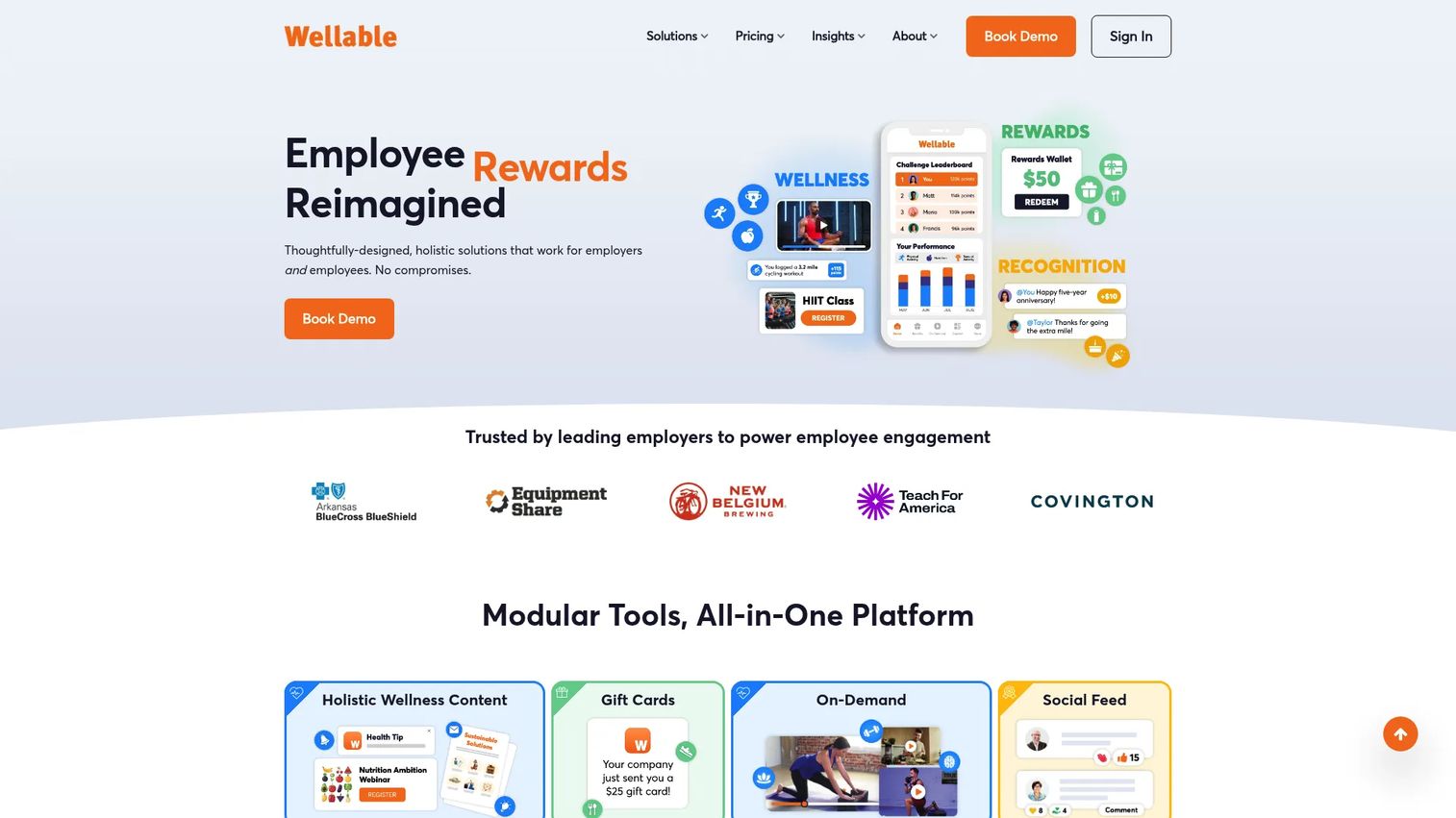
Wellable is the broadest all-around employee wellness platform on this list. It combines wellness challenges, assessments, on-demand classes, live events, rewards, and recognition into one program that employers can configure without standing up infrastructure. For a team that wants a mature platform with proven adoption mechanics, it is a strong default.
The appeal for founders and People Ops is breadth without sprawl. You get challenges to drive participation, content to keep people coming back, and recognition plus benefits navigation to reinforce the program, all in a single place with reporting attached.
Best for: Employers wanting a configurable corporate wellness and employee recognition program in one platform.
Key strengths
- Wellness challenges and assessments: Run step, habit, and health challenges that produce participation data, not just activity.
- On-demand classes, live events, and breaks: Keep engagement steady between challenges with content people actually use.
- Rewards, recognition, and benefits navigation: Tie incentives and acknowledgment to participation to lift adoption and retention.
Why choose Wellable: If you want one platform that covers challenges, content, and recognition without forcing you to choose, Wellable fits. It suits teams that value breadth and a recognition layer over a single specialized mechanic, and it scales from a starter program to a fuller rollout.
Wellable pricing: Wellable lists three subscription tiers. Essentials starts at $100/month ($4.00 per user per month), Pro at $150/month ($6.00 per user per month), and Enterprise is quote-based through the sales team. Pricing is presented as a custom quote on the site, so confirm your per-user rate for your headcount. No free tier is published.
2. CoreHealth
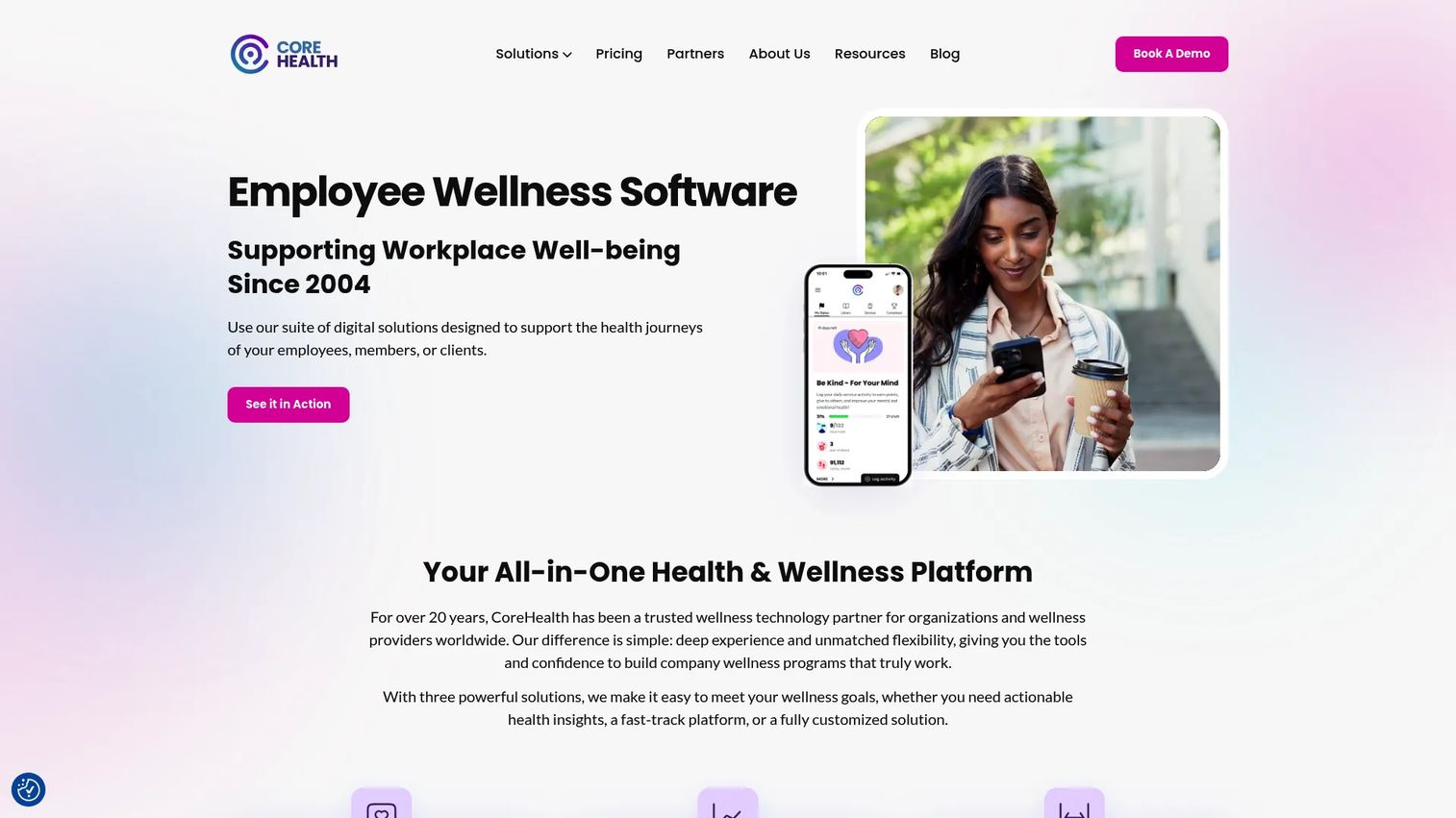
CoreHealth is the configurable, provider-grade corporate wellness platform on this list. Its architecture is built around distinct products: CoreHealth NOW for an out-of-the-box program, CoreHealth Pro for a white-label, fully configurable platform, and CoreHealth Checkpoint for modular health risk assessments. That structure lets you start fast or build something tailored to your brand and program design.
For teams that want a rollout shaped to their own workflows, with strong assessment depth and analytics, CoreHealth gives more control than a fixed template. It is also well suited to wellness providers reselling a branded experience.
Best for: Employers or wellness providers needing a configurable wellness platform with assessment depth.
Key strengths
- CoreHealth NOW: Launch an out-of-the-box wellness program quickly when you want structure without a long build.
- CoreHealth Pro: White-label, configurable platform for teams that want the program to carry their brand and logic.
- CoreHealth Checkpoint: Modular health risk assessments you can deploy as a standalone or inside a broader program.
Why choose CoreHealth: Pick CoreHealth when configurability and assessment depth matter more than a one-size template. The product split lets you scale from a packaged program to a fully branded build, which fits teams that expect their wellness program to evolve.
CoreHealth pricing: The public pricing page lists CoreHealth Checkpoint and CoreHealth NOW at $0/month under an annual license, with an implementation fee shown for Checkpoint. CoreHealth Pro is a three-year license priced through sales contact. There is no published free tier; confirm implementation and licensing terms for your program before committing.
3. Wellness360
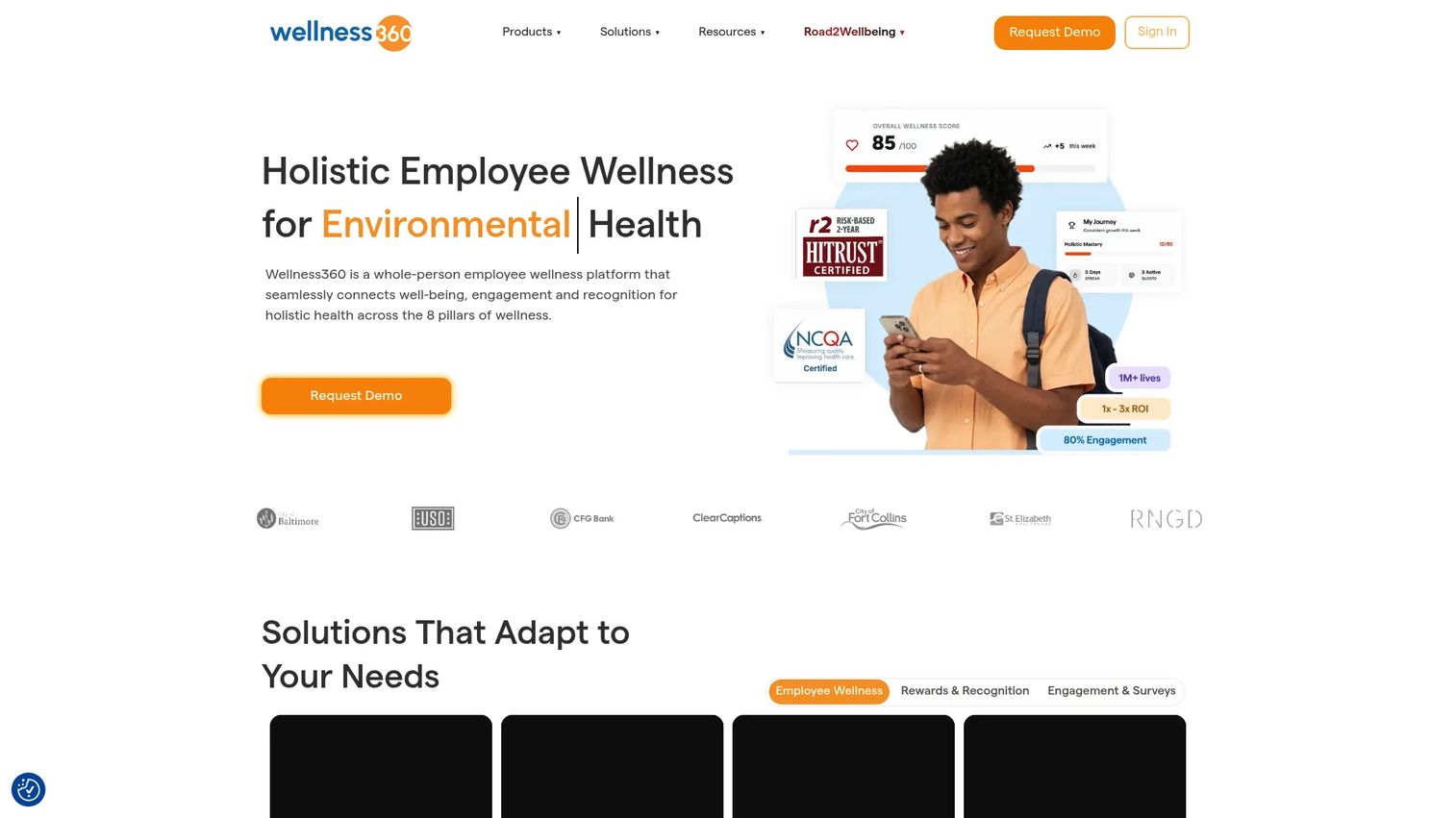
Wellness360 frames itself as a whole-person employee wellness platform spanning wellness, engagement, and recognition. It is a good fit for buyers comparing corporate wellness software as a broader engagement system rather than a single mechanic, with a clear emphasis on ROI and value-on-investment measurement.
The platform pairs challenges and trackers with health risk assessments, biometric screenings, rewards, and recognition. For an operator who needs to show leadership what the program returned, the analytics and engagement layer is the draw.
Best for: Employers seeking a customizable corporate wellness platform with rewards and engagement analytics.
Key strengths
- Wellness challenges and trackers: Drive participation with structured challenges that produce measurable activity data.
- Health risk assessments and biometric screenings: Build a clearer health baseline to target programs and report change over time.
- Rewards, recognition, and lifestyle spending accounts: Reinforce engagement with incentives that tie back to participation.
Why choose Wellness360: Choose Wellness360 if you want a configurable wellbeing software platform that leans into measurement and recognition together. It suits buyers who want challenges, assessments, and rewards under one roof with reporting they can defend.
Wellness360 pricing: Wellness360 does not publish a standalone pricing page. The only verifiable public price on its site appears on a comparison page, where Wellness360 is listed starting from $1 per user per month. Treat that as a starting reference and request a quote for your headcount and program scope. A free tier could not be confirmed from primary sources.
4. Vantage Fit
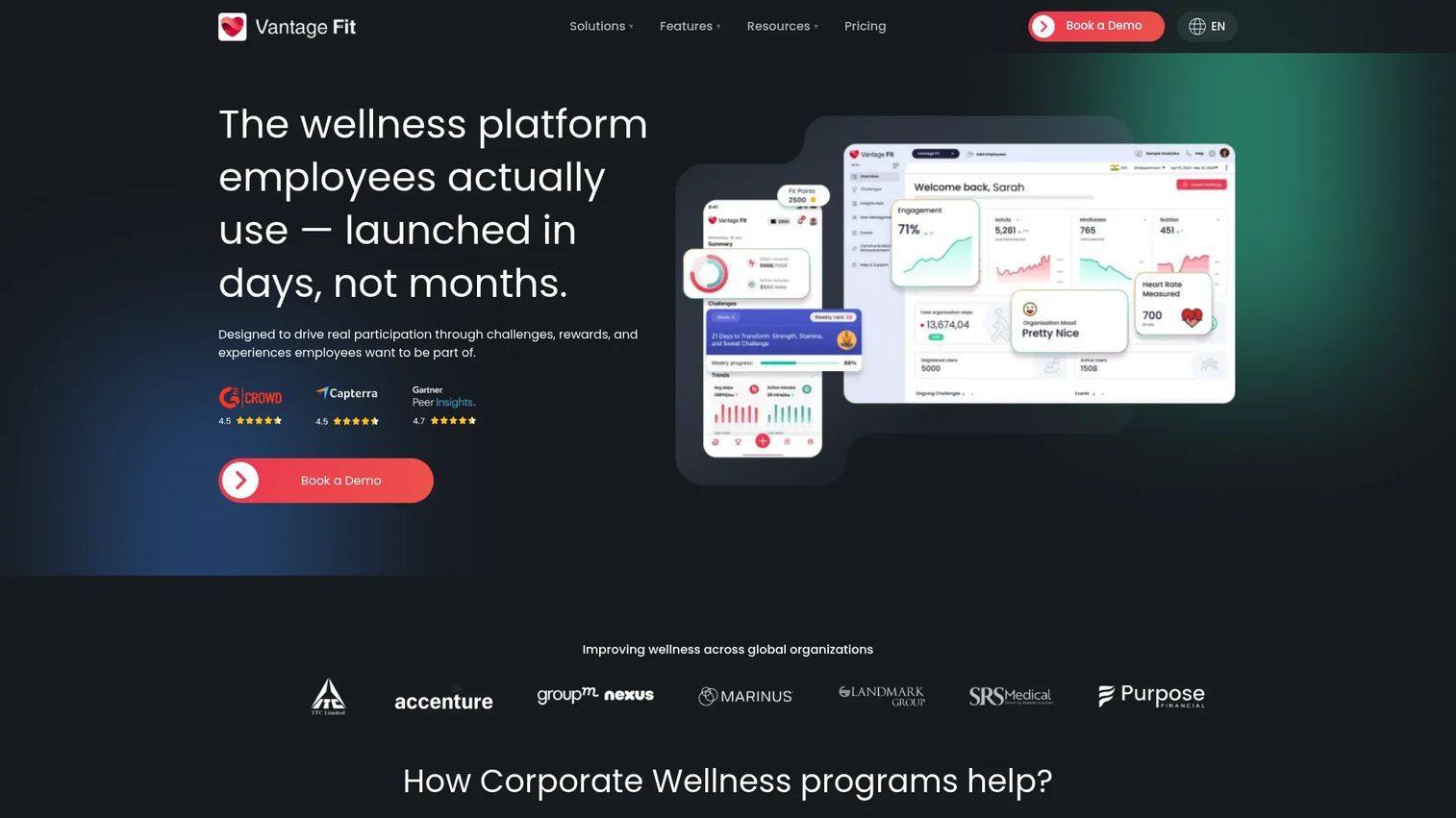
Vantage Fit is the engagement-first pick built around activity tracking, challenges, and rewards. If your priority is straightforward participation and habit-building, it keeps the program simple: track steps and activity, run challenges, climb the leaderboard, earn rewards.
It is mobile-led, with iOS and Android apps and wearable integrations, which makes it a natural fit for teams that want a low-friction, app-first program employees can engage with on their phones. HR teams running activity challenge programs are the core audience.
Best for: HR teams running employee wellness and activity challenge programs.
Key strengths
- Step and activity tracking: Capture movement automatically so participation does not depend on manual logging.
- Wellness challenges and leaderboards: Use competition and team dynamics to lift engagement and keep it sticky.
- iOS/Android apps with wearable integrations: Meet employees on their phones and connect the devices they already wear.
Why choose Vantage Fit: Pick Vantage Fit when you want a focused, mobile-first engagement engine rather than a broad benefits suite. It fits teams that want challenges and activity tracking to do the heavy lifting on participation.
Vantage Fit pricing: G2 lists Vantage Fit's Grow plan at $500.00 and Transform at $900.00 for 500 users per month, with Enterprise as contact us. The brand pricing page presents an interactive plan configurator where figures vary by employee count and challenge type, so confirm your exact price for your headcount. No free tier was found on the pricing page.
5. Wellable Wellness Platform
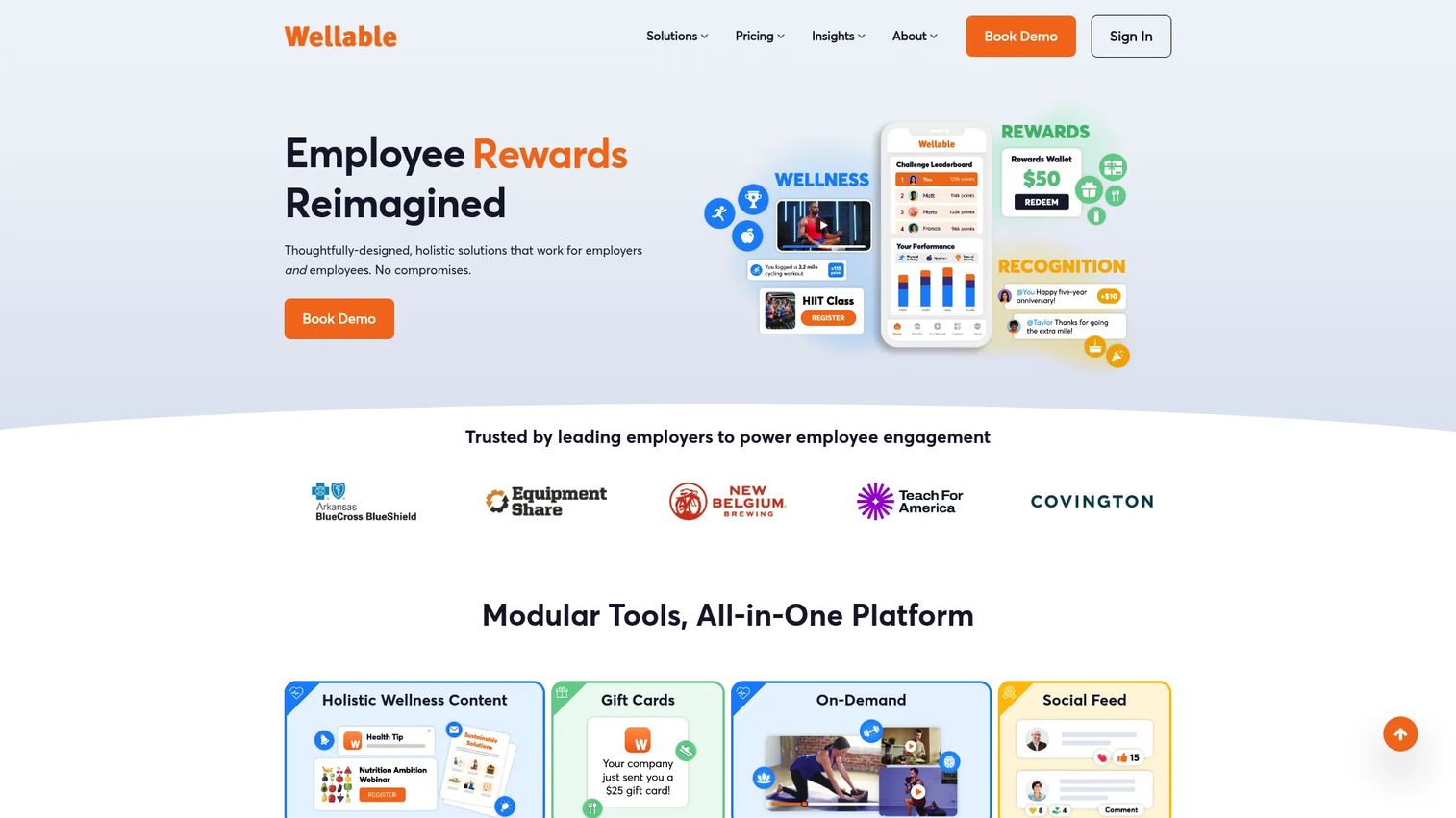
The Wellable Wellness Platform is how Wellable's employee wellness, rewards, and recognition platform shows up across review ecosystems and buyer shortlists. It appears in review-driven evaluations for the same reasons buyers shortlist it directly: customizable challenges, content, recognition, and incentives in one configurable program.
For buyers who discover vendors through review sites first, this listing is the one they compare. The focus is rewards, recognition, engagement, and employee participation, with a configurable program structure underneath.
Best for: Employers wanting a configurable wellness program with challenges, content, and incentives.
Key strengths
- Customizable wellness challenges: Tailor challenges to your team and program goals rather than running a fixed template.
- On-demand classes and live events: Sustain engagement between challenges with content employees return to.
- Rewards, recognition, and incentives: Connect acknowledgment and incentives to participation to drive adoption.
Why choose Wellable Wellness Platform: This is the right entry to evaluate if you found Wellable through a review marketplace and want to confirm fit. It suits teams that value configurable challenges plus a recognition layer, with a clear minimum commitment to plan around.
Wellable Wellness Platform pricing: The subscription page lists Essentials and Pro at $625/month ($1.25 per user per month), with Enterprise quote-based through sales. The site notes pricing is customized and the minimum commitment is 25 users. A free tier was not verified, so confirm terms for your headcount.
6. Personify Health
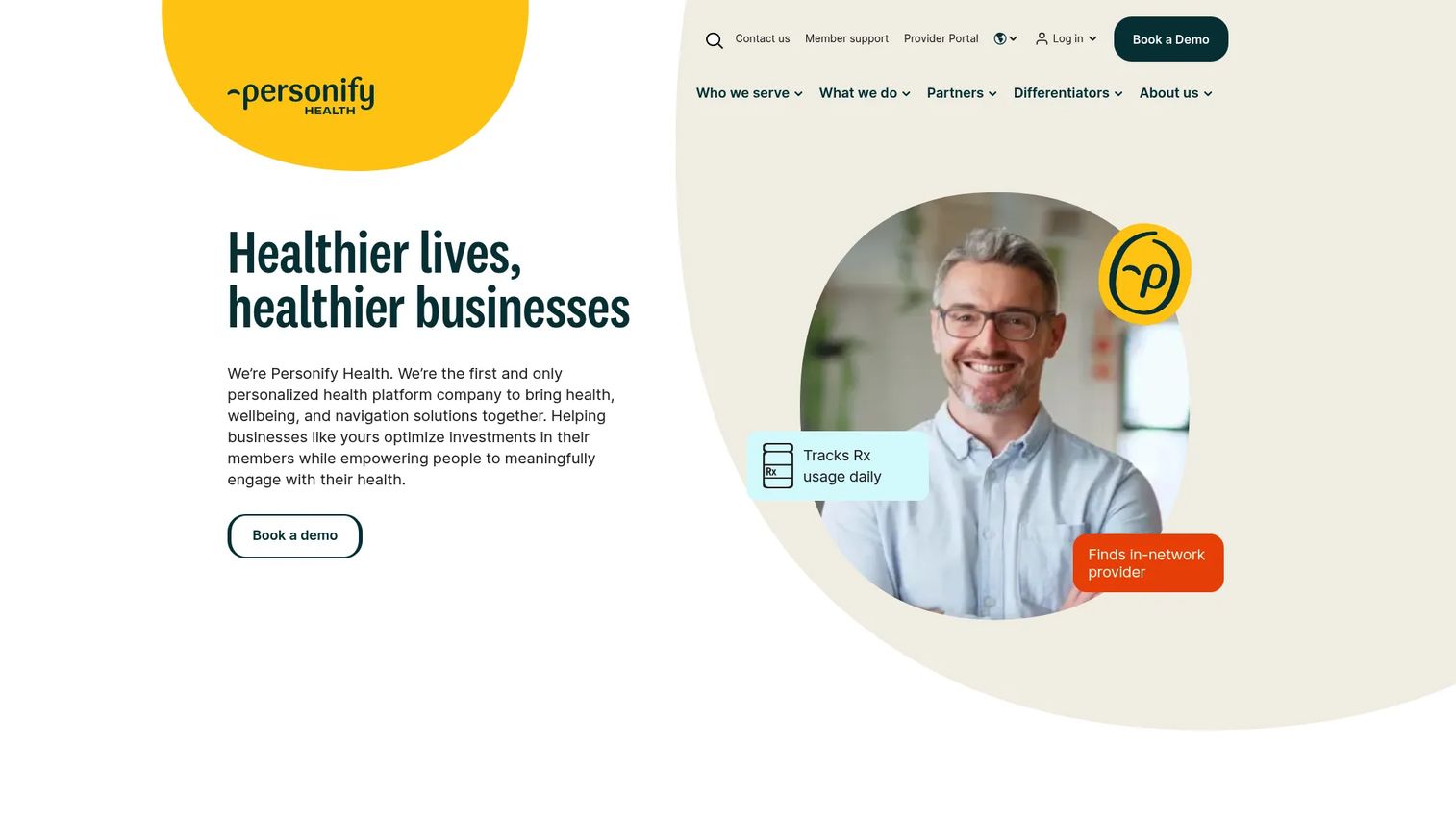
Personify Health is the broadest employee well-being and health experience platform on this list. It serves employers, health plans, and health systems with personalized health and wellbeing solutions, healthcare navigation and advocacy, and care and condition management. For buyers who want a comprehensive experience layer rather than a single engagement mechanic, it covers more ground.
The fit here is large organizations that want personalization and multi-domain wellness support in one place, with navigation and advocacy built in. That breadth makes it a different category of buy than a challenge-first app.
Best for: Large organizations seeking a personalized health platform for members or employees.
Key strengths
- Personalized health and wellbeing solutions: Tailor the experience to individuals across multiple wellness domains.
- Healthcare navigation and advocacy: Help employees find and use the right care, reducing friction around benefits.
- Care and condition management: Support people managing specific health conditions inside one platform.
Why choose Personify Health: Choose Personify Health when you want a comprehensive health experience layer, not just a wellness engagement tool. It fits larger organizations that need personalization, navigation, and condition management together, and that are buying an experience rather than a single feature.
Personify Health pricing: Personify Health does not publish public pricing on its site, and no visible price was available during research. Pricing is custom and arranged through sales. Given the platform's scope and audience, plan for an enterprise-style evaluation and request a tailored quote for your organization.
7. Wellhub
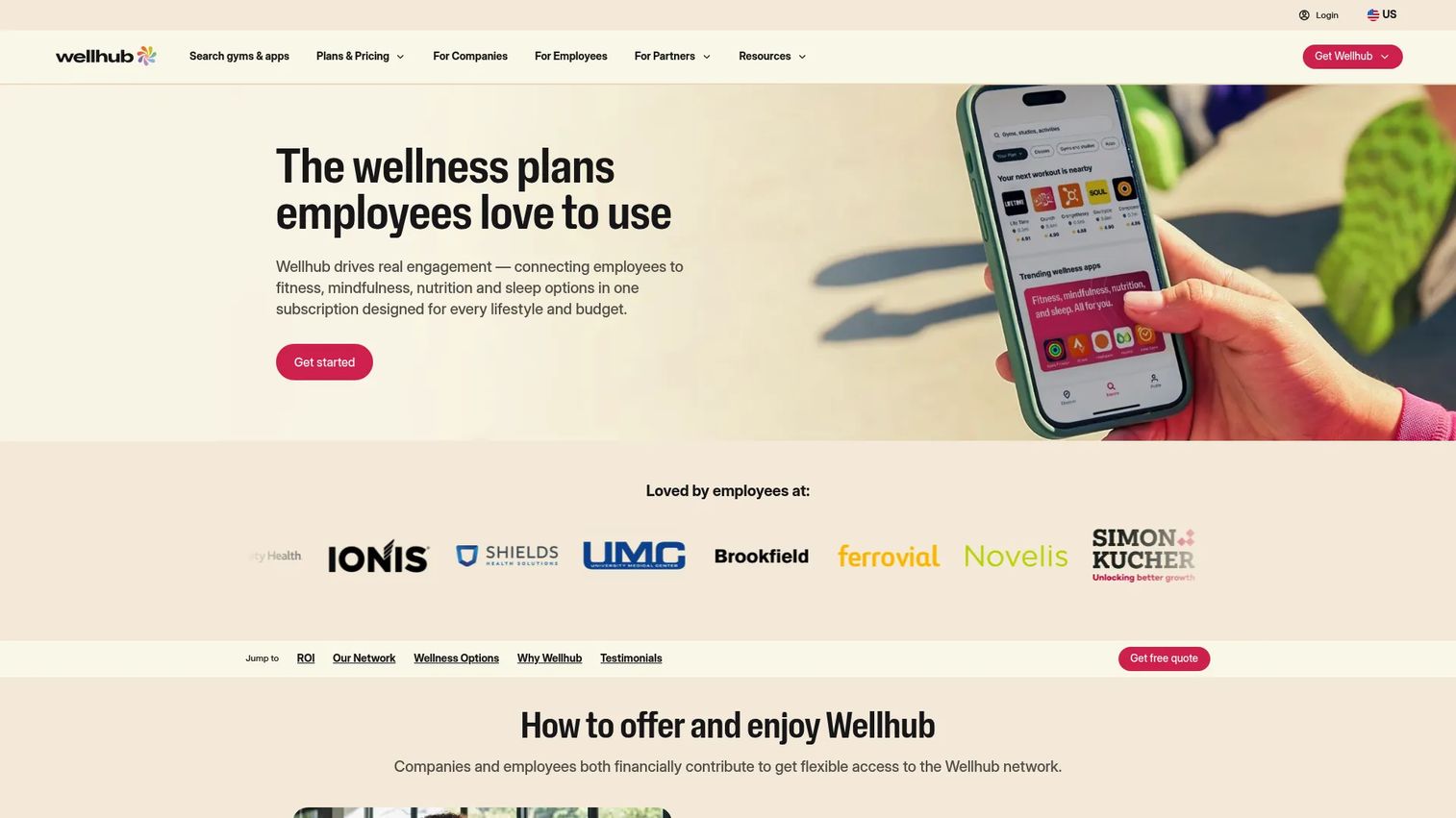
Wellhub takes a different angle from the assessment-heavy platforms: it is an access-based benefit. Employees get tiered access to gyms, studios, premium classes, and wellness apps through subscription plans. For companies that want wellness benefit utilization and broad employee engagement through real-world fitness and app access, it fits where a challenge-tracking tool would not.
It works best as a fitness and wellness access benefit rather than a measurement-first program. If your goal is to put a flexible, recognizable benefit in front of employees, Wellhub delivers that with a tiered model.
Best for: Employers looking to offer a flexible, tiered corporate wellness benefit.
Key strengths
- Multi-tier employee wellness plans: Offer a range of plans so employees pick the level of access that fits them.
- Access to gyms, studios, and premium classes: Give employees real-world fitness options, not just digital content.
- Unlimited premium access to wellness apps: Bundle wellness apps into the benefit to broaden everyday usage.
Why choose Wellhub: Pick Wellhub when access and benefit utilization matter more than assessments and ROI dashboards. It suits teams that want a tangible, flexible wellness benefit employees recognize and use, especially alongside a more analytics-driven platform.
Wellhub pricing: Wellhub publishes a tiered model. A Digital plan starts at $0.00/month, with paid plans including Bronze at $64.99/month, Silver at $109.99/month, Titanium at $159.99/month, Gold at $214.99/month, and Platinum at $289.99/month. Wellhub states there are 11 plans total, up to Diamond at $344.99/month, available monthly or annually. A free Digital tier is available.
Considerations before you buy
A shortlist is the easy part. These five criteria separate a platform that earns its place from one that becomes another unused line item.
Adoption mechanics
Content does not drive participation; mechanics do. Check how the platform creates reasons to return: challenges, recognition, incentives, and nudges. Ask vendors for typical participation rates by program type, and treat any tool that cannot show engagement data with caution.
Reporting depth
You will be asked to justify the spend. Look for dashboards that segment participation by group, program, and cohort, plus ROI or VOI framing you can present to leadership. Exportable reporting matters when finance wants the numbers in their own format.
Integrations and stack fit
A wellness platform that does not connect to your wearables, HRIS, and identity system creates manual work. Confirm wearable support, mobile apps, SSO, and any HRIS or benefits integrations you need before you commit, not after.
Privacy and data handling
Wellness platforms touch sensitive health data. Confirm how employee data is stored, who can access it, how it is segmented, and what consent flows exist. Mishandled biometric or health data is a real liability, so treat security controls as a gating criterion.
Speed to launch
Test how fast a pilot can go live. The faster you can stand up a real program with real participation data, the faster you learn whether the tool fits. A long, heavy rollout delays the only thing that matters: evidence it works.
Conclusion
The right corporate wellness software depends on the outcome you owe leadership, not the feature count. Wellable is the broad all-in-one pick for teams that want challenges, content, and recognition together. CoreHealth fits configurable, white-label rollouts with assessment depth. Wellness360 leans into ROI and engagement analytics. Vantage Fit is the focused, mobile-first engagement engine. Personify Health is the comprehensive health experience layer for larger organizations. Wellhub is the access-based benefit when fitness utilization matters most.
Your next step is simple: narrow to two or three platforms that match your intent, then compare them head to head on engagement mechanics, privacy controls, and reporting depth. Run a short pilot where you can. The corporate wellness vendors that earn their place are the ones that produce participation data and make wellness feel measurable, not fluffy.
If you build tools that need to show value through hands-on experience rather than slides, Start your journey with Guideflow today!
FAQs
Corporate wellness software is a platform that helps employers design, run, and measure employee health and well-being programs. It typically covers program administration, engagement mechanics like challenges and rewards, and reporting on participation and outcomes. The category spans physical, mental, financial, and social well-being, and the better corporate wellness apps treat engagement and measurement as the core, not a content library.
Prioritize features that drive participation and let you measure it: challenges, rewards, health assessments, coaching, analytics, and integrations. Engagement mechanics and reporting matter more than the size of any content catalog. A strong employee wellness platform should show you who is participating, how that trends over time, and how it connects to outcomes leadership cares about.
They track participation rates, challenge completion, activity and step data, session engagement, and dashboard reporting. The best platforms go further and show engagement trends by group, program, or cohort, so you can see where participation is strong and where it lags. That segmentation is what turns raw activity into something you can act on and report.
Compare program flexibility, reporting depth, integrations, privacy controls, and ease of rollout. Then test how quickly a pilot can go live, because speed to evidence is what tells you whether a tool fits your team. Evaluating wellness software with the same discipline you would apply to any stack decision, the way you might compare options in our guide to the best employee advocacy software tools, keeps the focus on outcomes rather than feature lists.
Wellness software handles sensitive health data, so consent, data access, storage, and segmentation all matter. Buyers should confirm how employee data is stored, who can see it, and how it is protected. There is also discrimination risk if health data is misused, so verify the vendor's security controls and data-handling practices before rollout.
Yes, if turnover, burnout, or underused benefits are hurting the business. Smaller teams should favor simple setups and clear participation reporting over sprawling feature sets they will not use. The goal is a program that launches fast, drives real participation, and gives you data, not a heavy platform that adds operational drag.
It can support retention by improving morale, reducing friction around benefits and support, and making well-being a consistent, visible part of how the company operates. The honest framing is that software supports retention by keeping a program consistent and easy to engage with; it is not a guaranteed fix. A well-run program with steady participation is more likely to contribute than a tool nobody opens.