


Automated investing sounds simple. Answer a few questions, fund the account, let an algorithm do the rest. Then you read the fine print.
The advisory fee is one number. The fund expense ratios underneath it are another. Some platforms run tax-loss harvesting for free, others gate it behind a minimum. A few give you a human advisor. Most do not. And the account minimum decides whether you can even open the door.
Those details change the real cost and the real value of automated investing more than any marketing page will admit. That matters now because the category is scaling fast. The global robo-advisory software market was estimated at USD 3.11 billion in 2024 and is projected to reach USD 15.5 billion by 2035, a 15.71% CAGR according to Market Research Future (2024). More capital, more products, more fine print to read.
This guide cuts through it. We compare seven robo advisors on the numbers that actually move your returns.
What's inside
This guide is for anyone comparing robo advisor software before opening an account. That includes first-time investors, financially literate beginners, and busy professionals who want hands-off portfolio management without overpaying.
We chose platforms based on four criteria that matter more than headline marketing:
- Fees: advisory fee plus the fund expense ratios underneath it
- Minimums: the balance required to open and to unlock features
- Tax tools: tax-loss harvesting, automatic rebalancing, and account-type coverage
- Advisor access: whether you can talk to a human, and at what cost
Each pick includes verified pricing, minimums, and portfolio details so you can compare quickly.
TL;DR
- Best overall for automated investing: Betterment. Goal-based portfolios, tax tools, and a low entry fee make it the strongest all-rounder.
- Best for low-cost, long-term planning: Vanguard Digital Advisor. Roughly $15 to $16 per $10,000 invested annually with retirement-focused glide paths.
- Best for existing Schwab users: Schwab Intelligent Portfolios. No advisory fee, though it holds cash as part of the allocation.
- Best for strong automation: Wealthfront. 0.25% annually with deep tax optimization and a high-yield cash account.
- Best for beginners and small balances: Acorns. Round-Ups and flat monthly pricing lower the barrier to start.
- Best for a broader finance stack: SoFi Invest. Robo investing at 0.25% plus self-directed trading in one app.
What is robo advisor software?
Robo advisor software is an automated investing platform that builds and manages a diversified portfolio for you using algorithms, based on your goals, timeline, and risk tolerance.
Instead of picking individual stocks, you answer a questionnaire. The software maps your answers to a portfolio allocation, usually a mix of low-cost ETFs across stocks and bonds. From there it handles the ongoing work most investors skip: buying, rebalancing, and in many cases tax optimization.
The core capabilities of robo advisor software include:
- Portfolio construction: algorithmic mapping of risk profile to an ETF portfolio across asset classes
- Automatic rebalancing: restoring your target allocation as markets drift, without manual trades
- Tax automation: tax-loss harvesting in taxable accounts to offset gains where eligible
- Account onboarding: digital signup, goal setup, and funding without a branch visit
The category spans standalone robo-advisors and automated products inside larger brokerages. Some are pure software. Others pair the algorithm with access to a human advisor for an added fee.
How robo advisors work
The mechanics are consistent across most platforms, even when the branding differs.
You start with a questionnaire. It asks about your age, income, goals, and how you would react to a market drop. That builds your risk profile.
Next comes goal selection. Retirement, a home down payment, an emergency fund, or general wealth building each imply a different timeline and a different asset mix. Longer goals lean more heavily toward equities.
Then the software sets your asset allocation. A retirement goal 30 years out might land at 90% stocks and 10% bonds. As you approach the target date, many platforms follow a glide path that gradually shifts toward bonds to reduce risk.
Here is the typical flow once you are funded:
- Answer the risk and goals questionnaire
- Get a recommended portfolio allocation of ETFs
- Fund the account and set recurring deposits
- The platform runs automatic rebalancing as markets move
- In taxable accounts, tax-loss harvesting sells losers to offset gains where eligible
Rebalancing keeps your risk level steady. Left alone, a strong equity run pushes your portfolio out of balance and quietly raises your risk. The software corrects it. Tax-loss harvesting captures losses to lower your tax bill, then reinvests to keep you in the market. Neither requires you to lift a finger.
When to use robo advisor software
Start investing without managing every trade
If you want your money in the market but do not want to research funds or time trades, automated portfolio management does the work. You set the goal and the deposit schedule. The software handles allocation, execution, and rebalancing. This suits people who value consistency over control.
Reduce decision fatigue with goal-based planning
Choosing between retirement, an emergency fund, and a house down payment is hard enough. Deciding the exact fund mix for each is harder. Goal-based robo investing assigns an appropriate allocation and glide path to each goal automatically, so you make one decision instead of dozens.
Keep portfolios aligned without constant monitoring
Markets move your allocation off target every week. Checking and correcting it manually is tedious and easy to skip. Automatic rebalancing and tax-loss harvesting run in the background, keeping your risk level and tax efficiency intact without you watching the ticker.
Comparison table
Read the table by starting with fees, then minimums, then whether tax tools and advisor access matter for your situation. The lowest advisory fee is not always the best deal once you factor in what you get and who can open the account. Betterment leads as the strongest all-round pick, with the rest ordered by relevance to most investors.
| # | Product | Best for | Key differentiator | Pricing | G2 rating |
|---|---|---|---|---|---|
| 1 | Betterment | Automated investing all-rounders | Goal-based portfolios with tax tools | $5/mo or 0.25%/yr | Not available |
| 2 | Charles Schwab | Integrated brokerage users | Full brokerage plus automated investing | $0 online stock/ETF trades | Not available |
| 3 | Schwab Intelligent Portfolios | Fee-averse Schwab investors | No advisory fee, automatic rebalancing | $0 advisory fee | Not available |
| 4 | Vanguard Digital Advisor | Low-cost long-term planning | Retirement glide paths, low fees | \~$15 to $16 per $10K/yr | Not available |
| 5 | Wealthfront | Automation-first investors | Deep tax optimization, cash account | 0.25% annually | Not available |
| 6 | Acorns | Beginners and small balances | Round-Ups and flat pricing | From $3/mo | Not available |
| 7 | SoFi Invest | Broader finance stack | Robo plus self-directed in one app | 0.25% advisory fee | 4.5/5 |
Best robo advisor software for 2026
1. Betterment

Betterment is one of the original standalone robo-advisors, and it remains the strongest all-round choice for automated investing. It builds goal-based portfolios of low-cost ETFs, runs automatic rebalancing, and applies tax-loss harvesting in taxable accounts. The onboarding is fast and the interface is built for people who do not want to think about fund selection.
Best for: individuals or employers who want automated investing and retirement account management with minimal effort.
Betterment stands out on goal-based structure. You can run separate goals, each with its own allocation and timeline, inside one account. That makes it easy to save for retirement, a house, and a safety net at the same time without juggling accounts. Tax automation runs across taxable accounts, and beyond investing, the platform offers a Cash Reserve high-yield account and self-directed investing in stocks and ETFs.
Key strengths
- Goal-based automated investing with per-goal allocation
- Tax-loss harvesting in eligible taxable accounts
- Cash Reserve high-yield cash account
- Self-directed investing in stocks and ETFs
Why choose Betterment: if you want one platform that handles automated portfolio management, tax tools, and cash in a beginner-friendly package, Betterment covers the most ground without demanding a large starting balance.
Betterment pricing: the Digital plan is $5/month or 0.25%/year depending on your balance and recurring deposits. Premium is 0.65%/year and requires a $100,000 minimum. Betterment at Work 401(k) pricing runs $150/month base plus $7/month per participant plus a 0.25% advisory fee.
2. Charles Schwab
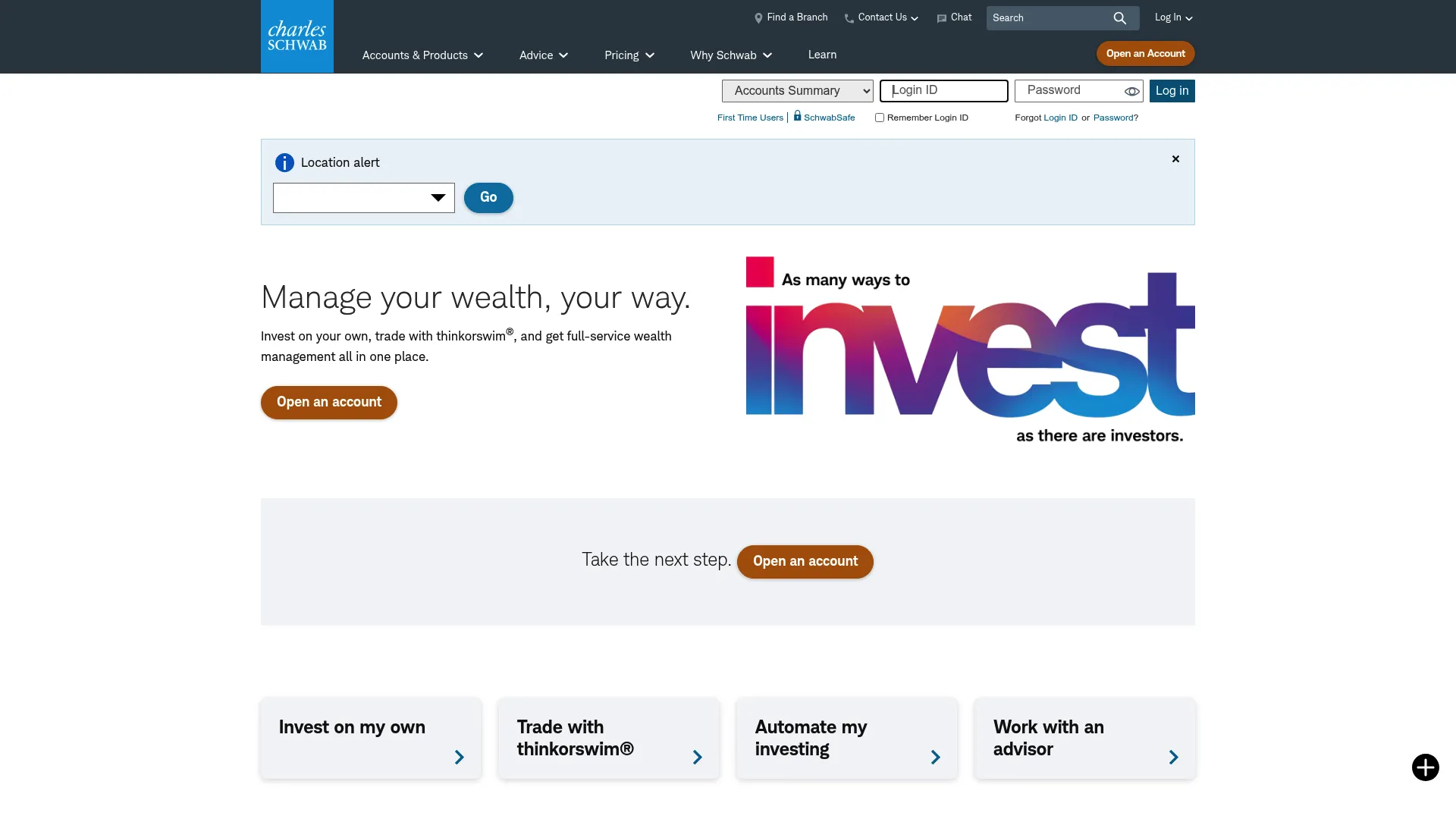
Charles Schwab is a large, established provider that pairs a full brokerage with automated investing. For investors who want more than a robo-advisor, Schwab connects self-directed trading, banking, and wealth management under one roof. Its automated product, covered separately below, plugs into that wider set of accounts.
Best for: investors who already use Schwab, or who want automated investing alongside a broader brokerage and banking relationship.
The appeal here is integration. If you hold a checking account, a brokerage account, and a retirement account, keeping automated investing in the same place simplifies transfers and reporting. Schwab charges $0 for online listed stock and ETF trades, $0 options base commission plus $0.65 per contract, and $0 for Schwab Mutual Fund OneSource trades.
Key strengths
- $0 online stock and ETF trades
- $0 options base commission plus per-contract fee
- Automated investing and advisory services under one login
Why choose Charles Schwab: if you value one provider for trading, banking, and automated investing, Schwab's breadth is hard to match. It fits people who want room to grow beyond a pure robo-advisor.
Charles Schwab pricing: online listed stock and ETF trades are $0. Options are $0 base commission plus $0.65 per contract. Schwab Mutual Fund OneSource trades are $0. Other services carry separate fees.
3. Schwab Intelligent Portfolios

Schwab Intelligent Portfolios is Schwab's dedicated robo-advisor. It recommends a diversified ETF portfolio from a questionnaire, then monitors it daily and rebalances automatically. Tax-loss harvesting is available for eligible accounts. Unlike the broader Schwab relationship, this is the specific automated product with its own minimums.
Best for: investors who want low-fee automated portfolio management from Schwab and can meet the starting minimum.
The headline is the fee: $0 advisory fee on the core product. That is a genuinely low-cost robo advisor for the automation you get. The tradeoff worth noting is that the portfolios hold a cash allocation as part of the strategy. The minimum to start is $5,000 for Schwab Intelligent Portfolios and $25,000 for the Premium tier, which adds planning.
Key strengths
- Questionnaire-based portfolio recommendation
- Daily monitoring and automatic rebalancing
- Tax-loss harvesting for eligible accounts
Why choose Schwab Intelligent Portfolios: if you want automated investing with no advisory fee and can clear the $5,000 minimum, this is one of the lowest-cost robo advisor options tied to a major institution.
Schwab Intelligent Portfolios pricing: the core product charges a $0 advisory fee. Premium adds a one-time $300 initial planning fee plus $30/month. Minimum investment is $5,000 for the standard product and $25,000 for Premium.
4. Vanguard Digital Advisor
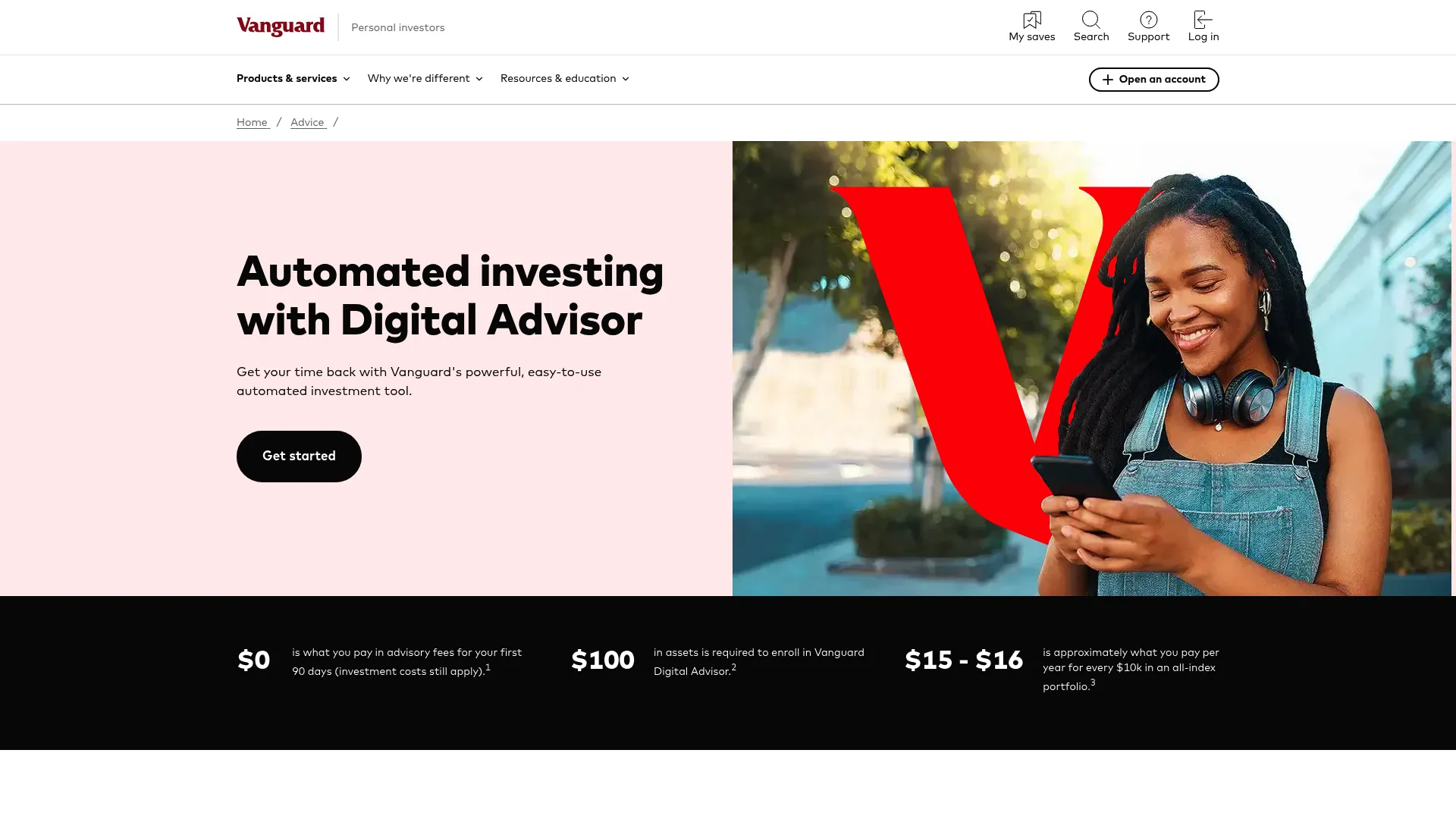
Vanguard Digital Advisor is Vanguard's automated robo-advisor, built around the low-cost, long-term philosophy the firm is known for. It runs a personalized assessment, builds ETF-based portfolios, and follows retirement-focused glide paths. It also includes planning tools like a debt payoff calculator and an emergency fund tool, plus tax-loss harvesting.
Best for: U.S. investors who want low-cost, hands-off automated portfolio management with a retirement focus.
The Vanguard robo advisor leans hard into cost and planning. Pricing runs roughly $15 to $16 per $10,000 invested annually after an initial 90-day advisory-fee waiver, which puts it among the lowest cost robo advisor options available. Portfolio options include all-index and active-index configurations, each with its own advisory fee. The glide path and goal planning make it well suited to people building toward retirement over decades.
Key strengths
- Automated ETF-based portfolios with retirement glide paths
- Goal planning with debt payoff and emergency fund tools
- Tax-loss harvesting and low advisory fees
Why choose Vanguard Digital Advisor: if long-term, low-cost investing with strong planning utility is the priority, the Vanguard name and fee structure make this a natural fit for retirement-minded investors.
Vanguard Digital Advisor pricing: Digital Advisor is $0 for the first 90 days, then approximately $15 to $16 per $10,000 invested annually. The all-index option runs $20 per $10,000 annually. The active-index option runs $25 per $10,000 annually.
5. Wealthfront

Wealthfront is a standalone platform known for strong automation and low maintenance. Its Automated Investing Account uses globally diversified index investing, and the platform layers in tax optimization for taxable accounts. Alongside investing, Wealthfront offers a Cash Account with a competitive APY and a commission-free Stock Investing Account with fractional shares.
Best for: investors who want automated portfolio management plus a high-yield cash account in one place.
Wealthfront appeals to people who want to set it and forget it. The automation covers rebalancing and tax optimization, and the product lineup extends into bond portfolios and direct indexing for larger balances. The advisory fee is a flat 0.25% annually on automated investing, and the platform states no account-opening, withdrawal, closing, trading, or transfer fees on covered accounts.
Key strengths
- Globally diversified automated index investing
- Cash Account with competitive APY
- Stock Investing Account with fractional shares, no commissions
Why choose Wealthfront: if you want deep automation, low maintenance, and a cash account under one login, Wealthfront delivers a tight, low-cost package at a flat advisory fee.
Wealthfront pricing: the Automated Investing Account and Automated Bond Portfolio are 0.25% annually. The Automated Bond Ladder is 0.15% annually. The S&P 500 Direct Portfolio is 0.09% annually and the Nasdaq-100 Direct Portfolio is 0.12% annually. The Stock Investing Account is free.
6. Acorns
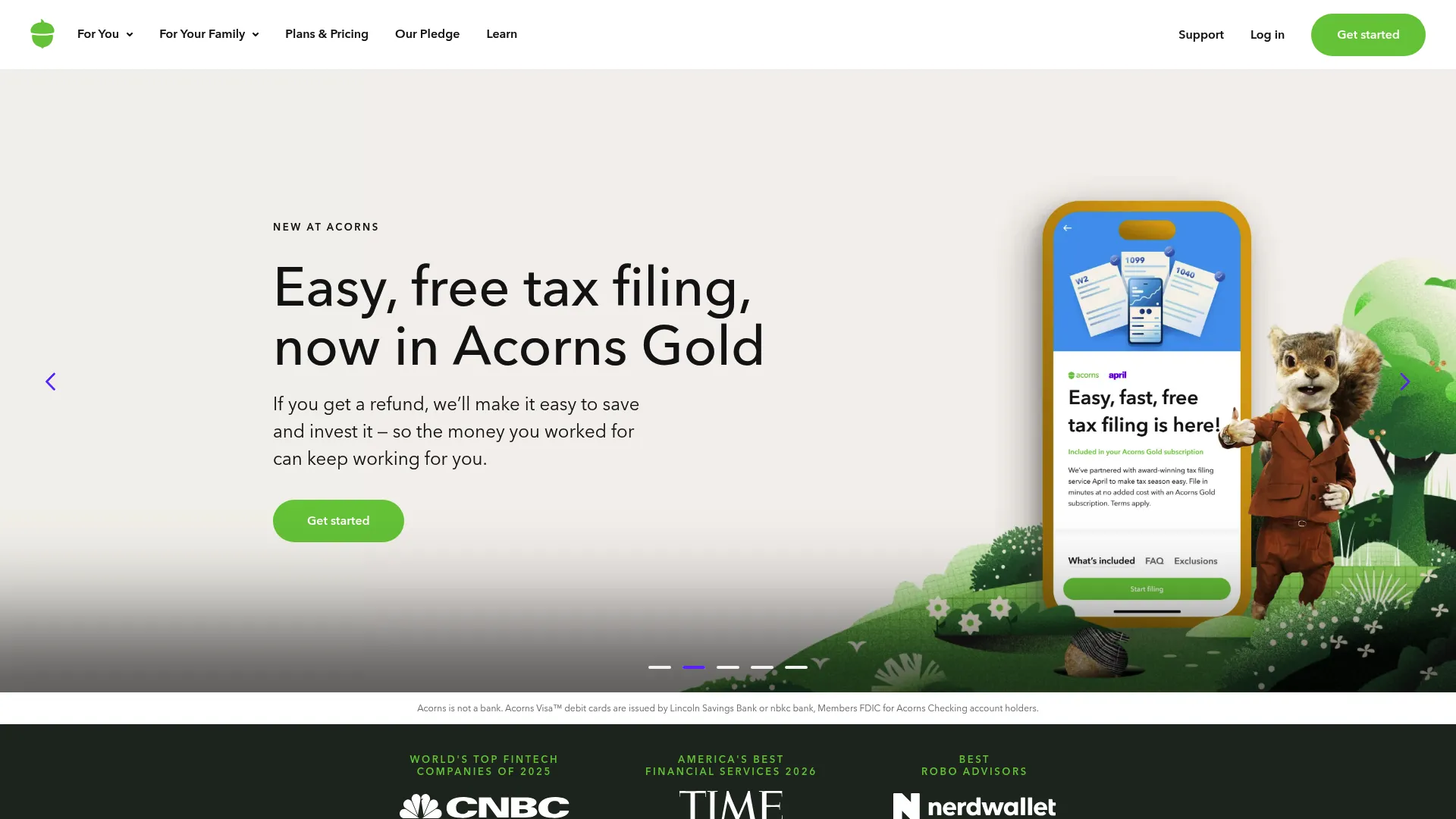
Acorns is built for people who want the easiest possible entry into investing. Its signature Round-Ups feature invests spare change from everyday purchases into a managed, diversified portfolio. Add automatic recurring investments on top, and small amounts compound without much thought. It is a financial wellness app first, an investing platform second.
Best for: beginners who want automated investing and spare-change savings without a large starting balance.
Acorns lowers the barrier to start. If a large minimum or a percentage-based fee has kept you on the sidelines, the flat monthly subscription and Round-Ups model make investing feel approachable. The portfolios are managed and diversified, and the app bundles adjacent tools for saving and family money management. This is practical for building the habit, not for fine-tuning a large portfolio.
Key strengths
- Round-Ups spare-change investing
- Automatic recurring investments
- Managed, diversified portfolios
Why choose Acorns: if getting started is the hardest part, Acorns removes the friction with flat pricing and automation designed around small, consistent contributions.
Acorns pricing: three flat monthly plans. Bronze is $3/month, Silver is $6/month, and Gold is $12/month.
7. SoFi Invest

SoFi Invest is SoFi's investing platform, combining automated portfolios with self-directed trading in one app. The robo investing option builds and manages a portfolio for you, while the self-directed side offers commission-free U.S. stock, ETF, and options trading plus fractional shares. It fits people who want simplicity and a broader financial toolkit.
Best for: investors who want self-directed stock and ETF trading alongside automated portfolios in a single app.
SoFi's draw is the combined stack. You can automate the core of your portfolio and still trade individual positions when you want to, without switching apps. The robo-advisor carries a 0.25% annual advisory fee, and self-directed trading is $0 commission with a $5 minimum to begin. For people already inside SoFi's broader finance products, keeping investing there is convenient.
Key strengths
- Commission-free U.S. stock, ETF, and options trading
- Fractional shares investing
- Robo investing with automated portfolios
Why choose SoFi Invest: if you want one app for both hands-off automated investing and occasional self-directed trades, SoFi packages them together with low fees.
SoFi Invest pricing: self-directed trading is $0 commission with $0 account maintenance and a $5 minimum to start. The Robo-Advisor carries a 0.25% annual advisory fee. IPO sales are $50 for the first sale and $5 for subsequent sales. Other mutual funds are 0.2% of the purchase amount, up to $20.
Considerations
Fees and fund expense ratios
The advisory fee is only half the cost. Underneath it sit the expense ratios of the ETFs the platform buys. A 0.25% advisory fee on top of low-cost index funds is very different from the same fee on pricier funds. Always read both numbers together to see your true all-in cost.
Account minimums and eligibility
Minimums decide what you can access. Some platforms open with no minimum, while others require $5,000 to start or $100,000 to unlock a premium tier. Check the minimum for both opening an account and for the specific features you want, such as advisor access or tax-loss harvesting.
Tax tools and rebalancing
For taxable accounts, tax-loss harvesting and automatic rebalancing can matter more than a small fee difference. Rebalancing keeps your risk level steady over time. Tax-loss harvesting can offset gains and reduce your tax bill. Confirm which account types qualify, since these features often apply only to taxable accounts.
Human advisor access
Some platforms offer access to a human advisor, either bundled at a higher tier or as an add-on. If you want a person to review a big decision, such as a home purchase or an inheritance, advisor access changes the calculus. If you are comfortable with pure automation, you can skip it and save the fee.
Portfolio style and customization
Most robo advisors default to broad ETF portfolios, but options vary. Some offer all-index, active-index, or ESG configurations. A few allow direct indexing for larger balances. Decide whether the default allocation is enough or whether you want to personalize the mix beyond the standard glide path.
Conclusion
The best robo advisor for you comes down to fees, tax tools, minimums, and whether you want a human in the loop.
Betterment is the strongest all-round pick for goal-based automated investing with tax tools. Vanguard Digital Advisor wins on low-cost, long-term retirement planning. Schwab Intelligent Portfolios stands out for its $0 advisory fee if you can meet the minimum. Wealthfront leads on deep automation and a strong cash account. Acorns is the easiest entry for beginners and small balances, and SoFi Invest fits anyone who wants robo investing plus self-directed trading in one app.
Before you open an account, do the math on the all-in cost. Add the advisory fee to the fund expense ratios, check the minimum for the features you actually want, and confirm whether tax-loss harvesting applies to your account type. Compare those numbers side by side, then pick the platform that fits your goals rather than the one with the flashiest homepage.
FAQs
For hands-off investors, usually yes. A robo advisor gives you a diversified portfolio, automatic rebalancing, and often tax-loss harvesting for a fee well below a traditional human advisor. If you want to pick your own funds and manage trades, the value is lower, but for most people who want consistency without effort, the automation earns its fee.
Compare four things: the all-in fee (advisory fee plus fund expense ratios), the account minimum, the tax tools, and whether you can access a human advisor. Match those against your goals and starting balance. A low-cost robo advisor with the tax features you need beats a cheaper one that lacks them.
Most charge either a flat monthly fee or an annual percentage of assets. Percentage fees commonly sit around 0.25% annually, though some run lower and premium tiers can reach 0.65%. Flat-fee apps can start around $3 a month. Remember to add the underlying fund expense ratios to get your real cost.
Robo advisors are not built to beat the market. They aim to match broad market returns through diversified index ETFs while managing risk, rebalancing, and reducing taxes. The value is in low-cost, disciplined investing and tax efficiency, not in outperformance.
It varies by platform. Some rebalance on a set schedule, others monitor daily and rebalance when your allocation drifts past a threshold. Schwab Intelligent Portfolios, for example, monitors portfolios daily. Automatic rebalancing keeps your risk level aligned with your target without manual trades.
Many do, though usually only in taxable accounts. Betterment, Wealthfront, Vanguard Digital Advisor, and Schwab Intelligent Portfolios all offer tax-loss harvesting for eligible accounts. It sells positions at a loss to offset gains, then reinvests to keep you in the market. Confirm eligibility, since it typically does not apply to retirement accounts.
A robo-advisor uses algorithms to build and manage a portfolio automatically at a low cost. A human financial advisor offers personalized advice across your whole financial picture, including planning, taxes, and complex decisions, at a higher fee. Some platforms blend both, pairing automated portfolios with advisor access at a premium tier.