Your crew finished the removal by noon. The invoice went out nine days later. The customer who asked for a stump grind estimate on Tuesday never heard back, because the note lived on a paper slip in a truck cab that got rained on. Meanwhile your office manager is texting three crews, updating a whiteboard, and re-keying job details into QuickBooks by hand.
This is the tax most tree service companies pay every week. Not on the work itself, but on the coordination around it. And it compounds. The global arborist management software market hit USD 367.0M in 2025 and is projected to reach USD 895.8M by 2033 at an 11.8% CAGR, per Congruence Market Insights. Owners are buying software because the paper-and-texting model stops scaling the moment you add a second crew.
The right tree service software collapses that whole cycle into one system: a lead comes in, an estimate goes out with photos and a map, the job gets scheduled and dispatched, the crew updates status from the field, and the invoice fires the same day the work finishes. The office stops being the bottleneck.
This guide compares eight platforms that handle that full workflow. Some are built specifically for arborists. Some are broader field-service systems that fit tree care well. We looked at scheduling, estimating, invoicing, CRM, mobile usability, and how cleanly each one hands off to accounting. If you run a tree care company and you are tired of the spreadsheet-and-clipboard routine, this is your shortlist.
What's inside
This is a buyer's comparison for tree service owners, arborists, and operations leads evaluating tree care software for field and office coordination. We built the list around the workflow that actually matters day to day: lead intake, estimating, scheduling, crew dispatch, field execution, invoicing, and customer communication.
We ranked and profiled each tool on six things: how it handles scheduling and dispatch, how fast it turns a site visit into an estimate, how quickly it invoices after a job, how well its mobile app works in the field, how it manages customer records, and how it connects to QuickBooks or other accounting. Pricing and ratings reflect verified, current values where publicly available.
TL;DR
- Best for field-first tree crews: Treezi. Purpose-built tree service software with tree inventory, client portal, and an estimate-to-invoice flow that runs from a phone.
- Best all-around service business fit: Jobber. Scheduling, quoting, invoicing, and payments in one system that adapts beyond tree care alone.
- Best for operations depth: GorillaDesk. Dispatch, route optimization, CRM, and invoicing built for field-heavy teams.
- Best arborist-specific CRM: ArboStar. Tailored to tree-care workflows with a live job map and integrated customer management.
- Best for scaling multi-service teams: Arborgold, with job costing, renewals, and QuickBooks integration for more complex operations.
- Best for margin control on larger crews: LMN. Budget-based estimating and job costing built for process-driven operators.
What is tree service software?
Tree service software is a field-service management platform that helps tree care and arborist businesses run the full job cycle, from lead intake and estimating through scheduling, crew dispatch, field execution, invoicing, and customer follow-up, in one connected system. It replaces the mix of spreadsheets, paper estimates, group texts, and manual accounting entry that most tree companies outgrow once they add crews and job volume.
The category sits inside the broader field service software for tree care market, which reached USD 352M in 2025 and is growing at a 7.1% CAGR through 2033, according to Data Insights Market. North America accounted for 42% of the arborist software market in 2025.
Core capabilities to expect from tree care business management software:
- Scheduling and dispatch: assign jobs to crews, manage the calendar, and handle crew dispatch without a whiteboard.
- Estimates and proposals: build a tree service estimate app workflow with photos, site maps, and clear scope.
- Invoicing and payments: turn completed jobs into invoices fast, with arborist billing software features like online payment collection.
- CRM: keep a full customer history so any job ties to the right property and contact, the foundation of a working tree service CRM.
- Mobile app: a tree service app crews use in the field for job details, status updates, photos, and sign-offs.
- Client portal: let customers approve estimates, view invoices, and message you without a phone call.
- Reporting: see revenue, job costing, crew productivity, and pipeline in one place.
- Integrations: connect to QuickBooks and payment processors so the office stops re-keying data.
The point of the category is coordination. Cloud adoption in arborist operations hit 65% in 2025 per Congruence Market Insights, and mobile matters just as much: 58% of daily log-ins to arborist systems came from mobile terminals in 2023, per Market Growth Reports. Running the business from the field and the back office together is the whole job.
When to use tree service software
Reduce back-office chaos
You know you have outgrown spreadsheets and group texts when the same mistakes keep repeating: a crew shows up to a job that was rescheduled, an estimate never gets logged, or a finished job sits un-invoiced for a week. That friction is manageable with one crew. Add a second or third, and job volume climbs, handoffs multiply, and the office turns into a switchboard. Tree service company software centralizes lead intake, scheduling, and billing so nothing lives only in someone's head or truck.
Speed up estimates and approvals
Tree work is visual. A quote for a 60-foot oak removal near a power line is a different conversation than a hedge trim, and photos plus a property map make the scope obvious to the customer. A good tree service estimate app lets you build the quote on site, attach images, and send it before you leave the driveway. Faster, clearer estimates close more work, because the customer approves while the job is still top of mind instead of a week later when three competitors have called.
Tighten dispatch, field execution, and invoicing
When crews need live job updates and the office needs to bill same-day, mobile workflows carry the weight. Crews pull up the day's jobs, log arrival and completion, snap before-and-after photos, and capture sign-off from their phones. The office sees status in real time and can invoice the moment work is done. That tight loop between crew dispatch, field execution, and arborist billing software is where the money leaks stop.
Comparison table
Here is the shortlist at a glance, sorted by relevance to tree service buyers. Pricing reflects publicly listed starting prices where available; some vendors use custom or seat-based quotes.
| # | Product | Intent | Key use case | Pricing | G2 rating |
|---|---|---|---|---|---|
| 1 | Treezi | Field-first tree service software | Estimate-to-invoice flow with tree inventory and client portal | From $49.99/user/mo | Not listed |
| 2 | Jobber | All-around service business platform | Scheduling, quoting, invoicing, and payments in one system | From $49/mo | 4.6/5 |
| 3 | GorillaDesk | Operations-depth field service | Dispatch, route optimization, CRM, and invoicing | From $49/mo | 4.8/5 |
| 4 | ArboStar | Arborist-specific operations and CRM | Live job map, scheduling, and integrated customer management | From $250/mo | 4.8/5 |
| 5 | Arborgold | Scaling multi-service tree/lawn/landscape | Job costing, renewals, and QuickBooks integration | From $149/mo | 4.3/5 |
| 6 | SingleOps | Established tree care operations | Tree inventory, proposals, and end-to-end job management | Custom | 3.0/5 |
| 7 | LMN | Process-driven larger operators | Budget-based estimating and job costing | From $297/mo | 3.7/5 |
| 8 | FieldPulse | Flexible field-service stack | Scheduling, estimates, invoicing, and customer portal | Custom | 4.7/5 |
The 8 best tree service software platforms
1. Treezi
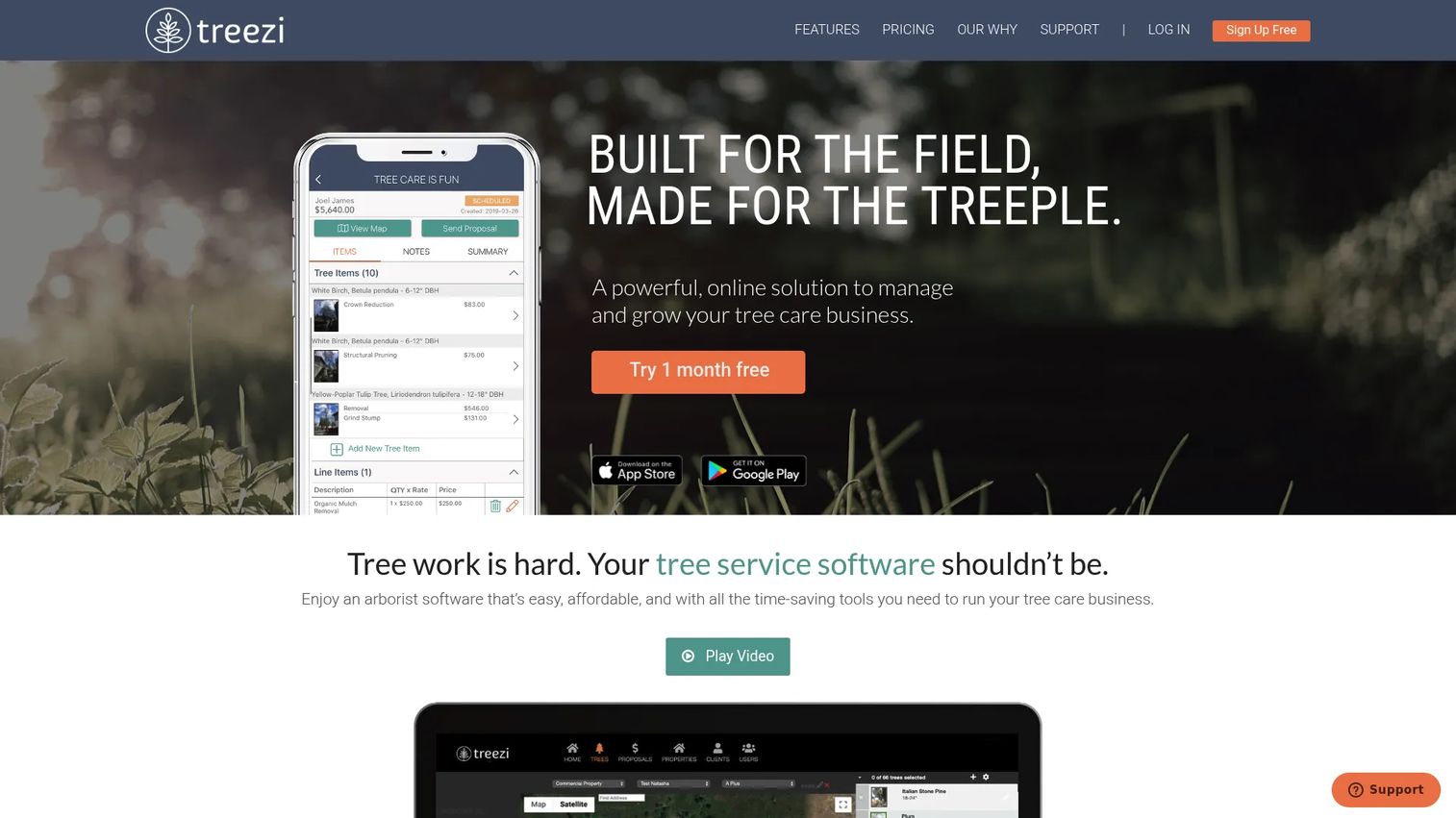
Treezi is tree service software built specifically for the field, covering estimates, scheduling, job tracking, tree inventory, invoicing, and a client portal in one app. Where generic field-service tools bolt tree work onto a broad template, Treezi assumes you are running an arborist operation from day one. That shows up in details like tree inventory, which lets crews and the office track individual trees on a property across visits, and a workflow designed to move a lead into an estimate, a job, and an invoice without switching systems.
Best for: Small to mid-sized tree crews that want a simple, mobile-first operating system for the whole job cycle.
Key strengths
- Tree inventory and client portal: Track trees per property and give customers a portal to approve estimates and view invoices.
- Estimate-to-invoice flow: Move from quote to scheduled job to paid invoice inside one system, no re-keying.
- Field-first mobile access: Cloud sync so crews and office see the same data, on site or at the desk.
Why choose Treezi: If your business is tree care specifically and you want software that already speaks your language, Treezi's tree-industry focus is the draw. It is built for owners who want to run the operation from a phone without configuring a general-purpose platform to fit. The single-plan pricing keeps the decision simple.
Treezi pricing: Treezi lists one public plan, Boost-In, at $49.99 per user per month, with an annual option at $503.88 per user per year (equivalent to $41.99 per month). The pricing page states no feature limitations and a pay-as-you-grow model. Check pricing live before committing, since plan structure can change.
2. Jobber
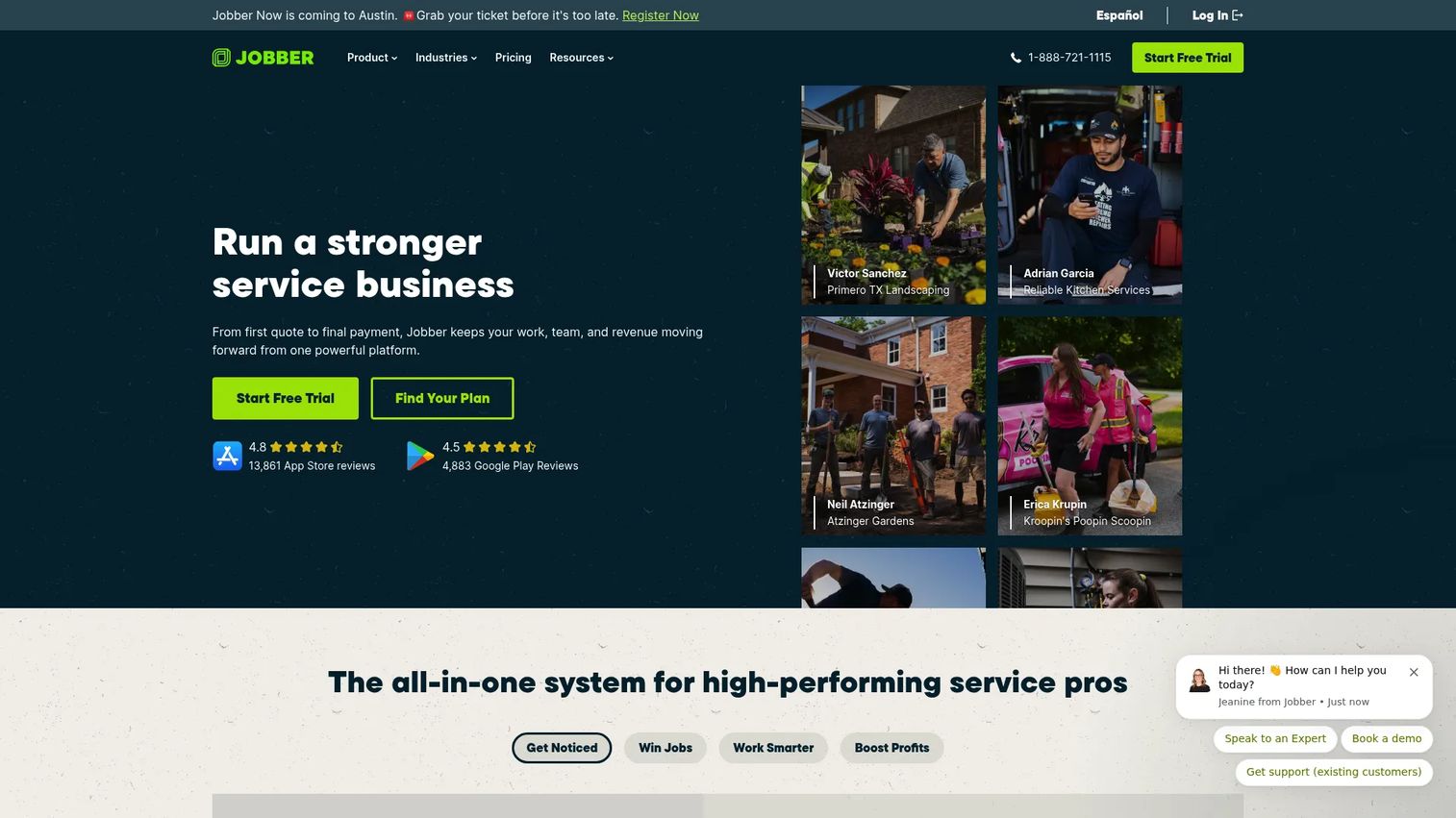
Jobber is field service management software used across home service industries, including tree care. It covers online booking, job scheduling, quoting, a client portal, invoicing, online payments, GPS tracking, and reporting. The appeal for tree service owners is breadth and adoption: Jobber is one of the most established platforms in the category, and its workflows are easy to learn, so crews and office staff ramp fast.
Best for: Home service businesses that want scheduling, quoting, invoicing, and crew coordination in one flexible system.
Key strengths
- Online booking and scheduling: Let customers request work and manage the crew calendar without phone tag.
- Quoting to invoicing: Send quotes, convert approved work to jobs, and invoice with online payment collection.
- GPS and time tracking: Track crew location and hours for accurate dispatch and job costing.
Why choose Jobber: Jobber suits teams that want a proven, broadly capable platform rather than a tree-only tool. If you run adjacent services, or expect to, its flexibility across service types is an advantage. The trade-off is that it is not arborist-specific, so features like tree inventory are not native.
Jobber pricing: Jobber offers four self-serve plans: Core at $49/mo, Connect at $139/mo, Grow at $199/mo, and Plus at $499/mo, plus a contact-sales option for larger teams. A free trial is available; there is no permanent free tier. Jobber holds a 4.6/5 rating on G2.
3. GorillaDesk
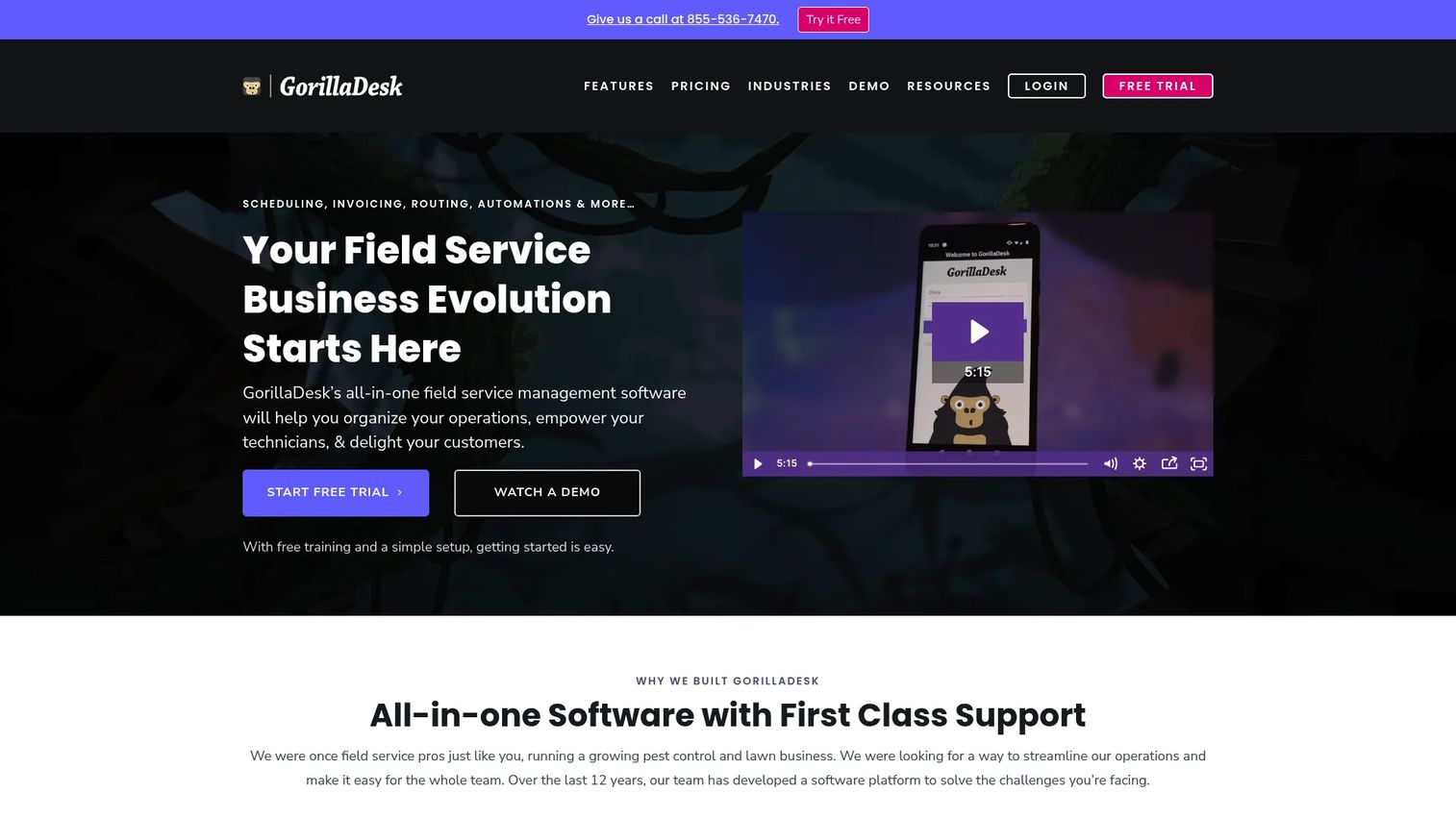
GorillaDesk is field service management software for local service businesses, with strong operational depth: scheduling and dispatching, CRM, digital estimates, invoicing, a mobile app, and route optimization. For tree companies with several crews covering a service area, route optimization alone can save real windshield time, and the dispatch tools keep the whole day organized without a whiteboard.
Best for: Small to mid-sized local service businesses that need scheduling, invoicing, and field operations tools with workflow depth.
Key strengths
- Scheduling and dispatching: Assign and reassign jobs to crews and keep the day organized in one view.
- CRM and invoicing: Full customer records tied to jobs, with fast invoicing after work is done.
- Mobile app and route optimization: Crews work from a phone; routing cuts drive time across a service area.
Why choose GorillaDesk: GorillaDesk fits operators who want operational breadth and dependable dispatch more than tree-specific features. If your priority is running crews efficiently across a region, its route optimization and dispatch tooling earn their place. It is a general field-service platform, so you configure it to tree work rather than getting arborist features out of the box.
GorillaDesk pricing: GorillaDesk publicly lists three plans: Basic at $49/month, Pro at $99/month, and Growth at $149/month. A 14-day free trial is offered with no credit card required. GorillaDesk holds a 4.8/5 rating on G2.
4. ArboStar
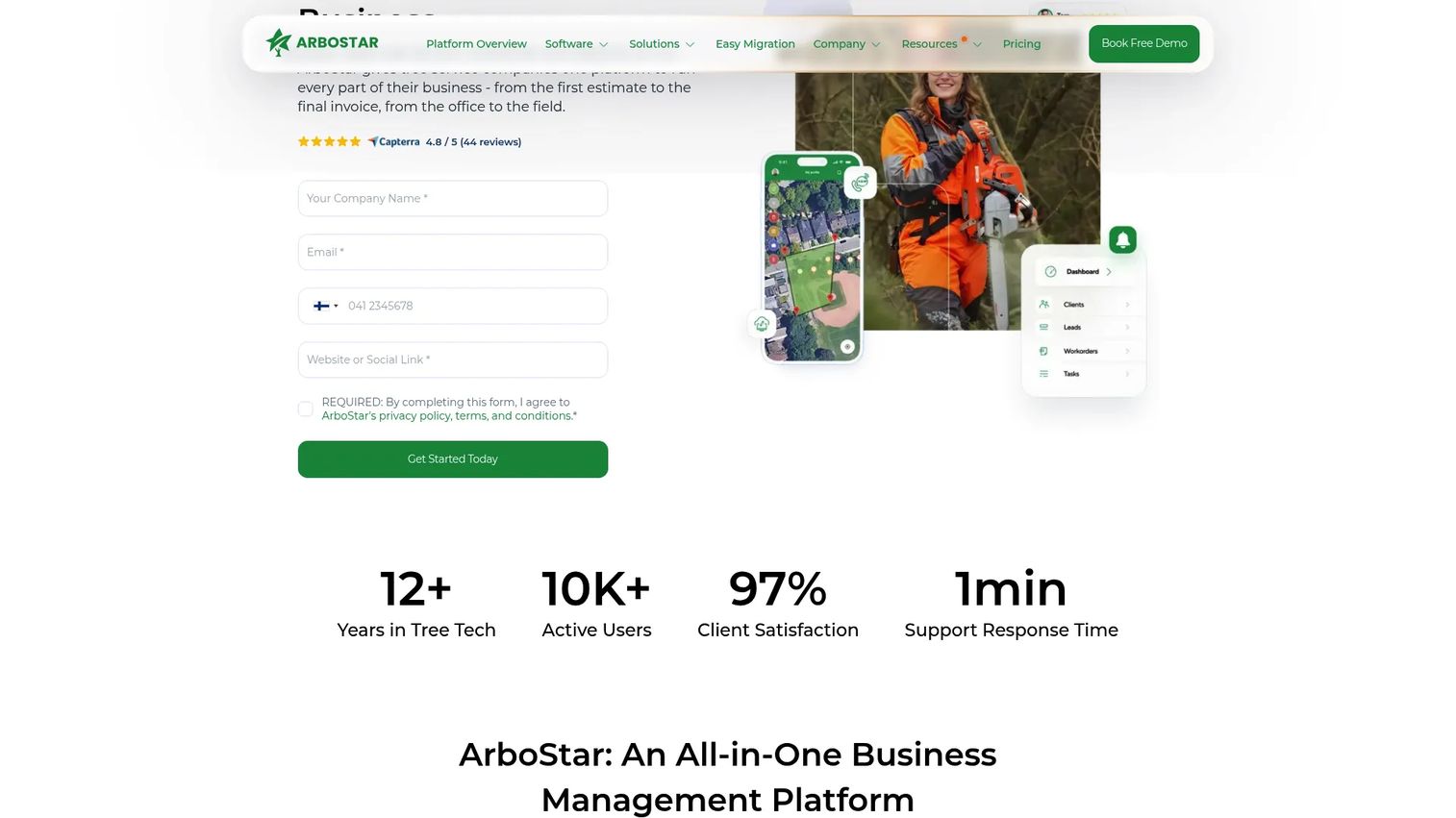
ArboStar is tree-care and landscaping business management software built around an integrated CRM. It combines customer records, scheduling and invoicing tools, and GPS tracking through a Live Job Map that shows where crews and jobs sit in real time. Because it is designed for arborists, its customer management, estimating, and communication workflows map to how tree companies actually sell and deliver work across the sales and service cycle.
Best for: Tree service and arborist businesses that need an all-in-one operations platform tailored to their trade.
Key strengths
- Integrated CRM: Manage customers, properties, and job history in one tree service CRM built for the industry.
- Scheduling and invoicing: Coordinate crews and bill jobs without leaving the platform.
- GPS tracking and Live Job Map: See crews and jobs on a live map for smarter dispatch and status visibility.
Why choose ArboStar: ArboStar suits owners who want software purpose-built for tree care and are ready to run more of the business through one system. Its CRM depth and live job visibility appeal to teams that manage a high volume of estimates and jobs and want a single source of truth. Pricing sits above entry-level tools, so it fits companies past the starter stage.
ArboStar pricing: ArboStar uses tailored pricing with custom quotes, with a public starting point listed from $250 per month. Annual subscriptions include two months free. There is no published free tier. ArboStar holds a 4.8/5 rating on G2.
5. Arborgold
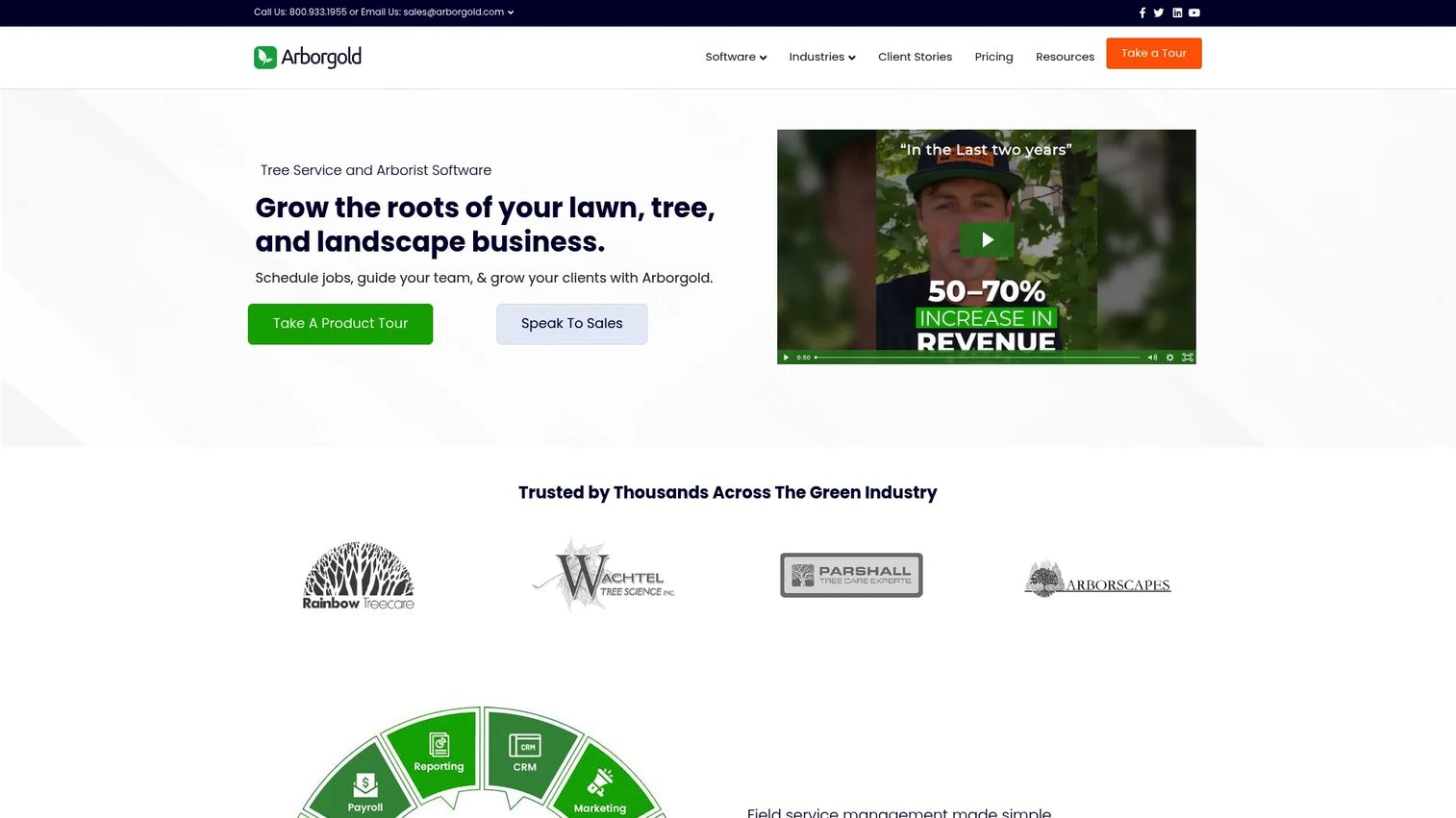
Arborgold is cloud-based business software for tree, lawn, and landscape service companies, built to handle more complex, multi-service operations. It covers CRM, estimating, scheduling, and invoicing, plus job costing, renewals, material inventory, and chemical tracking, and connects to QuickBooks for accounting handoff. Route optimization, GPS crew tracking, and time tracking round out the field side.
Best for: Tree, lawn, and landscape businesses that need field-service scheduling alongside estimating, invoicing, and job costing.
Key strengths
- End-to-end management: CRM, estimating, scheduling, and invoicing in one platform for multi-service teams.
- Job costing and renewals: Track profitability per job and manage recurring work like plant health care programs.
- QuickBooks integration: Push financial data to QuickBooks so the office avoids double entry.
Why choose Arborgold: Arborgold fits companies that have outgrown a single-service model and need to track material inventory, chemical applications, and recurring revenue alongside standard tree work. Its job costing and renewals features matter most for operators managing complexity and scaling. The depth means more to configure than a lightweight tool.
Arborgold pricing: Arborgold lists three public plans: Starter at $149/mo, Professional at $343/mo, and Enterprise at $573/mo. Monthly and annual payment options are available, with a twelve-month minimum commitment. Arborgold holds a 4.3/5 rating on G2, based on a small review sample.
6. SingleOps
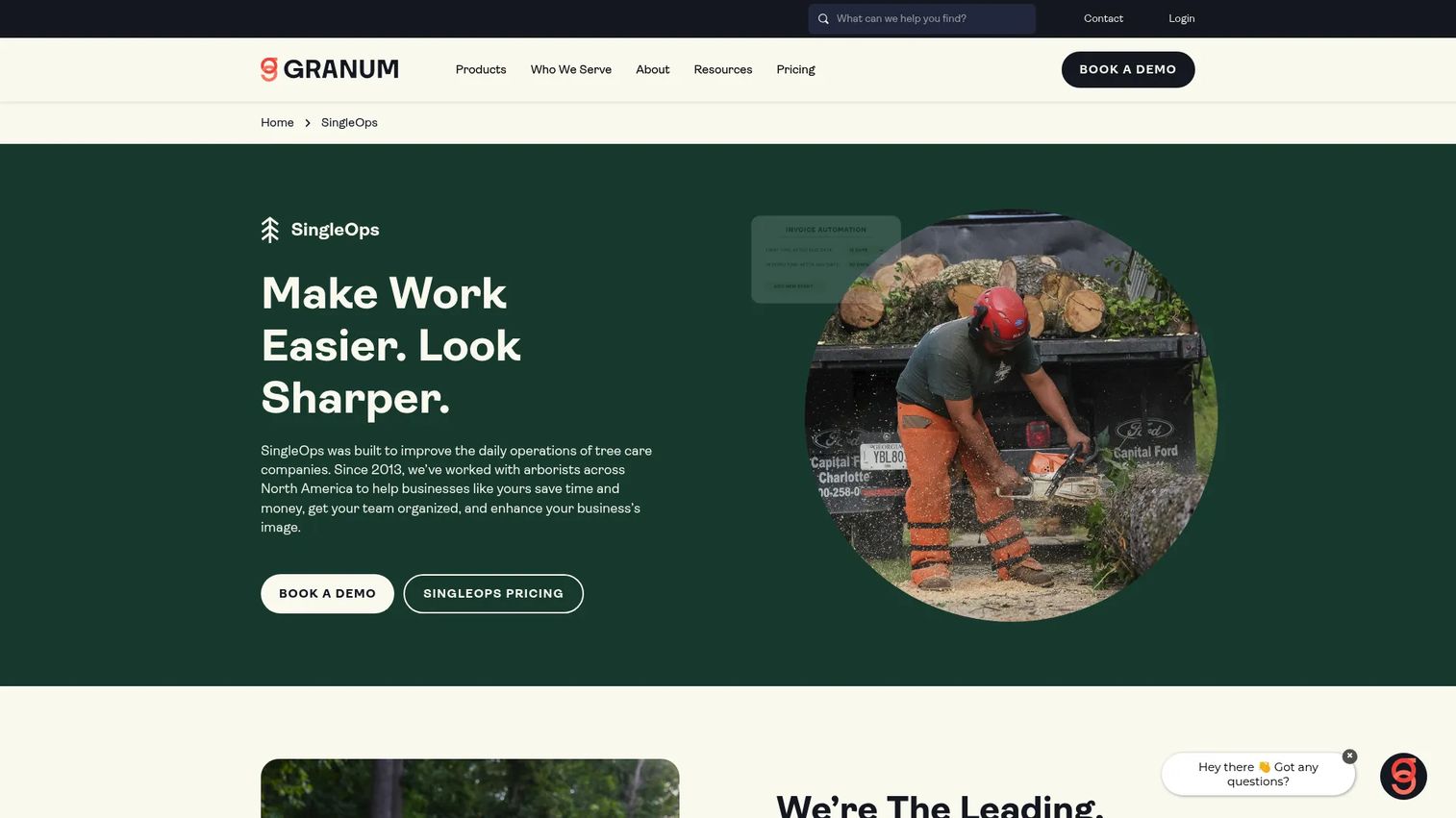
SingleOps is tree care business management software for arborists, covering tree inventory, estimating and proposals, scheduling and routing, crew work orders, and invoicing and payments. It positions itself for established tree care and arborist teams that want job, crew, and client management unified in one system, with an emphasis on operational visibility and connecting the office to the field.
Best for: Tree care and arborist teams that need job, crew, and client management in one connected system.
Key strengths
- Tree inventory and proposals: Track trees per property and build professional estimates that reflect the work.
- Scheduling and routing: Coordinate crews and optimize routes across the day's jobs.
- Invoicing and payments: Close the loop from work order to paid invoice inside the platform.
Why choose SingleOps: SingleOps appeals to more established tree care businesses that want end-to-end job management and are ready to invest in operational structure. Its arborist focus and unified workflow suit teams moving past patchwork tools. Pricing is not published publicly, so plan on a conversation with their team to scope tiers and cost.
SingleOps pricing: SingleOps lists three tiers, Essential, Plus, and Premier, but does not publish prices on its site; the vendor directs buyers to a sales conversation for pricing details. No free tier is confirmed. SingleOps holds a 3.0/5 rating on G2 from a small review sample, so weigh that against a hands-on trial.
7. LMN
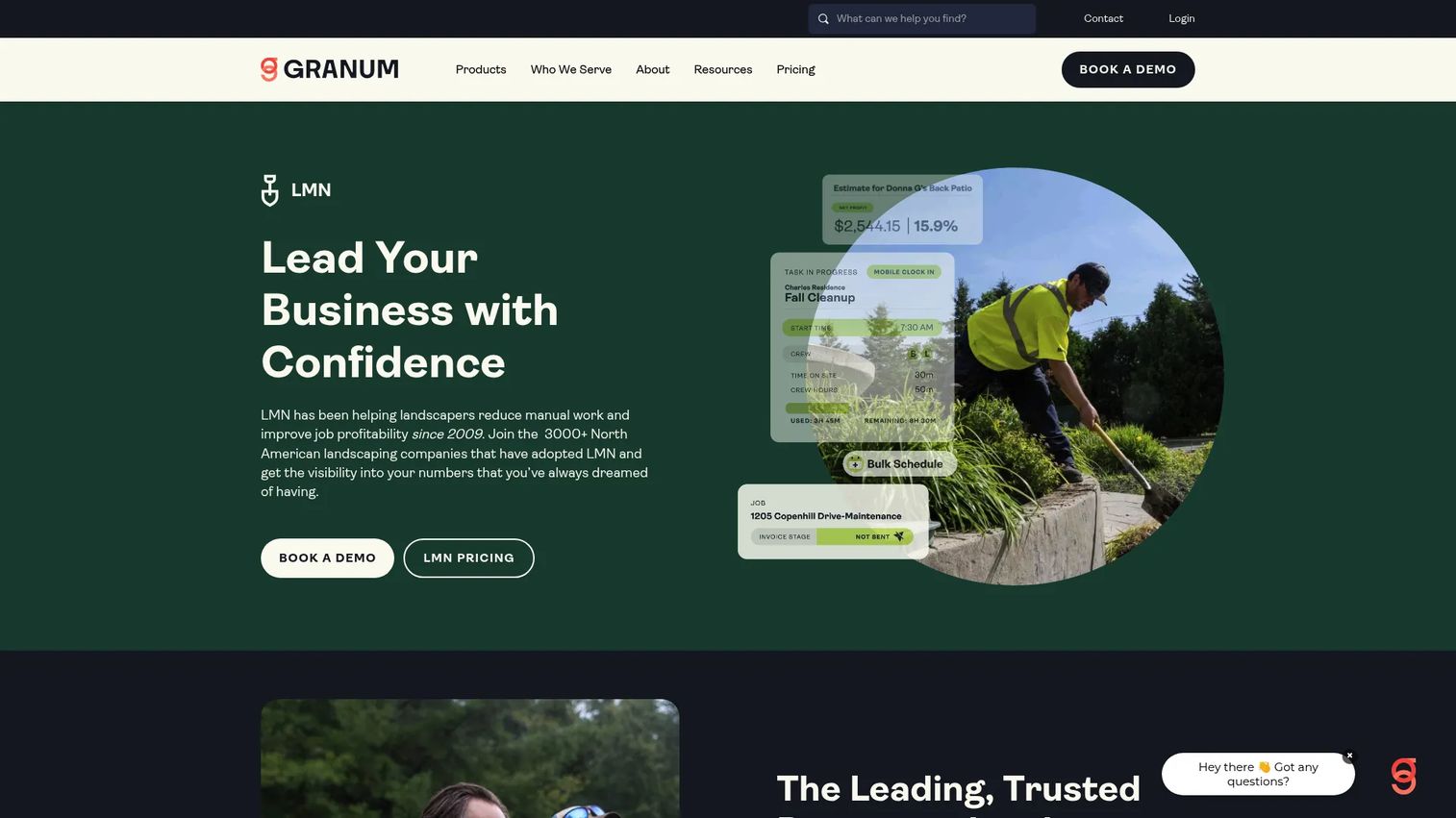
LMN is landscaping business management software built for estimating, scheduling, job tracking, invoicing, and job costing, with a strong emphasis on margin control. Its client management CRM, budget-based estimating, and automated scheduling with crew tracking are geared toward process-driven operators who want to know the true cost of every job. For larger tree and landscape teams, that budgeting rigor is the differentiator.
Best for: Landscaping and larger tree operations that need purpose-built operations management and job costing.
Key strengths
- Budget-based estimating: Build estimates from a real budget so pricing protects your margin.
- Client management CRM: Keep customer and job records organized across the full cycle.
- Automated scheduling and crew tracking: Schedule crews and track time for accurate job costing.
Why choose LMN: LMN suits larger or more process-driven operators who treat margin control as a discipline, not an afterthought. Its budgeting-first approach to estimating helps teams price work profitably and see where jobs run over. It is built for landscape and tree operators with the scale to justify the structure.
LMN pricing: LMN lists LMN Starter starting at $297/mo and LMN Professional starting at $648/mo, with LMN Enterprise priced through sales. Monthly billing is shown for Starter and Professional. LMN holds a 3.7/5 rating on G2.
8. FieldPulse
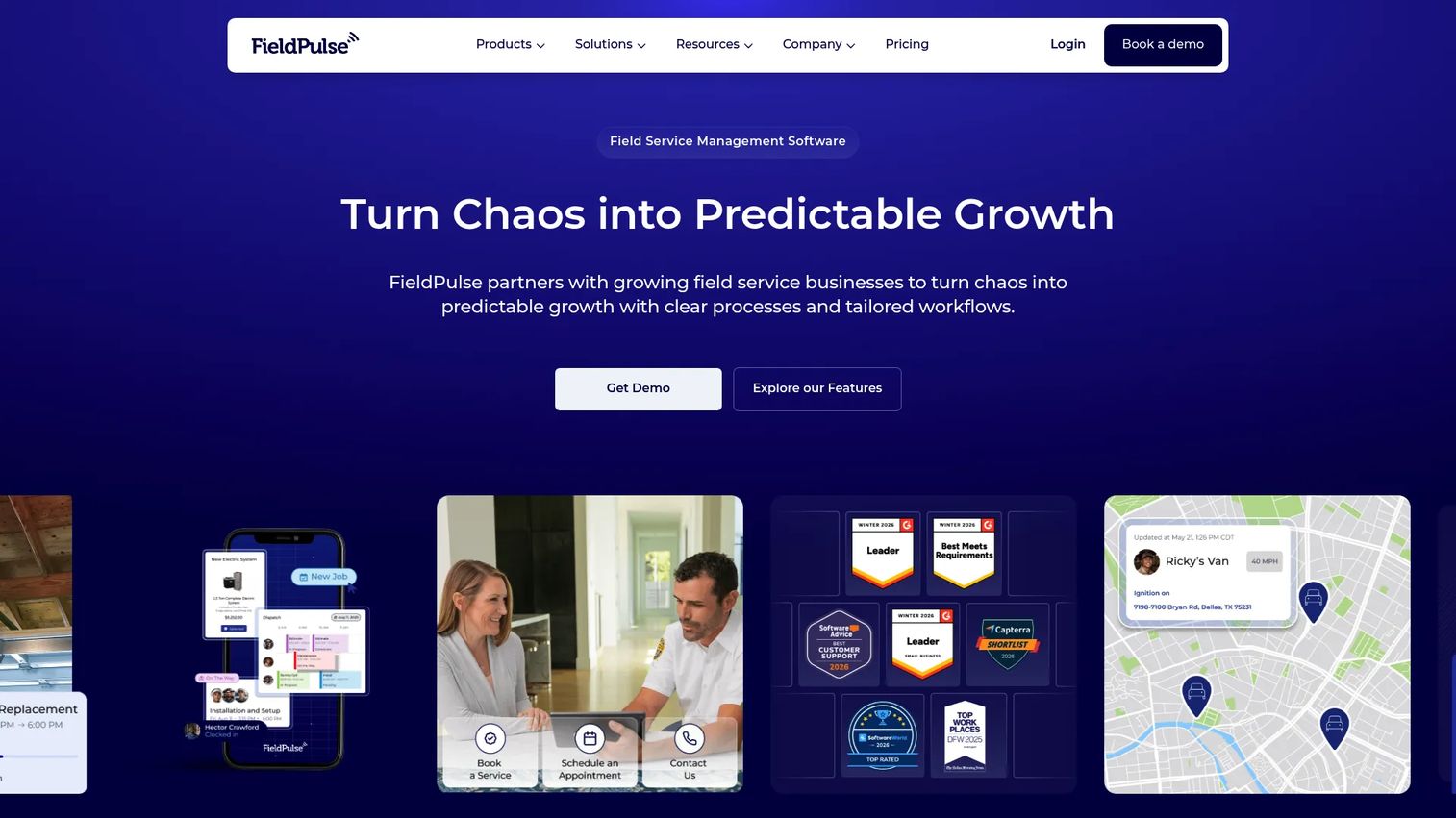
FieldPulse is field service management software for mobile service and contracting businesses, covering scheduling and routing, estimates and invoices, and a customer portal. It is a broad, flexible platform rather than a tree-only tool, which makes it a fit for tree companies that want a general field-service stack they can shape to their workflow, especially if they run adjacent services or plan to expand.
Best for: SMBs in field service or contracting that need scheduling, dispatch, invoicing, and customer management in one flexible system.
Key strengths
- Scheduling and routing: Organize crews and optimize the day across jobs and locations.
- Estimates and invoices: Build quotes in the field and invoice quickly once work is complete.
- Customer portal: Give clients a portal to view estimates, invoices, and job details.
Why choose FieldPulse: FieldPulse works best for teams that want a flexible service-business platform they can adapt to tree care rather than an arborist-specific tool. Its mobile-first workflows and broad feature set suit companies that value adaptability and may run more than one service line. As a general platform, tree-specific features like tree inventory are not native.
FieldPulse pricing: FieldPulse uses seat-based, customized pricing and does not publish plan prices on its site; the pricing page directs buyers to request a custom quote. FieldPulse holds a 4.7/5 rating on G2.
What to compare before switching software
Migration effort
Moving customer records, job history, and open estimates into a new system takes work. Ask each vendor how they handle data import, whether they migrate historical jobs or just active ones, and how long onboarding runs. A tool that fits your workflow but takes three months to stand up is a different decision than one you can run in a week.
Mobile usability in the field
Since a majority of daily log-ins in arborist software come from mobile, the crew's phone experience is not a nice-to-have. Test the app on a real device, with a real crew, on a real job. Can they pull job details, log status, snap photos, and capture sign-off quickly? If the field app is clunky, adoption dies and you are back to texting.
Accounting and QuickBooks sync
Many tools connect to QuickBooks Online, but the depth of sync varies. Some push invoices only; others sync customers, payments, and job costs both ways. If you already run QuickBooks, confirm exactly what syncs and what still needs manual entry, because a shallow integration recreates the double-entry problem you were trying to kill.
Pricing model and total cost
Compare per-user pricing against flat monthly plans based on your crew count. A $49-per-user tool costs very differently at three seats versus fifteen. Factor in payment processing fees, add-ons, and whether key features sit behind higher tiers. Match the plan to where your business is now, not where you hope it will be.
Support and onboarding
When a crew is standing in a customer's yard and the app will not load, response time matters. Ask about support channels, hours, and whether onboarding includes hands-on setup or just documentation. For a system your whole team depends on daily, support quality is part of the product.
Conclusion
The best tree service software is the one that matches your workflow complexity, crew size, and accounting setup, not the one with the longest feature list. If you run a small, tree-focused crew and want to operate from a phone, Treezi's field-first, arborist-specific design is the natural starting point. If you want a proven, broadly capable platform, Jobber and GorillaDesk both deliver strong scheduling, invoicing, and dispatch with room to grow. For arborist-specific depth, ArboStar's CRM and live job map are hard to beat, while Arborgold and SingleOps suit scaling, multi-service operations. LMN earns its place for larger operators who treat margin control seriously, and FieldPulse fits teams that want a flexible field-service stack.
Here is the practical next step: shortlist two or three tools that match your size and trade, then test the one thing that runs your business, the estimate-to-invoice flow. Build a real estimate, schedule a real job, and push a real invoice to your accounting system. The tool that makes that loop fast and clean is the one that will actually stop the office from being your bottleneck.
FAQs
Tree service software is a field-service platform that helps arborist and tree care businesses manage the full job cycle: scheduling, estimates, invoicing, customer records, and mobile field work. It replaces spreadsheets, paper estimates, and group texts with one connected system so the office and crews work from the same data. Most platforms include a mobile app crews use on site for job details, photos, and status updates.
At minimum, look for crew dispatch and scheduling, a CRM for customer and property history, estimating with photos and site maps, invoicing with online payments, a client portal, automated reminders, and reporting. The strongest tools also include tree inventory, route optimization, and QuickBooks integration. The goal is to run lead-to-invoice in one place instead of stitching together separate tools.
Yes. Several platforms, including Arborgold and many broader field-service tools, connect to QuickBooks Online. QuickBooks integration matters because it removes double entry: invoices, payments, and customers flow to your accounting system automatically. Depth of sync varies, though, so confirm whether a tool pushes invoices only or syncs customers, payments, and job costs both ways before you commit.
For small tree companies, prioritize simple, mobile-first platforms with fast setup over heavy customization. Treezi is purpose-built for tree crews and runs from a phone, while Jobber and GorillaDesk offer approachable pricing and quick onboarding. The right pick is the one your crew will actually use in the field without a long learning curve.
Larger crews need stronger operational control: route planning, detailed reporting, job costing, and approval workflows. LMN's budget-based estimating and job costing suit process-driven operators focused on margin, while ArboStar and Arborgold handle high job volume with CRM depth and multi-service management. The bigger the team, the more the ability to see and control costs across every job matters.
Yes, and field use is the whole point. A good tree service app lets crews pull job details, update status, capture photos, build estimates, invoice, and communicate with customers from a phone or tablet. Since most daily log-ins to arborist software come from mobile devices, test the app in real field conditions, and ask vendors about offline or low-connectivity behavior if you work rural areas.
Compare migration effort, pricing model, mobile usability, accounting sync depth, and onboarding support. Test the estimate-to-invoice flow on a real job before deciding, since that loop is what actually runs your business. Match the plan to your current crew size and trade, and confirm exactly what syncs to QuickBooks so you do not recreate the double-entry problem you are trying to solve.