Leads come in from portals, paid campaigns, open houses, and referrals. Then they disappear into inboxes, personal phones, and spreadsheets that nobody updates. By the time a team lead reconstructs what happened, three follow-up windows have already closed.
This is not a lead-quality problem. It is a systems problem. According to the National Association of REALTORS® 2025 Technology Survey, 23% of REALTORS® said their CRM generated the highest number of quality leads. The tool itself is a revenue driver, but only when it runs on consistent process, not founder heroics.
For a Series B founder evaluating a real estate or proptech stack, the question is sharper: "Can this CRM produce repeatable pipeline visibility that survives the founder stepping back?" The right answer depends on whether you need lead routing, relationship nurture, transaction depth, or brokerage-level governance. Which one fits how your team actually acquires, routes, and closes?
What's inside
This guide reviews 10 real estate CRM software tools for 2026, chosen for agents, teams, and brokerage operators. Items were selected based on:
- Lead capture and routing: How leads enter and get assigned
- Automation depth: Follow-up sequences, drip campaigns, action plans
- Transaction and back-office coverage: Checklists, commissions, compliance
- Pricing transparency and scale fit: Entry cost, team pricing, contract model
The list covers solo-agent tools through brokerage platforms, with a founder-level lens on each.
TL;DR
- Best overall for real estate teams: Follow Up Boss, for multi-source lead routing, Action Plans, and clean agent accountability
- Best value for small teams: Wise Agent, for flat-rate pricing, built-in support, and broad real estate workflows
- Best for all-in-one lead generation plus CRM: Lofty or Real Geeks, for teams that want IDX websites and CRM in one platform
- Best for established brokerages: BoldTrail or Lone Wolf, depending on whether lead generation or back-office operations is the priority
- Best budget option: RealtyJuggler, at $179 per year with a 90-day free trial and no credit card required
What is real estate CRM software?
Real estate CRM software is a customer relationship management system built to help agents, teams, and brokerages capture leads, manage client conversations, automate follow-up, track deals, and coordinate transaction-related work.
Unlike a general-purpose CRM, real estate platforms typically include property-specific fields, IDX or MLS connections, transaction checklists, and lead-routing rules built around agent availability and deal type. That specificity removes the configuration overhead a generic platform would require.
Core capabilities to look for in any real estate CRM include:
- Lead capture and source tracking: Consolidate portal, referral, paid-campaign, and event leads into one record
- Contact and relationship history: Store communication, property preferences, and past transactions per contact
- Automated follow-up: Trigger email, text, and task sequences based on lead status or activity
- Pipeline and deal management: Track buyer, seller, listing, and closing stages
- Team routing: Assign leads by round robin, geography, price point, or agent availability
- Transaction workflows: Manage checklists, documents, commissions, and closing deadlines
- Reporting: Show lead-source performance, agent response times, and conversion trends
- Integrations: Connect calendars, email, phone, IDX or MLS services, and marketing tools
| Real estate-specific CRM | General-purpose CRM | |
|---|---|---|
| Built-in IDX/MLS connection | Often included | Requires custom integration |
| Lead-routing rules | Native, agent-specific | Requires custom configuration |
| Transaction checklists | Standard feature | Add-on or workaround |
| Property fields | Built in | Custom fields required |
| Best fit | Agents, teams, brokerages | Broad revenue teams, custom stacks |
General CRMs can still work when a company needs deep custom logic or already runs a mature sales and marketing stack. The trade-off is configuration time and ongoing maintenance.
When to use real estate CRM software
Centralize leads before follow-up breaks down
The first trigger is a shared inbox that nobody fully owns. Leads from Zillow, paid social, website forms, and open-house sign-ins land in different places. A CRM standardizes source attribution, assigns ownership, and creates an auditable record. Without that record, a founder cannot tell which channels produce pipeline.
Create a repeatable follow-up motion across agents
Uneven execution is the gap between a high-performing agent and the rest of the team. Automations, Action Plans, and drip sequences replace the personal habit of one rep with a repeatable system. This is the infrastructure question a founder should ask before headcount doubles: "Does conversion depend on one agent, or on the process?"
Run transactions and reporting without stitching together tools
For teams handling more than 20 transactions per month, status reconstruction becomes a cost center. Transaction checklists, commission tracking, and stage-based reporting inside one system reduce the manual work of pulling deal status from email chains. Validate that the CRM is the system of record before consolidating other tools around it.
Real estate CRM software comparison
No single CRM wins every operating model. The table below compares tools on lead routing, automation, transaction depth, and pricing. Treat the pricing column as a starting point: Total cost shifts based on user count, communication add-ons, IDX packages, and implementation fees.
| # | Product | Best for | Key differentiator | Pricing | G2 rating |
|---|---|---|---|---|---|
| 1 | Follow Up Boss | Growing real estate teams | Multi-source lead routing and Action Plans | From $69/user/mo | 4.6/5 |
| 2 | Wise Agent | Small teams and agents | Flat-rate CRM with real estate workflows | From $49/mo | N/A on G2 |
| 3 | Lofty | Teams needing CRM plus lead generation | AI-powered CRM with IDX websites | Custom pricing | 4.3/5 |
| 4 | BoldTrail | Brokerages needing an integrated platform | CRM, IDX, marketing, and brokerage ops | Custom pricing | 4.5/5 |
| 5 | Real Geeks | Lead-generation-focused teams | IDX website plus CRM follow-up system | From $399/mo | 4.5/5 |
| 6 | IXACT Contact | Relationship-driven agents | Contact management and long-term nurture | From $46.75/mo | 4.5/5 |
| 7 | BoomTown | High-volume teams and brokerages | Lead generation and predictive CRM | Custom pricing | 4.7/5 |
| 8 | RealtyJuggler | Budget-conscious agents | Low-cost, transaction-oriented real estate CRM | $179/year | 4.5/5 |
| 9 | Top Producer | Established agents and teams | MLS-connected CRM with multi-source lead follow-up | From $179/user/mo | 3.1/5 |
| 10 | Lone Wolf | Brokerage operations | Transaction, back-office, and compliance workflows | Custom pricing | 3.7/5 |
Best 10 real estate CRM software tools for 2026
1. Follow Up Boss
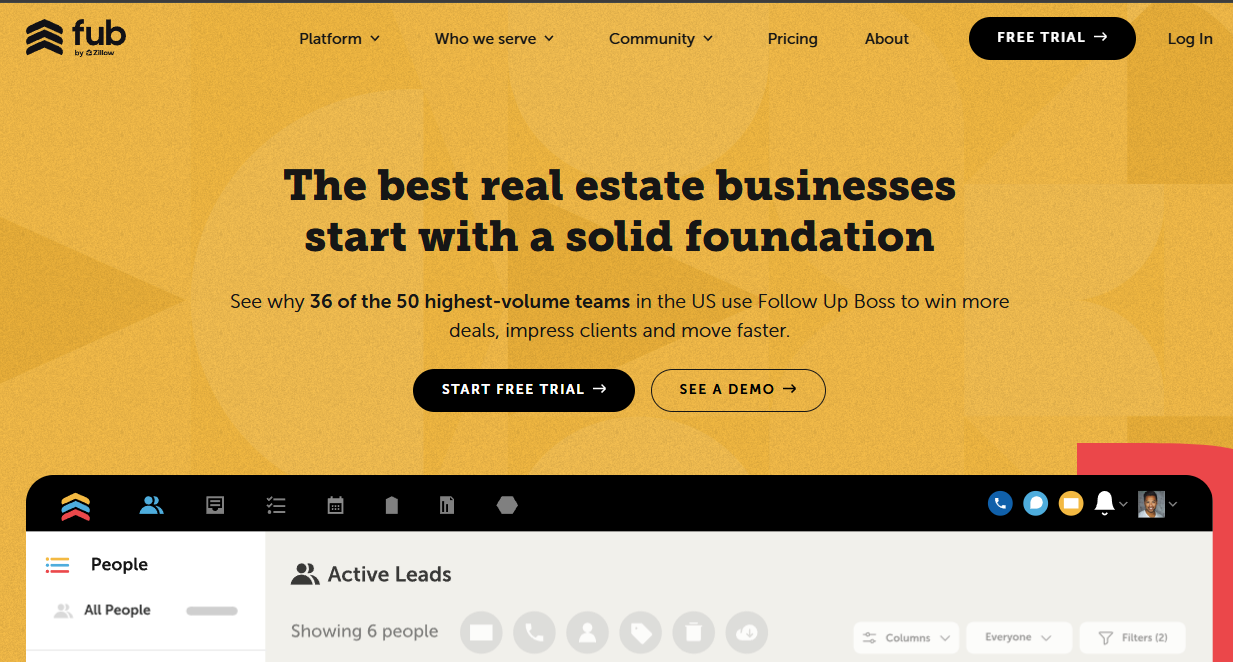
Follow Up Boss is a real estate CRM built around lead centralization and team follow-up. It pulls leads from more than 250 sources into one inbox, routes them by custom rules, and gives managers a live view of agent activity and response times. The platform is used across solo agents, growing teams, and multi-office operations.
Best for: Real estate teams that need a dedicated follow-up engine for high lead volume and multi-agent accountability.
Key features
- Multi-source lead capture from 250+ integrations
- Smart Lists for dynamic lead prioritization
- Action Plans for automated follow-up sequences
- Round-robin and rules-based lead distribution
- Calling, texting, email tracking, and team inboxes
Why choose Follow Up Boss: If your biggest bottleneck is leads falling through the cracks between agents, Follow Up Boss addresses that directly. The platform gives founders and team leads a clean operating layer before they need a broader all-in-one platform.
Follow Up Boss pricing: Plans start at $69 per user per month (monthly) or $58 per user per month (billed annually). The Pro plan runs $499 per month for 10 users, and the Platform plan is $1,000 per month for 30 users. A 14-day free trial is available with no contract required.
G2 rating: 4.6/5
2. Wise Agent
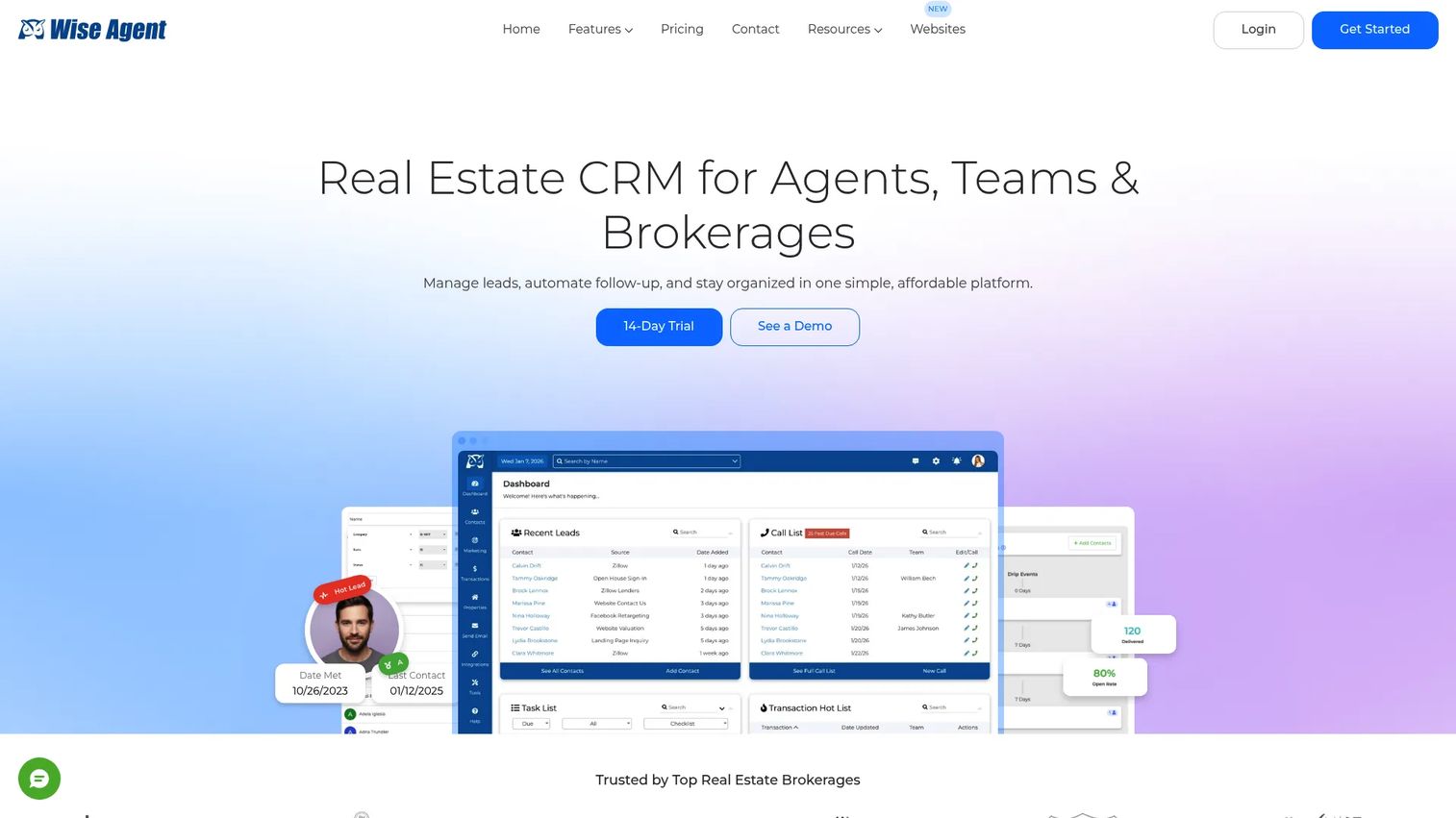
Wise Agent is an all-in-one real estate CRM covering lead generation, contact management, drip marketing, transaction tracking, and team collaboration. It has built a reputation for accessible pricing and 24/7 live support, which reduces onboarding friction for smaller teams without dedicated operations staff.
Best for: Small real estate teams that want a real-estate-specific CRM with predictable pricing and hands-on support.
Key features
- Contact and lead management with drip email campaigns
- Lead rules and distribution across team members
- Transaction checklists and milestone tracking
- Shared calendars, permissions, and team collaboration tools
- Customizable landing pages for lead capture
Why choose Wise Agent: The flat-rate structure means cost is predictable as the team grows to five members. Choose it when you want practical real estate workflows without the implementation complexity of a broader brokerage platform.
Wise Agent pricing: The CRM plan is $49 per month or $42 per month billed annually ($499 per year). Adding WiseSocial for social media automation brings the monthly rate to $69, or $59 billed annually. Enterprise plans for teams of 15 or more are priced by quote. A 14-day free trial is included.
3. Lofty

Lofty positions itself as an AI-powered real estate platform that combines CRM, marketing automation, IDX websites, lead generation, and transaction management. The platform includes AI agents for sales outreach, social media, and homeowner communication, giving teams a broader operational layer than a standalone CRM provides.
Best for: Teams that want fewer separate tools and are prepared to standardize lead generation, marketing, and follow-up inside one platform.
Key features
- AI-powered CRM with Smart Plans automation
- IDX websites and customizable landing pages
- Power Dialer for outbound calling at volume
- Transaction management and pipeline reporting
- AI Sales, Social, and Homeowner Agent capabilities
Why choose Lofty: It makes the most sense when your team will actively use the marketing and website capabilities, not just the CRM. If you are already paying for a separate IDX provider and a marketing platform, Lofty can consolidate that spend. Verify whether the surrounding features match your current workflow before committing.
Lofty pricing: Lofty uses custom pricing across Agent, Team, Broker, and Enterprise packages. Contact their sales team for a quote based on seat count and platform tier.
G2 rating: 4.3/5
4. BoldTrail
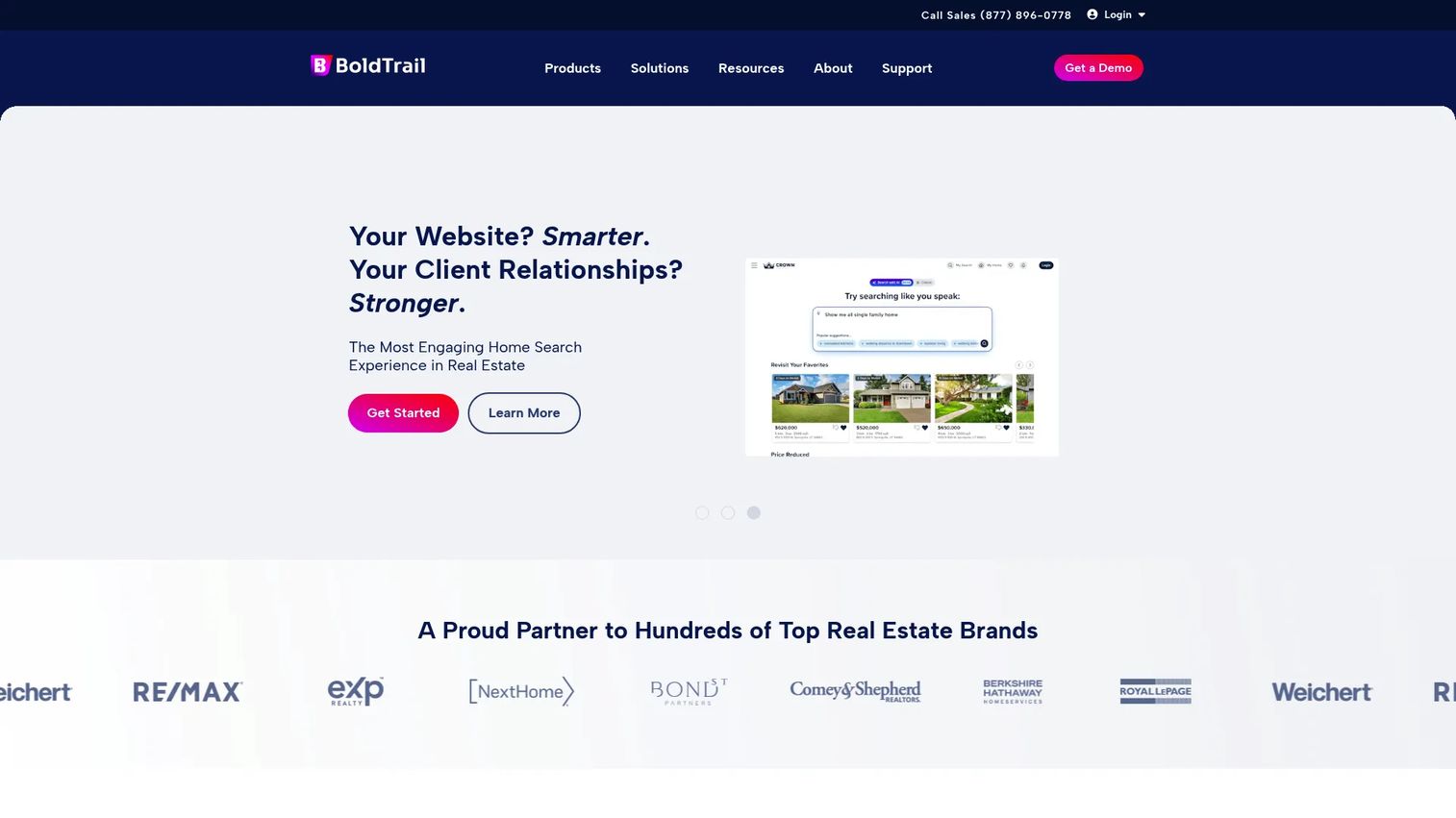
BoldTrail is a real estate technology platform built for teams and brokerages that need CRM, IDX websites, marketing automation, lead generation, and back-office reporting connected in one system. It includes recruiting and retention dashboards alongside the operational tools, which positions it as a brokerage operating layer rather than a lightweight CRM.
Best for: Brokerages that want a broad platform for agent operations, lead flow, and branded digital presence.
Key features
- AI-powered Smart CRM with behavioral nurturing
- Configurable IDX websites with real-time MLS integration
- Marketing automation and lead-generation tools
- Business intelligence dashboards and brokerage reporting
- Transaction, commission, and billing workflows
Why choose BoldTrail: Belongs on the shortlist when operational standardization across a larger agent base matters more than picking a lightweight CRM per individual user. Before signing, assess whether you need the full platform or whether a CRM with better lead routing would solve the immediate problem at lower rollout cost.
BoldTrail pricing: BoldTrail offers BASE, PLUS, and PRO packages. All plans require contacting sales for pricing. No standard rates are posted.
G2 rating: 4.5/5
5. Real Geeks
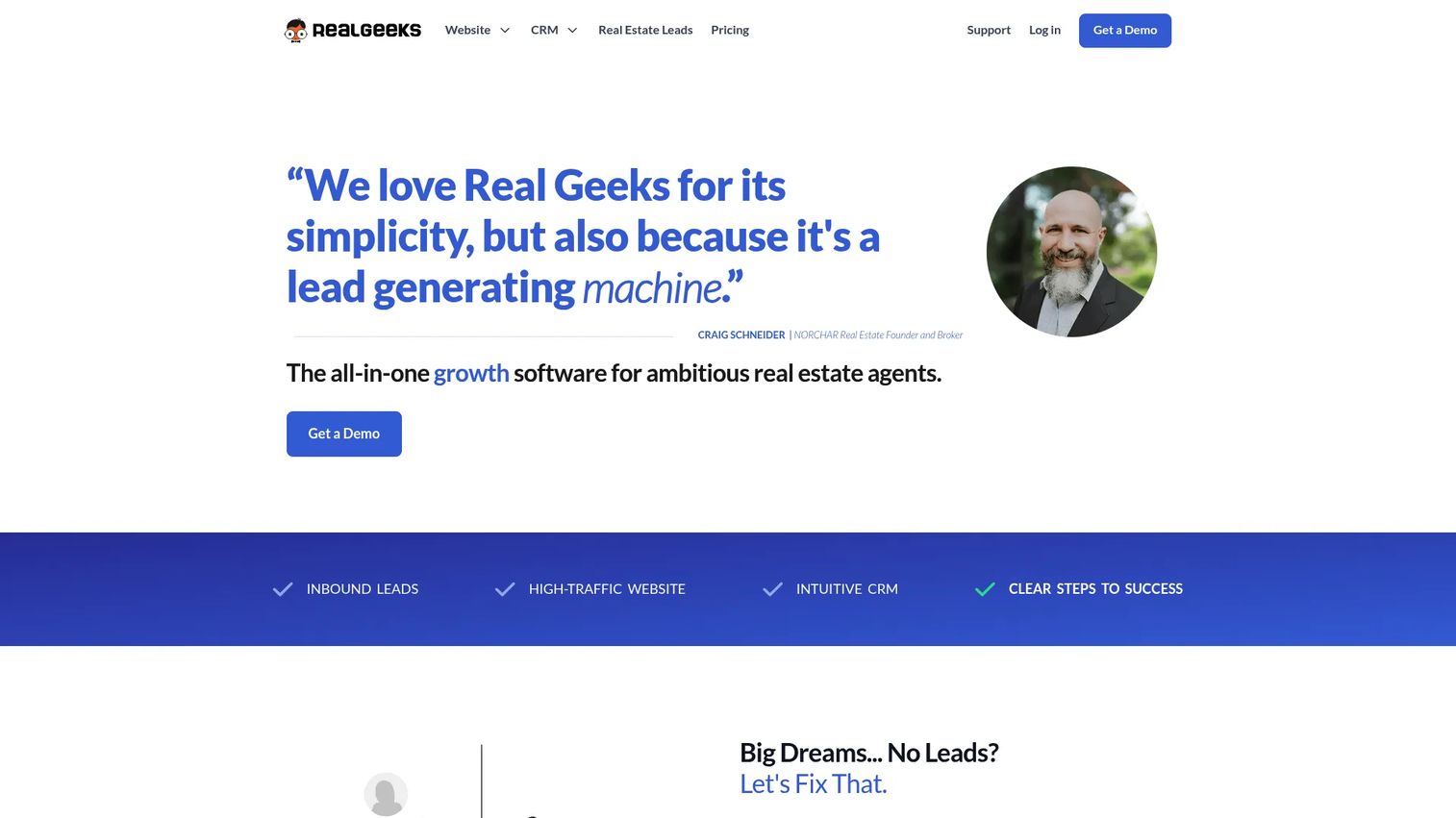
Real Geeks connects IDX website lead capture directly to CRM follow-up and automated campaign workflows. The base platform includes two user seats, a customizable IDX website with real-time MLS listings, a CRM with automated email and text follow-up, and access to more than 60 tools and features. Optional lead-generation packages for social, search, and seller campaigns can be added on top.
Best for: Lead-generation-focused teams that want their website, prospect capture, and follow-up process connected from the start.
Key features
- IDX website with real-time MLS listings and customizable templates
- CRM with automated email, text, and video follow-up
- Optional social, search, and seller lead-generation packages
- Team lead management and assignment workflows
- Geek AI Text add-on for AI-assisted messaging
Why choose Real Geeks: A stronger fit when paid or organic digital traffic is a primary acquisition channel. It is less suited for brokerage back-office operations. A founder should ask whether the CAC payback on the bundled lead generation justifies the platform cost, separate from the CRM value alone.
Real Geeks pricing: The base platform is $399 per month plus a $500 one-time setup fee, covering two users. Lead-generation packages start at $299 per month for social campaigns and $599 per month for search or seller campaigns. Additional IDX feeds are $10 per board per month. Geek AI Text is $49 per month.
G2 rating: 4.5/5
6. IXACT Contact
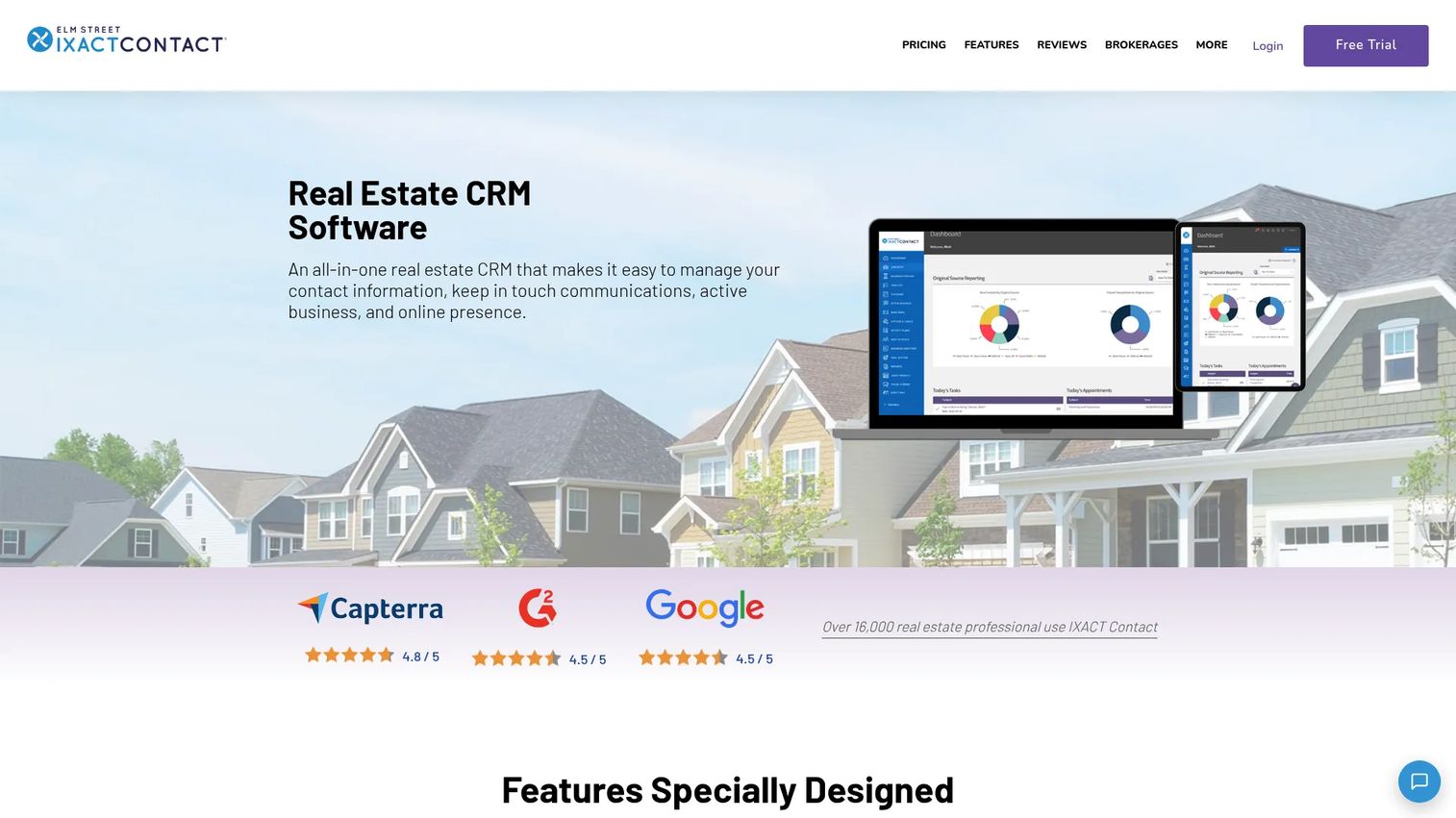
IXACT Contact is built for agents and teams who prioritize sphere management, referral tracking, and long-cycle client nurture over high-volume inbound lead routing. The platform includes automated email marketing, an agent website, a mobile app, and Google sync, with optional add-ons for IDX, social media automation, and IXACT Recruiter for brokerages.
Best for: Agents and smaller teams that rely on referral relationships and consistent long-term client follow-up.
Key features
- CRM and contact management with segmentation
- Automated email marketing and newsletters
- Responsive agent websites with lead capture
- Mobile app with Google Calendar and Contacts sync
- Social media automation via Social Stream add-on
Why choose IXACT Contact: Fits buyers whose business grows through relationship depth rather than high-volume paid lead intake. If your conversion model depends on referrals and repeat clients, this delivers the organized communication routines that support that motion without the cost of a larger brokerage platform.
IXACT Contact pricing: The core plan is $46.75 per month billed annually or $55 per month billed monthly. Additional team members are $28.90 per month annually or $34 per month billed monthly. Optional IDX Broker Core is $50 per month and Social Stream is $20 per month. A free trial is advertised on the pricing page.
G2 rating: 4.5/5
7. BoomTown
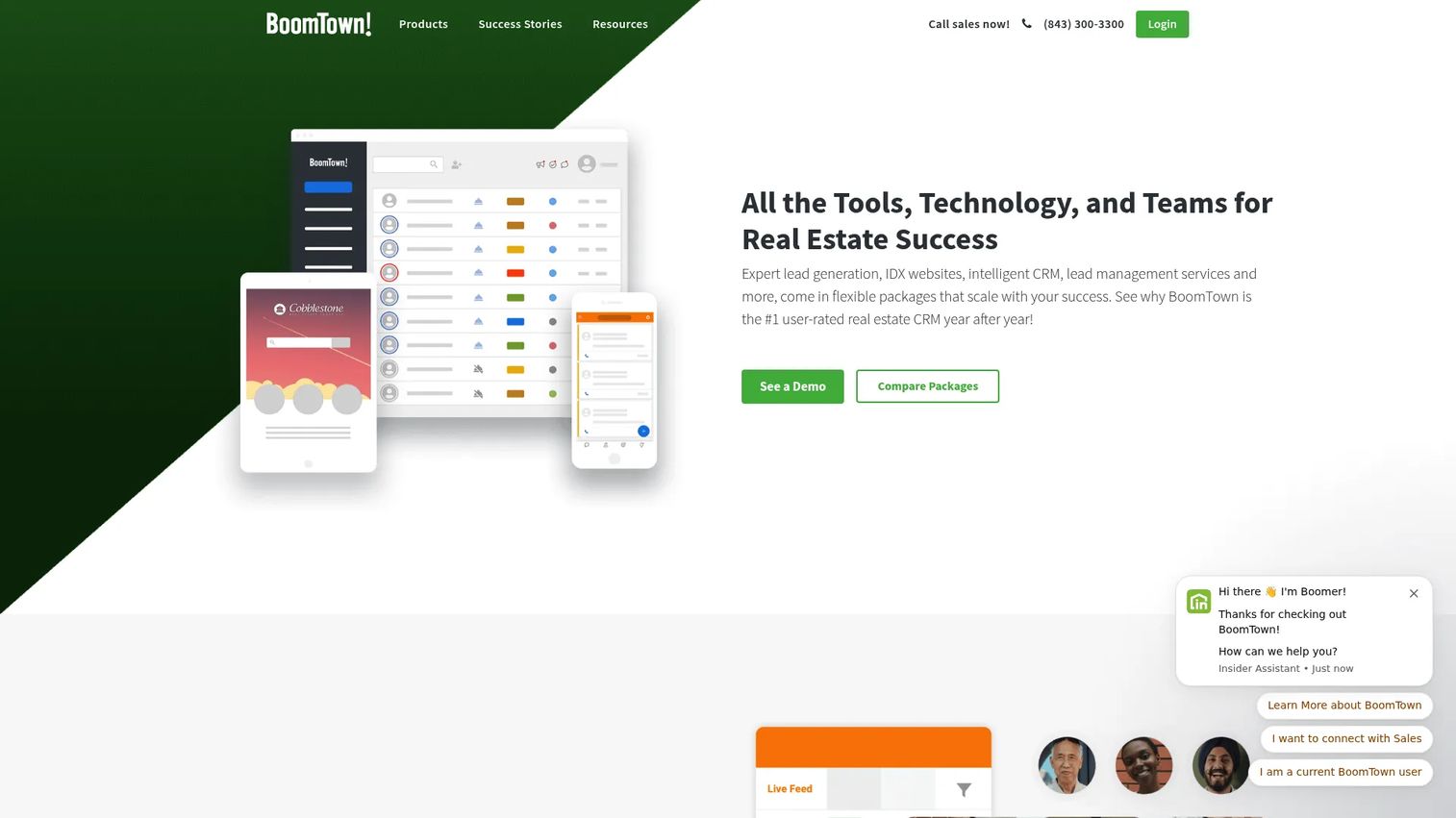
BoomTown combines an IDX consumer website, predictive CRM, lead generation through search and social advertising, mobile tools, and transaction management in one platform. Its predictive CRM segments leads by behavior and intent, routes them using hot sheets and smart drip, and gives managers agent-level activity visibility through reporting dashboards.
Best for: High-volume real estate teams and brokerages that need lead generation, predictive routing, and deeper operational support in one system.
Key features
- IDX consumer websites with customizable property search
- Predictive CRM with behavioral segmentation and smart-drip automation
- Lead generation through search ads, social campaigns, and retargeting
- NOW mobile app for calls, messages, tasks, and lead follow-up
- Transaction pipeline management with back-office integrations
Why choose BoomTown: A better fit for organizations that can support a larger platform rollout and want demand generation connected directly to operational follow-up. Smaller teams should scrutinize total cost carefully: Additional users are $35 per user, and advertising management carries a 15% fee on prior-month ad spend.
BoomTown pricing: BoomTown lists Launch, Core, and Grow packages, but posts no standard prices. Contact sales for platform costs. The additional-user fee of $35 per user and the 15% advertising management fee are documented.
G2 rating: 4.7/5
8. RealtyJuggler
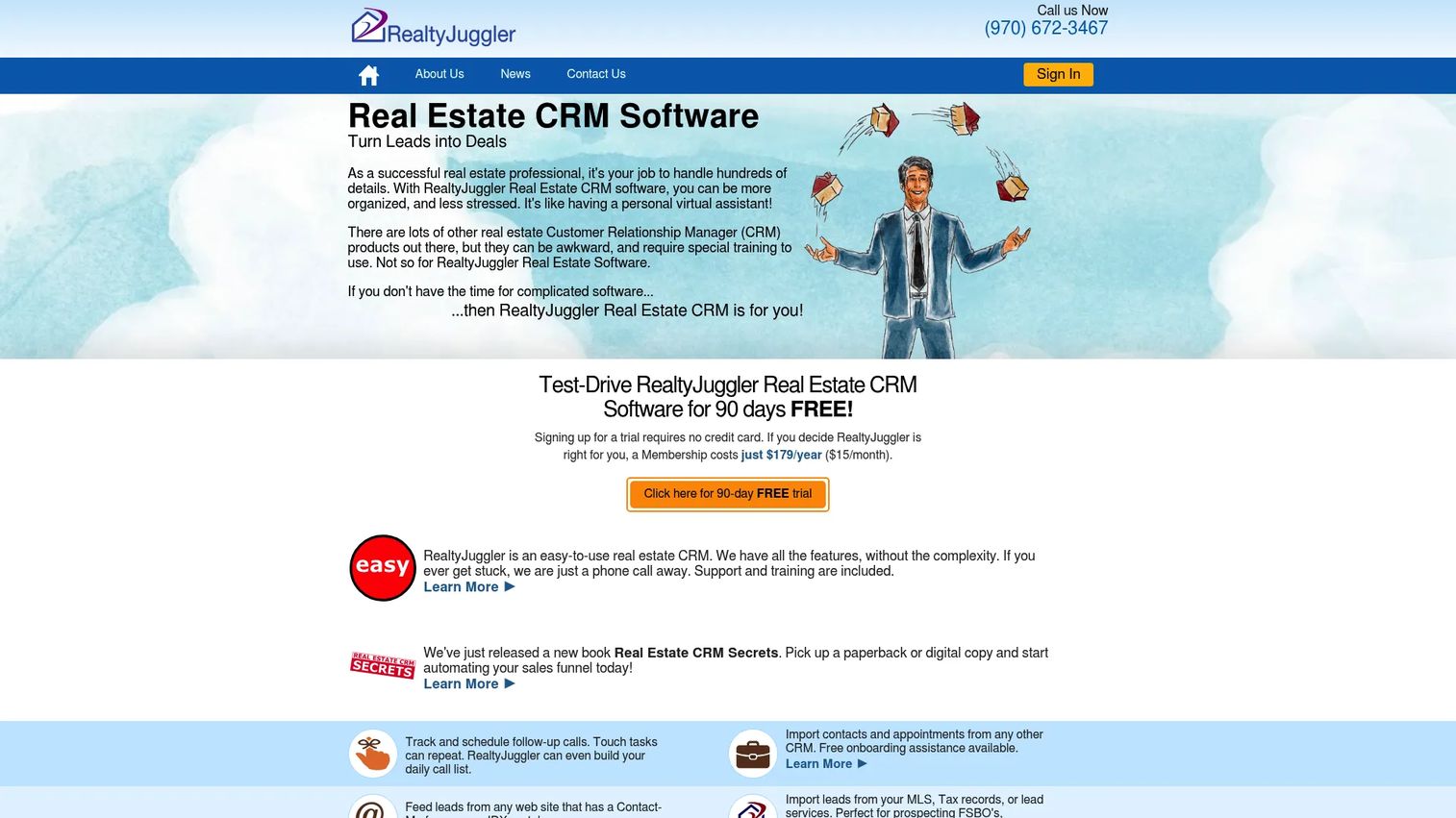
RealtyJuggler is a cloud-based real estate CRM focused on contact management, transaction tracking, drip campaigns, and lead importing at a low annual cost. It supports multi-user collaboration, mobile access, automatic backups, and Google Contacts and Calendar synchronization. SMS messaging through Twilio is available as an additional cost.
Best for: Solo agents or small teams that need broad real estate workflow coverage at a lower entry cost.
Key features
- Contact and prospect management with recurring reminders
- Transaction management for listings, offers, and closings
- Bulk email, drip campaigns, printed letters, and mail merge
- Lead importing from IDX portals, MLS, tax records, and lead services
- Cloud access, multi-user collaboration, and mobile support
Why choose RealtyJuggler: A practical choice when cost control matters more than a modern enterprise interface. A lower-cost CRM used consistently by the full team will produce better pipeline data than an expensive platform that sits underused. The 90-day free trial with no credit card required makes it easy to validate fit before committing.
RealtyJuggler pricing: One membership tier is offered at $179 per year, equivalent to about $15 per month. The 90-day free trial requires no credit card. SMS usage through Twilio carries a separate cost.
G2 rating: 4.5/5
9. Top Producer
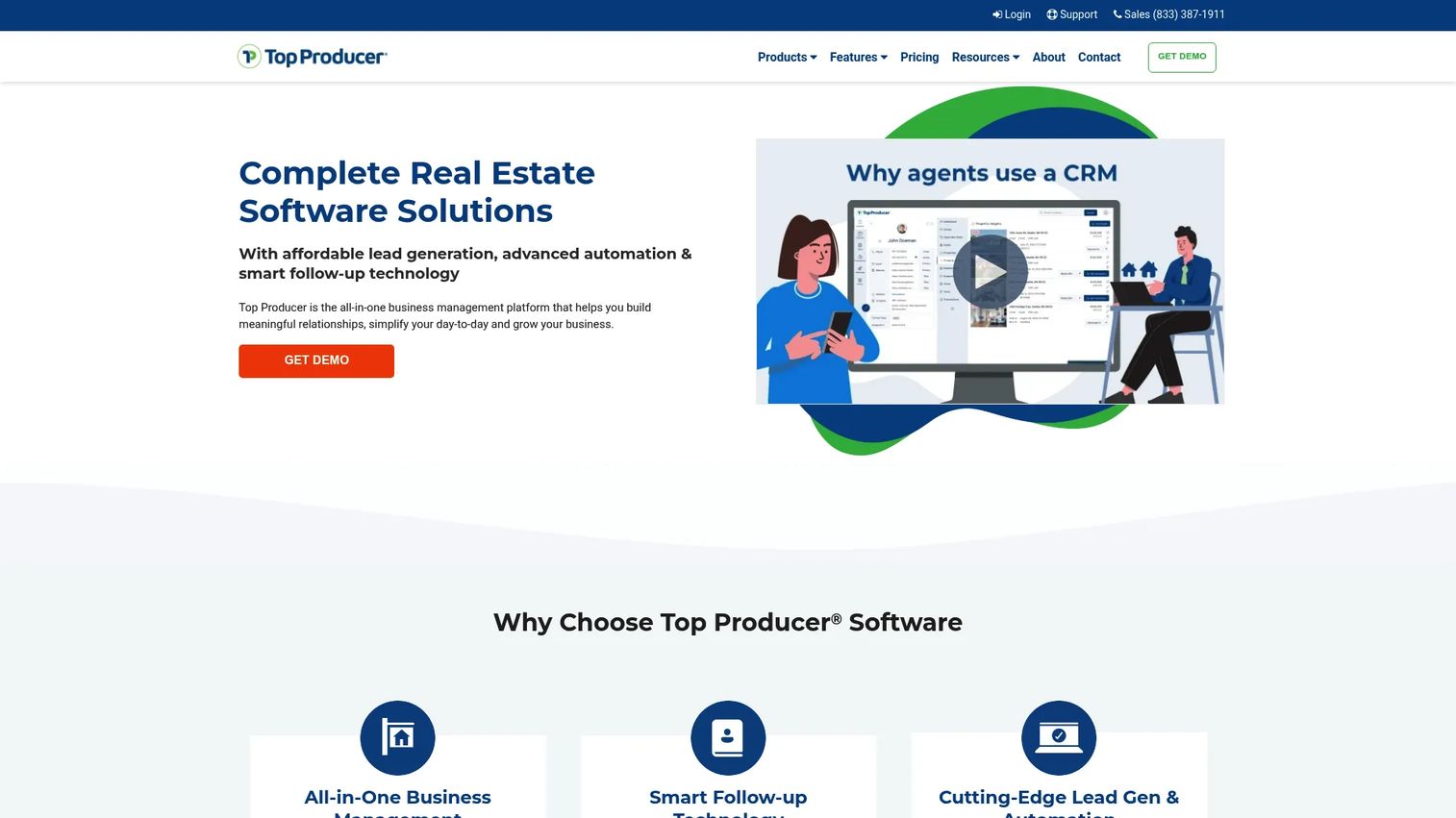
Top Producer is a longstanding real estate CRM covering contact management, MLS-integrated market reports, automated email and SMS response, transaction workflows, and lead generation from social media and more than 150 lead sources. The platform offers both individual agent and team pricing tiers.
Best for: Established agents and teams that want an MLS-connected CRM with automated follow-up, lead generation, and transaction workflows.
Key features
- MLS-integrated market reports and property insights
- Automated email and SMS lead response
- Contact management with social insights and 360-degree views
- Transaction management with customizable workflows
- Lead generation through 150+ lead sources and social media
Why choose Top Producer: Worth evaluating for agents who want MLS data woven directly into client communications. The G2 rating of 3.1/5 reflects a mixed user experience, so run a trial against your live lead-routing process before committing. A founder should also verify whether the platform's current product direction and integrations fit the next two years of scale, not just today's workflow.
Top Producer pricing: The Pro plan starts at $179 per user per month. Team plans cover up to 5 users for $399 per month, up to 10 users for $699 per month, and up to 25 users for $1,199 per month. Pro plus leads starts at $479 per month and pro plus farming at $599 per month, with costs varying by lead volume and farm size. The Top Producer Website add-on is $35 per user per month.
G2 rating: 3.1/5
10. Lone Wolf
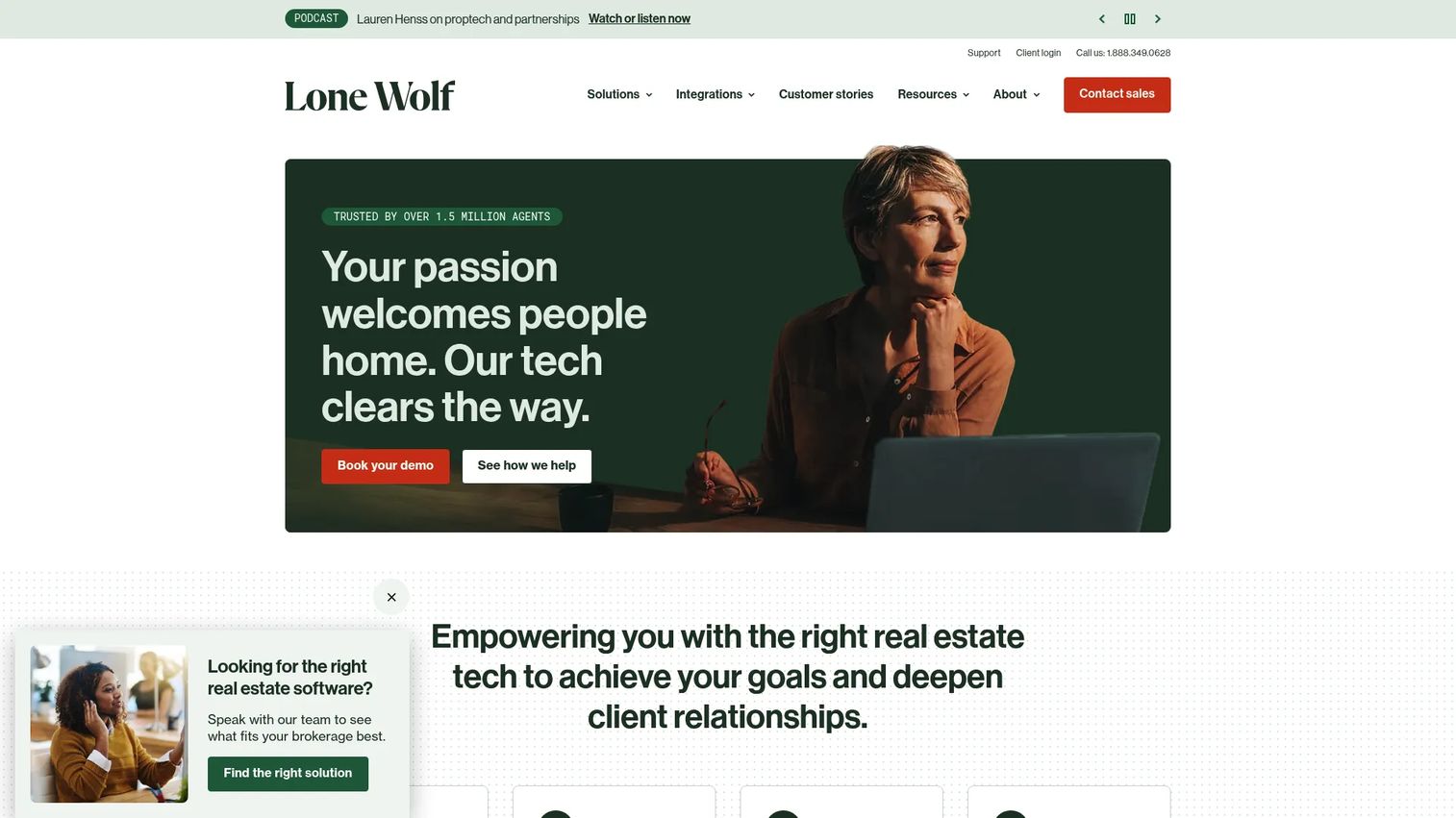
Lone Wolf is a real estate software platform built for brokers, administrators, MLSs, and associations that need transaction management, secure electronic signatures, open-house lead capture, and back-office workflow coverage. It serves the operational layer of a brokerage rather than functioning as a front-line lead follow-up CRM.
Best for: Brokerages that need transaction operations, compliance-oriented workflows, and a connected real estate operating stack.
Key features
- Transaction management with legal forms and streamlined workflows
- Secure electronic signatures with document access and compliance support
- Open-house lead capture with automated follow-ups and CRM synchronization
- Back-office and brokerage administration tools
- Agent, office, and association management capabilities
Why choose Lone Wolf: Belongs on the shortlist when the buyer needs more than lead management. Evaluate it as a brokerage operating platform rather than a CRM replacement. Before signing, confirm that internal ownership, rollout capacity, and data migration planning are in place.
Lone Wolf pricing: Pricing requires contacting sales. Lone Wolf does not post standard rates.
G2 rating: 3.7/5
Considerations when choosing real estate CRM software
Lead-source coverage and speed to lead
Map where leads originate today: Portals, paid advertising, referrals, open houses, or website forms. The CRM must capture attribution and route leads fast enough to meet your team's actual service-level expectations. A system that misses a lead source creates a blind spot in your pipeline reporting from day one.
Team routing and accountability
Evaluate whether leads can be assigned by rules that match your operating model, including geography, property value, agent availability, or round-robin. Confirm that managers can audit response time, reassignment history, and follow-up completion. Accountability requires data, and data requires routing rules that actually run.
Transaction depth versus CRM depth
Some platforms excel at sales follow-up. Others extend into checklists, documents, commissions, and brokerage operations. Buy the depth you will actively use. A broad platform creates overhead when the team only needs lead conversion. A lightweight CRM creates gaps when transaction coordination becomes the bottleneck.
Integrations, data ownership, and exportability
Map the required connections before signing: IDX provider, email, phone, calendar, accounting, and reporting stack. Confirm data-export processes and access rights before migration. A founder evaluating this for a proptech product should also ask which integration APIs are available and whether the CRM can serve as a data source for downstream analytics.
Implementation and adoption
A CRM does not fix a broken process by itself. Assign an owner for migration, define lifecycle stages, map lead sources, build initial automations, and set a weekly adoption review for the first 90 days. A phased rollout beats a one-day cutover, and a CRM used at 80% capacity by everyone outperforms a perfectly configured system that half the team ignores.
Conclusion
Follow Up Boss is the lead recommendation for growing real estate teams. Its multi-source lead routing, Action Plans, and manager reporting give a founder a clean operating layer before investing in a broader platform. Wise Agent is the strongest low-complexity option for smaller teams that want predictable pricing and practical workflows without enterprise rollout risk.
Lofty, BoldTrail, Real Geeks, and BoomTown fit teams that need lead generation, IDX websites, and CRM connected in one platform. Each carries a different cost and rollout commitment, so validate fit against your actual lead volume before signing. RealtyJuggler and IXACT Contact are the right picks when cost control and relationship-first workflows take priority over platform breadth. Lone Wolf belongs on the shortlist only when transaction and back-office depth is the core requirement.
The practical next step: Pick two tools that match your lead volume and operating model, run each through your live lead-routing process, then choose the one your team will use every day.
For more coverage of client management software and account management software relevant to your GTM stack, the Guideflow blog covers those categories in depth.
Start your journey with Guideflow today!
FAQs
The best option depends on your operating model. Follow Up Boss is the strongest pick for growing teams that need lead routing and agent accountability. Wise Agent fits smaller teams that want flat-rate pricing. Brokerages that need transaction and back-office operations should evaluate BoldTrail or Lone Wolf.
Real estate CRM software is a system that helps agents, teams, and brokerages capture leads from multiple sources, track client communication history, automate follow-up, manage deal stages, and coordinate transaction-related work. Most real estate platforms also include property-specific fields and IDX or MLS connections that generic CRMs require custom configuration to replicate.
Pricing ranges from $179 per year for RealtyJuggler to custom quotes for brokerage platforms like BoldTrail, BoomTown, and Lone Wolf. Mid-range options like Wise Agent start at $49 per month, while Follow Up Boss starts at $69 per user per month. Total cost rises with user count, texting and calling add-ons, IDX website packages, and lead-generation programs.
Core features include contact management, lead-source tracking, automated follow-up via email and text, pipeline reporting, team routing and role permissions, mobile access, data export, and integrations with the tools your team already uses. Transaction management and commission tracking matter more for brokerages than for solo agents.
Real estate platforms often include built-in lead routing, transaction workflows, IDX connections, and property-specific fields that a general CRM requires months of configuration to match. A general CRM can still work well when your team needs deep custom logic or already runs a mature sales and marketing stack. The trade-off is setup time and ongoing maintenance.
Evaluate total cost, speed to implementation, user permissions, and shared follow-up automation. Wise Agent offers flat-rate pricing for up to five team members with 24/7 live support included. IXACT Contact is strong when the business model depends on referrals and sphere-of-influence nurture. RealtyJuggler covers the widest feature set at the lowest entry cost.
Brokerages should prioritize governance, user roles, transaction workflows, reporting, integration depth, and data migration support. BoldTrail, BoomTown, and Lone Wolf are built for brokerage-scale operations, though each requires a custom pricing conversation. Separate brokerage operations, which require compliance and back-office depth, from agent-level lead follow-up needs before choosing.
A basic contact import can happen quickly, but a full migration requires field mapping, data cleanup, lead-source connections, automation rebuilds, user training, and reporting setup. Most teams underestimate adoption time. A phased rollout over 60 to 90 days, with a dedicated owner and weekly check-ins, produces better long-term data quality than a one-day cutover.
Some platforms, including Wise Agent, BoldTrail, and Lone Wolf, include meaningful transaction management alongside CRM functionality. Others, like Follow Up Boss, focus primarily on lead follow-up and sales pipeline rather than document management or commission tracking. Audit the transaction depth of any CRM before retiring a dedicated transaction system.