The board asks three questions. Which investors are active in your category right now? What do public comparables tell us about current valuation multiples? Why has a competitor's growth accelerated over the past two quarters?
Answering those questions without the right tools means downloading filings, reconciling spreadsheets, and piecing together information from five different sources. The bottleneck is not access to information. It is the time required to find, validate, and connect it before your next board meeting or fundraising conversation.
According to a 2024 Bloomberg Intelligence report, global spending on financial data and analytics reached $37 billion annually, driven by demand for faster, more integrated research workflows across institutional and corporate teams. That context matters for founders: The category has matured well beyond trading desks. Today's financial research platforms serve anyone who needs defensible answers quickly, including the finance and strategy leaders you are hiring right now.
This guide gives you a shortlist and a decision framework, not a feature inventory.
What's inside
This guide covers 12 financial research software tools across institutional market data, AI-powered document research, private-market intelligence, portfolio analytics, and financial statement extraction.
Tools were selected based on:
- Data coverage and source traceability: Can you validate the underlying claim before it reaches a board deck?
- Workflow fit: Does the tool match the research motion your team repeats every quarter?
- Pricing model: Does the cost reflect your team's actual usage frequency?
- Integrations and exports: Can the data move into spreadsheets, CRM records, or reporting tools your team already uses?
Pricing and G2 ratings are verified against live vendor pages and review listings (October 2026).
TL;DR
- Best for institutional market intelligence: Bloomberg Terminal for teams that need real-time cross-asset data, news, and professional analytics every day.
- Best for investment research workflows: FactSet for integrated company data, estimates, and portfolio analysis with Excel connectivity.
- Best for AI document research: AlphaSense for searching and synthesizing filings, transcripts, and broker research with source links.
- Best for founders doing fundraising or investor research: PitchBook for private-company data, investor activity, and deal intelligence.
- Best affordable public-market research: Koyfin for public comparables, macro dashboards, and screening without a terminal contract.
- Best for financial statement extraction: Daloopa for source-linked, model-ready financial data across 6,000+ global tickers.
What is financial research software?
Financial research software is a category of platforms that help users collect, analyze, verify, and present market, company, portfolio, and private-market information for investment, strategic, or financial decisions.
The category covers four distinct types of products:
Institutional terminals and data platforms provide broad market data, company financials, consensus estimates, news, analytics, and professional workflows in one environment. Bloomberg Terminal and LSEG Workspace are the leading examples.
AI research platforms search, synthesize, and cite information across filings, transcripts, research documents, and proprietary content libraries. AlphaSense is the primary example in this list. The key capability is source-linked answers: Every AI summary connects back to the original filing, transcript, or document excerpt.
Private-market intelligence platforms cover investors, funding rounds, funds, private companies, M&A activity, and transaction data. PitchBook and Preqin are the two most relevant tools here, with different strengths covered below.
Portfolio and self-service research products offer charts, screeners, watchlists, dashboards, and client-ready outputs at accessible price points. Koyfin, YCharts, and Morningstar Direct belong in this group.
Core capabilities to look for
- Real-time and historical market data
- Company financials, estimates, and ownership data
- Securities screening and peer benchmarking
- SEC filing, transcript, and research-document search
- Portfolio analytics and reporting
- Private company, investor, fund, and deal intelligence
- AI-assisted document synthesis with links to sources
- Spreadsheet, CRM, and reporting integrations
Financial research software is distinct from accounting or budgeting tools. It exists to support evidence-backed financial decisions, not to record transactions or manage operating budgets. Generic AI chat tools also belong in a different category: They lack source traceability, the feature that makes research outputs usable in board meetings or investor conversations.
When to use financial research software
Build a defensible board or fundraising narrative
Your board and prospective investors will ask where your numbers came from. A financial research platform gives your finance lead a repeatable way to pull comparable-company data, market context, and investor activity without rebuilding the same spreadsheet each quarter. Use it when board discussions require traceable inputs, not anecdote-level market claims.
Run market, competitor, or diligence research
Evaluating a strategic partner, acquisition target, potential customer segment, or competitor requires more than a quick web search. A research platform earns its cost when it reduces manual source checking and gives you a documented evidence trail. This applies equally to investor due diligence prep and competitive intelligence.
Equip your finance leader with a repeatable workflow
A new CFO or Head of Finance should not spend their first month rebuilding research infrastructure. Give them shared dashboards, standard source libraries, and exportable outputs from day one. The transition from founder-led research to a process your finance team owns depends on having a platform they can trust and maintain independently.
Financial research software comparison
No single platform covers every financial research job. Your choice depends on whether the team needs broad market data, private-market intelligence, AI document research, financial-statement extraction, or portfolio reporting. Scan the table to find the tools closest to your immediate workflow, then read those sections in detail.
| # | Product | Best for | Key differentiator | Pricing | G2 rating |
|---|---|---|---|---|---|
| 1 | Bloomberg Terminal | Institutional market intelligence | Real-time cross-asset data, news, analytics, and messaging | Contact sales | 4.4/5 |
| 2 | FactSet | Investment research and portfolio workflows | Integrated financial data, estimates, analytics, and Excel connectivity | Contact sales | 4.2/5 |
| 3 | AlphaSense | AI-powered document research | Source-linked search across filings, transcripts, and research libraries | Contact sales | 4.6/5 |
| 4 | S&P Capital IQ Pro | Company intelligence and transaction research | Deep company financials, ownership, deals, and Office integrations | Contact sales | 4.3/5 |
| 5 | LSEG Workspace | Global markets and data workflows | Market data, Reuters news, analytics, and enterprise data feeds | Contact sales | 3.8/5 |
| 6 | PitchBook | Private-market and investor research | Private company, investor, fund, and deal intelligence | Contact sales | 4.5/5 |
| 7 | Koyfin | Affordable public-market and macro research | Custom dashboards, global equity screening, and macro data | Free to $299/mo | 4.8/5 |
| 8 | Morningstar Direct | Advisor and portfolio research | Portfolio analytics, fund research, and client-ready reporting | Contact sales | 4.0/5 |
| 9 | Preqin | Alternatives and private-capital intelligence | Fund, investor, and alternatives data across private markets | Contact sales | 2.7/5 |
| 10 | Daloopa | Financial statement data extraction | Auditable, source-linked data into Excel models for 6,000+ tickers | Free tier available | N/A |
| 11 | YCharts | Advisor-friendly research and reporting | Portfolio analytics, model portfolios, and client communication tools | From $3,000/yr | 4.7/5 |
| 12 | Fiscal.ai | Filing, transcript, and company financial workflows | AI-assisted research with click-through auditability to source filings | Free to $64/mo | N/A |
Pricing and G2 ratings verified October 2026 from vendor pricing pages and live G2 listings.
Best 12 financial research software tools for 2026
1. Bloomberg Terminal
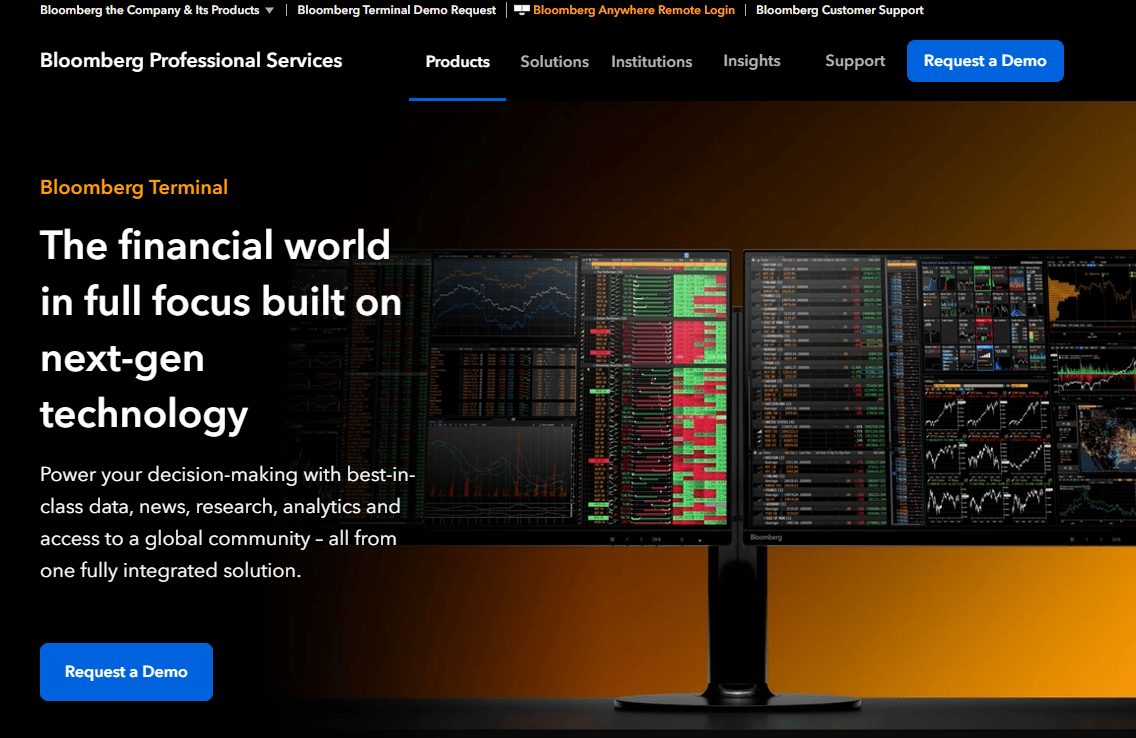
Bloomberg Terminal is the standard professional environment for institutional finance teams that need real-time cross-asset market data, news, proprietary analytics, and integrated communications. It covers equities, fixed income, currencies, commodities, and derivatives alongside consensus estimates, company financials, charts, and portfolio analytics. Bloomberg's messaging network is embedded directly in the platform, making it a collaboration environment as much as a data terminal.
Best for: Institutional investors, investment banks, corporate treasury teams, and finance organizations that require comprehensive, real-time market coverage daily.
Key features
- Real-time cross-asset market data and pricing
- Company financials, consensus estimates, and ownership data
- Proprietary and third-party research and analytics
- Bloomberg messaging and collaboration network
- Multi-asset execution and pre/post-trade analytics
Why choose Bloomberg Terminal: It earns its place when speed, depth, and global market coverage are daily requirements. For a Series B founder doing occasional investor or market mapping, the cost and complexity may exceed the workflow. The right fit is a team where a dedicated finance professional uses it continuously.
Bloomberg Terminal pricing: Bloomberg does not display pricing on its product page; contact their sales team directly. G2 reviewer-reported figures suggest annual per-seat costs that reflect enterprise contract structures.
Bloomberg Terminal holds a 4.4/5 G2 rating based on 69 verified reviews.
2. FactSet
FactSet combines financial data, estimates, portfolio analytics, and workflow tools for investment research and corporate finance teams. The platform connects company financials, alternative datasets, screening, ownership data, and performance analytics through a single interface with deep Excel and API integration. Research workflows move from raw data into models and reports without manually rebuilding outputs each time.
Best for: Investment research teams and corporate finance leaders who need an integrated workflow across data, models, portfolio analysis, and reporting.
Key features
- Company financials, estimates, and consensus data
- Portfolio analytics, performance, and risk tools
- Excel add-in and API data connectivity
- Global equity screening and peer benchmarking
- Alternative datasets and ownership intelligence
Why choose FactSet: The value is in the connected workflow. Data flows into models and reports in a way that reduces manual reconstruction. It fits organizations with a serious finance function, investor relations requirements, or frequent comparable-company analysis that needs to hold up under scrutiny.
FactSet pricing: FactSet uses enterprise contract pricing. Reach out to their team for a quote based on your seat count and product modules.
FactSet holds a 4.2/5 G2 rating at the seller level.
3. AlphaSense
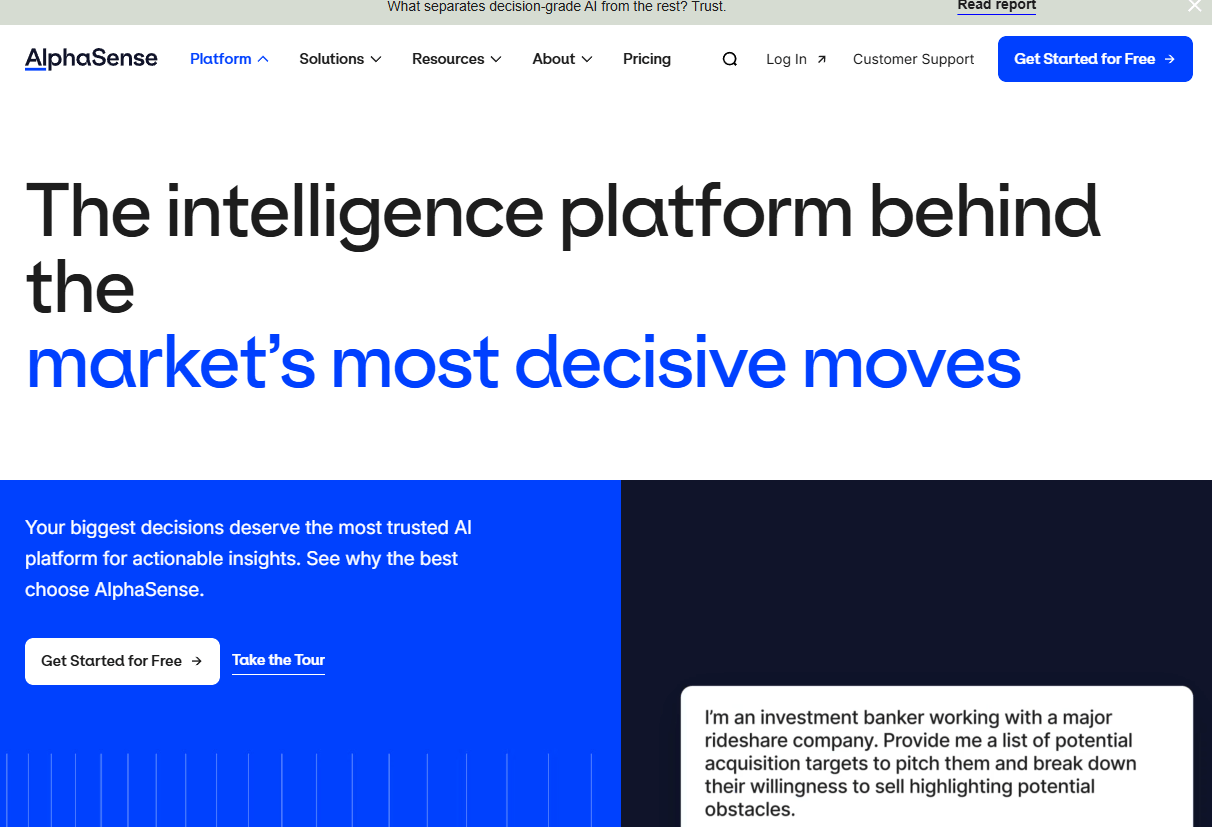
AlphaSense is an AI-powered market intelligence platform that searches and synthesizes information across more than 500 million financial and business documents. The library includes SEC filings, earnings transcripts, expert call content, broker research, trade publications, and company-internal documents for Enterprise Intelligence subscribers. Its Generative Search and Deep Research tools produce summaries with direct links to the source excerpt, so every AI output carries a trail back to the original filing or transcript.
Best for: Finance, strategy, and competitive-intelligence teams that spend significant time locating and cross-referencing evidence across earnings calls, filings, and market research documents.
Key features
- Filing and transcript search across 500M+ documents
- AI-generated research summaries with source links
- Company monitoring, alerts, and change tracking
- PowerPoint and Excel add-ins for workflow integration
- Workflow Agents for automated research tasks
Why choose AlphaSense: The core value is reducing document research time while preserving a clear route back to original sources. Before using any AI-generated summary in a board deck or investor memo, verify the underlying excerpt. AlphaSense makes that verification step practical, which is why it fits diligence, competitive intelligence, and market research workflows.
AlphaSense pricing: AlphaSense offers Market Intelligence and Enterprise Intelligence plans, both priced on annual subscription terms through a sales conversation. Contact their team for a quote based on team size and content access requirements.
AlphaSense holds a 4.6/5 G2 rating.
4. S&P Capital IQ Pro
S&P Capital IQ Pro provides deep financial intelligence across public and private companies, covering capital structure, ownership, transactions, M&A activity, and comparable-company analysis. Its Office Tools suite connects directly to Excel, PowerPoint, and Word, allowing analysts to pull live financial data into models and presentations without copy-paste workflows. The platform also includes AI-powered Document Intelligence and a ChatIQ feature for natural-language queries against its data library.
Best for: Corporate development, investment banking, strategic finance, and teams building detailed company or transaction research that needs to hold up in diligence.
Key features
- Public and private company financial profiles
- Capital structure, ownership, and transaction data
- M&A and deal intelligence across markets
- Excel, PowerPoint, and Word Office Tools integration
- Custom dashboards, screening, and market mapping
Why choose S&P Capital IQ Pro: It is the strongest choice when your team needs detailed company-level research and transaction context, particularly for acquisition analysis, investor list building, or board-grade competitive profiling. The Excel integration reduces manual data entry in modeling-heavy workflows.
S&P Capital IQ Pro pricing: Pricing is contract-based. Contact S&P Global Market Intelligence directly for a quote.
S&P Capital IQ Pro holds a 4.3/5 G2 rating.
5. LSEG Workspace
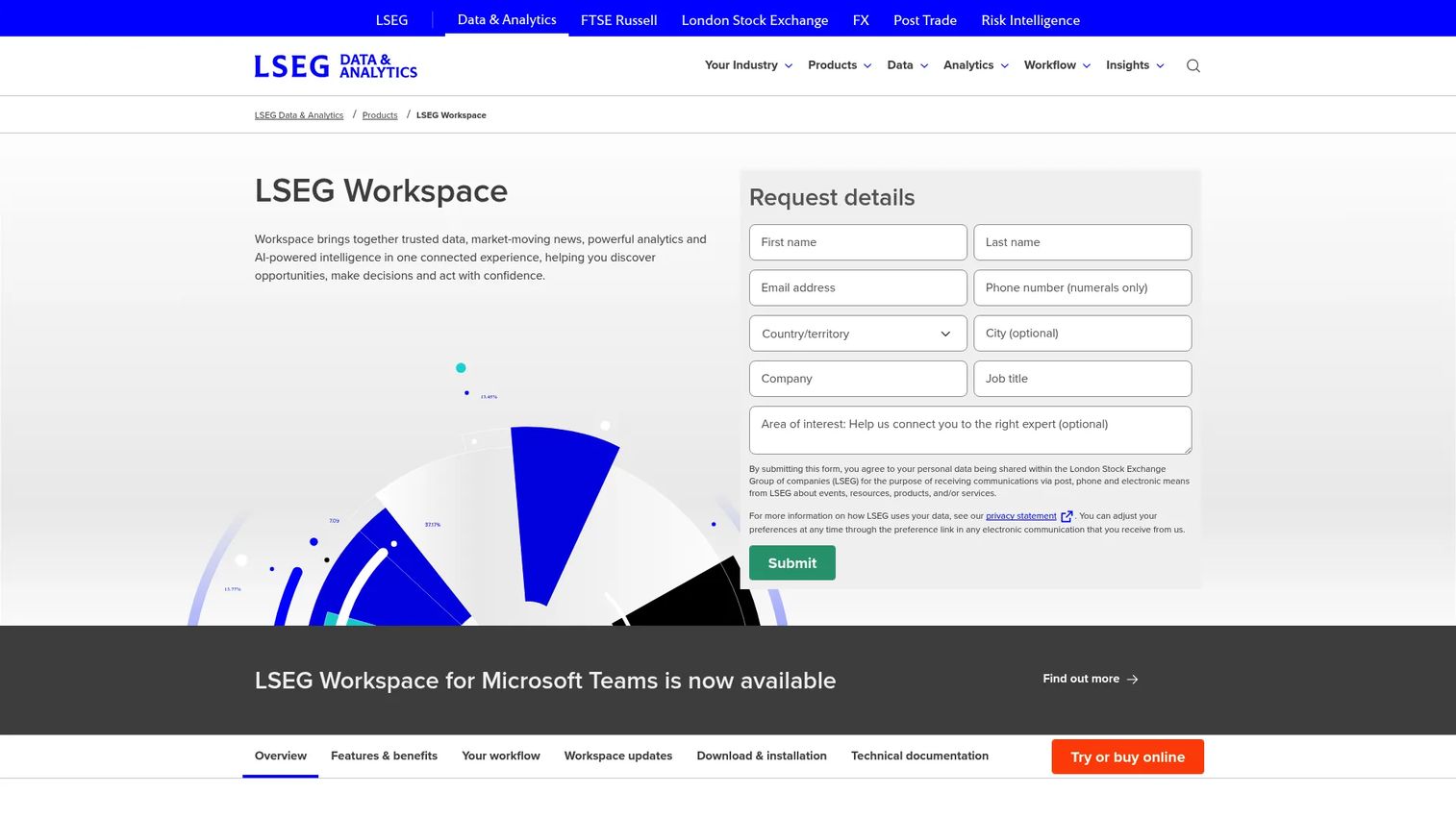
LSEG Workspace is London Stock Exchange Group's professional financial data environment, combining global market data, exclusive Reuters News, StarMine and MarketPsych analytics, and AI-powered research tools. The platform integrates with Microsoft 365 and Teams, providing enterprise data feeds alongside workflow support for wealth advisors, investment bankers, portfolio managers, and analysts. AI-powered Workspace agents and AI Search tools surface relevant market intelligence across the platform's content library.
Best for: Global finance teams, investment banks, and enterprise organizations that require broad market coverage, professional news access, and data feed infrastructure.
Key features
- Global market data across asset classes and geographies
- Exclusive Reuters News plus 10,000 additional sources
- StarMine and MarketPsych analytics and calculators
- AI-powered Workspace agents and AI Search
- Microsoft 365 and Teams integration
Why choose LSEG Workspace: LSEG Workspace suits organizations with global market exposure, treasury requirements, or enterprise data infrastructure needs. It is relevant for companies expanding internationally or managing FX, debt market, or multi-asset research workflows at scale.
LSEG Workspace pricing: LSEG does not display pricing. Contact their team for a quote based on workflow requirements and seat count.
LSEG Workspace holds a 3.8/5 G2 rating based on 4 reviews.
6. PitchBook
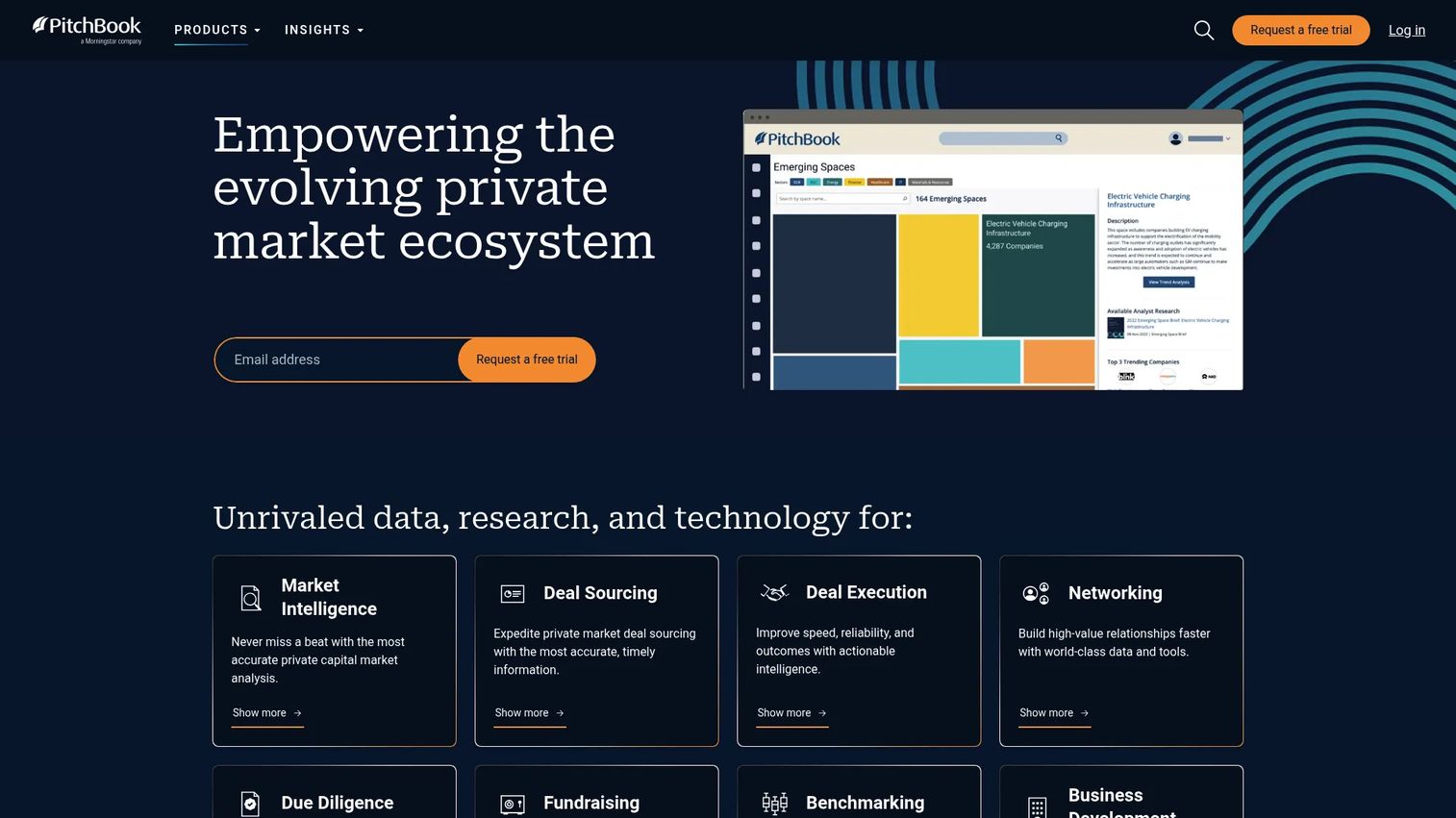
PitchBook is a private capital market platform covering venture capital, private equity, M&A, funds, investors, and private company data across global markets. For a Series B founder, it answers the questions that matter most before a fundraising conversation: Which investors have backed companies like yours, which firms are active in your category right now, and what deals set the current market context. The platform includes AI-integrated search, predictive tools, Excel and PowerPoint integrations, and direct CRM connectivity.
Best for: Founders, corporate development teams, and strategy leaders researching investors, comparable funding rounds, acquisition targets, or private-market conditions.
Key features
- Private company profiles with funding history and valuation data
- Investor and fund intelligence with activity tracking
- M&A and deal tracking across private markets
- AI-integrated search and predictive analysis tools
- Excel, PowerPoint, Chrome, and CRM integrations
Why choose PitchBook: It is the most founder-relevant tool on this list for fundraising preparation. The investor and fund intelligence capabilities answer the "who funds companies like ours?" question in a way that web research cannot match. It also supports market mapping and competitive deal tracking as a recurring motion, not just a one-off project.
PitchBook pricing: Pricing varies by seat count, firm type, and optional modules. Contact PitchBook for a quote. A free trial may be available depending on your organization profile.
PitchBook holds a 4.5/5 G2 rating.
7. Koyfin
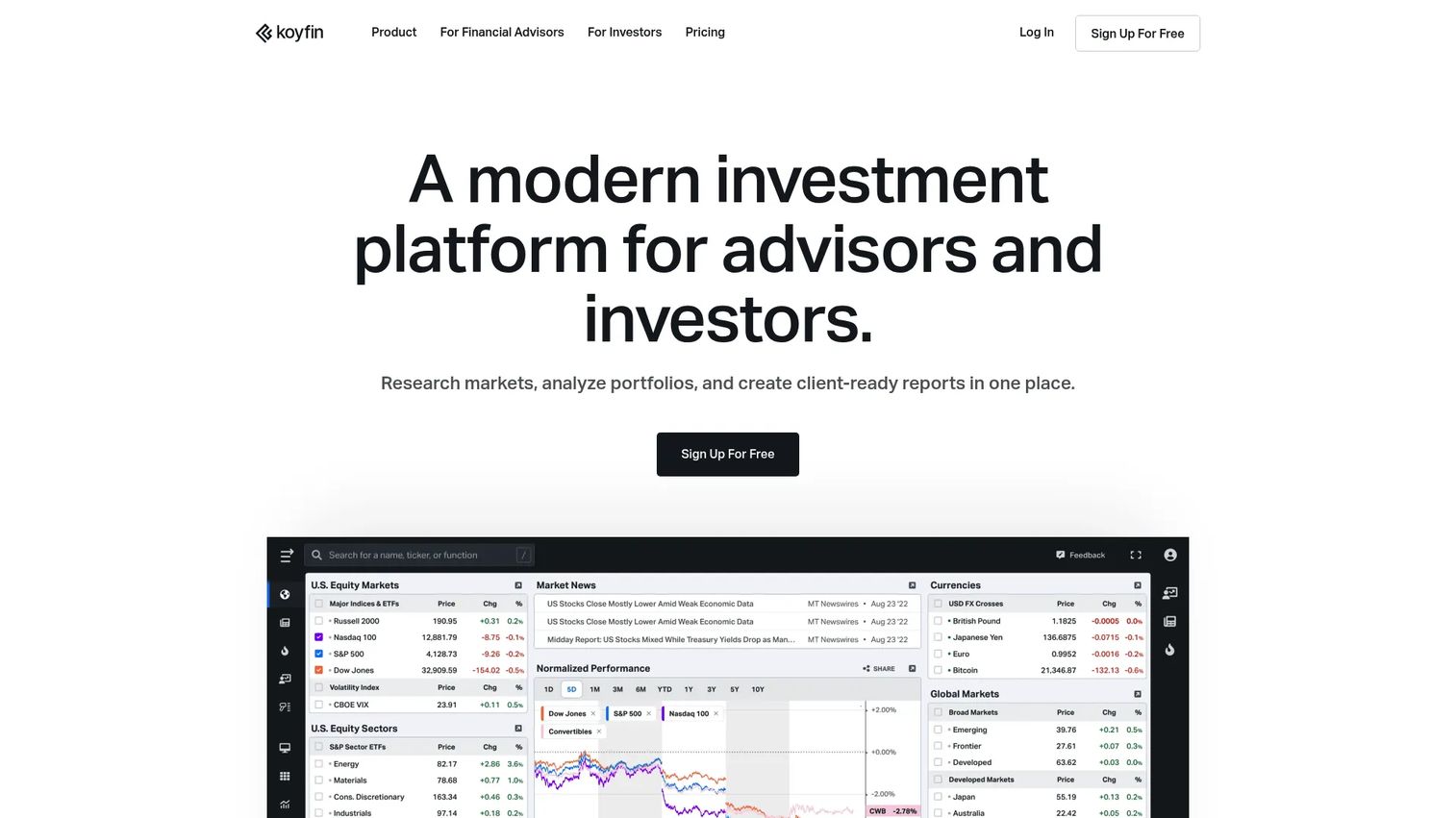
Koyfin is a financial analytics platform for researching global equities, tracking macroeconomic data, building custom dashboards, and screening public securities. It covers global equity data, bond and yield-curve data, FX, ETFs, and mutual funds alongside watchlists, portfolio tracking, and advanced charting. For a lean finance team or a founder who needs recurring public comparables and macro context without committing to an institutional terminal contract, Koyfin offers the most accessible entry point on this list.
Best for: Founders, operators, advisors, and lean research teams that need serious public-market and macro intelligence at a cost that fits a smaller finance stack.
Key features
- Custom dashboards and watchlists for ongoing monitoring
- Global equity screening with financial filters
- Macroeconomic and economic data dashboards
- Advanced charting with historical data
- Portfolio tracking and market reporting tools
Why choose Koyfin: It fills the gap between free web research and a full institutional terminal. If your team needs quarterly public comparable analysis, investor updates, and macro monitoring, Koyfin delivers that workflow at a price that makes sense before you have a dedicated research analyst.
Koyfin pricing: Free plan available. Plus starts at $39/month, Premium at $79/month, Advisor Core at $209/month, and Advisor Pro at $299/month (monthly billing). Annual billing reduces the per-month cost by up to 30%.
Koyfin holds a 4.8/5 G2 rating.
8. Morningstar Direct
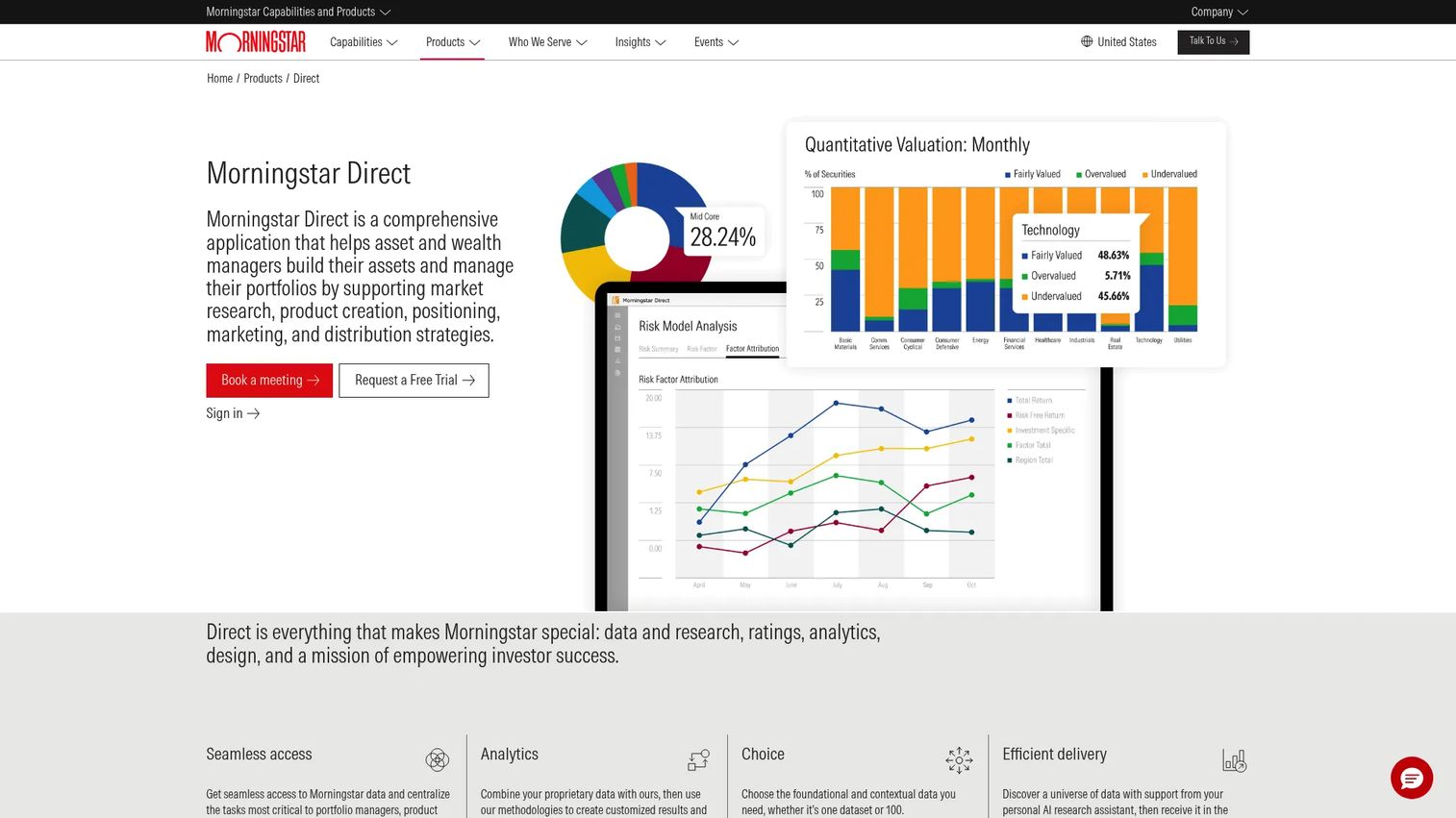
Morningstar Direct is an institutional investment analysis platform combining Morningstar data, research, ratings, portfolio construction, and reporting tools for asset managers, wealth managers, and investment analysts. The platform covers portfolio creation, optimization, stress testing, attribution analysis, and competitive analysis alongside custom-branded reports, factsheets, and automated data feeds. Its strength is the depth of fund and investment product research, not broad market data or private-company intelligence.
Best for: Wealth managers, investment advisors, asset managers, and teams focused on fund research, portfolio construction, and advisor-client reporting.
Key features
- Portfolio creation, analytics, optimization, and stress testing
- Fund and investment research with Morningstar ratings
- Risk, performance, and attribution analysis
- Custom-branded client reports and factsheets
- Competitive analysis and investment product data
Why choose Morningstar Direct: It is a specialist tool. For a Series B SaaS founder, the relevant use case is narrow: If your company serves wealth management, asset management, or investment advisory markets, Morningstar Direct belongs in the research stack. For general market intelligence or investor research, other tools on this list are more directly useful.
Morningstar Direct pricing: Morningstar offers a two-week free trial by request but does not display pricing on its product pages. Contact their team for commercial terms.
Morningstar Direct holds a 4.0/5 G2 rating.
9. Preqin
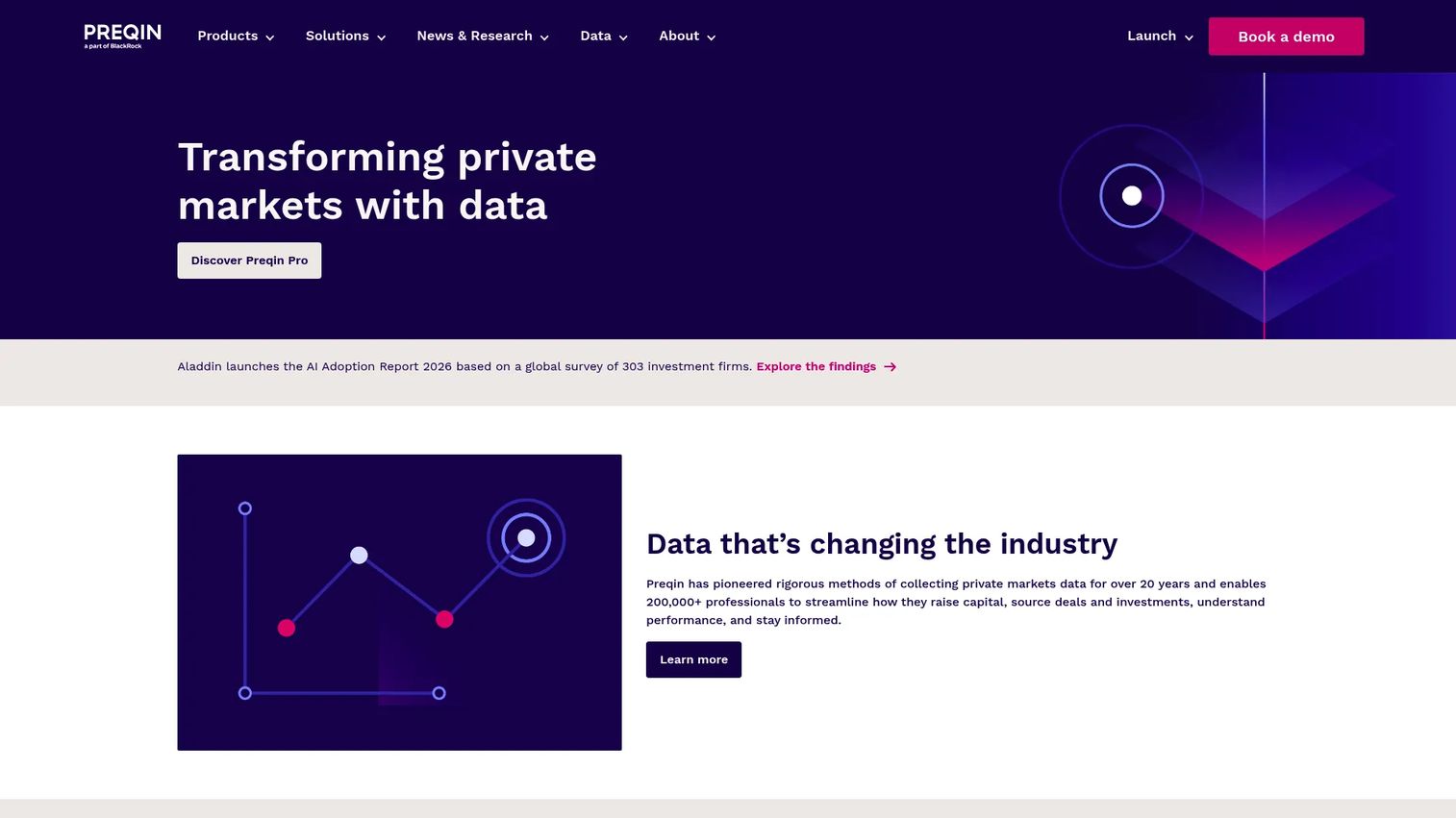
Preqin provides private markets data, analytics, and research focused on alternatives: Private equity, hedge funds, real estate, infrastructure, private debt, and venture capital. Its core strength is fund-level and allocator-level data, including fundraising intelligence, investor profiles, performance benchmarks, and private-capital market reports. Where PitchBook covers the private company and deal layer, Preqin focuses on the fund and allocator layer.
Best for: Private-market investors, fund managers, corporate development teams, and founders researching institutional investors and alternative-capital ecosystems.
Key features
- Private markets data across PE, hedge funds, real estate, infrastructure, private debt, and VC
- Investor and allocator profiles with allocation preferences
- Fundraising intelligence and private-capital benchmarks
- Portfolio analysis and market-level performance data
- Enterprise data delivery through feeds, APIs, and CRM integrations
Why choose Preqin: Choose Preqin when the question centers on funds, allocators, and alternatives rather than private company profiles. It is most useful for founders raising from institutional LPs, building a private-capital strategy, or researching which allocators are active in their investor's fund network.
Preqin pricing: Preqin does not display pricing. Contact their team to book a demo and discuss contract terms.
Preqin holds a 2.7/5 G2 rating based on 3 reviews at the seller level.
10. Daloopa
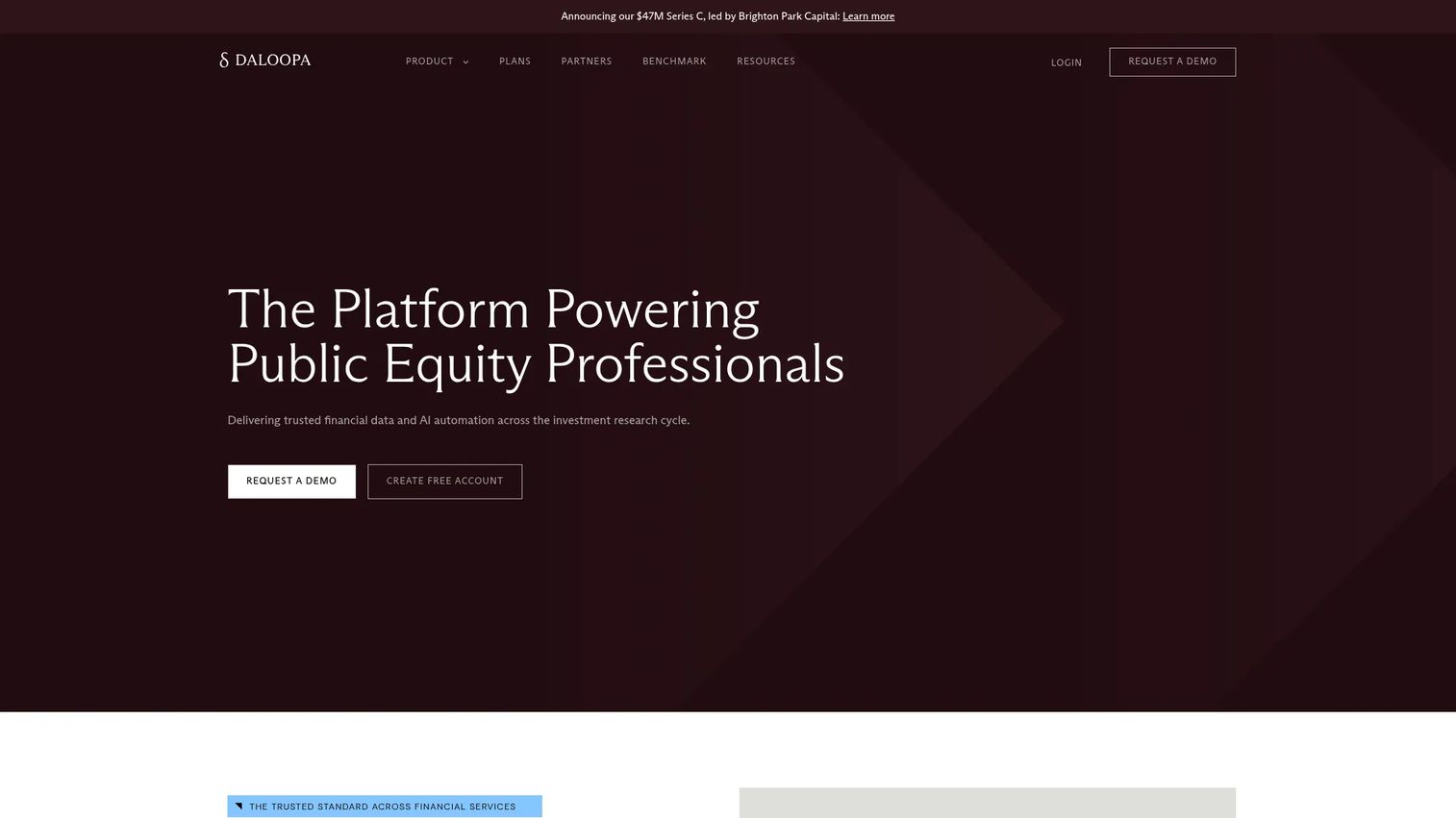
Daloopa is an AI-powered financial data platform that extracts source-linked, audit-ready financial statement data for public companies directly into Excel models. It covers 6,000+ global tickers, standardizes historical financials, and keeps models updated without manual re-entry. Every data point links back to the original filing, giving analysts a clear source trail for every cell. The platform also includes Daloopa Scout, an AI modeling assistant, and API access for analytics and AI agents.
Best for: Investment analysts, strategic finance teams, and modeling-heavy users who rebuild comparable-company models or initiate coverage repeatedly across a large company universe.
Key features
- Source-linked, audit-ready financial data for 6,000+ global tickers
- Excel-native AI financial modeling with Daloopa Scout
- Excel Add-in for automated model updates
- Programmatic API and MCP access for analytics integrations
- Historical data standardization with filing-level traceability
Why choose Daloopa: The core value is eliminating manual data extraction while preserving the source trail your team needs to defend numbers in board decks or investment memos. If your finance team regularly builds comparable-company models, investor materials, or earnings-season updates, the reduction in per-model build time is substantial.
Daloopa pricing: A free plan includes up to three Data Sheets. Core, Premium, and Fundamentals API plans are priced through a sales conversation. Contact Daloopa for a quote.
Daloopa does not yet have a meaningful G2 rating based on current listings.
11. YCharts
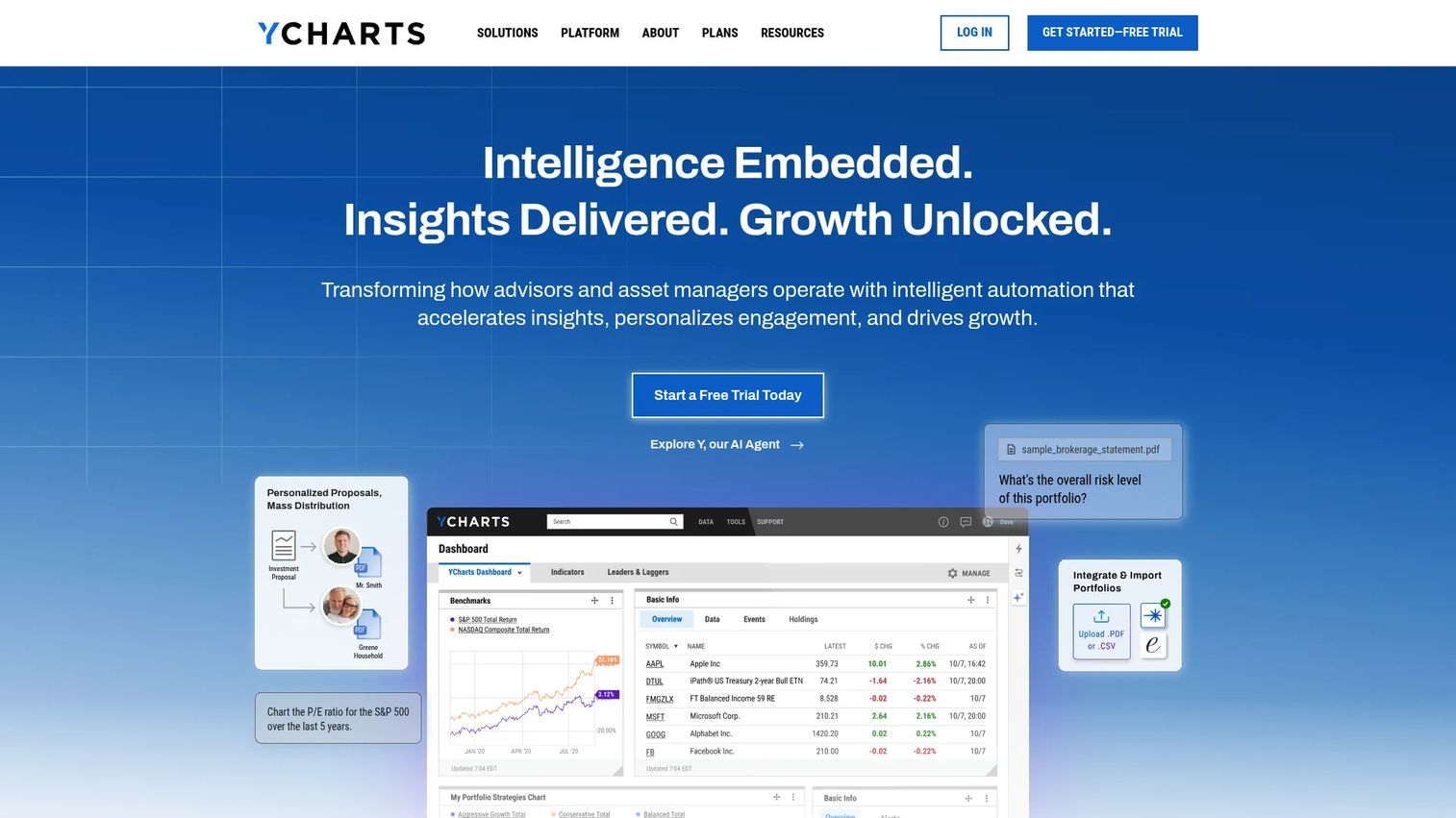
YCharts is a financial research, portfolio analysis, and client communication platform built for financial advisors and investment professionals. It combines market data, security screening, portfolio analytics, model portfolios, and client-ready reporting in one workflow. The platform covers stocks, funds, economic data, sectors, and crypto alongside custom charting, dashboards, watchlists, and alerts. Its strength is turning research into advisor-client conversations and clear portfolio outputs.
Best for: Financial advisors, wealth managers, and small investment teams that need research paired with client-ready portfolio reporting.
Key features
- Portfolio construction, optimization, and analytics
- Financial research across stocks, funds, economic data, and sectors
- Custom charting, dashboards, watchlists, and alerts
- Model portfolio management and rebalancing tools
- Client-ready reports and communication tools
Why choose YCharts: It is built for advisors who need to move from research to client conversation quickly. For a Series B founder, the narrow use case is running a wealthtech or advisor-facing business where you want to understand the research and reporting workflows your customers use daily.
YCharts pricing: Analyst plan starts at $3,000 per first seat annually (additional seats at $1,500). Professional plan starts at $6,300 per first seat annually (additional seats at $3,600). No free tier; contact YCharts for Enterprise pricing.
YCharts holds a 4.7/5 G2 rating.
12. Fiscal.ai

Fiscal.ai is a modern investment research terminal and financial data platform for public equities, ETFs, and funds. It combines global financial data, AI-powered Copilot, company-specific KPI and segment data, analyst estimates, earnings calls, transcripts, filings, and 13F ownership data in a single workspace. Every AI summary links back to the source filing, giving users a direct path to verify any claim before it moves into an investor update or board narrative.
Best for: Founders, equity researchers, and finance teams that want a lightweight research layer for filings, transcripts, and company financial data without committing immediately to an institutional terminal contract.
Key features
- Global financial data with click-through auditability to source filings
- AI Copilot and AI summaries for company research
- Company-specific KPI, segment, and estimate data
- Earnings calls, transcripts, slides, and IR content
- Ownership data, 13F filings, and customizable dashboards
Why choose Fiscal.ai: It offers a practical starting point for recurring public-company tracking and competitive research. The source auditability makes AI outputs usable in investor updates rather than requiring a separate verification step. At its entry price point, it can replace a patchwork of free tools without the commitment of an institutional terminal.
Fiscal.ai pricing: Free plan includes a two-week Pro trial. Plus is $24/month, Pro is $64/month (both billed monthly). Enterprise plans are priced on custom terms.
Considerations when choosing financial research software
Match the tool to the question your team repeats
Start by listing the five research questions your finance or strategy team answers every quarter. Then match each question to the platform type that answers it with the least manual stitching. A private-market investor mapping question calls for PitchBook. A recurring public comparable analysis calls for Koyfin or FactSet. Buying a broad terminal to answer an occasional question increases cost without improving outcomes.
Verify the source trail behind every AI output
AI summaries save time on first-pass research. They do not replace analyst judgment on source validity. Before any AI-generated claim reaches a board deck, investor memo, or strategic decision, trace it back to the filing excerpt, transcript section, or data cell it cites. Tools that make that verification step easy, such as AlphaSense or Fiscal.ai, are worth prioritizing over tools that present AI outputs without links.
Calculate cost against recurring analyst time
Compare the subscription against the hours your team spends gathering data, cleaning spreadsheets, and searching transcripts each month. A high-cost platform earns its place when the research workflow occurs frequently enough to justify the contract. For a founder team running quarterly analysis, a $39/month Koyfin plan may cover the job better than a six-figure terminal contract.
Check integration and export requirements
Confirm that data can move into Excel, Google Sheets, CRM records, or internal reporting tools. Ask specifically who owns the data export once research leaves the platform. Tools like FactSet, S&P Capital IQ Pro, and Daloopa are built around spreadsheet connectivity. That matters when your finance team lives in models, not browser tabs.
Separate raw research from client-facing output
Some platforms excel at raw financial data and deep research. Others excel at packaging analysis into advisor reports, portfolio reviews, or board-ready visuals. If your team needs both, determine whether one platform covers them without weakening either. YCharts and Morningstar Direct are built around the output step. Bloomberg Terminal and FactSet are built around the research step.
Conclusion
No single platform owns every financial research workflow. The strongest choice matches the questions your team repeats most often.
Bloomberg Terminal and LSEG Workspace serve teams that need institutional market coverage every day. FactSet and S&P Capital IQ Pro fit research-heavy finance and transaction workflows where data needs to move into models and presentations. AlphaSense is the clearest choice when teams work through large volumes of filings, transcripts, and research documents and need source-linked answers.
PitchBook is the most founder-relevant tool for investor mapping and fundraising preparation. Koyfin delivers the most accessible path to serious public-market and macro intelligence at a price that fits a lean finance stack. Daloopa removes the manual extraction bottleneck for teams building financial models repeatedly. Fiscal.ai offers a lightweight entry point for public-company research with source auditability built in.
Morningstar Direct and YCharts are specialist picks: Most relevant for founders whose products serve wealth management or advisory markets.
Start with one recurring decision that currently requires manual research, then trial the tool closest to that specific workflow. The right investment research platform earns its place in the first quarter by giving your finance lead a repeatable process your team can trust without routing every question back through you.
FAQs
The right tool depends on the question you repeat most often. PitchBook suits investor and private-market research, particularly during fundraising preparation. Koyfin suits public comparables and macro context at an accessible price point. AlphaSense fits document-heavy competitive or market research where source traceability matters. Most early-stage finance teams start with one focused tool before adding institutional-grade data contracts as research volume grows.
A market data terminal is a professional environment for real-time pricing, market news, analytics, and multi-asset coverage. Financial research software is a broader category that includes private-market databases, AI document search tools, financial statement extraction platforms, screening tools, and portfolio reporting products. Bloomberg Terminal and LSEG Workspace are terminals. PitchBook, AlphaSense, Daloopa, and Koyfin are financial research platforms with narrower, specialized functions.
No. AI tools accelerate search, extraction, and first-pass synthesis across large document sets. Analysts still need to validate source material, check calculation methods, confirm data dates, and assess context before using conclusions in investment memos, board presentations, or fundraising conversations. The value of a tool like AlphaSense or Fiscal.ai is making that validation step faster, not skipping it.
PitchBook and Preqin are the two primary options. PitchBook covers private companies, funding rounds, investor activity, venture deals, and M&A. Preqin focuses on the fund and allocator layer, including alternatives, fundraising benchmarks, and institutional investor profiles. Your choice depends on whether you primarily need company-level deal data or fund-level capital allocation intelligence.
Prioritize source traceability, export options, comparable-company data, and recurring dashboards your finance team can maintain between meetings. Board materials need evidence that can be checked quickly when a director asks where a number came from. Tools that link data points back to their filing or transcript source, and that export cleanly into spreadsheets or presentations, reduce the risk of a claim that cannot be defended under scrutiny.
It is worth the cost when it replaces recurring manual research, reduces what you would otherwise pay an outside firm, or supports a high-stakes decision such as fundraising, M&A, pricing strategy, or market entry. Smaller teams should start with narrower, lower-cost tools like Koyfin or Fiscal.ai before committing to enterprise data contracts. Evaluate cost against the hours your team currently spends doing the same research manually.
Excel and spreadsheet connectivity matter most for modeling-heavy finance teams. CRM or internal reporting integrations matter for corporate strategy and investor research workflows. Portfolio system integrations matter for advisors and investment firms. Choose based on where decisions and outputs happen after the research phase is complete, not based on the longest integration list.
Check the underlying source, the reporting period, the currency, the calculation method, and the data timestamp. For AI-generated outputs, require a direct link to the filing, transcript excerpt, document section, or source cell before reusing the claim in a high-stakes context. Platforms like AlphaSense, Daloopa, and Fiscal.ai are built around this traceability. If a platform cannot show you where a number came from, treat its AI outputs as a starting point for further verification rather than a finished answer.