Two teams pull the same metric. Sales says churn was 4%. Finance says 6%. Both are right, because nobody agreed on what churn means.
That argument is not a data problem. It is a vocabulary problem. When revenue, active user, conversion, and churn each carry three quiet definitions across three dashboards, every report becomes a negotiation. The global business glossary software market was valued at $1.8 billion in 2025 and is projected to reach $4.5 billion by 2034 at a 12.4% CAGR, according to Marketintelo (2025). Companies are not buying these tools for fun. They are buying a single source of truth for the words their business runs on.
Business glossary tools fix the argument at the source. They give every term one owner, one approved definition, and a version history that shows who changed what and when. That is the difference between a spreadsheet nobody trusts and governed definitions your dashboards can actually cite.
What's inside
This guide is for data governance leaders, analytics and BI teams, data stewards, and product managers who own an internal data platform and are tired of KPI disputes. Every tool here was chosen against the same criteria.
- Glossary coverage: how deeply it manages terms, owners, and approved definitions
- Catalog linkage: whether the business glossary and data catalog connect terms to real datasets, reports, and dashboards
- Governance workflow: approvals, roles, and glossary stewardship depth
- Version control: glossary version control, audit trails, and change accountability
- AI assistance: how it speeds term discovery and drafting at scale
The list focuses on tools that help you standardize terms and keep them current, not just store them.
TL;DR
- Best for enterprise governance: Collibra or Informatica, both built for regulated organizations with complex ownership structures
- Best for data catalog plus glossary: Atlan or OvalEdge, for teams that want definitions tied directly to data assets
- Best for straightforward terminology alignment: Dataedo, which connects business and technical metadata cleanly
- Best for AI-assisted glossary creation: DataGalaxy, with an AI copilot for discovery and drafting
- Best for stewardship and workflow depth: OvalEdge, with approvals, versioning, and access governance
- Bottom line: a glossary is only a single source of truth if it is a living system with owners, not a one-time export
What is business glossary software
Business glossary software is a governance tool that stores, standardizes, and maintains the approved definitions of an organization's business terms, along with their owners, status, and links to the data that represents them.
Think of it as the dictionary your entire company agrees to use. Instead of every team defining "active customer" its own way, the glossary holds one governed definition, one accountable steward, and a record of every change. Glossary management software turns scattered tribal knowledge into shared vocabulary that reporting, analytics, and onboarding can all reference.
Core capabilities usually include:
- Shared vocabulary: one approved definition per term, accessible across teams
- Term ownership: a named steward accountable for each definition
- Policy and lifecycle control: draft, review, approved, and deprecated statuses with governed workflow
- Links to data assets: terms connected to datasets, reports, and dashboards through a business glossary and data catalog
- Version history and auditability: a full trail of who changed a definition, when, and why
A quick distinction people confuse: a business glossary is not a data dictionary. A glossary defines business meaning ("what does net revenue mean to us"). A data dictionary documents technical structure (the net_rev column, its type, and its source table). Strong platforms link the two so a business term maps cleanly to the physical fields behind it, which is where reporting accuracy actually comes from.
When to use business glossary software
Standardize KPI definitions across teams
You know the meeting. Marketing reports a 20% conversion rate, sales reports 12%, and the next 30 minutes go to arguing about who counted trials. The metric was never the problem. The definition was.
A governed glossary settles it. Revenue, churn, conversion, and active user each get one definition, one owner, and a status everyone can see. When someone disputes a number, you point to the term, not to a Slack thread. Business term standardization is the quiet fix for most recurring KPI fights.
Keep reporting and BI aligned
Analysts build dashboards. Business users read them. When the two work from different definitions, every report needs a caveat. That is how trust erodes.
Connecting glossary terms to reports, datasets, and dashboards closes the gap. A business user hovering over "gross margin" sees the same approved definition the analyst built the query against. Here is the pattern most teams recognize.
| Problem | What glossary software fixes |
|---|---|
| Same metric, different numbers per team | One approved definition, linked to source data |
| "Which dashboard is right?" | Terms mapped to certified reports and datasets |
| New analyst guesses at a definition | Governed definition with owner and status |
| Reporting errors traced too late | Auditability and version history on every term |
Scale governance as the glossary grows
A spreadsheet works for 20 terms. At 1,300 terms across a dozen domains, it collapses. Nobody knows which tab is current, who owns what, or when a definition last changed.
That is where glossary workflow and stewardship earn their keep. Approvals route changes to the right owner. Glossary version control keeps a defensible record. Periodic reviews stop definitions from rotting as the business shifts. A data governance glossary is not a document you finish. It is a system you maintain.
Business glossary software comparison
Here is the shortlist side by side. Pricing and ratings are drawn from each vendor's live pricing page and G2 listing where public; several enterprise tools publish quote-based pricing only, noted below.
| # | Product | Best for | Key differentiator | Pricing | G2 rating |
|---|---|---|---|---|---|
| 1 | DataGalaxy | AI-assisted glossary creation | AI copilot (Blink) for discovery and drafting | Quote-based | 4.8/5 |
| 2 | OvalEdge | Stewardship and workflow depth | Glossary plus catalog with access and privacy controls | From $100/user/month | 5.0/5 |
| 3 | Atlan | Catalog plus glossary context | Metadata context layer with 80+ connectors | Quote-based | 4.5/5 |
| 4 | Dataedo | Terminology alignment | Business terms linked to technical metadata | From $18,000/year | 5.0/5 |
| 5 | Collibra | Enterprise governance | Governance workflows, policies, and audit support | Quote-based | 4.2/5 |
| 6 | Informatica | Broad data management fit | Glossary inside a full data management platform | Quote-based | 4.3/5 |
| 7 | Alation | Governed data discovery | Search-led catalog with trusted AI context | Quote-based | 4.4/5 |
Read it this way: the "best for" column is your fastest shortcut, and the "key differentiator" tells you why a tool earns its place. Ratings reflect current G2 listings, though a few carry small review counts. Use the sections below to pressure-test the fit against your own stewardship and reporting needs.
1. DataGalaxy
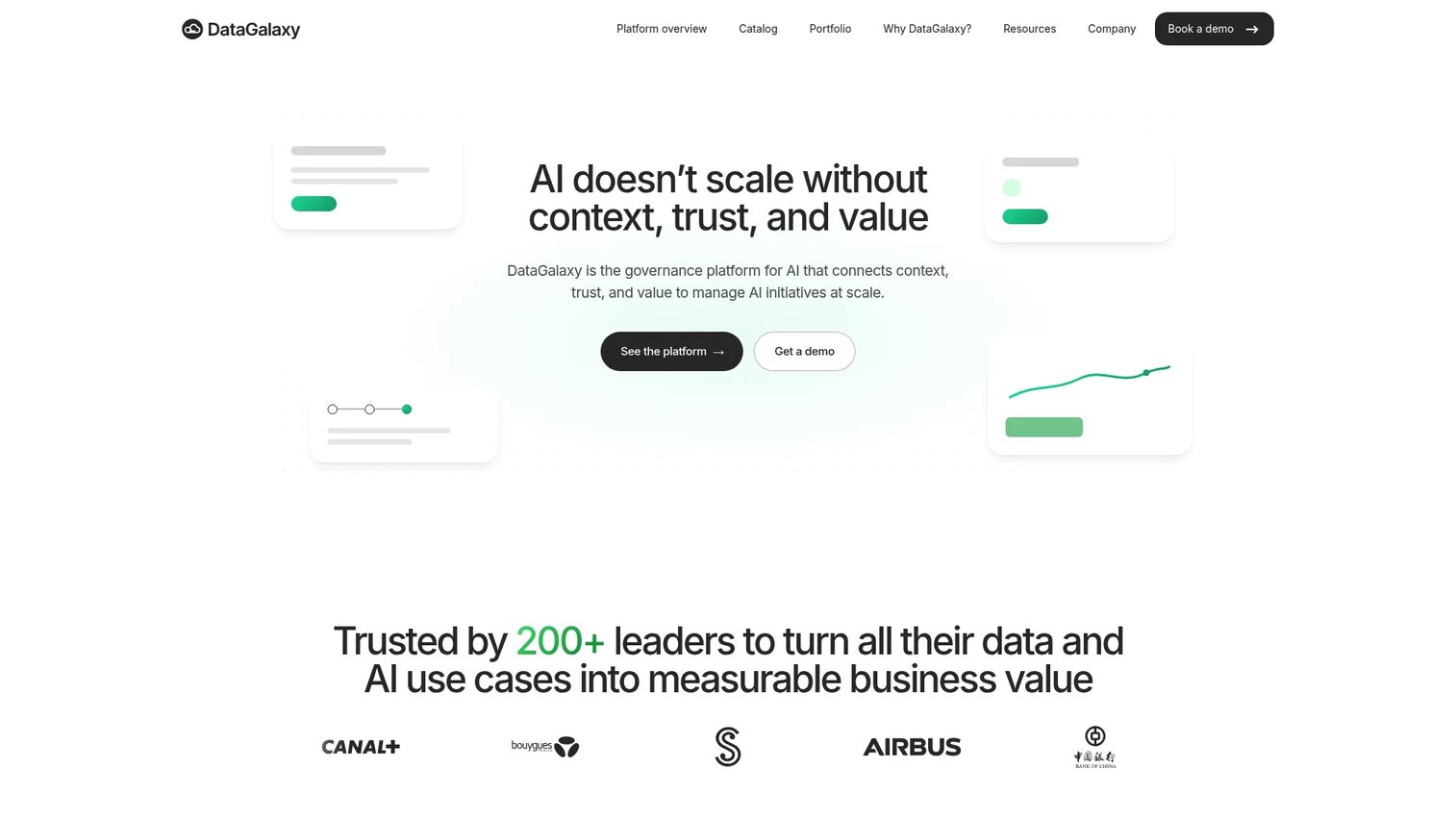
DataGalaxy is a data and AI governance platform built around a business glossary, catalog, lineage, and value management. Its "shared language" positioning is not marketing fluff: the product treats trusted definitions as the foundation everything else sits on. Terms carry owners, approved definitions, trust indicators, and links to the data assets that represent them.
The standout is AI-assisted glossary creation. DataGalaxy's Blink copilot helps discover terms, suggest definitions, and guide stewards through the glossary workflow, which matters when you are drafting hundreds of definitions rather than dozens. Certification campaigns push validation out to owners so definitions stay current instead of quietly aging.
Best for: teams that want to scale a governed glossary quickly with AI help and tie it directly to their data catalog.
Key strengths
- Data catalog with ownership, definitions, lineage, and trust indicators
- AI copilot (Blink) for data discovery and definition drafting
- Governance with certification campaigns, collaboration, and access control
Why choose DataGalaxy: if your bottleneck is the sheer volume of terms to define and validate, the AI copilot and campaign-based stewardship remove the manual grind. It fits mid-market and enterprise teams standardizing cataloging and governance together.
DataGalaxy pricing: the pricing page lists five plans, all quote-based, with no public numeric price displayed. Contact their team for a quote tied to your scope.
2. OvalEdge
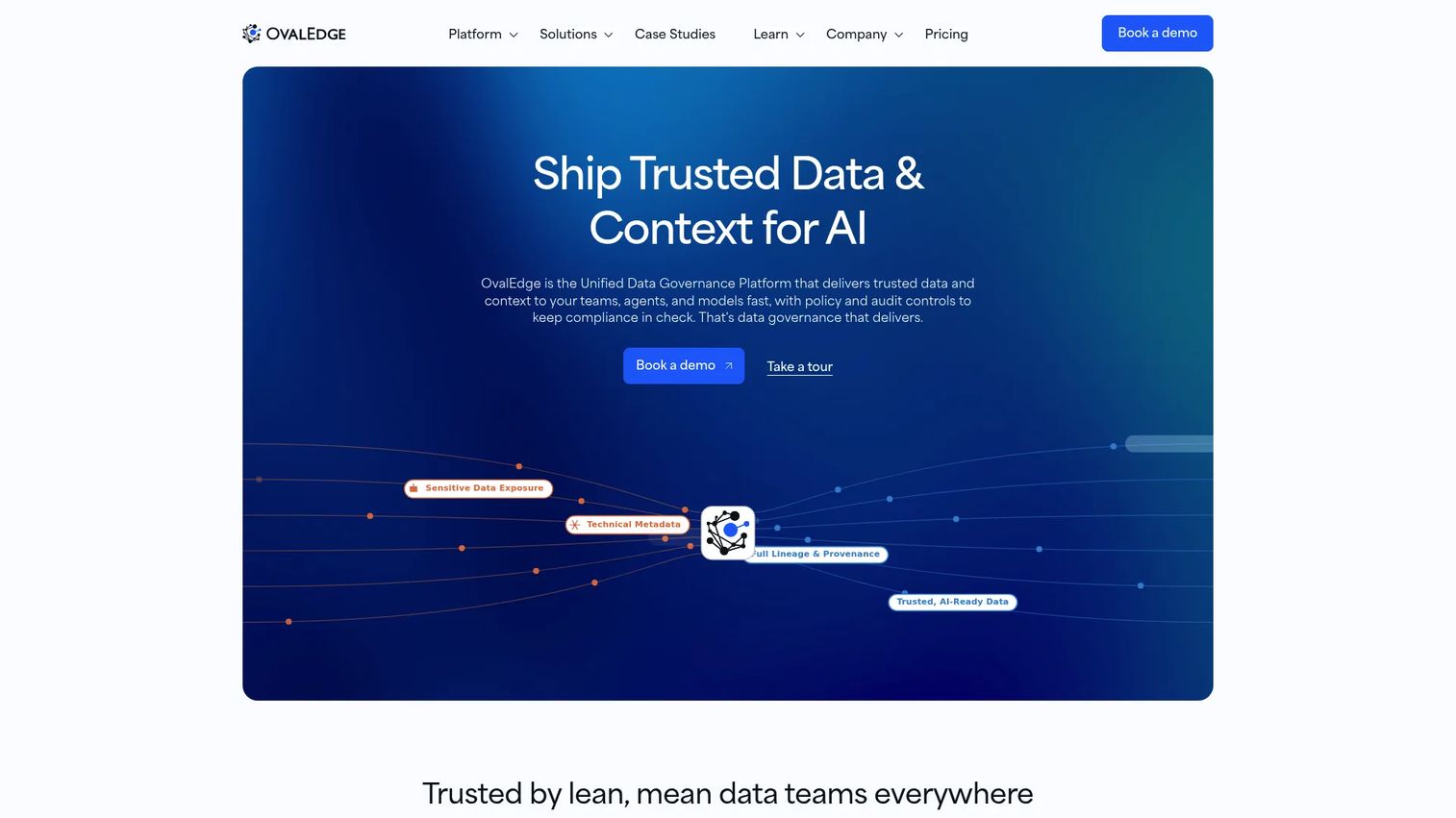
OvalEdge pairs a business glossary with a full data catalog and leans hard into operational governance. This is the tool for teams whose real problem is not defining terms but keeping the definitions accountable: approvals, roles, versioning, and access all live in one place.
Stewardship depth is the reason to look here. Analyst validation, glossary version control, and impact analysis mean a change to one definition surfaces everywhere it touches. That auditability is exactly what regulated teams need when someone asks who changed a definition and why. BI integrations connect governed terms to the dashboards business users already open.
Best for: enterprises that need a governed data catalog with serious stewardship, access, privacy, and quality controls.
Key strengths
- Data catalog and business glossary in one platform
- Data lineage and impact analysis across assets
- Data privacy, access governance, and data quality controls
Why choose OvalEdge: when the priority is workflow and glossary stewardship rather than a lightweight term list, OvalEdge's approvals and versioning carry the load. It fits operational data teams who own governance day to day.
OvalEdge pricing: a free trial is available. Pricing starts at $100 per user per month and $100 per connector per month, billed annually. Essential, Professional, and Enterprise plans use custom pricing across SaaS and on-prem deployments.
3. Atlan
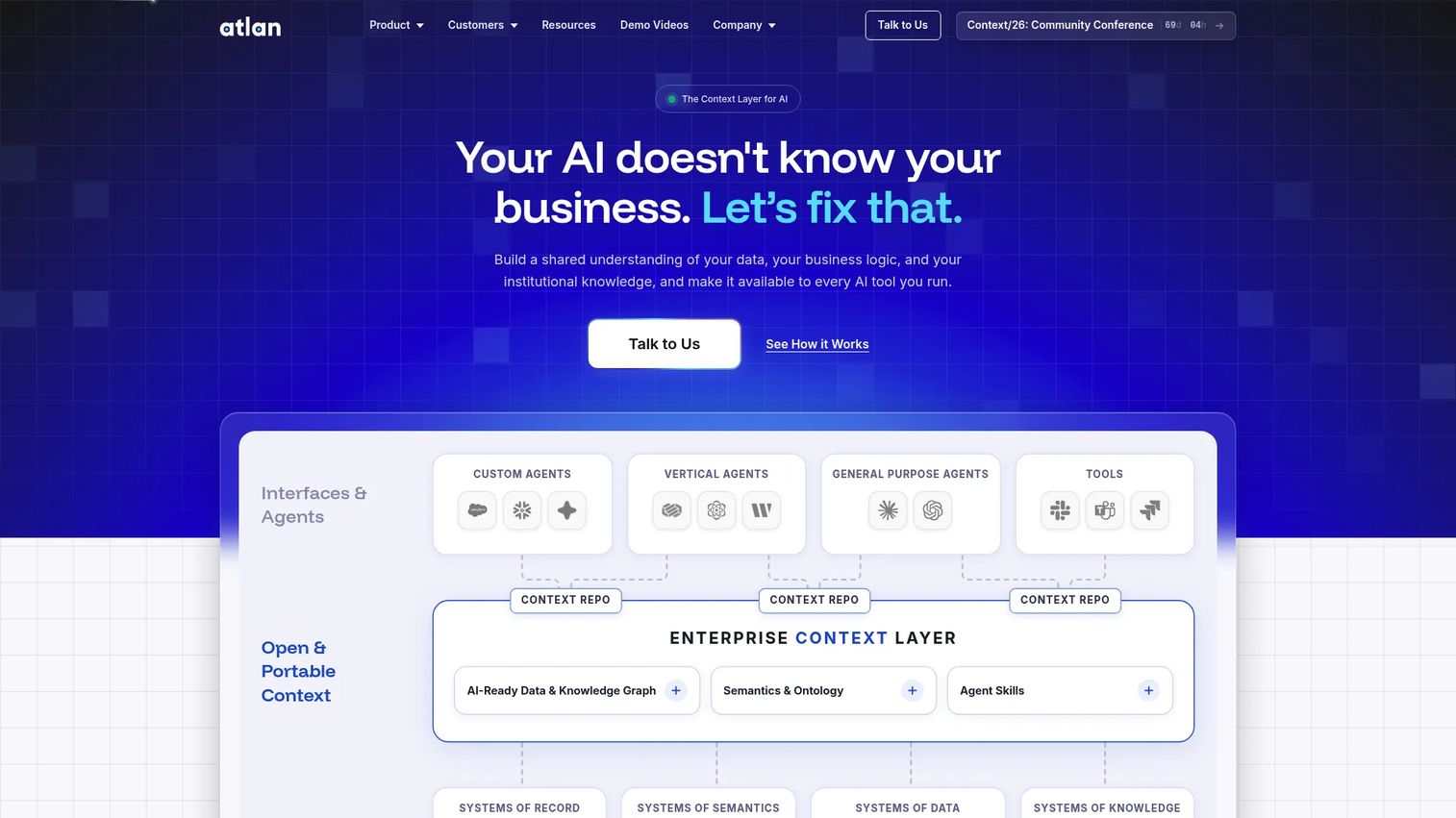
Atlan positions itself as a data and AI context layer, and the glossary is one part of a broader discovery and governance experience. Terms do not sit in isolation. They connect to lineage, assets, and search, so a definition is always one click from the data it describes.
That context-layer design is the differentiator. When an analyst searches for a dataset, the governed business term travels with it, which is how business glossary and data catalog linkage should feel. Templates and maintenance workflows help teams stand up a glossary fast rather than building structure from scratch. With connectors for 80+ data sources, the glossary stays wired into the real stack.
Best for: enterprise data teams that want a glossary embedded in a governed metadata platform with AI context and collaboration.
Key strengths
- Connectors for 80+ data sources
- Lineage and impact analysis across the stack
- Business glossary with search-led discovery
Why choose Atlan: if your team lives in search and discovery, Atlan puts governed definitions where people already look. It suits data teams building an AI-ready metadata foundation, not just a term repository.
Atlan pricing: Atlan uses subscription-based pricing and does not publish a public numeric price on its pricing pages. Book a demo or contact sales for a quote.
4. Dataedo
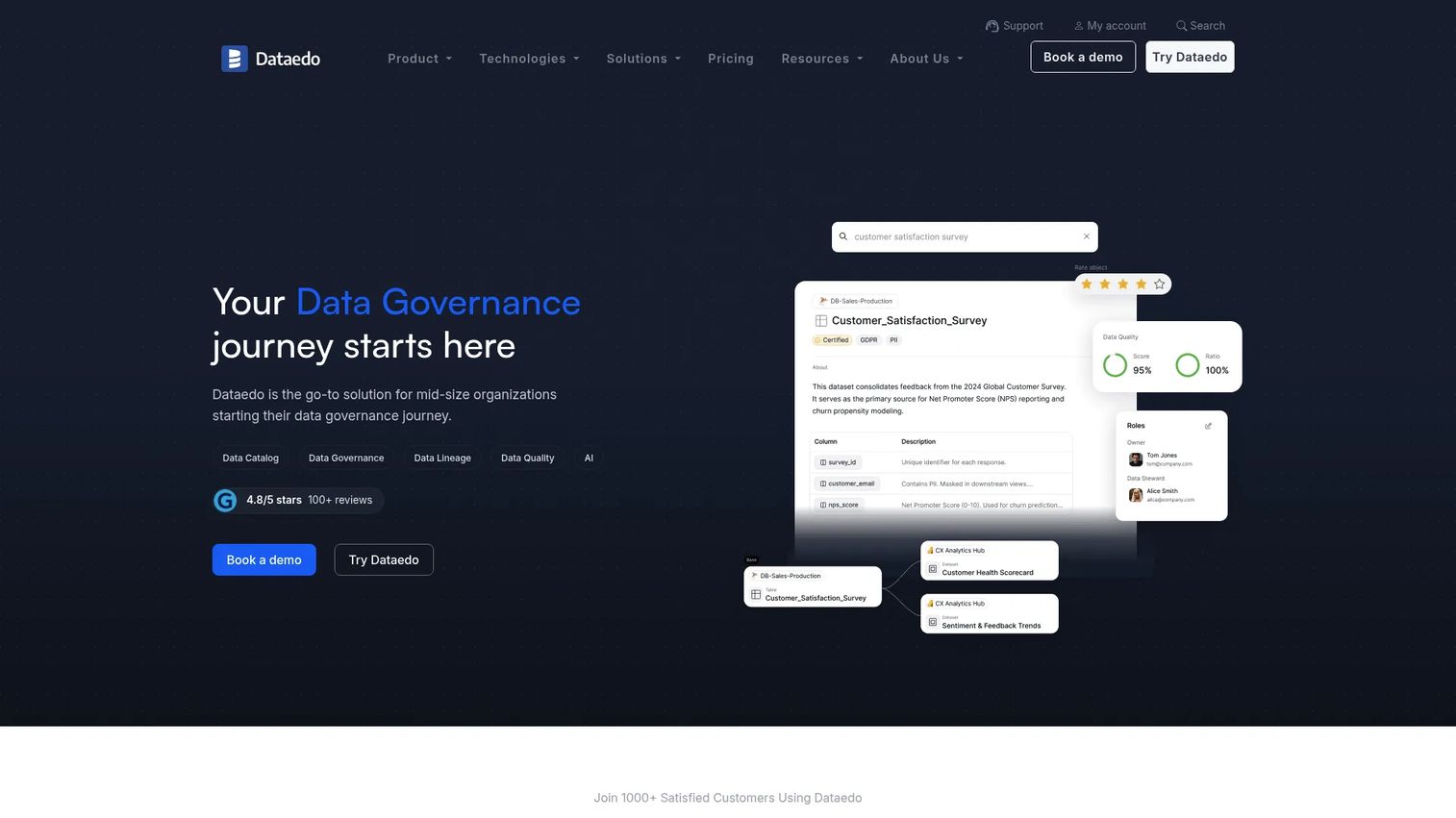
Dataedo is the practical pick for teams that want business terms and technical metadata connected without heavy overhead. Its strength is the link between the glossary and the data dictionary: a business definition maps to the physical columns and tables behind it, which is where reporting accuracy is won or lost.
Collaboration, approval workflows, and version history keep the glossary current as the business changes. Stewards review and approve definitions, and the history shows what moved and when. For mid-sized organizations, this connection between business meaning and technical structure is often the whole point of buying a tool.
Best for: mid-sized organizations that want business and technical terminology connected with catalog, lineage, and quality in one place.
Key strengths
- Data catalog with business-to-technical term mapping
- Data lineage across sources
- Data quality checks alongside documentation
Why choose Dataedo: if your analysts keep asking "which column does this metric actually come from," Dataedo's glossary-to-metadata linkage answers it directly. It fits teams that value clarity over enterprise sprawl.
Dataedo pricing: plans are priced annually by editors, with a minimum of three editors. Essentials starts at $18,000 per year, Data Lineage at $24,000 per year, and Data Quality at $32,000 per year. A 14-day free trial is offered.
5. Collibra
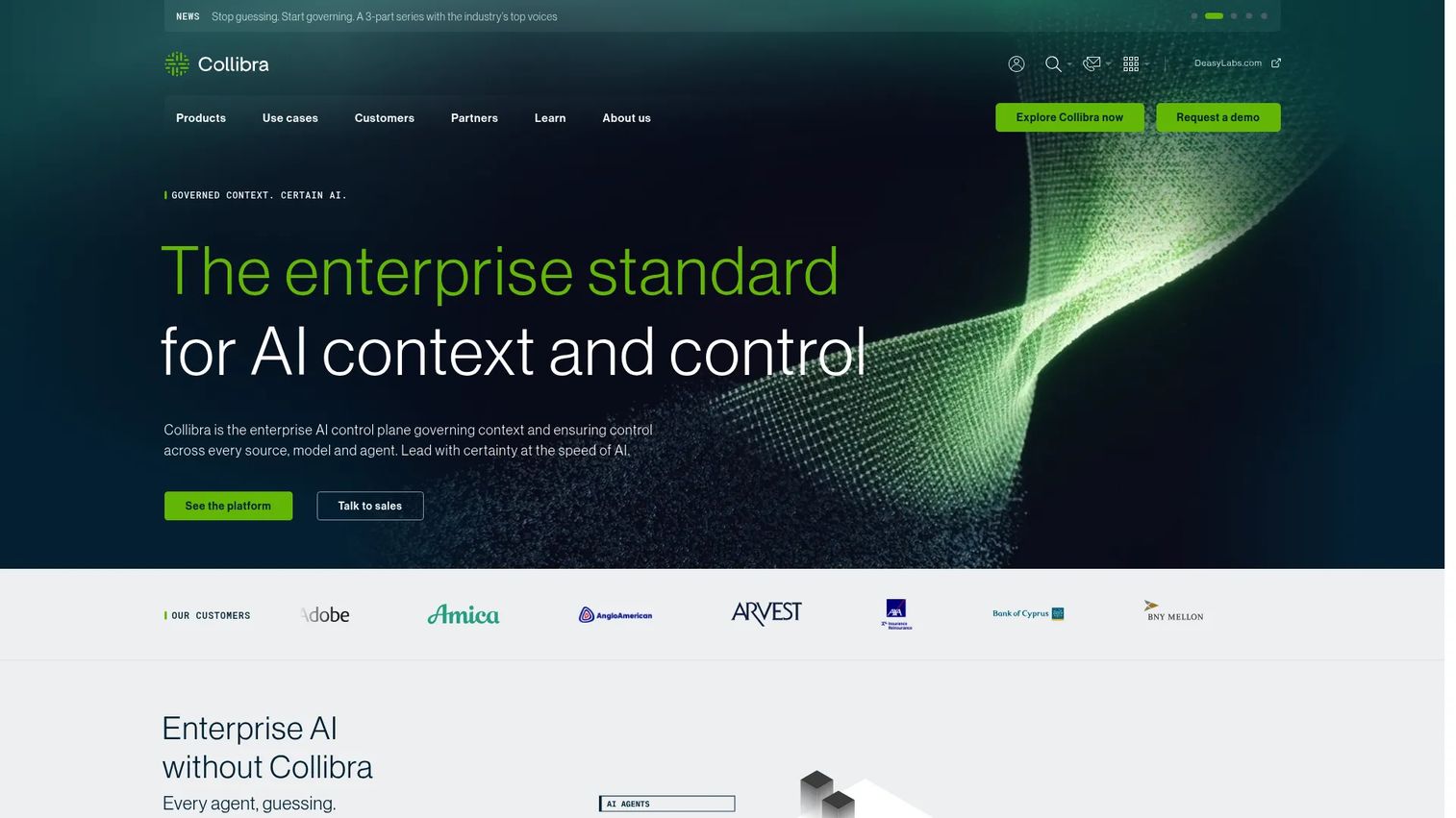
Collibra is built for enterprise governance at scale, and its glossary management sits inside a deep governance operating model. If your organization has complex ownership structures, regulatory pressure, and many domains, this is the category of tool designed for it.
The differentiator is governance depth. Workflows, policies, access controls, and audit support turn glossary stewardship into a defensible process rather than good intentions. A data catalog with 100+ native integrations, profiling, and lineage keeps definitions connected to real assets, and Collibra's AI features help automate discovery and curation as the glossary grows.
Best for: large organizations that need enterprise-grade governance, cataloging, and AI context control across many teams.
Key strengths
- Data Catalog with 100+ native integrations, profiling, and lineage
- Data Governance with workflows, policies, access controls, and audit support
- AI features for automated discovery, curation, and governance
Why choose Collibra: when governance is a board-level requirement and audit trails are non-negotiable, Collibra's operating model carries that weight. It fits regulated enterprises with mature governance ambitions.
Collibra pricing: Collibra does not publish public pricing. Its site directs buyers to request a demo or contact sales for a quote.
6. Informatica
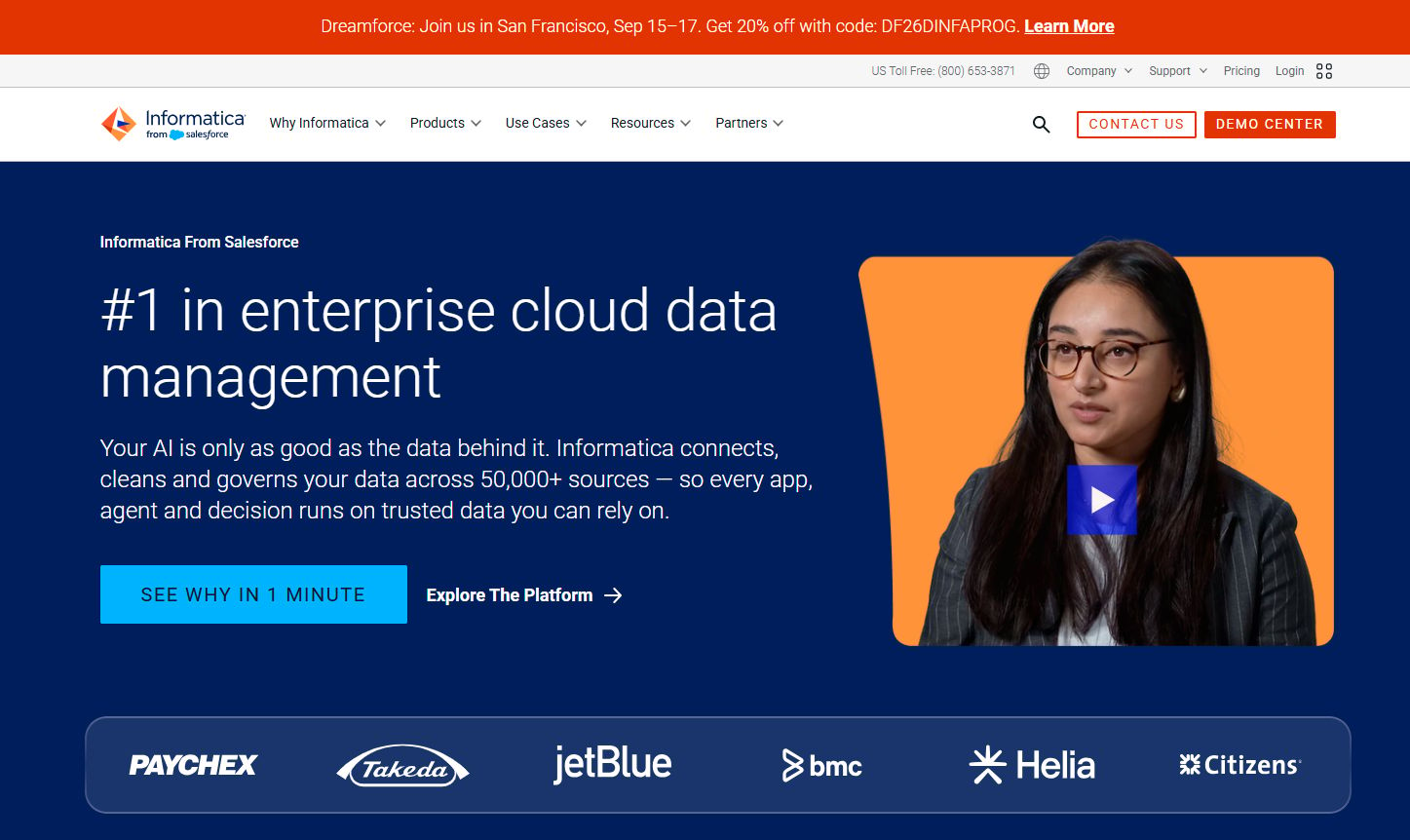
Informatica brings glossary workflows into a broad data management platform that also handles integration, quality, catalog, and MDM. The pitch is fit: if you already run Informatica for adjacent governance and integration work, the glossary lives inside the same environment rather than as a separate tool.
Its differentiator is scope. Policy management, metadata context, and glossary workflow connect to the wider data management ecosystem, so governed definitions ride alongside the pipelines and quality rules that feed your reports. For teams consolidating a fragmented stack, that breadth reduces the number of platforms to maintain.
Best for: large organizations that want glossary capabilities inside a full cloud data management and integration platform.
Key strengths
- Data integration and engineering
- API and application integration
- Data quality, governance, catalog, and MDM
Why choose Informatica: if you are already invested in Informatica for integration or data quality, keeping the glossary in the same platform reduces sprawl and tightens governance. It fits enterprises standardizing on one data management vendor.
Informatica pricing: Informatica uses flexible consumption-based pricing and does not publish a public starting price. A start-for-free option appears on some product pages, and quotes are available on request.
7. Alation

Alation puts search and discovery at the center, with a business glossary that lives inside a broader data intelligence platform. The idea is that people find data through search, so the governed definition should surface right where they are looking, not buried in a separate glossary tab.
The differentiator is that discovery-plus-governance experience. Intelligent search, conversational analytics, and a data products marketplace mean glossary terms show up in the flow of everyday work, which drives adoption. When business users and analysts search from the same governed vocabulary, reporting disputes shrink and trust in metrics grows.
Best for: large organizations that want governed data discovery and AI-ready metadata management in one experience.
Key strengths
- Intelligent search across data assets
- Conversational analytics for business users
- Data products marketplace with governed context
Why choose Alation: if adoption is your worry, Alation's search-first model meets people where they already work instead of asking them to visit a glossary. It fits teams that want discovery and governance unified.
Alation pricing: Alation does not expose a public list price. Its pages direct buyers to book a demo or contact an account manager for pricing.
Considerations
Governance depth
Look past the term list. Check how approvals route, whether ownership is enforced, and how the tool handles disputed or deprecated definitions. Confirm there is real glossary version control with a change history you can defend in an audit, so you always know who changed a definition and why.
Catalog and metadata integration
A glossary that floats free of your data rarely gets adopted. Verify that terms connect cleanly to datasets, dashboards, and technical metadata, and that the business glossary and data catalog stay in sync. Check which BI tools and warehouses the platform connects to, because integration depth drives whether business users actually reference definitions.
AI and automation
AI-assisted glossary creation can speed term discovery, definition suggestions, and scale from dozens to thousands of terms. Evaluate how the tool surfaces candidate terms and whether suggestions are useful or noisy. One rule holds regardless of vendor: AI drafts, stewards approve. Every AI-generated definition still needs human validation before it becomes governed.
Reporting accuracy and adoption
The payoff of a glossary is metric trust. Ask whether cross-team users can search and access definitions easily, and whether terms are visible inside the reports people already read. A definition nobody can find changes nothing. Searchability and in-context access are what turn a glossary into fewer reporting disputes.
Maintenance and ownership
A living glossary needs a review cadence and named owners. Confirm the tool supports periodic reviews, assigns stewardship clearly, and makes lifecycle updates cheap as your product and release cadence change. Without ownership, definitions rot quietly, and a stale glossary is worse than none because people trust it and shouldn't.
Conclusion
The right pick tracks to your maturity, not to a leaderboard. For enterprise governance with heavy audit and ownership demands, Collibra and Informatica are built for that weight. If you want the business glossary and data catalog tightly linked, Atlan and OvalEdge deliver that, with OvalEdge going deepest on stewardship and workflow. For straightforward terminology alignment between business and technical metadata, Dataedo is the practical choice. And if AI-assisted glossary creation is what will get you from dozens of terms to hundreds, DataGalaxy's copilot earns a close look.
Whatever you shortlist, treat the glossary as a living system with owners and a review cadence, not a one-time export. Pick two tools that match your governance depth and catalog needs, run a short pilot on your ten most-disputed metrics, and see which one actually ends the KPI arguments.
Start your journey with Guideflow today!
FAQs
A business glossary defines business meaning: what "active customer" or "net revenue" means to your organization, with an owner and approved definition. A data dictionary documents technical structure: the columns, data types, and source tables. Strong platforms link the two so a business term maps to the physical fields behind it.
Most mature teams use both. The glossary defines meaning, and the catalog connects that meaning to real datasets, reports, and dashboards. A glossary without a catalog risks becoming a document nobody references, while a catalog without governed definitions leaves metric disputes unresolved.
Ownership is shared but never vague. Each term needs a named steward, usually a business subject matter expert, accountable for its definition. A data governance team typically administers the platform and workflow, while cross-functional review keeps definitions accurate as the business changes.
Through governed glossary workflow: approvals route changes to the right owner, version control records every edit, and periodic reviews catch definitions that have drifted. Assign clear change ownership and tie reviews to your release cadence so the glossary stays a living reference rather than a stale one.
AI can speed the work significantly. AI-assisted glossary creation discovers candidate terms, drafts definitions, and helps stewards move faster from dozens of terms to hundreds. But human validation is still required. AI drafts, stewards approve, because a wrong definition that looks authoritative does more damage than a missing one.
At minimum: the term name, an approved definition, a named owner, a lifecycle status (draft, approved, deprecated), links to policies, related data assets, and version history. Those elements turn a definition into something governed and auditable rather than just a note in a shared doc.
Consistent definitions remove the root cause of most reporting disputes. When every dashboard cites the same governed definition of churn or conversion, teams stop arguing about whose number is right. That reduces reporting errors, shortens review cycles, and rebuilds trust in the metrics leadership uses to decide.
No. Enterprises use it for scale and compliance, but smaller teams benefit as soon as reporting and ownership get messy. Once two teams define the same metric differently, or a new analyst guesses at a definition, a governed glossary pays for itself regardless of company size.