Your IAM controls can be configured correctly and still miss a compromised identity already moving through the environment. Attackers who steal credentials or bypass MFA don't trigger a firewall alert. They log in. They escalate privileges quietly. They move laterally across systems that trust them because they look like a legitimate user.
The scale of this problem is accelerating. Identity-based threats made up 53% of Red Canary's 2025 detection volume, up from 20% in its 2024 edition, according to the Red Canary Threat Detection Report (2025). IAM, MFA, and endpoint controls are necessary but they don't watch what authenticated identities do after login.
That's where identity threat detection and response, or ITDR, comes in. This guide compares 13 ITDR tools to help security operations, IAM, SOC, and presales teams cut through vendor claims and build a defensible shortlist.
What's inside
This guide covers 13 identity threat detection and response software tools evaluated for 2026. It is written for security engineers, SOC analysts, IAM teams, IT administrators, and presales or sales engineers who support cybersecurity vendor evaluations.
Selection criteria used:
- Identity coverage: Active Directory, Microsoft Entra ID, SaaS identity providers, service accounts, and cloud roles
- Detection depth: Specific attack pattern coverage including MFA bypass, privilege escalation, lateral movement, and credential theft
- Response workflow: Containment actions, SIEM or XDR routing, and analyst context
- Integration fit: Native connectors to SIEM, EDR, XDR, PAM, and ITSM tools
- Buyer proof: What to validate in a demo or proof of concept
Pricing and G2 ratings reflect verified data from vendor pages and live G2 listings.
TL;DR
- Best overall enterprise ITDR: CrowdStrike Falcon Next-Gen Identity Security, for teams standardized on the Falcon platform
- Best for Microsoft-first environments: Microsoft Defender for Identity, licensed through Microsoft 365 E5
- Best for autonomous identity and endpoint response: SentinelOne Singularity Identity, starting at $229.99/yr per endpoint
- Best for managed ITDR without an in-house SOC: Huntress Managed ITDR, from $4.80/month per identity
- Best for Active Directory resilience: Semperis Directory Services Protector, rated 4.8/5 on G2
- Best for cloud identity threat detection: Permiso, covering AWS, Azure, Google Cloud, and SaaS identity environments
What is identity threat detection and response?
Identity threat detection and response is a cybersecurity category that detects, investigates, and responds to threats targeting user accounts, privileged identities, service accounts, and identity infrastructure.
Traditional security tools protect the perimeter or the endpoint. ITDR security focuses on what happens inside the identity layer, where most modern attacks actually operate. A stolen credential, an MFA bypass, or a session cookie hijack doesn't look like an intrusion at the network level. It looks like a user doing their job. ITDR observes identity behavior after authentication and flags when that behavior deviates from known patterns.
ITDR sits alongside IAM, not as a replacement for it. IAM manages access policies, user lifecycles, and authentication mechanisms. ITDR monitors whether identities are behaving according to those policies and responds when they're not. It also connects identity signals into SIEM, XDR, and SOAR workflows so analysts have the context to act fast.
Key capabilities to look for in ITDR tools:
- Continuous identity visibility across all identity stores
- Active Directory and Microsoft Entra ID monitoring
- Behavioral analytics and baseline deviation detection
- Anomaly detection for impossible travel, new-device logins, and session changes
- Identity risk scoring with actionable prioritization
- Credential exposure and dark web monitoring (where supported)
- Privilege escalation and lateral movement detection
- Automated containment such as account disable, session revoke, or MFA enforcement
- Non-human identity monitoring for service accounts, workload identities, and cloud roles
- SIEM, XDR, EDR, IAM, and SOAR integrations
Identity security posture management (ISPM) often overlaps with ITDR. ISPM focuses on finding and fixing risky identity configurations before an attack occurs. ITDR focuses on detecting and responding to attacks in progress. The strongest platforms in this guide handle both.
When to use identity threat detection and response
Detect account takeover before it spreads
ITDR helps spot the early signals of account takeover: Impossible travel, logins from new devices, MFA bypass attempts, sudden privilege changes, and unusual session activity. These behaviors often precede lateral movement. Catching them at the identity layer, before an attacker reaches a sensitive system, is the difference between an alert and a breach.
Monitor hybrid identity infrastructure
Most enterprises run a combination of on-premises Microsoft Active Directory, Microsoft Entra ID, SaaS identity providers, privileged access systems, and dozens of service accounts. Each system has gaps the others can't see. ITDR aggregates signals across this environment so risky identity relationships, misconfigured accounts, and anomalous access patterns become visible in one place.
Give the SOC identity context during incident response
When an alert fires, analysts need to know who the user is, what privileges they hold, what changed recently, and which systems need containment. Without identity context, SOC teams spend time reconstructing that picture manually. ITDR feeds that context directly into SIEM, XDR, EDR, and SOAR workflows so response actions can start faster and with more precision.
Identity threat detection and response comparison
The table below is a shortlist for initial evaluation, not a substitute for a proof of concept. Before finalizing any ITDR purchase, verify pricing against current vendor quotes, confirm supported identity stores, and test detection logic against your actual environment.
| # | Product | Best for | Key differentiator | Pricing | G2 rating |
|---|---|---|---|---|---|
| 1 | CrowdStrike Falcon Next-Gen Identity Security | Enterprise identity protection | Identity signals inside the Falcon platform | Custom pricing | 4.2/5 |
| 2 | Microsoft Defender for Identity | Microsoft-heavy environments | Deep AD and Microsoft security stack fit | From $60/user/month (Microsoft 365 E5) | 4.3/5 |
| 3 | SentinelOne Singularity Identity | Autonomous identity and endpoint response | Identity protection tied to Singularity workflows | From $229.99/yr per endpoint | Not rated on G2 |
| 4 | Palo Alto Networks Cortex XDR | XDR-centered security teams | Identity context inside broader detection | Custom pricing | 4.5/5 |
| 5 | Proofpoint Identity Threat Defense | Identity risk and entitlement visibility | Attack path management and deception detection | Custom pricing | Not rated on G2 |
| 6 | Cisco Identity Intelligence | Identity analytics inside Cisco environments | Identity graph correlation via Cisco Duo | From $6/user/month (Duo Advantage) | Not rated on G2 |
| 7 | Huntress Managed ITDR | MSPs and lean security teams | Managed ITDR with 24/7 human-led SOC | From $4.80/month per identity | 4.8/5 |
| 8 | Silverfort Identity Threat Detection & Response | Hybrid identity environments | Inline response across legacy and modern systems | Custom pricing | 4.8/5 |
| 9 | Netwrix Threat Prevention | Active Directory threat prevention | Real-time AD monitoring and blocking | Custom pricing | 3.8/5 |
| 10 | Sophos ITDR | Sophos security customers | 160+ identity posture checks with credential exposure | Free 30-day trial; paid pricing by quote | Not rated on G2 |
| 11 | Delinea Identity Threat Protection | Privileged identity risk | PAM-aligned identity monitoring and remediation | Custom pricing | Not rated on G2 |
| 12 | Semperis Directory Services Protector | AD resilience and recovery | Hybrid AD and Entra ID protection with automated rollback | Custom pricing | 4.8/5 |
| 13 | Permiso | Cloud identity threat detection | Universal Identity Graph for human and non-human identities | Custom pricing | Not rated on G2 |
Best 13 identity threat detection and response tools for 2026
Each tool in this list was selected for a distinct ITDR use case. The sections below cover what each does, who it fits, and what to validate before buying.
1. CrowdStrike Falcon Next-Gen Identity Security

CrowdStrike Falcon Next-Gen Identity Security is an AI-driven identity protection platform covering human identities, non-human identities, and AI identities across on-premises, cloud, and SaaS environments. It runs inside the Falcon platform, which means identity signals sit alongside endpoint, threat intelligence, and cloud data in a single console. Coverage includes both Falcon Identity Threat Detection and the higher Falcon Identity Threat Protection tier.
Best for: Large enterprise security teams already operating within the CrowdStrike Falcon ecosystem.
Key features
- AI-powered behavioral analytics, triage, and automated response
- Risk-based MFA and phishing-resistant FIDO2 authentication enforcement
- Just-in-time access and zero standing privileges
- Compromised credential detection and lateral movement blocking
- Continuous identity visibility and adaptive access control
Why choose CrowdStrike: Choose it when the SOC wants identity telemetry inside the same platform handling endpoint and threat intelligence data. Presales teams selling into organizations with existing Falcon deployments will find identity protection is a natural expansion conversation rather than a separate tool evaluation.
CrowdStrike Falcon Next-Gen Identity Security pricing: Pricing is licensed per active identity and requires a sales conversation. A 15-day free trial is available. Contact CrowdStrike directly to validate whether the Falcon Identity Threat Detection or Falcon Identity Threat Protection tier fits your coverage requirements.
G2 rating: 4.2/5
2. Microsoft Defender for Identity
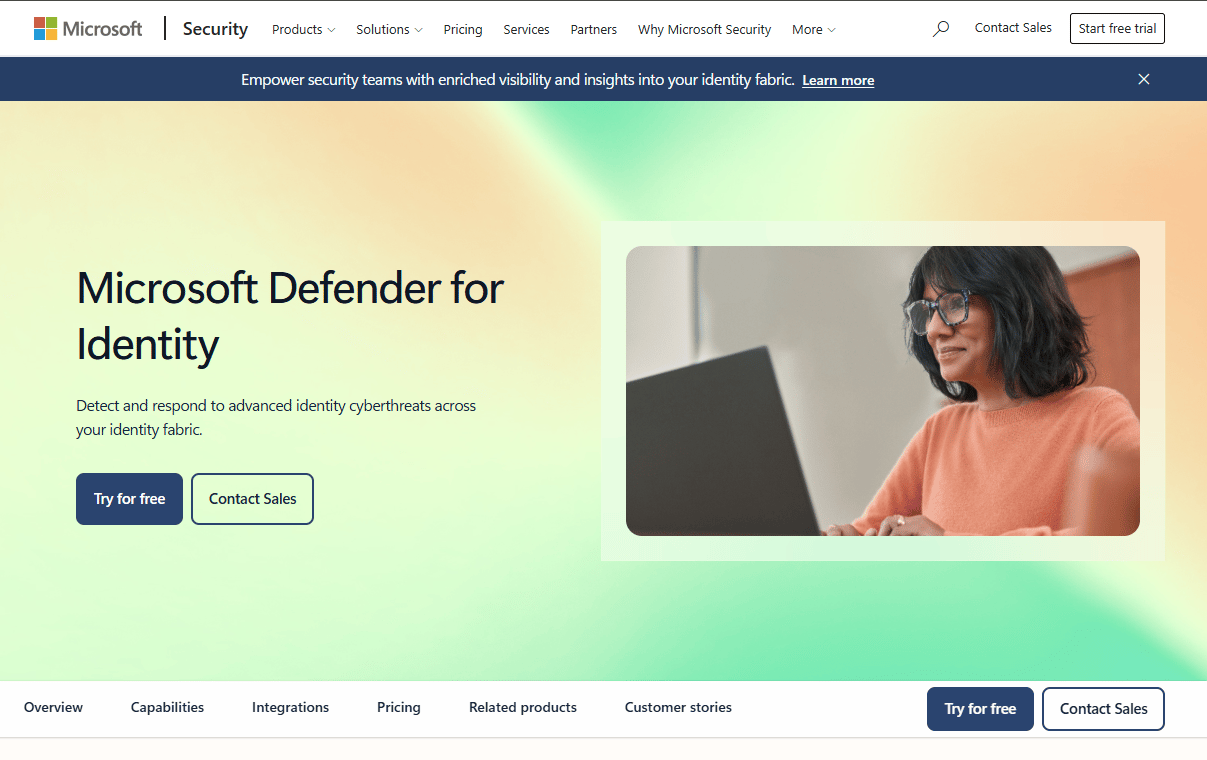
Microsoft Defender for Identity monitors on-premises Active Directory and cloud identity environments to detect suspicious activity, investigate compromised accounts, and route identity signals into Microsoft's broader security stack. It integrates with Microsoft Defender XDR, Microsoft Entra ID, and Microsoft Sentinel, making it a natural fit for organizations already standardized on Microsoft security tooling.
Best for: Enterprise security teams protecting hybrid Active Directory and Entra ID environments inside a Microsoft-first security architecture.
Key features
- Proactive identity security posture assessments
- Real-time behavioral analytics and signal correlation
- Suspicious activity alerts with investigation context
- Remediation actions for compromised identities
- Native integration with Defender XDR and Microsoft Sentinel
Why choose Microsoft Defender for Identity: The strongest argument here is workflow consolidation. Identity telemetry flows directly into Defender XDR and Sentinel, so analysts don't switch consoles. For presales teams, the licensing question is worth addressing early: The product is available through Microsoft 365 E5 or as part of Defender suite bundles, and many prospects already hold partial licensing.
Microsoft Defender for Identity pricing: Available through Microsoft 365 E5 at $60/user/month (paid yearly). It is also included in Microsoft Defender suite packages. Confirm exact licensing dependencies with Microsoft at the time of purchase.
G2 rating: 4.3/5
3. SentinelOne Singularity Identity
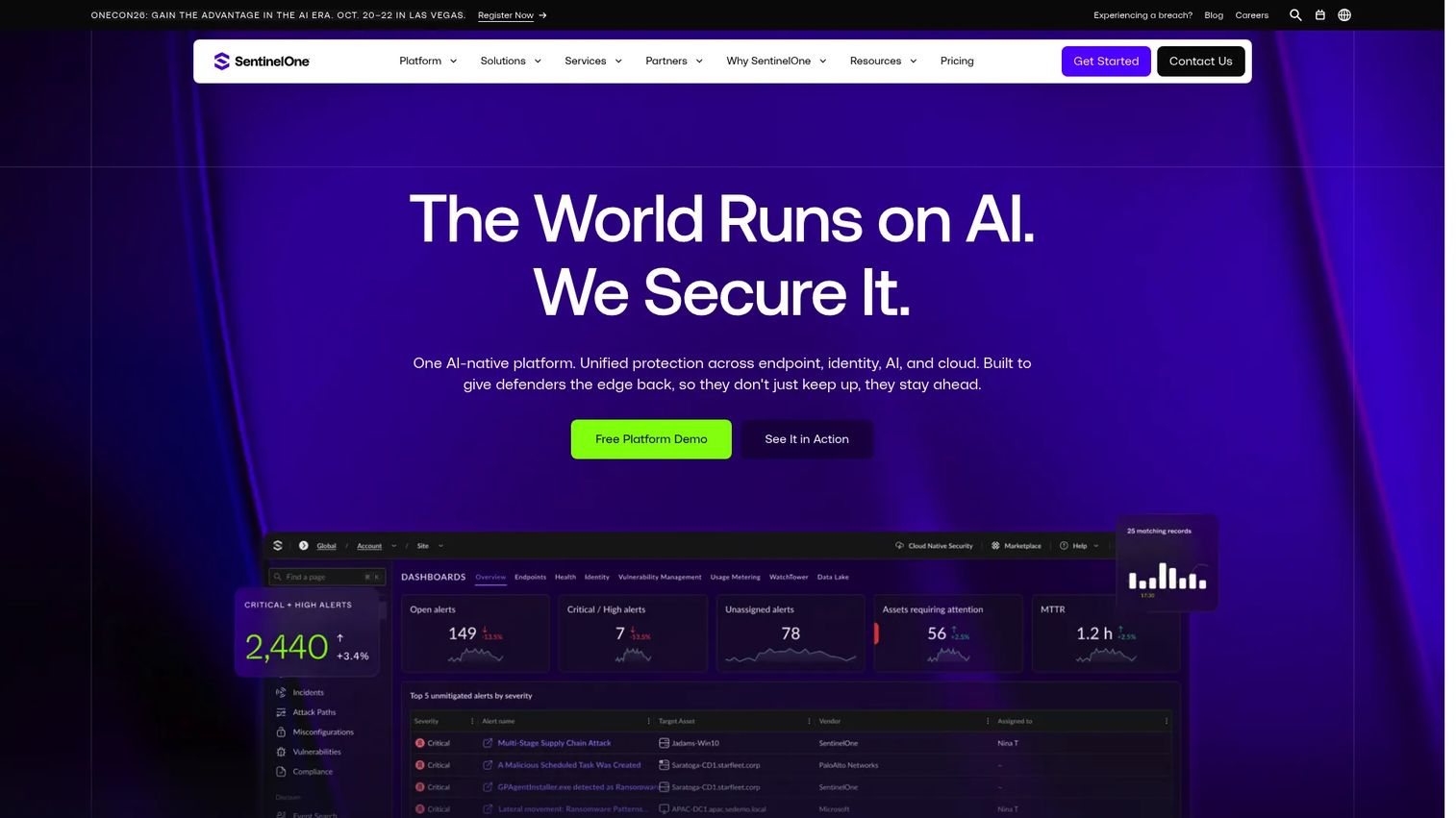
SentinelOne Singularity Identity delivers identity threat detection and response alongside endpoint protection within the Singularity platform. The product covers on-premises Active Directory and cloud identity providers, with autonomous response capabilities that can contain identity threats without requiring manual analyst action. One agent and console handle both endpoint and identity visibility.
Best for: Teams that want identity risk handled inside the same autonomous detection and response operating model as their endpoint security.
Key features
- Identity threat detection with automated remediation
- Identity security posture management for AD and cloud identity providers
- Conditional access policy enforcement
- Credential theft, privilege escalation, and lateral movement detection
- Unified endpoint and identity visibility in a single console
Why choose SentinelOne Singularity Identity: Choose it when the organization already runs SentinelOne for endpoint protection and wants to extend that autonomous response model to identity. The single-agent, single-console approach reduces operational overhead for lean security teams. Buyers evaluating an XDR consolidation play will find the identity module slots into that architecture without additional deployment complexity.
SentinelOne Singularity Identity pricing: Identity Detection and Response is included in the Singularity Commercial plan at $229.99 per endpoint per year. Singularity Enterprise pricing requires a sales contact. Verify current plan inclusions directly with SentinelOne, as identity features may be bundled or tiered differently at enterprise scale.
4. Palo Alto Networks Cortex XDR

Palo Alto Networks Cortex XDR is an XDR platform that correlates endpoint, network, cloud, and identity data into unified investigations and response workflows. Identity context inside Cortex XDR enriches detections from other data sources, helping analysts understand whether suspicious behavior involves a privileged account, a recently changed credential, or a known attacker pattern. Cortex XDR is not a standalone ITDR product; it is most relevant where identity signals need to sit inside a broader XDR architecture.
Best for: Enterprise security operations teams already standardized on Palo Alto Networks and seeking to incorporate identity context into cross-domain detection workflows.
Key features
- Cross-domain correlation across endpoint, network, cloud, and identity
- Identity-context enrichment for alert triage
- Behavioral analytics and machine-learning detections
- Automated incident response and remediation
- Threat hunting with Cortex Query Language (XQL)
Why choose Cortex XDR: Choose it when the security team wants identity signals beside endpoint and network telemetry in one investigation surface. It works best as part of a broader Palo Alto architecture. Presales teams supporting Palo Alto customers should frame identity as an enrichment layer that improves investigation quality across existing detections, rather than a standalone identity monitoring deployment.
Palo Alto Networks Cortex XDR pricing: Subscription tiers include Cortex XDR Prevent, Pro per Endpoint, and Pro per TB, but Palo Alto Networks does not publicly display prices. Contact the vendor for a quote based on deployment scope and modules selected.
G2 rating: 4.5/5
5. Proofpoint Identity Threat Defense
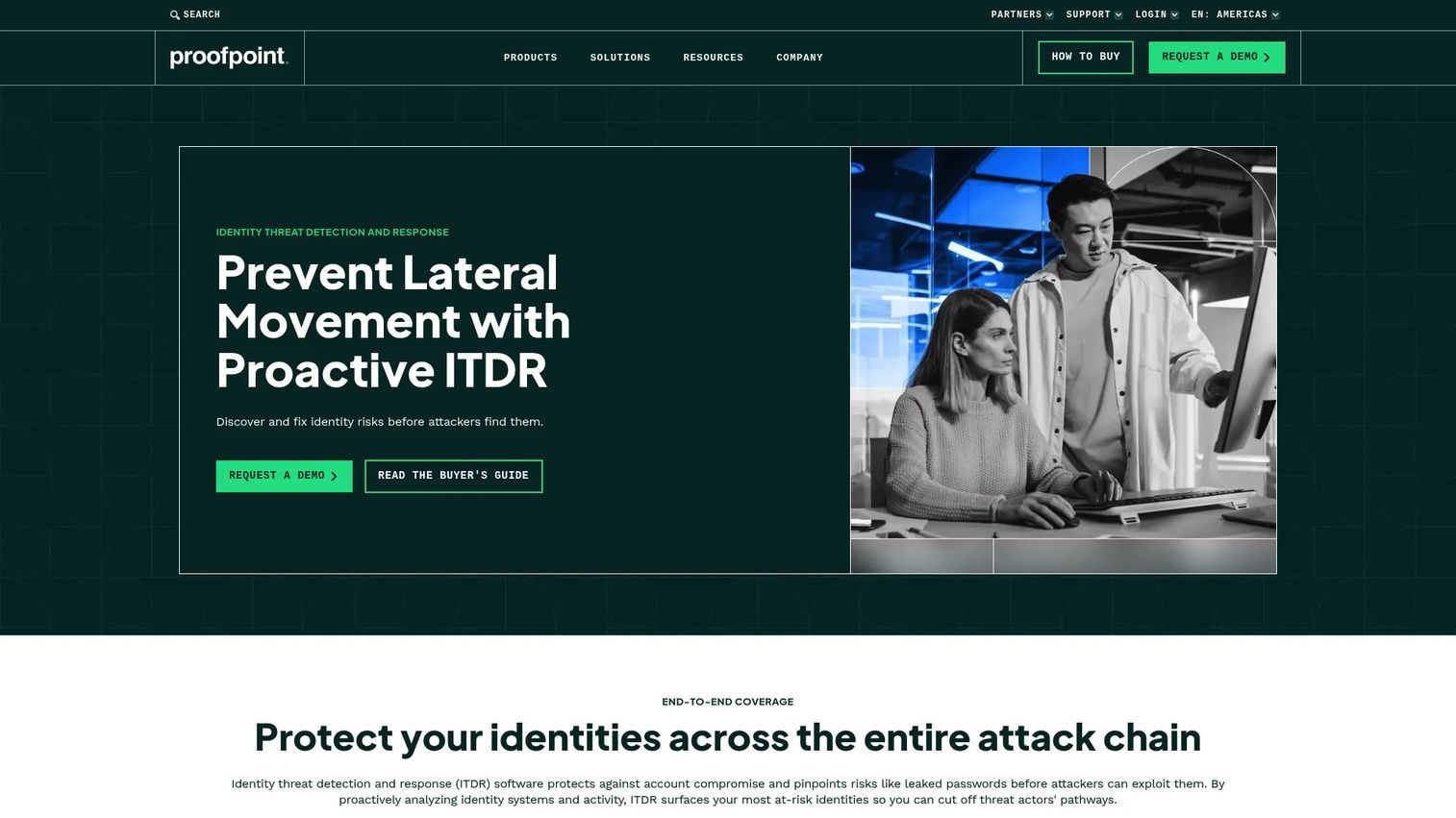
Proofpoint Identity Threat Defense is an identity security platform built around discovering identity vulnerabilities, prioritizing attack paths, and detecting threats using agentless deception techniques. It covers Active Directory, Microsoft Entra ID, PAM systems, and other identity repositories. The platform includes automated remediation for endpoint and server risks alongside forensic investigation support, framing identity defense as a proactive posture discipline rather than a reactive monitoring tool.
Best for: Enterprise security and IAM teams focused on reducing identity exposure before attacks escalate, particularly in environments with complex entitlement structures.
Key features
- Continuous discovery across AD, Entra ID, PAM, and identity repositories
- Attack path management and identity risk prioritization
- Agentless deception using 75+ deception techniques
- Automatic remediation of endpoint and server risks
- Forensic collection and investigation support
Why choose Proofpoint Identity Threat Defense: It stands out for the combination of posture discovery and active deception. Teams that want to harden identity configurations before a breach rather than respond after one will find the attack path prioritization particularly useful. IAM teams and security architects evaluating identity exposure across complex privilege hierarchies are the primary fit.
Proofpoint Identity Threat Defense pricing: Pricing requires a demo or direct sales conversation. Contact Proofpoint to validate coverage requirements, environment scope, and integration needs before requesting a quote.
6. Cisco Identity Intelligence

Cisco Identity Intelligence provides AI-powered identity visibility by correlating activity across connected identity providers and security tools. It builds a User 360 profile and identity graph for each account, assigning User Trust Levels and surfacing risky access, MFA gaps, and privilege anomalies. Cisco Identity Intelligence is included with Cisco Duo Advantage and Duo Premier, making it accessible to organizations already using Cisco's authentication infrastructure.
Best for: Organizations needing cross-source identity visibility and posture scoring inside a Cisco security architecture, particularly where Cisco Duo handles authentication.
Key features
- Identity activity correlation across connected identity providers
- User 360 profiles and identity graph visualization
- User Trust Levels and posture scoring
- Security checks for risky accounts, privileges, and MFA gaps
- Integration with Cisco Duo, Cisco XDR, and Cisco Secure Access
Why choose Cisco Identity Intelligence: The case is strongest for Cisco-aligned environments where Duo already handles authentication. Identity Intelligence adds visibility into what those authenticated identities are doing and how risky their access patterns look, without requiring a separate identity monitoring deployment. Presales teams should confirm which Duo tier the prospect holds before positioning this capability.
Cisco Identity Intelligence pricing: Included at no additional charge with Cisco Duo Advantage (from $6/user/month) and Duo Premier (from $9/user/month). These are monthly list prices; volume discounts apply. Confirm current tier availability and feature inclusions with Cisco.
7. Huntress Managed ITDR
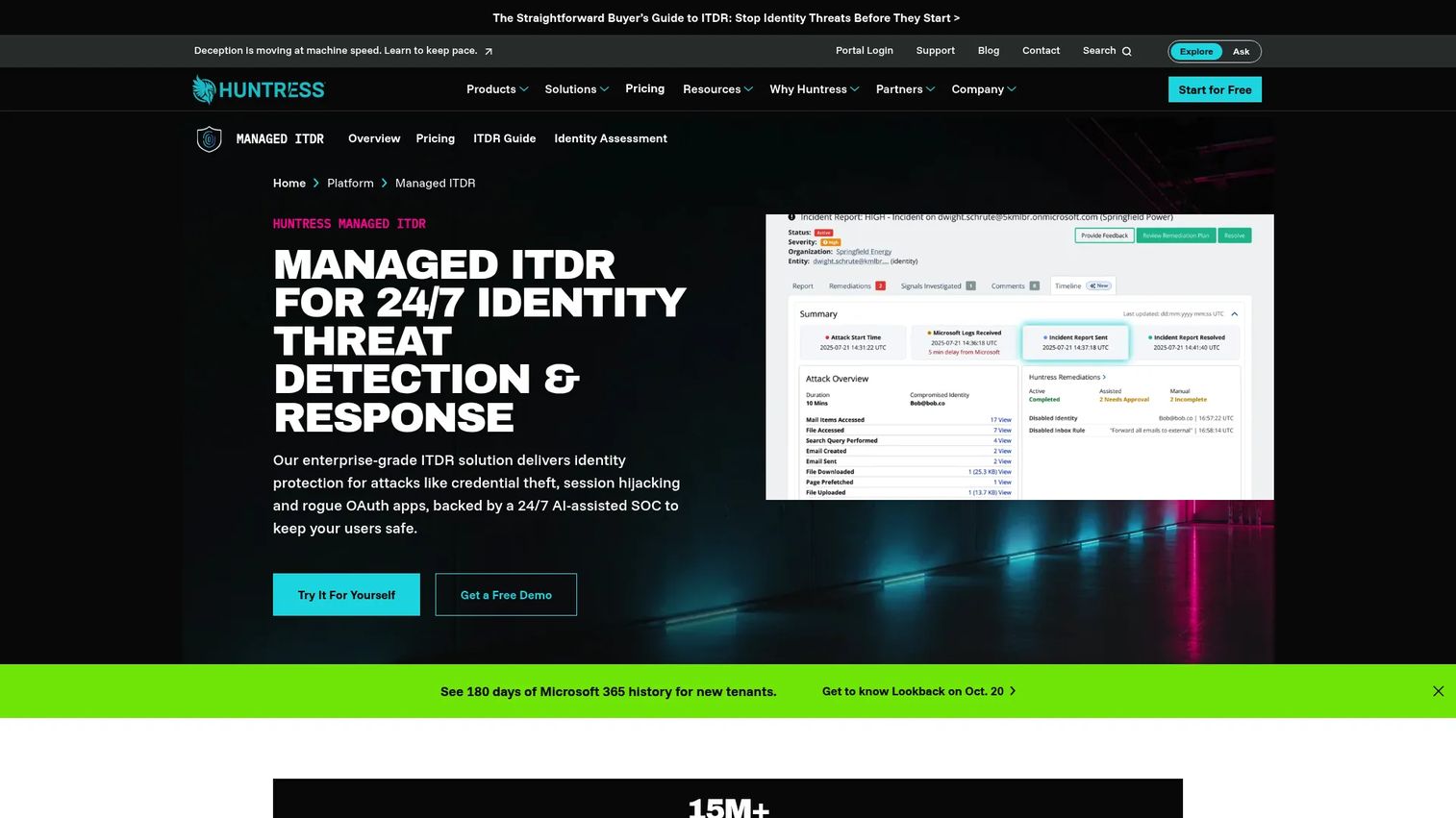
Huntress Managed ITDR is a managed identity threat detection and response service covering Microsoft 365 and Google Workspace, backed by Huntress's 24/7 SOC. Rather than adding another self-managed tool, it offloads identity monitoring and initial response to a human-led security team. Detection capabilities cover session hijacking, credential theft, rogue OAuth apps, location-based anomalies, shadow workflows, and business email compromise patterns.
Best for: SMBs, MSPs, and lean internal security teams that need managed, around-the-clock identity monitoring without operating a dedicated SOC.
Key features
- Session hijacking detection and response
- Credential theft and rogue OAuth app detection
- Location-based and VPN anomaly detection
- Shadow workflow and business email compromise detection
- 24/7 SOC-backed threat response and automated remediation
Why choose Huntress Managed ITDR: The distinction is operational, not just technical. When internal security coverage is thin, the handoff to Huntress's SOC means alerts get triaged by people with identity threat expertise, not a queue. For MSPs supporting multiple clients, the per-identity pricing model scales without requiring each client to run their own ITDR stack.
Huntress Managed ITDR pricing: Starts at $4.80/month per licensed identity for 50 to 99 identities on an annual subscription. Volume pricing steps down to $3.60/month at 100 to 249 identities, $3.36/month at 250 to 499 identities, and $3.12/month at 500 to 999 identities. A free trial is available.
G2 rating: 4.8/5
8. Silverfort Identity Threat Detection & Response
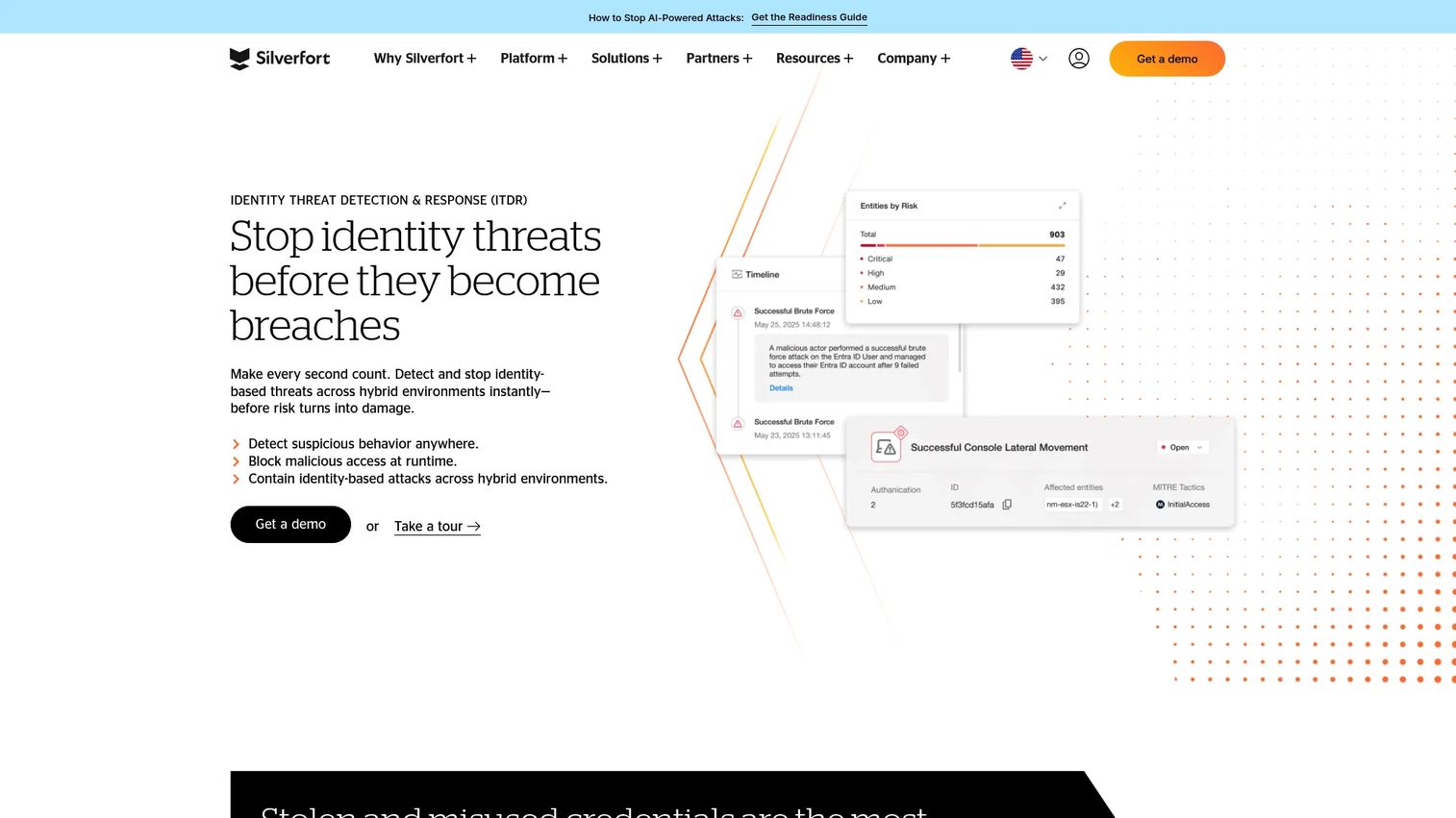
Silverfort Identity Threat Detection & Response detects and stops identity-based threats across hybrid environments in real time. Its key differentiator is inline response: Rather than only alerting, Silverfort can deny access, enforce MFA, or terminate a session at the moment a threat is detected, across both modern and legacy identity systems. Coverage extends to service accounts, legacy protocols, and on-premises systems that standard IAM tools don't reach.
Best for: Large enterprises with complex hybrid identity environments, including legacy systems, service accounts, and on-premises infrastructure that modern IAM platforms don't fully cover.
Key features
- Real-time detection of suspicious identity behavior across hybrid environments
- Inline access blocking, MFA enforcement, or session termination at runtime
- Protocol anomaly analysis and risk scoring
- Automated containment and response workflows
- SIEM, XDR, and SOAR integration for identity context routing
Why choose Silverfort: The inline response capability at runtime is what separates it from tools that only detect and alert. For environments with legacy authentication protocols that can't be easily replaced, Silverfort adds identity security coverage that wouldn't otherwise be possible. Presales teams should ask prospects to list their legacy systems and service account inventory before scoping a POC.
Silverfort Identity Threat Detection & Response pricing: Four packages: Core, Plus, Advanced, and Enterprise. ITDR capabilities are in the Advanced package. Pricing is based on organization size and requires a quote from Silverfort.
G2 rating: 4.8/5
9. Netwrix Threat Prevention
Netwrix Threat Prevention monitors and blocks risky activity across Active Directory, Exchange, file systems, and LDAP in real time. Where most ITDR tools detect and alert, Netwrix Threat Prevention can block unauthorized or suspicious actions before they complete. Coverage includes changes, authentications, and access attempts, with customizable policies, detailed audit trails, and SIEM integrations for downstream SOC workflows.
Best for: IT and security teams focused on Active Directory hardening and real-time prevention of unauthorized directory changes or access attempts.
Key features
- Real-time monitoring of AD changes, authentications, and access attempts
- Proactive blocking of unauthorized or suspicious activity
- Customizable alerting policies and analytics
- Detailed audit trails with contextual event data
- SIEM and third-party integrations
Why choose Netwrix Threat Prevention: It suits organizations where Active Directory remains the primary attack surface and where the team wants to stop threats at the directory level rather than only detect and respond after the fact. Teams evaluating a broad XDR-centric ITDR platform will find Netwrix Threat Prevention more narrowly focused on directory infrastructure. That focus is a strength for IT teams responsible for AD operations.
Netwrix Threat Prevention pricing: Pricing requires a quote from Netwrix. Contact the vendor to validate cost drivers, which include domain count, user count, and modules selected.
G2 rating: 3.8/5
10. Sophos ITDR
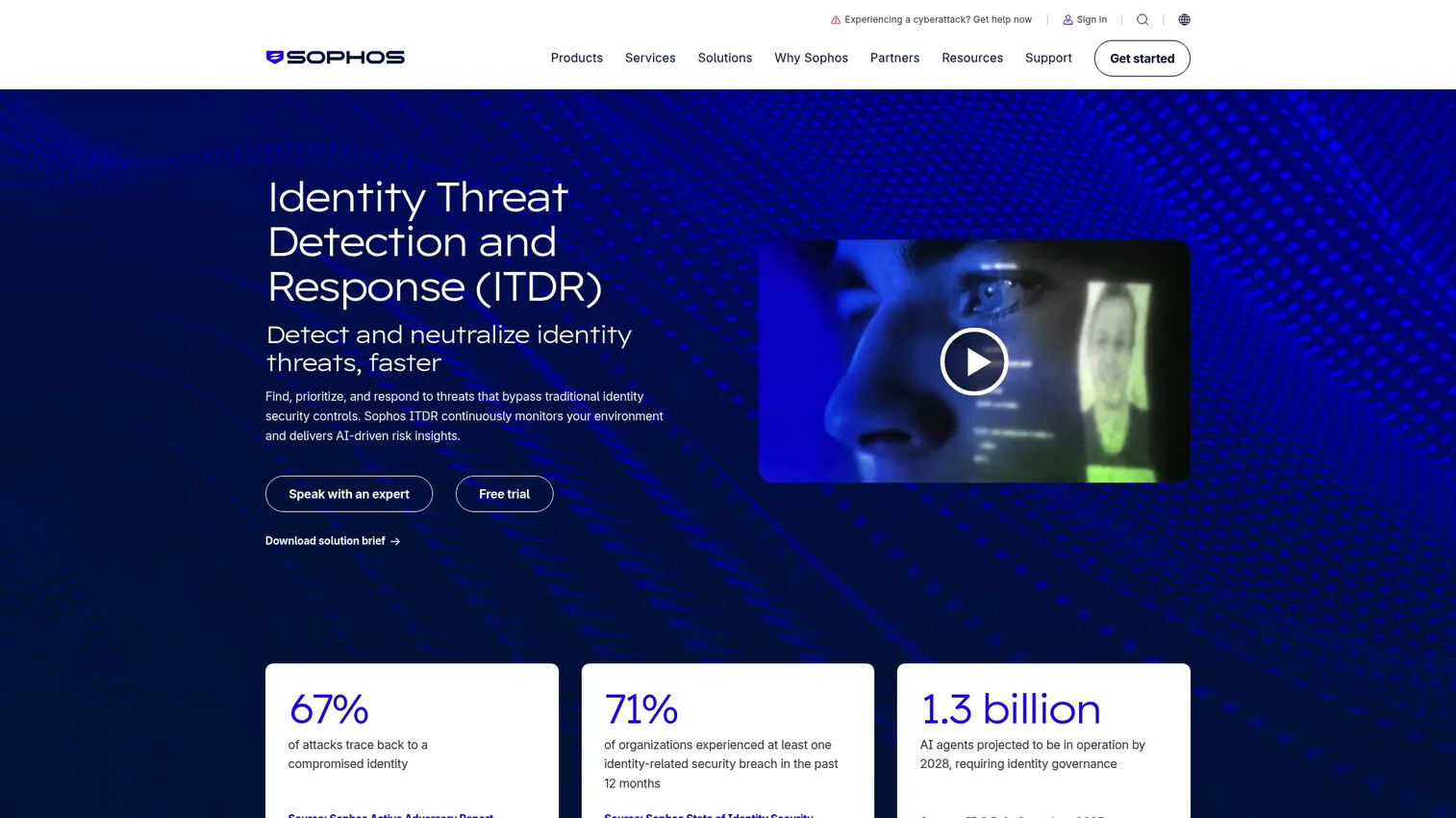
Sophos ITDR continuously monitors identity risk across Microsoft Entra ID and on-premises Active Directory. It runs more than 160 automatic identity posture checks, monitors credential exposure through dark web and breach databases, and applies AI-driven risk scoring to both human and non-human identities. Sophos ITDR connects to Sophos's broader detection and response services, including Sophos MDR.
Best for: Organizations already in the Sophos security environment that want identity coverage tied to their existing detection and managed response workflows.
Key features
- 160+ automatic identity posture checks
- Dark web and breach-database monitoring for exposed credentials
- AI-driven risk scoring for human and non-human identities
- Active Directory and Entra ID monitoring
- Integration with Sophos detection and response services
Why choose Sophos ITDR: The strongest argument is stack consolidation for existing Sophos customers. Identity risk feeds into the same Sophos MDR workflow that already handles endpoint and network detection, reducing the number of consoles analysts manage. The free 30-day trial makes initial evaluation practical without procurement overhead.
Sophos ITDR pricing: A 30-day free trial is available. Paid pricing requires a quote from Sophos. Contact the vendor to confirm coverage scope and bundle options within your existing Sophos subscription.
11. Delinea Identity Threat Protection
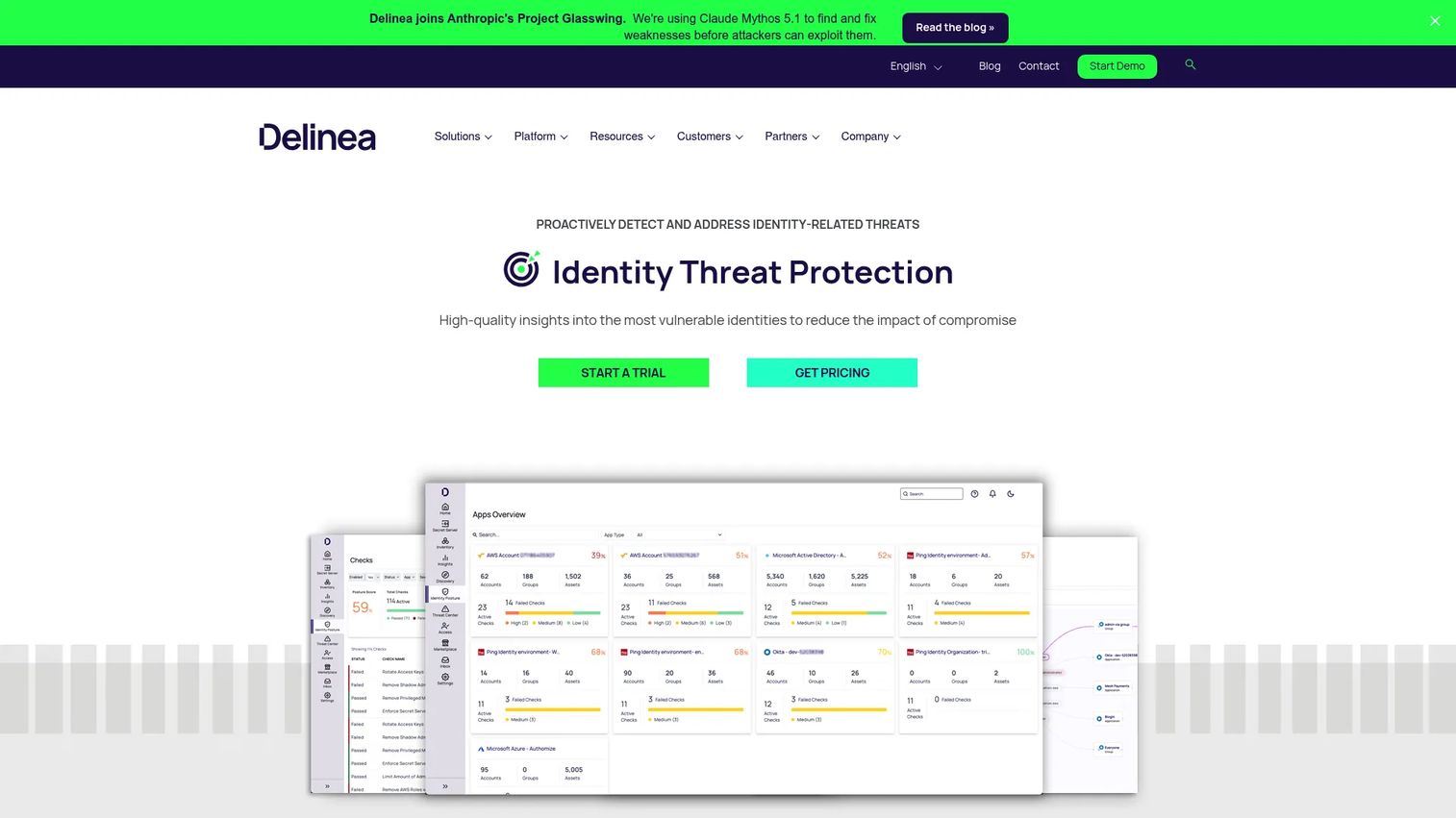
Delinea Identity Threat Protection continuously monitors identities, detects identity-related threats, and provides recommended or automated remediation. Its distinguishing angle is the visibility it provides across identity access paths, showing how identities connect across cloud, SaaS, on-premises infrastructure, and identity systems. AI-driven risk insights surface threats in context with the access relationships that make them dangerous. A free 30-day trial is available.
Best for: Security operations teams that view privileged identity as the highest-risk layer and want threat detection aligned with PAM-adjacent workflows.
Key features
- Continuous monitoring of identities, access, and behavior
- Detection of identity misconfigurations and anomalous behavior
- Access path visualization across cloud, SaaS, and on-premises identity systems
- AI-driven risk insights for identity threats
- Recommended or automated remediation workflows
Why choose Delinea: Organizations that already manage privileged access through Delinea's broader platform will find Identity Threat Protection extends that posture into active threat detection. The access path visualization helps security teams understand which privileged accounts pose the greatest risk before and during an incident.
Delinea Identity Threat Protection pricing: The product page offers a 30-day free trial. Paid pricing requires contacting Delinea directly. Confirm whether Identity Threat Protection is bundled with other Delinea PAM products or sold separately.
12. Semperis Directory Services Protector
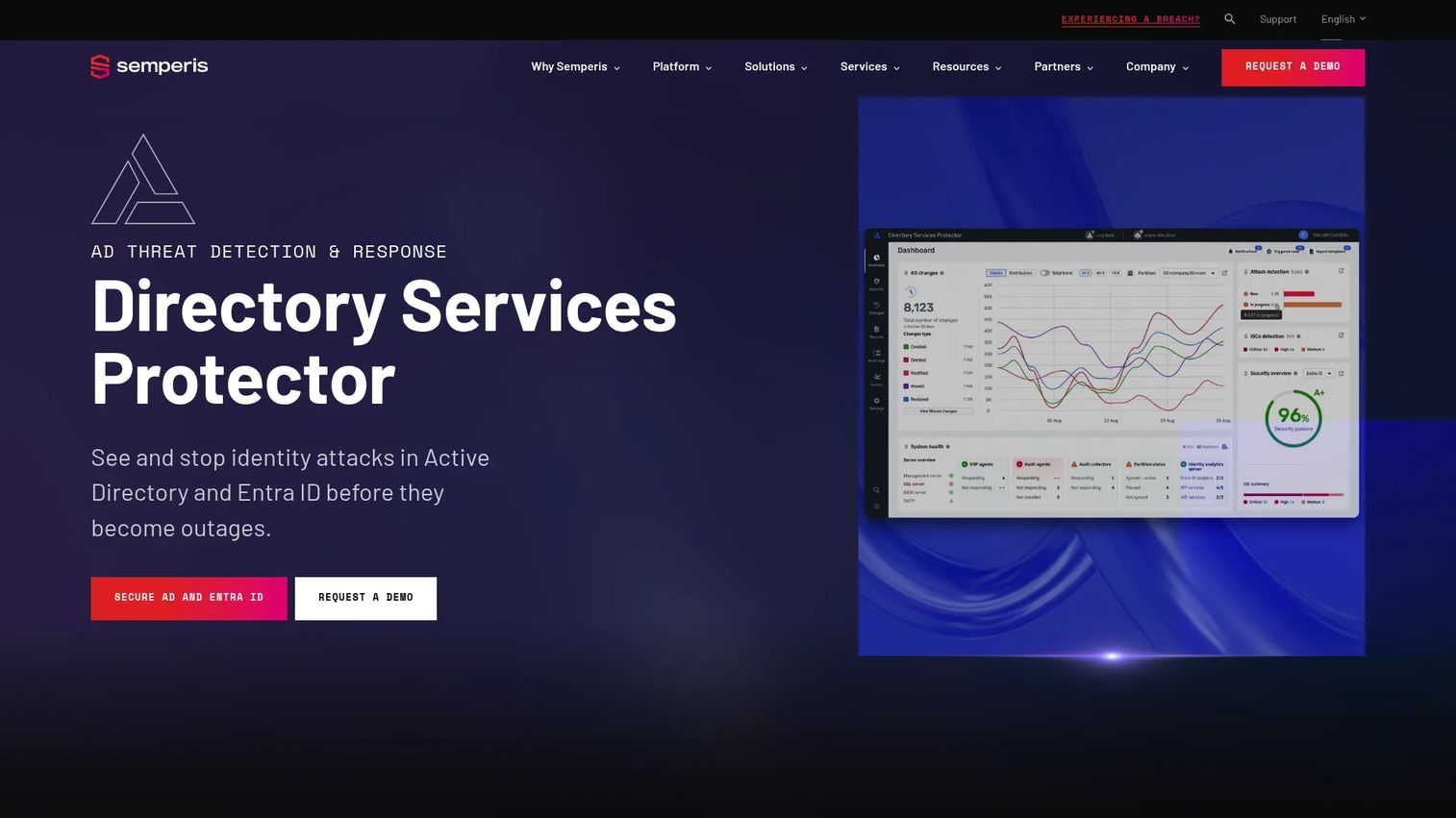
Semperis Directory Services Protector provides continuous monitoring, threat detection, and automated remediation for hybrid Active Directory and Microsoft Entra ID environments. It uses AI-powered attack pattern detection, tamperproof directory change tracking, and automated rollback to undo malicious changes. Semperis also surfaces attack paths within AD and offers SIEM integrations with Splunk and Microsoft Sentinel.
Best for: Enterprises where Active Directory resilience is a board-level risk, particularly those concerned about ransomware using AD as an escalation and propagation path.
Key features
- Hybrid AD and Entra ID vulnerability assessment
- AI-powered attack pattern detection
- Automated rollback of malicious directory changes
- Service account protection and tamperproof change tracking
- SIEM integrations with Splunk and Microsoft Sentinel
Why choose Semperis Directory Services Protector: The automated rollback capability is what makes it distinctive for organizations concerned about ransomware or destructive attacks. Security teams that need prevention, detection, and recovery in a single AD-focused platform will find more depth here than in broader ITDR tools with lighter directory coverage. Presales teams should surface the recovery angle early in conversations with enterprises worried about AD as a ransomware target.
Semperis Directory Services Protector pricing: Pricing is not publicly displayed. Contact Semperis for a quote based on environment size and modules required.
G2 rating: 4.8/5
13. Permiso

Permiso is an identity visibility, identity security posture management, and identity threat detection and response platform covering human identities, non-human identities, and AI identities. Its Universal Identity Graph stitches together identity data across AWS, Azure, Google Cloud, Okta, and Microsoft 365 to surface threats that span multiple cloud environments. Non-human identity inventory and runtime anomaly detection are core capabilities, addressing the service account and workload identity gaps that many enterprise ITDR tools underserve. Note: Permiso has joined Okta.
Best for: Cloud security teams focused on detecting identity-based attacks across multi-cloud and SaaS environments, including overprivileged roles, suspicious API calls, and unusual session behavior.
Key features
- Universal Identity Graph and identity stitching across cloud providers
- Identity security posture management for human and non-human identities
- ITDR across AWS, Azure, Okta, and Microsoft 365
- AI identity security for behavioral anomaly detection
- Non-human identity inventory and runtime anomaly detection
Why choose Permiso: It addresses a gap most on-premises-heavy ITDR tools leave open: Cloud identity attacks. Security teams managing identities across multiple cloud environments or with significant service account and workload identity exposure will find the Universal Identity Graph and non-human identity coverage particularly relevant. Validate current product scope and roadmap with Permiso given the Okta acquisition.
Permiso pricing: Pricing requires a direct conversation with the vendor. Contact Permiso to confirm current packaging, given the Okta acquisition may affect how the product is sold and bundled.
Considerations when choosing identity threat detection and response tools
Use these criteria to structure vendor evaluations and define proof-of-concept requirements before shortlisting ITDR vendors.
Identity system coverage
List every identity store in your environment before vendor demos. The question is whether the tool monitors all of them: On-premises Active Directory, Microsoft Entra ID, Okta, Google Workspace, privileged access systems, SaaS application identities, cloud roles, and service accounts. Coverage gaps become detection gaps.
Detection depth
Identity alerts need to map to actual attack techniques, not generic anomalies. Ask vendors to demonstrate detection for MFA bypass, impossible travel, privilege escalation, golden ticket, pass-the-hash, session hijacking, and abnormal admin activity. Vendors who can't show the detection logic for specific attack patterns are selling posture visibility, not threat detection.
Response workflow
Detection without response is an expensive alert system. Evaluate what the tool does after it detects a threat: Can it disable an account, revoke a session, require a password reset, enforce MFA, isolate an endpoint, open a ticket, or route the signal to SIEM or SOAR? Confirm which response actions are automated and which require analyst approval.
Integration fit
ITDR value compounds when identity signals flow into the tools your team already uses. Verify native integrations with SIEM platforms, XDR or EDR stacks, PAM systems, MDR services, and ITSM tools. Ask specifically whether integrations are native or require custom connector work, and which integrations are included in the base license versus priced as add-ons.
Proof in a demo or POC
Request concrete proof during evaluation. Ask vendors to show an identity graph or explain how a risk score is calculated. Simulate credential misuse and trace the alert from identity signal through to the response action. Show what an analyst sees in your SIEM or XDR. Prove non-human identity and service account coverage explicitly, because vendor coverage varies significantly on this point.
Refer to related resources on attack surface management software and AI security posture management tools if your evaluation extends beyond identity into broader attack surface and posture controls.
Conclusion
Identity threat detection and response is a buying decision shaped by your existing security architecture, your identity infrastructure, and the attack scenarios that matter most to your organization.
For enterprise teams on CrowdStrike, the Falcon Next-Gen Identity Security module is the natural starting point. Microsoft-first organizations get the clearest value from Defender for Identity through existing Microsoft 365 E5 licensing. SentinelOne buyers extending endpoint coverage to identity should evaluate Singularity Identity for autonomous response. Huntress Managed ITDR is the practical choice for MSPs and lean teams that need 24/7 SOC coverage without building it internally. For Active Directory resilience, Semperis Directory Services Protector offers depth on directory-specific attack paths and recovery. Cloud-native teams dealing with overprivileged roles and non-human identity exposure should look at Permiso.
A reasonable next step: Shortlist 3 vendors based on your current identity architecture, then run a POC against at least three specific attack scenarios: Compromised user account, privilege escalation, and risky service account activity. That's the fastest way to separate real detection capability from product positioning.
If your team sells complex cybersecurity software, buyers need to see how detection, investigation, and response work before they trust the claim. Use interactive demos to show the workflow without asking every stakeholder to join another live call. A Demo Center lets buyers explore relevant scenarios on their own terms, and a sandbox gives technical evaluators hands-on access to the product flow without provisioning a live environment.
Start your journey with Guideflow today!
FAQs about identity threat detection and response
Identity threat detection and response (ITDR) is a cybersecurity category that detects, investigates, and responds to threats targeting user accounts, privileged identities, service accounts, and identity infrastructure. It monitors behavior after authentication, where IAM and MFA controls leave off, and routes identity signals into security operations workflows for containment and remediation.
IAM manages access policies, authentication mechanisms, and identity lifecycles. ITDR monitors whether identities are behaving according to those policies and responds when they aren't. IAM answers who can access what. ITDR answers whether someone is misusing that access right now.
ITDR tools are built to detect credential theft, account takeover, MFA bypass, impossible travel, privilege escalation, lateral movement, golden ticket attacks, pass-the-hash, stolen session cookies, credential stuffing, and risky service account behavior. Coverage depth varies significantly across vendors, so mapping detection claims to specific attack techniques during a POC is worth the time.
No. MFA reduces unauthorized access by requiring additional verification. ITDR detects suspicious identity behavior before and after authentication, including bypass attempts that defeat MFA entirely. The two controls are complementary: MFA raises the cost of initial access while ITDR catches the behavior that follows when an attacker gets through anyway.
ITDR sends identity context, alerts, and risk signals into security operations tools. In a SIEM, identity signals add context to correlated alerts. In an XDR platform, identity telemetry enriches cross-domain investigations. EDR and ITDR together cover endpoint behavior and identity behavior in the same analyst workflow. Ask vendors which integrations are native versus requiring custom work.
Ownership is typically shared. Security operations handles detection and response. IAM and IT teams address identity posture issues and fix misconfigurations. Risk and compliance teams often have a stake in governance visibility. In practice, the SOC responds to active threats while IAM and IT handle the remediation work that prevents recurrence. Alignment across these groups is worth confirming before an ITDR deployment.
Test at minimum three scenarios: A compromised user account with lateral movement, a privilege escalation event, and risky service account activity. For each, ask the vendor to show the detection logic, the alert context presented to an analyst, and the available response actions. Also verify whether non-human identities and service accounts appear in the identity inventory at all, since coverage on this point varies considerably across platforms.
Yes, if the tool supports them. Service accounts, automation identities, workload identities, and cloud roles are frequent attack targets precisely because they often hold significant privileges and receive less monitoring than human accounts. Verify non-human identity coverage explicitly before purchase, because some ITDR vendors focus primarily on user accounts and add service account or cloud role coverage only in higher tiers or through separate modules.