Your shop does not lose margin only on the floor. It loses margin in the handoffs: Quote to work order, work order to schedule, schedule to materials, and labor time to actual job cost. By the time the accounting system shows a problem, the job has already shipped. The damage is done.
According to a 2025 Aptean survey, 49% of manufacturers still manage inventory partly or completely by hand. That same survey found 66% of manufacturers were either moving ERP to the cloud or had already done it. The category is moving fast, and the gap between shops running on spreadsheets and those running on integrated job shop software is widening every quarter.
This guide gives you a shortlist you can hand to your head of operations or COO. It covers 21 platforms across manufacturing ERP, MRP, scheduling, quoting, quality, and shop-floor execution. Skip to the TL;DR if you want the fast read. Use the comparison table to narrow your list. Run a real job through the finalists before you sign anything.
What's inside
This guide compares 21 job shop management software platforms for 2026, chosen based on recurring market presence, workflow coverage, and buyer-review visibility.
- Who it is for: Job shops, machine shops, fabricators, custom manufacturers, and operators evaluating ERP or MRP replacement
- How tools were selected: Category relevance, repeated market mentions, workflow coverage across quoting through invoicing, and verified review presence
- What we compared: Quoting, scheduling, production tracking, costing, quality, deployment model, pricing, and G2 rating
- How to use it: Shortlist 3 to 5 tools by shop size, process complexity, and implementation appetite, then test with a real job
TL;DR
- Best for broad manufacturing ERP: DELMIAWorks and Infor VISUAL cover the full ERP depth for mid-sized and larger operations
- Best for job shop quoting and production control: JobBOSS2 is purpose-built for make-to-order and machine shop workflows
- Best for smaller manufacturers that need MRP fast: MRPeasy starts at $49/user/month and deploys without a heavy rollout
- Best for regulated and quality-driven shops: ProShop ERP combines ERP, MES, and QMS in one system for precision manufacturing
- Best for engineer-to-order complexity: Total ETO starts at $7,500/year for 5 seats and is built specifically for custom machine builders
- Best for quoting bottlenecks: Paperless Parts uses geometry analysis to accelerate estimating at machine shops and fabricators
- Best for lighter service and repair operations: Orderry starts at $39/month and fits repair shops more than complex discrete manufacturing
What is job shop management software?
Job shop management software is software that helps custom and low-volume manufacturers quote work, schedule jobs, manage materials, track production, capture labor, and measure job-level profitability.
Core workflows job shop management software supports
- Quoting and estimating
- Work orders and routings
- Production scheduling and capacity planning
- Inventory and purchasing
- BOM management
- Shop-floor data collection and labor capture
- Job costing and margin reporting
- Quality control and traceability
- Shipping, invoicing, and financial reporting
ERP versus MRP versus MES for job shops
These three categories frequently overlap, but the distinction matters when you are choosing a first system.
ERP connects operational and financial processes across the business. MRP focuses on materials, production planning, and purchasing. MES focuses on shop-floor execution and production data. Most job shop platforms today blend two or all three. A shop with 15 employees and a straightforward workflow may only need MRP. A shop with multiple work centers, outside processing, and complex routings will likely need ERP-level integration across quoting, scheduling, inventory, and financials.
What makes job shop software different from standard manufacturing software
Standard manufacturing ERP is often built for repetitive, high-volume production. Job shops do the opposite: High-mix, low-volume work with custom routings, variable labor, and frequent schedule changes. Each job may have a unique BOM, routing, and cost structure. The software needs to handle quote-to-cash complexity at the job level, not just at the product line or SKU level. Margin visibility by job is what separates useful job shop software from general manufacturing tools.
When to use job shop management software
Replace spreadsheet scheduling before it breaks margin
Job shops often start with spreadsheets because they are flexible. They fail when quoting, materials updates, routing changes, and labor data stop reaching the schedule fast enough to act on. When a schedule change requires manual updates in four separate files, the floor runs on outdated information. That gap is where promise dates slip and margins erode.
Track job costs while the job is still active
Late job-cost reporting protects accounting records, not margin. The right software helps managers catch labor overruns, material variances, scrap, and rework while a job is still open. Catching a $400 labor overrun on day three is a conversation. Catching it on the invoice is a write-off.
Standardize quoting without slowing custom work
Quoting discipline matters in custom manufacturing because every inaccurate estimate compounds. Good job shop software helps teams reuse routing logic, historical job data, and costing assumptions without turning every quote into a bespoke finance exercise. Speed and consistency in quoting protects both win rate and margin.
Job shop management software comparison
The table below is a shortlist tool, not a final evaluation. Verify pricing directly with vendors before engaging sales teams. G2 ratings reflect current listings; where no G2 profile was confirmed, the table shows N/A. For advanced planning and scheduling software that sits adjacent to this category, see the linked guide.
| # | Product | Best for | Key differentiator | Pricing | G2 rating |
|---|---|---|---|---|---|
| 1 | DELMIAWorks | Mid-market manufacturers needing full ERP and MES | Integrated ERP and MES for discrete, repetitive, and batch manufacturing | Custom pricing | 4.1/5 |
| 2 | JobBOSS2 | Make-to-order and machine shop operations | Purpose-built job shop ERP from quote through shipping | Custom pricing | 3.8/5 |
| 3 | MRPeasy | Small manufacturers moving off spreadsheets | Cloud MRP starting at $49/user/month with fast deployment | From $49/user/month | 4.6/5 |
| 4 | ProShop ERP | Precision and quality-driven machine shops | ERP, MES, and QMS combined in one web-based platform | Custom pricing | 4.6/5 |
| 5 | Fishbowl | Inventory-heavy manufacturers | Published pricing starting at $229/month with QuickBooks integration | From $229/month | N/A |
| 6 | Infor VISUAL | Order-driven manufacturers with complex operations | Finite and Drum-Buffer-Rope scheduling with integrated financials | Custom pricing | N/A |
| 7 | Total ETO | Engineer-to-order custom machine builders | Full-feature ERP at $7,500/year for 5 seats with included implementation | From $7,500/year | 4.7/5 |
| 8 | Orderry | Repair and service shops | Work order management starting at $39/month | From $39/month | 4.4/5 |
| 9 | shopVOX | Sign, print, and custom fabrication shops | Online quoting, proofing, and job boards for custom orders | From $109/month | 3.5/5 |
| 10 | Statii | Small make-to-order manufacturers in the UK | Cloud MRP at £57.50/month per main user, month-to-month | From £57.50/month | N/A |
| 11 | Fusion Operations | Manufacturers needing real-time shop-floor visibility | MES-focused platform starting at $173/month with 4.9/5 on G2 | From $173/month | 4.9/5 |
| 12 | REALTRAC | Machine shops and custom job shops | Integrated quoting, costing, and scheduling with a 5.0 G2 rating | Custom pricing | 5.0/5 |
| 13 | CyberPlan | Manufacturers with complex scheduling challenges | Advanced planning, finite scheduling, and what-if simulation | Custom pricing | 4.3/5 |
| 14 | 1factory | Quality-driven job shops | Inspection, supplier quality, and nonconformance from $20/user/month | From $20/user/month | 5.0/5 |
| 15 | CADDi | Manufacturers with drawing and quote reuse challenges | AI-powered drawing search and procurement platform | Custom pricing | 4.9/5 |
| 16 | PolyPM | Apparel and sewn-products manufacturers | Unified ERP and PLM for cut-and-sew and decorated-goods production | Custom pricing | 4.0/5 |
| 17 | Aptean Industrial Manufacturing ERP WorkWise Edition | Industrial discrete manufacturers | Multi-level BOMs, job costing, and engineering change management | Custom pricing | 3.8/5 |
| 18 | ShopXpert | Job shops needing paperless shop-floor workflows | Quoting, scheduling, and QR-code-based job tracking | Custom pricing | N/A |
| 19 | Fitfactory Tricorn MRP | UK subcontract manufacturers and precision engineers | Modular production control and MRP with cloud or on-premise deployment | Custom pricing | N/A |
| 20 | Clarity Software | Sign and print production businesses | End-to-end quote, job, and invoice management for graphics trades | Custom pricing | 3.8/5 |
| 21 | Paperless Parts | Machine shops with quoting speed bottlenecks | Geometry-driven estimating with DfM warnings and AI quote analysis | Custom pricing | 4.6/5 |
Best 21 job shop management software tools for 2026
1. DELMIAWorks
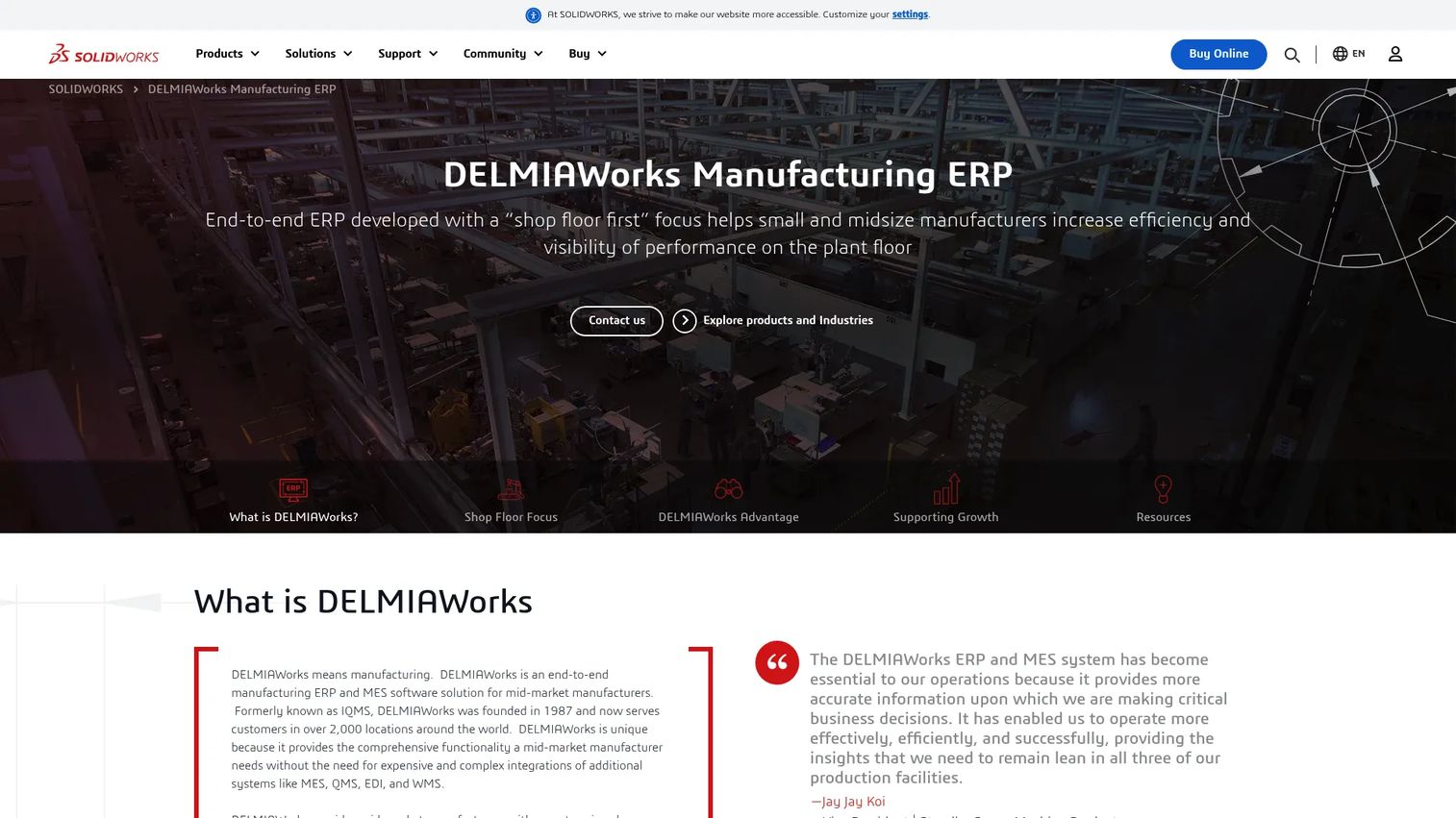
DELMIAWorks is an end-to-end manufacturing ERP and MES platform built for mid-market discrete, repetitive, and batch-process manufacturers. It connects front-office operations (quoting, estimating, and order management) with shop-floor execution (scheduling, work orders, quality, and financial controls) in one integrated system. The platform supports real-time production monitoring and supply chain management across the full manufacturing lifecycle.
Best for: Mid-sized to larger manufacturers that need integrated ERP and MES depth for job shop operations.
Key features
- Real-time production monitoring and shop-floor visibility
- End-to-end supply chain management
- Integrated quality management and traceability
- Production scheduling and capacity planning
- Job costing and financial controls
Why choose DELMIAWorks: This is the right fit for shops that have outgrown standalone scheduling or accounting tools and need ERP and MES working from a shared data set. Budget for implementation time and internal process documentation before going live.
DELMIAWorks pricing: Pricing is quote-based. Contact DELMIAWorks sales for license, implementation, and support costs specific to your shop size and module requirements.
G2 rating: 4.1/5
2. JobBOSS2
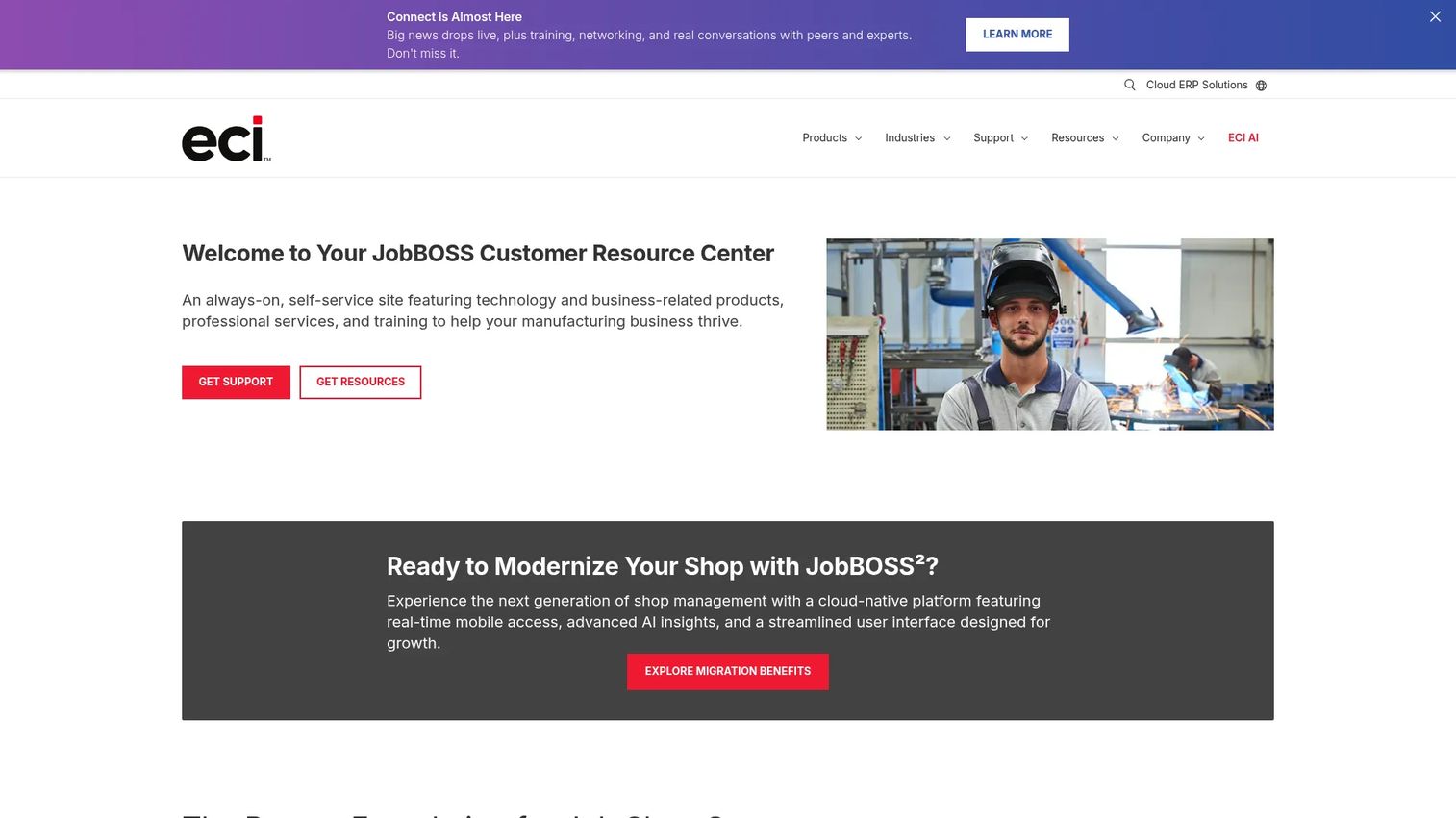
JobBOSS2 is a job shop ERP designed specifically for make-to-order and custom metal manufacturers. It covers the full production lifecycle from estimating and quoting through scheduling, shop-floor data collection, purchasing, quality management, and shipping. The platform includes an AI BOM Builder, real-time profitability analytics, and inventory forecasting built for high-mix, low-volume shops.
Best for: Small and mid-sized job shops that want a purpose-built system covering quoting, production, and delivery without generic ERP overhead.
Key features
- Estimating and quoting with AI BOM Builder
- Job scheduling and shop-floor data collection
- Purchasing control and inventory forecasting
- Quality management
- Real-time profitability reporting and dashboards
Why choose JobBOSS2: The job shop focus means the workflows match how make-to-order and machine shops actually run, rather than forcing a generic manufacturing ERP onto custom production patterns. Teams evaluating this tool should confirm whether cloud or on-premise deployment fits their IT environment.
JobBOSS2 pricing: Pricing is tailored to scale and required functionality. The official pricing page requires a quote request; ask sales specifically for license, implementation, and user costs.
G2 rating: 3.8/5
3. MRPeasy
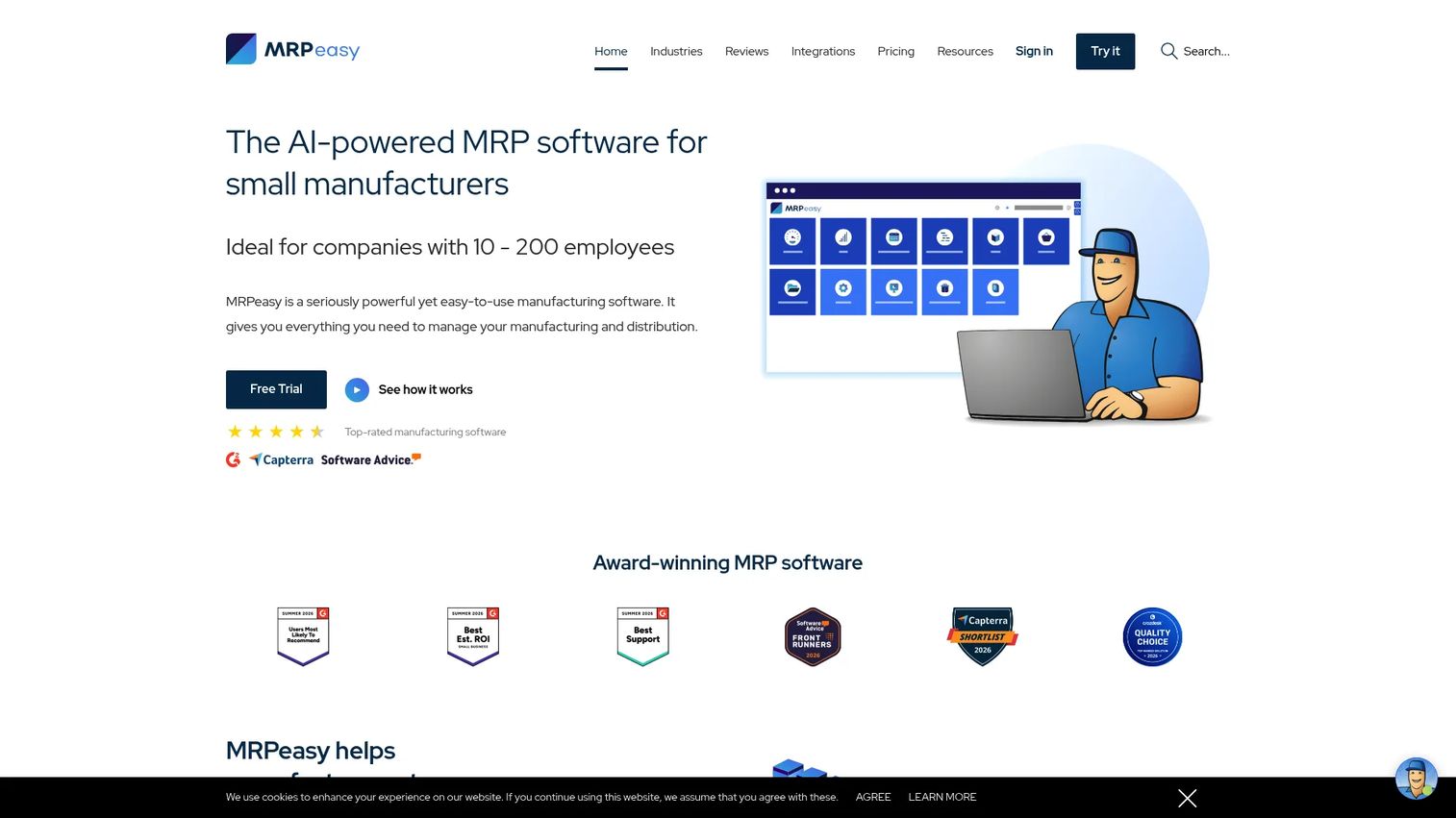
MRPeasy is cloud manufacturing resource planning software for small and midsize manufacturers. It covers production planning, inventory control, bills of materials and routing management, purchasing, CRM, and accounting integrations in a single cloud platform. The tool positions itself as MRP that small teams can adopt without a long implementation project or dedicated IT support.
Best for: Small manufacturers moving off spreadsheets that need MRP, inventory, and production planning without a heavy rollout.
Key features
- Production planning and scheduling
- Inventory management with lot, batch, and serial-number traceability
- BOM and routing management
- Purchasing and CRM modules
- Accounting integrations
Why choose MRPeasy: The published pricing and fast time to value make this a strong first option for shops under 50 employees. It fits teams where the main bottleneck is materials and production visibility rather than complex financial consolidation across multiple sites.
MRPeasy pricing: Starter plan at $49/user/month. Professional at $69/user/month, Enterprise at $99/user/month, and Unlimited at $149/user/month (2-user minimum). A free trial is available.
G2 rating: 4.6/5
4. ProShop ERP
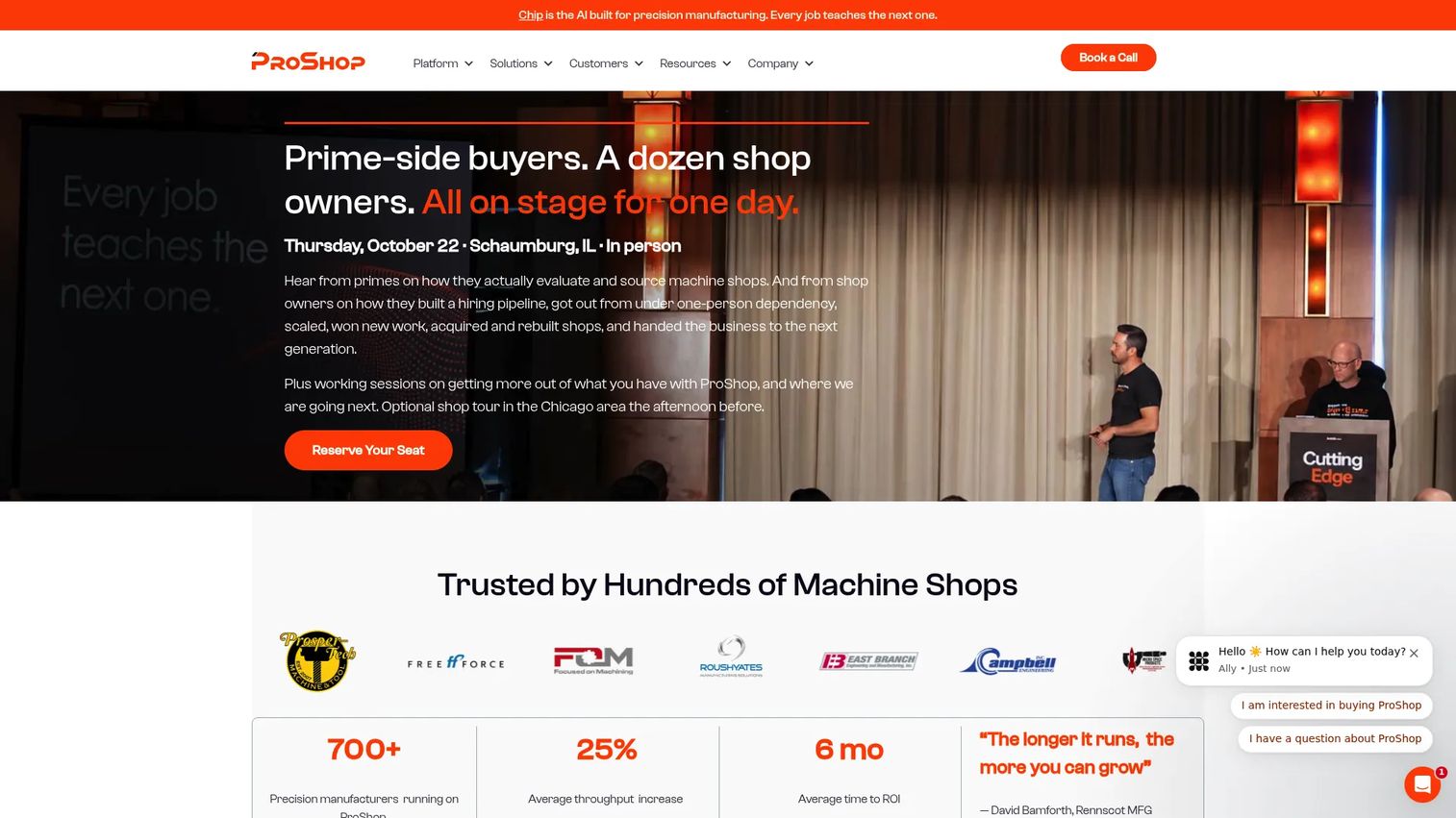
ProShop ERP is a web-based platform combining ERP, MES, and QMS capabilities for precision manufacturing and machine shops. It covers estimating, quoting, scheduling, shop-floor management, quality systems, inspection, tool management, document control, traceability, and job costing. The platform also includes CMMC and cybersecurity features relevant to aerospace and defense supply chains.
Best for: Quality-driven job shops, machine shops, and precision manufacturers that need ERP, MES, and QMS operating from one system.
Key features
- ERP, MES, and QMS integrated in one platform
- Quality systems management and inspection tracking
- Product data management and document control
- Cutting tool and fixture management
- Job costing and material planning
Why choose ProShop ERP: When quality records, process discipline, and job execution must stay connected and auditable, ProShop is a strong fit. It is purpose-built for shops where quality escapes are expensive and traceability requirements are strict.
ProShop ERP pricing: Pricing is customized by user count, with standard and government options available. Contact the ProShop team directly for a quote.
G2 rating: 4.6/5
5. Fishbowl
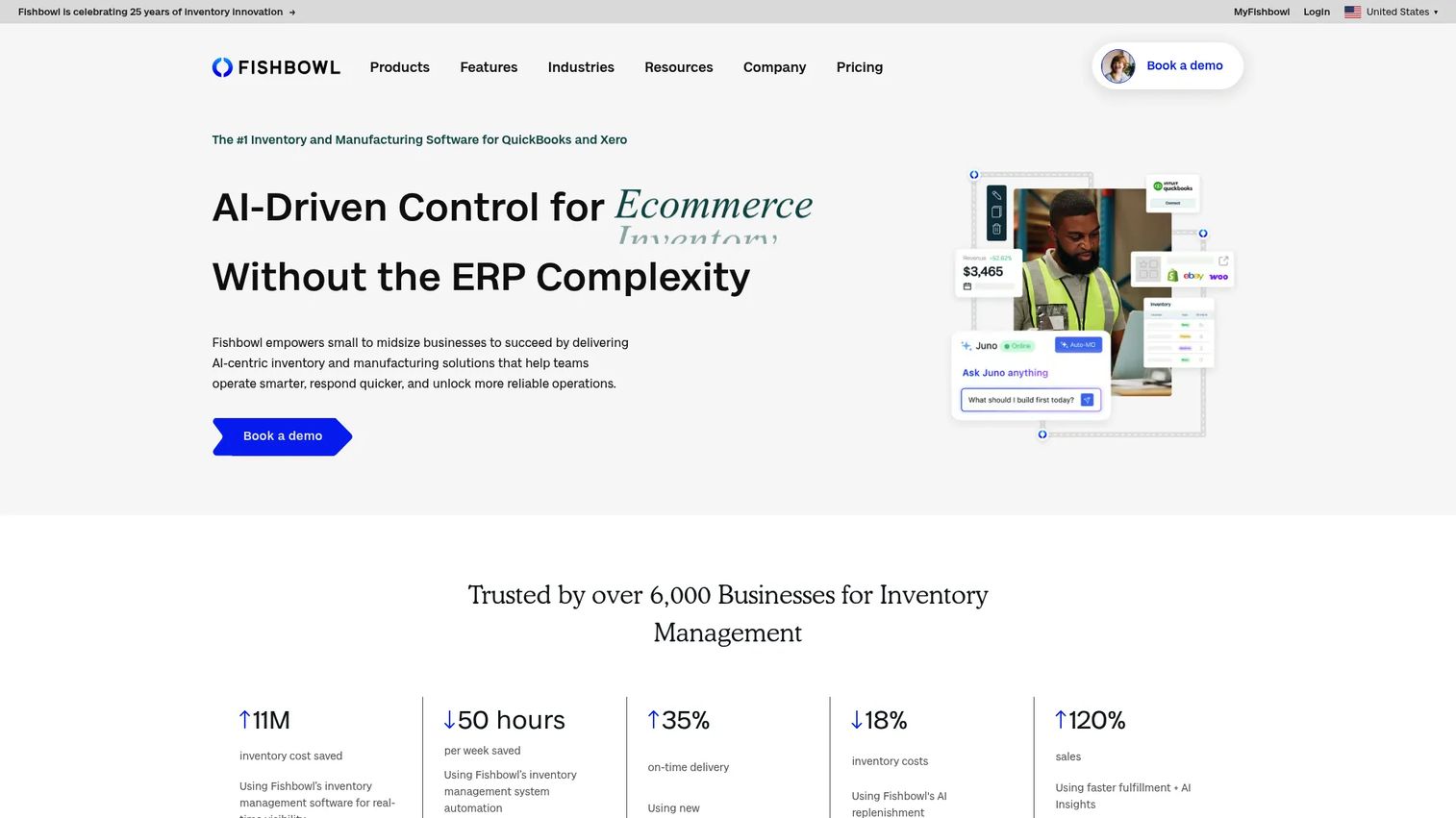
Fishbowl is inventory and manufacturing software built for businesses that manufacture, distribute, and sell physical products. Core capabilities include real-time inventory tracking across multiple locations, barcode scanning, manufacturing orders with BOMs, work orders, MRP, and purchasing. The platform integrates with accounting systems and is widely used alongside existing financial software.
Best for: Inventory-heavy manufacturers and distributors that need stronger stock control and basic manufacturing workflows.
Key features
- Real-time inventory and multi-location tracking
- Barcode scanning and mobile warehouse tools
- Manufacturing orders with BOMs and MRP
- Work orders and purchasing workflows
- Accounting system integration
Why choose Fishbowl: This fits well when inventory accuracy is the primary bottleneck and a full ERP overhaul is not on the table. It handles manufacturing workflows alongside inventory, but shops with complex routings or job-level costing needs may want to evaluate broader ERP options.
Fishbowl pricing: Essentials plan at $229/month billed annually. Growth at $429/month, Scale at $729/month. Advanced Manufacturing starts at $675/month and Advanced Warehouse starts at $595/month, both priced by user count and deployment requirements.
6. Infor VISUAL
Infor VISUAL is an end-to-end ERP for order-driven manufacturers. It covers finite and Drum-Buffer-Rope scheduling, estimate-to-actual cost tracking, shop-floor automation, quality management with inspections and corrective actions, performance analytics, and multi-entity or multisite support. The platform suits mid-to-larger manufacturers running complex, engineer-to-order or make-to-order operations.
Best for: Order-driven manufacturers that need mature ERP controls spanning production, financial visibility, and quality in one system.
Key features
- Finite and Drum-Buffer-Rope production scheduling
- Estimate, actual, and projected cost tracking
- Shop-floor automation and mobility
- Quality management with nonconformance and corrective actions
- Multi-entity, multisite, and multicurrency support
Why choose Infor VISUAL: Strong fit when operational complexity and financial visibility must come from a single source of truth across production and finance. Budget for implementation resources; this is a mature ERP designed for established operations with internal IT capacity.
Infor VISUAL pricing: Pricing is not publicly available. Contact Infor sales for a quote specific to your deployment, user count, and module requirements.
7. Total ETO
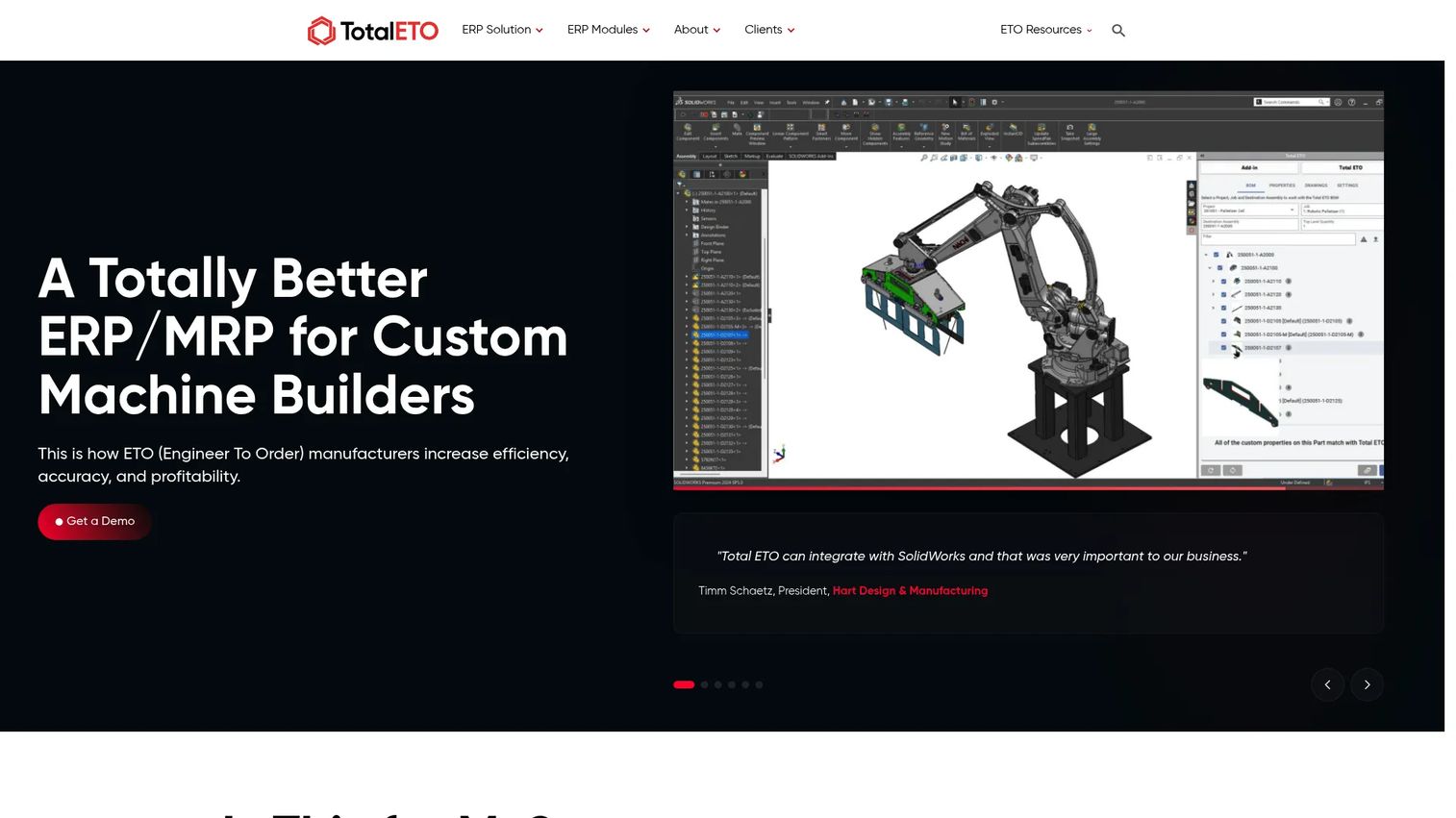
Total ETO is ERP and MRP software purpose-built for engineer-to-order manufacturers including custom machine builders, system integrators, panel shops, and OEMs. It covers dynamic and nested BOMs, SOLIDWORKS and Inventor CAD integration, procurement, real-time job costing, manufacturing, quality control, estimating, quoting, engineering change orders, and mobile time collection. Implementation and training are included in the annual price.
Best for: Engineer-to-order manufacturers that quote and build complex custom projects where engineering, purchasing, and production must stay synchronized.
Key features
- Dynamic and nested bills of materials
- SOLIDWORKS and Inventor CAD integration
- Procurement and inventory management
- Real-time job costing and project visibility
- Estimating, quoting, and engineering change orders
Why choose Total ETO: The right call when a job regularly changes after the quote, and engineering, purchasing, and production need to stay in sync without manual coordination. The all-inclusive pricing model removes the typical ERP implementation surprise costs.
Total ETO pricing: $7,500/year for 5 seats, all features included. Additional 5-user timecard packs and shop-floor kiosks cost $265/year each. No free tier; implementation and training are included.
G2 rating: 4.7/5
8. Orderry
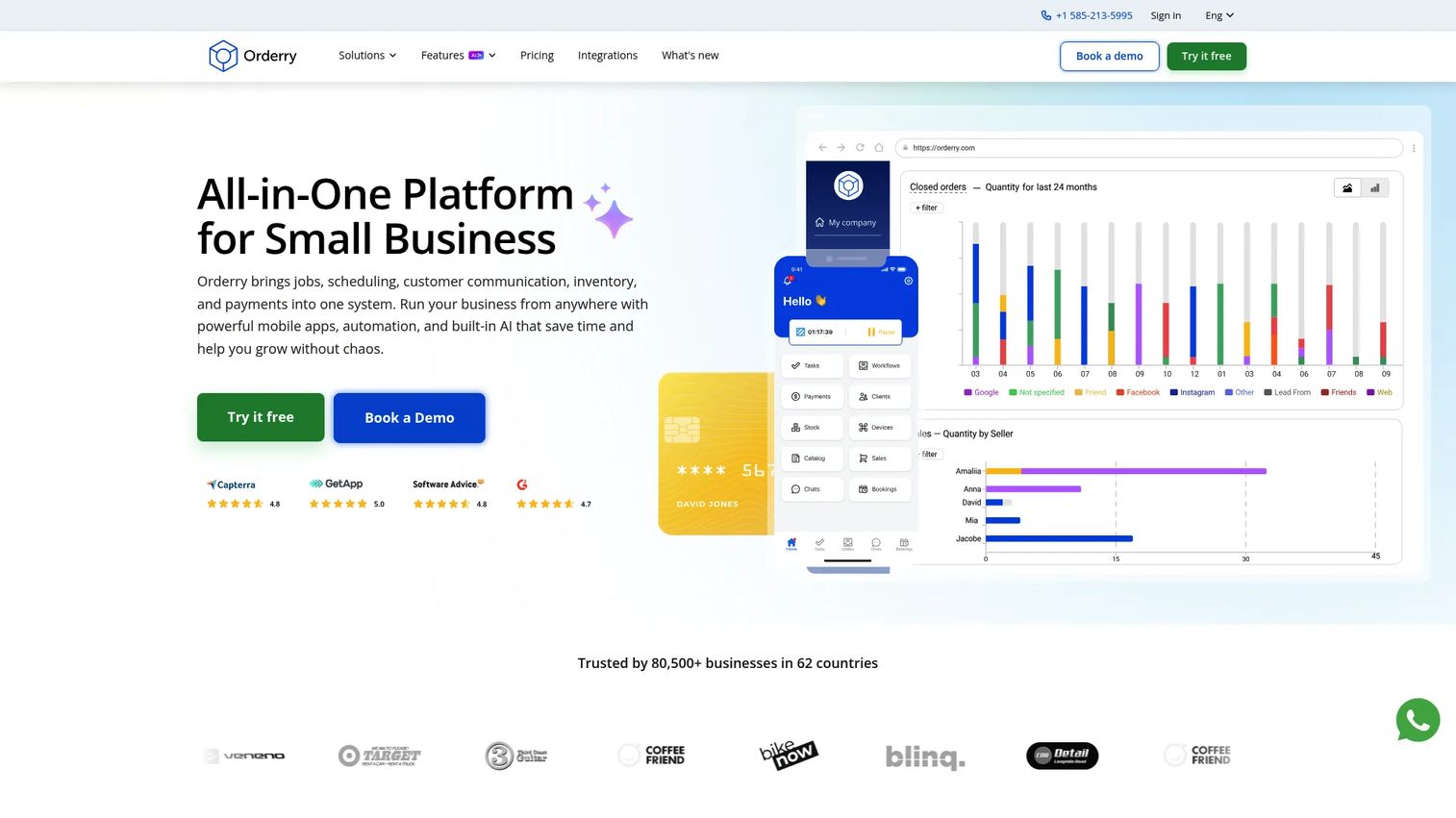
Orderry is an all-in-one business management platform for small service, repair, field-service, and retail businesses. It handles work orders, scheduling, customer management, inventory, invoicing, payments, and technician workflows. The platform also includes AI transcription, sentiment analysis, and product recognition features.
Best for: Repair and service shops that need work order control, customer visibility, and scheduling without the complexity of a full manufacturing ERP.
Key features
- Work order and job management
- Scheduling and online booking
- Customer management and communications
- Inventory and warehouse management
- Invoicing and payment processing
Why choose Orderry: Orderry fits service-oriented shops well. If your operation centers on repairs, field jobs, and customer-facing workflows rather than production routings and job costing, this is a simpler and more affordable starting point.
Orderry pricing: Hobby plan at $39/month. Startup from $69/month, Business from $99/month, Enterprise from $199/month. A 7-day free trial is available; annual billing saves approximately 10%.
G2 rating: 4.4/5 (from 16 reviews)
9. shopVOX
shopVOX is cloud-based shop management software built for sign, print, apparel, and custom fabrication businesses. It covers online quoting, job management, a visual job board, online proofing with client approvals, payment processing, and CRM. Accounting integrations connect to common small business platforms.
Best for: Sign, print, apparel, and custom fabrication shops that need quoting, order tracking, client proofing, and invoicing in one workflow.
Key features
- Quoting and pricing tools
- Job management and visual job board
- Online proofing and client approvals
- Invoicing and payment processing
- Sales leads and CRM (PRO plan)
Why choose shopVOX: The front-office workflow speed is the main advantage here. Shops where client approval cycles and quote-to-order speed drive revenue will find it a natural fit. Note that this is not a deep manufacturing ERP for complex production environments.
shopVOX pricing: Express plan at $109/month plus $29/user/month. PRO plan at $249/month plus $49/user/month, which adds CRM, advanced integrations, and premium support. A 14-day Express free trial is available.
G2 rating: 3.5/5 (from 5 reviews)
10. Statii
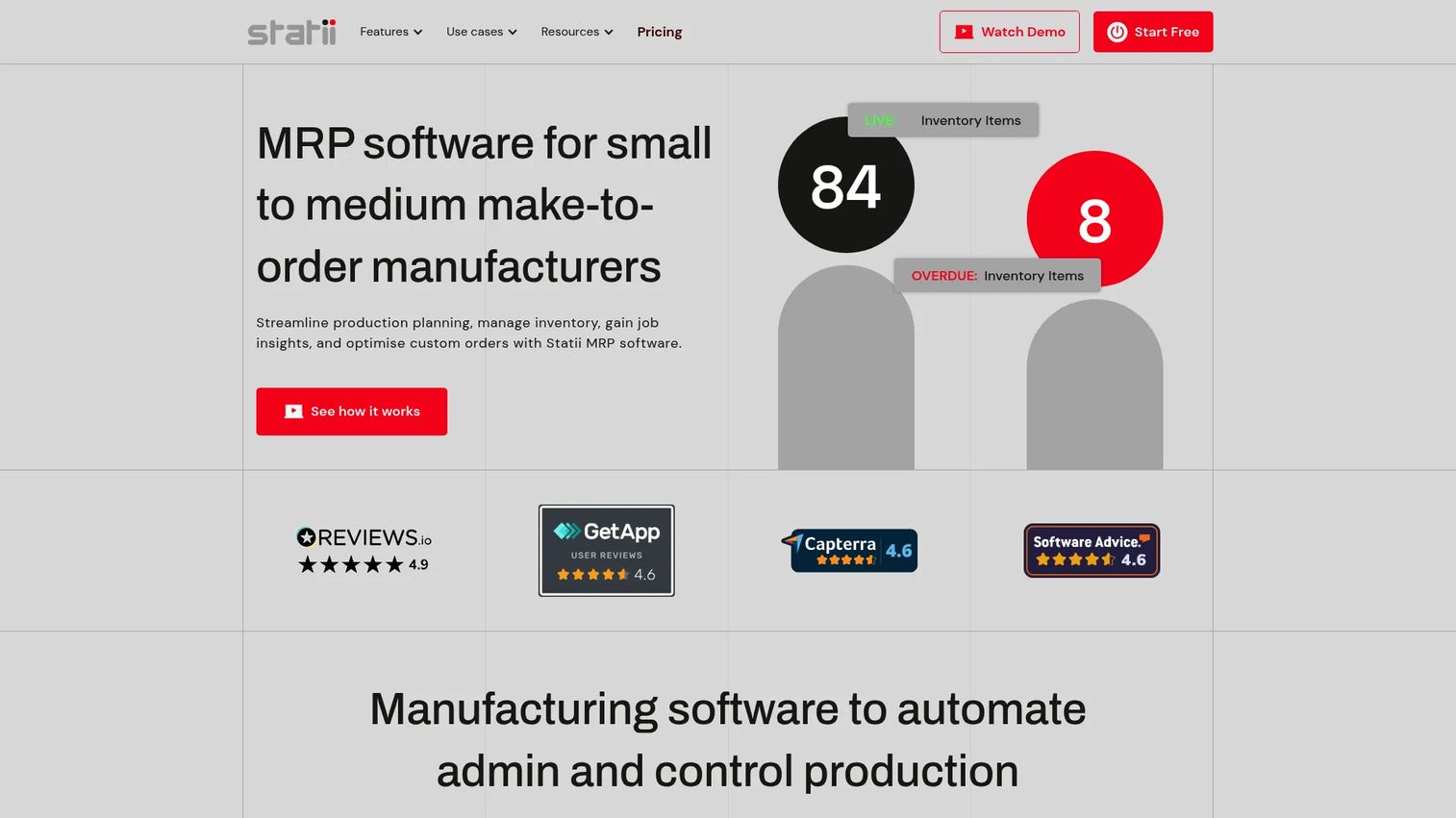
Statii is MRP and manufacturing software for small to medium-sized make-to-order manufacturers. The platform covers production planning, scheduling, inventory management, purchasing control, quoting, sales orders, works orders, shop-floor data collection, and real-time WIP tracking. It operates on a straightforward monthly subscription with no long-term commitment required.
Best for: Small make-to-order manufacturers that need cloud MRP and shop-floor control without an enterprise rollout or annual contract.
Key features
- Production planning and scheduling
- Inventory management and purchasing control
- Shop-floor data collection and real-time WIP tracking
- Quoting and works orders
- Month-to-month billing with no long-term lock-in
Why choose Statii: The month-to-month pricing and focused feature set make this a low-risk starting point for smaller shops. It fits straightforward manufacturing workflows; shops with multi-site operations or complex financial consolidation needs will want to evaluate broader ERP options. The platform has a strong fit for UK-based subcontract manufacturers.
Statii pricing: Main users at £57.50/month. Shop-floor users at £8.50/month. Month-to-month billing with no annual commitment required.
11. Fusion Operations
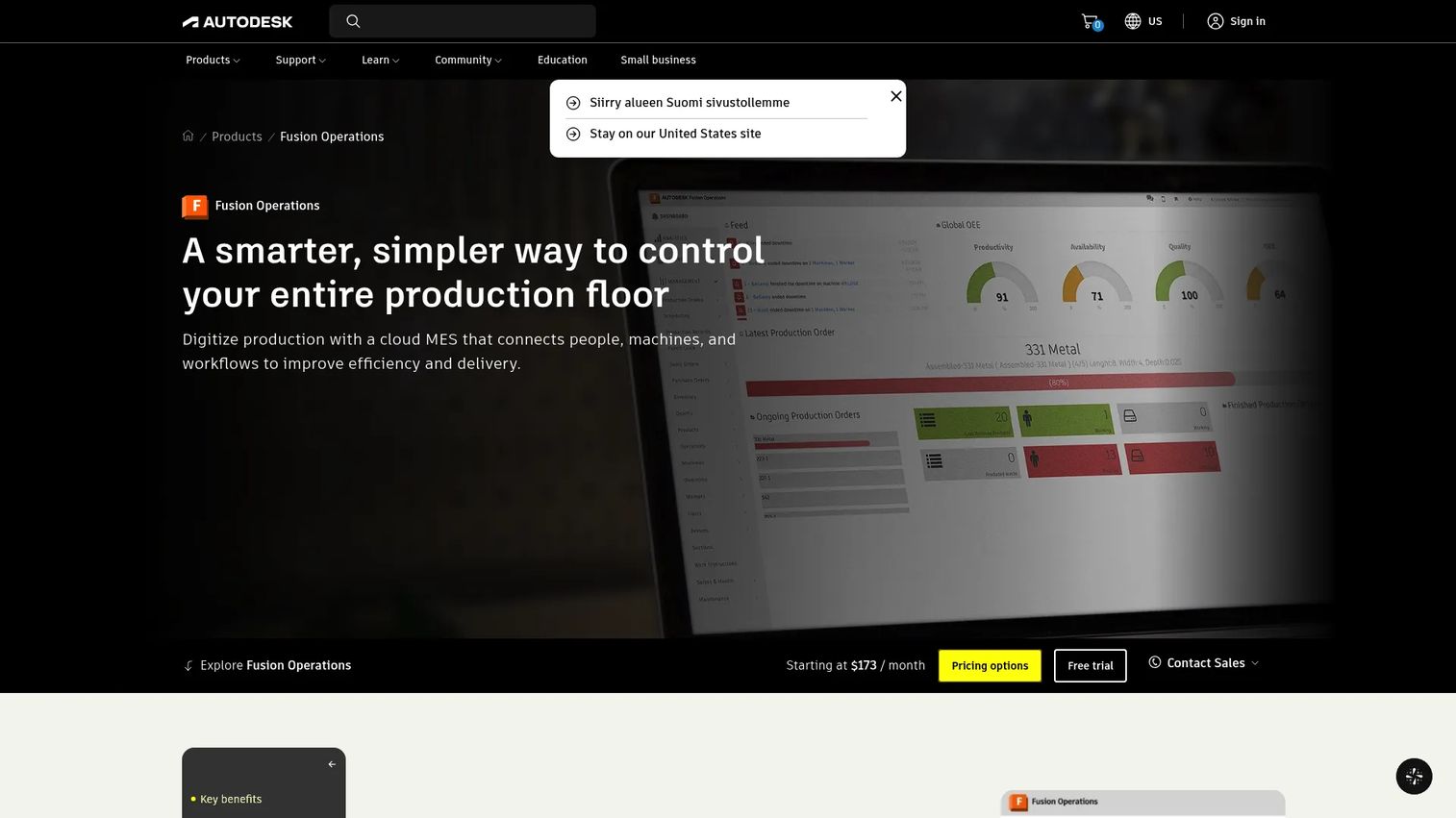
Fusion Operations by Autodesk is a cloud-based manufacturing execution system that digitizes shop-floor operations and connects planning with production in real time. It covers near-real-time dashboards, workflow standardization, scheduling and MRP, inventory tracking with traceability, quality management, maintenance management, and integrations with ERP, CRM, and PLM systems.
Best for: Manufacturers and fabricators that need real-time production visibility, traceability, scheduling, and quality data without a full ERP replacement.
Key features
- Near real-time production dashboards
- Scheduling and MRP
- Inventory and end-to-end traceability
- Quality and maintenance management
- ERP, CRM, and PLM integrations
Why choose Fusion Operations: Use this when the bottleneck is execution visibility rather than quoting or accounting. It works well as a shop-floor execution layer that complements an existing ERP, or as a standalone for manufacturers that do not yet need full financial integration.
Fusion Operations pricing: Starting at $173/month. A 14-day free trial is available. Business and Enterprise success plans are offered. Autodesk provides monthly, 1-year, and 3-year billing options.
G2 rating: 4.9/5 (from 16 reviews)
12. REALTRAC
REALTRAC is an integrated shop management and ERP system for machine shops, job shops, and custom manufacturers. It covers quoting and estimating, production scheduling, purchasing, inventory with BOM and MRP, job costing, time collection, shipping, invoicing, and reporting. QuickBooks and Sage 50 integrations are included.
Best for: Small and midsize machine shops and custom manufacturers that need integrated production, inventory, costing, and scheduling without overbuilding their software stack.
Key features
- Quoting and estimating
- Production scheduling and shop-floor control
- Purchasing, inventory, BOM, and MRP
- Job costing and time collection
- Shipping, invoicing, and reporting
Why choose REALTRAC: The machine shop focus and integrated job costing make this a practical choice for shops where tracking active job costs, not just end-of-month financials, is the priority. Available as SaaS (monthly or annual) or a software ownership model.
REALTRAC pricing: Modular SaaS plans are available billed monthly or annually. A software ownership option is also available. Contact REALTRAC sales for pricing specific to your module selection and user count.
G2 rating: 5.0/5 (from 1 review)
13. CyberPlan
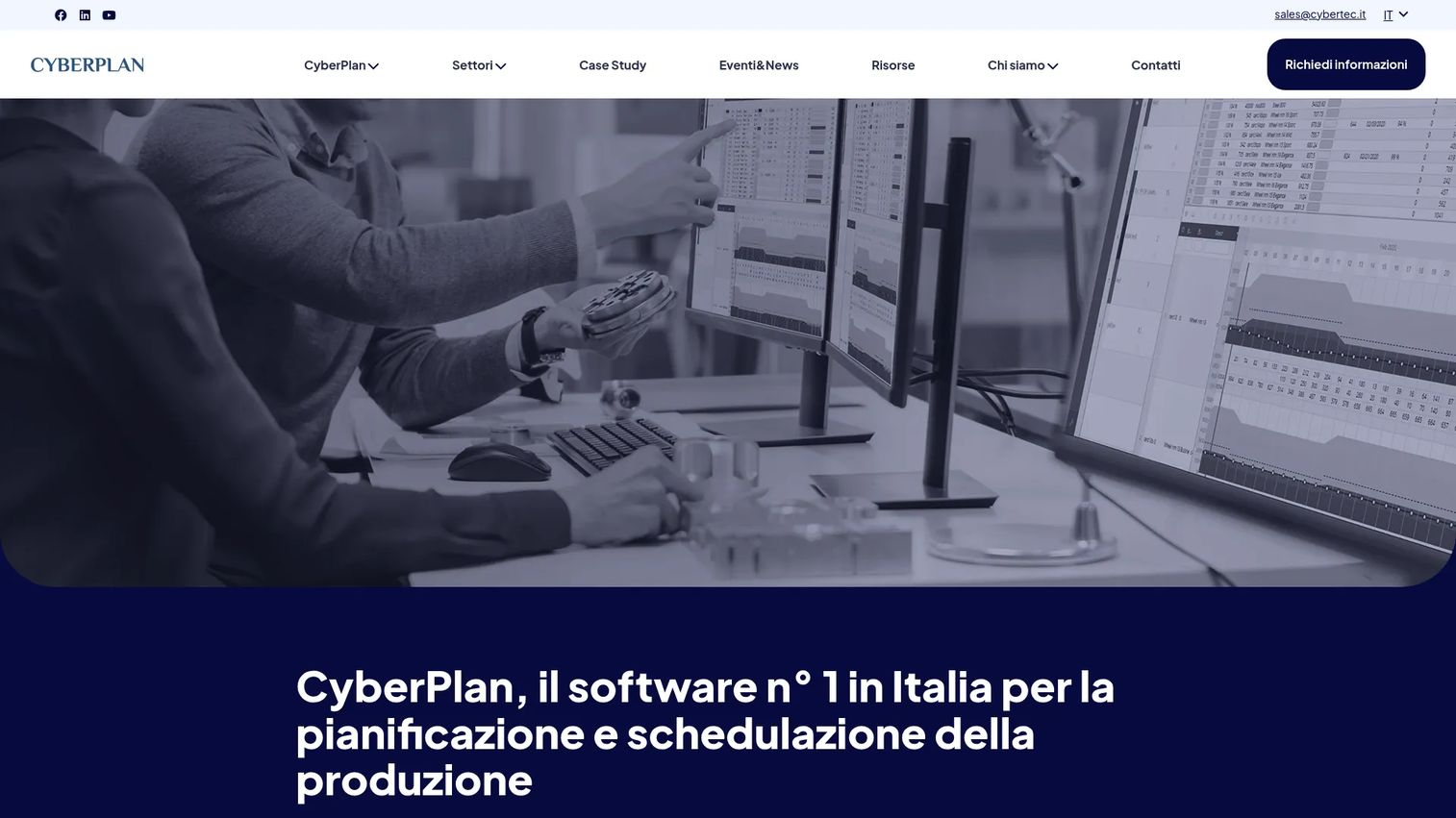
CyberPlan is advanced planning and scheduling software for manufacturing companies. Its capabilities include APS (advanced planning and scheduling), demand planning, S&OP, finite-capacity production scheduling, internal MRP, what-if scenario simulation, Demand Driven planning, and ERP integration. It is offered both on-premise and as a SaaS or cloud subscription.
Best for: Manufacturers where scheduling complexity creates missed delivery dates and capacity surprises that a standard ERP scheduler cannot handle.
Key features
- Finite-capacity production scheduling
- Demand planning and S&OP
- What-if scenario simulation
- Internal MRP and materials planning
- ERP and external information-system integration
Why choose CyberPlan: Best positioned as a planning layer that sits alongside an existing ERP rather than a standalone shop management system. Shops with complex multi-resource scheduling challenges will find more scheduling depth here than in most ERP built-in schedulers.
CyberPlan pricing: Available on-premise (one-time purchase) or as a SaaS subscription. Contact CyberPlan for pricing specific to your deployment model and user requirements.
G2 rating: 4.3/5 (from 16 reviews)
14. 1factory
1factory is manufacturing quality control software covering product quality, supplier quality, compliance, and production quality operations. Its capabilities include drawing auto-ballooning and revision comparison, inspection planning, first article inspection, PPAP management, automated CMM and digital-gage data import, statistical process control, nonconformance tracking, CAPA, SCAR, supplier management, and gage calibration.
Best for: Job shops and contract manufacturers that need better inspection management, supplier quality control, and nonconformance tracking.
Key features
- Inspection planning, FAI, and PPAP management
- Automated data import from CMM and digital gages
- Statistical process control and process capability
- Nonconformance, CAPA, and SCAR tracking
- Supplier collaboration and gage calibration
Why choose 1factory: Use this as a quality layer within an existing manufacturing stack when quality escapes, inspection delays, or supplier issues are hitting margin. It is a focused quality system rather than a full ERP replacement.
1factory pricing: Quality Control module at $75/QC user/month (5-user minimum, annual commitment). Supplier Collaboration at $20/connected supplier/month (5-supplier minimum, annual). Quality Management System at $20/QMS user/month (10-user minimum, annual). Enterprise options require a quote.
G2 rating: 5.0/5
15. CADDi

CADDi is an AI data platform for manufacturing that structures and connects fragmented manufacturing data. Its CADDi Drawer product extracts product geometry, structure, and specification values from 2D and 3D drawings, connects parts to process, defect, pricing, and supplier data, and enables drawing search and part history retrieval. The CADDi Quote module centralizes RFQ distribution, quote comparison, and supplier awards.
Best for: Manufacturers where estimating and purchasing teams waste significant time searching for prior drawings, replicating historical quotes, or managing fragmented supplier data.
Key features
- Drawing search and part history retrieval
- AI extraction of geometry and specification data from drawings
- Quote centralization and supplier RFQ management
- AI supplier recommendations based on purchase history
- Manufacturing data connection across engineering and procurement
Why choose CADDi: Strong fit when the quoting or procurement bottleneck stems from an inability to find and reuse prior work rather than from a production or scheduling gap. This is a knowledge-access and procurement tool, not a full job shop ERP.
CADDi pricing: Contact CADDi for pricing. The platform is enterprise-positioned and pricing is not publicly displayed.
G2 rating: 4.9/5 (rating reflects CADDi Drawer specifically)
16. PolyPM
PolyPM is an apparel and textile manufacturing ERP and PLM platform that unifies product development, inventory, production, costing, and shipping. Capabilities include unified ERP and PLM database management, production and WIP tracking, inventory with roll-level tracking, cut planning and marker integration, and decoration production management for embroidery, screen printing, and sublimation.
Best for: Apparel, garment, textile, and sewn-product manufacturers with job shop-like production needs centered on styles, materials, and decoration workflows.
Key features
- Unified ERP and PLM database
- Production and work-in-process tracking
- Inventory and materials management with roll-level tracking
- Cut planning and marker integration
- Decoration production management
Why choose PolyPM: This is a vertical-specific tool for sewn-goods manufacturers. If your shop runs cut-and-sew, embroidery, screen printing, or related production, PolyPM addresses workflows that generic manufacturing ERP does not model well. It is not a first fit for machine shops or metal fabrication.
PolyPM pricing: Contact PolyPM for pricing. No pricing is displayed on the vendor website.
G2 rating: 4.0/5 (from 1 review)
17. Aptean Industrial Manufacturing ERP WorkWise Edition
Aptean Industrial Manufacturing ERP WorkWise Edition is a cloud-native ERP for mid-sized and large discrete manufacturers. Its capabilities include complex and multi-level bills of materials, production scheduling, shop-floor reporting, job costing, engineering change management, inventory management, quality control, and financial management.
Best for: Industrial and discrete manufacturers that need a broad ERP system covering production, materials, financials, and quality with enterprise-level depth.
Key features
- Complex and multi-level bills of materials
- Production scheduling and shop-floor reporting
- Job costing and engineering change management
- Inventory management and quality control
- Financial management
Why choose Aptean WorkWise: Good fit when a job shop needs deeper enterprise controls than lighter MRP tools provide. Plan for implementation discipline and internal ownership; this is not a self-serve rollout. Budget for the full cost of ownership including implementation services.
Aptean WorkWise pricing: Aptean requires a pricing request. Contact sales via the Aptean pricing request page for license, implementation, and support costs.
G2 rating: 3.8/5 (from 2 reviews)
18. ShopXpert
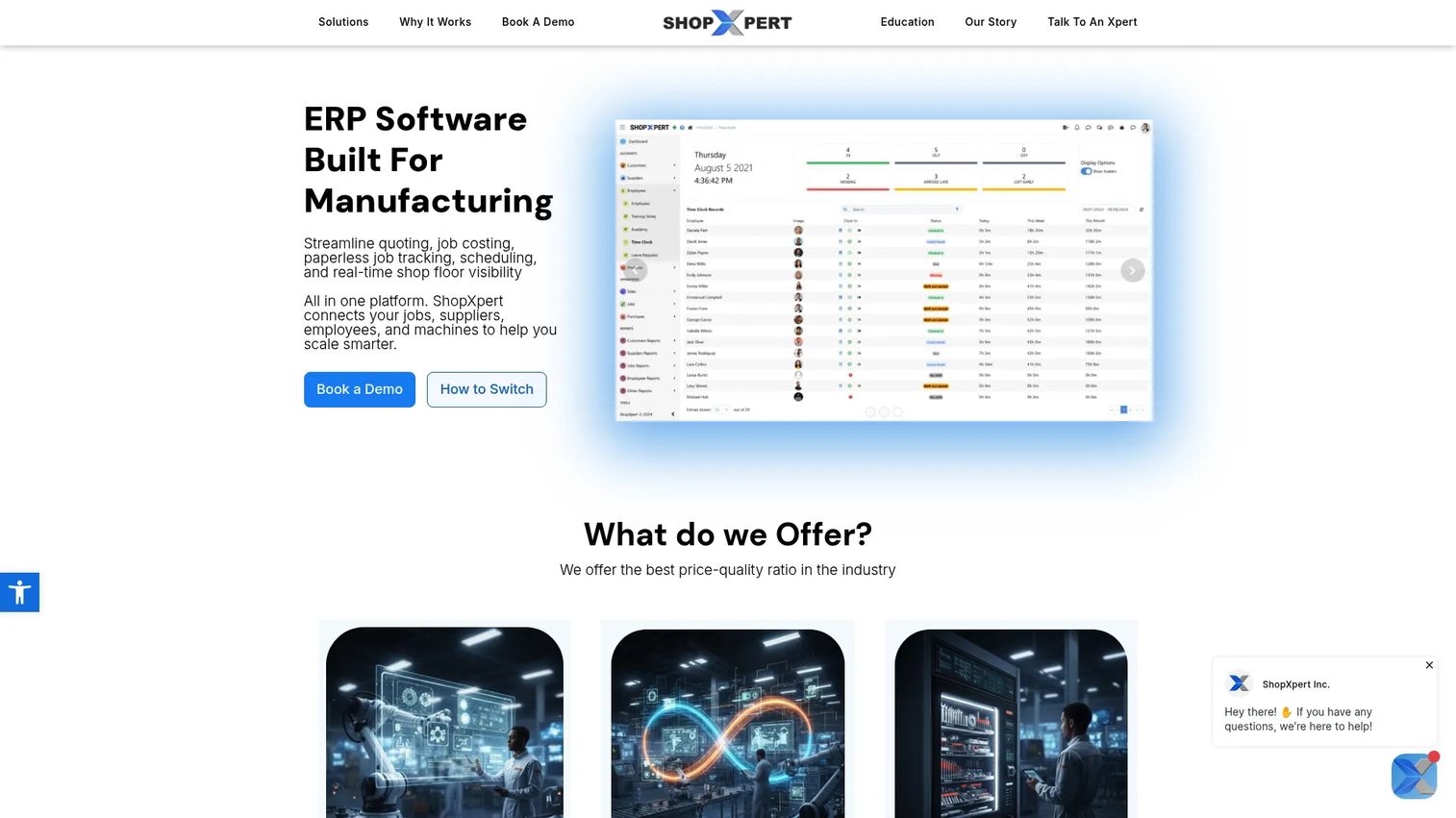
ShopXpert is a manufacturing ERP platform for managing jobs, suppliers, costs, employees, and shop-floor operations. Features include quoting and job costing, production scheduling, capacity planning, paperless shop-floor workflows, a supplier portal for outsource management, employee time tracking and training management, and customizable QR-code-based job tracking.
Best for: Manufacturing businesses and job shops that need paperless shop-floor workflows, supplier management, and job-level cost control.
Key features
- Quoting and job costing
- Production scheduling and capacity planning
- Paperless shop-floor workflows
- Supplier portal and outsource management
- Employee time tracking and QR-code job tracking
Why choose ShopXpert: The paperless shop-floor approach and supplier portal make this a practical option for shops trying to eliminate paper travelers and manual job status updates. A 14-day free trial is available to test the workflow fit before engaging sales.
ShopXpert pricing: Contact ShopXpert for pricing. No pricing is currently displayed on the vendor website.
19. Fitfactory Tricorn MRP
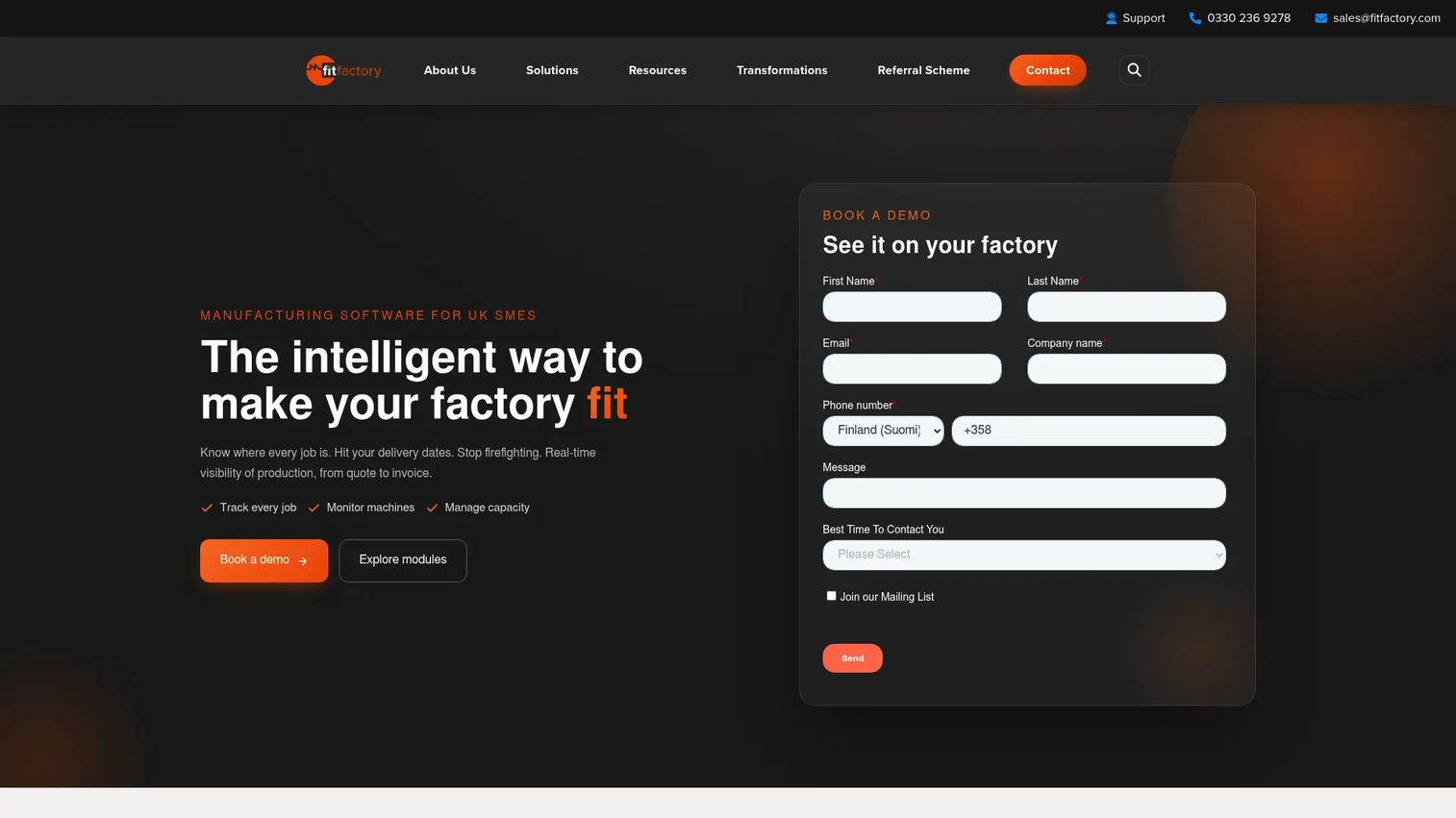
Fitfactory Tricorn MRP is modular production control and MRP software for UK manufacturing SMEs, covering the full production cycle from quotation through invoicing. Capabilities include quotation-to-invoice production control, inventory and works-order tracking with batch and serial-number traceability, full job and inspection traceability, built-in dashboards and real-time reporting, and both cloud and on-premise deployment options.
Best for: UK subcontract manufacturers, precision engineering firms, and fabricators that need integrated production control and traceability without a large ERP investment.
Key features
- Quotation-to-invoice production control
- Inventory, stock, batch-number, and works-order tracking
- Full job, material, process, and inspection traceability
- Built-in dashboards and real-time reporting
- Cloud or on-premise deployment
Why choose Fitfactory Tricorn MRP: The modular structure and UK focus make it a strong match for UK-based subcontract and precision engineering businesses. Shops that need traceability without full ERP complexity will find the feature scope fits their requirements well.
Fitfactory Tricorn MRP pricing: Contact Fitfactory for pricing. No pricing is currently displayed on the vendor website.
20. Clarity Software
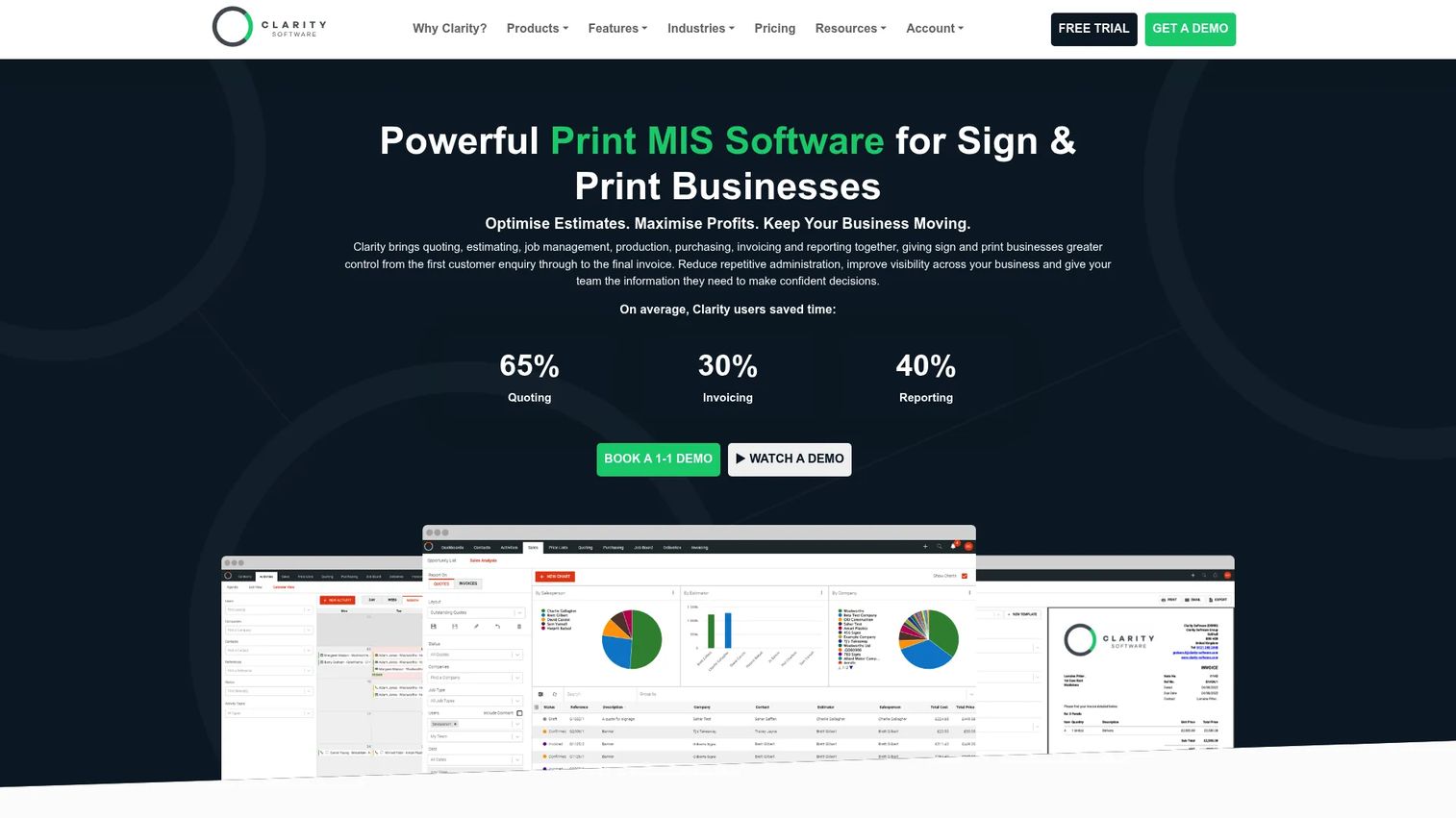
Clarity Software is a print management information system for sign, print, graphics, and related custom production businesses. It covers CRM and customer activity management, estimating and quoting, price lists with multi-currency support, sales pipeline management, production and job tracking, purchase orders and stock management, delivery scheduling, proof of delivery, digital invoicing, artwork approvals, and integrations with Xero, QuickBooks, and Sage.
Best for: Sign and print production businesses that need end-to-end workflow management from quote through job delivery and invoice.
Key features
- CRM and customer activity management
- Estimating, quoting, and price lists
- Production and job tracking
- Purchase orders and stock management
- Artwork approvals and digital invoicing
Why choose Clarity Software: Strong fit for sign and print businesses where customer-facing quoting, artwork approval, and production status need to run in one system. This is not a heavy industrial manufacturing ERP; the workflow matches creative custom production better than complex fabrication environments.
Clarity Software pricing: Clarity Go and Clarity Pro plans are available, but pricing is not currently displayed on the vendor website. Contact Clarity for a quote or request a free trial.
G2 rating: 3.8/5 (from 2 reviews)
21. Paperless Parts
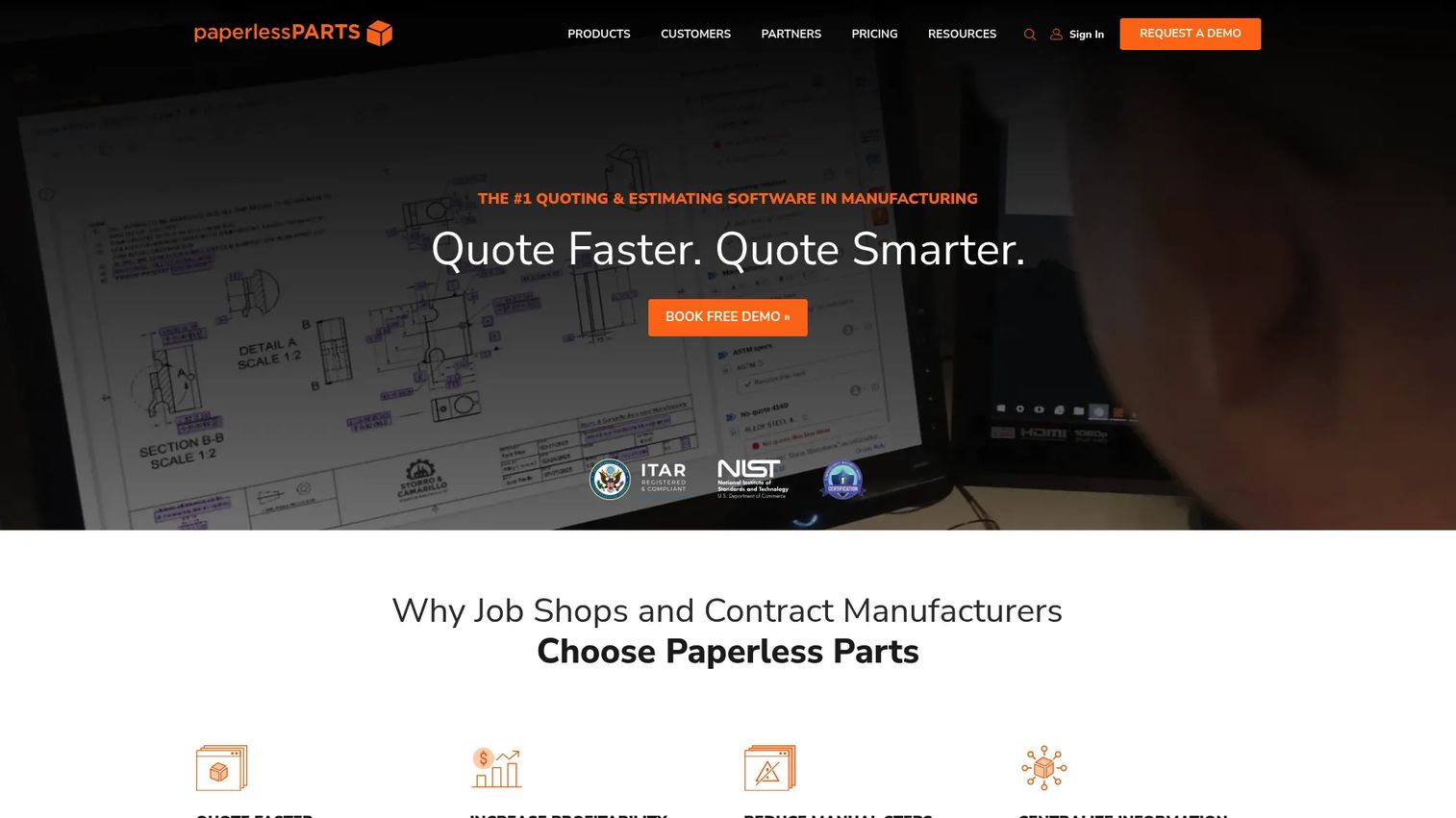
Paperless Parts is cloud-based quoting and estimating software for manufacturers and job shops. It uses geometry-driven cost estimating, customizable pricing and router templates, automatic manufacturability interrogations with DfM warnings, sheet-metal nesting, CAD unfolding, and an AI-powered Wingman feature for quote-package analysis. Customer portals and ERP integrations connect quoting to production workflows.
Best for: Machine shops and fabricators where quoting speed and consistency are the primary bottleneck limiting capacity utilization and win rates.
Key features
- Geometry-driven cost estimating and pricing
- Automatic DfM warnings and manufacturability analysis
- Customizable costing, pricing, and router templates
- Sheet-metal nesting and CAD unfolding
- ERP, CRM, and CAD system integrations
Why choose Paperless Parts: When quote turnaround time directly affects win rate, and estimators are spending hours manually analyzing drawings, this tool addresses that specific gap. It functions as a quoting layer alongside an existing ERP or production system rather than replacing the full manufacturing stack.
Paperless Parts pricing: Pricing is customized by shop size, required modules, integrations, and contract length. Contact Paperless Parts for a quote.
G2 rating: 4.6/5
Considerations when choosing job shop management software
Start with the workflow that breaks first
Identify the operational bottleneck before evaluating software. A shop losing margin at the quoting stage needs a different first system than a shop missing delivery dates because of capacity planning. Matching the tool to the current constraint produces faster return and lower adoption risk than buying the most feature-complete platform.
Check job costing before you check dashboards
Dashboards are only useful if the underlying data is complete. Ask every vendor how actual labor, material, outside services, scrap, and rework costs flow back to open jobs. Understand whether that data updates in real time or only at period close. Systems that show you margin at the job level while the job is still active are fundamentally more useful for protecting margin than those that report only at invoicing.
Match deployment to IT reality
Cloud, on-premise, and hybrid deployment carry different costs, security profiles, and maintenance responsibilities. A 15-person shop with no internal IT staff has a very different profile than a 200-person operation with an IT team managing shop-floor devices and network infrastructure. Factor in backup, access control, and the device types your shop-floor workers actually use before committing to a deployment model.
Budget for implementation, not only licenses
License cost is rarely the biggest number in a job shop ERP project. Data migration, routing setup, BOM cleanup, user training, integrations with accounting and CRM systems, and process redesign all carry time and cost. A cheaper per-seat price can become an expensive project if the internal bandwidth to configure and adopt the system is underestimated. Ask vendors for a realistic implementation plan with milestones, not just a go-live date.
Test the schedule with real jobs
Before selecting a platform, ask the vendor to schedule a sample set of jobs from your shop. Include a rush order, a rework scenario, a material shortage, and a job that uses outside processing. Watch how the system responds to each change. The scheduling engine is often where the real operational fit becomes obvious, and no demo script can substitute for running your actual production patterns through the tool.
Conclusion
The right job shop management software depends on where your operation currently loses time and margin, not on which platform has the most features.
For broad manufacturing ERP coverage, DELMIAWorks, JobBOSS2, Infor VISUAL, and Aptean WorkWise cover the most workflow depth. MRPeasy, Statii, and Fitfactory Tricorn MRP serve smaller manufacturers that need MRP without an enterprise rollout. ProShop ERP and 1factory are the strongest options for quality-driven and compliance-sensitive operations. Total ETO is the clearest fit for engineer-to-order manufacturers where engineering, purchasing, and production need to stay synchronized across a custom project. Paperless Parts addresses quoting speed directly. Fusion Operations and CyberPlan offer the deepest scheduling and execution visibility for shops where the production floor is the bottleneck.
Pick 3 vendors based on your primary bottleneck and shop size. Run one real job through each: Quote, schedule, purchasing, production, costing, and invoice. Compare the gaps you find, not the feature lists you read. That test will tell you more than any demo.
FAQs
There is no single answer because the right fit depends on whether the primary pain is in quoting, materials, scheduling, or quality. MRPeasy, Statii, and Fishbowl are frequently evaluated by smaller operations moving off spreadsheets. JobBOSS2 fits small to mid-sized job shops with strong make-to-order workflows. Start by identifying which workflow currently costs the most time or margin, then test candidates against that specific process.
Job shop ERP typically covers finance, purchasing, inventory, production, quality, and reporting in a unified system. Job shop management software is a broader label that can include standalone tools focused on a narrower scope, such as scheduling only, quoting only, quality management, or shop-floor execution. Some platforms marketed as job shop management software are full ERP systems; others are point solutions. Clarify the scope before evaluating.
MRP can be sufficient for smaller shops where the main challenge is materials and production planning rather than financial consolidation or complex multi-site operations. ERP becomes more useful when quoting, inventory, purchasing, accounting, and quality all need to share data in real time. Map your current bottleneck first, then choose the category that addresses it. Adding ERP complexity before the team is ready creates adoption risk without proportional operational benefit.
Pricing varies significantly by user count, module selection, deployment model, implementation scope, and support tier. Entry-level cloud MRP tools like MRPeasy start around $49/user/month. Fishbowl publishes plans starting at $229/month. Total ETO starts at $7,500/year for 5 seats with implementation included. Larger ERP systems from vendors like Infor, DELMIAWorks, and Aptean are quote-based and typically include implementation services as a separate cost. Compare total cost of ownership across at least two years, not just the license fee.
Finite capacity scheduling is the most important distinction. A scheduler that does not account for actual work center capacity, tooling availability, material readiness, and labor constraints will produce unrealistic plans. The schedule also needs to connect to quoting and job costing, so that a due-date change or rework event flows back to job margin automatically rather than requiring manual reconciliation. For more on this topic, see our guide on advanced planning and scheduling software.
Implementation length depends on data quality, process complexity, number of users, integrations required, and the internal time available to configure and train. Cloud MRP platforms with limited integration requirements can go live in weeks. Full ERP implementations with multi-site operations, custom integrations, and large user counts can run three to twelve months. Ask every vendor for an implementation plan that includes data migration, configuration, training, and go-live milestones, not just a target start date.
Most job shop platforms include financial modules or offer integrations with common accounting software. Key integration points include purchase orders, invoices, inventory valuation, labor cost, and job profitability reporting. Some platforms integrate with specific tools like QuickBooks, Xero, or Sage; others include their own financial modules. Verify the exact accounting platform your shop uses before selecting a system, and confirm the depth of the integration rather than assuming a checkbox on a feature list means bidirectional data flow.
Ask the vendor to run a real job from quote through invoice using your shop's actual data. Include at least one schedule change, one material shortage, one rework scenario, and one job with outside processing. Watch how the system updates job cost and delivery date when something changes mid-production. The response to those edge cases tells you more about operational fit than a polished demo of standard workflows. For shops evaluating options alongside an auto shop management software context, the same testing logic applies: Real scenarios beat scripted tours.