Your team spent three weeks building a workaround so a new product could quote correctly. It shipped. Then legal asked for a change to the endorsement logic, and the workaround broke. Again.
That is the reality of running a carrier on a policy administration system that was designed for a different decade. Quote, issuance, servicing, renewal, cancellation, and claims all touch the same record, and when the core cannot flex, every change becomes an engineering project with a queue attached. The cost is not just IT hours. It is slower product launches, brittle compliance reporting, and agents who lose deals while waiting for a rate change.
The market is voting with its budget. The global policy administration system market reached USD 7.2 billion in 2025 and is expected to hit USD 11.8 billion by 2034 at a 6.8% CAGR, according to MarketIntelo (2025). Cloud-based deployments already represent 62.1% of revenue in that same research, which tells you where the modernization pressure is heading.
This guide compares eight platforms on the criteria that actually decide implementation outcomes: full lifecycle coverage, product configurability, API and cloud readiness, billing and claims integration depth, auditability, and operating fit. If you are choosing an insurance policy management software today, the goal is not the longest feature list. It is the system that lets your team change a product without filing a ticket.
What's inside
This is a practical buyer's shortlist for insurance technology teams comparing a policy administration platform in 2026. We picked platforms based on four factors that matter most when you are the one accountable for the migration:
- Lifecycle coverage across quote, underwriting, issuance, servicing, renewals, and claims integration
- Configurability, meaning how much you can change without custom development
- Architecture and deployment fit, including cloud-native, modular, and API-first design
- Buyer-relevant credibility signals such as verified ratings and public product documentation
We left out pricing we could not verify against a first-party source, and we call out where ratings are thin.
TL;DR
Short on time? Here is the decision-oriented version of the list.
- Best for large P&C enterprise core: Guidewire PolicyCenter, for carriers standardizing on a configurable system of record.
- Best for modular, open-source flexibility: Openkoda Policy Management, for insurtech teams building custom workflows.
- Best for low-code modernization at scale: Duck Creek Policy, with a deep API and integration footprint.
- Best for cloud-native and AI-enabled operations: Majesco Policy, across personal, commercial, and specialty lines.
- Best for configurable product launches: EIS PolicyCore, with a product-factory approach.
- Best for mid-market P&C speed: BriteCore, a cloud-native core for insurers and MGAs.
- Best for lean, fast-moving insurers and MGAs: Insly, for modular insurance operations.
- Best for life, accident, and health: FINEOS Policy, with benefits-oriented workflow depth.
What is policy administration software?
Policy administration software is the core insurance system of record that manages the full policy lifecycle, from quote and issuance through servicing, renewals, cancellations, and integration with billing and claims. It is the operational backbone a carrier, MGA, or insurtech runs its business on, and it sits at the center of policy lifecycle management as the single source of truth for policy data.
A modern policy administration system insurance teams evaluate today typically covers these capabilities:
- New business and quoting: rating, product rules, and quote generation across lines of business
- Underwriting and issuance: automated and referral underwriting, an underwriting workbench, and policy issuance
- Servicing and endorsements: mid-term changes, endorsements, and policyholder updates
- Renewals, cancellations, and claims integration: lifecycle transitions and clean handoff to claims systems
- Billing, payments, and accounting: billing and payment integration, invoicing, and reconciliation
- Auditability and compliance: an audit trail, change history, versioning, and regulatory reporting support
- Reporting and data: a single source of truth with dashboards and analytics
The architecture story matters as much as the feature list. Legacy platforms were monolithic and hard to change. Modern insurance administration software leans toward modular, cloud-native, and API-first design, so carriers can launch products faster and integrate a distribution or claims tool without a re-platform.
When to use a policy administration system
Not every carrier needs the same platform, and the right time to move depends on what is breaking. Here is how to pattern-match your situation.
Replace legacy workarounds
If your current policy admin system is a mainframe-era core wrapped in spreadsheets, batch jobs, and custom scripts, you are paying an invisible tax on every change. A modern policy management system replaces those fragile patterns with configurable rules and a stable data model. This is the trigger when a routine rate or form change takes weeks and every fix risks breaking something else downstream.
Standardize multi-product operations
When you run personal, commercial, and specialty lines on different tools, data fragments and reporting gets painful. A configurable policy engine with strong product configuration and modularity lets you standardize workflows across lines while still tailoring each product. This matters most when you are launching new products often and need consistent underwriting, billing, and compliance behavior across all of them.
Improve customer and agent self-service
If your service team fields the same policy change requests all day, a modern platform with a customer portal and agent self-service reduces that operational load. Automating endorsements, document access, and payment updates frees staff for higher-value work. This is the trigger when servicing volume grows faster than headcount and you need to scale without adding people to every queue.
Comparison table
Here is the shortlist at a glance. Pricing across enterprise PAS is almost universally quote-based, so we mark those clearly rather than guessing. Ratings reflect verified G2 listings where available.
| # | Product | Intent | Key use case | Pricing | G2 rating |
|---|---|---|---|---|---|
| 1 | Guidewire PolicyCenter | Enterprise core | Full P&C policy lifecycle for large carriers | Quote-based | 4.2/5 |
| 2 | Openkoda Policy Management | Modular open-source | Custom policy workflows for insurtech teams | Free core; Enterprise from $4,000/mo | Not rated |
| 3 | Duck Creek Policy | Modular cloud platform | Low-code policy administration at scale | Quote-based | 4.6/5 |
| 4 | Majesco Policy | Cloud-native core | AI-enabled admin across P&C lines | Quote-based | 2.2/5 |
| 5 | EIS PolicyCore | Configurable policy engine | Product-factory launches and lifecycle | Quote-based | 4.0/5 |
| 6 | BriteCore | Mid-market cloud core | P&C admin, billing, and claims | Quote-based | 4.3/5 |
| 7 | Insly | Lean modular platform | Insurance operations for MGAs and insurers | Quote-based | Not rated |
| 8 | FINEOS Policy | Life, accident, health | Benefits-oriented policy administration | Quote-based | Not rated |
1. Guidewire PolicyCenter
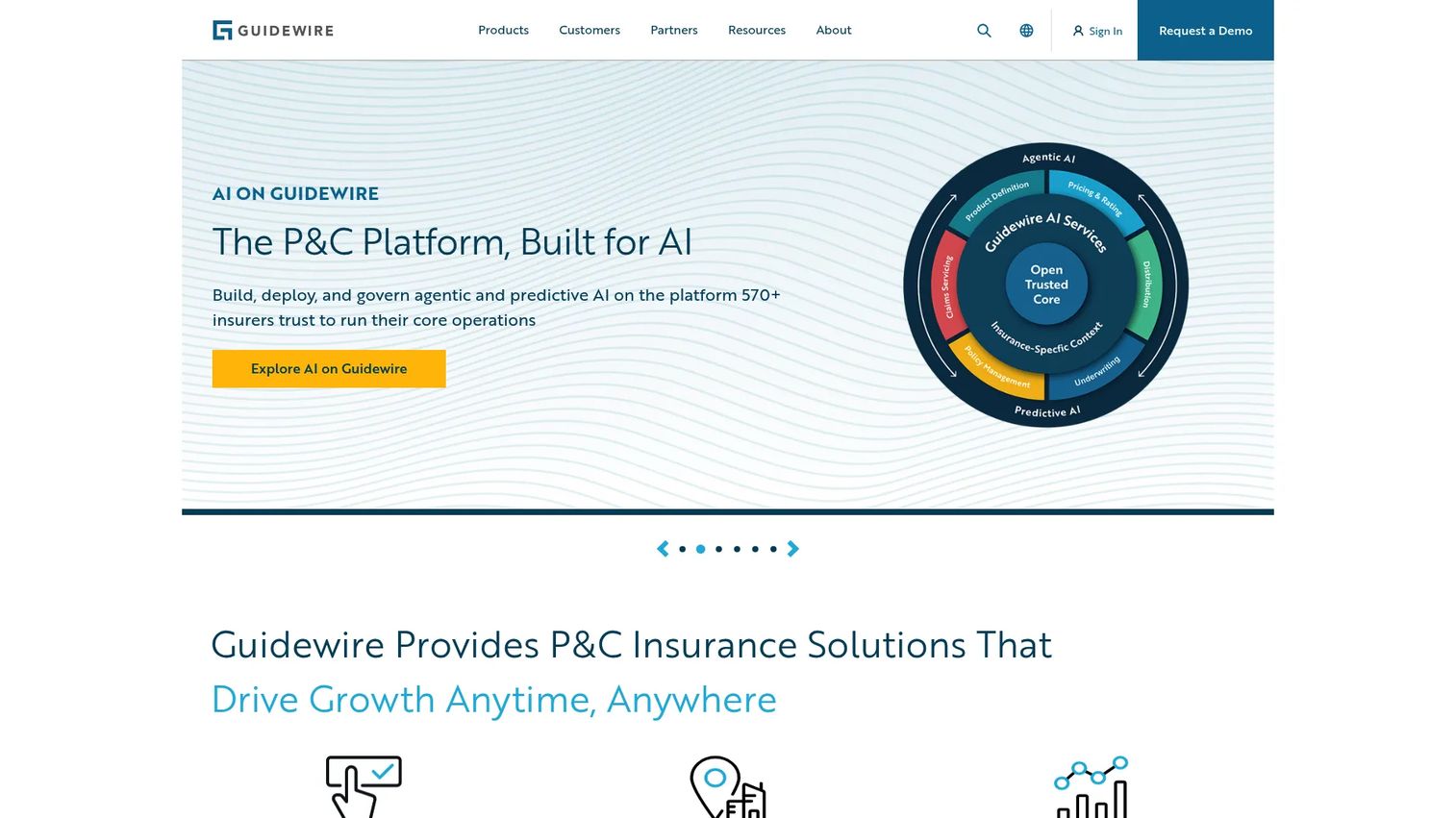
Guidewire PolicyCenter is the cloud insurance policy administration system for managing the full P&C policy lifecycle, and it is the reference point most large carriers benchmark against. It functions as a genuine system of record, so quote, issuance, servicing, and renewal all resolve against one consistent policy model. That system-of-record fit is why it shows up on nearly every enterprise shortlist.
Best for: P&C insurers that need a configurable policy administration platform they can standardize an entire operation on.
Key strengths
- Full lifecycle management: Handles the policy lifecycle from quote through renewal in one core.
- Flexible configuration: Configuration tools let teams deploy new products rapidly instead of coding each one.
- Connected core: Connects with billing and claims to keep data consistent across the operation.
Why choose Guidewire PolicyCenter: The case for PolicyCenter is depth and ecosystem. If you are a large carrier with complex products, multiple lines, and a long list of downstream integrations, the platform is built for that scale and has the partner network to support a serious implementation. It earns a 4.2/5 on G2. The tradeoff is that this power fits carriers ready to invest in a substantial rollout rather than teams wanting something lightweight.
Guidewire PolicyCenter pricing: Guidewire does not publish public pricing for PolicyCenter. The product pages direct visitors to request a demo or speak with an expert, so licensing is quote-based and scoped to your deployment. Expect an enterprise engagement rather than a self-serve price.
2. Openkoda Policy Management
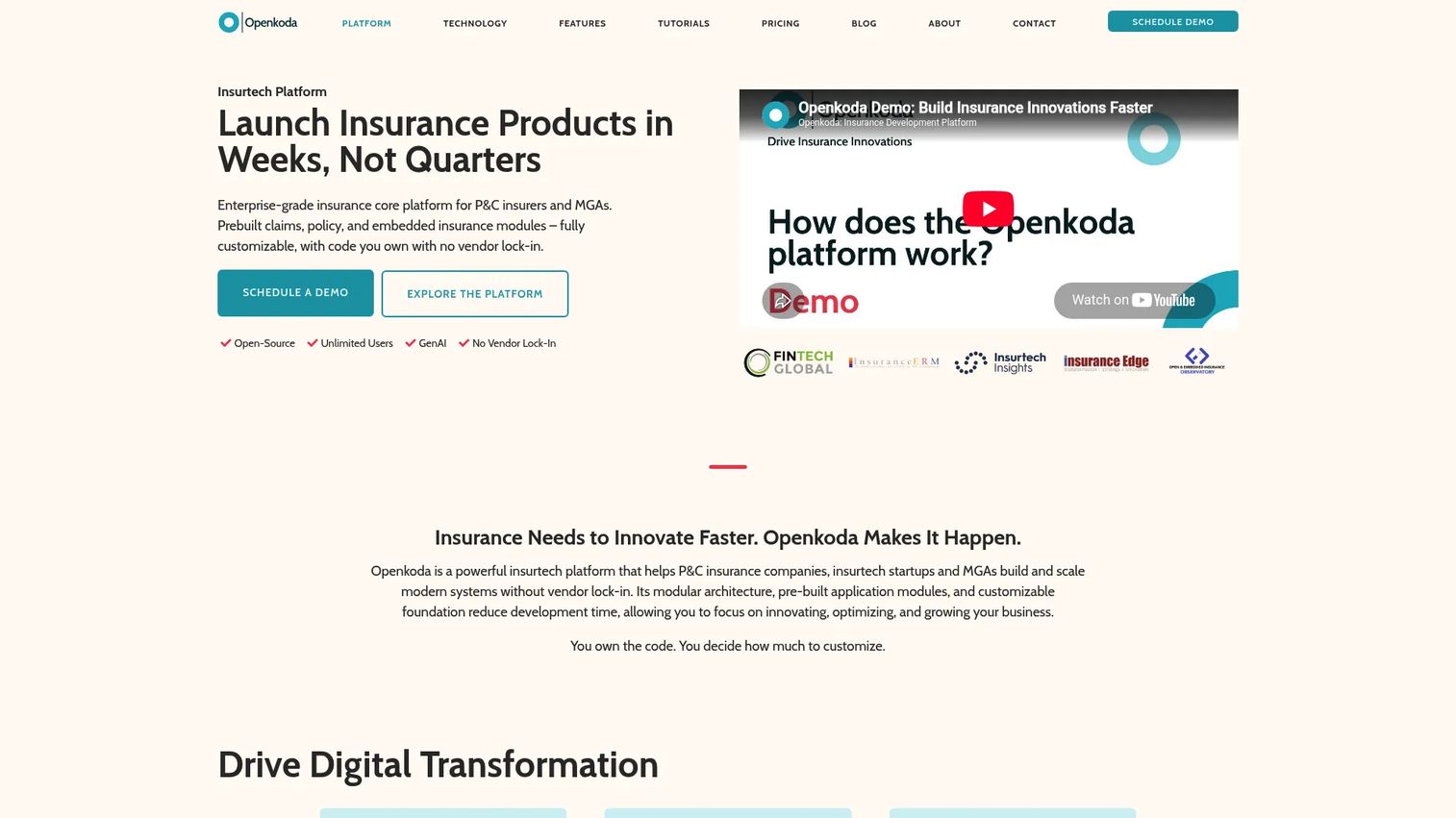
Openkoda Policy Management is a configurable policy administration template and platform for building and extending policy workflows, with an open-source core at its center. That open foundation is the whole pitch: teams that want to shape the system to their process, rather than shape their process to the system, start here. It appeals to insurtech builders and carriers with in-house engineering who value control over the data model and workflows.
Best for: Insurers and insurtech teams building customizable policy administration workflows on an open base.
Key strengths
- AI-powered reporting: Natural language reporting lets teams query policy data without building every report by hand.
- Multitenancy support: Multi-organization support suits MGAs and carriers running several entities on one platform.
- Customizable structure: Customizable dashboards and user roles adapt the workspace to different teams.
Why choose Openkoda Policy Management: The draw is flexibility and faster customization. Because the core is open-source under an MIT license, teams avoid the gated-feature friction of closed platforms and can extend workflows directly. This fits organizations that treat their policy engine as something to own and evolve, not just license.
Openkoda Policy Management pricing: Openkoda Core is free and open-source under an MIT license. Two paid plans exist: Enterprise Managed Cloud and Enterprise Self-Hosted, both listed at $4,000.00 per month. The free core makes it straightforward to evaluate before committing to a managed or hosted plan.
3. Duck Creek Policy
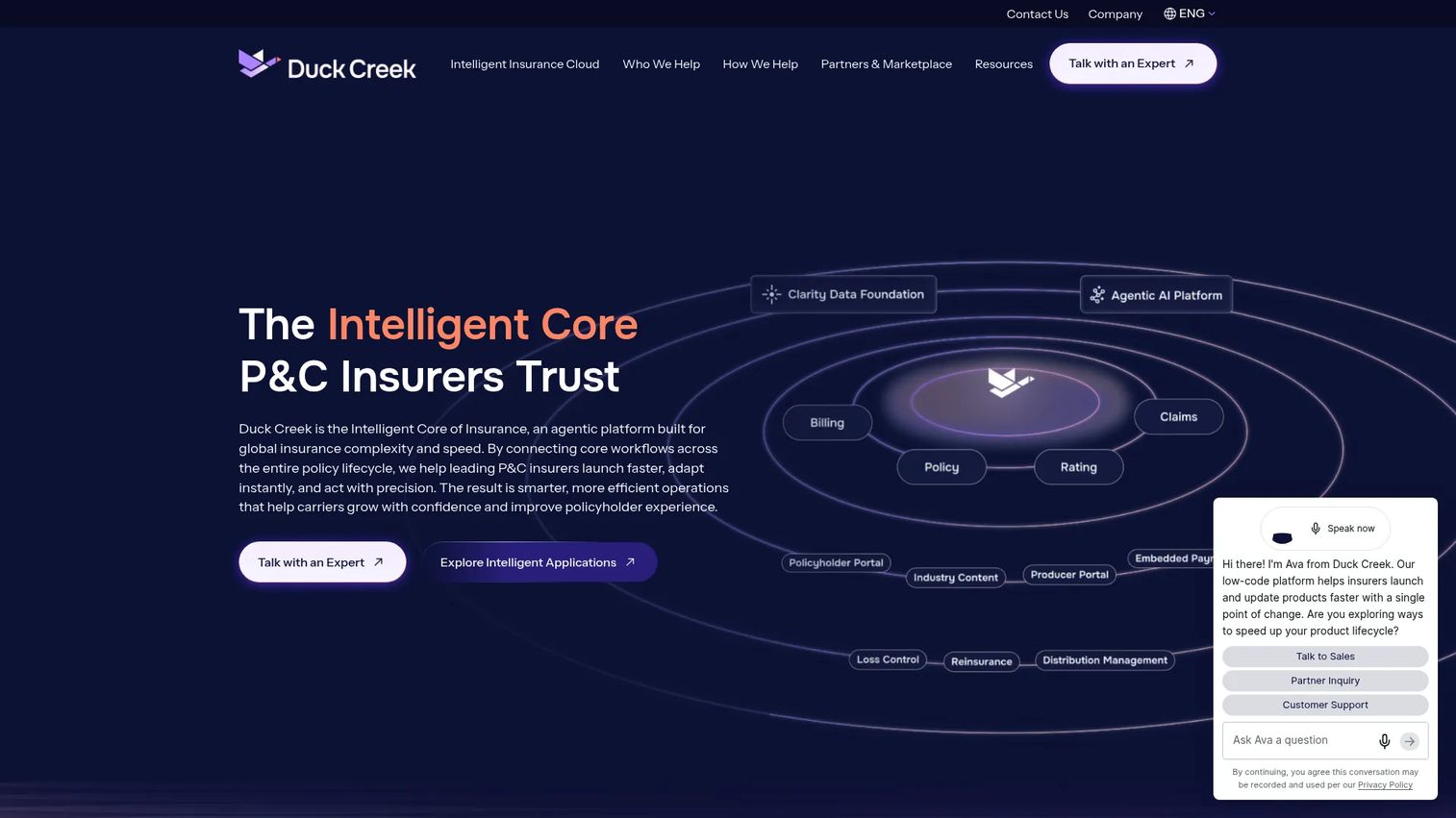
Duck Creek Policy is insurance policy administration software for P&C insurers, positioned around cloud-native architecture and low-code configurability. For teams whose main goal is modernization without endless custom development, the low-code approach is the headline. It lets business analysts adjust products and rules rather than routing every change through engineering, which is exactly the bottleneck most carriers are trying to remove.
Best for: Large P&C insurers that need configurable policy administration at scale with a deep integration footprint.
Key strengths
- Low-code configuration: Low-code and no-code policy configuration reduces the engineering queue for product changes.
- End-to-end lifecycle: Supports the full policy lifecycle in a single platform.
- Deep integration surface: More than 2,000 APIs and managed integrations connect billing, claims, and distribution tools.
Why choose Duck Creek Policy: The reason teams pick Duck Creek is the combination of API breadth and configurability for enterprise-grade modernization. With a 4.6/5 rating on G2, it carries strong reviewer sentiment among the platforms here. If your modernization roadmap depends on connecting many systems without brittle glue code, that 2,000-plus API footprint is the differentiator.
Duck Creek Policy pricing: Duck Creek does not publish public pricing. The policy product page directs visitors to talk to sales, so pricing is quote-based and scoped to your deployment. Plan for an enterprise procurement process.
4. Majesco Policy
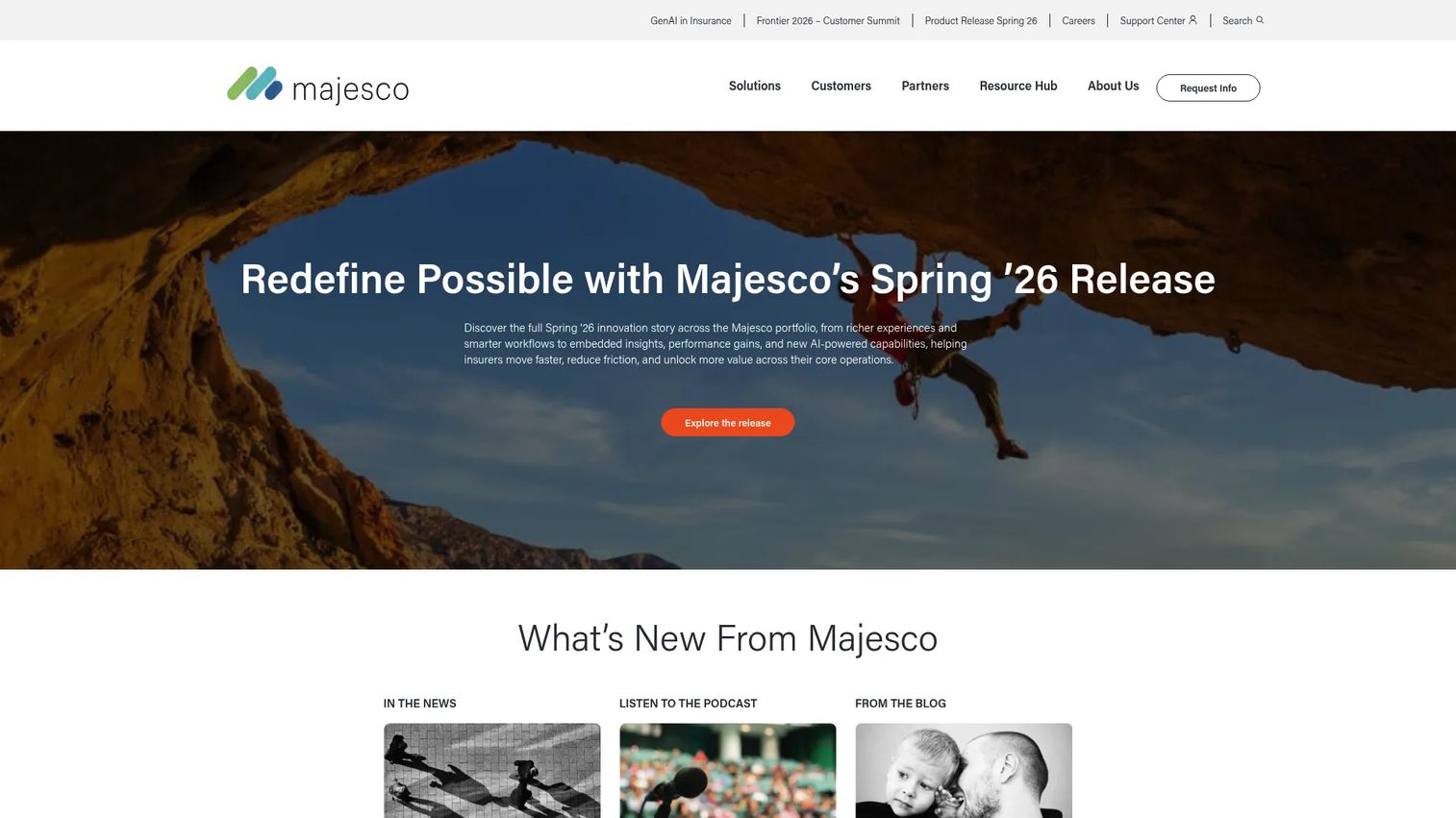
Majesco Policy is insurance policy administration software for P&C insurers, built around cloud-native, AI-enabled operations. Its scope is notably broad across lines of business, which makes it a candidate when you want one platform to standardize a diverse book. Buyers frequently compare it against legacy core replacements when the goal is to consolidate multiple aging systems onto a modern foundation.
Best for: P&C insurers that need configurable policy administration with AI features across many product lines.
Key strengths
- AI-enabled administration: AI features support underwriting and servicing workflows inside the core.
- Broad line coverage: Supports personal, commercial, specialty, workers' compensation, and emerging products.
- Embedded intelligence: Embedded analytics, automation, and configurable workflows come built in.
Why choose Majesco Policy: The argument for Majesco is line-of-business breadth plus a modern, automation-forward design. If you run a diverse portfolio and want a single cloud-native platform rather than several specialized ones, that coverage is compelling. Note that its current G2 rating sits at 2.2/5 on a limited review base, so weigh peer references and a hands-on evaluation heavily before committing.
Majesco Policy pricing: Majesco does not publicly display pricing. Industry references indicate subscription-based licensing, but no public figure is shown, so treat pricing as quote-based and scoped through a sales conversation.
5. EIS PolicyCore
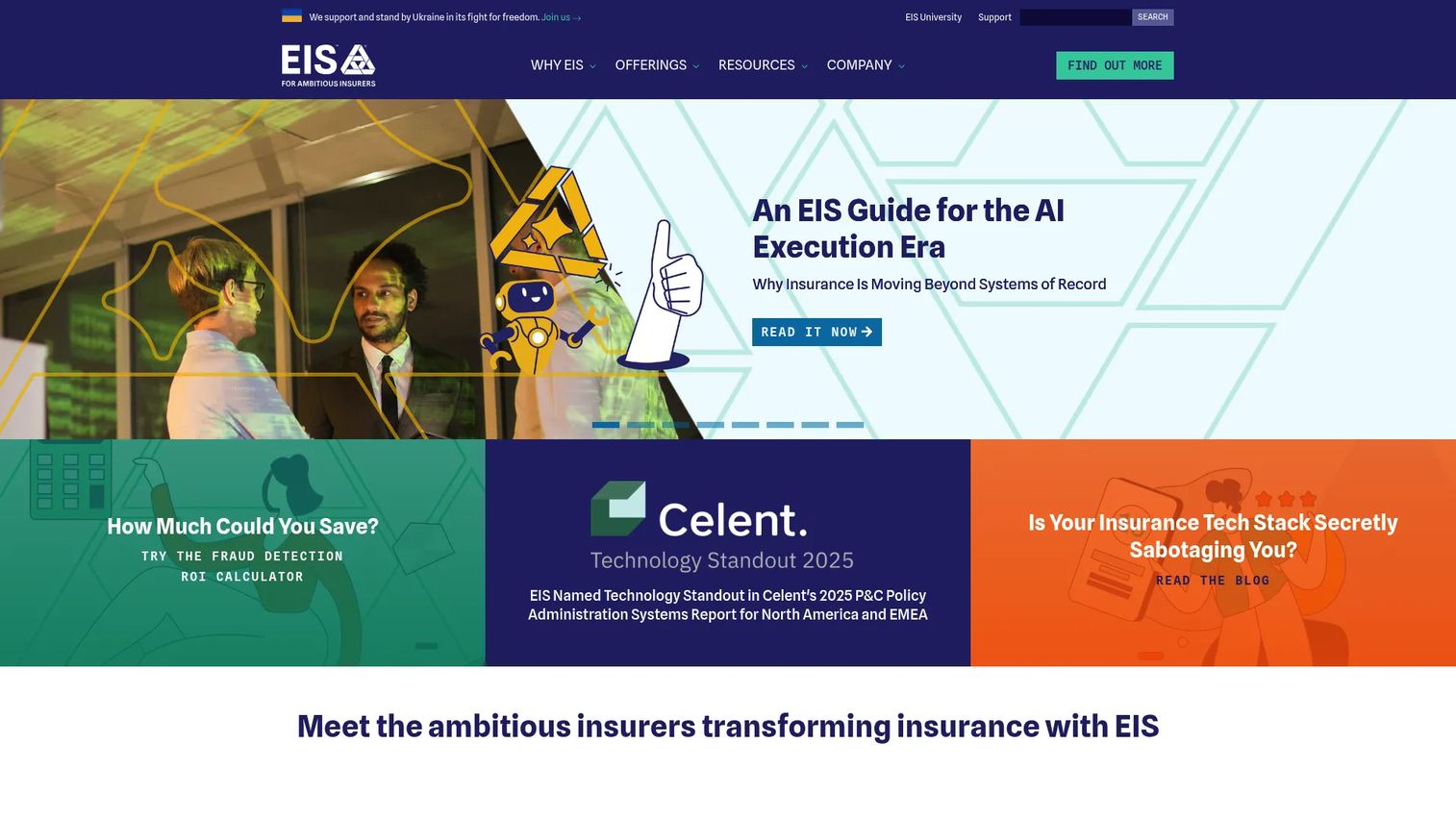
EIS PolicyCore is insurance policy administration software that manages quoting, underwriting, issuance, renewals, and related lifecycle workflows, built on an API-driven, modular design. Its defining idea is the product-factory concept: configure and launch new insurance products quickly rather than building each one from scratch. For teams whose competitive edge depends on shipping products fast, that configurability is the core reason to look here.
Best for: Insurers that need a configurable policy administration platform focused on rapid product launches.
Key strengths
- Lifecycle coverage: Manages the policy lifecycle from quote to renewal in one platform.
- Product configuration: Product bundling and tiering support flexible product definitions.
- Automated core: Automated underwriting, rating, and policy issuance reduce manual handling.
Why choose EIS PolicyCore: The case is operational agility through configuration. As part of a broader modular suite, PolicyCore lets teams stand up and iterate products without a re-platform, which suits carriers competing on speed to market. Its G2 listing shows a 4.0/5 rating on a very small review base, so lean on reference calls and a structured proof of concept during evaluation.
EIS PolicyCore pricing: EIS does not publish public pricing for PolicyCore. Pricing is quote-based and arranged through the vendor, so scope it as part of an enterprise procurement conversation.
6. BriteCore
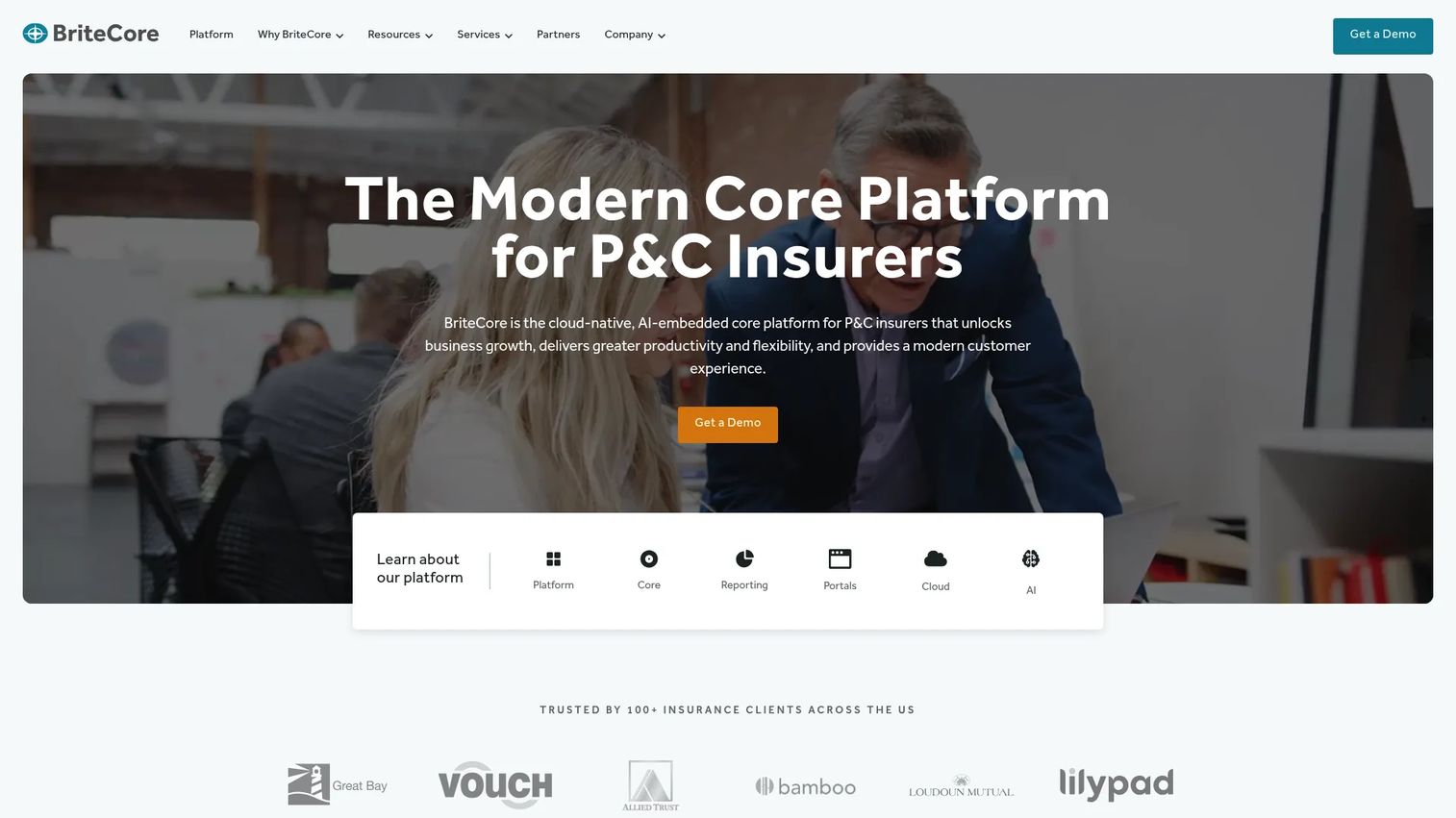
BriteCore is a cloud-native core insurance platform for P&C insurers, bundling policy administration, billing, and claims in one system. It is especially attractive for mid-market carriers and MGAs that want modern architecture and maintainability without the weight of the largest enterprise cores. The appeal is speed to value: a cloud-native core that a leaner team can actually operate and evolve.
Best for: Mid-size P&C insurers and MGAs that need a modern core platform with strong maintainability.
Key strengths
- Unified core: Policy administration, billing, and claims run in one platform.
- Reporting and analytics: Dashboards and custom reports give teams a clear operational view.
- Portals and APIs: Agent and policyholder portals plus APIs and integrations support self-service.
Why choose BriteCore: BriteCore fits teams that want cloud-native speed and lower operational overhead over the maximal configurability of the largest platforms. With a 4.3/5 rating on G2, it lands well with mid-market reviewers. If your priority is getting a modern core live and maintainable without a multi-year program, this is a strong fit.
BriteCore pricing: BriteCore does not publicly display pricing. The site directs visitors to book a demo or contact the team, so pricing is quote-based and scoped to your deployment size and lines of business.
7. Insly
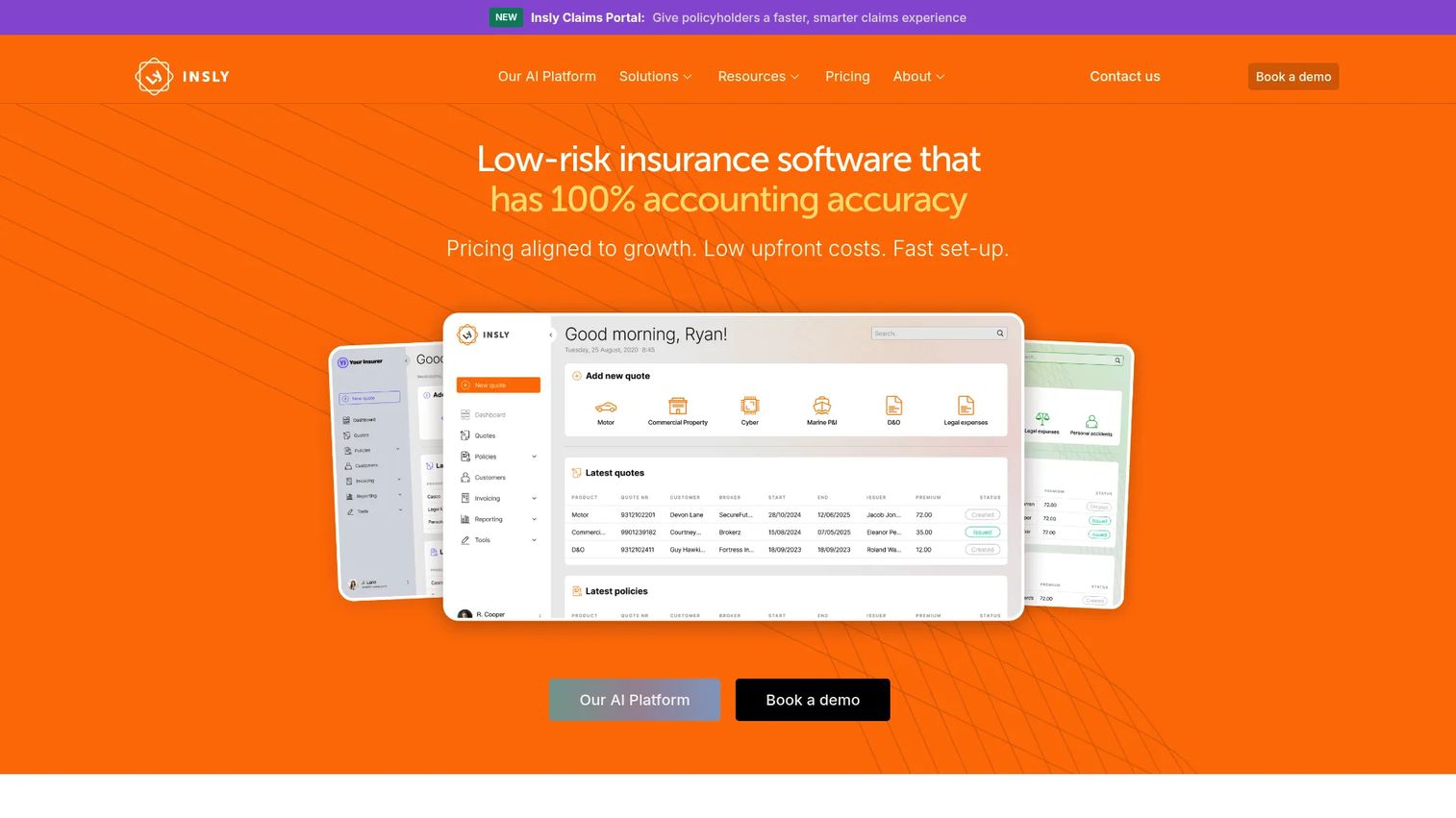
Insly is insurance software for MGAs and insurers, built to support product building, distribution, accounting, and claims workflows in a modular way. It is designed for leaner, fast-moving operations that want configurable insurance operations without the overhead of a heavyweight core. For smaller carriers and MGAs, the pitch is a platform they can configure and run without a large IT organization behind it.
Best for: MGAs and insurers that need modular insurance operations software they can move quickly with.
Key strengths
- Product builder: A product builder and policy administration layer let teams define and launch products.
- Insurance accounting: Built-in accounting and reporting keep financial workflows in the platform.
- Claims management: Native claims management connects servicing to the rest of the lifecycle.
Why choose Insly: The draw is a leaner, modular platform that fits fast-moving teams. Operational teams gain configurable product building, accounting, and claims in one system without the implementation weight of the largest enterprise cores. It suits MGAs and smaller insurers optimizing for agility and speed to launch.
Insly pricing: Insly's pricing is quote-based. The pricing page states that both MGA and insurer plans are tailored and shows a "get a tailored quote" path rather than a public number, so pricing is scoped to your operation.
8. FINEOS Policy
FINEOS Policy is policy administration software for employee benefits and life, accident, and health insurers, which sets it apart from the P&C-focused platforms on this list. For benefits-oriented carriers, that specialization is the point: the workflows, member administration, and rules are built for group and individual LAH products rather than retrofitted from a property core. It sits within a broader admin suite adjacent to billing and claims.
Best for: Large insurers that need a core policy administration platform for life, accident, and health lines.
Key strengths
- Policy and member administration: Handles both policy and member-level administration for benefits products.
- Workflow and rules engine: A configurable workflow and rules engine supports complex LAH processing.
- API-based integration: API-based integration connects to the insurer's surrounding systems.
Why choose FINEOS Policy: The reason to shortlist FINEOS is domain fit. If you write life, accident, and health or employee benefits, a platform purpose-built for those workflows and adjacent to billing and claims in the same suite reduces the integration and configuration burden of forcing a P&C core into a benefits shape.
FINEOS Policy pricing: FINEOS does not publish public pricing for its policy administration system. The product pages direct visitors to contact the team or see a demo, so pricing is quote-based and scoped through a sales conversation.
Considerations before you buy
A demo will show you the happy path. The following criteria surface what actually determines whether an implementation succeeds. Work through each before you sign.
Lifecycle coverage and configurability
Confirm the platform handles your full lifecycle, from quote and underwriting through servicing, renewals, cancellations, and claims handoff. Then push on configurability: what can a business analyst change without engineering, and what still requires custom development? The answer predicts your ongoing cost of change more than any feature list.
Architecture and deployment fit
Decide whether monolithic, modular, or API-first suits your operating model. Cloud-native platforms dominate new deployments, and cloud-based systems already represent 62.1% of policy administration system revenue per MarketIntelo (2025). Match the architecture to your integration roadmap and internal engineering capacity, not to a trend.
Billing and claims integration
Policy data does not live alone. Verify how the platform handles billing and payment integration and claims integration, whether through native modules or documented APIs. Weak integration here is where data drifts and reconciliation breaks, so treat it as a first-class evaluation area rather than an afterthought.
Auditability and compliance
Regulators care about the audit trail. Confirm the system captures change history, versioning, and the reporting you need to satisfy compliance in every jurisdiction you operate in. A clean single source of truth makes examinations and internal audits far less painful.
Total implementation risk
Be honest about your capacity. The most capable platform is the wrong choice if your team cannot staff the migration and data conversion. Weigh implementation timeline, data migration complexity, and vendor support against your internal resources before committing.
Conclusion
The right policy administration platform depends on your operating model, not on a ranking. For large P&C carriers standardizing on a configurable system of record, Guidewire PolicyCenter and Duck Creek Policy are the natural benchmarks, with Duck Creek's low-code and API depth strong for integration-heavy modernization. Majesco Policy and EIS PolicyCore compete on cloud-native breadth and configurable product launches. For mid-market P&C, BriteCore offers modern architecture with maintainability, while Openkoda Policy Management and Insly serve teams that want modular, flexible platforms they can move quickly with. If you write life, accident, and health, FINEOS Policy is purpose-built for your workflows.
The practical next step: narrow to two or three platforms that match your lifecycle needs and architecture, then run a structured proof of concept on your real products and data. Test configurability with an actual product change, verify billing and claims integration, and pressure-test the audit trail against a compliance scenario. That is how you avoid buying a system that demos well and implements poorly.
FAQs
Policy administration software manages the full policy lifecycle for an insurer: quoting, underwriting, issuance, servicing and endorsements, renewals, cancellations, and integration with billing and claims. It acts as the system of record and single source of truth for policy data, so every transaction resolves against one consistent model. Modern platforms add configuration tools so teams can launch and change products without custom code.
A CRM manages relationships, contacts, and sales pipeline. A policy administration system manages the policies themselves, the actual contracts, coverages, premiums, and lifecycle transactions that run the insurance business. They are complementary, not interchangeable. Carriers typically integrate the two so sales and servicing teams share context, but the PAS is the operational core where the policy record lives.
Prioritize full lifecycle coverage, configurability without heavy custom development, and architecture that fits your integration roadmap. Then evaluate billing and claims integration depth, a robust audit trail for compliance, and the vendor's implementation support. The best-fit platform is the one your team can actually configure, integrate, and maintain given your internal capacity, not the one with the longest feature list.
Cloud-native platforms dominate new deployments, and cloud-based systems represent 62.1% of policy administration system revenue per MarketIntelo (2025), largely for scalability, faster updates, and lower infrastructure overhead. That said, the right answer depends on your regulatory requirements, data residency needs, and existing infrastructure. Cloud-native is the default direction, but validate it against your specific compliance and integration constraints.
They are critical. Policy data feeds billing, and claims decisions depend on accurate policy and coverage data, so weak integration is where data drifts and reconciliation breaks. Evaluate whether the platform offers native billing and claims modules or well-documented APIs, and test the handoff during your proof of concept. Treat integration depth as a first-class selection criterion, not a checkbox.
For most modernizing carriers, modular and API-first architectures win because they let you change and integrate components without a full re-platform. Monolithic cores can still work for stable operations that rarely change, but they make product launches and integrations slower. Match the architecture to how often you launch products and how many systems you need to connect.
Any insurer whose servicing volume is outpacing headcount benefits from a customer portal and agent self-service. Portals let policyholders and agents handle endorsements, document access, and payments without a service rep, which reduces operational load and improves experience. The trigger is when your team fields the same routine requests repeatedly and needs to scale servicing without adding people to every queue.
Data migration and internal capacity are the two that sink projects most often. Converting legacy policy data cleanly is complex, and even the strongest platform fails if your team cannot staff the rollout and configuration. Scope the migration realistically, secure vendor implementation support, and run a proof of concept on real products and data before committing to a full deployment.