Your plant does not lose time because it lacks data. It loses time because recipe changes, lot records, quality holds, and production events live in different places, and nobody can pull them together fast enough when something goes wrong.
A batch fails review. An ingredient lot needs tracing back to the supplier. Leadership wants to understand the margin impact before the board call. Your team is rebuilding the story from paper logs, spreadsheets, and a generic ERP that was never designed for formula-driven production.
The batch management software market reached USD 2.05 billion in 2025, according to Global Market Statistics, and more than 7,500 manufacturing facilities worldwide already run some form of batch processing software, per MarketGrowthReports (2025). The category is maturing fast, but the range of products is wide. Some sit at the plant control layer. Others are full process manufacturing ERPs. A few are food-specific platforms built around compliance and traceability.
Picking the wrong category costs more than the license fee. It costs implementation time, data migration, retraining, and the integrations you did not budget for.
This guide helps you identify where your bottleneck actually sits before you start talking to vendors.
What's inside
This guide covers 12 batch management software tools evaluated for recipe management depth, execution capability, traceability, quality workflows, integration breadth, and industry fit. Tools were selected to represent the full category spectrum: MES platforms, process manufacturing ERPs, food-specific systems, and control-oriented batch execution software.
Selection criteria:
- Batch-specific capability: Recipes, execution, lot traceability, and electronic records
- Operational fit: Food, chemicals, life sciences, nutraceuticals, and broader process manufacturing
- Integration coverage: ERP, MES, LIMS, plant systems, and finance connections
- Implementation realism: Deployment model, data requirements, and total cost drivers
TL;DR
- Best for food safety and batch documentation: FoodReady, for food and beverage teams that need compliance, traceability, and quality in one operational system
- Best for process manufacturing ERP: BatchMaster ERP, for formula-driven manufacturers replacing generic accounting tools
- Best for plant-wide batch execution: TrakSYS, for multi-site manufacturers that need a configurable MES layer with electronic batch records
- Best for ISA 88 batch control: AVEVA Batch Management, for control-intensive process plants with complex recipe routing
- Best for Microsoft Dynamics-based food ERP: inecta Food ERP, for food operations that need batch manufacturing tied directly to finance
- Best for mid-market food production planning: JustFood ERP, for food companies needing production, traceability, and ERP in one platform
What is batch management software?
Batch management software helps manufacturers define recipes, execute controlled production steps, track materials and lots, record quality events, and maintain a searchable history of every production batch.
The term covers a broad set of products. Depending on the vendor, it may sit inside a manufacturing execution system (MES), a process manufacturing ERP, a dedicated batch control platform, or a food-specific compliance tool. Choosing the right one starts with knowing which layer you actually need.
Core functions
- Recipe and formula management: Master recipes, version control, scaling rules, and formula variants
- Batch scheduling and execution: Work order creation, operator instructions, and step sequencing
- Electronic batch records: Digital capture of every production event, material use, and operator action
- Material consumption and lot genealogy: Forward and backward traceability from raw material to finished product
- Quality checks and release workflows: In-process inspections, QC holds, deviation capture, and release approvals
- Audit trails and electronic signatures: Timestamped records supporting regulatory review and internal investigations
- Yield and variance reporting: Actual versus planned output, waste tracking, and batch cost analysis
- System integrations: Connections to ERP, LIMS, DCS, PLC, historian, and WMS platforms
How batch management software differs from ERP and MES
| Software layer | Primary job | Typical buyer |
|---|---|---|
| ERP | Commercial, inventory, planning, and finance system of record | CFO, CIO, operations leadership |
| MES | Plant execution connecting work instructions, operators, and equipment | Plant manager, operations director |
| Batch control | Process control and recipe execution for automation-intensive production | Process engineer, control system owner |
| Quality system | Testing, deviations, CAPA, inspections, and release | Quality director, regulatory affairs |
| Batch management software | Can sit inside any of the above, depending on vendor and industry | Varies by category fit |
Many platforms in this list span more than one row. The decision question is: Which layer is currently broken?
When batch management software becomes necessary
Four situations reliably signal that spreadsheets and generic tools have hit their ceiling:
- Repeated quality incidents where root cause takes days to establish
- Expansion from one site to multiple plants with inconsistent processes
- Growing audit, recall, or regulatory exposure with no reliable batch history
- Margin volatility caused by yield loss, rework, or inaccurate production costs
When to use batch management software
Standardize recipe execution across sites
Structured recipes, operator prompts, and revision control reduce process drift between shifts and plants. The catch: Standardization requires clean master data before go-live. Teams that skip recipe cleanup during implementation find the system mirrors the variation it was supposed to fix.
Trace ingredients through production and shipment
Forward traceability answers "where did this lot go?" Backward traceability answers "what went into this batch?" Both matter for customer complaints, supplier investigations, and recall readiness. The FDA Food Traceability Rule compliance deadline of July 20, 2028, gives food companies a planning horizon, but building traceability into operations takes longer than most teams expect.
Connect plant execution to planning and finance
Separate spreadsheets create a lag between what happened on the floor and what finance reports. By the time leadership sees yield or cost data, the root cause is three weeks old. ERP and MES integration closes that gap, but it requires decisions about data ownership and refresh frequency before selecting a platform.
Batch management software comparison
"Batch management software" describes a job, not a uniform product class. The 12 tools below span MES platforms, process manufacturing ERPs, food-specific compliance systems, and control-oriented batch execution software. Before comparing vendors, decide whether your primary gap is plant execution, business operations, food compliance, or automation control. The right answer changes which row of this table matters most.
| # | Product | Best for | Key differentiator | Pricing | G2 rating |
|---|---|---|---|---|---|
| 1 | FoodReady | Food safety and batch documentation | AI-powered food safety, traceability, and compliance workflows | Quote required; 14-day trial available | 4.7/5 |
| 2 | BatchMaster ERP | Formula-based process manufacturers | ERP plus recipes, batch production, quality, and lot traceability | Quote required | 2.9/5 |
| 3 | TrakSYS | Multi-site manufacturing execution | Configurable MES with electronic batch records and OEE analytics | From $1,999/mo (Essentials) | 4.8/5 |
| 4 | AVEVA Batch Management | ISA 88 batch control environments | Control-system-neutral recipe execution and batch history | Quote required | Not listed |
| 5 | Infor CloudSuite Food and Beverage | Enterprise food and beverage operations | Industry ERP with planning, quality, and supply chain depth | Quote required | Not listed |
| 6 | SYSPRO Food | ERP-led food and beverage manufacturers | Food processes inside a broader mid-market ERP | Quote required | 4.1/5 |
| 7 | Plex Food and Beverage | Cloud manufacturing operations | Cloud MES, quality, traceability, and analytics in one platform | Quote required | 4.0/5 |
| 8 | Adifo Software | Recipe-driven food and beverage manufacturers | Formulation, labeling, quality, and ERP-connected workflows | Quote required | 5.0/5 (1 review) |
| 9 | Columbus Food Manufacturing | Microsoft Dynamics food manufacturers | Food extensions, traceability, and transformation consulting | Quote required | Not listed |
| 10 | Fishbowl Manufacturing | Smaller manufacturers needing inventory control | Inventory, BOMs, and work orders with accounting sync | From $675/mo | 4.0/5 |
| 11 | JustFood ERP | Food companies on Microsoft Dynamics | Food-specific traceability, recipes, and production planning | Quote required | Not listed |
| 12 | inecta Food ERP | Growing food processors and distributors | Food ERP on Microsoft Dynamics 365 Business Central | Budget at least $150,000 | Not listed |
Best 12 batch management software tools for 2026
1. FoodReady
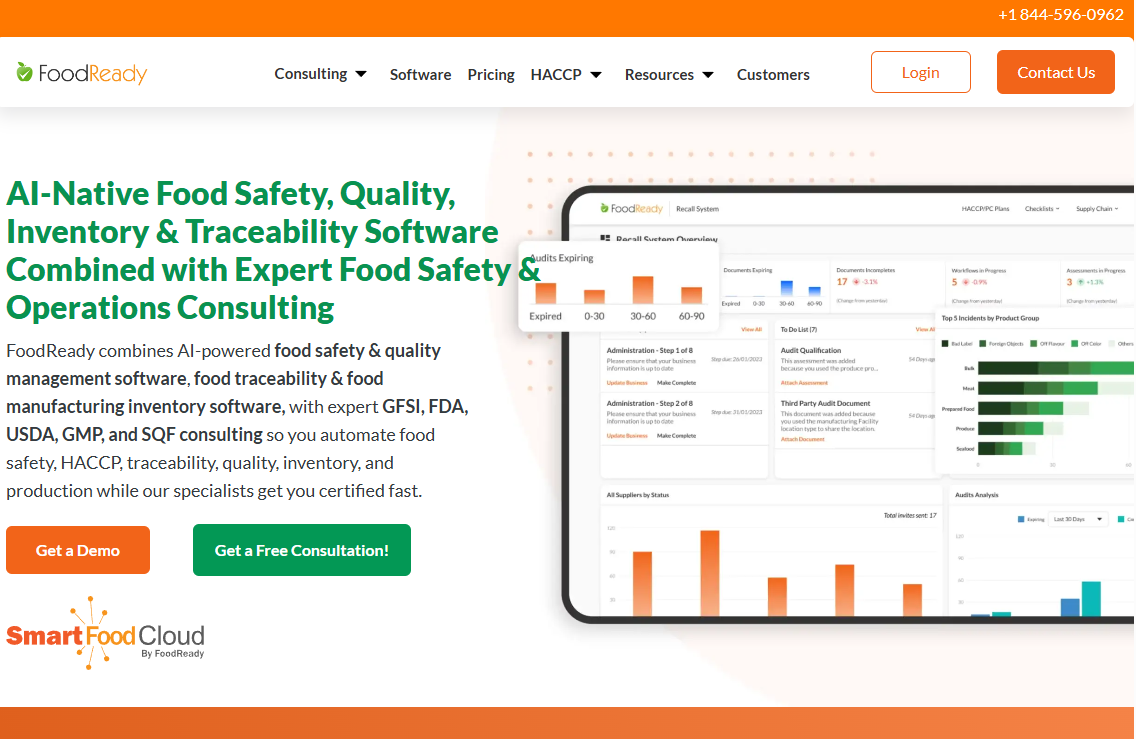
FoodReady is an AI-powered food safety, quality, traceability, inventory, and production platform built specifically for food manufacturers, processors, co-packers, and distributors. It combines HACCP and food safety program management with batch records, lot traceability, recipe management, and supplier documentation in one operational system. The platform also includes food safety consulting, which matters for teams without a full-time quality director. A mobile app handles digital logs and Bluetooth temperature monitoring on the floor.
Best for: Food and beverage operations that need food safety compliance, traceability, and batch documentation in the same platform rather than stitched across separate tools.
Key features
- AI HACCP and PCP plan builder
- Batch records, production logs, and recipe management
- Lot and ingredient traceability with recall management
- Automated supplier document management
- Mobile app with Bluetooth temperature logging and digital checklists
Why choose FoodReady: It earns its place when food safety program management and batch operations need to share the same data model, so a quality hold, a supplier issue, or a recall investigation pulls from one source of truth instead of three.
FoodReady pricing: All plans require a quote. A 14-day free trial is available. Annual plan options are offered.
G2 rating: 4.7/5 based on 20 reviews.
2. BatchMaster ERP
BatchMaster ERP is an industry-specific ERP built for formula-based process manufacturers across food, chemicals, nutraceuticals, pharmaceuticals, and cosmetics. It covers formula and laboratory management, batch production planning and scheduling, lot traceability, quality control with CAPA workflows, product costing, and mobile warehousing. The platform addresses the full production-to-finance loop, which makes it relevant for teams replacing generic accounting or ERP tools that were never designed for formula-driven manufacturing.
Best for: Growing and mid-market formula-based manufacturers that need ERP depth alongside batch operations, particularly when costing and quality compliance are primary constraints.
Key features
- Formula, recipe, and laboratory management
- Batch production planning and scheduling
- Lot traceability and compliance controls
- Quality control and CAPA workflows
- Product costing and mobile warehousing execution
Why choose BatchMaster ERP: It fits manufacturers that need a single system across production, inventory, quality, and finance rather than a separate batch tool bolted onto a generic ERP.
BatchMaster ERP pricing: Pricing requires registration and is confirmed by quote. No self-serve pricing page is available. Contact the vendor for a license and implementation estimate.
G2 rating: 2.9/5. Capterra reviewers rate it 4.4/5 from 17 reviews, which suggests a meaningful gap between platform audiences. Verify recent reviews for your industry before shortlisting.
3. TrakSYS
TrakSYS is a manufacturing execution system (MES) platform from Parsec that digitizes, connects, and optimizes complex manufacturing operations. Its batch-relevant capabilities include guided electronic work instructions, validated workflows, embedded quality checks, SPC, lot traceability, audit trails, electronic signatures, and real-time OEE tracking. The platform is configurable across industries and scales from single-plant KPI management to multi-site regulated manufacturing deployments. Parsec positions it for manufacturers that need both execution standardization and operational analytics.
Best for: Manufacturers that need a configurable plant-floor execution layer across multiple sites, especially where electronic batch records, quality evidence, and cross-site reporting need to share a common platform.
Key features
- Electronic batch records and validated workflows
- Guided work instructions with embedded quality checks
- Real-time OEE monitoring and production alerts
- Lot traceability, audit trails, and electronic signatures
- Multi-site production analytics dashboards
Why choose TrakSYS: The platform earns consideration when the bottleneck is plant-floor execution standardization, not ERP or finance, and when operational analytics need to reflect what is actually happening across sites in near-real time.
TrakSYS pricing: Subscription plans start at $1,999/month for the Essentials tier (annual terms). Growth starts at $4,999/month, Premier at $10,999/month, and Ultimate at $15,999/month. Final pricing depends on deployment scope, sites, modules, and services.
G2 rating: 4.8/5 based on 16 reviews.
4. AVEVA Batch Management
AVEVA Batch Management is a control-system-neutral platform for recipe management and batch execution in process manufacturing. It implements ISA 88 batch process models, supports concurrent multi-product and multi-stream execution with material traceability, and stores a complete electronic batch history. The platform connects to DCS and automation systems without requiring a specific vendor's control infrastructure. It also supports FDA 21 CFR Part 11 and cGMP Annex 11 compliance requirements for regulated manufacturers in life sciences, fine chemicals, and food and beverage.
Best for: Control-intensive process manufacturers where recipe execution must tie tightly to industrial automation, flexible production routing matters, and batch history needs to meet regulatory audit standards.
Key features
- ISA 88 recipe and batch process management
- Multi-product and multi-stream concurrent execution
- Automatic electronic batch record capture and storage
- DCS and control-system-neutral automation connectivity
- FDA 21 CFR Part 11 and cGMP Annex 11 support
Why choose AVEVA Batch Management: It fits plants where automation, shared equipment, and strict recipe execution consistency take priority over all-in-one ERP functions. Teams with existing AVEVA infrastructure will find integration more direct.
AVEVA Batch Management pricing: Pricing is confirmed by quote. No self-serve price is available. Budget for related platform components, DCS architecture considerations, and implementation partner costs.
5. Infor CloudSuite Food and Beverage
Infor CloudSuite Food and Beverage is an industry-specific cloud ERP suite combining production planning, raw material management, lot and shelf-life traceability, quality control, supply chain planning with AI and machine learning, product lifecycle management, and financial operations. It is built for food and beverage manufacturers that need broad enterprise coverage across manufacturing, supply chain, and finance, rather than a point solution for batch execution alone. Multi-site and global operations are core design targets.
Best for: Larger food and beverage businesses that need cross-functional enterprise ERP coverage, not just batch documentation, and have the implementation capacity for a significant platform deployment.
Key features
- Food and beverage ERP with production scheduling and raw material management
- Lot and shelf-life traceability with quality and compliance tools
- Supply chain planning with demand forecasting and AI-assisted scheduling
- Product lifecycle management for formulations and labeling
- Multi-site and enterprise financial management
Why choose Infor CloudSuite Food and Beverage: The right fit for operations that have outgrown a mid-market ERP and need a system that connects production, supply chain, and finance without heavy custom integration work.
Infor CloudSuite Food and Beverage pricing: Subscription-based cloud pricing confirmed by quote. No self-serve tier or starting price is displayed. Expect implementation services to be a significant cost driver alongside license fees.
6. SYSPRO Food
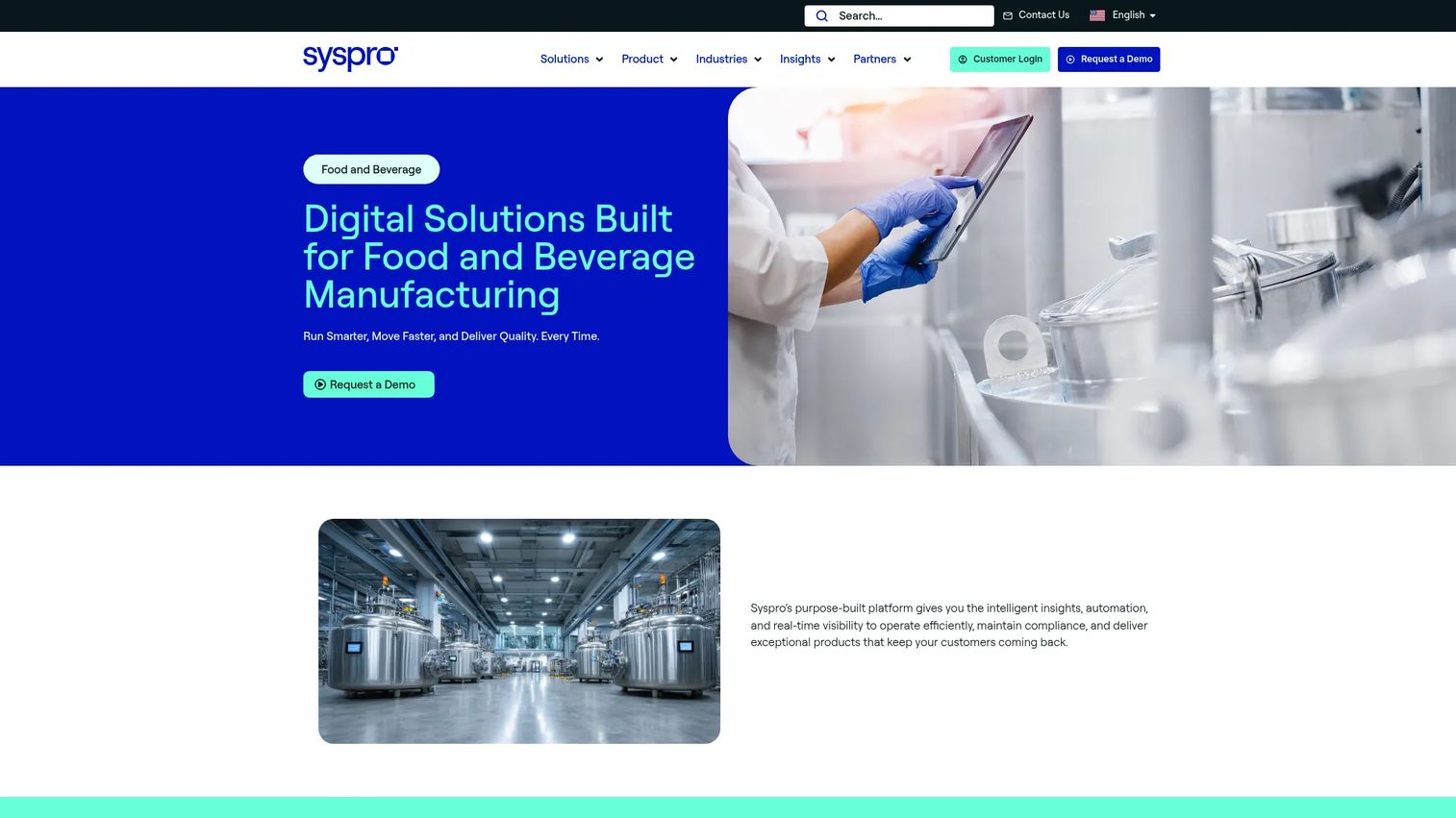
SYSPRO Food is a food and beverage manufacturing option within SYSPRO's broader mid-market ERP platform. It covers recipe and formula management, lot and batch traceability, shelf-life and expiry management, quality management, regulatory compliance workflows, manufacturing operations, and advanced planning and scheduling. The platform positions itself for mid-sized manufacturers that want one operating system across production, inventory, and finance rather than a separate batch execution tool.
Best for: Mid-sized food and beverage manufacturers that want integrated ERP, traceability, and recipe management without managing a separate plant execution system.
Key features
- Recipe and formula management with shelf-life controls
- Lot and batch traceability through the supply chain
- Quality management and regulatory compliance workflows
- Advanced planning and scheduling for production
- ERP financial integration across operations
Why choose SYSPRO Food: It works well when the primary need is consolidating food operations onto one ERP rather than adding a specialist MES or batch control system alongside an existing platform.
SYSPRO Food pricing: Contact the vendor for a quote. No self-serve pricing is available. Implementation scope and module selection drive the total cost.
G2 rating: 4.1/5.
7. Plex Food and Beverage
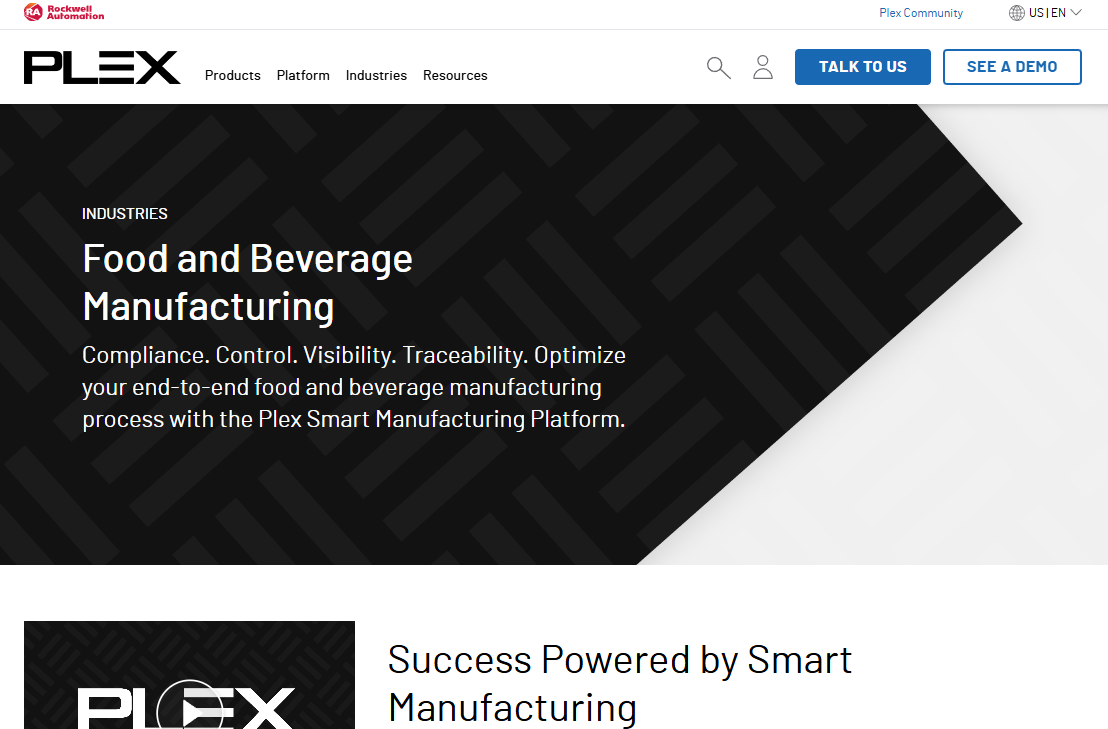
Plex Food and Beverage, part of Rockwell Automation, is a cloud-based smart manufacturing platform combining MES, ERP, quality management, supply chain planning, plant-floor automation, and analytics. Batch-specific capabilities include yield and cost reporting, food safety and quality management, lot traceability, recall support, demand forecasting, advanced MRP, and built-in EDI. The platform is designed for manufacturers seeking cloud-delivered operations software with broad plant visibility and reduced on-premises application management.
Best for: Food and beverage manufacturers seeking cloud-delivered manufacturing operations software that covers production execution, traceability, quality compliance, and enterprise visibility in one subscription.
Key features
- Batch-oriented MES with yield and cost reporting
- Lot traceability and food safety quality management
- Supply chain planning and advanced MRP
- Plant-floor automation and asset performance monitoring
- Built-in EDI and manufacturing analytics
Why choose Plex Food and Beverage: It suits teams that want cloud-delivered manufacturing operations data without maintaining on-premises application infrastructure, and where connected plant visibility across production, quality, and supply chain matters more than deep customization.
Plex Food and Beverage pricing: Annual subscription billing with package-based pricing confirmed by quote. No self-serve price is displayed on the first-party site.
G2 rating: 4.0/5 for the Plex Smart Manufacturing Platform.
8. Adifo Software
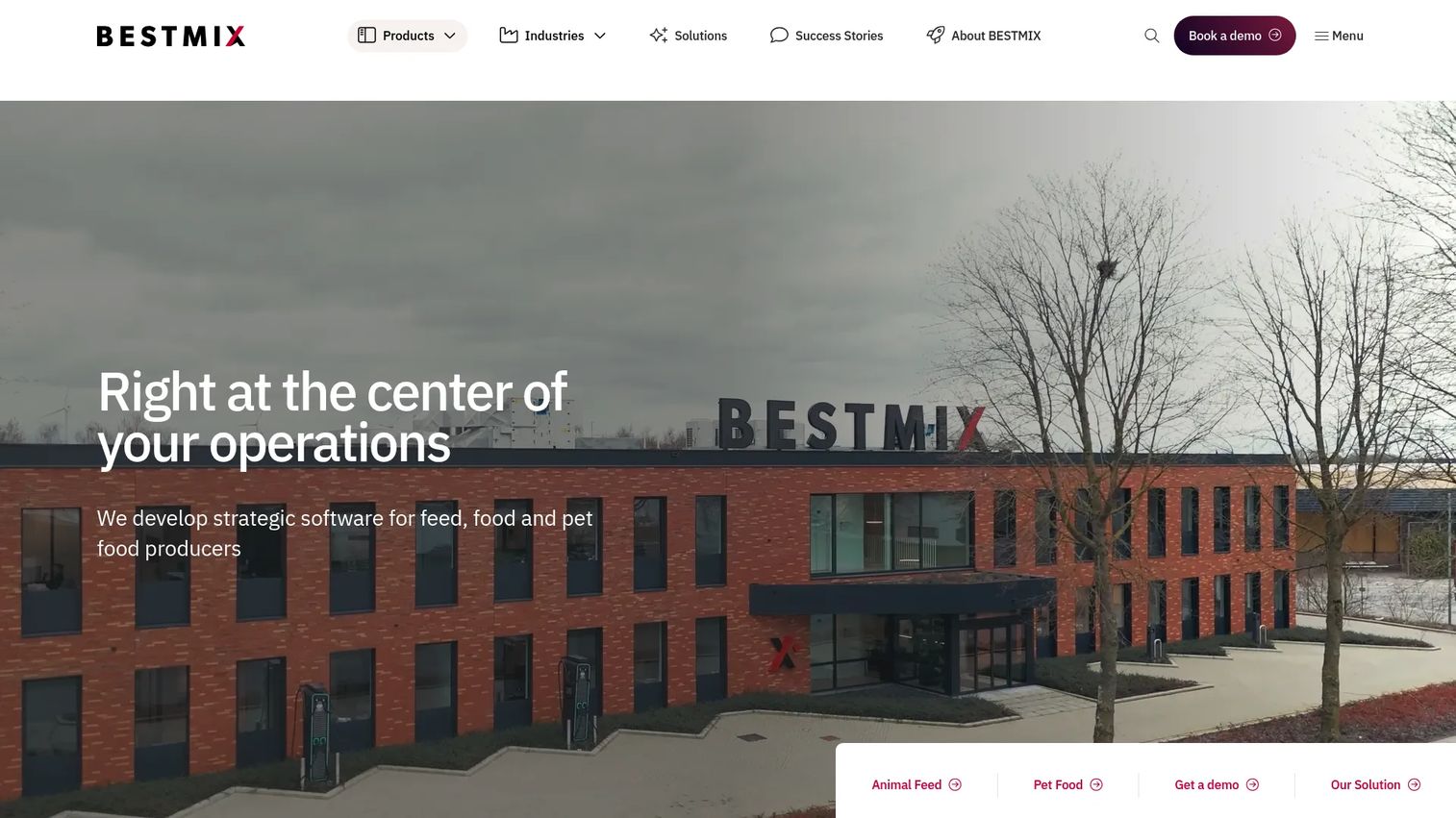
Adifo Software, now marketed as BESTMIX, develops strategic software for feed, food, and pet-food producers. The platform covers recipe formulation and cost optimization, quality data management with laboratory integrations and out-of-specification workflows, ERP and operational workflow management, automated label and specification generation, and cloud-based multilingual collaboration. It connects to ERP, MES, and LIMS platforms for operations that already have a core system of record.
Best for: Feed, food, pet-food, premix, and specialty food producers where formulation accuracy, nutritional data, labeling compliance, and recipe change control are the primary operational constraints.
Key features
- Recipe formulation and cost optimization
- Quality data management and lab integrations
- Automated labels, specifications, and nutritional declarations
- ERP, MES, and LIMS connectivity
- Cloud-based multilingual collaboration and reporting
Why choose Adifo Software: It earns a place when product development and formula governance need to connect tightly to manufacturing execution, particularly where labeling accuracy and regulatory declarations are recurring workstreams.
Adifo Software pricing: Contact the vendor for a quote. No pricing is displayed. Implementation scope and module selection determine the total cost.
G2 rating: 5.0/5 based on 1 review.
9. Columbus Food Manufacturing
Columbus Food Manufacturing provides digital transformation consulting and industry-specific technology for food and beverage manufacturers. Their food and beverage offering covers end-to-end supply chain traceability and compliance, production optimization with IoT-enabled freshness tracking, demand forecasting using historical data and seasonality inputs, quality controls for goods receipt and production, and MES integrations. Columbus delivers this largely through Microsoft platform implementations, making it relevant for operations already committed to the Microsoft stack.
Best for: Food manufacturers that want food-specific workflows and transformation expertise built around an existing Microsoft Dynamics investment.
Key features
- Supply chain traceability and compliance management
- Production optimization and IoT freshness tracking
- Demand forecasting with seasonality and pricing inputs
- Goods receipt and production quality controls
- MES and production system integrations
Why choose Columbus Food Manufacturing: It reduces fragmentation for teams committed to the Microsoft ecosystem and needing implementation expertise alongside the software. The consulting layer matters for organizations without deep internal ERP ownership.
Columbus Food Manufacturing pricing: Pricing is confirmed by quote and typically combines software licensing, implementation services, and Dynamics licensing. No self-serve price is available.
10. Fishbowl Manufacturing
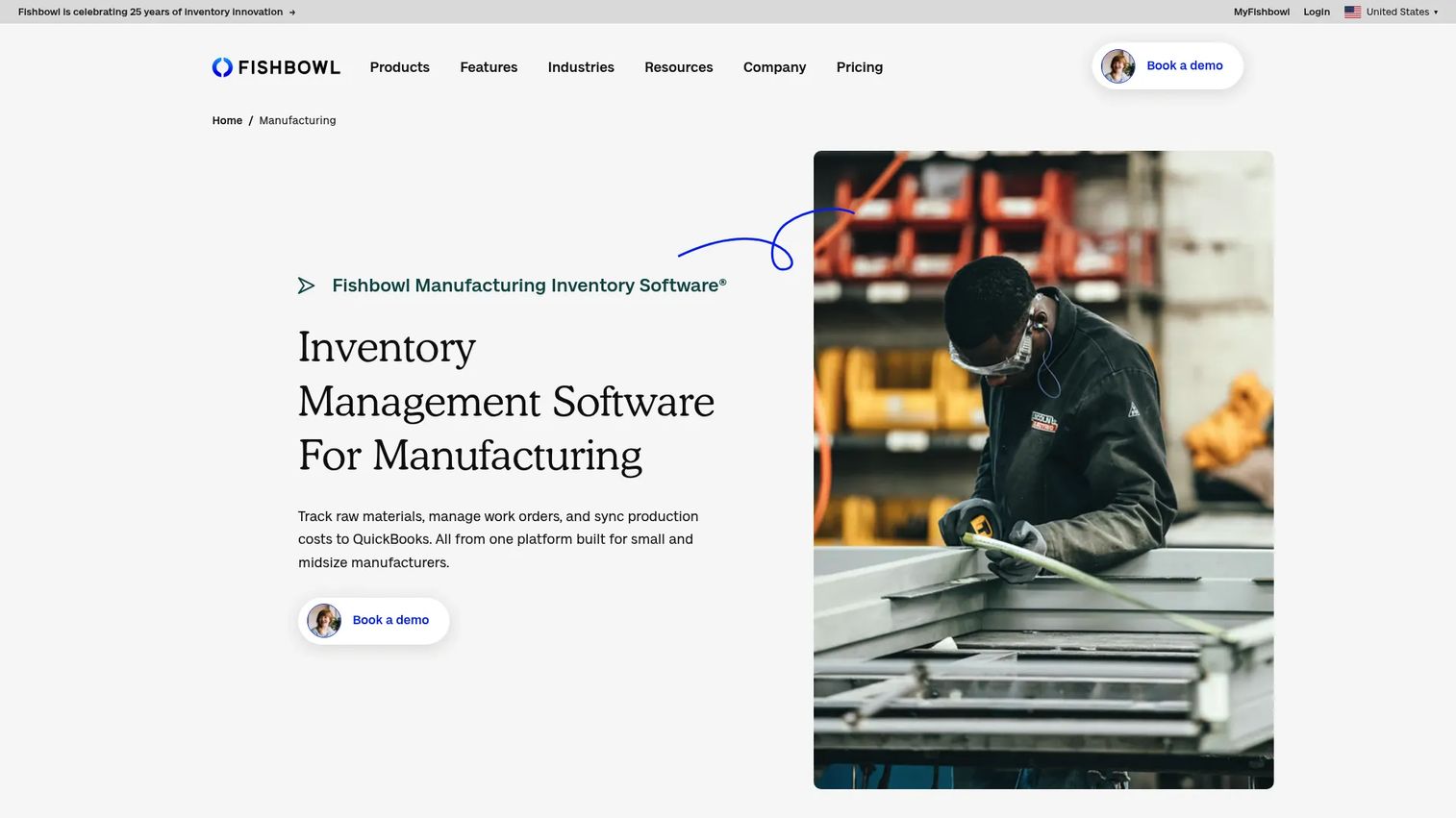
Fishbowl Manufacturing is cloud-hosted manufacturing inventory software covering bills of materials, configurable builds, work orders, production scheduling, material requirements planning, capacity planning, time tracking, lot traceability, and accounting system synchronization. It integrates with QuickBooks and supports barcode scanning for warehouse workflows. Fishbowl occupies a different tier from MES or process manufacturing ERP platforms, which matters when evaluating it against this list.
Best for: Smaller manufacturers that need better inventory control, work order management, and production visibility before taking on a full ERP or MES implementation.
Key features
- Bills of materials and configurable builds
- Work order management and MRP
- Lot and batch traceability
- Capacity planning and labor costing
- QuickBooks integration and mobile barcode scanning
Why choose Fishbowl Manufacturing: It fits operations where the primary gap is inventory and production order visibility, not regulated batch execution or complex formula management. It is a practical starting point before a larger platform investment.
Fishbowl Manufacturing pricing: Advanced Manufacturing plans start at $675/month. Final pricing depends on user count and deployment scope and is confirmed by quote.
G2 rating: 4.0/5.
11. JustFood ERP
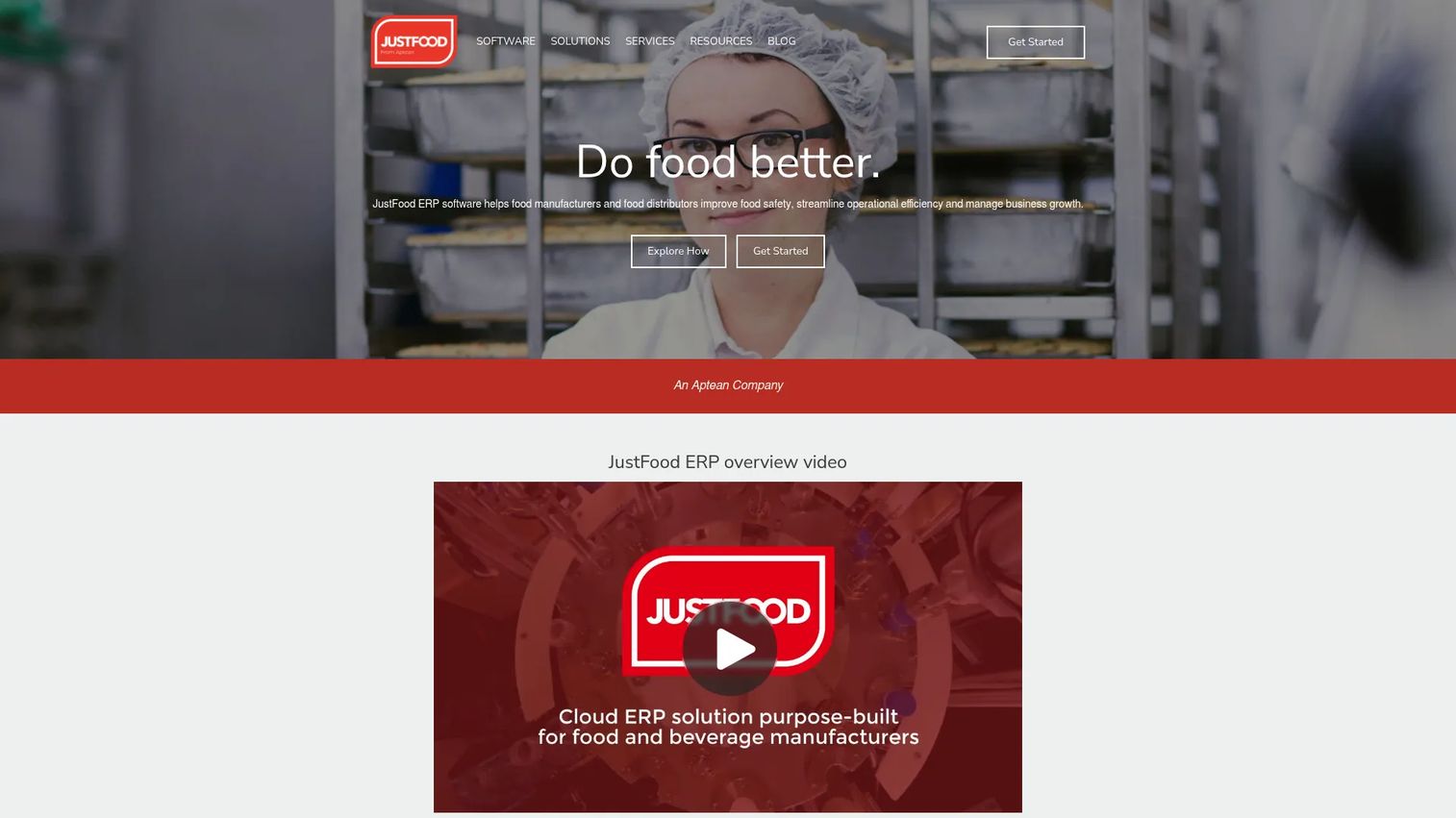
JustFood ERP is cloud ERP software built specifically for food manufacturers and distributors. It covers food safety, quality, compliance, traceability, and recall management alongside warehouse and inventory management with lot tracking, FEFO, and bin management. Production scheduling, batch processing, bills of materials, and yield reporting are included. The platform is designed to unite production, inventory, sales, procurement, and financial data for food companies.
Best for: Food manufacturers and distributors that need food-specific ERP coverage across production, traceability, compliance, and finance rather than a generic ERP with food modules added later.
Key features
- Food safety, quality, and recall management
- Lot tracking, FEFO, and bin-level warehouse management
- Batch processing, BOMs, and yield reporting
- Production scheduling with food-specific controls
- ERP-connected financial reporting
Why choose JustFood ERP: It fits food companies trying to unite production, inventory, and financial data in one system rather than managing handoffs between a plant system and a separate ERP. Confirm current product roadmap and support structure with the vendor before committing.
JustFood ERP pricing: Pricing requires a conversation with the vendor. The site directs buyers to request pricing based on deployment, modules, and team size.
12. inecta Food ERP
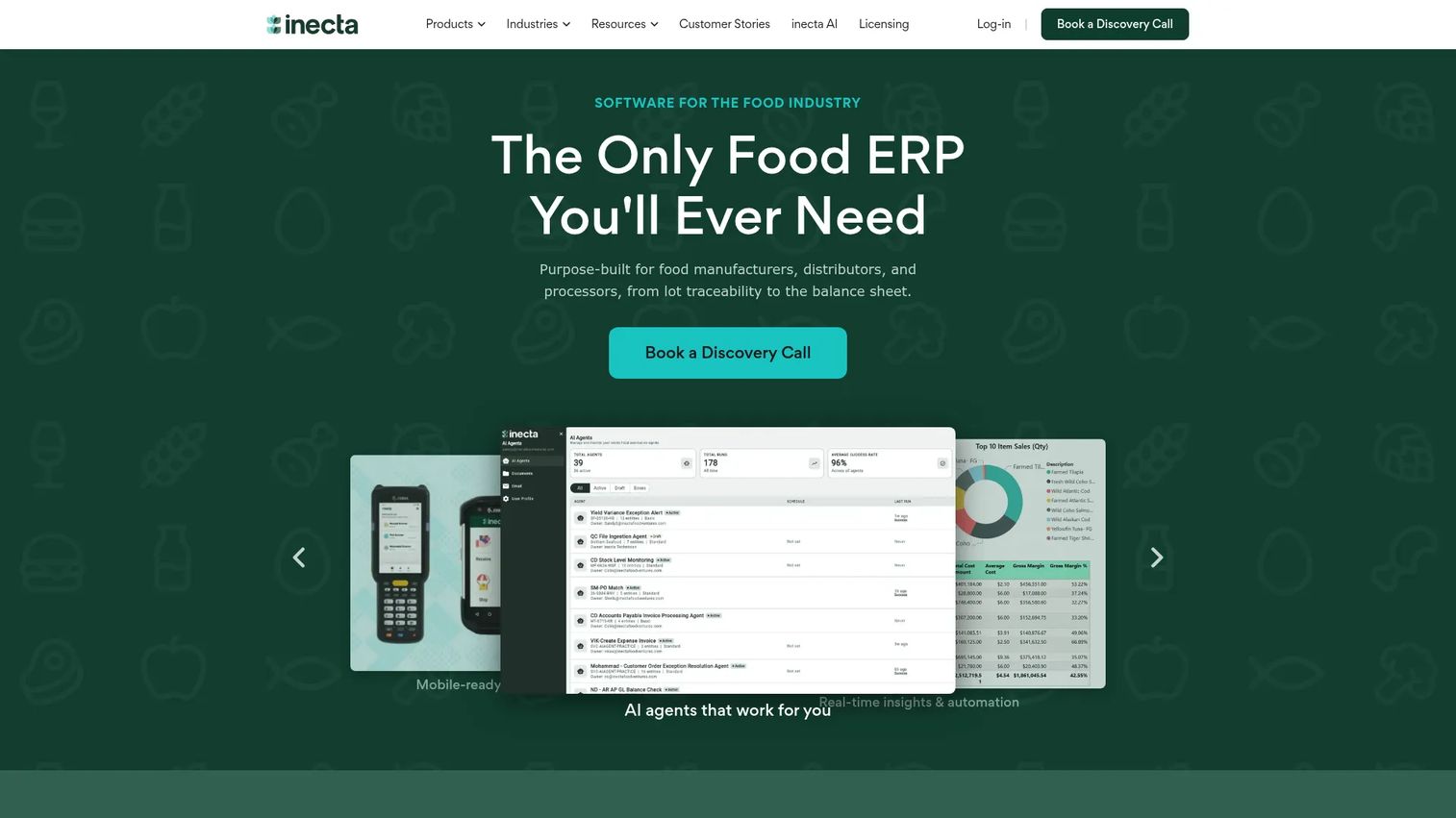
inecta Food ERP is a cloud-based food and beverage ERP built on Microsoft Dynamics 365 Business Central. It covers lot traceability and recall management, catch-weight and dual-unit-of-measure management, multi-level recipe and formula management, batch manufacturing with yield tracking and costing, FEFO, shelf-life, and expiration-date controls, and quality control with allergen tracking and compliance workflows. The platform addresses the specific operational needs of food processors, distributors, and traders where food-specific processes need to connect directly to finance and distribution.
Best for: Growing food processors, manufacturers, and distributors that need food-specific batch manufacturing, traceability, and catch-weight tied directly to finance without stitching food processes onto a generic ERP.
Key features
- Multi-level recipe and formula management
- Batch manufacturing, yield tracking, and costing
- Forward and backward lot traceability with recall management
- Catch-weight and shelf-life controls
- FEFO and allergen tracking with compliance workflows
Why choose inecta Food ERP: It suits operations where food-specific complexity (catch weight, dual units of measure, FEFO, allergen controls) breaks generic ERP modules, and where financial reporting needs to reflect actual production costs rather than estimates.
inecta Food ERP pricing: Pricing is customized by users, devices, modules, tenant tier, and operational complexity. The vendor typically works with companies budgeting at least $150,000. Annual license billing options may be available. Request a detailed license and implementation breakdown before comparing total cost.
Considerations when choosing batch management software
Decide whether you need ERP, MES, or batch control first
A recipe system cannot solve a broken planning and finance process. A general ERP cannot always control production steps or capture detailed plant-floor data in real time. Map your operational system of record and the plant execution layer before evaluating vendors. The answer changes which half of this list is relevant.
Test traceability with a real scenario before buying
Ask every vendor to demonstrate a forward and backward trace from raw material receipt to finished product shipment using a scenario from your own process. Include rework, substitutions, split lots, and quality holds where they exist. A trace that works on sample data may not work on your actual production structure.
Validate recipe and change control depth
Do not accept a generic bill-of-materials demo if your plant works with formulas, variable yields, allergen substitutions, potency adjustments, or multi-stage recipes. Ask specifically about revision control, version comparison, and how recipe changes propagate to scheduled batches already in production.
Price implementation separately from the license
The total cost includes data migration and recipe cleanup, integrations with ERP and plant systems, operator training, validation where required, and ongoing support. Ask vendors to identify explicitly what the implementation plan assumes your internal team will deliver, and what sits outside the implementation scope.
Confirm integration ownership before selecting a platform
List every system that must exchange data: ERP, MES, LIMS, WMS, DCS, EDI, historians, and finance. For each connection, identify the data owner, the refresh frequency, and how failures are handled. Integration assumptions built into a vendor proposal often depend on capabilities your internal team does not have yet.
Conclusion
The right choice depends on where your operational bottleneck actually sits, not on which platform has the longest feature list.
FoodReady is the strongest starting point for food safety, documentation, and traceability-focused teams that need compliance and production in one place. BatchMaster ERP suits process manufacturers replacing generic tools with a formula-built ERP. TrakSYS covers plant-wide manufacturing execution where electronic batch records and OEE analytics need to span multiple sites. AVEVA Batch Management fits automation-intensive plants where ISA 88 recipe control and batch history are the primary requirements. For food operations that need batch manufacturing connected directly to finance and distribution, inecta Food ERP is built for that specific job.
Before requesting a final proposal from any vendor, shortlist three products, run your own current batch record and recall scenario through each demo, and compare what each implementation plan assumes you will deliver internally. That comparison tells you more than a features comparison will.
Start your journey with Guideflow today!
FAQs
Batch management software helps manufacturers define recipes, execute controlled production steps, track materials and lots through the production process, record quality events, and maintain a searchable history of every batch. The capability may live inside an MES, a process manufacturing ERP, a dedicated batch control platform, or a food-specific compliance tool. The right product depends on whether the primary gap is plant execution, business operations, or automation control.
An MES focuses on executing and monitoring work on the plant floor, connecting operators, equipment, work instructions, and production data. Batch management is a capability that can exist within an MES, an ERP, or a control system, depending on the vendor. The best choice depends on whether the operational problem is plant execution, business system integration, or regulatory record-keeping.
Yes, particularly process manufacturing and food-specific ERP products. Buyers should verify whether the ERP supports versioned formulas, actual versus planned yields, lot genealogy, quality holds, and electronic batch records. Generic ERP platforms often cover BOMs and work orders but fall short on formula-specific controls, deviation tracking, and audit-ready batch history.
Food manufacturers should prioritize lot traceability covering forward and backward genealogy, allergen and substitution management, shelf-life and FEFO controls, catch weight where relevant, recipe scaling with yield tracking, quality checks with QC hold and release workflows, recall readiness with lot quarantine, and food safety documentation such as HACCP plans and supplier records.
Software can support the controlled records, audit trails, electronic signatures, traceability depth, and reporting structures that compliance programs require. It does not make an organization compliant by itself. The company's own processes, validation practices, operator training, and regulatory obligations all remain the organization's responsibility. For regulated industries, confirm what validation documentation the vendor provides and what the buyer must produce independently.
An electronic batch record is the digital history of how a specific batch was produced. It captures the recipe version used, materials consumed with lot numbers, operator actions and identities, timestamps for each step, quality checks performed, deviations from the expected process, and approvals or electronic signatures. In regulated industries, the EBR replaces paper batch records and must meet audit and inspection standards.
Most industrial batch management platforms use quote-based pricing. The total cost depends on user count, number of sites, modules selected, integrations required, equipment connections, implementation services, validation requirements for regulated environments, and ongoing support. Always request a license cost and implementation cost breakdown separately. The implementation cost frequently exceeds the first-year license fee for more complex deployments. Fishbowl Manufacturing publishes a starting price of $675/month. TrakSYS publishes a starting price of $1,999/month for its Essentials plan. Most other platforms on this list price by quote.
The primary industries are food and beverage, pharmaceuticals, chemicals, nutraceuticals, cosmetics, life sciences, specialty materials, and consumer packaged goods. The right product changes significantly with recipe complexity, regulatory environment, and integration requirements. A pharmaceutical manufacturer running validated processes has different needs than a food co-packer managing allergen controls and shelf-life. Confirm that the vendor has reference customers in your specific sub-industry before shortlisting.