You booked the same Victorian ballgown to two customers for the same Saturday. One shows up. One doesn't get the dress. Both are angry. And you didn't find out until the counter went quiet and someone pulled up a spreadsheet nobody had updated since Tuesday.
That is the real cost of running a costume rental business on scattered tools. Availability lives in one place, reservations in another, returns in a notebook, and billing in whatever gets remembered at month end. Items rotate fast, especially around weekends, cosplay conventions, and Halloween, and every gap between systems turns into a double-booking, a missing costume, or an invoice you forgot to send.
The stakes are not small. The U.S. formal wear and costume rental industry generated USD 1.1 billion in revenue in 2026, spread across roughly 1,035 businesses, according to IBISWorld (2026). Margins in that market depend on turns. If a costume sits waiting for cleaning while a paying reservation goes unfilled, that is money leaking out of the operation. Good costume rental software closes those gaps by putting inventory, reservations, billing, and reporting in one place where a team can actually run the floor without guessing.
What's inside
This guide covers costume and prop rental software for the operators who live inside these workflows: inventory tracking, reservation management, check in and check out, billing and invoicing, and rental reporting. We looked at rental-first platforms, retail POS systems, and inventory tools that costume shops commonly evaluate.
We ranked each tool on five things: rental workflow fit, inventory visibility, accounting integration, ease of use for a small team, and reporting depth. Pricing and ratings are pulled from vendor pages and public listings. Where a tool leans more toward research or general inventory than costume-specific rental logic, we say so plainly.
TL;DR
- Best rental-first fit for most operators: Rentman handles scheduling, item-level inventory, and quoting to invoicing in one rental-native system.
- Best for fast in-person checkout: Square for Retail suits smaller shops that need quick counter sales and simple stock discipline.
- Best for research and shortlisting: Capterra Inventory is a directory to compare inventory tools, not an operating system.
- Best for an all-in-one stack: Odoo bundles rental scheduling, quotations, invoicing, and accounting for teams that want ERP breadth.
- Best for simple visual inventory: Sortly gives small teams mobile, item-level tracking with barcodes and low-stock alerts.
- Best for outgrowing spreadsheets: Cin7, inFlow Inventory, and Zoho Inventory bring stronger inventory accuracy and accounting handoff.
What is costume rental software?
Costume rental software is an operational system that helps a rental business track costume and prop inventory, take and manage reservations, run check in and check out, handle billing and invoicing, and report on utilization and revenue.
Costume rentals differ from straight retail because the same item goes out, comes back, gets inspected and cleaned, then goes out again. That loop is where dedicated rental operations software earns its keep. Buyers should expect a core set of capabilities:
- Inventory tracking: item-level stock counts, size and variant handling, and barcode tracking so you know exactly what you own and where it is.
- Reservations and order management: date-based availability, double booking prevention, and order processing from quote to fulfillment.
- Check in and check out: structured workflows that move items out to a customer and back through inspection, cleaning, and re-rental readiness.
- Billing and invoicing: deposits, rental billing cycle handling, invoices, and payment tracking to reduce revenue leakage.
- Reporting and utilization insights: rental reporting and utilization reporting that show which items earn and which sit idle.
- Customer communication: a customer portal, notifications, and returns workflow updates that keep renters informed.
The global costume rentals market was estimated at USD 3.5 billion in 2024 and is forecast to reach USD 7.2 billion by 2033, an 8.6% CAGR, according to Verified Market Reports (2024). As demand grows across theatrical, event, and cosplay segments, the operators who systematize these workflows early scale cleanest.
When to use costume rental software
Not every shop needs the same depth. Here is how to pattern-match your situation to the right level of software.
Prevent double-booking across overlapping rentals
Costume items move fast, and demand clusters around weekends, seasonal peaks, and convention dates. When the same gown or prop can be reserved for overlapping periods, you need date-based availability and item-level inventory that block conflicts automatically. Availability management that ties a physical item to a calendar is the single biggest reason to leave spreadsheets behind. Without it, double-booking is not a risk, it is a matter of time.
Track returns, repairs, and re-rental readiness
A returned costume is not immediately rentable. It needs inspection, sometimes cleaning, sometimes repair. Software should move each item through a clear returns workflow: returned, inspected, cleaned, available. The payoff is knowing at a glance what you can rent again today versus what is sitting in the repair pile. That visibility is what keeps utilization high and prevents you from promising an item that is still on the mend.
Tighten billing and A/R handoff
Rental revenue leaks through untracked deposits, late invoices, and forgotten payments. A system that handles deposits, the rental billing cycle, invoices, and payment tracking protects margin. Add accounting integration and aging reports, and month end stops being a scramble. If you are running QuickBooks or a similar ledger, QuickBooks integration and clean multi location rental management become non-negotiable as you scale past one storefront.
Comparison table
We sorted this table by relevance to costume rental workflows, not alphabetically. Rental-first tools rank highest, followed by retail POS, then broader inventory platforms that costume shops adapt. Pricing reflects the entry point for each tool as published by the vendor, and ratings come from public G2 listings where available.
| # | Product | Intent | Key differentiation | Pricing | G2 rating |
|---|---|---|---|---|---|
| 1 | Rentman | Rental-first operations | Scheduling, inventory, quoting, invoicing in one rental system | From €14 per Power User/month | 4.5/5 |
| 2 | Square for Retail | Retail POS with inventory | Fast counter checkout and multi-location stock | Free plan; Plus $49/mo per location | Not listed |
| 3 | Capterra Inventory | Research and shortlisting | Directory to compare inventory tools | Listed products from $59/month | Not listed |
| 4 | Odoo | All-in-one ERP | Rental, quotations, invoicing, accounting modules | One App Free; Standard $24.90/user/mo | 4.2/5 |
| 5 | Cloakroom | QR-based item storage | QR check-in and real-time item tracking | Not publicly listed | Not listed |
| 6 | LendingHome (Kiavi) | Real estate financing | Investor loan programs, not rental ops | Program-based fees | 2.5/5 |
| 7 | Cin7 | Inventory and light ERP | Multi-channel inventory and manufacturing | From $349/month | 4.1/5 |
| 8 | inFlow Inventory | Inventory management | Stock, sales, purchasing with barcode mobile app | From $129/month | 4.4/5 |
| 9 | Zoho Inventory | Cloud inventory | Order management and Zoho ecosystem fit | Free plan; Standard $29/org/mo | 4.4/5 |
| 10 | Sortly | Visual inventory tracking | Mobile, item-level tracking with barcodes | Free plan; Advanced $24/mo | 4.3/5 |
1. Rentman
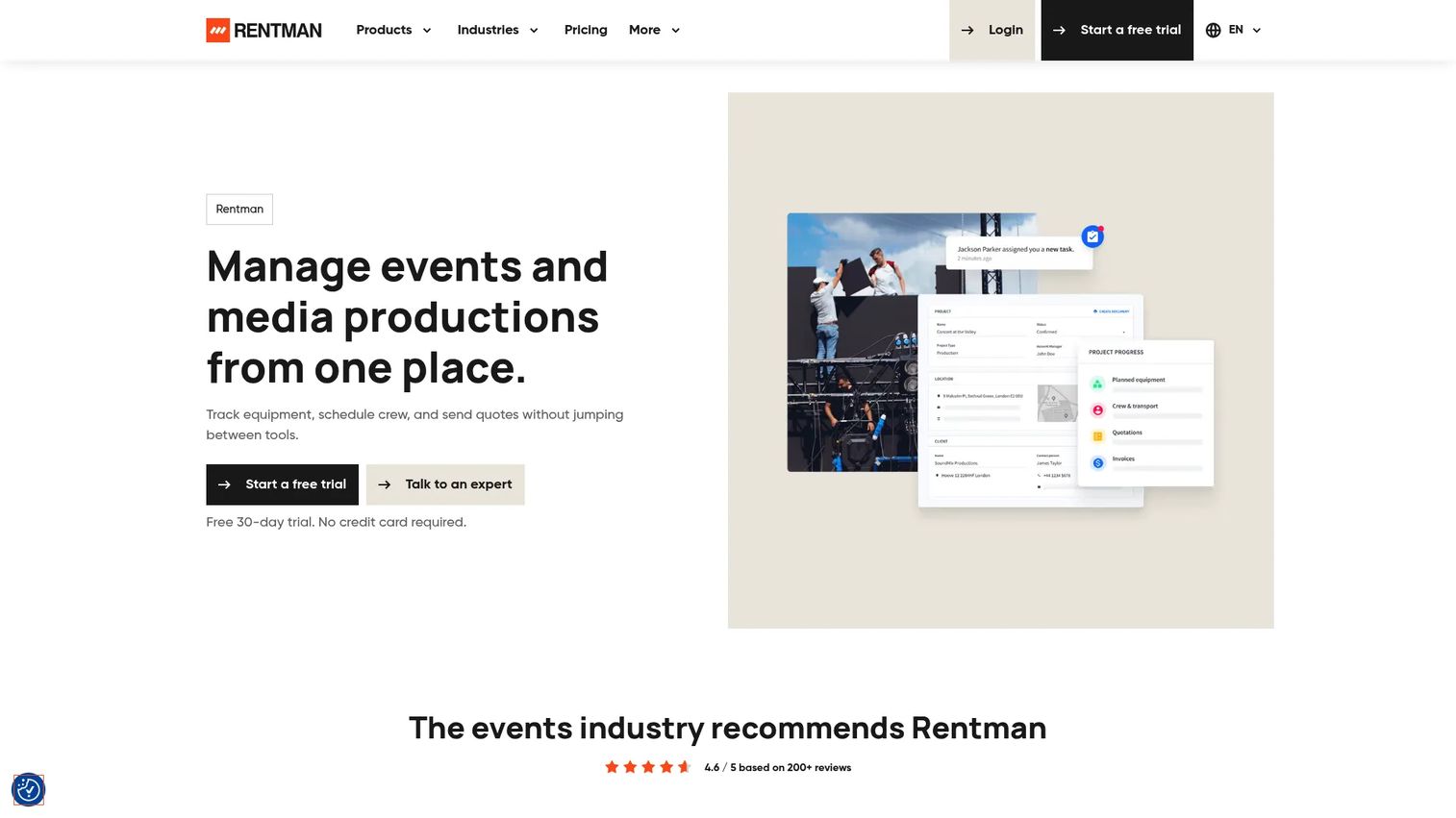
Rentman is cloud software built specifically for rental companies to manage equipment, crew, quotes, and payments. It is one of the few tools on this list designed rental-first rather than adapted from retail or general inventory. For costume and prop operations, that matters because scheduling, item-level inventory, and the quote-to-invoice loop already exist as native concepts rather than workarounds.
Best for: rental and event-production teams that want scheduling, inventory, and quoting in one purpose-built system.
Key strengths
- Equipment scheduling and inventory management: date-based availability tied to physical items, so overlapping reservations get flagged before they become double-bookings.
- Crew scheduling: coordinate the people side of larger productions alongside the items going out.
- Quoting and invoicing with payments: move from quote to order to invoice inside one system, reducing the manual billing cleanup that eats month end.
Why choose Rentman: If your operation is genuinely rental-first, a tool designed around the rental loop beats a retail POS you have to bend into shape. Rentman's scheduling and availability logic fits costume shops that rotate inventory quickly and need reservation management that actually blocks conflicts. It is the strongest baseline here for teams that think in terms of items going out and coming back.
Rentman pricing: Pricing is published in EUR and structured per Power User per month across two solution lines. Equipment Scheduling starts at €14 per Power User per month for Standard and €19 for Pro. Crew Scheduling ranges from €14 for Essential up to €24 for Pro, with an invite-only Enterprise tier. There is no free plan listed, though the per-user model scales with team size.
2. Square for Retail
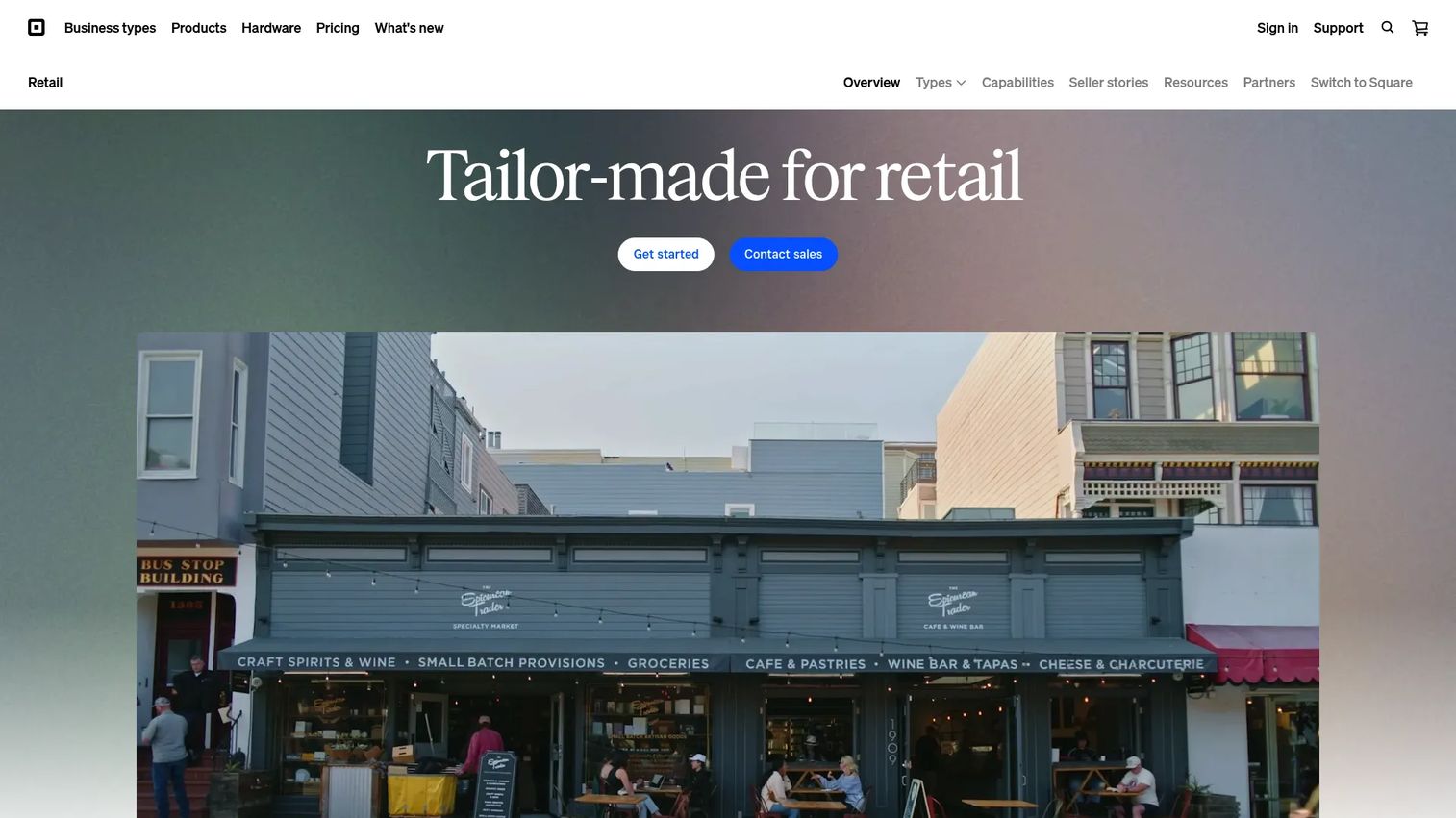
Square for Retail is Square's retail POS and commerce software, built for in-store and multi-channel retail operations. It is not rental-native, but for smaller costume shops that also sell accessories or need fast, reliable counter checkout, it brings clean inventory discipline and barcode workflows without a steep setup.
Best for: smaller costume shops that need quick in-person checkout and straightforward stock control.
Key strengths
- Inventory management across sales channels: track stock consistently whether items sell in-store or online.
- Bulk item and SKU creation and import: stand up a large catalog quickly, useful when you are cataloging hundreds of costume variants.
- Vendor, purchase order, and stock intake tools: manage incoming inventory and reorders in the same place you ring up sales.
Why choose Square for Retail: The rental fit depends on how complex your operation is. If your rentals are simple and you also do meaningful retail sales, Square's fast checkout and multi-location tools cover a lot of ground affordably. Shops with heavy date-based reservation needs will layer rental logic on top, but for counter-driven businesses, this is a practical, low-friction foundation.
Square for Retail pricing: There is a free plan that includes core retail features with no monthly subscription, plus processing fees. Square Plus runs $49 per month per location, Square Premium is $149 per month per location, and Square Pro is custom-priced for higher-volume merchants. The free tier makes it easy to start small and add paid features as the shop grows.
3. Capterra Inventory
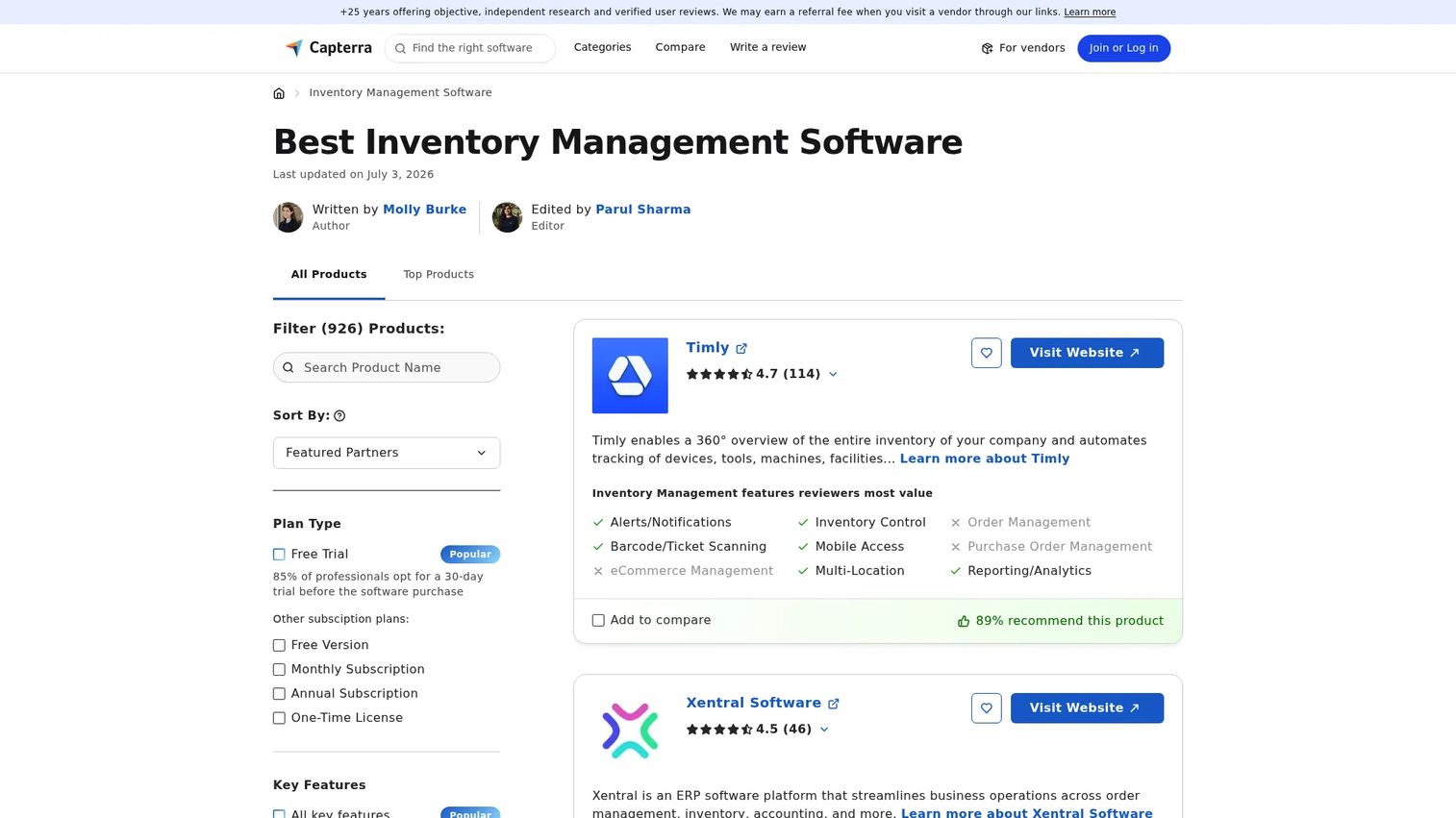
Capterra Inventory is Capterra's inventory management software category page and buyer guide, not a single rental application. Treat it as a research destination: a place to compare inventory-focused tools, read reviews, and shortlist vendors before you commit.
Best for: buyers actively comparing inventory management software options and pricing.
Key strengths
- Inventory tracking: browse and compare tools that handle stock counts and item-level visibility.
- Inventory control: filter options by the control features costume shops need, like variants and reorder logic.
- Purchase order management: evaluate how listed tools handle incoming stock and vendor workflows.
Why choose Capterra Inventory: This is not your operating system, it is how you find your operating system. When you are mid-consideration and want a neutral place to weigh inventory tools side by side, Capterra's category page and reviews shorten the research phase. Use it to build a shortlist, then evaluate the finalists against your actual rental workflow.
Capterra Inventory pricing: Capterra itself is free to browse. Individual products listed in the category carry their own pricing. One representative Inventory product on Capterra lists a Brick & Mortar plan at $59.00 per month and an E-tailer plan at $99.00 per month, both flat monthly rates, with a free trial available. Pricing varies widely by the specific vendor you shortlist.
4. Odoo
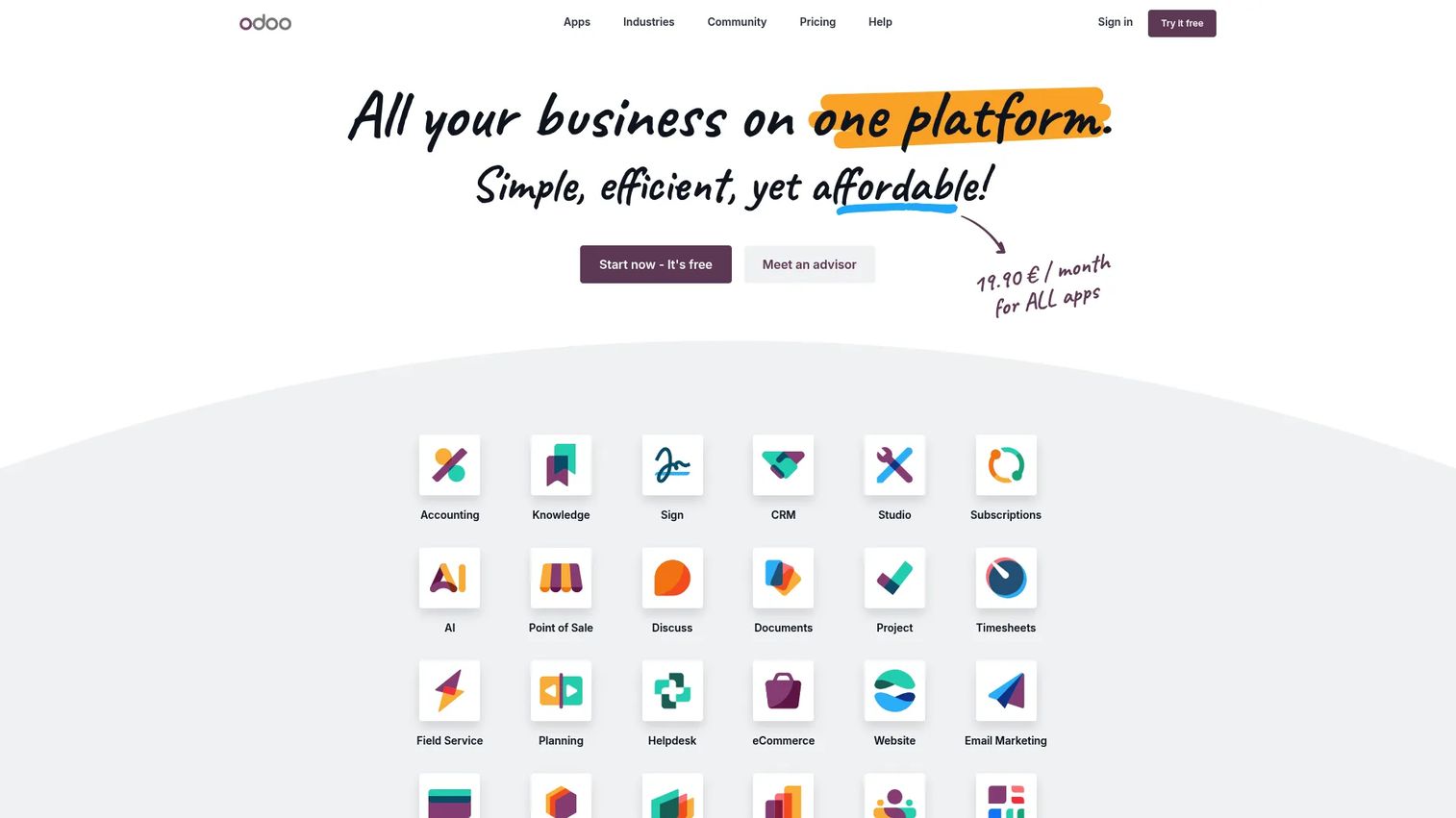
Odoo is an open-source ERP and business app platform that manages core operations in one system. For costume rental teams that want more than inventory, Odoo bundles rental scheduling, quotations, invoicing, serial tracking, and multi location rental management alongside accounting and CRM. It is the broadest option here for teams building a full operational stack.
Best for: businesses that want a modular all-in-one ERP with rental, accounting, and inventory under one roof.
Key strengths
- All apps in one platform: rental, sales, accounting, inventory, and POS modules work together, cutting the number of disconnected tools.
- Flexible deployment options: run Odoo Online, on Odoo.sh, or on-premise depending on your control and hosting needs.
- Modules for the full operation: add Sales, CRM, Accounting, Inventory, HR, Project, and POS as the business grows.
Why choose Odoo: If you would rather run one system than stitch together five, Odoo's breadth is the draw. Rental scheduling with quotations and serial tracking sits next to invoicing and accounting, which tightens the A/R handoff considerably. Expect meaningful configuration to tailor it to costume-specific workflows, but the payoff is a single source of truth for the whole operation.
Odoo pricing: Odoo offers a One App Free plan for unlimited users on a single app. The Standard plan is $24.90 per user per month billed yearly, and the Custom plan is $49.00 per user per month, both covering all apps. The free single-app tier is a genuine way to test rental or inventory before committing to the full suite.
5. Cloakroom
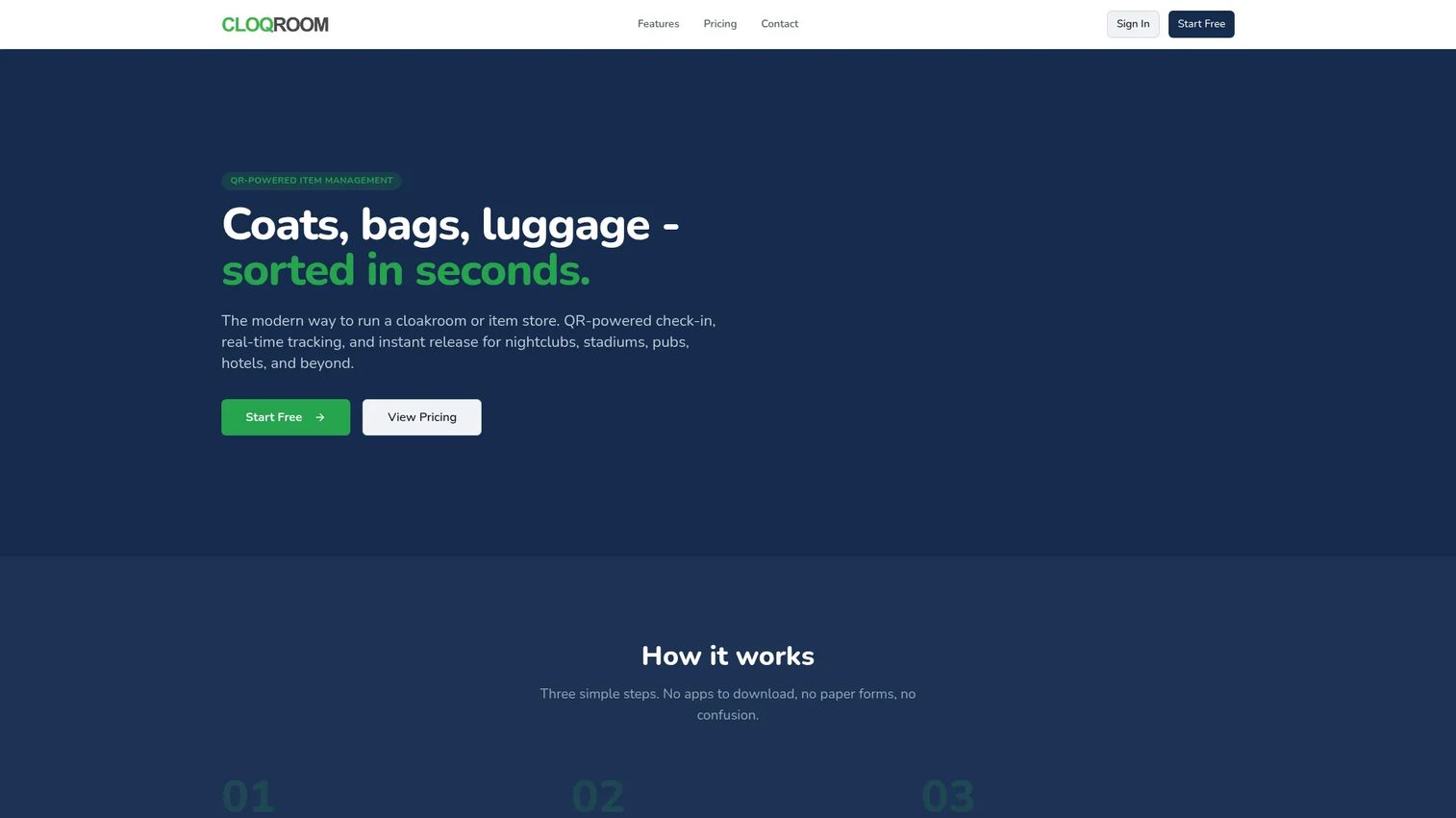
Cloakroom is QR-powered cloakroom and item storage software built for venues. It is a specialized tool for fast, QR-based check-in and release of items, with a real-time tracking dashboard. While it is oriented toward coat and bag storage rather than full costume rental cycles, its item-tracking and check in check out model illustrates why specialized, variant-aware tools matter when items move quickly.
Best for: venues that need fast, QR-based item storage and release with real-time tracking.
Key strengths
- QR-powered check-in and release: scan items in and out quickly, minimizing counter friction during busy periods.
- Real-time item tracking dashboard: see what is stored and released at a glance.
- White-label branding and multi-venue support: run consistent operations across more than one location under your own brand.
Why choose Cloakroom: The value here is speed and traceability for high-volume item handoffs. If your costume operation includes a venue component or fast in-and-out handling, Cloakroom's QR model shows how tight check in and check out can be. For deeper rental logic like deposits and rental billing cycles, you would pair it with dedicated billing tools.
Cloakroom pricing: Cloakroom does not publish pricing on its site, and no public plan tiers were verified. Interested operators should contact the vendor directly for a quote based on venue count and volume.
6. LendingHome (now Kiavi)
LendingHome now redirects to Kiavi, a real estate investment financing platform. To be direct: this is not costume rental software. It offers bridge loans, DSCR rental loans, and new-construction financing for property investors. We include it here only to clear up confusion, because the name surfaces in rental-related searches despite serving an entirely different market.
Best for: real estate investors seeking short-term bridge, rental, or new-construction financing, not costume shop operators.
Key strengths
- Fix-and-flip and bridge loans: short-term financing for property investors.
- DSCR rental loans: loans underwritten on rental property cash flow.
- New construction loans: financing for ground-up investment builds.
Why choose LendingHome: For a costume rental business, you would not. If your search led you here expecting inventory or reservation tools, look to the rental-first and inventory options above instead. We flag Kiavi only so you do not waste an evaluation cycle on a financing product mislabeled as rental operations software.
LendingHome pricing: Kiavi's pricing is loan-program-specific rather than subscription-based. Its bridge loan program lists origination fees as low as 1% (around $2,400), and its broker program lists 50 bps or a $999 origination fee, whichever is greater. There is no SaaS-style plan or free tier.
7. Cin7
Cin7 is cloud inventory management and light ERP software for product sellers. It is a strong fit for costume operations that have outgrown spreadsheets but do not want to jump straight into a full ERP build. Real-time inventory visibility and multi-location tracking give you the inventory accuracy and operational reporting that keep a growing catalog under control.
Best for: product businesses needing multi-channel inventory, manufacturing, and order management in one system.
Key strengths
- Real-time inventory visibility: know stock levels across locations without manual counts.
- Manufacturing workflow tools: useful if you build or repair costumes and props in-house.
- EDI connectivity: connect with trading partners for larger supply operations.
Why choose Cin7: If inventory accuracy is your bottleneck and reporting matters, Cin7 brings serious inventory control without the full weight of an ERP implementation. It suits mid-sized costume and prop businesses managing stock across more than one location. Pair it with dedicated reservation logic if your rental scheduling needs run deep, since Cin7's core strength is inventory rather than date-based booking.
Cin7 pricing: Cin7 Core lists a Standard plan at $349 per month, Pro at $599 per month, and Advanced at $999 per month. Cin7 Omni is custom-priced. There is no free tier, which places Cin7 at the higher end for smaller shops but reflects its depth for teams scaling past spreadsheets.
8. inFlow Inventory
inFlow Inventory is inventory management software for tracking stock, sales, purchasing, and related workflows. Its clean, practical design and strong barcode tracking make it a solid pick for small to mid-sized costume rental operations that want reliable inventory without heavy overhead.
Best for: businesses that need inventory, sales, and purchasing management with mobile barcode workflows.
Key strengths
- Stock tracking and reorder management: keep item counts accurate and flag low stock before it becomes a gap.
- Sales and purchase order workflows: handle order processing and incoming inventory in one flow.
- Mobile app with barcode scanning and label printing: scan items during check in and check out and print labels for a large costume catalog.
Why choose inFlow Inventory: For a small or mid-sized shop, inFlow strikes a practical balance between capability and simplicity. The mobile barcode workflows fit costume operations that need to move items in and out quickly and keep counts honest. As with other inventory-first tools, layer reservation logic on top if your date-based booking needs are complex, since inFlow's core focus is stock rather than rental scheduling.
inFlow Inventory pricing: inFlow publishes pricing in multiple currencies. The Stockroom plan starts at $129 USD per month, the Manufacturing plan is $561 USD per month, the Enterprise plan is $2,249 USD per month, and the Expansion plan is $2,874 USD per month. There is a 14-day free trial but no permanent free tier.
9. Zoho Inventory
Zoho Inventory is cloud inventory management software for tracking stock, orders, warehouses, and shipping. It is especially appealing to teams already using other Zoho tools, since the ecosystem fit smooths accounting handoff and order management. For lightweight operational control at a low entry price, it is hard to beat.
Best for: small to mid-sized businesses needing cloud-based inventory and order tracking.
Key strengths
- Inventory management: track stock levels and item movement across the operation.
- Multi-warehouse tracking: manage inventory across more than one location for multi location rental management.
- Barcode scanning: speed up check in and check out and keep counts accurate.
Why choose Zoho Inventory: If you already run Zoho Books or CRM, the integration value is real, and the low starting price makes it easy to justify. It suits smaller costume operations that want clean inventory and order visibility with a straightforward accounting integration path. Add dedicated reservation tooling if your rental calendar is the core of the business.
Zoho Inventory pricing: Zoho offers a free plan, then Standard at $29 per organization per month, Premium at $79, Plus at $129, and Enterprise at $249, all billed annually per organization. The per-organization pricing (rather than per-user) can make it very cost-effective for small teams.
10. Sortly
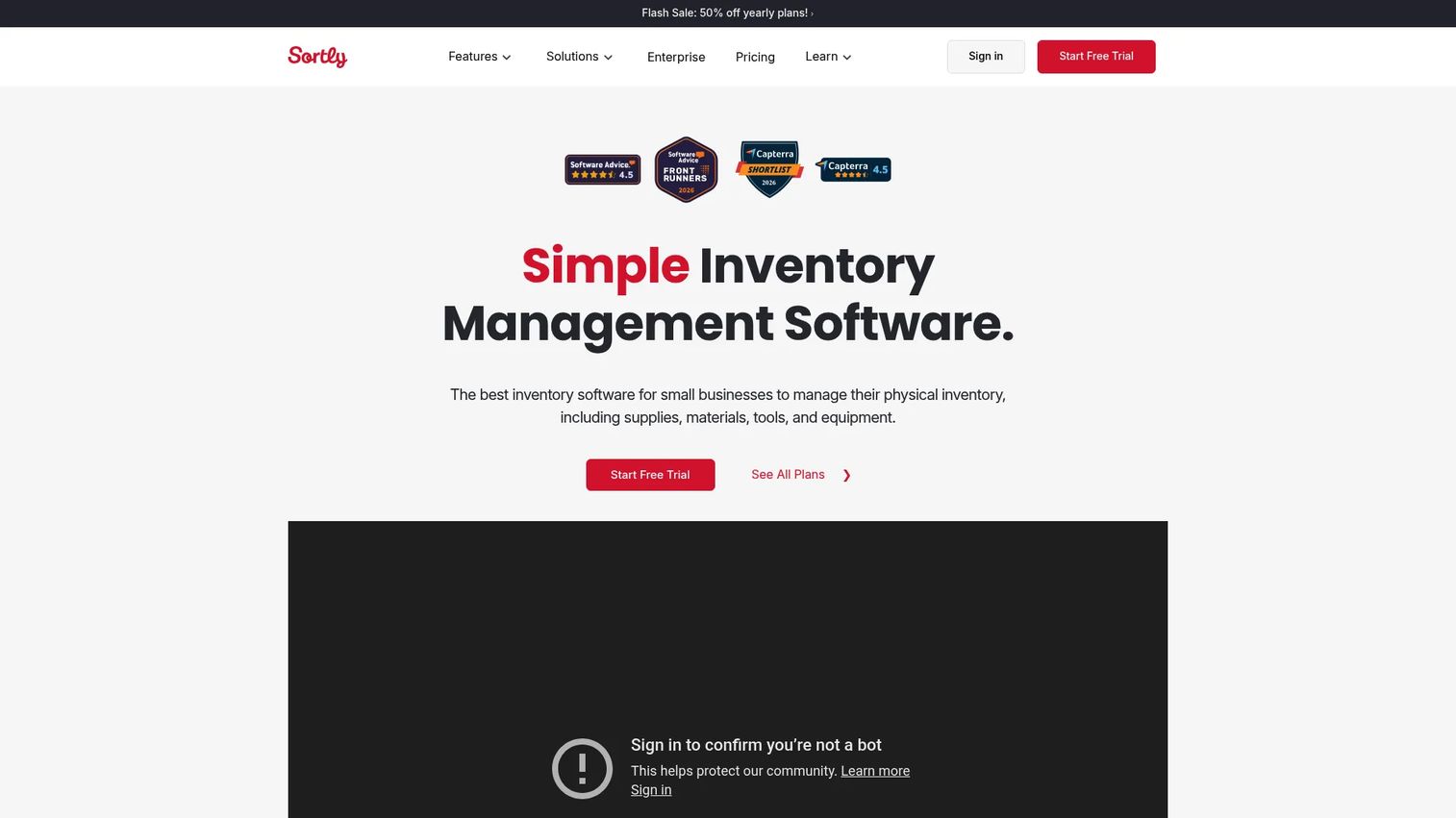
Sortly is inventory management software for tracking items, assets, and supplies across devices. Its mobile-friendly, visual approach makes it easy to set up and simple to run, which is exactly what a small costume team prioritizing quick visibility over complex logic often needs.
Best for: small to mid-sized businesses needing simple, visual inventory tracking.
Key strengths
- Mobile app with offline access: manage inventory from the floor even without a connection.
- Barcode and QR code scanning and label generation: tag and scan costume items for fast, accurate counts.
- Low stock and date-based alerts: get notified before you run short or when a date-based event approaches.
Why choose Sortly: When simplicity is the priority, Sortly is the easiest entry point on this list. Its visual, photo-driven catalog suits costume shops that want to see their inventory at a glance and track it on mobile. For deeper rental-specific workflows like deposits, reservations, and rental billing cycles, you would pair Sortly with dedicated rental or billing tools, but for pure item visibility it is fast and friendly.
Sortly pricing: Sortly has a free plan, then Advanced at a promotional $24 per month (standard $49), Ultra at $74 per month (standard $149), and Premium at $149 per month (standard $299), with an Enterprise tier by quote. Paid plans include a 14-day free trial, and annual billing carries a discount.
How to choose costume rental software
Before you commit, run every finalist against the criteria that actually decide whether the software survives a busy Saturday.
Rental workflow fit
Does the tool understand items going out and coming back, or is it retail software you are bending into shape? Rental-first platforms handle date-based availability and reservations natively. Inventory tools handle stock beautifully but may need reservation logic layered on. Match the tool to how your business actually moves items.
Inventory visibility and variants
Costumes come in sizes, colors, and bundled kits. Confirm the tool handles size variants, barcode tracking, and item-level counts, not just SKUs. Bundled kits matter especially, since a single reservation might pull five linked items that all need to be tracked and returned together.
Accounting integration
Check how billing hands off to your ledger. QuickBooks integration, aging reports, and clean invoice syncing decide whether month end is calm or chaotic. If accounting is a pain point today, weight this criterion heavily.
Multi-location and scale
If you run more than one storefront now or plan to, verify multi location rental management and centralized inventory visibility. A tool that works for one shop can crumble across three if stock and reservations do not sync in real time.
Conclusion
The right pick depends on how your business moves items. For a genuinely rental-first operation, Rentman is the strongest baseline, with scheduling, item-level inventory, and quoting to invoicing built around the rental loop. For all-in-one breadth, Odoo covers rental, invoicing, and accounting in one modular stack. Smaller shops that lead with counter sales will find Square for Retail fast and affordable, while Sortly wins on simple, visual inventory.
Teams outgrowing spreadsheets but not ready for full ERP should look at Cin7, inFlow Inventory, or Zoho Inventory for stronger inventory accuracy and accounting handoff. Capterra Inventory is where you shortlist, not where you operate. And if a financing product like Kiavi surfaced in your search, cross it off, it does not serve rental operations at all.
Your next step: pick the two finalists that match your workflow depth, run each against a real weekend of reservations, and watch how they handle returns and billing. That is where the right tool proves itself.
FAQs
At minimum, it should track item-level inventory with size and variant handling, date-based availability, reservations, check in and check out status, deposits and invoices, and utilization reporting. The goal is a single view of what you own, what is booked, what is out, and what is earning.
It depends on how central date-based booking is to your business. Rental-first tools handle availability and reservations natively, which prevents double-booking automatically. Inventory software like inFlow, Zoho Inventory, or Sortly handles stock accuracy well and can work for simpler operations, but you may need to layer reservation logic on top.
It ties each physical item to a calendar of availability. When a reservation is placed for a date range, the system blocks that item from being booked again for the overlapping period. That item-level, date-based logic is what spreadsheets cannot reliably do, especially during weekend and seasonal demand spikes.
Utilization reporting shows which items earn and which sit idle, so you can invest in high-demand inventory and retire dead stock. Aging and A/R reports protect revenue by surfacing unpaid invoices and overdue deposits. Rental reporting on turns and revenue per item helps you price and plan seasonal peaks.
Small shops often do well with Square for Retail for fast counter checkout, Sortly for simple visual inventory, or Zoho Inventory for low-cost cloud tracking with accounting handoff. If your rentals are date-heavy, a rental-first tool like Rentman is worth the step up. Choose based on whether counter sales or reservations dominate your day.
Very, once you scale past one location or a handful of rentals a week. Accounting integration and QuickBooks integration eliminate manual invoice re-entry, keep deposits and payments reconciled, and make month end predictable. Tools like Odoo bundle accounting directly, while inventory tools like Zoho Inventory and inFlow connect to external ledgers.