Your production team logs volumes in one system. Accounting reconciles them in another. Land tracks leases in a spreadsheet nobody trusts. Midstream logistics runs on a separate platform entirely. By the time finance closes the month, three people have re-keyed the same numbers, and nobody is fully confident the barrels reported match the barrels billed.
That fragmentation is the real problem oil and gas software solves. It is not a technology gap. It is a data integrity gap, where production, accounting, land, logistics, and asset data live in disconnected systems that never fully agree.
The market reflects how much that costs. Digital transformation in the oil and gas industry is forecast to grow from USD 72.18 billion in 2026 to USD 124.89 billion by 2031, an 11.59% CAGR, with software accounting for 44.53% of revenue in 2025, according to Mordor Intelligence (2026). Money is moving toward workflow unification because the manual handoffs are expensive.
This guide ranks oil and gas software providers by operational fit, not brand size. If you are a founder or operator staring at fragmented finance and field data, the goal here is to help you match a platform to your actual workflow reality. Along the way, we will note where interactive product demos and other buyer-side tools help you evaluate any of these platforms faster. For teams also weighing security posture during vendor reviews, our roundup of the best AI cybersecurity solutions is a useful companion read.
What's inside
This list covers software used by upstream, midstream, and integrated oil and gas teams. It spans purpose-built energy suites, enterprise ERP platforms, asset lifecycle management systems, process simulation software, and enterprise content management.
We chose each entry based on four criteria: industry specialization, workflow breadth, data integrity, and real-world operational fit. The list is built for buyers comparing ERP, accounting, operations, and asset management options. If you are trying to decide whether you need a specialized upstream suite or a broad enterprise platform, this is a shortlist mapped to that decision.
TL;DR
- Best for upstream specialist teams: Quorum Software, for deep production operations, measurement, and accounting.
- Best for asset lifecycle and enterprise operations: IFS, for unified asset lifecycle management, ERP, and service.
- Best for field to finance integration: W Energy, for connecting production, land, and accounting on one platform.
- Best for broad ERP and enterprise scale: SAP and Oracle, for corporate standardization across global operations.
- Best for engineering and process simulation: AspenTech, for technical modeling and asset optimization.
- Best for content and document workflows: OpenText, for compliance, records, and enterprise content tied to operations.
What is oil and gas software?
Oil and gas software is industry-specific software that manages upstream, midstream, and downstream operations, from field production and hydrocarbon measurement to accounting, ERP, asset management, and logistics, on integrated platforms built for energy workflows.
Buyers evaluate several distinct software layers, and most stacks combine more than one:
- Operations: production operations software, well data, SCADA management, and field service.
- Accounting: oil and gas accounting software for joint interest billing, revenue, and regulatory reporting.
- ERP: oil and gas ERP for finance, procurement, supply chain, and human capital.
- Asset management: asset lifecycle management, enterprise asset management, and asset investment planning.
- Logistics: midstream oil and gas software for pipeline, plant, and transportation accounting.
- Analytics and planning: reserve planning, petroleum economics, and process simulation.
The core distinction is between point solutions and integrated suites. A point solution solves one job well, such as measurement or land management, but leaves the integration work to you. An integrated platform unifies multiple layers so production data flows into accounting without re-keying. For founders and operators, integration matters because every manual handoff is a place where data integrity breaks and month-end slows down. The right oil and gas industry software reduces those handoffs rather than adding another silo.
When to use oil and gas software
Different operational problems point to different categories of oil and gas software solutions. Here is how to pattern-match your situation before you shortlist.
Unify upstream and midstream workflows
When production, accounting, land, and transportation all live in separate systems, reconciliation becomes a full-time job. This is the trigger for suite-style platforms. If data fragmentation across field and finance is your main pain, prioritize upstream oil and gas software and integrated energy software that keep operations, measurement, and accounting in one place. The goal is to stop re-keying and start trusting your numbers.
Improve field to finance visibility
When finance and operations are consistently out of sync, and month-end depends on chasing volumes across teams, the problem is field to finance visibility. This often triggers an accounting-first or ERP-first selection. You want a platform where production activity in the field shows up cleanly in the ledger, so operational visibility and financial reporting draw from the same source of truth.
Support planning, simulation, or asset decisions
Sometimes the decision is not about transactions at all. When you need to model process performance, optimize plant operations, plan capital, or evaluate reserves, the shortlist shifts toward engineering-led and asset investment planning tools. This is where technical software enters, sitting alongside your operational and financial systems rather than replacing them.
Comparison table of oil and gas software providers
The table below translates vendor positioning into buyer language. Use the intent column to match a platform to your operational layer, then read the item sections for depth. Pricing across this category is largely quote-based, and G2 ratings reflect current listings.
| # | Product | Intent | Key differentiation | Pricing | G2 rating |
|---|---|---|---|---|---|
| 1 | Quorum Software | Upstream and midstream suite | Purpose-built energy suite for production, measurement, and accounting | Quote-based | 4.2/5 |
| 2 | IFS | Asset lifecycle and enterprise operations | Unified ERP, EAM, and FSM with embedded industrial AI | Quote-based | 4.0/5 |
| 3 | W Energy | Field to finance platform | Stream+ unifying upstream and midstream operations and accounting | Quote-based | Not listed |
| 4 | SAP | Enterprise ERP | Cloud ERP and business AI across finance and operations | Joule Base at no cost; packages quote-based | 4.2/5 |
| 5 | Oracle | Enterprise ERP and cloud | Database, cloud infrastructure, and applications at scale | Free tier; OCI usage-based | 4.1/5 |
| 6 | AspenTech | Process simulation and optimization | Process modeling and asset performance management | Quote-based | 4.5/5 |
| 7 | OpenText | Content and document management | Enterprise information management with AI and integrations | Quote-based | 4.2/5 |
1. Quorum Software
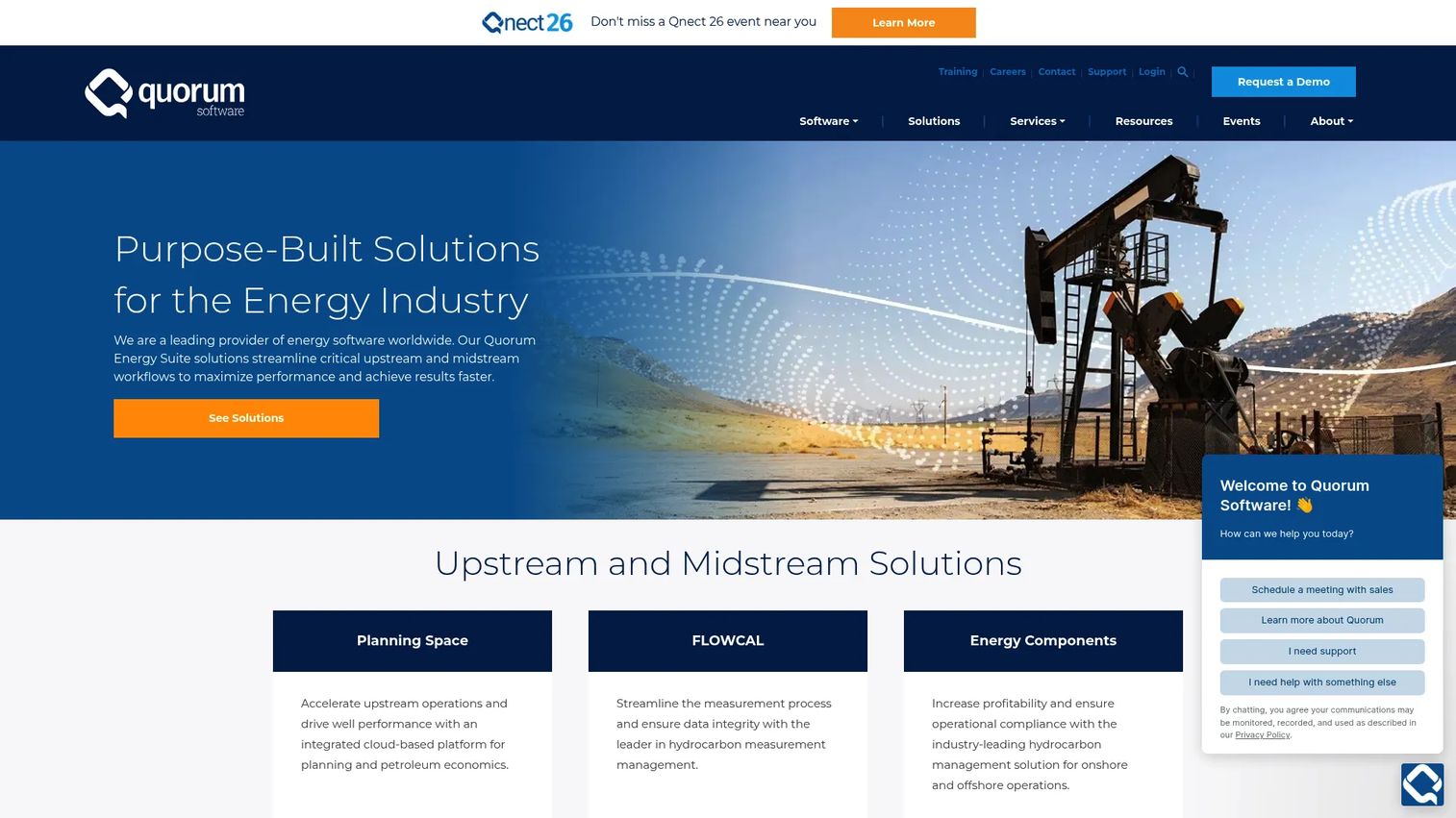
Quorum Software is an energy software provider offering cloud-based solutions for upstream, midstream, and measurement workflows. It is one of the most specialized oil and gas software company options on this list, built specifically for energy operators rather than adapted from a general business platform. That depth is the point: Quorum covers the operational, accounting, and planning layers that matter to producers on one integrated stack.
Best for: Energy companies that want deep oil and gas specialization across operations, accounting, and planning in a single suite.
Key strengths
- Integrated upstream workflows: Well operations, land, accounting, and production operations software connect so field activity flows into the ledger.
- Hydrocarbon measurement management: Purpose-built measurement handling keeps volumes accurate from the wellhead through allocation.
- Planning and petroleum economics: Reserve planning and economic modeling support capital decisions alongside daily operations.
Why choose Quorum Software: If your team is drowning in reconciliation between production, measurement, and accounting, a purpose-built energy suite removes the seams that a generic platform leaves behind. Quorum fits operators that value industry depth over broad enterprise features, and that want upstream and midstream workflows to share one source of truth rather than a spreadsheet bridge.
Quorum Software pricing: Quorum does not publish list pricing on its site, and pricing appears to be quote-based rather than publicly disclosed. Budget for a sales conversation scoped to your operational footprint. Quorum Software holds a 4.2/5 rating on G2.
2. IFS
IFS is an enterprise software vendor focused on industrial AI, ERP, enterprise asset management, and field service management. For oil and gas operators, IFS lands where asset lifecycle management and enterprise coordination matter most. It brings ERP, EAM, supply chain, and FSM together on one platform, which suits larger operating environments juggling physical assets and financial visibility at once.
Best for: Larger operators that need enterprise coordination across assets, service, and finance in a unified platform.
Key strengths
- Unified ERP and EAM: ERP, EAM, SCM, and FSM live in one platform, so asset and financial data stay connected.
- Embedded industrial AI: Predictive maintenance and orchestration are built in, supporting asset investment planning decisions.
- Composable architecture: Evergreen delivery and a composable design let the platform flex as operations change.
Why choose IFS: When your main problem is coordinating maintenance, service, and finance across a large asset base, IFS unifies asset lifecycle management with the ERP and field to finance layers that surround it. It fits companies that treat physical assets as central to the business and want maintenance and financial visibility drawing from the same system rather than reconciled after the fact.
IFS pricing: IFS Cloud pages emphasize demos and contact-sales flows, and no public numeric price is exposed. Pricing is quote-based and scoped to deployment. IFS Cloud holds a 4.0/5 rating on G2 across a substantial review base.
3. W Energy
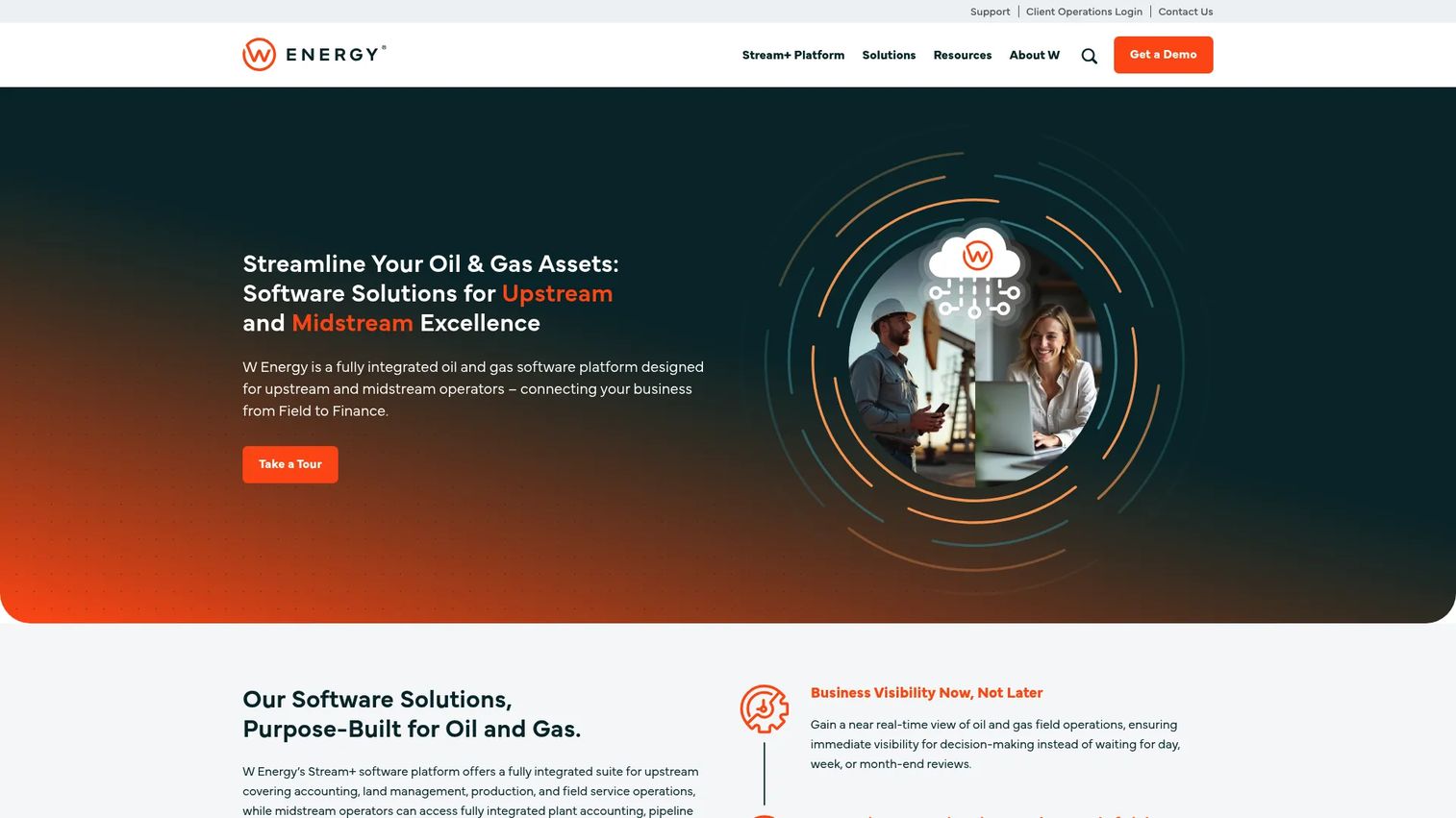
W Energy is cloud-based oil and gas software for upstream and midstream operators, built to connect field operations to finance. Its Stream+ platform unifies operations and accounting, which makes it a practical pick when field to finance visibility is the core problem. W Energy is designed around the reality that production, land, and accounting should not live in different worlds.
Best for: Upstream and midstream operators that want an integrated field to finance platform with speed and visibility.
Key strengths
- Stream+ unified platform: One system spanning upstream and midstream operations keeps field and finance data aligned.
- DataView business intelligence: Built-in reporting gives operators operational visibility without stitching dashboards together.
- Broad module coverage: Accounting, land, production, field service, and pipeline or plant accounting are all covered.
Why choose W Energy: If your month-end stalls because production volumes and accounting never quite match, a field to finance architecture closes that gap. W Energy suits operators that value speed and visibility, and that run both upstream and midstream oil and gas software needs on a single platform rather than bolting midstream accounting onto an upstream tool.
W Energy pricing: W Energy routes to demo and contact flows rather than publishing prices, so expect quote-based pricing scoped to your modules and operational size. A current public G2 rating was not available at the time of writing.
4. SAP
SAP is an enterprise application software and business AI provider whose oil and gas ERP footprint spans upstream, midstream, and downstream. SAP is the choice when corporate standardization across a global operation matters more than industry-specific depth. Its cloud ERP and business suite bring finance, supply chain, procurement, and HR under one roof, which is why large, multi-region operators shortlist it.
Best for: Large organizations that need integrated enterprise software across finance, operations, and supply chain at global scale.
Key strengths
- Cloud ERP and business suite: Finance, procurement, supply chain, and HR run on one enterprise backbone.
- Business AI with Joule: Embedded AI supports decision-making across core business functions.
- Broad functional coverage: Supply chain, finance, HR, procurement, and sustainability are covered in one ecosystem.
Why choose SAP: When your priority is one standardized backbone across every region and business unit, SAP delivers the enterprise breadth that specialized suites do not attempt. It fits operators where corporate consistency, global finance, and cross-function standardization outweigh the need for deep, purpose-built upstream tooling.
SAP pricing: SAP Business AI includes Joule Base at no additional cost in all SAP Cloud subscriptions, while premium AI packages are quote-based, per SAP's pricing page. Core ERP is priced through sales conversations. SAP holds a 4.2/5 rating on G2.
5. Oracle
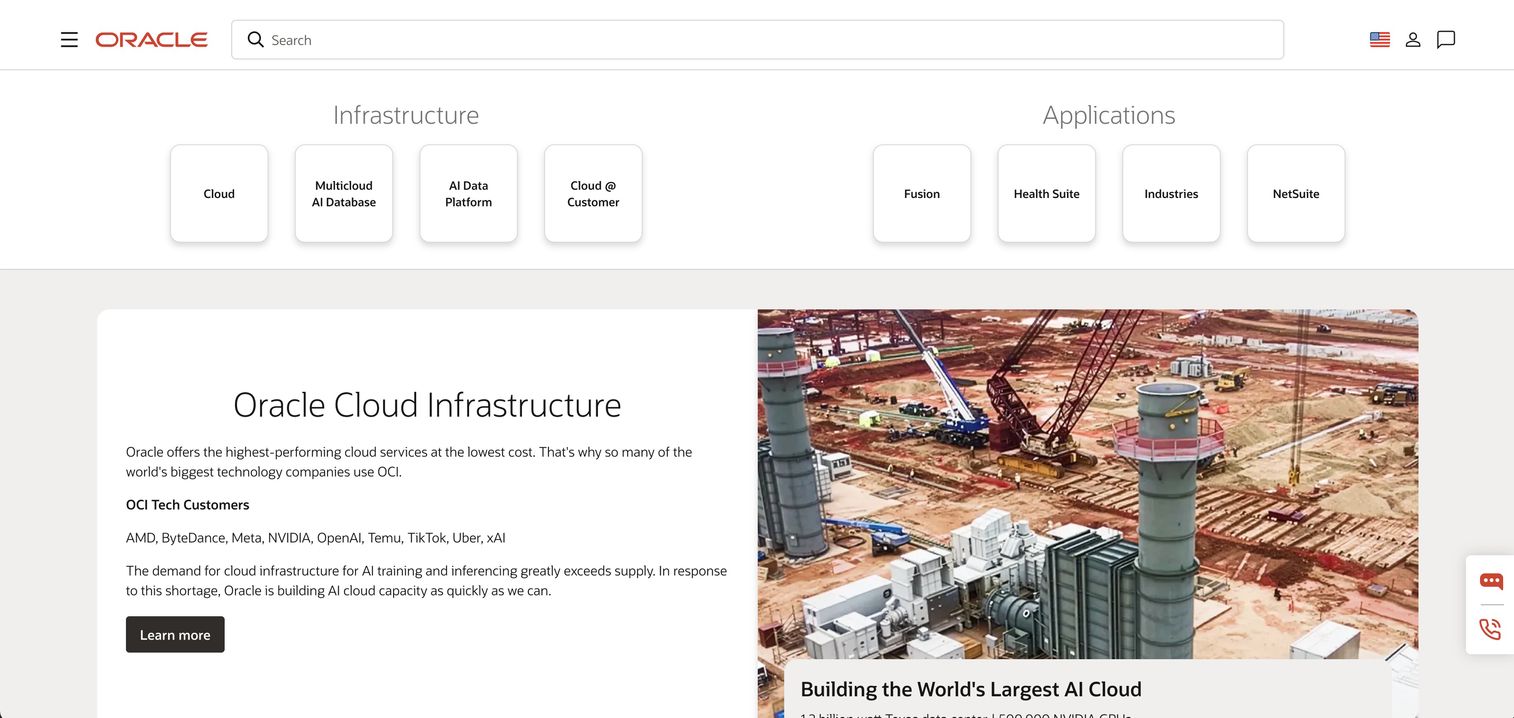
Oracle is an enterprise software and cloud infrastructure company offering databases, cloud services, applications, and developer tools. For oil and gas companies, Oracle fits large, complex organizations that need database, cloud, and application infrastructure at scale. Its strength sits in asset build, operate, and finance workflows anchored by cloud ERP and a deep data platform.
Best for: Enterprises that need database, cloud, and application infrastructure at scale across complex operations.
Key strengths
- Database and cloud infrastructure: Core data and infrastructure services underpin large enterprise workloads.
- Autonomous AI Database: Autonomous database services reduce manual administration for data-heavy operations.
- OCI pricing with cost estimator: A free tier entry point and a cost estimator support usage-based planning.
Why choose Oracle: When your organization already runs on a data-intensive infrastructure and you want ERP, applications, and cloud sitting on the same foundation, Oracle competes hard against other broad ERP buyers. It fits enterprises whose asset build, operate, and finance workflows benefit from consolidating data and applications on one cloud platform.
Oracle pricing: Oracle does not publish a single company-wide subscription price; pricing is service-specific and usage-based across OCI. There is a publicly visible free tier entry point, with paid services priced individually. Oracle holds a 4.1/5 rating on G2.
6. AspenTech
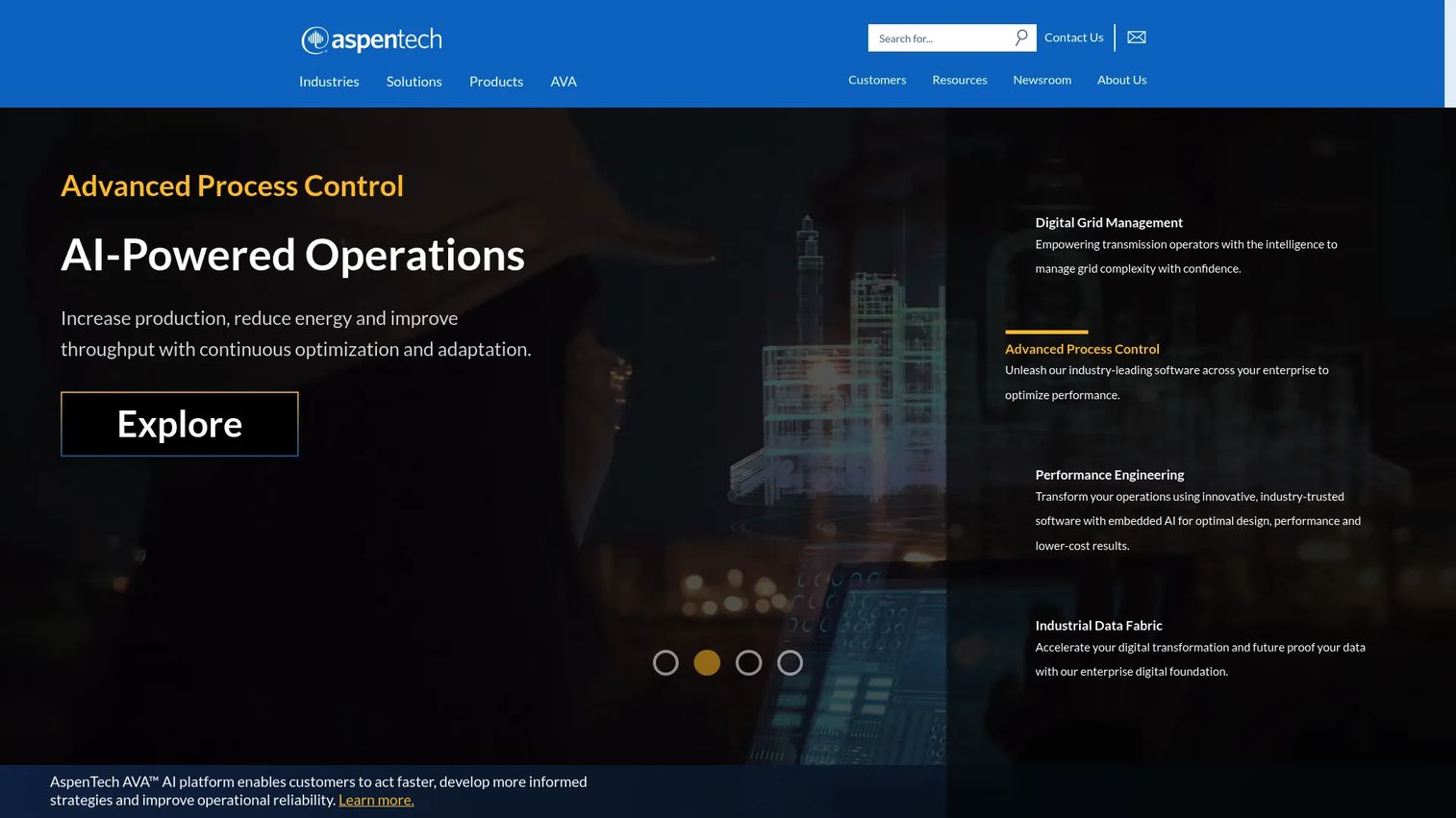
AspenTech is an industrial software company focused on asset optimization, industrial AI, and sustainability. It is the shortlist entry for engineering and technical buyers rather than a general ERP replacement. AspenTech's process simulation and asset performance management tools shine in upstream, midstream, refining, and process environments where the decision is about performance modeling, not transactions.
Best for: Engineering and technical teams that need process simulation, asset optimization, or operational planning.
Key strengths
- Process simulation: Engineering optimization and process simulation model plant and process performance before changes go live.
- Asset performance management: Predictive analytics anticipate equipment issues and improve asset uptime.
- Digital grid and data fabric: Digital grid management and an industrial data fabric support complex operational data.
Why choose AspenTech: When your questions are technical, such as how a process unit will perform or where an asset is likely to fail, AspenTech gives engineering teams modeling depth that operational and financial systems do not offer. It is not a core ERP or accounting suite, so it sits alongside those systems, adding process simulation and optimization where technical decisions carry real capital weight.
AspenTech pricing: AspenTech's site uses contact-sales flows rather than public software list pricing, so plan for a scoped quote. AspenTech holds a 4.5/5 rating on G2, the highest on this list.
7. OpenText
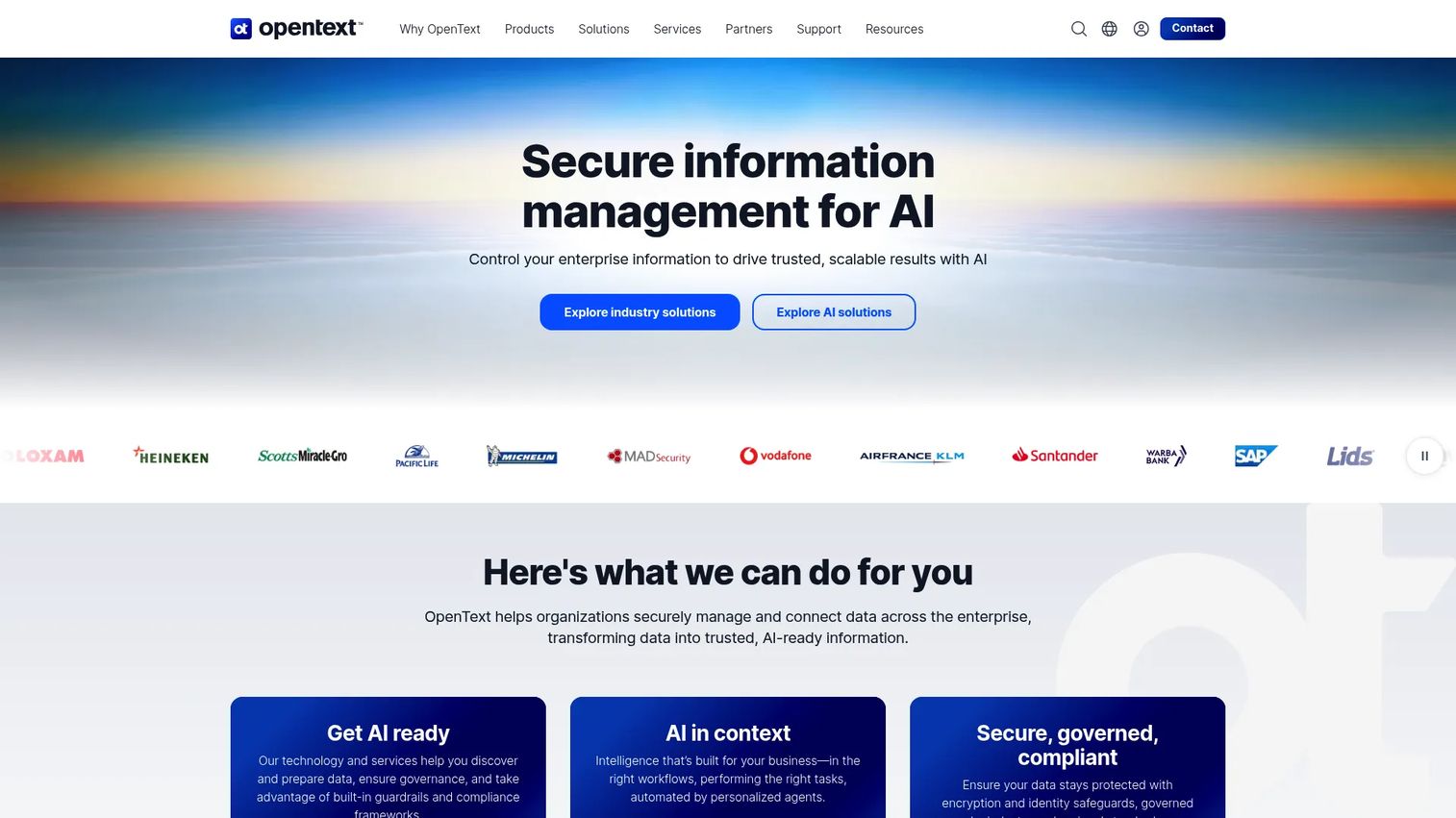
OpenText is an enterprise information management software company offering content, cybersecurity, business network, DevOps, and service management solutions. In oil and gas, its relevance centers on document and content management: the contracts, permits, compliance records, and operational knowledge that pile up across the asset lifecycle. OpenText is a support layer, not a core operational suite, and that is exactly why it earns a place in many stacks.
Best for: Large organizations that need control over enterprise content, compliance records, and operational documents.
Key strengths
- Enterprise content management: Secure document handling and workflow automation manage unstructured operational content.
- AI through Aviator: Content Aviator adds AI capabilities to surface and summarize enterprise information.
- Broad integrations: Connectors to Microsoft 365, SAP, and Salesforce tie content into existing systems.
Why choose OpenText: When compliance, records retention, and unstructured content are slowing teams down, OpenText brings governance and control to the documents that operational and financial systems do not manage well. It fits organizations that already run a core operational suite and need a dedicated content and compliance layer around it, especially where integrations with SAP or Microsoft 365 matter.
OpenText pricing: OpenText Content Management offers Express, Premium, and Ultimate plans described as purpose-built, though public prices are not shown on the pricing page. Expect a quote based on plan and scale. OpenText holds a 4.2/5 rating on G2.
Considerations before you buy oil and gas software
A shortlist is only useful if you evaluate it against your operational reality. Run every candidate through these criteria before committing.
Operational layer fit
Be honest about which layer is your actual bottleneck: production operations, accounting, ERP, asset management, or content. A platform that is excellent at one layer and weak at yours will create more fragmentation, not less. Map the tool to the workflow that is costing you time today.
Data integrity across handoffs
Every place production data moves between systems is a place errors creep in. Ask each vendor to show exactly how field volumes reach the ledger. The fewer manual re-keying steps between operations and finance, the more you can trust month-end.
Integration with your existing stack
You almost certainly are not replacing everything. Verify how the platform connects to what you keep, whether that is SAP, Microsoft 365, a measurement system, or a data warehouse. Weak integration turns an integrated platform into another silo.
Upstream versus midstream coverage
Upstream and midstream have genuinely different accounting and operational needs. Confirm a platform handles both if you run both. A tool built primarily for upstream may bolt midstream on awkwardly, and vice versa.
Evaluation speed and proof
Founders should not commit blind. Ask for interactive product demos, hands-on sandboxes, and reference calls with operators your size. The faster you can validate fit against your own workflow, the lower the risk of an expensive mismatch.
Conclusion
There is no single best software for oil and gas companies, and any list pretending otherwise is selling you something. The right choice depends entirely on which problem is loudest.
If upstream specialization is your priority, Quorum Software gives you purpose-built depth. If asset lifecycle and enterprise coordination dominate, IFS unifies EAM, ERP, and service. If field to finance visibility is the pain, W Energy connects production and accounting on one platform. If corporate standardization at global scale matters most, SAP and Oracle bring enterprise ERP breadth. If the decision is technical, AspenTech delivers process simulation and asset optimization. And if content and compliance are the friction, OpenText controls the documents everything else generates.
Build your shortlist by workflow, not by brand name. Name the layer that is costing you most, then evaluate two or three platforms against that specific reality, ideally through interactive demos and hands-on sessions before you sign. The platform that removes the most manual handoffs from your stack is the one worth paying for.
FAQs
Oil and gas software manages the operational, financial, and technical workflows of energy production, from field operations and hydrocarbon measurement to accounting, ERP, asset management, and logistics. Its main job is unifying data that would otherwise live in disconnected systems, so production, finance, and operations draw from the same source of truth. That reduces manual re-keying and improves data integrity across the business.
For upstream operators wanting deep industry specialization, Quorum Software and W Energy are strong choices because they are purpose-built for energy workflows rather than adapted from general business platforms. For operators prioritizing enterprise-wide standardization across regions and functions, SAP and Oracle offer broader oil and gas ERP breadth. The right answer depends on whether industry depth or corporate standardization matters more to you.
Choose an integrated suite when your main pain is fragmentation, where production, accounting, land, and logistics live in separate systems that never fully agree. Choose a point solution when one specific job, such as measurement or content management, is the only gap in an otherwise working stack. The deciding question is whether integration or best-in-class depth for a single workflow matters more right now.
Field to finance software connects operational activity in the field, such as production volumes and well data, directly to accounting and financial reporting. It removes the manual handoffs where operations and finance drift out of sync, so month-end draws from the same numbers the field records. W Energy and IFS both emphasize this field to finance architecture.
For midstream oil and gas software covering pipeline, plant, and transportation accounting, W Energy and Quorum Software both offer integrated coverage that spans upstream and midstream on one platform. Larger operators needing enterprise-wide supply chain and finance integration may lean toward SAP or Oracle. The best fit depends on whether you run midstream alongside upstream or as a standalone operation.
Yes. Enterprise ERP platforms like SAP and Oracle work well for oil and gas companies that prioritize corporate standardization, global finance, and cross-function coordination. They provide broad coverage across finance, procurement, supply chain, and HR. Companies needing deep, purpose-built upstream or midstream operational tooling often pair enterprise ERP with a specialized energy suite.
Founders should identify the single operational layer costing the most time, then evaluate platforms against that specific workflow rather than by brand reputation. Verify data integrity across handoffs, integration with the existing stack, and coverage for both upstream and midstream if relevant. Ask for interactive demos, hands-on sandboxes, and reference calls with operators of similar size to validate fit before committing.
Yes. Process simulation software, such as AspenTech's tools, is a technical layer of oil and gas software used to model plant and process performance, optimize operations, and support capital decisions. It sits alongside operational and financial systems rather than replacing them, and it is most relevant to engineering and technical buyers making performance and asset decisions.