

A fraudster tests a stolen card on your signup form at 2am. Your rules engine flags it. It also flags 40 legitimate customers who happened to sign up on a new device that week. By morning, support has a backlog, three real buyers have churned, and finance still wants to know why chargebacks went up.
That is the actual problem with fraud. It is not a single event you block. It is a tradeoff you manage across conversion, support load, and trust, on every transaction, every session, every account.
For a product manager, that tradeoff lands directly on activation and retention. Shallow prevention adds friction that legitimate users feel. Aggressive rules inflate false positives. Weak coverage lets losses climb. The right fraud detection software has to score risk in real time, verify identity without slowing good users, and give your fraud ops team a workflow that scales across release cycles.
The stakes keep rising. The global fraud detection and prevention market is projected to grow from USD 35.71 billion in 2026 to USD 80.01 billion by 2031, a 17.5% CAGR, according to MarketsandMarkets (2026). That growth reflects how fast attack patterns evolve and how much of the buying journey now runs through digital channels most teams cannot fully police by hand.
This guide compares the fraud prevention solutions worth evaluating and shows how to match each to your operating model.
What's inside
This guide is written for product managers and risk owners evaluating fraud prevention software in mid to late stage. It focuses on the operational realities that shape a purchase, not generic security talk.
We selected and compared tools on four criteria:
- Real-time detection and scoring depth
- Fraud ops workflows: alert triage, case management, investigation
- Identity, device, and behavioral signal coverage
- Integration depth with your internal and external data
You will get a comparison table, a breakdown of each tool, a buyer's checklist, and answers to the questions PMs actually ask before committing engineering time.
TL;DR
- Best for unified fraud and AML workflow: Sardine, which combines fraud, compliance, and case management with agentic automation.
- Best for enterprise decisioning and analytics: SAS Fraud Decisioning, built for real-time scoring and heavy analytics teams.
- Best for identity and device intelligence: TransUnion Fraud Detection Software, strong on multi-layered identity, device, and behavioral coverage.
- Best for framework-level understanding and architecture: F5 Fraud Detection, useful when you are shaping a detection approach and need bot and abuse context.
- Watch the workflow, not just the model: the tool that reduces false positives and speeds case handling usually beats the one with the flashiest machine learning.
What is fraud prevention software?
Fraud prevention software is a category of tools that detect, score, and stop fraudulent activity across signup, login, payment, and account events in real time. A modern fraud detection system combines identity signals, device intelligence, behavioral analytics, and machine learning to separate legitimate users from bad actors, then routes suspicious cases into an investigation workflow.
The core capabilities most fraud analytics software shares:
- Real-time monitoring and scoring: assigns a risk score to each event as it happens, so you can allow, block, or step up.
- Identity verification and device risk signals: checks identity data and device intelligence to spot synthetic identities and known bad devices.
- Behavior analytics and machine learning: models normal patterns for each user and flags anomalies that rules alone would miss.
- Case management and investigation workflows: gives analysts a queue, alert triage, and tooling to resolve cases and feed decisions back into the model.
- Integration with internal and external fraud data: connects to your CRM, payment stack, and consortium or third-party data for richer context.
Here is how a dedicated fraud prevention platform compares to the alternatives many teams start with.
| Approach | Real-time scoring | False positive control | Case management | Scales with volume |
|---|---|---|---|---|
| Spreadsheet-based review | No | Manual and slow | Ad hoc | No |
| Static manual rules | Limited | Rigid, high false positives | Minimal | Poorly |
| Generic security tooling | Partial | Not fraud-specific | Not built for fraud ops | Varies |
| Fraud prevention software | Yes | Tunable with ML | Purpose-built | Yes |
The distinction matters because fraud is adversarial. Attackers adapt, so a system that only scores against fixed rules ages fast. Tools built around machine learning and structured fraud ops workflows keep pace better than a spreadsheet or a bolt-on security layer.
When to use fraud prevention software
Stop fraud at sign-up and onboarding
Synthetic identity fraud and bot-driven account creation hit hardest at the front door. A fraud detection tool checks identity, device, and behavioral signals during onboarding, so you catch fake accounts before they consume support time or poison your data. For a PM, cleaner signups mean more reliable activation metrics and fewer downstream investigations.
Detect suspicious activity across payment and account events
Payment fraud and account takeover prevention depend on real-time fraud detection across the full session, not just the checkout moment. Transaction monitoring scores each payment and login against behavioral baselines. When something deviates, the system can block, hold, or trigger step-up verification, which protects revenue without a blanket review that clogs the queue.
Reduce false positives without slowing legitimate users
Every false positive is a good customer told no. That is lost conversion and a support ticket. Behavioral analytics and machine learning let you tune sensitivity so genuine users pass through while risky ones get scrutiny. Faster, more accurate review also lightens fraud ops load, which is the operational win most teams underrate.
Comparison table
The four tools below cover different operating models, from unified risk platforms to enterprise decisioning to architecture-first frameworks. Pricing for most fraud prevention software is quote-based, so treat the pricing column as a signal to talk to sales rather than a public rate card.
| # | Product | Best for | Key differentiator | Pricing | G2 rating |
|---|---|---|---|---|---|
| 1 | Sardine | Unified fraud, AML, and risk ops | Agentic workflows plus consortium data | Custom | 4.9/5 |
| 2 | SAS Fraud Decisioning | Enterprise decisioning and analytics | Real-time scoring on SAS Viya | Custom | 4.1/5 |
| 3 | TransUnion Fraud Detection Software | Identity and device intelligence | Multi-layered identity plus device risk | Custom | 4.3/5 |
| 4 | F5 Fraud Detection | Bot, abuse, and fraud architecture | Signal-based detection across web, mobile, API | Custom | 4.4/5 |
Best fraud prevention software tools for 2026
1. Sardine
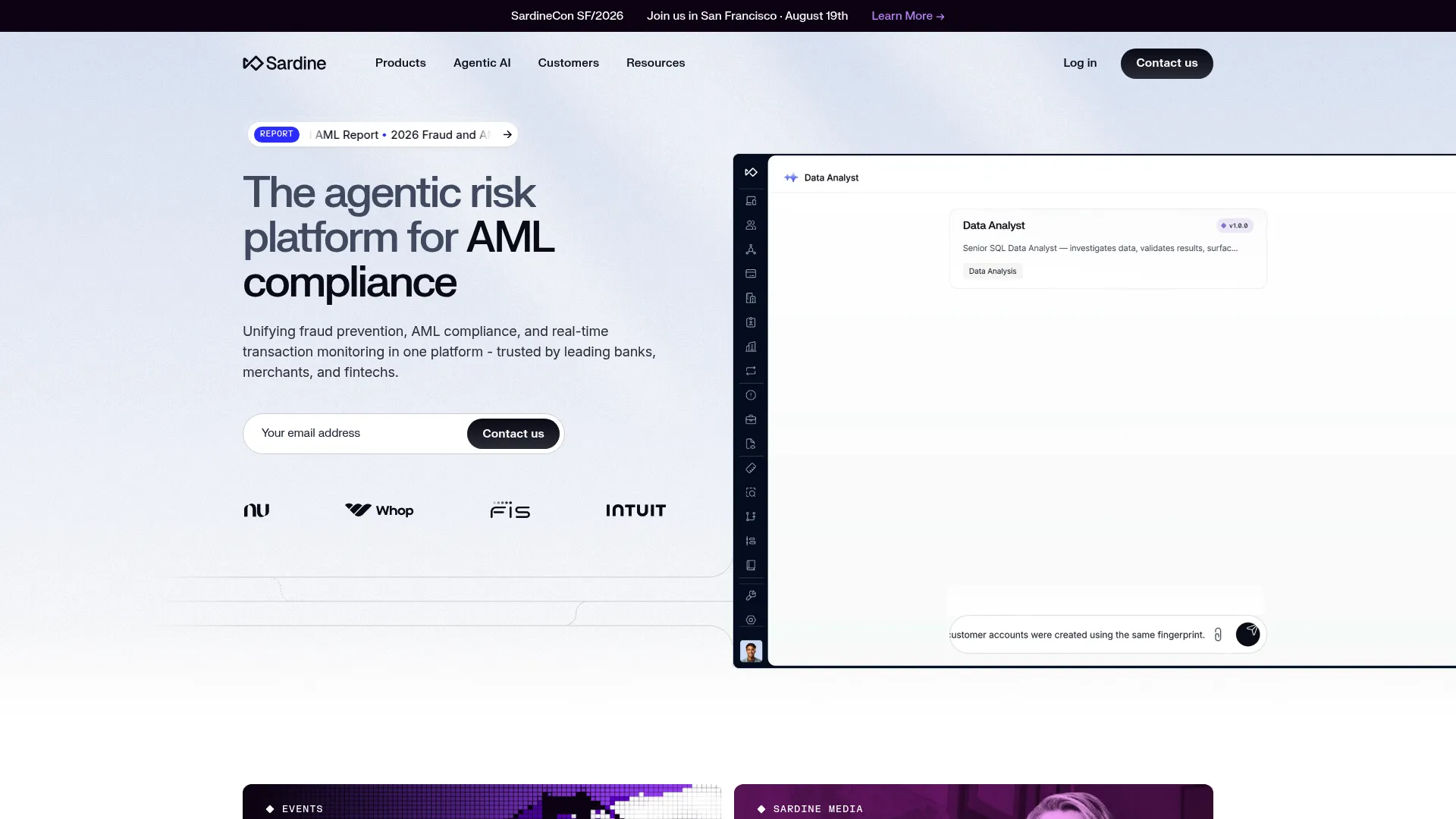
Sardine is an agentic risk platform that unifies fraud prevention, AML compliance, and real-time transaction monitoring in one system. Instead of stitching together separate tools for fraud, compliance, and case work, teams run detection, decisioning, and investigation from a single platform. It leans on device and behavior intelligence, a rules engine paired with machine learning, and consortium data to catch patterns a single company would not see alone.
Sardine covers a broad set of fraud types, from payment fraud and account takeover to bot abuse, refund fraud, and policy abuse. The platform pairs that coverage with fraud investigations and case management, so analysts work suspicious events in a structured queue rather than chasing signals across systems. The agentic layer adds specialized agents that automate parts of triage and investigation, which reduces manual review load as volume grows.
Best for: Banks, fintechs, marketplaces, and merchants that want unified fraud and AML tooling in one platform.
Key features
- Device and behavior fraud detection
- Rules engine plus machine learning scoring
- Fraud investigations and case management
- Agentic AI workflows and specialized agents
- Consortium data for shared fraud signals
Why choose Sardine: Pick it when you want one platform for fraud, AML, and case management rather than a stack of point tools. It fits teams that value a broad risk workflow and want automation to absorb repetitive triage as they scale.
Sardine pricing: Pricing is custom and quote-based. The pricing page directs you to contact the company for a proposal, so scope your volume and use cases before the call.
2. SAS Fraud Decisioning

SAS Fraud Decisioning is cloud-native fraud detection, prevention, and investigation software built on SAS Viya. It targets enterprise risk teams that need real-time scoring at scale and deep analytics behind every decision. The platform follows a profile, score, evaluate workflow, applying AI and machine learning to each event and letting teams test strategies before they go live.
Coverage spans payment fraud, scams, account takeover, synthetic identity fraud detection, and check fraud. SAS pairs that breadth with champion-challenger testing and strategy optimization, so analytics-heavy teams can compare models and tune decisioning against real outcomes. Automated investigation workflows and case management keep the analyst side organized, and enterprise deployment options plus long-standing analyst credibility make it a common fit for banks and large financial institutions.
Best for: Banks and financial institutions that need real-time enterprise fraud decisioning with heavy analytics.
Key features
- Real-time decisioning and scoring
- AI and ML-driven fraud analytics
- Champion-challenger testing and strategy optimization
- Automated investigation workflows
- Case management for analyst teams
Why choose SAS Fraud Decisioning: Choose it when your team is analytics-first and wants to model, test, and optimize fraud strategies rather than run fixed rules. It suits enterprises with the data science capacity to get value from champion-challenger testing.
SAS Fraud Decisioning pricing: Public pricing is not shown on the SAS site. The product is sold through enterprise agreements, so pricing depends on deployment, volume, and the modules you need. Contact SAS to scope a quote.
3. TransUnion Fraud Detection Software

TransUnion Fraud Detection Software, delivered through its TruValidate offering, helps businesses identify legitimate consumers and mitigate fraud risk across digital and phone channels. The approach is definition-first and multi-layered: rather than one control, it stacks identity verification, behavioral analytics, device risk insights, and step-up verification to raise confidence at each decision point.
Coverage includes account takeover prevention, synthetic identity fraud detection, payment fraud, and internal fraud. The multi-layered model is the point. Real-time monitoring catches suspicious activity early, identity verification software confirms who is transacting, and device intelligence flags risky hardware, while step-up verification adds friction only when the risk score warrants it. The stated benefits track what PMs care about: early detection, preserved customer trust, and fewer false positives that would otherwise cost conversion.
Best for: Enterprises that want broad fraud detection, identity verification, and device-risk controls in one stack.
Key features
- Real-time monitoring across channels
- Device risk insights and device intelligence
- Identity verification software
- Behavioral analytics for anomaly detection
- Step-up verification tied to risk score
Why choose TransUnion Fraud Detection Software: Choose it when identity and device coverage is your priority and you want a layered stack rather than a single detection method. It fits teams that need to confirm legitimate consumers across both digital and phone channels.
TransUnion Fraud Detection Software pricing: Public pricing is not shown. The fraud detection page directs you to contact sales, so pricing is scoped to your channels, volume, and the identity and device modules you enable.
4. F5 Fraud Detection
F5 Fraud Detection covers a set of distributed cloud security services that detect and mitigate bots, abuse, and fraudulent activity across apps and APIs. F5 is education-first in how it frames fraud detection, which makes it useful when you are shaping a detection approach and want to understand rule-based, anomaly-based, and machine learning methods before committing to an architecture. Its fraud-related offerings sit close to security, including bot detection and mitigation, so the context extends beyond transaction scoring.
F5 detects fraud using behavioral, network, and environmental signals, and its data intelligence surfaces insights across user, device, and network. That signal breadth is the differentiator for teams thinking about real-time versus retrospective detection and where fraud controls sit relative to their broader security stack. If you are building a fraud detection framework or evaluating architecture, F5 gives you both the conceptual grounding and the runtime protection for web, mobile, and API traffic.
Best for: Enterprises that need bot and fraud protection across web, mobile, and API traffic.
Key features
- Bot detection and mitigation
- Behavioral, network, and environmental signals
- Data intelligence across user, device, and network
- Protection for web, mobile, and API traffic
- Real-time and retrospective detection context
Why choose F5 Fraud Detection: Choose it when your fraud problem overlaps heavily with bots and abuse, or when you are defining a detection framework and need security-adjacent context. It fits teams evaluating architecture as much as individual detection features.
F5 Fraud Detection pricing: F5 sells Distributed Cloud Services as annual subscription packages, with Essentials and Enterprise tiers, plus cloud marketplace and pay-as-you-go options. Public list prices are not shown, so contact F5 or check your cloud marketplace for a quote.
Considerations
Before you commit engineering time, pressure-test each shortlisted tool against your actual operating model. These are the criteria that separate a tool that fits from one that adds work.
Fraud types you must cover
Map the fraud you actually see to what each tool covers. Account takeover, synthetic identity fraud, payment fraud, and policy abuse each need different signals. A tool strong on payment fraud may be thin on onboarding fraud, so match coverage to where your losses and friction concentrate.
Integration with internal and external data
A fraud detection system is only as good as the data feeding it. Check how it connects to your CRM, payment stack, and identity or consortium data. Weak integrations mean thin context, which means more false positives and more manual review for your team.
False positives and customer friction
Ask each vendor how they measure and reduce false positives. Behavioral analytics and step-up verification should add friction only when risk warrants it. Model the conversion cost of aggressive blocking, because a good customer told no is churn plus a support ticket.
Investigation workflow and case handling
Look past the scoring model at the fraud ops experience. Evaluate alert triage, case management, and how decisions feed back into the model. The tool that speeds investigation and reduces manual review usually delivers more operational value than the one with the most impressive machine learning claims.
Deployment, scale, and governance
Confirm the tool scales with your transaction volume and fits your deployment and compliance needs. Check explainability, since regulated decisions must be defensible, and confirm it holds up across your release cadence without constant retuning.
Conclusion
There is no single best fraud prevention software, only the best fit for your operating model and the fraud you actually face.
- Choose Sardine for unified fraud, AML, and risk workflows with agentic automation.
- Choose SAS Fraud Decisioning for enterprise decisioning and analytics-heavy teams that want to model and test strategies.
- Choose TransUnion Fraud Detection Software for broad identity, device, and behavioral coverage across channels.
- Choose F5 Fraud Detection for framework-level understanding and fraud architecture that overlaps with bot and abuse protection.
Your next step: shortlist two tools that match your primary fraud type and operating model, then run each against your own data and fraud ops workflow. Judge them on false positive rate and case-handling speed, not just the model on the slide. The tool that reduces friction for legitimate users while keeping your team fast on real threats is the one worth the engineering investment.
FAQs
Fraud detection identifies suspicious activity after or as it happens, usually by scoring events and flagging anomalies. Fraud prevention is broader, aiming to stop fraud before it completes through identity verification, device checks, and step-up authentication. Most modern platforms do both, which is why the terms are often used together.
Start with the fraud that costs you most in losses or friction, not the fraud that sounds scariest. For many SaaS products that means account takeover and synthetic identity fraud at signup, then payment fraud once transactions scale. Map your actual incidents and false positives before picking a tool.
Device intelligence flags risky or known-bad hardware and detects when one device spins up many accounts. Behavioral analytics models how legitimate users normally act, then flags deviations that fixed rules would miss. Together they raise accuracy, which cuts false positives and lets good users through without extra friction.
Case management is the fraud ops workflow that turns alerts into resolved decisions. It gives analysts a queue, alert triage, investigation tooling, and an audit trail, then feeds outcomes back into the scoring model. Strong case management is often the difference between a tool that saves time and one that creates a backlog.
Tune sensitivity with behavioral analytics and machine learning so only genuinely risky events get scrutiny. Use step-up verification to add friction selectively rather than blocking broadly. Measure the conversion cost of every rule, because each false positive is a lost customer and a support ticket.
Tie evaluation to activation, conversion, support load, and fraud loss, not just detection accuracy. Run each shortlisted tool against your own data and measure false positive rate, case-handling speed, and impact on legitimate user flow. The best fraud detection software improves the business metrics you already own, not just a security dashboard.
Yes. The strongest fraud prevention solutions cover the full customer lifecycle, from synthetic identity checks at signup to real-time transaction monitoring at payment. Covering both surfaces gives you consistent risk scoring across the journey and avoids gaps that fraudsters exploit between onboarding and checkout.