The line is six deep. Your card reader spins. The signal drops right as someone hands over a phone to tap. Behind you, three tickets are stacking on the pass and nobody can read the modifiers. That is the exact moment a food truck POS system either earns its keep or turns a good service into a slow one.
Food trucks do not run like restaurants. You have a few square feet, one or two people, unpredictable connectivity at events, and a menu that changes when the fish sells out. A point of sale that assumes a fixed counter and reliable Wi-Fi will fight you all day. The right one takes orders fast, keeps working when the internet does not, routes tickets to the kitchen, and gives you clean numbers at the end of the night.
The stakes are real. Roughly 48,400 food trucks operate across the U.S., and the industry has grown about 8% per year over the last five years, according to FoodTruckProfit (2026). Around 82% of owners say cards and mobile payments now make up the vast majority of their transactions. When card handling stalls, so does revenue. This guide is built to help you avoid that.
What's inside
This guide compares seven food truck POS systems that hold up in the real conditions trucks operate in. We chose them on four things that matter most on a busy service line: offline reliability so payments keep flowing when the signal drops, ordering workflows including KDS and QR ordering, reporting that helps a lean operator run the business, and hardware fit plus overall value. Every price and rating here reflects verified vendor sources as of mid-2026. Verify current numbers before you sign, since plans and processing rates change.
TL;DR
- Best default for most food trucks: Square, thanks to free software, strong offline card handling, and pay-as-you-go pricing.
- Best food-truck-specific fit: EasyEats, built around KDS, online ordering, and pickup notifications at low cost.
- Best for growth and flexibility: Quantic POS, a mobile-first cloud platform with online ordering and loyalty.
- Best all-in-one operations: Toast, with online ordering, QR order-and-pay, and loyalty in one stack.
- Best polished hardware: Clover, for operators who want purpose-built devices and card, contactless, and wallet payments.
- Best bundled suite: SpotOn, combining POS, commission-free online ordering, and reservations.
Background
A food truck POS system is the software and hardware a mobile food business uses to take orders, accept payments, route tickets to the kitchen, and track sales, all in a compact setup that works on the move.
Because trucks operate in tight spaces with variable connectivity, the feature set skews toward mobility and resilience. The pieces that matter most:
- Mobile payments: Tap-to-pay, chip, swipe, and digital wallets from a handheld or tablet, since most transactions are now cards and phones.
- Offline mode: The ability to keep taking card payments and queuing orders when the connection drops, then sync once you are back online.
- KDS (kitchen display system): A screen that shows orders and modifiers so the cook is not squinting at printed tickets in a cramped galley.
- QR code ordering: Customers scan, order, and pay from their phones, which shortens the physical line during a rush.
- Handhelds: Compact terminals a runner can carry down the line to take orders and payment before people reach the window.
- Reporting: Real-time sales, item performance, tax, and end-of-day summaries so a solo owner can run lean.
Nearly 9 in 10 food truck owners rely on digital tools, including mobile POS systems, per FoodTruckProfit (2026). And 91% of trucks are independent operations, which means the owner is usually the one setting up, running, and reconciling the system. Simplicity is not a luxury here. It is the difference between closing out at 9 p.m. or midnight.
When to use a food truck POS system
Not every operator needs the same thing. Here is how to match the tool to the moment.
When you need faster line flow
A festival rush punishes slow checkout. When your bottleneck is the window, a POS with handhelds and QR code ordering lets you take orders and payment in parallel instead of one at a time. The outcome is a shorter physical line, fewer walk-aways, and more covers in the same two-hour window.
When connectivity is unreliable
Parking lots, fairgrounds, and street corners rarely have solid Wi-Fi. When you cannot trust the signal, offline mode is non-negotiable. A system that keeps accepting card payments and holding orders locally, then syncs when the connection returns, protects revenue that a cloud-only setup would drop on the floor.
When you want orders, payments, and reporting in one stack
Juggling a separate card reader, a paper ticket system, and a spreadsheet at night is how mistakes happen. When you want one source of truth, an all-in-one food truck point of sale ties orders, payments, KDS, and reporting together. The outcome is cleaner numbers, faster reconciliation, and less time on admin after close.
Comparison table
The table below summarizes each food truck POS system by intent, key differentiation, pricing, and rating. Pricing and ratings reflect verified vendor sources as of mid-2026 and should be confirmed before you buy, since plans and processing rates change often.
| # | Product | Intent | Key differentiation | Pricing | G2 rating |
|---|---|---|---|---|---|
| 1 | Square | Default all-rounder | Free software, strong offline card handling | Free; Plus $49/mo per location; Premium $149/mo | 4.5/5 |
| 2 | EasyEats | Food-truck-specific | KDS, online ordering, pickup notifications | 0.95% per transaction, or $90/mo annual | Not enough reviews |
| 3 | Quantic POS | Growth and flexibility | Mobile-first cloud POS with loyalty | Contact vendor | Not enough reviews |
| 4 | Toast | All-in-one operations | Online ordering, QR order-and-pay, loyalty | Free; Point of Sale $69/mo | 4.2/5 |
| 5 | Clover | Polished hardware | Purpose-built devices, wallet payments | From $799 + $25/mo per device | 3.9/5 |
| 6 | SpotOn | Bundled suite | POS, commission-free ordering, reservations | Free; Counter-service $99/mo | 4.4/5 |
| 7 | UpMenu | Branded digital ordering | Direct online ordering plus POS | From $49/mo per restaurant | Not enough reviews |
1. Square
Square is the default benchmark for food trucks, and for good reason. It pairs free POS software with hardware that fits a tight counter, and it handles card, contactless, and mobile wallet payments out of the box. For a solo owner or a two-person crew, the appeal is simple: you can be taking payments the same day the reader arrives, without a contract or an install crew.
Its offline card handling is what makes it a food truck staple. When the signal drops at an event, Square can keep accepting swiped card payments and process them once you reconnect. Add QR code ordering, handhelds, and a compact terminal, and you have a setup that scales from a single window to a small fleet without changing platforms.
Best for: Small to mid-sized food businesses that want integrated payments and POS software with no upfront software cost.
Key strengths
- Free software tier: Square Free carries no monthly subscription, so you only pay processing.
- Offline payments: Keeps card transactions moving when connectivity fails, then syncs.
- Flexible hardware: Readers, handhelds, and terminals that fit compact truck counters.
Why choose Square: If you want the lowest-risk starting point with the widest hardware and payment coverage, Square is hard to beat. It suits owners who value speed of setup and pay-as-you-go pricing over a bundled operations suite. As the business grows, the paid tiers add depth without forcing a migration.
Square pricing: Square offers three plans. Square Free is $0 per month with no subscription cost. Square Plus is $49 per month per location, and Square Premium is $149 per month per location. Both paid plans include a free 30-day trial. Processing fees apply on top of the software cost. Square holds a 4.5/5 rating on G2.
2. EasyEats
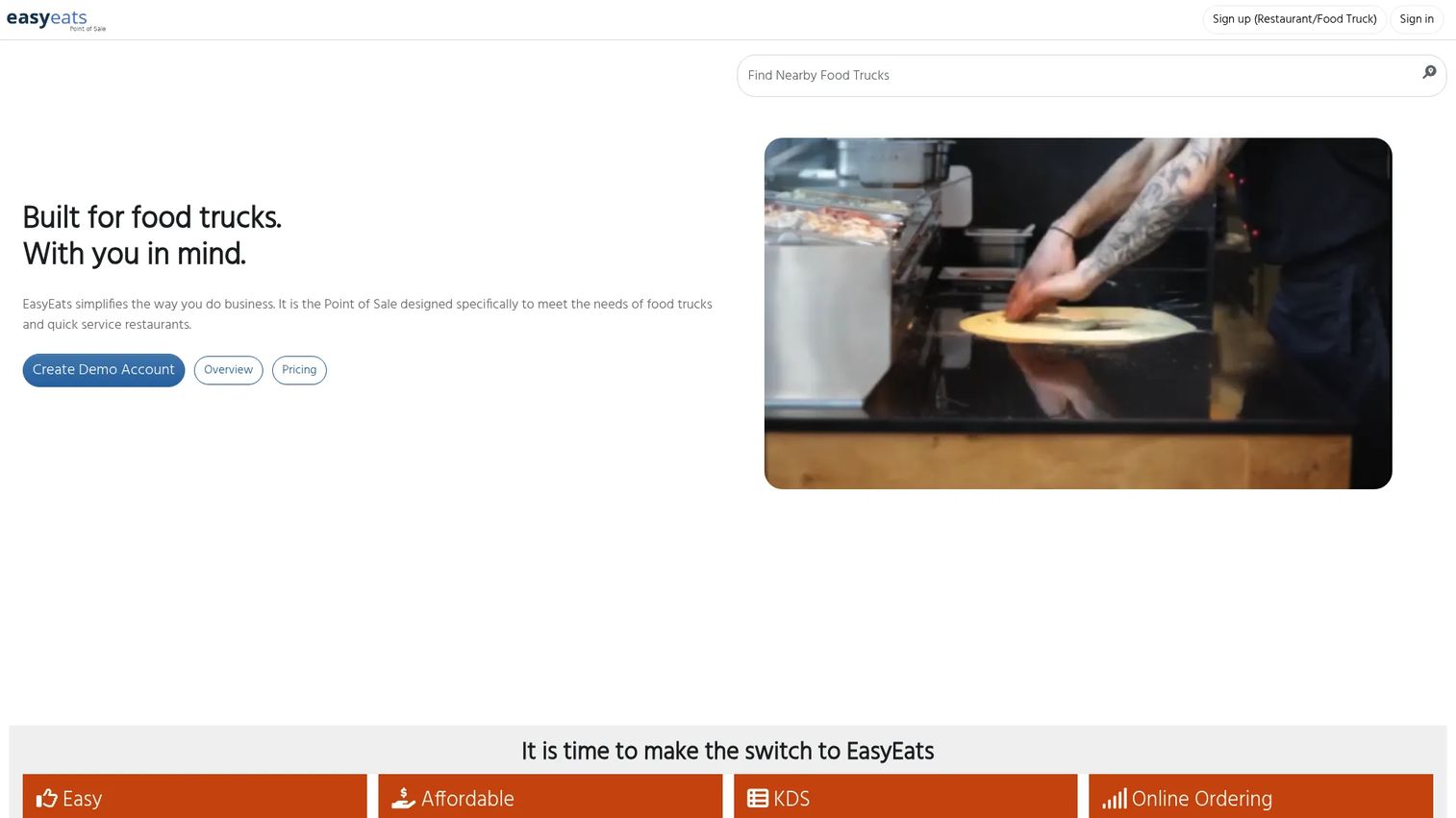
EasyEats is built for the exact workflow a food truck runs, not a full-service dining room retrofitted for the road. It pairs a point of sale with online ordering and a kitchen display system, so the person at the window and the person on the flat top stay in sync during a rush. That focus shows in how little setup it demands to get moving.
The standout for trucks is the combination of KDS and pickup notifications. Orders route to the kitchen screen cleanly, and customers get a text when their food is ready, which keeps the window clear and cuts the crowd hovering at the counter. For events where you are managing a wave of pickups, that flow matters.
Best for: Food trucks and quick-service operators who need POS plus online ordering without paying for restaurant-scale features.
Key strengths
- Kitchen display system: Routes orders and modifiers to a screen for tight galley kitchens.
- Online ordering: Lets customers order ahead so the line moves before they arrive.
- Pickup notifications: Texts customers when food is ready to keep the window uncluttered.
Why choose EasyEats: Choose EasyEats when you want a system designed around food-truck realities rather than adapted to them. Its value-oriented pricing suits independents watching every dollar, and the pickup-text workflow is a genuine operational edge at busy events.
EasyEats pricing: EasyEats offers a Pay As You Go plan at 0.95% per transaction with no monthly minimum, or an Annual Contract at $90 per month billed monthly. A free demo account is available so you can test the workflow before committing. EasyEats does not yet have enough G2 reviews to show a rating.
3. Quantic POS
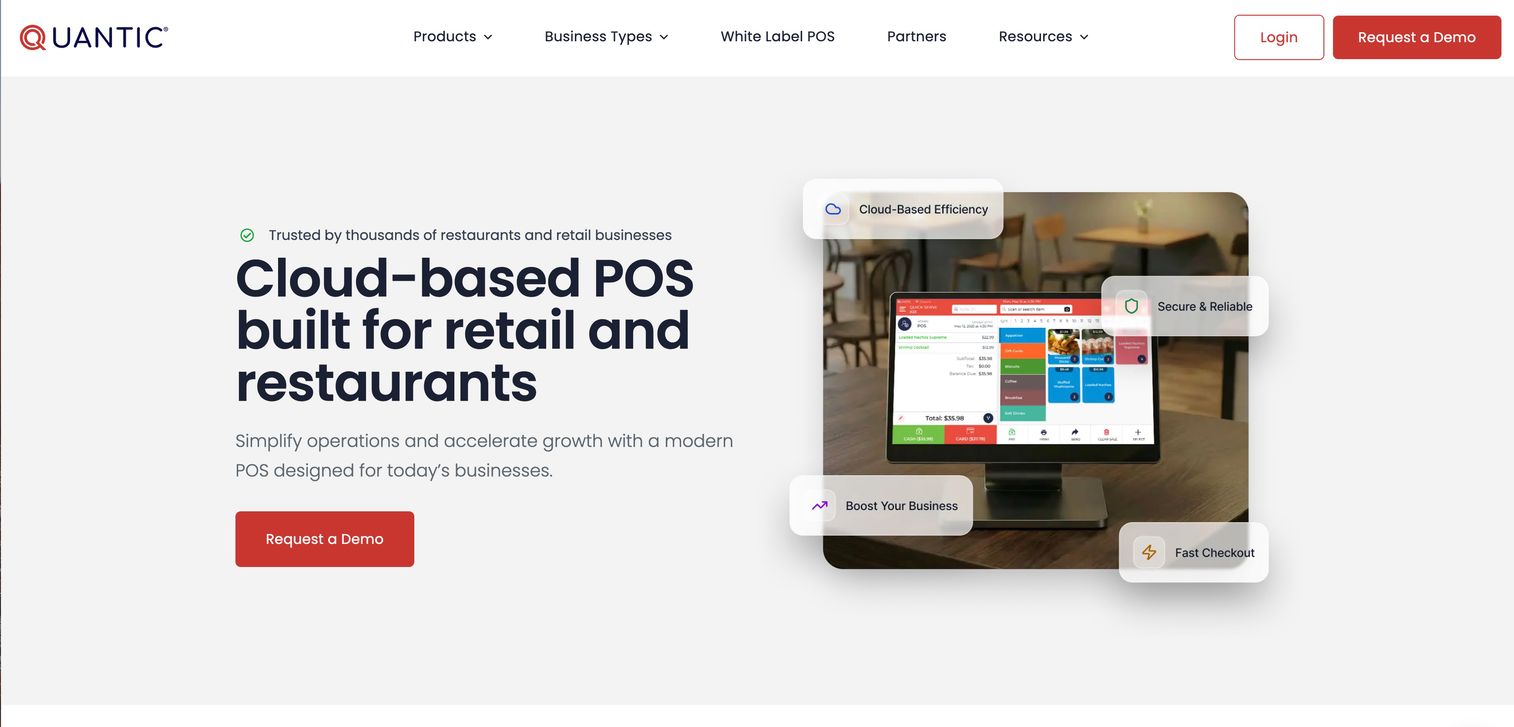
Quantic POS is a cloud-based POS platform for restaurants and retail, and its mobile-first design makes it a strong fit for operators thinking about growth. The system runs on tablets and compact hardware, so it adapts to a truck counter as easily as a brick-and-mortar counter. That flexibility is useful if you plan to add a second truck or a small storefront later.
For food trucks, the draw is the mix of online ordering, inventory management, and loyalty tied into one cloud platform. You can track what is selling, spot when a popular item is running low, and reward repeat customers who follow your truck from stop to stop. The kitchen display system keeps order routing clean even when the window gets loud.
Best for: Operators who want a cloud POS that can flex from a single truck to a multi-location setup.
Key strengths
- Mobile-first design: Built to run on tablets and compact hardware that fits a truck.
- Online ordering: Captures orders ahead of the window to smooth out rush periods.
- Loyalty and inventory: Rewards regulars and tracks stock in one cloud platform.
Why choose Quantic POS: Pick Quantic if you value operational flexibility and plan to scale beyond one truck. The cloud foundation and loyalty tools reward operators who want to build a following, not just process transactions.
Quantic POS pricing: Quantic POS does not publish standardized public pricing, and plans are quoted based on your setup. Contact the vendor for a quote tailored to your hardware and location count. Quantic does not yet have enough G2 reviews to display a rating, so weigh it on a demo rather than aggregate scores.
4. Toast
Toast is an established restaurant POS and management platform, and its all-in-one approach appeals to food trucks that want more than a card reader. The cloud-based POS ties together payment processing, online ordering and delivery, loyalty, and even payroll and scheduling. For an operator running a truck plus a growing catering side, that breadth removes the need to stitch together separate tools.
The features that translate best to trucks are online ordering and QR order-and-pay. Customers scan a code, browse the menu, and pay from their phones, which pulls demand off the physical window during peak hours. Loyalty and marketing add-ons help you turn a festival crowd into repeat traffic. The tradeoff is that the platform's packaging and add-ons can add up, so it rewards operators ready to use the fuller stack.
Best for: Food trucks that want an all-in-one POS with integrated payments and operations tools.
Key strengths
- Online ordering and delivery: Captures off-window demand and routes it into the kitchen.
- QR order-and-pay: Lets guests order and pay from their phones to speed service.
- Loyalty and marketing: Turns one-time crowds into repeat customers.
Why choose Toast: Choose Toast when your operation is more than a single window and you want ordering, payments, loyalty, and back-office tools under one roof. It fits operators ready to grow into the platform rather than those wanting the leanest possible setup.
Toast pricing: Toast publicly lists a Starter Kit at $0 per month, a Point of Sale plan at $69 per month, and a Build Your Own option with custom pricing. Pricing applies to new customers and single locations. Payment processing rates apply separately. Toast holds a 4.2/5 rating on G2.
5. Clover
Clover is a cloud-based POS and payment platform for small businesses, and its calling card is polished, purpose-built hardware. If you want devices that feel solid on a busy counter and handle card, contactless, gift card, and mobile wallet payments cleanly, Clover fits the bill. Its device-based options span restaurants, retail, and mobile businesses, so a truck can pick the form factor that suits its space.
For food trucks, the appeal is the combination of dependable payment handling and built-in operational tools. Inventory, reporting, employee management, and customer engagement features come baked in, so a lean crew can run the essentials without bolting on extra apps. The kitchen display options keep order routing tidy in a compact galley.
Best for: Small food businesses that want an all-in-one POS with polished hardware and operational tools.
Key strengths
- Purpose-built hardware: Solid, counter-ready devices designed for daily service.
- Broad payment acceptance: Card, contactless, gift card, and mobile wallet in one device.
- Built-in operations: Inventory, reporting, and employee management included.
Why choose Clover: Choose Clover if hardware quality matters to you and you want operational tools bundled with your payment device. It suits operators who would rather buy a considered device than assemble a setup from parts.
Clover pricing: Clover pricing combines device costs with monthly software fees and processing rates. Its kitchen display hardware starts at $799 plus $25 per month per device for the 14-inch unit, and $899 plus $25 per month for the 24-inch unit. Clover offers Starter, Standard, and Advanced software plans, though full plan prices require selecting your configuration. Clover holds a 3.9/5 rating on G2.
6. SpotOn
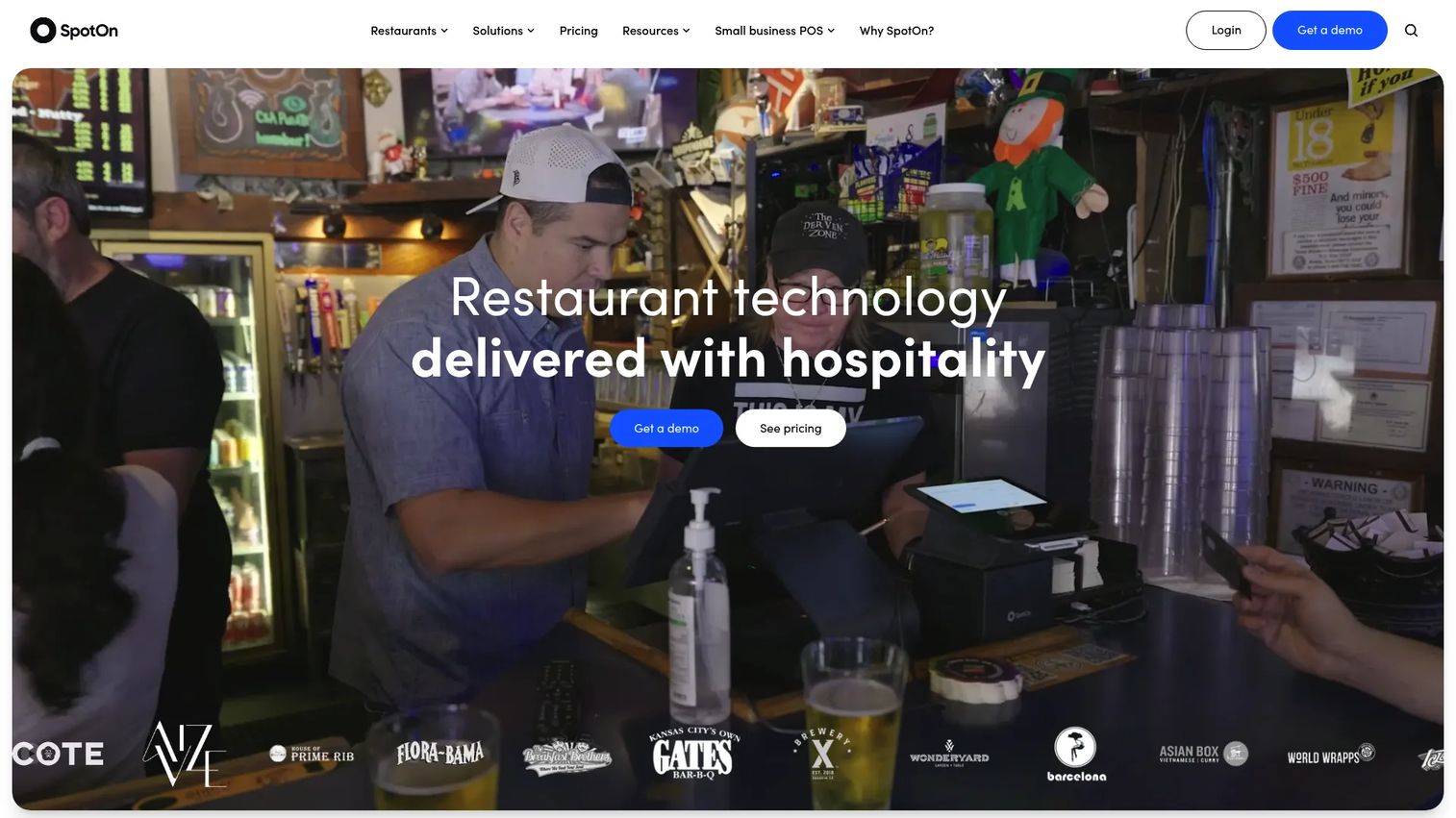
SpotOn is a restaurant technology platform that bundles POS with ordering, reservations, marketing, scheduling, and profitability tools. For a food truck, the value is in what the bundle replaces: instead of paying separately for online ordering, a marketing tool, and a scheduling app, you get them in one suite. That consolidation is the pitch, and it lands for operators tired of managing five logins.
The commission-free online ordering is a real differentiator. Rather than handing a cut of every online order to a third-party marketplace, SpotOn lets you take direct orders and keep the margin. Combined with reservations, waitlist, and experiences tools, it suits trucks that also run pop-ups, private events, or a small dine-in area.
Best for: Food trucks and operators wanting an all-in-one POS and operations suite in one platform.
Key strengths
- Commission-free online ordering: Take direct orders without surrendering marketplace fees.
- Reservations and waitlist: Manage pop-ups, events, and pickup queues in one place.
- Bundled operations: POS, marketing, and scheduling under a single platform.
Why choose SpotOn: Choose SpotOn when consolidation matters and you want to cut the number of separate tools you pay for. It fits operators who value commission-free ordering and a broad feature set over the leanest single-purpose setup.
SpotOn pricing: SpotOn lists POS plans starting as low as $0 per month. A Counter-service plan runs $99 per month and a Full-service plan $135 per month. The brand also references a Core Bundle at $50 per month plus a small percentage of gross volume, capped monthly. Processing rates apply separately. SpotOn holds a 4.4/5 rating on G2.
7. UpMenu
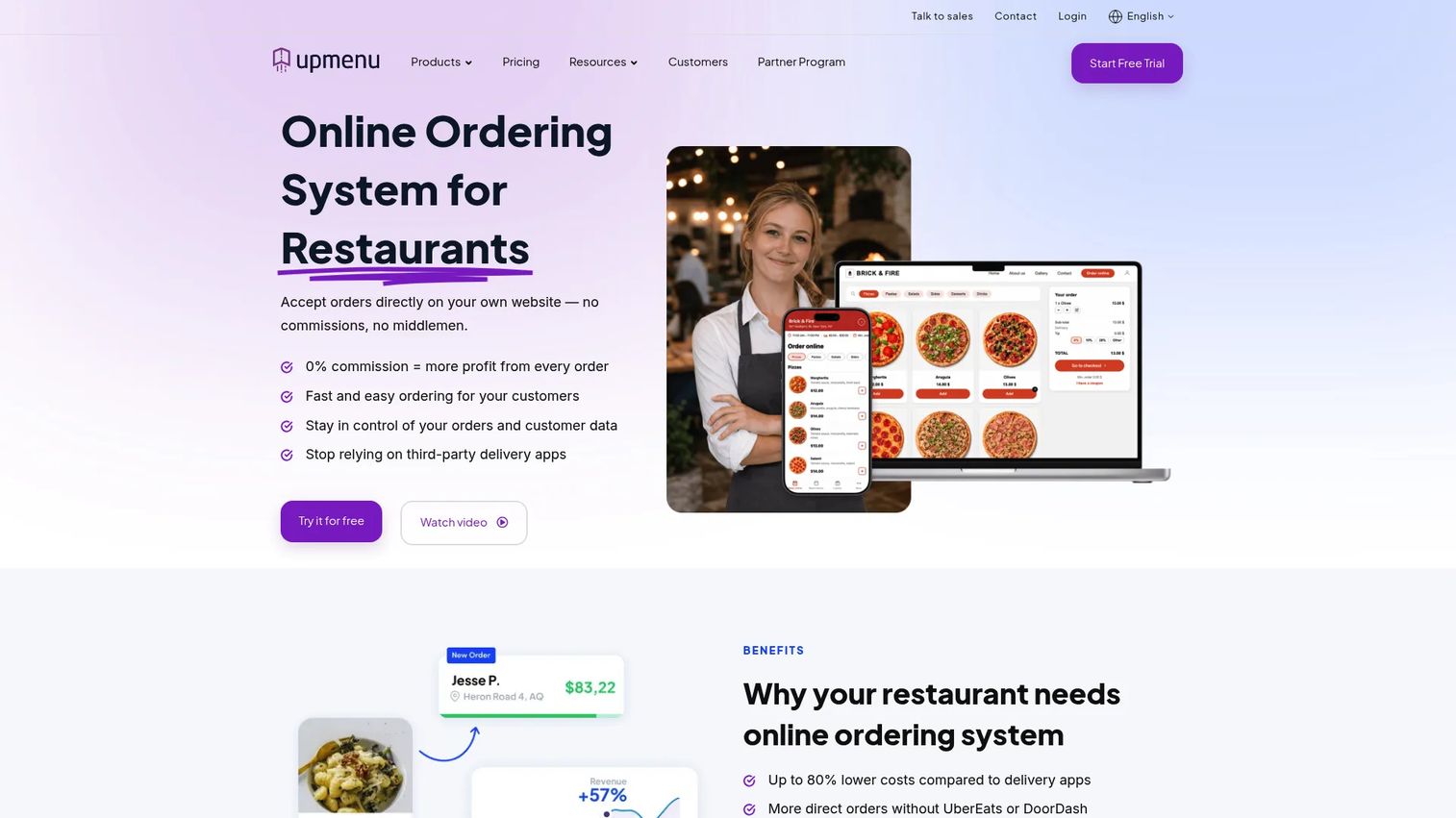
UpMenu is restaurant software centered on branded online ordering, with POS, websites, mobile apps, reservations, loyalty, and delivery management around it. For a food truck building a following, the differentiator is that the ordering experience carries your brand, not a marketplace's. Customers order directly from your site or app, and you own the relationship and the data.
The mobile POS positioning fits trucks well. Orders flow in from your branded channels and in-person sales alike, and real-time sales visibility means you can see how a stop is performing without waiting for the end of the night. Pricing is transparent and published, which independents appreciate when they are budgeting tightly.
Best for: Independent food trucks and small chains wanting direct, branded online ordering alongside POS.
Key strengths
- Branded online ordering: Customers order from your own site and app, not a marketplace.
- Restaurant POS: In-person and online orders flow into one system.
- Branded mobile app: Puts your truck in a customer's pocket for repeat orders.
Why choose UpMenu: Choose UpMenu when owning your customer relationship and brand matters more than a bundled hardware ecosystem. It suits operators building a loyal, repeat customer base through direct digital ordering.
UpMenu pricing: UpMenu publishes three monthly plans per restaurant: Basic at $49, Standard at $89, and Premium at $169. Add-ons include a Mobile App at $49 per month, a Driver App at $14 per month per driver, Delivery Services around $40 to $49 per month, and a Loyalty Program at $19 per month. UpMenu does not currently display a G2 star rating, so evaluate it on a demo.
Conclusion
The right food truck point of sale system depends on which constraint bites hardest in your operation. If you want the lowest-risk, widest-coverage starting point, Square is the default with free software and strong offline card handling. If you want a system built around food-truck workflow, EasyEats leads on KDS and pickup notifications at a low cost. For growth and flexibility, Quantic POS offers a mobile-first cloud platform with loyalty. Toast fits operators ready for an all-in-one stack with QR order-and-pay, Clover suits those who want polished hardware, SpotOn wins on bundled commission-free ordering, and UpMenu is the pick for branded direct ordering.
Here is the practical next step. Pick your two closest fits, then test each against one busy service scenario, a festival rush with spotty Wi-Fi, before you commit. Watch how each handles offline payments, how fast the line moves, and how clean the end-of-night report is. The system that survives your worst service is the one to buy.
FAQs
There is no single universal winner, since the best fit depends on your operation. Square is the strongest default for most trucks thanks to free software and reliable offline payments. Choose EasyEats if food-truck-specific KDS and pickup notifications matter most, Toast for an all-in-one operations stack, or SpotOn for a bundled, commission-free ordering suite.
Yes. Parking lots, fairgrounds, and street corners rarely offer reliable Wi-Fi, and 82% of food truck transactions are cards and mobile payments per FoodTruckProfit (2026). Offline mode should let you keep accepting card payments and queuing orders locally when the signal drops, then sync automatically once the connection returns so no revenue is lost.
Costs break into software, hardware, and processing. Software ranges from free plans like Square and Toast's Starter Kit up to $135 or more per month for full-service tiers. Hardware such as Clover's kitchen display starts around $799 plus a monthly device fee. Payment processing rates apply on top of software, and add-ons like loyalty or delivery can raise the monthly bill.
Prioritize mobility, offline reliability, and speed at the window. A kitchen display system keeps orders and modifiers clear in a tight galley, QR code ordering pulls demand off the physical line, and flexible payment acceptance covers cards, contactless, and wallets. Clean real-time reporting rounds it out so a lean owner can reconcile fast.
Yes. Systems like EasyEats, Toast, SpotOn, and UpMenu support online ordering that routes directly into the kitchen. Pickup notifications, usually a text message when the order is ready, reduce crowding at the window and cut confusion during a rush. Together, order routing and customer notifications remove friction on both sides of the counter.
Compact and mobile wins in a truck. Handhelds let a runner take orders and payment down the line, tablets on a stand save counter space, and a dedicated terminal handles the window. Purpose-built devices like Clover's are sturdy for daily use, while Square's readers and handhelds offer flexible, budget-friendly options for tighter spaces.
They overlap heavily, since many food truck systems are restaurant platforms adapted for mobility. The difference is emphasis. A food truck point of sale leans harder on offline resilience, compact hardware, and fast single-window service, whereas a full restaurant POS assumes fixed counters, table management, and reliable Wi-Fi. Several tools here serve both.
Use a simple framework: budget, service speed, and growth needs. If cost and simplicity lead, start with Square. If you want an all-in-one operations stack, look at Toast. For polished hardware, consider Clover; for a bundled suite with commission-free ordering, SpotOn. Then test your top two against one busy, low-connectivity service before deciding.