A blockchain feature can pass QA and still be unsafe to ship. The contract executes exactly as written. The problem is that the logic, key controls, external integrations, and monitoring plan were never stress-tested against hostile conditions.
Smart contract exploits, private key compromises, phishing attacks, and bridge failures cost the Web3 ecosystem $3.35 billion across 630 incidents in 2025, according to CertiK's 2025 annual security report. That figure covers financial losses. It does not capture the engineering time, legal exposure, and reputational damage that follow a product incident.
Blockchain security is not a one-tool problem. A PM who owns a tokenized payment flow, a DeFi integration, or a smart contract governance mechanism needs a stack: Pre-launch code review, independent audit, runtime monitoring, and transaction intelligence. Buying an audit without monitoring is like securing the front door and leaving the windows open.
"An audit is a release gate. Monitoring is an operating requirement."
The right combination depends on your architecture and release stage. This guide gives you a practical shortlist, a clear definition of what blockchain security actually covers, and the evaluation framework to match tools to the risks in your product.
What's inside
This guide is built for PMs managing blockchain features, smart contracts, or digital asset workflows who need to shortlist security tooling before involving engineering, legal, and procurement.
- Seven tools across smart contract auditing, static analysis, onchain monitoring, and transaction intelligence
- Selection criteria: functional coverage, release lifecycle fit, integration requirements, and engineering overhead
- A comparison table with verified pricing and G2 ratings
- A buyer checklist framed around product ownership and release readiness
TL;DR
- Best overall for smart contract security programs: OpenZeppelin, for teams that need secure development standards, architecture support, and ongoing coverage
- Best for blockchain analytics and transaction risk: Chainalysis, for compliance workflows, wallet screening, and fund tracing
- Best for end-to-end testing and incident readiness: Halborn, for architecture assessments, penetration testing, and security response
- Best for independent smart contract review: Quantstamp, for deep code review, formal verification, and security research
- Best for continuous onchain threat detection: Forta, for runtime monitoring and alert workflows after deployment
- Best for free developer-side static analysis: Slither, for automated Solidity scanning inside CI pipelines
What is blockchain security?
Blockchain security is the combination of cryptographic, software, infrastructure, governance, and operational controls used to protect blockchain networks, smart contracts, wallets, transactions, and connected systems.
The distinction that matters for product teams: A ledger can be tamper-evident while the full product stack remains vulnerable. Cryptography and consensus protect the protocol layer. They do not protect against weak contract logic, compromised keys, or insecure external integrations.
How blockchain systems create and shift security risk
Security responsibility in a blockchain product splits across five layers:
- Protocol level: Consensus rules, validator assumptions, finality guarantees
- Application level: Smart contract logic, access roles, upgrade paths, business rules
- Key and identity level: Private key custody, multisig policies, privileged role management
- Infrastructure level: RPC endpoints, nodes, oracles, bridges, APIs, cloud systems
- Operational level: Monitoring, incident response, change management, governance
A product team that only addresses application-level security through an audit misses the other four.
Core blockchain security mechanisms
- Cryptography: Secures signatures, hashes, and transaction authorization
- Distributed validation: Removes reliance on a single database operator
- Consensus: Establishes shared rules for transaction ordering and finality
- Immutability: Makes confirmed historical records difficult to alter
- Access controls: Limits privileged actions and protects administrative functions
Public, private, permissioned, and permissionless security models
| Model | Primary security concern | PM implication |
|---|---|---|
| Public permissionless | Economic attacks, wallet safety, smart contract exploits | Design for adversarial users and transparent code |
| Public permissioned | Identity and governance controls | Define validators, roles, and approval processes |
| Private permissioned | Insider risk, access control, weak governance | Treat identity, logs, and segregation of duties as product requirements |
| Hybrid architecture | Cross-system data flow and integration risk | Threat-model bridges, APIs, and offchain dependencies |
What blockchain security does not guarantee
Blockchain does not automatically prevent flawed smart contract logic, compromised private keys, phishing, wallet approval abuse, oracle manipulation, or misconfigured infrastructure. Each of those requires its own control.
When to use blockchain security tools
Validate a smart contract before deployment
Any product introducing contract logic, token transfers, governance actions, or financial workflows needs pre-launch review. Automated scanners like Slither catch classes of known vulnerabilities during development. Independent audit services test assumptions, business logic, and upgrade paths that a scanner cannot model.
Monitor protocols after launch
Deployed contracts that hold user assets, manage permissions, or depend on external integrations need runtime visibility. A post-launch monitoring tool alerts teams to unusual behavior, privilege changes, and suspicious transaction patterns before they escalate into incidents.
Screen transactions and investigate exposure
Products touching digital asset payments, custodial flows, exchange integrations, or regulated counterparties need transaction intelligence. Blockchain analytics helps teams evaluate wallet exposure and trace fund flows without replacing legal or compliance judgment on what those findings mean.
Blockchain security tools comparison
No single product covers every security layer. The decision starts with identifying whether your immediate risk is code quality, transaction exposure, runtime detection, infrastructure design, or independent review. The tools below are organized by the job each one performs in a complete security program.
| # | Product | Best for | Key differentiator | Pricing | G2 rating |
|---|---|---|---|---|---|
| 1 | OpenZeppelin | Smart contract development standards and ongoing security programs | Open-source libraries plus enterprise security services | Quote-based services; open-source tools free | 5.0/5 |
| 2 | Chainalysis | Transaction intelligence, compliance, and investigations | Blockchain analytics across wallets, entities, and risk exposure | Quote-based | 4.8/5 |
| 3 | Halborn | Architecture reviews, penetration testing, and incident readiness | Broad digital asset security services across code and infrastructure | Quote-based | N/A |
| 4 | Quantstamp | Smart contract audits and formal verification | Deep code review and research-led security assessment | Quote-based | N/A |
| 5 | CertiK | Smart contract audits and project monitoring | Audit services plus public security intelligence products | Quote-based | N/A (0 reviews) |
| 6 | Forta | Real-time onchain threat detection | Detection bots and network-based monitoring | Quote-based | N/A |
| 7 | Slither | Developer-led static analysis | Open-source Solidity and Vyper analysis for development workflows | Free, open source | N/A |
Pricing and ratings verified October 2026 from each vendor's official pricing page and live G2 listing.
Best 7 blockchain security tools for 2026
1. OpenZeppelin
OpenZeppelin provides open-source smart contract development tools and security services for onchain finance. Its audited contract libraries give teams a vetted foundation for token standards, governance mechanisms, and upgradeable contract patterns. Beyond the open-source layer, the company offers security audits, architecture reviews, and continuous security programs for production systems.
Best for: Product teams building smart-contract-backed products who need security standards embedded from architecture through deployment.
Key features
- Audited smart contract libraries for ERC standards and governance
- Contracts Wizard for generating and configuring smart contracts
- Upgradeable-contract plugins for Hardhat and Foundry
- Contracts MCP for AI-assisted development workflows
- Security audits and continuous security service programs
Why choose OpenZeppelin: It fits teams that need a durable engineering standard, not just a point-in-time audit. If your roadmap includes upgrades, governance, or access-controlled roles, embedding OpenZeppelin's library patterns early reduces the attack surface that an auditor later has to review. For PMs: Put an explicit "security assumptions" section in the PRD, then validate each assumption during the review engagement.
OpenZeppelin pricing: Open-source development tools are available without any subscription. Security review and advisory engagements require a quote. Contact the team directly to scope an engagement.
G2 rating: 5.0/5
2. Chainalysis
Chainalysis is a blockchain intelligence platform used by governments, financial institutions, exchanges, and crypto businesses for transaction tracing, wallet risk screening, compliance workflows, and fraud investigations. Its data covers a wide range of chains and categorizes entities, exchanges, and exposure risk across transaction activity.
Best for: Product teams operating digital asset payment flows, custodial services, or exchange integrations that need to evaluate counterparty and transaction risk.
Key features
- Blockchain transaction tracing and fund flow analysis
- Wallet risk screening and entity attribution intelligence
- Real-time fraud detection and Web3 threat monitoring
- Investigation workflow support for compliance and legal teams
- Transaction monitoring with risk analysis
Why choose Chainalysis: It becomes essential when product risk extends well beyond contract code quality. Examples include payments with unknown counterparties, token issuance with secondary market exposure, or custody flows touching regulated jurisdictions. For PMs: Include transaction-risk decision points in the product flow itself. Define when a transaction should be blocked, held, reviewed, or escalated before users depend on the system.
Chainalysis pricing: Enterprise pricing is quote-based across all products. Contact Chainalysis directly. G2 reviewer-reported ranges were not available at verification time.
G2 rating: 4.8/5 for Chainalysis KYT
3. Halborn
Halborn is a digital asset security firm providing advisory and assurance services across smart contract review, blockchain architecture assessment, penetration testing, red team exercises, and AI security assessments. The firm works with financial institutions, blockchain projects, and digital asset infrastructure providers.
Best for: Product teams with ecosystem-level risk problems across smart contracts, infrastructure, key management, and connected services.
Key features
- Smart contract assessments and code security audits
- Blockchain Layer 1 infrastructure assessments
- Web application and cloud infrastructure penetration testing
- Red team exercises for adversarial simulation
- AI security assessments and AI red teaming
Why choose Halborn: It fits when the security problem is broader than a single contract. Products involving bridges, wallet infrastructure, staking, custody, APIs, or multiple chains need a firm that can assess the full attack surface, not just the Solidity code. For PMs: Request a finding taxonomy that separates critical release blockers from post-launch hardening work. That separation drives the remediation plan and the release gate decision.
Halborn pricing: All security engagements are quote-based. Halborn does not publish packaged pricing. Contact the team to scope an engagement.
4. Quantstamp

Quantstamp provides web3 security services including smart contract audits, infrastructure audits, continuous monitoring, operational security reviews, and smart contract insurance. The firm applies formal verification methods alongside manual code review and security research to evaluate contract logic and system risk.
Best for: Teams preparing a high-value contract deployment, protocol upgrade, or token mechanism that needs independent security review with formal methods.
Key features
- Smart contract audits and security assessments
- Formal verification for contract correctness proofs
- Web3 infrastructure penetration testing
- Continuous monitoring across onchain assets and communications
- Security certifications and risk coverage products
Why choose Quantstamp: It fits when the audit needs to go beyond automated findings into contract logic assumptions, economic design, and privileged role risks. Formal verification adds a mathematical correctness layer that manual review alone cannot provide. For PMs: Avoid sending an unfinished requirements model to an audit. The engagement validates a stable release candidate, not an in-progress spec.
Quantstamp pricing: Audit pricing is scoped and quoted per engagement. The cost varies by contract complexity, codebase size, chain, and timeline. Quantstamp's blog provides guidance on what drives audit cost. Contact them to scope.
5. CertiK
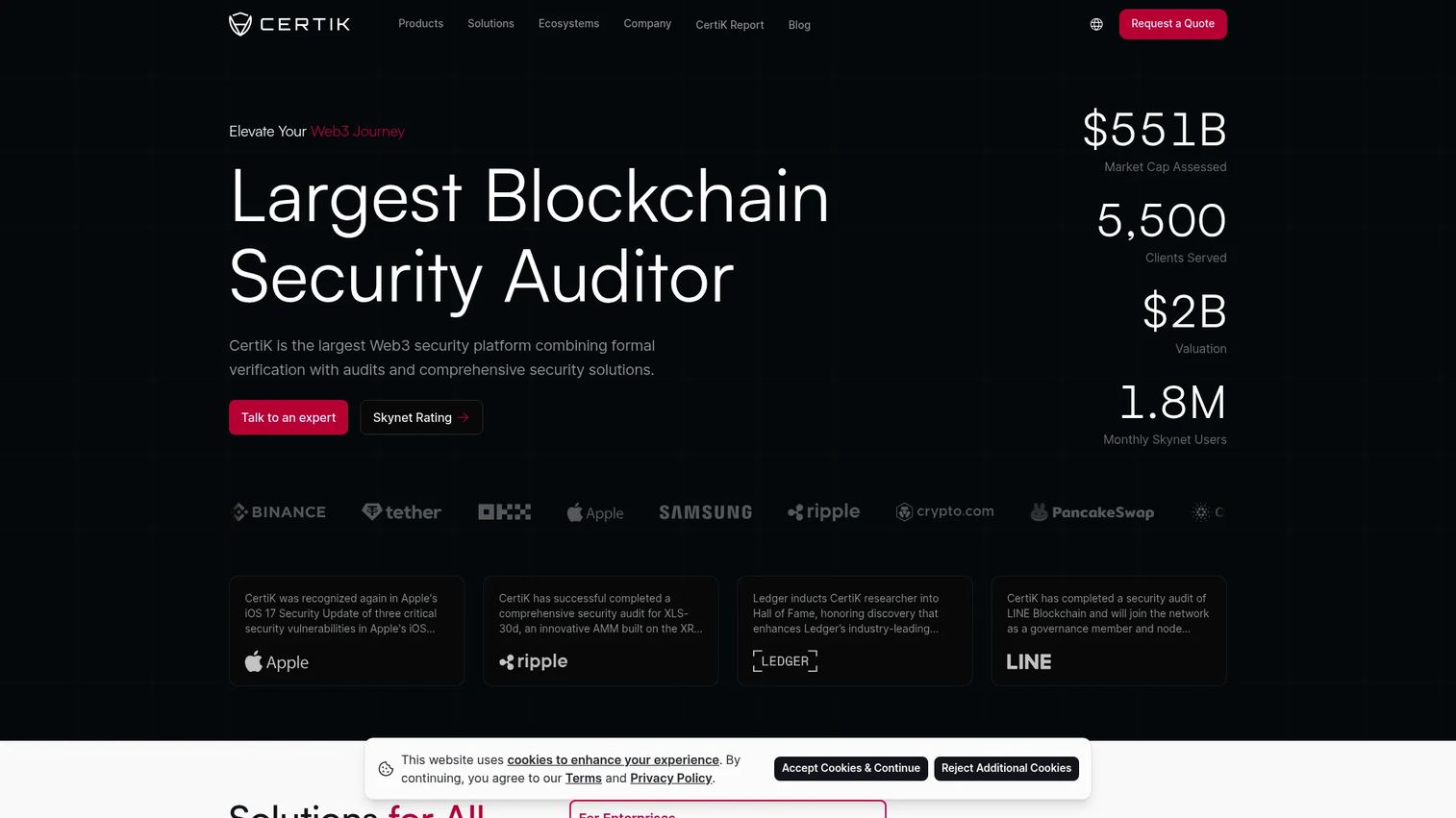
CertiK is a Web3 security platform providing smart contract audits, penetration testing, formal verification, and real-time security intelligence through its Skynet and SkyInsights products. CertiK is widely cited across the Web3 ecosystem and publishes security scores for projects it has audited.
Best for: Teams seeking a recognizable audit partner with public-facing security transparency and onchain monitoring coverage.
Key features
- Smart contract and blockchain code audits
- Web3 penetration testing
- Formal verification methods
- Real-time project evaluation through Skynet
- AML and transaction monitoring through SkyInsights
Why choose CertiK: Its public security visibility can carry weight for ecosystem trust, particularly for protocols with a consumer-facing community. PMs should still evaluate the audit deliverable's depth, the remediation workflow, scope boundaries, and what ongoing monitoring actually covers. Treat the audit report as an input to a remediation plan, not as a certification. Assign owners, due dates, retest requirements, and release criteria before the engagement closes.
CertiK pricing: Audit and enterprise security services require a quote request through the CertiK site. No package pricing is displayed.
6. Forta
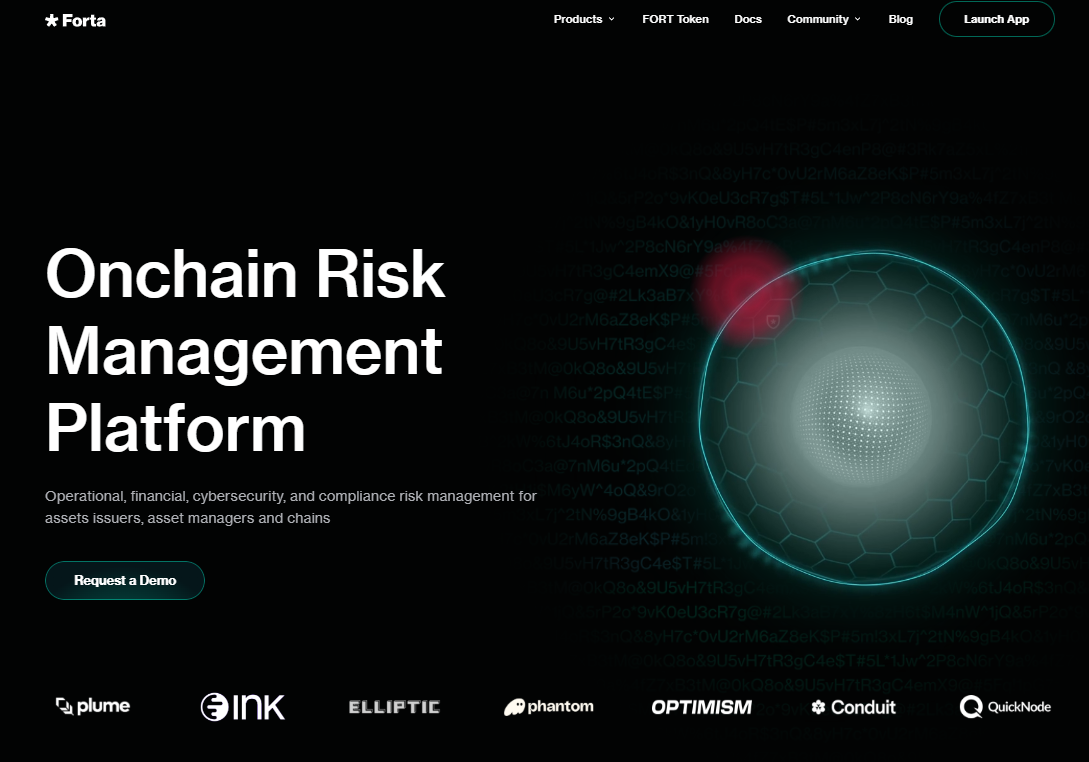
Forta is an onchain risk management platform providing real-time monitoring, threat detection, transaction screening, and compliance controls for blockchain assets and chains. It uses AI-driven detection and a network of detection bots to identify malicious transactions and unusual contract behavior.
Best for: Product and security teams that need runtime visibility after deploying contracts or launching a protocol.
Key features
- Real-time monitoring with alerts via email, webhook, or API
- AI-driven detection and blocking of malicious transactions
- Compliance screening for sanctions lists and custom jurisdictional rules
- Onchain detection bots for suspicious transaction monitoring
- Custom detection logic for protocol-specific risks
Why choose Forta: Audits analyze a codebase at a point in time. Forta watches what happens after users, bots, integrations, and attackers interact with the deployed product. It fills the gap between pre-launch review and incident response. For PMs: Define alert ownership before launch. An alert without a response playbook is just another dashboard that nobody checks during an incident.
Forta pricing: Forta's current plan model, enterprise features, and any free usage tiers require direct verification with the team. Contact Forta for current pricing.
G2 rating: No verified Forta blockchain security rating was found on G2 at time of publication.
7. Slither
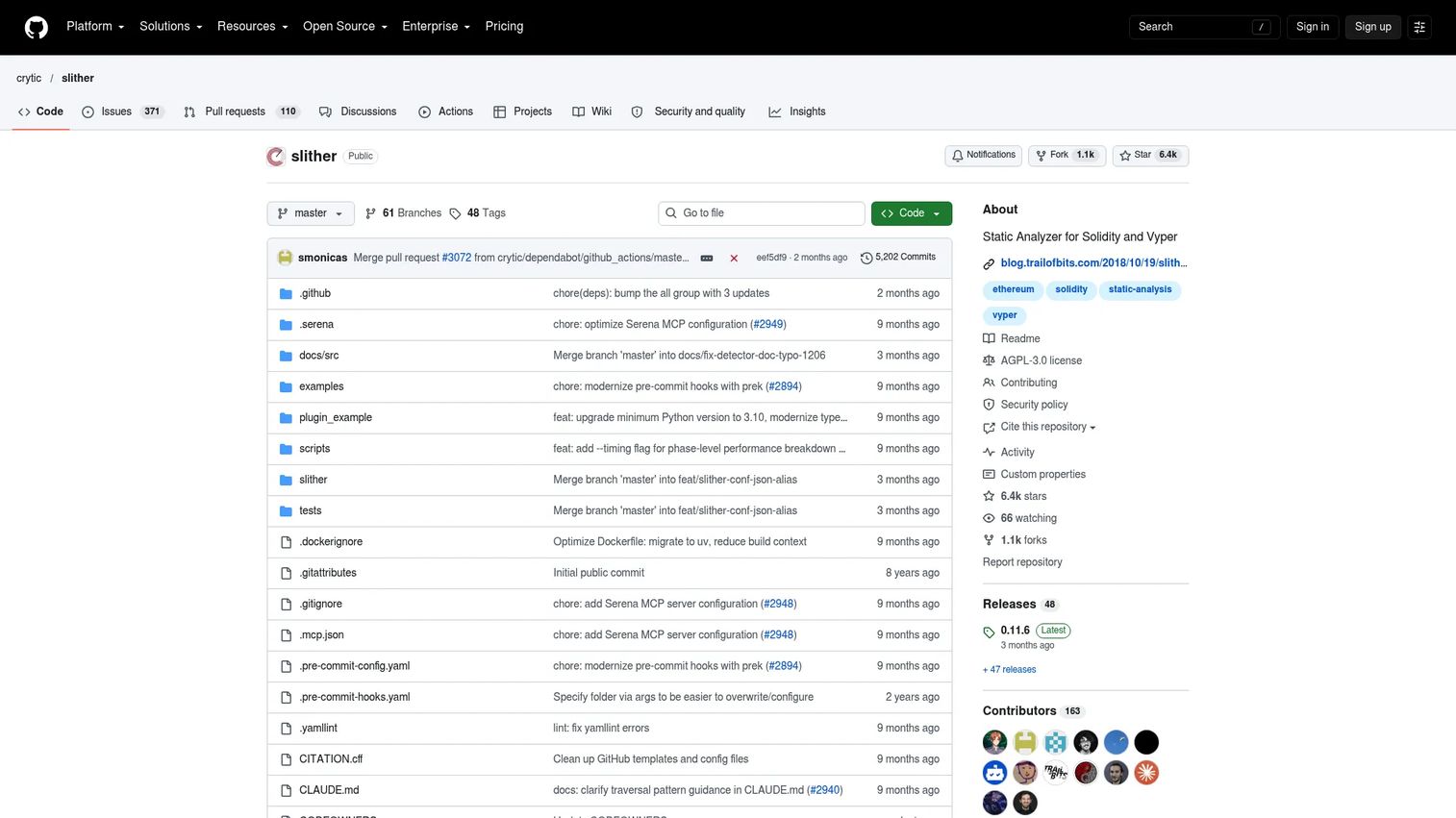
Slither is an open-source static analysis framework for Solidity and Vyper smart contracts, maintained by Trail of Bits. It detects vulnerabilities, analyzes contract code, and supports custom analysis through a Python API. Engineers run it locally, in CI pipelines, and with Hardhat or Foundry.
Best for: Engineering teams that want automated security feedback during development without waiting for an external audit cycle.
Key features
- Vulnerability detectors with low false positive rates
- CI, Hardhat, and Foundry integration
- Built-in printers for contract information and call graphs
- Python API for custom analyses and detection rules
- Support for both Solidity and Vyper contracts
Why choose Slither: It gives your engineers fast feedback on known vulnerability classes before code reaches an external reviewer. It does not replace threat modeling, independent audit, or monitoring, but it raises the baseline quality of what goes into an audit, which reduces time and cost. For PMs: Add automated Slither scanning to the definition of done for every contract change. Track recurring findings to improve engineering standards over time.
Slither pricing: Slither is free and open source. The real cost is engineering time for CI integration, custom rule development, and finding triage.
Considerations when choosing blockchain security tools
Match the tool to the threat layer
Don't compare an audit service with a transaction intelligence platform as though they solve the same job. Map each tool to the layer it protects: Code, infrastructure, transactions, runtime, or incident response. A gap in any one of those layers is a gap in the product.
Evaluate coverage across the release lifecycle
Ask what happens before code freeze, at deployment, after launch, and during an incident. One-time assessments do not provide runtime visibility, and monitoring does not replace pre-launch review. The strongest programs address all four stages.
Define ownership and response workflows
Security tools produce findings, alerts, and reports. Before buying any of them, decide who triages each output, who can pause a feature or block a transaction, and what evidence the team needs before communicating externally. An unowned alert is as dangerous as no alert.
Check integration and data requirements
Evaluate chain coverage, supported contract languages, API access, SIEM workflows, ticketing integration, and data retention. A tool that produces useful signals but connects to nothing in your current stack creates an orphaned reporting surface.
Treat governance as a product requirement
For permissioned systems, upgradeable contracts, multisig wallets, and privileged roles, document who can change what before launch. Review approval workflows, key rotation schedules, emergency pause controls, and recovery processes as product requirements, not post-launch tasks.
Conclusion
Blockchain security is a layered operating model, not a single purchase. The tools above serve different jobs, and the right starting point depends on where your product sits in its release lifecycle.
Choose OpenZeppelin when secure development standards and ongoing security partnership matter from the architecture stage. Choose Chainalysis when transaction intelligence and wallet-risk workflows are central to the product. Choose Halborn for broader architecture review, testing, and incident-readiness needs. Choose Quantstamp or CertiK for independent smart contract assurance with deep code review. Choose Forta for runtime monitoring after deployment. Choose Slither to move static analysis into daily engineering workflows.
Before evaluating any vendor, write a one-page threat model for the feature you plan to launch. List the assets, privileged roles, integrations, abuse cases, telemetry plan, and escalation owner. The tool choice becomes easier once the risk is specific.
For further reading on related security tooling, see the guides on application security testing software, attack surface management software, and AI cybersecurity solutions.
Frequently asked questions about blockchain security
Blockchain security is the set of controls that protect blockchain networks, smart contracts, private keys, transaction flows, and connected infrastructure. It includes both technical safeguards, such as cryptography and access controls, and operational processes, such as monitoring, incident response, and governance. Neither layer alone is sufficient.
Blockchain systems use cryptographic hashes, digital signatures, distributed validation, and consensus mechanisms to make confirmed transaction records difficult to alter. These mechanisms protect the protocol layer. They do not secure vulnerable smart contract code, compromised private keys, or insecure offchain systems connected to the chain.
The most consequential risks include smart contract vulnerabilities, private key compromise, phishing, wallet approval abuse, bridge and oracle exploits, 51% attacks on smaller chains, Sybil attacks on identity or participation mechanisms, and infrastructure misconfiguration. Risk profile varies significantly by chain, product model, and the value held in the system.
No. An audit reviews a defined codebase at a point in time. It does not cover what happens after deployment, how keys are managed, how infrastructure is configured, or how the team responds to an incident. Secure products need threat modeling, controlled deployment, runtime monitoring, governance controls, and incident response plans alongside the audit.
Blockchain analytics examines transaction activity, wallet exposure, and entity relationships across the chain after transactions occur. Smart contract auditing evaluates code, logic, permissions, and vulnerability risk before or after deployment. They address different risks and both can be necessary depending on the product.
Product teams generally need a layered stack rather than a single tool. Developer scanning during build, independent review before launch, monitoring after deployment, and transaction intelligence when the product handles digital assets. The right combination depends on the architecture, the value at risk, and the release stage.
Start with the product's threat model and release lifecycle. Then assess chain and language support, integrations with existing tooling, alert ownership and response workflows, reporting quality, pricing model, audit scope, remediation workflow, and ongoing maintenance requirements. Avoid evaluating tools in isolation from the security layer they're meant to address.
Yes. Private and permissioned systems reduce some public-network risks, including 51% attacks and anonymous adversaries. They introduce a different set of risks: Insider access, identity and governance weaknesses, endpoint compromise, and misconfigured access controls. Security requirements shift rather than disappear.
Blockchain risk management means identifying the assets, privileged roles, integrations, and abuse cases in a product, then building controls and telemetry to detect and respond to failures in each area. For a PM, this translates to: Threat-model the feature, instrument what happens after launch, define the escalation path, and budget for monitoring and response before the roadmap is locked.