
Your supplier data lives in six places. Onboarding a new vendor takes three weeks of email chasing and PDF collection. Risk reviews happen in a spreadsheet someone updates once a quarter, if that. And when leadership asks how your top 20 suppliers are actually performing, you don't have a clean answer. That is the exact friction supplier relationship management software is built to remove. The category matters more each year: the global SRM software market is projected to grow from $13.35B in 2025 to $20.91B in 2030 at a 9.2% CAGR, according to The Business Research Company (2026).
The reason is simple. Procurement teams are done running critical supplier lifecycle management out of disconnected tools. More than 55% of procurement teams are now investing in digital supplier management platforms to improve operational efficiency, and about 64% of organizations are moving to cloud-based supplier management, per Global Growth Insights (2025). A good supplier management solution centralizes supplier records, automates onboarding and reviews, monitors supplier risk in real time, and gives you the supplier visibility to make decisions that hold up under scrutiny.
This guide is written for the buyer who has to defend that decision internally. If you think like a product manager, you already know the real question is not "which tool has the most features." It is "which system delivers measurable operational impact without becoming another high-maintenance liability." That is the lens we used.
What's inside
This guide covers SRM software for teams evaluating supplier onboarding, supplier risk, supplier performance, collaboration, and full supplier lifecycle management. It is aimed at procurement leaders, sourcing managers, supplier quality teams, and risk or compliance owners who need to centralize supplier data and cut manual review work.
We built the list around four criteria: breadth of supplier and procurement capabilities, relevance to real procurement workflows, depth of automation and analytics, and fit for enterprise supplier lifecycle automation. We prioritized platforms that treat onboarding, risk, performance, and compliance as connected workflows, not isolated features.
TL;DR
- Best for full source-to-pay breadth and supplier network scale: SAP Ariba, backed by one of the largest supplier networks in the market.
- Best for centralized spend and supplier management: Coupa, if you want procurement and finance standardized in one place.
- Best for highly configurable global procurement: Ivalua, when your supplier workflows refuse to fit a template.
- Best for complex procurement environments: JAGGAER, strong in manufacturing, higher ed, and public sector.
- Best for regulated industries and supplier quality: ComplianceQuest, Salesforce-native with deep compliance and traceability.
- Best for AI-driven unified procurement: GEP Smart, with analytics and collaboration built into one suite.
What is supplier relationship management software?
Supplier relationship management software is a system that centralizes how an organization onboards, evaluates, monitors, and collaborates with its suppliers across the full supplier lifecycle. Where basic supplier management software often stops at storing vendor records, SRM software treats the supplier relationship as an ongoing, measurable program spanning qualification, risk, performance, and continuous improvement.
In practice, a modern SRM platform supports the entire arc of working with a supplier. It handles onboarding and qualification, then layers in monitoring, scorecards, collaboration, and improvement workflows so procurement teams stop reacting and start managing proactively.
Core capabilities you should expect:
- Supplier onboarding and qualification: structured intake, document collection, and approval workflows that replace email and spreadsheets.
- Supplier risk management: continuous risk monitoring across financial, compliance, ESG, and operational dimensions.
- Supplier performance management: supplier scorecards, KPIs, and evaluation cycles tied to real delivery data.
- Supplier collaboration tools: shared portals for documents, communication, and joint improvement plans.
- Supplier compliance management software: certifications, audits, and regulatory tracking with an audit trail.
- Supplier analytics and visibility: dashboards that surface spend, risk, and performance in one view.
The distinction from vendor relationship management software is mostly one of depth. Vendor management tends to focus on transactional oversight and cost control. SRM software adds the strategic layer: supplier segmentation, innovation, and long-term relationship value. Good supplier evaluation software sits inside this, standardizing how you qualify and score every supplier.
When to use supplier relationship management software
Not every procurement team needs a full suite on day one. Here is how to pattern-match your situation to the category.
Reduce manual supplier onboarding and assessment work
If onboarding a supplier means chasing documents over email, re-keying data into a spreadsheet, and manually routing approvals, you are paying an ongoing tax in time and error rate. SRM software replaces that with structured intake forms, automated document collection, and workflow-driven approvals. The payoff is faster time to first purchase order and a clean, auditable record from the start. For teams onboarding dozens of suppliers a quarter, this is usually the fastest source of measurable ROI.
Standardize supplier risk and compliance monitoring
Manual risk reviews go stale the moment you close the spreadsheet. A supplier that passed screening in January can trip a sanctions list or lose a certification in March, and nobody notices until it becomes a problem. SRM software with real-time risk monitoring watches financial health, compliance status, ESG signals, and sanctions continuously. Supplier compliance management software also keeps certifications and audit records current, so a regulatory review does not turn into a fire drill.
Improve supplier performance reviews and continuous improvement
Inconsistent performance tracking makes supplier conversations subjective. One reviewer scores on delivery, another on price, and nobody agrees on who the strategic suppliers actually are. Supplier performance management standardizes this with shared supplier scorecards, defined KPIs, and scheduled evaluation cycles. Pair that with supplier collaboration tools, and reviews shift from finger-pointing to joint improvement plans that move the numbers.
Comparison table
The table below sorts platforms by relevance to procurement buyer intent, not alphabetically. Pricing across this category is almost entirely quote-based, and G2 ratings shift over time, so verify both against each vendor's current pricing page and live G2 listing before you shortlist. Treat the ratings as directional, not final.
| # | Product | Intent | Key use case | Pricing | G2 rating |
|---|---|---|---|---|---|
| 1 | SAP Ariba | Enterprise source-to-pay | Supplier network, sourcing, and collaboration at scale | Price upon request | 4.1/5 |
| 2 | Coupa | Centralized spend management | Unified procurement, finance, and supplier visibility | Contact sales | 4.2/5 |
| 3 | Ivalua | Configurable global procurement | Source-to-pay with tailored supplier workflows | Contact sales | 4.3/5 |
| 4 | JAGGAER | Complex procurement environments | Source-to-pay with supplier intelligence | Contact sales | 4.3/5 |
| 5 | GEP Smart | AI-driven unified procurement | Source-to-pay with supplier collaboration and analytics | Contact sales | Not published |
| 6 | Oracle Procurement Cloud | Integrated ERP procurement | Source-to-settle within the Oracle ecosystem | Contact sales | 4.1/5 |
| 7 | Zycus | Source-to-pay automation | Supplier management, compliance, and AP efficiency | Contact sales | 3.7/5 |
| 8 | ComplianceQuest | Regulated-industry SRM | Supplier risk, quality, and compliance management | Contact sales | 4.3/5 |
1. SAP Ariba
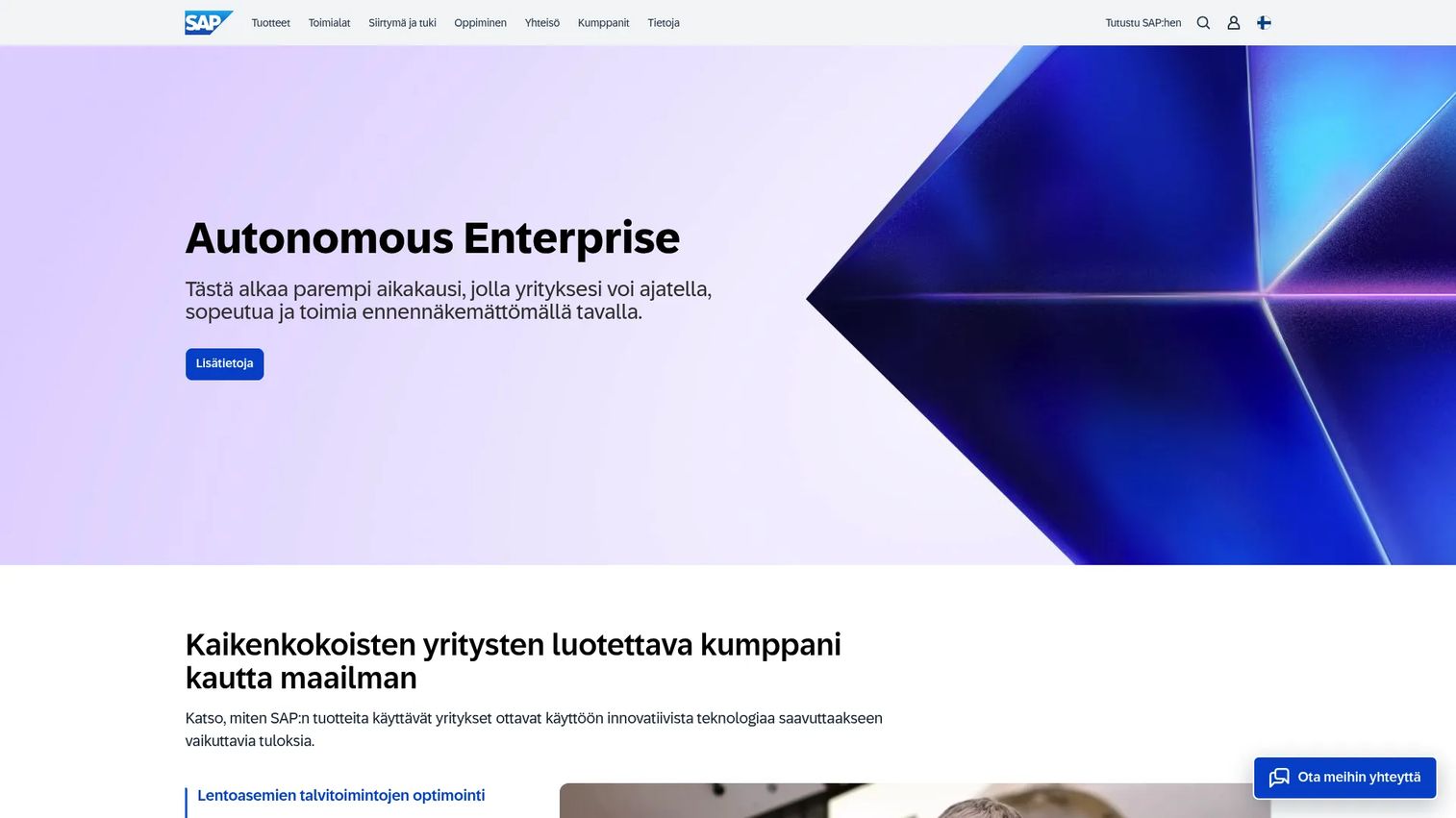
SAP Ariba is SAP's spend management suite covering sourcing, procurement, and invoicing, anchored by one of the largest supplier networks in the market. That network is the differentiator: it connects buyers to a vast pool of pre-registered suppliers, which shortens supplier discovery and onboarding for global procurement organizations. For enterprises that already run SAP, the integration story is hard to beat.
Best for: Large enterprises managing source-to-pay and supplier collaboration workflows at scale.
Key strengths
- Supplier network reach: A large connected network speeds up supplier discovery, onboarding, and collaboration.
- AI-assisted sourcing: Sourcing and supplier discovery are supported by AI to surface qualified suppliers faster.
- Guided, policy-compliant buying: Automated invoice processing and guided buying keep procurement inside policy.
Why choose SAP Ariba: If your organization runs global source-to-pay and needs supplier collaboration, compliance, and onboarding under one roof, Ariba's network scale and SAP integration make it a natural anchor. It fits best in large, process-heavy procurement functions rather than lean teams that want something light to stand up in a week.
SAP Ariba pricing: SAP does not publish a standard numeric price. The public pricing page for SAP Ariba Sourcing standard edition lists "price upon request," billed per user per year, and Buying and Invoicing is quote-based. Expect a sales-led process and enterprise contract terms. Verify current figures directly with SAP before budgeting.
2. Coupa
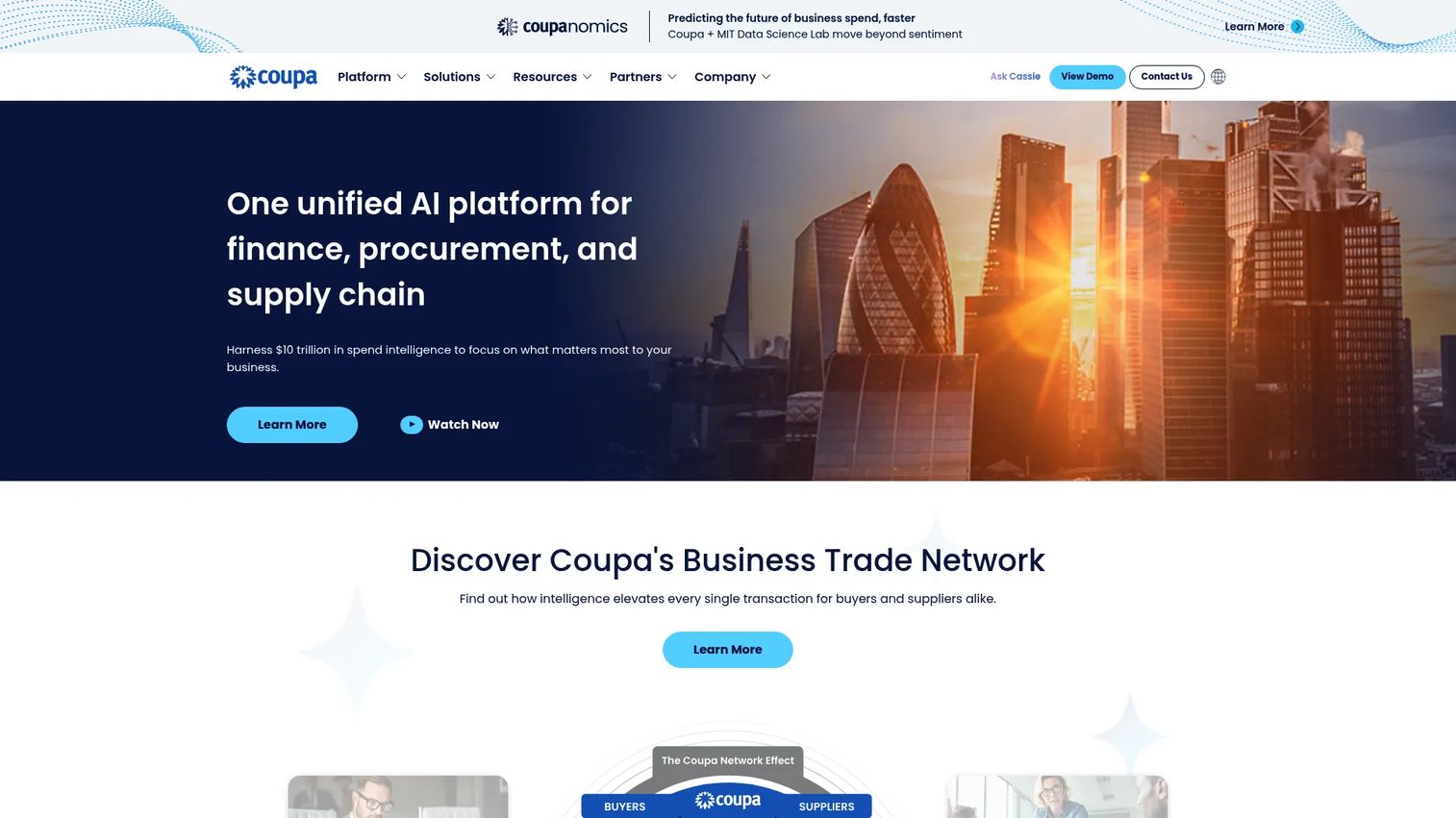
Coupa is business spend management software that spans procurement, invoicing, expenses, and pay, with supplier management sitting inside a broader spend context. That framing matters: Coupa's strength is giving procurement and finance a single standardized view of spend, suppliers, and compliance rather than treating supplier management as a bolt-on. For teams trying to consolidate a fragmented stack, that unification is the draw.
Best for: Enterprises and mid-market teams standardizing spend management across procurement and finance.
Key strengths
- Unified spend management: Procure, invoice, expense, and pay workflows live in one platform.
- Supplier and contract coverage: Spend analysis, strategic sourcing, contract, and supplier management in a single system.
- Analytics and automation: Reporting, dashboards, budgets, and workflow automation improve supplier visibility.
Why choose Coupa: Coupa is a strong choice for centralized procurement teams that want supplier management as part of a wider spend program, not a standalone tool. Its analytics and standardization help procurement prove savings and compliance, which is exactly what a PM-minded buyer wants when defending the spend internally.
Coupa pricing: Coupa does not display general customer pricing on its public site and directs buyers to contact its team. Supplier-side portal access is described as free, though that is separate from the core business spend management product. Confirm current pricing and packaging with Coupa directly.
3. Ivalua
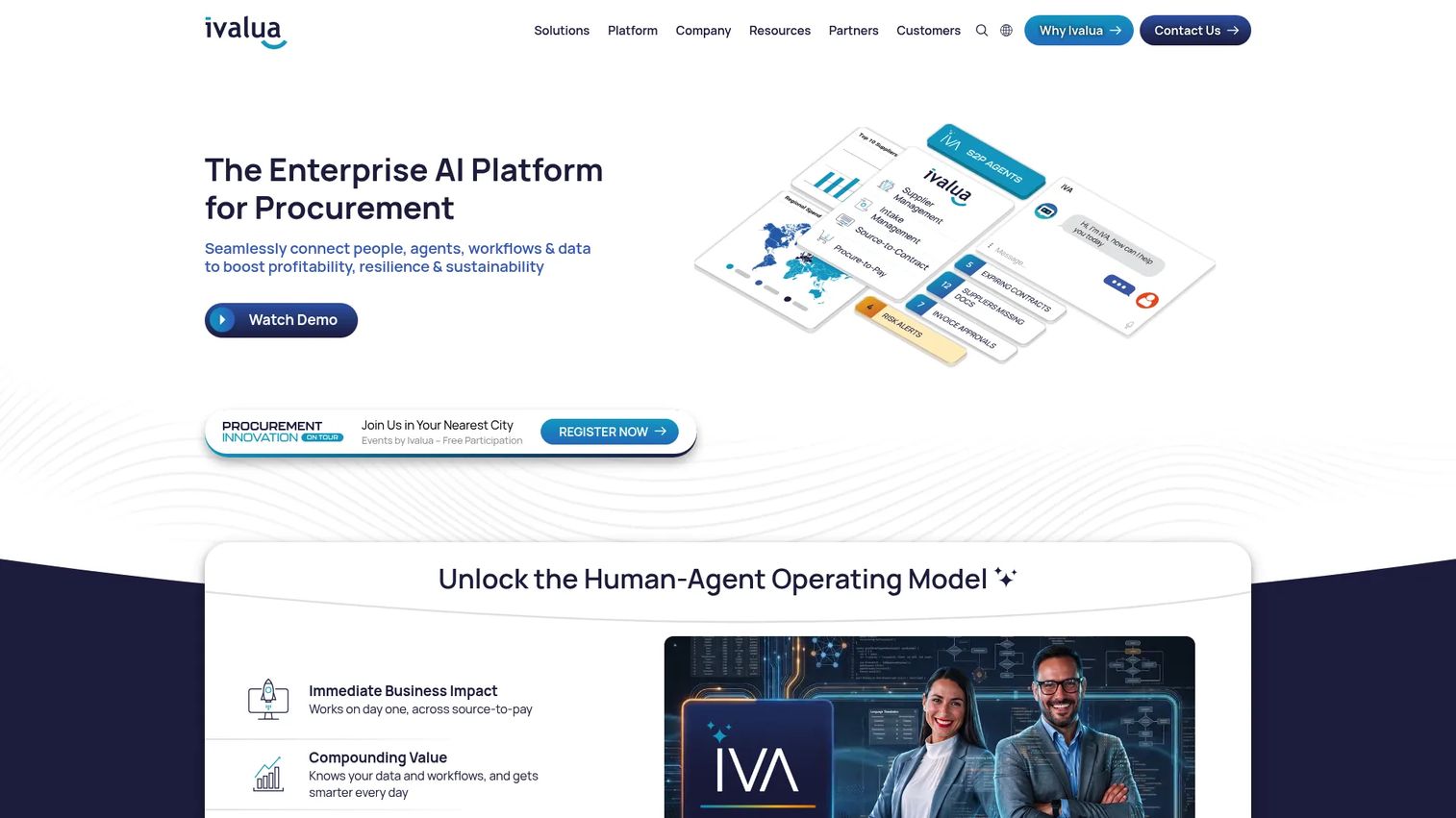
Ivalua is an enterprise AI procurement and spend management platform built for source-to-pay processes, and its reputation rests on configurability. Where many suites force your supplier workflows into a fixed template, Ivalua is designed to bend to complex, global processes without heavy custom development. That makes it a common shortlist entry for enterprises whose supplier lifecycle management does not fit a standard mold.
Best for: Large, global enterprises needing configurable source-to-pay procurement software.
Key strengths
- Configurable workflows: Supplier and procurement processes adapt to your rules, not the other way around.
- Performance and risk tracking: Supplier performance management and supplier risk management run inside one platform.
- Cross-process visibility: Spend management and supplier analytics give a connected view across sourcing, risk, and AP.
Why choose Ivalua: Complex global enterprises choose Ivalua when configurability is non-negotiable and a rigid suite would force painful workarounds. That flexibility is the value, and it pairs with a real implementation investment, so plan for a considered rollout with procurement, IT, and your systems integrator aligned.
Ivalua pricing: Ivalua does not publish pricing on its website; both the vendor site and G2 direct buyers to contact sales. Pricing is sales-led and scoped to your process complexity and module needs. Review implementation scope and total cost of ownership with Ivalua before committing.
4. JAGGAER
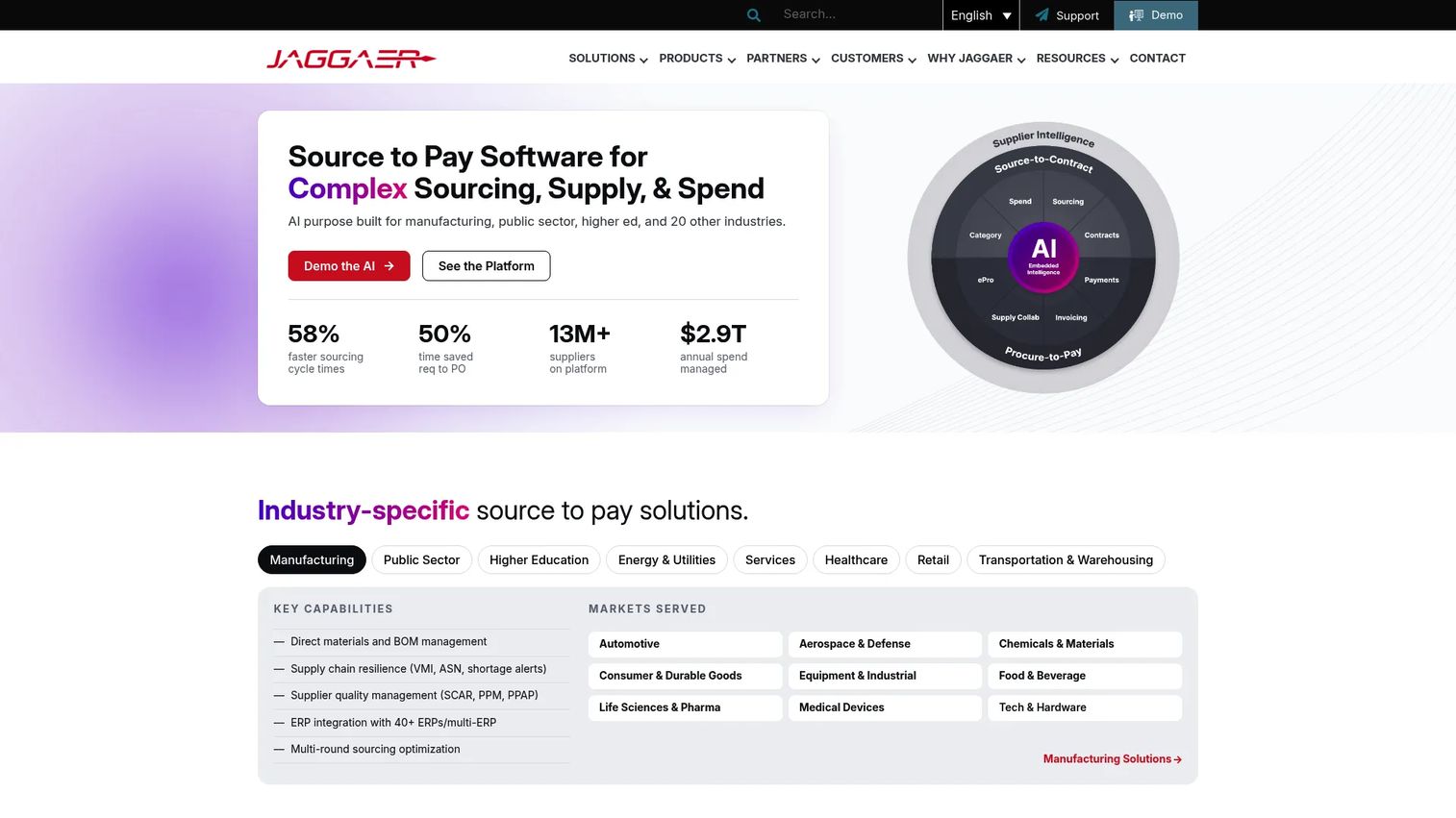
JAGGAER is an enterprise source-to-pay platform spanning sourcing, contracts, procure-to-pay, supplier intelligence, invoicing, and payments. Its supplier intelligence and embedded AI are the standouts, and it has a strong track record in complex procurement environments where category depth and supplier data quality matter more than a slick interface.
Best for: Large organizations needing a unified procurement and source-to-pay platform in complex settings.
Key strengths
- Source-to-pay breadth: Sourcing, contracts, procure-to-pay, invoicing, and payments in one platform.
- Supplier intelligence: Supplier data and risk monitoring feed better qualification and evaluation decisions.
- Embedded AI: AI supports sourcing, supplier discovery, and procurement automation across the workflow.
Why choose JAGGAER: JAGGAER earns its place in manufacturing, higher education, and public sector procurement, where supplier and contract workflows get genuinely complicated. If your category management and supplier intelligence needs are heavy, its depth pays off. It is a fit for procurement organizations ready to invest in a full platform rather than a point solution.
JAGGAER pricing: JAGGAER does not publish public pricing and routes buyers to contact sales or request a demo. Pricing is scoped per organization and module footprint. Ask for a detailed breakdown by module and seat count during evaluation.
5. GEP Smart
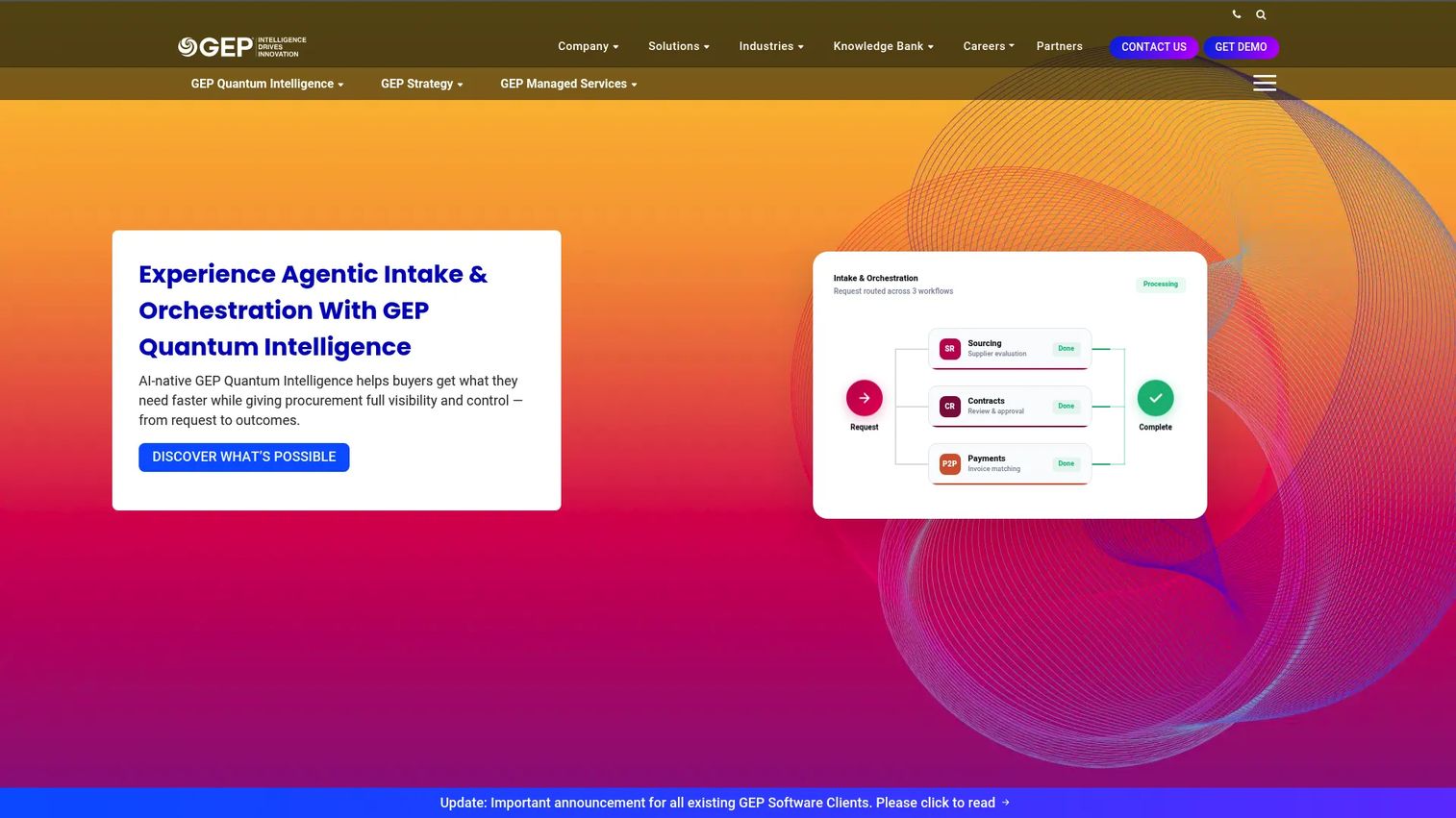
GEP Smart is an AI-powered source-to-pay platform for enterprise procurement teams, positioned around unifying procurement and supply chain in one system. Its pitch is a single AI-driven suite covering spend analysis, sourcing, contract management, supplier management, and procure-to-pay, so teams stop stitching together separate tools for each stage.
Best for: Large enterprises needing unified procurement and supply chain automation.
Key strengths
- Unified source-to-pay: Spend analysis, sourcing, contracts, supplier management, and procure-to-pay in one platform.
- Supplier collaboration: Shared workflows connect buyers and suppliers across the lifecycle.
- AI-driven analytics: Procurement and supplier analytics surface risk, spend, and performance insight.
Why choose GEP Smart: GEP Smart fits large procurement teams that want an AI-first, unified suite rather than a collection of modules from different eras. The consolidation and analytics story is the selling point. As with the other enterprise suites here, expect a scoped implementation aligned to your procurement and supply chain footprint.
GEP Smart pricing: GEP does not publish standard public list pricing; its portfolio is positioned through a sales-led process. A contract-specific government pricing document exists but does not reflect standard commercial pricing. Request current pricing and module scope directly from GEP.
6. Oracle Procurement Cloud
Oracle Procurement Cloud is Oracle's cloud procurement suite covering source-to-pay, sourcing, contracts, purchasing, and supplier management. Its clearest advantage is integration: for organizations already running Oracle ERP, procurement and supplier data sit inside the same ecosystem, which reduces reconciliation work and standardizes processes across finance and procurement.
Best for: Large organizations needing an integrated Oracle source-to-settle procurement suite.
Key strengths
- Procure-to-pay automation: Sourcing, requisitions, purchase orders, and supplier data are automated end to end.
- Supplier lifecycle and compliance: Contracts, supplier records, and compliance workflows run inside one suite.
- Built-in AI and analytics: AI, collaboration, analytics, and sustainability reporting are included natively.
Why choose Oracle Procurement Cloud: If Oracle is already your system of record, keeping procurement and supplier lifecycle management inside the same ecosystem is a strong standardization play. The integration reduces data silos and reporting friction. It is best suited to enterprises committed to the Oracle stack rather than teams looking for a standalone SRM tool.
Oracle Procurement Cloud pricing: Oracle does not expose public pricing on its procurement product page and routes buyers to sales or a demo. Pricing is quote-based and typically tied to broader Oracle Cloud agreements. Confirm packaging and licensing with Oracle before you plan budget.
7. Zycus
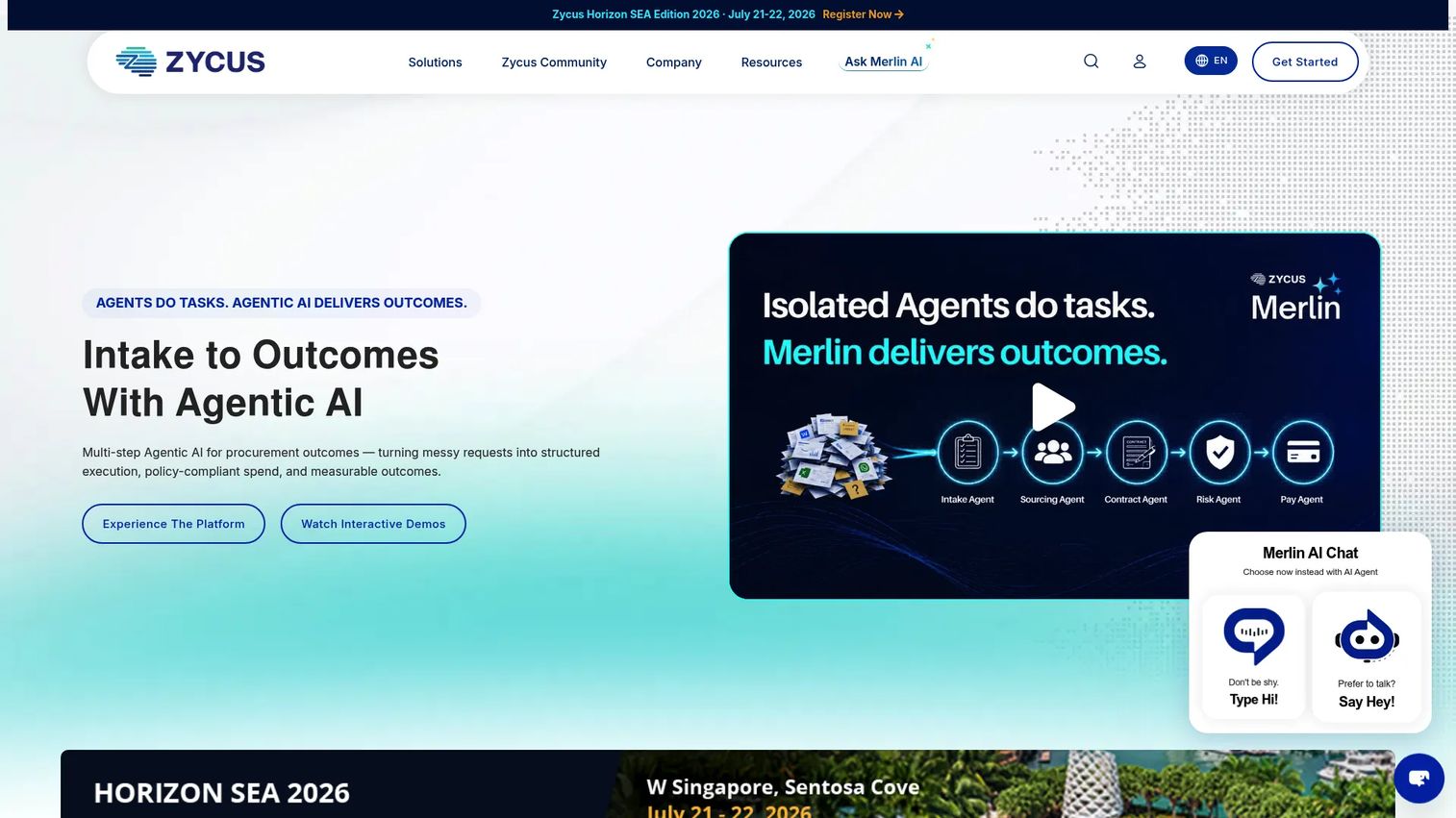
Zycus is an AI-powered source-to-pay platform for enterprises, with a focus on supplier management, compliance, and procurement efficiency. It covers the full source-to-pay arc, including eProcurement with guided buying and AP and invoice management, and procurement teams often compare it against the larger suites when they want strong automation without the largest incumbent footprint.
Best for: Large enterprises looking to unify procurement, sourcing, and AP workflows.
Key strengths
- Source-to-pay suite: End-to-end coverage from sourcing through AP and invoice management.
- Guided buying: eProcurement with guided buying keeps purchasing compliant and efficient.
- Automation and analytics: AI-driven automation and supplier analytics reduce manual procurement work.
Why choose Zycus: Procurement teams shortlist Zycus when they want source-to-pay breadth and automation and are weighing it against the largest suites. Its supplier management and compliance focus makes it a credible unifier for teams consolidating procurement and AP. Evaluate it head to head on the specific workflows you run most.
Zycus pricing: Zycus does not publish public pricing on its site, so plan for a sales-led, scoped quote. Pricing depends on modules, users, and procurement scope. Request a module-level breakdown and confirm current terms directly with Zycus.
8. ComplianceQuest
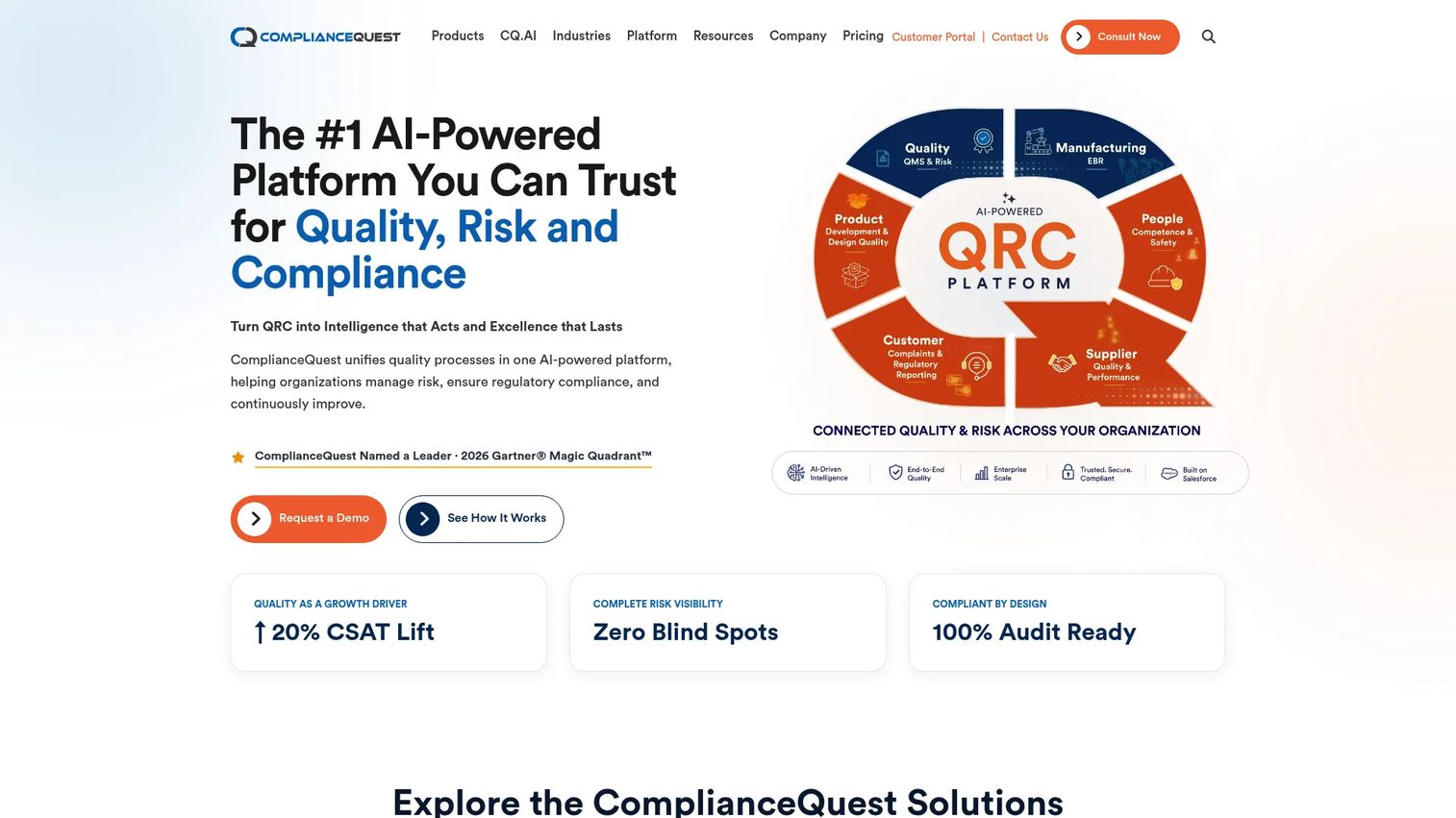
ComplianceQuest is AI-powered quality, risk, and compliance software built natively on Salesforce, with strong supplier risk, compliance, quality, and onboarding capabilities. In regulated industries, that native architecture and compliance depth are the differentiators: it treats supplier quality management and traceability as first-class concerns rather than afterthoughts.
Best for: Regulated organizations needing a configurable, Salesforce-native supplier and quality platform.
Key strengths
- Quality and compliance depth: QMS software with enterprise scalability and audit readiness built in.
- Traceability and control: Document management with controlled workflows and full traceability.
- Training and compliance tracking: LMS software supports supplier training, assessments, and compliance tracking.
Why choose ComplianceQuest: For regulated industries where supplier quality management and compliance carry real audit and safety stakes, ComplianceQuest's Salesforce-native design and traceability focus are compelling. It is the sharpest fit when compliance and quality are the primary drivers rather than broad source-to-pay procurement, so weigh it against the full suites based on where your risk actually sits.
ComplianceQuest pricing: ComplianceQuest states it does not publish fixed pricing and uses a quote process based on users, modules, sites, integrations, and compliance scope. Expect an enterprise, quote-based agreement. Scope your module and compliance requirements before requesting pricing.
How to choose the right SRM software
The strongest picks come down to what problem is loudest in your procurement function right now. Use these criteria as a buyer's checklist.
Match the tool to your dominant pain
If supplier risk and compliance keep you up at night, weight your evaluation toward continuous risk monitoring and audit readiness, where ComplianceQuest and the risk depth of Ivalua and JAGGAER stand out. If the pain is fragmented spend, Coupa and the full source-to-pay suites earn a closer look. Buy for the problem you actually have, not the longest feature list.
Assess onboarding complexity
Ask how many suppliers you onboard per quarter and how much manual work each one takes. If onboarding is your bottleneck, prioritize structured intake, automated document collection, and approval routing. A large supplier network, like SAP Ariba's, can meaningfully cut discovery and onboarding time.
Check workflow and configurability fit
Rigid suites force workarounds; overly open platforms need heavier setup. If your supplier workflows are non-standard, favor configurability like Ivalua's. If they are fairly standard, a more opinionated suite gets you to value faster with less tuning.
Verify integrations and ecosystem fit
Your SRM software has to sit inside your existing ERP, finance, and data stack. If you run Oracle, Oracle Procurement Cloud reduces reconciliation. If you live in Salesforce, ComplianceQuest's native architecture matters. Confirm the specific integrations you depend on before shortlisting.
Confirm analytics and measurement depth
You will need to prove impact: savings, risk reduction, onboarding speed, and performance trends. Check that supplier scorecards, dashboards, and reporting can be exported and shared with stakeholders. If you cannot measure it, you cannot defend the investment.
Conclusion
The best supplier relationship management software for your team depends on which lens matters most. For source-to-pay breadth and supplier network scale, SAP Ariba leads. For centralized spend and supplier visibility, Coupa is the standardization play. Ivalua wins on configurability for complex global procurement, JAGGAER on depth in complicated environments, and GEP Smart on AI-driven unification. Oracle Procurement Cloud is the clear pick if you already run Oracle, and ComplianceQuest is the sharpest fit for regulated industries where supplier quality and compliance drive the decision.
Shortlist based on three things: where your supplier risk actually sits, how complex your onboarding is, and how well each platform fits your existing workflows. From there, the next step is practical. Compare live demos side by side, verify the integrations you depend on against your current stack, and review pricing and total cost of ownership with procurement and finance together before you commit.
FAQs
Supplier relationship management software is a system that centralizes how you onboard, evaluate, monitor, and collaborate with suppliers across the full supplier lifecycle. It combines supplier onboarding, supplier risk management, supplier performance management, and compliance into connected workflows. The goal is to move procurement from reactive, spreadsheet-driven work to proactive, measurable supplier management.
Basic supplier management software often focuses on storing vendor records and handling transactional oversight. SRM software adds a strategic layer: supplier segmentation, performance scorecards, risk monitoring, and long-term relationship value. In short, supplier management software keeps records, while SRM software manages the relationship as an ongoing program.
Prioritize supplier onboarding automation, continuous supplier risk management, supplier performance management with scorecards, supplier collaboration tools, and supplier compliance management software with a clean audit trail. Strong supplier analytics and dashboards matter too, since you need to prove savings, risk reduction, and performance gains. The right mix depends on which of these problems is loudest in your organization.
Beyond procurement and sourcing, supplier quality teams use it for supplier scorecards and quality management, and risk or compliance teams use it for continuous risk monitoring and audit readiness. Finance uses the spend and supplier visibility for budgeting and savings tracking. Operations and supply chain teams also rely on it to manage supplier performance and continuity.
SRM software replaces periodic manual reviews with continuous risk monitoring across financial, compliance, ESG, and operational signals. It flags issues like a lapsed certification or a sanctions hit in real time, rather than surfacing them at the next quarterly review. That shift from reactive to proactive is where most of the risk-reduction value comes from.
It can be, especially if manual onboarding, inconsistent supplier evaluation, or growing supplier risk are already costing time and creating exposure. Mid-market teams often start with a focused supplier management solution and expand into full supplier lifecycle management as they scale. The test is whether the operational savings and risk reduction outweigh the implementation cost, which you can model before buying.
Ask to see a real supplier onboarding flow end to end, how risk monitoring surfaces and escalates issues, and how supplier scorecards and performance reviews work in practice. Push on integrations with your existing ERP and finance stack, analytics exportability, and total cost of ownership including implementation. Use the demo to pressure-test the specific workflows you run most, not the polished happy path.
Score vendors on the workflow that matters most to you, whether that is onboarding, supplier risk management, performance management, or compliance. Weigh configurability against implementation effort, confirm the specific integrations you depend on, and verify current pricing and G2 ratings against each vendor's live sources. Then run the shortlist through side-by-side demos using your own supplier scenarios before deciding.