You want to add a wallet, issue cards, or offer net terms inside your product. Then legal asks who holds the license. Compliance asks about KYC. Engineering estimates six quarters to build a regulated stack that a fintech would spend years hardening. The feature dies in a planning doc.
That is the real friction behind embedded finance. The demand is not in question. Boston Consulting Group put the North America and Europe SME embedded finance TAM at around USD 185 billion in 2025, with current penetration near USD 32 billion. The gap is execution: most software companies cannot become a regulated financial institution overnight, and they should not try.
Embedded finance software closes that gap. It gives you the accounts, payment rails, card issuing, lending, and treasury plumbing through APIs, so you ship a financial feature without owning the bank charter behind it. The question stops being "can we build this?" and becomes "which platform fits our product, our launch timeline, and our compliance posture?"
This guide answers that question for product, platform, and fintech teams evaluating vendors right now.
What's inside
This guide is for product managers, platform leaders, and fintech teams choosing an embedded finance vendor, not readers who just want a definition. We built the shortlist around the criteria that decide these deals:
- Platform breadth: payments, accounts, cards, lending, treasury coverage
- Implementation speed: how fast a team ships a working feature
- Trust and compliance signals: licenses, sponsor banks, security posture
- B2B and SaaS fit: how well the platform supports software products
- Monetization potential: whether new financial features grow revenue
The article covers embedded payments, accounts and wallets, card issuing, capital and lending, and treasury workflows across seven platforms.
TL;DR
- Best for broad embedded finance coverage: Unit, for teams building accounts, cards, payments, and credit into software
- Best for enterprise payment breadth: Adyen, for a single global payments stack across online and in-person
- Best for B2B net terms and invoicing: TreviPay, for trade credit and receivables automation
- Best for treasury and cash workflows: Kyriba, for treasury, payments, and liquidity management
- Best for core banking infrastructure: Finastra, for banks and lenders needing configurable financial software
- Best for developer-first payments: Stripe, for fast implementation and adjacent financial products
- Best for European embedded banking: Solaris, for regulated accounts, cards, and lending in Europe
What is embedded finance software
Embedded finance software is the infrastructure that lets a non-financial company offer financial services inside its own product experience. Instead of sending users to a bank or a separate payments provider, the company embeds accounts, payments, cards, lending, or treasury features directly into its app through APIs and SDKs.
It works by abstracting the regulated stack. The platform holds or brokers the bank relationships, compliance workflows, and money-movement rails. Your product calls an API, and the financial action happens inside your interface.
The core capabilities across embedded finance platforms include:
- Embedded payments: accepting, processing, and settling money in-product
- Accounts and wallets: holding balances and provisioning ledgers per user
- Card issuing: creating virtual or physical debit and credit cards
- Capital or lending: extending credit, loans, or net terms to users
- Treasury or money movement: transfers, payouts, and liquidity management
- Compliance and identity workflows: KYC, KYB, and fraud controls
- Reporting, orchestration, and integrations: ledgers, dashboards, and connections to your CRM, ERP, and data stack
Open banking and Banking as a Service sit underneath as enabling layers. Open banking gives permissioned access to account data. Banking as a Service exposes a licensed bank's capabilities through APIs. Neither is the end product. They are the rails that embedded finance software packages into something a product team can actually ship.
The distinction matters when you evaluate vendors. Some platforms sell you raw BaaS access and expect you to assemble the experience. Others deliver a fuller stack with dashboards, ledgers, and compliance tooling built in. Knowing which layer you are buying prevents surprises three sprints into the build.
When to use embedded finance software
Add financial services without forcing users out of your product
Embedded finance earns its keep when the financial action is part of the workflow, not a separate destination. A marketplace paying out sellers, a vertical SaaS tool issuing cards to field crews, a platform extending net terms at checkout: each keeps the money movement inside the product. Users never leave, and you own the experience and the data.
Modernize revenue models without rebuilding the stack
Financial features open new revenue lines. Interchange on issued cards, spread on lending, fees on payments, float on balances. Teams reach for embedded finance when they want to lift customer lifetime value or retention without diverting engineering into building a regulated core from scratch. The platform handles the plumbing so you monetize faster.
Support B2B workflows that depend on payments, credit, or treasury
SaaS, vertical software, and platform businesses are the common buyers because their customers already transact. B2B invoicing, buyer credit, supplier payouts, and treasury operations all benefit from being native to the software. Embedding these turns a tool people use into infrastructure their business runs on.
Comparison table
We ranked this shortlist by relevance to product teams choosing infrastructure they can embed, weighting platform breadth, implementation fit, and compliance readiness. Pricing in embedded finance is almost always custom or transaction-based, so treat the pricing column as a directional signal, not a quote. G2 ratings reflect current listings.
| # | Product | Best for | Key differentiator | Pricing | G2 rating |
|---|---|---|---|---|---|
| 1 | Unit | Broad embedded finance coverage | Accounts, cards, payments, and credit in one stack | Custom | 3.5/5 |
| 2 | Adyen | Enterprise global payments | Single integration across online and in-person | From $0.13 + 4.19% + $0.30 per transaction | 4.0/5 |
| 3 | TreviPay | B2B net terms and invoicing | Managed trade credit and A/R automation | Custom | 5.0/5 |
| 4 | Kyriba | Treasury and cash workflows | Treasury, payments, and liquidity connectivity | Custom | 4.5/5 |
| 5 | Finastra | Core banking and lending | Configurable financial software for institutions | Custom | 3.2/5 |
| 6 | Stripe | Developer-first payments | Global rails plus adjacent financial products | From 2.9% + 30¢ per transaction | 4.4/5 |
| 7 | Solaris | European embedded banking | Regulated accounts, cards, and lending in Europe | Custom | Not listed |
Best 7 embedded finance platforms for 2026
1. Unit
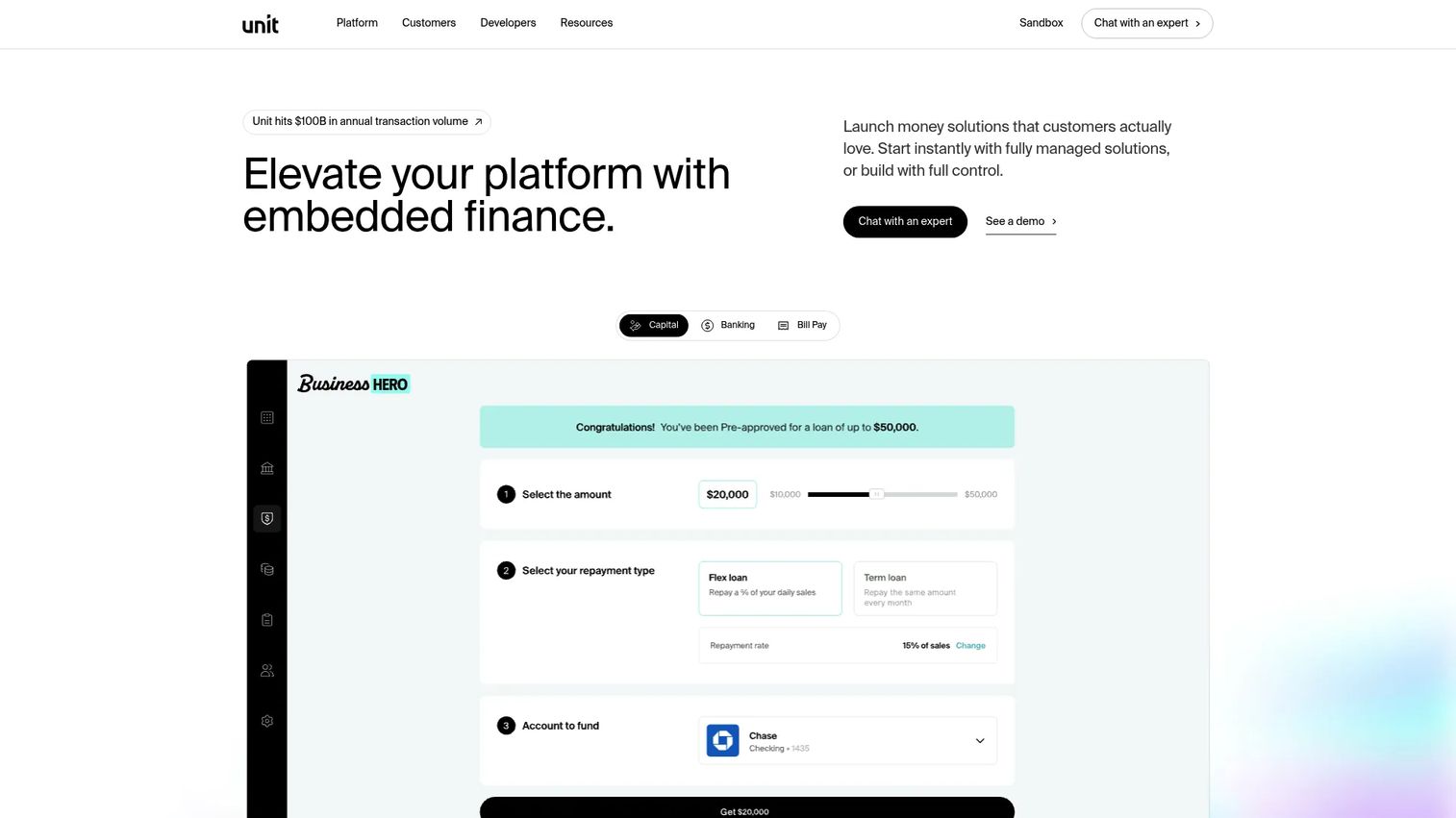
Unit is enterprise-grade financial infrastructure for building embedded banking, payments, cards, and credit products directly into software. It gives product teams accounts, money movement, card issuing, and capital through a single API, dashboard, and set of UI components, so a SaaS company can launch financial features without assembling the regulated stack piece by piece.
Best for: companies building embedded finance and banking products into their software.
Key strengths
- Accounts and wallets with per-user ledgers
- Money movement across transfers and payouts
- Card issuing for virtual and physical cards
- Capital and credit products
- API, dashboard, and prebuilt UI components
Why choose Unit: If you want breadth in one place, Unit covers accounts, cards, payments, and lending under a single integration rather than stitching four vendors together. That consolidation suits product teams that plan to expand from one financial feature into several without re-architecting each time.
Unit pricing: Unit does not publish a public price. Pricing is handled on a contact-sales basis and typically scales with the products you enable and your volume. Expect a custom quote tied to your specific stack.
2. Adyen
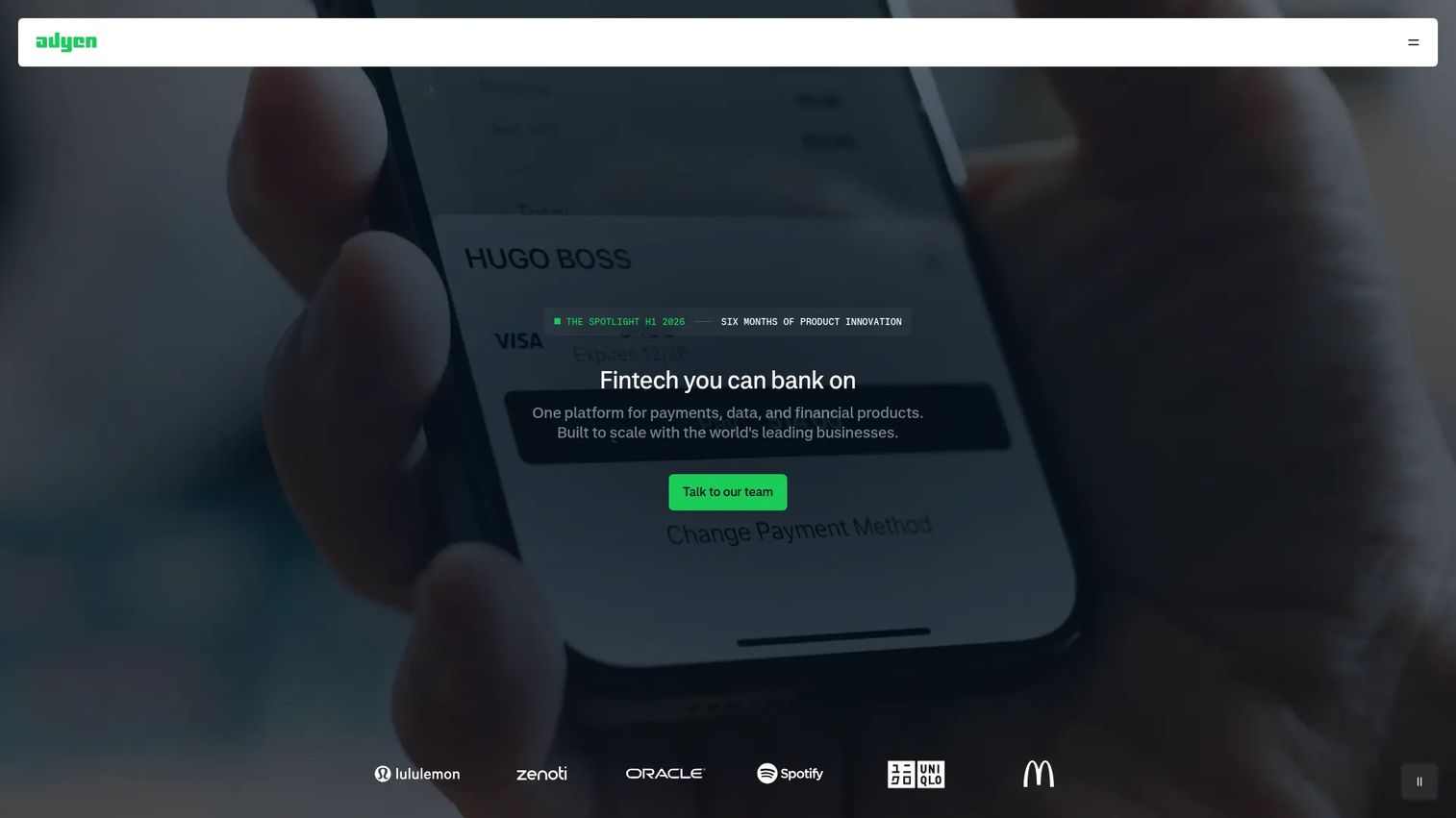
Adyen is a global payments platform for accepting, processing, and settling payments across online and in-person channels. It runs on a single integration that covers many payment methods and geographies, with risk, authentication, and revenue-optimization tooling layered on top. For teams that want embedded payments plus adjacent financial services under one enterprise umbrella, Adyen carries the scale.
Best for: enterprises needing a single global payments stack across online and offline channels.
Key strengths
- Single integration for multiple payment methods
- Payments online, in-app, and in-person
- Risk management and authentication tools
- Revenue-optimization features
- Global coverage across regions
Why choose Adyen: Adyen fits mid-market and enterprise teams that process payments across countries and channels and want one contract instead of a patchwork. Its commercial maturity and breadth make it a fit when payments are core, not a side feature.
Adyen pricing: Adyen charges no setup or monthly fees and bills per transaction. Published U.S. pricing starts around $0.13 + 4.19% + $0.30, though fees vary by payment method and country. Pricing is shown per method on the Adyen pricing page.
3. TreviPay
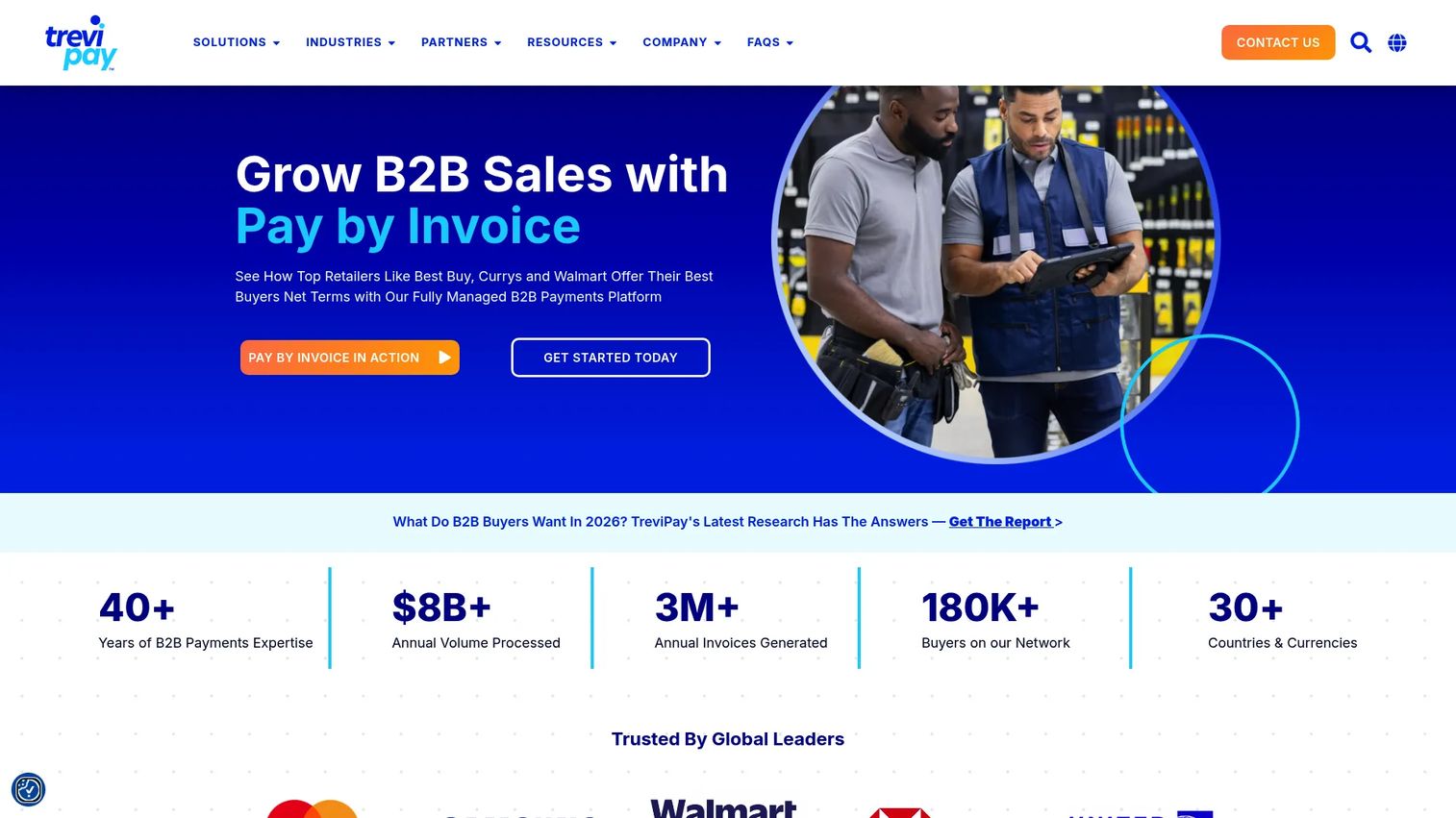
TreviPay is an enterprise B2B payments, invoicing, credit, and accounts receivable automation platform. It handles the hard part of business trade credit: underwriting buyers, extending net terms, invoicing, and automating receivables, so sellers offer credit at checkout without carrying the risk or the manual collections work.
Best for: large B2B sellers needing managed net terms and receivables automation.
Key strengths
- B2B payments across channels
- A/R automation
- AI-enhanced underwriting
- Smart invoicing
- Omnichannel net terms
Why choose TreviPay: If your buyers expect to pay on terms and your team is drowning in manual invoicing and credit decisions, TreviPay takes that motion off your plate. It is built for B2B trade flows specifically, not general consumer payments.
TreviPay pricing: TreviPay does not list a public price. Fees are transaction-based and vary by program, industry, and volume, so pricing comes through a sales conversation tied to your Credit-as-a-Service program.
4. Kyriba
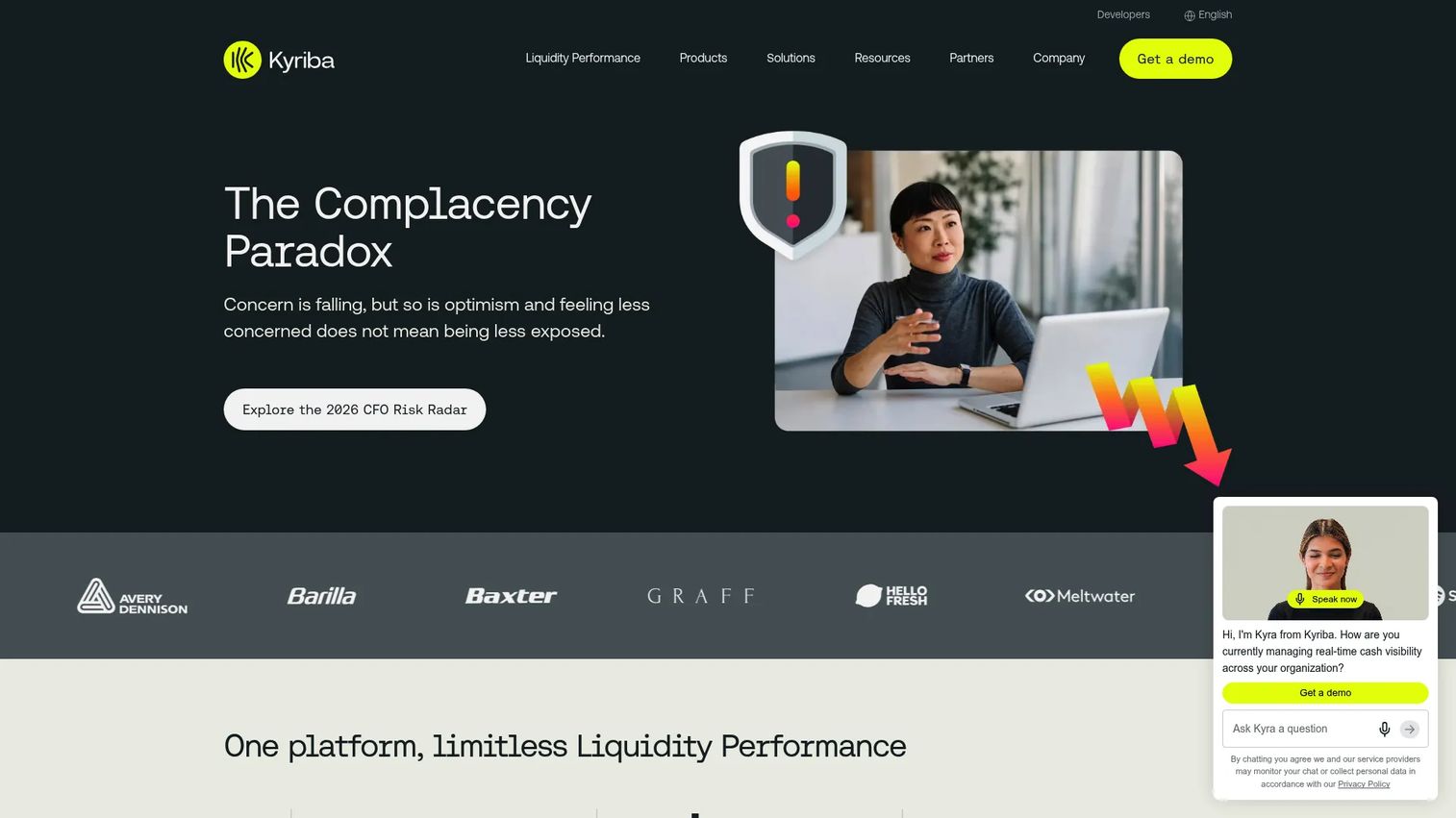
Kyriba is a cloud treasury, payments, risk, working capital, and connectivity platform for finance teams. Where most embedded finance platforms focus on customer-facing money movement, Kyriba modernizes the treasury and cash operations behind it, with deep bank, ERP, and API connectivity that brings embedded treasury workflows into the systems finance already runs.
Best for: enterprise finance teams needing treasury, payments, and liquidity management.
Key strengths
- Cash and treasury management
- Payments automation and fraud prevention
- Risk management across exposures
- Bank, ERP, and API connectivity
- Working capital and liquidity tooling
Why choose Kyriba: Kyriba is the pick when the workflow you need to modernize is treasury itself: cash visibility, payment controls, and liquidity. It pairs well with ERP-heavy environments where bank connectivity and fraud prevention matter more than consumer card issuing.
Kyriba pricing: Kyriba does not publish public pricing. Rates are subscription-based and set through an account manager, so plan for a custom quote scoped to your treasury and payments needs.
5. Finastra

Finastra is a global financial software provider for banks, lenders, and other financial institutions. Its scope spans lending, payments, and core banking, delivered on-premise or in the cloud, with the modularity that institutions need to configure financial infrastructure rather than accept a fixed product.
Best for: banks and financial institutions needing lending, payments, or core banking software.
Key strengths
- Lending for consumer, commercial, mortgage, and trade finance
- Payments and financial messaging
- Universal and core banking solutions
- Digital banking capabilities
- On-premise and cloud deployment
Why choose Finastra: Finastra suits teams operating closer to the bank layer than the app layer: institutions and fintech platforms that need configurable, modular financial infrastructure with deep integration options. Its breadth across lending, payments, and core banking is the draw.
Finastra pricing: Finastra does not publish public pricing. Its lending Solution Store serves existing customers as a purchase channel, but plan for institution-specific quoting rather than a public price list.
6. Stripe
Stripe is a payments infrastructure platform for accepting, managing, and automating online and in-person commerce. It is the developer-first choice: strong documentation, fast implementation, and a wide set of adjacent financial products like billing, tax, invoicing, and issuing that a product team can expand into once payments are live.
Best for: businesses that need a developer-friendly payments platform with global scale and multiple adjacent financial products.
Key strengths
- Global payments across 195+ countries and 100+ methods
- Built-in fraud prevention and 3D Secure
- Billing, tax, and invoicing tools
- Card issuing capabilities
- Extensive developer documentation and APIs
Why choose Stripe: Stripe fits teams that want to ship embedded payments fast and monetize adjacent financial workflows over time. Its developer experience and ecosystem shorten the path from integration to first transaction.
Stripe pricing: Stripe's standard payments pricing starts at 2.9% + 30¢ per successful domestic card transaction. Custom pricing is available for larger volumes. Some products are priced separately, such as Sigma from $15.00 per month and Tax Complete starting at $90.00 per month on annual terms.
7. Solaris
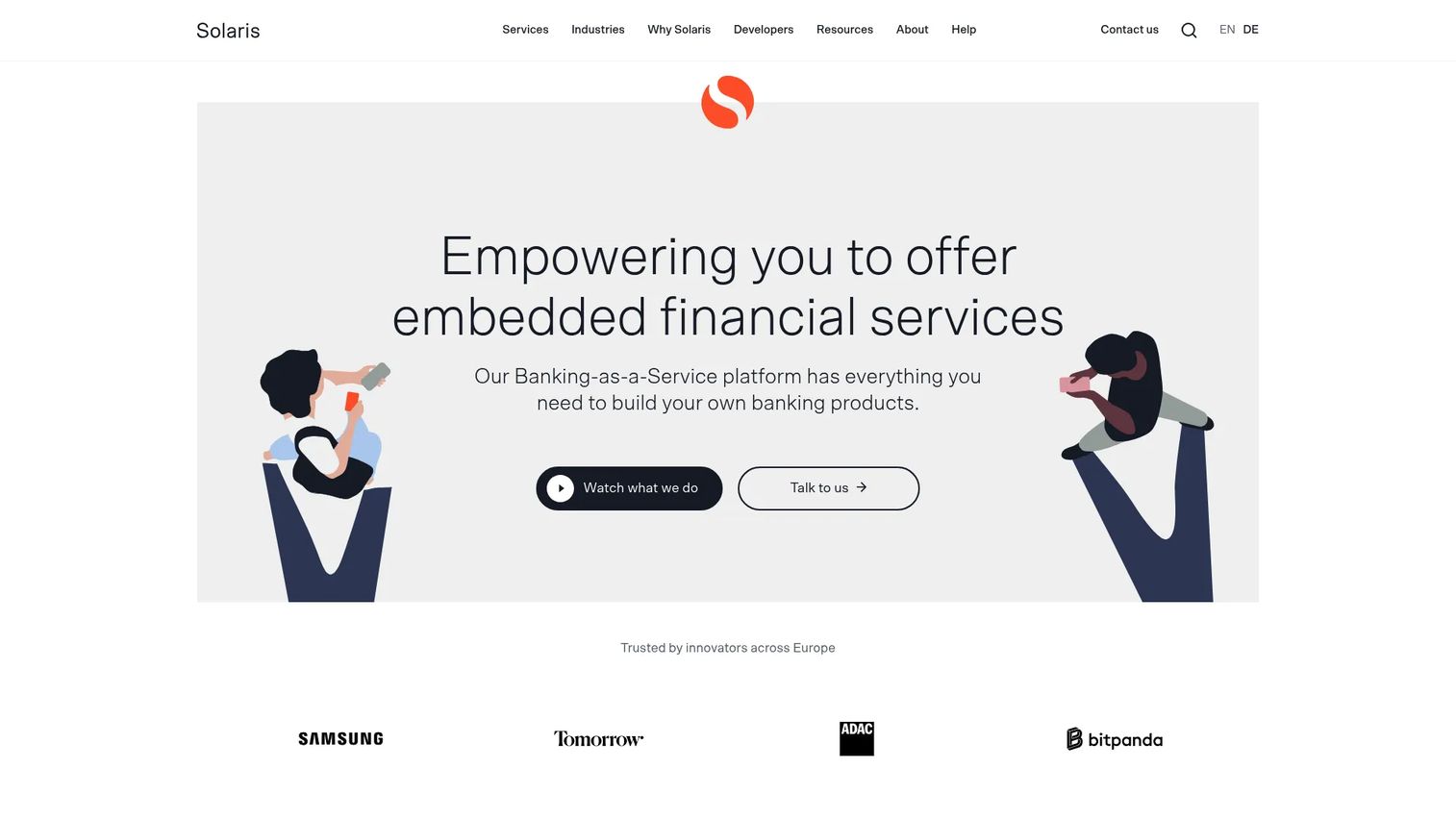
Solaris is a European embedded finance and Banking-as-a-Service platform. It lets businesses embed regulated banking features into their products through digital banking APIs, with accounts, cards, payments, lending, and identity verification built for the European regulatory context.
Best for: businesses that want to embed regulated banking features into their products.
Key strengths
- Digital banking APIs and accounts
- KYC and KYB identity verification
- Cards and payments services
- Lending capabilities
- European regulatory coverage
Why choose Solaris: If you operate in Europe and need regulated banking infrastructure, Solaris handles the accounts, cards, and compliance layer within that jurisdiction. Its regional focus is the reason to choose it over a globally spread payments vendor.
Solaris pricing: Solaris does not publish public pricing. Expect a custom quote scoped to the banking features you embed and your regulatory footprint, arranged through a sales conversation.
Considerations
Before you commit to a platform, work through the criteria that separate a clean launch from a stalled one.
Confirm regulatory and compliance readiness
Ask who holds the license and which sponsor bank sits behind the platform. Verify the compliance posture: KYC, KYB, AML, and how the vendor handles audits. A platform's technical breadth means nothing if its regulatory relationships do not cover your market or your product type.
Match the platform to the workflow
Embedded payments, accounts, cards, lending, and treasury are different buying motions with different vendors. A payments-first platform is not automatically a good treasury platform. Map your primary workflow to the platform's core strength before you evaluate secondary features.
Check implementation speed and control
Some platforms offer ready-to-launch paths that get a feature live in weeks. Others give you lower-level control that takes longer but fits complex products. Decide how much your engineering team wants to own, then choose a launch path that matches your release cadence and opportunity cost.
Verify integration depth
Features matter, but so does how the platform plugs into your stack. Check API and SDK quality, plus integrations with your CRM, ERP, and data tools. Shallow integrations create manual work that erodes the time savings you bought the platform for.
Assess monetization and reporting
Judge whether the platform can support revenue growth, not just feature launch. Look at how interchange, fees, or spread flow to you, and whether reporting gives you the visibility to prove impact. A platform that hides the numbers makes it hard to justify the next investment.
Conclusion
The best embedded finance software depends entirely on the workflow you are embedding. If you want broad coverage across accounts, cards, payments, and credit, Unit consolidates the stack. If payments are core and global, Adyen and Stripe both carry scale, with Stripe leaning developer-first. For B2B net terms and receivables, TreviPay is purpose-built. For treasury and cash operations, Kyriba modernizes the finance back office. For core banking and lending at the institution level, Finastra offers modular depth. For regulated banking in Europe, Solaris fits the jurisdiction.
Your next step: shortlist two or three platforms based on implementation speed, product breadth, and compliance fit, then run each through a sandbox against your actual use case. The market is expanding fast, projected by Fortune Business Insights to grow from USD 193.27 billion in 2026 toward USD 1.92 trillion by 2034, so vendor choices made now will compound. Choose for the workflow you are launching and the ones you plan to add next.
FAQs
Embedded finance software is infrastructure that lets a non-financial company offer financial services inside its own product through APIs and SDKs. It covers payments, accounts, cards, lending, and treasury, so a software company can ship financial features without becoming a regulated bank itself.
Banking as a Service is the enabling layer that exposes a licensed bank's capabilities through APIs. Embedded finance is the outcome: the financial experience delivered inside a non-financial product. BaaS is the rails; embedded finance is the feature your users actually touch.
Prioritize the capabilities that match your workflow: payments, accounts and wallets, card issuing, lending, or treasury. Then evaluate compliance readiness, API and SDK quality, integration depth with your CRM and ERP, and reporting that lets you prove monetization. Breadth matters only if it aligns with what you plan to launch.
Embedded payments is usually the fastest first launch because the rails are mature and vendor implementation paths are well documented. Accounts and wallets often follow. Lending and treasury tend to involve more compliance work, so many teams sequence them after a payments feature is live.
They monetize through transaction fees, interchange on issued cards, spread or interest on lending, and float on held balances. Many charge per-transaction or program-based fees rather than flat subscriptions. That is why pricing is often custom and scales with your volume and the products you enable.
You need a licensed bank behind the financial services, but most embedded finance platforms broker that relationship for you. The platform holds or arranges the sponsor bank and compliance layer, so you consume it through an API. Always confirm which bank sits behind the vendor and whether it covers your market.
Evaluate regulatory and compliance readiness, workflow fit, implementation speed, integration depth, and monetization potential. Map your primary financial feature to the platform's core strength, confirm the sponsor bank covers your market, and check that reporting will let you measure impact. The right choice supports both the feature you launch now and the ones you add later.