Your agency runs on a dozen moving parts at once. A nurse charts a visit in the field. A scheduler fills a shift that fell through this morning. Billing chases an EVV mismatch before a claim gets denied. A compliance lead pulls OASIS data ahead of a survey. When those parts live in disconnected spreadsheets and standalone tools, the work does not disappear. It just moves onto someone's plate as manual reconciliation, and the leakage shows up in missed visits, denied claims, and cash that arrives weeks late.
The home health care software market is expected to grow from USD 5.08 billion in 2026 to USD 9.27 billion by 2031 at a 12.74% CAGR, according to Mordor Intelligence. That growth is not abstract. It reflects agencies replacing patchwork operations with platforms that carry scheduling, documentation, billing, EVV, and compliance on one system of record. For an operator, the real question is not whether to buy software. It is which platform matches your most painful bottleneck without creating three new ones.
This guide reads like a buyer's decision framework, not a feature dump. If you evaluate demo experiences in your own product work, you may find our roundups on ai content creation tools and ai customer service software useful in parallel, since agency software buying and SaaS stack buying share the same trap: too many tools, not enough signal. Here we focus on home health, home care, and hospice operations, and we organize the shortlist by agency size and workflow priority so you can narrow the field fast.
What's inside
This guide compares 8 home health care software platforms for 2026. We selected each one based on workflow coverage across intake, scheduling, and documentation, compliance and EVV support, billing and claims depth, analytics and operational visibility, and fit across different agency sizes. The list spans end-to-end agency systems, EHR-first clinical platforms, scheduling and field-operations tools, workforce and caregiver management, and training and compliance support. It is built for agencies evaluating home health, home care, or hybrid care operations, whether you run a small single-site team or a multi-location organization with payer-connected workflows.
TL;DR
- Best overall for end-to-end operations: WellSky, for coordinated care across intake, documentation, scheduling, and revenue cycle.
- Best for compliance-heavy home health and hospice teams: Alora Health, for broad payer coverage, offline charting, and survey readiness.
- Best for EHR-first clinical workflow: Netsmart, for point-of-care documentation and care coordination.
- Best for use-case-led evaluation and agency enablement: CareAcademy, for caregiver training and compliance automation.
- Best for scheduling and field operations: AxisCare, for scheduling, EVV, and caregiver mobile workflows.
- Best for workforce and caregiver operations: Aaniie, for all-in-one operations plus recruiting and retention.
- Best for larger multi-location agencies: Homecare Homebase, for documentation, routing, and operational scale.
- Best for interoperability and payer-connected workflows: HHAeXchange, for EVV, billing, and compliance across networks.
What is home health care software?
Home health care software is an end-to-end platform that runs the operational and clinical work of a home-based care agency: patient intake and referral, scheduling and dispatch, point-of-care documentation, billing and claims, EVV, compliance, and reporting. It replaces disconnected spreadsheets, standalone scheduling tools, and paper charting with a single source of truth that carries a patient from referral through reimbursement.
The category spans several buyer needs. Some agencies need a home health EHR built around clinical documentation and OASIS. Others need a home care management system focused on scheduling, caregiver coordination, and EVV. Many need a home health agency software platform that covers both, plus billing and analytics, in one place. Home care software and home health software overlap heavily, but the clinical depth, payer connections, and compliance requirements differ by care type.
Most platforms in this category share a core set of capabilities that agencies should expect:
- Scheduling and dispatch: Fill shifts, match caregivers to visits, and manage route efficiency.
- Mobile point-of-care documentation: Chart visits in the field, online or offline, on a phone or tablet.
- EVV and regulatory support: Capture electronic visit verification and support HIPAA, OASIS, and payer-specific rules.
- Billing, claims, and revenue cycle tools: Scrub claims, manage payer requirements, and shorten days to payment.
- Analytics and operational visibility: Track visits, utilization, reimbursement, and quality in dashboards.
- Integrations and interoperability: Connect referral sources, payers, and adjacent systems so data moves without rekeying.
Cloud-based platforms account for 57.12% of home healthcare software market revenue as of 2025 and are projected to grow at a 14.22% CAGR through 2031, per Mordor Intelligence. That shift matters for operators who want mobile access, faster updates, and less infrastructure to maintain.
When to use home health care software
When your agency is replacing spreadsheets or disconnected tools
If your schedulers work in one system, your clinicians chart in another, and your billing team reconciles both by hand, you do not have an operations problem. You have a data problem. Every handoff between disconnected tools is a place where a visit gets missed, a note goes unsigned, or a claim gets delayed. A single home health agency software platform gives you one record per patient, one source of truth for visits, and far less manual reconciliation. The payoff shows up as fewer missed visits, faster documentation, and cash that arrives on schedule.
When compliance and EVV are non-negotiable
Regulated agencies do not treat compliance as a nice-to-have. EVV is mandated for Medicaid personal care and home health services, and payers enforce it. HIPAA governs how patient data is stored and shared. OASIS assessments drive both quality reporting and reimbursement for home health. Software built for this category captures EVV at the point of care, enforces documentation rules, and produces audit-ready reports ahead of a survey. If your agency serves Medicaid or Medicare populations, this is table stakes, not sophistication.
When you need better visibility into performance and reimbursement
Founders and operators care about repeatability and cash flow. You cannot fix a leaky revenue cycle you cannot see. Analytics, dashboards, and claims tools turn a fog of spreadsheets into clear signals: which payers pay slowly, which visits go undocumented, where utilization drops. That visibility is what turns a good quarter followed by a bad one into a pattern you can diagnose and correct. Home health agencies represent 60.02% of end-user spending in home healthcare software as of 2025, per Mordor Intelligence, which tells you how central these platforms have become to agency operations.
Comparison table
Here is how the eight platforms compare at a glance. Pricing for most enterprise home health systems is quote-based and tailored to agency size, so public numbers are shown where a vendor lists them.
| # | Product | Intent | Key differentiation | Pricing | G2 rating |
|---|---|---|---|---|---|
| 1 | WellSky | End-to-end coordinated care | Referral, documentation, scheduling, and revenue cycle plus analytics | Quote-based; training products from $125/yr | 4.2/5 |
| 2 | Alora Health | Compliance-heavy home health, home care, hospice | Offline charting, EVV, broad payer coverage, survey readiness | Quote-based | 4.5/5 |
| 3 | Netsmart | EHR-first clinical workflow | Point-of-care documentation and care coordination | Quote-based | Not published |
| 4 | CareAcademy | Training and compliance enablement | Caregiver training library, compliance automation, audit reports | From $239/mo | 4.4/5 |
| 5 | AxisCare | Scheduling and field operations | Scheduling, EVV, caregiver mobile app | Quote-based | Not published |
| 6 | Aaniie | Workforce and caregiver operations | All-in-one platform plus recruiting, payroll, retention | From $195/mo | 4.6/5 |
| 7 | Homecare Homebase | Larger multi-location agencies | Documentation, scheduling, billing, and analytics at scale | Quote-based | Not published |
| 8 | HHAeXchange | Interoperability and payer-connected workflows | EVV, scheduling, billing, claims scrubbing | Quote-based; no-cost state portals | 3.9/5 |
1. WellSky
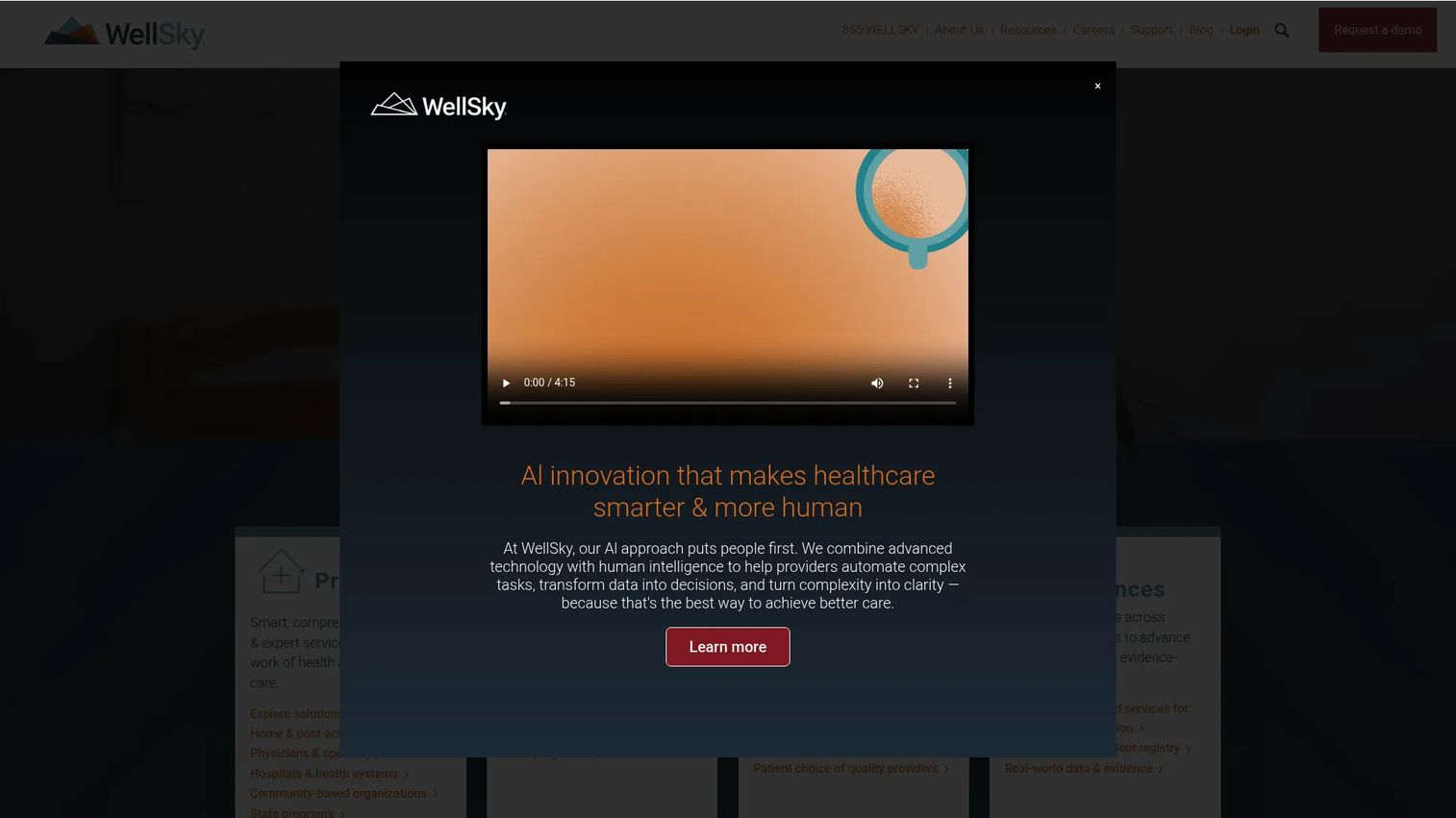
WellSky is a healthcare technology company that offers software, analytics, and services for coordinated care across health and community settings. Its home health software covers referral and intake, clinical documentation, scheduling, and revenue cycle, backed by AI-assisted workflows and reporting. For agencies that want one platform to carry a patient from referral through reimbursement, WellSky is the most complete end-to-end option on this list. It also runs the WellSky Learning Center, which offers OASIS and compliance training and certification for clinical staff.
Best for: Providers and care organizations that need coordinated-care software plus training content in one ecosystem.
Key strengths
- End-to-end coverage: Referral, documentation, scheduling, and revenue cycle live on one platform, reducing handoffs between tools.
- AI-assisted software and analytics: Reporting and workflow support that help agencies read episode-level performance.
- Training and certification: The WellSky Learning Center adds OASIS and compliance education without a separate vendor.
Why choose WellSky: If your most painful bottleneck is fragmentation across intake, care delivery, and billing, WellSky consolidates the whole workflow. It is also a natural continuity path for agencies coming from earlier home health systems that WellSky has absorbed over time, so existing users often find migration less disruptive.
WellSky pricing: Core enterprise software pricing is quote-based and not published, which is standard for platforms of this scope. The WellSky store does list public prices for individual training products, including an OASIS LMS subscription at $125.00 per year and a broader LMS subscription at $205.00 per year. There is no free tier for the core platform.
2. Alora Health
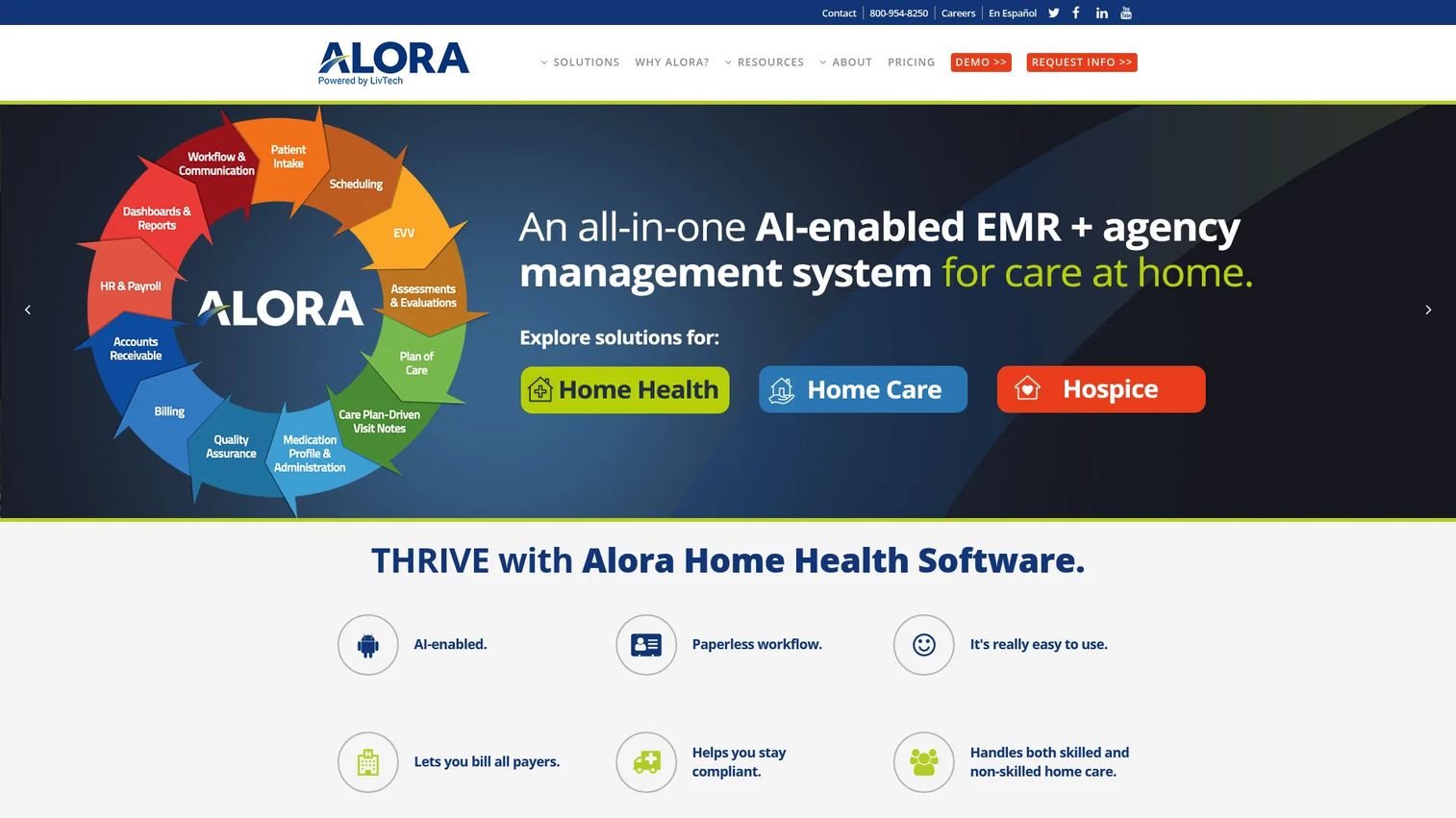
Alora Health is a home health, home care, and hospice platform built for agencies that need one system across multiple care types. It covers scheduling, billing, clinical documentation, HR management, offline charting, and EVV. The offline charting matters more than it sounds: clinicians in areas with poor connectivity can document a visit without a signal and sync later, which keeps point-of-care records complete. Alora leans hard into compliance and survey readiness, which is why it fits regulated agencies well.
Best for: Home health agencies that need an all-in-one EHR and agency management platform with broad payer coverage.
Key strengths
- Multi-care coverage: Home health, home care, and hospice run on one platform, useful for hybrid agencies.
- Offline charting: Clinicians document visits without connectivity and sync later, protecting documentation completeness.
- EVV and compliance: Built-in EVV and survey-readiness features support HIPAA and payer requirements.
Why choose Alora Health: If your agency spans multiple care types or serves payers with strict documentation and EVV rules, Alora's breadth and compliance depth reduce the number of systems you maintain. Its ease-of-use emphasis also lowers the training burden on field staff.
Alora Health pricing: Public pricing is not disclosed on the Alora site. The company states that pricing depends on agency size or patient volume and directs buyers to request a quote. There is no free tier.
3. Netsmart
Netsmart is a healthcare and human services technology provider with an EHR-first approach to home-based care. Its CareFabric platform emphasizes clinical workflow, with tools that span intake, scheduling, documentation, claims, and interoperability. Field-facing tools like Mobile Caregiver+ support point-of-care documentation, while referral and routing tools help coordinate care across teams. AI and automation are positioned as augmentation to clinical work rather than a replacement for it.
Best for: Healthcare and human services organizations that want enterprise EHR software with strong clinical documentation and care coordination.
Key strengths
- EHR-first clinical workflow: Documentation and care coordination are the center of the platform, not an add-on.
- Point-of-care mobile tools: Field documentation supports clinicians where visits actually happen.
- Interoperability: Referral and data-exchange tools connect the agency to a broader care network.
Why choose Netsmart: If clinical documentation quality and care coordination are your priority, and you want a platform built around the clinical record first, Netsmart's EHR-first design fits. It suits agencies that see documentation and interoperability as the foundation of quality and reimbursement.
Netsmart pricing: Netsmart does not publish pricing on its site, and pricing appears to be quote-based, which is typical for enterprise EHR platforms. Agencies should request a scoped quote based on care lines and volume.
4. CareAcademy
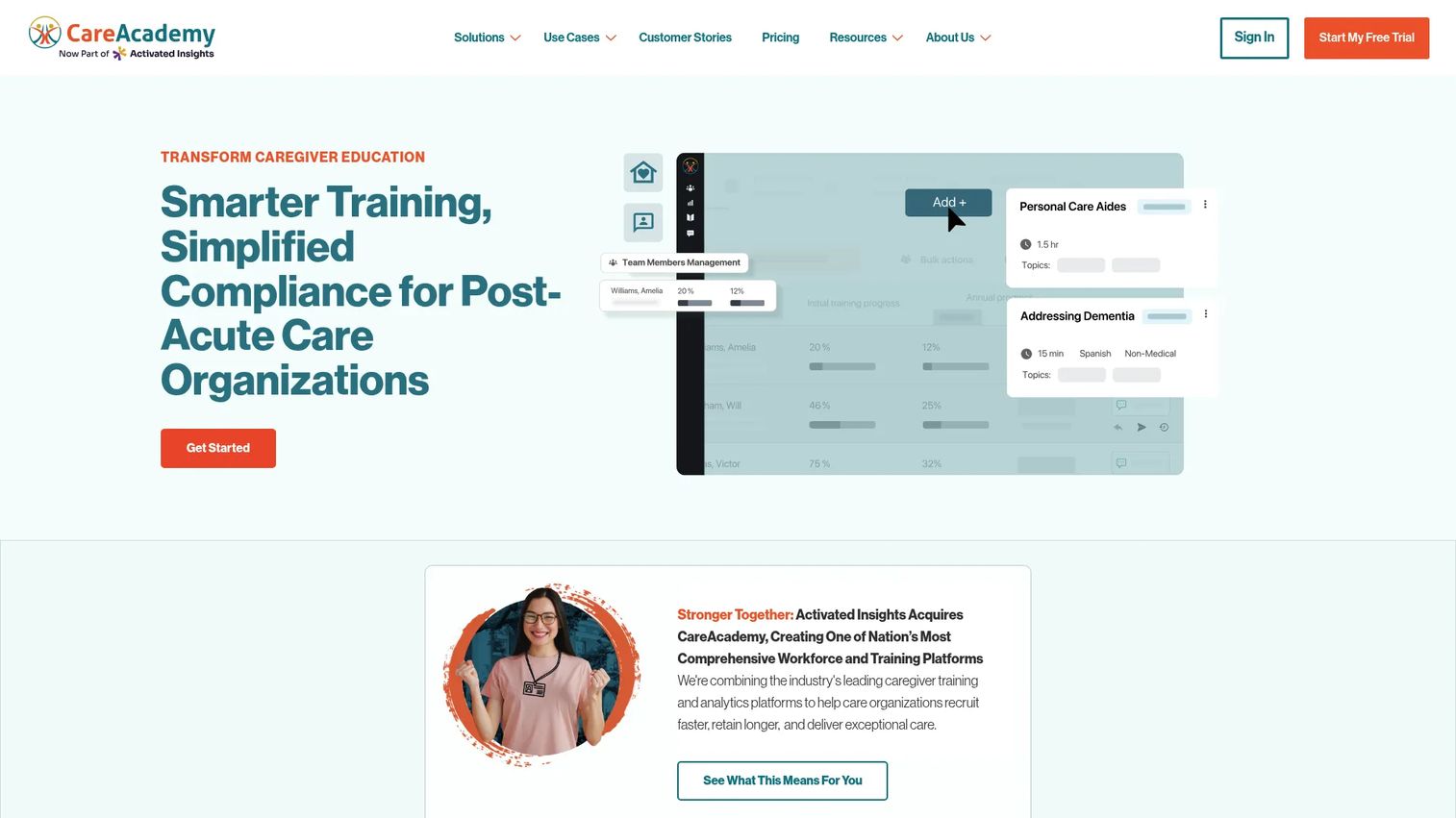
CareAcademy is a caregiver training and compliance platform for post-acute care organizations. It is a different category emphasis from the core operations suites on this list. Rather than running scheduling and billing, it handles the training library, compliance automation, and audit-ready reporting that agencies need to keep caregivers certified and survey-ready. That makes it useful during evaluation: many agencies pair a core operations platform with a training and compliance layer, and CareAcademy integrates with back-office systems to keep records aligned.
Best for: Home care, home health, hospice, and senior living teams that need training and compliance management alongside their operations stack.
Key strengths
- Compliance automation: Audit-ready reports and automated compliance tracking reduce manual survey prep.
- Caregiver training library: A broad course catalog, including a Spanish-translated experience, supports diverse field teams.
- Back-office integrations: Connects to operational systems so training and compliance records stay in sync.
Why choose CareAcademy: If your operations platform is solid but caregiver training and compliance tracking are manual and time-consuming, CareAcademy fills that specific gap. Treat it as a training and compliance layer rather than a replacement for a core agency system.
CareAcademy pricing: CareAcademy publishes plan pricing. The Essentials plan starts at $239 billed monthly, Advanced at $383 billed monthly, and Complete at $419 billed monthly. Plans require a minimum one-year contract, and monthly or annual billing is available. Some add-ons carry custom pricing. There is no free tier, though a free trial is available.
5. AxisCare
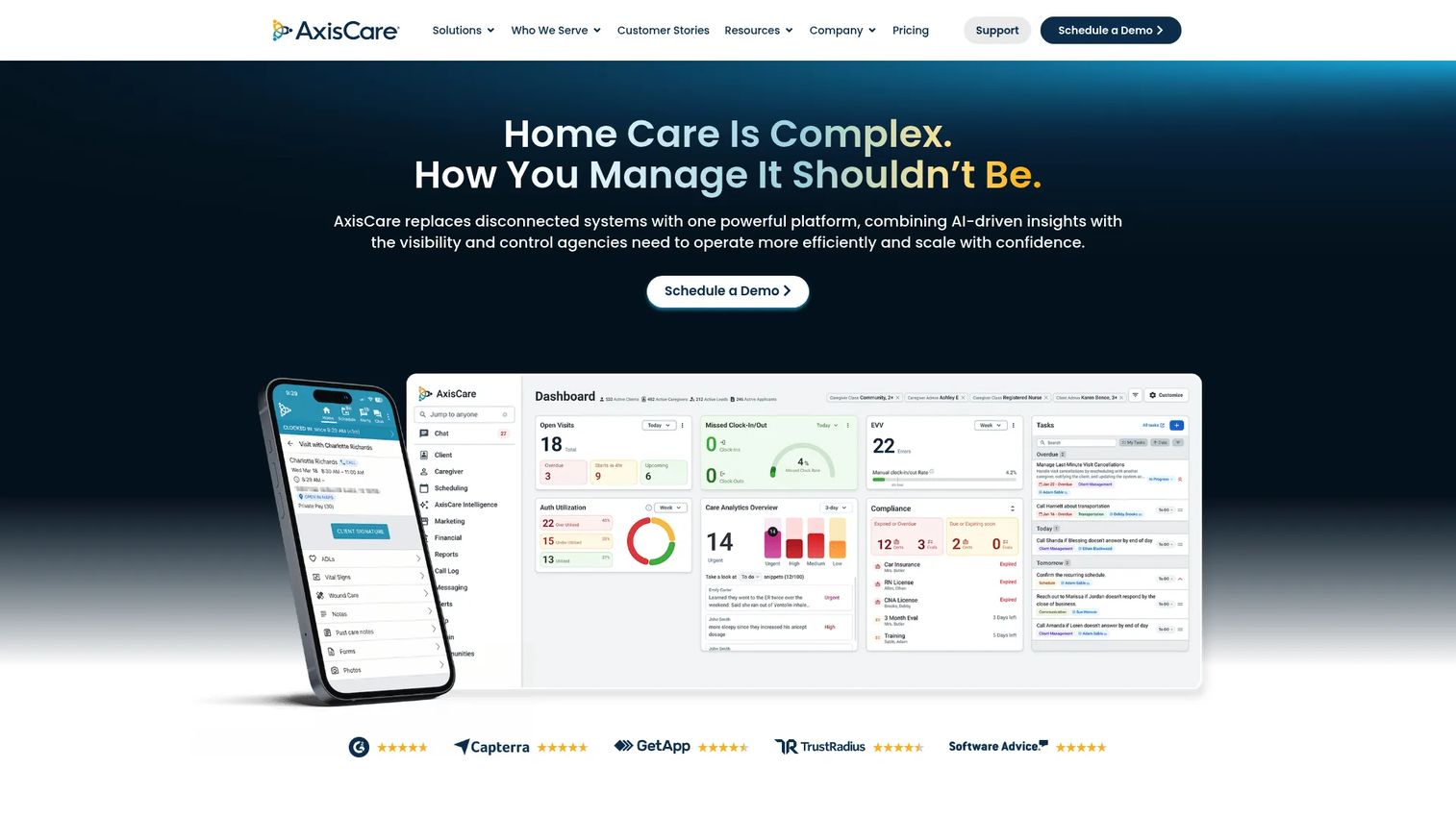
AxisCare is home care management software built for agencies where scheduling efficiency drives service quality. Its core covers scheduling, electronic visit verification, and a caregiver mobile app that keeps field staff connected to their shifts and visit details. When your operational pain is a schedule that falls apart under last-minute changes, AxisCare's scheduling and dispatch depth is the differentiator. EVV capture is built in, which keeps Medicaid-funded visits compliant without a bolt-on tool.
Best for: Home care agencies that need strong scheduling, EVV, and mobile caregiver workflows.
Key strengths
- Scheduling and dispatch: Fill shifts, manage changes, and keep visits covered without manual scramble.
- Built-in EVV: Electronic visit verification captured at the point of care supports Medicaid compliance.
- Caregiver mobile app: Field staff access schedules and visit details from their phones.
Why choose AxisCare: If scheduling is the bottleneck that most directly affects your service quality and caregiver satisfaction, AxisCare's focus on scheduling and field operations is the strongest match. It fits agencies that treat the schedule as the heart of the operation.
AxisCare pricing: AxisCare uses quote-based pricing tailored to agency size and client count. Its pricing page shows four segments, from small to enterprise agencies, without public numeric prices. There is no free tier. Agencies request a quote scoped to their size.
6. Aaniie
Aaniie is an all-in-one home care software platform that folds caregiver operations into the same system as scheduling, billing, and payroll. What sets it apart for staffing-constrained agencies is the built-in recruiting and hiring ATS alongside EVV-compliant point-of-care and scheduling. Add CRM and caregiver retention tools, and Aaniie targets the full workforce lifecycle: recruit, hire, schedule, pay, and retain. For agencies where the hardest problem is coordinating people, that breadth is the draw.
Best for: Home care agencies that need an all-in-one operations platform with recruiting and retention built in.
Key strengths
- All-in-one operations: Scheduling, billing, payroll, and CRM in one platform reduce tool sprawl.
- Recruiting and retention: A built-in ATS plus caregiver retention tools address staffing head-on.
- EVV-compliant point-of-care: Visit verification and field documentation keep Medicaid visits compliant.
Why choose Aaniie: If caregiver recruiting, retention, and daily coordination are your biggest operational drag, Aaniie's workforce-first breadth handles staffing and operations in one place. It suits agencies that see people coordination as the constraint on growth.
Aaniie pricing: Aaniie publishes pricing. The All-inclusive plan starts at $195 per month for up to 15 clients at signing. All-inclusive Pro starts at $13 per client per month for 16 or more clients at signing. Enterprise is custom. Monthly or annual billing is available, and there is no free tier.
7. Homecare Homebase
Homecare Homebase is cloud-based EHR software for home-based care agencies, spanning home health, hospice, and personal care. It brings documentation, scheduling, and billing into one platform, with point-of-care mobile documentation, analytics, interoperability, and back-office services. The platform is built for depth and scale, which is why it fits larger, multi-location, or more operationally complex organizations that need consistent workflows across sites. Route management and clinical documentation depth are core to its appeal for agencies at scale.
Best for: Home health, hospice, and personal care agencies that need a unified EHR and operations platform at scale.
Key strengths
- Unified documentation, scheduling, and billing: One platform covers the core operational workflow across care lines.
- Point-of-care mobile documentation: Clinicians chart in the field with tools built for volume.
- Analytics and back-office services: Reporting, interoperability, and support services help larger agencies run consistently.
Why choose Homecare Homebase: If you run a multi-location or higher-volume organization and your bottleneck is consistency and scale across sites, Homecare Homebase's depth is built for that reality. It fits agencies that have outgrown lighter tools.
Homecare Homebase pricing: Homecare Homebase does not publish pricing on its site and routes visitors to request a demo. Pricing is quote-based, consistent with enterprise EHR platforms. Agencies should scope a quote against care lines, volume, and locations.
8. HHAeXchange
HHAeXchange is a homecare software platform for providers and payers, built around EVV, scheduling, case coordination, billing, and compliance. Its differentiator is payer-connected workflows: it links agencies to payers for EVV, claims, and care management, which matters most for agencies operating inside Medicaid networks. Billing, payroll, and pre-billing claims scrubbing help reduce denials before submission. In several states, HHAeXchange runs no-cost, state-funded EVV portals, with an enterprise solution available for enhanced features.
Best for: Homecare agencies and payers that need EVV and compliance workflows connected across networks.
Key strengths
- Payer-connected workflows: Direct connections to payers streamline EVV, claims, and care management.
- EVV and case coordination: Visit verification and scheduling are built for Medicaid compliance at scale.
- Claims scrubbing: Pre-billing claims review reduces denials before submission.
Why choose HHAeXchange: If your agency operates in Medicaid networks and interoperability with payers is the deciding factor, HHAeXchange's payer-connected model is the strongest fit. It suits agencies that need connected network and compliance workflows more than a broad clinical suite.
HHAeXchange pricing: HHAeXchange does not publish numeric pricing. It offers a no-cost, state-funded EVV portal in some states and an enterprise solution with enhanced features for an additional cost. Agencies should confirm what their state program covers before scoping the enterprise tier.
How to choose the right platform for your agency
The best platform is the one that solves your most painful bottleneck first, then covers the rest without forcing you to keep three other tools alive. Use these criteria to narrow the field.
Workflow coverage vs. your actual gap
Do not buy for every feature. Buy for the workflow that is bleeding time or cash today. If billing and claims are the leak, weight revenue cycle depth. If the schedule falls apart weekly, weight scheduling and dispatch. Map the platform's strengths to your specific gap before you compare anything else.
Compliance and EVV fit for your care type
Home health, home care, and hospice carry different compliance loads. Confirm the platform supports EVV for your payers, HIPAA for data handling, and OASIS if you deliver Medicare home health. A platform strong in one care type may be lighter in another, so match it to what you actually deliver.
Agency size and scale
A small single-site agency and a multi-location organization need different things. Smaller agencies value fast setup and published, predictable pricing. Larger organizations need depth, consistency across sites, and back-office support. Buy for the size you are, with a realistic view of where you are heading.
Migration and continuity
Switching systems is where operations break if you rush it. Ask how patient records, schedules, and billing history migrate. Ask what the first 90 days look like. A platform with a clear migration path and continuity for existing data lowers the risk of a painful transition.
Conclusion
Choosing home health care software is a high-stakes operational decision, and the right answer depends on your agency's shape and its most painful bottleneck. For end-to-end coordinated care, WellSky is the most complete option. For compliance-heavy home health and hospice teams that need broad payer coverage and offline charting, Alora Health fits. Netsmart suits agencies that want an EHR-first clinical platform, while CareAcademy fills the training and compliance layer alongside a core system.
For scheduling and field operations, AxisCare is the strongest match. Aaniie handles workforce and caregiver operations for staffing-constrained agencies. Homecare Homebase serves larger, multi-location organizations that need depth at scale, and HHAeXchange fits agencies inside payer-connected Medicaid networks. Start with the platform that matches the bottleneck costing you the most today, confirm its compliance and EVV fit for your care type, and scope a quote against your actual size and volume. That is how you turn a fragmented operation into a repeatable one.
FAQs
Home health care software is an end-to-end platform that runs a home-based care agency's operational and clinical work, including intake, scheduling, point-of-care documentation, billing and claims, EVV, and compliance. It replaces disconnected spreadsheets and standalone tools with one system of record that carries a patient from referral through reimbursement.
Prioritize the workflow that is costing you the most today. For most agencies that means scheduling and dispatch, mobile point-of-care documentation, EVV, and billing and claims. Analytics and interoperability matter, but they deliver the most value once the core operational workflow is on one platform.
They overlap heavily but are not identical. Home health software often centers on clinical documentation, OASIS, and Medicare workflows, while home care software focuses more on scheduling, caregiver coordination, and Medicaid EVV. Many platforms serve both, and hybrid agencies often need a home care management system that spans clinical and non-clinical care.
Yes, if they serve Medicaid personal care or home health populations. EVV is mandated for those services, and payers enforce it. Software that captures EVV at the point of care keeps visits compliant and reduces claim denials tied to verification mismatches.
Look for platforms with revenue cycle depth and claims scrubbing. WellSky offers end-to-end revenue cycle within a coordinated-care platform, while HHAeXchange focuses on payer-connected billing and pre-billing claims scrubbing that reduces denials. The best fit depends on whether your payers are primarily Medicare, Medicaid, or mixed.
Small agencies should weight fast setup, predictable pricing, and coverage of their core workflow without paying for enterprise depth they will not use. Platforms with published pricing, such as Aaniie and CareAcademy, make budgeting easier, and an all-in-one system reduces the number of tools a lean team has to maintain.
Compare a home health EHR on clinical documentation quality, OASIS support, EVV, billing and claims depth, interoperability, and fit for your care type. Then weigh agency size, migration path, and pricing model. The right EHR matches your care lines and your most painful bottleneck rather than the longest feature list.
An EMR is a digital version of a patient's clinical chart within a single agency, focused on documentation. A home health EHR is broader: it shares patient data across care settings and connects documentation to scheduling, billing, EVV, and interoperability. In practice, most home health platforms marketed today function as EHRs because agencies need data to move across systems and payers.