An officer takes a report at a scene. That same information gets re-typed into a booking system, copied again into an evidence log, and re-entered a third time when the case moves toward the prosecutor. Each hand-off is a chance to introduce an error, lose a timestamp, or delay a report that command staff needs today.
That is the daily reality when records live across disconnected spreadsheets, legacy databases, and paper. A records management system exists to end the re-entry. It is not just a database. It is the operational spine that connects incidents, arrests, citations, warrants, bookings, evidence, and reporting into one record that follows a case from first call to final disposition.
The stakes are rising. The global law enforcement software market sits at USD 20.41 billion in 2026 and is projected to reach USD 40.76 billion by 2033, growing at a 10.4% CAGR, according to Grand View Research (2026). Agencies are modernizing because legacy tools cannot keep up with NIBRS reporting demands, interoperability requirements, and audit expectations.
This guide compares eight current police RMS platforms for 2026. It is built for public safety leaders, records supervisors, command staff, and IT buyers who need a decision-ready shortlist, not another glossary. If your evaluation touches adjacent categories, procurement teams often cross-reference audit management software, contract lifecycle management, and event management software during the same modernization budget cycle.
What's inside
This guide is a shortlist for agencies evaluating an RMS replacement or a CAD/RMS modernization project. It covers eight platforms that show up in category data and serve real law enforcement records workflows.
Each tool was selected against four criteria that matter to public safety buyers:
- Workflow coverage: incident, arrest, booking, citation, warrant, and evidence handling in one record
- Interoperability: connections to CAD, NCIC, courts, jails, and state networks
- Compliance and reporting: NIBRS and UCR support, audit trails, redaction, and access control
- Usability: how quickly officers in the field and staff at the desk can actually work in it
Only category-native, verifiable law enforcement RMS products are included. No filler, no adjacent tools stretched to fit.
TL;DR
- Best overall for broad agency fit: CentralSquare Enterprise RMS, for its integrated records and digital evidence workflows across medium to large agencies.
- Best for an ecosystem approach: Axon Records, if your agency already runs Axon Evidence and wants records tied to it.
- Best for cloud modernization: Mark43 RMS, for agencies replacing legacy on-prem systems with a cloud-native platform.
- Best for unifying public safety systems: Versaterm RMS, when RMS needs to sit close to CAD and mobile.
- Best for small agencies on a budget: CrimeStar RMS with transparent license pricing, and A.L.E.I.R. with a free core product.
- Best for enterprise governance: Oracle Public Safety RMS and PremierOne Records, for larger municipalities with complex IT and interoperability needs.
What is police records management software?
Police records management software (RMS) is a system law enforcement agencies use to capture, store, connect, search, and report on records across the full incident-to-disposition lifecycle, from the first call for service to the closed case in court.
A modern law enforcement records management system does more than store files. It links every record type to a master index so a person, vehicle, location, or property item entered once appears everywhere it is relevant. That shared database is what removes duplicate entry and gives command staff a single, defensible view of activity.
Core functional areas of a police RMS software platform include:
- Incident and case management: report writing, case linking, and investigative follow-up
- Arrest and booking records: charges, custody, and disposition tracking
- Citations and warrants: issuance, service, and status management
- Evidence and property workflows: chain of custody, storage, and disposal
- Reporting and compliance: NIBRS and UCR outputs, crime analysis, and command dashboards
- Audit trails and access control: who touched what record, when, and why
- Integrations: CAD, NCIC, NLETS, courts, jails, and standards like NIEM and JXDM
Together these functions turn scattered records into one connected system of record for the agency.
When to use police records management software
Not every agency needs to replace its RMS this year. These three situations signal that the move is worth it.
Replace disconnected spreadsheets and legacy tools
When officers re-enter the same data into three systems, retrieval takes ten minutes instead of ten seconds, and no one can pull a clean activity report without a spreadsheet export. That fragmentation costs shift time and buries visibility. A modern rms police platform ends the re-entry by capturing a record once and pushing it everywhere it belongs, so a booking pulls from the arrest and the arrest pulls from the incident.
Standardize reporting and compliance
When NIBRS submissions bounce back for validation errors, audit requests take days to fulfill, and redaction is a manual copy-paste job, the agency has outgrown its tooling. A capable law enforcement RMS software validates NIBRS and UCR fields at entry, keeps immutable audit trails, and applies role-based access so sensitive records stay controlled. That is the difference between reactive cleanup and clean reporting on the first pass.
Improve interoperability across justice systems
When the RMS cannot talk to CAD, NCIC, the courts, or the jail, staff become the integration layer, re-keying data between systems all day. Agencies modernizing a CAD/RMS stack need bi-directional connections to state and federal networks and standards-based data sharing. The right rms software for law enforcement connects to those systems so information flows across the justice ecosystem without a person retyping it.
Comparison table
Sorted by relevance and breadth of fit for police records management software. Pricing for most public safety platforms is quote-based; where a vendor publishes prices, they are listed.
| # | Product | Intent | Key differentiation | Pricing | G2 rating |
|---|---|---|---|---|---|
| 1 | CentralSquare Enterprise RMS | Integrated records for medium to large agencies | Records plus synchronized digital evidence management | Contact sales | 4.0/5 |
| 2 | Axon Records | Ecosystem-aligned RMS | Native tie-in to Axon Evidence | Contact sales | Not listed |
| 3 | Mark43 RMS | Cloud modernization | Cloud-native records, cases, and investigations | Contact sales | Not listed |
| 4 | Versaterm RMS | Unified public safety systems | RMS with CAD and mobile integration | Contact sales | 3.2/5 |
| 5 | PremierOne Records | Enterprise public safety stack | Configurable records with CAD data prefill | Contact sales | Not listed |
| 6 | Oracle Public Safety RMS | Enterprise governance and interoperability | Records within Oracle public safety systems | Contact sales | Not listed |
| 7 | CrimeStar RMS | Small to mid-sized agencies | Transparent per-license pricing | From $3,300 per license | 5.0/5 |
| 8 | A.L.E.I.R. | Small or specialized agencies | Free core RMS and dispatch | Free, paid support from $499/yr | 4.3/5 |
1. CentralSquare Enterprise Records Management System
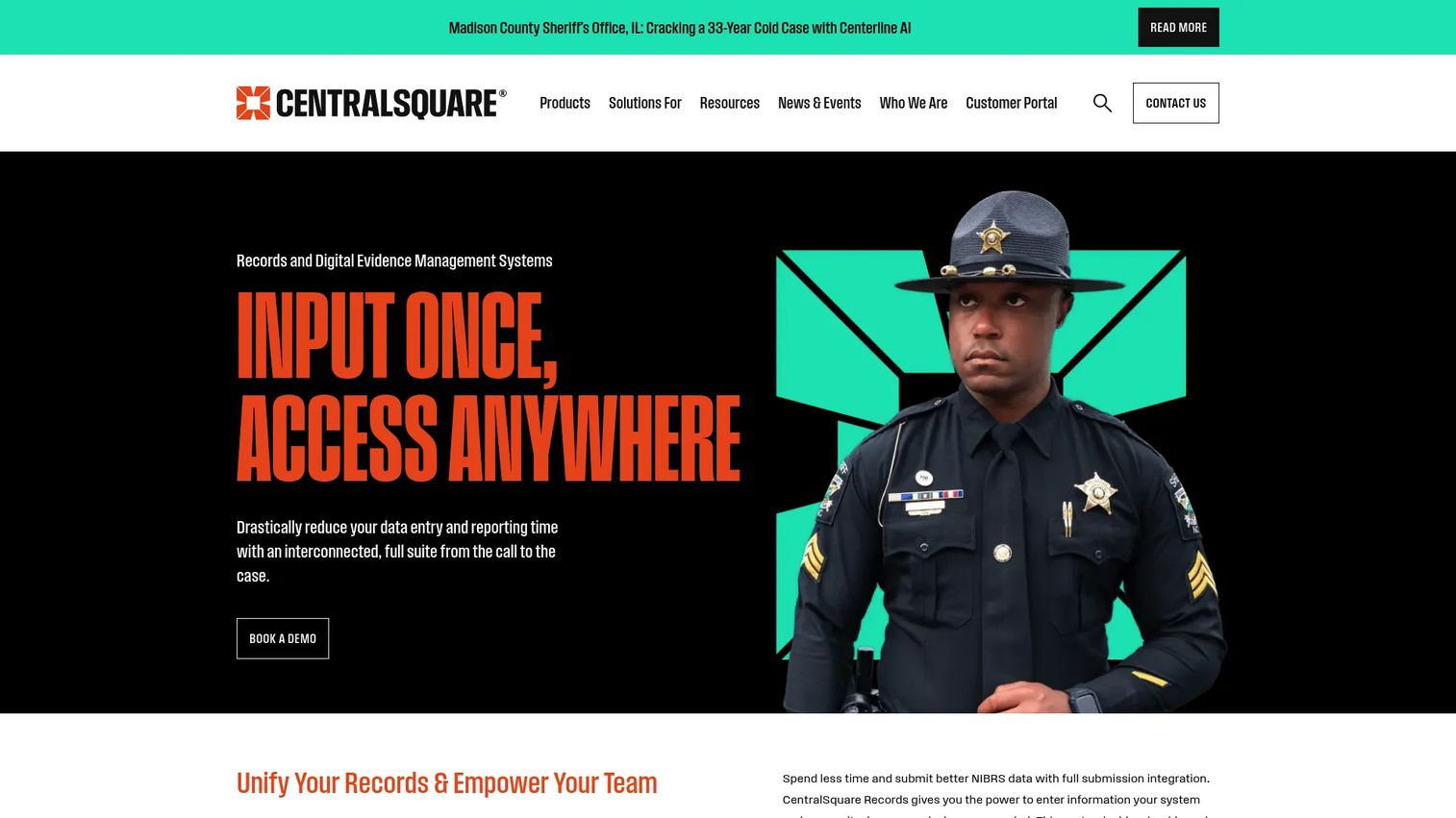
CentralSquare Enterprise Records Management System is a cloud-based public safety records and digital evidence platform built for agencies that want a full records stack rather than a collection of point tools. It connects records management with evidence handling so an officer's report, the attached digital evidence, and the case file live together instead of in separate systems.
Best for: Public safety agencies that need integrated RMS and digital evidence workflows in one platform.
Key strengths
- Interconnected records: A master index reduces duplicate data entry and cuts reporting time across incident, arrest, and case records.
- Digital evidence management: Evidence stays synchronized with CAD and Records, so chain of custody follows the case without manual reconciliation.
- Configurable reporting: Custom fields, forms, modules, dashboards, and a built-in report generator let agencies shape outputs to their own workflows.
Why choose CentralSquare: The platform fits agencies that want a mature, integrated public safety system rather than stitching records and evidence together from separate vendors. The pairing of records with digital evidence is the differentiator here, and the configurability means a mid-sized department and a large multi-jurisdiction agency can both shape it to their reporting requirements. Larger deployments are worth scoping carefully, since integrated platforms reward agencies that plan their data migration and module rollout up front.
CentralSquare pricing: CentralSquare does not publish a public price. The RMS is sold through a contact-sales and demo process, so agencies receive a quote based on modules, agency size, and deployment scope. On G2, the CentralSquare Technologies seller profile carries a 4.0/5 rating.
2. Axon Records
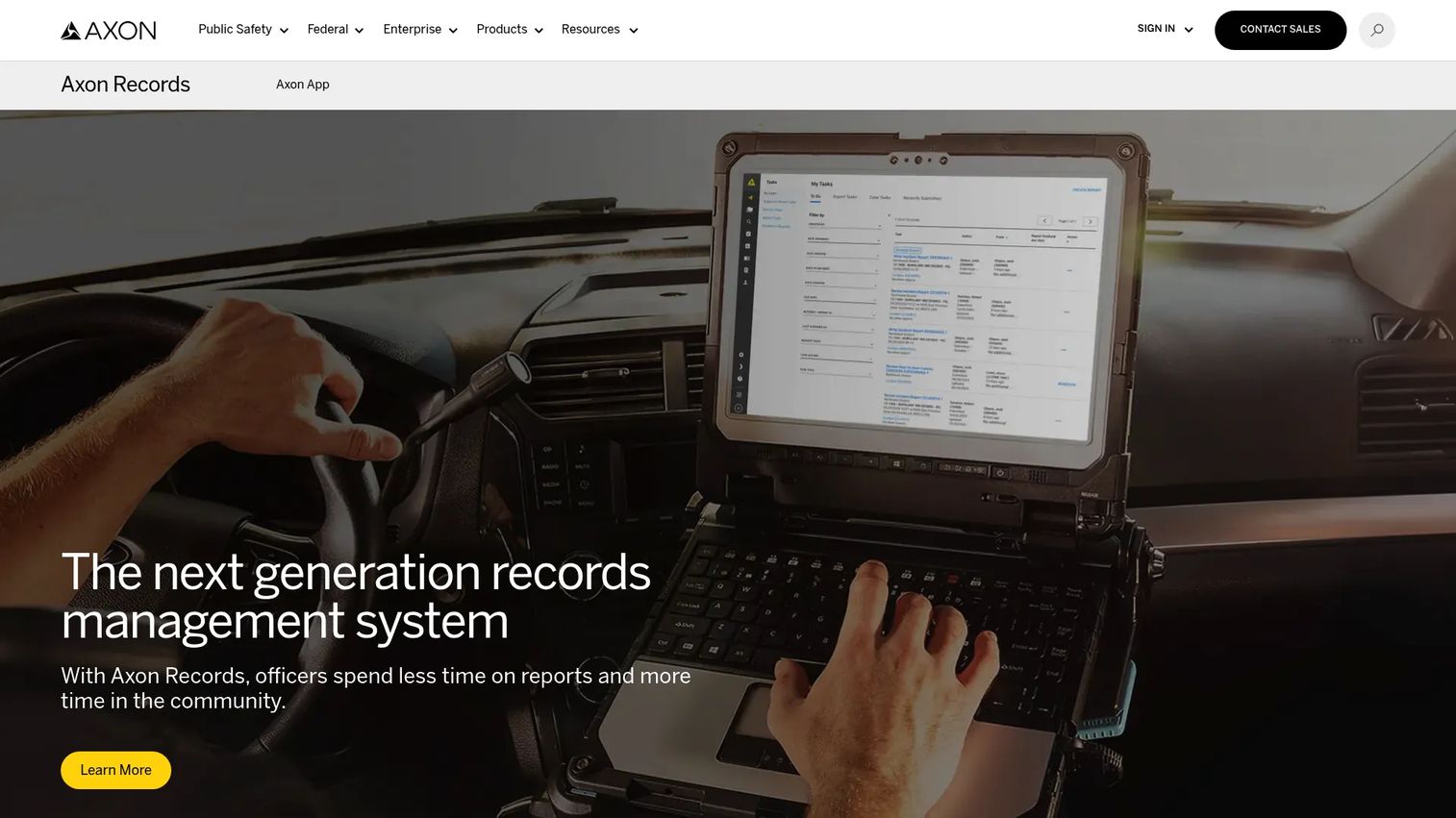
Axon Records is a cloud-native records management system that unifies reporting, evidence, and workflows for law enforcement. Its clearest advantage shows up at agencies already using Axon hardware and Axon Evidence, where records and digital evidence connect natively instead of through a bolt-on integration.
Best for: Agencies that want records tightly coupled to an existing Axon evidence ecosystem.
Key strengths
- Dynamic report writing: Customizable templates and forms speed report creation and keep formatting consistent across officers.
- NIBRS-ready compliance: Built-in NIBRS-compliant fields and validation catch errors at entry rather than at submission.
- Native evidence integration: Direct connection to Axon Evidence links body camera footage and digital files to the record automatically.
Why choose Axon Records: For agencies that value platform cohesion, the value is in the ecosystem. When records, evidence, and devices share one vendor, officers spend less time moving files between systems and more time on the report itself. Configurable workflows, user groups, and modules let the agency adapt the system to its structure rather than the reverse.
Axon Records pricing: Axon does not display a public price and directs agencies to contact its team for pricing programs and plans. Quotes typically reflect the broader Axon ecosystem an agency is adopting, so records pricing often sits alongside evidence and device programs.
3. Mark43 RMS
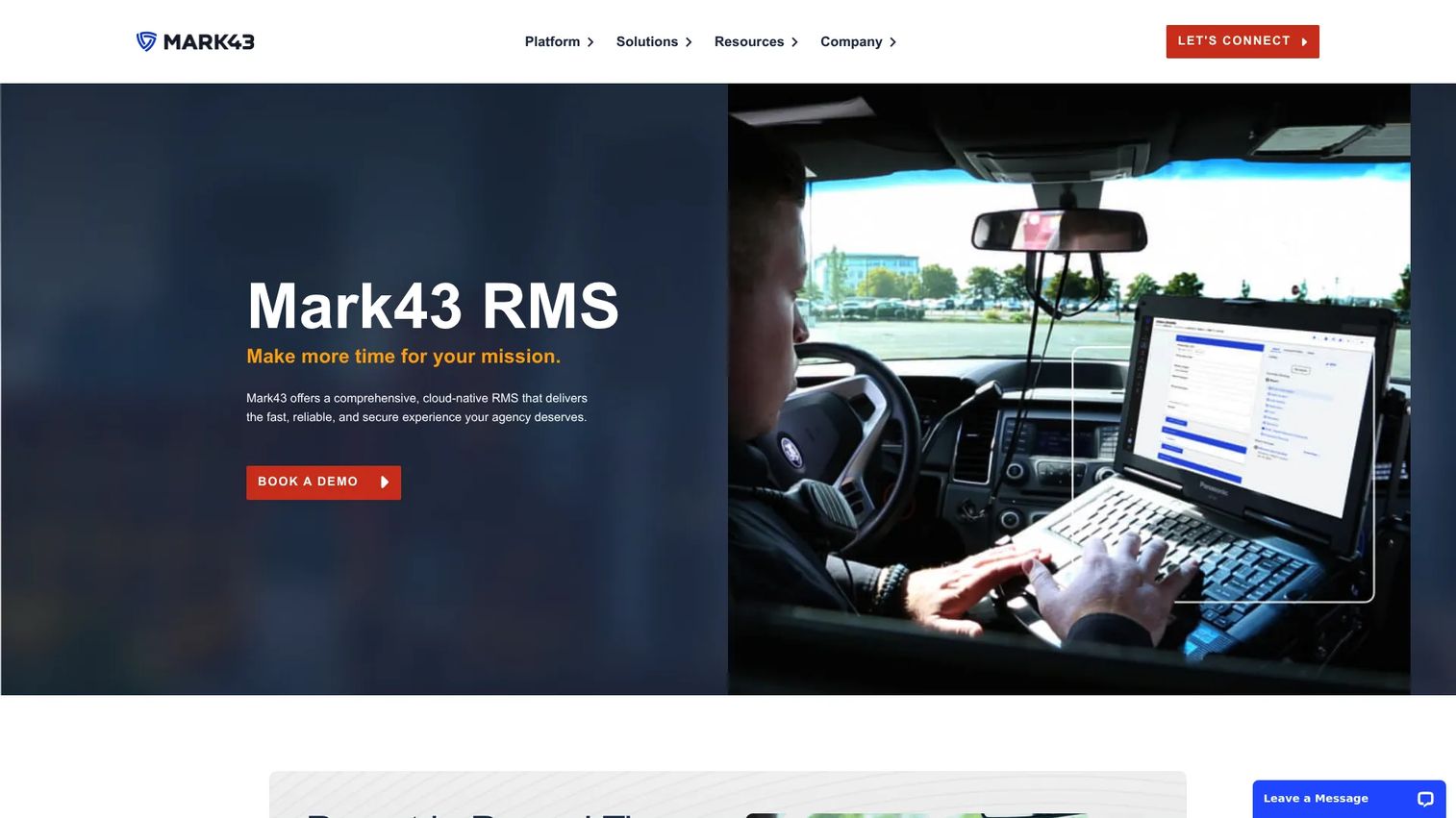
Mark43 RMS is a cloud-native records management system built for agencies moving off legacy on-prem software. It centers on modern report writing, case management, and investigations, with a usability focus that helps departments shorten training time and drive faster adoption.
Best for: Law enforcement agencies modernizing legacy workflows with a cloud-based RMS.
Key strengths
- Report writing with validation: Error validation at the point of entry keeps records clean before they reach reporting.
- Case management and investigations: Linked cases and investigative workflows keep follow-up organized across a case's life.
- Property and evidence management: Evidence and property records stay tied to their originating incident and case.
Why choose Mark43: Modernization is the trigger, and Mark43's cloud architecture removes the maintenance overhead of aging on-prem servers. Agencies that prioritize a clean interface and fast officer adoption tend to gravitate here, since a system officers actually use in the field returns more complete data. Mark43 has also referenced an RMS Essentials offering aimed at agencies with 50 or fewer sworn personnel, signaling a path for smaller departments as well.
Mark43 pricing: Mark43 does not publish public pricing and directs agencies to book a demo for a quote. Pricing reflects agency size, module selection, and deployment scope, consistent with the quote-based norm across enterprise public safety RMS.
4. Versaterm RMS
Versaterm RMS is an enterprise-level public safety records management system built for mission-critical operations. Its strength is proximity to the broader public safety stack, with records that connect to CAD and mobile so data moves across dispatch, the field, and the desk without re-entry.
Best for: Public safety agencies that want RMS integrated with CAD and mobile workflows.
Key strengths
- Role-based records workflow: Seamless data entry, potent searches, and role-based functionality match access to job function.
- Deep network interoperability: Bi-directional integration with NCIC/CPIC, NLETS, and state networks keeps queries and records synchronized with external systems.
- Compliance support: NIBRS and UCR2 compliance support helps agencies meet reporting mandates.
Why choose Versaterm: Agencies looking to unify systems rather than run RMS in isolation are the core fit. The bi-directional connections to state and federal networks matter for departments that live in NCIC and NLETS queries daily. In multi-department environments, having records sit close to CAD and mobile reduces the hand-off friction that slows investigations.
Versaterm pricing: Versaterm does not publish public first-party pricing and sells through a quote and contact process. On G2, the Versaterm seller profile shows a 3.2/5 rating.
5. PremierOne Records
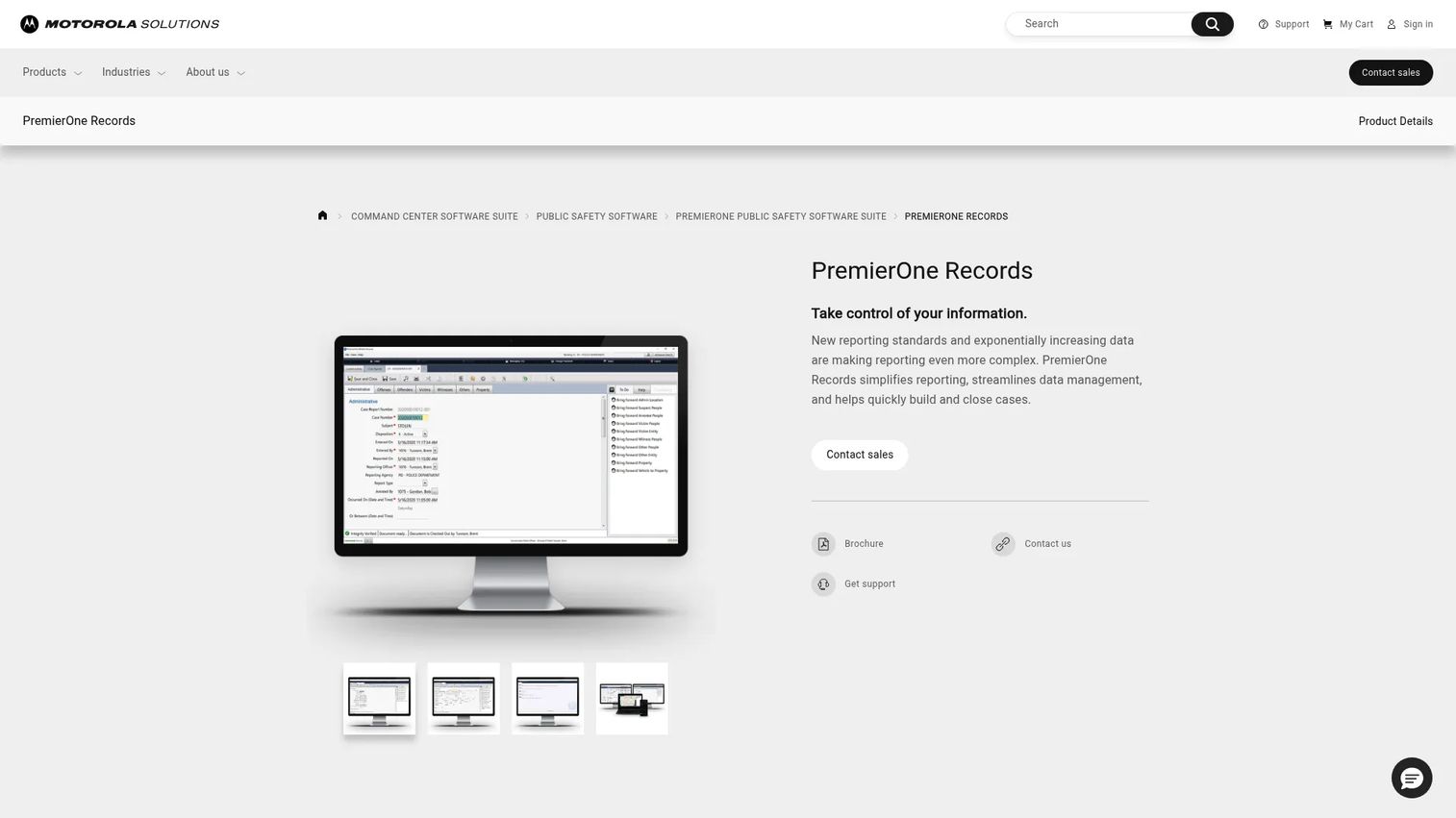
PremierOne Records is Motorola Solutions' public safety records software for managing, organizing, and closing cases. It is built to prefill reports with CAD data and support real-time collaboration, which appeals to agencies already invested in the broader Motorola public safety stack.
Best for: Public safety agencies wanting a configurable RMS within a familiar enterprise ecosystem.
Key strengths
- CAD data prefill: Reports prepopulate with CAD data, cutting redundant entry between dispatch and records.
- Real-time collaboration: Multiple users can collaborate on reports at once, speeding multi-officer incident documentation.
- In-line compliance validation: IBR compliance is validated in real time so errors surface as reports are written.
Why choose PremierOne Records: The system suits agencies that value vendor consolidation and want records aligned with an established enterprise public safety platform. Prefilling from CAD and validating compliance as officers type removes two common sources of delay and error. For departments already running Motorola infrastructure, the ecosystem alignment shortens the path from incident to closed case.
PremierOne Records pricing: Motorola Solutions does not display public pricing and directs agencies to contact sales or request information. Quotes reflect the modules and agency scale involved, consistent with enterprise public safety procurement.
6. Oracle Public Safety Records Management System
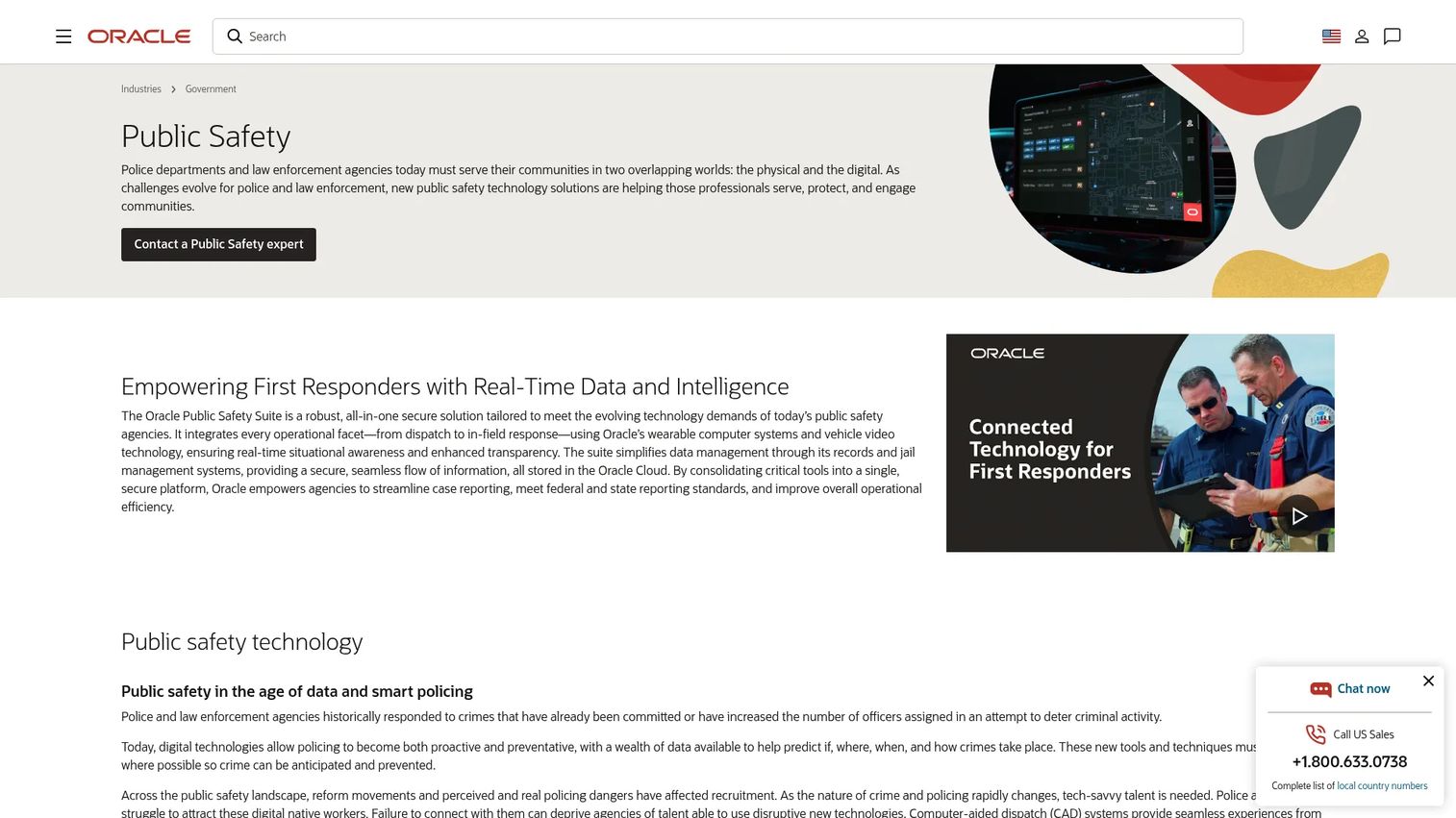
Oracle Public Safety Records Management System is Oracle's cloud-based RMS for public safety agencies managing crime reports, evidence, and investigative records. It brings Oracle's enterprise data and governance heritage to records, which appeals to larger agencies and municipalities with complex IT requirements.
Best for: Larger agencies or municipalities with complex integration and governance needs.
Key strengths
- Full records lifecycle: Entry, storage, retrieval, viewing, and archiving of public safety records in one governed system.
- Case management: Case creation and management for crime reports keeps investigations structured.
- Public safety integration: Connections to Dispatch Command Center, Vehicle Communications, and Personal Communications systems tie records to field operations.
Why choose Oracle: Oracle fits buyers who need large-scale platform alignment and enterprise-grade data governance more than a lightweight standalone RMS. Agencies already standardized on Oracle infrastructure gain a records system that speaks the same data language as the rest of their stack. For complex municipalities, the governance and archiving depth is the draw.
Oracle pricing: Oracle does not publish public pricing for this product family and uses a sales-contact and quote-based model. Pricing reflects the scale and integration scope typical of enterprise public safety deployments.
7. CrimeStar RMS
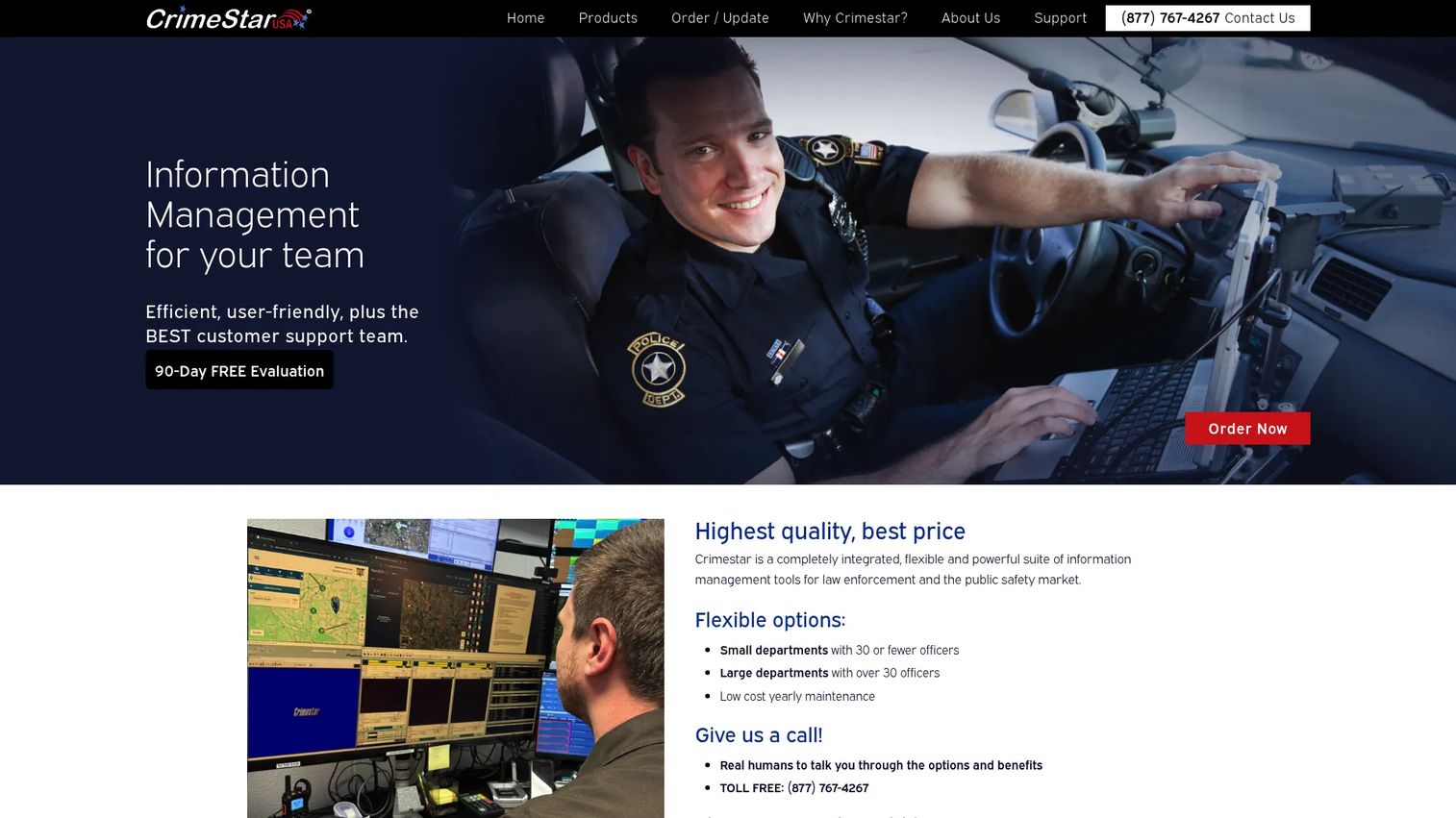
CrimeStar RMS is law enforcement records management software for agencies that want RMS, CAD, web, and mobile public safety tools without an enterprise price tag. It is one of the few platforms in this category with transparent, published license pricing, which makes budgeting straightforward for smaller departments.
Best for: Small to mid-sized law enforcement agencies needing a configurable RMS suite.
Key strengths
- Integrated records modules: Records management with integrated modules covers core workflows without add-on sprawl.
- Comprehensive search: Searches across people, vehicles, locations, property, and documents surface connections quickly.
- Deep reporting library: More than 200 canned reports plus a custom report creator cover most command and compliance needs out of the box.
Why choose CrimeStar: Simplicity and transparent pricing are the draw. Agencies that want core records coverage, strong search, and a deep reporting library without a lengthy enterprise procurement find CrimeStar practical. The published license model means a chief can estimate cost before a single sales call.
CrimeStar pricing: CrimeStar publishes pricing on its order page. A Records Management user license with one year of support runs $3,300 each ($2,900 one-time license plus $400 first-year support). An additional laptop/sync computer license is $1,950, a dispatch seat license is $4,650, and the web interface is $1,400, each including first-year support. Annual support renews at $400 after year one. On G2, CrimeStar RMS shows a 5.0/5 rating, though based on a single review.
8. A.L.E.I.R.
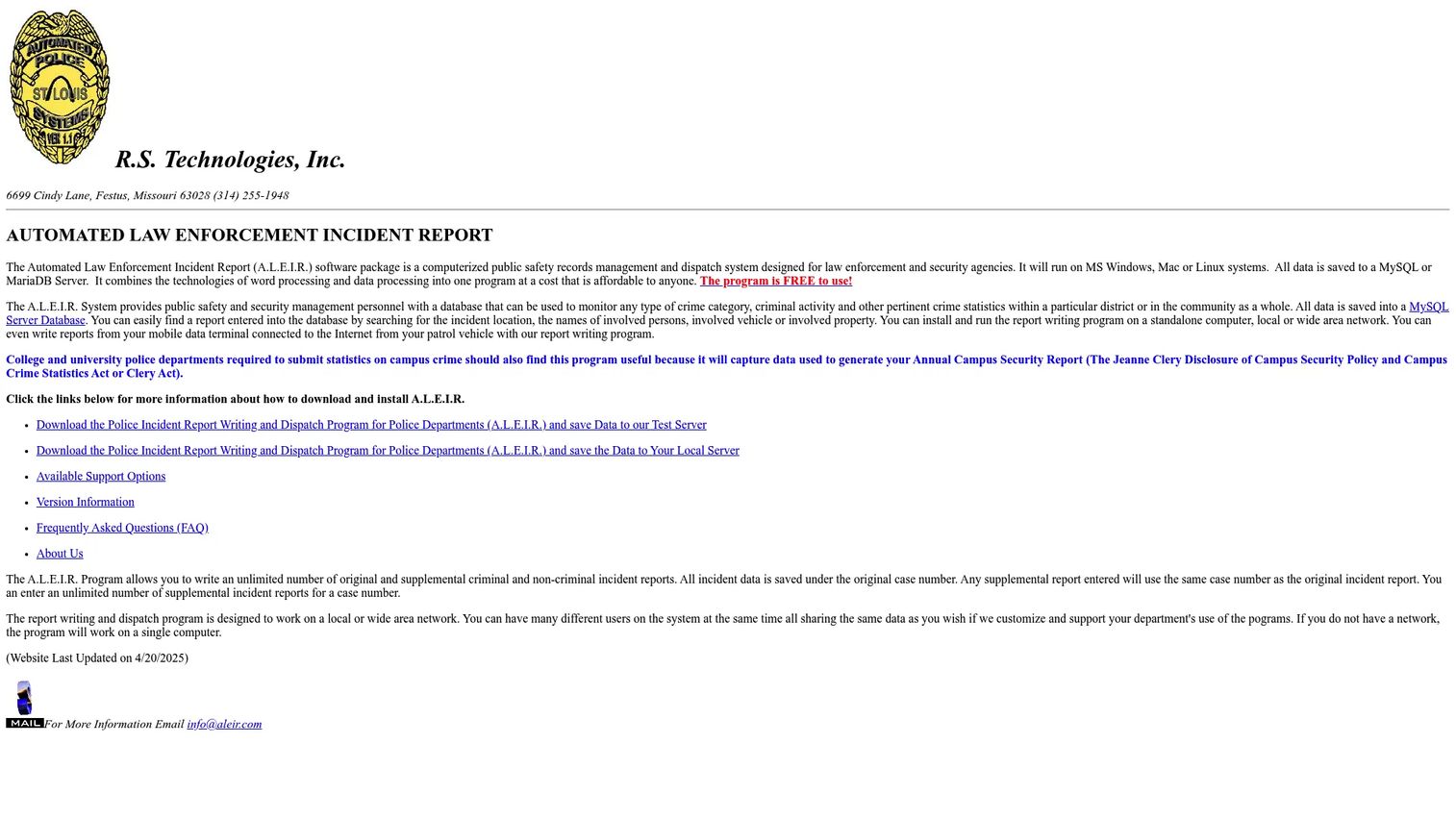
A.L.E.I.R. is computerized police records management and dispatch software for law enforcement and security agencies. It is notable for a free-to-use core product, which lowers the barrier for small agencies, volunteer departments, and specialized security teams that need incident reporting and dispatch without a capital purchase.
Best for: Small agencies or specialized teams wanting an established RMS and dispatch system.
Key strengths
- Cross-platform flexibility: Runs on Windows, Mac, or Linux, so agencies use existing hardware.
- Open data storage: Stores data in MySQL or MariaDB, giving agencies control over their own records database.
- Records plus dispatch: Includes incident reporting and computer-aided dispatch in one package.
Why choose A.L.E.I.R.: When scope is narrower and budget is tight, a free core RMS with dispatch is a practical starting point. Agencies that need direct incident and arrest records plus a dispatch link, without enterprise complexity, get an established option they can stand up on their own hardware. Paid support tiers add a safety net for agencies that want vendor backing.
A.L.E.I.R. pricing: The core software is free to use. Two paid support and customization options are published: Option II at $499 per year and Option III at $599 per year. On G2, A.L.E.I.R. carries a 4.3/5 rating.
Considerations before you choose
A demo looks good in a controlled walkthrough. Procurement is where the real questions surface. Work through these five criteria before you shortlist.
Workflow coverage
Confirm the RMS handles incident, arrest, citation, warrant, booking, and evidence/property without forcing workarounds. Ask the vendor to show a full record moving from first call to disposition. If any step requires a spreadsheet, a separate tool, or manual re-entry, that gap will cost your staff time every shift.
Interoperability
Verify bi-directional connections to CAD, NCIC, NLETS, courts, and jail systems, plus support for standards like NIEM and JXDM. An RMS that cannot query state and federal networks turns your staff into the integration layer. Ask which connections are native, which require middleware, and who maintains them.
Data quality and governance
Look for field validation, immutable audit trails, redaction, expungement, and role-based access control. In law enforcement, a record's defensibility in court depends on who touched it and when. Governance is not a nice-to-have; it is the difference between an admissible record and a challenged one.
Reporting and compliance
Make sure the system supports NIBRS and UCR workflows with validation at entry, not after submission. Command staff need crime-analysis outputs they can act on, not raw exports they have to rebuild. Ask to see the actual reports leadership will use weekly.
Adoption and usability
Confirm that officers in the field and records staff at the desk can work in the system quickly. A powerful RMS that officers avoid produces incomplete data. Field usability and short training time are not soft criteria; they determine whether the records you rely on are complete.
Choosing the right RMS for your agency
The right police records management system depends on your workflow depth, interoperability requirements, and reporting mandates, not on which vendor has the loudest pitch. For medium to large agencies wanting integrated records and digital evidence, CentralSquare is the broad-fit pick. Agencies invested in Axon evidence gain the most from Axon Records. Departments modernizing off legacy on-prem systems fit Mark43, while Versaterm suits those unifying RMS with CAD and mobile.
For enterprise governance and complex integration, Oracle and PremierOne Records fit larger municipalities. And for small or budget-conscious agencies, CrimeStar offers transparent license pricing while A.L.E.I.R. offers a free core product.
Move from shortlist to decision by scoping a full record lifecycle demo, verifying interoperability with your existing CAD and state networks, and pressure-testing NIBRS reporting against your real submission requirements. The agency that walks into procurement with those three questions answered buys the right system the first time.
FAQs
Police records management software captures, connects, and reports on law enforcement records across the incident-to-disposition lifecycle. It links incidents, arrests, citations, warrants, bookings, and evidence to a master index so data entered once appears everywhere it is relevant. That removes duplicate entry, speeds retrieval, and gives command staff a single, defensible view of agency activity.
CAD (computer-aided dispatch) handles the real-time side of policing: taking calls, dispatching units, and tracking active incidents as they happen. An RMS handles the record that results, storing and connecting reports, arrests, evidence, and case files after the fact. The two work best when integrated, so CAD data prefills the RMS record and staff never re-enter the same information twice.
A capable RMS should manage incidents and cases, arrest and booking records, citations, warrants, and evidence and property with chain of custody. It should also handle master indexes for people, vehicles, locations, and property so records cross-reference automatically. Reporting, audit trails, and access control round out what a full law enforcement records management system covers.
A strong RMS validates NIBRS and UCR fields at the point of entry, catching errors before a submission is built rather than after it bounces back. It maps incident and offense data to the required NIBRS structure and generates the export automatically. That turns NIBRS compliance from a manual cleanup task into clean reporting on the first pass.
The highest-value integrations are CAD for incident prefill, NCIC and NLETS for state and federal queries, and courts and jail systems for downstream case flow. Standards support like NIEM and JXDM matters for data sharing across the justice ecosystem. Prioritize native, bi-directional connections over middleware that adds a maintenance burden.
Agencies rely on the RMS to keep immutable audit trails that log who accessed or changed each record and when. Redaction tools remove sensitive information before records are released, and expungement workflows seal or delete records when the law requires it. Role-based access control ties all three together, ensuring only authorized staff touch sensitive records.
Small departments should prioritize transparent pricing, fast setup, and core workflow coverage without enterprise complexity. Look for incident, arrest, citation, and evidence handling plus a solid reporting library and NIBRS support. Options with published pricing or a free core product let a smaller agency budget accurately and stand up the system without a lengthy procurement.
County and multi-jurisdiction agencies should prioritize deep interoperability, strong data governance, and a shared master index across agencies. The system needs bi-directional CAD, NCIC, court, and jail connections plus role-based access that spans departments. Reporting and audit depth become critical at scale, so command staff can see clean, cross-jurisdictional activity without manual consolidation.