You hired a contractor last quarter through your personal network. Three weeks in, you realized they misunderstood the brief entirely. Fixing it cost you more leadership time than just doing it yourself would have.
That pattern is expensive at Series B. Your team needs senior output before the headcount plan catches up, and the wrong freelance hire costs more than the invoice because it consumes VP hours your company cannot spare. According to the Upwork Research Institute (2025), 28% of U.S. skilled knowledge workers now work as freelancers or independent professionals, which means the talent is out there. The question is which platform routes you to the right kind, with the right infrastructure for payment protection, vetting, and repeat hiring.
This guide maps 15 freelance platforms across marketplaces, job boards, portfolio networks, and professional networks. It tells you which fits a one-off sprint, which supports a contractor bench, and which gives a new VP capacity on day one without routing every hire through the founder.
What's inside
This guide compares 15 freelance platforms for 2026, covering marketplaces, job boards, portfolio networks, and professional networks.
- Who it's for: Founders, operators, and hiring managers comparing platform fit; freelancers evaluating where to build a client base
- How platforms were chosen: Marketplace depth, use-case fit, payment model, and trust signals
- What you'll compare: Fees, vetting, payment protection, client quality, and platform type
- How to use it: Start with the TL;DR, then use the comparison table to shortlist by work type
TL;DR
- Best overall for SaaS hiring: Upwork covers broad categories, repeat hiring, escrow, and business controls in one marketplace
- Best for packaged services: Fiverr works when the task is well-defined and the turnaround needs to be fast
- Best for vetted senior talent: Toptal reduces screening burden for high-stakes roles where weak matching wastes executive time
- Best for design work: 99designs for contested creative briefs, Dribbble and Behance for portfolio-led discovery
- Best for remote freelance roles: FlexJobs and We Work Remotely function as curated job boards for ongoing contract work
- Best direct-access route: Contra and Jobbers suit founders willing to own more of the contract and payment process
What are freelance platforms?
Freelance platforms are online services that connect clients with independent workers and help freelancers find paid projects, contract roles, or service buyers. The global freelance platforms market reached $6.4 billion in 2025 and is projected to hit $24.2 billion by 2033, according to Grand View Research (2026). That growth reflects a structural shift: 52% of surveyed companies reported their use of freelancers increased over the previous three years, per Remote (2025).
Four distinct platform types exist, and matching the type to the work is the first decision.
Marketplace platforms: Upwork, Fiverr, Freelancer.com, Guru, PeoplePerHour, and Jobbers fall here. A client posts a job or buys a service. Freelancers apply, bid, or list packages. The platform handles messaging, contracts, escrow, and payments. Marketplaces work well for operationally simple hiring and repeatable contractor sourcing.
Curated talent platforms: Toptal screens candidates before matching. The cost runs higher, but the screening burden on your team drops significantly. Better for senior roles where a weak hire burns more than the platform fee.
Job boards and professional networks: FlexJobs, We Work Remotely, LinkedIn, and SimplyHired distribute opportunities rather than manage the full hiring cycle. Your team owns screening, contracts, and payment. Better for ongoing contract roles and remote freelance work where you want a proper job description process.
Portfolio and creative networks: Behance, Dribbble, and 99designs lead with visual proof. Strong for design, branding, illustration, and motion work. Portfolio quality filters candidates before you ever send a message.
Key features to look for
- Escrow or payment protection
- Freelancer vetting and identity verification
- Transparent fees for both buyers and sellers
- Portfolio depth and review history
- Search filters by skill, rate, and availability
- Milestone payments and dispute support
- Client quality and project volume on the platform
When to use freelance platforms
Hire for a project before adding headcount
A freelance platform covers a discrete capacity gap without burning runway on a full-time salary. Launch design, technical writing, outbound list building, RevOps cleanup, and Webflow development all fit this model. Bringing in a contractor first also validates whether the role needs to exist permanently before you commit to a hire.
Find specialist skills your team does not need every week
Localization, data migration, SEO audits, analytics instrumentation, legal ops support, and motion design are examples of expertise that would sit idle 80% of the time on a full-time contract. Freelance platforms give you access to senior specialists on demand without building a function around a quarterly need.
Build a contractor bench before the next bottleneck
Reactive hiring costs more than planned sourcing. Test two or three contractors for recurring needs before urgency hits. A new VP of Marketing who joins and immediately has three reliable freelancers available looks like a founder who planned ahead. That capacity is one of the most tangible things you can hand off.
Freelance platforms comparison
The table below covers all 15 platforms with verified pricing and G2 ratings. Pricing reflects what clients pay at entry level. For platforms with freelancer-side fees or subscription tiers, see the individual sections. G2 ratings are listed where a verified listing exists; N/A indicates no confirmed rating at time of writing.
| # | Product | Best for | Key differentiator | Pricing | G2 rating |
|---|---|---|---|---|---|
| 1 | Upwork | Broad SaaS contractor hiring | Large marketplace with escrow and business controls | Free to post; service fees apply | 4.5/5 |
| 2 | Fiverr | Packaged services and quick tasks | Service catalog with clear deliverables | Free to browse; Pro Advanced $129/mo | 4.3/5 |
| 3 | Toptal | Vetted senior specialists | Screened matching for high-stakes roles | $79/mo platform fee; talent rates separate | 4.7/5 |
| 4 | Freelancer.com | Competitive bidding | Large global pool with milestone payments | Free tier; paid from $4.50/mo | 4.2/5 |
| 5 | PeoplePerHour | Project-based freelance work | Hourly and fixed-price with escrow protection | Free to join; freelancer fees apply | 4.1/5 |
| 6 | Guru | Flexible contracts and collaboration | WorkRooms with milestone and multi-payment options | Free posting; freelancer fee as low as 5% | 4.7/5 |
| 7 | Contra | Portfolio-led independent talent | Commission-free payments, direct client relationships | Free; Pro $29/mo or $199/yr | 4.9/5 |
| 8 | FlexJobs | Vetted remote and flexible roles | Screened job board with scam-reduction focus | From $2.95 for 14-day trial | 4.5/5 |
| 9 | We Work Remotely | Remote contract hiring | Remote-first board with strong tech audience | Free basic; Pro from $14.95/mo | 2.0/5 |
| 10 | Network-based freelance discovery | Profiles, referrals, and job posts in one network | Free basic; Premium from $89.99/mo | 4.4/5 | |
| 11 | Behance | Creative portfolio discovery | Visual portfolio network in the Adobe ecosystem | Free; Pro $9.99/mo | N/A |
| 12 | Dribbble | Design talent and hiring | Designer portfolio network with job board | Free; paid designer plans from $4/mo | 4.2/5 |
| 13 | 99designs | Design contests and brand work | Contest model for comparing multiple directions | Bronze from $249 per project | 4.0/5 |
| 14 | SimplyHired | Broad contract role discovery | Job aggregation with salary estimator | Free to search; employer pricing varies | 3.4/5 |
| 15 | Jobbers | Direct communication, low commissions | Commission-free transactions with direct payment | Free to post; visibility plans from $3/mo | N/A |
Best 15 freelance platforms for 2026
1. Upwork
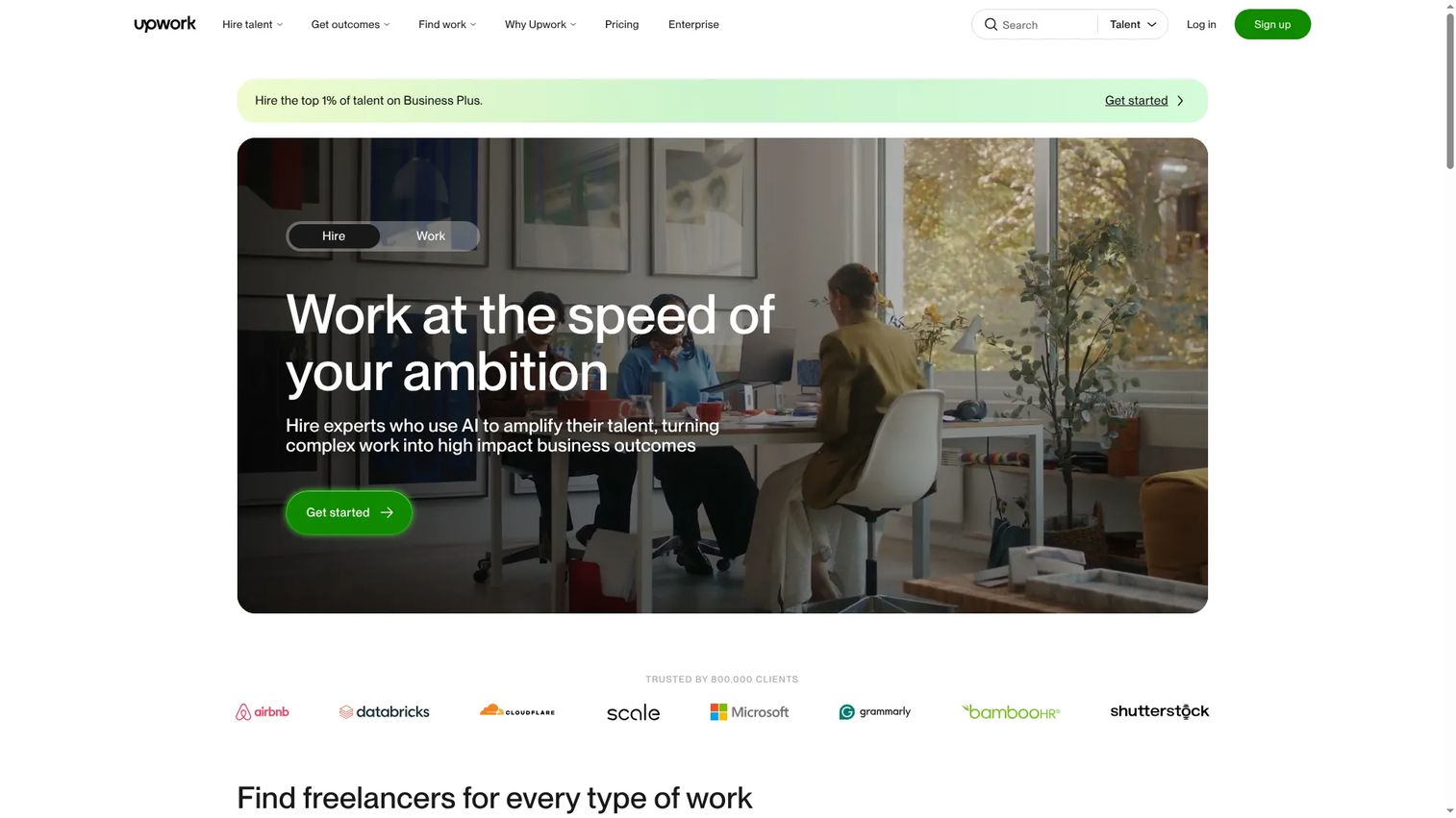
Upwork is the largest global freelancing marketplace, connecting businesses with independent professionals across engineering, design, marketing, customer support, finance, admin, and more. Clients can post jobs, invite talent, or browse the Project Catalog for predefined services. Escrow-protected contracts and milestone payments reduce payment risk on both sides.
Best for: Founders who want a single marketplace for repeat contractor hiring across departments without switching platforms by role type.
Key features
- Escrow payment protection for hourly and fixed-price contracts
- Project Catalog for predefined service packages
- Talent search with filters for skill, rate, and availability
- Business hiring controls for team-level management
- AI-powered Uma tools for matching and project scoping
Why choose Upwork: It is the default starting point when your team needs optionality across roles. The depth of supply means you can source a technical writer, a demand gen contractor, and a Webflow developer from the same platform. Tight briefs matter here because a broad marketplace produces noisy applicant pools without them.
Upwork pricing: Free to create an account and post jobs. Freelancer service fees range from 0% to 15% per contract. Freelancer Plus runs $19.99/month for added Connects and proposal insights.
G2 rating: 4.5/5
2. Fiverr
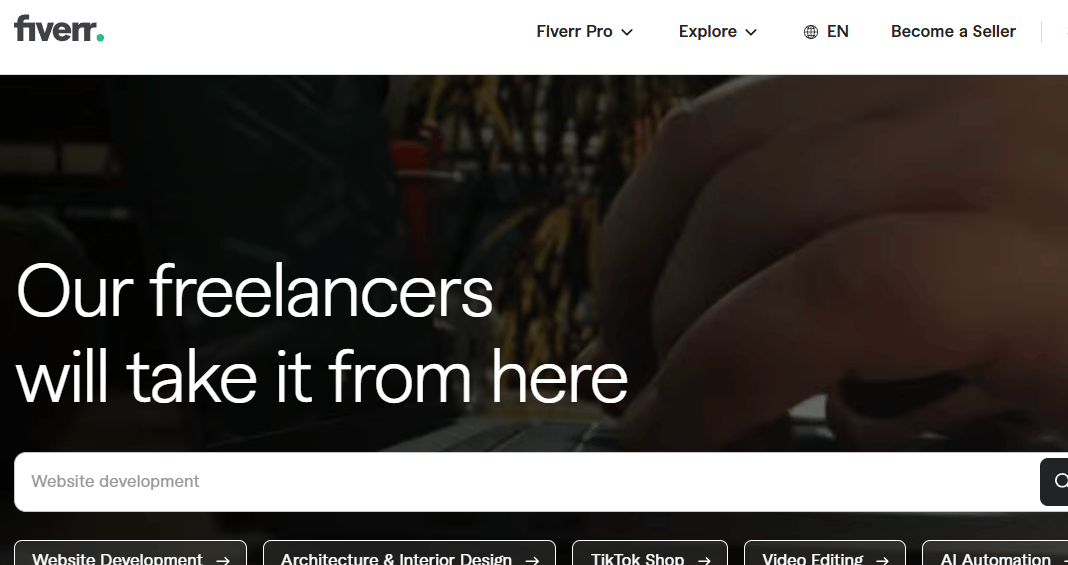
Fiverr is a global service marketplace where freelancers list fixed-price packages and buyers purchase them directly without posting a job. Packages come with clear deliverables, timelines, and seller ratings. Fiverr Pro surfaces a vetted layer of higher-end talent for more complex work.
Best for: Teams buying well-defined services where the brief is clear and turnaround speed matters more than deep collaboration.
Key features
- Service catalog with fixed-price packages and clear deliverables
- Seller tiers and reviews for quality filtering
- Fiverr Pro for vetted, premium service providers
- Marketplace payment protection for buyers
- Business account for team ordering and approvals
Why choose Fiverr: Use it when the task is productized and you want to compare options fast. A landing page hero image, explainer edit, voiceover, or basic automation runs well here. For open-ended strategic work where scope changes frequently, a marketplace with proposal-based hiring gives more flexibility.
Fiverr pricing: Browsing is free. Fiverr Pro Advanced runs $129/month, giving access to enhanced Pro talent, team invoicing, and priority support. Enterprise pricing is custom. Individual service package prices are set by sellers.
G2 rating: 4.3/5
3. Toptal
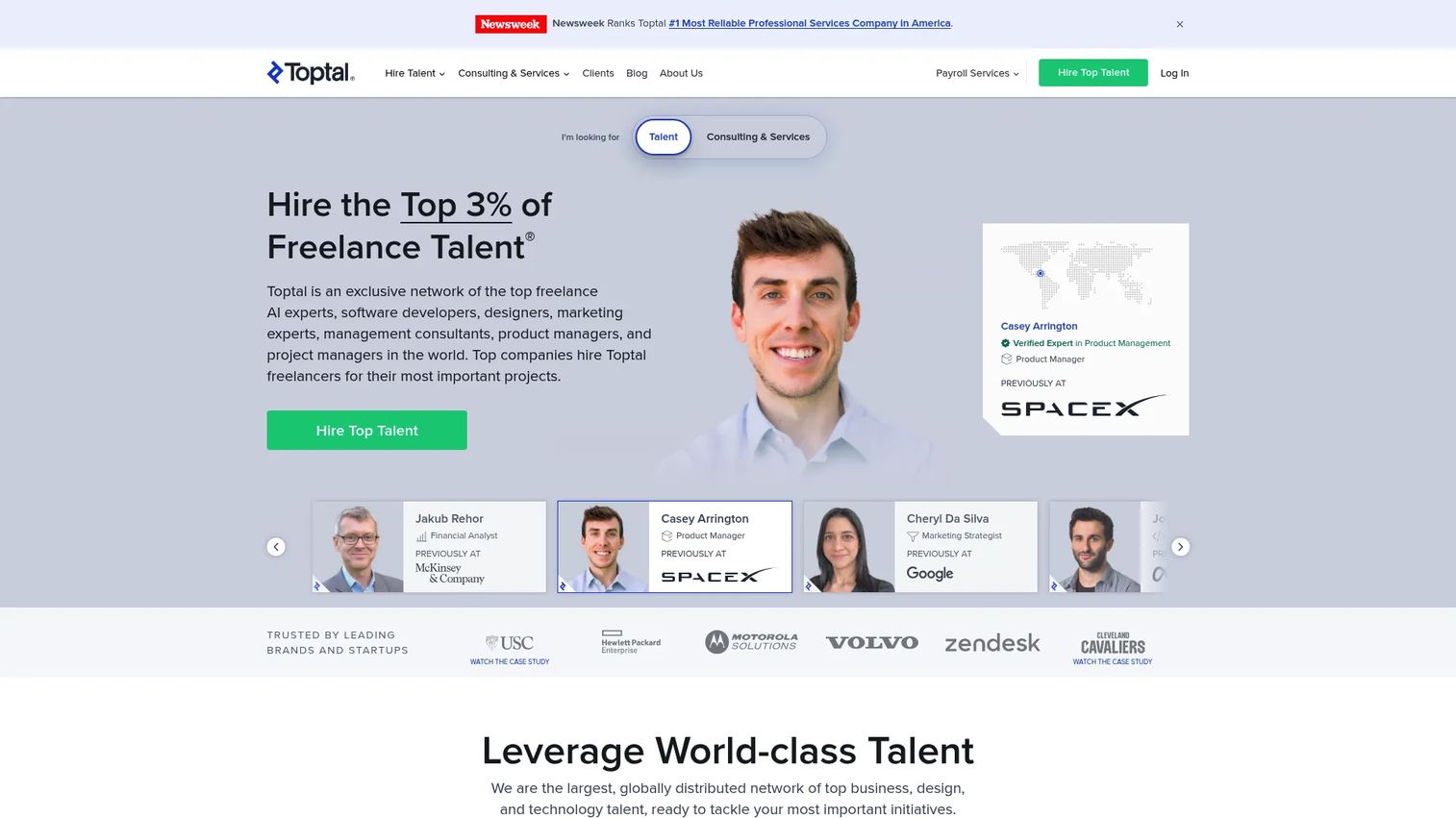
Toptal connects businesses with rigorously screened freelance and consulting professionals across software engineering, product management, design, finance, and strategy. The platform claims to accept only the top 3% of applicants. Matching is handled by Toptal staff, not by open bidding, which reduces the time a founder or VP spends evaluating candidates.
Best for: High-stakes contract work where a weak screening process would consume executive time and where senior-level output is non-negotiable.
Key features
- Pre-screened talent network across tech, design, finance, and strategy
- Staff-led matching based on project requirements
- Hourly, part-time, and full-time engagement models
- No-risk trial period at the start of each engagement
- Cross-functional team assembly for multi-role projects
Why choose Toptal: When the role is critical and your VP does not have bandwidth to interview 15 candidates, Toptal's screening process does that work for you. The cost is higher than open marketplaces, but the time saved on bad interviews is the actual ROI case.
Toptal pricing: A $79/month platform subscription applies when you proceed with talent matching. Individual talent engagement rates are set separately through the matching process.
G2 rating: 4.7/5
4. Freelancer.com
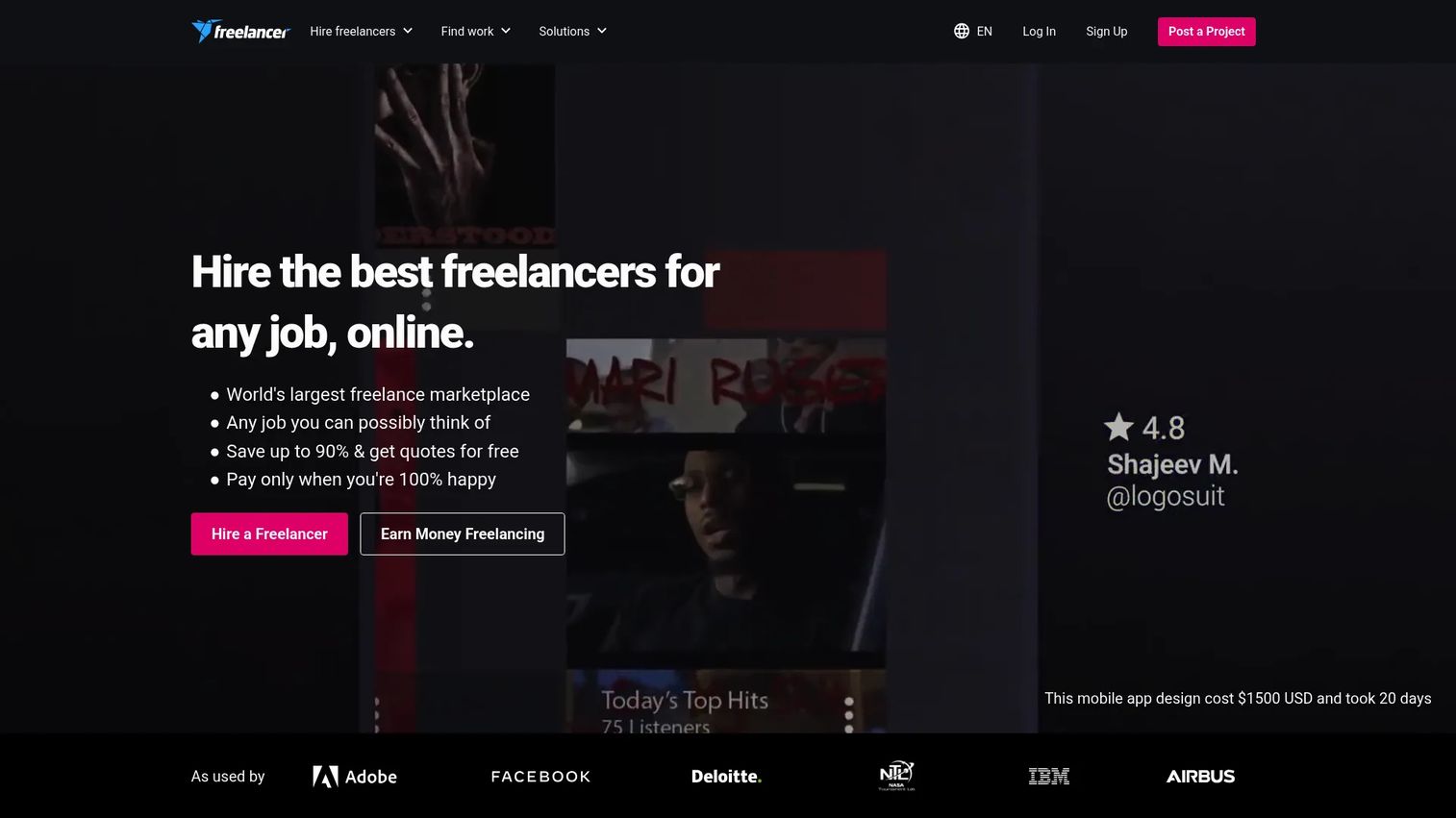
Freelancer.com is a broad global marketplace built around project posting and competitive bidding. Clients post a project, freelancers submit proposals with pricing, and buyers select from the incoming bids. The platform also supports design contests and skill-based filtering across a large global talent pool.
Best for: Founders who want market breadth and bid comparison for well-defined projects where price discovery matters.
Key features
- Competitive bidding with proposals from a global pool
- Design and development contests for multiple submissions
- Milestone-based payments with buyer release control
- Real-time chat, file sharing, and collaboration tools
- Skill category filters and recruiter services
Why choose Freelancer.com: The bidding model surfaces pricing quickly across many freelancers at once. It suits well-specified projects where you want to compare proposals before committing. Brief quality and screening discipline matter because a vague post attracts speculative bids from every corner of the globe.
Freelancer.com pricing: A free membership tier is available. Paid plans start at $4.50/month (Basic, billed annually at $54) and $9.99/month (Plus, billed monthly with a one-month free trial).
G2 rating: 4.2/5
5. PeoplePerHour
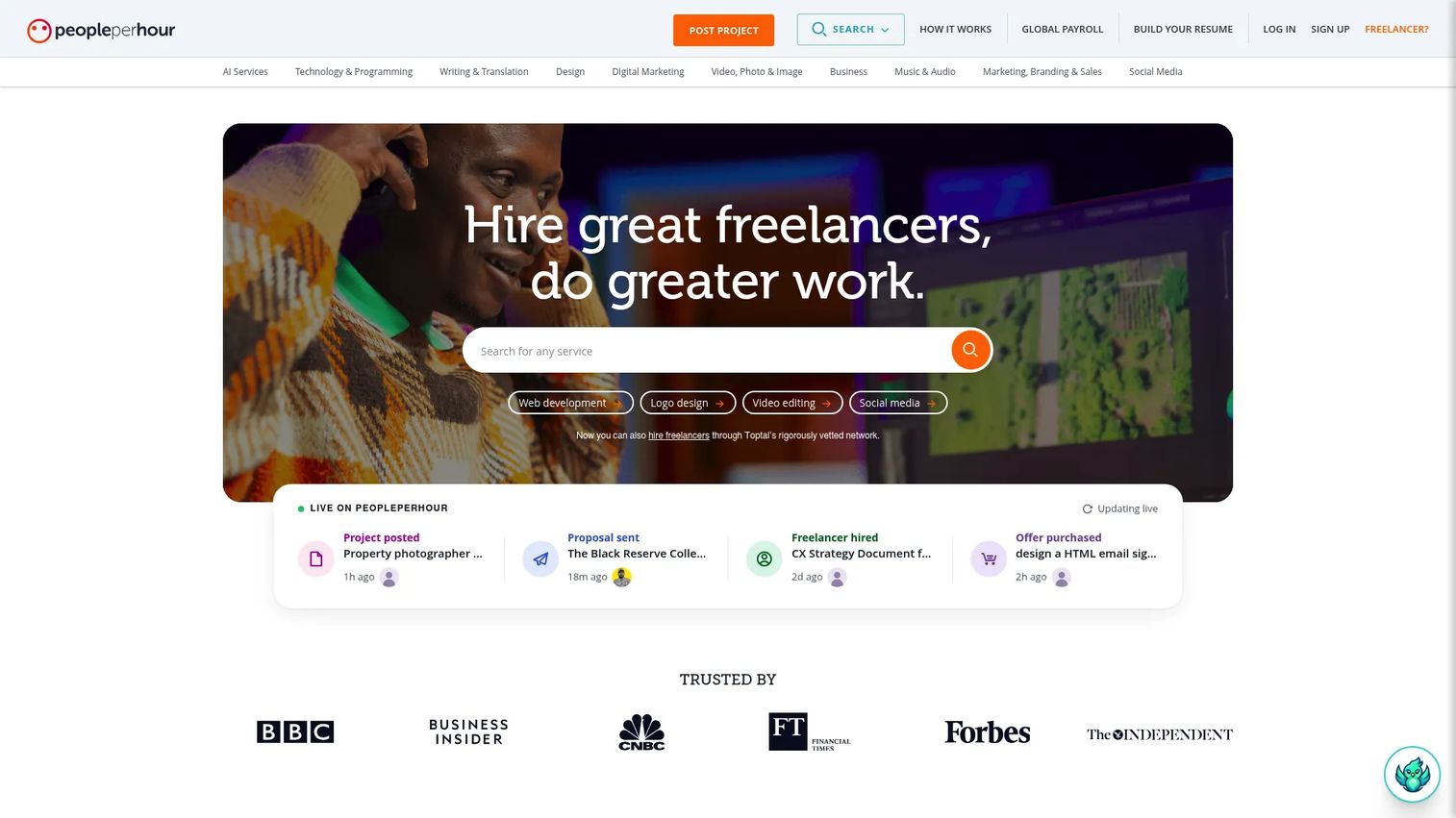
PeoplePerHour is a freelance marketplace for project-based and hourly work covering digital marketing, writing, design, development, and admin support. Freelancers list fixed-price Offers or respond to client project posts. The WorkStream tool handles messaging, file sharing, invoicing, and project management within the platform.
Best for: Operators sourcing practical freelance support for defined business tasks at a mid-range budget.
Key features
- Fixed-price Offers and project posting with freelancer proposals
- WorkStream for messaging, invoicing, and project management
- Escrow-protected payments
- Freelancer profiles with ratings and reviews
- Hourly and fixed-price contract options
Why choose PeoplePerHour: It sits between a pure service catalog and a fully open bidding marketplace. You can browse Offers for speed or post a project for more tailored proposals. Useful for digital marketing sprints, copywriting, and operational tasks where you want more context than a gig listing but less process than a full interview.
PeoplePerHour pricing: Free to join with no upfront payments for buyers. Individual freelancer prices are set by each freelancer on their Offers and proposals.
G2 rating: 4.1/5
6. Guru
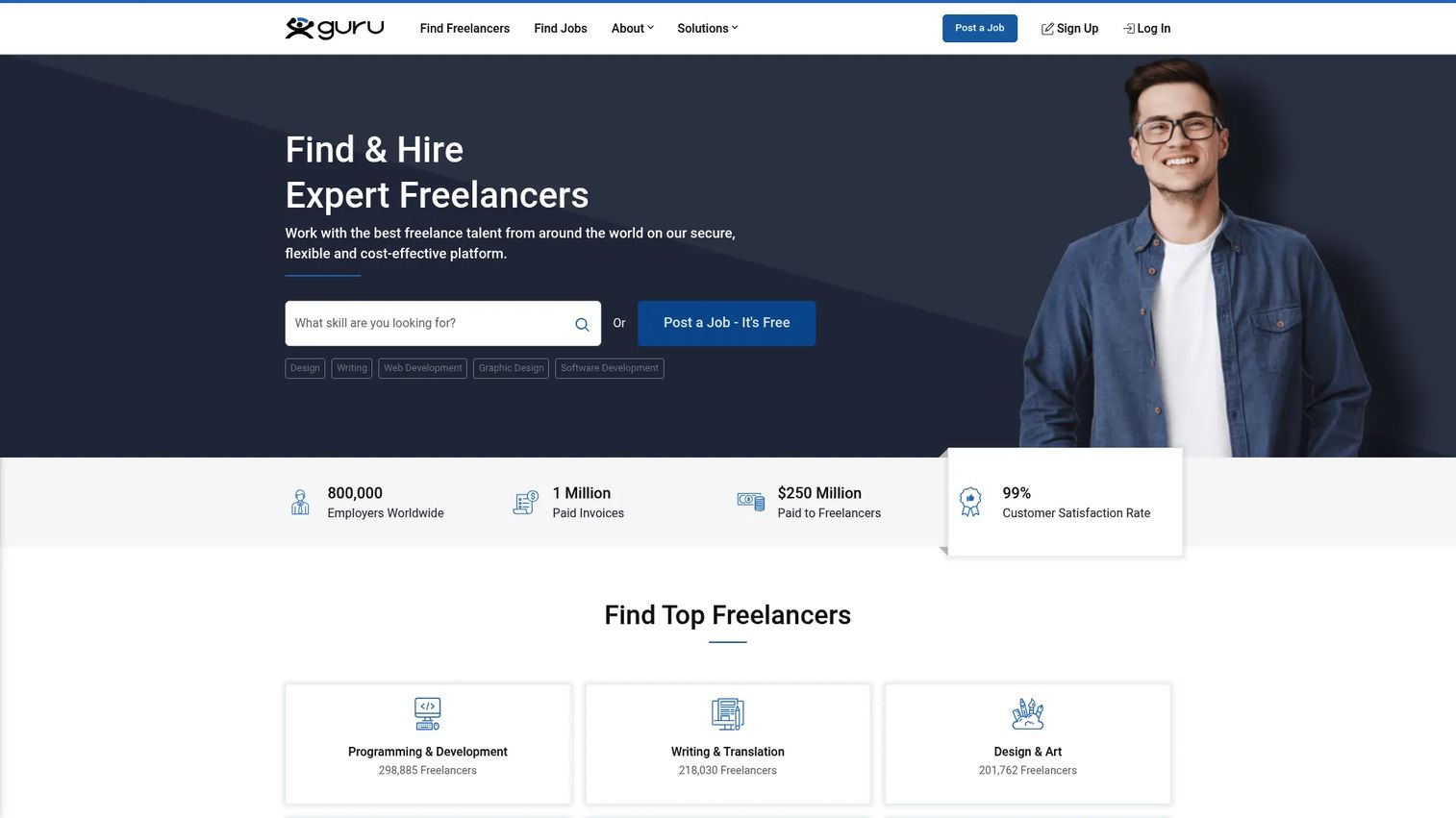
Guru is a freelance marketplace that adds collaboration infrastructure on top of standard marketplace mechanics. WorkRooms give clients and freelancers a shared project workspace for managing tasks, milestones, files, and payments. Multiple payment structures are available, including milestone-based, hourly, recurring, and task-based.
Best for: Teams that want flexible contract structures and a built-in collaboration workspace for ongoing freelance relationships.
Key features
- WorkRooms for shared project collaboration and management
- Milestone, hourly, recurring, and task-based payment options
- Quote submission and freelancer profile browsing
- SafePay escrow-protected payment system
- Broad skill categories across tech, design, writing, and admin
Why choose Guru: The WorkRoom model makes it practical for projects that span several weeks, where you want a shared space for deliverables and payments without jumping between tools. The freelancer fee can run as low as 5%, which tends to attract experienced contractors who care about take-home rate.
Guru pricing: Job posting is free for employers. Freelancer service fees start as low as 5% for high-volume relationships. Enterprise clients can negotiate a custom fee structure with no enterprise-tier fee.
G2 rating: 4.7/5
7. Contra
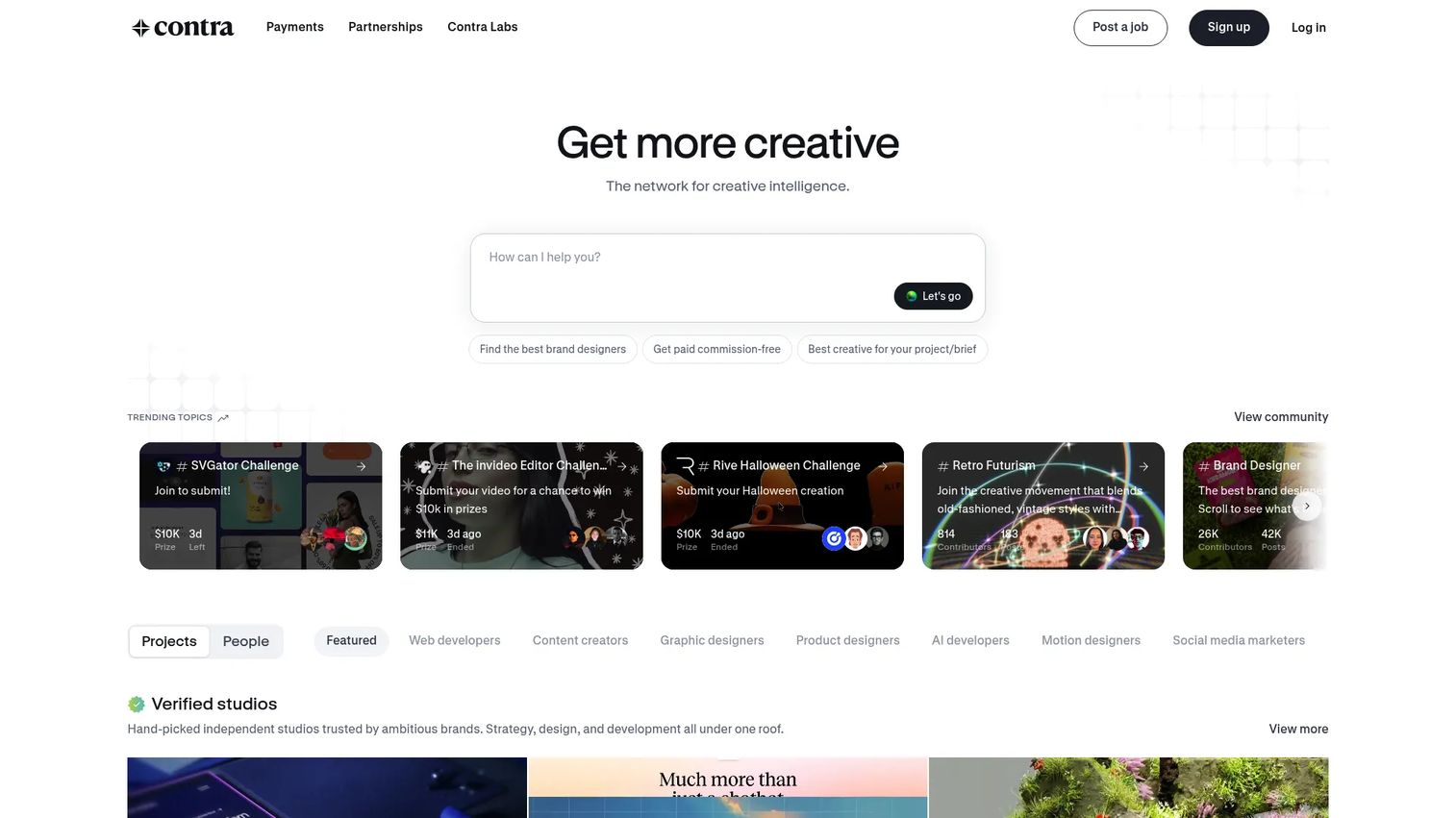
Contra is a portfolio-driven professional network for independent creatives, marketers, product specialists, and no-code builders. Freelancers build polished profiles showcasing project work, and clients discover talent by browsing those portfolios directly. Payments on Contra carry no platform commission from the client or freelancer side (standard third-party processing fees still apply).
Best for: Founders who want to evaluate work quality before outreach and prefer a direct working relationship without heavy marketplace intermediation.
Key features
- Portfolio-first profiles with project showcases
- Direct project inquiries and commission-free payments
- Contract and invoicing tools built in
- Digital product sales for freelancers
- Community and direct messaging
Why choose Contra: The commission-free model means the freelancers you hire keep more of what you pay them, which tends to attract motivated independents who take their craft seriously. Portfolio browsing shifts the first filter to work quality rather than proposal volume.
Contra pricing: Free to join and post jobs. Contra Pro for freelancers costs $29/month or $199/year, adding boosted discoverability and waived platform listing fees.
G2 rating: 4.9/5
8. FlexJobs
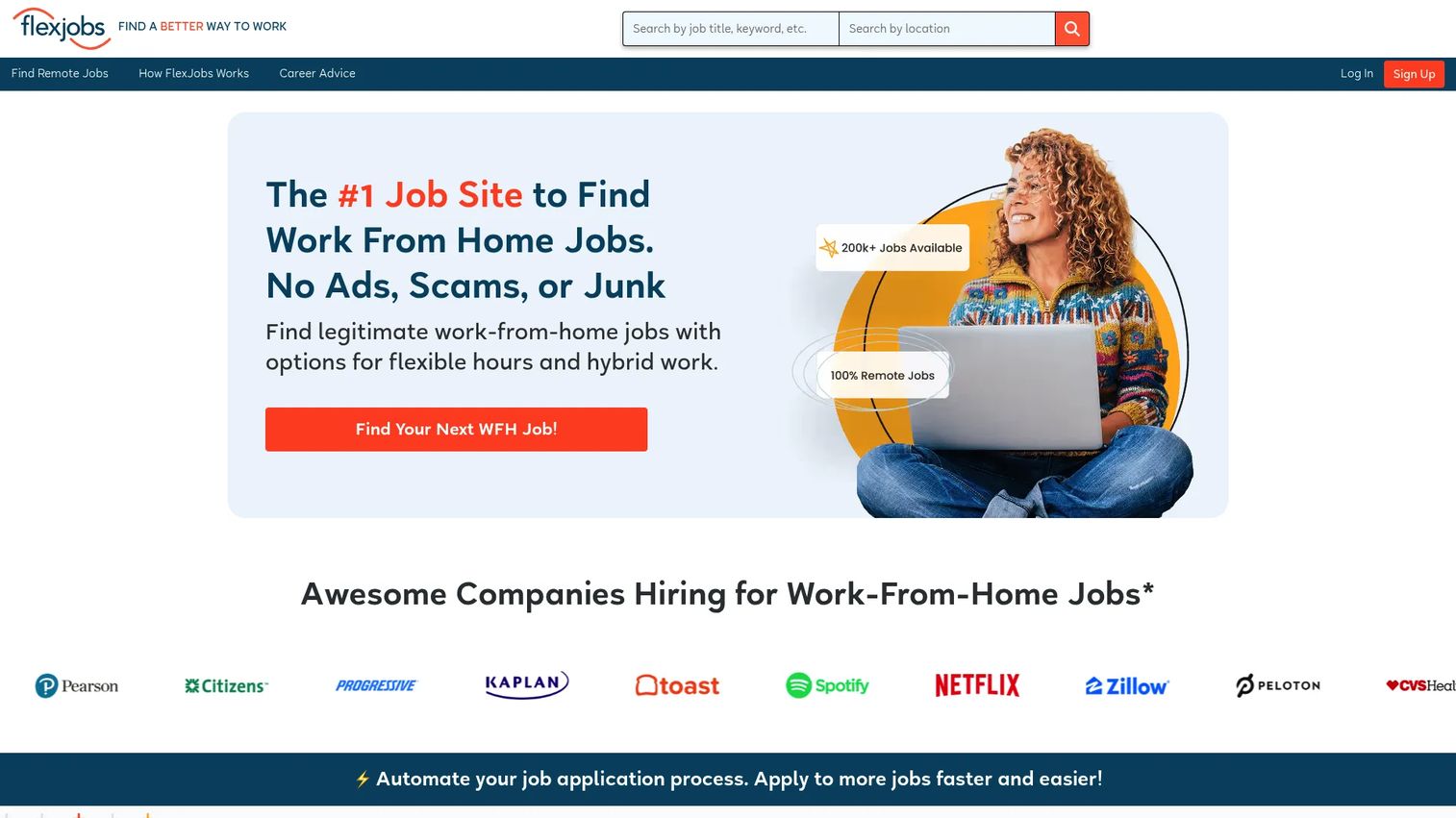
FlexJobs is a curated job board for remote, flexible, freelance, and part-time roles. Every listing is hand-screened before publication to remove scams and low-quality posts. The platform is structured as a subscription service for job seekers, not an open marketplace, which means the hiring process and payment workflow stay with the company.
Best for: Hiring managers posting legitimate remote and flexible contract roles, and freelancers who want a clean, vetted job-search experience without the noise of broad aggregators.
Key features
- Hand-screened job listings with scam-reduction focus
- Advanced search filters by job type, schedule, and location
- AI-powered ExpertApply for job seekers
- Career resources including resume review and coaching
- Employer posting options for sourcing screened applicants
Why choose FlexJobs: Use it when you want the quality of a job board with verification behind each listing. It works better for fractional and ongoing roles than for one-off gig purchases. Employers handle screening, contracts, and payment directly.
FlexJobs pricing: Job seekers pay a subscription: $2.95 for a 14-day trial (auto-renews at $23.95 per four weeks), $9.95/month on the three-month plan, or $5.95/month on the annual plan. Employer posting pricing is separate.
G2 rating: 4.5/5
9. We Work Remotely
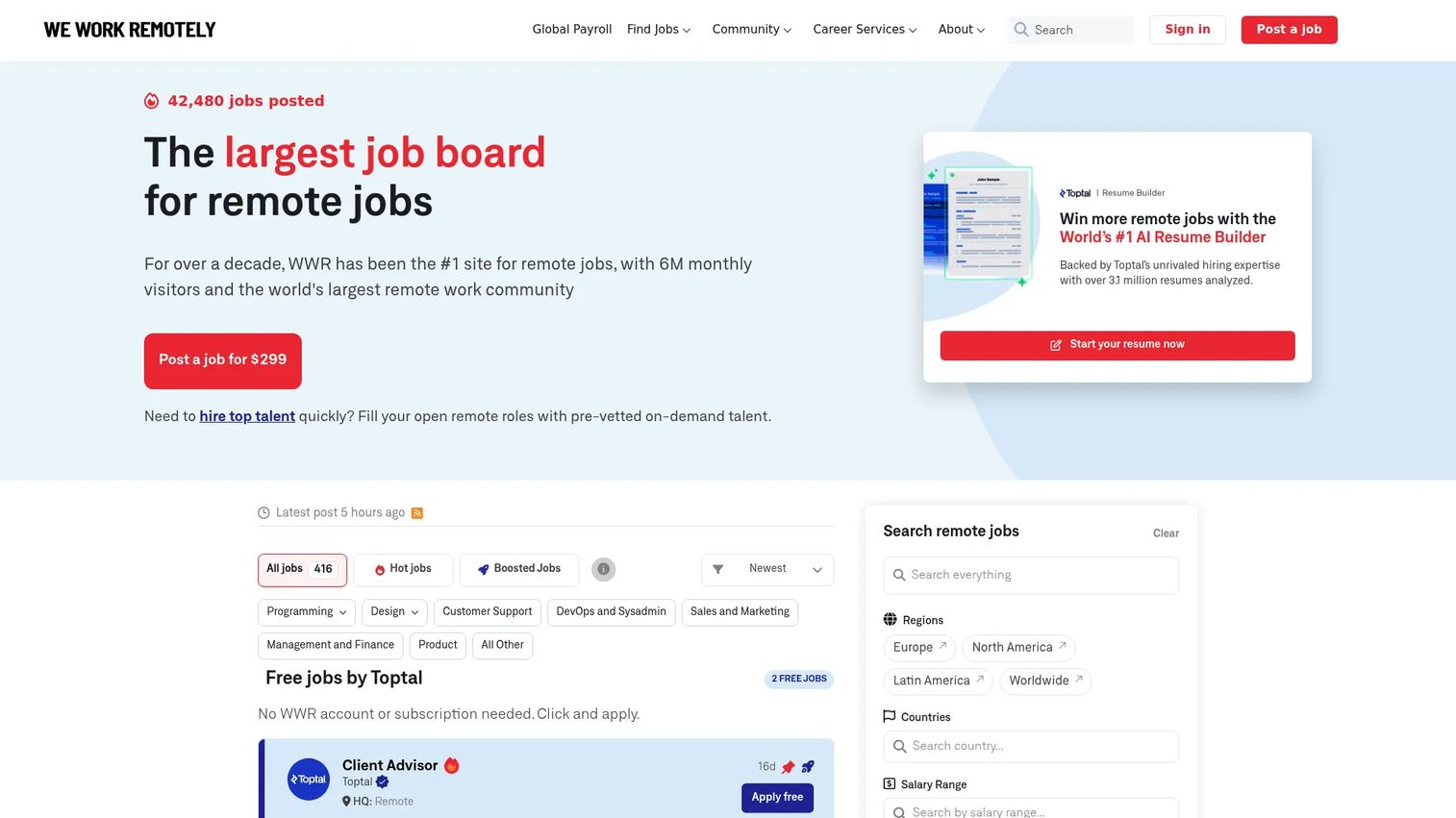
We Work Remotely is a remote-first job board serving the technology, product, design, marketing, and customer support community. It sits closer to a traditional job board than a freelance marketplace, making it better for contract or freelance roles that look like jobs, with a clear description, defined engagement, and direct hiring workflow.
Best for: Companies posting remote contractor or freelance roles with full job descriptions, where the hiring team manages screening and payment outside the platform.
Key features
- Remote job search by category and engagement type
- Job seeker accounts with saved jobs and custom alerts
- Employer job postings, boosted listings, and Mega Placements
- Broad distribution to a tech-first remote audience
- WWR Pro for job seekers with unlimited applications
Why choose We Work Remotely: Reach among tech and startup workers is the primary advantage. A contractor role for a product designer, growth marketer, or data engineer will find a relevant audience here. The hiring team runs the full process, which suits companies that have an internal recruiting workflow already.
We Work Remotely pricing: Basic job seeker access is free. WWR Pro runs $14.95/month (12-month commitment, first month $2.95). TopAccess is $29.95/month. Employer job posts are priced separately at $299 for a standard post.
G2 rating: 2.0/5
10. LinkedIn
LinkedIn is a professional network rather than a dedicated freelance marketplace. Its advantage for freelance hiring is referral context. You can search for a fractional CFO or a senior product designer, see mutual connections, review their full work history, and reach out with context before any formal process starts. Job posts on LinkedIn also reach a large professional audience for contract roles.
Best for: Founders hiring through referral networks and senior contractor discovery where reputation and mutual context matter as much as platform mechanics.
Key features
- Professional profiles with full work history and endorsements
- Network referrals and mutual connection visibility
- Job posting tools with broad professional distribution
- Recruiter Lite and Sales Navigator for targeted outreach
- InMail for direct messaging outside your network
Why choose LinkedIn: For senior fractional or specialist roles, a warm referral path reduces the screening cost significantly. The tradeoff is manual outreach effort and no built-in escrow or payment protection. Use it when you would rather start with someone a trusted peer has worked with before.
LinkedIn pricing: Free basic account available. Premium All-in-One runs $89.99/month per license (or $899.88/year). Premium Company Page is $99.99/month. Recruiter and Sales Navigator products are priced separately.
G2 rating: 4.4/5
11. Behance
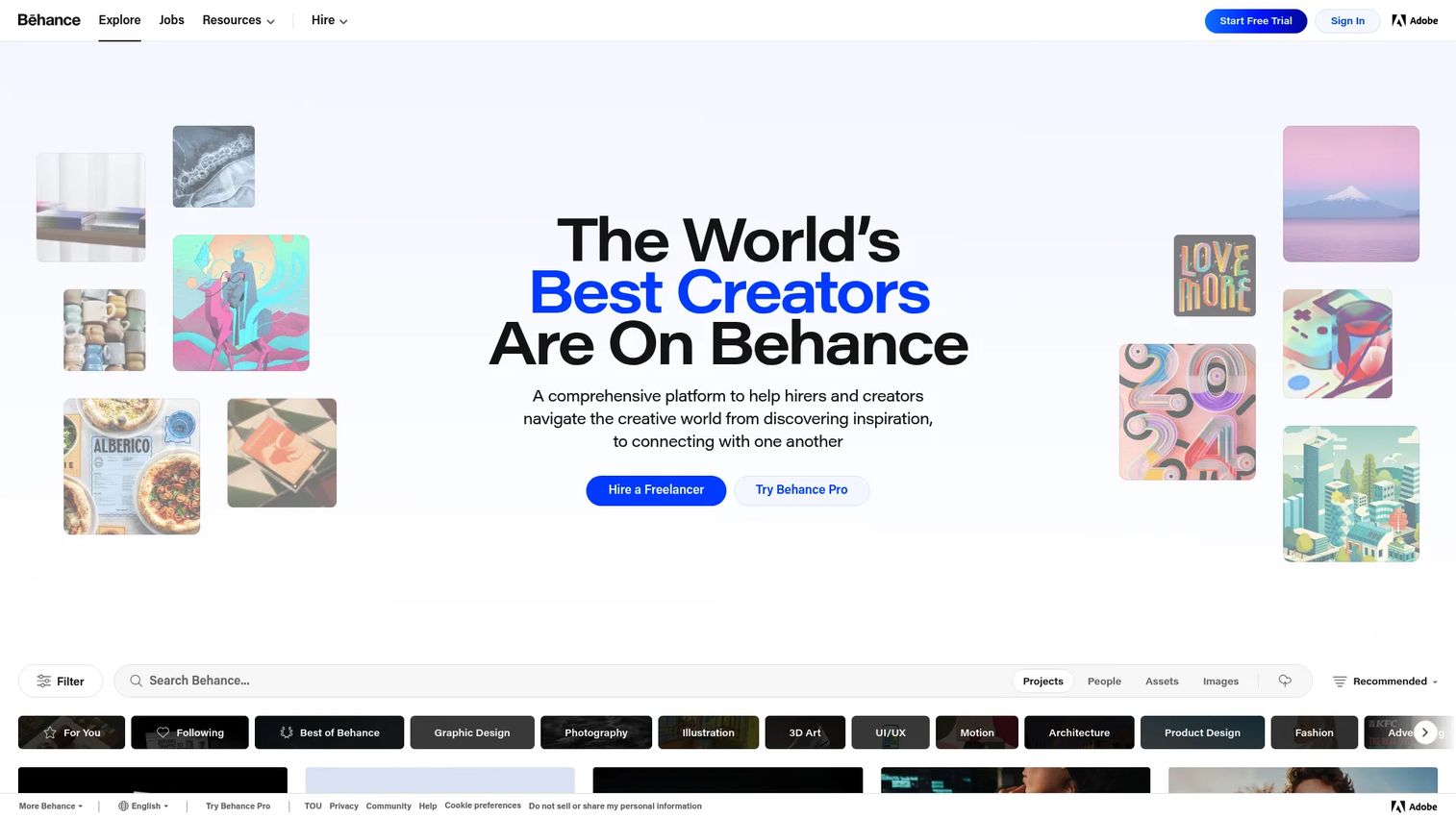
Behance is an Adobe-owned creative portfolio platform where designers, illustrators, photographers, brand creatives, and motion designers publish project work. For hiring teams, the discovery model is portfolio-first: You browse actual completed work before sending a single message. Behance Pro adds advanced analytics for freelancers and 0% platform fees, and includes Adobe Portfolio.
Best for: Founders and marketing leaders evaluating creative talent by the quality of their delivered work rather than proposals or bids.
Key features
- Visual portfolio browsing across creative categories
- Project showcases with process documentation
- Freelance services and client proposals within the platform
- Behance Pro for advanced analytics and platform-fee waiver
- Job board and hiring options for posting open roles
Why choose Behance: When the proof is the work itself, portfolio browsing is more efficient than reviewing applications. Particularly useful for brand identity, product illustration, and campaign creative where aesthetic judgment is the primary filter. No built-in escrow, so payment workflows stay off-platform.
Behance pricing: Free to create a profile and browse. Behance Pro runs $9.99/month (annual commitment, billed monthly) and adds 0% platform fees, advanced stats, and profile boosts.
12. Dribbble
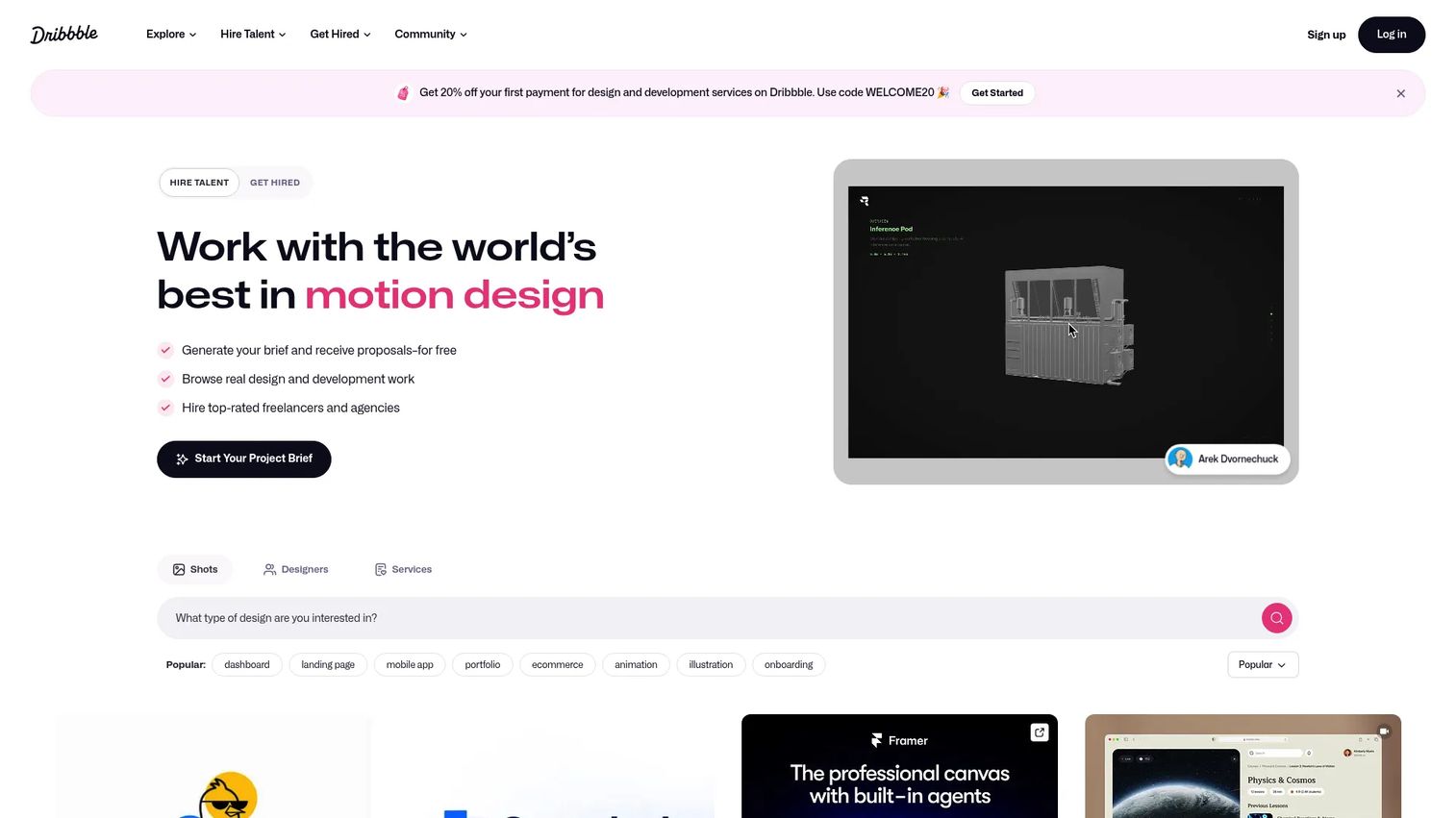
Dribbble is a design community and hiring platform where product designers, UI/UX designers, illustrators, and brand designers publish portfolio shots and project work. The job board and hiring search tools make it practical for posting design roles or browsing talent by specialty. Hiring Suite at $300/month and Job Post at $150/month are the main employer products.
Best for: Teams hiring freelance product or brand designers where visual portfolio quality is the primary evaluation criterion.
Key features
- Designer portfolios and Shot publishing for discovery
- Job board with freelance, contract, and full-time listings
- Hiring search tools for targeting by specialty
- Designer community reach for authentic outreach
- Designer Pro plans to boost profile visibility and leads
Why choose Dribbble: The concentration of product and brand design talent makes candidate quality higher in this niche than on general marketplaces. When design taste drives the hire, portfolio-led discovery reduces the time spent filtering mismatched applicants.
Dribbble pricing: Free profile for designers. Designer Pro plans run from $4/month (Lite, billed annually) to $8/month (Standard) and $99/month (Plus). Employer hiring is priced separately at $150/month for a job post.
G2 rating: 4.2/5
13. 99designs
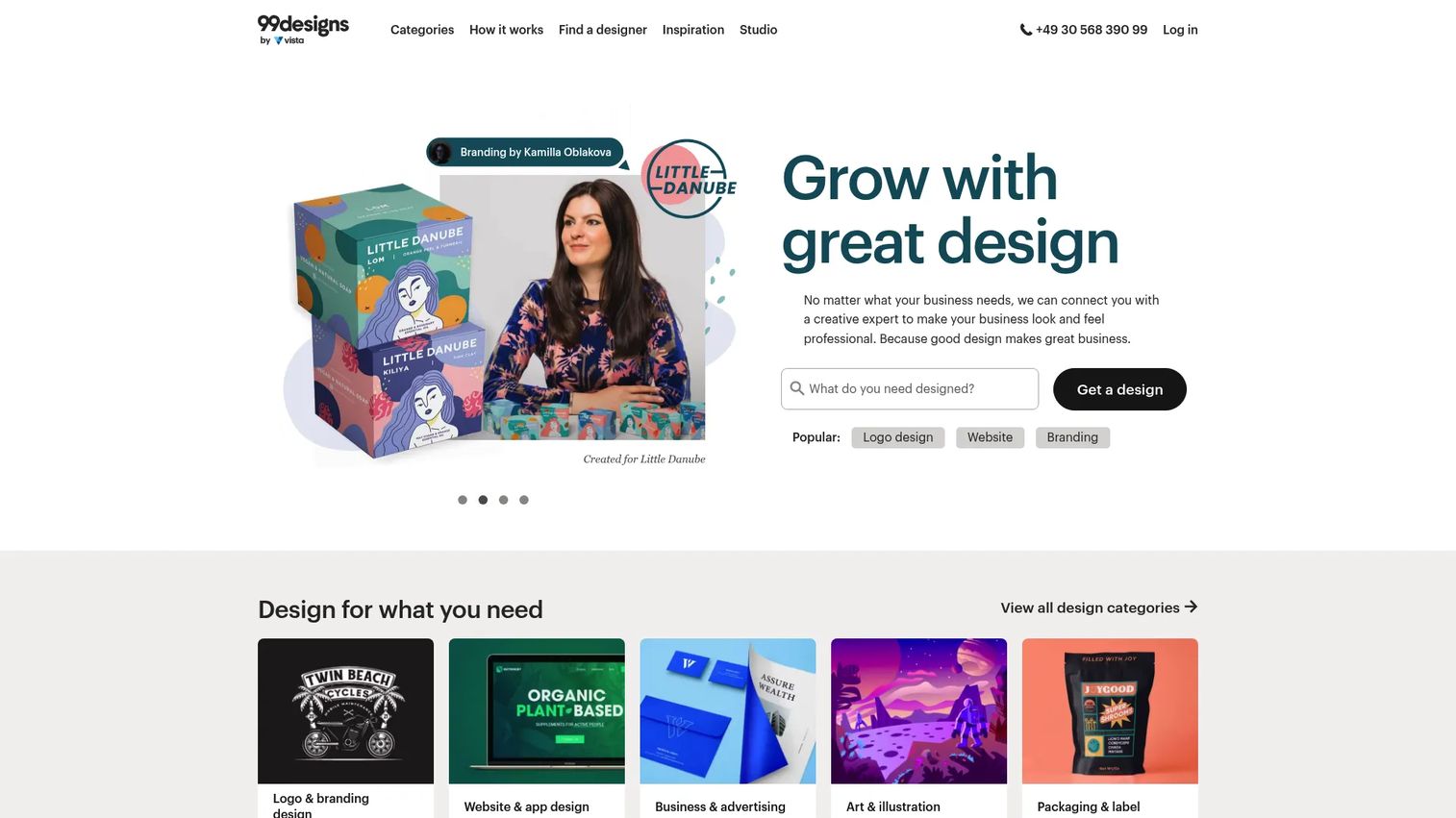
99designs is a creative platform built around design contests and direct designer hiring. For contests, a client writes a brief, designers submit multiple concepts, and the client chooses the winner. Logo design, brand identity, packaging, web design, and book covers are common use cases. Direct hire projects let clients work with one designer from the start.
Best for: Founders comparing multiple design directions before committing to a creative route, particularly for brand identity and visual projects.
Key features
- Design contests with concepts from multiple designers
- Direct designer hiring for focused collaboration
- Clear creative brief workflow with revision rounds
- Secure payments and copyright ownership at project close
- Category-specific pricing tiers for different project scopes
Why choose 99designs: The contest model reduces the risk of a single creative direction by generating multiple options before any final commitment. Particularly valuable for brand identity work, where seeing three or four directions often surfaces an insight the brief alone would not have produced.
99designs pricing: Logo design contest packages: Bronze at $249, Silver at $399, Gold at $799, Platinum at $1,050 (all fixed-price, excluding sales tax). Direct project pricing varies by category.
G2 rating: 4.0/5
14. SimplyHired
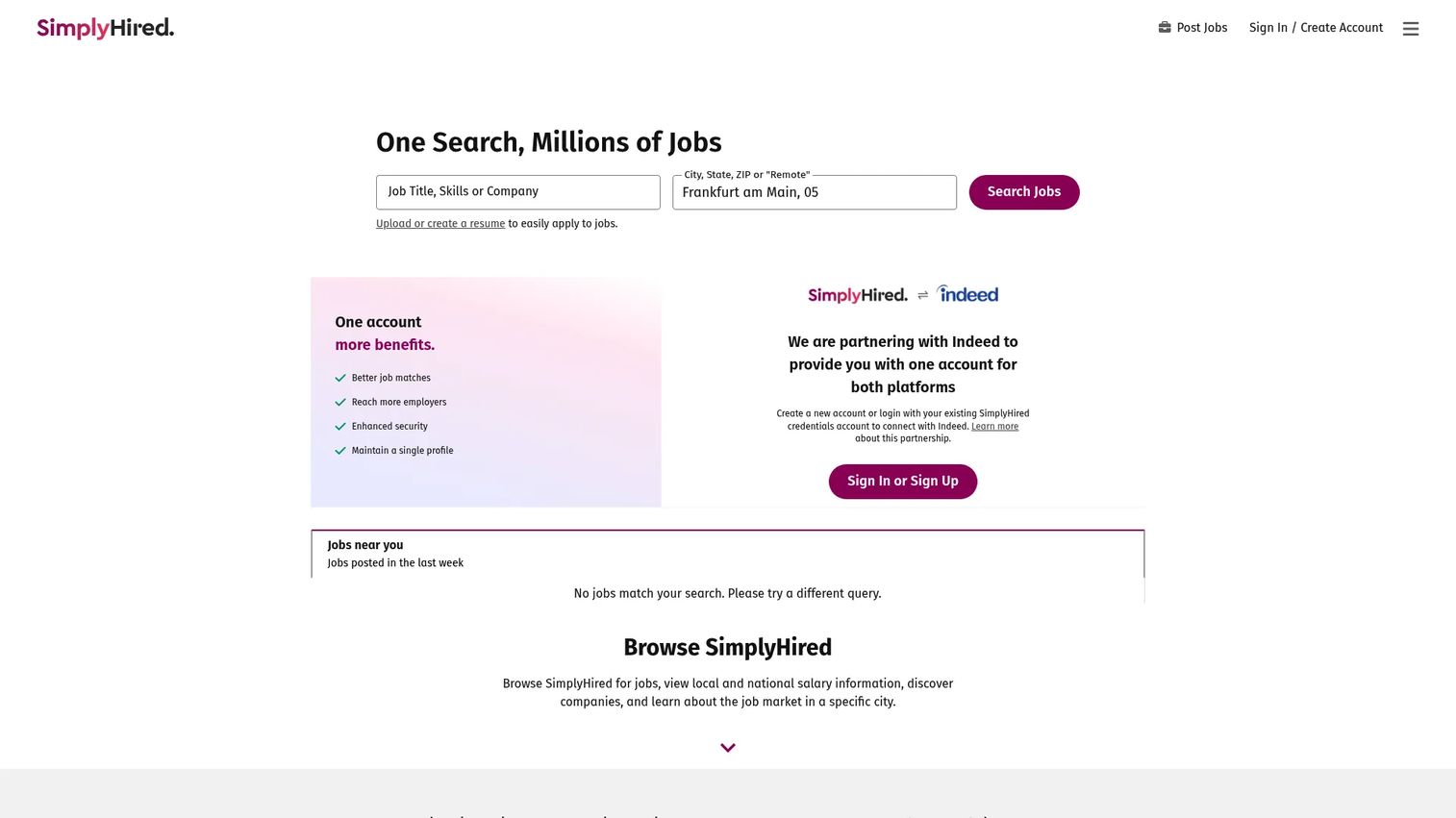
SimplyHired is a job search and aggregation engine that pulls listings from company sites, job boards, and direct posts into a searchable index. Job seekers search by title, skills, company, location, or remote status. A salary estimator helps freelancers gauge market rates before applying or negotiating.
Best for: Freelancers searching for broad contract opportunities across industries, and companies distributing contract-style roles to a wide job-search audience.
Key features
- Job search aggregation across multiple sources
- Salary estimator for rate benchmarking
- Resume upload or creation for applications
- Job alerts for saved searches
- Indeed account integration for shared profile management
Why choose SimplyHired: Discovery breadth is the advantage. For a freelancer trying to find contract opportunities across markets, aggregated search saves time. For employers, it functions as a distribution channel rather than a managed marketplace. Payment protection and escrow are not part of the workflow.
SimplyHired pricing: Free to search and apply for job seekers. Employer posting pricing was not publicly listed on the official site at time of writing.
G2 rating: 3.4/5
15. Jobbers
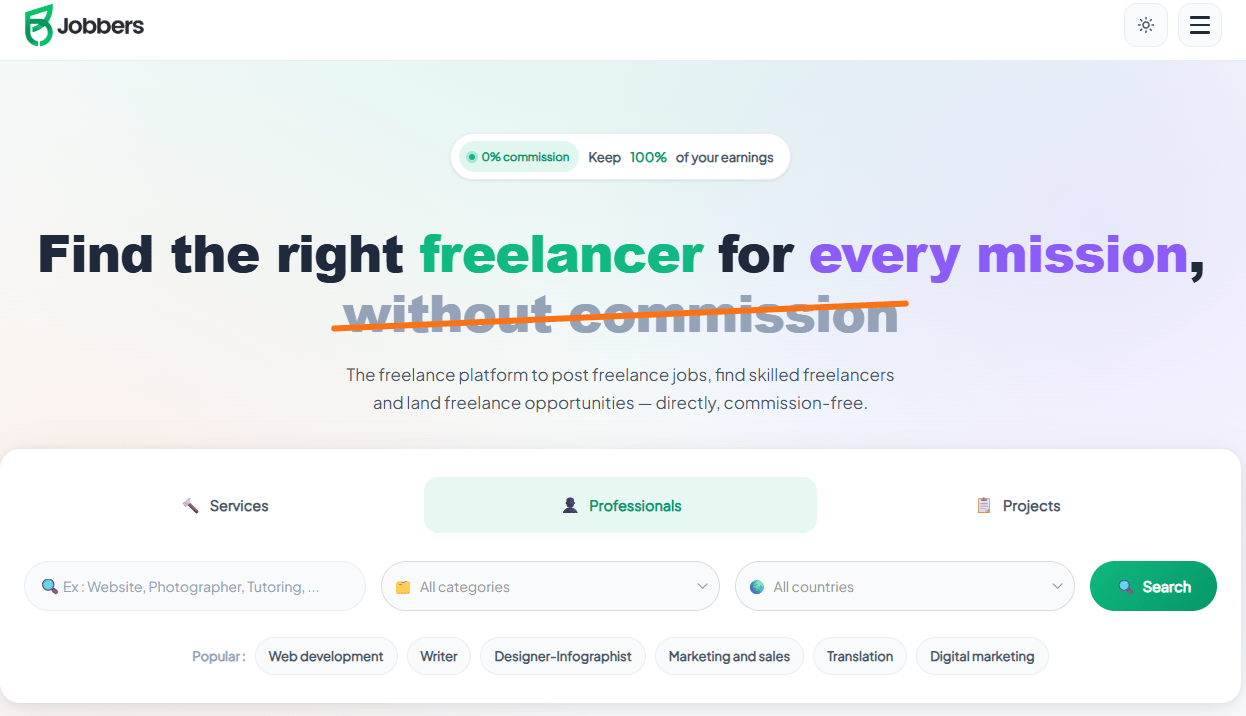
Jobbers is a commission-free freelance marketplace that emphasizes direct communication between clients and professionals. Clients post projects for free and receive proposals, then negotiate and pay directly with the freelancer. Profiles include verification, reviews, portfolio samples, and location filters. Mobile apps are available for iOS and Android.
Best for: Clients and freelancers who want a direct relationship with low platform overhead, and are prepared to manage contracts and payments independently.
Key features
- Direct freelancer contact and negotiation
- Location-based and language-based browsing
- Freelancer profiles with reviews and portfolio samples
- Free project posting with proposal receipt
- Commission-free transactions with direct payment
Why choose Jobbers: The commission-free model means both parties keep more of the deal. The tradeoff is that payment protection and dispute infrastructure are limited compared to escrow-based marketplaces. Best suited to buyers with enough process experience to handle contracts and payment terms on their own.
Jobbers pricing: Free to post projects. Paid visibility packages for freelancers start at $3/month (Business service), $6/month (Premium service), and $20 to $41/month for sponsored placement by category, city, country, or site-wide.
Considerations when choosing freelance platforms
Match the platform type to the work shape
A logo project fits a design contest. A fractional RevOps operator building your attribution model needs a deeper evaluation process with interviews and a trial project. The platform type determines how much infrastructure exists between discovery and a signed agreement. Choose accordingly before spending time on any single marketplace.
Count the full cost, not just the hourly rate
Buyer fees, freelancer service fees, subscriptions, payment processing, and premium hiring tiers all add to the real cost of a hire. On a $3,000 project, a 20% service fee on the freelancer side and a 5% buyer fee changes the math significantly. Factor in your own team's review time too, because a platform that produces 40 weak proposals costs leadership hours that do not appear on any invoice.
Decide how much screening you need upfront
A landing page graphic and a production database migration are not equivalent hiring decisions. Toptal's vetting model is worth the premium when screening failure costs a VP a week of interviews. Open marketplaces work when the work is well-specified, reversible, and scope-limited.
Check payment protection and dispute handling
Escrow and milestone-based payments protect both parties when a project goes sideways. Direct-payment platforms save on fees but transfer more risk to the buyer. Before committing to a platform, understand what happens if a deliverable misses the brief and the freelancer disagrees.
Evaluate the talent supply for your specific role
A platform strong for developers may have thin supply for senior marketing operators. Check whether the category you need has active, experienced freelancers with recent reviews before posting. Freelancers should ask the same question from the other direction: Does this platform attract clients with real budgets and clear briefs, or is it a race to the lowest bid?
Conclusion
The freelance platform market is large enough that there is a right answer for each hiring scenario. Upwork handles broad SaaS contractor hiring with the most supply and the most infrastructure. Fiverr gets packaged tasks done fast when the brief is tight. Toptal reduces the screening burden for senior roles where your VP's time is the real constraint. For talent management across a growing company, thinking in platform types rather than platform names is the more repeatable system.
For design work, 99designs surfaces multiple creative directions before you commit. Dribbble and Behance let portfolio quality do the filtering. For ongoing remote roles that look more like jobs than gigs, FlexJobs and We Work Remotely reach the right audience. Contra and Jobbers suit founders willing to own more of the contract workflow in exchange for lower platform fees.
The practical next step: Pick two platforms based on your current work type, publish the same tightly written brief on both, and compare proposal quality before committing. That test takes an afternoon and tells you more than any comparison guide can.
For broader hiring and web design software resources your contractors will need access to, the Guideflow blog covers tool stacks across the GTM and product function. You can also explore AI design tools to understand what your creative contractors are already using when they come on board.
FAQs
Upwork is the strongest starting point for broad SaaS contractor hiring, covering engineering, design, marketing, customer support, and operations in one marketplace with escrow and business account controls. Toptal is better when the role is senior and screening cost is the bottleneck. LinkedIn works well for referral-driven hiring where mutual context matters more than marketplace mechanics.
For freelancers starting out, Fiverr and Freelancer.com allow profile creation and service listing without prior review history. SimplyHired surfaces contract opportunities through aggregation and suits broad job discovery. Creative beginners on Behance or Dribbble can build a portfolio presence before pitching clients directly.
Safety varies significantly by platform type. Escrow-based marketplaces like Upwork, Guru, and PeoplePerHour hold funds until work is approved, reducing payment risk for both parties. Direct-payment platforms like Jobbers shift more risk to the buyer and require independent contracts. Keep communications and payments inside the platform when marketplace protection is part of why you chose it.
Most platforms charge buyers a service fee, sellers a commission on earnings, or both. Upwork charges freelancers 0% to 15% per contract. Fiverr Pro Advanced is a flat $129/month for enhanced access. 99designs takes a percentage of the project package price. Freelancer.com charges a project fee on accepted bids. Total project cost includes all applicable fees on both sides, not just the headline rate.
A marketplace manages project discovery, proposals, messaging, payment, and dispute resolution inside the platform. Job boards like FlexJobs, We Work Remotely, and SimplyHired distribute job listings and leave the screening, contracting, and payment workflow entirely to the hiring team. Marketplaces offer more infrastructure; job boards offer more control over the hiring process.
99designs suits projects where comparing multiple creative directions before committing reduces decision risk, particularly for brand identity and logo work. Behance and Dribbble both lead with portfolio quality, with Dribbble skewing toward product and UI design and Behance spanning a broader creative range. Fiverr works for defined creative tasks like ad creative, icon sets, and social graphics with fast turnaround.
Freelancers fit short-term projects, specialist work, and demand spikes before the work pattern is clear. Full-time employees fit recurring, strategic work that needs deep company context and long-term ownership. At Series B, using freelancers to validate a role before converting it to full-time protects runway and avoids a costly bad hire in a function that may not need permanent headcount yet.
Yes. Most founders use different platforms for different role types: Upwork for operational contractors, Toptal for senior technical work, Dribbble for design hiring. Posting the same vague brief everywhere produces noise. Use each platform for the work type it serves best, with a brief written specifically for that audience.