Your checkout page has a card-entry field, a payment-service script, a fraud-detection widget, a chat bubble, and four analytics tags. Ask your team which of those scripts can read the card number field. Odds are nobody has a clear answer.
That gap is exactly what attackers exploit. According to cside (2025), 72,740 websites were compromised in client-side attacks in Q2 2025 alone. And Jscrambler's 2025 research found that 97% of surveyed companies acknowledged third-party JavaScript can access sensitive information, yet only 36% had formal strategies or tools to mitigate the risk.
PCI DSS 4.0.1 sharpened the stakes further. Requirements 6.4.3 and 11.6.1 now call for documented script authorization, integrity monitoring, and change detection on payment pages. That is not a network-edge problem. It is a browser-side problem, which means a WAF alone won't cover it.
Which platform gives your team the visibility and control to answer "what runs on our checkout page, and who approved it?"
What's inside
This guide is for product managers and security leads evaluating client-side security for payment pages, signup flows, and sensitive customer journeys.
- Seven platforms covering script discovery, runtime monitoring, CSP enforcement, and compliance evidence
- PCI DSS 4.0.1 context for requirements 6.4.3 and 11.6.1
- Selection criteria: Script inventory depth, enforcement controls, PCI evidence quality, and operating overhead
- Guidance on fitting client-side protection into release cadence and cross-functional ownership
Pricing and G2 ratings were verified from vendor pricing pages and G2 listings in October 2026. Confirm details before purchasing.
TL;DR
- Best overall for enterprise script visibility: Akamai Client-Side Protection & Compliance, for organizations needing runtime monitoring, risk-scored alerts, and PCI DSS v4.0 workflows
- Best for discovery-to-enforcement workflows: Imperva Client-Side Protection, for teams that want a staged path from script inventory to blocking
- Best for Fortinet security stacks: FortiWeb, for detailed CSP collector configuration and policy-mode controls within an existing WAF program
- Best for Fastly-native teams: Fastly Client-Side Protection, for organizations whose security operations already run through Fastly's edge
- Best for Cloudflare-centric web teams: Cloudflare Page Shield (now Client-Side Security), for browser-side script monitoring alongside existing Cloudflare controls
- Best for payment-page fraud overlap: DataDome Client-Side Protection, for e-commerce teams where client-side risk intersects with bot defense
- Best for JavaScript application hardening: Jscrambler, for engineering teams that need code protection alongside third-party script governance
What is client-side protection?
Client-side protection is a set of security controls that discovers, monitors, and governs JavaScript and third-party resources running inside a user's browser, especially on pages that handle payment or sensitive customer data.
Modern web applications load a significant number of resources from external sources. Imperva (2025) reports that the average modern web application loads 209 client-side resources, with 66% of those scripts coming from third-party domains. Each one represents code your team did not write, running in the same browser context as your users' payment data.
Client-side protection addresses this through several distinct capabilities:
- Script inventory: Identify first-party scripts, third-party scripts, domains, and tags loaded on each protected page
- Runtime monitoring: Detect unauthorized resource loading, form-field access, DOM changes, and script modifications after page delivery
- Risk analysis: Score scripts by reputation, behavior, known vulnerabilities, and access to sensitive data
- Policy controls: Use Content Security Policy (CSP), allowlists, blocklists, and Subresource Integrity (SRI) to establish boundaries
- Change detection: Alert on script modifications, new resources, and policy violations
- Compliance evidence: Maintain inventories, change records, and audit reports for payment-page script controls
Why this matters for product managers
Product teams decide which vendors, analytics tools, payment widgets, and A/B testing scripts reach critical user journeys. A release that adds a new tag to checkout also adds a new attack surface. Client-side protection gives you instrumentation over that surface, not just a security team dashboard.
Client-side protection versus a WAF
| Capability | WAF | Client-side protection |
|---|---|---|
| Inspects inbound web traffic | Yes | Limited |
| Observes JavaScript after page delivery | Limited | Yes |
| Inventories third-party browser resources | Limited | Yes |
| Detects browser-side script changes | Limited | Yes |
| Supports CSP monitoring or enforcement | Varies | Core capability |
| Protects payment pages from skimming | Part of the stack | Core focus |
Both tools belong in a mature web-security posture. Neither replaces the other.
When to use client-side protection
Protect payment and checkout flows
Payment pages concentrate the highest risk: Card-entry fields, payment-service scripts, conversion tags, and fraud tooling all share the same execution context. Start the rollout here. Inventory every script, assign an owner, and monitor before you enforce. Aggressive CSP blocking on an untested checkout page can kill conversion.
Govern third-party scripts without freezing releases
Marketing, product, and engineering teams add tags and embedded services continuously. The right platform shows you what changed, which domain it loaded from, and whether it touched sensitive fields. Script visibility gives Security the signal it needs without requiring a release freeze for every tag update.
Build evidence for PCI DSS 4.0.1 reviews
Requirements 6.4.3 and 11.6.1 call for payment-page script authorization, integrity monitoring, and change detection records. Client-side protection platforms can generate the inventory, authorization trails, and change logs your assessor will ask to see. The platform supports the evidence collection; your assessor and compliance program determine what satisfies the requirement.
Client-side protection tools comparison
Use this table as a fast routing tool. Capabilities and pricing change. Verify against each vendor's current materials before a purchasing decision.
| # | Product | Best for | Key differentiator | Pricing | G2 rating |
|---|---|---|---|---|---|
| 1 | Akamai Client-Side Protection & Compliance | Enterprise payment-page protection | Runtime script behavior monitoring with PCI DSS v4.0 workflows | Free tier available; standard pricing usage-based | Not verified |
| 2 | Imperva Client-Side Protection | Discovery-to-enforcement workflows | One-click blocking with PCI DSS 4.0 dashboard | Contact sales | Not verified |
| 3 | FortiWeb | Fortinet security stack teams | CSP collector, monitor and block modes, SRI actions | From $0.03/unit (AWS); contact sales for appliance/VM | 4.8/5 |
| 4 | Fastly Client-Side Protection | Fastly-native security teams | CSP enforcement and resource inventory at the edge | Contact sales | 4.2/5 (Fastly WAAS) |
| 5 | Cloudflare Page Shield | Cloudflare-centric web teams | Script monitoring and code change detection in Cloudflare | Free tier; advanced at $0.099/1k requests | Not verified |
| 6 | DataDome Client-Side Protection | Payment-page fraud and bot-risk environments | Script authorization and PCI DSS 4.0 support with fraud context | Contact sales | 4.7/5 |
| 7 | Jscrambler | JavaScript application hardening | LLM-resilient code protection plus third-party script governance | Contact sales | 4.4/5 |
Best 7 client-side protection tools for 2026
1. Akamai Client-Side Protection & Compliance
Akamai Client-Side Protection & Compliance monitors browser-side JavaScript and third-party script behavior on sensitive web pages, with a focus on digital skimming, formjacking, and client-side data exfiltration. The platform combines real-time behavioral detection with risk-scored alerting and PCI DSS v4.0 reporting workflows for requirements 6.4.3 and 11.6.1.
Best for: Enterprise organizations managing complex web estates with strict payment-page oversight and mature security operations.
Key features
- Real-time behavioral detection against client-side attacks
- Vulnerability-focused URL analysis for known CVEs
- Risk-scored alerts with one-click mitigation controls
- Script visibility dashboards and incident reporting
- PCI DSS v4.0 workflows covering requirements 6.4.3 and 11.6.1
- Flexible edge or origin deployment options
Why choose Akamai Client-Side Protection & Compliance: This platform suits product and security teams that need a shared script inventory across Marketing Ops, Security, and Engineering, with clear ownership signals before an incident occurs rather than after.
Akamai Client-Side Protection & Compliance pricing: Akamai documents a qualified-customer self-service free tier covering up to 1 million analyzed script executions per month. Standard protection runs on usage-based pricing; contact Akamai for current packaging. Verify free-tier qualification requirements directly with the vendor, as the original announcement dates to March 2021.
2. Imperva Client-Side Protection
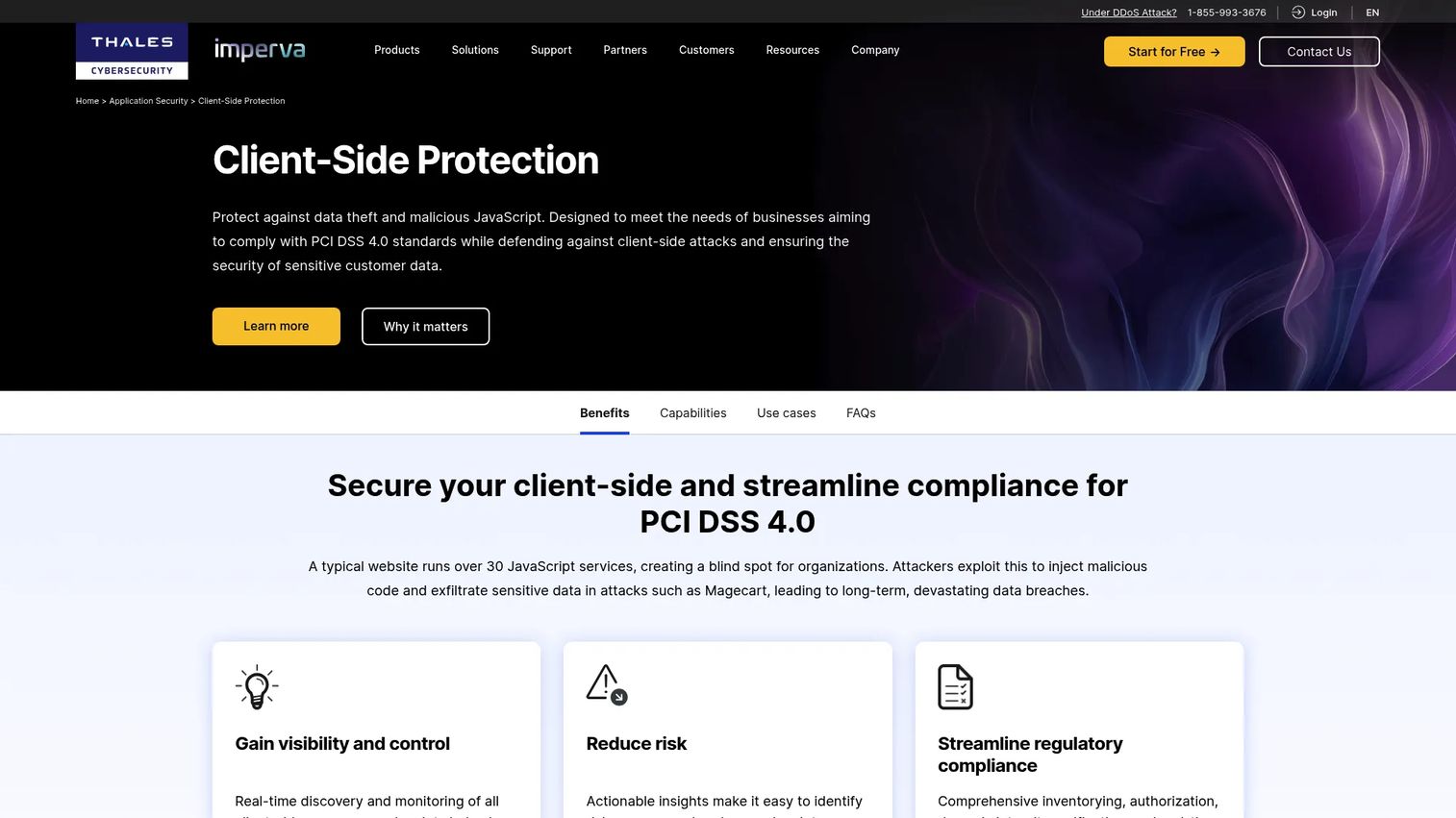
Imperva Client-Side Protection is built around a staged workflow: Discover all first-party and third-party JavaScript resources, assess risk with domain scoring and AI-assisted explanations, then authorize or block. The platform deploys without code changes and without adding page latency, which matters when protecting revenue-critical checkout flows.
Best for: Security and product teams that need to move from script inventory into policy enforcement with clear approval guardrails.
Key features
- Continuous discovery and monitoring of first- and third-party JavaScript
- Domain risk scoring, compromised-code detection, and AI Explain
- One-click blocking or authorization, including zero-trust enforcement
- PCI DSS 4.0 dashboard covering requirements 6.4.3 and 11.6.1
- Deployment without code changes or added page latency
Why choose Imperva Client-Side Protection: Product managers should consider it when the business runs many external services on critical pages and needs a practical path from "what's there" to "what's allowed." Test policy changes in monitoring mode before applying enforcement to conversion-critical pages.
Imperva Client-Side Protection pricing: Contact Imperva sales for current pricing. A free trial or demo is available through the product page. No tiered public price was found at the time of research.
3. FortiWeb
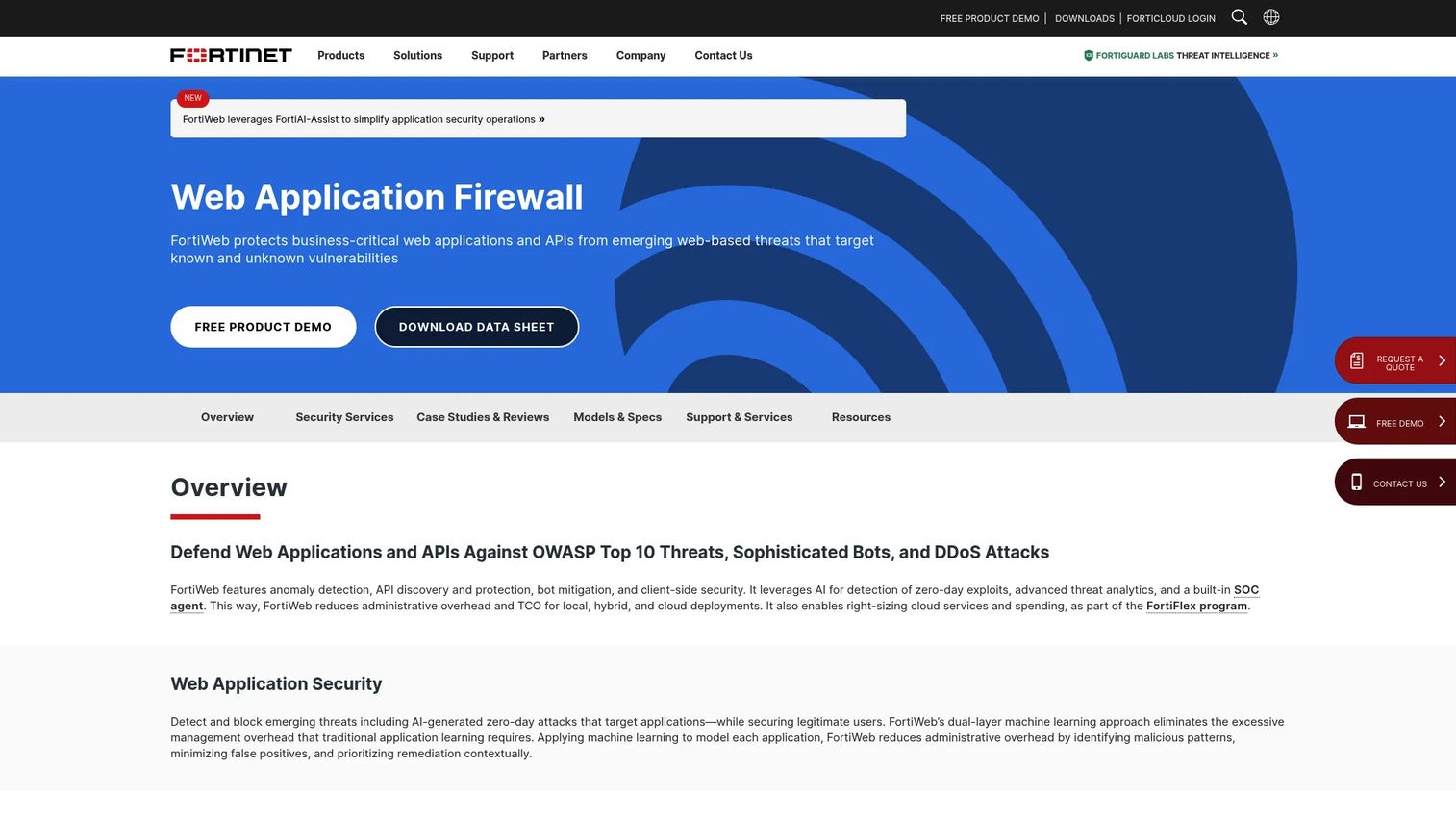
FortiWeb is Fortinet's web application firewall and API protection platform, with client-side protection built into the broader WAF program. Its client-side capabilities center on CSP-Collector telemetry, passive HTML analysis, and policy-mode controls, giving security teams detailed configuration options for script governance alongside OWASP Top 10 and zero-day threat coverage.
Best for: Security teams already operating FortiWeb who need detailed client-side controls embedded within their existing WAF program.
Key features
- CSP-Collector telemetry for JavaScript behavior collection
- Passive HTML analysis without instrumentation changes
- Monitor and Block policy modes for staged enforcement
- Subresource Integrity (SRI) actions for script validation
- Security Fabric integration with FortiGate and FortiSandbox
Why choose FortiWeb: Best for buyers who value deep CSP configuration and already have security operations capable of managing policy exceptions. Product managers should confirm who owns alert triage and release approvals before integrating this into the checkout deployment process.
FortiWeb pricing: FortiWeb Cloud on AWS Marketplace starts at $0.03 per protected web application unit and $0.40 per data transferred unit, billed as metered usage. Hardware, virtual machine, and other cloud packaging requires a quote from Fortinet. Verify current AWS Marketplace rates and non-cloud packaging directly with Fortinet.
G2 rating: 4.8/5
4. Fastly Client-Side Protection
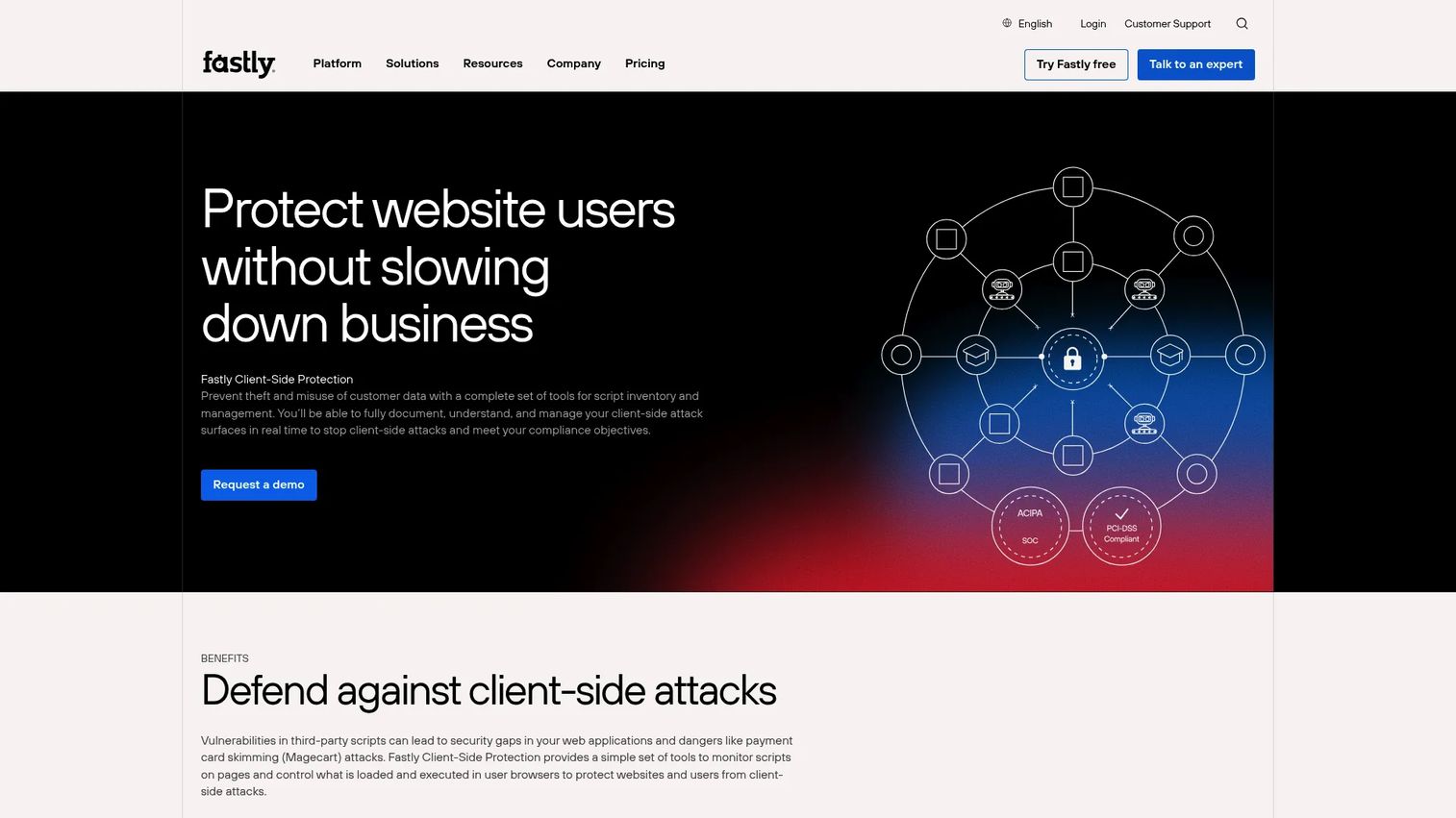
Fastly Client-Side Protection monitors and controls browser resources and third-party scripts from within Fastly's edge security stack. The platform provides a client-side script and resource inventory, CSP creation and enforcement, script authorization management, and protection against Magecart, formjacking, cross-site scripting, and data exfiltration. It must be purchased and enabled through Fastly.
Best for: Product and security teams whose web delivery and application security operations already run through Fastly.
Key features
- Client-side script and resource inventory
- Real-time monitoring, reporting, and alerting for unauthorized activity
- CSP creation, enforcement, and report-only mode
- Script authorization management and justification tracking
- Protection against Magecart, formjacking, and data exfiltration
Why choose Fastly Client-Side Protection: Stack alignment shortens implementation time and clarifies ownership across Application Security and Platform Engineering. If your team operates outside the Fastly environment, evaluate whether adding a new edge dependency is worth the implementation overhead.
Fastly Client-Side Protection pricing: Pricing requires a sales conversation through Fastly; no standalone numeric price appears on the Fastly pricing page. Contact Fastly directly for current packaging and any platform dependencies.
G2 rating: 4.2/5 for Fastly's Web Application and API Security product, verified October 2026. A standalone Fastly Client-Side Protection rating was not confirmed on G2 at time of publication.
5. Cloudflare Page Shield
Cloudflare Page Shield, renamed Client-Side Security in 2026, monitors browser-side scripts and third-party resources across Cloudflare-proxied pages. The platform uses threat intelligence and machine learning to detect malicious scripts, surfaces code changes, and lets teams set content security rules for allowlisting or blocking resources. It fits organizations that want browser-side visibility without adding a separate security console.
Best for: Cloudflare customers that need script monitoring and change detection alongside their existing Cloudflare security controls.
Key features
- Client-side resource monitoring across Cloudflare-proxied pages
- Malicious script detection via threat intelligence and machine learning
- Code change detection and alerting
- Connection and cookie monitoring
- Content security rules for allowlisting and blocking
Why choose Cloudflare Page Shield: The strongest case is stack consolidation. For product managers, the key question is whether the depth of visibility and alerting covers critical checkout and account-recovery pages, or whether a dedicated client-side protection layer is needed alongside it.
Cloudflare Page Shield pricing: A basic free tier is available. The Client-Side Security advanced capability runs at $0.099 per 1,000 requests, billed on usage. Confirm current plan availability and any request-volume thresholds through Cloudflare's pricing page.
G2 rating: A verified current rating for Page Shield or Client-Side Security was not confirmed at time of publication. Check Cloudflare's G2 profile directly before shortlisting.
6. DataDome Client-Side Protection
DataDome Client-Side Protection (Page Protect) focuses on payment-page script monitoring with PCI DSS 4.0 support, combining continuous script discovery, script authorization management, and client-side anomaly detection. DataDome's broader platform includes bot defense and fraud prevention, making this a fit for e-commerce teams where browser-side script risk and automated fraud overlap.
Best for: Enterprise e-commerce organizations needing payment-page script monitoring where PCI DSS compliance and fraud prevention are connected requirements.
Key features
- Continuous discovery and inventory of client-side scripts
- Dashboard visibility, monitoring, and one-click reporting
- Script authorization and integrity assurance
- Client-side script analysis and anomaly detection
- PCI DSS 4.0 support for requirements 6.4.3 and 11.6.1
Why choose DataDome Client-Side Protection: It fits teams where client-side risk and account abuse share the same security program. Before deploying enforcement, validate that policy changes don't introduce friction on legitimate checkout sessions. Monitor conversion metrics and checkout abandonment rates alongside security alerts after any enforcement change.
DataDome Client-Side Protection pricing: Page Protect-specific pricing is not displayed on DataDome's product page. The AWS WAF offering notes that pricing is based on payment pages. Contact DataDome for a current quote and any proof-of-value engagement options.
G2 rating: 4.7/5 for DataDome overall
7. Jscrambler
Jscrambler provides a unified client-side security platform covering code protection, third-party script governance, and runtime controls. Its Webpage Integrity module handles script inventory and behavioral defense against third-party script risks. The Iframe Integrity module addresses overlay attacks, hijacking, and formjacking. And its LLM-resilient code protection layer hardens proprietary JavaScript against reverse engineering, which matters for teams protecting front-end IP alongside payment flows.
Best for: Product and engineering teams that need JavaScript application protection alongside third-party script governance.
Key features
- LLM-resilient JavaScript code protection and obfuscation
- Webpage Integrity: Third-party script inventory and behavioral defense
- Iframe Integrity: Protection against overlay, hijacking, and formjacking
- Runtime application self-defense controls
- Security event visibility and alerting
Why choose Jscrambler: Choose it when the concern extends beyond tag governance into front-end intellectual property, client-side tampering, and application resilience. Product managers should assess how code protection integrates with build pipelines and front-end release workflows before committing, since this requires closer Engineering involvement than a pure monitoring deployment.
Jscrambler pricing: Jscrambler directs buyers to request a personalized demo. No public plan names or numeric prices were found on the first-party site. Contact Jscrambler for current packaging.
G2 rating: 4.4/5
Considerations when choosing client-side protection tools
Script visibility across first-party and third-party code
An inventory is only useful if it distinguishes owned scripts from vendor scripts and tracks which pages each one loads on. Before evaluating platforms, ask: Can you answer "who approved this script on our checkout page" without a manual spreadsheet audit? The platform should make that answer operationally sustainable, not just possible in a one-time review.
Monitoring before enforcement
Content Security Policy enforcement on an untested page can break third-party payment widgets, analytics tools, and accessibility scripts. Every platform on this list supports some form of monitoring or report-only mode. Use it. Validate in staging, then roll enforcement to your highest-risk pages first before expanding to the broader application.
PCI DSS evidence and change governance
Map each platform's inventory records, change detection logs, and reporting outputs to your specific PCI DSS 4.0.1 obligations before purchase. Requirements 6.4.3 and 11.6.1 call for authorization records and integrity monitoring, but your assessor interprets what satisfies them. The tool generates evidence; your compliance program defines what counts.
Integration with existing security operations
Confirm how alerts flow into your WAF, SIEM, ticketing system, and incident-response workflow. A dashboard that Security doesn't watch consistently won't stop an attack. The right integration means a script change alert becomes a triage ticket, not a notification that ages in an unmanned console.
Release cadence and ownership
Identify who owns script approvals, policy exceptions, and enforcement updates before you buy. Product, Engineering, Security, and Marketing Ops each add or rely on scripts running on sensitive pages. A shared operating model with explicit owners produces fewer surprises than a tool that one team uses and three others ignore.
Conclusion
Client-side security is a release-governance problem as much as a cybersecurity one. The scripts that load on your checkout, signup, and account-recovery pages accumulate faster than most teams track them, and PCI DSS 4.0.1 now requires documented evidence that you know what those scripts are and what they do.
Akamai Client-Side Protection & Compliance fits enterprise programs that need runtime monitoring and PCI-oriented reporting with flexible deployment. Imperva Client-Side Protection suits teams that want a structured path from discovery to enforcement without touching their codebase. FortiWeb is strongest for organizations already running Fortinet's WAF who want client-side controls in the same management layer. Fastly Client-Side Protection and Cloudflare Page Shield both reward teams already committed to those edge platforms. DataDome Client-Side Protection fits e-commerce operations where fraud defense and client-side monitoring share a program. Jscrambler is the right call when the requirement includes front-end code hardening alongside script governance.
Start by inventorying every script on your payment, checkout, and account pages. Assign an owner to each one. Then choose the platform whose monitoring depth, evidence quality, and operational model fits your release cadence and security team's capacity.
For further reading on related security and risk topics, see the Guideflow blog's coverage of attack surface management software, AI security posture management tools, and cloud data security software.
FAQs
Client-side protection is a category of security controls that discovers, monitors, and governs JavaScript and third-party web resources running inside a user's browser. It is especially relevant for payment pages, login flows, and any page where users enter sensitive data, because attackers can target browser-side code after the page has already been delivered by the server.
A WAF protects web applications at the network and application edge, inspecting and filtering traffic before it reaches the server or reaches users. Client-side protection focuses on what scripts and resources do inside the browser after delivery. Most organizations use both, because they cover different parts of the attack surface.
PCI DSS 4.0.1 requirements 6.4.3 and 11.6.1 require payment-page script authorization records, integrity monitoring, and change detection. Client-side protection platforms generate script inventories, authorization trails, and change logs that support those requirements. The platform provides the evidence; your assessor and compliance program determine what satisfies the standard.
Requirement 6.4.3 addresses the authorization, integrity, and inventory management of scripts loaded on payment pages. Requirement 11.6.1 covers detecting unauthorized modifications to security controls, including script changes on payment pages. Both requirements took effect under PCI DSS version 4.0, with the 4.0.1 update refining the language. Work with your PCI assessor and compliance team for interpretation specific to your environment.
Content Security Policy (CSP) in report-only mode collects violation reports without blocking any resources. Enforcement mode actively blocks resources that violate the defined policy. Report-only mode is the correct starting point for any critical page, because enforcement on an untested checkout page can break payment widgets or analytics tools before you have validated what's safe.
These platforms can help detect suspicious scripts, alert on unauthorized behavior, monitor form-field access, and apply policy controls that limit how scripts interact with sensitive elements. Whether a specific attack is prevented depends on configuration, coverage depth, incident response speed, and the broader application security program. No single tool guarantees prevention.
Start with payment pages, checkout flows, login and account-creation pages, password reset flows, and billing pages. These are the surfaces where users enter card data, credentials, and personal information. Prioritize pages where a compromised script could access the most sensitive data or cause the most direct business or regulatory harm.
Establish a script ownership model: Every script on a sensitive page should have a named owner, an approval record, and a review cadence. Product managers should own customer-impact risk and conversion metrics; Security owns threat assessment and incident response. A shared review checklist for new third-party additions to checkout or account pages is the most practical starting point. Treat a new tag addition to a payment page the same way you'd treat a code change to the payment flow itself.
Monitoring collects behavioral data and generates alerts when scripts behave unexpectedly or violate an established policy. Enforcement applies active controls, such as blocking unauthorized resources or preventing script access to form fields. A staged deployment that starts with monitoring, then applies enforcement to the highest-risk pages first, reduces the chance of enforcement changes breaking product functionality.