Last updated: October 2026. Author: Team Guideflow.
A buyer spends two hours configuring a payment online. They value their trade, pick a trim, and start a credit application. Then they walk into the store and get asked to start over.
That restart is not a technology gap. It is a continuity failure. The deal details, pricing assumptions, and credit intent the buyer built online never transferred into a usable workflow for the sales desk or F&I manager. According to Cox Automotive's 2025 research, 65% of consumers prefer to complete at least part of the buying process online. Yet most dealerships still operate two disconnected workflows: One for digital and one for the showroom.
The question is not whether to invest in digital retailing. It is whether your platform creates a deal record your team can actually act on, or just another lead form your BDC has to reconstruct from scratch.
For automotive software operators and dealer groups evaluating this category, the selection decision is more systems architecture than feature checklist. Integration depth, data portability, and the ability to hand a live deal from a website to a desk manager without rekeying anything - those are the criteria that separate a real retail platform from a digital brochure with a contact form.
What's inside
This guide covers nine automotive digital retailing platforms evaluated for 2026. Selection criteria include:
- Online-to-showroom continuity: Does the deal record follow the buyer into the store?
- Finance and F&I workflow depth: Does the platform support payment calculation, credit, and F&I presentation, not just lead capture?
- Integration coverage: DMS, CRM, desking, lender networks, and contracting
- Deployment model: Single rooftop versus dealer group readiness, including permissions, reporting, and rollout support
Pricing and G2 ratings for each platform require live verification before publication, given how frequently automotive vendor packaging changes.
TL;DR
- Best for connected online-to-showroom deal workflows: Roadster
- Best for configurable online finance and deal building: AutoFi
- Best for AI-enabled shopper engagement with retail capability: CarNow
- Best for chat-led customer engagement tied to retail conversion: Gubagoo
- Best for F&I depth inside a digital retailing experience: Darwin Automotive
- Best for credit, finance, and contracting workflows: RouteOne Digital Retail
- Best for website-native digital retailing: Dealer Inspire Online Shopper
- Best for configurable dealer and OEM deployments: Motoinsight
- Best for credit-first deal progression: eLEND Solutions
What is automotive digital retailing?
Automotive digital retailing is dealership software that lets vehicle shoppers research inventory, build a deal, estimate payments, value a trade, apply for financing, review F&I options, and continue the transaction with a store team.
The category exists because the car-buying journey is no longer cleanly online or cleanly in-store. Cox Automotive's 2025 data shows 93% of shoppers expect a connected, personalized buying experience across online and offline channels (Fullpath, 2025). A platform earns its place by bridging that expectation without creating a second disconnected workflow for the store.
Key capabilities in automotive digital retailing
- Inventory connection and vehicle detail page integration
- Payment calculation using dealer pricing and lender programs
- Trade-in valuation and appraisal workflow support
- Credit application or consumer-consented pre-qualification
- F&I product presentation and menu workflows
- Digital contracting and e-signature support
- CRM, DMS, desking, lender, and website integrations
- Shopper behavior analytics and lead routing
- Store handoff workflows for BDC, sales desk, and F&I teams
What automotive digital retailing is not
| Category | Primary job | Why it is insufficient alone |
|---|---|---|
| Dealer website | Publish inventory and capture leads | Does not carry deal details into store workflows |
| Automotive CRM | Manage leads and follow-up | Does not replace payment, credit, and contracting steps |
| Chat platform | Engage and qualify shoppers | Does not create a complete digital deal |
| Full digital retailing platform | Build and progress a vehicle transaction | Connects shopping intent with the operational deal workflow |
Understanding this boundary matters for buyers evaluating the car dealer software market. A chat tool or a website provider may include light retailing features, but those are not substitutes for a platform designed around deal progression.
When to use automotive digital retailing platforms
Let shoppers build a deal before they contact your team
Buyers want to test payment scenarios, explore trade estimates, and check available inventory before committing to a conversation. A platform should preserve everything they complete, so the first call with a BDC rep starts with context rather than a blank slate. The intent signal from a saved payment or submitted trade is more actionable than a generic form fill.
Keep online and showroom workflows connected
The BDC, sales desk, and F&I manager each need a shared view of where a deal stands. Prioritize platforms that retain payment selections, pricing assumptions, and submitted credit information through every handoff. Without that continuity, store teams spend time reconstructing buyer intent instead of progressing the transaction.
Standardize retailing across multiple rooftops
Dealer groups need consistent deal-building policies with room for local pricing rules. Evaluate integration breadth, permission controls, group-level reporting, and rollout support before committing. A single-rooftop pilot that works smoothly does not automatically prove dealer-group readiness.
Automotive digital retailing platform comparison
The table below is a starting reference, not a substitute for integration validation. Digital retail outcomes depend on whether the vendor can connect to your current DMS, CRM, website, lender network, desking workflow, and compliance process. Verify pricing and G2 ratings against each vendor's live pages immediately before publishing.
| # | Product | Best for | Key differentiator | Pricing | G2 rating |
|---|---|---|---|---|---|
| 1 | Roadster | Connected online-to-showroom deal workflows | Dealer workflow continuity and digital deal building | Contact vendor | Not listed on G2 |
| 2 | AutoFi | Online finance and deal configuration | Configurable digital finance with lender routing | Contact vendor | Not listed on G2 |
| 3 | CarNow | AI-enabled shopper engagement and retail | Conversational retail paired with payment and F&I tools | Contact vendor | 5.0/5 |
| 4 | Gubagoo | Chat-led customer engagement | Conversation tools connected to digital retail and data intelligence | Contact vendor | 4.3/5 |
| 5 | Darwin Automotive | F&I depth in digital retailing | Predictive F&I recommendations and e-contracting | Contact vendor | Not listed on G2 |
| 6 | RouteOne Digital Retail | Credit, F&I, and contracting workflows | Embedded credit application with lender-network depth | Contact vendor | 4.7/5 |
| 7 | Dealer Inspire Online Shopper | Website-native digital retailing | Retailing built into dealer website and marketing infrastructure | Contact vendor | 4.5/5 |
| 8 | Motoinsight | Configurable dealer and OEM deployments | Omnichannel retail across dealership and OEM contexts | Contact vendor | Not listed on G2 |
| 9 | eLEND Solutions | Credit-first deal progression | Pre-qualification, identity verification, and lender-matched payments | Contact vendor | 4.5/5 |
Pricing verified from vendor product pages (October 2026). G2 ratings verified from each tool's live G2 listing (October 2026). Several vendors do not display subscription pricing and direct prospects to contact sales.
Best automotive digital retailing platforms for 2026
1. Roadster
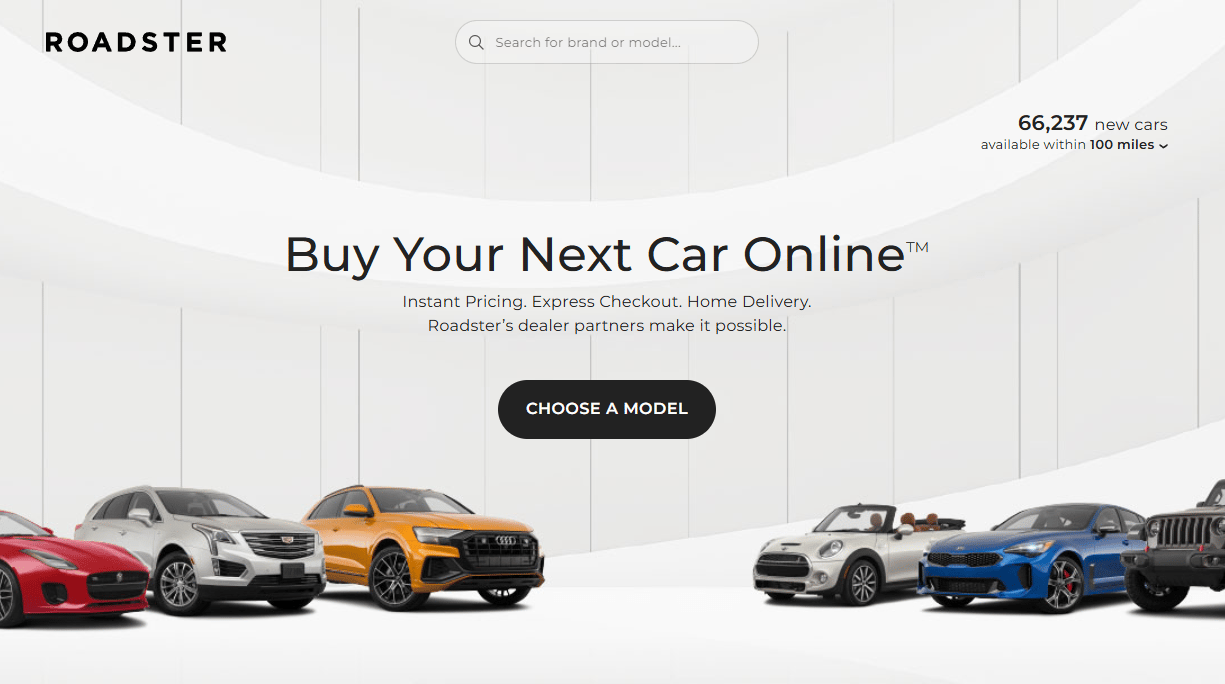
Roadster is a digital retailing platform for automotive dealerships that enables customers to configure deals and complete a substantial portion of the vehicle-purchase process online. Its Express Store product supports vehicle configuration, payment exploration, trade-in valuation, financing, soft-credit inquiry, and options for home delivery or in-store pickup. The platform connects shopper activity to dealer workflows, so deal details that begin online can transfer into the store.
Best for: Dealer groups that want a connected digital retail experience tied closely to in-store deal progression.
Key features
- Express Store online vehicle shopping and deal building
- Trade-in valuation and standalone trade submission
- Financing, soft-credit inquiry, and vehicle reservation
- Home delivery or in-store pickup options
- Google Analytics and Google Tag Manager integrations
Why choose Roadster: Choose Roadster when online-to-showroom continuity is the primary bottleneck. The platform is built around preserving deal context from the first payment estimate through the showroom handoff. Validate its current DMS and CRM integration coverage during a live proof-of-concept before committing.
Roadster pricing: Roadster does not display subscription pricing on its website. Contact the vendor for dealer package terms, onboarding fees, and any rooftop-level pricing structure.
2. AutoFi
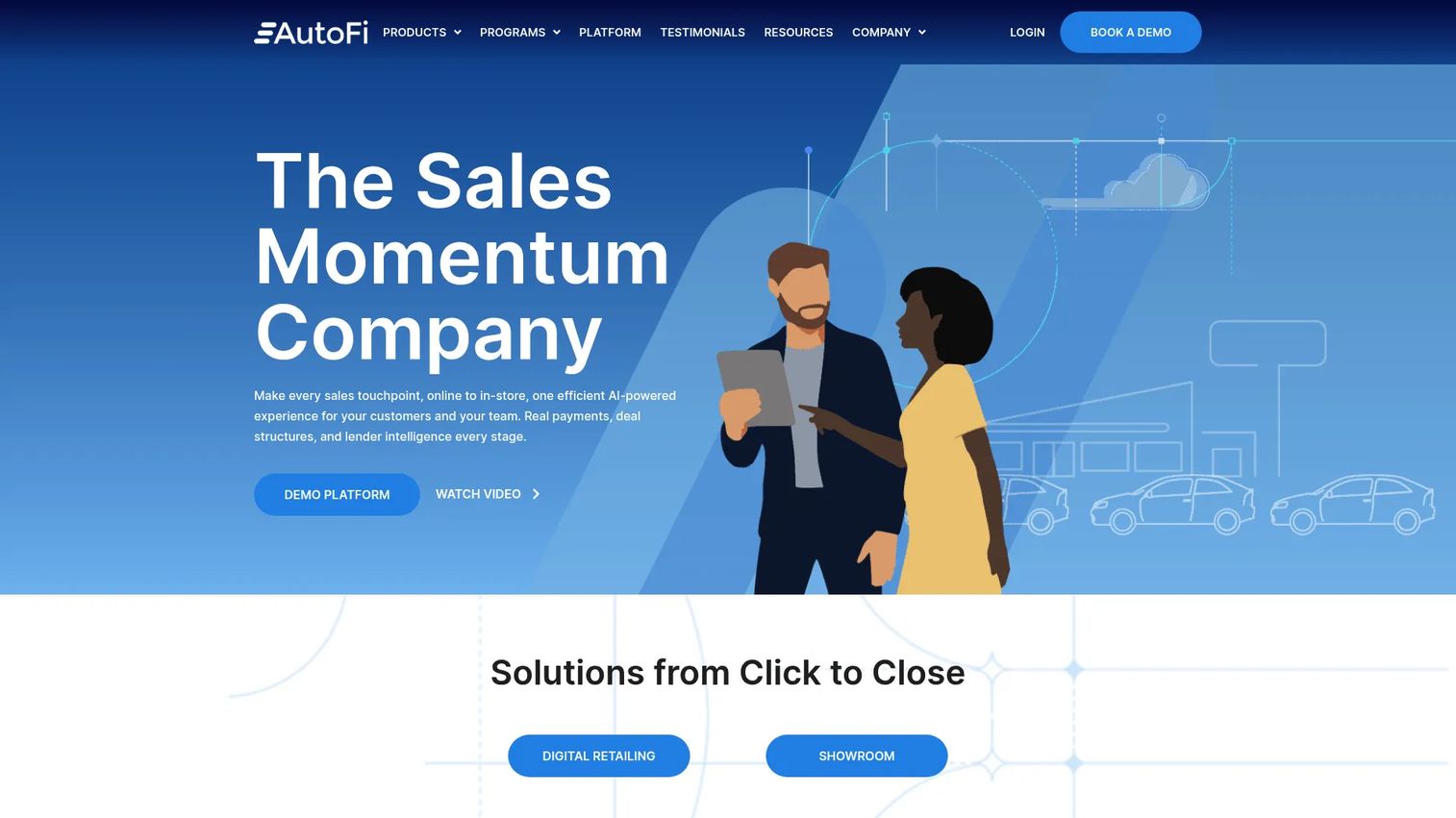
AutoFi is a sales platform that connects digital retailing and in-store showroom workflows for automotive dealerships and OEMs. The platform focuses on payment accuracy, incentive integration, and dynamic credit applications with instant finance decisioning. AutoFi's showroom component supports real-time lender routing and F&I product presentation alongside the digital deal.
Best for: Dealers that want more control over online payment scenarios and deal configuration, including accurate incentive and lender program application.
Key features
- Accurate pricing, incentives, payments, and trade-in values in the online deal
- Soft-credit affordability estimation with dynamic credit applications
- Real-time lender routing and instant finance decisioning
- F&I product presentation alongside deal structuring
- Showroom deal structuring connected to the online flow
Why choose AutoFi: AutoFi is a strong option when payment accuracy is the conversion problem. A payment quote that cannot survive an in-store review creates distrust and forces the desk to start over. Evaluate AutoFi alongside your current lender coverage and desking process to confirm the numbers will hold through to contract.
AutoFi pricing: AutoFi does not list subscription pricing on its website. Reach out to the vendor directly for dealer pricing, package options, and any transaction-level or rooftop-based terms.
3. CarNow
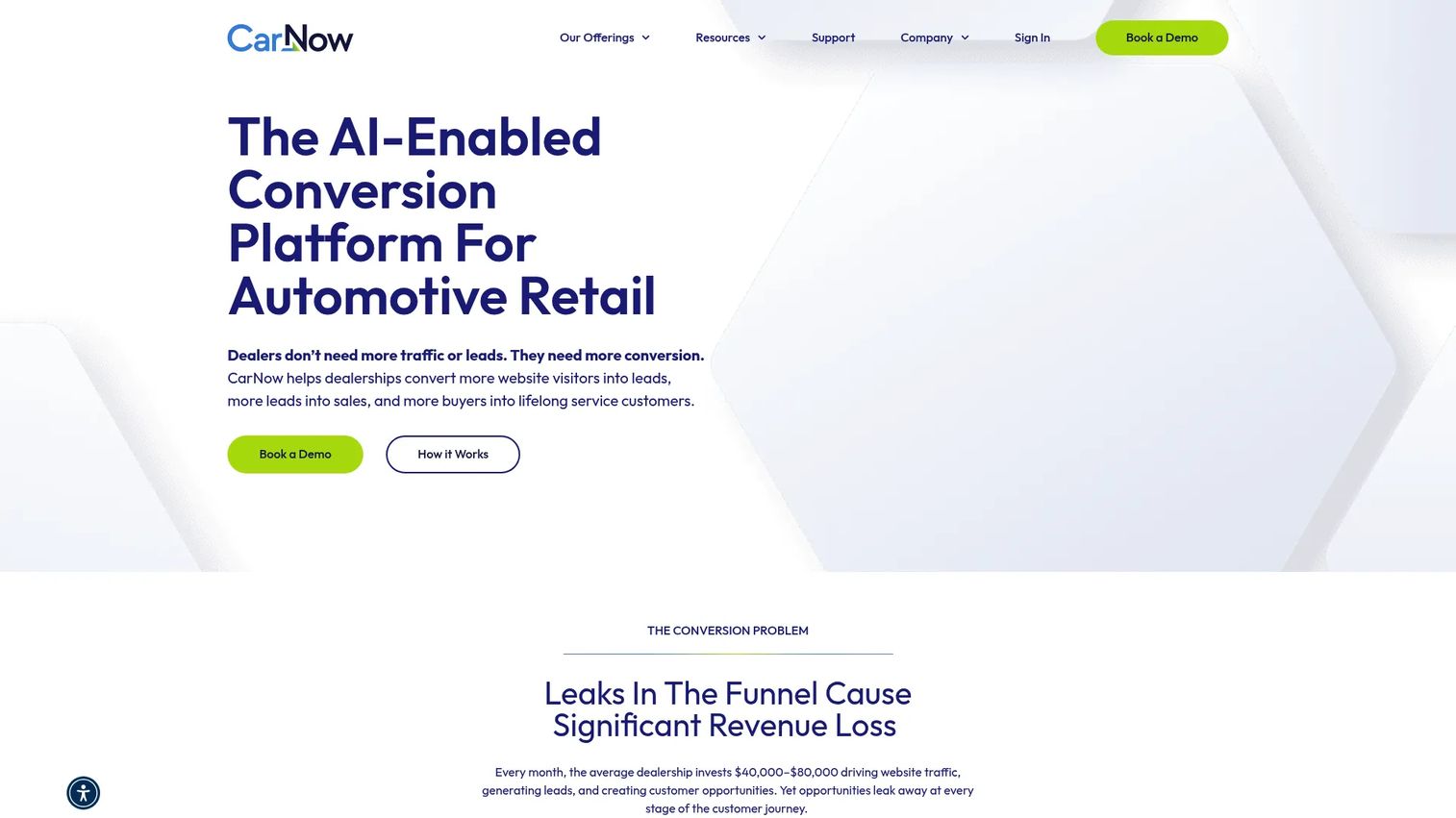
CarNow is an AI-enabled conversion platform for automotive dealerships that combines managed chat with digital retailing capabilities. Its Search by Payment feature lets shoppers filter inventory by monthly payment rather than by price, connecting browsing behavior to deal initiation. The platform also includes CRM-integrated lead follow-up, automated email and SMS campaigns, and AI conversation summaries.
Best for: Dealerships that want customer engagement, shopper messaging, and retail progress in a connected motion rather than separate point tools.
Key features
- AI-powered and professionally managed chat and messaging
- Search by Payment for payment-based inventory discovery
- Digital retail with trade valuation, payments, financing, and F&I integrations
- CRM-integrated lead follow-up with automated email and SMS
- AI conversation summaries and suggested replies
Why choose CarNow: CarNow fits stores where speed of response and guided shopper engagement are as important as self-service deal building. The platform removes the choice between chat and retailing by connecting both. Validate the depth of its F&I integration and lender coverage against your current stack before shortlisting.
CarNow pricing: CarNow does not display pricing on its website. Contact the vendor for current dealer terms and any location-based or module-based packaging.
CarNow holds a 5.0/5 rating on G2, based on 4 reviews (verified October 2026).
4. Gubagoo
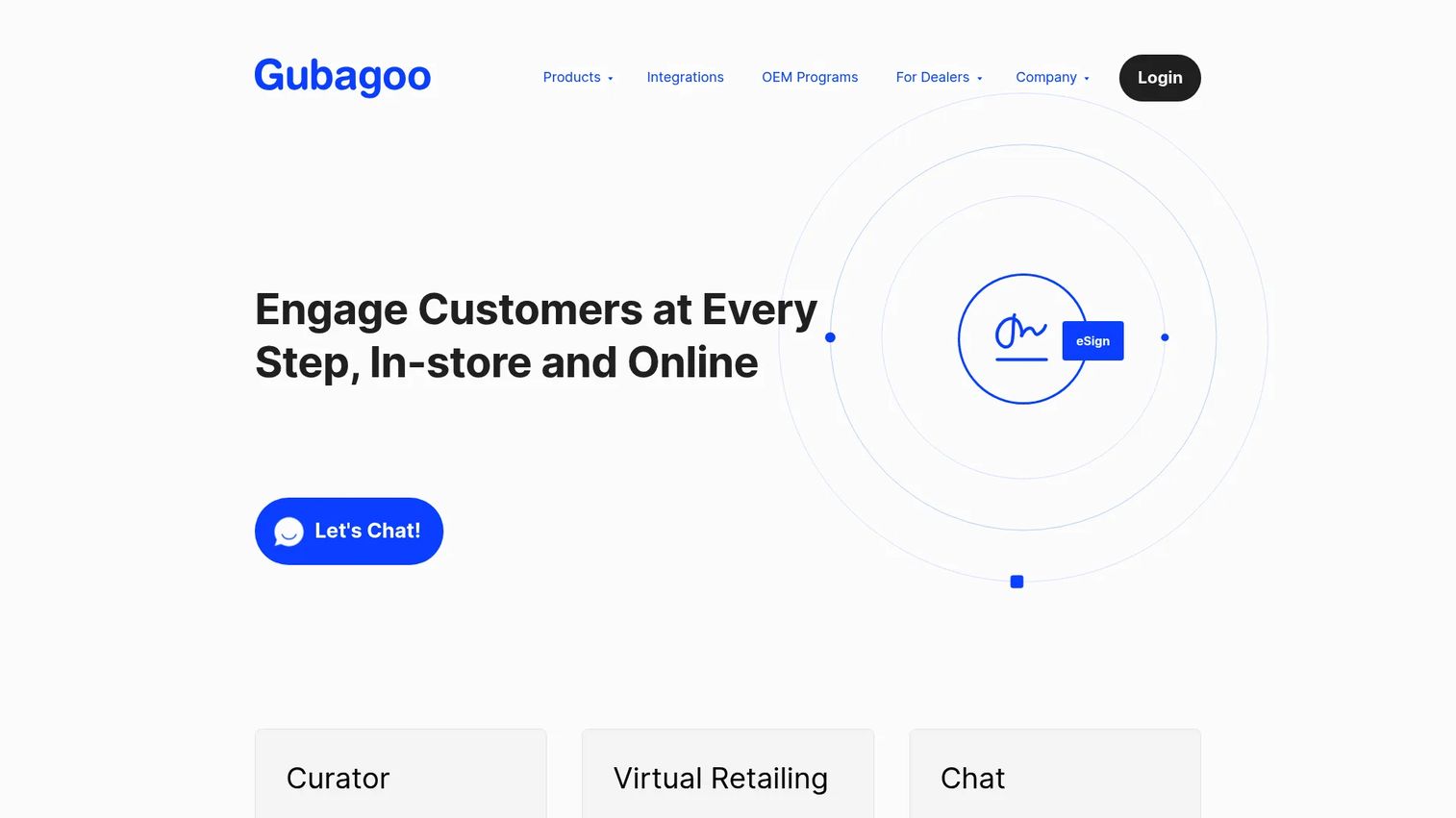
Gubagoo provides conversational commerce, digital retailing, and unified customer intelligence for automotive dealerships and OEMs. Its core offering combines AI-powered and human-assisted chat with a digital retailing suite that includes trade valuations, payment calculations, real-time lender approvals, desking, and F&I. The Curator layer adds data hygiene, identity resolution, audience activation, and attribution reporting on top of the engagement and retail workflow.
Best for: Dealers that want to connect customer conversations with an actionable retail workflow and gain account-level intelligence from shopper engagement data.
Key features
- AI-powered and human-assisted chat with opportunity scoring and mobile access
- Digital retailing with trade valuations, payment calculations, and real-time lender approvals
- Desking, F&I, and online-to-in-store deal continuity
- Curator data intelligence with identity resolution and attribution reporting
- Sales enablement, audience activation, and automated lead management
Why choose Gubagoo: Gubagoo is the right fit when stores struggle with slow response or lose context as shoppers move between web, chat, and physical visits. The Curator layer makes it worth evaluating for groups that want engagement data to feed CRM scoring and audience targeting. Ask the vendor to map the specific data flow between Curator and your existing DMS and CRM.
Gubagoo pricing: Gubagoo's website directs prospects to contact sales for pricing. The vendor does not display subscription tiers or per-location rates on its product pages.
Gubagoo holds a 4.3/5 rating on G2, based on 13 reviews (verified October 2026).
5. Darwin Automotive
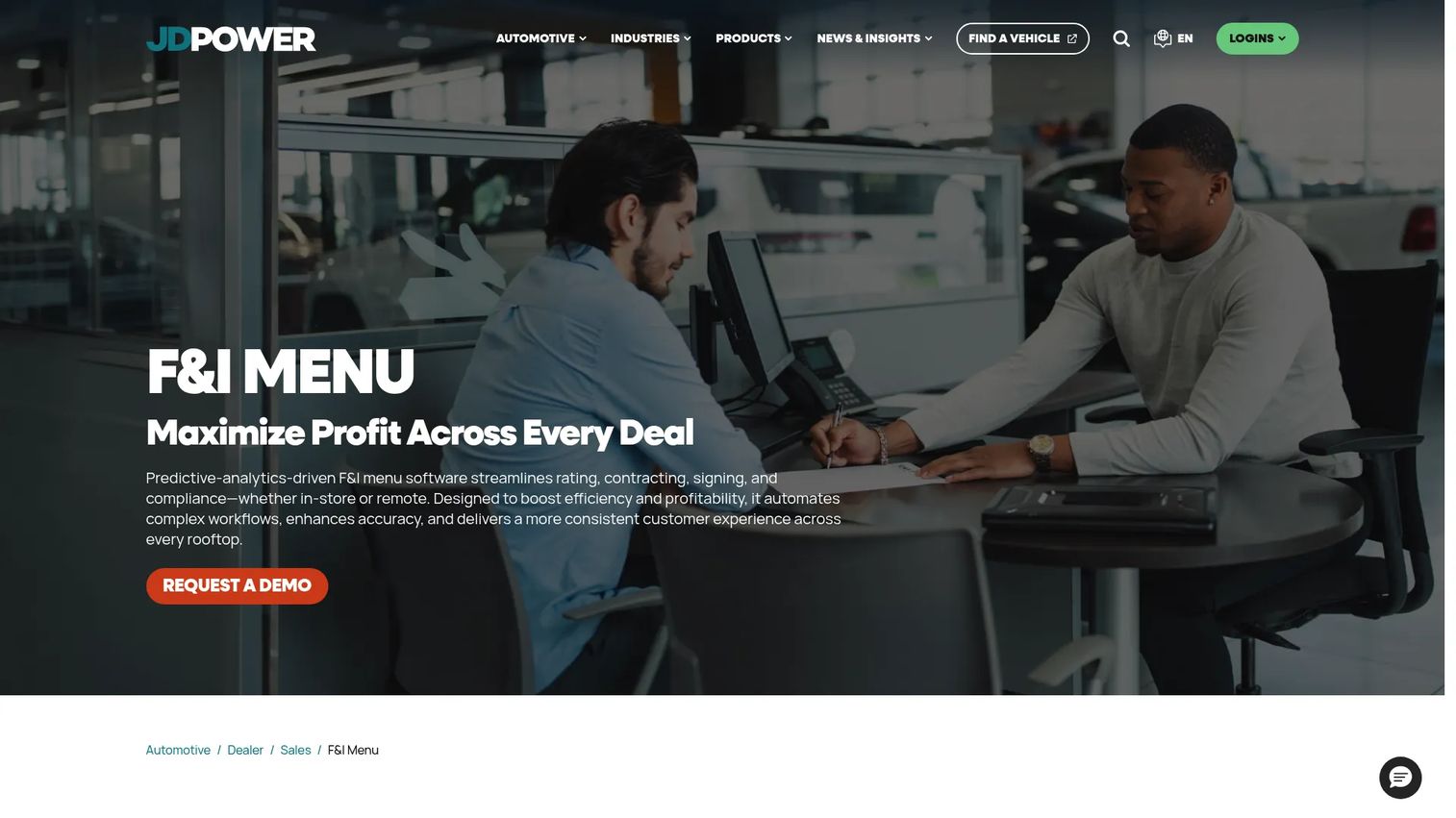
Darwin Automotive is an automotive F&I menu and digital retailing platform. Its predictive analytics engine drives F&I product recommendations, and the platform supports F&I rating, contracting, and e-signature workflows for both showroom and service-lane use cases. Darwin also covers remote and consumer-direct digital retailing, connecting the front-end shopping experience to the downstream F&I process.
Best for: Dealerships that want F&I product presentation, menu depth, and e-contracting embedded within their digital retailing workflow.
Key features
- Predictive-analytics-driven F&I product recommendations
- F&I rating, contracting, and e-signature workflows
- Service-lane F&I with repair order integration, e-rating, and e-contracting
- Remote and consumer-direct digital retailing
- Deal structure visibility across the transaction
Why choose Darwin Automotive: Darwin is the right shortlist candidate when F&I outcomes, not just lead volume, are the measure of digital retail success. The platform is built around getting product presentation and lender participation into the digital journey, not stopping at a contact form. Validate lender participation, specific state contracting support, and how submitted deals reach the F&I desk during your evaluation.
Darwin Automotive pricing: Darwin Automotive does not display pricing on its website. Contact the vendor for current rooftop or dealer-group pricing and module packaging terms.
Darwin Automotive does not have a verified G2 rating under its current product name at this time.
6. RouteOne Digital Retail
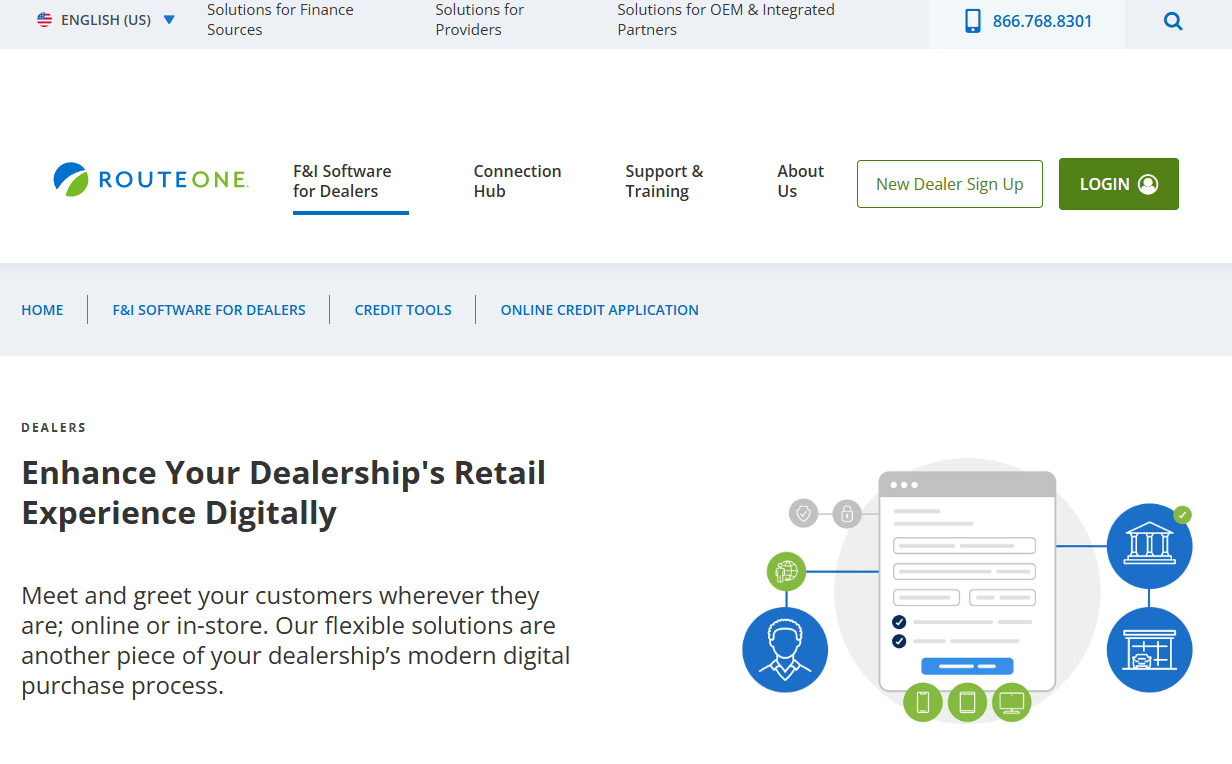
RouteOne Digital Retail provides online and in-store vehicle financing and purchase workflows for franchise dealerships. The platform offers three subscription levels (Basic, Standard, and Premium) and is built around RouteOne's existing lender network and dealer finance infrastructure. Capabilities include an embedded credit application, prequalification, trade-in valuation, payment calculation, F&I product selection, and processing through RouteOne Fusion.
Best for: Franchise dealers that need digital retailing connected to automotive finance, credit, and contracting processes, particularly those already using RouteOne for lender submissions.
Key features
- Embedded online credit application with responsive design and customizable branding
- Prequalification, trade-in valuation, and payment calculation
- F&I product selection and credit application processing through RouteOne Fusion
- Lead capture, web analytics, video guidance, and multilingual functionality
- Compliance-related documentation workflows
Why choose RouteOne Digital Retail: RouteOne's strength is finance workflow depth. The lender network coverage and the connection between the digital retail flow and credit processing are where this platform earns its place. Validate the specific lenders available in your market, confirm which states support digital contracting, and map how submitted applications reach your F&I office before treating the integration as complete. Describe what the platform supports operationally. Do not conflate workflow controls with regulatory compliance outcomes.
RouteOne Digital Retail pricing: RouteOne offers Basic, Standard, and Premium subscription tiers for Digital Retail Services. The core RouteOne product is available to dealerships at no charge; Digital Retail Services are subscription-based. Specific per-tier pricing is not displayed on the product page. Contact RouteOne for current rates.
RouteOne holds a 4.7/5 rating on G2, based on 11 reviews (verified October 2026).
7. Dealer Inspire Online Shopper
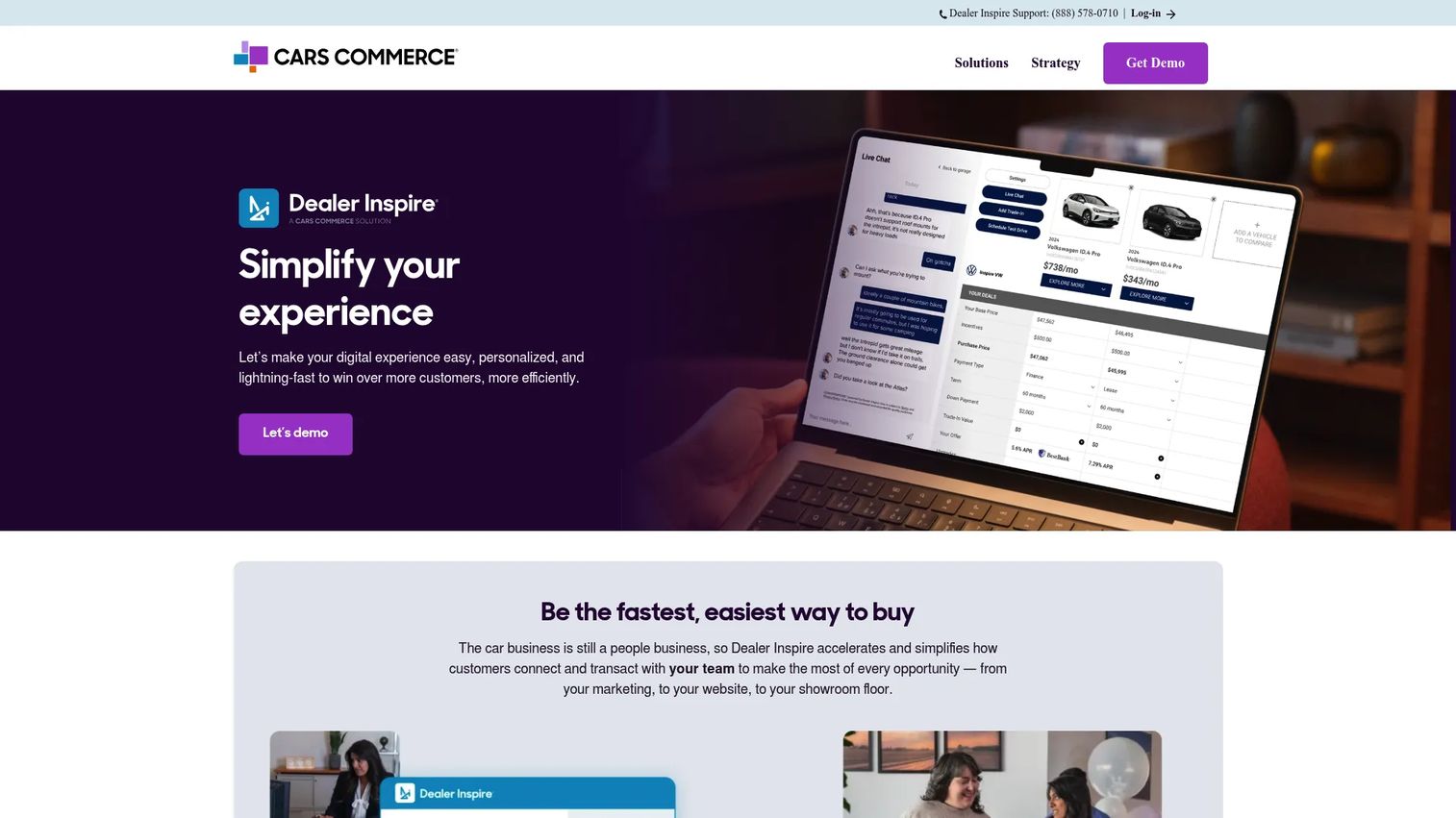
Dealer Inspire Online Shopper is digital retailing software that lets automotive shoppers customize payments, compare vehicles, estimate trade-in values, chat with dealers, and schedule pickup or delivery, all within the dealership website experience. It is part of Dealer Inspire's broader website and digital marketing infrastructure, which means the retail functionality lives natively alongside inventory, SEO, and campaign tools rather than as a separately embedded widget.
Best for: Dealer groups that want digital retailing embedded within their website and marketing stack, with fewer handoffs between the website vendor and the retail vendor.
Key features
- Customizable finance and lease payment options within the website
- Save and compare vehicles and payment details
- Instant trade-in value estimates
- Dealer chat and video chat
- Pickup or delivery scheduling
Why choose Dealer Inspire Online Shopper: The case for this platform is operational consolidation. If your dealership already uses or is evaluating Dealer Inspire for its website, adding Online Shopper removes the integration layer that typically sits between a website provider and a third-party digital retail vendor. Before treating website integration as equivalent to full workflow integration, confirm DMS, CRM, desking, and F&I connections with the vendor in a live demonstration.
Dealer Inspire Online Shopper pricing: Dealer Inspire does not display current pricing for Online Shopper as a standalone product on its website. Contact the vendor for package terms, bundling options, and any dealer-group or contract minimum requirements.
Dealer Inspire holds a 4.5/5 rating on G2 (verified October 2026). This rating reflects Dealer Inspire overall, not Online Shopper specifically.
8. Motoinsight
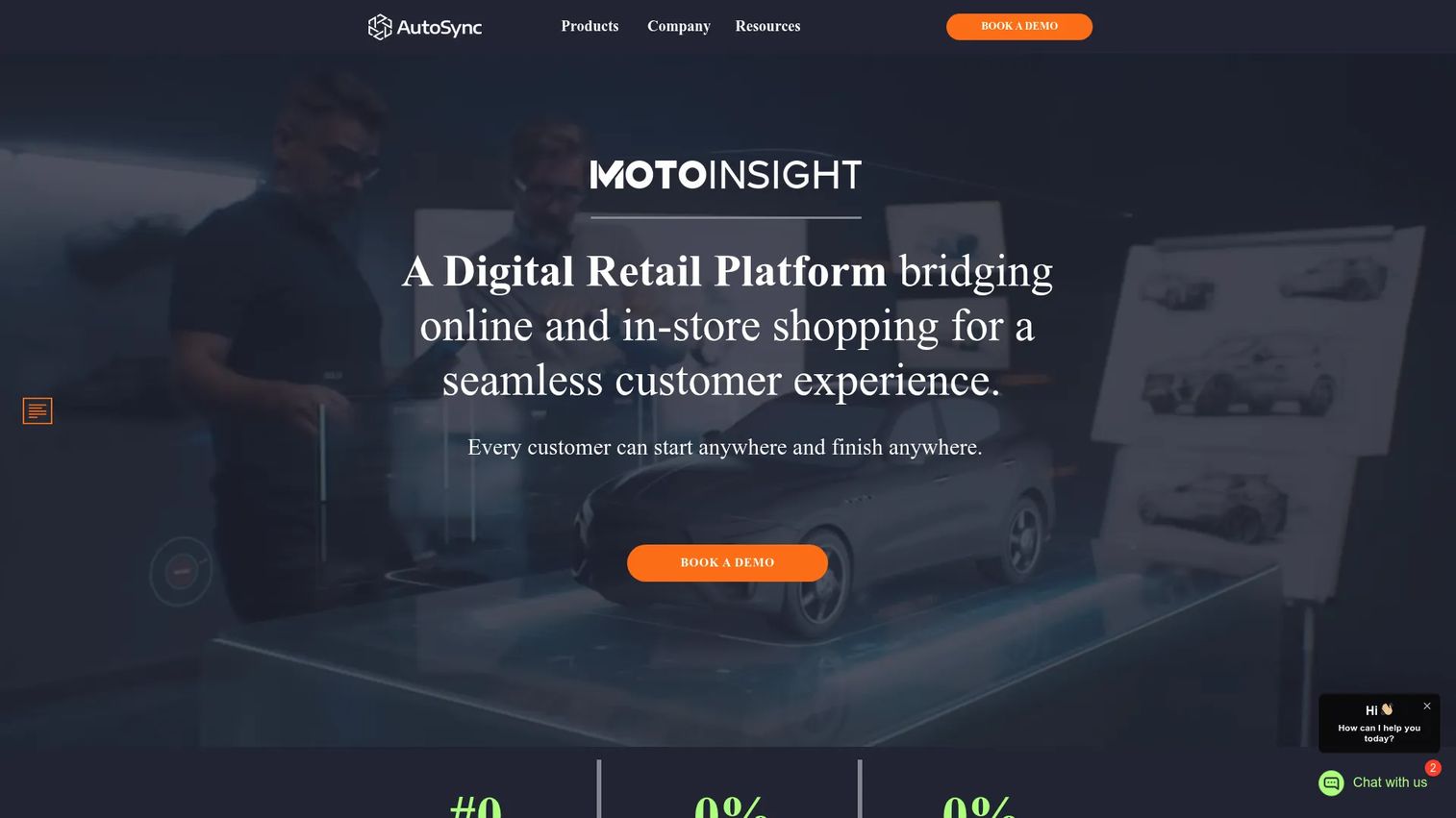
Motoinsight provides omnichannel automotive digital retailing for dealerships, OEMs, lenders, and automotive partners. The platform supports online and in-store vehicle shopping, payment calculators, trade-in tools, deposits, credit applications, and appointment scheduling. Virtual inventory and vehicle preorders extend the platform beyond physical stock, and automated customer notifications connect shopper activity to CRM records.
Best for: Automotive businesses that need configurable retail experiences across dealerships, OEMs, or partner networks, particularly where the deployment environment involves multiple stakeholders or brand governance requirements.
Key features
- Omnichannel online and in-store vehicle shopping
- Payment calculators, trade-ins, deposits, and credit applications
- Vehicle acquisition tools, virtual inventory, and vehicle preorders
- Automated customer notifications and CRM integration
- Customer journey analytics
Why choose Motoinsight: Motoinsight is the right evaluation candidate for firms that need a retailing workflow shaped around a specific brand standard, dealer network, or OEM partnership model rather than a single-store deployment. Configuration flexibility is its differentiator. Assess rollout time, governance requirements, and integration complexity against your actual deployment environment before signing a contract.
Motoinsight pricing: Motoinsight does not display pricing on its website and directs prospects to request a product demonstration. Contact the vendor for enterprise and partner pricing terms.
9. eLEND Solutions

eLEND Solutions is an automotive retail fintech platform connecting consumers, dealers, lenders, and finance data to support credit qualification, identity verification, and lender-matched deal structuring. The platform supports both hard-pull credit applications and soft-pull pre-qualification, giving dealerships the ability to structure deals around actual credit profiles before a shopper sets foot in the store. Identity verification includes driver-license authentication and DMV real-time verification.
Best for: Dealers that want to qualify and structure deals earlier through credit and finance workflows, reducing uncertainty before a shopper invests time in a visit.
Key features
- Lender-matched lease and finance payment scenarios across inventory and credit tiers
- Soft-pull pre-qualification and hard-pull credit applications with instant decisions
- Identity verification including driver-license authentication and DMV real-time verification
- Digital deal generation and CRM integrations
- Pre-desking matched to lender programs before showroom contact
Why choose eLEND Solutions: eLEND is the right choice when the bottleneck is deal uncertainty rather than shopper engagement. By qualifying buyers on credit profile and matching them to lender programs before the desk conversation, the platform reduces the gap between what the shopper expects and what the dealership can actually approve. The difference between pre-screen and pre-qualification carries legal and operational weight. Use current vendor documentation and legal review to define which workflow your store will run.
eLEND Solutions pricing: eLEND Solutions does not display subscription or package pricing on its website. Contact the vendor for current dealer pricing and any per-transaction or per-location terms.
eLEND Solutions holds a 4.5/5 rating on G2, based on 2 reviews (verified October 2026).
Considerations when choosing an automotive digital retailing platform
Integration depth beats feature count
Ask each vendor to map the data flow between their platform and your DMS, CRM, desking tool, lender network, and F&I system. A long feature list cannot offset a workflow that requires manual reentry at the desk or the F&I office. Request a demonstration using your actual systems, not a generic environment.
Payment accuracy and pricing governance
Verify how each platform handles taxes, fees, incentive programs, lender-specific rates, trade-in values, and F&I selections. The shopper-facing payment must match the terms your dealership can honor when the buyer arrives. A discrepancy at the desk undoes the digital experience entirely.
Online-to-store deal continuity
Test what a salesperson, desk manager, and F&I manager can see after a shopper saves or submits a deal. Require a live workflow demonstration. The useful question is not whether continuity is technically possible but whether your current store staff can access and act on the deal record without additional training or rekeying.
Rollout model for dealer groups
Evaluate whether the platform supports location-specific pricing rules while still giving the corporate team consistent reporting, permission controls, and governance tools. A single-rooftop pilot that performs well does not prove dealer-group readiness. Ask for references from groups with a comparable number of rooftops and a similar DMS mix.
Measurement tied to revenue operations
Track beyond lead volume. Completed payment scenarios, trade submissions, credit starts, appointment conversion rates, deal completion rates, and staff intervention points all give a clearer picture of platform value than raw form fills. Connect platform analytics to your CRM and reporting stack before measuring impact. Platforms that support this kind of granular tracking are also covered in guides to compliance management software and best ecommerce platforms for operational benchmarking.
Conclusion
Automotive digital retailing is fundamentally a continuity decision. The platform you choose either preserves buyer intent from the first payment estimate through the showroom handoff, or it creates a second workflow your store team has to reconstruct.
Each of the nine platforms covered here owns a different part of that problem:
- Roadster for connected deal progression from online to store
- AutoFi for payment accuracy and deal configuration
- CarNow for AI-enabled engagement tied to retail workflow
- Gubagoo for chat-connected retail and customer data intelligence
- Darwin Automotive for F&I menu depth and e-contracting
- RouteOne Digital Retail for credit, finance, and lender-network integration
- Dealer Inspire Online Shopper for website-native retailing
- Motoinsight for configurable OEM and dealer network deployments
- eLEND Solutions for credit-first, pre-desking deal qualification
The most useful next step is a single-vehicle, single-customer scenario run through each finalist. Start from a payment quote, carry it through a trade submission and credit start, and verify what the sales desk and F&I manager see at handoff. That test will tell you more than any demo in a controlled environment.
For operators and automotive software founders looking to understand adjacent software categories, the car dealer software guide covers the broader dealer technology stack, and the best ecommerce platform for small business roundup provides useful framing for evaluating commerce workflows outside automotive.
Start your journey with Guideflow today!
FAQs
Automotive digital retailing is software that helps car dealerships support vehicle shopping, deal building, payment calculation, trade-in valuation, financing, F&I presentation, and contracting across digital channels. The goal is to let shoppers progress a real transaction online and continue it without interruption when they arrive at the store. Capabilities vary significantly by platform, with some covering the full deal flow and others focusing on specific steps such as credit or engagement.
A dealership website publishes inventory and captures shopper interest, typically through contact forms or chat. A digital retailing platform lets the shopper progress actual transaction details: Payment scenarios, trade submissions, credit applications, and F&I selections. Some providers, such as Dealer Inspire, combine both. In most cases, they are separate systems that require integration to share deal data.
Some platforms support more of the transaction than others, but whether a buyer can complete an entire purchase online depends on state regulations, lender participation, contracting capabilities, dealer policy, and the platform's specific integration coverage. For most dealerships, the more achievable near-term goal is a continuous deal record that travels from the digital channel into the showroom rather than a fully self-service purchase.
At minimum, verify DMS integration (which data flows in each direction and at which stage), CRM lead routing, inventory synchronization, desking tool connectivity, lender network coverage, trade-in valuation data, F&I system connection, and e-contracting support. Ask each vendor for a specific data-flow map rather than a generic logo grid. Integration claims that cannot be demonstrated in a live environment with your actual systems should not be counted. Related guidance on evaluating software integrations appears in the compliance automation software guide.
Most platforms collect vehicle information from the shopper, apply valuation data from a third-party source, and calculate payments using dealer-configured pricing rules and lender programs. The accuracy of those quotes depends on how current the incentive and lender data is, how well the platform applies local tax and fee rules, and whether the trade value reflects mileage, condition, and regional market pricing. Test with a real vehicle and a real buyer scenario against your store's actual pricing to verify that the quote will hold at the desk.
Structured shopper actions provide more actionable intent data than generic contact forms. A buyer who has saved a specific payment, submitted a trade, or started a credit application has demonstrated real purchase intent. That signal lets BDC and sales teams prioritize follow-up based on deal progress rather than treating every form fill equally. The quality improvement depends on whether the platform captures and transfers that structured data to the CRM in a usable format.
Assess location-specific configuration options, user permissions and access controls, data consistency across rooftops, group-level reporting, change management support, integration complexity at each site, and the vendor's support capacity for a multi-location rollout. Confirm whether location-level business rules (local fees, regional incentive programs, store-specific trade policies) can be applied without overriding the group-level configuration. A pilot at one store is a starting point, not proof that the platform scales to the group. The best product management tools guide covers evaluation frameworks that translate well to complex software rollout decisions.
No. The software handles self-service and reduces the amount of repetitive data collection that happens during a store visit. Store teams still guide complex decisions, verify deal details, manage exceptions, handle trade negotiations, and complete the relationship-driven parts of the purchase. F&I managers in particular remain central to product presentation, compliance documentation, and lender submission. The platform's job is to give those team members a better starting point, not to replace the conversation.