You inherited a pricing model with 40 linked spreadsheets. One tab feeds the next. A junior analyst changed an assumption three weeks ago and nobody logged it. Now the valuation numbers don't tie out, close is in four days, and you cannot trace which cell broke. Sound familiar?
Spreadsheet sprawl is still how a surprising amount of pricing, valuation, and reserving work gets done. It works until it doesn't. Hidden assumptions, brittle links, slow reruns, and audit trails that live in someone's memory turn every reporting cycle into a fire drill. The moment a regulator, an auditor, or a board member asks "how did you get this number," the whole thing wobbles.
Purpose-built actuarial software exists to remove that fragility. Insurers running advanced actuarial modeling platforms report a 65% reduction in model development time and 40% faster regulatory reporting versus legacy approaches, according to Finantrix (2025). That same research found 73% of insurers plan to modernize their actuarial platforms by 2027. The market is moving, and the reason is simple: manual workflows can't keep pace with IFRS 17, Solvency II, and LDTI demands while staying auditable.
This guide ranks 10 actuarial modeling software options for 2026. The angle is decision support, not vendor marketing. We focus on what matters when you actually have to run pricing, valuation, ALM, reserving, and reporting under governance pressure: transparency, workflow depth, integrations, performance, and enterprise readiness.
What's inside
This is a buyer's shortlist for actuarial software covering pricing, valuation, ALM, reserving, regulatory reporting, and model governance. It's written for actuarial leaders, pricing teams, model governance stakeholders, and technical buyers who are past the "why modernize" stage and into the "which platform" stage.
We selected and ranked platforms on five criteria that separate a real modeling system from a glorified calculator:
- Transparency and explainability: can you trace every assumption, formula, and result?
- Workflow depth: does it cover data prep through deployment and reporting?
- Integrations: does it connect to your data platforms, including Snowflake and APIs?
- Performance and scalability: does it handle stochastic runs and large model points?
- Enterprise readiness: governance, auditability, versioning, and regulatory support.
TL;DR
- Best for transparency and explainability: Slope Software, with visible assumptions, formulas, and results plus cloud-native projection speed.
- Best for governed enterprise analytics: SAS, for large teams needing an integrated, AI-assisted actuarial lifecycle.
- Best for custom actuarial builds: SCN Soft (ScienceSoft), when off-the-shelf can't match non-standard requirements.
- Best for enterprise regulatory modeling: Prophet, for insurers running IFRS 17, Solvency II, and local GAAP at scale.
- Best for life and annuity modeling: AXIS, covering pricing, reserving, ALM, and capital in one configurable system.
- Best for capital and reinsurance decisions: Tyche, for economic capital modeling and reinsurance optimization.
What is actuarial software?
Actuarial software is a specialized platform that lets insurance and actuarial teams build, run, govern, and report on financial models for pricing, valuation, reserving, asset-liability management (ALM), and regulatory compliance. It replaces spreadsheet-based workflows with a controlled environment where assumptions, formulas, projections, and results are traceable and repeatable.
What it does:
- Runs deterministic and stochastic projections across cash flows, reserves, and capital.
- Manages assumptions, models, and versions with audit trails.
- Produces regulatory and board-ready reporting outputs.
Common users:
- Pricing actuaries setting or revising rate structures.
- Valuation and reserving teams closing the books each period.
- Model governance and risk functions signing off on results.
- Finance and reinsurance teams collaborating on capital and ALM.
Core workflows: data prep, assumption setting, model build, projection runs, model validation, scenario testing, reporting, and deployment.
Key capabilities: transparency and formula tracing, versioning, governance controls, performance at scale, integrations with data warehouses and APIs, and regulatory support.
Regulatory relevance: strong actuarial modeling software directly supports IFRS 17, Solvency II, and LDTI workflows, where consistency, traceability, and auditability are not optional. When a regulator asks how a figure was derived, the software should answer in minutes, not days.
When to use actuarial software
Not every task needs a full modeling platform. But three situations make dedicated actuarial software the clear call over spreadsheets.
Pricing new products or revising rate structures
Pricing is where assumptions change constantly. New mortality tables, updated lapse studies, revised expense loads, shifting interest scenarios. When your assumptions move weekly, you need a system that lets you swap them without rebuilding the model, and one that logs what changed and when. Insurance modeling software gives you scenario testing on demand, faster reruns, and full traceability so you can defend every rate you file. Speed matters here, but defensibility matters more.
Running valuation, reserving, and ALM at scale
Valuation, reserving, and ALM are repeatable by design, which is exactly why manual workflows hurt. You need repeatable projections that produce identical results given identical inputs, plus audit trails that survive scrutiny. As portfolios grow, performance and scale become gating factors. Multi-team collaboration adds another layer: pricing, valuation, and finance often touch the same models, so model governance and versioning keep everyone working from one source of truth instead of five conflicting copies.
Preparing regulatory and board-ready reporting
IFRS 17, Solvency II, and LDTI reporting punish inconsistency. A number that ties out in one report but not another triggers questions you don't want. Actuarial software enforces consistency across outputs, supports model validation, and gives you reporting confidence because the lineage from assumption to result is visible. When close compresses to days, the difference between a governed platform and a spreadsheet chain is the difference between a calm review and a scramble.
Comparison table
Here's how the 10 platforms compare on intent, differentiation, pricing, and public ratings. Pricing for enterprise actuarial software is almost always quote-based, so several entries reflect that reality rather than a missing figure.
| # | Product | Intent | Key differentiation | Pricing | G2 rating |
|---|---|---|---|---|---|
| 1 | Slope Software | Transparent cloud-native modeling | Visible assumptions, formulas, and results with fast projections | Quote-based | Not available |
| 2 | SAS | Governed enterprise analytics | Integrated data, AI, and reporting lifecycle | By quote; free trials offered | 4.3/5 |
| 3 | SCN Soft (ScienceSoft) | Custom actuarial builds | Bespoke insurance software and IT consulting | From $150,000–$400,000+ per project | 4.7/5 |
| 4 | DevOpsSchool | Research and skills enablement | Training resource, not a modeling vendor | From $10/month | Not available |
| 5 | Prophet | Enterprise regulatory modeling | IFRS 17, Solvency II, and GAAP with GPU execution | Contact sales | Not available |
| 6 | AXIS | Life and annuity modeling | Pricing, reserving, ALM, and capital in one system | Contact sales | Not available |
| 7 | MoSes | Projection and liability modeling | Actuarial and statistical computation depth | Contact vendor | 3.8/5 |
| 8 | RiskAgility FM | Financial modeling for insurers | Open modeling language with debugging tools | Contact WTW | Not available |
| 9 | MG-ALFA | Actuarial projections and reporting | Milliman modeling for pricing and risk | Contact sales | Not available |
| 10 | Tyche | Capital and reinsurance modeling | Economic capital and reinsurance optimization | Contact Aon | Not available |
1. Slope Software
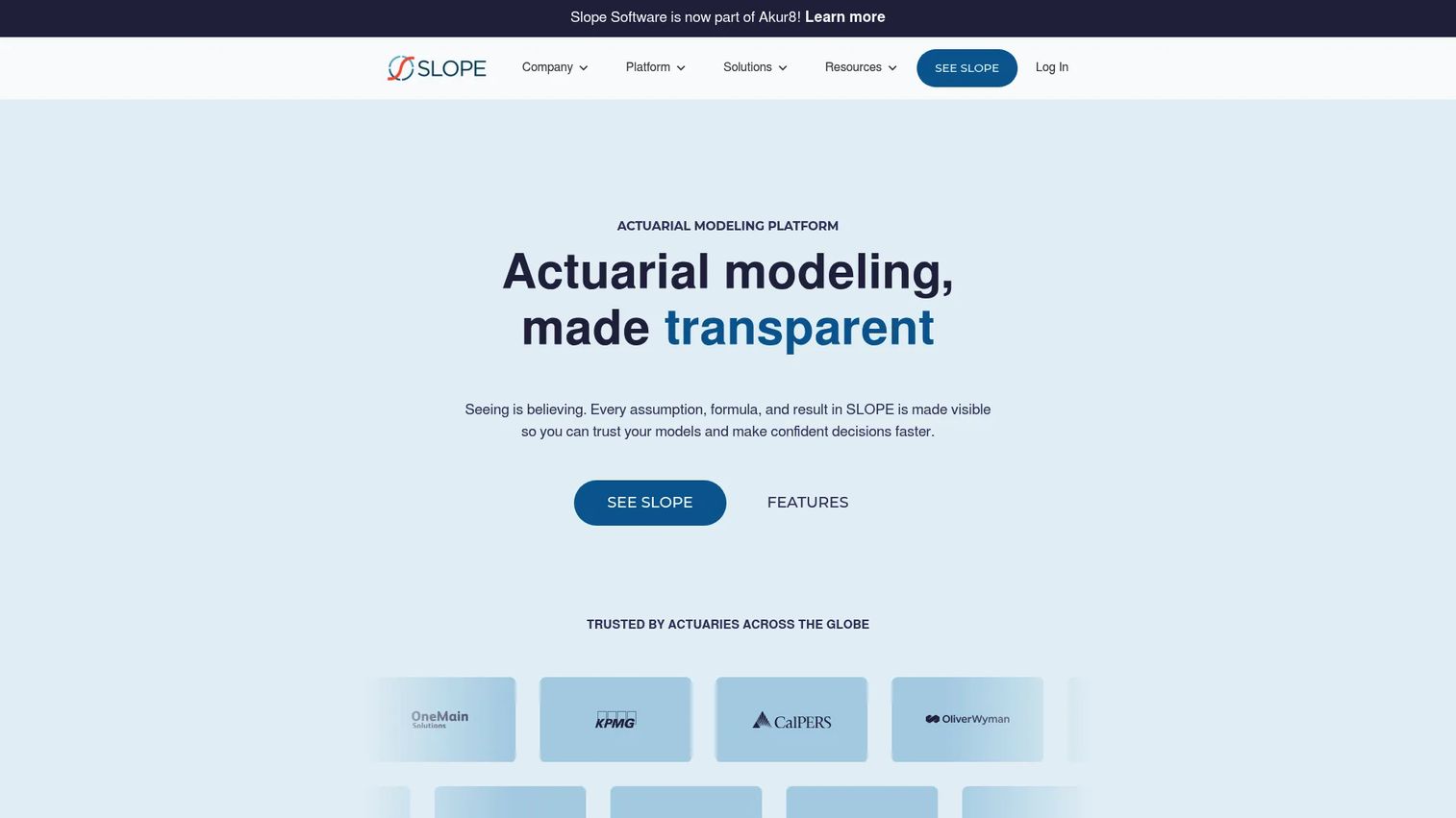
Slope Software is a cloud-native actuarial modeling platform built around one idea most legacy tools bury: you should be able to see everything. Assumptions, formulas, and results are visible rather than locked inside compiled logic, which makes debugging a model point a matter of navigation instead of guesswork. For teams that have spent hours reverse-engineering a spreadsheet, that visibility is the whole pitch.
The platform handles pricing and valuation workflows with projections, embedded reporting, and assumption management under governance. Because it's cloud-native, projection speed and scalability come without infrastructure overhead on your side. When something looks off, you trace dependencies through the model rather than opening ten linked files.
Best for: actuarial teams that want visibility into every assumption and output across pricing and valuation.
Key strengths
- Transparent calculations: Assumptions, formulas, and results stay visible for formula tracing and fast debugging.
- Projections with embedded reporting: Run projections and generate reporting in one governed environment.
- Models and assumption governance: Manage models, assumptions, and versions with clear controls.
Why choose Slope Software: If explainability and auditability rank at the top of your list, this is the strongest fit on the list. It's built for teams tired of black-box models and manual traceability. The cloud-native design suits groups that want projection performance without managing servers.
Slope Software pricing: Slope Software does not publish a public price. Its pricing page is structured around use cases with demo requests, so expect a quote-based conversation tied to your team size and workflow scope.
2. SAS
SAS brings a governed, end-to-end analytics lifecycle to actuarial work. It covers data management, exploratory analysis, model development, and production deployment, which makes it a fit for large insurance teams that want pricing, valuation, and reporting connected inside one governed environment rather than stitched across tools. AI-assisted modeling and optimization sit alongside traditional actuarial methods.
The strength here is integration and governance. Data lineage, model governance, and collaboration are core rather than bolted on, so cross-functional teams can work the same models with control. For organizations already running SAS elsewhere, the actuarial workflow slots into an existing, trusted stack.
Best for: large organizations needing governed analytics, AI-assisted modeling, and integrated reporting.
Key strengths
- Data management and governance: Controlled data prep and lineage across the modeling lifecycle.
- Visual analytics and reporting: Exploratory analysis and reporting in one platform.
- Machine learning and model development: AI-assisted modeling alongside actuarial methods.
Why choose SAS: Pick SAS when you need a governed lifecycle from data prep to deployment and your team values collaboration and traceability at scale. It fits enterprises where model governance and reporting confidence outweigh the appeal of a lighter, single-purpose tool.
SAS pricing: SAS handles most software pricing by request or quote, with some products available in its store. It offers free trials and free academic resources, though there is no permanently free software plan. SAS holds a 4.3/5 rating on G2.
3. SCN Soft (ScienceSoft)
SCN Soft, branded ScienceSoft, is an IT consulting and custom software development firm rather than an off-the-shelf modeling product. That's exactly why it belongs on this list. When your requirements don't match any packaged tool, a custom build covering data ingestion, scenario testing, reserving, pricing, reporting, and compliance can fit your workflow instead of forcing your workflow to fit the software.
ScienceSoft builds industry-specific insurance actuarial software with integrations into your existing data pipelines and predictive analytics where useful. The trade-off is time and cost versus a ready platform, but for teams with non-standard reserving logic or unusual reporting needs, bespoke coverage is the point.
Best for: enterprises needing custom insurance actuarial software or IT consulting for non-standard requirements.
Key strengths
- Custom software development: Tailored builds for pricing, reserving, reporting, and compliance.
- IT consulting: Advisory support across architecture, data, and integrations.
- Industry-specific solutions: Insurance-focused development with predictive analytics options.
Why choose SCN Soft: Choose ScienceSoft when a packaged platform can't match your requirements and you'd rather build to spec. It fits teams with unusual workflows, deep integration needs, or a mandate to own the software outright.
SCN Soft pricing: ScienceSoft publishes pricing models and cost calculators, with custom software projects reported in the $150,000 to $400,000+ range depending on scope. Many engagements require a tailored quote. It holds a 4.7/5 rating on G2.
4. DevOpsSchool
DevOpsSchool is not an actuarial modeling vendor. It's an online training and certification provider, and it earns a spot here for a different reason: comparison and educational content is where many buyers start their shortlist. If you're building the internal case for a platform, structured comparison sources help you frame selection criteria, use cases, and an evaluation framework before you talk to vendors.
Treat DevOpsSchool as a research and skills-enablement resource, not a modeling tool. It's useful for teams that need to level up technical or data-engineering skills that support an actuarial platform rollout, and for researchers synthesizing how the market lines up.
Best for: researchers and teams building a shortlist or upskilling around a platform rollout.
Key strengths
- Training and certification: Structured DevOps and technical courses.
- Flexible learning formats: Self-paced, live interactive, and mentorship options.
- Hands-on labs and LMS access: Practical projects and platform access.
Why choose DevOpsSchool: Use it when you need to build technical or data-engineering capability around an actuarial platform, or when you want an external comparison framing to structure your own evaluation. It's a supporting resource, not the software you'll model in.
DevOpsSchool pricing: Public pricing starts at $10/month for self-paced video access billed yearly at $120. Live and interactive programs are priced around $419, and some pages list a higher 1-on-1 mentorship option.
5. Prophet
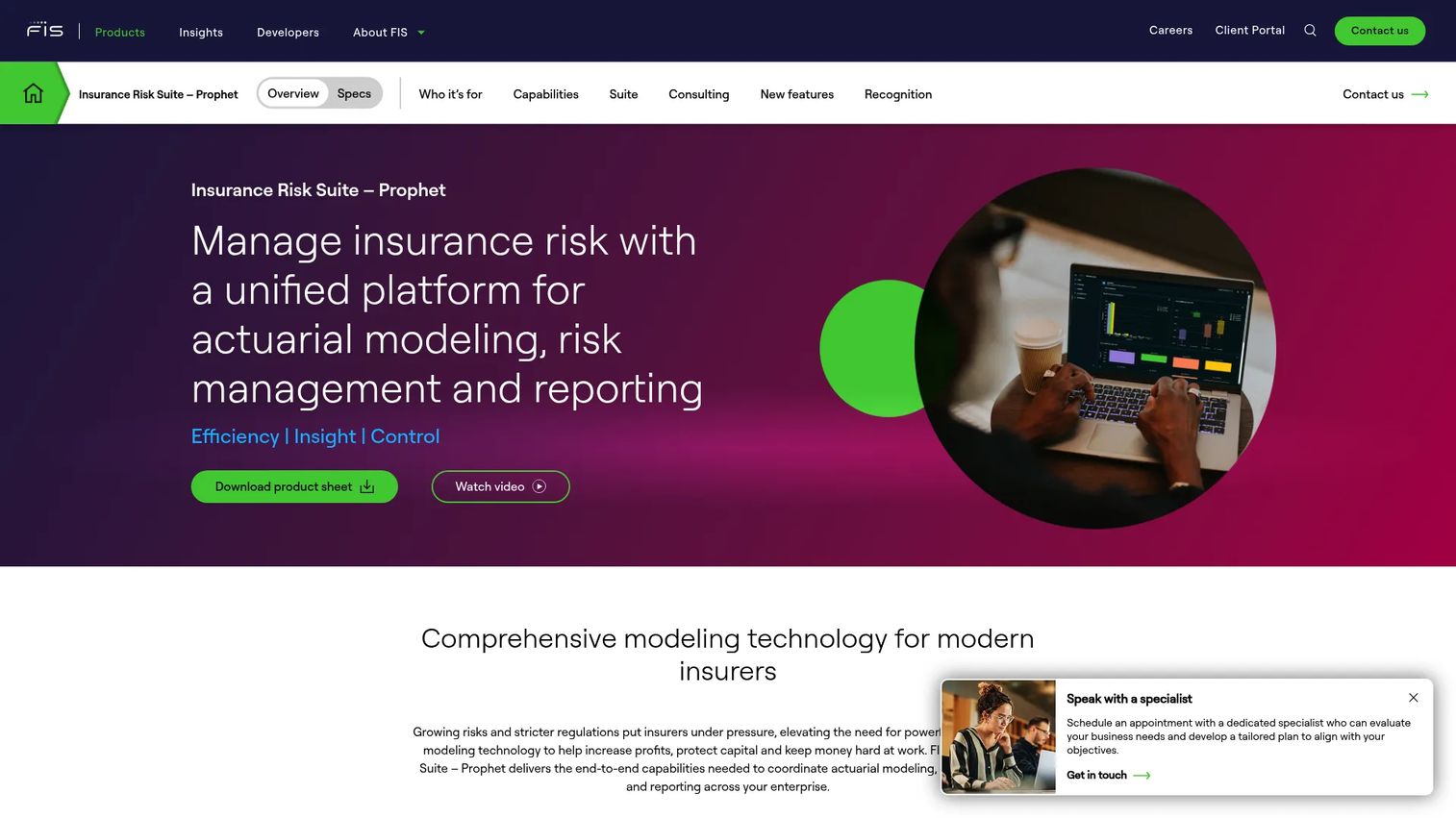
Prophet, part of the FIS Insurance Risk Suite, is a unified actuarial modeling, risk management, and reporting platform with deep roots in enterprise insurance. It's a familiar name in actuarial stacks for good reason: it handles deterministic and stochastic scenario modeling and supports IFRS 17, Solvency II, and local GAAP reporting in one place.
Performance is a headline feature. Parallel CPU and GPU execution with workflow automation lets large insurers run heavy stochastic workloads within reporting windows. For teams whose primary pressure is regulatory reporting at scale, that combination of modeling depth and compute is the draw.
Best for: insurers needing enterprise actuarial modeling and multi-framework regulatory reporting.
Key strengths
- Deterministic and stochastic modeling: Broad scenario coverage for pricing, valuation, and capital.
- Multi-framework reporting: IFRS 17, Solvency II, and local GAAP support.
- Parallel CPU/GPU execution: Workflow automation and compute for heavy runs.
Why choose Prophet: Choose Prophet when regulatory reporting across multiple frameworks and stochastic performance are your top requirements. It fits established insurers with large portfolios and demanding close cycles.
Prophet pricing: FIS handles Prophet pricing through sales contact, with no public price on the product page. Expect a quote scoped to your modeling scale and reporting needs.
6. AXIS
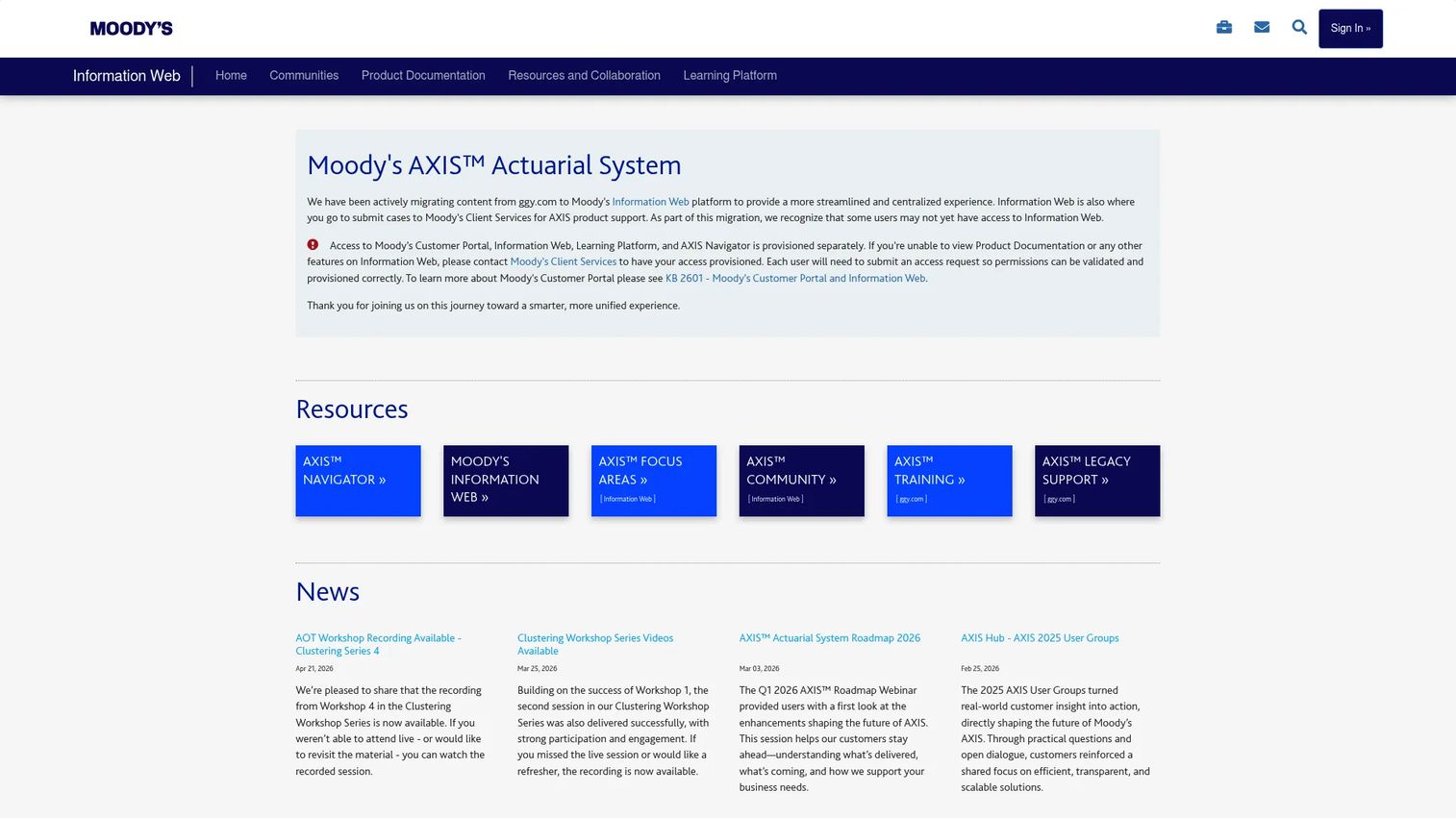
AXIS, from Moody's, is an actuarial modeling and analytics system for life insurers, reinsurers, and consultants. Its range is broad: pricing, reserving, ALM, financial modeling, capital calculations, and hedging all live in one modular platform. Teams turn on the modules they need rather than buying capability they won't use.
The system produces detailed monthly cash-flow projections spanning up to 100 years, with reporting, stochastic, and enterprise modules layered on top. That depth makes it a common backbone for life and annuity actuarial work where long-horizon projections and capital calculations sit at the center of the workflow.
Best for: large insurers and actuarial teams needing a configurable life and annuity modeling platform.
Key strengths
- Broad actuarial coverage: Pricing, reserving, ALM, financial modeling, capital, and hedging.
- Long-horizon projections: Detailed monthly cash flows up to 100 years.
- Modular architecture: Reporting, stochastic, and enterprise modules as needed.
Why choose AXIS: Pick AXIS when life and annuity modeling with long-horizon projections and capital calculations is central to your work. Its modular licensing suits teams that want to scope capability to actual use.
AXIS pricing: AXIS uses module-based, quote-driven licensing. No public price appears on the site, so pricing follows a contact-sales conversation scoped to the modules you need.
7. MoSes

MoSes, an actuarial and statistical software from Towers Watson, is evaluated by teams that value projection workflows and computational depth. It has a long history in liability modeling and scenario analysis, and it remains a recognized name among actuaries who need flexible model logic for complex projections.
Teams look at MoSes when computation depth and modeling flexibility are the priority, and when governance and reporting are part of the workflow. Its familiarity in certain actuarial circles, particularly pension and statistical modeling, keeps it on shortlists for teams with those specific needs.
Best for: pension actuaries and teams prioritizing statistical and liability modeling depth.
Key strengths
- Projection workflows: Structured modeling for liability and cash-flow projections.
- Scenario analysis: Flexible logic for complex scenario testing.
- Computational depth: Statistical modeling capability for detailed work.
Why choose MoSes: Consider MoSes when projection and liability modeling depth matters and your team has experience with its modeling approach. It fits pension and statistical use cases where computational flexibility is the priority.
MoSes pricing: No public pricing is available; access is arranged through vendor contact. MoSes holds a 3.8/5 rating on G2.
8. RiskAgility FM
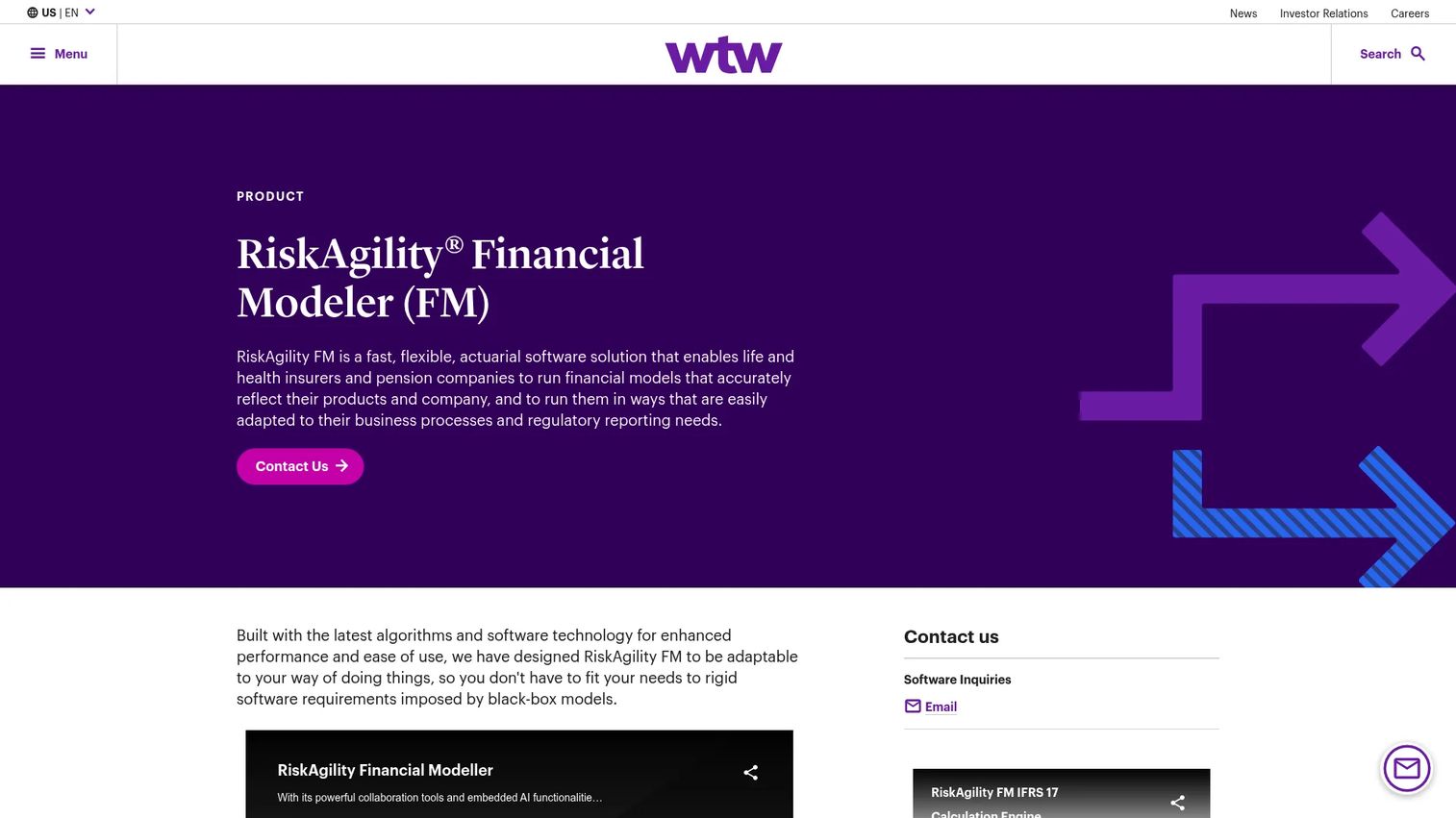
RiskAgility FM, WTW's Financial Modeler, is actuarial financial modeling software for life and health insurers and pension companies. It's built for flexibility across both business and regulatory reporting needs, with an open modeling language that gives actuaries control over model logic rather than boxing them into fixed templates.
Developer-friendly touches set it apart: code-analysis and debugging tools help teams find and fix model issues, which matters when actuarial and finance functions collaborate on shared models. SaaS options for compute, regression testing, and hosting let teams scale runs without owning the infrastructure. Editions span Foundation, Standard, and Team to match team size.
Best for: life and health insurers needing flexible enterprise modeling with strong debugging.
Key strengths
- Flexible modeling: Coverage for business and regulatory reporting needs.
- Open modeling language: Code-analysis and debugging tools for model control.
- SaaS options: Compute, regression testing, and hosting on demand.
Why choose RiskAgility FM: Choose RiskAgility FM when you want an open, debuggable modeling language and actuarial-finance collaboration on shared models. Its edition tiers and SaaS compute options suit teams scaling from foundational to enterprise use.
RiskAgility FM pricing: WTW does not publish pricing; the product page directs you to contact WTW. Editions (Foundation, Standard, Team) and SaaS add-ons are scoped through that conversation.
9. MG-ALFA
MG-ALFA, from Milliman, is a financial modeling and actuarial projection system for insurance companies. It covers product development and pricing, financial and risk management analysis, regulatory compliance, and actuarial projections, which makes it a broad workhorse for insurers running the full modeling lifecycle.
Its strength is the combination of Milliman's actuarial credibility with enterprise model management. Teams evaluating MG-ALFA typically weigh implementation effort against the depth of coverage across pricing, projections, and compliance. For insurers already working with Milliman's consulting side, the software integrates into an established relationship.
Best for: insurance and financial services teams needing broad actuarial modeling and projection coverage.
Key strengths
- Product development and pricing: Modeling support for new products and rate structures.
- Financial and risk analysis: Financial management and risk analysis in one system.
- Regulatory compliance and projections: Compliance workflows and actuarial projections.
Why choose MG-ALFA: Pick MG-ALFA when you want broad lifecycle coverage backed by Milliman's actuarial depth. It fits insurers valuing an established vendor relationship and enterprise model management across pricing, projections, and compliance.
MG-ALFA pricing: Milliman does not publish a public price for MG-ALFA. Pricing is arranged directly through Milliman based on your scope and needs.
10. Tyche
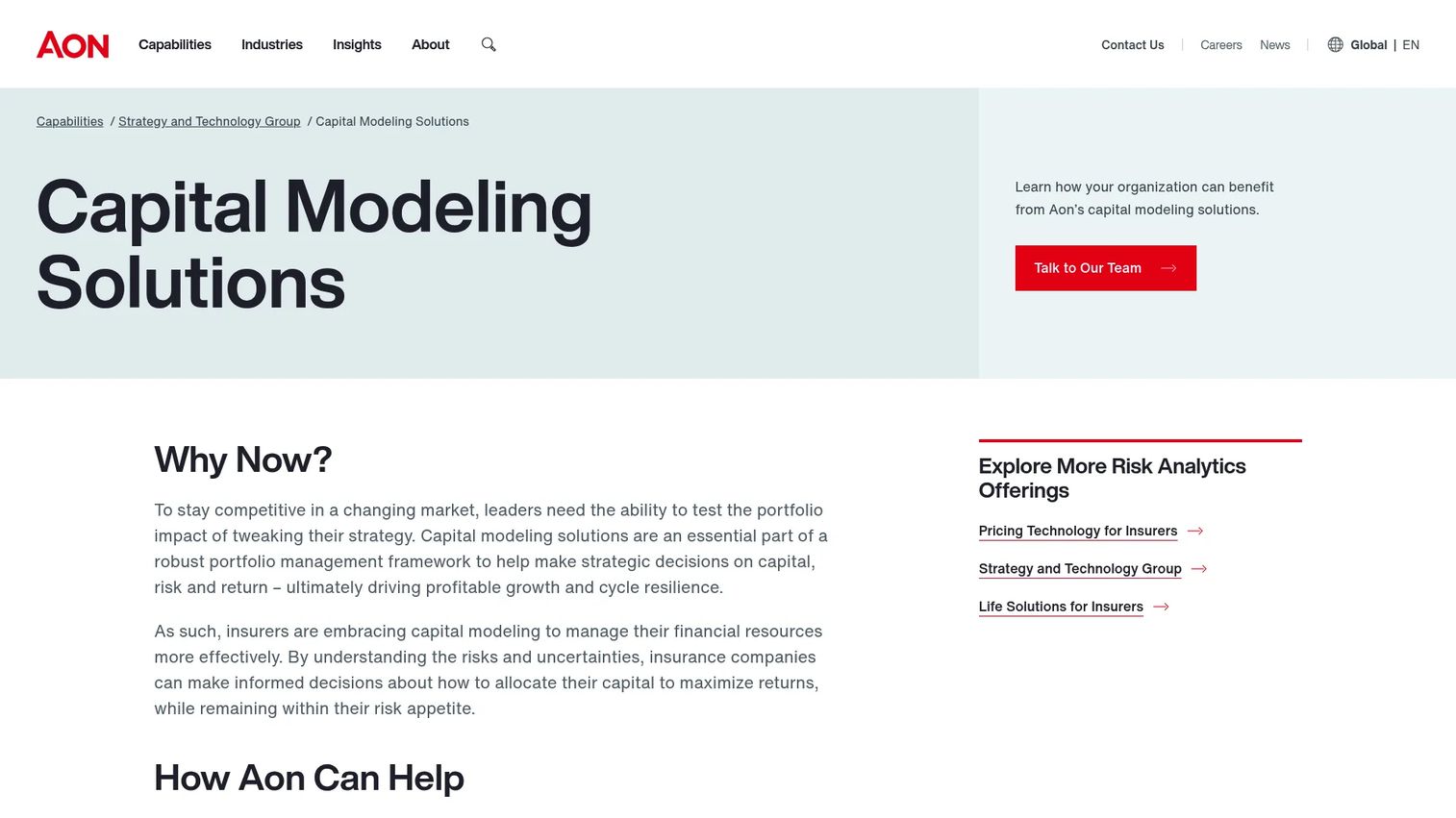
Tyche, from Aon, is a capital modeling solution used for insurance and reinsurance decision support. It rounds out a 2026 shortlist because capital and reinsurance sit adjacent to core actuarial modeling, and many teams need both in one conversation. Tyche covers economic and regulatory capital modeling, reinsurance optimization, and catastrophe reinsurance pricing.
Where the other platforms center on liability and reserving, Tyche's focus on capital and reinsurance decisions makes it a specialist. Insurers and reinsurers weighing reinsurance structures, capital efficiency, and catastrophe pricing evaluate it for exactly that decision support, often alongside a primary reserving or valuation platform.
Best for: insurers and reinsurers needing capital modeling and reinsurance decision support.
Key strengths
- Capital modeling: Economic and regulatory capital calculations.
- Reinsurance optimization: Analysis to structure and optimize reinsurance.
- Catastrophe pricing: Reinsurance pricing for catastrophe exposure.
Why choose Tyche: Choose Tyche when capital efficiency, reinsurance optimization, and catastrophe pricing drive your decisions. It fits insurers and reinsurers who need specialist capital modeling alongside their core actuarial stack.
Tyche pricing: Aon does not display public pricing for Tyche; the page uses contact-based language. Pricing follows a direct conversation with Aon.
Considerations before you buy
Feature lists blur together fast. These are the criteria that actually predict whether a platform survives contact with your workflow.
Governance and audit trails
You need to know who changed what, when, and why, without asking around. Look for versioning, assumption logging, and formula tracing built into the platform rather than tracked in a side spreadsheet. When an auditor or regulator asks for lineage, the answer should be a click, not a project. Traceability is the single strongest signal of a mature platform.
Performance and scale
Stochastic runs and large model points expose weak performance quickly. Evaluate projection speed, parallel or GPU execution, and how the platform behaves as your portfolio grows. Cloud-native options can remove infrastructure headaches, but confirm that scalability is real under your actual workloads, not a benchmark demo.
Integration and data pipelines
Your models are only as good as the data feeding them. Check for integrations with your data warehouse, APIs, and platforms like Snowflake, plus clean data ingestion from prep to deployment. A platform that can't connect to your data stack turns into another silo you have to feed by hand.
Regulatory support
IFRS 17, Solvency II, and LDTI are non-negotiable for most insurers. Confirm the platform supports the frameworks you report under, with consistency and model validation baked in. Multi-framework support matters if you report under several regimes at once.
Implementation effort and vendor support
Ask hard questions about implementation timelines, migration from existing models, and the quality of ongoing support. Vendor credibility, security posture, and a real trust center reduce risk. The best software fails if the rollout stalls, so weigh support and change management as seriously as features.
Conclusion
The right actuarial software depends on where your pressure sits. If transparency and explainability top your list, Slope Software's visible assumptions and formulas are the strongest fit. For a governed, AI-assisted lifecycle at enterprise scale, SAS covers data prep through deployment. When no packaged tool matches your requirements, SCN Soft's custom builds fit the workflow to you rather than the reverse.
For heavy regulatory reporting, Prophet handles IFRS 17, Solvency II, and GAAP with serious compute. AXIS and MG-ALFA cover broad life and annuity modeling, RiskAgility FM and MoSes bring flexible, debuggable projection depth, and Tyche specializes in capital and reinsurance decisions.
Your next step: shortlist two or three platforms that match your primary pressure, then run a scoped proof of concept using your own models and assumptions. Test traceability, performance, and integration with your data stack under real conditions. The platform that survives your actual workflow, not the demo, is the one to buy.
FAQs
Actuarial software runs the financial models insurers depend on: pricing new products, valuing liabilities, calculating reserves, managing asset-liability matching, and producing regulatory reports. It replaces fragile spreadsheet chains with a governed environment where assumptions, projections, and results are traceable and repeatable. That control is what makes audits and regulatory reviews manageable.
It depends on your priorities. Slope Software stands out for transparency in pricing and valuation, with visible assumptions and formulas. SAS suits large teams wanting a governed lifecycle, while AXIS and MG-ALFA offer broad coverage for life and annuity work. Prophet is a strong pick when regulatory reporting sits alongside pricing and valuation at scale.
Purpose-built platforms enforce consistency across reporting outputs, support model validation, and preserve the lineage from assumption to result. That means a number in one report ties out with the same number elsewhere, and you can show exactly how it was derived. Platforms like Prophet explicitly support IFRS 17, Solvency II, and local GAAP in one system.
Prioritize versioning, assumption logging, and formula tracing built into the platform rather than tracked externally. You want to answer "who changed what, when, and why" with a click. Strong model governance and audit trails are the clearest sign a platform will hold up under regulator and auditor scrutiny.
Yes. Cloud-native platforms handle stochastic runs and large model points while removing infrastructure overhead from your team. Slope Software is built cloud-native, and platforms like RiskAgility FM offer SaaS options for compute and hosting. Confirm scalability against your actual workloads rather than a benchmark before committing.
Most teams define selection criteria first, transparency, workflow depth, integrations, performance, and enterprise readiness, then shortlist two or three vendors. From there, a scoped proof of concept using real models and assumptions tests each platform under actual conditions. Comparison and educational sources help frame the evaluation before vendor conversations begin.
Many modern platforms integrate with data warehouses, APIs, and tools like Snowflake to pull clean data from prep through deployment. Integration depth varies by vendor, so confirm that a platform connects to your specific data stack before buying. A tool that can't feed from your warehouse becomes another manual silo.
Packaged actuarial software, like Prophet or AXIS, gives you ready modeling capability out of the box with defined workflows. Custom insurance software, built by a firm like SCN Soft, is developed to your exact requirements when no off-the-shelf tool fits. Packaged tools are faster to adopt; custom builds trade time and cost for a workflow shaped entirely around your needs.