
You built the route in your head. Which machines run dry by Thursday. Which locations move energy drinks but never gum. Which driver always comes back with the wrong cash count. Then the fleet doubled, you added a second driver, and the whole thing started leaking money you can't see.
That's the moment spreadsheets stop working. A stockout you didn't catch is a sale you didn't make. A machine you can't reconcile is profit you can't prove. And when inventory, routes, and cash all live in different tabs, nobody on [the team has one number they trust.
The market is moving fast enough that the tooling gap is widening. The global vending machine management tools market is projected to grow from USD 640 million in 2026 to USD 1,064 million by 2034, an 8.7% CAGR, according to Intel Market Research (2025).](https://www.intelmarketresearch.com/vending-machine-management-tools-market-27957) Grand View Research (2025) reports that cashless payments held the highest share of the retail vending machine market in 2025. Operators who standardized their systems early are the ones capturing that growth.
The right vending machine software connects the parts of your operation that currently only connect inside your head. It gives you real-time inventory visibility across warehouse, truck, and machine, tighter route execution, and machine-level financials you can defend. This guide compares seven tools that do exactly that, so you can pick the one that matches your current bottleneck instead of buying features you won't use.
What's inside
This guide is for vending operators, route managers, and owners who have outgrown manual tracking and want one system for inventory, routes, telemetry, and finance. We selected tools based on four things operators actually buy on: inventory depth (warehouse to machine), route workflow support (pre-kitting, pick lists, optimization), reporting and financial control (machine-level P&L, cash vs card reconciliation), and integration flexibility across mixed fleets and payment hardware. Every tool below solves at least one of those jobs well. Some solve all four. We've noted pricing and ratings where they could be verified against first-party sources.
TL;DR
Short on time? Here's the fast version.
- Best all-around vending management software: VendSoft, for operators standardizing inventory, routes, and telemetry in one system.
- Best for telemetry-first inventory tracking: VendingMetrics, for operators who want real-time monitoring plus mobile picking.
- Best for building custom workflows: Softr, for teams that want a no-code system shaped to their exact process.
- Best for the category view before buying: ZippyAssist, for operators researching support automation and unattended retail workflows.
- Best for cashless and connected-machine ecosystems: Cantaloupe and Nayax, for operators anchored to payment hardware and telemetry.
- Best for tight route and field control: Parlevel, for operators who want day-to-day operational accountability.
What is vending machine software?
Vending machine software is a vending management system that centralizes inventory, routes, sales, telemetry, and finance for vending operations in one platform. It replaces the spreadsheets, paper pick lists, and disconnected payment reports that operators use to run machines, and it gives owners real-time inventory visibility and machine-level profit reporting instead of guesses.
Most vending management software shares a core set of capabilities. The strongest platforms cover all of them; lighter tools focus on one or two.
- Inventory tracking across warehouse, truck, and machine: know exactly what stock sits where, at every stage of the supply chain.
- Low-stock alerts and restocking workflows: get flagged before a machine runs dry, then build the restocking run around real demand.
- Route optimization and pick lists: plan efficient routes and generate accurate pick lists so drivers load the right product for each stop.
- Pre-kitting support: stage each machine's order in the warehouse before the truck leaves, cutting time on site.
- Sales and product performance analytics: see which products move at which machines, and cut the slots that don't earn.
- Commissions, taxes, and machine-level P&L: track machine profitability, location commissions, and cash vs card reconciliation without a separate finance workflow.
- Telemetry and cashless payment systems: connect telemetry-enabled machines for live sales and stock data, and reconcile card and cash transactions in one place.
Put together, these capabilities turn a fleet of machines into a system you can actually manage by the numbers. That's the difference between a vending business software stack and a folder of spreadsheets.
When to use vending management software
Not every operator needs a full vending management system on day one. Here's how to tell when the switch pays off.
Replace spreadsheets that no longer hold up
Manual inventory sheets and handwritten route notes work fine at five machines. They fall apart at fifty. Once you're running multiple locations, multiple drivers, or a fleet large enough that no single person can hold the state of it in their head, error rates climb and money leaks quietly. Miscounts, missed restocks, and cash discrepancies stop being rare and start being weekly. That's the signal that vending software will pay for itself.
Connect inventory, routes, and financials
The real cost of spreadsheets isn't data entry. It's that inventory, route execution, and finance never talk to each other. You can't see whether a machine is unprofitable because it's understocked, overstocked with the wrong product, or bleeding cash in reconciliation. A vending management system gives you one source of truth so you can make restocking and route decisions fast, backed by product performance and machine-level P&L instead of gut feel.
Support mixed fleets and field teams
Most growing operators run a mixed fleet: some telemetry-enabled machines that report sales and stock in real time, and older offline machines that still rely on manual counts. Good vending machine software handles both. Telemetry gives you real-time inventory visibility where it exists, and mobile workflows let drivers update counts on offline machines from the field. Mixed fleet support and mobile access are what keep the whole operation on one system instead of two.
Comparison table
The list below is ordered by relevance to operators searching for vending machine software. Pricing and ratings reflect first-party sources verified at the time of writing; where a value could not be confirmed, it's left out rather than estimated.
| # | Product | Intent | Key use case | Pricing | G2 rating |
|---|---|---|---|---|---|
| 1 | VendSoft | All-in-one vending management | Inventory, routes, telemetry, and machine-level P&L in one system | From $19/mo | 4.3/5 |
| 2 | VendingMetrics | Telemetry-first operations | Real-time telemetry, inventory tracking, and mobile picking | From $109/mo | Not listed |
| 3 | Softr | Build-your-own workflows | No-code custom vending inventory and route apps | Free; from $59/mo | 4.7/5 |
| 4 | ZippyAssist | Support automation | Customer support and refund handling for unattended retail | From $99/mo | Not listed |
| 5 | Cantaloupe | Payments + management | Cashless hardware, telemetry, and vending management software | From $19.95/mo | 4.4/5 |
| 6 | Nayax | Cashless + connected machines | Cashless payments, telemetry, and remote machine management | From $99/mo | 3.9/5 |
| 7 | Parlevel | Route and field control | Route management, inventory tracking, and micro market support | Account required | Not listed |
1. VendSoft
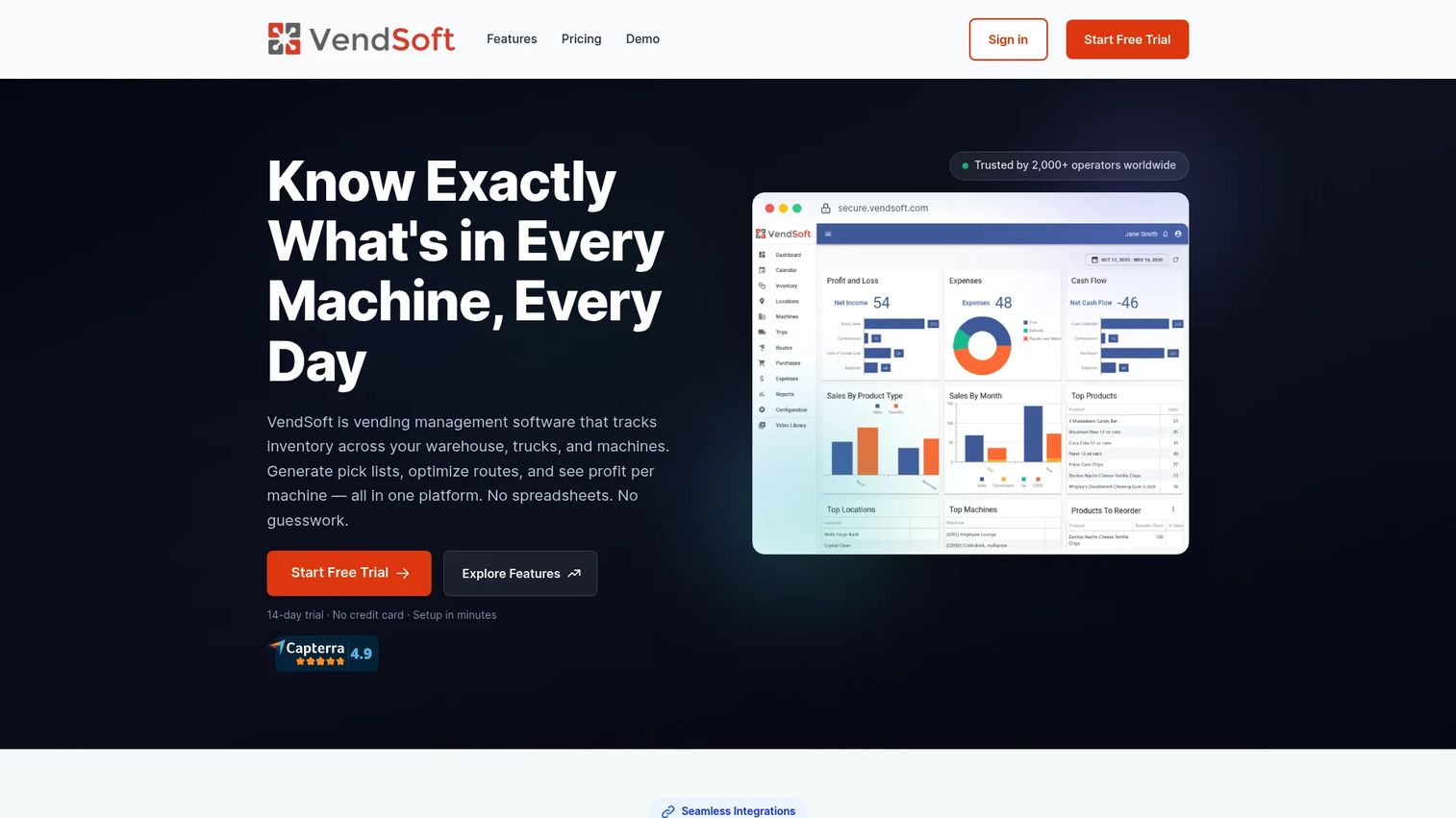
VendSoft is vending management software built to track inventory, routes, sales, and telemetry in one system. For operators moving off spreadsheets, it's the broadest default: inventory visibility from warehouse to truck to machine, pre-kitting and pick lists to stage restocking runs, route planning to cut windshield time, and sales analytics to see which products actually earn per machine. It also handles machine-level profitability and telemetry integrations, so real-time data and manual counts live under one roof.
The reason VendSoft works as a first serious system is that it doesn't force you to choose between operations and finance. Inventory movement, route execution, and machine-level P&L all connect, which is exactly the visibility spreadsheets can't give you once the fleet grows.
Best for: Operators scaling beyond spreadsheets who want inventory, routes, and financials in a single vending management system.
Key strengths
- Inventory management: Track stock across warehouse, truck, and machine, with low-stock alerts that drive the restocking workflow.
- Route planning: Build efficient routes with pre-kitting and pick lists so drivers load the right product for every stop.
- Telemetry integrations: Connect telemetry-enabled machines for live sales and stock data alongside manual counts on offline machines.
Why choose VendSoft: If your core problem is that inventory, routes, and money live in separate places, VendSoft pulls them into one operational picture. It fits operators who want machine-level accountability without stitching together three tools.
VendSoft pricing: Plans start at $19/mo for Essentials (5 machines), $49/mo for Pro (30 machines), and $199/mo for Business (120 machines), all billed monthly in USD. Overages are billed per active machine. There's no free tier. VendSoft holds a 4.3/5 rating on G2.
2. VendingMetrics
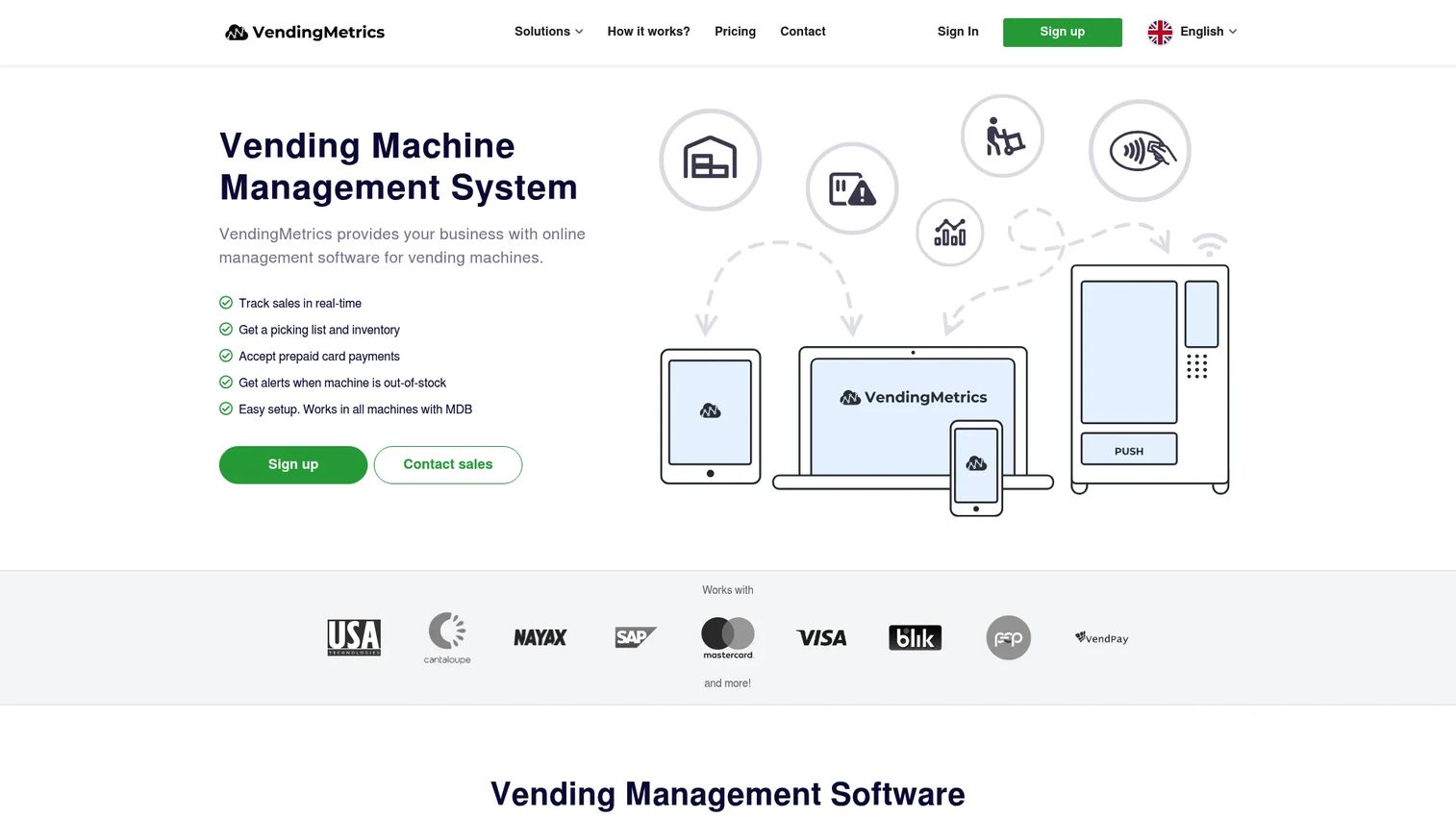
VendingMetrics is vending telemetry software with inventory and replenishment management built around real-time machine monitoring. For operators who want live visibility first, it pairs online telemetry with inventory management, picking lists, and sales, cash, and coin tracking. The mobile picking workflow lets drivers work from accurate pick lists in the field, and alerts flag machines before they run dry.
Where it earns its place is the combination of telemetry and field execution. You see what's selling and what's low in real time, then act on it with mobile inventory tracking and structured restocking. For a mixed payment environment, cash and coin tracking sits alongside the telemetry data, so reconciliation isn't a separate chore.
Best for: Operators who want real-time reporting plus field execution across telemetry-enabled machines.
Key strengths
- Online telemetry: Monitor machine sales and stock live, so low-stock alerts and restocking decisions are based on real demand.
- Inventory and picking lists: Generate accurate pick lists and manage inventory so drivers load exactly what each stop needs.
- Sales, cash, and coin tracking: Track revenue and reconcile cash and coin against sales without a separate finance step.
Why choose VendingMetrics: If telemetry is central to how you want to run, VendingMetrics puts real-time monitoring and mobile picking in the same workflow. It fits operators who value live inventory tracking over building everything from a blank slate.
VendingMetrics pricing: Public pricing shows a telemetry system at $109/month, with a $29 base price and $4 per machine per month, all in USD. Hardware is listed separately, including a MetricsBox at $259 one-time and an RFID card reader at $129 one-time. There's no free tier.
3. Softr
Softr is a no-code platform for building business software, portals, internal tools, and workflows, and it's the build-your-own option on this list. Instead of buying an off-the-shelf vending management system, you build one: a database of machines and products, custom inventory tracking, route generation, supplier ordering, and role-based permissions shaped to your exact process. Its AI app builder speeds up the initial setup.
This is a different animal from the purpose-built vending tools above, and that's the point. Operators with unusual internal processes, or who want inventory and route workflows that match how they already run rather than adapting to a vendor's model, get full control. You own the data model and the logic.
Best for: Operators or in-house builders who want a custom vending inventory management software system on a no-code foundation.
Key strengths
- AI app builder: Stand up a working internal app fast, then refine the inventory and route logic to your process.
- Custom portals and internal tools: Build driver-facing and manager-facing views with role-based access.
- Workflows, forms, and database support: Model machines, products, suppliers, and routes exactly how your operation works.
Why choose Softr: Choose Softr when off-the-shelf vending software doesn't match your workflow and you want to own the system. It fits operators willing to invest setup time in exchange for a tool built around their exact process rather than a vendor's assumptions.
Softr pricing: Softr offers a Free plan at $0/month, then Basic at $59/month, Professional at $167/month, and Business at $323/month, with custom Enterprise pricing on quote. Monthly and yearly billing are available. Softr holds a 4.7/5 rating on G2.
4. ZippyAssist
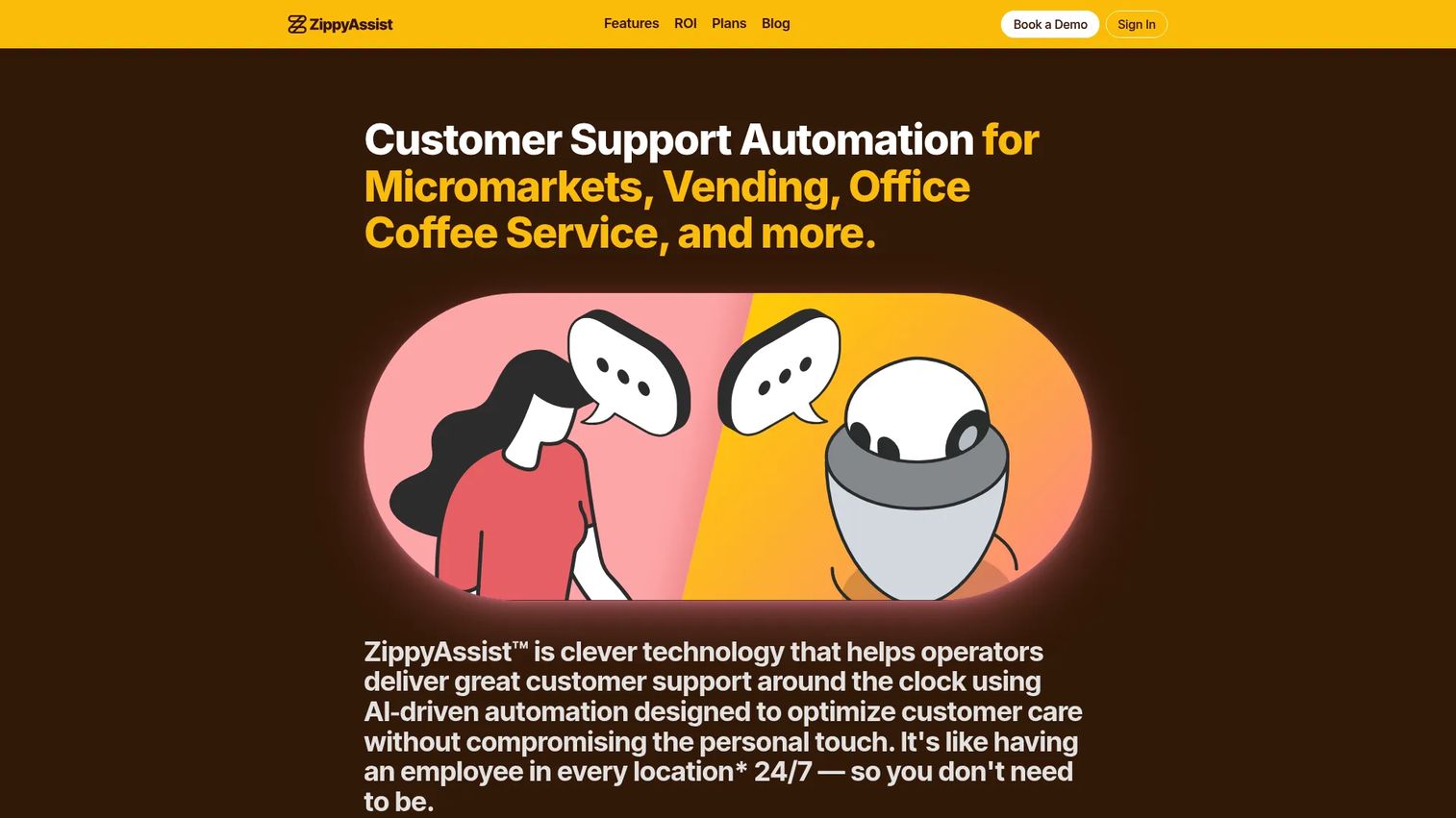
ZippyAssist is customer support automation for unattended retail and self-service environments. It's the support-layer choice on this list rather than a full vending management system, and it's worth understanding as you map your stack. When a customer loses money in a machine, ZippyAssist handles the help request through a dedicated text or phone number, processes refunds online, and captures voice messages from inbound calls, all without a person manually chasing every complaint.
For operators researching the category, ZippyAssist clarifies where support automation fits alongside inventory, route, and telemetry tools. It's the piece that turns machine-side customer friction into a fast, trackable workflow, which matters more as your fleet and transaction volume grow.
Best for: Unattended retail operators who want automated customer support and refund handling as part of their stack.
Key strengths
- Help requests via dedicated number: Customers reach support through a text or phone number posted on the machine.
- Online refunds workflow: Process and track refunds without manual back-and-forth.
- Voice messages for inbound calls: Capture and route inbound calls so no complaint gets lost.
Why choose ZippyAssist: Choose ZippyAssist when customer support and refunds are eating operator time and you want that workflow automated. It pairs naturally with an inventory-and-route platform rather than replacing one.
ZippyAssist pricing: Monthly plans run from $99/month for Zippy Starter, $169/month for Zippy Build, $299/month for Zippy Grow, and $469/month for Zippy Pro, with custom Enterprise pricing on contact. All paid plans include every feature, and there's a 30-day free trial rather than a free tier. Prices are in USD.
5. Cantaloupe
Cantaloupe provides self-service retail hardware, payment processing, and vending and micro market management software. It's less a lightweight point tool than a full ecosystem, which is exactly what operators anchored to cashless payment systems and connected machines look for. Card readers and kiosks, Seed Live device management, and Seed Cashless+ and Seed Pro vending management software combine hardware and software under one roof.
The draw here is payment hardware compatibility plus telemetry and machine connectivity in a single ecosystem. If cashless acceptance and connected-machine visibility are central to your operation, Cantaloupe covers the payment layer and the management layer together rather than making you integrate two vendors.
Best for: Operators who need self-service retail payments plus vending and micro market management software in one ecosystem.
Key strengths
- Card readers and kiosks: Accept cashless payments across vending and micro market points with self-service hardware.
- Seed Live device management: Monitor and manage connected machines remotely.
- Seed Cashless+ and Seed Pro: Run vending management workflows tied directly to the payment and telemetry layer.
Why choose Cantaloupe: Choose Cantaloupe when payment hardware and telemetry are the backbone of your operation and you want them integrated with management software. It fits operators who prefer one ecosystem over stitching payments and management together.
Cantaloupe pricing: Cantaloupe's pricing page shows multiple packages, including Cantaloupe One plans and product-specific bundles. Displayed prices include an Engage Pulse card reader kit at $19.95/month and Cantaloupe One packages at $119/month and $225/month, with enterprise kits at custom pricing. Cantaloupe holds a 4.4/5 rating on G2.
6. Nayax
Nayax provides cashless payment, telemetry, and business management tools for unattended retail. For operators who prioritize payment infrastructure and remote machine visibility, it combines cashless acceptance with telemetry and management features like remote price changes, an inventory dashboard, and dynamic transaction monitoring. That means you can adjust pricing across machines from the office and watch transactions as they happen.
Operators typically evaluate Nayax alongside a broader vending management system, using it for the payment and connectivity layer while a route-and-inventory platform handles day-to-day operations. Its strength is the payment ecosystem plus real-time machine visibility, which is exactly what an operator optimizing for cashless acceptance and remote control wants.
Best for: Unattended retail operators optimizing machine connectivity and cashless payment acceptance.
Key strengths
- Remote price change: Update product pricing across machines without visiting each one.
- Inventory dashboard: See machine inventory and status from a central view.
- Dynamic transaction monitoring: Track cashless transactions as they happen for faster reconciliation.
Why choose Nayax: Choose Nayax when cashless payments and remote machine visibility are your priority. It fits operators who want strong payment infrastructure and telemetry, often paired with a dedicated inventory and route platform.
Nayax pricing: Publicly displayed retail pricing on NayaxRun is $99/month with no service fee, no hardware purchase, and no transaction fees. NayaxRun+ processes up to $5,000/month in sales free, then adds 2.5% + 10¢ over that amount, at the same $99/month base. Nayax holds a 3.9/5 rating on G2.
7. Parlevel
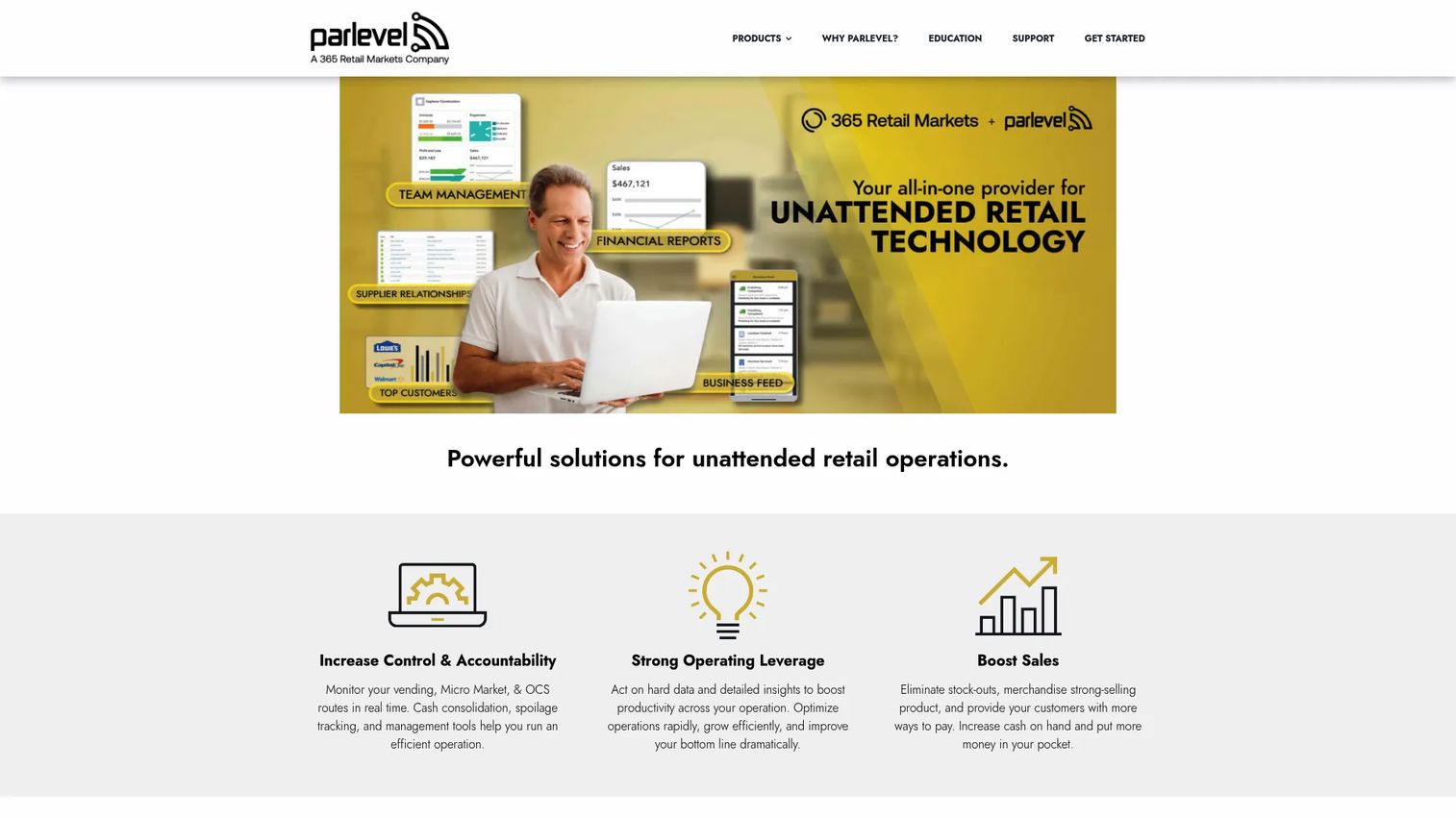
Parlevel is a vending and unattended retail technology provider covering vending, micro markets, and office coffee service operations. Its focus is day-to-day operational control: real-time route and machine management, micro market and smart cooler support, and cashless payment acceptance including mobile payments. For operators who want tighter route execution and machine-level accountability, it keeps field work and management on one platform.
The practical value is route control paired with inventory tracking across a mixed fleet. Drivers work from real-time data, managers see machine status and performance, and the operation runs from a shared source of truth rather than end-of-day paper.
Best for: Operators managing vending, micro markets, and cashless readers who want tighter route and field control.
Key strengths
- Real-time route and machine management: Run routes and monitor machines from live data instead of end-of-day counts.
- Micro market and smart cooler support: Manage micro markets and smart coolers alongside traditional machines.
- Cashless payment support: Accept cashless and mobile payments across the fleet.
Why choose Parlevel: Choose Parlevel when route execution and field accountability are your bottleneck and you run a mixed fleet that includes micro markets. It fits operators who want operational control across formats on one platform.
Parlevel pricing: Parlevel does not publicly list pricing on its site and notes that account creation is required to see full product pricing, so a public starting price could not be verified. Reach out through their store page for a quote tied to your fleet size.
Considerations before you buy
Before committing to a vending management system, run every option through the same checklist against your actual operation.
Inventory depth across the supply chain
Confirm the tool tracks inventory at every stage: warehouse, truck, and machine. Shallow inventory tracking that only counts machine-level stock leaves you blind to what's in the warehouse and on the truck. Real-time inventory visibility across all three is what drives accurate pre-kitting and restocking.
Route workflow support
Check whether the tool generates pick lists, supports pre-kitting, and offers route optimization for vending. Drivers loading from accurate pick lists and pre-staged kits spend less time per stop and make fewer mistakes. Route optimization matters more as your fleet and geography grow.
Financial control and reconciliation
Look for machine-level P&L, location commissions, and cash vs card reconciliation. If you can't see machine profitability or reconcile driver-level collection tracking against sales, you can't tell which machines and locations actually earn. This is where the money hides.
Telemetry and mixed fleet support
Decide how much telemetry you need now versus later. Strong offline vending machine software still works with manual counts and mobile updates, then adds telemetry as you connect machines. Mixed fleet support keeps your whole operation on one system instead of two.
Integrations and payment compatibility
Verify the tool works with your cashless payment systems and any telemetry hardware you run. Payment and telemetry compatibility determines whether card and cash data flows into your reporting automatically or has to be re-entered by hand.
Conclusion
The right vending machine software depends entirely on which bottleneck is costing you the most right now. If you're replacing spreadsheets and want inventory, routes, and machine-level P&L in one system, VendSoft is the broad default. If real-time telemetry and mobile picking come first, VendingMetrics fits. If your process is unusual enough that off-the-shelf tools don't match it, Softr lets you build exactly what you need.
For the payment and connectivity layer, Cantaloupe and Nayax both anchor operations around cashless payment systems and connected machines. Parlevel earns its place when route execution and field control across a mixed fleet are the problem. And ZippyAssist adds automated customer support and refunds on top of whatever management platform you choose.
Start with the tool that matches your biggest current bottleneck, not the one with the longest feature list. A vending business software stack that fixes your worst leak this quarter beats a perfect platform you never fully adopt. Pick the one that earns its place in the first month, then expand from there.
FAQs
Vending machine software is a vending management system that helps operators track inventory, routes, sales, telemetry, and finance in one place. It replaces spreadsheets and paper pick lists with real-time inventory visibility and machine-level profit reporting, so owners can run a fleet by the numbers instead of by memory.
No. Telemetry improves visibility by reporting sales and stock in real time, but it isn't required. Many platforms still support manual counts and mobile updates, so you can run offline machines and telemetry-enabled machines on the same system and add telemetry as you connect more machines.
The core features are inventory tracking across warehouse, truck, and machine, route optimization for vending with pick lists and pre-kitting, low-stock alerts, sales and product performance reporting, cashless payment support, and machine-level financial controls. The best fit depends on which of these solves your current bottleneck.
Yes. Strong offline vending machine software works with manual counts and mobile updates from drivers in the field, then lets you add telemetry later as machines are connected. Mixed fleet support keeps offline and telemetry-enabled machines on one platform.
It helps operators see machine-level performance, product movement, location commissions, and cash vs card reconciliation in one place. Machine-level P&L shows which machines and slots actually earn, so you can cut underperforming products, adjust pricing, and fix reconciliation gaps that quietly drain profit.
No, but the ROI becomes clearer as complexity increases. At a handful of machines, spreadsheets may hold up. Once you're running multiple locations, multiple drivers, or a fleet too large to track by memory, the error rate and hidden losses make vending management software pay for itself.
Compare inventory depth across the supply chain, route workflow support like pick lists and pre-kitting, reporting and reconciliation, telemetry and mixed fleet support, integrations with your cashless payment systems, and pricing relative to your fleet size. Match the tool to your biggest current bottleneck rather than the longest feature list.