
Your hiring team is juggling 14 open requisitions. Candidate data lives in three spreadsheets, two inboxes, and a Slack channel nobody reads. The best applicant from last week went cold because scheduling took six days. Sound familiar?
This is what hiring without a real system looks like. And the cost is not abstract. Every delay loses a candidate, every dropped handoff loses context, and every manual task pulls a recruiter away from the work that actually moves a hire forward.
The market reflects how serious this problem has become. The global talent acquisition software market is projected to grow from USD 22.22 billion in 2025 to USD 46.75 billion by 2035, a 7.72% CAGR, according to Market Research Future (2025). Adoption of AI is climbing just as fast: 43% of organizations were using AI for HR and recruiting by 2025, up from 26% in 2024, per SHRM data summarized by Pin (2026).
So the question is not whether to buy a talent acquisition platform. It is which one fits your hiring motion, your company size, and your existing stack. The same buying logic that drives enablement decisions applies here: teams want one system for process, governance, adoption, and measurable outcomes. If you have ever evaluated ai recruiting software or compared agentic ai tools for sales, the evaluation lens will feel familiar. We compared 8 tools across ATS depth, sourcing, automation, onboarding workflow, integrations, and reporting.
What's inside
This guide compares 8 talent acquisition software tools chosen for breadth of workflow coverage, buyer-fit, automation depth, integrations, and scalability. The list mixes enterprise, mid-market, and SMB-friendly products so you can match a tool to your actual hiring reality, not a brand name.
We selected and ordered each tool based on four things:
- Workflow coverage: how much of the source-to-onboard journey it handles
- Buyer-fit: whether it suits enterprise, mid-market, or small teams
- Automation and AI: how much manual work it removes from recruiters
- Integrations and reporting: how cleanly it connects to your HRIS, calendar, and analytics
Items are ordered by relevance to the keyword and commercial usefulness, not by popularity alone.
TL;DR
Short on time? Here are the quick decision shortcuts.
- Best for enterprise hiring teams: SmartRecruiters, for AI-powered recruiting and deep enterprise integrations at scale.
- Best for fast-moving, scaling teams: Ashby, for all-in-one ATS, scheduling, and analytics in one system.
- Best for structured, process-heavy hiring: Greenhouse Recruiting, for governance and repeatable interview workflows.
- Best for sourcing-led teams: Lever, for ATS plus candidate relationship management in one platform.
- Best for Workday-centric enterprises: Workday Talent Management, for organizations already standardized on the Workday ecosystem.
- Best for small to mid-size teams: Workable, for ease of use and fast rollout.
AI now handles matching, screening support, interview scheduling, and follow-up across most of these platforms. The bigger differentiator is integration depth and governance, which separate a tool that scales from one that creates new admin.
What is talent acquisition software?
Talent acquisition software is an end-to-end recruiting platform that helps teams source, track, engage, interview, and onboard candidates in one system. It replaces the scattered mix of spreadsheets, inboxes, and job board logins that most hiring teams outgrow.
A full talent acquisition system usually bundles these core capabilities:
- Applicant tracking system (ATS): the system of record for requisitions, pipelines, and stage management
- Candidate relationship management (CRM): nurture and engagement for passive and future candidates
- Sourcing automation: job board posting, candidate discovery, and outreach at scale
- Candidate communication: templated and automated messaging across the funnel
- Interview scheduling: calendar coordination, scorecards, and interview kits
- Analytics and reporting: time-to-hire, pipeline conversion, and source quality
- Onboarding workflow: the handoff from offer accepted to first day
It helps to separate an ATS from a broader recruiting platform. An ATS is the tracking core. A talent acquisition suite wraps sourcing, CRM, automation, analytics, and onboarding around that core, so the whole hiring motion lives in one place. AI in hiring software is the layer that reduces admin: it matches candidates to roles, drafts outreach, screens applications, and automates scheduling so recruiters spend more time with people and less time with data entry.
What to look for in talent acquisition software
Not every recruiting platform fits every team. These are the four factors that separate a tool that scales from one that creates more work.
ATS depth and workflow control
Requisitions, pipelines, stage management, and approvals are the backbone of any recruiting platform. The real question is whether the system supports your actual hiring motion, not just basic applicant tracking. Look for configurable stages, approval chains that match your org, and the ability to run high-volume hiring and executive search in the same tool without friction.
Sourcing and candidate engagement
Sourcing, nurture campaigns, and CRM-style engagement decide pipeline quality before a single interview happens. This matters most for hard-to-fill roles and high-volume hiring, where you cannot rely on inbound alone. Strong sourcing automation surfaces candidates, keeps passive talent warm, and turns a one-time applicant into a future hire.
Automation and AI
The tasks worth automating are predictable and repetitive: interview scheduling, screening, candidate matching, reminders, and follow-up. Good recruiting automation removes admin. The wrong setup adds a layer of review work on top of the old process. Evaluate whether AI recruiting features actually reduce recruiter clicks or just generate more to check.
Reporting and integrations
A talent acquisition solution lives inside a wider stack. CRM, HRIS, calendar, job board, and communication integrations decide whether data flows or stalls. Pair that with governance, data visibility, and reporting that leadership trusts. If you have evaluated ai governance tools or audit management software, the same questions about permissions and data ownership apply here.
Quick checklist before you shortlist: Does it match your hiring motion? Does it source as well as it tracks? Does AI reduce admin or add it? Does it connect cleanly to your HRIS and calendar?
When teams use talent acquisition software
The category becomes urgent at predictable moments. Here is how to pattern-match your situation.
Replacing spreadsheets and fragmented recruiting workflows
When candidate data lives in email threads, spreadsheets, and Slack, nothing is the source of truth. Recruiters lose hours reconstructing where a candidate stands. A talent acquisition platform consolidates that data so the whole hiring team sees the same pipeline. This is usually the first trigger that pushes teams off manual processes.
Scaling hiring across multiple roles or locations
As headcount grows, process consistency stops being optional. Hiring 40 people across five locations with manual coordination produces five different candidate experiences. A recruiting platform enforces consistent stages, approvals, and communication, and gives leadership pipeline visibility across every req at once.
Improving speed-to-hire and candidate experience
Speed wins candidates. Automation and structured communication cut the delays that cause drop-off: slow scheduling, silent gaps, and manual follow-up. Compared with manual hiring, a good system shortens time-to-hire and keeps candidates engaged with timely, consistent touchpoints. That difference often decides who accepts your offer.
Comparison table
The fastest way to compare these top recruiting software tools is side by side. Read this table by intent and fit, not just by brand recognition: the right tool depends on your hiring motion and company size, not which name you recognize. Pricing reflects publicly listed figures verified as of mid-2026, and many enterprise plans route to sales rather than publishing a number.
| # | Product | Intent | Key differentiation | Pricing | G2 rating |
|---|---|---|---|---|---|
| 1 | SmartRecruiters | Enterprise recruiting | AI-powered hiring platform with deep enterprise integrations | Essential starts at $14,995 | 3.9/5 |
| 2 | Ashby | Scaling teams | All-in-one ATS, scheduling, and analytics | Foundations $400/month | 4.7/5 |
| 3 | Greenhouse Recruiting | Structured hiring | Structured, repeatable interview workflows | Custom (Core, Plus, Pro) | 4.4/5 |
| 4 | Lever | Sourcing-led teams | ATS plus recruiting CRM in one | Custom quote | 4.3/5 |
| 5 | Workday Talent Management | Workday-centric enterprises | Unified talent suite on the Workday platform | Custom | 4.4/5 |
| 6 | iCIMS | Large hiring operations | Enterprise ATS, CRM, and employer branding | Custom | 4.2/5 |
| 7 | Workable | Small to mid-size teams | Combined ATS and recruiting with AI sourcing | Standard $299/month | Not listed |
| 8 | Zoho Recruit | Budget-sensitive teams | Flexible ATS with a free tier | Standard $25/recruiter/month | 4.4/5 |
Read pricing as a signal, not a verdict. Enterprise platforms list custom pricing because deals scale with seats, modules, and hiring volume. Smaller-team tools publish flat monthly rates because their packaging is simpler. Enterprise fit favors workflow depth and governance; SMB fit favors fast rollout and predictable cost.
1. SmartRecruiters
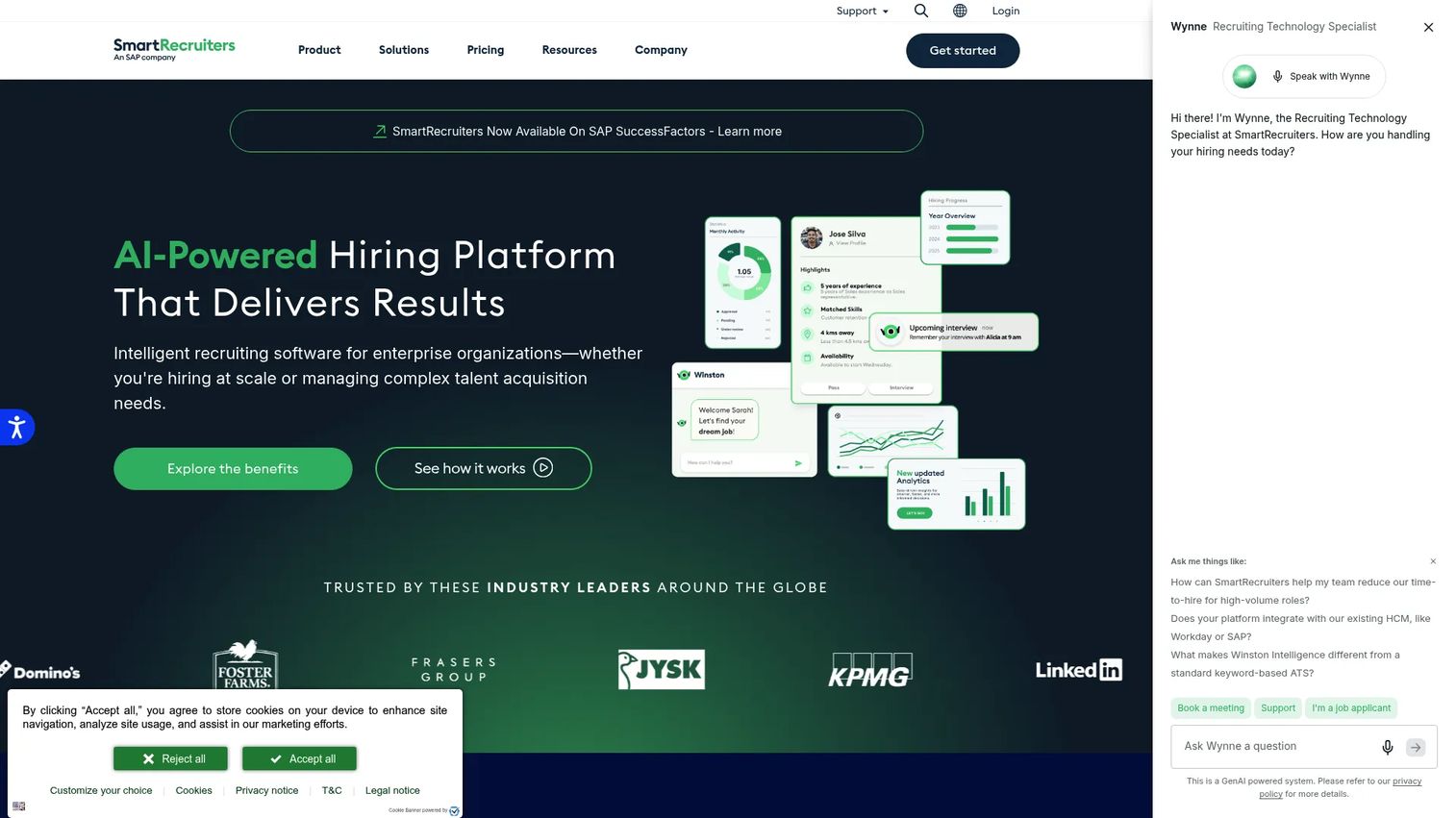
SmartRecruiters is an AI-powered hiring platform built for enterprise recruiting and talent acquisition. It is positioned around its SmartOS architecture, which connects applicant tracking, CRM, and onboarding into one workflow. The platform is designed for large or growing organizations that need to run complex hiring across teams, regions, and high-volume roles without losing candidate experience along the way.
Best for: Large or growing organizations that need an enterprise recruiting platform with strong AI and integrations.
Key strengths
- Applicant tracking: A configurable ATS core that supports complex requisitions, approval chains, and pipeline management at scale.
- CRM: Built-in candidate relationship management to source, nurture, and re-engage talent across the funnel.
- Onboarding: Onboarding workflow that carries accepted candidates through to their first day inside the same system.
Why choose SmartRecruiters: If you are running enterprise hiring across multiple teams and locations, the breadth here is the draw. The AI and automation layer handles matching and screening, interview scheduling reduces coordination drag, and enterprise integrations connect recruiting data to the rest of your HR stack. This is a fit for hiring teams that have outgrown lighter tools and need governance plus scale.
SmartRecruiters pricing: The public pricing page lists four plans. The Essential plan starts at $14,995, while Professional, High Volume, and Complete route to sales for a custom quote. This packaging reflects an enterprise-first motion, so expect a sales conversation to scope the right tier for your hiring volume.
2. Ashby
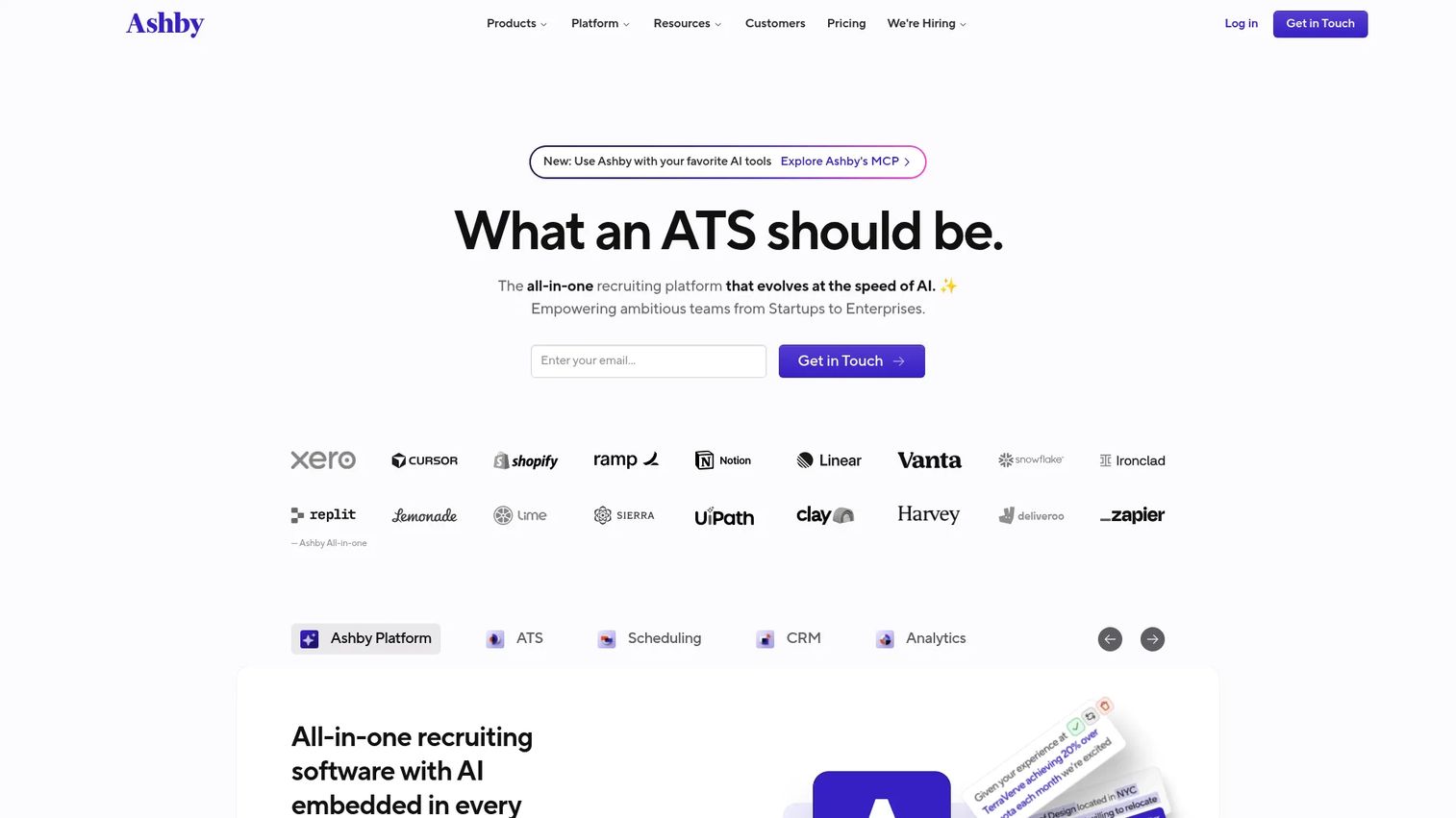
Ashby is an all-in-one recruiting platform that combines applicant tracking, CRM and sourcing, interview scheduling, and analytics in one system, with AI woven through each step. It has become a favorite among high-growth teams that want recruiter workflow speed and serious hiring analytics without stitching together four separate tools. Its appeal is operational efficiency: fewer tabs, faster scheduling, and reporting that actually answers questions.
Best for: High-growth recruiting teams that want an all-in-one ATS, scheduling, and analytics platform.
Key strengths
- Applicant tracking and CRM: A unified pipeline and candidate relationship management layer so sourcing and tracking live together.
- Interview scheduling: Fast, automated scheduling that cuts the back-and-forth that slows candidates down.
- Recruiting analytics: Deep reporting and an AI notetaker that give scaling teams visibility into every stage and bottleneck.
Why choose Ashby: For a team scaling quickly, the analytics depth is the differentiator. You can see conversion by stage, source quality, and recruiter throughput in one place, then act on it. The all-in-one design means less tool sprawl and faster recruiter workflows, which matters when you are hiring fast and cannot afford coordination drag.
Ashby pricing: The All-In-One Foundations plan covers companies up to 100 employees at $400 per month. The Plus, Enterprise, and Ashby Analytics tiers require contacting sales. Annual commitments earn a 10% discount, so factor billing cadence into your budget.
3. Greenhouse Recruiting
Greenhouse Recruiting is an AI-powered hiring platform built around structured hiring, recruiting, interviewing, and onboarding. It remains a standard for teams that need governance and repeatability in how they evaluate candidates. Structured scorecards, interview kits, and consistent stages reduce bias and make hiring decisions defensible, which is why process-heavy and compliance-conscious organizations gravitate to it.
Best for: Mid-market to enterprise teams that need a structured, scalable hiring platform.
Key strengths
- Structured hiring workflows: Standardized stages, scorecards, and interview kits that make every hire consistent and repeatable.
- Candidate sourcing and CRM: Sourcing and candidate relationship management to build pipeline alongside structured evaluation.
- Interview kits, scorecards, and scheduling: Interview collaboration tools that keep panels aligned and feedback comparable.
Why choose Greenhouse Recruiting: If your priority is process governance, this is the tool. The structured approach drives adoption across hiring managers because everyone follows the same playbook, and the integrations ecosystem is broad enough to fit most stacks. It is a strong fit for teams that care about repeatability and audit-ready hiring decisions.
Greenhouse Recruiting pricing: Greenhouse does not publish numeric pricing. The Core, Plus, and Pro plans are quoted based on your hiring needs, billed annually. You will need a demo conversation to scope which tier matches your volume and feature requirements.
4. Lever
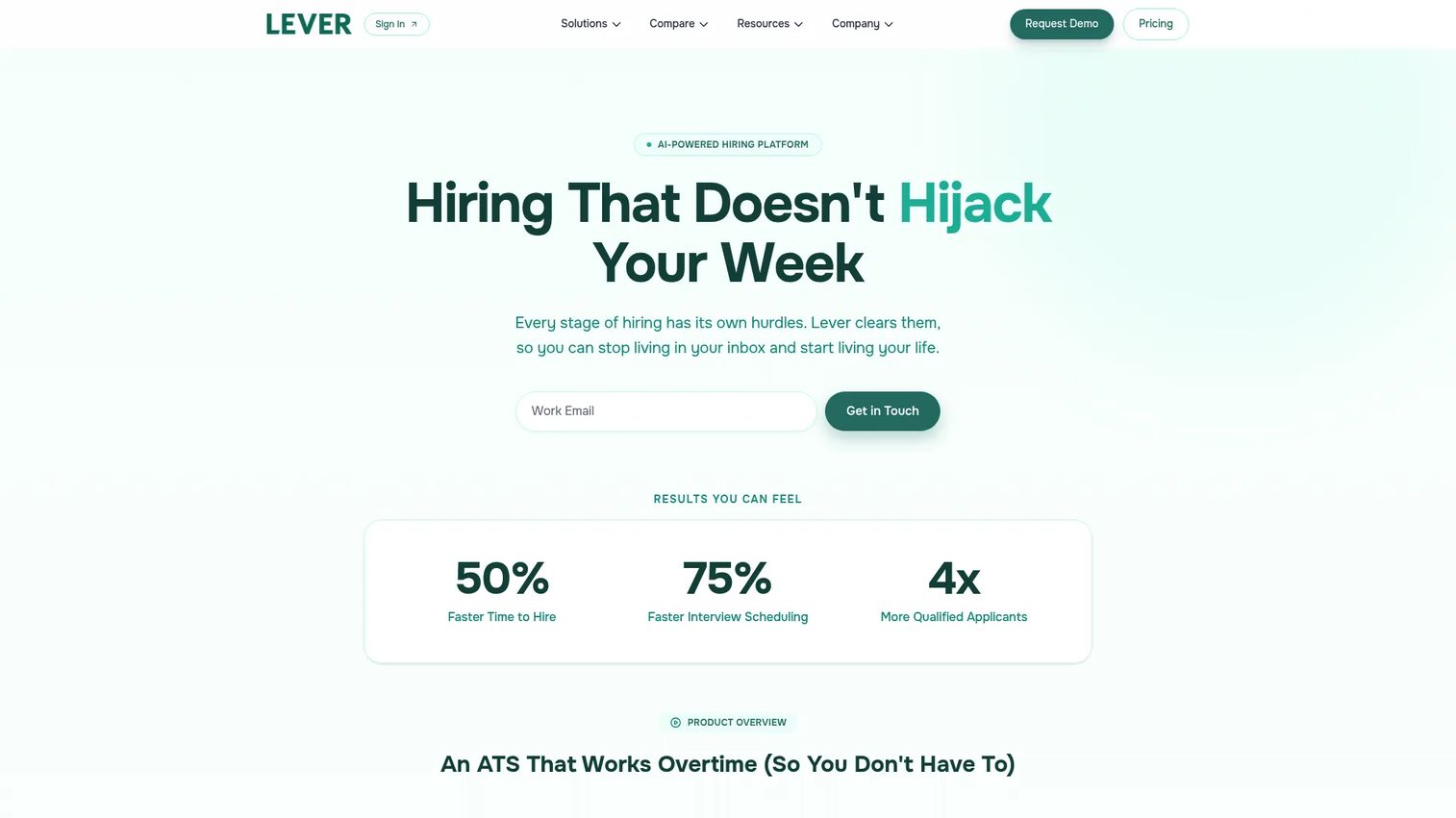
Lever is an AI-powered applicant tracking and recruiting CRM platform built for hiring teams that blend sourcing with pipeline management. Its defining angle is the ATS-plus-CRM combination, which treats candidate relationships as a continuous lifecycle rather than a series of one-off applications. That makes it a strong fit for teams that nurture passive talent and build pipeline ahead of demand.
Best for: Growing and enterprise hiring teams that want ATS, CRM, and analytics in one system.
Key strengths
- ATS and CRM in one platform: A unified system where sourcing, nurture, and pipeline management share the same candidate record.
- AI-powered screening and matching: AI recruiting features that surface and rank candidates to speed up qualification.
- Reporting, analytics, and interview automation: Hiring analytics plus interview automation that keep the process moving.
Why choose Lever: For sourcing-led teams, the CRM and nurture capabilities are the reason to pick Lever. You can run campaigns, keep passive candidates warm, and convert relationships into hires without bouncing between tools. The mid-market fit is strong: enough depth for complex hiring, without the heaviest enterprise overhead.
Lever pricing: Lever uses customized pricing available by quote, and does not display a public numeric price. Plan to scope your needs with their team to get an accurate figure for your seat count and hiring volume.
5. Workday Talent Management
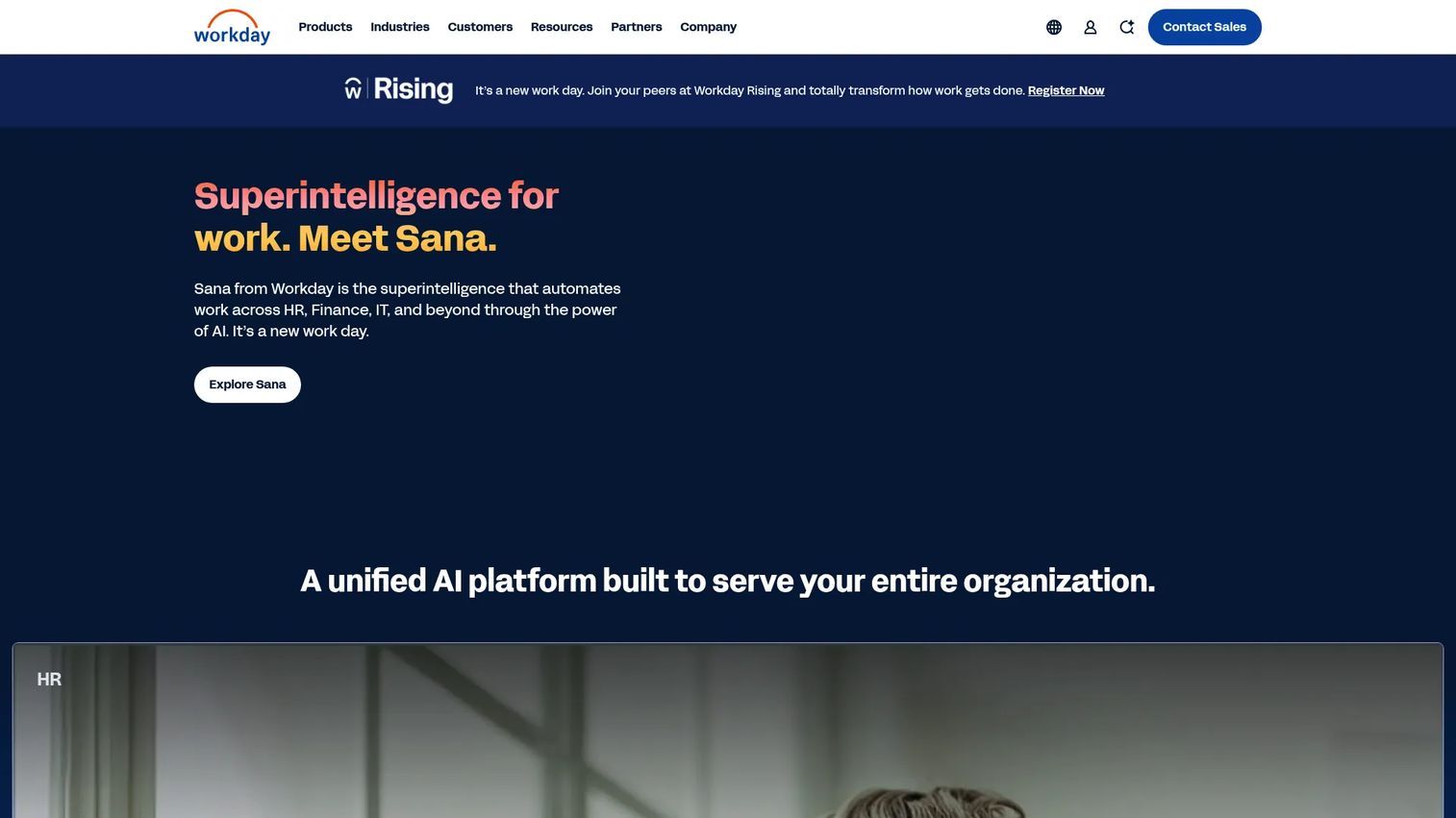
Workday Talent Management is AI-powered talent management software that handles recruiting, developing, and retaining employees on a unified Workday platform. Its strength is ecosystem fit. For organizations already standardized on Workday for HR and finance, talent acquisition lives inside the same system of record, which removes the integration friction that often slows enterprise hiring.
Best for: Mid-market to enterprise organizations that need an integrated talent suite with recruiting, development, and mobility.
Key strengths
- Talent acquisition: Recruiting workflows that connect directly to the broader Workday HR data model.
- Talent development: Skills management, goals, feedback, and growth planning in one suite.
- Talent optimization: Performance enablement, recognition, and internal mobility that extend beyond the hire.
Why choose Workday Talent Management: If your company already runs on Workday, this is the obvious path. Recruiting data, employee records, and internal mobility all share one platform, so you avoid the data silos that come from bolting on a separate ATS. The suite breadth means talent acquisition is one part of a wider lifecycle, from hire to development to retention.
Workday Talent Management pricing: Workday does not publish public pricing for talent management. Pricing is handled through sales and scoped to your organization. Expect an enterprise procurement motion rather than a self-serve signup.
6. iCIMS
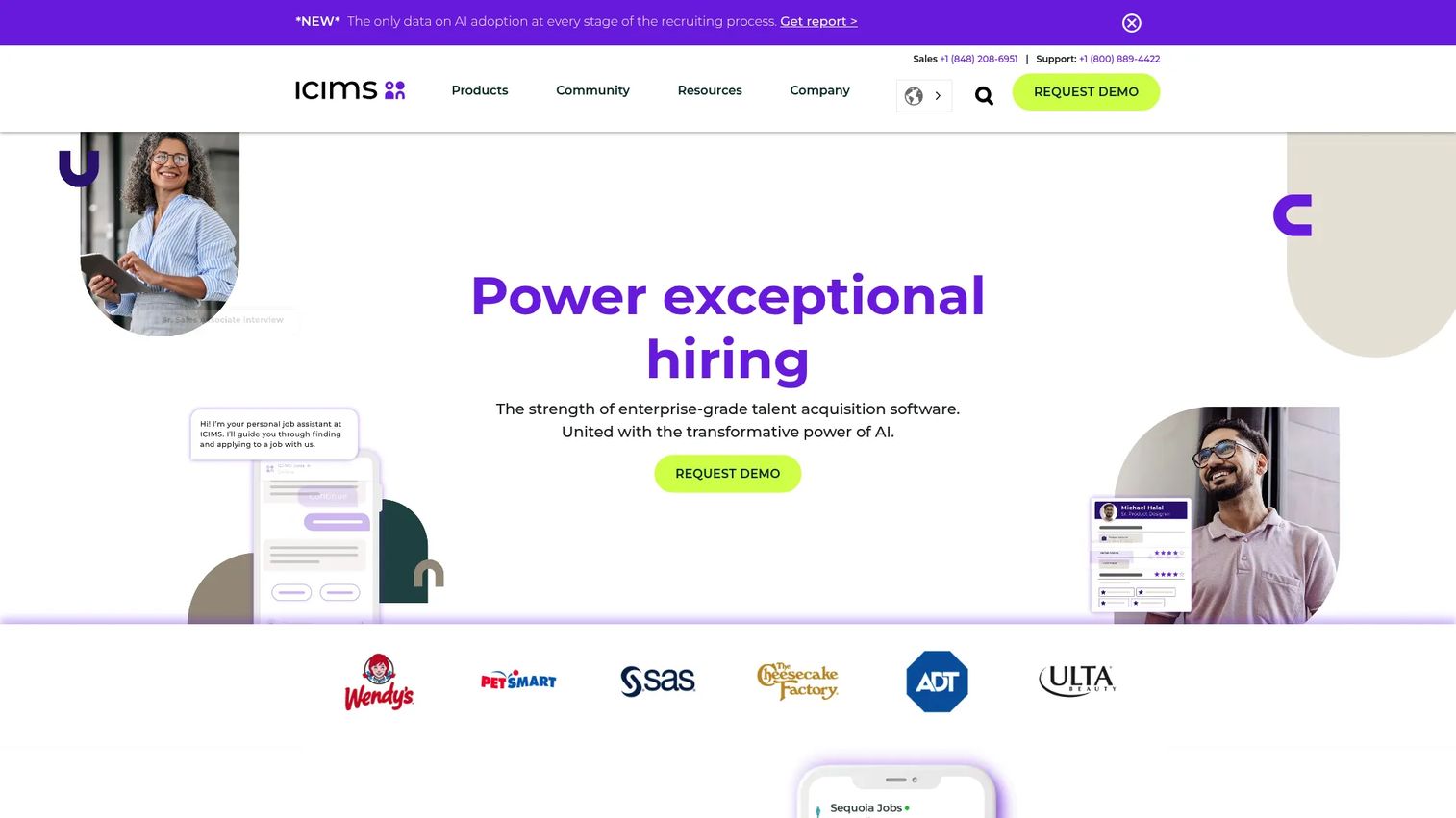
iCIMS is enterprise talent acquisition software combining an ATS, CRM, employer branding, and AI recruiting tools. It is built for large and mid-market organizations managing complex hiring operations across many roles and locations. Its modular approach lets enterprise teams assemble the workflow depth they need, which is why it shows up in large talent acquisition stacks where customization matters.
Best for: Large and mid-market organizations managing enterprise hiring workflows.
Key strengths
- Applicant tracking system: An enterprise-grade ATS that handles high-volume hiring and complex requisition structures.
- Candidate relationship management: CRM to build talent pools and nurture candidates across a long hiring cycle.
- Employer branding and career sites: Branded career site tools that strengthen the candidate experience at the top of the funnel.
Why choose iCIMS: For large hiring operations, the modularity and workflow depth are the draw. You can configure the platform to match intricate approval flows, branding requirements, and high-volume hiring needs. It is a fit for enterprise teams that want a talent acquisition suite they can shape around their existing processes rather than the reverse.
iCIMS pricing: iCIMS does not publish public pricing and uses a demo or request-quote motion. Plan for a sales conversation to scope modules, seats, and hiring volume for an accurate enterprise quote.
7. Workable
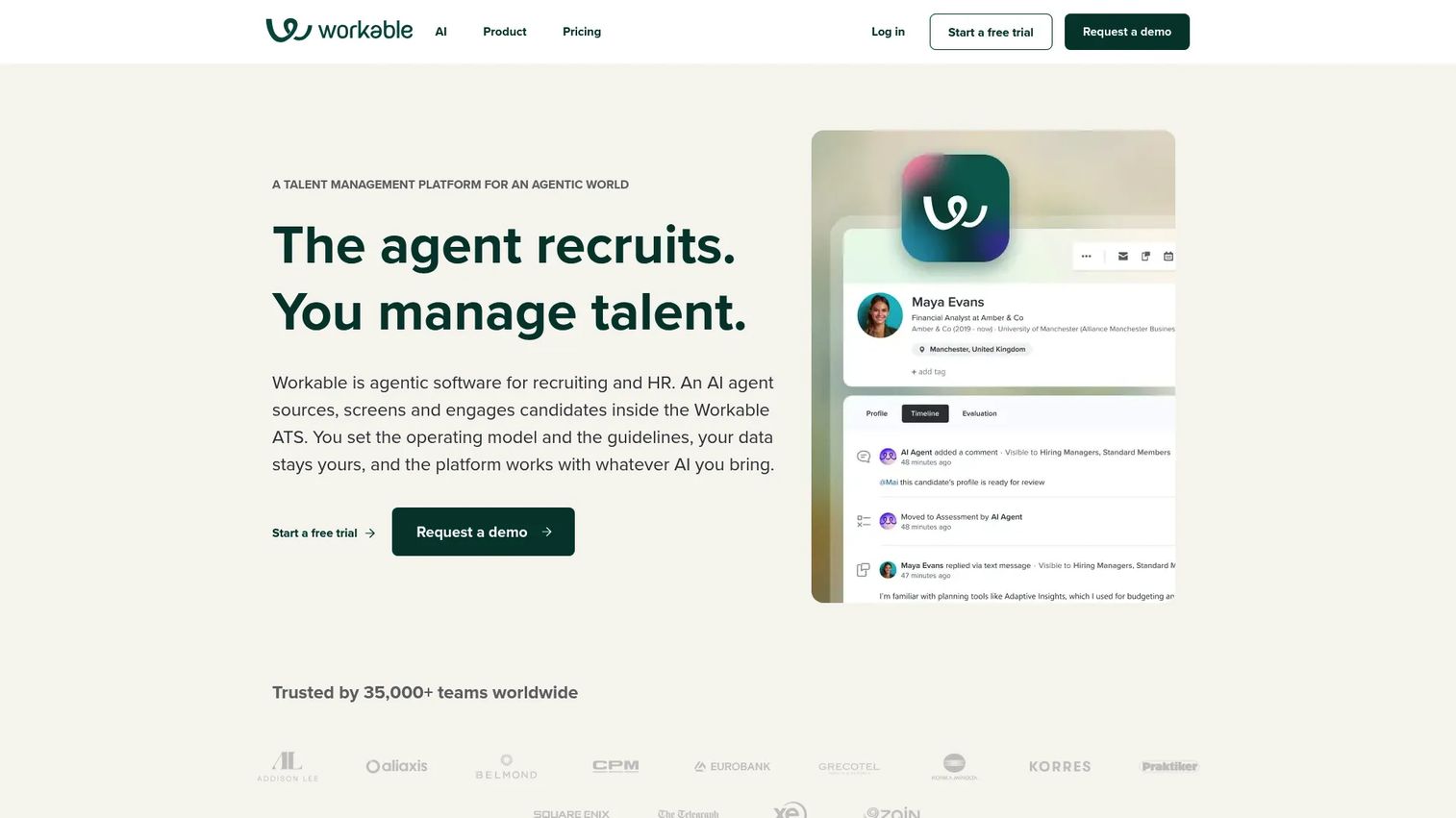
Workable is an AI-powered recruiting and HR platform for sourcing, tracking, and hiring candidates. Its calling card is accessibility: it pairs a combined ATS and recruiting workflow with AI-assisted sourcing in a package that small and mid-size teams can roll out quickly. That speed-to-implement and lower operational overhead make it a practical first real recruiting platform for many teams.
Best for: Teams that want a combined ATS and recruiting platform with AI-assisted sourcing and hiring.
Key strengths
- Candidate sourcing suite: Built-in sourcing automation and job board posting to fill pipeline fast.
- Applicant tracking system: A clean ATS that covers the core hiring workflow without a heavy learning curve.
- AI-powered recruiting workflow: AI recruiting features that assist sourcing, screening, and candidate communication.
Why choose Workable: For a small to mid-size team, simplicity and rollout speed are the win. You get sourcing, tracking, and AI assistance without the implementation cycle that enterprise suites demand. It is a strong fit for teams that need a real recruiting platform working in days, not quarters, with predictable monthly pricing.
Workable pricing: Public pricing shows three plans: Standard at $299 per month, Premier at $599 per month, and Enterprise at $719 per month, plus paid add-ons and separate Workable Agent credit bundles. The published flat rates make budgeting straightforward for smaller teams.
8. Zoho Recruit
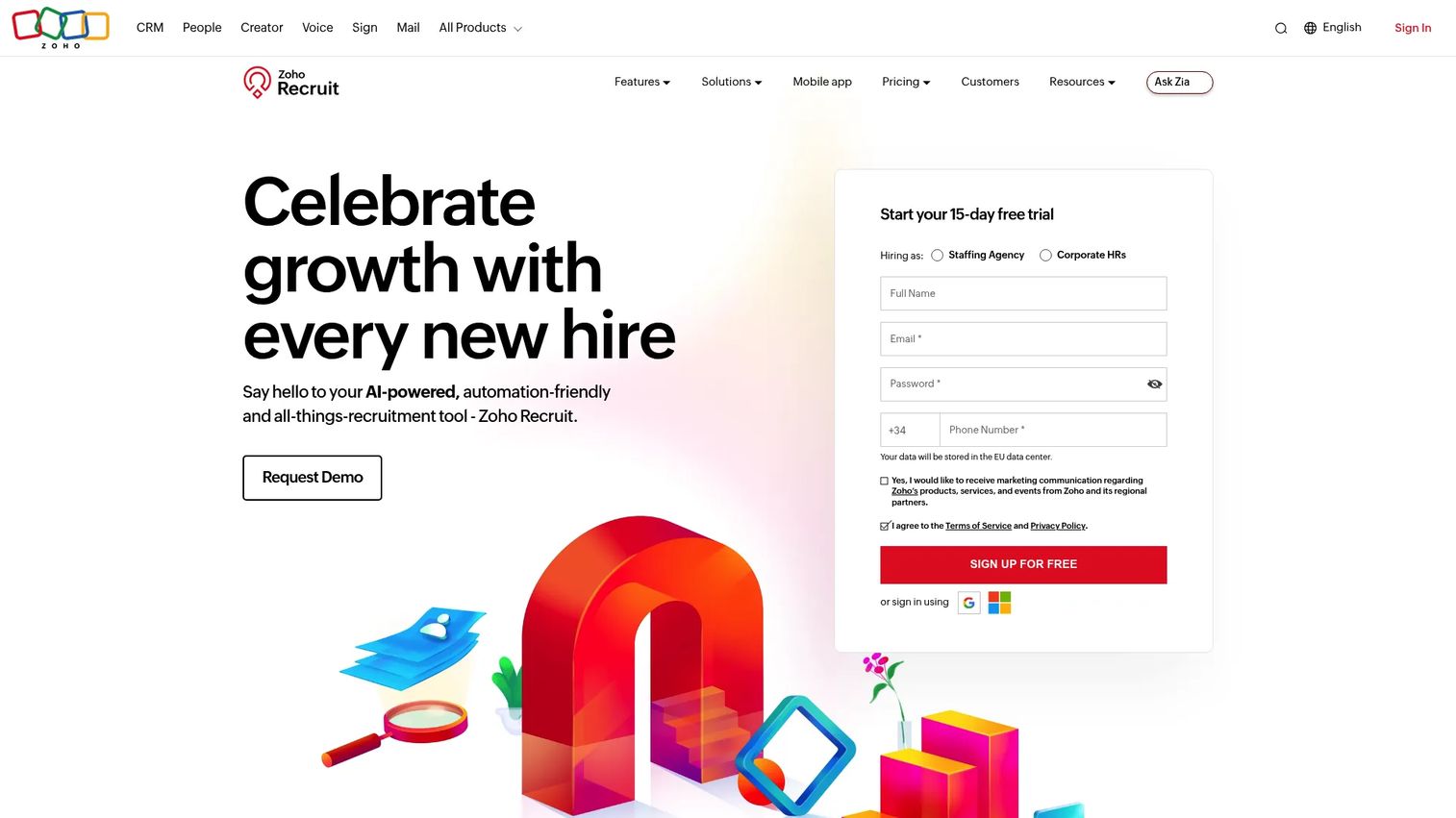
Zoho Recruit is cloud-based applicant tracking and recruitment CRM software for hiring teams and staffing agencies. Its strengths are flexibility and affordability, with broad use across recruiting motions and a free tier that lowers the barrier to entry. For cost-conscious teams, and especially those already in the Zoho ecosystem, it delivers ATS and CRM-style recruiting workflows at a price point that is hard to match.
Best for: HR teams and staffing agencies that need an all-in-one ATS with CRM-style recruiting workflows.
Key strengths
- AI candidate matching and AI-assisted content: AI recruiting features that match candidates to roles and assist content creation.
- Job board posting and candidate sourcing: Sourcing automation across job boards to build pipeline efficiently.
- Workflow automation and custom hiring pipelines: Configurable pipelines and recruiting automation that adapt to different hiring motions.
Why choose Zoho Recruit: For budget-sensitive teams, the value and ecosystem alignment are the case. If you already use Zoho for CRM or other operations, recruiting slots into the same environment. The free tier lets you start without commitment, and the paid plans stay affordable as you grow.
Zoho Recruit pricing: Zoho Recruit offers a Free Forever plan, a Standard plan at $25 per recruiter per month billed annually ($30 billed monthly), and an Enterprise plan at $50 per recruiter per month billed annually ($60 billed monthly). A 15-day free trial and a 45-day money-back guarantee lower the risk of trying it.
Considerations before you buy
The shortlist narrows once you weigh how each tool fits your operational reality. Run through this checklist before committing.
Integration requirements
Confirm the platform connects to your HRIS, calendar, email, job boards, and collaboration tools. A talent acquisition system that does not sync with your existing stack creates duplicate data entry instead of removing it. Map your must-have integrations before the demo, and verify them live.
Reporting and analytics
Decide which metrics leadership actually wants: time-to-hire, source quality, pipeline conversion, or offer acceptance. Then confirm the tool reports them cleanly and exports them where you need. Reporting that nobody trusts is reporting that nobody uses.
Hiring volume and complexity
Match the tool to your motion. High-volume hiring needs strong automation and bulk actions. Complex, multi-stakeholder roles need configurable stages and approvals. A tool built for one rarely shines at the other, so be honest about which describes your hiring.
Governance and approvals
Verify that approval chains, permissions, and audit trails match how your organization actually makes hiring decisions. For enterprise recruiting, governance is not optional. The same discipline that drives ai security posture management applies to who can touch candidate data and when.
Ease of adoption
A platform only delivers value if recruiters and hiring managers use it. Check the learning curve, onboarding resources, and how quickly your team can be productive. The most powerful suite is worthless if adoption stalls.
Security and permissions
Candidate data is sensitive. Confirm role-based permissions, data residency, and compliance certifications before you sign. Get your security team involved early so procurement does not stall the deal at the finish line.
Conclusion
The right talent acquisition software depends less on brand recognition and more on fit. Enterprise teams should prioritize workflow depth, governance, and integrations: SmartRecruiters, Workday Talent Management, and iCIMS all carry the breadth and approval controls that complex hiring demands. Process-heavy teams that care about repeatability lean toward Greenhouse Recruiting, while sourcing-led teams get the most from Lever's ATS-plus-CRM model.
Smaller and faster-moving teams have different priorities. Ashby gives scaling teams all-in-one workflows and analytics in one system. Workable wins on ease of use and rollout speed, and Zoho Recruit delivers real recruiting workflows at a budget-friendly price with a free tier to start.
If you want a single recommendation: start by naming your hiring motion and company size, then shortlist the two tools above that match it. For most growing teams that want depth without enterprise overhead, Ashby is the strongest all-around starting point. For enterprises already invested in a broader HR ecosystem, anchor your decision on integration fit first, then evaluate workflow depth.
FAQs
Talent acquisition software is an end-to-end recruiting platform that helps teams source, track, engage, interview, and onboard candidates in one place. It goes beyond basic applicant tracking by adding sourcing, CRM, automation, analytics, and onboarding workflow. The goal is to run the entire hiring motion in a single system instead of scattered spreadsheets and inboxes.
An ATS is usually one component of a broader talent acquisition suite. The ATS handles requisitions, pipelines, and stage tracking, while a full talent acquisition platform wraps sourcing automation, candidate relationship management, AI recruiting, reporting, and onboarding around that core. If you only need to track applicants, an ATS may suffice. If you need to source, nurture, and onboard too, you want the broader suite.
The features that matter most are ATS depth, sourcing and CRM, interview scheduling, automation and AI, reporting, and integrations. ATS depth controls your hiring workflow, sourcing fills the pipeline, automation removes admin, and integrations keep data flowing into your HRIS and calendar. Prioritize the features that match your specific hiring motion rather than chasing the longest feature list.
Enterprise hiring teams should prioritize workflow depth, governance, and scalability. SmartRecruiters, Workday Talent Management, and iCIMS all fit large, complex hiring operations with strong integrations and approval controls. The best choice often comes down to your existing stack: if you already run Workday, the unified ecosystem is a major advantage.
Small teams usually value ease of use, fast setup, and predictable cost. Workable offers a combined ATS and recruiting workflow that rolls out quickly, and Zoho Recruit delivers affordable recruiting with a free tier to start. Both let a small team get a real recruiting platform running in days without an enterprise implementation cycle.
Yes, though depth varies by platform. Some tools add full CRM and sourcing automation to nurture passive talent and run outreach campaigns, while others focus more on pipeline management once candidates are in the system. Lever and Greenhouse lean into sourcing and CRM, while lighter tools concentrate on tracking. Match the sourcing depth to how much pipeline you need to build proactively.
At minimum, a recruiting platform should integrate with your HRIS, calendar, email, job boards, and collaboration tools like Slack. These connections decide whether data flows automatically or whether recruiters re-enter it by hand. Before buying, list your must-have integrations and confirm each one works during the demo, not after the contract.
AI is genuinely useful when it reduces admin rather than adding review work. The high-value use cases are candidate matching, interview scheduling, screening support, and follow-up automation. With 43% of organizations using AI for HR and recruiting by 2025, per SHRM data summarized by Pin (2026), the question has shifted from whether to use AI recruiting to which tasks it should own. Evaluate whether each AI feature removes recruiter clicks or just generates more output to check.