Your safety records live in three spreadsheets, two email threads, and one person's head. An incident happens at a second site on a Tuesday, and by the time the corrective action gets logged, the audit trail is already thin. When the board asks for a clean compliance picture, you spend a week stitching it together by hand.
That is the operational reality most scaling companies hit before they buy environmental health safety software. The category exists to replace scattered records and manual reporting with one system of record for incidents, audits, inspections, corrective actions, and training. Global spending on dedicated EHS software is modeled to grow from $1.47B in 2021 to $2.5B in 2026, at an 11.5% CAGR, driven by digitization of EHS processes and ESG risk management needs, according to Verdantix (2021). The broader market is projected to reach $12.15 to $14.52B by 2030 to 2035, per Custom Market Insights (2026).
We selected these tools based on breadth of EHS workflows, reporting and analytics depth, workflow automation, and fit for multi-site operations. This is a buyer's comparison, not a vendor pitch. The lens throughout is operational control: which platform helps you standardize compliance, cut manual reporting, and improve visibility across sites and teams. If your evaluation touches adjacent processes, you may also find our roundups on audit management software and contract lifecycle management useful for stack planning, plus our guide to best contract management software tools for procurement-heavy programs.
What's inside
This guide covers 8 environmental health safety software tools built for 2026 buying decisions. We chose platforms for four reasons: depth of EHS workflows across incident, audit, and inspection use cases, reporting and analytics that hold up to executive scrutiny, workflow automation that reduces manual data entry, and fit for teams running multiple locations or business units. The list favors platforms that help founders and operators standardize processes and improve cross-site visibility, rather than single-purpose point tools. Every pricing figure and rating below reflects verified vendor and third-party sources at the time of writing.
TL;DR
- Best overall for compliance workflows and reporting: EHS Insight, for its modular platform, offline mobile app, and configurable compliance flows.
- Best for mobile-first field teams: SafetyCulture, for fast frontline adoption of inspections and issues.
- Best for enterprise governance and multi-site programs: CorityOne, for unified EHS data across regulated environments.
- Best for incident-heavy operations: Intelex, for configurable incident, near-miss, and corrective action workflows.
- Best for ESG and EHS in one place: Enablon, SpheraCloud, and Benchmark Gensuite, for combined sustainability, risk, and safety reporting.
What is environmental health safety software?
Environmental health safety software is a system of record that centralizes how an organization manages safety, environmental, and compliance obligations across incidents, audits, inspections, training, and reporting. Instead of tracking corrective actions in spreadsheets and chasing sign-offs over email, teams run these workflows in one platform with a clear audit trail.
Most EHS management software platforms share a common set of modules:
- Incident management: report, investigate, and close out incidents and near-misses with root-cause analysis.
- Audits and inspections: schedule, run, and score audits with mobile data capture and photo evidence.
- Corrective and preventive actions: assign, track, and verify actions to closure.
- Training and competency: track certifications, expirations, and required training by role.
- Document control: version and distribute policies, SDS, and procedures.
- Risk tracking: log hazards, assess risk, and monitor mitigation.
- Dashboards and reporting: surface leading and lagging indicators for leaders and regulators.
What modern buyers expect from EHS compliance software in 2026:
- Cloud deployment with mobile and offline capture for field teams.
- No-code configuration so program owners can adjust workflows without engineering.
- Role-based access across sites, departments, and business units.
- Open integrations with HR, ERP, and analytics systems.
- ESG and sustainability reporting alongside core safety data.
Cloud-based EHS software is the fastest-growing deployment model, with a projected 8.4% CAGR for cloud versus lower growth for on-premise between 2026 and 2035, per Custom Market Insights (2026).
When to use EHS software
Centralize compliance workflows
Spreadsheets and email threads work until they don't. The breaking point usually comes when a second location goes live, when audit frequency climbs, or when a regulator asks for records you can't reconstruct quickly. At that stage, environmental health and safety software creates one source of truth for inspections, incidents, and corrective actions. Every action has an owner, a due date, and a status, and nothing falls through the cracks between shifts or sites.
Improve reporting and accountability
You need EHS software the moment leadership wants performance visibility that a spreadsheet can't provide. Dashboards, audit trails, and trend reporting let you show leading indicators, not just incident counts after the fact. For a founder preparing board materials or due diligence, this matters. Clean, defensible compliance data is one less thing that raises questions in a diligence room.
Standardize operations across locations
Multi-site and field-heavy teams need the same workflow to run identically in every location. EHS safety software enforces consistency through standardized forms, role-based access, and mobile data capture that works offline in the field. A technician on a plant floor logs an inspection the same way a manager reviews it from headquarters, and the data rolls up cleanly for cross-site reporting.
Comparison table
Here is how the eight platforms compare on intent, differentiation, pricing, and rating. Tools are sorted by relevance to buyers searching for environmental health safety software.
| # | Product | Intent | Key differentiation | Pricing | G2 rating |
|---|---|---|---|---|---|
| 1 | EHS Insight | Modular EHS with mobile and ESG | Offline mobile app, AI safety tools, configurable modules | From $5k/year (SMB) | 4.7/5 |
| 2 | SafetyCulture | Mobile-first frontline operations | Fast inspection and issue adoption across field teams | Free; Premium $24/seat/mo (annual) | 4.6/5 |
| 3 | CorityOne | Enterprise EHS and occupational health | Unified EHS+ data, no-code configuration, open APIs | Custom | 4.0/5 |
| 4 | Enablon Platform | Enterprise risk, EHS, and sustainability | Governance and reporting depth for mature programs | Custom | 4.1/5 |
| 5 | Intelex EHS Software | Configurable incident and audit workflows | Broad EHS coverage with enterprise compliance | From $44/user/mo (annual, 25 user min) | Not listed |
| 6 | SpheraCloud | EHS, ESG, and operational risk | Predictive analytics and integrated sustainability | Custom | 4.0/5 |
| 7 | Benchmark Gensuite | Audit, compliance, and workflow automation | AI-native EHS, sustainability, and quality in one | Custom | 4.0/5 |
| 8 | KPA EHS Software | Frontline safety and compliance execution | Training, inspections, and incident workflows | Custom | 4.5/5 |
1. EHS Insight
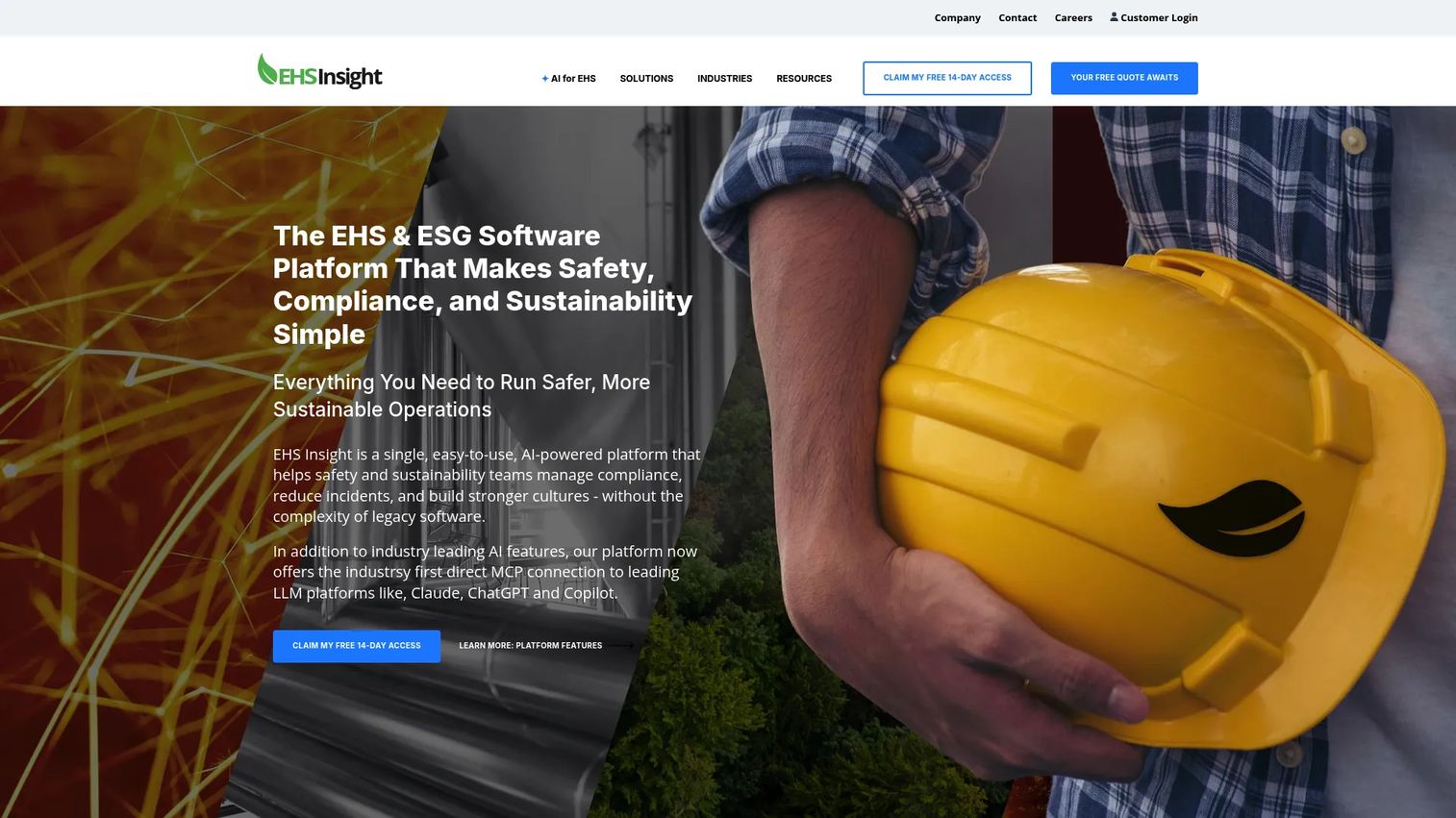
EHS Insight is cloud-based EHS management software covering safety, compliance, risk, and ESG workflows in a modular platform. Teams adopt only the modules they need, from incident management and audits to training and document control, then expand as the program matures. Its AI-assisted safety tools help teams query records and surface trends without manual report building, and the offline mobile app keeps field data capture running when connectivity drops. For scaling companies, the appeal is standardizing compliance without a heavy implementation lift.
Best for: Organizations that want a modular EHS platform with offline mobile use and configurable compliance workflows.
Key strengths
- Modular EHS platform: turn on incident, audit, training, and ESG modules as your program grows.
- Offline mobile app: capture inspections and incidents in the field without a live connection.
- AI-powered safety tools: query records and surface trends without building reports by hand.
Why choose EHS Insight: The modular structure fits teams that want to start with core incident and audit workflows and add ESG and risk tracking later, without switching platforms. The no-sales-call trial flow lets operators evaluate fit before committing, which matters when you are protecting cash and want a first-week read on stack fit.
EHS Insight pricing: EHS Insight publishes a Small & Medium Business Solution starting at $5k per year, with an Enterprise Solution priced on contacts, modules, and implementation requirements. The pricing page invites you to start a free trial, so you can validate workflows before a purchase decision.
2. SafetyCulture
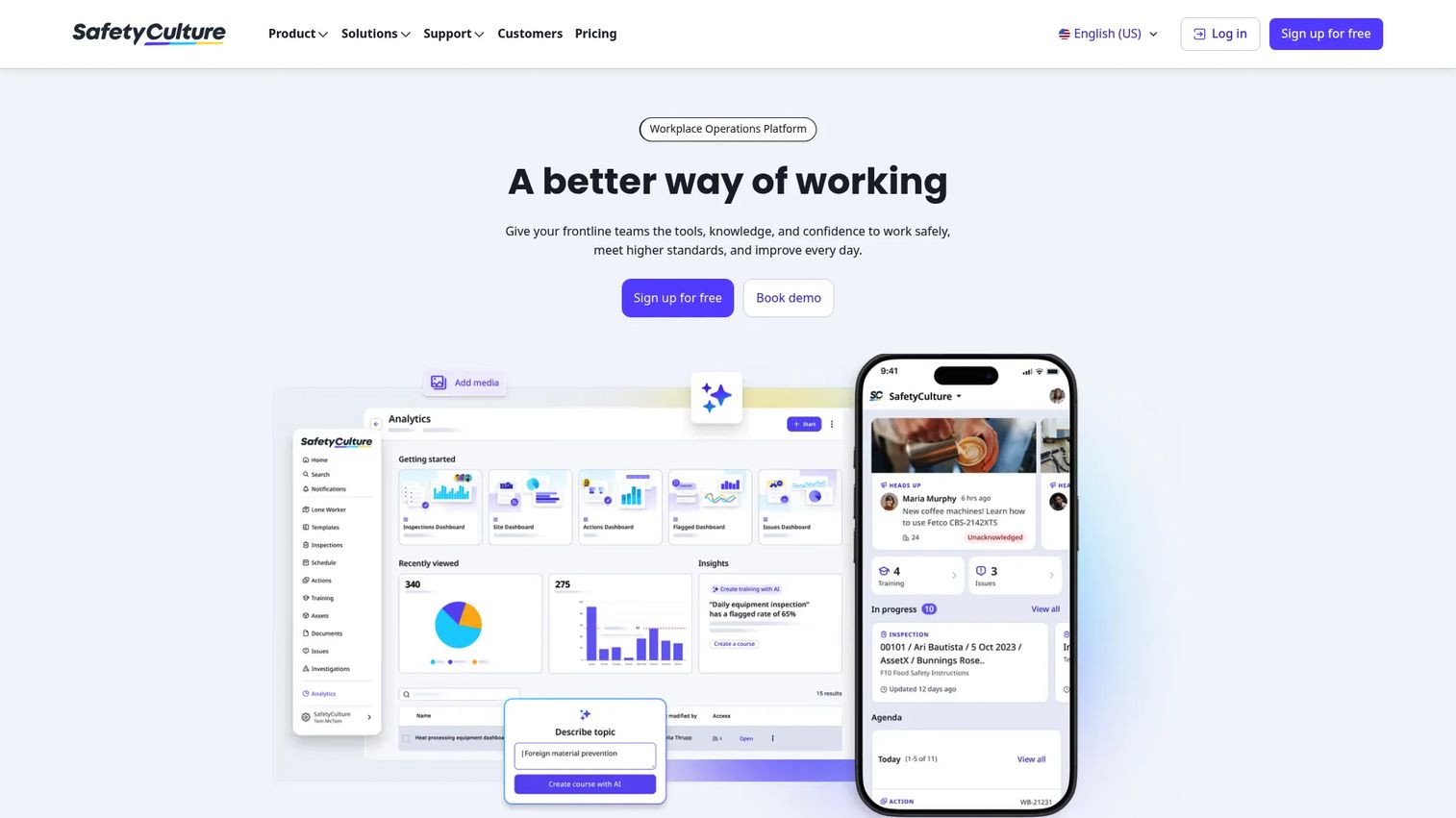
SafetyCulture is a workplace operations platform built around inspections, training, issues, assets, and safety workflows. Its strength is frontline adoption: smart forms and mobile-first inspections make it fast for field workers to log data without training overhead. Beyond inspections, it handles schedules, actions, investigations, documents, assets, sensors, and analytics, which gives operations teams broad coverage from a single app. For teams that want quick, wide adoption across a distributed workforce, it moves fast.
Best for: Teams needing digital inspections, safety and compliance workflows, and frontline operations management.
Key strengths
- Templates and inspections: build and deploy digital inspection forms across every site.
- Schedules, actions, issues, and investigations: route and close safety tasks with clear ownership.
- Broad operational coverage: training, documents, assets, sensors, lone worker, analytics, and marketplace in one platform.
Why choose SafetyCulture: If your priority is getting frontline users to actually use the tool, SafetyCulture's mobile-first design lowers the adoption barrier. It fits operations-led teams that want inspections and issue tracking live across sites quickly, then layer in analytics and asset tracking as the program deepens.
SafetyCulture pricing: SafetyCulture is free for teams up to 10 users. Premium is $24 per seat per month billed annually, or $29 per seat per month billed monthly, adding advanced analytics, training, integrations, permissions, and security. Enterprise is custom-priced for large organizations. The free tier makes it low-risk to pilot with a single team before rolling out.
3. CorityOne
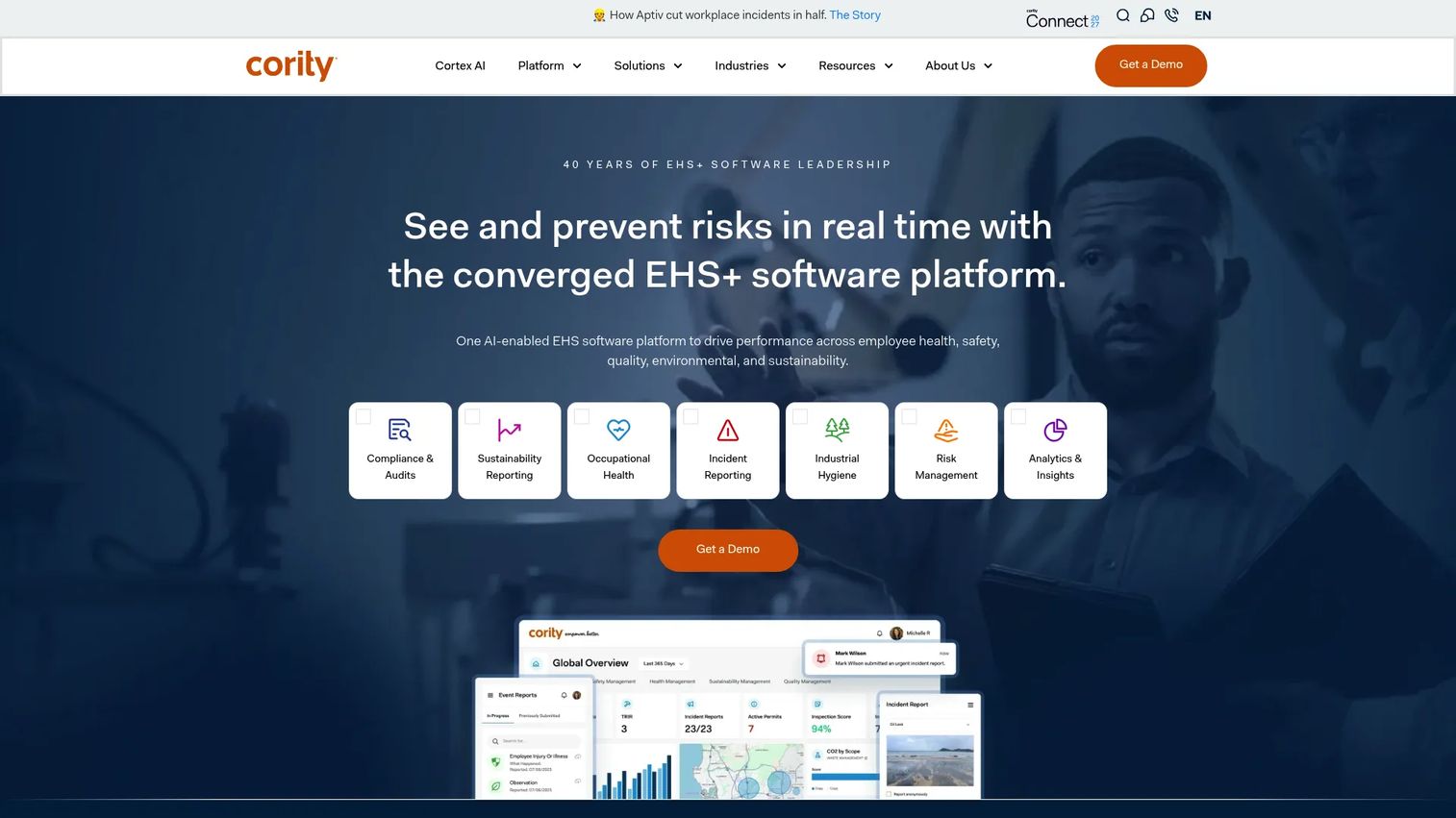
CorityOne is an enterprise EHS+ platform that unifies environmental, health, safety, quality, and sustainability operations in one place. It stands out for regulated, multi-department environments where occupational health and complex compliance obligations sit alongside core safety. No-code workflow configuration lets program owners adjust processes and permissions without developer involvement, and open RESTful APIs connect EHS data to the rest of the enterprise stack. For large organizations, the unified data model reduces the silos that make cross-department reporting painful.
Best for: Large, regulated enterprises needing a unified EHS+ platform across safety, health, and environmental programs.
Key strengths
- Unified EHS+ data: one data model across safety, health, environmental, quality, and sustainability.
- No-code workflow configuration: adjust workflows and permissions without engineering.
- Open integrations and RESTful APIs: connect EHS data to HR, ERP, and analytics systems.
Why choose CorityOne: CorityOne fits organizations with occupational health requirements and complex, multi-jurisdiction compliance that simpler tools don't cover. If your program spans several regulated departments and you need one system that reports across all of them, the unified model earns its place.
CorityOne pricing: Cority does not publish pricing on its site and directs buyers to request a demo or contact sales. Expect enterprise, quote-based pricing scoped to modules, users, and implementation. Budget for a scoping conversation rather than a self-serve signup.
4. Enablon Platform
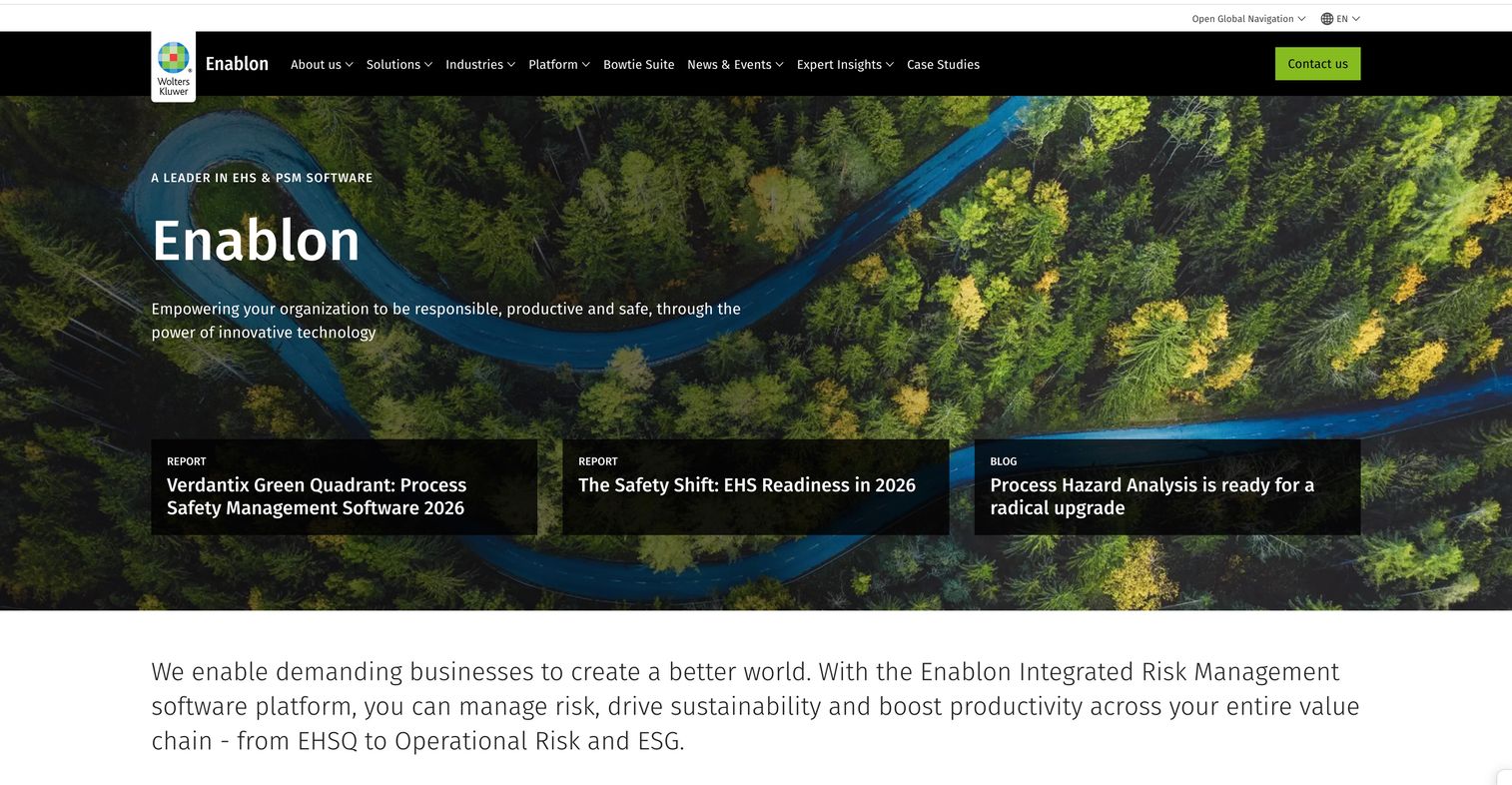
Enablon, a Wolters Kluwer business, is an enterprise platform for sustainability, EH&S, and operational risk management. It targets mature programs that need governance and reporting depth across incident, audit, compliance, and risk workflows, with sustainability reporting built in rather than bolted on. Its strength is bringing multiple stakeholder groups, from EHS to risk to sustainability, onto shared data and shared reporting. For organizations where compliance and ESG reporting must satisfy several audiences at once, that consolidation is the point.
Best for: Large enterprises managing sustainability, compliance, and operational risk in one platform.
Key strengths
- Sustainability and EH&S management: combine safety, environmental, and ESG workflows on shared data.
- Compliance and risk management workflows: govern obligations across departments and jurisdictions.
- Incident, audit, and reporting depth: support mature programs with multiple stakeholders.
Why choose Enablon: Enablon suits established programs where multiple teams depend on the same compliance and risk data, and where reporting has to hold up to regulators, boards, and sustainability disclosures. It rewards organizations ready to invest in a governance-grade platform.
Enablon pricing: Enablon does not publish public pricing; the site routes to demo requests and product materials. Pricing is enterprise and quote-based, scoped to modules and organization size. Plan for a sales-led evaluation.
5. Intelex EHS Software
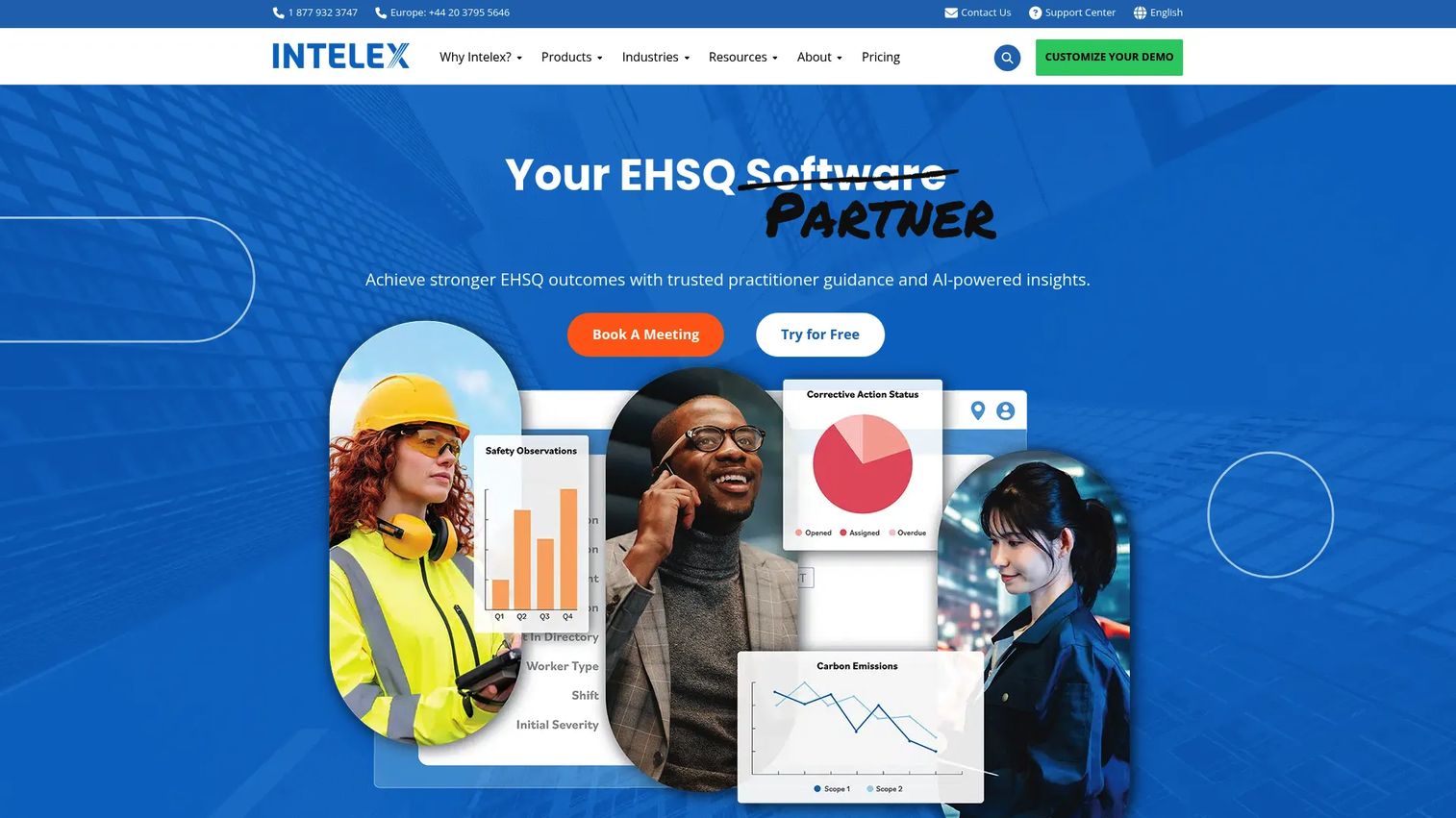
Intelex is an EHS, quality, and ESG management platform built for enterprise and growing teams. It is strong on incident-heavy operations, with configurable incident management, near-miss reporting, audits, inspections, and corrective action workflows. Mobile and offline access keep field capture reliable, and analytics plus integrations tie the data into wider systems. Its configurability makes it a flexible fit for scaling teams that need to shape workflows around their processes rather than the reverse.
Best for: Organizations needing configurable EHS software with enterprise-grade compliance and workflow management.
Key strengths
- Incident management and near-miss reporting: capture, investigate, and close incidents with structured workflows.
- Audits, inspections, and corrective actions: run and track the full audit-to-closure cycle.
- Mobile and offline access, analytics, and integrations: keep field data flowing and reporting connected.
Why choose Intelex: For teams where incidents and corrective actions are the daily workload, Intelex's configurable workflows adapt to how your program actually runs. It fits scaling operations that want enterprise-grade compliance without being locked into rigid, out-of-the-box processes.
Intelex pricing: Intelex publishes a Safety Essentials tier at $44 USD per user per month, with a minimum of 25 users, billed annually. Other offerings are custom, quote-based. The public entry price gives you a concrete starting point for budgeting before a scoping call.
6. SpheraCloud
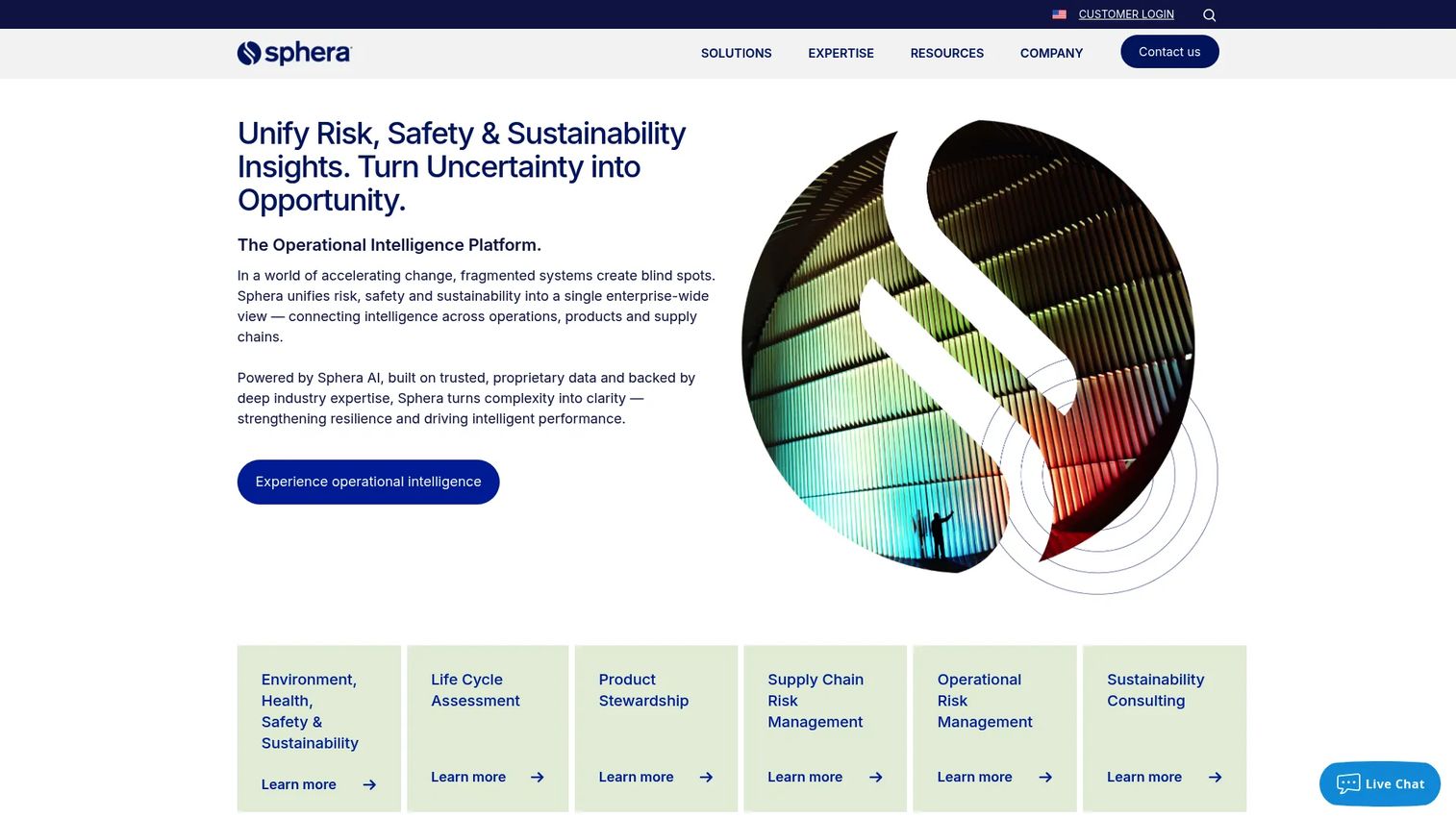
SpheraCloud is Sphera's SaaS platform for EHS, ESG, operational risk, and product stewardship. It sits within larger EHS and ESG programs, unifying safety, sustainability, and risk data on one cloud platform with a configurable UI. Predictive and prescriptive analytics, plus integrated sustainability reporting, make it relevant for enterprises that want to move from lagging indicators to forward-looking risk signals. For organizations managing operational risk at scale, the analytics depth is the differentiator.
Best for: Enterprise teams managing sustainability, safety, and operational risk in one platform.
Key strengths
- Unified cloud platform: EHS, ESG, operational risk, and product stewardship together.
- SaaS and mobile with configurable UI: adapt the cloud interface to your program.
- Predictive and prescriptive analytics: pair sustainability reporting with forward-looking risk insight.
Why choose SpheraCloud: SpheraCloud fits larger enterprises that treat operational risk and sustainability as strategic, not just compliance line items. If you want analytics that anticipate risk rather than only report it, and you already run a broad EHS and ESG program, it belongs on the shortlist.
SpheraCloud pricing: Sphera does not publish pricing on its primary site and routes buyers to demo and contact forms. Pricing is enterprise and quote-based. Expect a sales-led scoping process tied to modules and scale.
7. Benchmark Gensuite
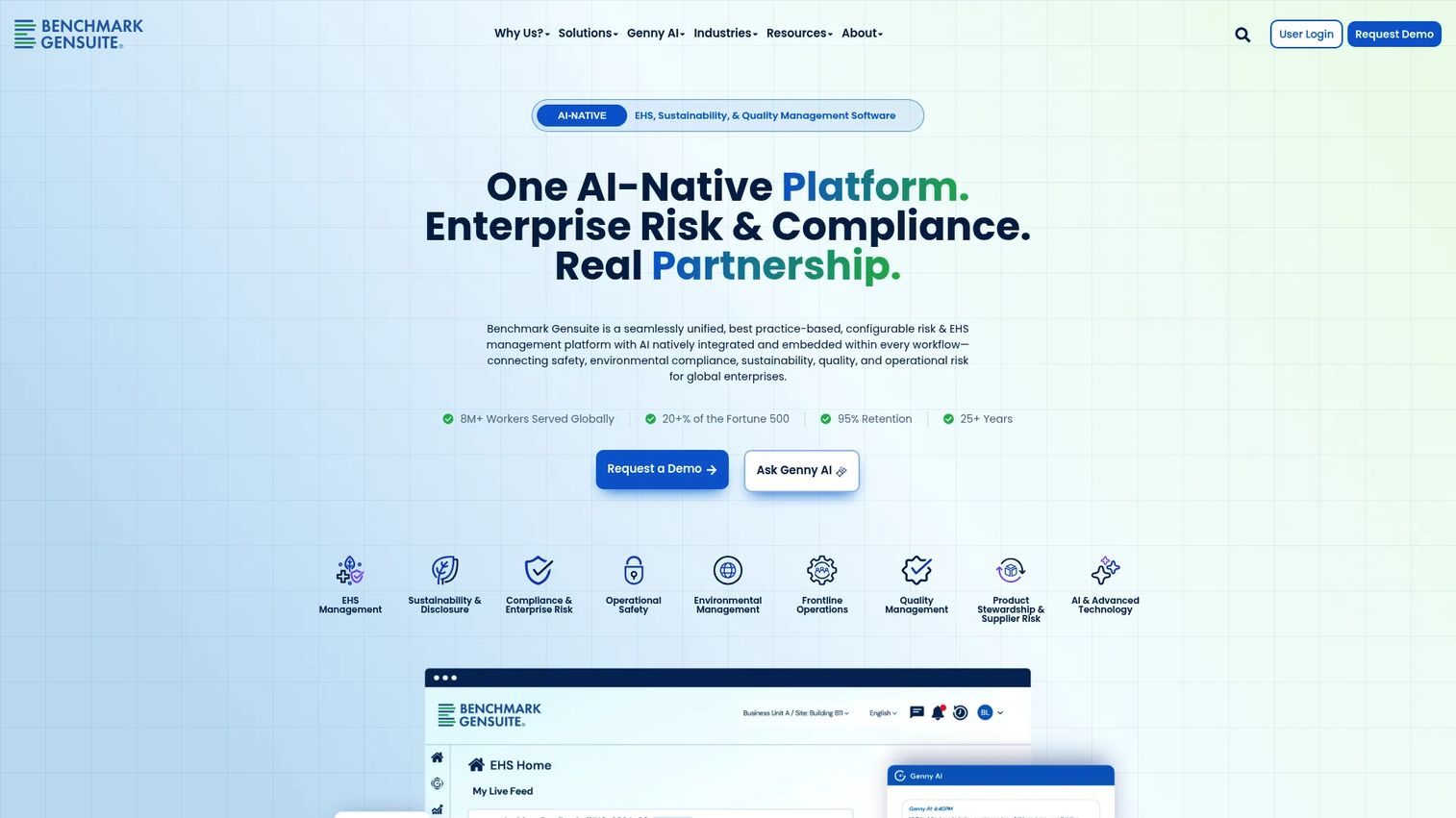
Benchmark Gensuite is AI-native EHS, sustainability, quality, and enterprise risk management software for global organizations. It brings audit, compliance, inspections, and workflow automation together on a configurable platform, with embedded AI and analytics across the board. Its cross-functional reach, spanning safety, environmental, quality, and risk, makes it a fit for organizations that want one governance layer across programs. Mobile and configurable workflow tools keep it usable for both field teams and program administrators.
Best for: Large enterprises needing a configurable EHS and sustainability management platform.
Key strengths
- Unified EHS, sustainability, quality, and risk platform: manage cross-functional programs in one place.
- Embedded AI and analytics: surface insights across audits, compliance, and workflows.
- Mobile and configurable workflow tools: support field capture and administrator configuration alike.
Why choose Benchmark Gensuite: Benchmark Gensuite suits organizations that want breadth across safety and environmental programs with automation baked in. If cross-functional reporting and governance across many programs is the goal, its combined coverage reduces the number of systems you maintain.
Benchmark Gensuite pricing: Benchmark Gensuite does not publish public pricing; the site uses a contact and demo flow. Pricing is enterprise and quote-based, scoped to your programs and organization size. Plan for a sales conversation to size the engagement.
8. KPA EHS Software
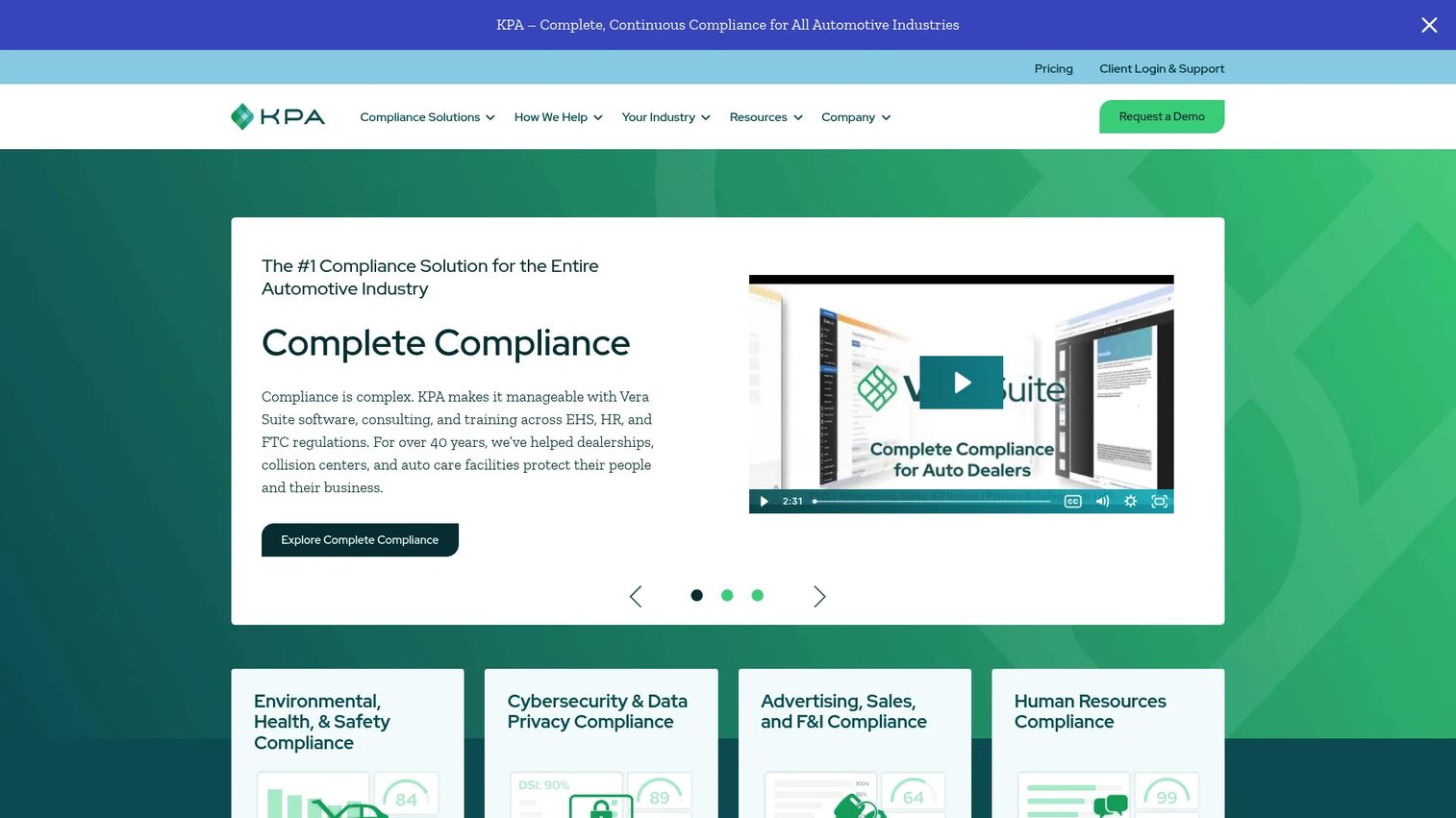
KPA is cloud-based EHS compliance software for safety, training, inspections, incident management, and reporting. Its strength is operational simplicity and frontline usability, which makes it a practical fit for multi-location businesses that want focused execution over sprawling configuration. Incident management, training management, and forms, audits, and inspections cover the core compliance workload without overwhelming frontline users. For teams that value getting safety and compliance workflows running cleanly, it closes the list as a pragmatic choice.
Best for: Automotive and multi-location businesses needing configurable EHS compliance workflows.
Key strengths
- Incident management: capture and resolve incidents with clear ownership.
- Training management: track certifications and required training by role.
- Forms, audits, and inspections: standardize compliance checks across locations.
Why choose KPA: KPA fits teams that want a focused, usable EHS platform without the overhead of enterprise configuration. Its frontline-friendly design and multi-location fit make it a strong option for operations that prioritize execution and adoption over breadth.
KPA pricing: KPA presents custom pricing and a request-a-demo flow rather than a public price. Pricing is scoped to your locations, users, and modules. Expect a scoping conversation to size the deployment.
How to choose the right EHS software
Before you shortlist, run each candidate through these criteria.
Workflow coverage and fit
Map your actual processes first: incidents, audits, inspections, corrective actions, training, and document control. Then check which platform runs those workflows natively versus which needs heavy configuration. The best fit is the one that matches how your team already works, not the one with the longest feature list.
Reporting and analytics depth
You are buying visibility as much as workflows. Look for dashboards that surface leading indicators, audit trails that hold up to scrutiny, and reporting you can hand to a board or regulator without a week of manual assembly. If ESG reporting matters, confirm it is native, not an add-on.
Multi-site and mobile readiness
For distributed teams, confirm role-based access, offline mobile capture, and clean cross-site roll-ups. A platform that works flawlessly at one location but fragments across five is not solving your real problem.
Implementation and change management
Fast time-to-value beats a longer feature list at your stage. Ask about implementation timelines, whether program owners can configure workflows without engineering, and how the vendor supports adoption. A tool nobody uses delivers nothing.
Integration and total cost
Check integrations with your HR, ERP, and analytics stack, and price the full deployment, not just the entry tier. Custom-priced enterprise platforms can be worth it, but budget for the scoping conversation and implementation, not only the license.
Conclusion
The right environmental health safety software is the one that fits your operating model, not the one with the most modules. If you want strong compliance workflows with offline mobile and room to add ESG, EHS Insight leads. For fast frontline adoption across sites, SafetyCulture moves quickest. For enterprise governance across regulated departments, CorityOne, Enablon, and SpheraCloud carry the depth. For incident-heavy operations, Intelex and KPA keep execution clean, while Benchmark Gensuite spans cross-functional programs with automation.
The next step is to shortlist two or three based on what your team prioritizes: mobile field capture, enterprise governance, or reporting depth. Run a scoped trial or demo against your real workflows, not a generic checklist, and measure how fast the tool gives you a first win. That first-week read tells you more about fit than any feature comparison. If your evaluation touches adjacent systems, our guides to best event management software and best marketing resource management software can help round out the operational stack.
FAQs
Environmental health safety software is a system of record that centralizes how a company manages safety, environmental, and compliance obligations. It replaces spreadsheets and email threads with one platform for incidents, audits, inspections, corrective actions, training, and reporting, complete with an audit trail. The goal is fewer manual reports and clearer visibility across sites.
Prioritize incident management, audits and inspections, corrective and preventive actions, training tracking, and reporting dashboards. For multi-site teams, offline mobile capture and role-based access are essential. If ESG matters, confirm sustainability reporting is native. The features that matter most are the ones that map to your actual daily workflows.
Safety management software focuses primarily on workplace safety: incidents, hazards, and safety training. EHS software is broader, adding environmental compliance and often health and sustainability into the same platform. Many tools overlap, so the practical difference is scope. If you need environmental and ESG reporting alongside safety, choose a full EHS platform.
Look for standardized workflows that run identically across locations, role-based access so each site sees the right data, and offline mobile capture for field teams. Clean cross-site reporting is the payoff. A technician logging an inspection at one plant and a leader reviewing roll-ups from headquarters should be working from the same source of truth.
Yes. Audit and inspection management is a core module in most EHS platforms. You schedule audits, run them on mobile with photo evidence, score results, and route findings into corrective actions with owners and due dates. This turns audits from a paperwork exercise into a tracked, closable workflow with a full history.
Yes, and it is often the main reason teams buy. Dashboards surface leading and lagging indicators, audit trails document every action, and trend reporting shows performance over time. For a founder or operator preparing board materials, clean and defensible compliance data reduces the manual assembly that eats a week before every review.
Match the tool to your complexity, not your ambition. If you run multiple regulated departments and need occupational health, ESG, and cross-jurisdiction compliance, an enterprise platform like CorityOne or Enablon earns its cost. If you need fast frontline adoption of inspections and incidents, a simpler, mobile-first tool like SafetyCulture gets you value faster.
Yes. Several platforms combine EHS and ESG on shared data, including EHS Insight, Enablon, SpheraCloud, and Benchmark Gensuite. This lets you report on safety, environmental, and sustainability metrics from one system rather than reconciling separate tools. If ESG disclosure is on your roadmap, confirm the reporting is native rather than a bolt-on before you buy.