You are running lot rent through a spreadsheet. One tab tracks who paid, another tracks utility splits, a third is your maintenance log, and none of them agree with each other. Then a lender asks for a clean rent roll and a trailing P&L, and you lose a weekend reconciling numbers by hand.
That is the real problem mobile home park operators are trying to solve. Not "we need a tenant portal." The job is rent collection, lot and home accounting, utility billing, maintenance, screening, and reporting that holds up under owner and lender scrutiny. Generic property tools handle apartments cleanly. Parks are different: you own the land, the resident often owns the home, and lot rent, home sales, and pass-through utilities create workflows a standard platform was never built for.
The market reflects how fast this is professionalizing. The mobile home park management software market is projected to grow from USD 0.85 billion in 2024 to USD 1.5 billion by 2032, a 7.3% CAGR according to WiseGuyReports (2024). Money is flowing into the category because operators are consolidating spreadsheets into software that produces investor-grade numbers.
This guide is a purchasing memo, not a vendor pitch. Below is a practical mobile home park software comparison built to help you separate true mobile home park management software from broader platforms that merely rank for the search. If you are evaluating rent collection software for mobile home parks or full mobile home park accounting software, this is the shortlist to work from.
What's inside
This guide covers seven platforms operators actually shortlist for mobile home parks, manufactured housing communities, and mixed portfolios. Some are purpose-built for manufactured housing. Others are broader property management tools that can handle park workflows when configured well.
We selected and ranked each tool on four criteria that matter for mobile home park operations:
- Niche fit: How well it handles lot rent, home vs. land ownership, and owner tracking
- Rent and billing workflows: Recurring charges, late fees, and utility billing
- Reporting depth: Rent rolls, collections, vacancy, and lender-ready P&L
- Pricing posture and feedback: Public pricing where available, plus verified user ratings
TL;DR
- Best niche fit for large operators: Yardi MH Manager, purpose-built for manufactured housing with deep accounting, compliance, and reporting.
- Best for deep financial control at scale: Rent Manager, strong accounting, 450+ reports, and heavy customization.
- Best industry-specific mid-market option: ManageAmerica, built specifically for manufactured housing communities.
- Best balance of usability and value: DoorLoop, fast to roll out, strong rent collection, and highly rated by users.
- Best for mixed portfolios: AppFolio, a broad platform for teams also running apartments and other assets.
- Best budget option: Innago, no monthly fee and no setup fee for cost-sensitive operators.
What is mobile home park software?
Mobile home park software is a property management platform built to handle lot rent, resident and home-owner tracking, utility billing, maintenance, screening, and reporting for manufactured housing communities and trailer parks. It differs from standard tools because it models the land-versus-home ownership split that defines park operations.
The best mobile home park management software typically covers a core operational stack:
- Rent and lot rent collection: Recurring charges, autopay, late fees, and online payments for lot rent management.
- Lot and lease management: Track occupied and vacant lots, home ownership, leases, and home sales.
- Utility billing: Sub-metered or ratio utility billing for mobile home parks passed through to residents.
- Maintenance requests: Work orders, vendor assignment, and status tracking.
- Tenant screening: Applications, background and credit checks, and online lease signing.
- Resident portal: Payments, messaging, documents, and announcements.
- Reporting and KPI tracking: Rent rolls, collections, vacancy, delinquency, and P&L for owners and lenders.
That last layer is where mobile home property management software earns its keep. When manufactured housing software produces a clean rent roll and trailing financials on demand, refinancing and reporting stop being a fire drill.
When to use mobile home park software
Replace spreadsheets and manual rent tracking
Spreadsheets work until they don't. The moment a park grows past a couple dozen lots, or you add a second property, manual tracking starts leaking money. Payments get missed, late fees go uncharged, and no one can answer "what did we actually collect last month" without an hour of reconciling. Software makes collections auditable, so mobile home park management stops depending on one person's memory.
Standardize rent collection and billing
Recurring lot rent, variable utility charges, and late fees are exactly the kind of repetitive work software removes. Set the charge once, and the platform bills it, applies late fees on schedule, and pushes reminders. Rent collection software for mobile home parks with autopay and online payments cuts the follow-up calls that eat a manager's week and shortens the gap between due date and deposit.
Improve visibility for owners, lenders, and managers
This is the reporting angle, and it is often the real buying trigger. Owners want a live rent roll and a trailing P&L. Lenders want proof of collections and occupancy before they refinance. Managers want to see the maintenance backlog and delinquency in one place. Reporting and KPI tracking turns operational data into the numbers that survive due diligence.
Mobile home park software comparison
The table below is your quick-scan mobile home park software comparison. Note where public pricing exists versus where it is quote-based. Purpose-built manufactured housing platforms tend toward custom pricing and larger portfolios, while broader tools publish tiers aimed at smaller operators.
| # | Product | Intent | Key use case | Pricing | G2 rating |
|---|---|---|---|---|---|
| 1 | Yardi MH Manager | Enterprise manufactured housing | Accounting, compliance, and reporting for large operators | Custom quote | 4.0/5 |
| 2 | ManageAmerica | Industry-specific MH management | Home/site tracking and utility billing for communities | Custom (Core, Signature, Premier) | Not verified |
| 3 | Rent Manager | Customizable all-in-one | Deep accounting and 450+ reports at portfolio scale | Custom quote | 4.6/5 |
| 4 | AppFolio | Broad property management | Mixed portfolios needing accounting and leasing | Quote-based; Stack from $0.50/unit/mo | 4.6/5 |
| 5 | DoorLoop | Usable all-in-one | Fast rollout, rent collection, and screening | From $69/month | 4.8/5 |
| 6 | Buildium | General portfolio management | Accounting, payments, and maintenance for SMBs | From $62/month | 4.4/5 |
| 7 | Innago | Budget-sensitive landlords | Free rent collection, screening, and applications | No monthly fee | 4.8/5 |
1. Yardi MH Manager
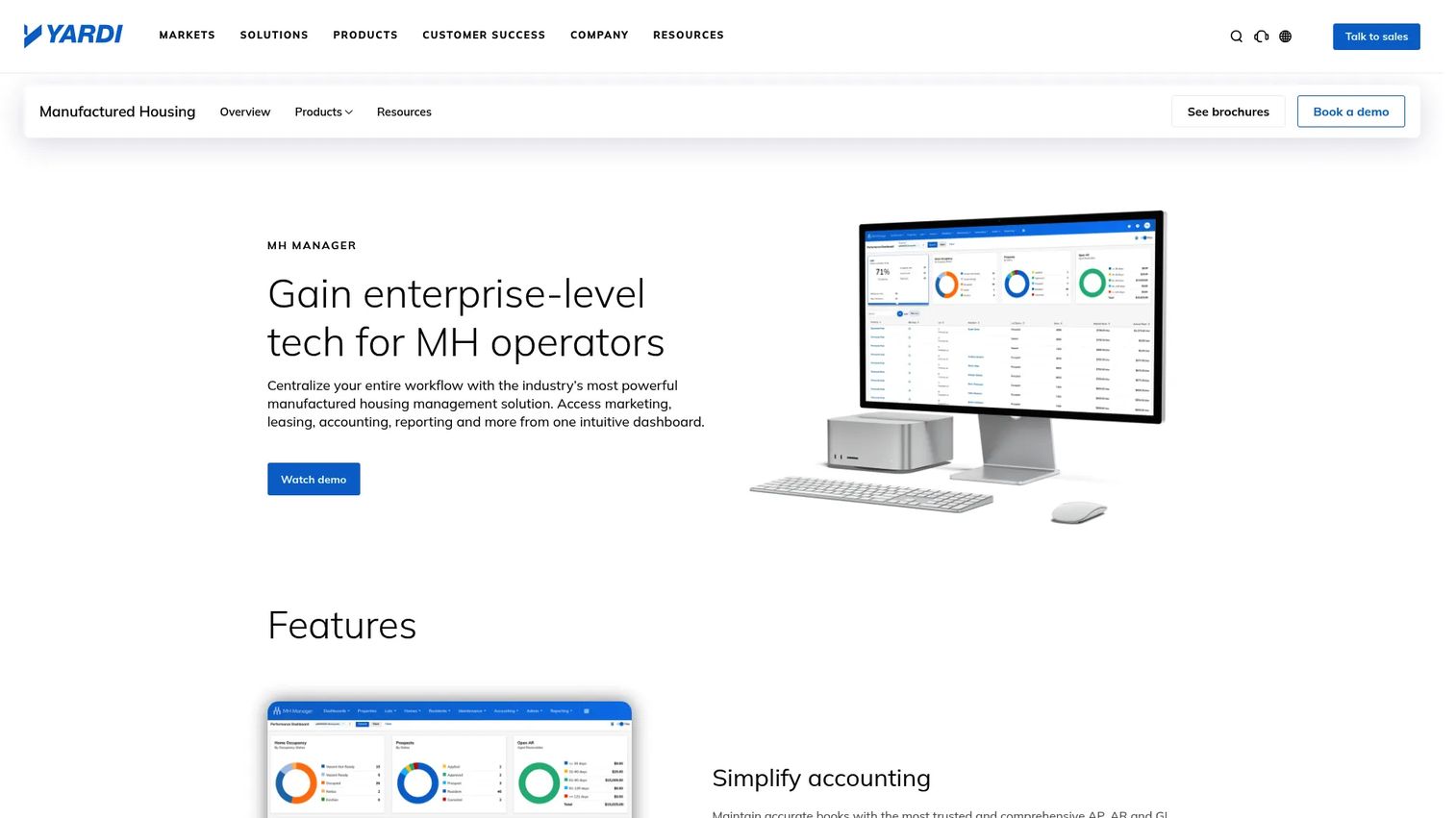
Yardi MH Manager is enterprise software built specifically for manufactured housing operators. It covers full accounting, leasing, homes-and-lots inventory, compliance, maintenance, and reporting in one platform. Because it models the manufactured housing world directly, including the land-versus-home ownership split, it fits operators who need institutional depth rather than a repurposed apartment tool.
Best for: Large manufactured housing operators needing an enterprise management platform.
Key strengths
- Full accounting (AP/AR/GL): A complete general ledger, not a bolt-on, so financials stay lender-ready.
- Homes and lots inventory tracking: Manage occupied lots, vacant sites, and home sales in one system.
- Violations and compliance management: Track community rule violations and compliance workflows across properties.
Why choose Yardi MH Manager: If you run a large portfolio and answer to institutional owners or lenders, Yardi's depth is the point. The accounting and compliance layers are built for scale and reporting rigor, and the platform is mobile-friendly for staff working across multiple properties. It is a heavier commitment than an SMB tool, which is exactly what larger operators want.
Yardi MH Manager pricing: Yardi does not publish pricing on its MH Manager product page. Pricing is quote-based and scoped to portfolio size and requirements, so plan to go through a sales conversation. On G2, the Yardi seller profile carries a 4.0/5 rating. Treat the quote process as part of your evaluation, and ask specifically about implementation timelines and custom reporting.
2. ManageAmerica
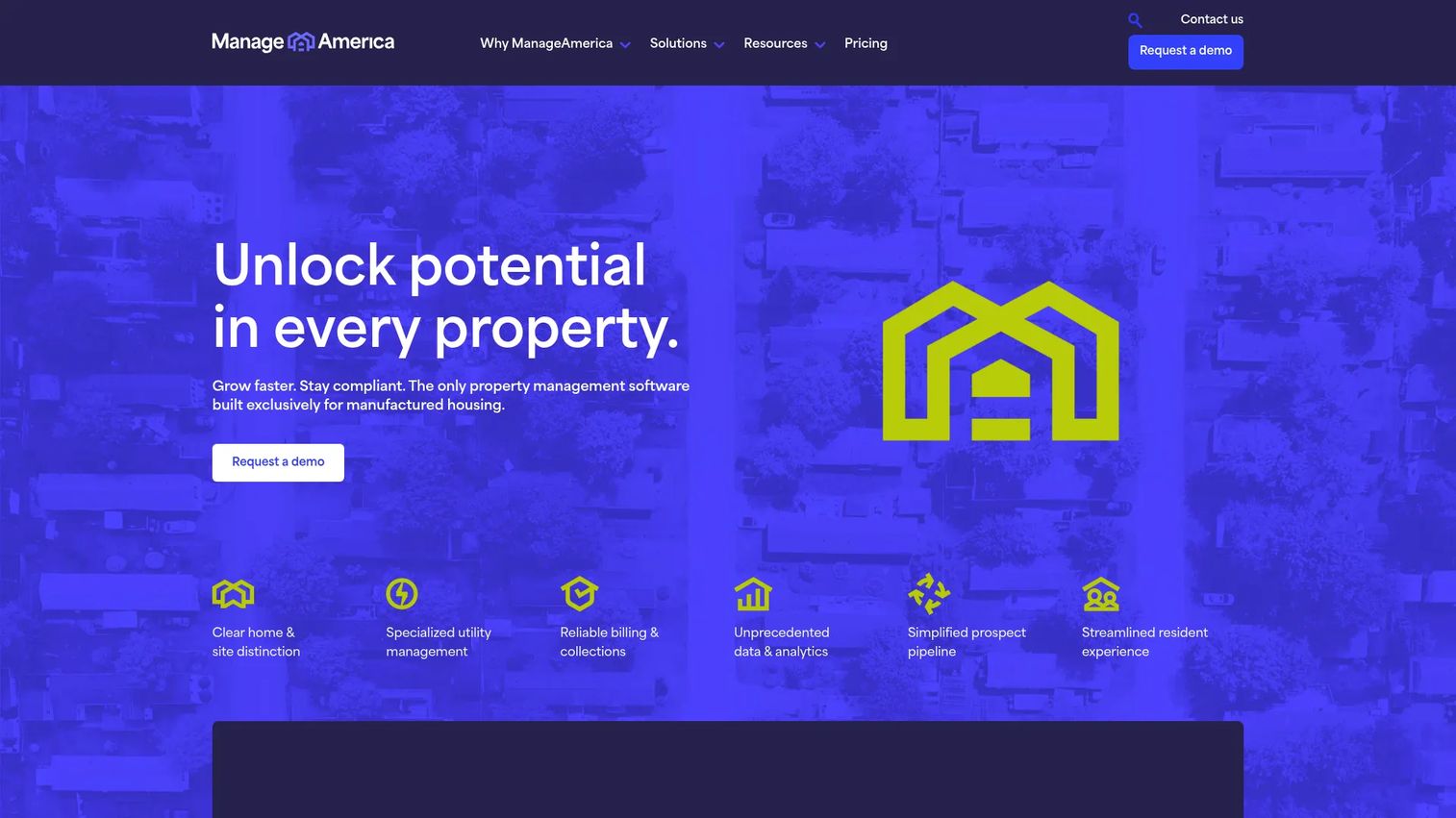
ManageAmerica is property management software built specifically for manufactured housing communities. That focus shows in how it handles the workflows park operators live in every day: home and site tracking, utility management, billing and collections, and resident communications. It is not a general tool stretched to fit parks; it was designed for them.
Best for: Manufactured housing operators needing an industry-specific property management platform.
Key strengths
- Home and site tracking: Purpose-built inventory for lots, homes, and community sites.
- Utility management and billing: Meter reads, utility billing, and collections handled natively.
- Reporting and dashboards: Operational dashboards plus resident communications in one place.
Why choose ManageAmerica: The pull here is niche fit. If your portfolio is entirely manufactured housing and you want software that speaks your operational language without heavy configuration, ManageAmerica is built for exactly that. Utility billing and site tracking are first-class citizens rather than add-ons, which matters when pass-through utilities drive real revenue.
ManageAmerica pricing: ManageAmerica offers three plans, Core, Signature, and Premier, customized by portfolio size and operational needs. The pricing page confirms the plan structure but does not list public numeric prices, so expect a scoped quote. A third-party G2 rating was not verified at the time of writing. When you request pricing, ask which plan tier includes the utility billing depth and reporting your parks need.
3. Rent Manager
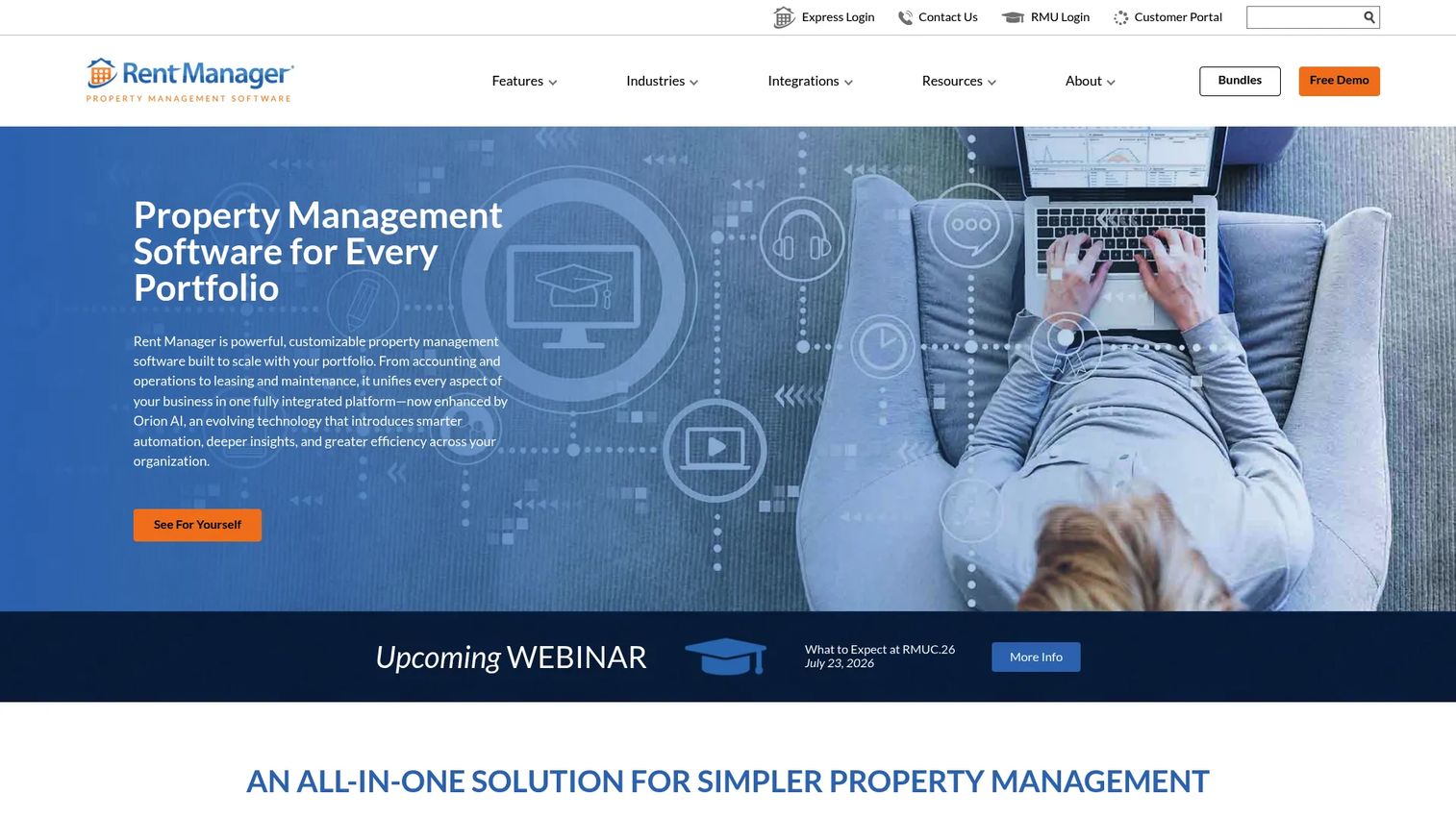
Rent Manager is a highly customizable all-in-one platform that spans residential, commercial, and other real estate portfolios, including manufactured housing. Its reputation rests on accounting depth and reporting flexibility. For operators who care about deep financial control, it is one of the strongest fits on this list.
Best for: Property managers needing a customizable all-in-one platform with serious accounting.
Key strengths
- Complete accounting system: A full double-entry ledger that handles complex park financials.
- Over 450 reports: Extensive reporting library plus custom reporting for owners and lenders.
- Marketing, leasing, and work orders: Leasing tools, work order management, a mobile app, and AI-powered features.
Why choose Rent Manager: Choose Rent Manager when reporting and financial control are non-negotiable and your portfolio is large enough to justify the customization work. The 450-plus report library and custom reporting mean you can produce almost any view an owner or lender asks for. That flexibility rewards operators willing to configure the system to their exact workflows.
Rent Manager pricing: Rent Manager does not display public numeric pricing. The site uses a compare-bundles page across Basic, Plus, and Premium tiers with a Get Quote flow, so pricing is scoped to your portfolio. On G2, Rent Manager holds a strong 4.6/5 rating. When you request a quote, confirm which bundle unlocks the reporting depth and manufactured-housing workflows you rely on.
4. AppFolio
AppFolio is a broad, cloud-based property management platform covering accounting, marketing and leasing, work orders, and an investor portal. It is not built specifically for mobile home parks, but it shows up in park searches because many operators run mixed portfolios, and AppFolio handles apartments, single-family, and commercial cleanly alongside park units.
Best for: Property managers and real estate operators running mixed portfolios who want one platform.
Key strengths
- Property accounting and reports: Full accounting with financial reporting for owners and investors.
- Marketing and leasing: Listing syndication, applications, and leasing workflows.
- Work orders and investor portal: Maintenance management plus an investor portal and AppFolio Stack integrations.
Why choose AppFolio: AppFolio makes the most sense when parks are one slice of a broader portfolio. If you manage apartments and manufactured housing together, running one platform beats stitching two tools. Before committing to it purely for parks, verify how it handles lot rent, home-owner tracking, and pass-through utility billing, since those are park-specific workflows rather than its core design.
AppFolio pricing: AppFolio's Core, Plus, and Max plans are quote-based, so you request pricing rather than see a public number. The one publicly listed figure is AppFolio Stack Premium at $0.50 per connected unit per month, with a $100 monthly minimum per account. There is no free tier. On G2, AppFolio carries a 4.6/5 rating. Ask about minimum unit counts, since AppFolio is typically priced for portfolios above a certain size.
5. DoorLoop
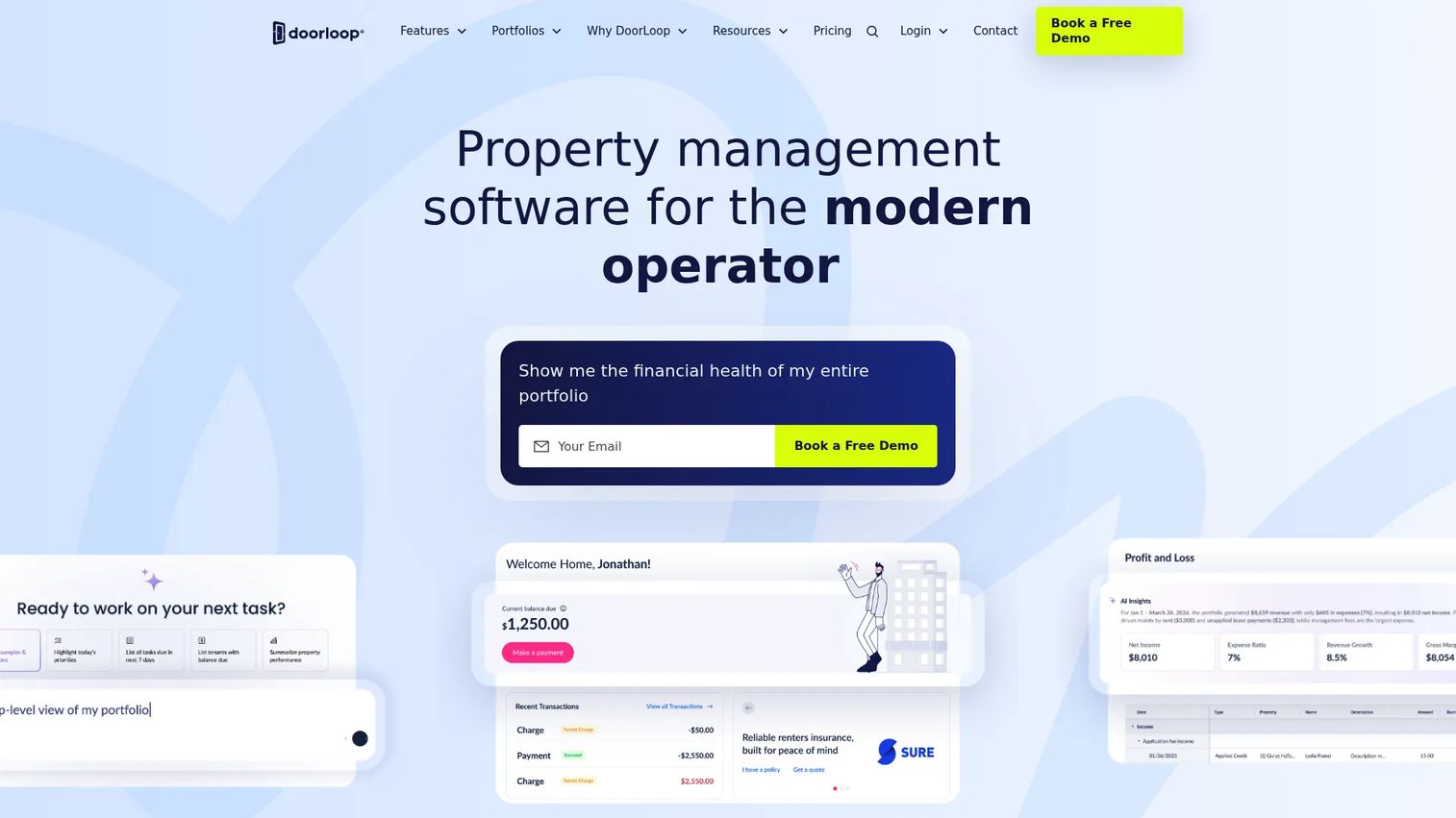
DoorLoop is an all-in-one property management platform known for speed and usability. It covers rent collection automation, accounting and financial reporting, and leasing with tenant screening and eSignatures. For smaller to mid-sized operators who want a fast rollout without a long implementation, it is one of the easiest platforms to get running.
Best for: Small to mid-sized property management teams that want an all-in-one platform they can launch quickly.
Key strengths
- Rent collection automation: Recurring charges, autopay, and reminders that cut manual follow-up.
- Accounting and financial reporting: Built-in accounting with the reports owners expect.
- Leasing, screening, and eSignatures: Tenant screening, online applications, and lease signing in one flow.
Why choose DoorLoop: DoorLoop's edge is time-to-value. If you are moving off spreadsheets and want rent collection live in days rather than months, its usability is the reason to pick it. It is a general property management tool rather than a manufactured-housing specialist, so confirm it maps cleanly to lot rent and owner tracking, but for many small park operators the mobile-friendly ease of use wins.
DoorLoop pricing: DoorLoop states pricing starts at $69/month for the first 10 units on its Starter plan, with Pro and Premium tiers above it and annual billing discounted up to 20%. Public base prices for Pro and Premium are not listed, so scope those with sales. There is no free tier. On G2, DoorLoop holds a category-leading 4.8/5 rating, which lines up with its usability reputation.
6. Buildium
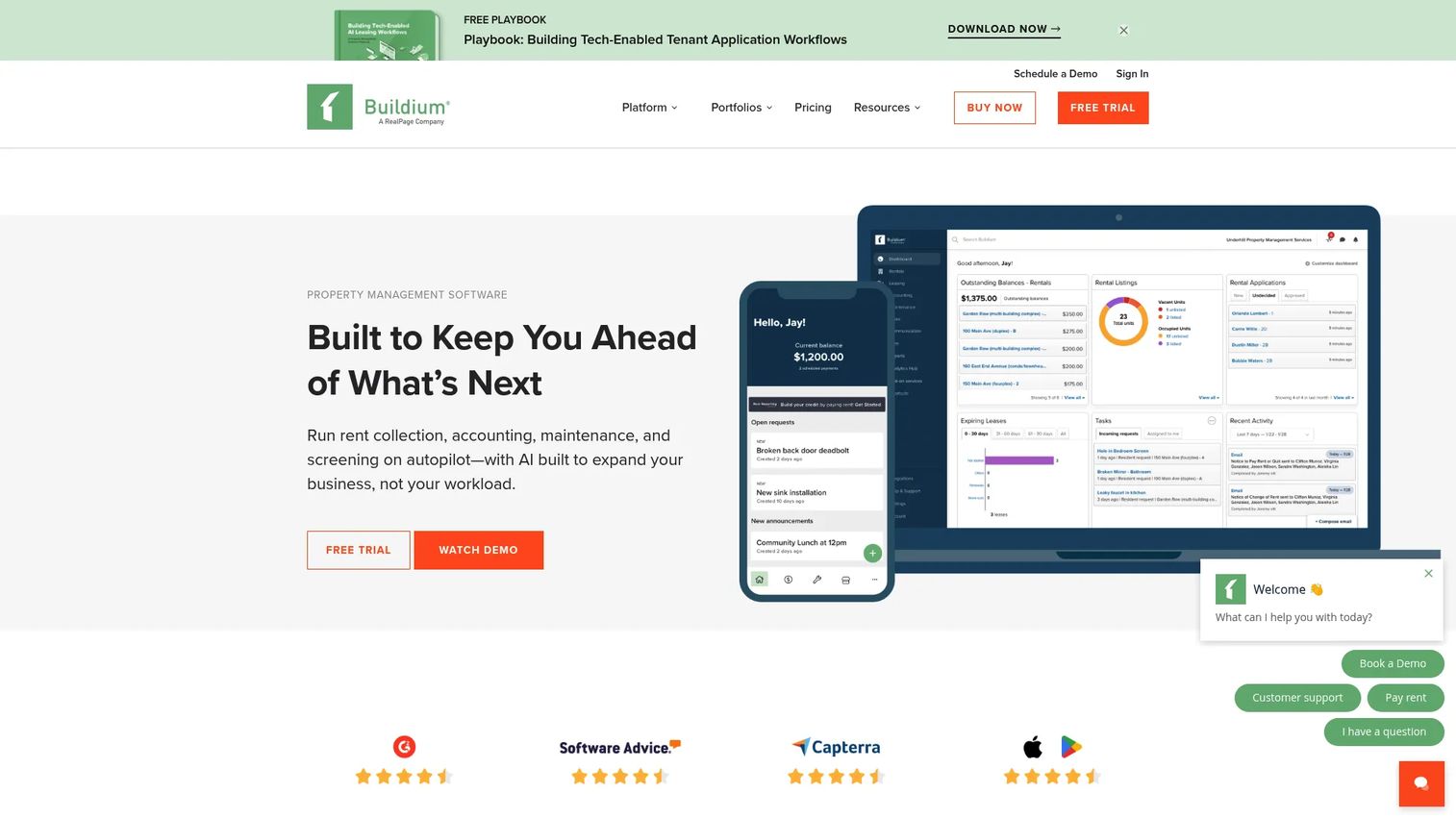
Buildium is a general property management platform covering accounting, online rent collection and payments, leasing and screening, and maintenance across rental portfolios and community associations. It works for smaller operators who want an established all-in-one tool with transparent, published pricing.
Best for: Property managers needing an all-in-one platform for accounting, leasing, payments, and maintenance.
Key strengths
- Accounting and financial reporting: Full accounting with owner-ready financial reports.
- Online rent collection and maintenance: Online payments plus work orders, inspections, and mobile apps.
- Leasing and screening: Tenant screening, eSignature, and marketplace integrations.
Why choose Buildium: Buildium is a solid, well-supported general platform with public pricing, which makes budgeting straightforward. It is not as niche-specific as the dedicated manufactured-housing platforms, so it fits operators whose park workflows are simple enough to model in a general tool. If you need heavy lot-rent, utility, and home-ownership logic, weigh it against the purpose-built options first.
Buildium pricing: Buildium publishes three plans on its pricing page: Essential at $62/month, Growth at $192/month, and Premium at $400/month. There is no free tier, but Buildium offers a 14-day free trial, and some add-on and usage fees apply on top of the base price. On G2, Buildium carries a 4.4/5 rating. The published pricing makes it easy to compare against DoorLoop for smaller portfolios.
7. Innago
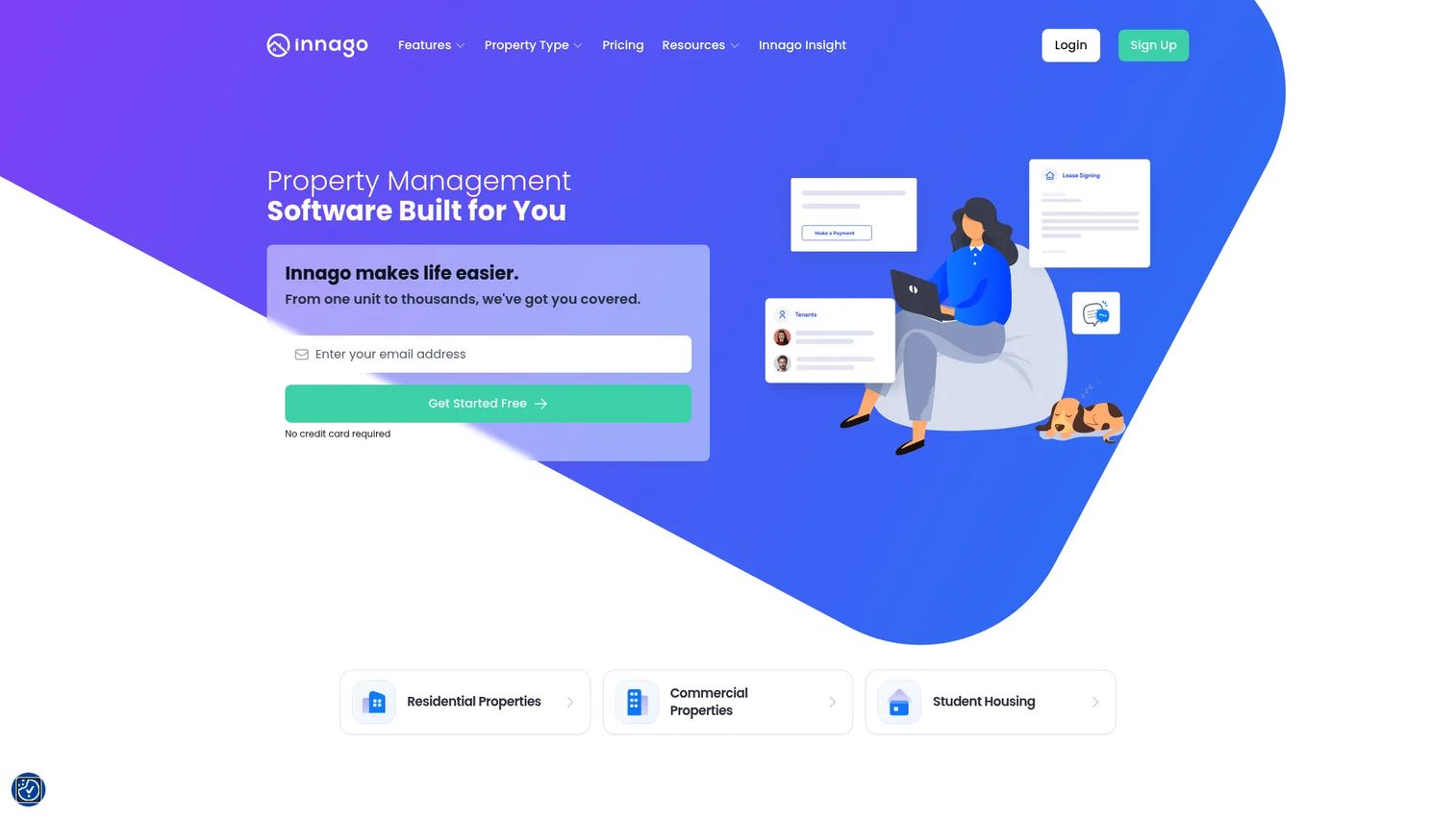
Innago is free online property management software aimed at landlords and small property managers. It covers online rent collection, tenant messaging and announcements, tenant screening, and online lease signing. For cost-sensitive operators, the pricing posture alone makes it worth a look.
Best for: Landlords and small property managers looking for a free rental management platform.
Key strengths
- Online rent collection: Recurring charges and online payments at no subscription cost.
- Tenant screening and lease signing: Applications, screening, and online lease signing built in.
- Tenant messaging and announcements: Communicate with residents directly inside the platform.
Why choose Innago: The pull is the price. Innago publicly states no monthly fee, no setup fee, and no contract, with revenue coming from optional transaction and add-on fees. For an operator running a small park who wants rent collection, screening, and reporting without a subscription line item, that is compelling. As a portfolio grows and reporting and accounting needs deepen, some operators graduate to a paid platform with more financial control, but the free entry point is genuinely useful.
Innago pricing: Innago's pricing page states no monthly fee, no setup fee, and no contract, and there is a free tier. Costs come through optional fees rather than a base subscription. On G2, the Innago seller profile carries a 4.8/5 rating. For budget-sensitive operators, next-day deposits and a zero-subscription model are the headline reasons to test it.
How to choose the right mobile home park software
Before you commit, run every shortlisted tool through the same checklist. These are the criteria that separate a good demo from a good fit.
Niche fit for park workflows
Confirm the platform models lot rent, the land-versus-home ownership split, home sales, and owner tracking. A tool that assumes you own both the unit and the land will force awkward workarounds. Purpose-built manufactured housing software handles this natively; general platforms need verification.
Rent collection and billing depth
Test recurring lot rent, late fee automation, autopay, and utility billing for mobile home parks. Pass-through utilities are common in parks, so ask specifically how sub-metered or ratio billing works and whether it flows into resident statements automatically.
Reporting and lender-ready outputs
Ask to see an actual rent roll, a delinquency report, and a trailing P&L. Owners and lenders care about these, and custom reporting is where mobile home park accounting software either saves you or fails you at refinance time.
Pricing posture and total cost
Separate published pricing from quote-based pricing, and factor in transaction fees, add-ons, and implementation. A low monthly base with high per-transaction costs can beat or lose to a higher flat fee depending on your unit count.
Support and implementation
Enterprise platforms take longer to stand up than SMB tools. Ask about implementation timelines, data migration, and ongoing support before you sign, because a powerful tool you never fully deploy is worse than a simple one running today.
Conclusion
The right pick depends far more on portfolio size and reporting needs than on any single feature list. Here is the shortlist by operator type.
For larger manufactured housing operators who need niche depth, compliance, and reporting rigor, Yardi MH Manager and Rent Manager lead, with ManageAmerica as the industry-specific mid-market choice. For the best balance of usability and value, DoorLoop is hard to beat, with Buildium close behind on published pricing, and AppFolio the pick when parks sit inside a mixed portfolio. For the best budget option, Innago's no-monthly-fee model is the clear starting point for small operators.
The practical next step: build a three-vendor shortlist that spans one purpose-built platform and one general tool, then run each through the same test. Compare rent collection, reporting, and support side by side with your real lot data. The tool that produces a clean rent roll and a trailing P&L fastest is the one that will earn its place in your operation.
FAQs
Mobile home park software is a platform built to manage lot rent, residents, home and site inventory, maintenance, tenant screening, billing, and reporting for manufactured housing communities and trailer parks. It differs from generic tools because it accounts for the land-versus-home ownership structure unique to parks.
The core stack is rent and lot rent collection, a resident portal, maintenance requests, utility billing, tenant screening, and reporting. If a platform handles those six workflows cleanly for your portfolio, it covers most of what park operators need day to day.
Often yes. Mobile home parks have unique lot, home, and owner workflows, plus reporting needs that general trailer park management software may not handle cleanly. Standard tools assume you own the unit; in parks, the resident frequently owns the home while you own the land, which changes accounting and billing.
For small parks, ease of use and cost usually matter more than enterprise depth. Innago's free model suits the most budget-sensitive operators, while DoorLoop offers a fast, usable rollout starting at $69/month and Buildium provides transparent pricing from $62/month. Match the tool to your unit count and how much accounting depth you need.
Specialized platforms with stronger reporting, compliance, and multi-property controls are usually the better fit at scale. Yardi MH Manager and Rent Manager both offer the accounting depth and custom reporting that larger operators and their lenders expect, while ManageAmerica delivers purpose-built manufactured housing workflows.
Yes, especially for mixed portfolios that include apartments or single-family alongside parks. Before committing, verify how each handles lot rent, home-owner tracking, and pass-through utility billing, since those park-specific workflows are not always native to general property management platforms.
It is one of the biggest time savers. Recurring lot rent billing, automated late fees, payment reminders, and online payments remove the manual follow-up that consumes a manager's week. Automated rent collection software for mobile home parks also shortens the gap between a due date and money in the bank.
Yes. Owners and lenders regularly ask for rent roll accuracy, collections, vacancy, maintenance backlog, and P&L visibility. Reporting and KPI tracking turns day-to-day operational data into the numbers that survive due diligence and speed up refinancing conversations.