You track 14 grants across four funders. Deadlines live in one spreadsheet, budgets in another, and the compliance documentation sits in an email thread nobody wants to reopen. Then a program officer asks for a mid-cycle report, and you spend two days reconstructing numbers that should have taken twenty minutes.
That is the real cost of running grants on spreadsheets and inboxes. Not the missed deadline you can see coming, but the quiet accumulation of duplicate entry, version drift, and reporting that eats the time you should spend on program work. The global grant management software market hit roughly USD 3.07B in 2025 and is projected to reach USD 8.09B by 2035, growing at a 10.17% CAGR according to Precedence Research (2026). That growth is not vanity. It maps to a specific pressure: funders want tighter compliance and reporting, and manual workflows cannot keep up.
A grant management system exists to fix that. It centralizes intake, award, post-award tracking, and closeout so a single record follows each grant from application to final report. The right grants management software turns audit trails, deadline management, and funder reporting from a scramble into a workflow. If your team is weighing grant compliance software against grant tracking software, or trying to figure out where a lightweight tool ends and an enterprise platform begins, the same buying questions apply. This guide answers them.
The category sits alongside adjacent operations tooling that many teams evaluate in the same quarter, from audit management software to contract lifecycle management and event management for fundraising programs.
What's inside
This guide covers grant management software for nonprofits, public sector agencies, and grantmakers who fund others. We looked at seven platforms and chose them on four criteria: lifecycle coverage from pre-award to closeout, grant compliance software depth, reporting and dashboard clarity, and how well each tool handles automation, dashboards, and integrations with the finance and program systems you already run.
We focused on practical buying criteria, not feature bloat. Every tool here earns its place because it solves a specific part of the grant lifecycle well. Where a platform fits a narrow use case, like grant discovery or application intake, we say so, so you can shortlist against your actual workflow instead of a generic feature checklist.
TL;DR
- Best for public sector grant programs: Euna Grants, built for state, local, and government lifecycle management with audit trails and compliance tracking.
- Best for grantmakers needing affordability and accessibility: Good Grants, with transparent annual pricing and no per-seat cost.
- Best for nonprofit grant operations with workflow depth: LiveImpact, which ties grant tracking to donor, case, and event management in one platform.
- Best for enterprise grantmaking and complex reporting: Fluxx, built for foundations and agencies managing high grant volume.
- Best for application intake and review workflows: Submittable, strong on forms and multi-stage review.
- Best for grant discovery and prospecting: Instrumentl, which pairs opportunity matching with full lifecycle grant workflow software.
- Best for lightweight tracking: GrantHub, though the product was sunset on January 31, 2026, so plan a migration path.
Whether you are new to grantmaking software or replacing a spreadsheet stack, match the tool to your grant volume and compliance needs first.
What grant management software is
Grant management software is a platform that manages the full grant lifecycle, from intake and application review through award, post-award tracking, compliance, reporting, and closeout, in a single system of record. It replaces the spreadsheets, shared drives, and email threads that fragment grant data across a team.
The category spans two sides of the same coin. Grant seekers use it to find opportunities, draft applications, track deadlines, and report to funders. Grantmakers use it to accept applications, run reviews, issue awards, and monitor compliance across a portfolio of grantees. Many platforms serve both.
Core capabilities you should expect from grant administration software:
- Grant discovery and opportunity tracking for pre-award management, so teams surface and prioritize the right funding.
- Application intake and review with structured forms and multi-stage evaluation workflows.
- Award management and document handling that keep agreements, budgets, and correspondence attached to each grant record.
- Post-award management covering reporting, deadline management, and automated notifications so nothing slips.
- Audit trails, permissions, and transparency that make regulated workflows defensible under review.
- Financial and program integrations that sync grant data with accounting, ERP, and program systems.
Grant reporting software sits at the center of most buying decisions. When a funder asks for a progress report or an auditor requests documentation, the platform should produce it from live data, not a manual rebuild. That single capability, clean funder reporting on demand, is what separates real grant management from a tracking sheet with extra columns.
When to use grant management software
When spreadsheets stop scaling
A spreadsheet works for two or three grants. At ten or more, the cracks show. Someone edits an outdated version, budget figures diverge across tabs, and a reporting deadline hides three rows down where nobody scrolls. You end up doing duplicate entry across finance, program, and compliance files, and every report becomes a reconciliation project. Grant management software collapses that into one record, so the deadline, the budget, and the documentation live together and update once.
When compliance and auditability matter
Federal, state, and foundation grants come with strings. You need to show who approved what, when a document changed, and how funds were spent against the award. That requires traceability spreadsheets cannot provide. Grant compliance software gives you role-based permissions, timestamped audit trails, and audit-ready records, so when a monitor or auditor asks a question, the answer is a query, not a week of forensic email search.
When multiple teams touch the same grant
Grants rarely belong to one person. Program staff run the work, finance tracks the spend, and leadership signs off on reporting. When each team works from its own file, misalignment is guaranteed. A shared grant workflow software layer with notifications and a single data source keeps everyone reading from the same record. Program updates flow to finance, deadlines trigger reminders, and nobody discovers a missed requirement after the funder does.
Comparison table
Read this table as a shortlist filter, not a ranking. The "Intent" column tells you what buying motion each tool fits, and "Key use case" points to the part of the grant lifecycle it handles best. Pricing reflects publicly listed figures where vendors publish them; several use custom quotes. Ratings come from the vendor's live review listings where available.
| # | Product | Intent | Key use case | Pricing | G2 rating |
|---|---|---|---|---|---|
| 1 | Euna Grants | Public sector lifecycle | Government grant seeking and grantmaking, compliance tracking, audit trails | Custom quote | Not listed |
| 2 | Good Grants | Grantmaking, mid-budget | Application intake, review, award, and post-award reporting | From $3,950/year | 4.5/5 |
| 3 | LiveImpact | Nonprofit operations | Grant tracking tied to donor, case, and event management | From $150/month | 4.8/5 |
| 4 | Fluxx | Enterprise grantmaking | Full lifecycle for foundations and agencies, analytics | Custom quote | Not listed |
| 5 | Submittable | Application intake | Forms, multi-stage review, program management | Custom quote | 4.5/5 |
| 6 | Instrumentl | Grant discovery | Prospecting, matching, and full lifecycle management | From $299/month | 4.9/5 |
| 7 | GrantHub | Lightweight tracking | Nonprofit grant tracking (product sunset Jan 2026) | Not listed | Not listed |
1. Euna Grants
Euna Grants is public-sector grant management software built for the full lifecycle, serving both grant seekers and grantmakers. Euna Grants targets state, local, and government organizations that need to manage funding discovery, applications, awards, and compliance tracking in a single, auditable system. It pairs research tools with award and post-award workflows, so a public agency can run its own grant seeking and administer grants it makes to others.
Best for: State, local, and public-sector organizations managing the full grant lifecycle under compliance and transparency requirements.
Key strengths
- Dual-sided lifecycle coverage: Supports grant seeker workflows with reminders and reporting, plus grantmaker applications, evaluation, and awards from one platform.
- Compliance and audit trails: Tracks approvals and document history so public sector grant management stays defensible under audit.
- Funding discovery: Surfaces funding opportunities and reminders, connecting pre-award management to downstream administration.
Why choose Euna Grants: Public sector teams answer to auditors, oversight bodies, and taxpayers, and that raises the bar on traceability and transparency. Euna is built around that reality, with compliance tracking and audit trails treated as core, not add-ons. If your organization both pursues and distributes public funds, running both sides in one system removes the reconciliation gap between them.
Euna Grants pricing: Euna does not publish public pricing. The product page routes to a Request Pricing and Contact Sales flow, so expect a tailored quote based on scope, modules, and organization size. Budget for a sales conversation rather than a self-serve signup.
2. Good Grants
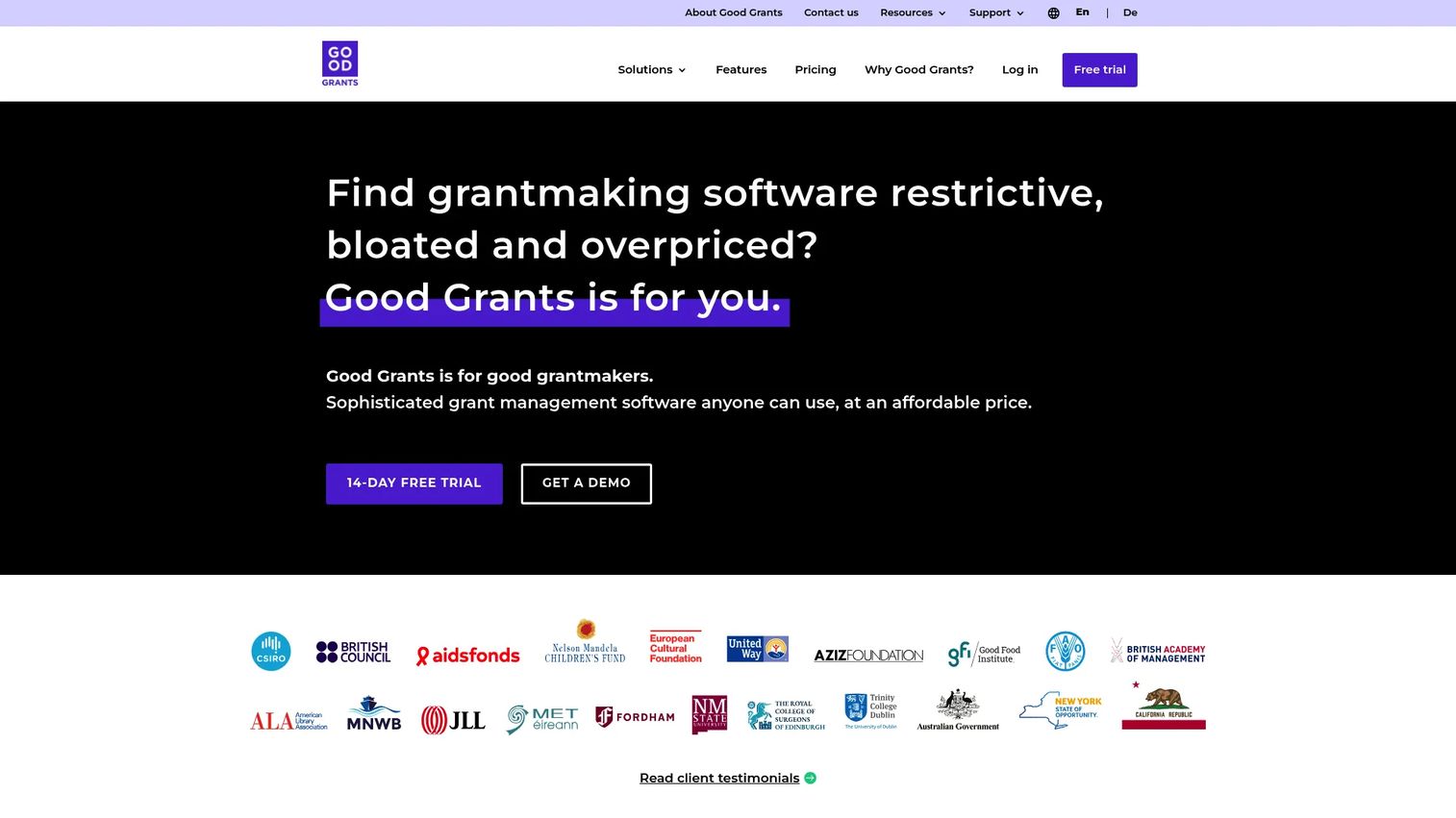
Good Grants is grant management software for grantmakers to accept, manage, review, award, and report on grant applications. Good Grants leans into affordability and accessibility, with transparent annual pricing that is not tied to per-seat costs, plus multilingual support and integrations for teams running programs across regions.
Best for: Organizations that need configurable grantmaking and review workflows with predictable annual pricing and no per-seat fees.
Key strengths
- Application and review workflows: Configurable intake and multi-stage review, so grantmakers run evaluation the way their program requires.
- Award and post-award reporting: Funding management and post-award reporting tools keep the lifecycle in one place through closeout.
- Integrations, API, and AI tools: Connects to your stack and adds multilingual support, useful for grantmakers operating internationally.
Why choose Good Grants: The no per-seat pricing model matters when your review process pulls in a rotating panel of evaluators. You are not penalized for adding reviewers during a busy cycle. Combined with published annual pricing, that makes budgeting straightforward, which is a genuine relief for teams tired of opaque enterprise quotes.
Good Grants pricing: Good Grants publishes tiered annual pricing. The Intro plan starts at $3,950 USD per year, Premium at $7,900 USD per year, and Enterprise is a custom quote for tailored needs. There is no free tier, but the site offers a 14-day free trial so you can test workflows before committing.
3. LiveImpact
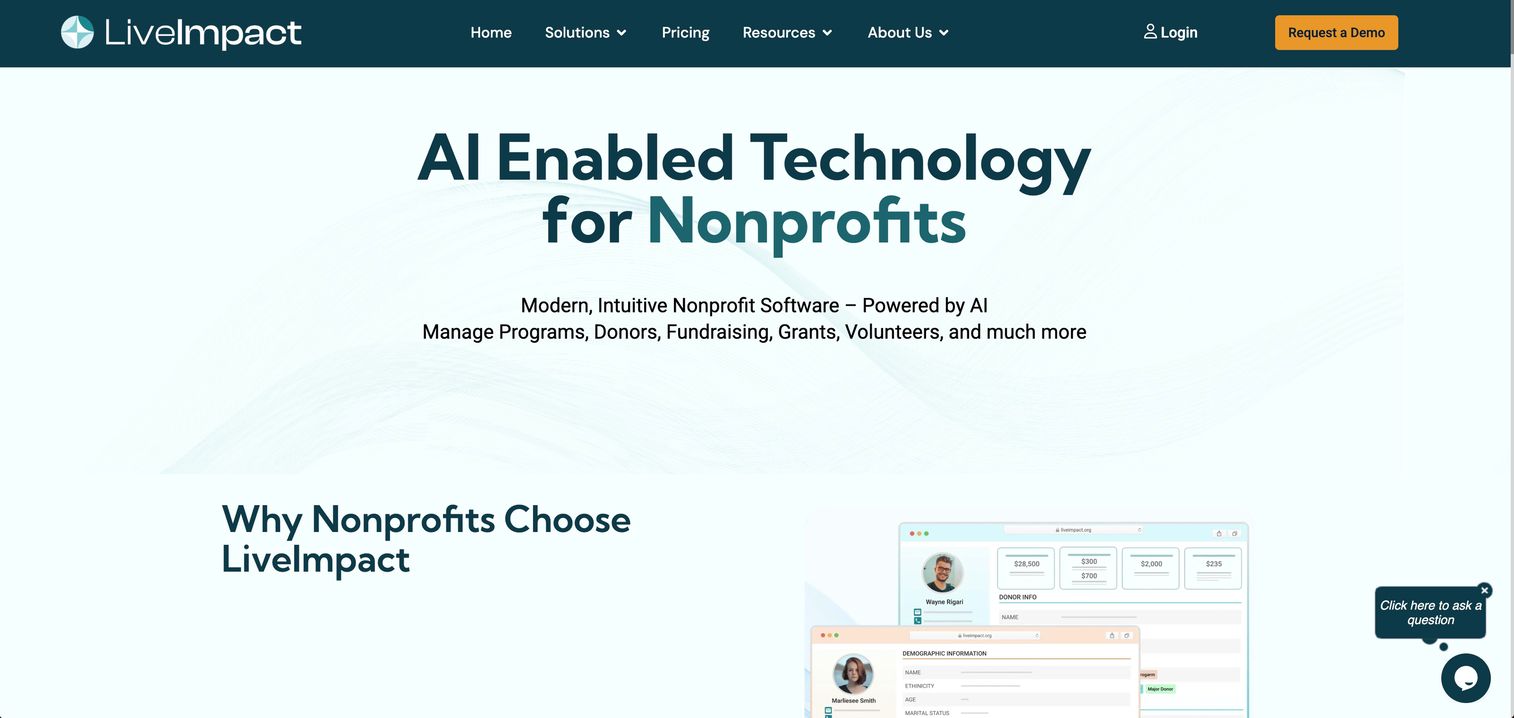
LiveImpact is all-in-one nonprofit software that spans donor management, fundraising, case management, events, and grants, with AI-assisted workflows. LiveImpact fits nonprofits that want grant tracking connected to the rest of their operations rather than isolated in a standalone tool. Because grants, donors, and program data live in one platform, post-award oversight ties directly to the programs the funding supports.
Best for: Nonprofits wanting a single platform for donor, case, event, and grant management instead of a stack of disconnected tools.
Key strengths
- Nonprofit CRM and donor management: Keeps funder relationships and grant history in the same system as donor and fundraising data.
- Case management: Notes, documents, assessments, and referrals connect grant-funded programs to the outcomes funders ask about.
- Event management: Ticketing, seating, auctions, and communications support fundraising events alongside grant workflows.
Why choose LiveImpact: For a nonprofit, grants rarely stand alone. A funder wants program outcomes, and those outcomes live in your case and donor data. LiveImpact keeps grant management software for nonprofits connected to that operational context, so funder reporting draws on real program data instead of numbers copied across systems.
LiveImpact pricing: LiveImpact publishes public pricing. Fundraising and donor management plans start with Starter at $150 per month and Pro at $275 per month, both billed annually. The program and case management Core plan runs $350 per month billed annually. There is no free tier, and larger needs move to a contact-sales conversation.
4. Fluxx
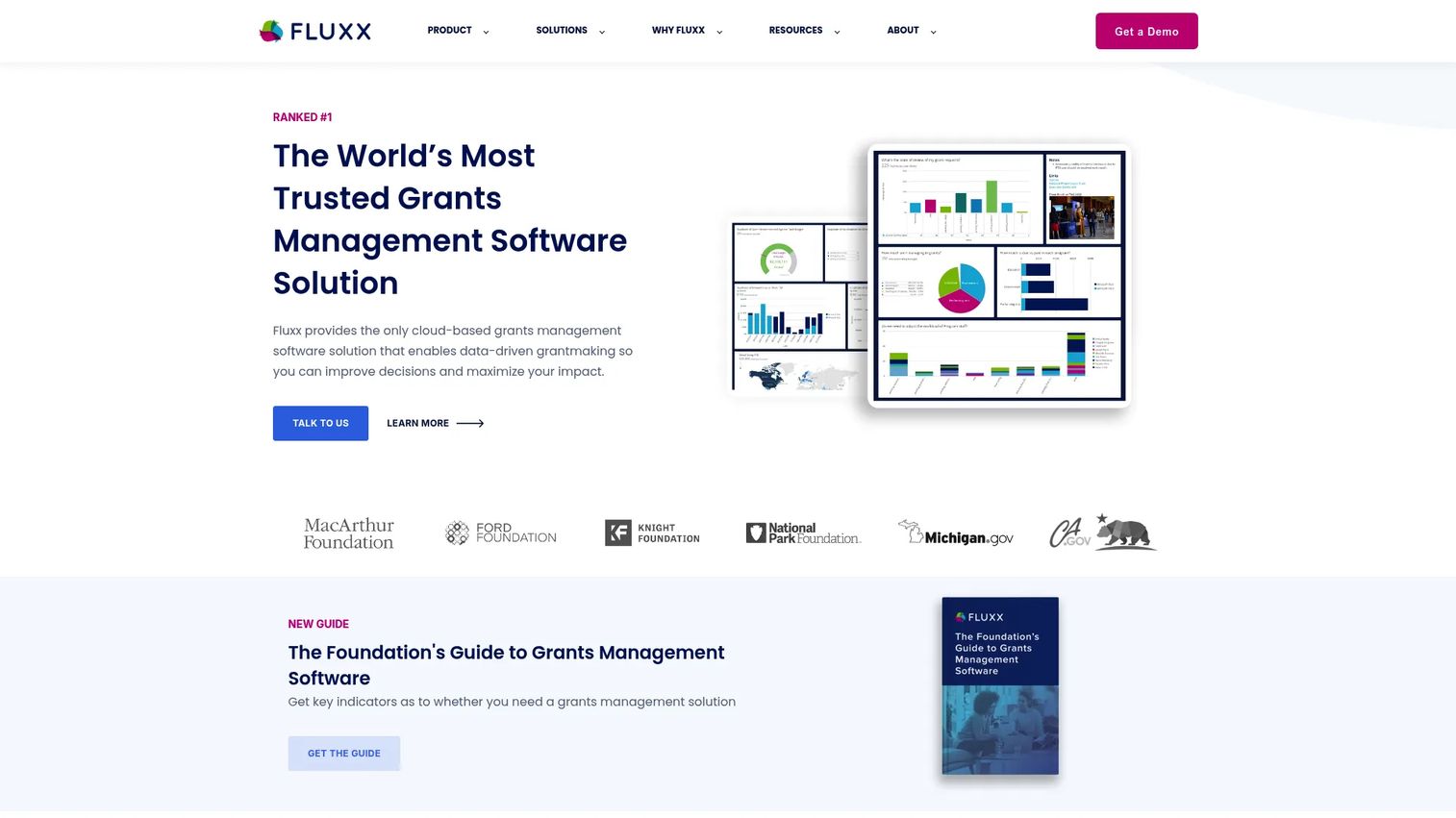
Fluxx is cloud-based grants management software for grantmakers and award management teams operating at scale. Fluxx is built for foundations, government agencies, and other funders managing the full grant lifecycle across high volume and multiple programs. Its strength is depth: role-based dashboards, a collaborative grantee portal, and analytics that give reporting teams control over a large portfolio.
Best for: Foundations, government agencies, and grantmakers managing the full lifecycle across high grant volume and complex reporting requirements.
Key strengths
- Collaborative grantee portal: Gives grantees a direct channel for applications, reporting, and communication, reducing back-and-forth email.
- Role-based dashboards: Tailors views by role, so program officers, finance, and leadership each see the data relevant to their work.
- Reporting and Grantelligence analytics: Turns portfolio data into reporting and insight, built for the reporting complexity enterprise grantmakers face.
Why choose Fluxx: When your grant volume runs into the hundreds and reporting must satisfy boards, regulators, and grantees at once, lightweight tools run out of room. Fluxx is built for that scale, with configurability and analytics depth that match complex grantmaking. It rewards organizations ready to invest in a structured, high-control platform.
Fluxx pricing: Fluxx does not display public pricing on its site. Pricing is demo and contact based, so plan for a sales conversation scoped to your grant volume, program count, and configuration needs. Treat it as an enterprise procurement, not a self-serve purchase.
5. Submittable
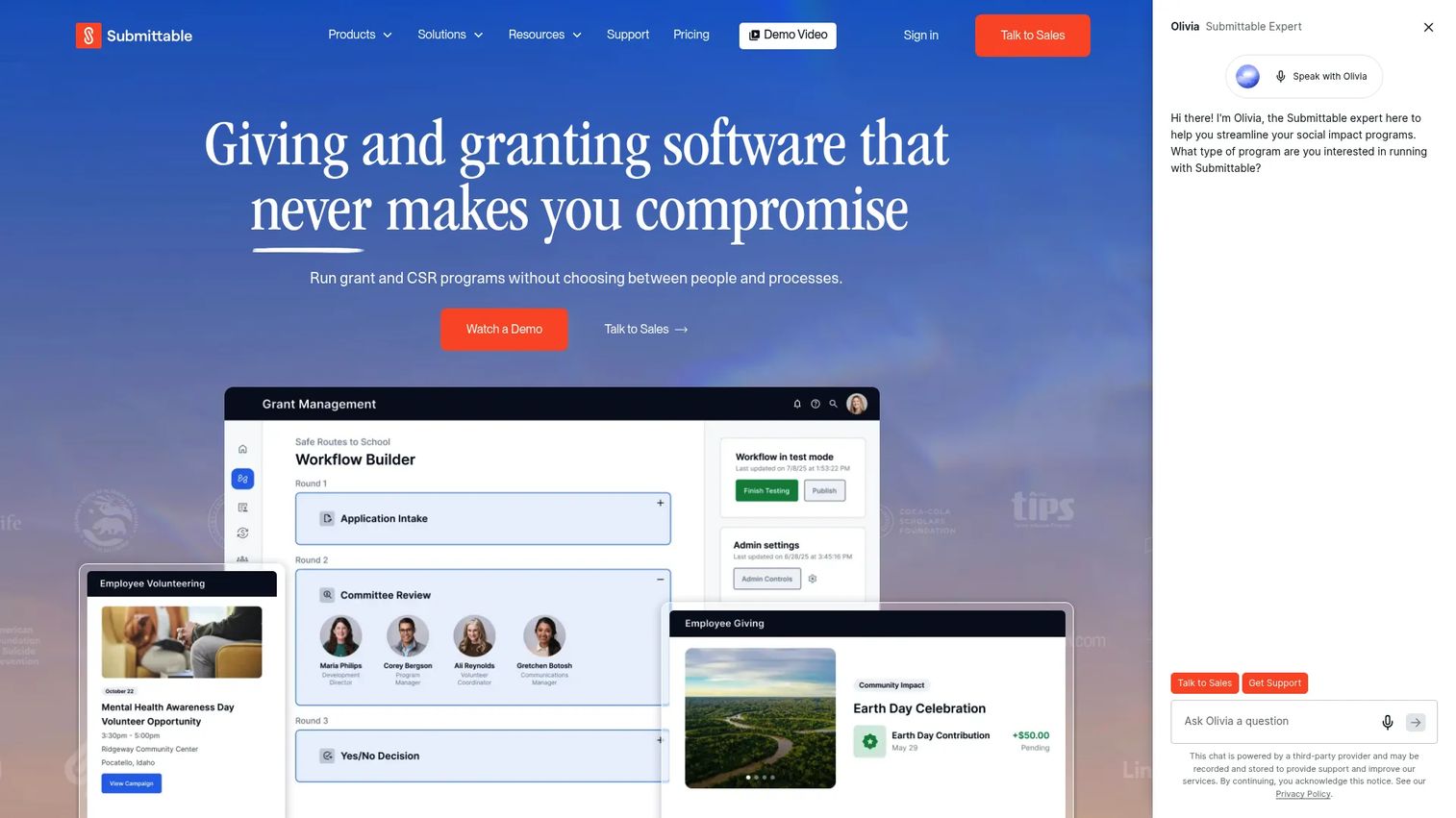
Submittable is software for grant, application, and submission management, with review workflows and reporting. Submittable is strongest where structured submissions and reviewer coordination matter most, making it a natural fit for organizations that run high application volume through defined evaluation stages. Its drag-and-drop forms and multi-stage review keep intake and scoring organized from first submission to decision.
Best for: Organizations that need application intake, review, and grant or program management workflows with a clean applicant experience.
Key strengths
- Drag-and-drop online forms: Build application forms without technical help, so program teams launch cycles fast.
- Multi-stage review workflows: Route submissions through defined evaluation stages, keeping reviewer coordination organized.
- Integrations and API: Connect intake and review data to the rest of your stack for reporting and reconciliation.
Why choose Submittable: If your bottleneck is intake and review rather than post-award tracking, Submittable focuses on exactly that. The applicant experience is clean, which lifts completion rates, and the review workflows keep a rotating panel of evaluators aligned. Operational efficiency at the intake stage is where this tool earns its keep.
Submittable pricing: Submittable does not display public dollar pricing. Its pricing page lists product categories, including a Corporate Social Responsibility platform, a Grant and Application Management offering, and an Enterprise tier, and directs you to book a meeting. Expect a quote scoped to volume and modules rather than a published rate.
6. Instrumentl
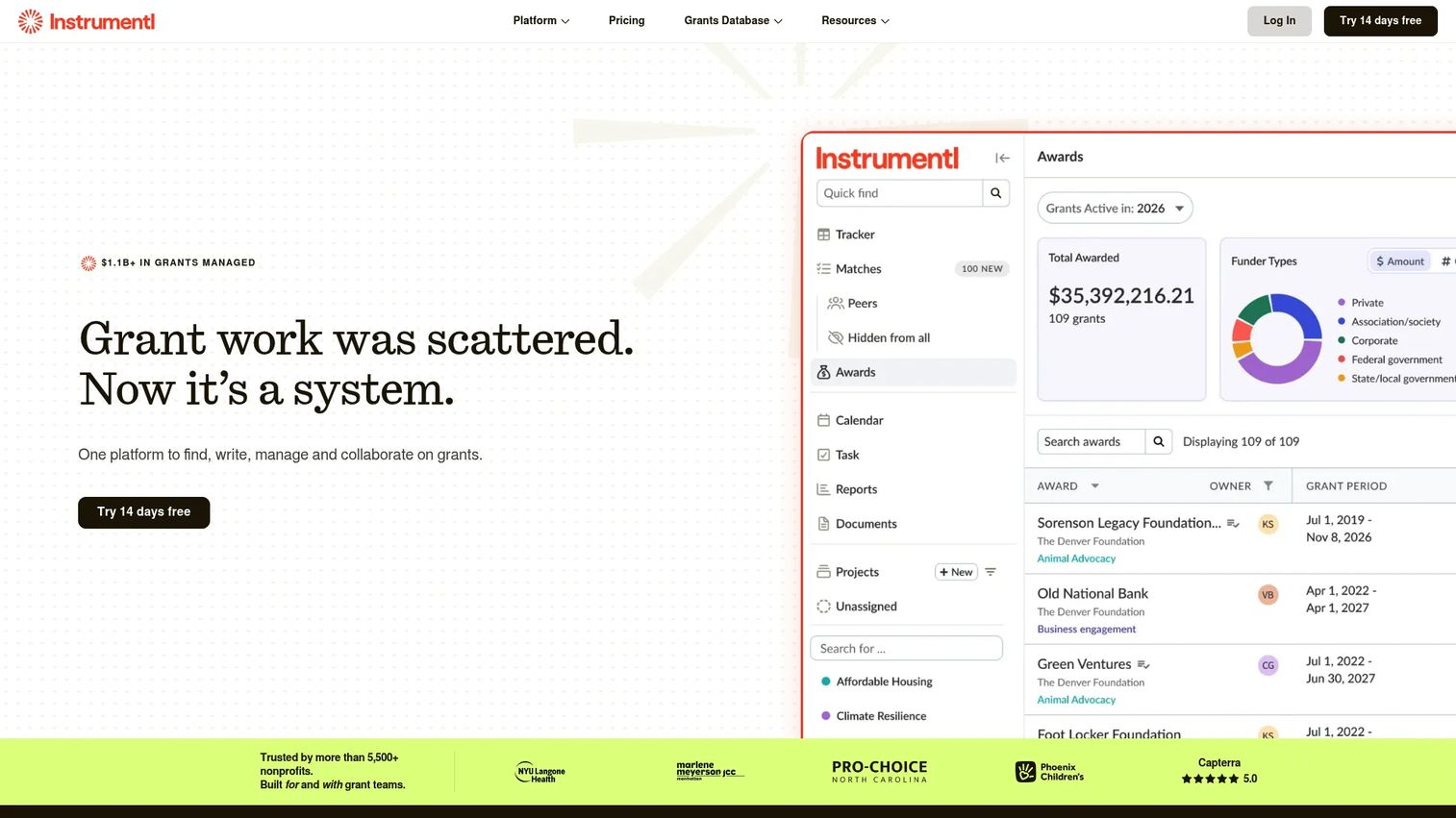
Instrumentl is an all-in-one grant discovery, writing, and management platform. Instrumentl stands out for the top of the lifecycle: finding the right grants before you ever manage one. It pairs intelligent matching with application drafting and full lifecycle tracking, so teams move from prospecting to award to reporting without switching tools. For organizations whose first problem is finding funding, this is the strongest fit on the list.
Best for: Nonprofits, consultants, and universities that need grant discovery and prospecting alongside full lifecycle management.
Key strengths
- Grant prospecting and intelligent matching: Surfaces funding opportunities matched to your organization, so pre-award management starts with the right targets.
- Application drafting and collaboration: Draft and collaborate on applications in one place, keeping the writing team aligned on deadlines.
- Tracking, award management, and reporting: Carries discovered grants through award and reporting, so nothing falls out of the pipeline.
Why choose Instrumentl: Most platforms assume you already know which grants to pursue. Instrumentl starts one step earlier, with discovery and matching, then carries those opportunities through the full lifecycle. If your team spends real time hunting for grant application software prospects and losing track of deadlines, this closes that gap.
Instrumentl pricing: Instrumentl publishes clear tiers. Discover starts at $299 per month paid annually, Pre-Award at $499 per month annually, and Full Lifecycle at $999 per month annually, with monthly billing available at higher rates. Enterprise is custom. All plans include a 14-day free trial.
7. GrantHub
GrantHub was grant management software for nonprofits from Foundant Technologies, designed for lightweight grant tracking and simpler team needs. GrantHub and its GrantHub Pro variant served smaller organizations that wanted deadline tracking and grant records without the weight of an enterprise platform. Important context for 2026 buyers: GrantHub and GrantHub Pro were sunset on January 31, 2026.
Best for: Historically, nonprofits seeking straightforward grant tracking software, though the product is no longer available.
Key strengths
- Grant management for nonprofits: Focused on the core tracking needs of smaller grantseeking teams.
- GrantHub Pro variant: Offered an expanded option for teams that outgrew the base product.
- Educational resources for grantseekers: Paired the tool with learning content to support grant teams.
Why choose GrantHub: With the product sunset on January 31, 2026, GrantHub is no longer a buying option. We include it because teams researching it will find dated recommendations, and you deserve the current status up front. If you previously ran on GrantHub, prioritize a migration plan to a supported platform, and use this list to shortlist a replacement matched to your workflow maturity.
GrantHub pricing: No current public pricing is available following the January 31, 2026 sunset. Teams evaluating a replacement should look to a supported tool on this list, matching grant volume and compliance needs to the right tier.
Considerations before you buy
Before you commit to a grant management system, run your shortlist through these checks. The wrong fit is expensive in migration time and lost workflow, so pressure-test each tool against your actual operations.
Lifecycle coverage
Map the tool to your workflow, from pre-award management through closeout. Some platforms shine at discovery, others at intake and review, others at post-award reporting and compliance. Confirm the tool covers the stages where your team actually loses time, not just the ones that demo well.
Compliance and audit readiness
If you handle federal, state, or foundation funds, grant compliance software depth is not optional. Check for role-based permissions, timestamped audit trails, and audit-ready record export. Ask how the platform handles a monitor or auditor request, and whether the answer is a query or a manual rebuild.
Reporting and dashboards
Funder reporting is where most teams feel the pain. Verify that grant reporting software produces funder-ready reports from live data, with dashboards your leadership will trust. Confirm you can export in the formats your funders and board require without reformatting by hand.
Integrations with finance and program systems
Grant data has to reconcile against accounting or ERP records. Confirm the platform integrates with your finance system, and ideally your program and CRM tools, so numbers stay consistent. Weak integration means duplicate entry, which is the exact problem you are trying to leave behind.
Pricing model and total cost
Watch for per-seat pricing that punishes you for adding reviewers, and for feature gating that pushes essentials into a higher tier. Match the pricing model to how your team actually works across a grant cycle, and read the annual commitment terms before signing.
Conclusion
The best grant management software depends on three things: your grant volume, your compliance requirements, and how complex your reporting needs to be.
Public sector teams that answer to auditors should start with Euna Grants for its lifecycle and compliance depth. Grantmakers who want transparent pricing without per-seat costs fit Good Grants. Nonprofits running grants alongside donor and program work get the most from LiveImpact. Foundations and agencies at high volume need Fluxx. If intake and review is your bottleneck, Submittable focuses there. If your first problem is finding grants at all, Instrumentl leads on discovery and carries opportunities through the full lifecycle. And if you were running GrantHub, its January 2026 sunset means your next step is a migration plan to one of these supported tools.
Start with the platform that matches your workflow maturity today. Then audit its integration and reporting depth against where your grantmaking software needs will be in two years. Match the tool to the work, confirm the compliance and reporting fit, and you replace the spreadsheet scramble with a system you can defend under audit.
FAQs
Grant management software is a platform that manages the full grant lifecycle, from application intake and review through award, post-award tracking, compliance, and reporting to closeout. It centralizes grant data in one system of record, replacing the spreadsheets, shared drives, and email threads that scatter information across a team. Lifecycle coverage matters because a single record following each grant is what makes reporting and audits fast instead of forensic.
Grant tracking software is narrower. It records deadlines, amounts, and statuses so you know where each grant stands. Grant management software includes that tracking but adds workflow, application review, compliance and reporting, document handling, and team collaboration across the full lifecycle. If you only need a shared list of deadlines, tracking may be enough; if multiple teams touch each grant and funders require compliance documentation, you need management.
Nonprofits outgrow spreadsheets and email when grant volume rises, deadlines start slipping, or funder reporting eats days that should go to program work. At that point grant management software for nonprofits pays for itself in recovered time and reduced compliance risk. A single grant on a spreadsheet is fine; ten grants across multiple funders with overlapping reporting cycles is where a real system becomes worth it.
Look for application intake and review, award and document management, post-award deadline management and notifications, funder reporting from live data, audit trails with role-based permissions, and integrations with finance and program systems. The specific mix depends on whether you seek grants, make them, or both. Prioritize the capabilities that map to where your team actually loses time.
It becomes worth it when the time you spend on manual tracking, duplicate entry, and report rebuilding exceeds the cost of the tool, or when a compliance miss would be costly. For a team managing a handful of small grants, a spreadsheet may still work. Once missed deadlines, version drift, or audit exposure become real risks, the switch usually pays back quickly through saved admin time and cleaner reporting.
Public sector grant management demands strong audit trails, transparency, role-based permissions, and reporting that satisfies oversight bodies and the public. Prioritize timestamped record histories, defensible approval workflows, and export formats that meet reporting mandates. Because government teams often both seek and distribute funds, a platform that handles both sides in one auditable system removes reconciliation gaps between them.
Yes, and it should. Integration with accounting or ERP systems keeps grant spending reconciled against awards without duplicate entry, and lets reporting draw on consistent financial data. Confirm the specific systems a platform supports before buying, since integration depth varies. Weak integration reintroduces the manual reconciliation that grant management software is supposed to eliminate.
For grant discovery and prospecting, Instrumentl leads because it pairs intelligent opportunity matching with application drafting and full lifecycle tracking. It solves the problem most platforms skip, which is finding the right grants before you manage them, then carries those opportunities through award and reporting. Teams whose first challenge is sourcing funding rather than administering it will get the most from a discovery-first tool.