

Your HR team is handling more this quarter than last, with the same headcount. More open roles. More policy questions. More onboarding sequences. More benefits tickets that pile up the week before open enrollment. None of it is hard. All of it is repetitive. And every hour spent re-explaining PTO accrual is an hour not spent on retention, leveling, or the people work that actually moves the business.
That gap is exactly why AI agents for HR moved from pilot to budget line in 2026. According to SHRM Talent Trends data, 43% of HR departments used AI in at least one function in 2025, up from 26% in 2024, the largest single-year jump recorded for any HR tech category. Salesforce Research found CHROs project AI agent adoption inside their organizations to grow from 15% today to 64% by 2027, a 327% increase in two years. The reason is simple: agents don't just answer questions, they execute work across systems.
For a founder watching operational drag scale faster than revenue, that distinction matters. An agentic ai layer that resolves a benefits question, books an interview, or moves an onboarding checklist forward without a human in the loop is leverage, not headcount. If you're also evaluating adjacent stacks, the same logic shows up in ai customer service and ai recruiting tooling, where deflection and routing compound the same way. This guide breaks down the 12 HR AI agents worth comparing, what they actually do, and how to pick the right one for your scale.
What's inside
This guide covers AI agents for HR across the full employee lifecycle: recruiting, onboarding, employee support, performance, compensation, and admin workflows. It includes both enterprise HCM suites with embedded agents and specialized HR AI tools built for a single high-value motion.
We selected tools based on real HR workflow coverage, enterprise readiness, integration depth with HRIS and communication systems, governance and human oversight controls, and breadth of use cases. Each entry includes who it fits, where it excels, verified pricing where public, and a current rating. The goal is a practical shortlist you can act on, not a feature dump.
TL;DR
- Best for enterprise orchestration: Oracle Fusion Agentic Applications and IBM watsonx Orchestrate, when you want coordinated agents acting across an enterprise data layer.
- Best for the Workday ecosystem: Workday AI agents, when HR runs on Workday and you want agents in the same workflow layer.
- Best for high-volume recruiting: Paradox Olivia, for conversational screening, scheduling, and candidate communication at scale.
- Best for employee self-service: Leena AI and Druid AI, for policy, benefits, and ticket deflection across people teams.
- Best for performance and development: Lattice, for reviews, goals, feedback, and manager workflows.
- Best for lean teams: Factorial, for broad HR coverage when one platform has to do everything.
What AI agents for HR are
AI agents for HR are software systems that observe context, interpret an employee or manager's intent, and take action across HR systems, escalating to a human when judgment is required.
That last part is what separates an ai agent for hr from older tooling. Traditional automation follows predefined rules: if a form is submitted, send an email. Predictive AI forecasts outcomes: this employee has a high flight risk. Agents do something different. They reason across multiple steps, decide what to do next, and execute the work, then hand off to a person when the task exceeds their authority.
The core mechanics look like this:
- Input: an employee question, a manager request, a system event, or a scheduled trigger.
- Reasoning: the agent interprets intent, pulls relevant policy or data, and plans the steps.
- Action: it executes across HRIS, HCM, ticketing, or communication tools.
- Memory: it retains context across a conversation or a multi-step workflow.
- Escalation: it routes to a human when confidence is low or approval is required.
Agentic AI in HR can support recruiting and ai recruiting screening, interview scheduling, onboarding automation, employee self-service for policy and benefits, PTO and leave requests, performance review prep, compensation queries, and offboarding tasks.
What AI agents for HR actually do
In practice, an HR agent sits between your people and your systems. An employee asks "how many vacation days do I have left," and the agent reads intent, checks the HRIS, and answers, no ticket created. A manager asks to start a backfill, and the agent opens the requisition, routes it for approval, and notifies the recruiter.
Three behaviors do the heavy lifting: self-service question handling, workflow execution across connected systems, and routing to a human when the request needs judgment. The best implementations treat that escalation path as a feature, not a fallback.
How they differ from traditional automation and predictive AI
The distinction is worth making concrete, because the three categories solve different problems and often run side by side.
| Capability | What it does | HR example |
|---|---|---|
| Traditional automation | Follows fixed if-then rules | Sends an onboarding email when a hire is added |
| Predictive AI | Forecasts a likely outcome | Flags attrition risk on a team |
| AI agent | Reasons and acts across steps | Resolves a benefits question, then updates the record |
Automation is reliable but rigid. Predictive AI is insightful but passive. Agents close the loop by acting on the insight.
Where HR agents fit in the employee lifecycle
Map them across the lifecycle and the leverage becomes obvious. In recruiting, they screen and schedule. In onboarding, they move forms, provisioning, and reminders forward. For benefits and PTO, they handle repeatable self-service. In performance, they prep reviews and surface feedback. In employee support, they deflect routine tickets. At offboarding, they coordinate the checklist and access removal.
What HR teams should look for in AI agents
Buying an HR AI assistant is less about model quality and more about whether it fits your workflows, your systems, and your governance reality. Four lenses matter most.
Workflow breadth
The strongest tools handle more than one narrow task. Before you commit, check whether the agent can support recruiting, onboarding, employee support, and admin, not just one of them. A point tool that only books interviews leaves the rest of your queue untouched. Look for coverage across:
- Recruiting and scheduling
- Onboarding and provisioning
- Policy, benefits, and PTO self-service
- Performance and compensation queries
Integration with HRIS, HCM, ERP, and communication tools
An agent is only useful when it can act on real systems. An answer with no action is just a chatbot. Verify native connections to your HRIS and HCM, your ERP for compensation and finance data, ticketing for case management, identity systems for provisioning, and Slack or Teams where employees actually ask questions. Shallow integrations create more manual work, not less.
Governance, approvals, and human oversight
HR data is sensitive and HR decisions carry legal weight. Any serious deployment needs role-based permissions, audit trails, and clear escalation paths. Verify access controls down to the field level, review flows for anything that touches pay or status, and logging you can defend in an audit. The teams evaluating ai governance controls early tend to deploy faster, because security and legal sign off without a fight.
Change management and AI literacy
Adoption depends on people, not software. Managers and HR staff need to know what the agent can do, where it hands off, and how to give feedback when it gets something wrong. Plan for clear ownership, a phased rollout, and a feedback loop, or the smartest agent in the stack sits unused. The same orchestration discipline that shows up in ai orchestration projects applies here: define the workflow before you automate it.
When HR teams use AI agents
Agents create the most leverage in a handful of high-frequency moments. Here is where they earn their seat.
Hire faster without turning recruiters into schedulers
Recruiting is full of work that doesn't need a recruiter: parsing applications, sending screening questions, finding interview slots, and chasing candidates for confirmation. Agents handle recruitment automation across screening, scheduling, and candidate communication, so recruiters spend time on the conversations that actually decide a hire. Candidates get instant responses instead of a week of silence.
Give employees instant answers without burying HR
The single biggest source of HR ticket volume is repeatable questions. How much PTO do I have. What's our parental leave policy. When does open enrollment close. An agent resolves these through employee self-service, pulling from policy and the HRIS in real time. Employees get answers at 9pm without waiting for business hours, and HR stops re-answering the same five questions every week.
Reduce manual admin in onboarding and operations
Onboarding automation is where agents quietly save the most hours. A new hire triggers a cascade: equipment requests, account provisioning, document signatures, benefits enrollment, training reminders. An agent moves each step forward, nudges the people who are blocking, and flags what's stuck, so nothing falls through the gap between offer and first day.
Support performance, career development, and compensation workflows
Agents also assist with performance management AI workflows: pulling goals into review prep, surfacing peer feedback, and reminding managers of deadlines. For compensation and benefits automation, they answer pay-band and equity questions, explain benefits options, and route anything sensitive to a human. The repetitive layer gets handled; the judgment stays with people.
Comparison table
A quick read on how the 12 stack up. Pricing reflects publicly available figures; many enterprise HR platforms quote per organization, so treat blank cells as sales-led rather than missing.
| # | Product | Best for | Key differentiation | Pricing | G2 rating |
|---|---|---|---|---|---|
| 1 | Oracle Fusion Agentic Applications | Enterprise HCM orchestration | Coordinated agents inside Oracle Fusion Cloud HCM | From $585/month (midsize HCM) | 4.1/5 |
| 2 | Workday AI agents | Workday-native HR teams | Agents in the Workday workflow layer | Quote-based | 4.2/5 |
| 3 | IBM watsonx Orchestrate | Multi-agent orchestration | Cross-system agent control plane | Free tier; from $1,110/month (Standard) | 4.3/5 |
| 4 | Druid AI | Employee experience automation | No-code conversational agent builder | Custom | 4.5/5 |
| 5 | Paradox Olivia | High-volume recruiting | Conversational screening and scheduling | Quote-based | 4.6/5 |
| 6 | Leena AI | Employee self-service | Pre-built AI Colleagues for HR, IT, finance | Custom | 4.6/5 |
| 7 | ServiceNow HR Service Delivery | Enterprise HR case management | Unified workflow and AI platform | Custom | 4.4/5 |
| 8 | Lattice | Performance and development | Modular performance, goals, and engagement | From $11/seat/month | 4.5/5 |
| 9 | Eightfold AI | Talent intelligence | Skills-based matching and internal mobility | Quote-based | 4.2/5 |
| 10 | ADP AI agents | Payroll-adjacent HR ops | HR and payroll workflow support | Quote-based | 4.4/5 |
| 11 | Rippling | Connected HR, IT, and finance | Unified workforce operations layer | Quote-based | 4.8/5 |
| 12 | Factorial | SMB and mid-market HR | Broad all-in-one HR coverage | From $8/user/month | 4.4/5 |
The split is clear: enterprise suites win when you want system-level orchestration across an existing data layer, while specialists win when you need one workflow solved fast. Match the tool to the job, not the brand.
1. Oracle Fusion Agentic Applications for HR
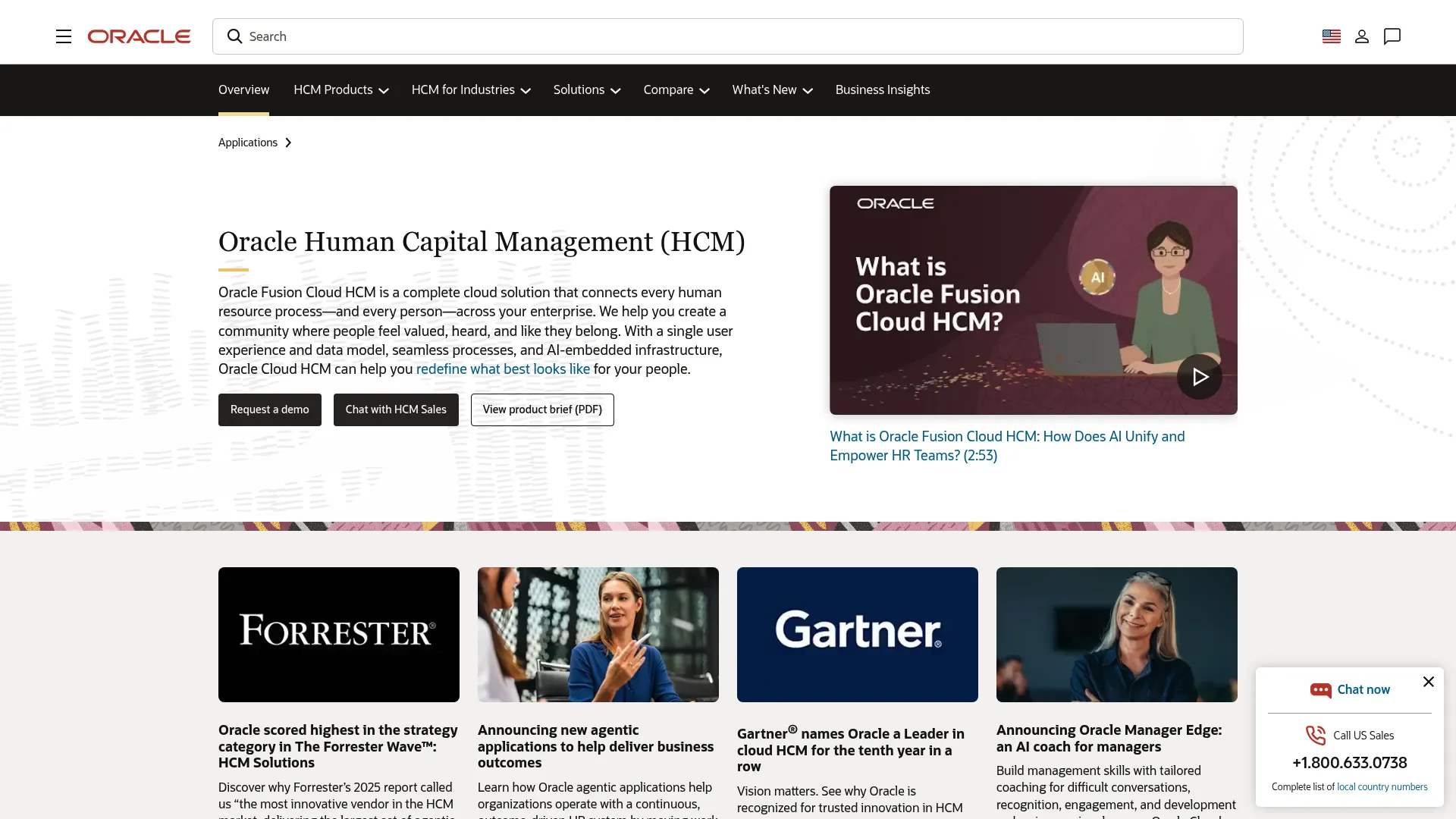
Oracle embeds agentic applications directly into Oracle Fusion Cloud HCM, the cloud suite for managing HR, talent, payroll, and workforce processes. Instead of bolting an assistant onto the side, Oracle runs coordinated, specialized agents on top of enterprise HR data, so an agent acting on a compensation request already has the records, permissions, and policy context it needs.
Best for: Large organizations that want deep governance and system-level agent orchestration inside an existing Oracle HCM footprint.
Key strengths
- Enterprise data context: Agents operate on unified HR, talent, and payroll records, so actions stay accurate and auditable.
- Coordinated specialized agents: Multiple agents handle distinct tasks and hand off cleanly across workflows.
- Governance depth: Role-based permissions and audit controls fit organizations with serious compliance requirements.
Why choose Oracle: If your HR already runs on Oracle Fusion Cloud HCM, the agentic layer is the path of least resistance. You get workflow automation across recruiting, onboarding, and employee support without standing up a separate integration project. It suits enterprises that prioritize governance and system-level orchestration over fast point fixes.
Oracle pricing: Oracle's public price list shows Oracle Human Capital Management Cloud for Midsize starting around $585 per month, with a related midsize tier listed at $650 per month. Enterprise HCM pricing is quote-based and varies by module and headcount. No free tier was found on the first-party HCM pricing materials. Oracle holds a 4.1/5 rating on G2.
2. Workday AI agents for HR
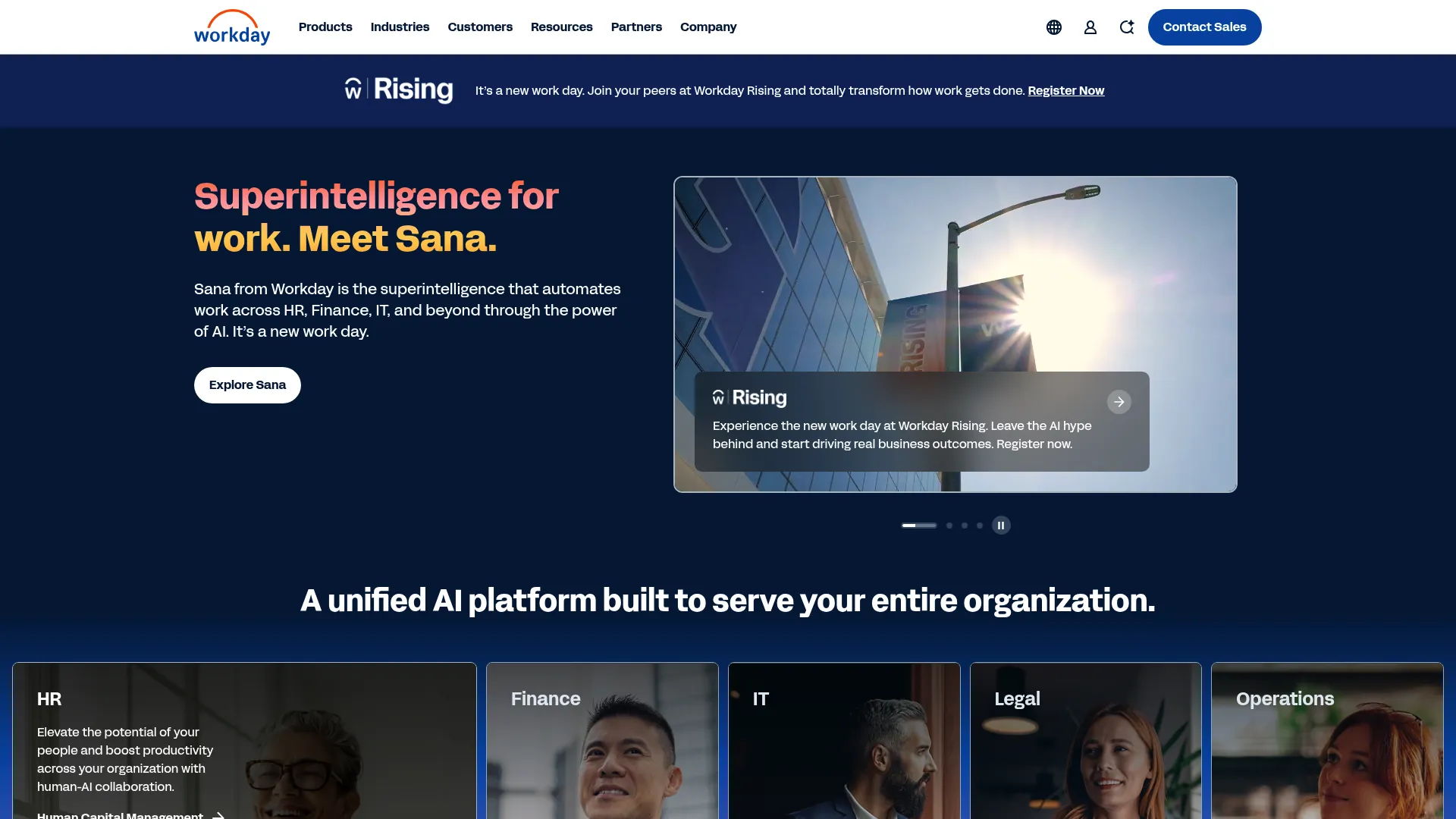
Workday is an enterprise platform for HR, finance, and workforce operations, and its agentic direction puts AI agents inside the same workflow layer employees and managers already use. Rather than a standalone tool, Workday's HR AI agents live where the work happens: requisitions, onboarding tasks, and HR helpdesk-style requests.
Best for: Large organizations running HR on Workday that want agents embedded in their existing operating layer.
Key strengths
- Unified HCM suite: Agents act across a single source of HR truth, from hire to retire.
- AI-powered recruiting and payroll: Built-in agentic support across talent acquisition and pay workflows.
- Workforce planning and analytics: Agents tie into planning data, not just transactional records.
Why choose Workday: Workday works as an HR operating layer, not a point tool. For teams already standardized on it, agents extend the platform into self-service and workflow automation without adding another system to govern. Recruiting, onboarding, and employee support all run inside the environment your people already know.
Workday pricing: Workday's HCM pricing is quote-based; its overview pages route to sales. The only public pricing surfaced was for Workday Adaptive Planning, which notes pricing varies and offers a 30-day trial. Workday holds a 4.2/5 rating on G2.
3. IBM watsonx Orchestrate for HR
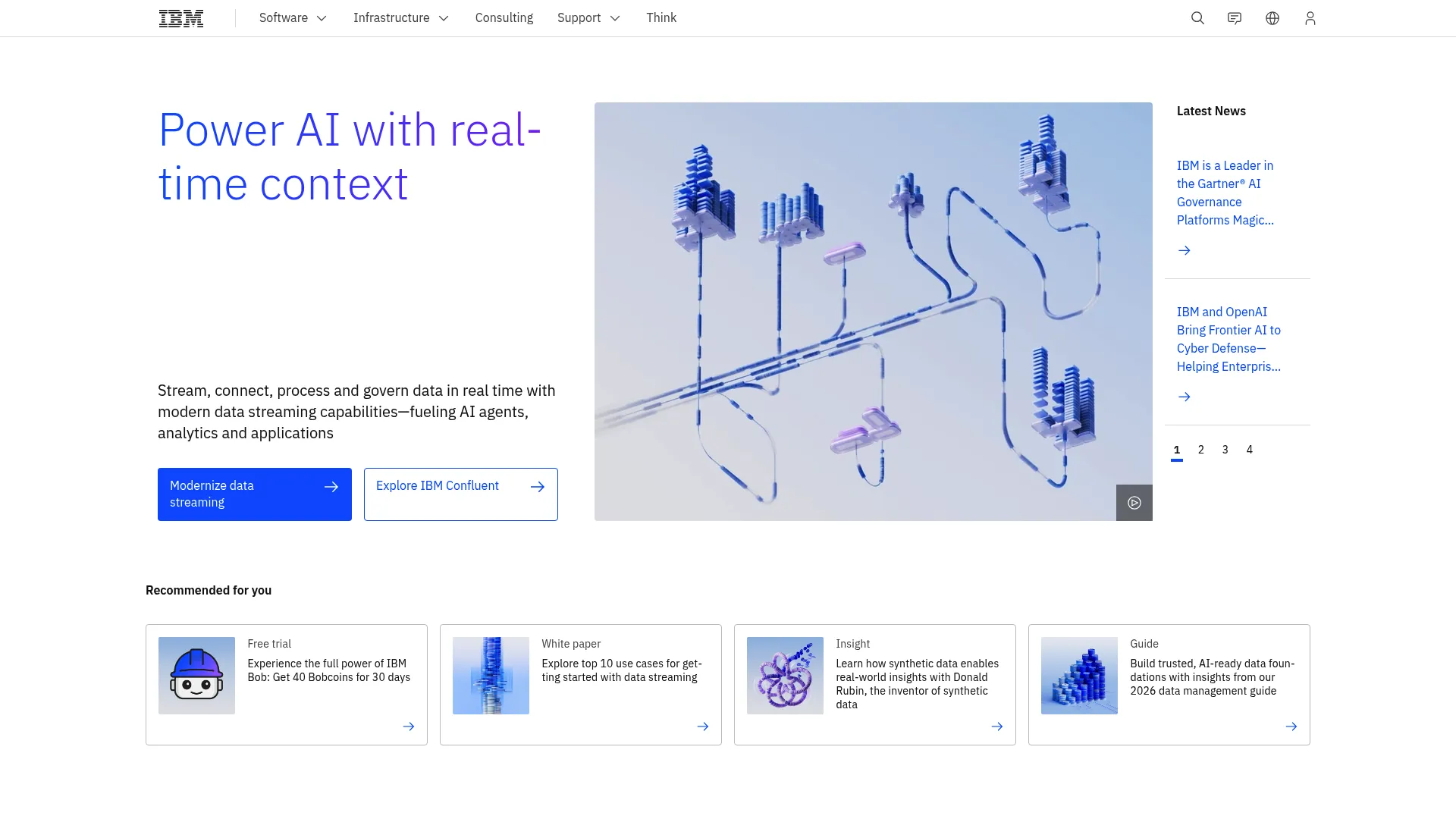
IBM positions watsonx Orchestrate as an agent control plane: a layer that coordinates multiple agents and executes work across enterprise systems. For HR, that means AskHR-style employee support and HR service workflows running through the same orchestration model that handles cross-functional automation.
Best for: Enterprises that want multi-agent orchestration and cross-system execution under strong governance.
Key strengths
- Multi-agent coordination: Orchestrates specialized agents across HR and adjacent functions from one control plane.
- Cross-system execution: Acts across enterprise software, not just within a single HR module.
- Enterprise governance: Built for organizations standardizing on IBM software, cloud, and AI tooling.
Why choose IBM: watsonx Orchestrate suits teams that see HR as one workflow domain inside a broader agentic strategy. If you want a single orchestration layer governing HR support, IT, and operations together, it fits. The focus is coordination and execution at enterprise scale.
IBM pricing: IBM watsonx.ai offers a free Toolbox playground, an Essentials pay-as-you-go plan starting at USD 0/month, and a Standard plan starting around USD 1,110/month. Model and feature-specific pricing also apply. IBM holds a 4.3/5 rating on G2.
4. Druid AI for HR and employee experience
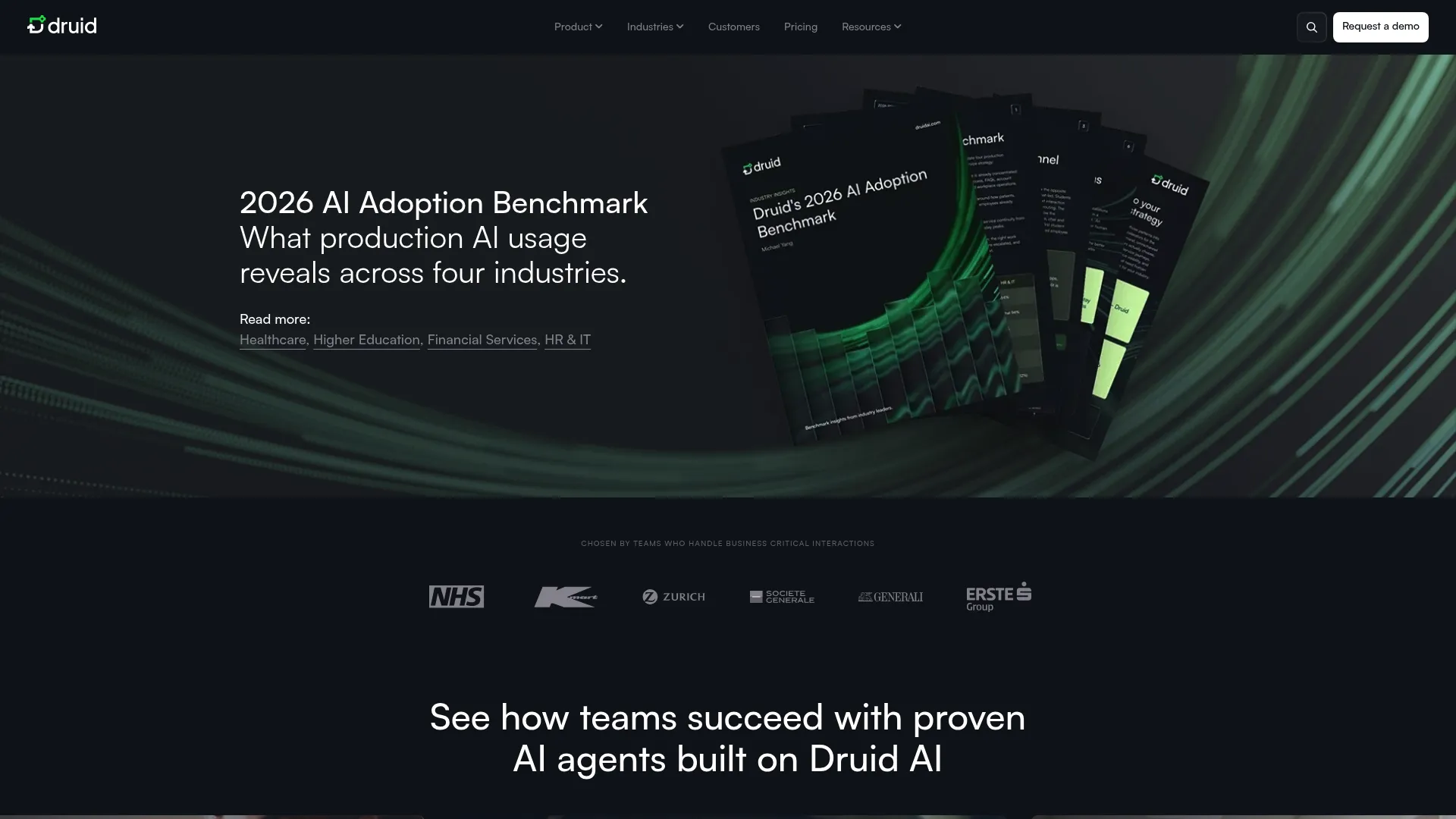
Druid AI is an enterprise platform for building and deploying conversational AI agents, with HR as a strong use case. It positions agents around employee support, candidate sourcing, and repetitive request handling, with a no-code builder that lets HR teams author agents in plain language.
Best for: Enterprises that want governed, conversational HR agents with custom integrations.
Key strengths
- No-code agent builder: Author and adjust agents in plain English, without engineering dependency.
- Employee self-service: Handles policy, benefits, and routine requests through conversation.
- Enterprise integrations and governance: Connects to back-office systems with security controls built in.
Why choose Druid AI: Druid suits people teams that want fast deployment of service automation across HR operations. The value sits in employee experience: candidate sourcing on the front end, self-service and request handling on the back end. It fits organizations that want conversational agents without a heavy build.
Druid AI pricing: Druid AI uses custom pricing; its page directs prospects to talk to an expert for a tailored quote. No public price or tier names were visible. Druid AI holds a 4.5/5 rating on G2.
5. Paradox Olivia
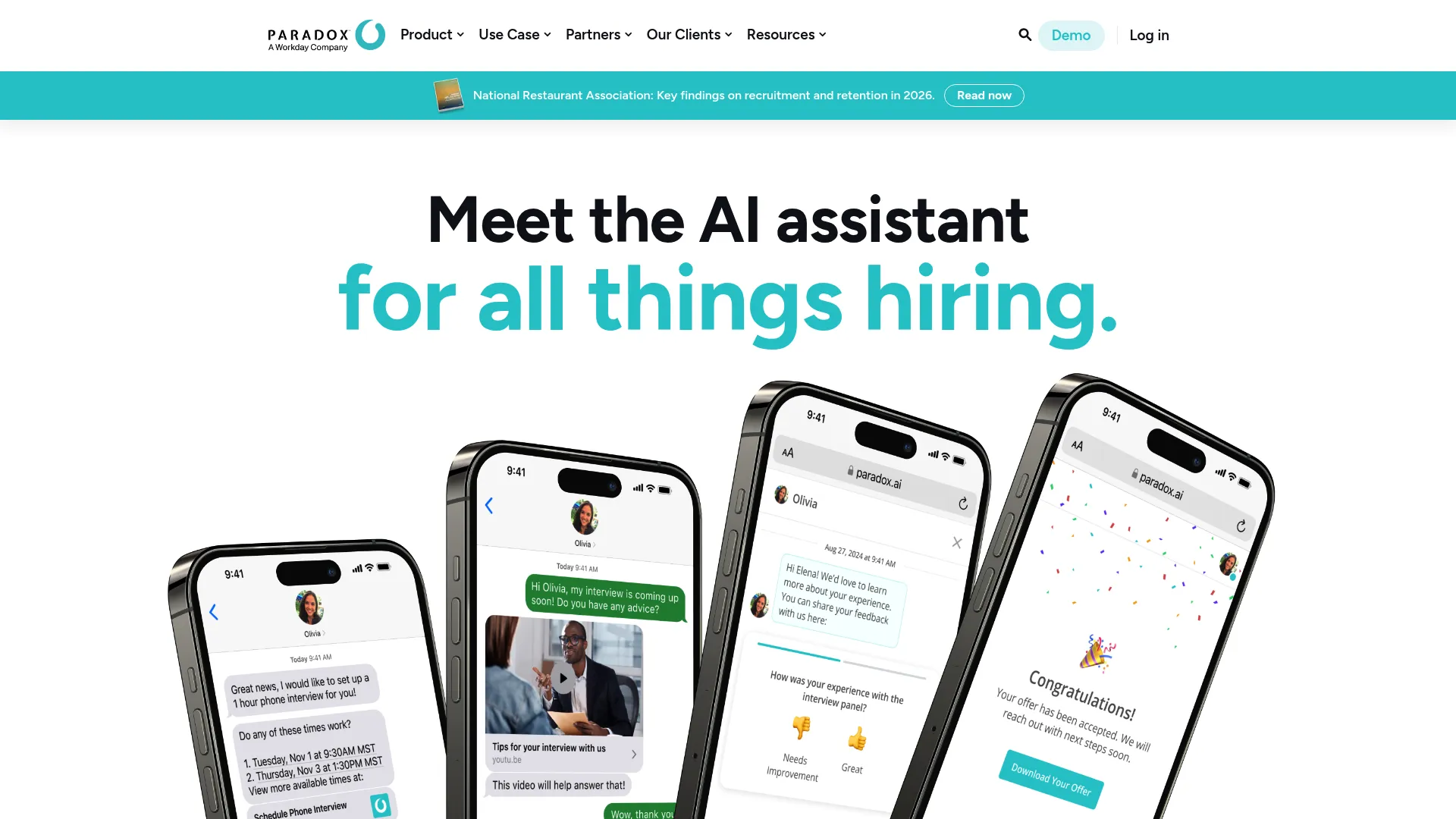
Paradox builds conversational hiring software anchored by its assistant, Olivia, which automates the high-volume mechanics of recruiting. It screens applicants, qualifies candidates, schedules interviews, and keeps candidate communication moving, all through a conversational interface.
Best for: High-volume recruiting teams that want AI-driven screening and scheduling without manual coordination.
Key strengths
- Applicant screening: Qualifies candidates through conversation, filtering the queue automatically.
- Interview scheduling: Books and confirms interviews without recruiter back-and-forth.
- Conversational ATS: Candidates apply and progress through a chat-first experience.
Why choose Paradox: When hiring volume is the constraint, Olivia removes the scheduling and screening drag that turns recruiters into coordinators. It fits frontline, hourly, and high-req environments where speed of response decides who you land. Candidate experience improves because answers arrive instantly.
Paradox pricing: Paradox does not publish pricing; its pages route to a demo request and sales contact. No public price was found during review. Paradox holds a 4.6/5 rating on G2.
6. Leena AI
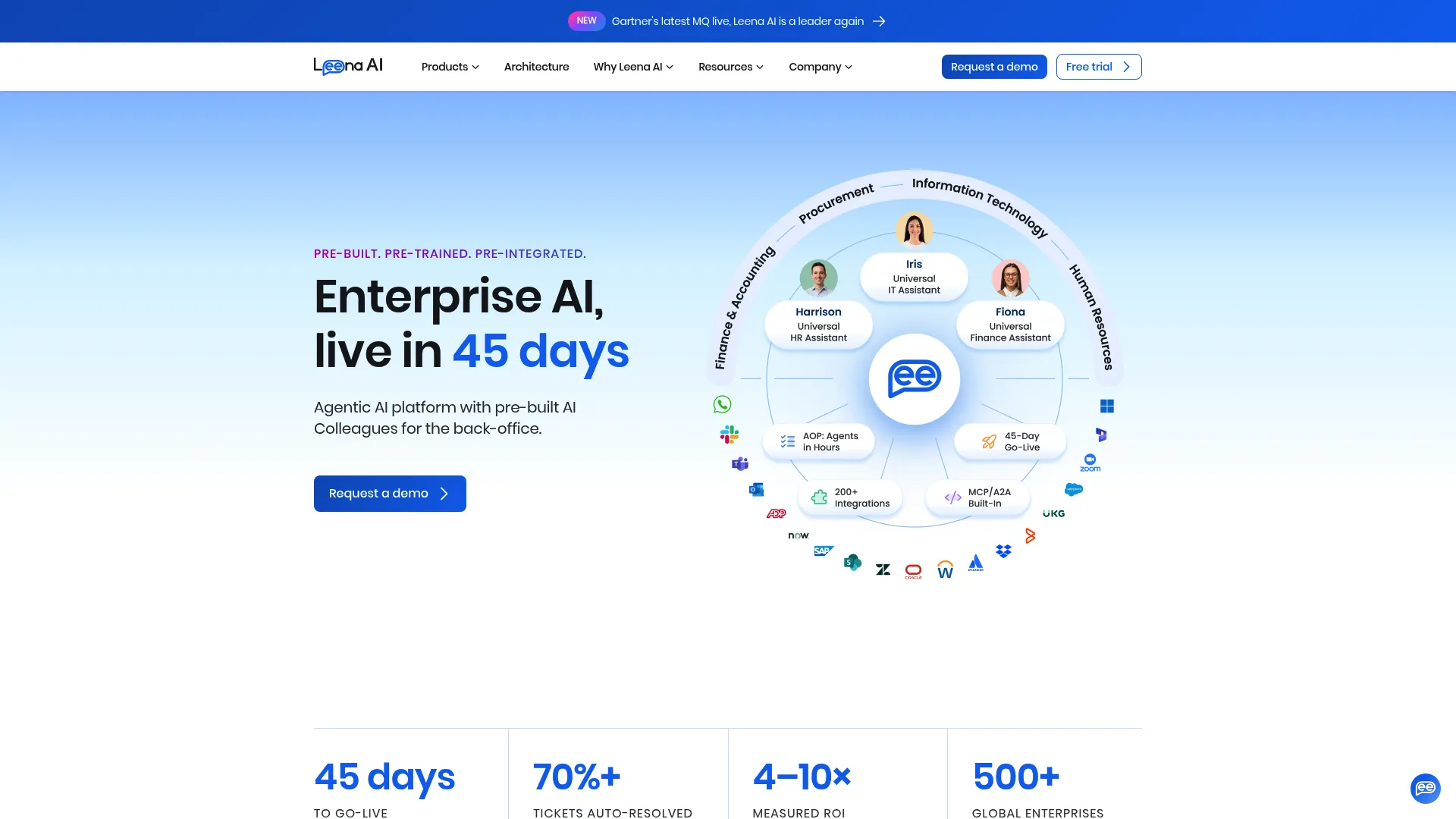
Leena AI is an enterprise agentic AI platform built around pre-built AI Colleagues for HR, IT, finance, and procurement. For HR, it acts as a service assistant handling policy, benefits, onboarding, and support, with strong ticket deflection across employee questions.
Best for: Large enterprises automating employee support and back-office workflows across HR, IT, and finance.
Key strengths
- Pre-built AI Colleagues: Ready-made agents for back-office workflows shorten time to value.
- 200+ enterprise integrations: Connects broadly across the systems HR already runs on.
- Observability and governance: Audit trails and role-based access controls support compliant deployment.
Why choose Leena AI: Leena fits people teams that want service and policy automation with knowledge retrieval at enterprise scale. The deflection angle is the draw: routine questions resolve through self-service, so HR operations focus on the cases that need a human. The broad integration footprint helps it act, not just answer.
Leena AI pricing: Leena AI uses personalized quotes tailored to each organization; no public numeric price or tier names were shown on its pricing page. Leena AI holds a 4.6/5 rating on G2.
7. ServiceNow HR Service Delivery with AI agents
ServiceNow brings AI agents to HR Service Delivery on its broader workflow automation platform. For companies already on ServiceNow, HR case management, request routing, approvals, and employee support all run on the same engine that powers IT and operations.
Best for: Large enterprises that already run on ServiceNow and want HR service on a unified workflow platform.
Key strengths
- AI agents and autonomous workflows: Agents resolve and route HR cases across the platform.
- Unified data and workflow platform: HR shares the same backbone as IT, security, and operations.
- App development and automation: Build custom HR workflows on a single configurable platform.
Why choose ServiceNow: The case for ServiceNow is consolidation. If employee service, IT, and operations already live there, adding HR agents avoids another silo. Request routing, approvals, and case management get the same orchestration depth ServiceNow brings to every other workflow domain.
ServiceNow pricing: ServiceNow uses custom, quote-based pricing; its pages list plan names like ITSM Foundation, Advanced, and Prime but display no public prices. ServiceNow holds a 4.4/5 rating on G2.
8. Lattice
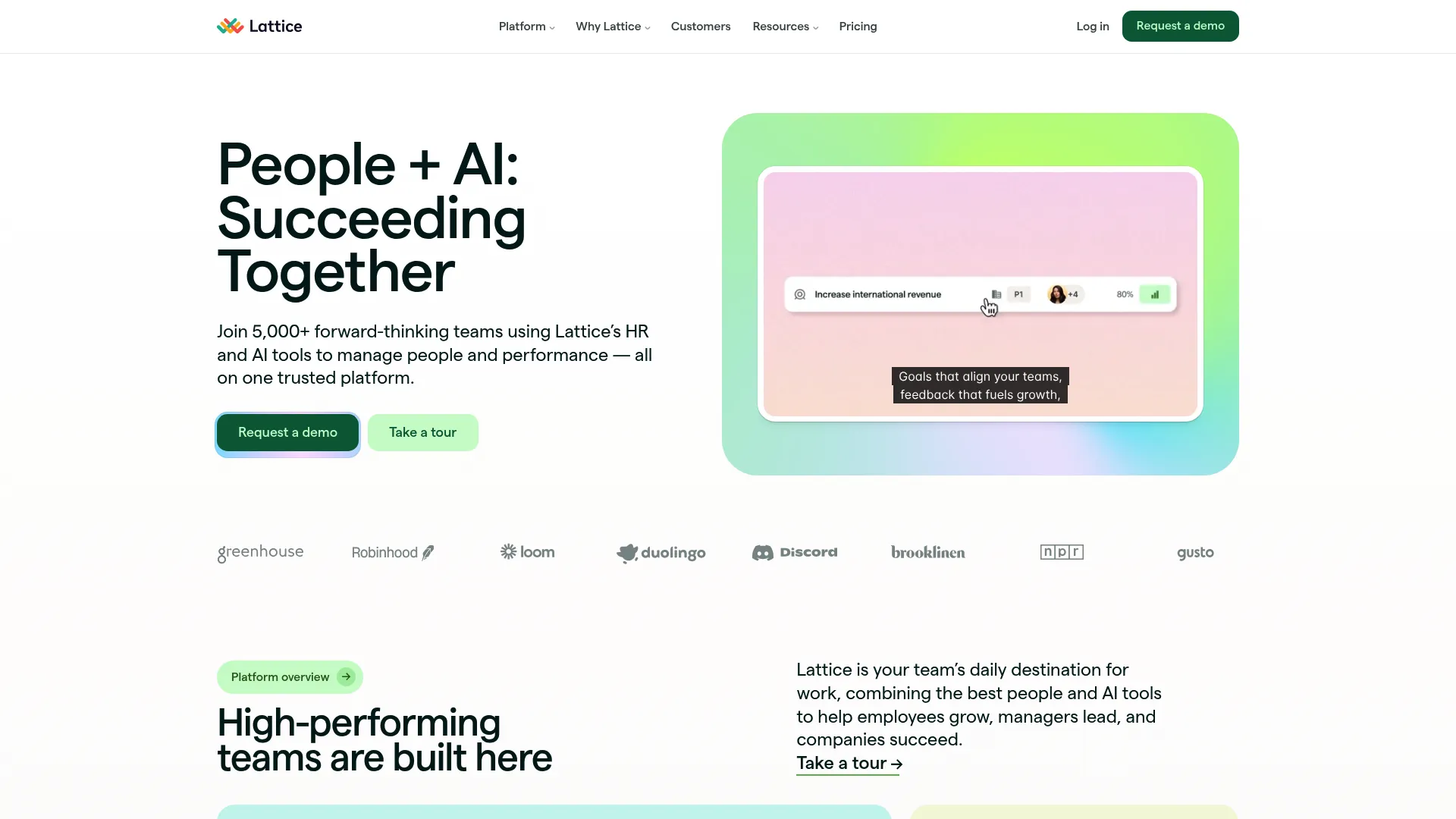
Lattice is an AI-powered people and performance management platform. Its agentic features support reviews, goals, feedback, and 1:1s, while answering routine employee questions and assisting managers across the development cycle.
Best for: Companies optimizing people development and manager workflows that want modular performance tooling.
Key strengths
- Performance reviews and feedback: Reviews, 1:1s, and weekly updates run in one place with AI assistance.
- Goals and OKRs: Goal tracking with integrations ties development to outcomes.
- Engagement and growth tools: Surveys, analytics, compensation, and career development in a modular suite.
Why choose Lattice: Lattice keeps the emphasis on performance and manager productivity. Agentic support handles review prep, feedback surfacing, and policy questions, so managers spend less time on admin and more on coaching. The modular structure lets you start with performance and add compensation or engagement later.
Lattice pricing: Lattice starts at $11 per seat per month for the Foundations package, with add-on products like Performance and Goals & OKRs at $8 per seat per month, Engagement at $4, Compensation at $6, and Grow at $4. Enterprise is a custom quote. Contracts bill annually in USD with a $4,000 minimum annual agreement, and there is no free tier. Lattice holds a 4.5/5 rating.
9. Eightfold AI
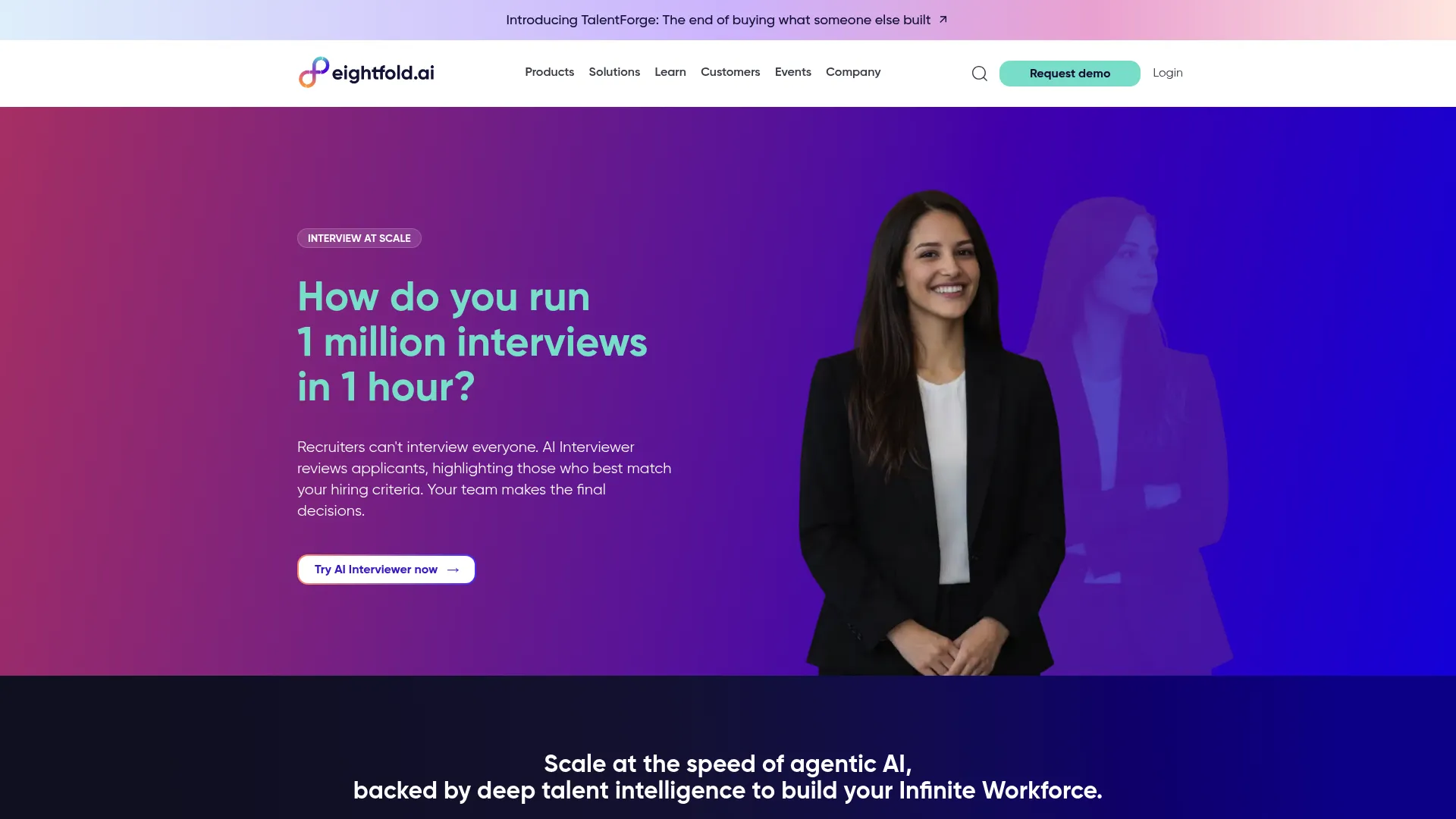
Eightfold AI is an AI-native talent intelligence platform for hiring, development, and workforce planning. Its agentic support spans talent acquisition, internal mobility, and skills-based matching, using deep skills data to connect people to roles.
Best for: Enterprises modernizing recruiting, internal mobility, and talent planning with AI.
Key strengths
- Talent acquisition: Matches candidates to roles using skills inference, not just keywords.
- Talent management and mobility: Surfaces internal candidates and career paths from skills data.
- Workforce planning: Connects hiring and development to longer-term workforce strategy.
Why choose Eightfold AI: Eightfold's value is talent intelligence with agentic support layered on top. It fits organizations that want skills-based hiring and internal mobility working from the same data, so a candidate rejected for one role surfaces for another. Recruiting and career development run off one skills graph.
Eightfold AI pricing: Eightfold AI uses sales-led pricing; no public price or plan table was exposed on its site during review. Eightfold AI holds a 4.2/5 rating on G2.
10. ADP AI agents
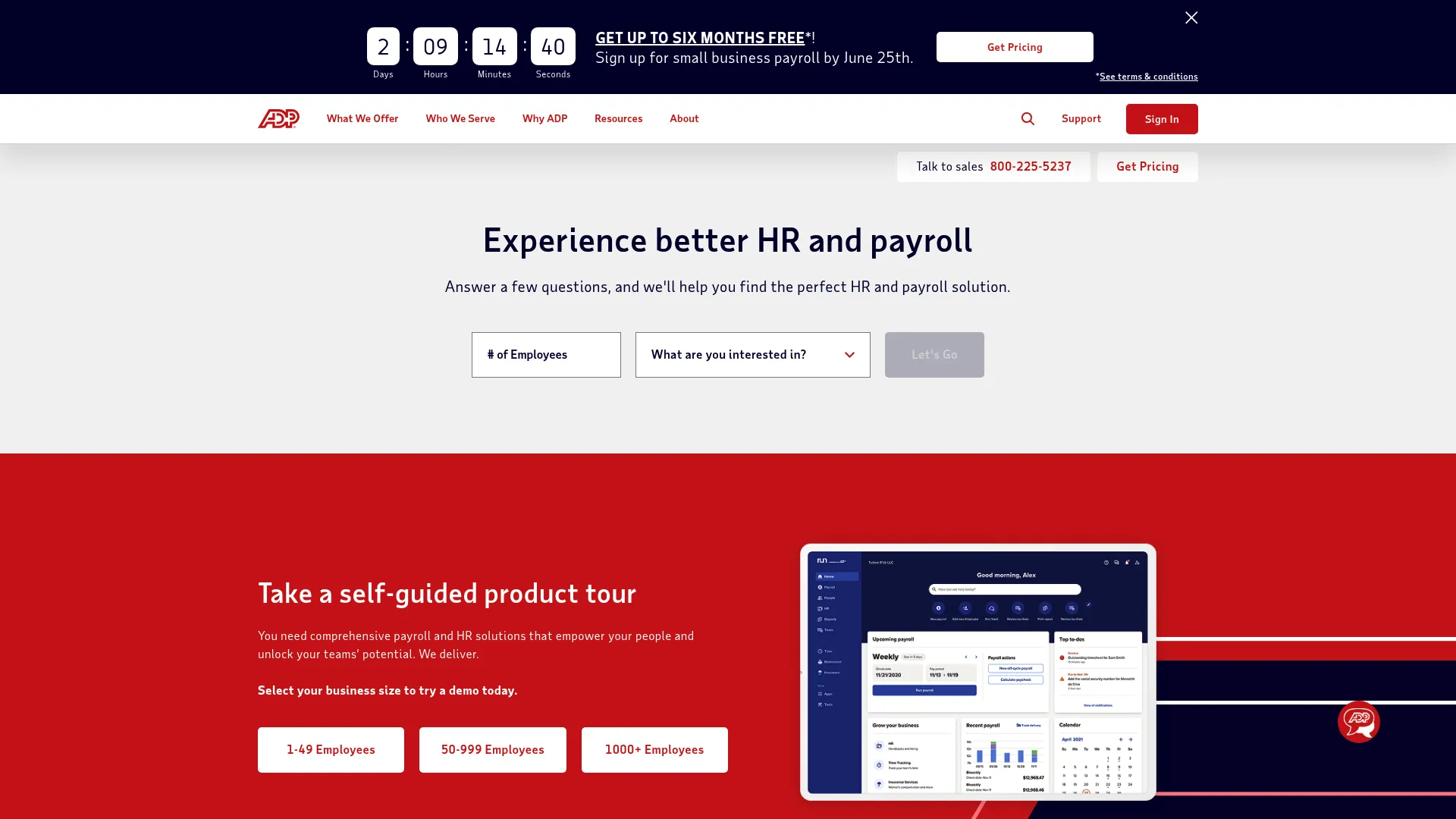
ADP is a global HCM provider spanning payroll, HR, talent, time, and benefits, and its AI agents support both practitioners and employees. For companies already on ADP, agents assist with payroll-related workflows, administrative automation, and employee-facing help.
Best for: Businesses needing payroll and HR platforms that scale from small business to enterprise.
Key strengths
- Payroll and tax filing: Agents assist across the payroll workflows ADP is known for.
- HR, talent, time, and benefits: Broad administrative coverage across the people lifecycle.
- PEO and HR outsourcing: Support extends into outsourced HR operations.
Why choose ADP: ADP's agentic support is practical and operations-focused. If payroll and HR already run on ADP, agents reduce administrative load and give employees self-service help without leaving the platform. The fit is strongest for teams that value payroll-adjacent automation and broad compliance coverage.
ADP pricing: ADP uses quote-based pricing for its main offerings; its public materials describe packages without exposing numeric prices. ADP holds a 4.4/5 rating on G2.
11. Rippling
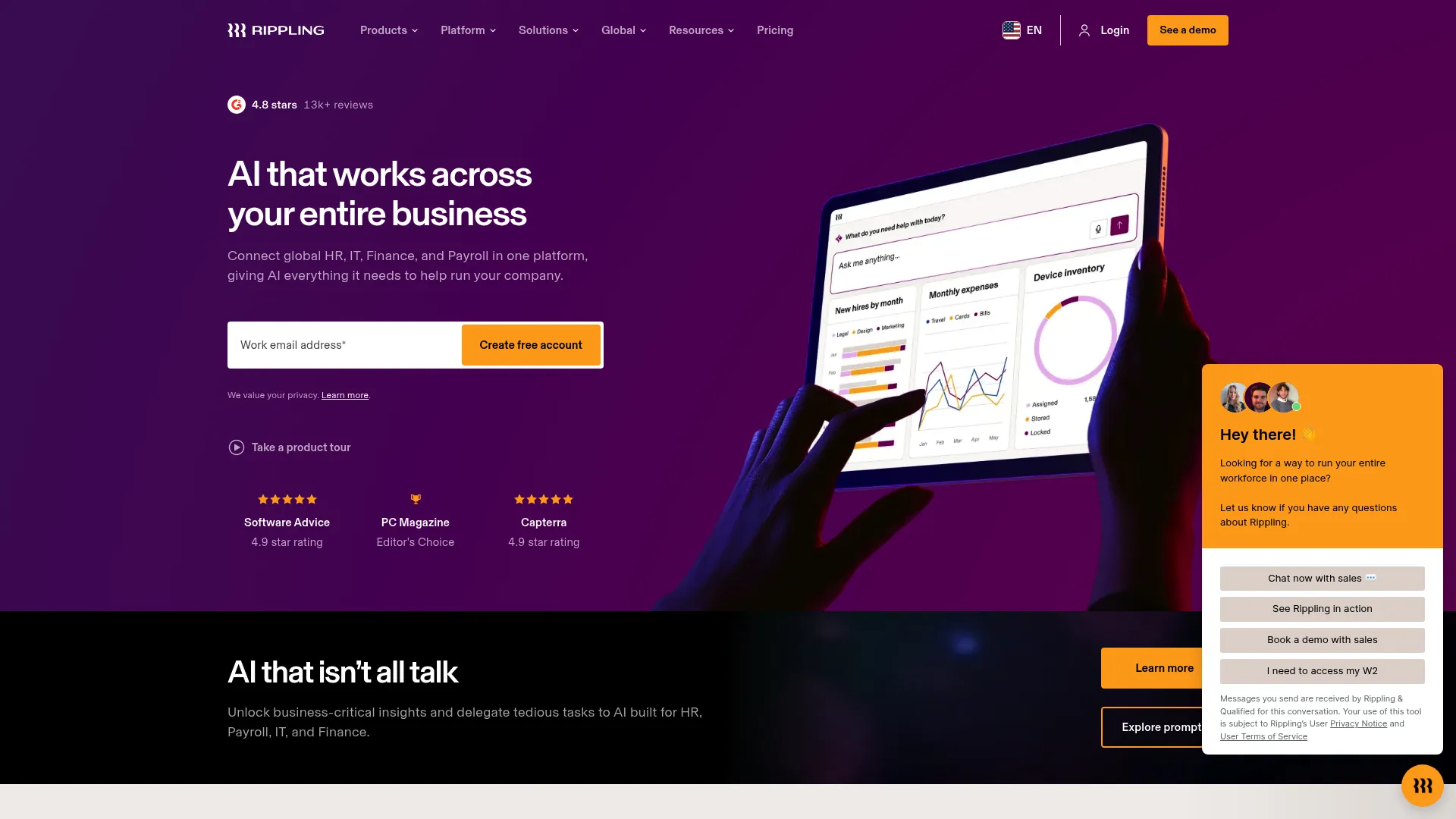
Rippling unifies HR, IT, payroll, and finance in one platform, which makes its agentic workflows unusually broad. Employee lifecycle tasks, account provisioning, and policy-related assistance all run from a single source of employee data.
Best for: Companies wanting one platform to manage HR, IT, payroll, and spend together.
Key strengths
- Unified HR, IT, and finance: One employee record drives workflows across every function.
- Workflow Studio automation: Build custom agentic workflows and analytics without code.
- 650+ integrations: Connects deeply across the tools a modern company runs on.
Why choose Rippling: Rippling's edge is connected workforce operations. When a hire joins or leaves, agentic workflows handle HR, device provisioning, and access in one motion, cutting the manual coordination that usually spans three teams. It fits companies that want to reduce handoffs across HR and IT.
Rippling pricing: Rippling uses quote-based pricing; products are purchased separately alongside the required Rippling Platform, billed mostly per employee per month. No public numeric price is displayed. Rippling holds a 4.8/5 rating on G2.
12. Factorial AI
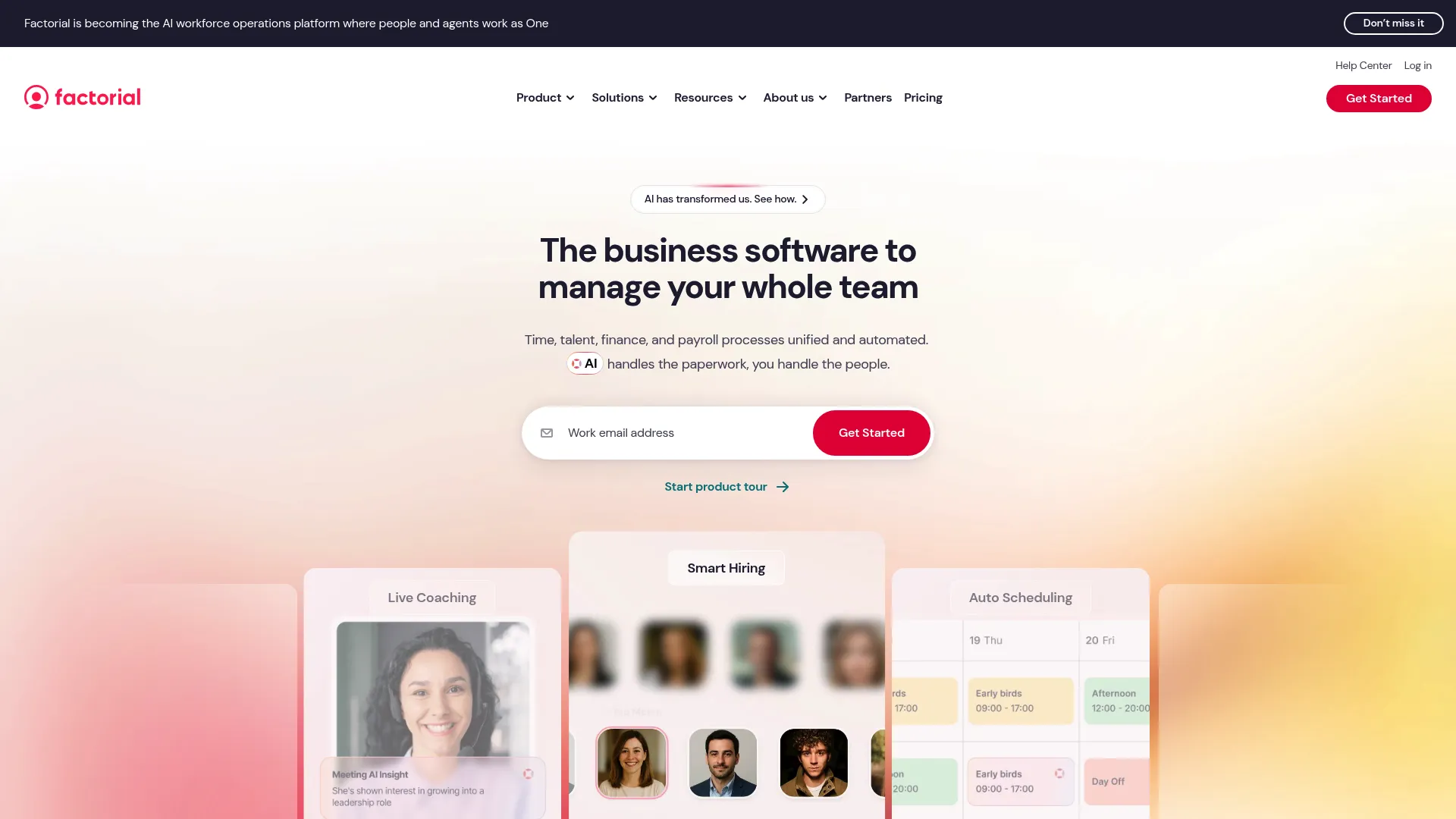
Factorial is AI-powered HR software built for SMB and mid-market teams that need broad coverage from one platform. Its agentic support spans onboarding, performance, employee support, and internal requests, with admin automation across the people lifecycle.
Best for: SMBs and lean teams wanting an all-in-one HR platform with time, payroll, and people-ops workflows.
Key strengths
- Onboarding and offboarding: Employee directory, document sending, and e-signature in one flow.
- Time and attendance: Time off, time tracking, shifts, and clock-in handled natively.
- Broad HR coverage: Performance, recruitment, engagement, and expenses under one roof.
Why choose Factorial: For a lean team without a dedicated HR ops function, Factorial covers a lot of ground affordably. Agentic support handles onboarding, internal requests, and admin so a small team punches above its weight. The breadth is the point: one platform instead of five point tools.
Factorial pricing: Factorial Core starts at $8 per user per month, with additional modules like Time Off, Performance, and Recruitment available as add-ons; module-level prices are not all public. Factorial holds a 4.4/5 rating on G2.
What to consider before choosing
Before you commit budget, run every shortlisted tool through the same checklist.
Integration depth
Confirm native connections to your HRIS, HCM, ERP, ticketing, identity provider, and Slack or Teams. An agent that can't act on your real systems creates more manual work, not less. Ask for the specific integration list, not a logo wall.
Security and governance
Verify role-based permissions, field-level access controls, audit logging, and data residency. HR data is sensitive and HR actions carry legal weight, so security and legal sign-off should happen before the pilot, not after.
Implementation effort
Be honest about what it takes to get live. Enterprise suites with embedded agents extend an existing platform; specialist tools deploy a single workflow fast. Map the effort to the outcome you need this quarter.
ROI measurement
Decide upfront what you'll measure: ticket deflection rate, time saved per workflow, response speed, and employee satisfaction. Agree on the baseline before launch so you can prove impact at the next board review.
Conclusion
The right HR AI agent depends entirely on the job you're solving. If you want system-level orchestration across an existing data layer, the enterprise suites lead: Oracle and IBM watsonx Orchestrate for cross-system agents, Workday for Workday-native teams, ServiceNow for consolidated service. If you need one workflow solved fast, the specialists win: Paradox for high-volume recruiting, Leena AI and Druid AI for employee self-service, Lattice for performance, Eightfold AI for talent intelligence, Rippling for connected HR and IT, and Factorial for lean teams that need broad coverage.
The practical path is simple. Pick the workflow drowning your team right now, shortlist the two or three tools that own it, and pilot against a measured baseline. Enterprise buyers building for scale should weight integration depth and governance; founders solving a single bottleneck should weight speed to value. Either way, start with the bottleneck, not the brand.
Start your journey with Guideflow today!
FAQs
AI agents for HR are software systems that observe context, interpret intent, and take action across HR systems, escalating to a human when needed. Unlike tools that only answer questions, agents execute work: booking interviews, resolving benefits queries, or moving onboarding tasks forward across recruiting, support, and admin.
A chatbot follows scripted conversation and answers within a set of predefined responses. An AI agent reasons across multiple steps and executes tasks in your real systems. A chatbot tells an employee where to find the PTO policy; an agent checks the HRIS and tells them their actual balance.
The highest-value workflows are repetitive and rule-bound but require some judgment. Strong fits include recruiting screening and scheduling, onboarding automation, employee self-service for policy and benefits, PTO and leave requests, performance review prep, and routine compensation queries.
Yes. HR data is sensitive and many HR actions carry legal weight, so approval and escalation paths are essential. Verify role-based permissions, audit trails, and clear handoff rules so anything touching pay, status, or compliance routes to a human before it executes.
Yes, this is one of the strongest use cases. Benefits, PTO, and policy questions are repeatable and high-volume, which makes them ideal for employee self-service. An agent pulls from policy and the HRIS to answer in real time, deflecting tickets and giving employees instant answers outside business hours.
At minimum, your HRIS and HCM, your ERP for compensation and finance data, ticketing for case management, identity systems for provisioning, and communication tools like Slack or Teams. An agent is only as useful as the systems it can act on, so prioritize native integration depth over a long logo list.
Track ticket deflection rate, time saved per workflow, response speed, and employee satisfaction. Set a baseline before launch so you can attribute change to the agent, then review against it regularly to prove operational impact and decide where to expand.
Yes, if the workflow is repetitive enough. Smaller teams benefit most when a single agent handles high-frequency tasks like onboarding, internal requests, and routine questions, freeing a lean HR function to focus on higher-value work. The fit depends on volume, not headcount.