An employee messages HR to ask how much parental leave they have left. Two days pass. They ask again. Somewhere in the middle, a benefits question, an onboarding form, and a payroll correction all pile into the same inbox, and a two-person People Ops team tries to route them by hand.
Multiply that across 80 employees and you get the real cost: slow answers, frustrated staff, and an HR team that scales linearly with headcount instead of leverage. For a founder watching burn and trying to prove the business runs without heroics, that friction shows up as churn risk and wasted payroll.
HR service delivery software exists to fix exactly that. It centralizes employee requests, routes them automatically, and makes self-service actually work through a searchable knowledge base and an employee self-service portal. The category is growing fast for a reason. According to WiseGuy Reports (2026), the HR service delivery software market is projected to grow from USD 12.33 billion in 2026 to USD 20 billion by 2035, at a 5% CAGR, as more teams push repetitive employee support into workflow automation instead of manual queues.
This kind of internal tooling sits next to the same evaluation logic you use for any support stack. If you have compared ai customer service software or built out a knowledge base, the muscle is identical: deflect the repeatable, escalate the exceptions, and measure what actually resolves. The rise of agentic ai platforms is now reshaping how much of that HR service management can run without a human in the loop.
What's inside
This guide covers the best HR service delivery software for teams that want faster resolution, better self-service, and less manual HR work. It is written for operators evaluating tools by workflow fit, not by feature-count marketing.
We ranked each tool against five criteria that actually predict outcomes:
- Employee portal quality and search experience
- Request routing and HR case management depth
- Knowledge base strength and case deflection
- AI and automation capability
- Integrations with your existing HR stack
The list favors software with real service delivery capabilities, not general HRIS features bolted onto an employee record.
TL;DR
- Best overall for large, complex orgs: ServiceNow HR Service Delivery, for centralized case management and AI-assisted routing at scale.
- Best if HR already lives in SAP: SAP SuccessFactors, keeping service workflows close to your system of record.
- Best for lighter HR support automation: ADP HR Assist, for teams anchored in the ADP ecosystem.
- Best for employee experience and portal design: Applaud, for a branded self-service layer over existing systems.
- Best for AI-led support workflows: Leena AI Autonomous Agent, for high-volume deflection across HR requests.
- Best for a familiar help desk model: Zendesk for Employee Service, for teams that want ticketing they already understand.
What is HR service delivery software?
HR service delivery software is a platform that centralizes employee HR requests, automates their routing, and resolves them through self-service, case management, and knowledge tools. It handles the service side of HR: the questions, requests, and issues employees raise every day.
The category combines an employee self-service portal, structured request intake, routing and triage, HR case management with escalation, and a searchable knowledge base for tier 0 self-service. Its goal is simple: faster employee support with less manual HR effort.
Core capabilities buyers should expect
- Employee self-service portal: a single HR portal where staff find answers, submit requests, and track status.
- Request submission, triage, and routing: structured intake with automatic request routing to the right team.
- HR case management and escalation: ownership, SLAs, and escalation paths for issues that need a human.
- Knowledge base and FAQ deflection: searchable content that resolves common questions before a case is opened.
- AI assistants and workflow automation: conversational answers and automated multi-step HR workflows.
- Analytics: visibility into satisfaction, deflection rate, resolution time, and employee productivity.
How it differs from general HRIS
An HRIS stores employee data: records, payroll, org structure, and compliance fields. HR service delivery handles the interactions and resolution workflows on top of that data. Your HRIS knows an employee's leave balance. Your service delivery layer answers the employee who is asking about it, routes the exception, and closes the loop. Most teams run both, with the service layer pulling from the system of record.
When to use HR service delivery software
Reduce repetitive employee questions
When your HR team answers the same questions about leave, benefits, onboarding, and policies over and over, you have a deflection problem, not a headcount problem. A strong knowledge base and self-service portal let employees resolve tier 0 questions on their own, so HR spends time on the cases that actually need judgment. This is the same case deflection logic that reshaped ai customer service queues.
Standardize HR support across locations
Global or multi-office teams break down when every location handles HR requests differently. Consistent service workflows, shared knowledge access, and unified request routing keep the experience the same whether an employee sits in Austin or Amsterdam. Case visibility across the whole org also gives leadership a single view of where issues cluster.
Improve employee experience without adding headcount
This is the efficiency play founders care about. Automation and self-service create speed without expanding the HR team one hire at a time. When routine work runs itself, your existing team absorbs more employees per person, and the employee experience improves instead of degrading as you scale. That is real operational leverage, and it shows up in retention.
Comparison table
The tools below are ranked by relevance to HR service delivery and by enterprise fit. Pricing for most enterprise HR service delivery tools is quote-based, so we have noted public figures where vendors publish them and left the rest as custom.
| # | Product | Intent | Key differentiation | Pricing | G2 rating |
|---|---|---|---|---|---|
| 1 | ServiceNow HR Service Delivery | Enterprise HR service management | Centralized case and knowledge management with AI-assisted workflows | Custom quote | 4.5/5 |
| 2 | SAP SuccessFactors | Enterprise HCM with service workflows | Service delivery close to a global system of record | Contact sales | 4.1/5 |
| 3 | ADP HR Assist | HR support automation | HR guidance and compliance layer for ADP Workforce Now | Login to view | 4.2/5 |
| 4 | Applaud | HR self-service and experience | Branded employee portal over existing HR systems | Contact for pricing | 4.8/5 |
| 5 | Leena AI Autonomous Agent | AI-assisted HR service delivery | Agentic AI across HR, IT, and back-office workflows | Custom quote | 4.6/5 |
| 6 | Zendesk for Employee Service | Employee support (help desk) | Familiar ticketing model adapted for internal service | From $29/agent/mo | 4.3/5 |
| 7 | Hyland OnBase | HR case management (content-heavy) | Document and records management with workflow automation | Custom | 4.4/5 |
| 8 | Cegid HR | HR service within broader HR ops | Modular HR suite with service and portal capabilities | Contact for pricing | 4.2/5 |
1. ServiceNow HR Service Delivery
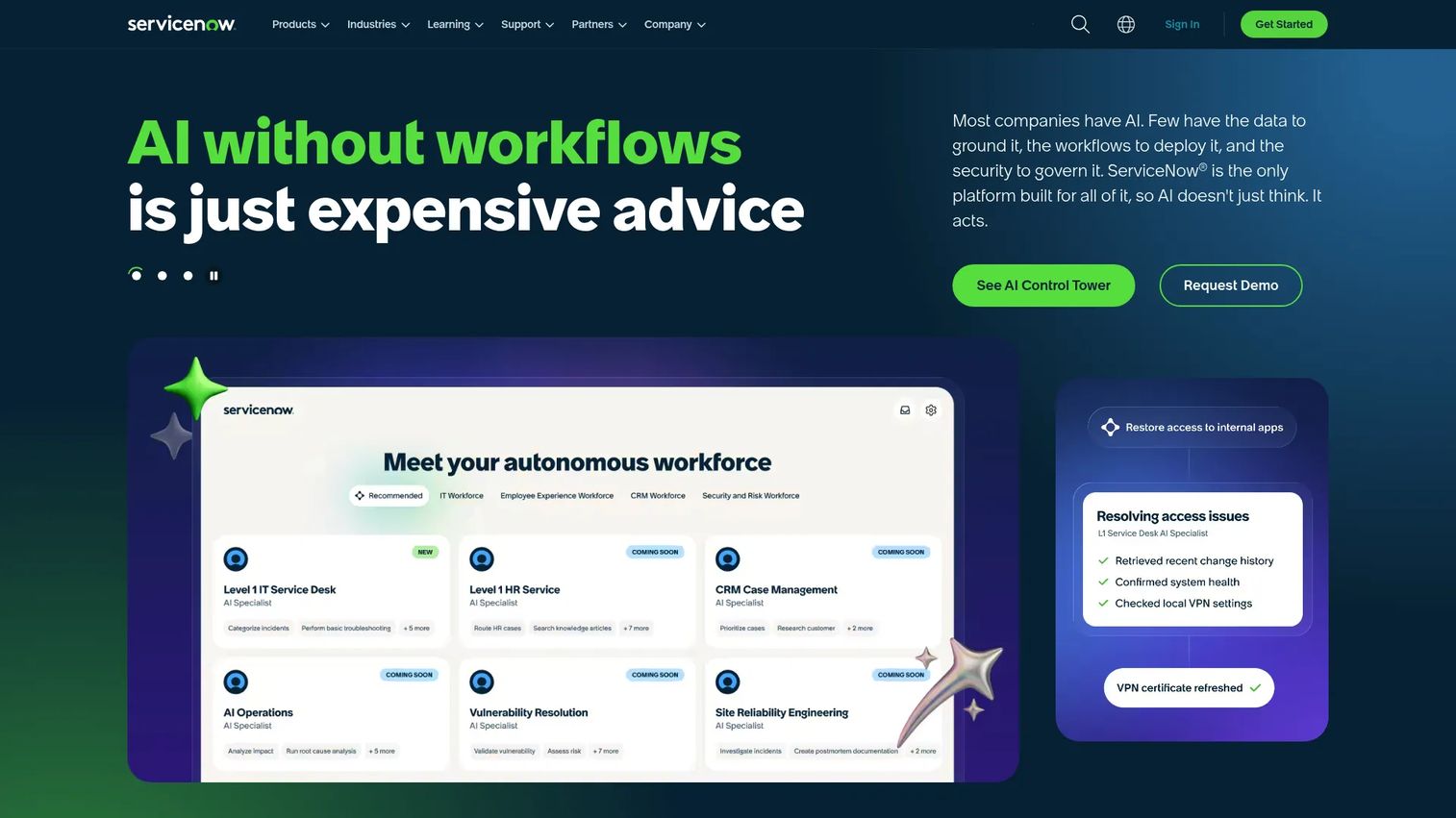
ServiceNow HR Service Delivery is HR service management software built to streamline employee support, cases, and HR workflows at enterprise scale. It brings employee requests into a single Employee Center, routes them through structured case management, and layers AI-assisted workflows on top. For large organizations with complex HR operations, it is the reference point most buyers benchmark against.
The platform pairs a self-service employee portal with deep case and knowledge management, plus a Virtual Agent that handles routine questions before they become tickets. Manager workflows keep people-leaders in the loop on approvals and escalations without routing everything through HR.
Best for: Large organizations that want a centralized HR service delivery and employee self-service platform.
Key strengths
- Employee Center: a single branded HR portal for requests, answers, and status tracking.
- Case and knowledge management: structured routing, escalation, and SLA handling backed by a searchable knowledge base.
- Virtual Agent and AI workflows: AI-assisted HR service delivery that deflects repetitive questions and speeds resolution.
Why choose ServiceNow HR Service Delivery: If your HR operation spans thousands of employees, multiple regions, and layered approval chains, ServiceNow handles the complexity most lighter tools were not built for. It fits teams that need governance, auditability, and workflow depth over speed of setup.
ServiceNow HR Service Delivery pricing: ServiceNow publicly lists three packages, HR Foundation, HR Advanced, and HR Prime, but the pricing page shows a custom quote flow rather than a public number. Expect enterprise-tier pricing scoped to your org size and modules. On G2, ServiceNow HR Service Delivery holds a 4.5/5 rating.
2. SAP SuccessFactors
SAP SuccessFactors is SAP's cloud HCM suite covering core HR, payroll, talent management, and workforce analytics. HR service delivery here lives inside a broader human capital management platform, which is the point: service workflows run close to the system of record, so employee requests and employee data share the same foundation.
For organizations already standardized on SAP, that proximity matters. Requests, approvals, and case handling connect directly to core HR data without stitching multiple systems together.
Best for: Large enterprises that need an integrated, global HR platform.
Key strengths
- Core HR and payroll: service workflows anchored to a single global system of record.
- Talent management: HR service delivery that spans the full employee lifecycle, not just support tickets.
- HR analytics and workforce planning: reporting that ties service data to broader workforce metrics.
Why choose SAP SuccessFactors: Choose it when HR already runs on SAP and you want service delivery integrated rather than bolted on. The tradeoff is that it is a full HCM commitment, so it fits organizations investing in an end-to-end suite, not teams looking for a standalone service layer.
SAP SuccessFactors pricing: SAP's HCM packages page directs buyers to contact sales, and no public starting price is visible on the suite pricing page. Pricing is scoped per organization and module set. On G2, SAP SuccessFactors HCM holds a 4.1/5 rating.
3. ADP HR Assist
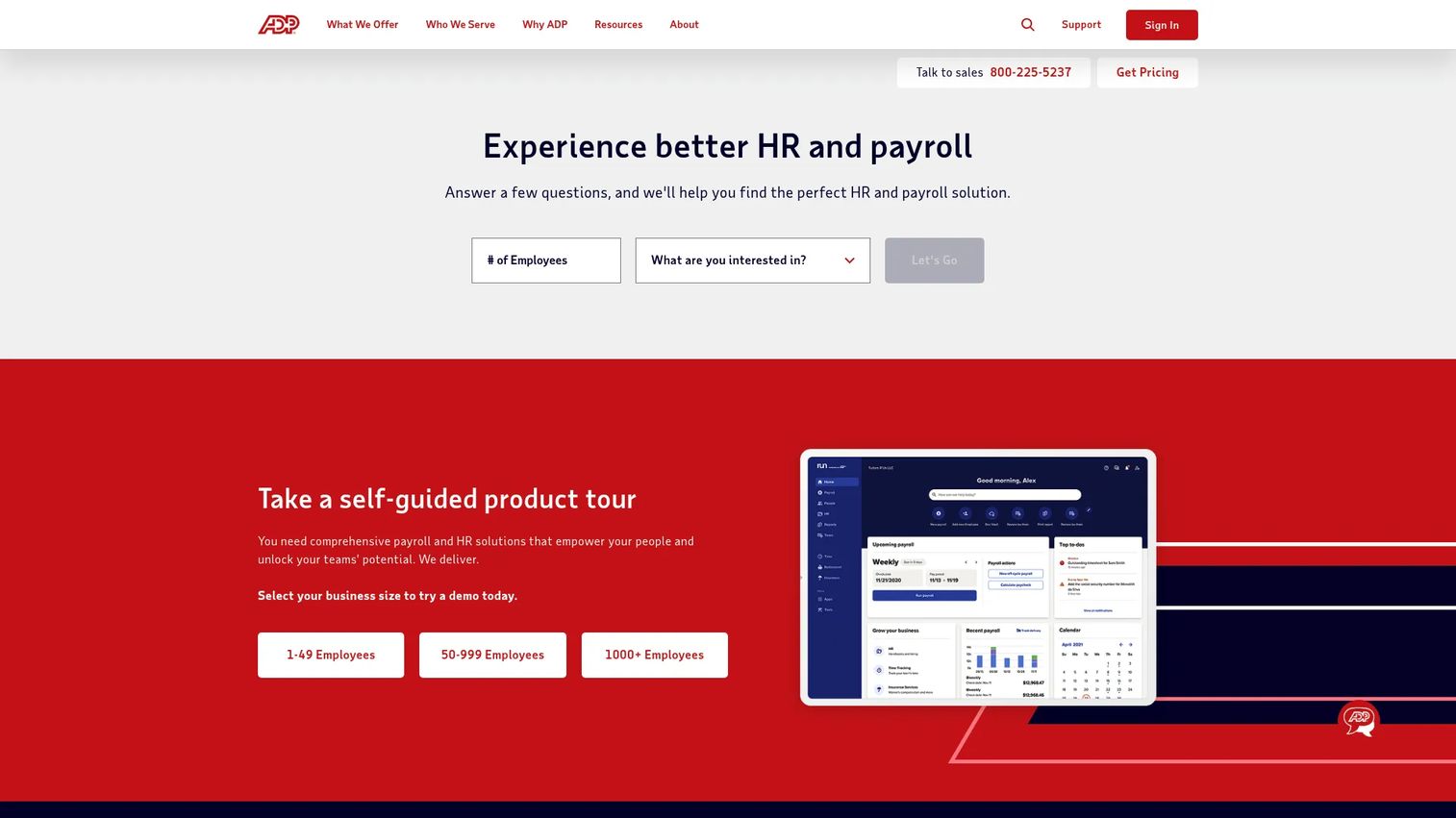
ADP HR Assist is an HR and compliance support add-on for ADP Workforce Now. It gives teams practical HR service features, an HR HelpDesk, quick HR answers, and compliance resources, without committing to a giant standalone platform. If your payroll and core HR already run on ADP, this extends that stack into everyday HR support.
The value here is fit and ease of adoption. Teams anchored in ADP get HR guidance, forms, and knowledge tools inside an environment they already use, which lowers the barrier to getting real self-service live.
Best for: Businesses using ADP Workforce Now that want HR guidance and compliance resources.
Key strengths
- HR HelpDesk and quick HR answers: fast employee support and knowledge access inside the ADP ecosystem.
- HR forms, documents, and wizards: handbook, job description, and audit wizards that standardize common HR work.
- Compliance resources: state and federal compliance updates and HR checkups built in.
Why choose ADP HR Assist: Pick it when you are ADP-centric and want practical HR service and compliance support without a large implementation. It fits smaller and mid-sized teams that value adoption speed over the breadth of an enterprise service platform.
ADP HR Assist pricing: ADP does not publicly display pricing for HR Assist; the marketplace page requires a login to view price and points to a contact flow. It is offered as a recurring subscription edition. ADP HR Assist carries a 4.2/5 rating on the ADP Marketplace.
4. Applaud
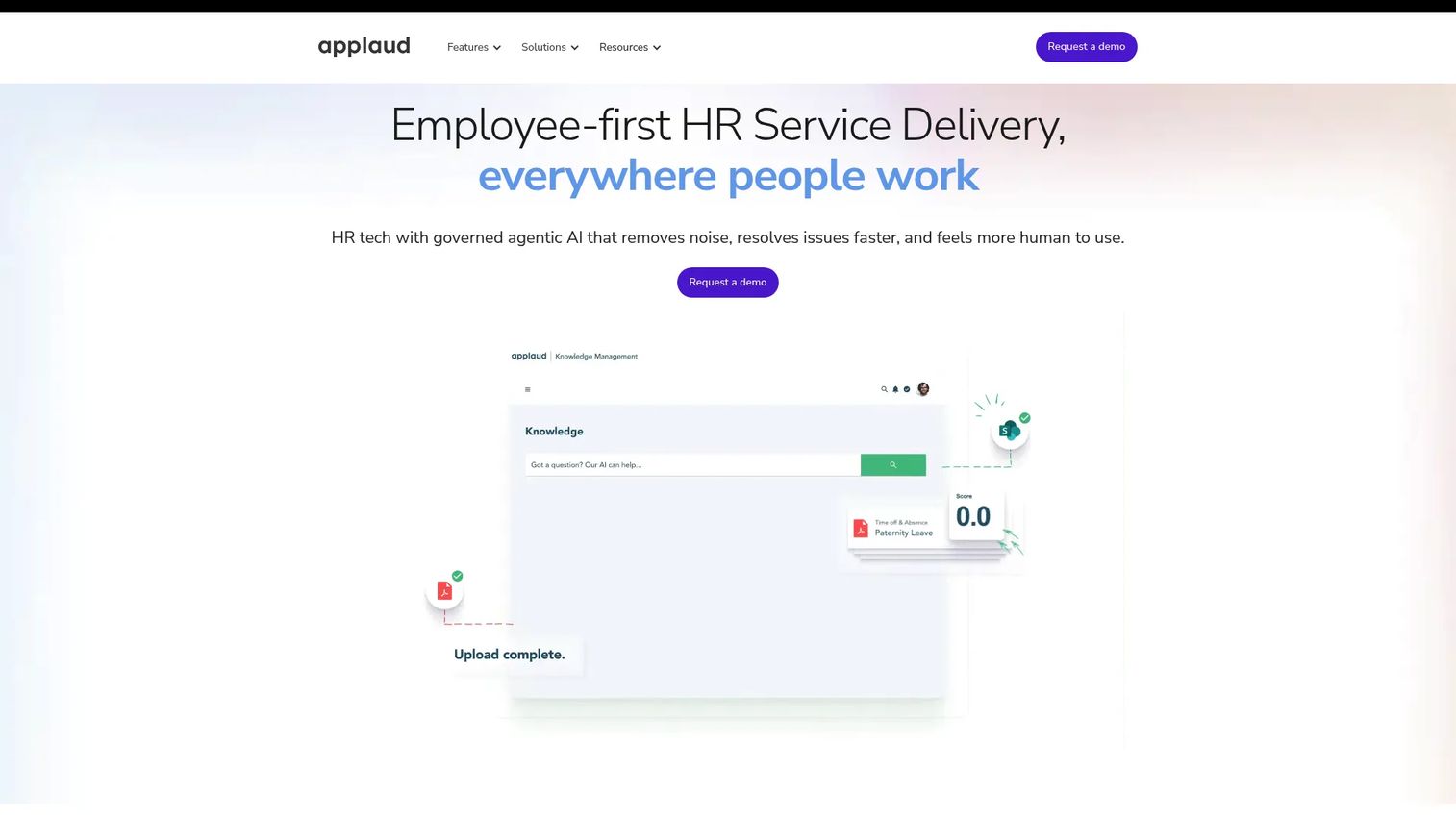
Applaud is HR service delivery software built around employee self-service, with a strong focus on portal design and experience. It sits as a service and experience layer over your existing HR systems, unifying case management, knowledge, guided journeys, and an AI assistant behind a single branded employee portal. If employee experience is the priority, Applaud is built for it.
The standout is the front end. Instead of forcing employees into whichever back-end system owns a given process, Applaud gives them one consumer-grade destination for every HR interaction.
Best for: Mid-enterprise HR teams needing an employee-facing service delivery layer over existing systems.
Key strengths
- Employee portal and journeys: a branded self-service portal with guided journeys for onboarding, leave, and more.
- HR case management and knowledge management: structured case handling paired with searchable knowledge for deflection.
- AI assistant and creator platform: conversational self-service plus a no-code way to build service experiences.
Why choose Applaud: Choose it when the employee experience of HR is the problem you are solving, and you want a unified portal layered over systems you already run. It fits teams that treat internal experience with the same seriousness as customer experience.
Applaud pricing: Applaud prices per user per month on a subscription basis, but the pricing page shows a contact-for-pricing flow rather than a public amount. Among the tools here, Applaud carries the highest G2 rating at 4.8/5.
5. Leena AI Autonomous Agent
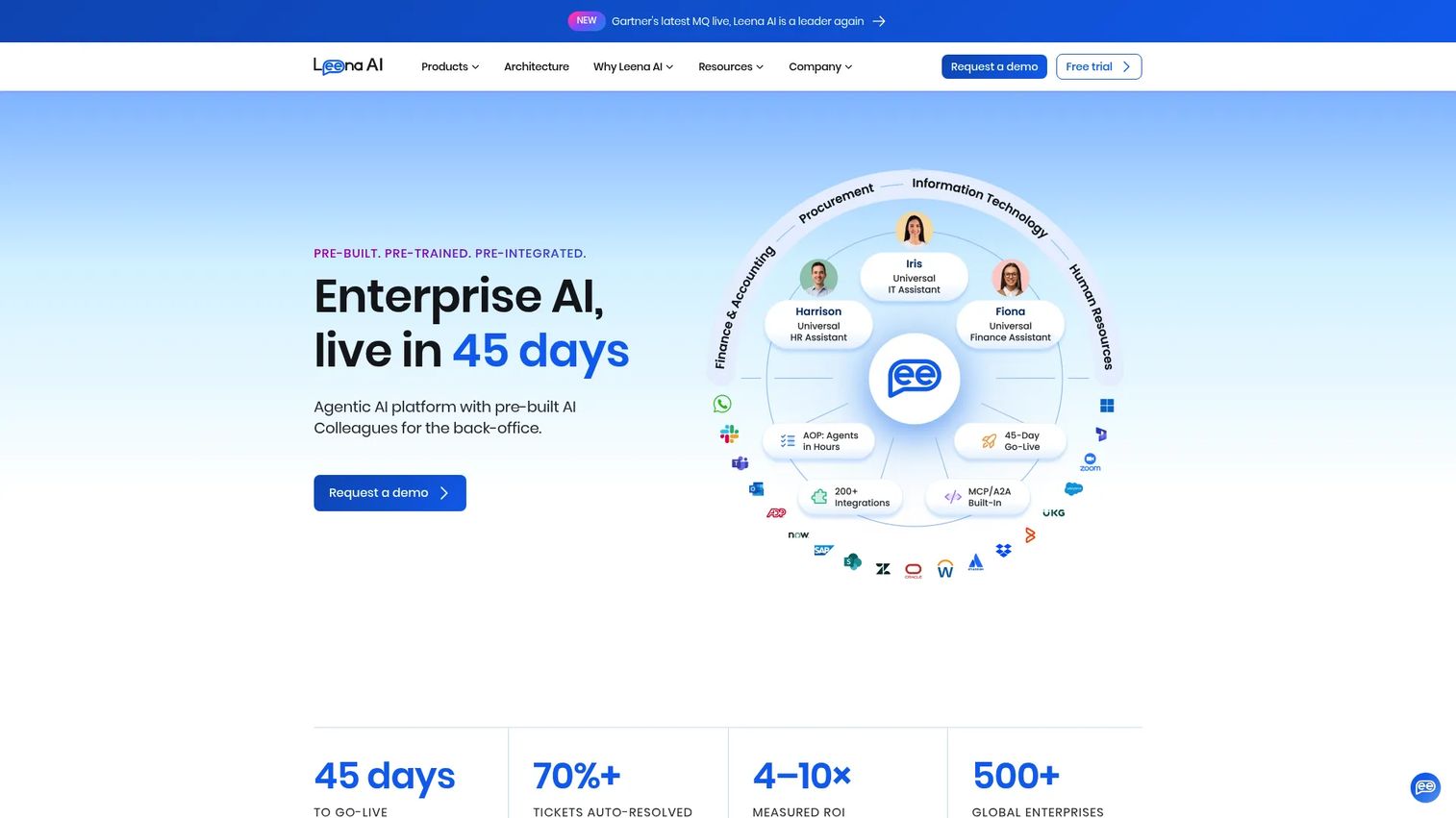
Leena AI Autonomous Agent is an enterprise agentic AI platform that automates back-office workflows across HR, IT, finance, and procurement. For HR service delivery, its value is AI-first: conversational self-service and autonomous handling of repetitive requests, so a large share of employee questions resolve without a human touching them. This is where agentic ai is genuinely changing HR operations.
Because it orchestrates across enterprise systems, Leena AI can act on requests, not just answer them, pulling data and executing steps across the tools employees already rely on.
Best for: Large enterprises wanting an AI agent layer for employee-service automation and back-office ticket reduction.
Key strengths
- Agentic AI orchestration: centralized AI that acts across HR, IT, and finance workflows, not just a chatbot.
- Broad integrations: hundreds of enterprise integrations that let the agent execute end-to-end.
- Governance controls: runtime permissions, observability, and controls built for enterprise deployment.
Why choose Leena AI Autonomous Agent: Pick it when deflection and autonomous resolution are the goal and you have the request volume to justify an AI-first layer. Integration depth with your HR systems is the thing to scope carefully, because the agent is only as capable as its connections.
Leena AI Autonomous Agent pricing: Leena AI uses quote-based, request-a-demo pricing rather than public numbers. Pricing is personalized to deployment scope. On G2, Leena AI holds a 4.6/5 rating.
6. Zendesk for Employee Service
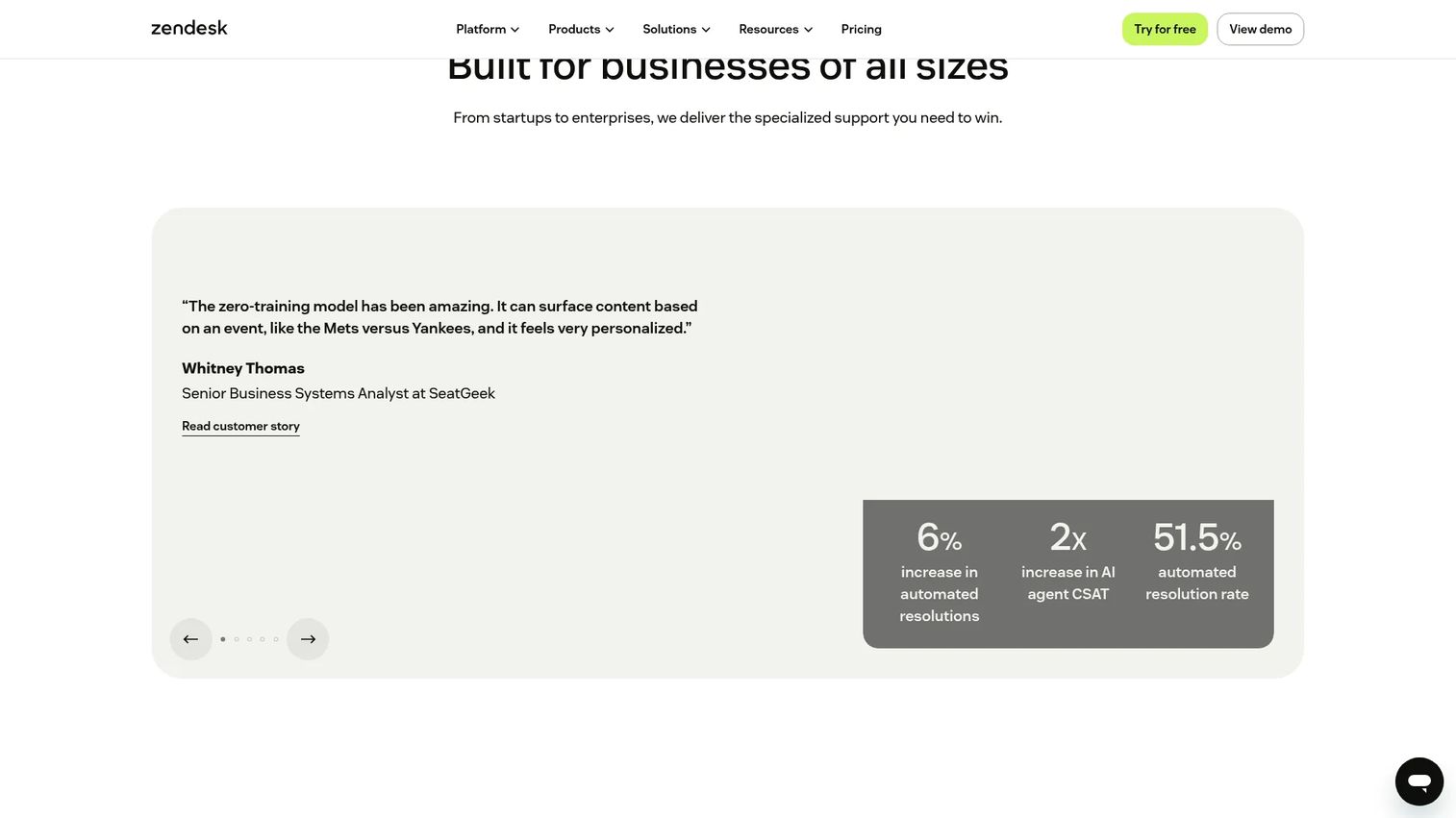
Zendesk for Employee Service takes the service-desk model teams already know and adapts it for internal IT and HR support. Employees submit requests, agents work tickets, and knowledge and AI agents deflect the repeatable questions, all inside a familiar help desk workflow. If your team already thinks in tickets, this is the shortest path to structured employee support.
The difference from traditional customer support use is the audience and the catalog. Instead of external customers, you are serving employees, with a service catalog and asset management tuned for internal requests.
Best for: Mid-market to enterprise teams centralizing internal IT and HR support.
Key strengths
- AI agents: automated first-line responses that deflect common HR and IT questions.
- Service catalog: structured request intake and routing for internal services.
- IT asset management: tracking that pairs employee support with asset visibility.
Why choose Zendesk for Employee Service: Choose it when a proven ticketing model matters more than HR-specific depth, or when the same platform serves both IT and HR support. It fits teams that value a familiar workflow and want employees productive on it quickly.
Zendesk for Employee Service pricing: Zendesk publishes seat-based plans: Suite Team at $29 per agent per month, Suite Growth at $59, and Suite Professional at $99, each billed yearly, with Suite Enterprise on a talk-to-sales basis. A 14-day free trial is available on Professional. Zendesk for Employee Service holds a 4.3/5 rating on G2.
7. Hyland OnBase
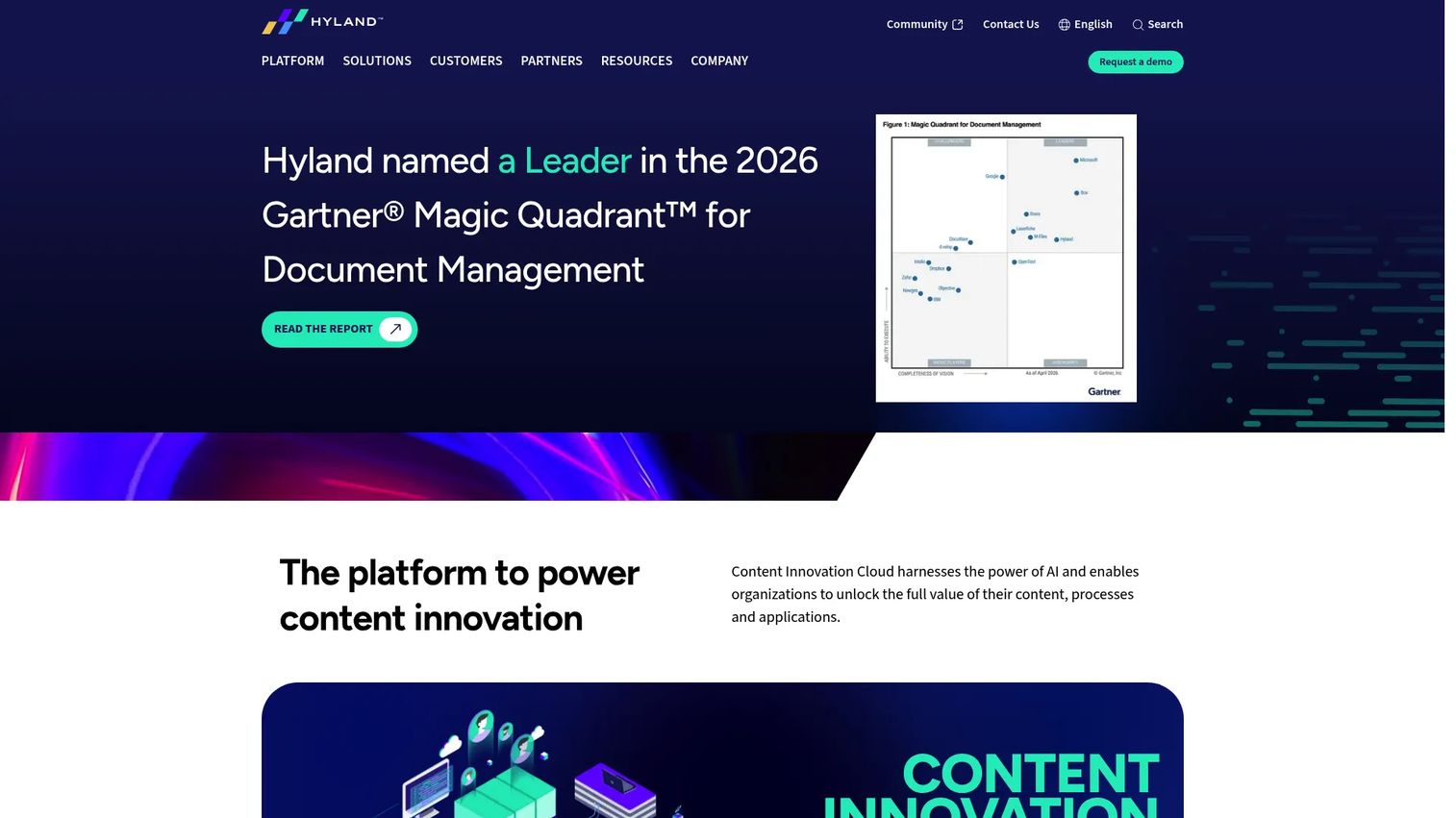
Hyland OnBase is enterprise operational content management software for capturing, governing, and automating document-centric work. For HR, that means the paper-heavy side of service delivery: employee records, forms, compliance documents, and the workflows that move them. If your HR service processes revolve around documents and records, OnBase is built for that reality.
Concretely, think onboarding paperwork, benefits enrollment forms, and compliance records that need capture, routing, retention, and audit trails. OnBase automates those flows and keeps the records governed.
Best for: Large organizations that need configurable content management and workflow automation.
Key strengths
- Automated multichannel capture: intake of HR documents from any source into structured workflows.
- Process automation and case management: workflow automation for document-driven HR service processes.
- Retention and records management: governed storage and audit trails for compliance-heavy HR records.
Why choose Hyland OnBase: Choose it when compliance, forms, and content management sit at the center of your HR service processes. It fits document-intensive, regulated organizations more than teams whose HR requests are mostly quick questions.
Hyland OnBase pricing: Hyland does not publish public pricing for OnBase, so plan on a scoped enterprise quote. On G2, Hyland OnBase holds a 4.4/5 rating from a large review base.
8. Cegid HR
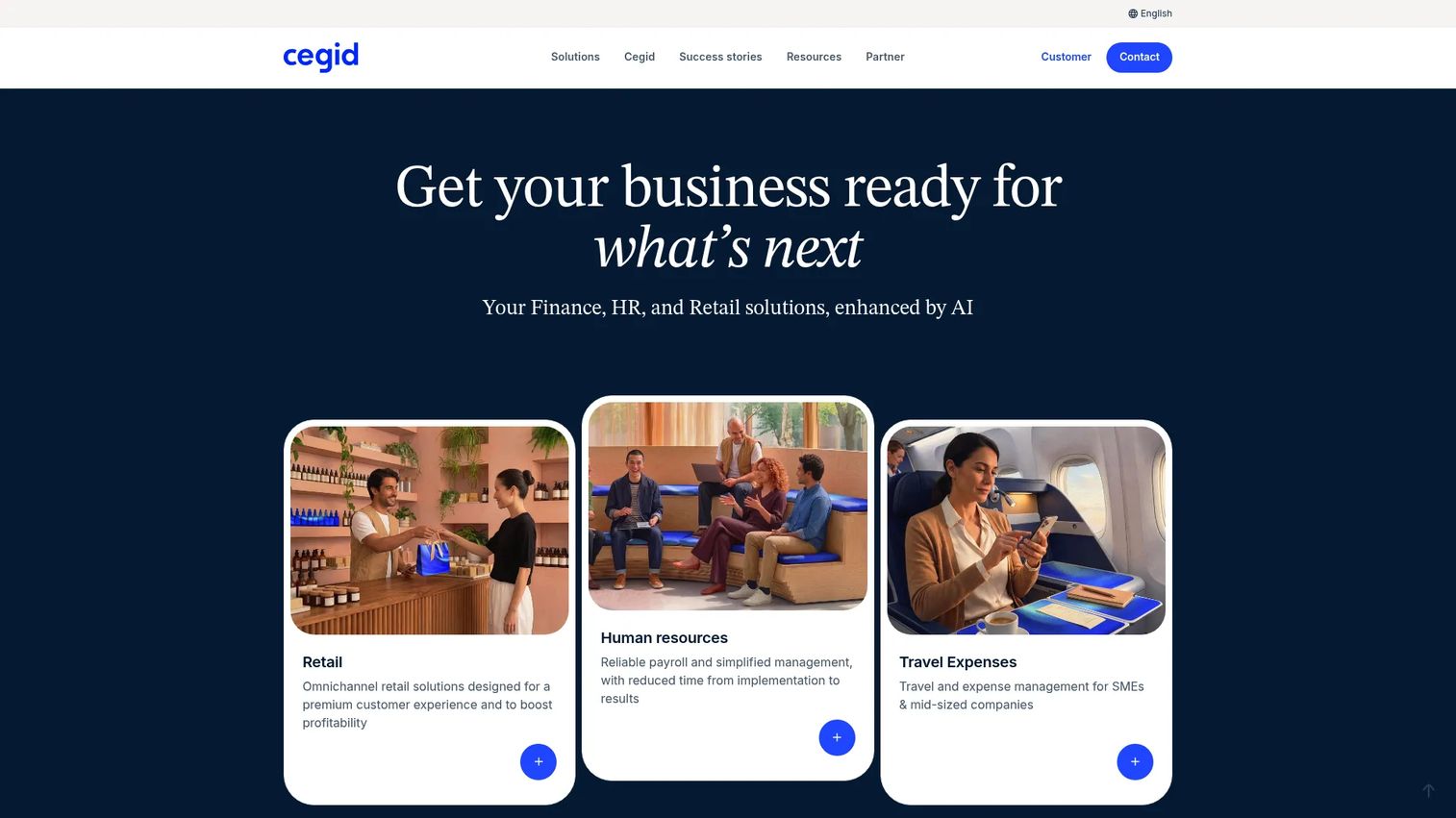
Cegid HR is a cloud-based HR suite spanning core HR, recruiting, talent management, and learning, with service and portal capabilities inside broader HR operations. It fits regional and international organizations that want structured HR processes and a service layer within one modular platform rather than a standalone service desk.
Because it is modular, teams can adopt the pieces they need, from core HR and analytics to talent management, while running employee support and portal access on the same foundation.
Best for: Mid-market and large organizations needing a modular HR suite.
Key strengths
- Core HR and analytics: service and portal capabilities anchored to a single HR platform.
- Recruitment and talent acquisition: HR service delivery that spans hiring through the employee lifecycle.
- Skills and talent management: structured processes for development alongside everyday support.
Why choose Cegid HR: Choose it when you want service and portal features inside a broader, modular HR suite, especially across regional or international operations. It fits teams consolidating HR operations rather than buying a dedicated service delivery point solution.
Cegid HR pricing: Cegid does not publicly display pricing for its HR suite, so pricing is quote-based and scoped to your modules. On G2, Cegid HR holds a 4.2/5 rating.
What to check before you buy
Portal and self-service quality
The employee self-service portal is where adoption lives or dies. Test the search, the request flows, and how fast an employee gets to an answer. If self-service is clunky, employees route around it and back into HR's inbox, and your deflection numbers never move.
Routing and case management depth
Look at how requests get triaged, routed, and escalated. Strong request routing and HR case management with clear ownership and SLAs is what turns a pile of messages into a managed queue. Check whether escalation paths and manager workflows match how your team actually operates.
Knowledge base and deflection
A knowledge base is only useful if it deflects. Evaluate how content is authored, kept current, and surfaced inside self-service and AI answers. The goal is tier 0 self-service that resolves common questions before a case opens. Reviewing dedicated knowledge base software alongside your shortlist helps you set the bar.
AI and automation fit
AI-assisted HR service delivery earns its keep through deflection and speed, not novelty. Scope what the AI actually does: answers questions, drafts responses, or executes multi-step workflows. The current wave of agentic ai tools can act autonomously, so match capability to your request volume and governance needs.
Integrations and ROI
Service delivery only works if it connects to your HRIS, payroll, and communication tools. Verify the integrations you need exist before you commit. Then tie the purchase to measurable ROI: reduced case volume, faster resolution, and HR productivity that scales without linear hiring.
Conclusion
The right HR service delivery software depends on your operating model, not a leaderboard. For enterprise-heavy operations with complex workflows, ServiceNow HR Service Delivery sets the standard. If HR already runs on SAP, SAP SuccessFactors keeps service delivery close to the system of record. Teams anchored in ADP get practical support fast with ADP HR Assist, while Applaud wins when employee experience and portal design are the priority.
For AI-first deflection at volume, Leena AI Autonomous Agent leads. Zendesk for Employee Service fits teams that want a familiar help desk model, Hyland OnBase suits document-heavy and compliance-driven HR, and Cegid HR fits modular, international HR operations.
Whatever the shortlist, judge tools on the same five things: portal quality, request routing, knowledge base strength, AI and automation, and integration fit. Shortlist two or three based on your current HR stack and service complexity, then run a real request through each before you sign. The payoff is a leaner HR operation, better employee experience, and support that scales without adding a head for every hundred employees.
FAQs
An HRIS stores employee data: records, payroll, org structure, and compliance fields. HR service delivery software manages the interactions on top of that data, employee requests, case workflows, and self-service resolution. Most teams run both, with the service layer pulling from the HRIS as its system of record.
A strong employee self-service portal offers fast search, a searchable knowledge base and FAQs, structured request submission, real-time status tracking, and clear access to relevant HR content. The best portals feel consumer-grade, so employees prefer self-service over messaging HR directly.
HR case management starts with intake through a portal or form, then routes the request to the right team based on type or priority. Cases carry ownership, SLAs, and escalation paths for issues that need a human, and resolution is tracked end to end. This gives HR visibility into volume, bottlenecks, and response times.
Yes, when it is grounded in workflow value. AI drives case deflection by answering common questions instantly, drafts responses for agents, and in agentic tools executes multi-step HR workflows. The measurable win is fewer repetitive tickets and faster answers, not AI for its own sake.
Focus on efficiency and outcomes: does it measurably reduce manual HR work, improve employee experience, and fit your existing HR stack. Check integration depth, portal quality, and whether it scales support without linear hiring. Tie the decision to ROI you can defend, lower case volume and faster resolution.
HR and People Ops own these HR service delivery tools day to day, but managers use them for approvals and escalations. IT and workplace operations often share the same platform for internal service requests, especially in tools that serve both HR and IT support from one service center.
Track deflection rate, average resolution time, employee satisfaction, HR productivity, and total case volume reduction. Compare case volume per HR headcount before and after rollout to see whether support is scaling without added hires. Rising self-service adoption alongside falling resolution time is the clearest signal of ROI.