You quoted a warehouse tear-out last month. Two days of manual takeoff, a spreadsheet with 40 line items, and a margin you crossed your fingers on. The client sent an addendum three days before the bid closed. You reworked half the estimate by hand, missed a hazardous material line, and lost the job to a contractor who turned their revised number around in four hours.
That gap is the whole game in demolition. The scope is messy, the site conditions change, and the bid window is short. Manual estimating turns every revision into a fire drill, and every missed quantity into a margin hit you find out about after the concrete is already gone.
The market is moving fast enough that the tooling gap is widening. The U.S. demolition and wrecking market is projected to grow from about USD 10.1 billion in 2025 to USD 13.8 billion by 2032 at a 4.5% CAGR, according to PS Market Research (2024). More work means more bids, and more bids mean the contractors who can quantify scope, price it accurately, and turn revisions around fast are the ones taking the contracts.
Demolition software is how you close that gap. Good tools cut takeoff time, keep your numbers consistent across revisions, and let you bid more work without hiring three more estimators. This guide separates the engineering-analysis tools from the estimating and AI takeoff tools, then ranks four options by buyer intent so you can pick the one that fits your workflow.
What's inside
This guide compares four demolition software tools for contractors, estimators, and preconstruction teams. Two categories show up here: engineering-grade structural analysis for demolition planning, and estimating, takeoff, and bidding software for winning work.
We selected tools based on four criteria: estimating and takeoff workflow depth, speed to a finished bid, accuracy and revision handling, and proof of real contractor or engineering fit. Every pricing figure and rating below reflects the vendor's public source at the time of writing. Where a vendor gates pricing behind a sales conversation, we say so instead of guessing.
TL;DR
- Best for engineering-grade demolition analysis: Extreme Loading for Structures (ELS), built for collapse, blast, seismic, and progressive-collapse modeling.
- Best for cloud estimating and takeoff: STACK, a cloud-based platform for takeoff, estimating, and preconstruction collaboration.
- Best for contractor estimating workflows: HCSS HeavyBid, focused on estimating and bid management for heavy civil and infrastructure contractors.
- Best for AI-assisted operational automation: Beam AI, an AI agent platform for governing and orchestrating operational workflows.
- Rule of thumb: if you need to predict how a structure comes down, buy analysis software. If you need to price the work and win the bid, buy estimating software.
What is demolition software?
Demolition software is a category of tools that help contractors and engineers plan demolition projects, quantify scope, estimate costs, and prepare competitive bids. It spans two distinct jobs: engineering analysis that predicts how a structure behaves under demolition loads, and estimating software that turns scope into a priced, submittable bid.
The distinction matters because buyers often conflate the two. Structural analysis tools answer "how does this building come down safely?" Estimating tools answer "what does it cost, and can I win the job at that price?" Most contractors need the second. Engineering firms handling complex or high-risk structures need the first.
Demolition-focused software is a meaningful slice of a growing market. Demolition applications account for about 24.5% of the global jobsite waste management software market, worth roughly USD 0.51 billion in 2025 and growing at an 11.2% CAGR through 2034, per MarketIntelo (2025). North America drives 42.3% of that spend.
Core capabilities you should expect across the category:
- Quantity takeoff: measure areas, volumes, and counts from drawings or PDFs to quantify scope.
- Cost estimation: apply labor, equipment, disposal, and hauling rates to takeoff quantities.
- Bid and proposal generation: produce a client-ready number and submittable documents.
- Collaboration: let estimators, PMs, and field staff work from one source of truth.
- Automation: speed up repetitive measurement and calculation work.
- Project variables: handle addenda, revisions, site conditions, and hazardous material lines.
- Structural analysis (engineering tools only): simulate collapse, blast, seismic, and progressive-collapse behavior before work begins.
When to use demolition software
Speed up bid preparation
If your estimators spend two or three days on a single takeoff, and half of that is measuring by hand off printed plans, you have a speed problem. Manual takeoff and spreadsheet estimating scale linearly: more bids means more hours, and eventually you turn down work because nobody has time to price it. Demolition takeoff software collapses that measurement time, so you bid more jobs with the same team.
Handle complex scope changes
Addenda land late. Site conditions differ from the drawings. A hidden concrete slab or an asbestos line rewrites your number. When scope changes and your estimate lives in a fragile spreadsheet, every revision risks a broken formula or a dropped line item. Estimating software built for demolition keeps quantities linked to costs, so a revision flows through the whole bid instead of forcing a manual rebuild.
Improve win rates and profitability
Faster, more accurate bids win more work at defensible margins. When you can turn a revision around in hours instead of days, you stay in bids that slower competitors drop out of. When your takeoff is accurate, you stop leaving margin on the table or eating overruns you did not price. Both speed and accuracy compound directly into win rate and profit.
Comparison table
The table below separates the engineering-analysis tool from the estimating and operational-automation tools so you can match intent to workflow. Whether you need structural simulation or bid-ready estimating, the split here is the fastest way to shortlist demolition software that fits your job.
| # | Product | Intent | Key use case | Pricing | G2 rating |
|---|---|---|---|---|---|
| 1 | Extreme Loading for Structures (ELS) | Engineering-grade demolition analysis | Collapse, blast, seismic, and progressive-collapse modeling | ELS Cloud from $99/month, 30-day free trial | Not available |
| 2 | STACK | Cloud estimating and takeoff | Takeoff, estimating, and preconstruction collaboration | Essential from $599/user/year | 4.4/5 |
| 3 | HCSS HeavyBid | Contractor estimating and bidding | Estimating and bid management for heavy civil | Custom quote | Not listed on G2 (4.6/5 on Capterra) |
| 4 | Beam AI | AI operational automation | Agentic automation of operational workflows | Platform from $499/month, 7-day trial | 4.9/5 |
1. Extreme Loading for Structures (ELS) software
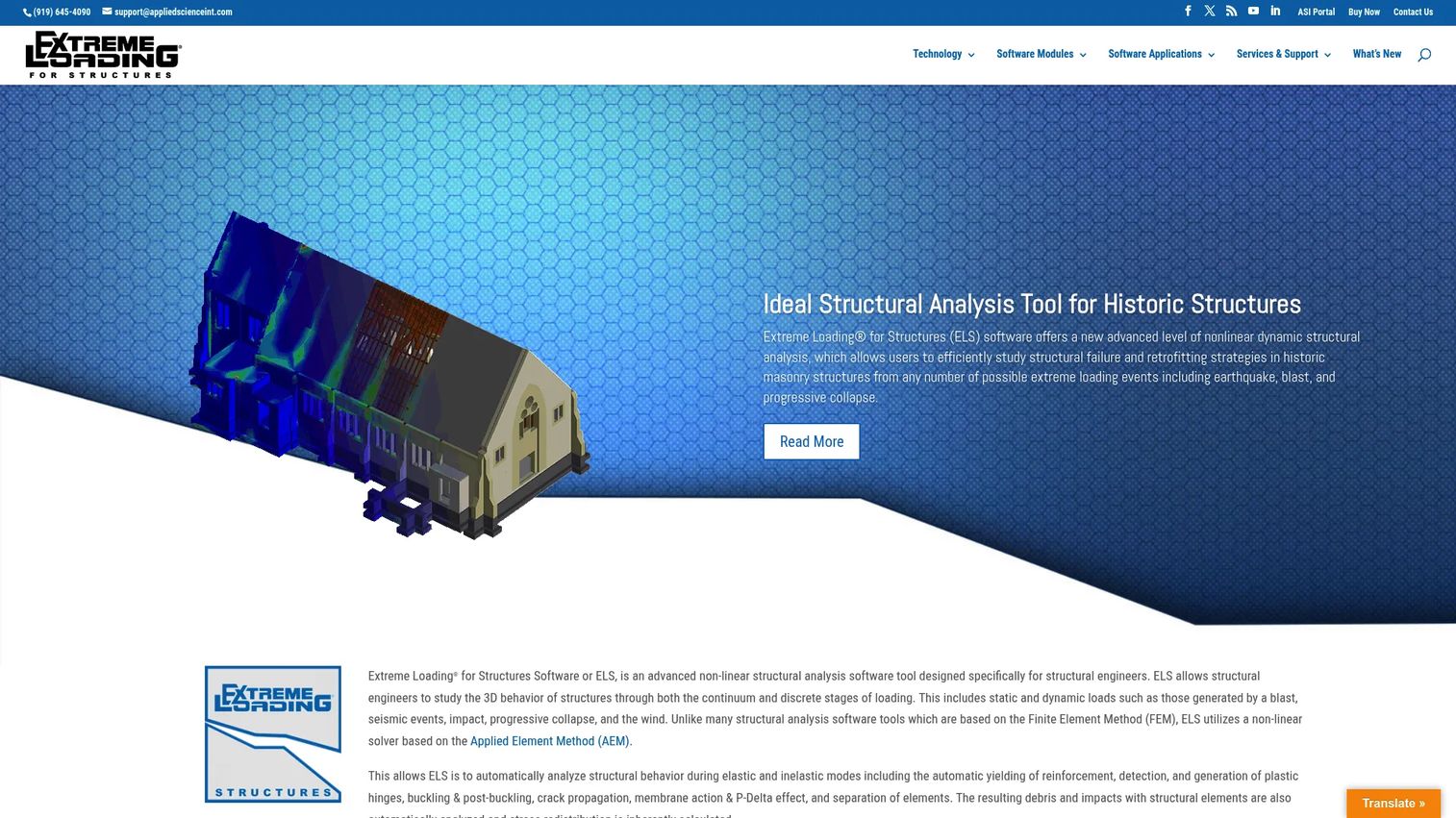
Extreme Loading for Structures (ELS) is nonlinear dynamic structural analysis software for engineers analyzing extreme loads and collapse behavior. It sits at the engineering end of the demolition software spectrum. Instead of pricing a job, it predicts how a structure fails, separates, and collapses under demolition, blast, seismic, or progressive-collapse conditions. That makes it a planning and safety tool for high-risk structures, not a takeoff or bidding tool.
The engine behind ELS is the Applied Element Method (AEM), which models automatic crack propagation, element separation, collision, and full collapse without the manual re-meshing that trips up traditional finite-element workflows. For a controlled demolition or a partial tear-out next to occupied structures, that predictive modeling is the difference between a planned sequence and a guess.
Best for: Structural engineers and specialist demolition planners who need extreme-load, collapse, blast, seismic, or progressive-collapse analysis before work begins.
Key strengths
- Fully nonlinear analysis: runs both static and dynamic nonlinear analysis to model real structural failure behavior.
- AEM-based collapse solver: automatically handles crack propagation, separation, collision, and collapse in one model.
- 3D modeler plus cloud licensing: builds detailed 3D models with a cloud licensing option for lighter setup.
Why choose Extreme Loading for Structures: Choose ELS when the engineering risk is the problem, not the price. If you plan controlled demolitions, work near occupied buildings, or need to defend a collapse sequence to a client or regulator, this is the category of tool you need. It does not replace estimating software; contractors pricing routine tear-outs will find it far heavier than their workflow requires.
Extreme Loading for Structures pricing: ELS Cloud is publicly listed from $99 per month and includes a 30-day free trial, per the vendor's ELS Cloud sales page. Other license types are not publicly priced and are directed to contact sales. There is no verified G2 rating for the product at the time of writing.
2. STACK
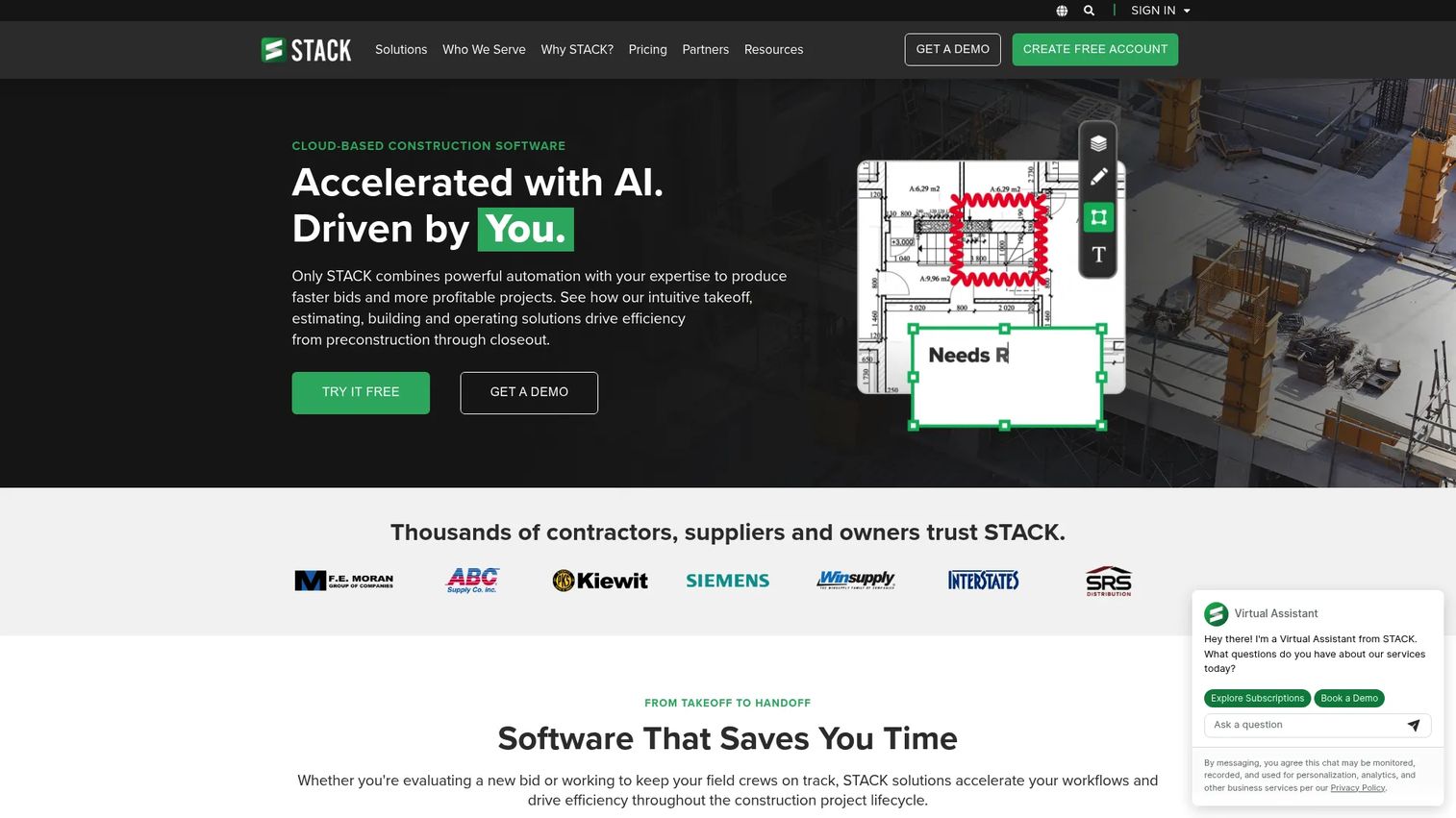
STACK is cloud-based construction software for estimating, takeoff, and field and project management. For demolition contractors, it functions as a digital preconstruction hub: upload plans, run quantity takeoff, build the estimate, and manage documents and collaboration from one place. Because it is cloud-based, estimators, PMs, and field staff work from the same current set of drawings instead of trading marked-up PDFs by email.
The takeoff and estimating workflow is the core draw. STACK offers AI-assisted takeoff, unlimited projects and documents, and tools for daily reports, document markup, and workflow management. For a contractor bidding demolition work, that means measuring scope faster, keeping quantities linked to costs, and pushing revisions through without rebuilding the estimate by hand.
Best for: Contractors and estimators who want cloud-based takeoff, estimating, and construction collaboration software in one platform.
Key strengths
- AI-assisted takeoff and estimating: speeds up measurement and quantity extraction from drawings.
- Unlimited projects and documents: no artificial caps on how much work you can manage.
- Workflows and document markup: daily reports, markup, and collaboration keep the whole team aligned.
Why choose STACK: STACK fits contractors who want a single cloud platform for the full preconstruction motion rather than a stack of disconnected point tools. It is the strongest general-purpose estimating and takeoff pick here for teams that value collaboration and want the flexibility of a free version to test the workflow before committing.
STACK pricing: STACK publicly lists Essential at $599 per user per year and Pro at $699 per user per year, with Enterprise and a customized Build Your Own option available by contacting sales, per its Build & Operate pricing page. The Takeoff & Estimate product also shows a free version and paid plans. STACK Construction Technologies holds a 4.4/5 rating on G2.
3. HCSS HeavyBid
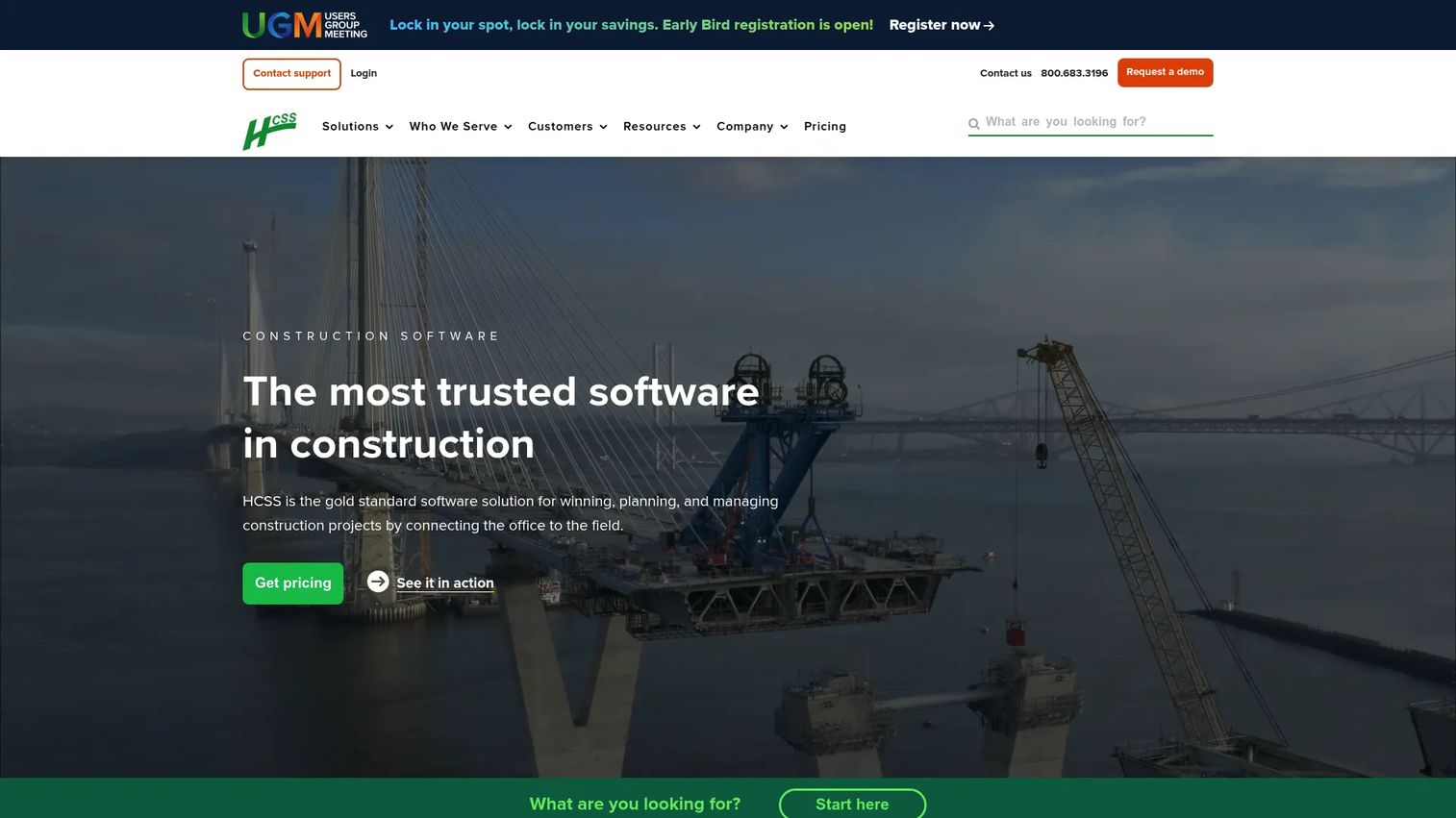
HCSS HeavyBid is construction estimating software built for heavy civil and infrastructure contractors, with estimating and bid management at its core. It skews toward the heavy civil world, where demolition is often one line in a larger site or infrastructure job. If your demolition work sits inside earthwork, site prep, or infrastructure projects, HeavyBid is designed for that reality.
The workflow centers on structured estimating and bid management: setup and takeoff, quote management, and building a defensible bid from consistent cost data. For contractors running high bid volume, that structure standardizes how estimates get built, so a revision or a new bid does not depend on which estimator happens to be at the keyboard.
Best for: Heavy civil and infrastructure contractors who need estimating and bid management, with demolition as part of a broader scope.
Key strengths
- Bid management: organizes and controls the full bid process from setup to submission.
- Setup and takeoff: builds structured takeoffs that feed directly into the estimate.
- Quote management: tracks and manages subcontractor and vendor quotes inside the bid.
Why choose HCSS HeavyBid: HeavyBid fits contractors whose demolition work lives inside larger heavy civil bids and who want estimating built around that scale and structure. It is a fit for high bid volume and standardized processes rather than one-off residential tear-outs. Expect an implementation conversation, since HCSS scopes deployments to the contractor rather than offering a self-serve signup.
HCSS HeavyBid pricing: HCSS does not publicly list HeavyBid pricing. Its pricing page directs visitors to request a custom quote, so cost depends on your team size and configuration. HeavyBid holds a 4.6/5 rating on Capterra; a verified G2 rating for the product was not available at the time of writing.
4. Beam AI

Beam AI is an AI agent platform for enterprise operations and agentic automation. It is the most modern, automation-led option on this list, but it approaches the work differently from purpose-built estimating tools. Rather than a fixed takeoff-to-bid interface, Beam AI builds and orchestrates AI agents that automate operational workflows, including document-heavy processes that show up across preconstruction and back-office operations.
That agentic model is what sets it apart. Beam AI provides an agent hub for creating, managing, and orchestrating agents, integrations with business systems and custom connectors, and support for memory, tools, triggers, and human-in-the-loop review. For a contracting business drowning in repetitive document processing and operational handoffs, that automation layer can remove manual steps that traditional estimating software leaves untouched.
Best for: Enterprises and larger contracting operations that need governed AI agents to automate repetitive operational and document workflows.
Key strengths
- AI agent hub: create, manage, and orchestrate agents across operational workflows.
- System integrations: connect to business systems with prebuilt and custom connectors.
- Human-in-the-loop control: memory, tools, triggers, and review keep automation governed and accountable.
Why choose Beam AI: Beam AI fits operations that want to automate repetitive, document-heavy workflows with governed AI agents rather than run every process by hand. It is different in kind from the estimating tools above: where STACK and HeavyBid give you a structured bidding interface, Beam AI gives you an automation layer you configure to your own processes. That flexibility suits larger operations with clear, repeatable workflows to automate.
Beam AI pricing: Beam AI publicly shows a 7-day free trial with no credit card required, platform pricing from $499 per month for roughly 2,000 orders, and custom AI agent setup starting from $10,000, per its public pricing landing page. Beam AI holds a 4.9/5 rating on G2.
Considerations before you buy
Before you commit, run every shortlisted tool against the criteria that actually decide whether it earns a place in your workflow.
Match the tool to the job, not the label
The biggest mistake in this category is buying analysis software when you need estimating software, or the reverse. If your problem is predicting collapse behavior on a risky structure, you need engineering analysis like ELS. If your problem is turning scope into a priced bid, you need estimating and takeoff software like STACK or HeavyBid. Name your actual bottleneck first.
Takeoff speed and accuracy
The core value of demolition takeoff software is measuring scope faster and more accurately than spreadsheets. Test the takeoff workflow on a real set of your own plans, not a vendor demo file. Time it end to end and check whether quantities flow cleanly into the estimate without manual re-entry.
Revision and addenda handling
Scope changes are constant in demolition. Confirm how each tool handles a mid-bid revision. The right answer is that a changed quantity updates the estimate automatically, not that you rebuild a spreadsheet by hand under deadline pressure.
Pricing model and total cost
Pricing here ranges from $99 per month for ELS Cloud to per-seat annual plans with STACK to custom quotes with HeavyBid. Match the model to your team size and bid volume. A per-user annual plan can be predictable for a small estimating team, while a custom quote makes sense when your deployment is large or complex.
Fit with your existing workflow
A tool only helps if your team uses it. Check whether it fits how your estimators and PMs already work, whether it integrates with the systems you rely on, and whether there is a free trial or free version so you can validate fit before you pay.
Conclusion
The split in demolition software is simple once you name your bottleneck. If your problem is engineering risk, predicting how a structure comes down safely under blast, seismic, or progressive-collapse conditions, Extreme Loading for Structures is the category you need. If your problem is winning work, turning messy scope into an accurate, defensible bid fast, you want estimating and takeoff software.
For most contractors, that means STACK for cloud-based takeoff, estimating, and preconstruction collaboration, or HCSS HeavyBid when demolition sits inside larger heavy civil bids and you need structured bid management at scale. Beam AI is the pick when your bigger problem is repetitive operational and document workflows you want governed AI agents to automate.
Start with the free trial or free version wherever one exists, test the takeoff on your own plans, and time a full bid including one revision. The tool that survives that test on your real work is the one worth paying for.
FAQs
Demolition software helps contractors and engineers plan projects, quantify scope, estimate costs, and prepare competitive bids. Estimating tools handle takeoff, cost estimation, and bid generation, while engineering tools simulate structural collapse behavior. Most contractors use it to bid faster and more accurately without living in spreadsheets.
Not exactly. Demolition estimating software is one type of demolition software, focused on takeoff, cost estimation, and bidding. The broader category also includes engineering analysis tools that model structural failure and collapse. If you are pricing work, you want estimating software specifically.
For most contractors, STACK is the strongest general-purpose pick, with cloud-based takeoff, estimating, and collaboration. HCSS HeavyBid fits contractors whose demolition work sits inside larger heavy civil and infrastructure bids. The right choice depends on your bid volume and whether demolition is standalone or part of bigger scope.
Yes. Faster, more accurate bids win more work at defensible margins. When you can turn a mid-bid revision around in hours instead of days, you stay in bids that slower competitors abandon. Accurate takeoff also stops you from leaving margin on the table or eating unpriced overruns.
Test takeoff speed and accuracy on your own plans, not a vendor sample. Confirm that quantities flow into the estimate without manual re-entry, and that mid-bid revisions update automatically. Check pricing against your team size and look for a free trial so you can validate fit before you commit.
AI-assisted takeoff can speed up measurement and quantity extraction from drawings, which is where much of the manual time goes. Tools like STACK offer AI-assisted takeoff inside an estimating workflow, while platforms like Beam AI automate broader operational and document processes. The value depends on how repetitive and document-heavy your current process is.
Engineering simulation software, like Extreme Loading for Structures, predicts how a structure fails and collapses under demolition, blast, or seismic loads. Estimating software prices the work and produces a submittable bid. They answer different questions: one is about structural safety and sequencing, the other is about cost and winning the job.
Pricing varies widely by category and vendor. ELS Cloud is publicly listed from $99 per month, STACK starts at $599 per user per year for its Essential tier, and Beam AI's platform pricing starts at $499 per month. HCSS HeavyBid is quoted custom based on your team and configuration, so cost depends on your deployment.