A pipeline fails at 2am. Not with a crash, but a silent one. A source API returned partial data, the downstream transform ran anyway, and the executive dashboard now shows numbers that are wrong in a way nobody will catch until the board meeting.
That is the real friction data orchestration software solves. Not moving data. Coordinating it: sequencing tasks, enforcing dependencies, retrying failures, backfilling gaps, and giving you a single place to see what ran, what broke, and why.
The stakes are climbing. The global data orchestration platform market reached $12.4 billion in 2025 and is forecast to hit $51.8 billion by 2034, growing at a 17.3% CAGR, according to MarketIntelo (2025). More pipelines, more systems, more dependencies. The manual firefighting scales linearly with all of it unless something coordinates the chaos for you.
For presales and technical buyers, this topic shows up in a specific way. A prospect asks whether your platform can scale, handle governance, integrate with their warehouse, and survive an audit. If you sell into data teams, you need to speak fluently about how orchestration tools differ, where each fits, and what "enterprise-ready" actually means. Buyers evaluating complex products often want to explore that fit hands-on, which is exactly where a well-built interactive demo or sandbox earns its place in a technical evaluation.
What's inside
This guide is for data engineers, analytics engineers, platform teams, and the technical buyers and presales folks who have to explain orchestration to a room.
We picked these tools on four criteria that matter when you actually run pipelines in production:
- Workflow fit: batch, event-driven, or mixed pipeline support
- Governance and security: RBAC, audit logs, secrets, isolation
- Integration breadth: warehouses, lakehouses, BI, reverse ETL, CI/CD
- Observability and scalability: lineage, retries, backfills, and how it holds up as pipelines multiply
The article covers a clean definition, the differences between orchestration and adjacent categories, a comparison table, seven tool breakdowns, and a buyer's checklist.
TL;DR
- Best for open-source teams: Apache Airflow and Dagster give you full control and a broad ecosystem, with no license fee to start.
- Best for Python-native workflows: Prefect fits teams that want to write orchestration as regular Python code.
- Best for data-aware asset management: Dagster models pipelines as assets with built-in lineage and quality checks.
- Best for managed enterprise orchestration: Astronomer, AWS Step Functions, Azure Data Factory, and Google Cloud Composer remove the operational load of running orchestration yourself.
- Best for cloud-native stacks: the managed cloud orchestrators align tightly with the platform you already run.
What is data orchestration software?
Data orchestration software is a platform that centrally coordinates moving, transforming, validating, and delivering data across multiple systems. It acts as the conductor: it does not do the ingestion or the transformation itself, it decides what runs, in what order, on what schedule, and what happens when something breaks.
Core functions include:
- Scheduling: run jobs on cron-like timers or defined windows
- Dependencies: enforce that task B only runs after task A succeeds
- Triggers: start pipelines on events, files, or upstream completion
- Retries and backfills: re-run failed tasks and fill historical gaps
- Monitoring and observability: track status, latency, lineage, and failures in one view
A few distinctions people get wrong.
Orchestration vs ETL: ETL and ELT tools move and transform data. Data orchestration coordinates when and how those jobs run and what depends on what. ETL is a worker. Orchestration is the manager. The "data orchestration vs ETL" question is really "who does the work" versus "who coordinates the work."
Orchestration vs workflow automation: workflow automation can trigger any action, from sending a Slack message to updating a record. Data orchestration is data-aware. It understands datasets, lineage, retries, and backfills as first-class concepts, which generic automation does not.
Data orchestration vs workflow orchestration: workflow orchestration is the broader parent category for coordinating any tasks. Data orchestration is the subset focused specifically on data pipelines, with the dataset-level scheduling and observability that data teams need.
What orchestration software is not: it is not a raw ingestion connector, and it is not a transformation-only tool. It sits above both, coordinating them across your modern data stack.
When to use data orchestration software
Coordinate ETL and ELT pipelines
Reach for orchestration when you have ordered, repeatable data movement across several tools. A typical batch flow: extract from a source, load into a warehouse, run transformations, then validate. Each step depends on the last. Orchestration scheduling handles the sequence, the retries, and the dependency management so a failed extract does not silently corrupt everything downstream.
Keep BI and activation jobs on schedule
Timeliness is a reliability problem. Reports that refresh late are reports nobody trusts. Use data pipeline orchestration to keep these on track:
- Dashboard and report refreshes tied to upstream loads
- Reverse ETL syncing warehouse data back into operational tools
- Data activation pushing segments into marketing or sales platforms
- SLA-bound jobs where lateness has a business cost
Support AI and ML workflows
ML pipelines live or die on reproducibility. You need versioned data, governed access, and repeatable runs to retrain a model and trust the result. Orchestration coordinates feature generation, training, evaluation, and deployment as a dependency graph. As agent and AI workflows grow, the same coordination layer keeps data access governed and runs auditable.
Comparison table
Here is the shortlist at a glance. Pricing and ratings reflect verified vendor and G2 sources at time of writing. Sort order runs from broad open-source options to managed cloud-native platforms.
| # | Product | Best for | Key differentiator | Pricing | G2 rating |
|---|---|---|---|---|---|
| 1 | Apache Airflow | Open-source workflow orchestration | Broad ecosystem and Python-defined DAGs | Open source (free) | 4.4/5 |
| 2 | Prefect | Python-native workflows | Orchestration written as normal Python | Free; Developer $35/dev/mo + usage | 4.5/5 |
| 3 | Dagster | Data-aware asset management | Asset-based model with lineage and quality checks | From $10/mo; free trial | 4.5/5 |
| 4 | Astronomer | Managed Airflow at scale | Enterprise operations layer on Airflow | Custom | Not listed |
| 5 | AWS Step Functions | AWS-native orchestration | Serverless state machines across AWS services | From $0.000025 per state transition | 4.3/5 |
| 6 | Azure Data Factory | Microsoft-centric estates | Code-free ETL/ELT with 90+ connectors | Usage-based | Not listed |
| 7 | Google Cloud Composer | Managed Airflow on GCP | Managed Airflow with native GCP integration | From $0.35/hour | 3.5/5 |
Best 7 data orchestration software for 2026
1. Apache Airflow
Apache Airflow is the open-source platform that made "orchestration as code" a default expectation. You define workflows as directed acyclic graphs in Python, schedule them, and monitor runs through a web UI. It has been in production at thousands of companies for years, which means a deep well of operators, integrations, and community knowledge. If a system exists, someone has probably already written an Airflow operator for it.
That maturity is the whole case. When a technical buyer asks whether your stack integrates with theirs, Airflow's ecosystem is usually the safe answer, because the connector already exists.
Best for: teams that want open-source workflow orchestration with maximum flexibility and a broad integration ecosystem.
Key strengths
- Python-based workflow definitions as DAGs
- Scheduling and monitoring through a web UI
- Extensible operators for hundreds of systems
- Large open-source community and ecosystem
Why choose Apache Airflow: choose it when you have engineering capacity and want full control over your orchestration layer without a license fee. It fits teams with existing Airflow investment and broad ecosystem needs.
Apache Airflow pricing: Apache Airflow is open source and free to self-host under the Apache 2.0 license. Managed versions are available from cloud vendors and are priced separately.
2. Prefect
Prefect treats orchestration as Python you already know how to write. You decorate functions as tasks and flows, and Prefect handles scheduling, state, and recovery around them. For teams whose data logic already lives in Python, this removes the mental tax of learning a separate orchestration language. Failure handling, retries, and observability come as part of the runtime rather than as bolt-ons.
The result fits teams that want orchestration to feel like an extension of their codebase, not a separate system they have to babysit.
Best for: teams building and operating Python-based data pipelines who want a developer-first workflow.
Key strengths
- Python-first workflow orchestration
- Scheduling with state and recovery handling
- Built-in observability and monitoring
- Cloud and self-hosted deployment options
Why choose Prefect: choose it when your team lives in Python and wants orchestration that reads like regular code rather than a new DSL. It suits teams that value flexibility over a heavier, prescriptive framework.
Prefect pricing: Prefect offers a free Personal plan. The Developer plan starts at $35 per developer per month plus usage, and Enterprise pricing is custom. Pricing is published on Prefect's site.
3. Dagster
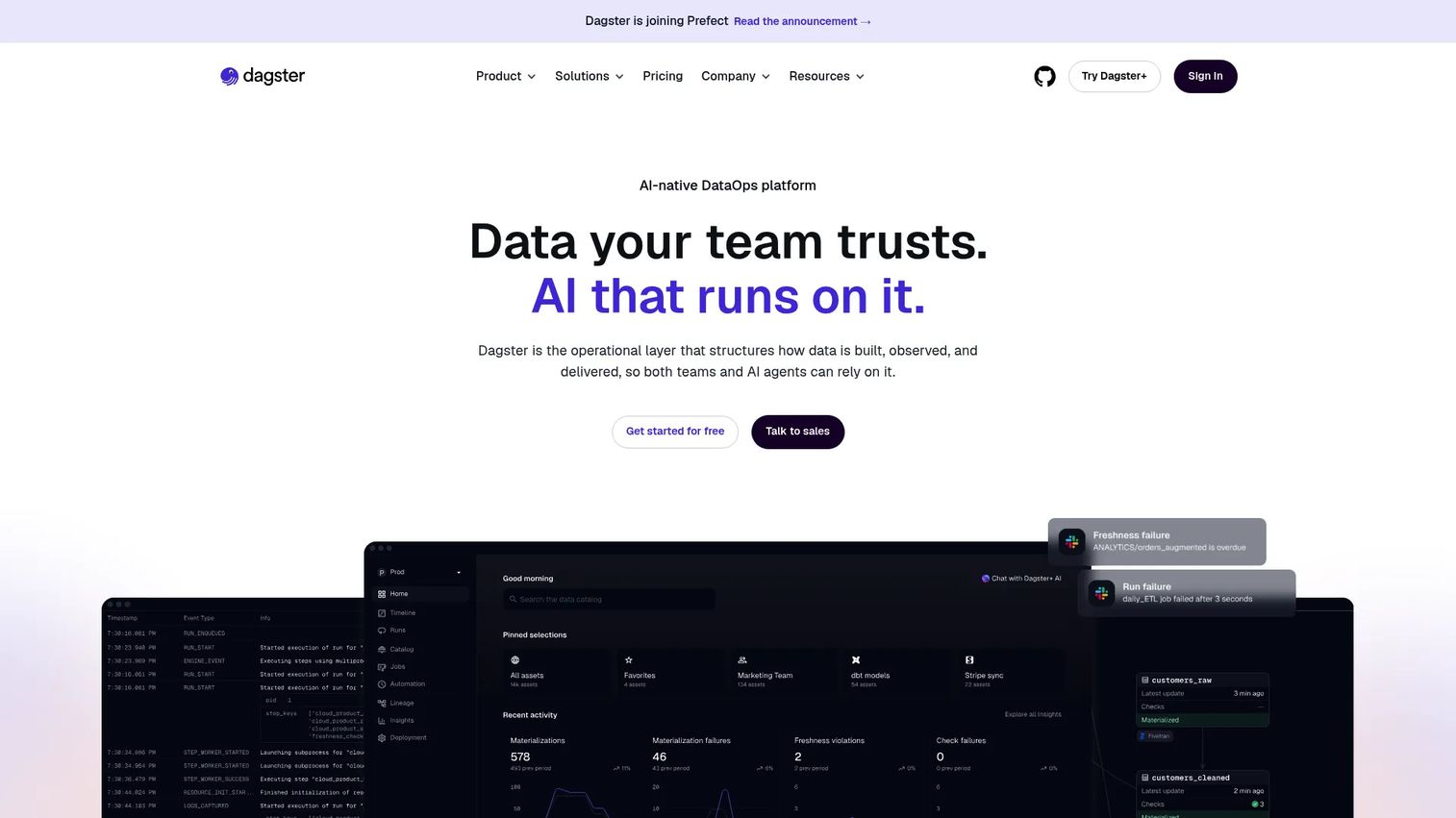
Dagster takes a different angle: it models pipelines around data assets rather than around tasks. Instead of "run this job, then that job," you declare the tables, files, and models you want to exist, and Dagster figures out how to build and keep them fresh. That asset-centric view brings a data catalog, lineage, and data quality checks into the orchestration layer itself, which is why it stands out for modern data stacks.
For a data team that cares about what the pipeline produces, not just that it ran, the asset model maps cleanly onto how they already think.
Best for: teams that want asset-centric orchestration with catalog, lineage, and quality checks in one platform.
Key strengths
- Asset-based orchestration model
- Integrated data catalog and lineage
- Built-in data quality checks and observability
- Available as open source or managed cloud
Why choose Dagster: choose it when data quality, lineage, and observability matter as much as scheduling. It fits teams building a modern data stack who want testing and asset awareness built in rather than added later.
Dagster pricing: Dagster offers a free trial. Paid plans start at $10 per month for a Solo tier and $100 per month for a Starter tier, with Pro pricing available through sales. Dagster is also available as open source to self-host.
4. Astronomer
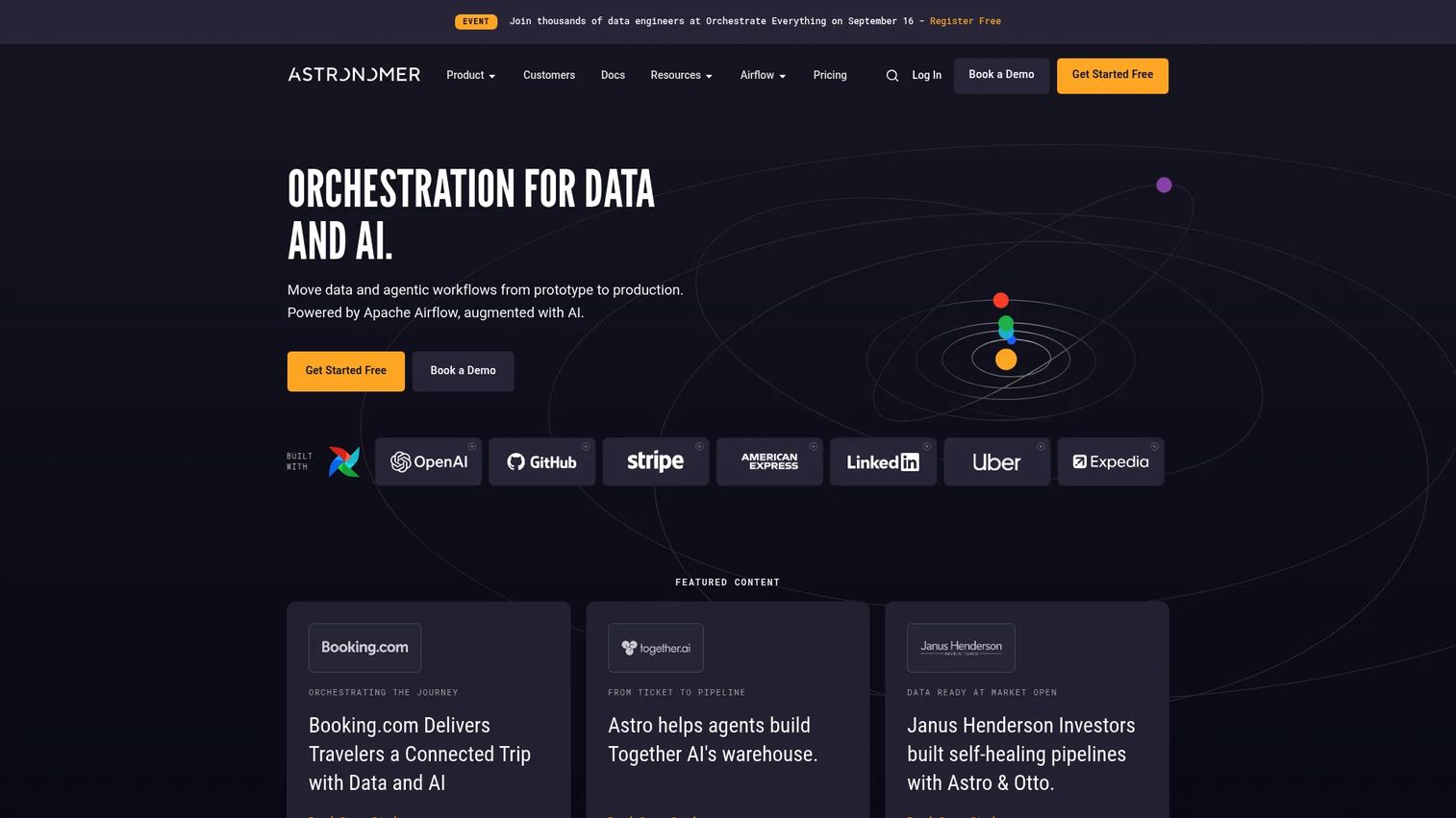
Astronomer is the managed operations layer for Apache Airflow. It does not replace Airflow or invent a new orchestration language. Instead, it runs Airflow for you at scale, adding the enterprise operations most teams would otherwise have to build: environment management, deployment tooling, observability, and support. If your team already knows Airflow but does not want to run the infrastructure, Astronomer is the natural bridge.
That positioning matters for buyers who like Airflow's ecosystem but need managed reliability and someone to call when a scheduler misbehaves at scale.
Best for: teams that want Airflow's ecosystem without the operational burden of running it themselves.
Key strengths
- Fully managed Apache Airflow environments
- Enterprise deployment and environment tooling
- Observability and operational monitoring
- Commercial support and reliability guarantees
Why choose Astronomer: choose it when you are committed to Airflow but want to reallocate engineering time away from infrastructure and toward pipelines. It fits enterprise data platform teams that value managed reliability.
Astronomer pricing: Astronomer uses custom pricing tied to usage and scale. Contact their sales team for a quote based on your environment and workload.
5. AWS Step Functions
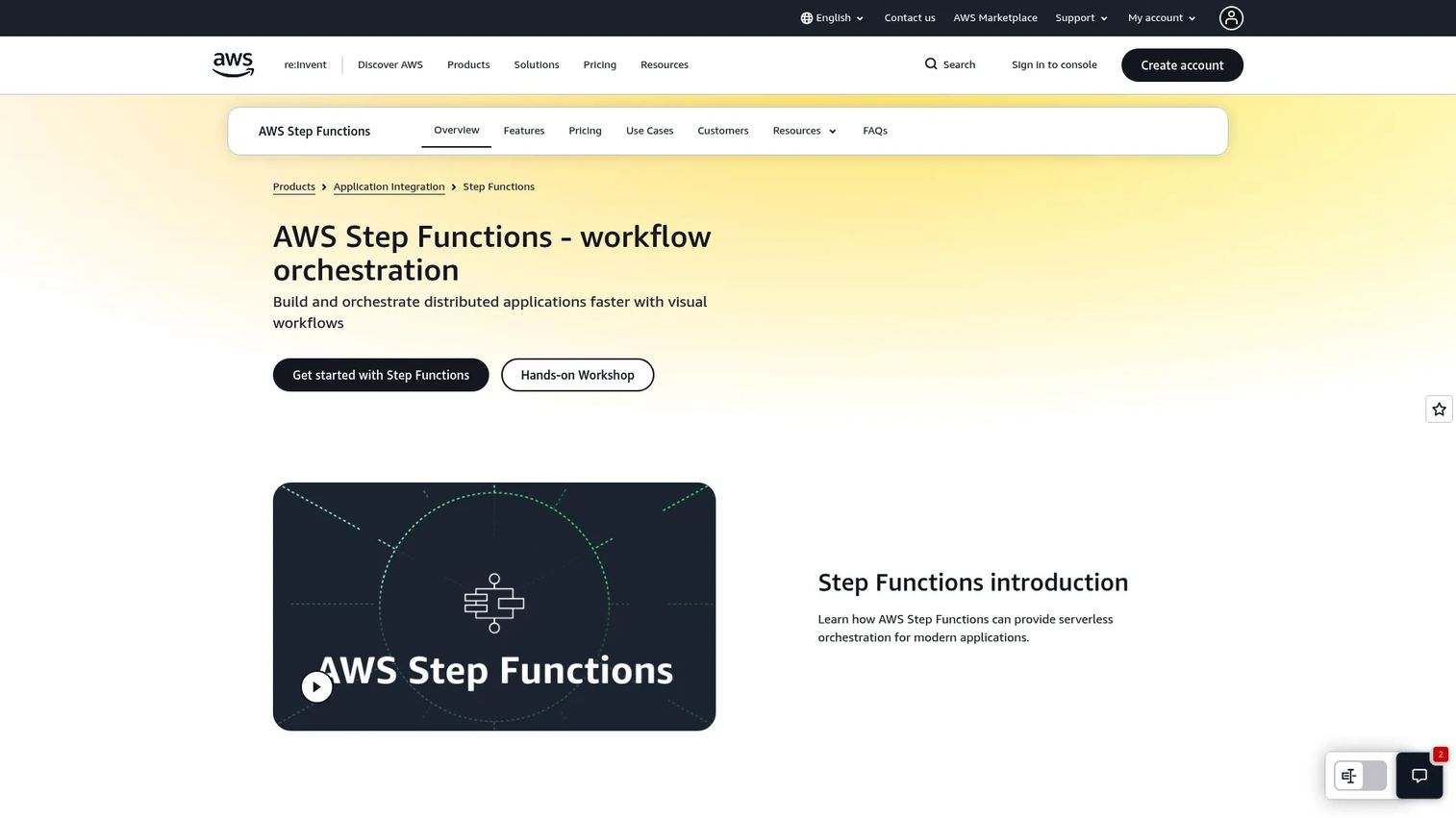
AWS Step Functions is serverless orchestration built for AWS-heavy environments. You define state machines visually or in Amazon States Language, and Step Functions coordinates Lambda functions, AWS services, and HTTPS endpoints with branching, parallel execution, retries, and timeouts. For data and operational workflows already running inside AWS, it removes the need to stand up a separate orchestration server. You pay per state transition rather than for idle infrastructure.
That pay-as-you-go economics makes it attractive for teams that want orchestration to scale to zero when nothing is running.
Best for: teams that need serverless orchestration of multi-step AWS or API-driven workflows.
Key strengths
- Visual workflow orchestration
- Amazon States Language state machines
- Branching, parallel execution, retries, and timeouts
- Native integration across AWS services
Why choose AWS Step Functions: choose it when your stack lives in AWS and you want orchestration that integrates natively without managing servers. It fits teams blending data and operational workflows in one cloud.
AWS Step Functions pricing: a free tier covers 4,000 state transitions per month. Standard Workflows are billed at $0.000025 per state transition. Express Workflows are billed at $1.00 per million requests plus a duration charge.
6. Azure Data Factory
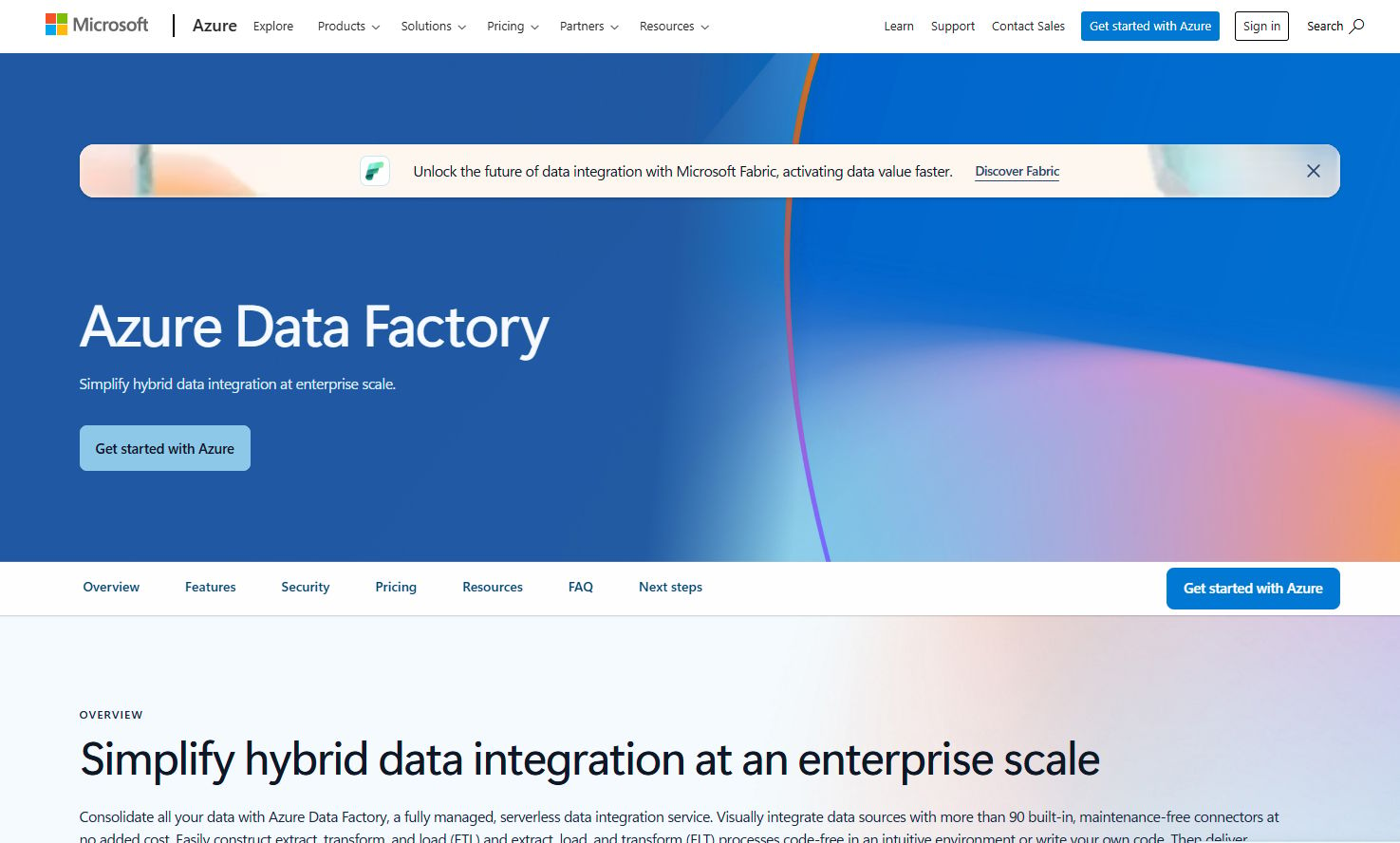
Azure Data Factory is the orchestration and data integration service for Microsoft-centric data estates. It combines code-free ETL and ELT pipeline building with orchestration, monitoring, and management in one managed, serverless service. With more than 90 built-in connectors, it handles hybrid integration across on-premises and cloud sources, which is why it fits organizations already standardized on Azure. Governance and security features tie into the broader Azure identity and policy model.
For enterprise buyers running Microsoft infrastructure, that native alignment is the differentiator. Orchestration, integration, and governance sit inside one estate rather than stitched across vendors.
Best for: teams needing cloud-native data integration and orchestration across hybrid sources.
Key strengths
- Code-free ETL and ELT pipeline building
- More than 90 built-in connectors
- Pipeline orchestration, monitoring, and management
- Native Azure governance and identity integration
Why choose Azure Data Factory: choose it when your data estate runs on Azure and you want integration plus orchestration without leaving the Microsoft ecosystem. It fits enterprise teams that value hybrid connectivity and native governance.
Azure Data Factory pricing: Azure Data Factory uses usage-based pricing tied to pipeline activity, data movement, and compute. Costs vary by workload, and current rates are published on the Azure pricing page.
7. Google Cloud Composer
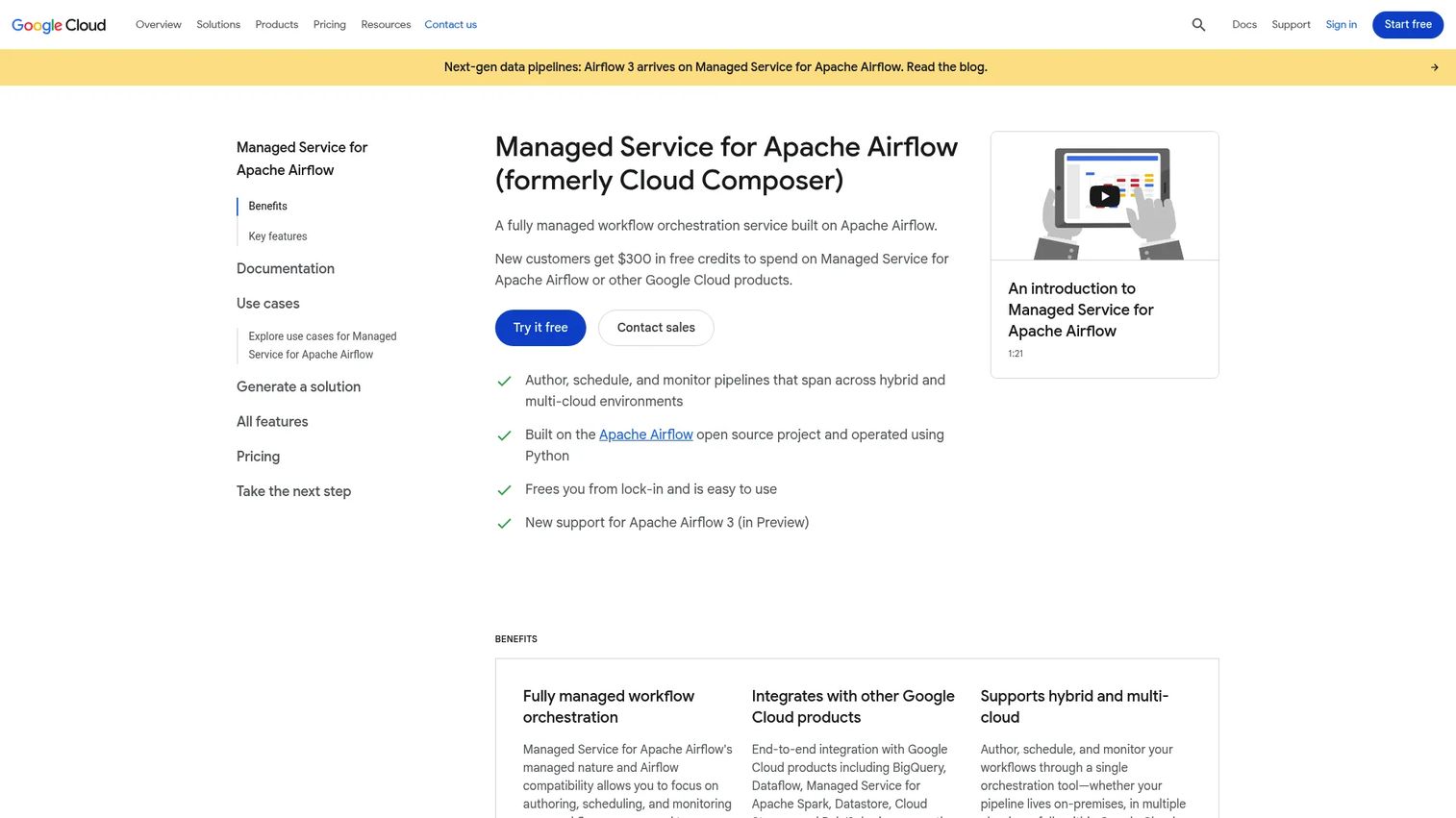
Google Cloud Composer is fully managed Apache Airflow on Google Cloud, now offered as Google's Managed Service for Apache Airflow. It gives teams the familiar Airflow programming model with Python-based DAGs, while Google handles the underlying environment. Built-in integration with Google Cloud products makes it a natural fit for teams whose pipelines already run on GCP, and it supports hybrid and multi-cloud workflow orchestration for estates that span providers.
Teams that have standardized on Google Cloud use Composer to get Airflow's flexibility without operating the infrastructure themselves.
Best for: teams needing managed Airflow for pipeline orchestration across hybrid or multi-cloud environments.
Key strengths
- Managed Apache Airflow with Python-based DAGs
- Built-in integration with Google Cloud products
- Hybrid and multi-cloud workflow orchestration
- Managed environment and scaling
Why choose Google Cloud Composer: choose it when your pipelines run on GCP and you want managed Airflow that aligns with the rest of your Google Cloud estate. It fits teams that value ecosystem alignment over building orchestration from scratch.
Google Cloud Composer pricing: pricing is consumption-based, with hourly environment fees starting at $0.35 per hour for a small environment. Highly resilient environments and larger sizes cost more, plus compute and storage charges. New customers get $300 in free credits.
Considerations
The right tool depends on the shape of your workflow, not the loudest brand. Run through this checklist before committing.
Workflow fit
Match the tool to your pipeline shape. Batch-heavy estates, event-driven architectures, and mixed workloads each favor different designs. A serverless state machine fits event-driven operational flows. A DAG-based scheduler fits ordered batch pipelines. "Best" is defined by your workload, not by a G2 badge.
Governance and security
Enterprise data orchestration needs more than scheduling. Check for role-based access control, SSO and SAML, audit logs, secrets management, network isolation, and policy gates. If a tool cannot answer a security questionnaire, it will stall in procurement no matter how good the scheduler is.
Observability and reliability
Separate operational observability from data observability. Operational tells you the job ran. Data observability tells you the output is correct. Look for lineage, proactive alerts, retries, backfills, and a clear incident response path. Silent partial failures are the expensive ones.
Integration breadth
Orchestration sits across the stack, not inside one layer. Verify support for your warehouses, lakehouses, BI tools, reverse ETL, and CI/CD. The tool that already speaks to your systems saves months of custom connector work. This is where Airflow's ecosystem and the cloud-native connectors earn their keep.
TCO and operating model
Compare open source against managed honestly. Open source has no license fee but carries engineering overhead for maintenance, upgrades, and scaling. Managed platforms trade a bill for reclaimed engineering time. Factor in training, staffing, and how the cost scales as pipelines multiply.
Conclusion
The shortlist sorts cleanly by buyer profile. If you want open-source control and a deep ecosystem, Apache Airflow and Dagster lead, with Dagster edging ahead when data-aware asset management and lineage matter. If your logic already lives in Python, Prefect fits the way your team writes code. If you want Airflow without running it, Astronomer is the managed operations layer. And if you are cloud-committed, AWS Step Functions, Azure Data Factory, and Google Cloud Composer each align with the platform you already run.
The right choice comes down to workflow shape, governance needs, and operating model, not marketing copy. The fastest way to decide is to pilot your top two candidates on a representative pipeline, something with real dependencies, a failure case, and a backfill. How each tool handles the messy parts tells you more than any feature list.
If you sell into these data teams, the same principle applies to how you prove fit. Letting a technical buyer explore your product through a self-serve interactive demo or validate workflows in a hands-on sandbox turns an abstract pitch into something they can test on their own terms.
Start your journey with Guideflow today!
FAQs
ETL extracts, transforms, and loads data. It does the actual work of moving and reshaping it. Data orchestration coordinates when those ETL jobs run, in what order, and what depends on what across your whole stack. In short, the data orchestration vs ETL distinction is coordination versus execution. Most teams run both: ETL tools do the work, orchestration manages the sequence.
Workflow automation can trigger almost any action, from posting a message to updating a CRM record. Data orchestration is data-aware. It treats datasets, lineage, retries, and backfills as first-class concepts, which generic automation does not. If your workflow needs to understand data dependencies and re-run failed transforms, orchestration is the fit. If you just need to chain arbitrary actions, automation is enough.
Probably yes. Ingestion connectors and transformation frameworks cover important slices of the stack, but not the full coordination layer. They handle the loading and the transforming. Orchestration decides when each runs, enforces dependencies between them, and gives you one place to monitor failures and trigger backfills. As pipelines and dependencies grow, that coordination layer becomes hard to hand-roll.
Five things: governance (RBAC, SSO, audit logs), observability (lineage, alerts, incident response), security (secrets management, network isolation), scalability (how it holds up as pipelines multiply), and integration breadth across your warehouses, BI, and CI/CD. A scheduler that cannot pass a security review will not get through procurement, so treat governance and security as gating criteria, not nice-to-haves.
Yes, especially for teams with existing Airflow investment and broad ecosystem needs. Its library of operators and integrations remains one of the deepest available, and the community knowledge base is large. It performs best when you have engineering capacity to run it or choose a managed version through Astronomer or a cloud provider. For Python-native or asset-centric preferences, Prefect and Dagster are worth evaluating alongside it.
Data-aware platforms like Dagster and Python-native options like Prefect are commonly evaluated for AI and ML workflows because they handle reproducibility, versioning, and governed data access well. Managed cloud-native orchestrators are also strong when your ML stack already runs in that cloud. The right pick depends on where your models train and how much lineage and asset awareness you need.
It comes down to control versus operating overhead. Open source like Apache Airflow gives you full flexibility and no license fee, but you run and maintain it. Managed orchestration such as Astronomer, Azure Data Factory, or Google Cloud Composer trades a bill for reclaimed engineering time and built-in reliability. Weigh your engineering capacity, governance needs, and how the cost scales as your pipeline count grows.