You can prove demand in one country and still lose money in the next. The checkout converts until the buyer sees an unexpected duty charge. The order ships until customs holds it. The market looks promising until returns start crossing borders at a cost that erases the margin on every unit.
Cross-border e-commerce is not a shipping add-on. It is an operating model, and most of the cost is invisible until after launch. According to DHL eCommerce (2025), 59% of global shoppers already buy from retailers outside their home country, which means international demand is real. The gap between demand and a profitable operating model, however, is where most expansion efforts stall.
Duty surprises kill checkout conversion. Unsupported payment methods push buyers to competitors. Localization that stops at currency conversion delivers a foreign experience in a local wrapper. This guide cuts through the platform categories, maps each tool to the job it actually solves, and gives you the decision criteria to share with your VP of Operations or Head of Finance before you commit to a market.
What's inside
This guide compares eight cross-border ecommerce platforms for 2026, covering storefront expansion, localized checkout, duty and tax visibility, shipping, and managed international delivery.
Items were chosen based on four criteria:
- International checkout and currency support: Does the platform handle local currencies, payment methods, and pricing controls?
- Duties, taxes, and landed-cost visibility: Can buyers see the full delivered cost before payment?
- Shipping, fulfillment, and returns: Does the platform solve physical delivery, not just digital checkout?
- Fit for the expansion stage: Does it suit a founder-led launch or require enterprise-scale resources to operate?
Verify all pricing and feature details against official vendor pages before making a decision.
TL;DR
- Best for extending an existing storefront: Shopify Markets gives merchants a single foundation for domestic and international selling, with country-level pricing, currencies, and language controls
- Best for flexible B2B and enterprise architecture: BigCommerce suits complex catalog structures and composable commerce strategies that need international support without rebuilding the core platform
- Best for managed international checkout: Global-e runs localization, payments, duty handling, and returns as a managed service, suited to brands with proven international demand
- Best for enterprise global commerce operations: ESW handles localized checkout, merchant-of-record compliance, and omnichannel order management for large retailers entering multiple markets
- Best for duty and landed-cost clarity: Zonos calculates guaranteed landed costs and automates tax compliance at checkout, stopping duty surprises before they cancel orders
- Best for carrier-led international delivery: FedEx International Connect delivers parcels to 220-plus countries with tracked and untracked options, for brands that have checkout solved and need reliable physical delivery
What is cross border ecommerce?
Cross-border ecommerce is the sale of goods or services online to customers in another country, with the seller managing or outsourcing the payments, taxes, duties, shipping, customs, returns, and localized customer experience required to complete the order.
How cross-border ecommerce works
The operating chain runs like this:
- A shopper finds a localized storefront or marketplace listing
- The checkout shows price, currency, payment method, and delivery promise
- The order receives duty and tax treatment before or at payment
- A carrier or fulfillment partner ships the item and handles customs documentation
- The company manages returns, refunds, delivery updates, and country-level reporting
Core capabilities to look for
- Local currency display and pricing controls
- Local payment methods accepted at checkout
- Duty and tax calculation, ideally before payment
- Landed-cost visibility so buyers know the full delivered price
- Customs documentation support from carrier or platform
- International shipping and real-time tracking
- Returns management across borders
- Localized content, delivery promises, and customer communications
- Country-level reporting separate from domestic performance
The four platform categories
These products solve different parts of the cross-border stack. Treat them as complementary layers, not interchangeable options.
| Platform category | What it handles | Best for |
|---|---|---|
| Ecommerce platform | Storefront, catalog, checkout foundation | Brands expanding an existing store |
| Managed cross-border provider | Localization, checkout, tax, shipping coordination | Retailers wanting a market-ready global layer |
| Duty and shipping platform | Landed cost, carrier options, customs data | Brands fixing international delivery friction |
| Logistics network | Fulfillment and delivery execution | Teams scaling physical delivery across markets |
Key terms: Landed cost is the full delivered cost to the buyer, covering product price, shipping, duties, taxes, and carrier fees. DDP (Delivered Duty Paid) means the seller collects duties at checkout rather than passing a surprise bill to the buyer. VAT is a consumption tax applied in most international markets. An HS code is the product classification number customs authorities use to calculate duty rates. A merchant of record is the legal entity responsible for processing payments, collecting taxes, and handling compliance in a given market.
When to use a cross border ecommerce platform
Enter a new country without rebuilding your storefront
Your analytics show strong inbound traffic from Germany or Australia. Your storefront does not show prices in euros or Australian dollars, does not offer local payment methods, and cannot calculate duties. A cross-border platform lets you add country-specific experiences on top of an existing stack. The key discipline here is phased: Launch one or two markets with measurable hypotheses before committing to a broad rollout.
Prevent duty surprises from killing checkout conversion
A buyer fills a cart, reaches checkout, and discovers a duty charge they did not expect. They abandon. A Delivered Duty Paid setup collects that cost at checkout with a transparent landed-cost calculation. The buyer knows the total before paying, conversion holds, and you avoid the reputation damage of a surprise charge at the doorstep.
Reduce the operational load of international fulfillment
A lean team cannot operationalize international shipping country by country. Custom declarations, carrier selection, return labels, and market-specific tax remittance each require time and expertise. Managed cross-border providers and logistics networks absorb that complexity so your operations team can run international volume without building a country-by-country exception process.
Cross border ecommerce platform comparison
These eight platforms cover different layers of the cross-border stack. Choosing the right one starts with identifying which layer is your actual bottleneck: Storefront, checkout, duty calculation, or physical delivery.
| # | Product | Best for | Key differentiator | Pricing | G2 rating |
|---|---|---|---|---|---|
| 1 | Shopify | Extending an existing storefront to new markets | Shopify Markets with country-level pricing, currencies, and domains | From $29/month (billed annually) | 4.4/5 |
| 2 | BigCommerce | Flexible B2B and enterprise commerce architecture | Open API and multi-storefront for composable commerce | From $29/month (billed annually) | 4.2/5 |
| 3 | Global-e | Managed international checkout and localization | End-to-end cross-border operations as a managed service | Custom pricing | 4.8/5 |
| 4 | ESW | Enterprise global commerce operations | Localized checkout plus merchant-of-record compliance at scale | Custom pricing | 4.8/5 |
| 5 | Zonos | Landed-cost visibility and duty clarity | Guaranteed landed-cost calculation with AI-powered HS classification | Setup from $2,000; per-order fees apply | 4.8/5 |
| 6 | FlavorCloud | Cross-border shipping and fulfillment orchestration | Multi-carrier network across 220-plus markets with automated customs | Custom pricing | 4.6/5 |
| 7 | Reach | Merchant-of-record and local payment acceptance | Localized payments and tax handling for international sellers | Custom pricing | N/A |
| 8 | FedEx International Connect | Carrier-led international parcel delivery | Tracked and untracked delivery to 220-plus countries | Quote-based | N/A |
Pricing and G2 ratings verified October 2026 from each vendor's pricing page and G2 listing.
Best 8 cross border ecommerce platforms for 2026
1. Shopify

Shopify is an all-in-one commerce platform for selling online, in person, and across multiple sales channels. For international expansion, its Shopify Markets feature centralizes country experiences including currencies, domains, localized pricing, and language settings. It is the storefront-first choice for merchants who want to test international markets without replacing their core commerce infrastructure.
Best for: Founders with an established Shopify store who want to add cross-border capabilities incrementally rather than switching platforms.
Key features
- Shopify Markets country configurations and domain management
- Local currencies, international pricing controls, and market-specific promotions
- Multi-language storefront tools
- Shopify Checkout with multi-currency support
- Broad app ecosystem for duties, shipping, and tax integrations
Why choose Shopify: Shopify is the right fit when your storefront is already there and international expansion is an extension, not a rebuild. The platform's breadth of integrations means you can add duty calculation, carrier services, and localized payment methods through the app ecosystem rather than switching infrastructure. Teams still need to handle tax liability, product restrictions, and return workflows separately.
Shopify pricing: Plans start at $29/month (Basic, billed annually) or $39/month on a monthly basis. The Grow plan is $79/month (annually) and Advanced is $299/month (annually). Shopify Plus starts at $2,300/month on a 3-year term. A 3-day free trial is available.
G2 rating: 4.4/5
2. BigCommerce
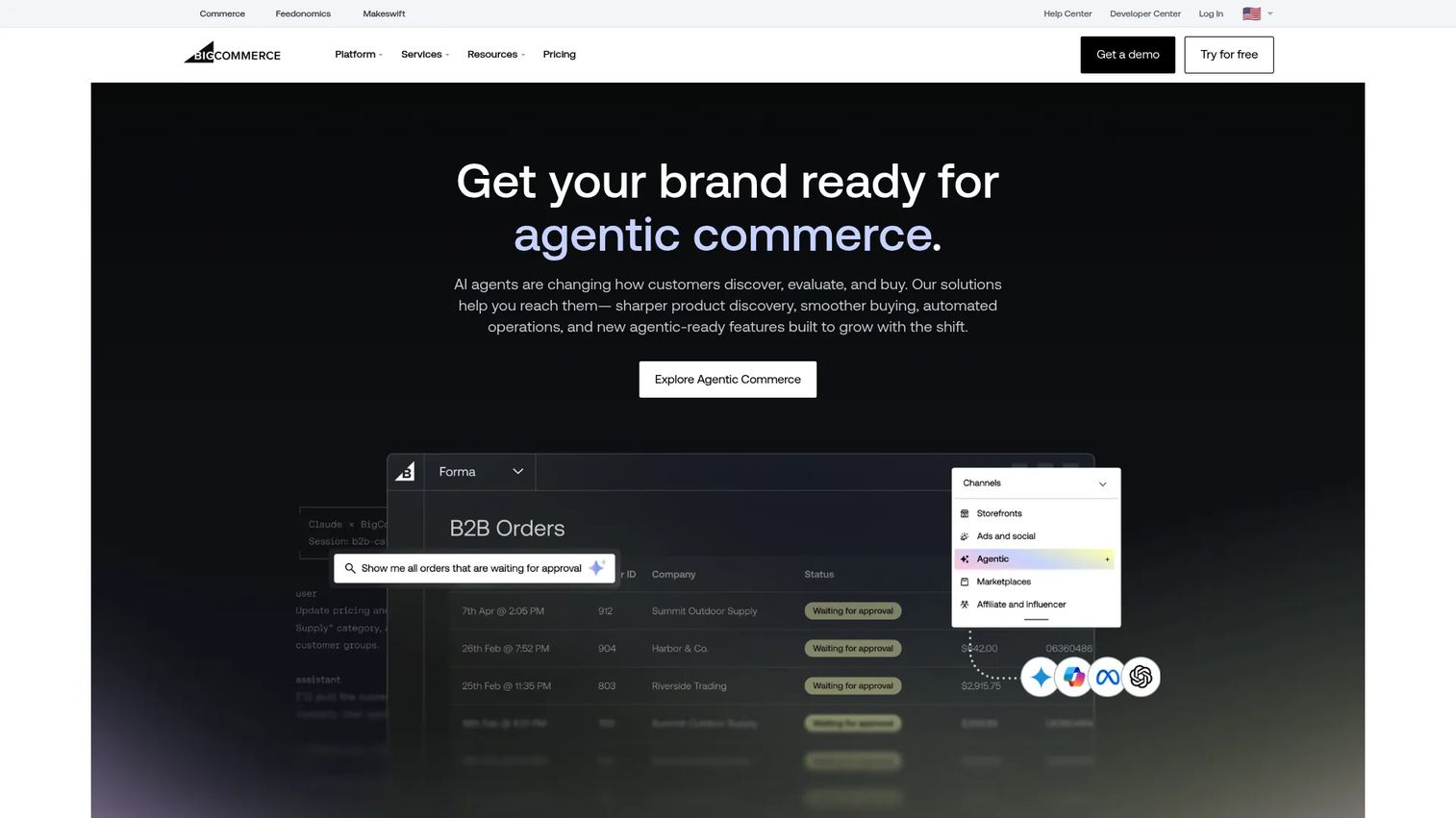
BigCommerce is an open ecommerce platform built for merchants who need more architectural flexibility than a standard storefront provides. Its multi-storefront capability, API-first design, and native B2B commerce functions make it a practical choice for companies with complex catalog structures or a composable commerce strategy. If your international expansion must connect to an existing ERP, PIM, or OMS, BigCommerce's open architecture reduces integration friction. For a broader look at best ecommerce platforms across different use cases, that comparison covers the full market.
Best for: Companies with complex catalogs, multiple buyer types, or a headless front end that needs international market support without a platform migration.
Key features
- Multi-storefront architecture for managing separate country experiences
- API-first integrations with ERP, PIM, OMS, and custom front ends
- Multi-currency support and localization controls
- Native B2B commerce functions including account management and pricing tiers
- Headless and composable commerce capabilities
Why choose BigCommerce: BigCommerce fits a business where international expansion is an architecture decision as much as a market decision. The open API means your engineering team can connect the commerce layer to existing systems without rebuilding. You will still need specialist partners for duties, localized payments, international returns, and carrier management.
BigCommerce pricing: The Core plan is $29/month (billed annually) or $39/month monthly. Growth is $79/month (annually) or $105/month monthly. Scale is $299/month (annually) or $399/month monthly. Performance starts at $1,499/month (annually) with custom scope.
G2 rating: 4.2/5
3. Global-e

Global-e enables brands and retailers to sell internationally through localized cross-border ecommerce experiences and managed global commerce operations. Rather than building each market capability in-house, retailers can use Global-e as a managed layer that handles local currencies, payment methods, duty and tax treatment, delivery options, customer support tooling, and returns. Its merchant-of-record services cover payment processing, tax filing, and local regulatory handling across supported markets.
Best for: Retailers with proven international demand who want a dedicated cross-border partner rather than assembling a stack of specialist apps.
Key features
- Localized checkout with local currencies, languages, and market-specific pricing
- International payment methods coverage across supported markets
- Duty and tax handling with transparent landed-cost display
- Global returns support and market-specific delivery options
- Merchant-of-record services for tax, payment, and compliance
Why choose Global-e: This is the fit when the founder wants to shorten the path to localized selling without hiring a country-by-country operations team. The managed-service model means Global-e absorbs much of the operational complexity. Review contractual structure, market coverage scope, merchant-of-record responsibilities, and service fee structure closely before signing.
Global-e pricing: Global-e uses a pay-as-you-go commercial model with PRO and Enterprise tiers. Pricing is arranged through sales, with no figures displayed on the site. Contact Global-e directly for a quote.
G2 rating: 4.8/5
4. ESW

ESW is a global ecommerce platform that helps enterprise brands manage international commerce across payments, compliance, fulfillment, returns, and localized checkout. Its merchant-of-record services handle tax, duty, and regulatory management, while omnichannel order management covers inventory visibility, order routing, and fulfillment orchestration. ESW is purpose-built for large retailers entering multiple markets simultaneously, where operational governance matters as much as storefront conversion. If you are also evaluating B2B ecommerce platforms as part of a broader stack review, that guide covers the B2B-specific market.
Best for: Large retailers and brands entering multiple international markets where localized checkout, global customer experience, and operational governance are equal priorities.
Key features
- Localized checkout with local currencies, payment methods, and transparent landed costs
- Merchant-of-record services for tax, duty, and compliance management
- Omnichannel order management with inventory visibility and order routing
- International payment coverage across supported markets
- Cross-border delivery coordination and returns management
Why choose ESW: ESW suits buyers with international revenue scale, broad country coverage requirements, and internal teams that can manage a complex vendor relationship. Smaller teams should compare implementation scope, minimum revenue commitments, and rollout timelines against the international revenue opportunity before engaging.
ESW pricing: ESW does not display pricing. All commercial arrangements go through sales. Contact ESW for package details and minimum commitment terms.
G2 rating: 4.8/5
5. Zonos
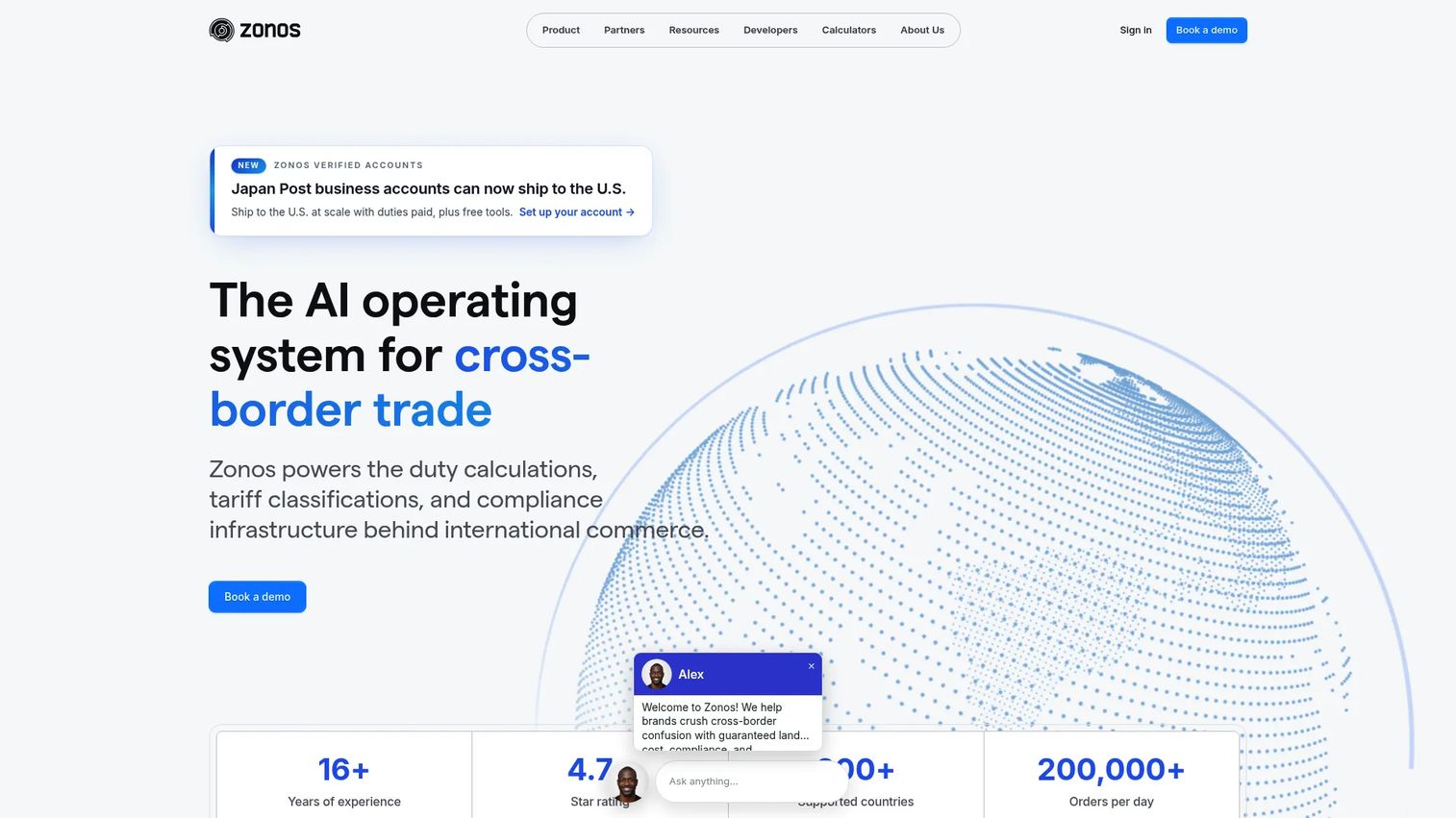
Zonos provides AI-powered infrastructure for cross-border ecommerce, with a focus on duty and tax calculation, tariff classification, compliance, and localized checkout. Its core value is showing the buyer a guaranteed landed cost before payment, which eliminates duty surprises at delivery and reduces the abandonment and returns that come with them. Zonos also handles automated tax compliance and remittance, international fraud protection, and restricted-item screening. For merchants also thinking about ecommerce personalization in parallel with international expansion, that category covers the personalization layer separately.
Best for: Brands that have a storefront and shipping process in place but need accurate duty, tax, and landed-cost treatment to prevent international buyers from discovering costs after payment.
Key features
- Guaranteed landed-cost calculations for duties, taxes, and import fees at checkout
- AI-powered HS-code classification and customs-data extraction
- Automated tax compliance and remittance across supported markets
- International fraud protection and restricted-item screening
- Shipping-rate management, labels, and commercial invoices
Why choose Zonos: Zonos solves a specific and measurable problem: Buyers who abandon or return orders because of unexpected international costs. Accurate product data, correct origin information, and proper HS classification are prerequisites for the calculation to hold. Teams should verify country coverage and fee structures against their target markets before launch.
Zonos pricing: Setup costs start at $2,000 for Standard and $4,000 for Premium onboarding, with Enterprise at custom scope. Per-order fees apply: $2 per order plus 10% of duties, taxes, and import fees. Export processing may add $5 for customers cross-docking with Zonos.
G2 rating: 4.8/5
6. FlavorCloud
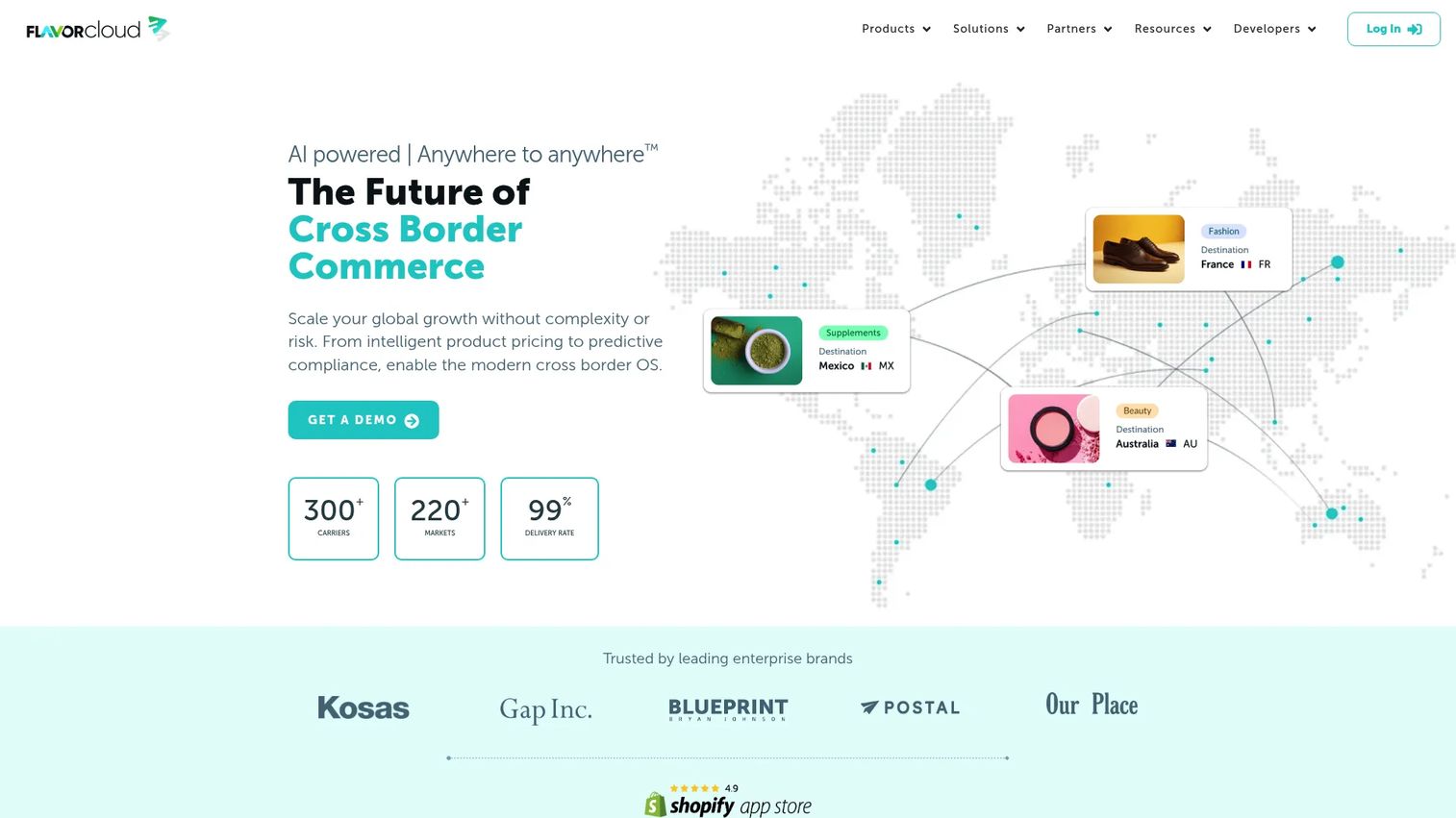
FlavorCloud is AI-powered cross-border commerce software focused on international shipping, compliance, landed-cost calculation, and checkout optimization. Its multi-carrier network spans 220-plus markets, and its platform automates customs, tariff, and tax calculations alongside carrier selection. For enterprise brands and 3PLs dealing with international shipping complexity, FlavorCloud positions itself as the operational layer between the storefront and the carrier network.
Best for: Growing ecommerce businesses with significant international order volume that cannot manage shipping country by country with their current team.
Key features
- Multi-carrier shipping network across 220-plus markets
- Automated customs, tariff, tax, and landed-cost calculations
- Localized market pricing and checkout optimization
- Carrier orchestration and delivery routing
- Compliance and documentation support for international shipments
Why choose FlavorCloud: The value here is operational. The right fit is a team dealing with physical-product complexity, rising international volume, or recurring customs and delivery problems. FlavorCloud is less relevant for a company whose primary bottleneck is storefront localization or local payment acceptance rather than the logistics layer.
FlavorCloud pricing: FlavorCloud does not show subscription tiers on its website. Prospects are directed to request a demo for commercial terms. Pricing Intelligence is documented as a paid add-on. Contact FlavorCloud directly for pricing.
G2 rating: 4.6/5
7. Reach
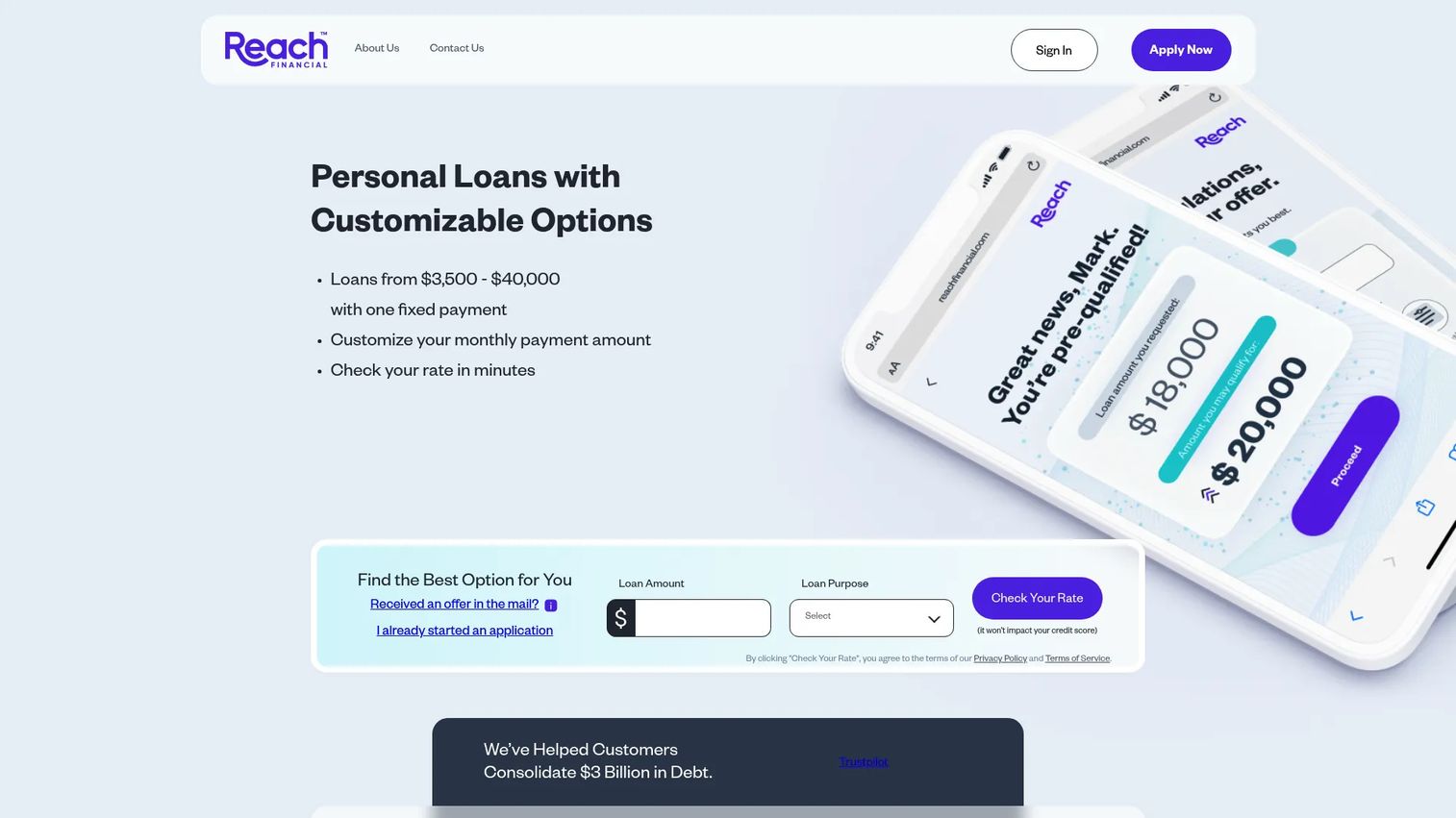
Reach is positioned as a global ecommerce partner helping merchants sell internationally through localized payment acceptance, merchant-of-record services, and tax handling. For businesses where local payment methods and tax compliance create the primary friction, Reach aims to reduce the operational and legal burden of entering new markets.
Best for: Businesses that want to reduce the operational burden of selling internationally, particularly when local payment acceptance and tax treatment are the immediate blockers.
Key features
- Merchant-of-record services for supported markets
- Local payment methods coverage at checkout
- Multi-currency checkout and pricing controls
- Tax and duty support for cross-border transactions
- Global customer experience tooling
Why choose Reach: Reach warrants evaluation when a founder needs more than currency conversion and carrier labels, specifically when local payment acceptance and regulatory compliance create the friction. Scrutinize country availability, merchant responsibilities retained after engagement, settlement timelines, refund workflows, and the gross-margin impact of the service model before committing.
Reach pricing: Pricing is arranged through sales. Contact Reach for package details and commercial terms.
8. FedEx International Connect
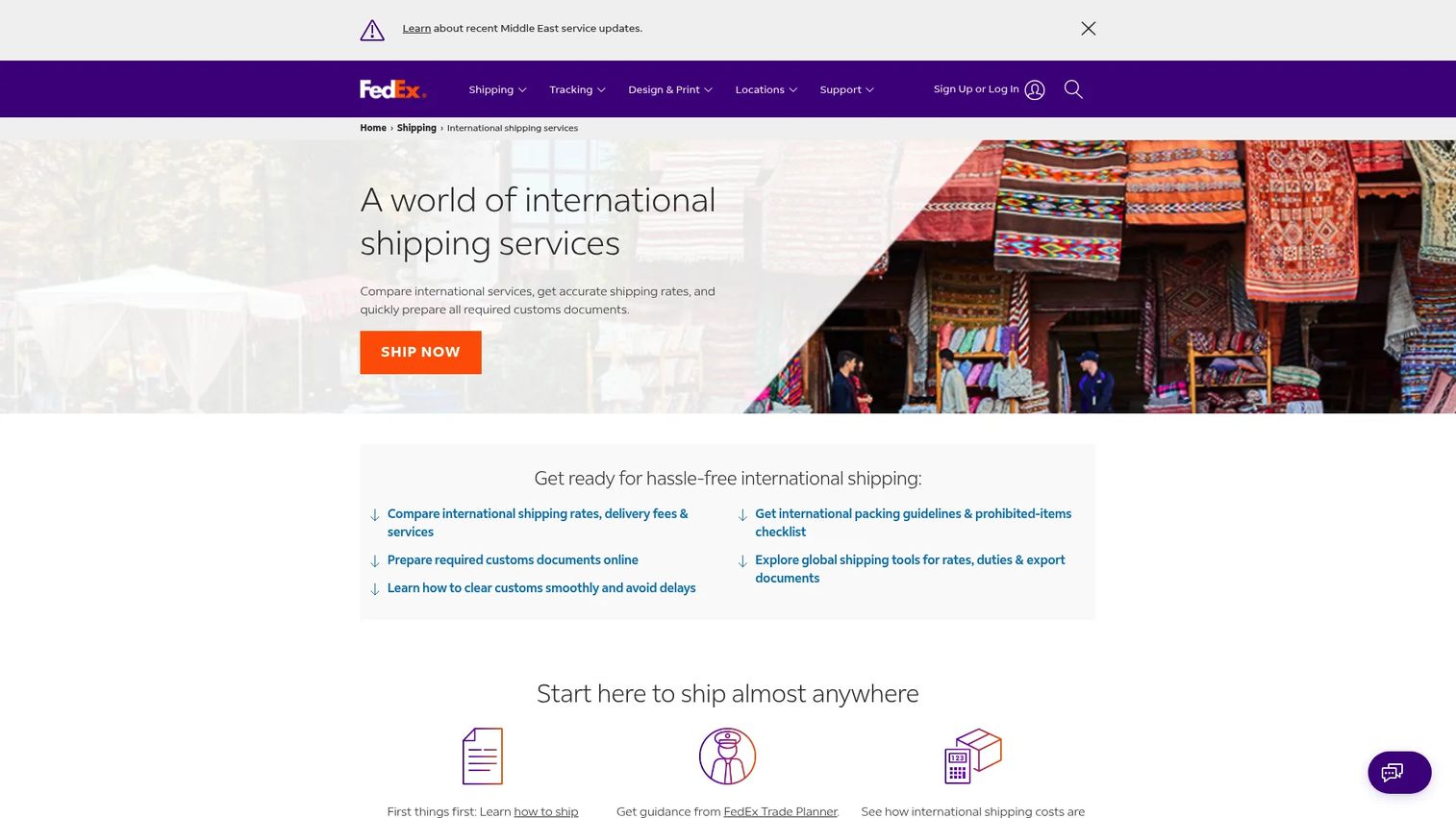
FedEx International Connect is an international ecommerce shipping service, not a full commerce operating platform. The distinction matters: It solves physical delivery, not localized checkout, duty calculation, or payment acceptance. It delivers parcels to more than 220 countries and territories through local final-mile carriers, with tracked and untracked options. Businesses integrate via API or bulk file upload to generate shipping labels and manage international dispatch.
Best for: Brands that have their storefront, checkout, and duties covered, and need dependable international parcel delivery through a global carrier network.
Key features
- Tracked delivery with a 4 to 12 business-day delivery aim
- Untracked delivery with a 7 to 15 business-day delivery aim
- Delivery coverage across 220-plus countries and territories
- API integration and bulk file upload for label generation
- DDP or DDU customs-clearance options
Why choose FedEx International Connect: A carrier-led option makes sense when fulfillment and delivery reliability are the immediate constraints and the rest of the stack is already in place. It will not replace a localized checkout, merchant-of-record service, duty calculation layer, or broader cross-border platform. Treat it as the last-mile layer, not the operating model.
FedEx International Connect pricing: Pricing is quote-based and varies by origin country, destination, package characteristics, service level, and shipment volume. Contact FedEx directly for commercial terms.
Considerations when choosing a cross border ecommerce platform
Choose the operating model before the vendor
Decide whether your primary bottleneck is storefront localization, checkout and payments, duty calculation, or physical delivery. Buying overlapping tools without clear ownership creates duplicate costs and no single source of accountability. A founder who needs a localized checkout and a VP who needs reliable shipping are solving different problems, and the vendor list should reflect that.
Calculate contribution margin after international costs
International revenue looks attractive in a dashboard. Contribution margin after duty, delivery, payment fees, return costs, fraud exposure, and customer support often tells a different story. Model landed cost, return rate, and average order value by market before treating international GMV as a growth signal.
Verify country coverage at product level
Platform country availability means little if your catalog faces restrictions based on product classification, country of origin, sanctions lists, labeling requirements, or category-specific import rules. A country-by-SKU review before launch prevents the discovery of product-level constraints after you have built the market experience. For broader ecommerce platform for small business decisions, that guide covers the foundational platform choice for teams earlier in their commerce journey.
Treat returns as part of the product experience
International returns can erase the margin on a profitable-looking order. Before launch, test label generation, return routing, refund timing, customer communication, and local return options. Return cost and refund speed are often what determines whether a market is worth staying in.
Measure international performance separately
Blended reporting that combines domestic and international performance hides weak markets behind strong ones. Build country-level reporting covering conversion rate, delivery promise attainment, return rate, cancellation rate, and contribution margin before you scale. A market that looks promising at the GMV level can be unprofitable once costs are separated. For payment processing software decisions that sit alongside the international stack, that guide covers the payments layer independently.
Conclusion
Cross-border ecommerce succeeds when the operating model matches the expansion risk. The platforms in this guide each solve a distinct part of the stack.
Shopify and BigCommerce handle the storefront and catalog layer, with Shopify Markets suited to merchants who want incremental international expansion and BigCommerce suited to complex or composable commerce architectures. Global-e and ESW provide managed international selling as a service, suited to retailers with proven demand who want a partner to absorb operational complexity. Zonos is the right pick when duty surprises at checkout are killing international conversion. FlavorCloud and FedEx International Connect solve physical delivery, with FlavorCloud providing carrier orchestration across markets and FedEx offering a dependable last-mile network. Reach addresses local payment acceptance and merchant-of-record needs for markets where payment friction is the primary blocker.
Start with one market, one product set, and one measurable hypothesis. Expand only after you can see international conversion, delivery reliability, return cost, and contribution margin in the same report. That is the operating discipline that separates international growth from international complexity.
For teams building the broader commerce stack, the best ecommerce search software and best ecommerce personalization software guides cover adjacent layers worth evaluating in parallel.
Start your journey with Guideflow today!
FAQs
Cross-border ecommerce is the sale of goods or services online to customers in another country. The seller manages or outsources the payments, taxes, duties, shipping, customs, returns, and localized customer experience required to complete the order. It covers the full operating chain from storefront through delivery and post-purchase, not just the shipping step.
International shipping is one operational layer within cross-border ecommerce. A complete cross-border operation also includes localized pricing, local payment methods, duty and tax collection, customer support, returns management, and regulatory compliance. Treating shipping as the whole solution typically results in duty surprises, unsupported payment methods, and poor return economics.
The right choice depends on the current storefront and the primary bottleneck. A small business already on Shopify can use Shopify Markets to add international capabilities without migrating. A product business with high international shipping complexity may prioritize Zonos for duty clarity or FlavorCloud for carrier orchestration. Start by identifying whether the friction is checkout, duties, or physical delivery.
Platforms use destination country, product classification (HS code), declared value, country of origin, shipping cost, and applicable tax rules to estimate duties and taxes. The accuracy of that calculation depends heavily on correct product data and classification. For high-volume markets, validate calculations with qualified customs and tax specialists before relying on automated estimates alone.
Landed cost is the full delivered cost of a product to the customer or importer. It includes the product price, shipping, duties, taxes, insurance, carrier fees, and any handling costs. Showing landed cost at checkout, rather than revealing it at delivery, prevents the abandonment and returns that come from buyer surprise.
It depends on your country coverage, tax registration strategy, and payment acceptance requirements. A merchant-of-record service shifts certain tax filing, payment processing, and compliance responsibilities to the provider in supported markets. The seller should review the contractual split of responsibilities carefully, because merchant-of-record arrangements vary significantly by provider and by market.
Use inbound demand data, shipping feasibility, local payment preferences, product restrictions, return economics, and language requirements to identify candidates. Then model contribution margin for that market before launch. A limited market test with a defined hypothesis is more useful than a broad geographic rollout. Expand to a second market only after the first shows positive unit economics, not just top-line revenue.
Some providers support international returns while others focus primarily on checkout or outbound shipping. Return capability varies significantly by provider and by market. Test the full return workflow, including label generation, return routing, refund timing, and customer communication, before launch. International return costs and refund speed often determine whether a market is profitable to operate in.
Payment method coverage varies by market and can significantly affect checkout conversion. Credit cards are not universal: Markets like Germany favor bank transfers, the Netherlands relies heavily on iDEAL, and much of Southeast Asia uses digital wallets. Confirm that your checkout layer supports the dominant payment methods in each target market before treating localization as complete.
Duty rates, tax rules, carrier service availability, and platform pricing change frequently. A quarterly review of country-level pricing, carrier contracts, duty rates, and platform fees prevents margin erosion from rates that shifted after launch. Build the review cadence into your operations calendar before the first international order ships, not after you notice the problem in reporting.