Your onboarding flow is losing users before their first successful action. Security wants stronger identity checks. Fraud wants more proof. Engineering wants an SDK that fits the release cadence without a six-week integration spike.
Here is the tension no vendor will tell you plainly: A provider can reduce fraud while simultaneously increasing drop-off, false rejects, and support volume. A high approval rate and a strong verification program are not the same thing.
The biometric authentication market reflects how seriously organizations are taking this tradeoff. The global biometric authentication and identification market reached $7.67 billion in 2025 and is projected to grow to $30.79 billion by 2034, according to Straits Research (2025). More than 70% of global enterprises have already adopted some form of biometric authentication, per Daon (2026). Despite that adoption, most product teams still struggle to choose a provider that fits their specific job: Onboarding verification, recurring login, fraud signals, or large-scale identity matching.
The right choice depends on whether your product needs onboarding verification, recurring authentication, fraud signals, or large-scale identity matching. This guide gives you the shortlist and the evaluation framework to make that call.
What's inside
This guide is for product managers, identity product owners, and fraud and security teams evaluating biometric authentication software for customer onboarding, login, or high-risk transaction flows. Tools were selected based on four criteria:
- Coverage of the primary job: Does the tool address identity verification, biometric login, or large-scale matching?
- Deployment model: SDK maturity, web support, and mobile platform coverage
- Verified pricing and ratings: Sourced from official pricing pages and current G2 listings
- Instrumentation and measurement: Analytics, fallback flows, and fraud outcome data
TL;DR
- Best for 3D face authentication and liveness: FaceTec 3D Face Authentication for teams that need dedicated selfie biometrics and anti-spoofing controls across mobile and web
- Best for global customer identity verification: Veriff for digital onboarding teams needing document checks, face matching, and fraud signals across many markets
- Best for flexible KYC and fraud workflows: iDenfy for product teams combining identity verification, business verification, and AML-adjacent checks
- Best for high-volume fraud automation: AU10TIX for organizations prioritizing automated document and biometric verification at scale
- Best for risk-based step-up authentication: PingOne Recognize for teams embedding biometric controls inside a broader customer identity platform
- Best for large-scale biometric matching: HID ABIS for government, border, and high-assurance identity programs
- Best for configurable identity proofing: Onfido (now part of Entrust) for teams integrating document and biometric checks into digital onboarding
What is biometric authentication software?
Biometric authentication software verifies a person using physical or behavioral characteristics, such as a face, fingerprint, voice, iris, or interaction pattern, to approve access or confirm identity.
Most buying conversations collapse four distinct jobs into one category. Before evaluating vendors, map which job your product actually needs.
Biometric identity verification
This is the onboarding or account-opening job. The system compares a selfie or face scan with a government-issued document or trusted record. Common examples include opening a bank account, completing KYC before crypto trading, verifying a marketplace seller, or confirming age before accessing a regulated service.
Biometric authentication
This is the recurring access or approval job. A user proves they are the same person who enrolled previously. Common examples include logging into a mobile app, approving a high-value payment, recovering an account after a risky event, or reauthenticating before changing a withdrawal destination.
Biometric identification
This is a one-to-many matching problem, usually associated with ABIS platforms and high-assurance deployments. The system answers "Who is this person among a large population?" rather than "Is this the enrolled user?" Government, border control, and law enforcement programs typically sit here.
Behavioral biometrics and risk signals
Behavioral signals evaluate typing cadence, touch patterns, device context, and user flow. They complement face or fingerprint checks when a workflow needs adaptive risk decisions without requiring an explicit biometric prompt.
| Job | Typical user moment | Primary evidence | Example outcome |
|---|---|---|---|
| Identity verification | Account opening | Document plus selfie | Confirm a new customer |
| Biometric authentication | Login or high-risk action | Enrolled biometric | Approve access |
| Biometric identification | One-to-many matching | Biometric database search | Identify a person in a large population |
| Behavioral biometrics | Continuous risk assessment | Behavioral and device signals | Trigger step-up verification |
Key features to look for:
- Face match and liveness detection (passive and active)
- Presentation attack detection: Photo, mask, replay, injection
- Mobile SDKs (iOS, Android, Flutter) and web SDKs
- Document verification and NFC chip reading
- Risk scoring and step-up authentication triggers
- Configurable fallback and recovery journeys
- Consent, retention, deletion, and audit controls
- Analytics covering enrollment completion, false rejects, and fraud outcomes
When to use biometric authentication software
Reduce password and recovery friction
Recurring login, account recovery, and sensitive account changes all benefit from biometric controls when they reduce user burden without eliminating accessible fallback paths. The implementation should still report retry rates and recovery abandonment, not just successful authentications. A system that improves pass rates for most users while silently failing others is an instrumentation gap, not a win.
Add proof to high-risk actions
Payments, bank account changes, high-value transfers, marketplace payouts, and health data access are natural candidates for step-up authentication. Risk-based triggers let you prompt biometrics only when the event warrants it, which keeps the experience low-friction for routine actions and defensible for high-risk ones.
Verify customers during regulated onboarding
KYC, age checks, merchant onboarding, worker verification, and financial account opening require more than a selfie alone. Document capture, face-to-ID matching, and fraud signal evaluation work together to satisfy regulatory requirements. Choose a provider based on the document types, geographies, and failure scenarios your actual user base generates, not on the broadest coverage claim in a sales deck.
Biometric authentication software comparison
Pricing across this category varies by verification volume, regions covered, document types, fraud modules, and support tier. The figures below reflect verified sources as of October 2026. Run your own check before signing a contract, because volume commitments and enterprise terms move frequently.
Pricing and G2 ratings verified October 2026 from each vendor's official pricing page and current G2 listing.
| # | Product | Best for | Key differentiator | Pricing | G2 rating |
|---|---|---|---|---|---|
| 1 | FaceTec 3D Face Authentication | 3D face authentication and liveness | Dedicated 3D face biometrics with server-side deployment | Quote-based, monthly minimum | 4.5/5 |
| 2 | Veriff | Global customer identity verification | Document plus biometric verification across 230+ countries | From $0.80/verification ($49/mo minimum) | 4.5/5 |
| 3 | iDenfy | Flexible KYC and fraud workflows | Identity, KYB, and AML in one platform with 24/7 human review | From $1.35/verification ($135/mo minimum) | 4.9/5 |
| 4 | AU10TIX | High-volume fraud automation | Deepfake and serial-fraud detection with $500/mo minimum | From $500/mo minimum | 4.3/5 |
| 5 | PingOne Recognize | Risk-based step-up authentication | Privacy-preserving biometrics with no stored templates | Custom pricing | N/A |
| 6 | HID ABIS | Large-scale biometric matching | One-to-many biometric identification for civil and government programs | Custom pricing | N/A |
| 7 | Onfido (Entrust IDV) | Configurable identity proofing | Document, selfie, and liveness checks with AI-powered fraud signals | Custom pricing | 4.4/5 |
Best biometric authentication software tools for 2026
1. FaceTec 3D Face Authentication
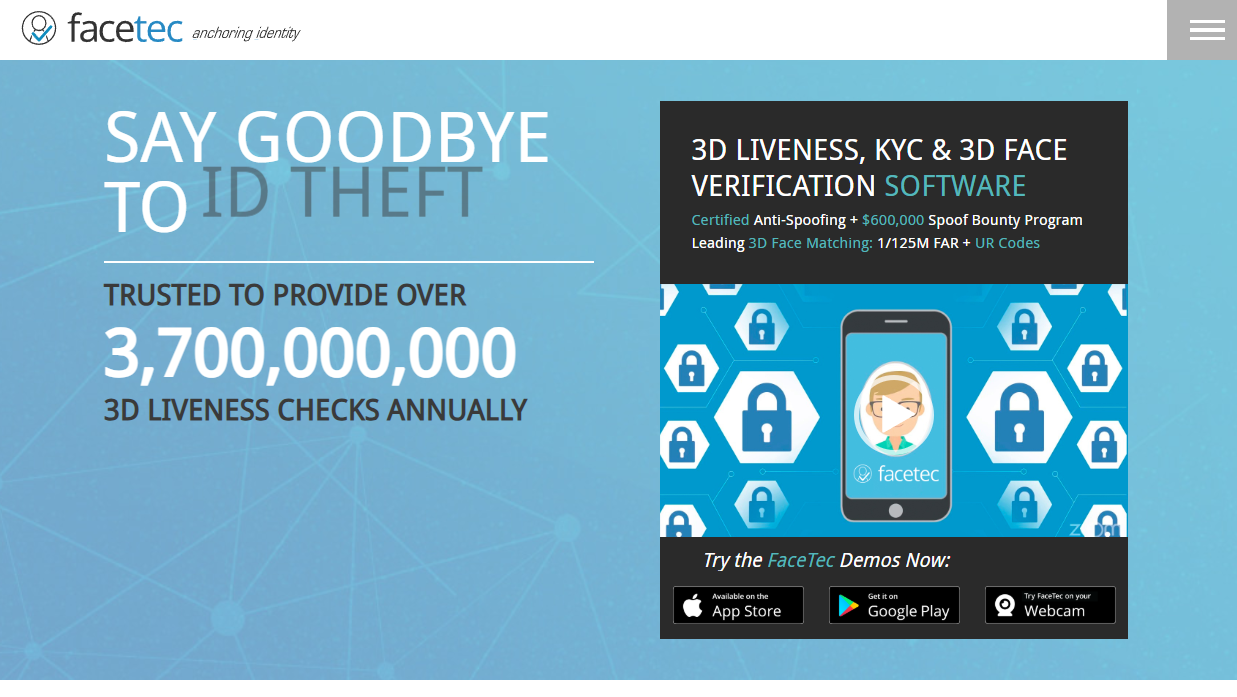
FaceTec is a specialist in 3D face biometrics, building its platform around certified liveness detection, 3D FaceMap creation, and face-to-ID matching for web and mobile. Unlike broader identity platforms that include face matching as one module among many, FaceTec's entire stack centers on the biometric layer. Customers run FaceTec software on their own servers, which keeps biometric data within the organization's own environment. The platform also covers OCR, barcode reading, NFC chip support, and one-to-many deduplication for catching duplicate identities at enrollment.
Best for: Product teams where face authentication and liveness resistance are the primary technical requirement, not a secondary feature of a broader KYC suite.
Key features
- Certified 3D liveness detection
- 3D FaceMap creation and face matching
- Photo ID capture with face-to-ID matching
- 1:N deduplication and fraud detection
- OCR, barcode, and NFC support
Why choose FaceTec: FaceTec fits teams that need biometric depth and server-side control over where templates are processed and stored. If your primary job is onboarding verification with a document provider already in place, evaluate whether you need a dedicated biometric layer or a full identity platform.
FaceTec pricing: Pricing is quote-based. Customers pay a monthly minimum for 3D Liveness usage, billed on the server they operate. Distribution partners can provide access without the same minimum commitment structure. Demo and sample apps are available for proof-of-concept testing at no cost.
G2 rating: 4.5/5 (verified October 2026)
2. Veriff
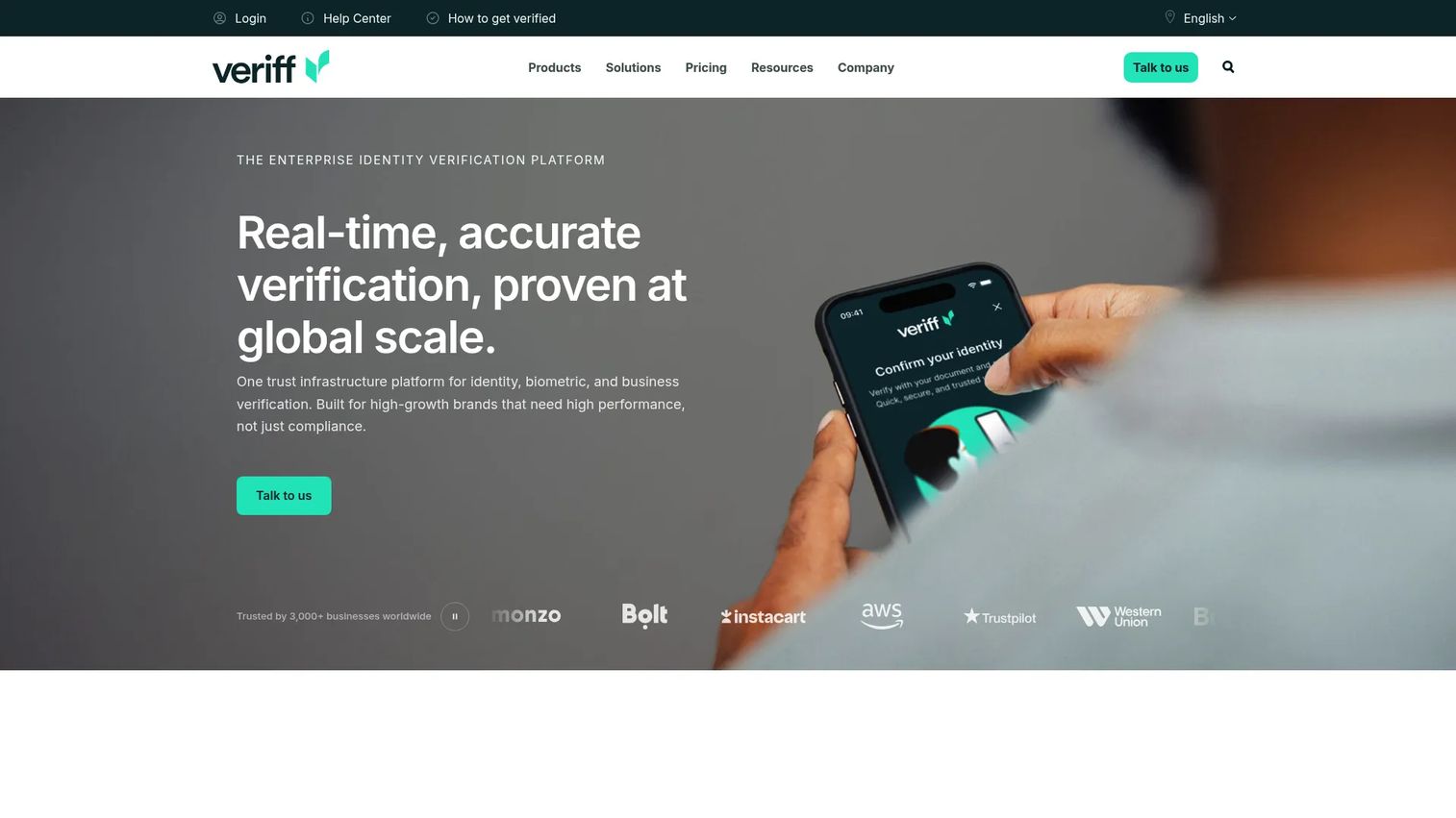
Veriff provides identity verification for digital onboarding across more than 230 countries and territories, combining document capture, biometric checks, liveness detection, and fraud signals in a single API. Its self-serve plans let product teams start without a sales conversation, which shortens the path from evaluation to production. The platform also covers AML screening for PEPs and sanctions, proof of address, age estimation, and network analytics for device and behavioral signals. For best identity verification software comparisons covering adjacent categories, Veriff is a frequent reference point in the identity verification market.
Best for: Digital onboarding teams launching customer verification across multiple markets and document types who need a self-serve entry point and enterprise scale in the same platform.
Key features
- Document verification with OCR and NFC
- Biometric verification and liveness detection
- AML screening: PEPs, sanctions, adverse media
- Fraud and network/device analytics
- Age validation and proof of address
Why choose Veriff: Veriff is a strong fit when the product surface is customer onboarding and the team needs geographic coverage without building country-specific document handling in-house. Run a staged test against your actual user geography and document mix before committing, because global coverage claims do not guarantee consistent conversion in every market.
Veriff pricing: Self-serve plans start at $0.80 per verification with a $49/month minimum (Essential tier). The Plus tier runs $1.39 per verification with a $99/month minimum, and Premium is $1.89 per verification with a $209/month minimum. A 15-day free trial with up to 50 sessions is available. Enterprise pricing is custom.
G2 rating: 4.5/5 (verified October 2026)
3. iDenfy
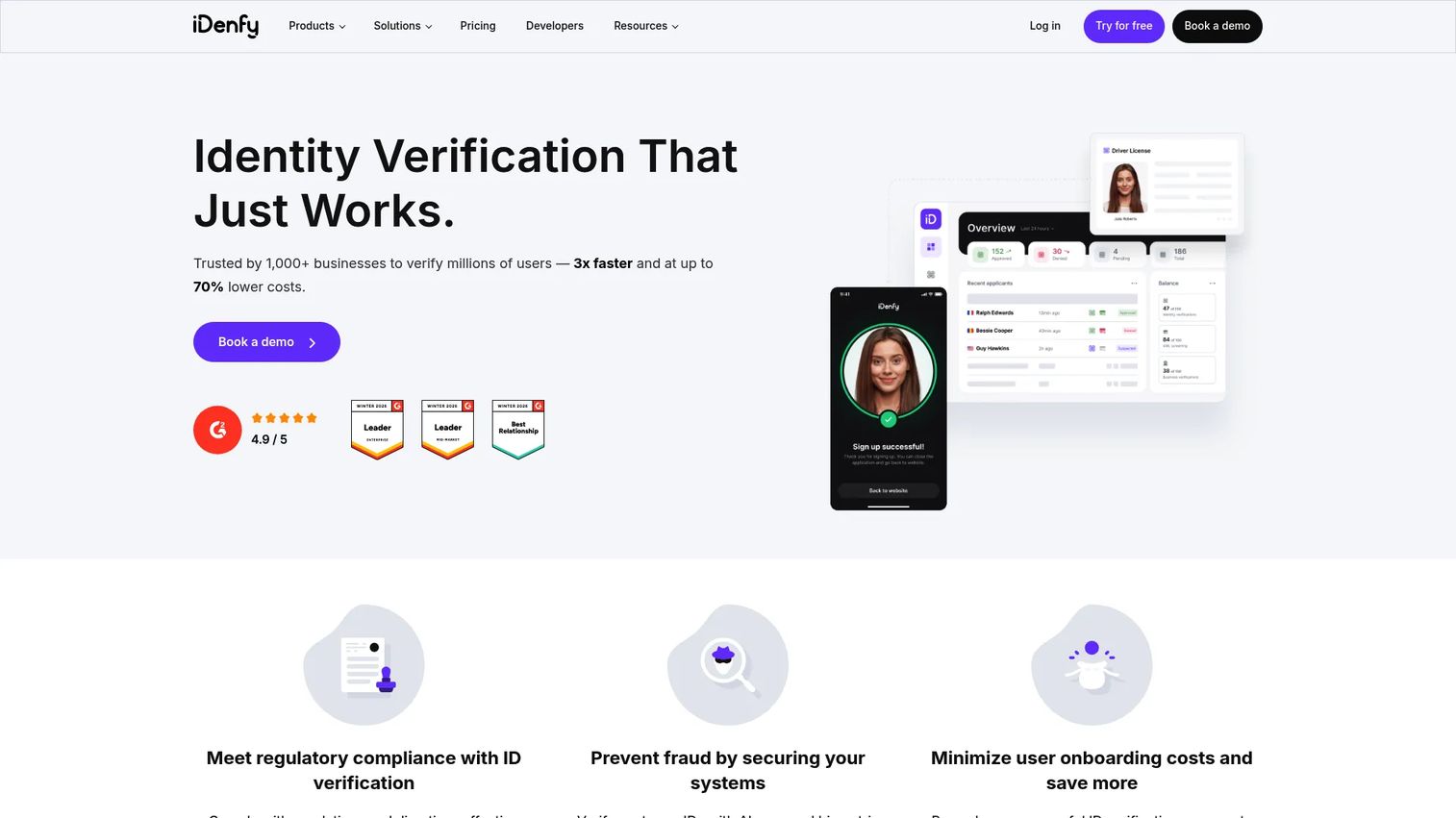
iDenfy covers identity verification, business verification, AML screening, and fraud prevention in one platform, which reduces the number of vendors a product team needs for a compliant onboarding stack. Its passive and 3D liveness detection, 24/7 manual review queue, and no-code integration options (iFrame alongside API and SDK) mean teams with varying engineering bandwidth can still reach production quickly. The platform supports KYB for business customers alongside the standard KYC individual flow, which matters for marketplaces or platforms that onboard both consumers and businesses. Among the tools in this list, iDenfy carries the highest G2 rating.
Best for: Product teams that need KYC, KYB, and AML workflows from a single provider, particularly those with limited engineering bandwidth who need both API depth and no-code deployment options.
Key features
- Identity and document verification with OCR
- Face verification with passive and 3D liveness
- AML screening and ongoing monitoring
- KYB and business verification
- API, SDK, iFrame, and no-code integrations
Why choose iDenfy: iDenfy fits teams trying to reduce stack fragmentation across onboarding compliance workflows. The 24/7 manual review option is useful when automated decisions need a human escalation path for edge cases, particularly in regulated markets.
iDenfy pricing: Pay-as-you-go plans start at $1.35 per verification with a $135 monthly minimum (Basic tier). Enterprise pricing is volume-based and annual, and can reach as low as $0.50 per verification at scale. A 14-day free trial with 10 free checks is available.
G2 rating: 4.9/5 (verified October 2026)
4. AU10TIX
AU10TIX is an AI-powered identity verification and fraud prevention platform built for organizations with high verification volumes and a strong requirement for automation. Its Enhanced KYC tier adds deepfake detection, serial-fraud identification, proof of address, and AML screening on top of the core document and biometric checks. The platform also offers continuous risk monitoring and reusable digital identity at the Enterprise tier. For product managers evaluating fraud tooling alongside verification, AU10TIX's position in financial services and regulated industries reflects its focus on automating decisions at scale. See also the bot detection software and best click fraud software guides for adjacent fraud prevention categories.
Best for: Organizations with high verification volumes in financial services or regulated markets where automated fraud detection, deepfake resistance, and AML screening need to run without manual review overhead.
Key features
- Automated document and ID verification
- Biometric face matching with liveness
- Deepfake, forgery, and serial-fraud detection
- AML, PEP, and sanctions screening
- Continuous risk monitoring and reusable digital ID
Why choose AU10TIX: Evaluate AU10TIX on fraud outcomes and review reduction, not just approval speed. A system that approves more users can also approve more fraud if the underlying controls are not tuned for your document types and markets. Ask for false accept rate, false reject rate, and manual review data during the evaluation.
AU10TIX pricing: Basic KYC and Enhanced KYC plans each start at a $500 monthly minimum. Basic covers automated ID verification, biometrics, and case management. Enhanced adds deepfake detection, serial-fraud controls, proof of address, and AML screening. Enterprise pricing is available on request.
G2 rating: 4.3/5 (verified October 2026)
5. PingOne Recognize
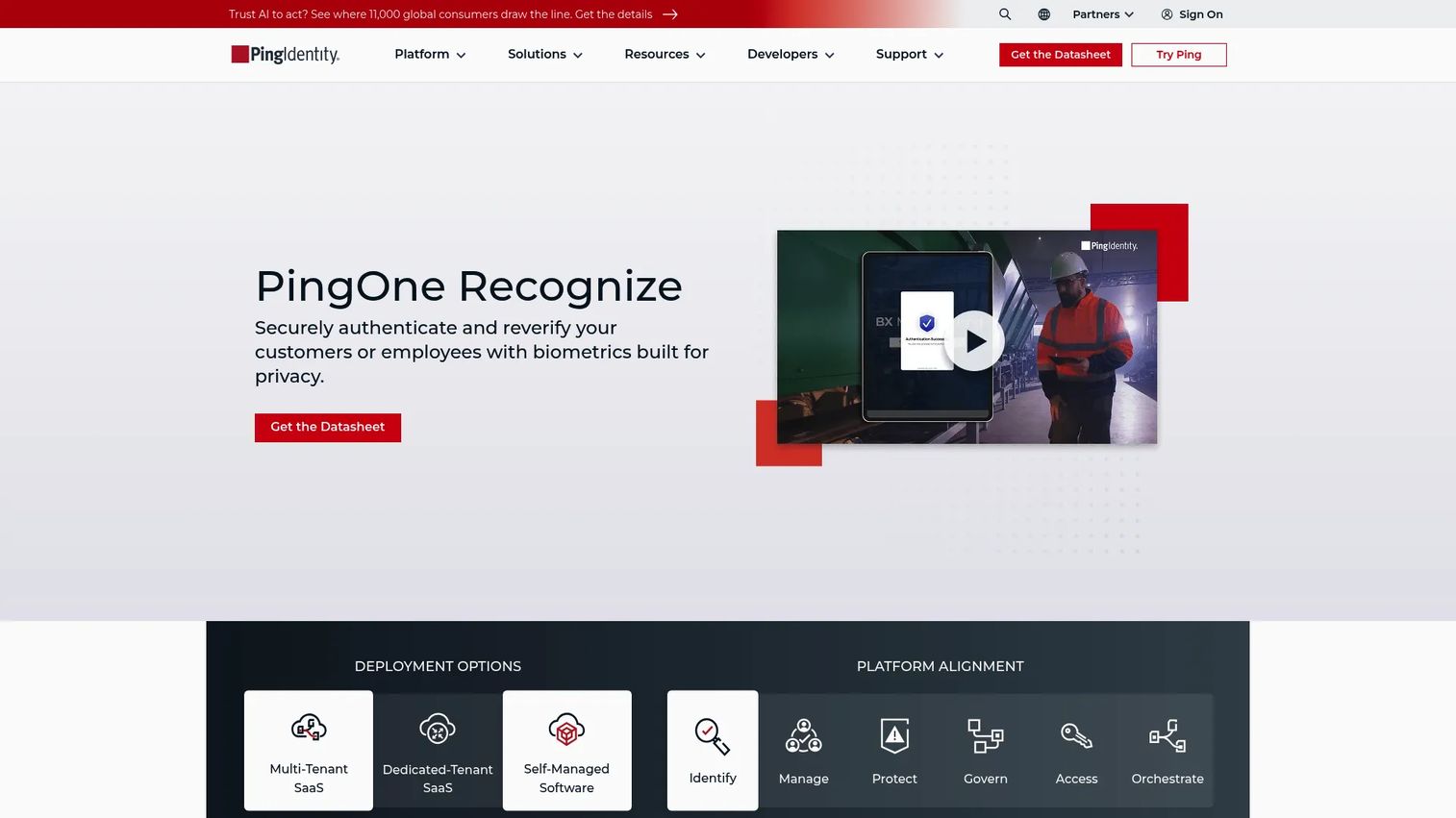
PingOne Recognize is a privacy-preserving biometric authentication product within the Ping Identity customer identity platform. Its documentation states that biometric data is not stored, with authentication handled through a local match on the device combined with server-side liveness and injection-attack prevention. The product covers facial enrollment and authentication, passive liveness, account recovery, device binding, and payment authentication with dynamic linking. For product teams already evaluating customer identity and access management (CIAM), multifactor authentication, or risk-based step-up flows, Recognize is one component in a broader Ping Identity deployment rather than a standalone verification tool.
Best for: Product teams solving ongoing authentication risk, payment approvals, account recovery, and credential change protection inside an existing or planned customer identity architecture.
Key features
- Facial biometric enrollment and authentication
- Passive liveness and injection-attack prevention
- Account recovery and device binding
- Payment authentication with dynamic linking
- Web, mobile, and native SDK support
Why choose PingOne Recognize: Recognize is a stronger fit for recurring authentication scenarios than for onboarding identity proofing. If the job is a one-time KYC check at account opening, a standalone verification platform will be more direct. If the job is protecting ongoing high-risk actions across an existing customer identity stack, Recognize is worth evaluating.
PingOne Recognize pricing: Ping Identity directs buyers to contact sales for platform pricing. A free trial covering authentication, user management, MFA, risk management, identity verification, and API access management is available on the Ping Identity pricing page.
6. HID ABIS
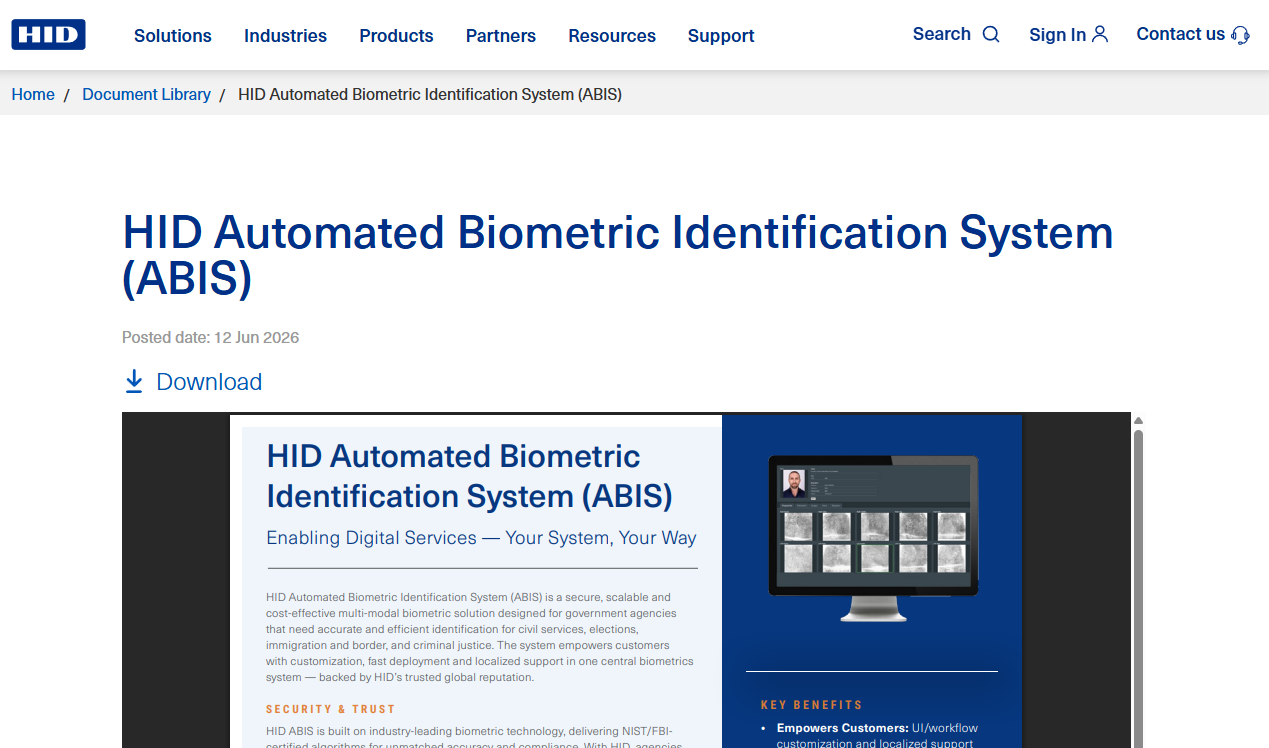
HID ABIS is an automated biometric identification system built for one-to-many matching and high-assurance identity programs at scale. The platform supports multimodal biometrics including fingerprints, faces, palms, and iris, and is designed for civil government programs, law enforcement, border management, and national identity deployments where the system must identify a person across a large biometric database rather than simply verify a returning user. HID's focus on civil and government identity distinguishes ABIS from the consumer and enterprise onboarding tools elsewhere in this list.
Best for: Government, border, public safety, and civil identity programs that need biometric search and deduplication across large population-scale databases.
Key features
- One-to-many biometric matching and deduplication
- Multimodal support: Fingerprint, face, palm, iris
- Enrollment, deduplication, and secure identity management at scale
- Case management for high-assurance programs
- Designed for civil government and law enforcement deployments
Why choose HID ABIS: HID ABIS belongs on a shortlist only when the core job is biometric identification across a large database. For a SaaS product manager building customer account opening or login, this platform addresses a fundamentally different scale and governance problem. The data handling, matching accuracy requirements, integration model, and procurement process are all different from a one-to-one verification API.
HID ABIS pricing: Pricing requires direct engagement with HID. Key cost drivers include database size, modality coverage, deployment architecture, integration scope, support tier, and operating environment.
7. Onfido (Entrust IDV)
Onfido, acquired by Entrust in April 2024 and now listed on G2 as Entrust IDV, provides AI-powered identity verification for customer onboarding, fraud prevention, and compliance workflows. The platform combines document verification, selfie and video liveness checks, and KYC/AML data checks in a configurable API. Its acquisition by Entrust means the product roadmap now sits within a broader identity and credential management portfolio, which is worth factoring into long-term vendor strategy. For teams evaluating best identity verification software options more broadly, Onfido's document coverage and configurable onboarding journeys have made it a frequently cited option in regulated industries. Related reading on fraud and verification tooling is available in the breach and attack simulation software and cloud data security software guides.
Best for: Digital products that need configurable identity proofing during customer onboarding, with the flexibility to tune the verification journey across document types and markets.
Key features
- Government ID document verification
- Selfie, video, and liveness checks
- Data verification and KYC/AML compliance checks
- Fraud signal evaluation
- Web and mobile SDK support
Why choose Onfido: Onfido fits teams that need flexibility in how the verification journey is structured, particularly across different user segments or regulatory contexts. Evaluate regional document coverage against your actual user geography and ask for verification evidence quality before committing to a volume contract.
Onfido pricing: Onfido directs buyers to contact sales through the Entrust identity verification page. Pricing is based on identity check volume and product configuration.
G2 rating: 4.4/5 (verified October 2026, listed as Entrust IDV, formerly Onfido)
Considerations when choosing biometric authentication software
Match the provider to the user moment
Do not evaluate an ABIS platform against a KYC onboarding vendor on the same scorecard. Define the job first: Is the system verifying a new identity, authenticating a returning user, or searching a population database? A provider that excels at one job may be the wrong architecture for another.
Measure fraud outcomes alongside conversion
Track approval rate, false reject rate, fraud loss, manual review rate, verification abandonment, and retry rate together. A vendor evaluation that reports only successful verifications hides the user experience and fraud cost of the failures. Ask every finalist for false accept and false reject data from a cohort similar to your own user base.
Test against your actual deployment conditions
Benchmark the tool against your specific devices, operating systems, browsers, lighting conditions, network speeds, languages, and document types. Claims about global accuracy do not replace conversion testing in the countries and on the devices that drive your actual product traffic. The best mobile attribution platforms guide covers instrumentation approaches that apply directly to measuring verification funnel performance on mobile.
Design fallback and recovery paths before launch
Plan for users who cannot complete a face or document check. Include retry rules, quality guidance on screen, alternate verification methods, accessible routes, manual review escalation where appropriate, and support instrumentation to capture failure reasons. A failed check that leads to a dead end is a conversion loss and a support ticket.
Review biometric data handling before implementation
Bring legal, security, privacy, and procurement into the evaluation before engineering commits to an SDK. Ask specifically: Where is biometric data processed, whether templates are stored by the vendor or only on device, how retention and deletion requests are handled, and what audit evidence is available for regulatory review. The attack surface management software guide covers adjacent security review considerations.
Conclusion
Each tool in this list solves a different job, and the evaluation framework matters more than the vendor ranking.
FaceTec is the pick for teams that need dedicated 3D face biometrics with server-side control. Veriff covers global document plus biometric verification with a self-serve entry point. iDenfy fits teams that want KYC, KYB, and AML in one platform at a competitive per-verification price. AU10TIX suits high-volume programs where deepfake detection and fraud automation are the primary drivers. PingOne Recognize belongs in customer identity architectures where step-up authentication and payment approval are the recurring jobs. HID ABIS is the right shortlist entry only for government-scale one-to-many identification programs. Onfido (Entrust IDV) offers configurable identity proofing for digital onboarding teams that need flexibility across document types and markets.
Before you sign a contract with any of them, build a pilot scorecard. Test the same user journeys, device mix, document types, fraud cases, and recovery paths across every finalist. The vendor with the strongest demo is not always the one that produces the best activation and fraud outcomes in your product.
Start your journey with Guideflow today!
FAQs
Identity verification proves who a new user is during onboarding, typically through a government-issued document and a facial biometric comparison. Biometric authentication confirms that an enrolled user is the same person during a login or high-risk action. The two jobs often require different vendors, different SDK integrations, and different data handling models, so conflating them at the architecture stage creates problems downstream.
Safety depends on the controls around the implementation, not the modality itself. Evaluate liveness detection, presentation attack resistance (photo, mask, replay, injection), biometric template handling, fallback paths for users who cannot complete a face check, account recovery options, consent and deletion controls, and logging depth. A face authentication flow without a tested recovery path is an accessibility and support risk regardless of how strong the biometric controls are.
Track enrollment completion, authentication success rate, false reject rate, fraud attempts blocked, user retries, recovery completion rate, help tickets related to verification failures, and segment-level differences by device, geography, and operating system. A single aggregate pass rate hides the performance differences across the device and market segments that matter most to your activation and retention metrics.
It can reduce password reliance significantly, but it works best as part of a layered authentication architecture. Many products combine biometrics with passkeys, device binding, risk scoring, and step-up factors for high-risk events. According to the 2025 State of Identity Fraud Report, 63% of consumers say they would go completely passwordless if they could access accounts solely through biometrics, which signals strong user appetite, but the engineering and fallback design requirements to make that safe at scale are non-trivial.
Liveness detection checks whether a biometric sample comes from a physically present human rather than a photo, replayed video, mask, synthetic media, or injected digital signal. Methods vary significantly between passive liveness (which analyzes the sample without requiring user action) and active liveness (which prompts a specific movement or challenge). Deepfake and injection attack resistance are increasingly relevant evaluation criteria as attack sophistication rises.
Face matching is a one-to-one check: The system compares a presented biometric against a specific enrolled template or document photo to confirm the user is who they claim to be. Face identification is a one-to-many search: The system compares a presented biometric against a large population database to answer who the person is, without a claimed identity to start from. Government, border, and law enforcement programs typically run identification at scale. Consumer onboarding and login products almost always use matching.
The best method depends on the specific user moment. Face authentication fits remote onboarding and step-up authentication flows where the user is at a distance from the device. Fingerprint authentication works well for device-based recurring login where the sensor is reliable and the user is holding the device. Behavioral signals add risk context in the background without requiring an explicit biometric prompt. For most consumer mobile products, the practical answer is to instrument multiple modalities and let risk policy determine when each one triggers, rather than committing the entire product to a single authentication method.
Design the failure path before you design the success path. Include on-screen quality guidance to reduce preventable retries, a retry limit with a clear counter, alternate verification methods for users who cannot pass a biometric check, an accessible manual review or support escalation path, and instrumentation that captures failure reasons at the step level. A failed check that returns an opaque error and no next step creates a support ticket, a churned user, or both. The best onboarding flow software guide covers instrumentation patterns that apply directly to this failure-path design problem.
Biometric data is regulated more strictly than most other personal data in many jurisdictions, including the EU, US state laws such as Illinois BIPA, and others. Key questions for any vendor evaluation include: Where biometric templates are processed and whether they are stored by the vendor, how long templates are retained and what triggers deletion, how users consent to collection and what they can request after the fact, and what audit evidence the vendor provides for regulatory review. This is a legal and privacy question as much as a product question. Involve legal, security, and privacy review early, before the SDK is integrated.