

Your best analyst just resigned. You never saw it coming. Two weeks later, HR runs the exit interview and hears the whole story: they'd been frustrated for months, felt stuck, and got a call from a recruiter at the wrong moment.
That's the problem with waiting until someone leaves. Exit interviews tell you why people quit. They tell you nothing you can act on, because the person is already gone.
Stay interviews flip the timing. You have the conversation while someone still works for you, while the frustration is still fixable. You ask what keeps them, what pushes them toward the door, and what would make them stay another year. Then you build a plan around the answers.
The problem is consistency. One manager runs a great stay interview. Another skips the follow-up. A third asks closed questions and learns nothing. Turnover cost keeps climbing while the conversations stay uneven. Stay interview software fixes the structure, giving every manager the same questions, the same stay plan, and the same documentation workflow.
What's inside
This guide covers six tools for running structured employee retention interviews at scale. We looked at question frameworks, stay plans, survey and feedback capture, reporting, and how easy each tool is to actually use.
We chose tools across the full workflow, not just one slice of it. Some are complete toolkits. Some are single templates. One calculates turnover cost to help you build the business case. Selection came down to four things:
- Question frameworks: Does it give managers proven stay interview questions?
- Follow-up: Does it support a stay plan and documentation?
- Capture: Can you collect feedback through interviews, surveys, or both?
- Fit: Who is it built for, and how fast can a team adopt it?
This guide is for HR leaders, People Ops, frontline managers, and enablement-minded operators who care about consistent execution and measurable follow-through.
TL;DR
- Best for an all-in-one toolkit: Stay Interview Toolkit, a ready-to-use resource with a guide, dos and don'ts, and an editable worksheet.
- Best for a managed retention program: Stay Interviews by People Element, with templated interviews, analytics, and multi-channel survey delivery.
- Best for a guided walkthrough: Stay Interview Guide, which explains the process and hands managers five core questions.
- Best for the business case: Turnover Cost Calculator, a free way to put a dollar figure on retention risk and win leadership buy-in.
A stay interview toolkit works best when it covers questions, a stay plan, and a documentation workflow together, not just a list of prompts.
What is stay interview software
Stay interview software is a set of tools for planning, running, documenting, and acting on retention conversations with current employees. It structures the interview, captures the answers, and turns feedback into a follow-up action plan a manager can own.
It is different from two things people confuse it with. An exit interview happens after someone resigns, so the feedback is retrospective and unactionable. A performance review evaluates output and often ties to pay. A stay interview does neither. It is a forward-looking conversation about experience, motivation, and what would keep someone here.
Most stay interview software covers some or all of these capabilities:
- Question frameworks: Proven, open-ended stay interview questions with follow-up probes.
- Templates and scripts: A repeatable stay interview template for openings, prompts, and closings.
- Stay plans: A documented action plan tied to each conversation, with owners and dates.
- Survey capture: A stay interview survey option for anonymous or broad feedback.
- Aggregation and reporting: Rollups of themes and retention risk across teams.
The strongest tools tie all five together. Weak ones give you questions and stop there, which leaves managers with feedback and no workflow to act on it. The category grew out of the same shift driving the rest of HR tech: the exit interview software market alone was estimated at USD 2.72 billion in 2025 and is projected to reach USD 7.737 billion by 2035, according to Market Research Future. Retention tooling is following the same curve.
When to use stay interview software
Reduce surprise turnover
Most resignations are not sudden. The frustration builds for months before the recruiter call lands. Stay interviews surface that risk early, while you can still do something about it. When a manager hears the same complaint about growth or workload in a stay interview, that is a signal, not a surprise. Software makes those signals visible before they turn into a resignation letter.
Standardize manager check-ins
One manager runs a thoughtful conversation. Another turns it into a status update. Software fixes that by giving every manager the same core stay interview questions and the same structure. Most teams run stay interviews on an annual or semiannual cadence, often decoupled from performance reviews so the conversation stays about experience, not evaluation. Consistency is where supervisor accountability starts.
Turn feedback into action plans
A stay interview that ends with notes and no plan changes nothing. The stay plan is where the value lives. It records what the employee raised, what the manager will do, who owns each action, and when it gets revisited. Tie the tool to that follow-up ownership and the conversation stops being a chat and becomes a commitment.
Comparison table
Here is how the six tools compare. Some are full platforms, some are single downloadable resources, and one is a free calculator. Pricing reflects publicly listed figures where available, and ratings reflect the vendor's current G2 listing where one exists.
| # | Product | Best for | Key differentiator | Pricing | G2 rating |
|---|---|---|---|---|---|
| 1 | Stay Interview Toolkit | All-in-one toolkit | Guide, dos and don'ts, editable worksheet | $20.30 (sale), $29 regular | Not listed |
| 2 | Stay Interviews | Managed retention program | Templated interviews plus analytics | Custom quote | 4.7/5 |
| 3 | Stay Interview Guide | Guided manager walkthrough | Five core questions and best practices | From $11,000/year (platform) | 4.7/5 |
| 4 | Stay Plan | Follow-up action plan | Conversation guide plus retention action plan | Member resource | Not listed |
| 5 | Stay Interview Template | Repeatable template | Free downloadable worksheet | Free (platform from $4 seat/month) | 4.7/5 |
| 6 | Turnover Cost Calculator | Business case and ROI | Turnover cost breakdown with multipliers | Free | Not listed |
Best stay interview tools for 2026
1. Stay Interview Toolkit
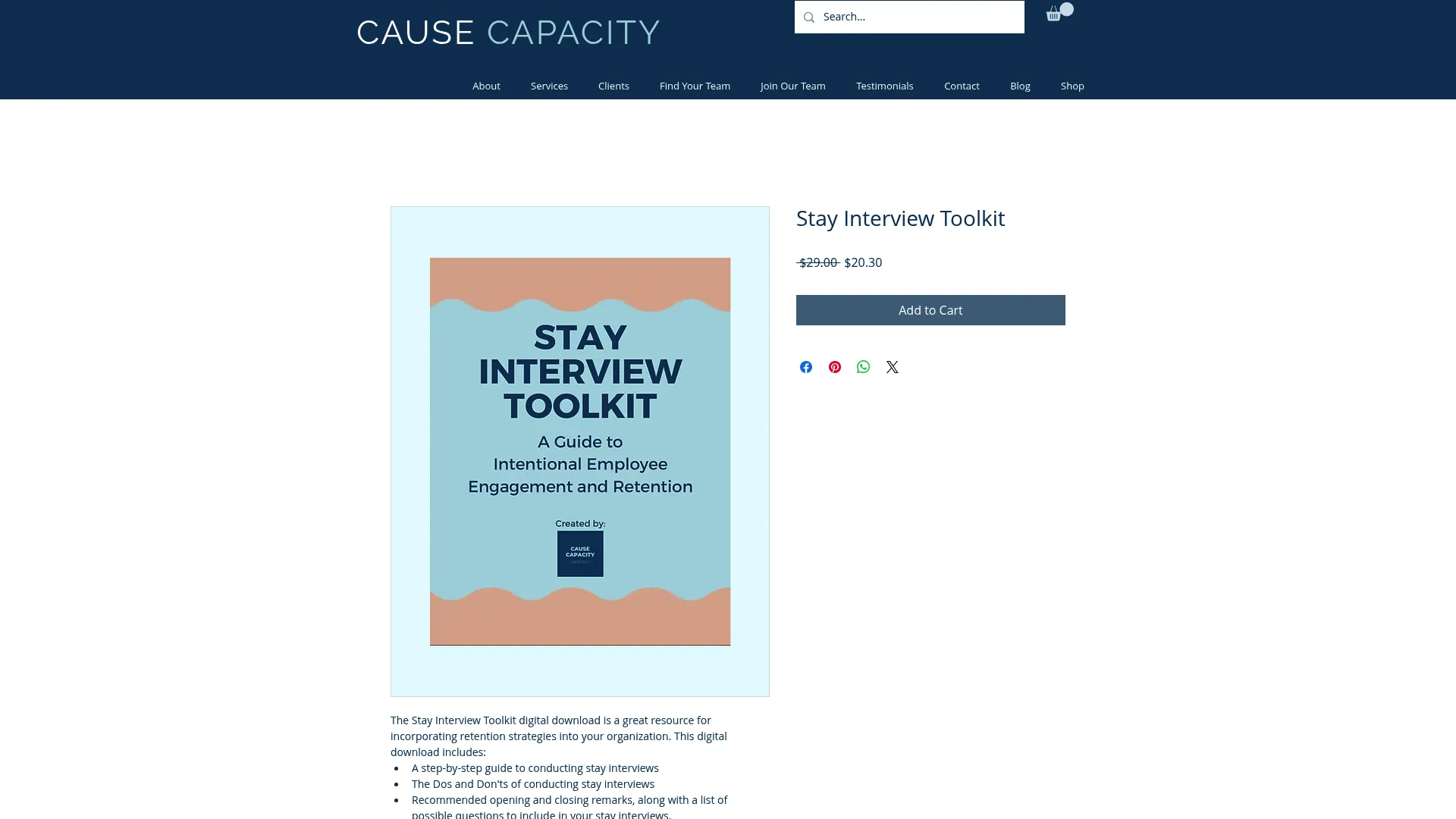
Stay Interview Toolkit is a digital download built for teams that want the whole workflow in one place. It bundles a step-by-step guide to conducting the conversation, a set of dos and don'ts, and an editable worksheet you can hand to any manager. It leans practical, so a supervisor with no prior training can run a solid stay interview from the first try.
What sets it apart is scope. Plenty of resources give you five questions and leave you there. This one walks through the pre-step, the conversation itself, and the follow-up, which means the questions connect to an actual stay plan rather than floating on their own. For a small org or a nonprofit that needs something usable today, that end-to-end coverage matters more than a big platform.
Best for: Nonprofits or small organizations wanting a ready-to-use stay interview resource without a software contract.
Key strengths
- Step-by-step guide to running the full interview
- Dos and don'ts to keep managers on track
- Editable stay interview worksheet for notes and follow-up
- Full process coverage, not just a question list
Why choose Stay Interview Toolkit: If you want something you can download and use this week without onboarding a platform, this is the most complete single resource on the list. It fits teams that value simplicity and speed over analytics.
Stay Interview Toolkit pricing: One-time digital download. Regular price is $29, with a sale price of $20.30. No subscription and no free tier.
2. Stay Interviews
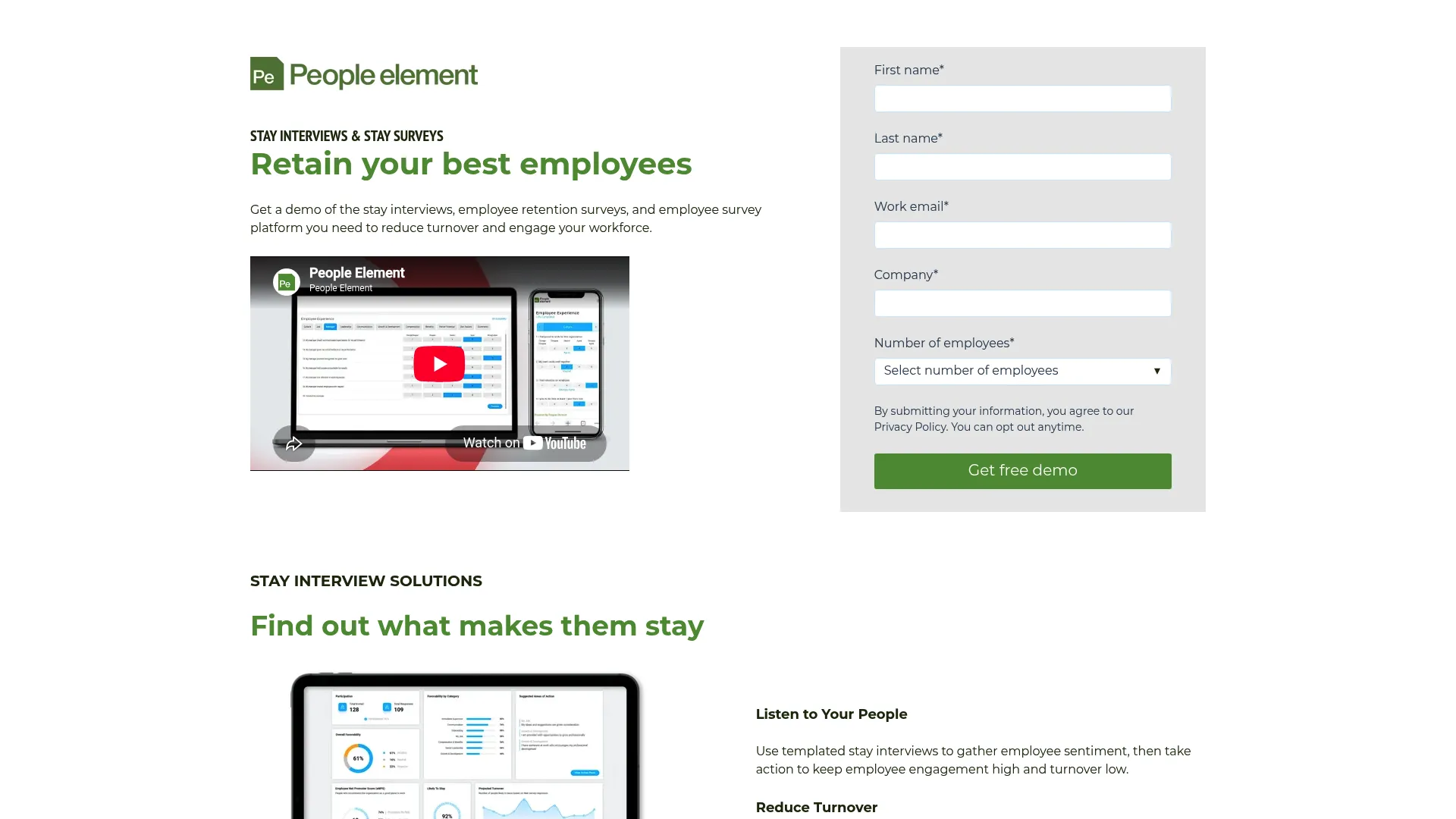
Stay Interviews by People Element is a managed program rather than a static download. It combines templated stay interviews with automated HR analytics and action plans, so the feedback does not stop at a manager's notebook. Where the toolkit hands you a worksheet, this platform captures responses and rolls them into themes across teams.
The delivery options are the standout. You can run stay interviews and surveys through email, SMS, kiosk, and in more than 100 languages, which fits distributed or frontline workforces where not everyone sits at a desk. That reach turns a one-to-one conversation into an employee listening program you can scale.
Best for: HR teams that want a managed stay interview and employee listening program aimed at reducing turnover.
Key strengths
- Templated stay interviews with proven questions
- Automated HR analytics and action plans
- Email, SMS, kiosk, and 100+ language delivery
- Theme rollups across teams for retention risk
Why choose Stay Interviews: Choose this when you need capture and reporting, not just a script. It fits organizations with enough headcount that manual note-taking and aggregation stop being realistic.
Stay Interviews pricing: Pricing is not publicly listed. People Element uses a custom-quote flow, so you request a quote based on your needs.
3. Stay Interview Guide
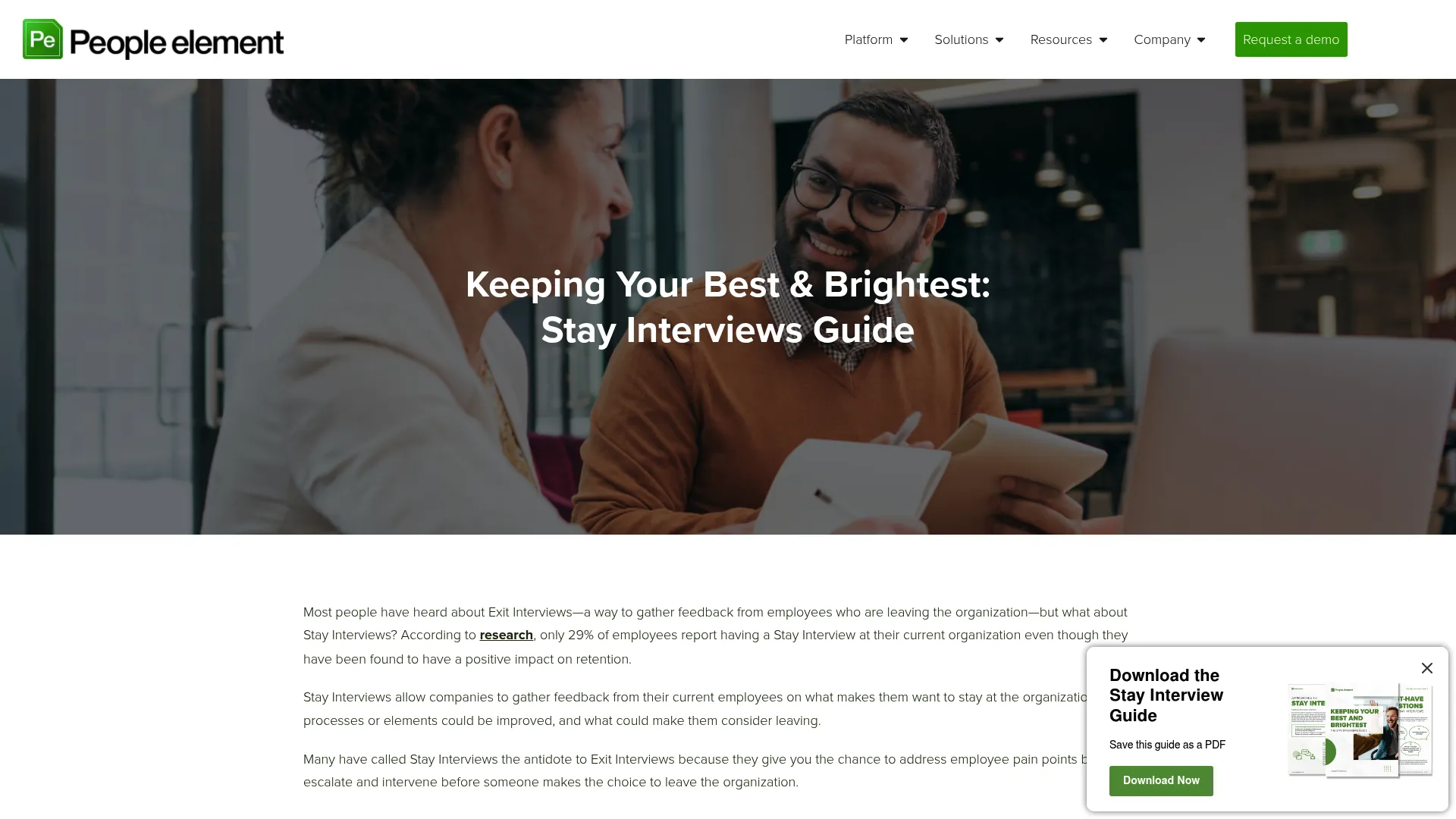
Stay Interview Guide is People Element's content resource for managers who want to understand the conversation before they run it. It explains what stay interviews are, why they matter, and covers approaches, benefits, and best practices. It also hands over five must-have stay interview questions, so a manager walks in with a proven framework instead of improvising.
Think of it as the training layer that sits under the platform. It is action-oriented, focused on getting a manager comfortable enough to hold a real conversation and act on what they hear. For teams already evaluating People Element's employee listening platform, the guide doubles as onboarding for the wider workflow.
Best for: HR teams wanting a guided approach to stay interviews with a proven question set and best practices.
Key strengths
- Explains what stay interviews are and why they matter
- Covers approaches, benefits, and best practices
- Includes five must-have stay interview questions
- Prepares managers to run and act on the conversation
Why choose Stay Interview Guide: Choose this when your managers need the why and the how before the tooling. It closes the knowledge gap that makes stay interviews inconsistent.
Stay Interview Guide pricing: The guide content sits on the People Element platform, which runs on an all-inclusive plan starting at $11,000 per year based on the number of employees surveyed, with unlimited surveys, admins, and support included.
4. Stay Plan
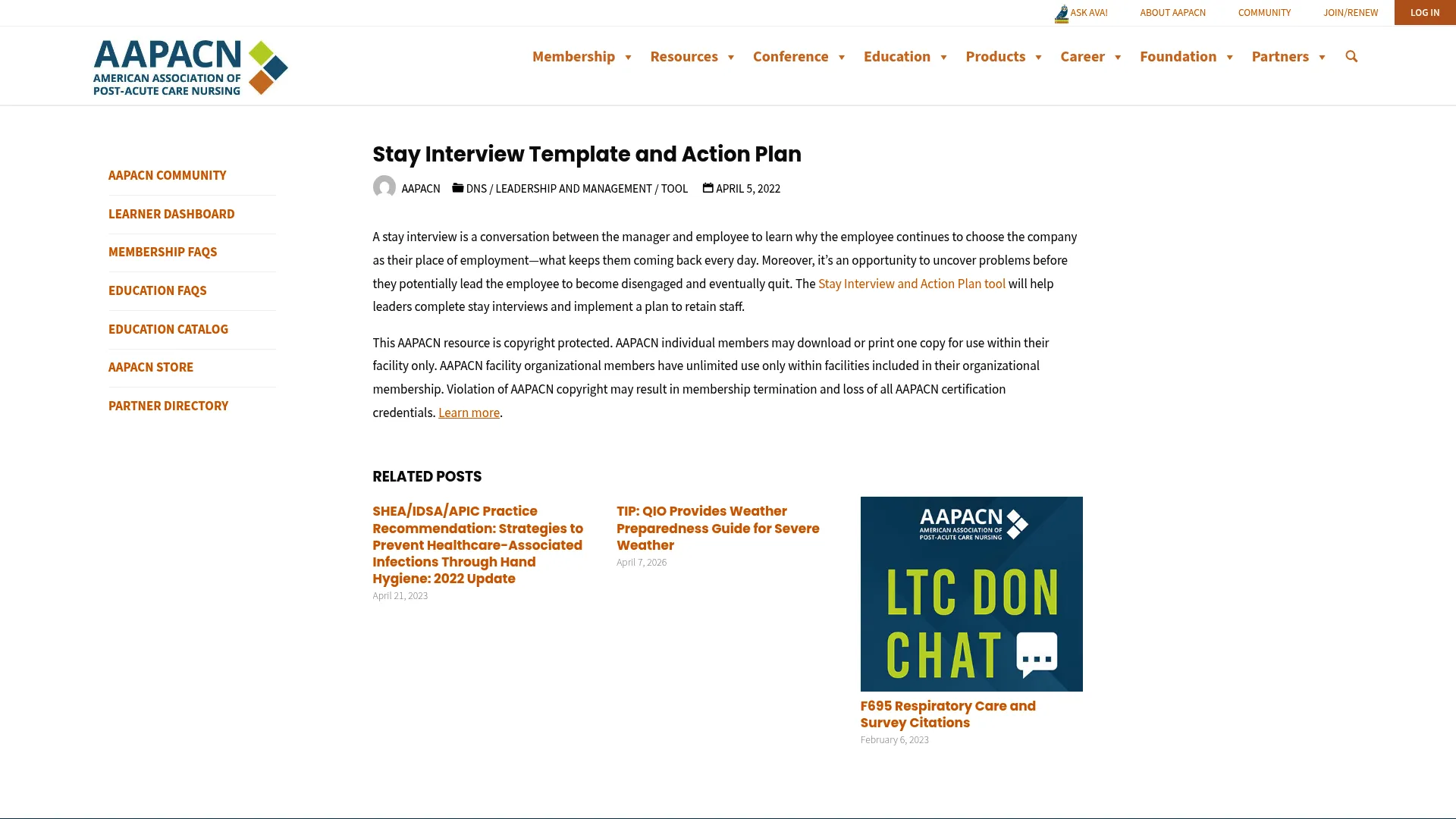
Stay Plan is AAPACN's stay interview template and action plan, built for post-acute care managers who need a structured follow-up more than a fancy interface. It pairs a stay interview conversation guide with an action plan for staff retention, so the discussion and the next steps live in the same document.
The value here is the documentation workflow. Most tools help you ask good questions but leave the follow-up loose. This one puts the follow-up action plan front and center, giving managers a printable, storable record of what was raised and what happens next. In a sector where turnover directly hits care quality, that accountability is the point.
Best for: Post-acute care managers needing a structured stay interview and retention action plan.
Key strengths
- Stay interview conversation guide
- Action plan for staff retention
- Printable, downloadable format for easy storage
- Keeps the conversation and follow-up in one place
Why choose Stay Plan: Choose this when the follow-up is where you keep losing the thread. It forces the stay plan to exist as a document, not a vague intention.
Stay Plan pricing: This is an AAPACN member resource. Access is tied to membership rather than a standalone price, so pricing is not publicly displayed on the tool page.
5. Stay Interview Template
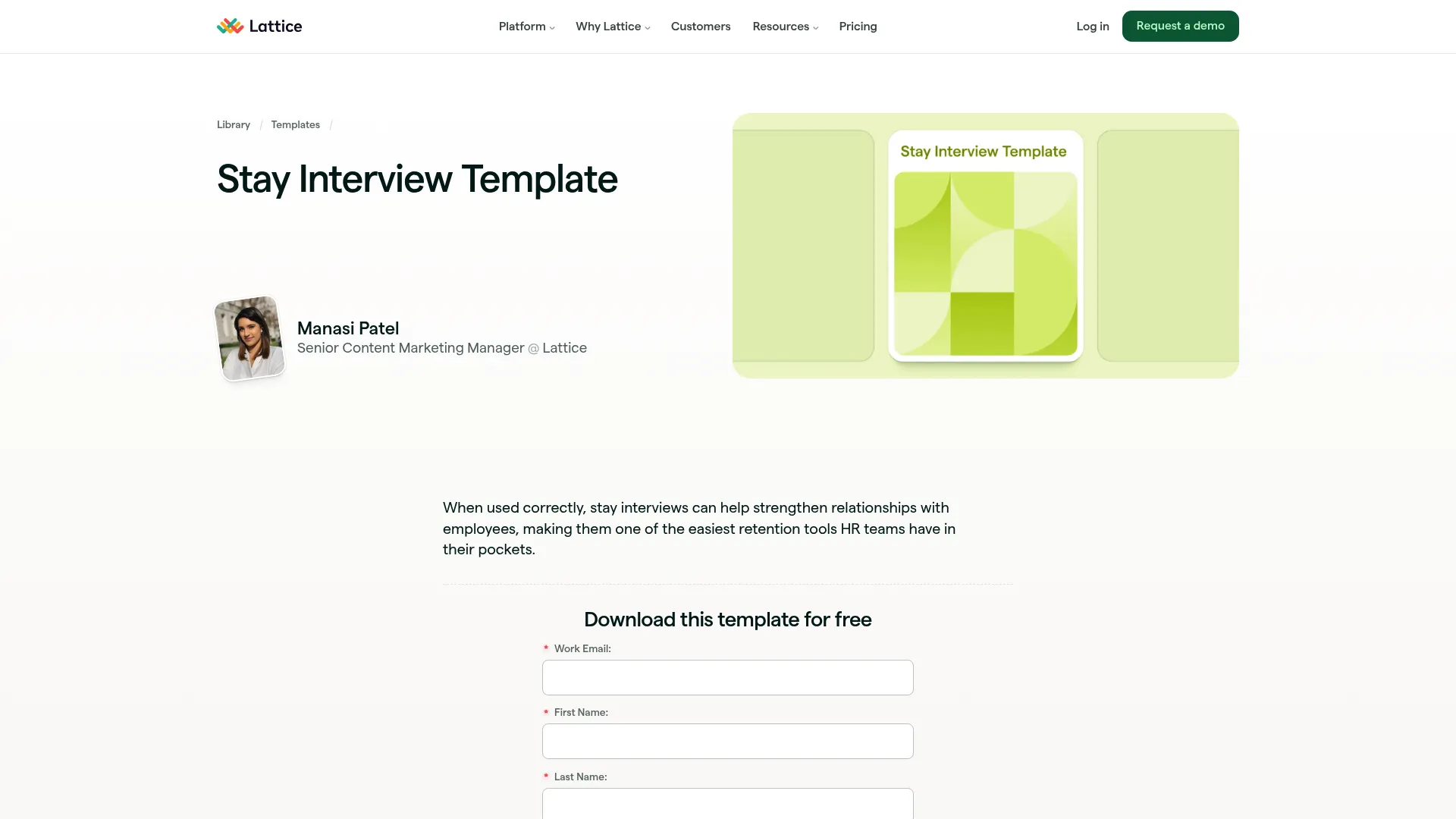
Stay Interview Template from Lattice is a free downloadable worksheet built to make retention conversations repeatable. It is part of Lattice's broader HR templates library and is designed to help managers strengthen the conversation without building a script from scratch every time.
Templates matter more than they look. A good stay interview template is how you get manager consistency at scale, because every conversation starts from the same structure and captures the same fields. A strong one covers opening context, a set of open-ended questions, space for follow-up probes, and a clear section for the stay plan and next steps. This one gives HR teams that starting structure for free, with the option to grow into Lattice's platform later.
Best for: HR teams looking for a free stay interview worksheet with a path into wider people-management software.
Key strengths
- Free downloadable template
- Part of Lattice's HR templates library
- Structure for questions, notes, and follow-up
- Repeatable format for manager consistency
Why choose Stay Interview Template: Choose this when you want a proven, free starting point and might later consolidate onto a performance and engagement platform. It is the lowest-friction entry on the list.
Stay Interview Template pricing: The template is free to download. Lattice's platform starts at $4 per seat per month, billed annually, with a $4,000 minimum annual agreement and higher tiers up to $13 per seat per month.
6. Turnover Cost Calculator
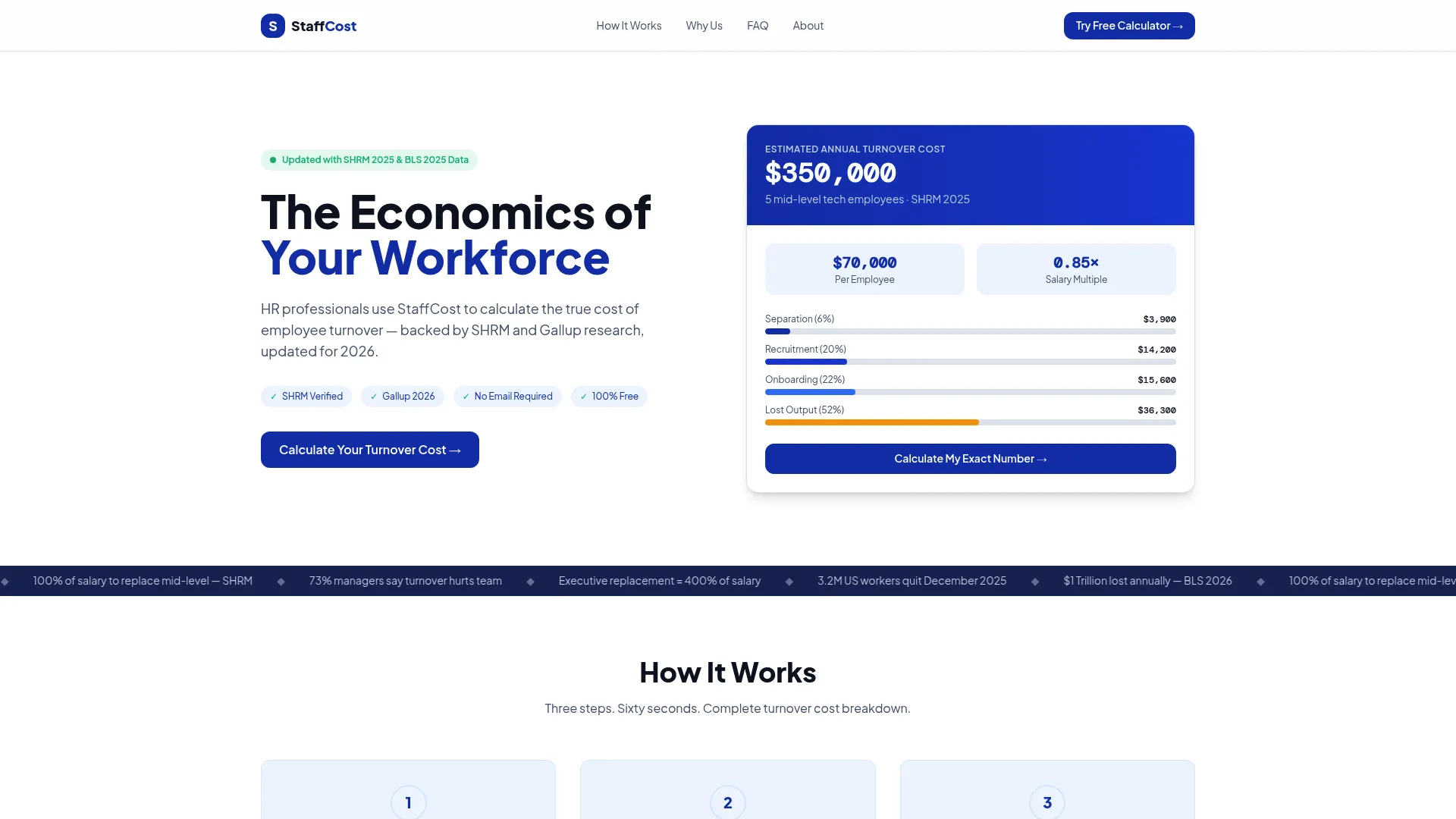
Turnover Cost Calculator is not a stay interview tool in the strict sense. It is the business case behind one. It breaks turnover cost into four buckets, applies industry-specific multipliers, and exports an instant PDF, so you can put a real dollar figure on every resignation you fail to prevent.
This is the tool that gets a stay interview program funded. Leadership rarely argues with a conversation about culture, but they act on a number. When you can show that losing a single mid-level employee costs a specific amount in recruiting, ramp time, and lost productivity, the case for retention economics stops being soft. Use it to justify the program, then use the other five tools to run it.
Best for: HR teams estimating the full cost of employee turnover to build a retention business case.
Key strengths
- Four-bucket turnover cost breakdown
- Industry-specific multipliers
- Instant PDF export
- No account or email required
Why choose Turnover Cost Calculator: Choose this when you need leadership buy-in before you invest in a stay interview program. It turns retention risk into a number a CFO understands.
Turnover Cost Calculator pricing: Completely free. No email required, no account needed, and no paywall.
Considerations
Question quality matters more than volume
A stay interview lives or dies on the questions. Open-ended prompts with real follow-up probes surface the frustration underneath a surface answer. Checkbox-style scripts do not. Ten yes-or-no questions tell you less than three good open ones. Look for a tool that gives managers proven stay interview questions and prompts to dig deeper, not a longer list of shallow ones.
Manager accountability is non-negotiable
The conversation only matters if someone owns the next action. A stay plan with no owner and no date is a note, not a commitment. Evaluate whether the tool ties each action to a person and a follow-up date. Supervisor accountability is what separates a program that reduces turnover from one that just documents it.
Documentation should be simple
Stay plans fall apart when documentation is too heavy. If a manager needs 40 minutes to log a conversation, they will skip it. Look for lightweight, accessible storage that a busy supervisor will actually use. A printable worksheet or a clean template beats a complex system nobody updates.
Cadence should match turnover risk
Annual is enough for a stable team. A volatile team, or one in a high-turnover sector, needs a semiannual cadence so you catch drift before it becomes departure. Match the frequency to the risk, and keep manager capacity in mind. Better to run fewer conversations well than schedule quarterly ones nobody follows up on.
Surveys and interviews play different roles
Anonymous surveys give you breadth. Live interviews give you depth. A stay interview survey surfaces themes across a whole team, while a one-to-one conversation gets the nuance behind them. When you need both broad signal and personal follow-through, use them together rather than picking one.
Conclusion
The right stay interview software depends on what your team is missing. If you want the full workflow in one place, the Stay Interview Toolkit covers questions, guidance, and a worksheet in a single download. If you need capture and analytics at scale, Stay Interviews by People Element handles multi-channel delivery and reporting. If follow-up is your weak point, Stay Plan forces the action plan to exist as a document.
For teams that just want a proven starting structure, the Stay Interview Template from Lattice is free and repeatable. And before you spend anything, the Turnover Cost Calculator gives you the number that gets the program approved.
Start with the most complete tool for your workflow, then layer in templates or a calculator as needed. A toolkit that covers questions, a stay plan, and documentation together will take you further than any single script. Retention is not one conversation. It is a system, and the tool you pick should support the whole thing.
FAQs
A stay interview is a structured conversation with a current employee about what keeps them at the company and what might push them to leave. Unlike an exit interview, which happens after someone resigns and captures retrospective feedback, a stay interview is proactive. You still have time to act on what you hear and change the outcome.
Most teams run them on an annual or semiannual cadence. Annual works for stable teams with low turnover. Semiannual makes more sense for volatile teams or high-turnover sectors where risk builds faster. Tie the frequency to your actual retention risk and to how much time managers can realistically commit to meaningful follow-up.
Focus on open-ended questions with follow-up probes rather than yes-or-no prompts. The common framework uses around five core questions covering what the employee looks forward to, what they would change, what might tempt them to leave, and what would make them stay. The follow-up probe is where the real insight surfaces, so leave room for it.
The conversation should produce a stay plan. That means documenting what the employee raised, what the manager will do about it, who owns each action, and a follow-up date to check progress. Without action ownership and a date, a stay interview is just a chat. The follow-up action plan is what actually moves retention.
Live stay interviews are usually not anonymous, since they are one-to-one conversations between a manager and an employee. A stay interview survey can be anonymous, which is why the two formats complement each other. Use interviews for personal depth and follow-through, and use anonymous surveys when you want honest, broad feedback that people might not share face to face.
They help by surfacing retention risk early and making feedback actionable before someone resigns. The conversation itself does not retain anyone. The follow-through does. When managers act on what they learn and own a stay plan, stay interviews improve the odds. When they treat them as a formality, they change little. The value is in the action.
A performance review evaluates output and often connects to pay and promotion decisions. A stay interview is about retention and experience: what motivates the person, what frustrates them, and what would keep them here. Keeping the two separate matters, because mixing evaluation with a retention conversation makes employees guarded and buries the honest feedback you need.